
Problem solving techniques Unit-1 THE ROLE OF
SN
Published · 52 slides · 0 views

1 / 1

Description
Problem solving techniques Unit-1 THE ROLE OF ALGORITHMS IN COMPUTITNG PROBLEM SOLVING Problem solving is the process of overcoming issues, mistakes, errors, failures and risks to move forward. It is the programmer who has to write down the
Related Topics
Share
Embed code
Download this presentation From Below
"Problem solving techniques Unit-1 THE ROLE OF" is the property of its rightful owner. Permission is granted to download and print the materials on this website for personal, non-commercial use only, and to display it on your personal computer provided you do not modify the materials and that you retain all copyright notices contained in the materials. By downloading content from our website, you accept the terms of this agreement.
Presentation Transcript
01
Problem solving techniques<br>
02
Unit-1 THE ROLE OF ALGORITHMS IN COMPUTITNG<br>
03
PROBLEM SOLVING
Problem solving is the process of overcoming issues, mistakes, errors, failures and risks to move forward.
It is the programmer who has to write down the solution to the problem in terms of simple operations which the computer can understand and execute.
In order to solve a problem by the computer one has to pass through certain stages or steps.<br>
Problem solving is the process of overcoming issues, mistakes, errors, failures and risks to move forward.
It is the programmer who has to write down the solution to the problem in terms of simple operations which the computer can understand and execute.
In order to solve a problem by the computer one has to pass through certain stages or steps.<br>
04
Steps Involved in Problem Solving:- Understanding the Problem
Designing the algorithm
Analysis of Algorithm
Coding / Implementation
Testing and Debugging<br>
Designing the algorithm
Analysis of Algorithm
Coding / Implementation
Testing and Debugging<br>
05
Algorithm:- A set of sequential steps usually written in Ordinary Language to solve a given problem is called Algorithm.
OR
An algorithm can be defined as a step-by-step procedure for accomplishing a task.
The choice of various Algorithms depends on the factors like reliability, accuracy and easy to modify.
The most important factor in the choice of algorithm is the Time requirement to execute it.<br>
OR
An algorithm can be defined as a step-by-step procedure for accomplishing a task.
The choice of various Algorithms depends on the factors like reliability, accuracy and easy to modify.
The most important factor in the choice of algorithm is the Time requirement to execute it.<br>
06
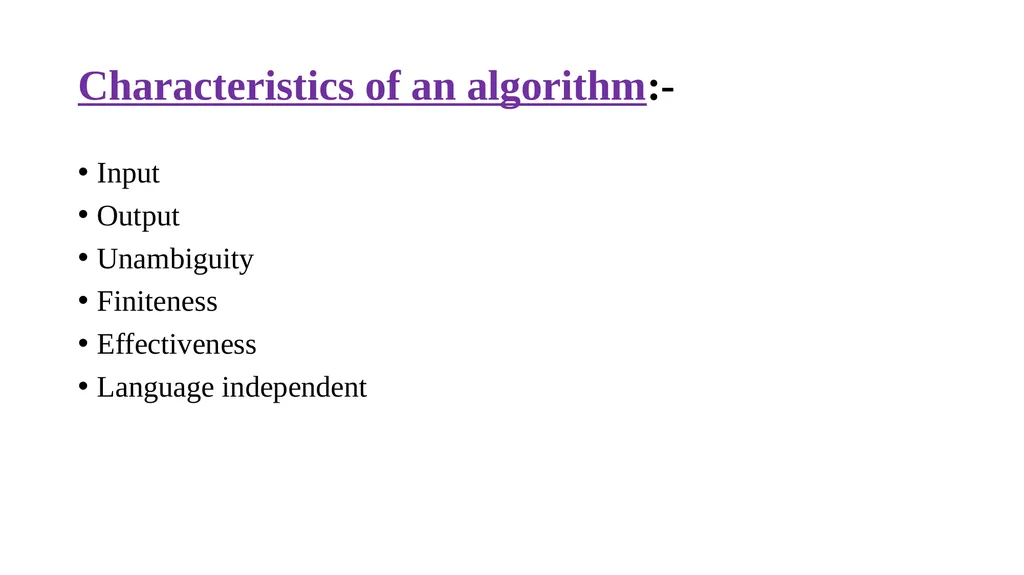
Characteristics of an algorithm:- Input
Output
Unambiguity
Finiteness
Effectiveness
Language independent<br>
Output
Unambiguity
Finiteness
Effectiveness
Language independent<br>
07
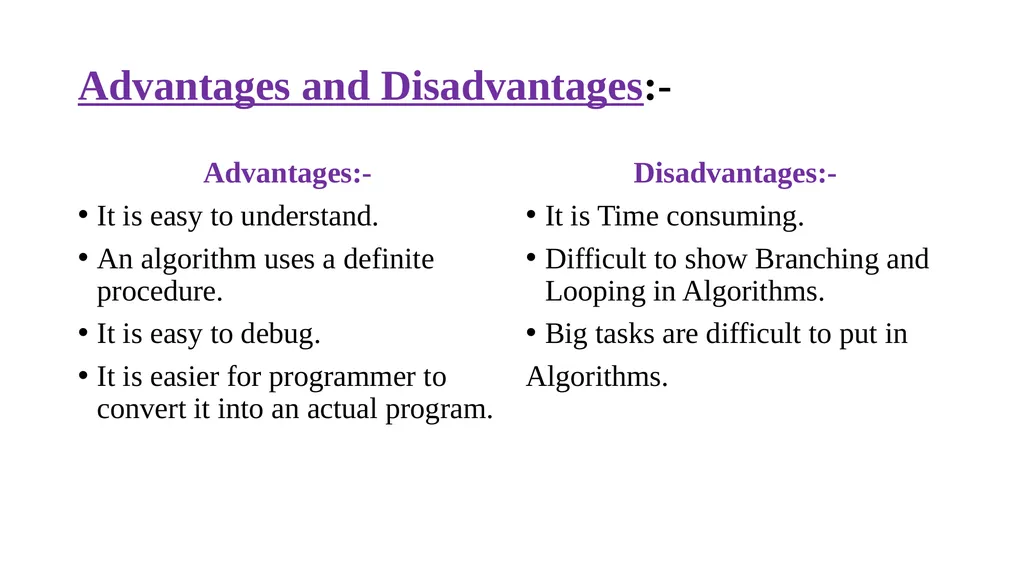
Advantages and Disadvantages:- Advantages:-
It is easy to understand.
An algorithm uses a definite procedure.
It is easy to debug.
It is easier for programmer to convert it into an actual program. Disadvantages:-
It is Time consuming.
Difficult to show Branching and Looping in Algorithms.
Big tasks are difficult to put in
Algorithms.<br>
It is easy to understand.
An algorithm uses a definite procedure.
It is easy to debug.
It is easier for programmer to convert it into an actual program. Disadvantages:-
It is Time consuming.
Difficult to show Branching and Looping in Algorithms.
Big tasks are difficult to put in
Algorithms.<br>
08
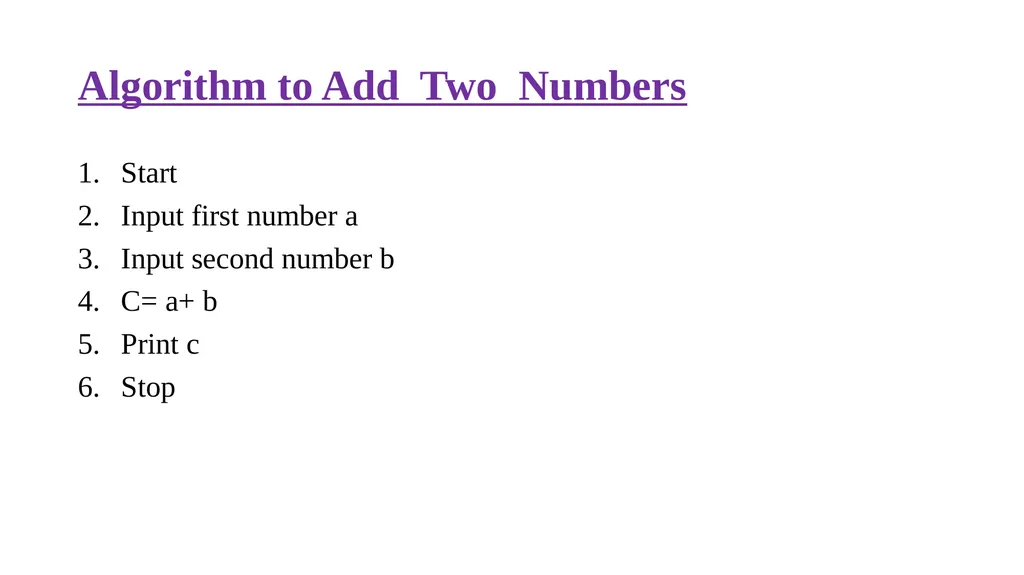
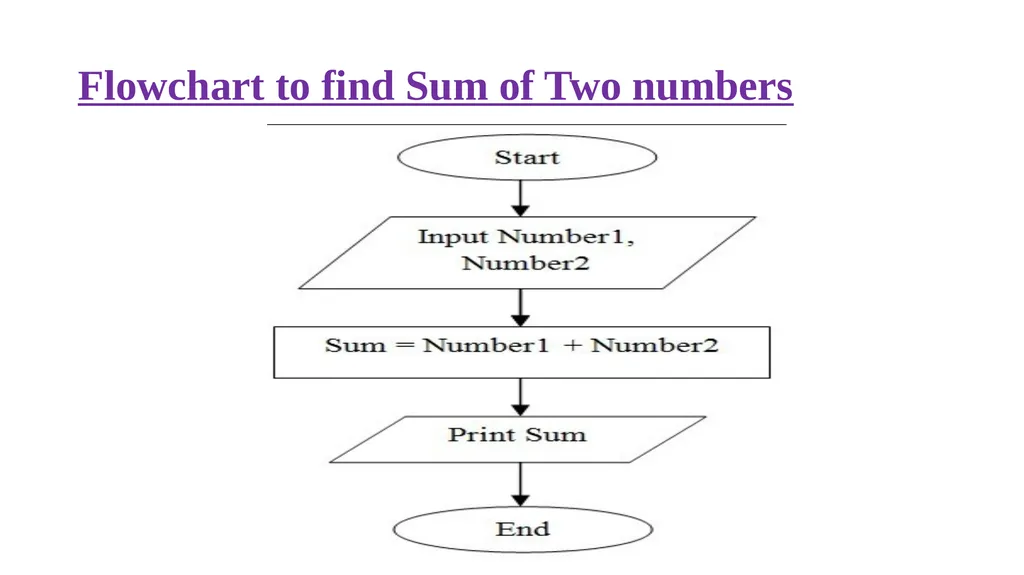
Algorithm to Add Two Numbers Start
Input first number a
Input second number b
C= a+ b
Print c
Stop<br>
Input first number a
Input second number b
C= a+ b
Print c
Stop<br>
09
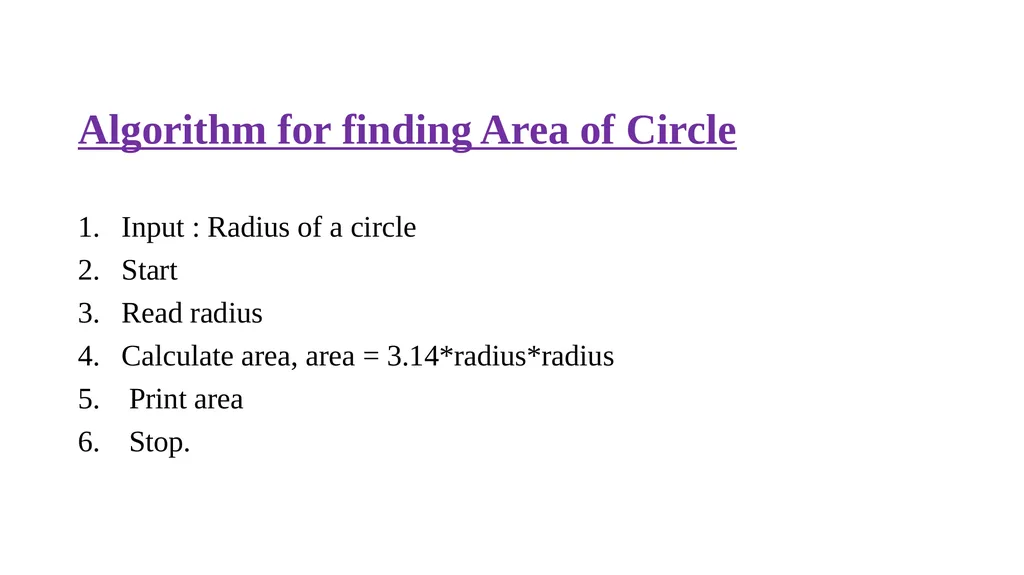
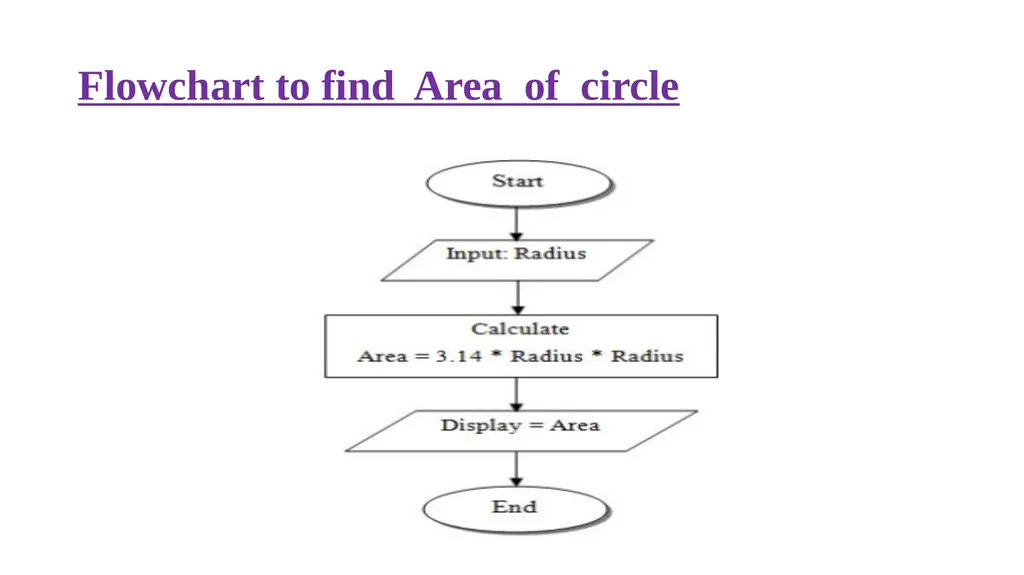
Algorithm for finding Area of Circle
Input : Radius of a circle
Start
Read radius
Calculate area, area = 3.14*radius*radius
Print area
Stop.<br>
Input : Radius of a circle
Start
Read radius
Calculate area, area = 3.14*radius*radius
Print area
Stop.<br>
10
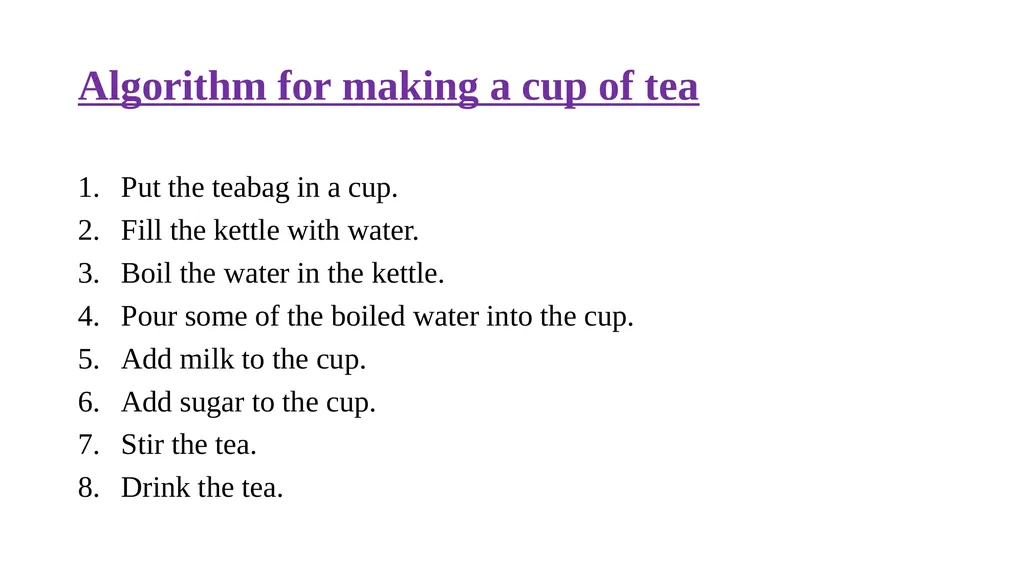
Algorithm for making a cup of tea Put the teabag in a cup.
Fill the kettle with water.
Boil the water in the kettle.
Pour some of the boiled water into the cup.
Add milk to the cup.
Add sugar to the cup.
Stir the tea.
Drink the tea.<br>
Fill the kettle with water.
Boil the water in the kettle.
Pour some of the boiled water into the cup.
Add milk to the cup.
Add sugar to the cup.
Stir the tea.
Drink the tea.<br>
11
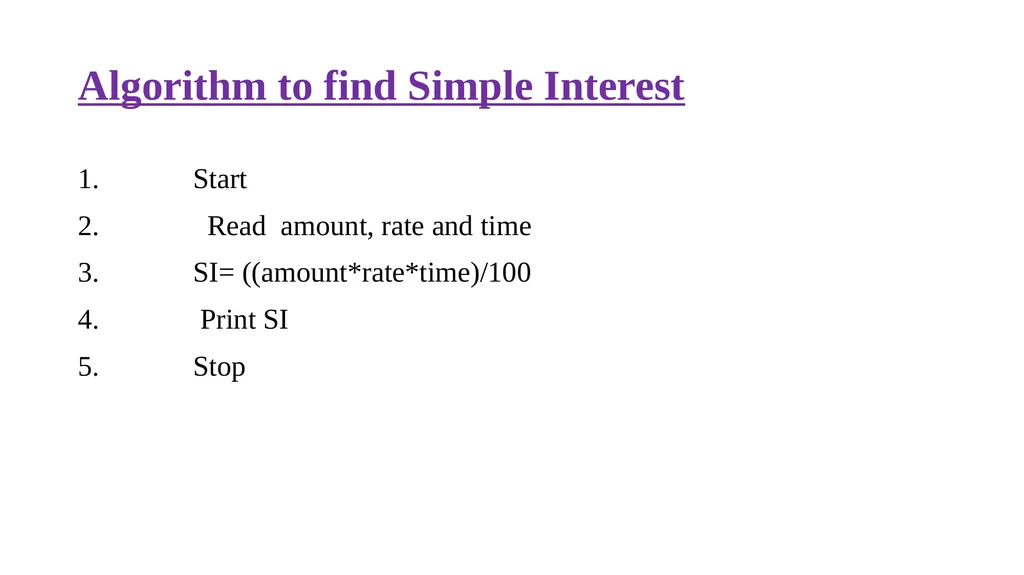
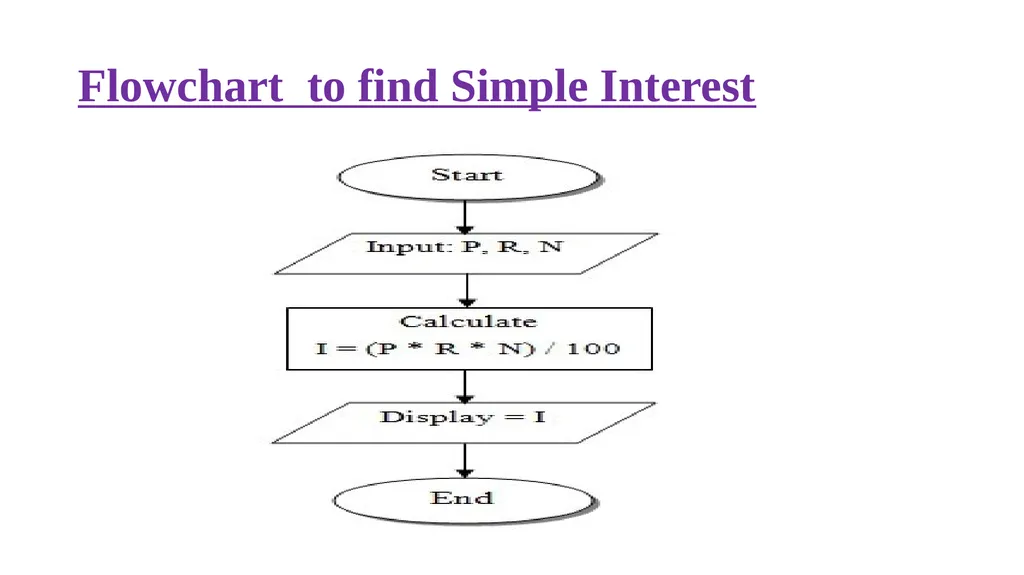
Algorithm to find Simple Interest Start
Read amount, rate and time
SI= ((amount*rate*time)/100
Print SI
Stop<br>
Read amount, rate and time
SI= ((amount*rate*time)/100
Print SI
Stop<br>
12
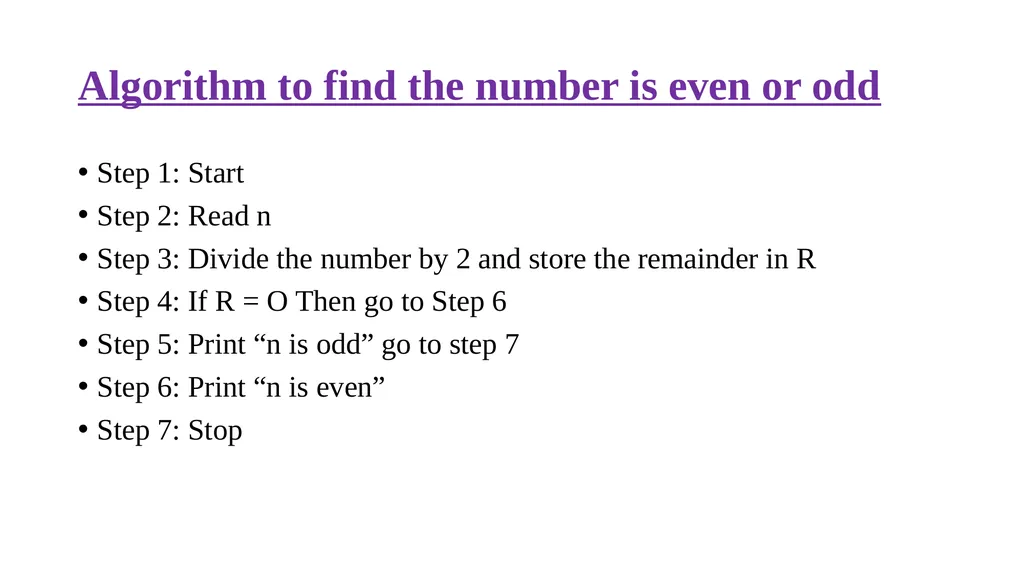
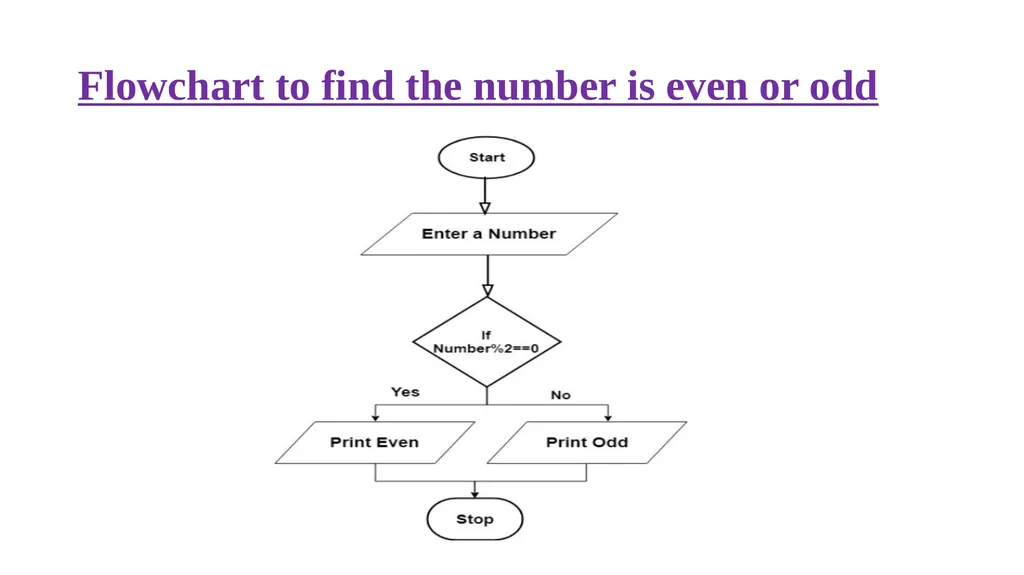
Algorithm to find the number is even or odd Step 1: Start
Step 2: Read n
Step 3: Divide the number by 2 and store the remainder in R
Step 4: If R = O Then go to Step 6
Step 5: Print “n is odd” go to step 7
Step 6: Print “n is even”
Step 7: Stop<br>
Step 2: Read n
Step 3: Divide the number by 2 and store the remainder in R
Step 4: If R = O Then go to Step 6
Step 5: Print “n is odd” go to step 7
Step 6: Print “n is even”
Step 7: Stop<br>
13
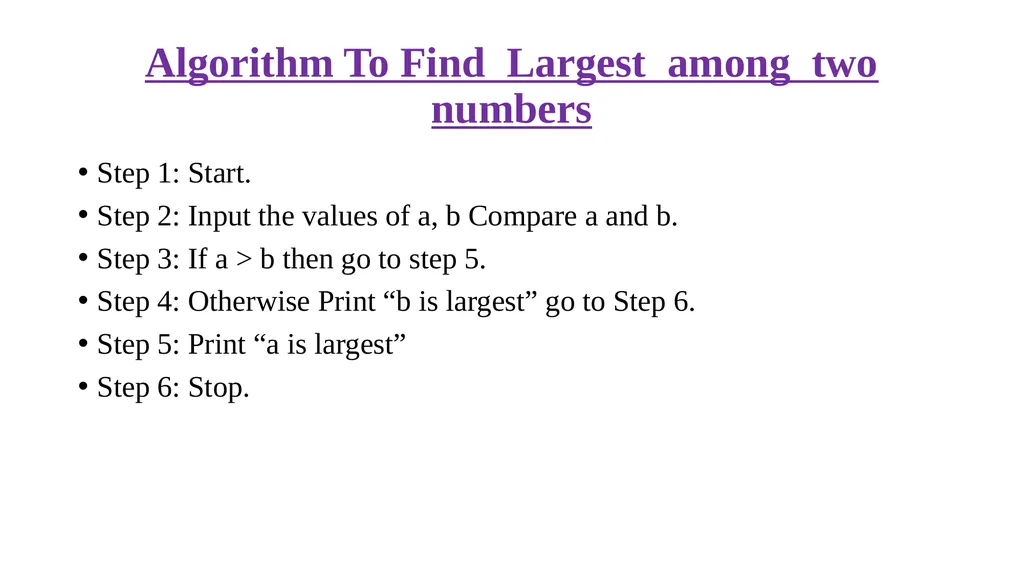
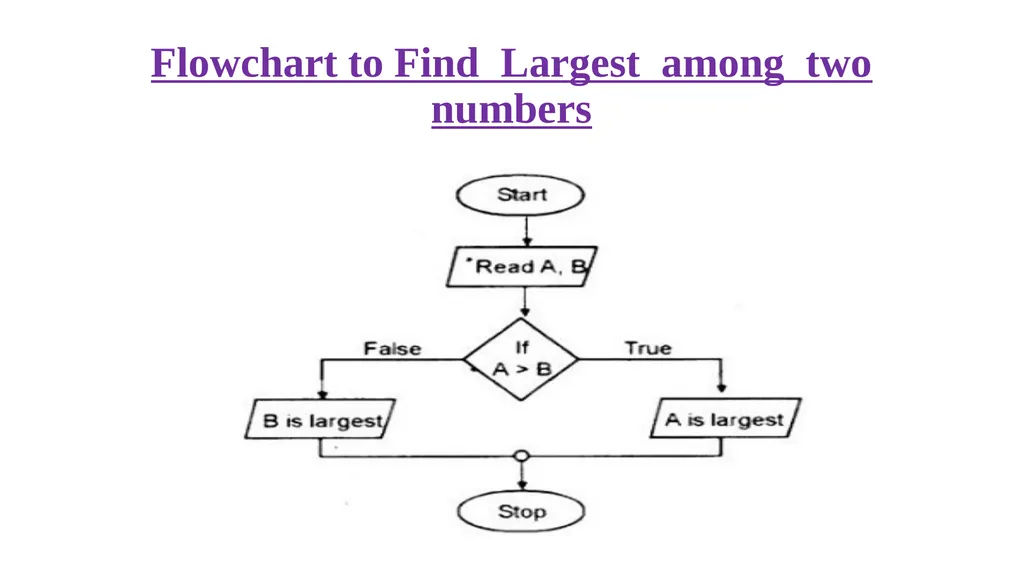
Algorithm To Find Largest among two numbers Step 1: Start.
Step 2: Input the values of a, b Compare a and b.
Step 3: If a > b then go to step 5.
Step 4: Otherwise Print “b is largest” go to Step 6.
Step 5: Print “a is largest”
Step 6: Stop.<br>
Step 2: Input the values of a, b Compare a and b.
Step 3: If a > b then go to step 5.
Step 4: Otherwise Print “b is largest” go to Step 6.
Step 5: Print “a is largest”
Step 6: Stop.<br>
14
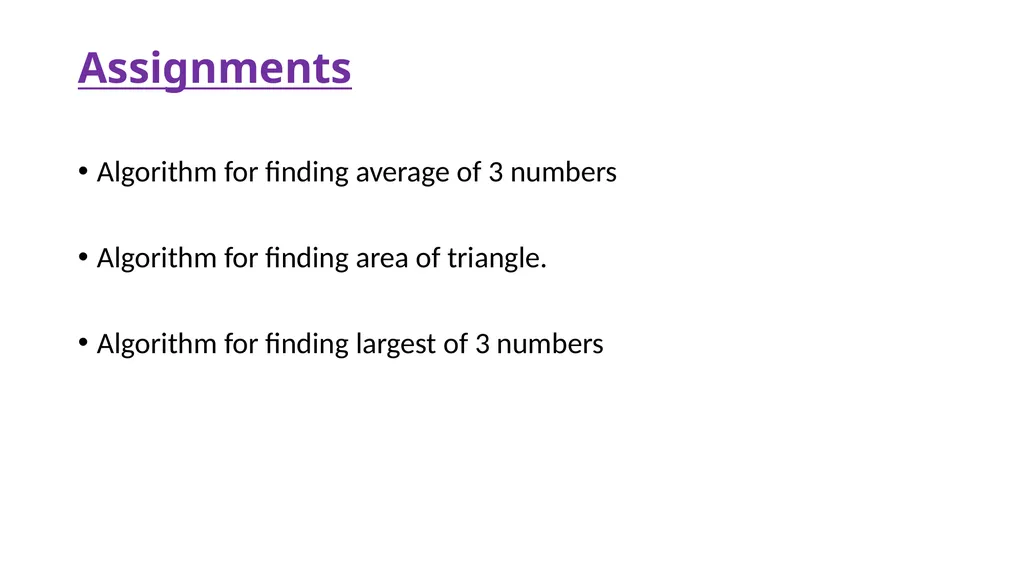
Assignments Algorithm for finding average of 3 numbers
Algorithm for finding area of triangle.
Algorithm for finding largest of 3 numbers<br>
Algorithm for finding area of triangle.
Algorithm for finding largest of 3 numbers<br>
15
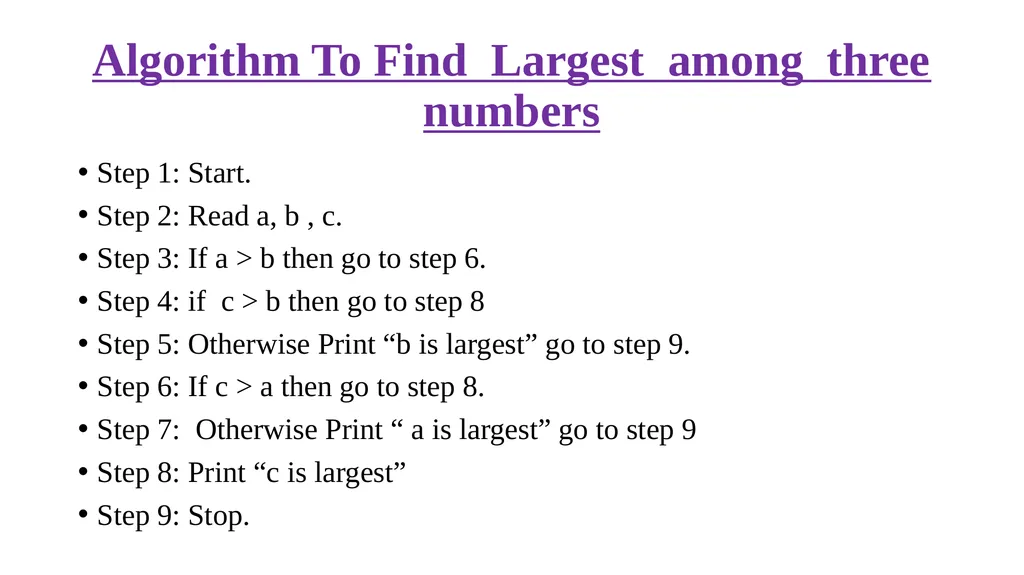
Algorithm To Find Largest among three numbers Step 1: Start.
Step 2: Read a, b , c.
Step 3: If a > b then go to step 6.
Step 4: if c > b then go to step 8
Step 5: Otherwise Print “b is largest” go to step 9.
Step 6: If c > a then go to step 8.
Step 7: Otherwise Print “ a is largest” go to step 9
Step 8: Print “c is largest”
Step 9: Stop.<br>
Step 2: Read a, b , c.
Step 3: If a > b then go to step 6.
Step 4: if c > b then go to step 8
Step 5: Otherwise Print “b is largest” go to step 9.
Step 6: If c > a then go to step 8.
Step 7: Otherwise Print “ a is largest” go to step 9
Step 8: Print “c is largest”
Step 9: Stop.<br>
16
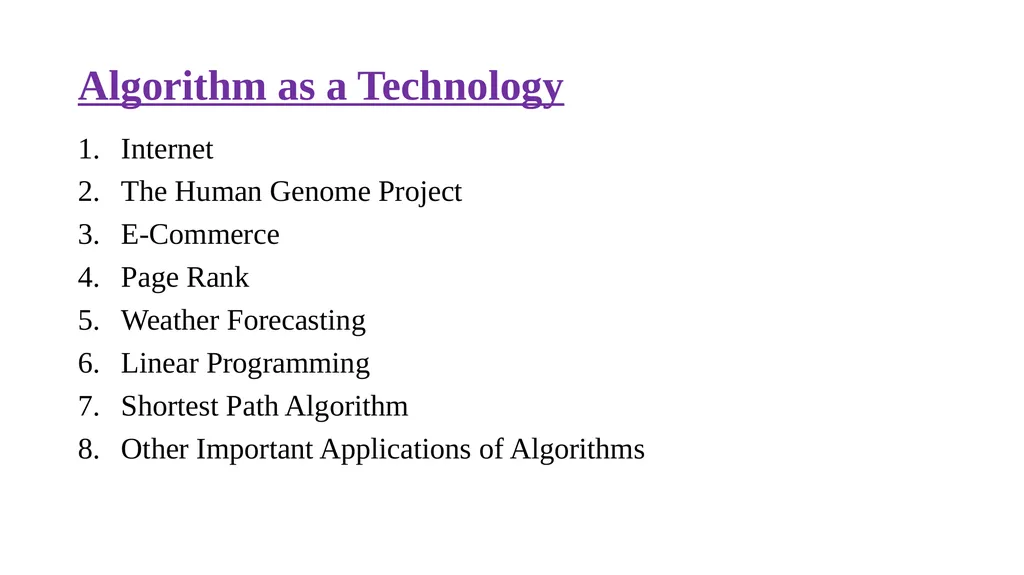
Algorithm as a Technology Internet
The Human Genome Project
E-Commerce
Page Rank
Weather Forecasting
Linear Programming
Shortest Path Algorithm
Other Important Applications of Algorithms<br>
The Human Genome Project
E-Commerce
Page Rank
Weather Forecasting
Linear Programming
Shortest Path Algorithm
Other Important Applications of Algorithms<br>
17
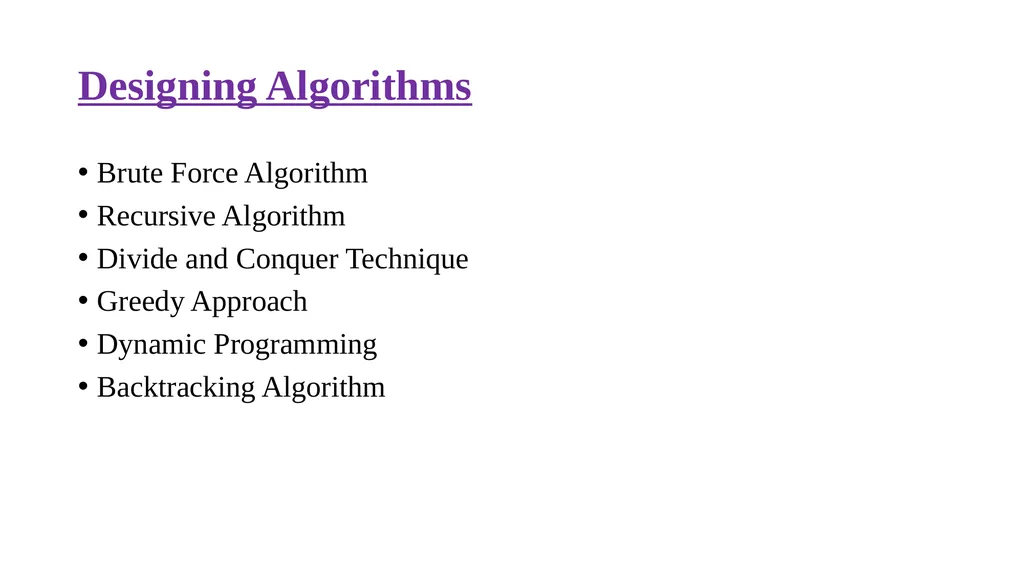
Designing Algorithms Brute Force Algorithm
Recursive Algorithm
Divide and Conquer Technique
Greedy Approach
Dynamic Programming
Backtracking Algorithm<br>
Recursive Algorithm
Divide and Conquer Technique
Greedy Approach
Dynamic Programming
Backtracking Algorithm<br>
18
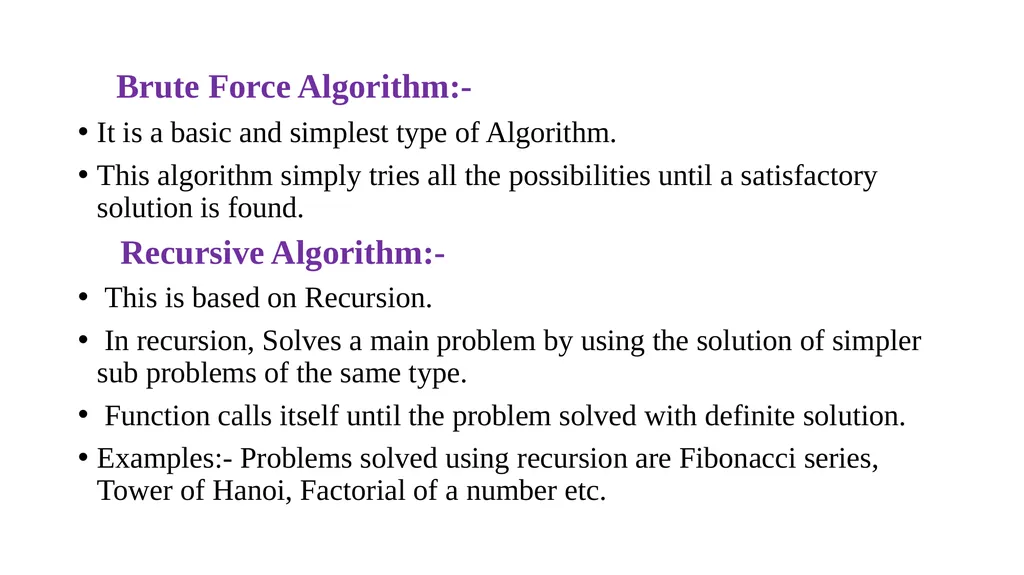
Brute Force Algorithm:-
It is a basic and simplest type of Algorithm.
This algorithm simply tries all the possibilities until a satisfactory solution is found.
Recursive Algorithm:-
This is based on Recursion.
In recursion, Solves a main problem by using the solution of simpler sub problems of the same type.
Function calls itself until the problem solved with definite solution.
Examples:- Problems solved using recursion are Fibonacci series, Tower of Hanoi, Factorial of a number etc.<br>
It is a basic and simplest type of Algorithm.
This algorithm simply tries all the possibilities until a satisfactory solution is found.
Recursive Algorithm:-
This is based on Recursion.
In recursion, Solves a main problem by using the solution of simpler sub problems of the same type.
Function calls itself until the problem solved with definite solution.
Examples:- Problems solved using recursion are Fibonacci series, Tower of Hanoi, Factorial of a number etc.<br>
19
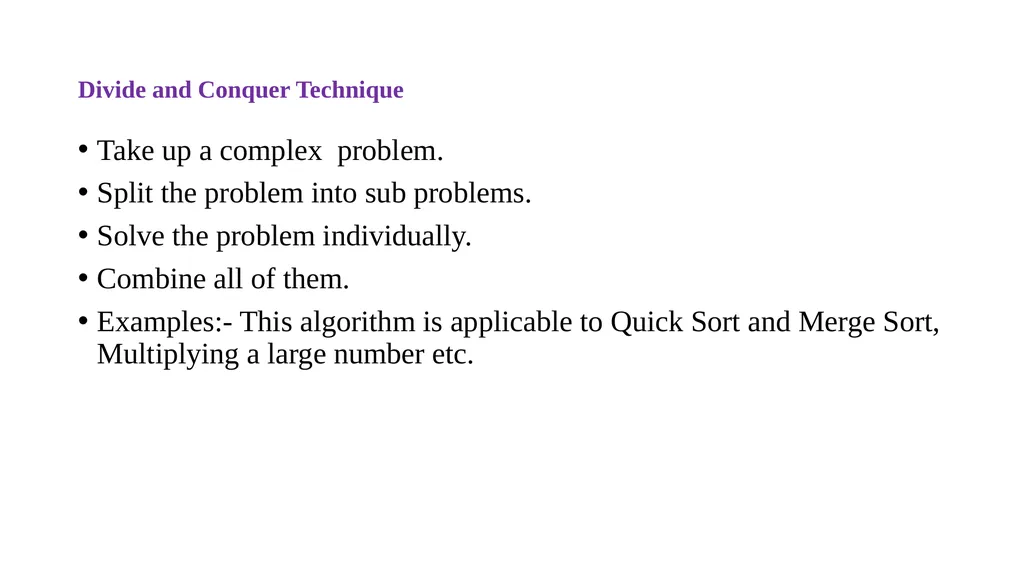
Divide and Conquer Technique Take up a complex problem.
Split the problem into sub problems.
Solve the problem individually.
Combine all of them.
Examples:- This algorithm is applicable to Quick Sort and Merge Sort, Multiplying a large number etc.<br>
Split the problem into sub problems.
Solve the problem individually.
Combine all of them.
Examples:- This algorithm is applicable to Quick Sort and Merge Sort, Multiplying a large number etc.<br>
20
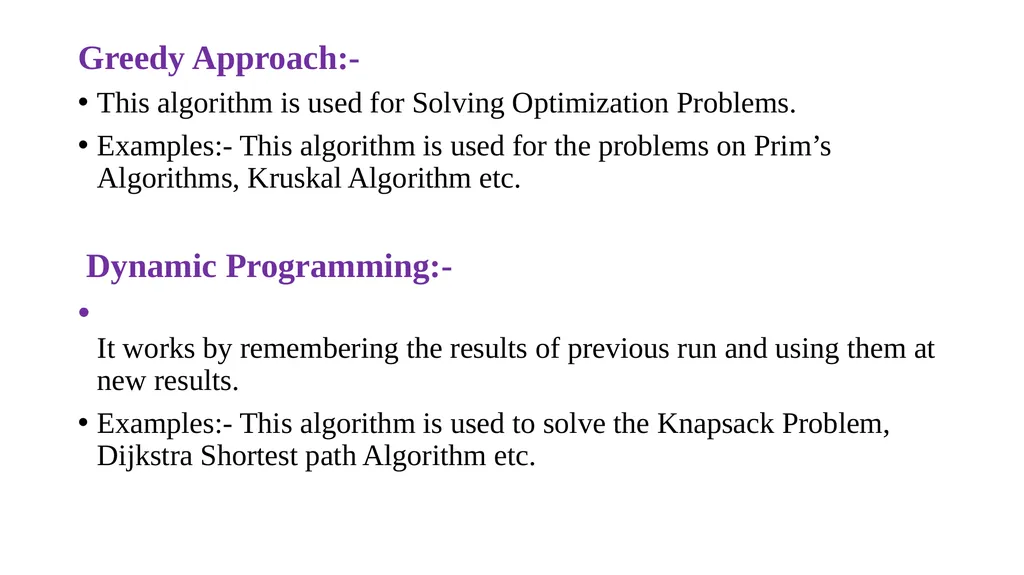
Greedy Approach:-
This algorithm is used for Solving Optimization Problems.
Examples:- This algorithm is used for the problems on Prim’s Algorithms, Kruskal Algorithm etc.
Dynamic Programming:-
It works by remembering the results of previous run and using them at new results.
Examples:- This algorithm is used to solve the Knapsack Problem, Dijkstra Shortest path Algorithm etc.<br>
This algorithm is used for Solving Optimization Problems.
Examples:- This algorithm is used for the problems on Prim’s Algorithms, Kruskal Algorithm etc.
Dynamic Programming:-
It works by remembering the results of previous run and using them at new results.
Examples:- This algorithm is used to solve the Knapsack Problem, Dijkstra Shortest path Algorithm etc.<br>
21
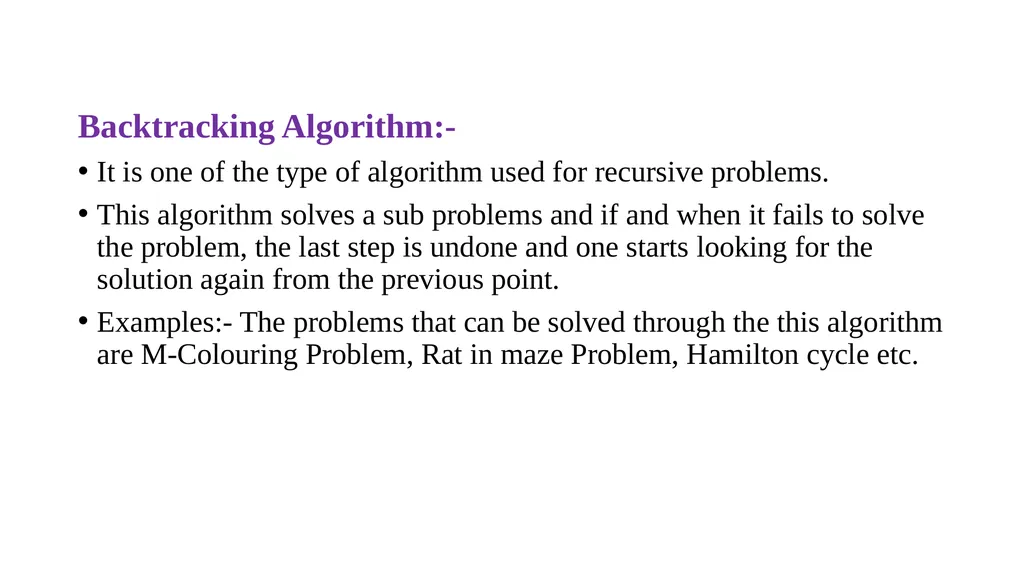
Backtracking Algorithm:-
It is one of the type of algorithm used for recursive problems.
This algorithm solves a sub problems and if and when it fails to solve the problem, the last step is undone and one starts looking for the solution again from the previous point.
Examples:- The problems that can be solved through the this algorithm are M-Colouring Problem, Rat in maze Problem, Hamilton cycle etc.<br>
It is one of the type of algorithm used for recursive problems.
This algorithm solves a sub problems and if and when it fails to solve the problem, the last step is undone and one starts looking for the solution again from the previous point.
Examples:- The problems that can be solved through the this algorithm are M-Colouring Problem, Rat in maze Problem, Hamilton cycle etc.<br>
22
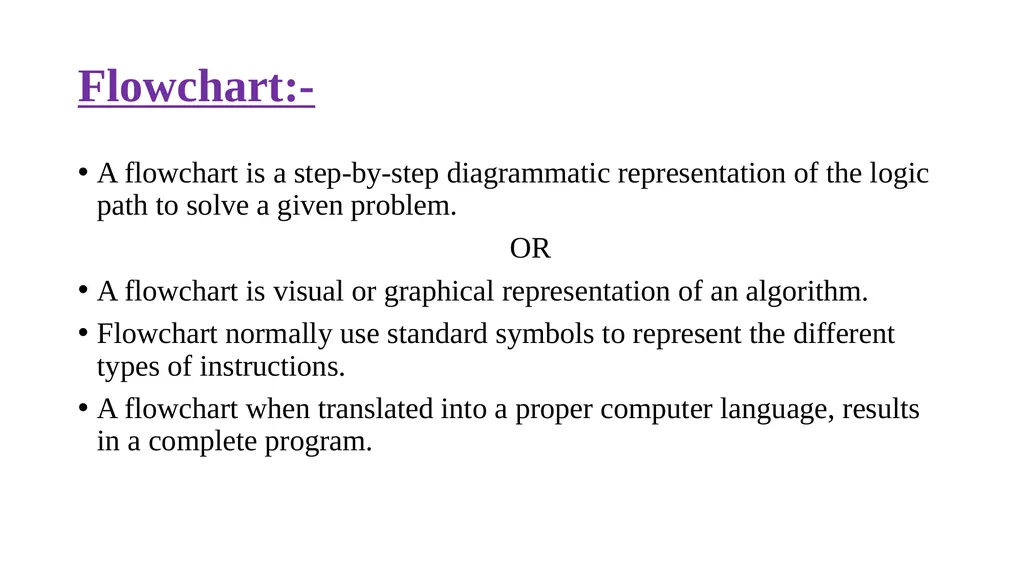
Flowchart:- A flowchart is a step-by-step diagrammatic representation of the logic path to solve a given problem.
OR
A flowchart is visual or graphical representation of an algorithm.
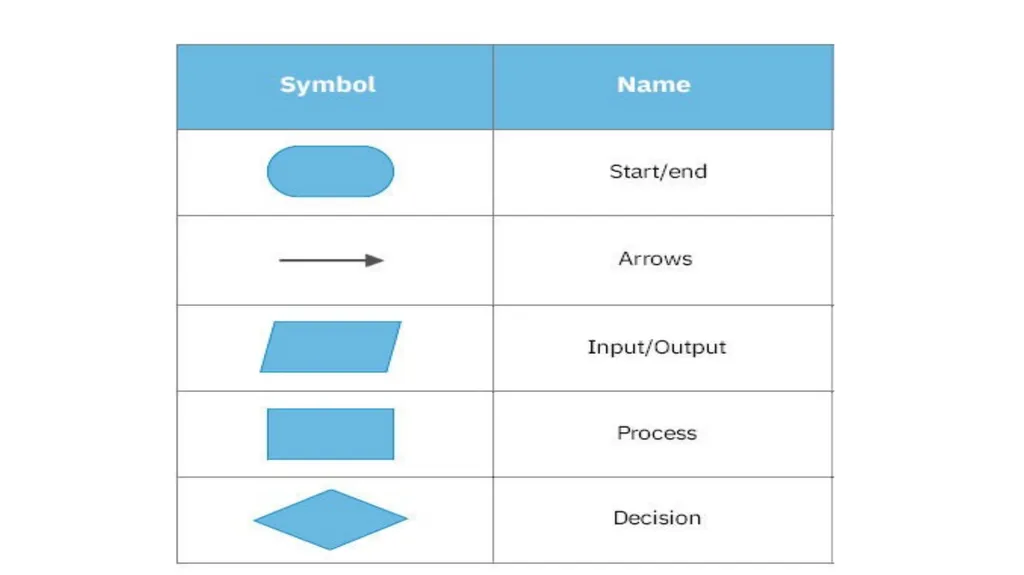
Flowchart normally use standard symbols to represent the different types of instructions.
A flowchart when translated into a proper computer language, results in a complete program.<br>
OR
A flowchart is visual or graphical representation of an algorithm.
Flowchart normally use standard symbols to represent the different types of instructions.
A flowchart when translated into a proper computer language, results in a complete program.<br>
23
Flowchart to find Area of circle<br>
24
Flowchart to find Sum of Two numbers<br>
25
Flowchart to find Simple Interest<br>
26
Flowchart to find the number is even or odd<br>
27
Flowchart to Find Largest among two numbers<br>
28
Flowchart:- Advantages:-
Easy to make.
Mistakes can be easily identified.
Communication becomes effective and easy to understand.
Logics can be easily interpreted. Disadvantages:-
It is a time consuming process.
No scope for alteration or modification.
No man to computer communication.<br>
Easy to make.
Mistakes can be easily identified.
Communication becomes effective and easy to understand.
Logics can be easily interpreted. Disadvantages:-
It is a time consuming process.
No scope for alteration or modification.
No man to computer communication.<br>
29
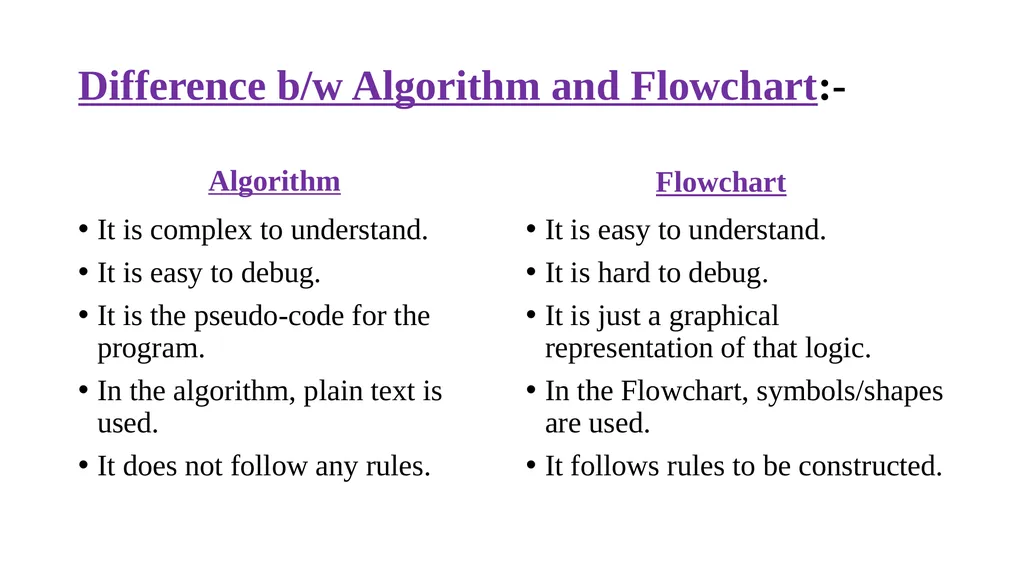
Difference b/w Algorithm and Flowchart:- Algorithm It is complex to understand.
It is easy to debug.
It is the pseudo-code for the program.
In the algorithm, plain text is used.
It does not follow any rules. Flowchart It is easy to understand.
It is hard to debug.
It is just a graphical representation of that logic.
In the Flowchart, symbols/shapes are used.
It follows rules to be constructed.<br>
It is easy to debug.
It is the pseudo-code for the program.
In the algorithm, plain text is used.
It does not follow any rules. Flowchart It is easy to understand.
It is hard to debug.
It is just a graphical representation of that logic.
In the Flowchart, symbols/shapes are used.
It follows rules to be constructed.<br>
30
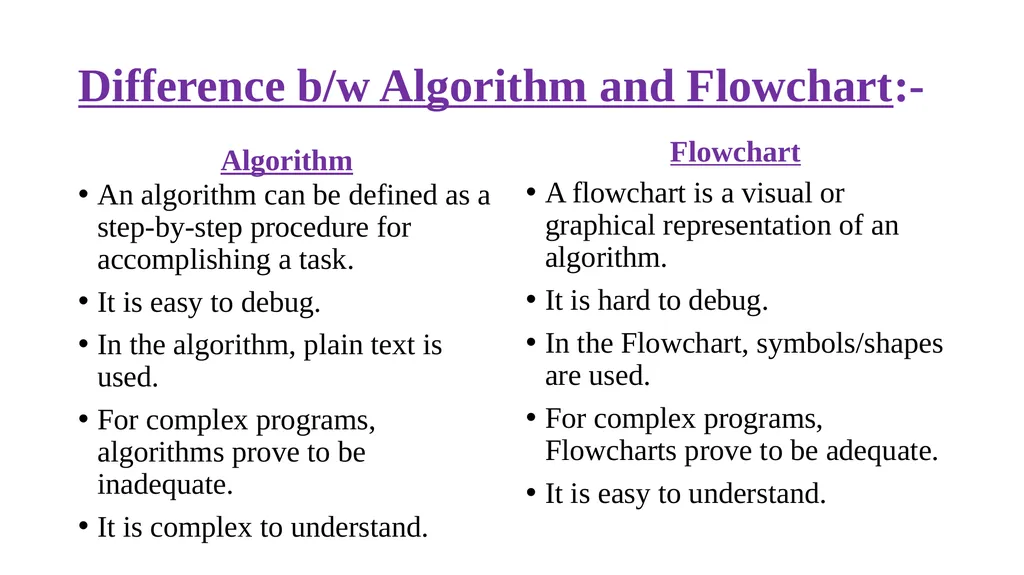
Difference b/w Algorithm and Flowchart:- Algorithm An algorithm can be defined as a step-by-step procedure for accomplishing a task.
It is easy to debug.
In the algorithm, plain text is used.
For complex programs, algorithms prove to be inadequate.
It is complex to understand. Flowchart A flowchart is a visual or graphical representation of an algorithm.
It is hard to debug.
In the Flowchart, symbols/shapes are used.
For complex programs, Flowcharts prove to be adequate.
It is easy to understand.<br>
It is easy to debug.
In the algorithm, plain text is used.
For complex programs, algorithms prove to be inadequate.
It is complex to understand. Flowchart A flowchart is a visual or graphical representation of an algorithm.
It is hard to debug.
In the Flowchart, symbols/shapes are used.
For complex programs, Flowcharts prove to be adequate.
It is easy to understand.<br>
31
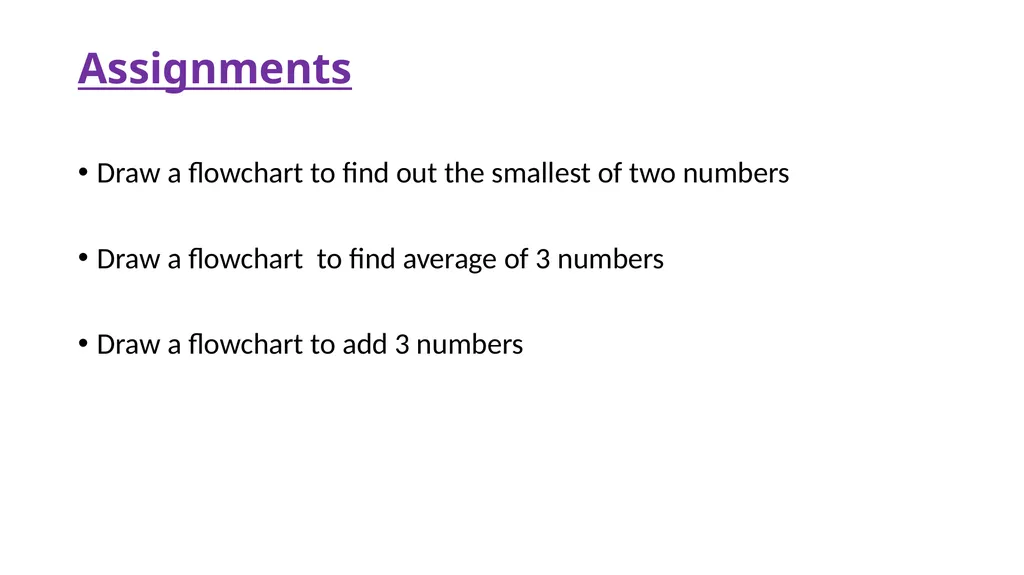
Assignments Draw a flowchart to find out the smallest of two numbers
Draw a flowchart to find average of 3 numbers
Draw a flowchart to add 3 numbers<br>
Draw a flowchart to find average of 3 numbers
Draw a flowchart to add 3 numbers<br>
32
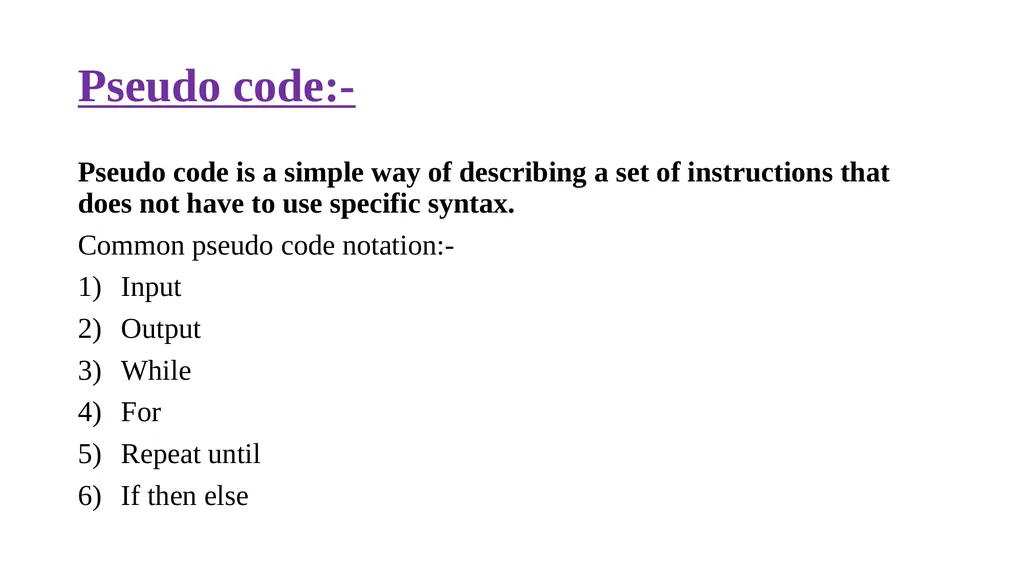
Pseudo code:- Pseudo code is a simple way of describing a set of instructions that does not have to use specific syntax.
Common pseudo code notation:-
Input
Output
While
For
Repeat until
If then else<br>
Common pseudo code notation:-
Input
Output
While
For
Repeat until
If then else<br>
33
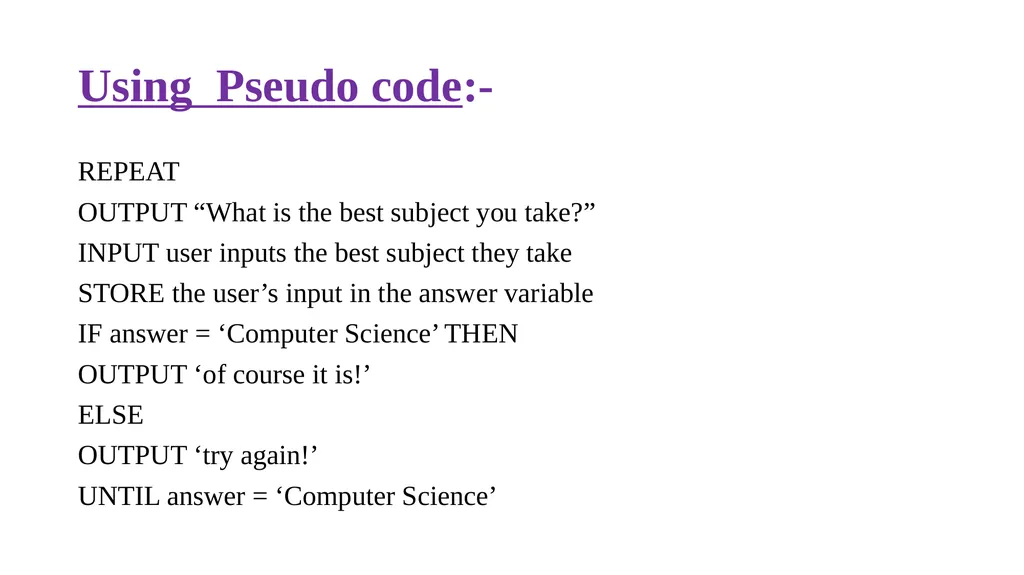
Using Pseudo code:- REPEAT
OUTPUT “What is the best subject you take?”
INPUT user inputs the best subject they take
STORE the user’s input in the answer variable
IF answer = ‘Computer Science’ THEN
OUTPUT ‘of course it is!’
ELSE
OUTPUT ‘try again!’
UNTIL answer = ‘Computer Science’<br>
OUTPUT “What is the best subject you take?”
INPUT user inputs the best subject they take
STORE the user’s input in the answer variable
IF answer = ‘Computer Science’ THEN
OUTPUT ‘of course it is!’
ELSE
OUTPUT ‘try again!’
UNTIL answer = ‘Computer Science’<br>
34
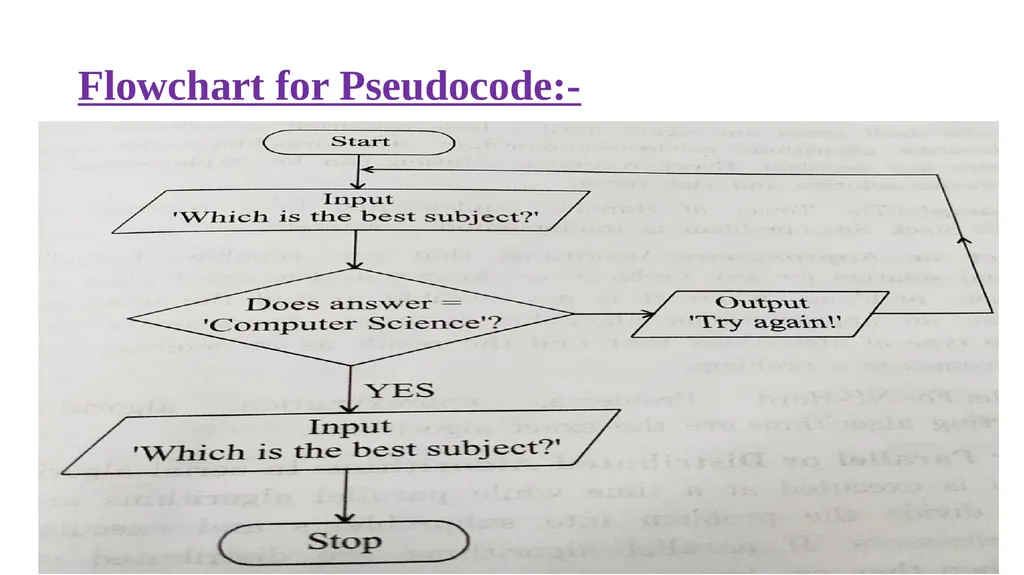
Flowchart for Pseudocode:-<br>
35
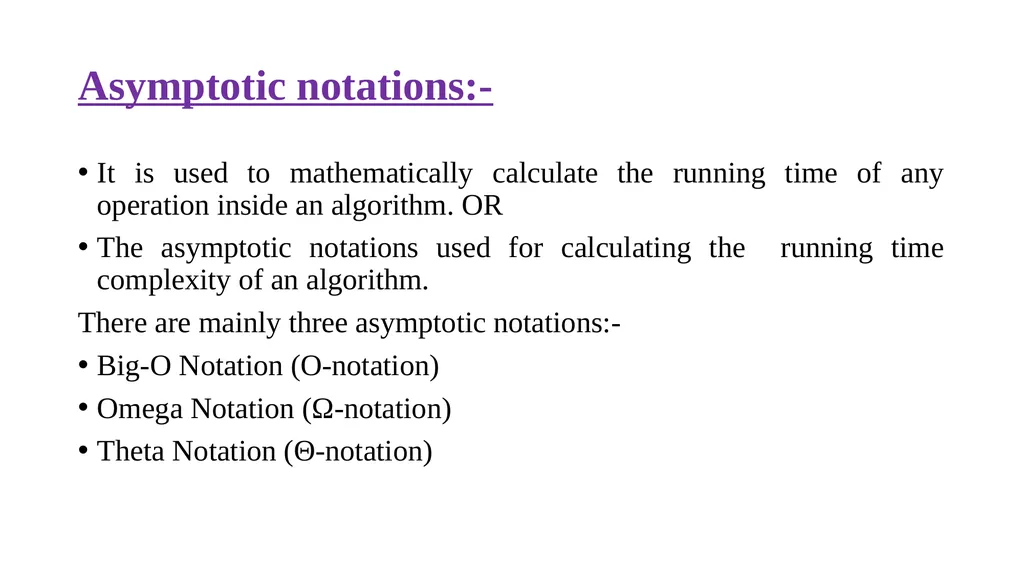
Asymptotic notations:- It is used to mathematically calculate the running time of any operation inside an algorithm. OR
The asymptotic notations used for calculating the running time complexity of an algorithm.
There are mainly three asymptotic notations:-
Big-O Notation (O-notation)
Omega Notation (Ω-notation)
Theta Notation (Θ-notation)<br>
The asymptotic notations used for calculating the running time complexity of an algorithm.
There are mainly three asymptotic notations:-
Big-O Notation (O-notation)
Omega Notation (Ω-notation)
Theta Notation (Θ-notation)<br>
36
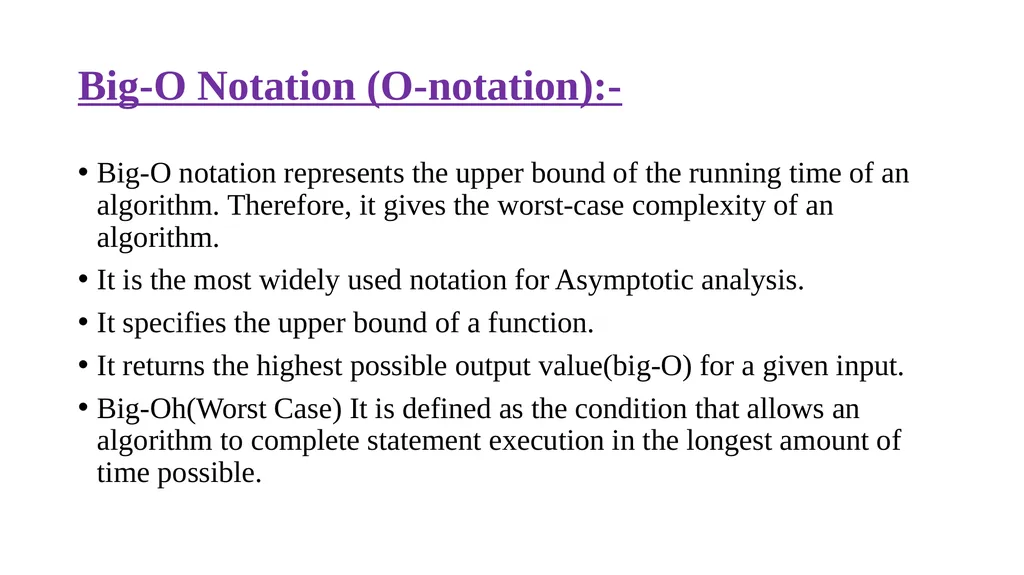
Big-O Notation (O-notation):- Big-O notation represents the upper bound of the running time of an algorithm. Therefore, it gives the worst-case complexity of an algorithm.
It is the most widely used notation for Asymptotic analysis.
It specifies the upper bound of a function.
It returns the highest possible output value(big-O) for a given input.
Big-Oh(Worst Case) It is defined as the condition that allows an algorithm to complete statement execution in the longest amount of time possible.<br>
It is the most widely used notation for Asymptotic analysis.
It specifies the upper bound of a function.
It returns the highest possible output value(big-O) for a given input.
Big-Oh(Worst Case) It is defined as the condition that allows an algorithm to complete statement execution in the longest amount of time possible.<br>
37
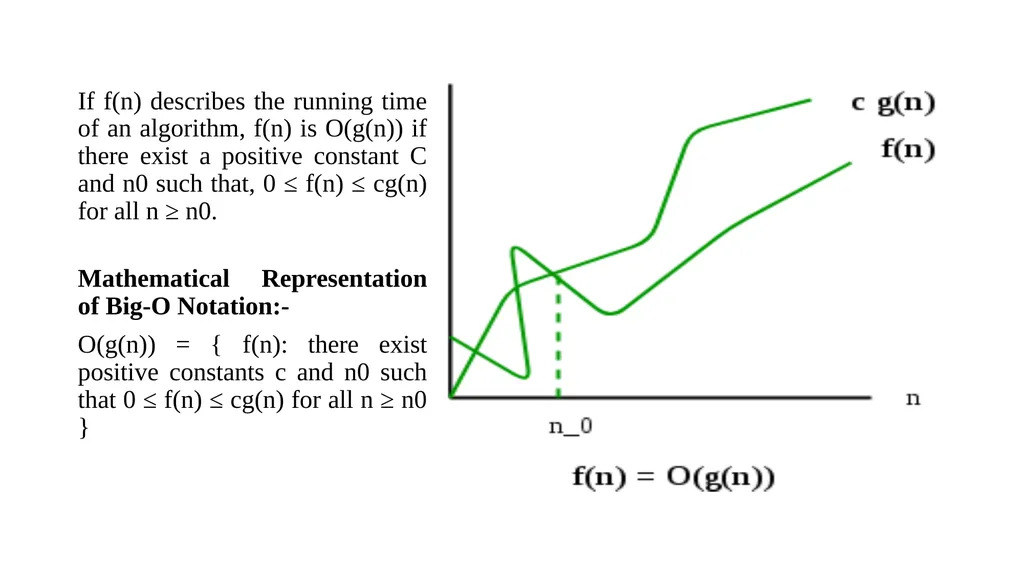
If f(n) describes the running time of an algorithm, f(n) is O(g(n)) if there exist a positive constant C and n0 such that, 0 ≤ f(n) ≤ cg(n) for all n ≥ n0.
Mathematical Representation of Big-O Notation:-
O(g(n)) = { f(n): there exist positive constants c and n0 such that 0 ≤ f(n) ≤ cg(n) for all n ≥ n0 }<br>
Mathematical Representation of Big-O Notation:-
O(g(n)) = { f(n): there exist positive constants c and n0 such that 0 ≤ f(n) ≤ cg(n) for all n ≥ n0 }<br>
38
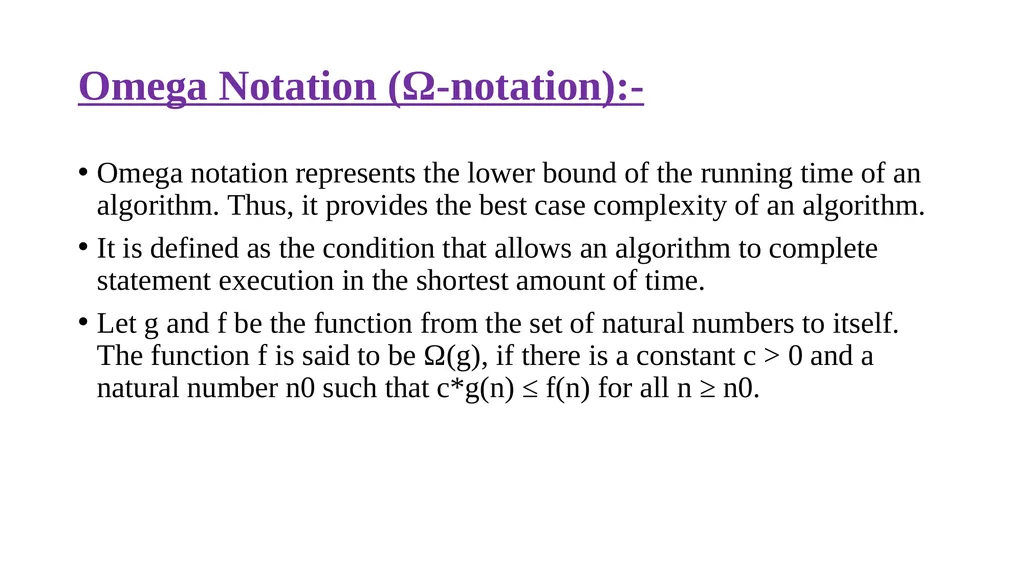
Omega Notation (Ω-notation):- Omega notation represents the lower bound of the running time of an algorithm. Thus, it provides the best case complexity of an algorithm.
It is defined as the condition that allows an algorithm to complete statement execution in the shortest amount of time.
Let g and f be the function from the set of natural numbers to itself. The function f is said to be Ω(g), if there is a constant c > 0 and a natural number n0 such that c*g(n) ≤ f(n) for all n ≥ n0.<br>
It is defined as the condition that allows an algorithm to complete statement execution in the shortest amount of time.
Let g and f be the function from the set of natural numbers to itself. The function f is said to be Ω(g), if there is a constant c > 0 and a natural number n0 such that c*g(n) ≤ f(n) for all n ≥ n0.<br>
39
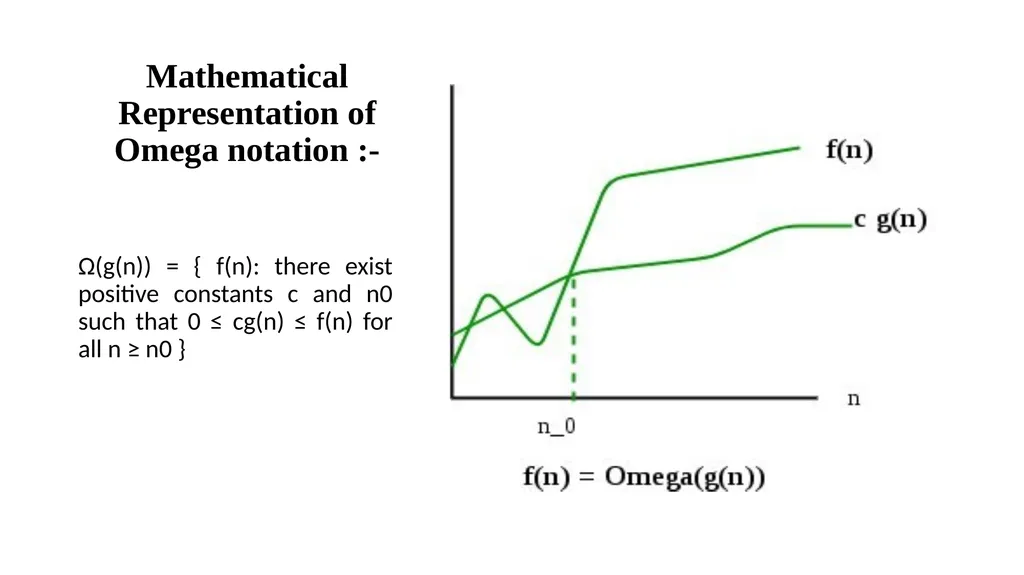
Mathematical Representation of Omega notation :- Ω(g(n)) = { f(n): there exist positive constants c and n0 such that 0 ≤ cg(n) ≤ f(n) for all n ≥ n0 }<br>
40
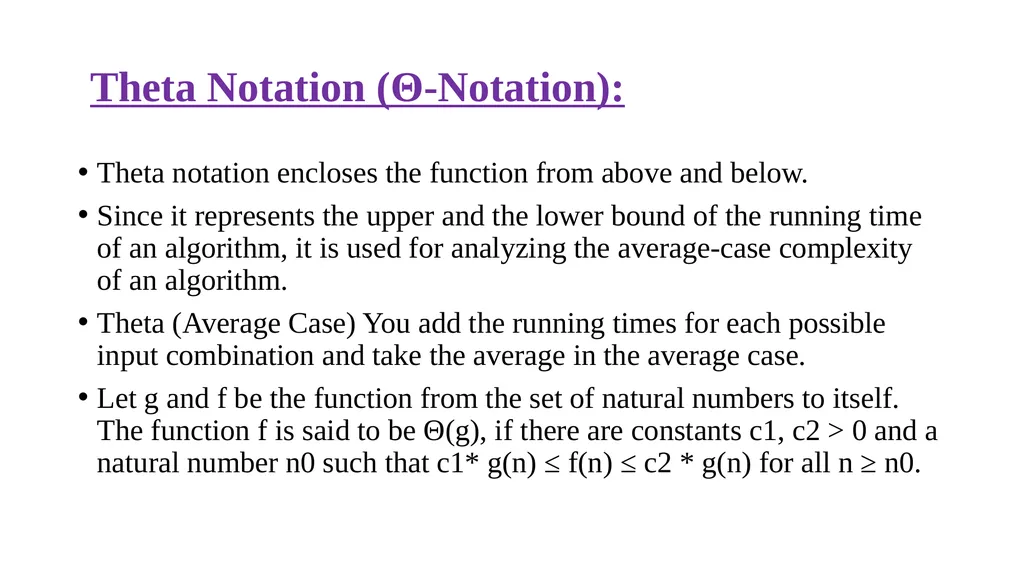
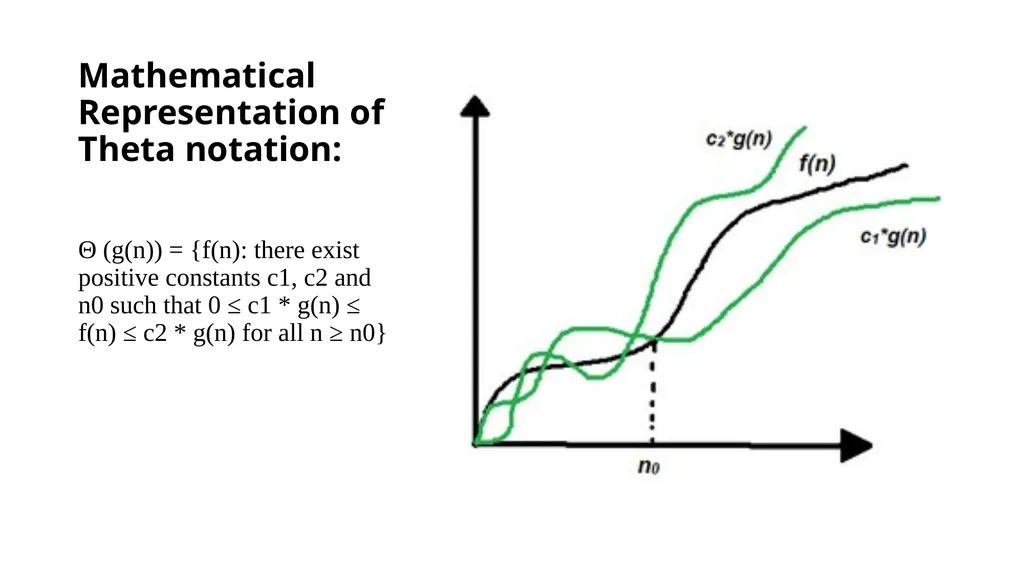
Theta Notation (Θ-Notation): Theta notation encloses the function from above and below.
Since it represents the upper and the lower bound of the running time of an algorithm, it is used for analyzing the average-case complexity of an algorithm.
Theta (Average Case) You add the running times for each possible input combination and take the average in the average case.
Let g and f be the function from the set of natural numbers to itself. The function f is said to be Θ(g), if there are constants c1, c2 > 0 and a natural number n0 such that c1* g(n) ≤ f(n) ≤ c2 * g(n) for all n ≥ n0.<br>
Since it represents the upper and the lower bound of the running time of an algorithm, it is used for analyzing the average-case complexity of an algorithm.
Theta (Average Case) You add the running times for each possible input combination and take the average in the average case.
Let g and f be the function from the set of natural numbers to itself. The function f is said to be Θ(g), if there are constants c1, c2 > 0 and a natural number n0 such that c1* g(n) ≤ f(n) ≤ c2 * g(n) for all n ≥ n0.<br>
41
Mathematical Representation of Theta notation: Θ (g(n)) = {f(n): there exist positive constants c1, c2 and n0 such that 0 ≤ c1 * g(n) ≤ f(n) ≤ c2 * g(n) for all n ≥ n0}<br>
42
Analyzing Algorithms Analysis refers to the task to determine the computing time and storage space required for an algorithm.
It is called as “Performance Analysis” or “efficiency” of an algorithm.
Definition:
Performance analysis of an algorithm is the process of calculating space required by that algorithm and time required by that algorithm. Algorithm can be analyzed in two ways:
Time Factor: Time is measured by counting the number of key operations such as comparisons in the sorting algorithm.
Space Factor: Space is measured by counting the maximum memory space required by the algorithm.<br>
It is called as “Performance Analysis” or “efficiency” of an algorithm.
Definition:
Performance analysis of an algorithm is the process of calculating space required by that algorithm and time required by that algorithm. Algorithm can be analyzed in two ways:
Time Factor: Time is measured by counting the number of key operations such as comparisons in the sorting algorithm.
Space Factor: Space is measured by counting the maximum memory space required by the algorithm.<br>
43
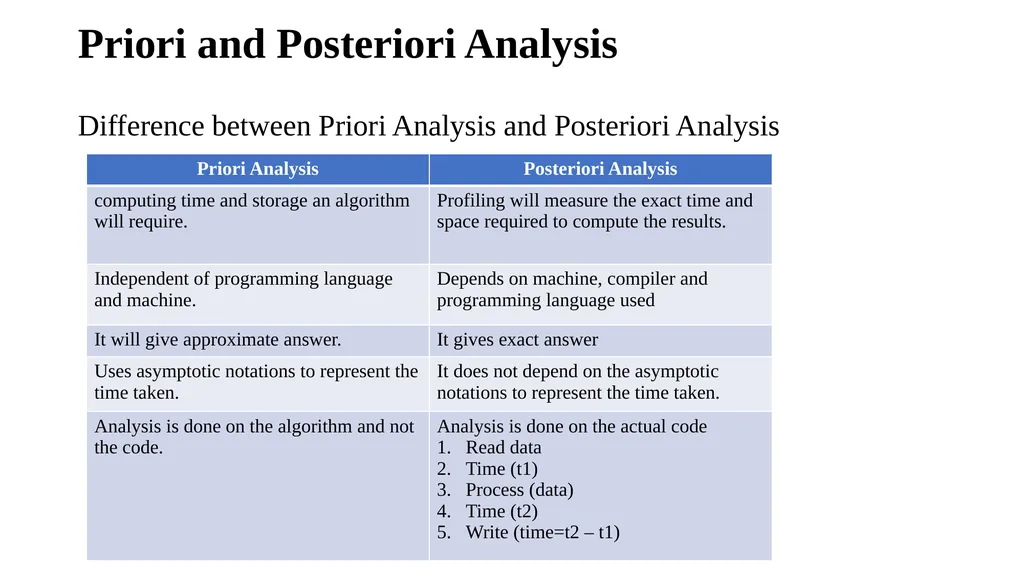
Priori and Posteriori Analysis To analyze the algorithm, 2 phases are required.
1)Priori Analysis – “Priori” means before. This analysis is done before its implementation.
Total time taken by the algorithm = The number of times the statement will be executed (frequency count) x time taken for one execution
The notations used in Priori analysis are Big-oh (O), Omega (Ω), Theta(θ), small-oh(o).
2) Posteriori Analysis – “Posterior” means after. This analysis is done after implementing the algorithm in any programming language.<br>
1)Priori Analysis – “Priori” means before. This analysis is done before its implementation.
Total time taken by the algorithm = The number of times the statement will be executed (frequency count) x time taken for one execution
The notations used in Priori analysis are Big-oh (O), Omega (Ω), Theta(θ), small-oh(o).
2) Posteriori Analysis – “Posterior” means after. This analysis is done after implementing the algorithm in any programming language.<br>
44
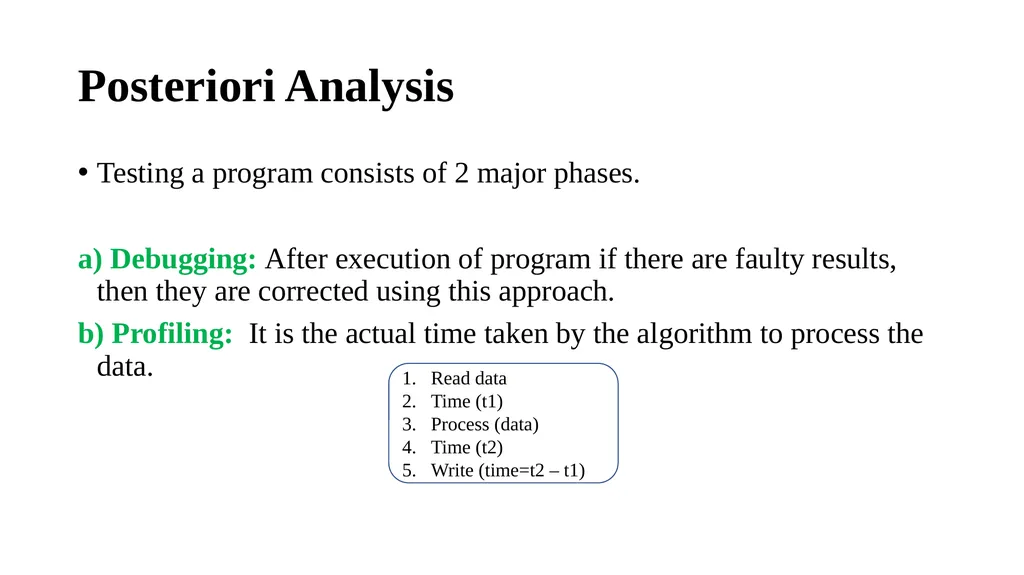
Posteriori Analysis Testing a program consists of 2 major phases.
a) Debugging: After execution of program if there are faulty results, then they are corrected using this approach.
b) Profiling: It is the actual time taken by the algorithm to process the data. Read data
Time (t1)
Process (data)
Time (t2)
Write (time=t2 – t1)<br>
a) Debugging: After execution of program if there are faulty results, then they are corrected using this approach.
b) Profiling: It is the actual time taken by the algorithm to process the data. Read data
Time (t1)
Process (data)
Time (t2)
Write (time=t2 – t1)<br>
45
Priori and Posteriori Analysis Difference between Priori Analysis and Posteriori Analysis<br>
46
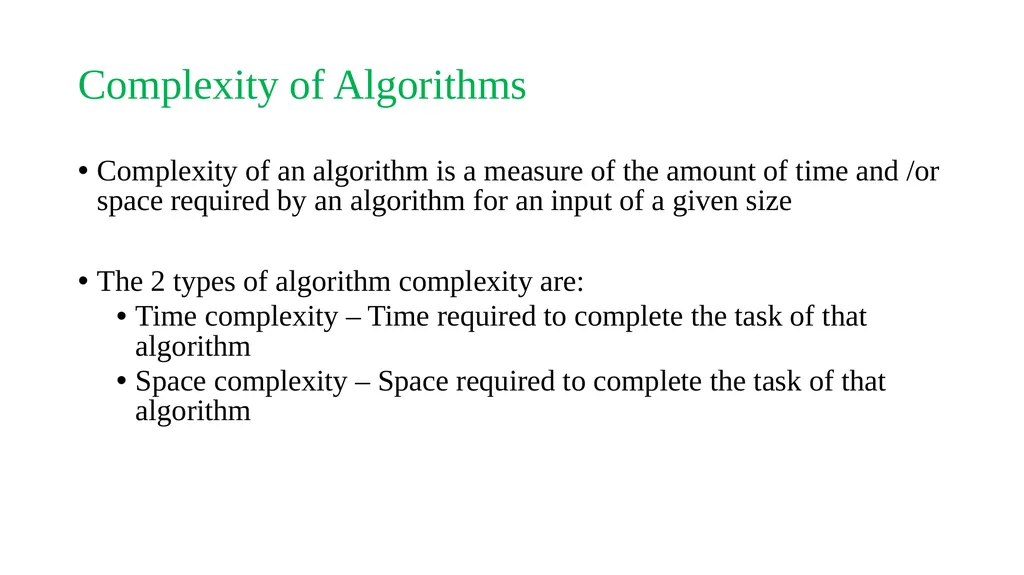
Complexity of Algorithms Complexity of an algorithm is a measure of the amount of time and /or space required by an algorithm for an input of a given size
The 2 types of algorithm complexity are:
Time complexity – Time required to complete the task of that algorithm
Space complexity – Space required to complete the task of that algorithm<br>
The 2 types of algorithm complexity are:
Time complexity – Time required to complete the task of that algorithm
Space complexity – Space required to complete the task of that algorithm<br>
47
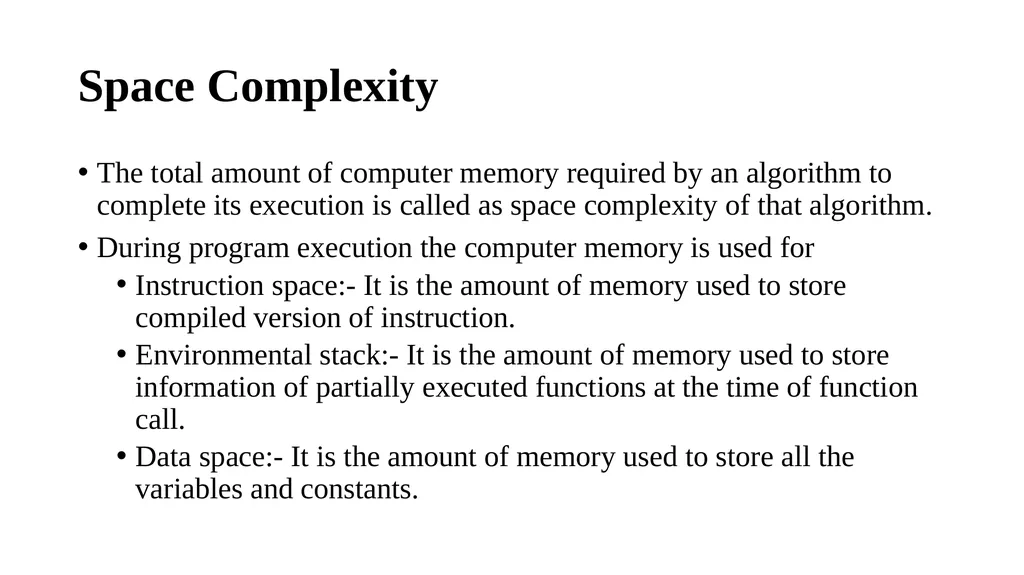
Space Complexity The total amount of computer memory required by an algorithm to complete its execution is called as space complexity of that algorithm.
During program execution the computer memory is used for
Instruction space:- It is the amount of memory used to store compiled version of instruction.
Environmental stack:- It is the amount of memory used to store information of partially executed functions at the time of function call.
Data space:- It is the amount of memory used to store all the variables and constants.<br>
During program execution the computer memory is used for
Instruction space:- It is the amount of memory used to store compiled version of instruction.
Environmental stack:- It is the amount of memory used to store information of partially executed functions at the time of function call.
Data space:- It is the amount of memory used to store all the variables and constants.<br>
48
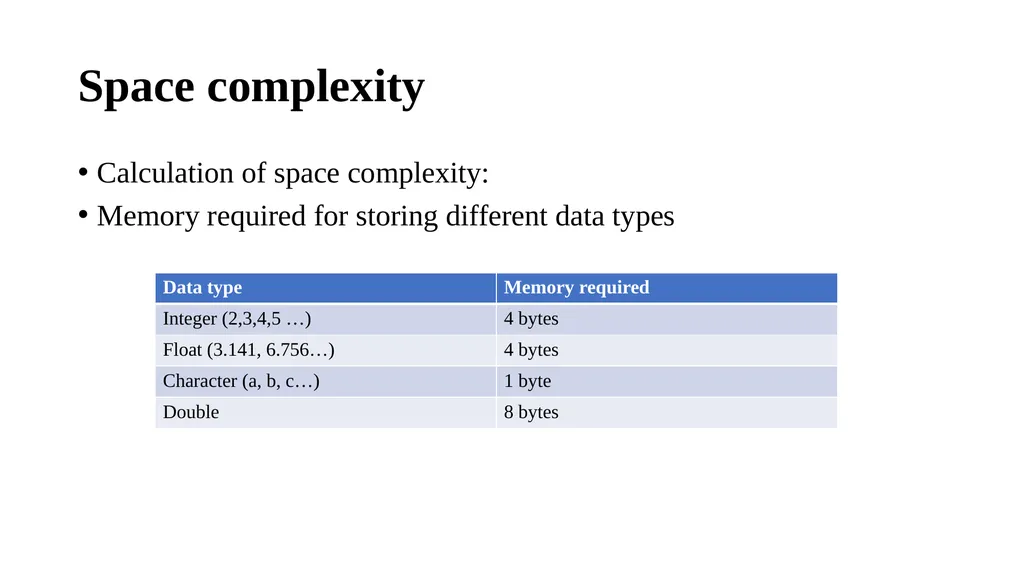
Space complexity Calculation of space complexity:
Memory required for storing different data types<br>
Memory required for storing different data types<br>
49
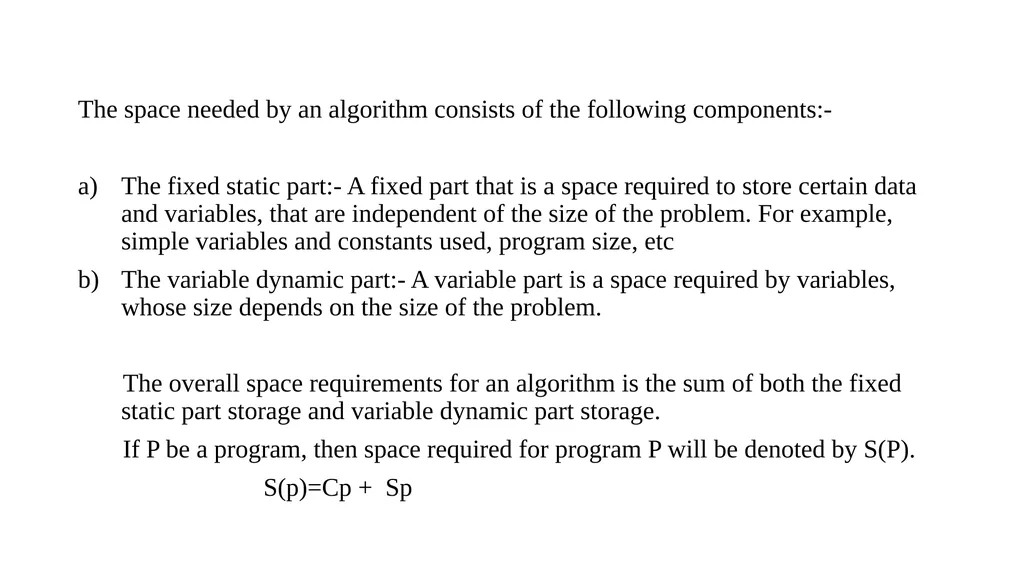
The space needed by an algorithm consists of the following components:-
The fixed static part:- A fixed part that is a space required to store certain data and variables, that are independent of the size of the problem. For example, simple variables and constants used, program size, etc
The variable dynamic part:- A variable part is a space required by variables, whose size depends on the size of the problem.
The overall space requirements for an algorithm is the sum of both the fixed static part storage and variable dynamic part storage.
If P be a program, then space required for program P will be denoted by S(P).
S(p)=Cp + Sp<br>
The fixed static part:- A fixed part that is a space required to store certain data and variables, that are independent of the size of the problem. For example, simple variables and constants used, program size, etc
The variable dynamic part:- A variable part is a space required by variables, whose size depends on the size of the problem.
The overall space requirements for an algorithm is the sum of both the fixed static part storage and variable dynamic part storage.
If P be a program, then space required for program P will be denoted by S(P).
S(p)=Cp + Sp<br>
50
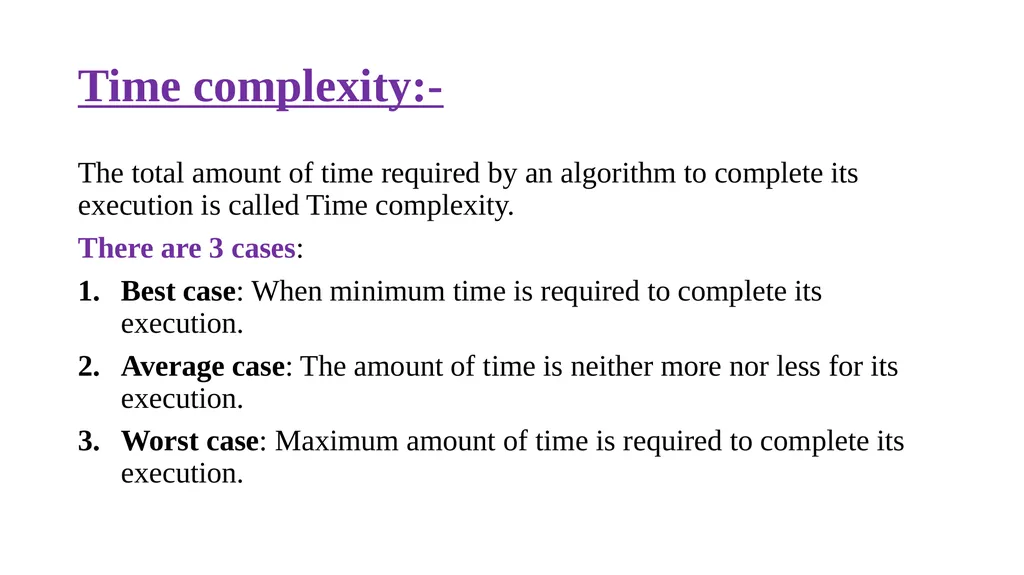
Time complexity:- The total amount of time required by an algorithm to complete its execution is called Time complexity.
There are 3 cases:
Best case: When minimum time is required to complete its execution.
Average case: The amount of time is neither more nor less for its execution.
Worst case: Maximum amount of time is required to complete its execution.<br>
There are 3 cases:
Best case: When minimum time is required to complete its execution.
Average case: The amount of time is neither more nor less for its execution.
Worst case: Maximum amount of time is required to complete its execution.<br>
51
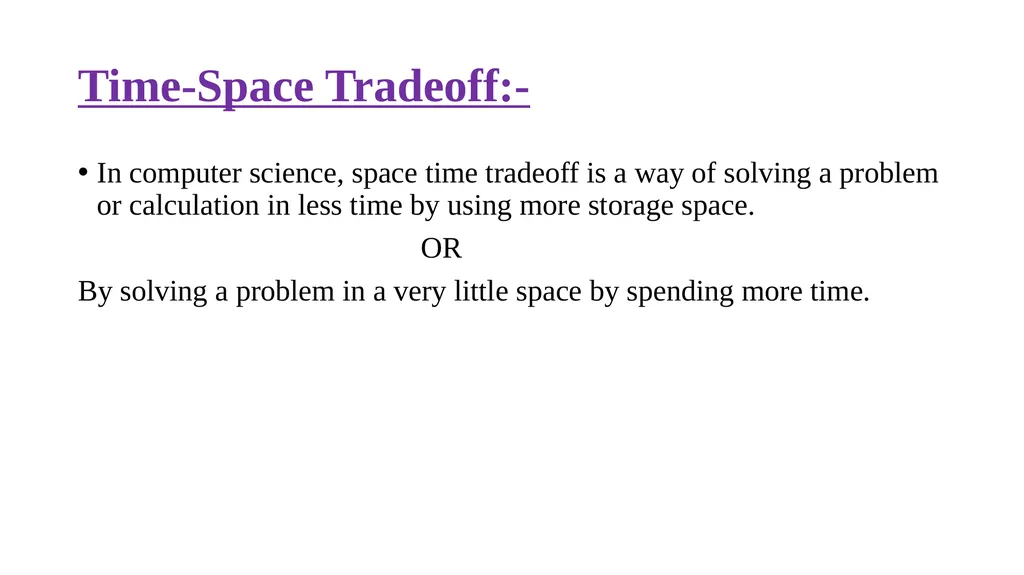
Time-Space Tradeoff:- In computer science, space time tradeoff is a way of solving a problem or calculation in less time by using more storage space.
OR
By solving a problem in a very little space by spending more time.<br>
OR
By solving a problem in a very little space by spending more time.<br>