
Project B1: Fuel assembly and core design
MT
Published · 20 slides · 0 views

1 / 1


Description
Project B1: Fuel assembly and core design optimization for SMRs ANItA Symposium 2023, October 30-31 Flavio Ferella (UU) Uppsala 2023 Contents Uppsala 2023 2 The B1 Team and its interfaces B1 achievements so far Motivation for SMR fuel
Related Topics
Share
Embed code
Download this presentation From Below
"Project B1: Fuel assembly and core design" is the property of its rightful owner. Permission is granted to download and print the materials on this website for personal, non-commercial use only, and to display it on your personal computer provided you do not modify the materials and that you retain all copyright notices contained in the materials. By downloading content from our website, you accept the terms of this agreement.
Presentation Transcript
01
Project B1:
Fuel assembly and core design optimization for SMRs
ANItA Symposium 2023, October 30-31 Flavio Ferella (UU) Uppsala 2023<br>
02
Contents Uppsala 2023 2 The B1 Team and its interfaces
B1 achievements so far
Motivation for SMR fuel assembly and core design optimization
Specific questions to address for SMR fuel and core design
Optimization methodology development
Thesis tentative milestones<br>
B1 achievements so far
Motivation for SMR fuel assembly and core design optimization
Specific questions to address for SMR fuel and core design
Optimization methodology development
Thesis tentative milestones<br>
03
B1 Team Uppsala 2023 3 UU:
Henrik Sjöstrand (academic supervisor)
Cecilia Gustavsson (academic supervisor)
Andreas Solders (academic supervisor)
Flavio Ferella (PhD student)
Vattenfall:
Jesper Kierkegaard (advisor)
Petter Gabrielsson (advisor)
Westinghouse:
Uffe Bergmann (project manager)
Fausto Franceschini (reactor physics)
Marcus Seidl (reactor physics)<br>
Henrik Sjöstrand (academic supervisor)
Cecilia Gustavsson (academic supervisor)
Andreas Solders (academic supervisor)
Flavio Ferella (PhD student)
Vattenfall:
Jesper Kierkegaard (advisor)
Petter Gabrielsson (advisor)
Westinghouse:
Uffe Bergmann (project manager)
Fausto Franceschini (reactor physics)
Marcus Seidl (reactor physics)<br>
04
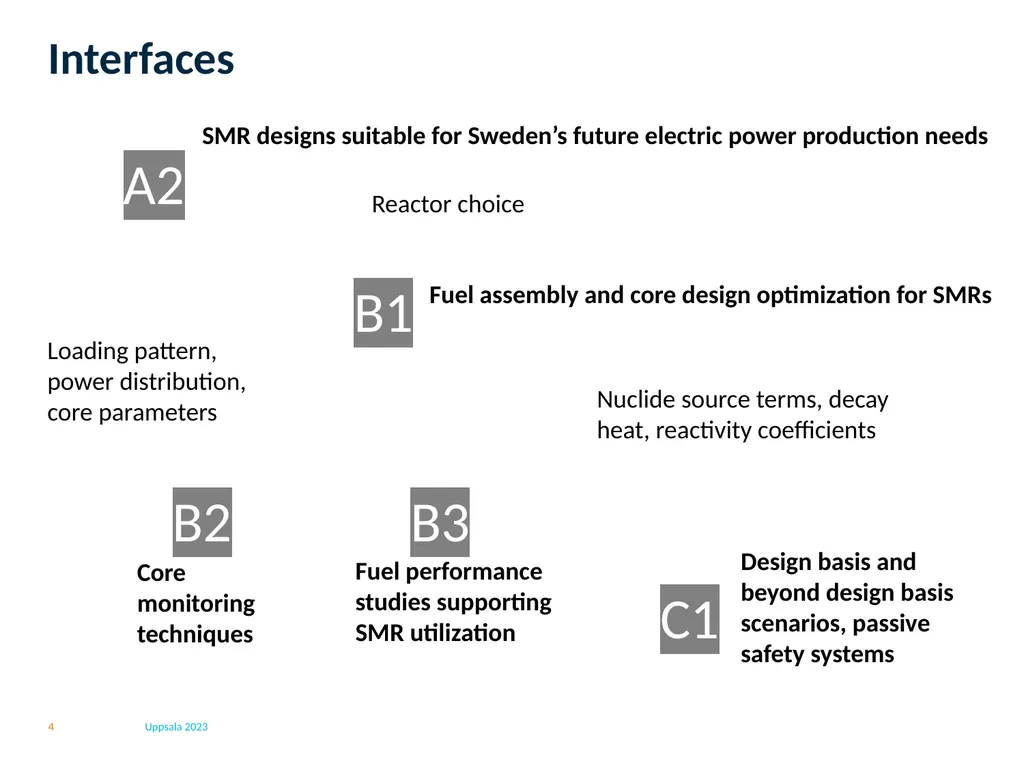
Interfaces Uppsala 2023 4 B1 A2 B2 B3 C1 SMR designs suitable for Sweden’s future electric power production needs Fuel assembly and core design optimization for SMRs Fuel performance studies supporting SMR utilization Core monitoring techniques Design basis and beyond design basis scenarios, passive safety systems Loading pattern,
power distribution,
core parameters Nuclide source terms, decay heat, reactivity coefficients Reactor choice<br>
power distribution,
core parameters Nuclide source terms, decay heat, reactivity coefficients Reactor choice<br>
05
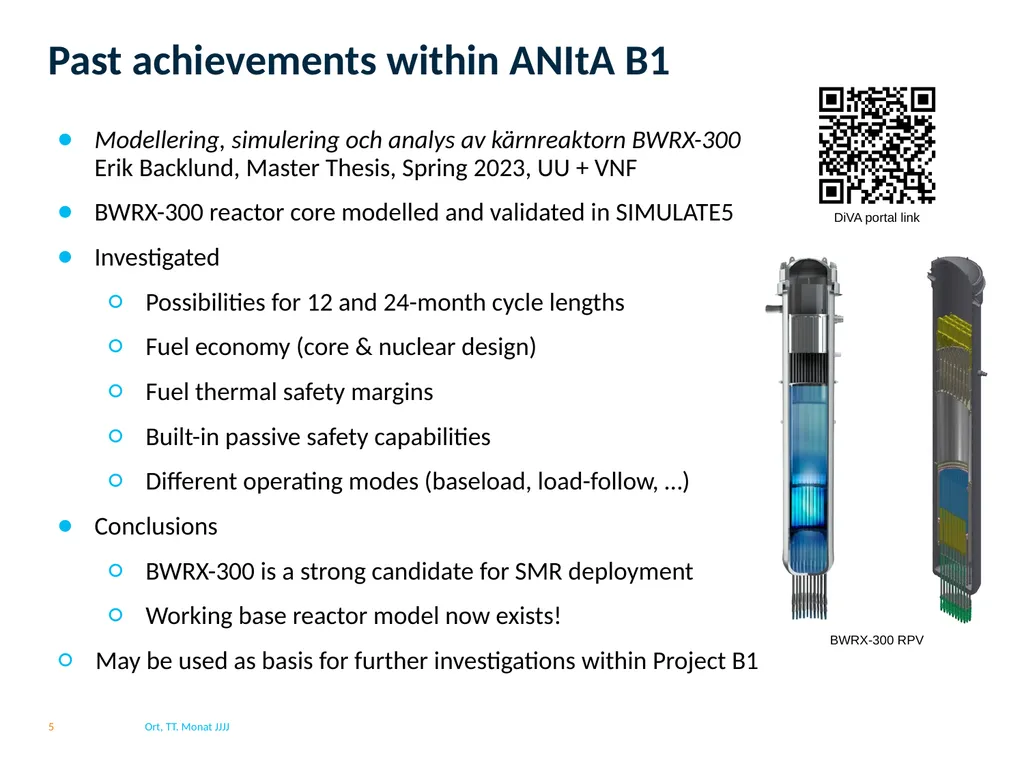
Past achievements within ANItA B1 Ort, TT. Monat JJJJ 5 Modellering, simulering och analys av kärnreaktorn BWRX-300
Erik Backlund, Master Thesis, Spring 2023, UU + VNF
BWRX-300 reactor core modelled and validated in SIMULATE5
Investigated
Possibilities for 12 and 24-month cycle lengths
Fuel economy (core & nuclear design)
Fuel thermal safety margins
Built-in passive safety capabilities
Different operating modes (baseload, load-follow, …)
Conclusions
BWRX-300 is a strong candidate for SMR deployment
Working base reactor model now exists!
May be used as basis for further investigations within Project B1 BWRX-300 RPV DiVA portal link<br>
BWRX-300 reactor core modelled and validated in SIMULATE5
Investigated
Possibilities for 12 and 24-month cycle lengths
Fuel economy (core & nuclear design)
Fuel thermal safety margins
Built-in passive safety capabilities
Different operating modes (baseload, load-follow, …)
Conclusions
BWRX-300 is a strong candidate for SMR deployment
Working base reactor model now exists!
May be used as basis for further investigations within Project B1 BWRX-300 RPV DiVA portal link<br>
06
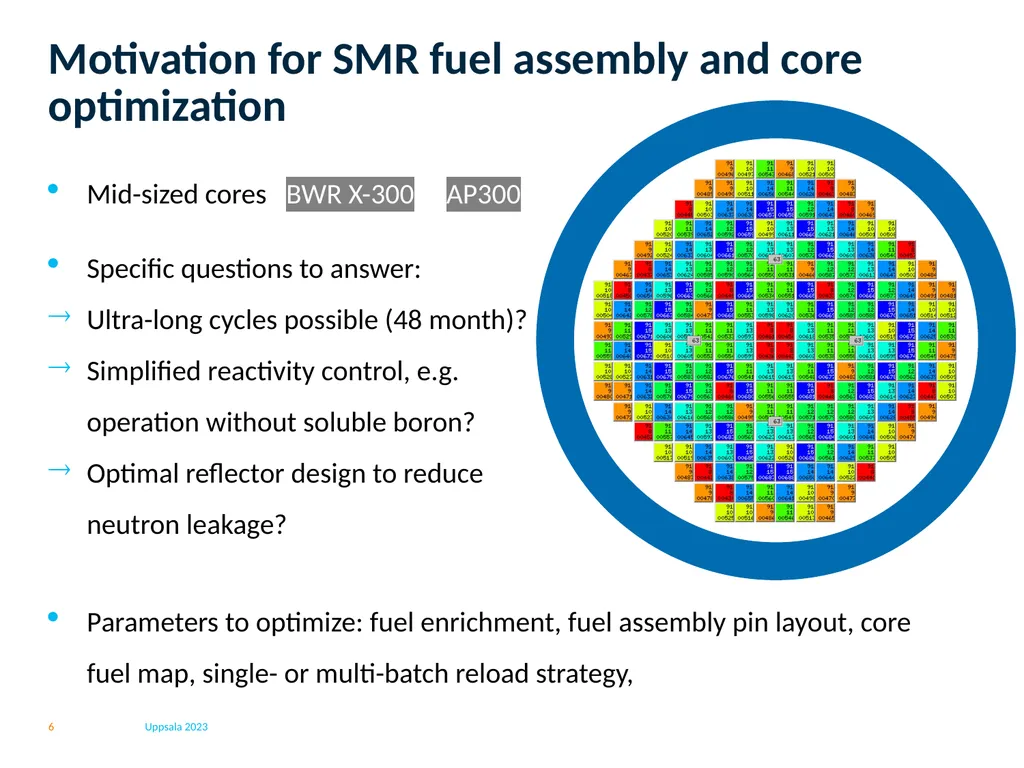
Motivation for SMR fuel assembly and core optimization Uppsala 2023 6 Mid-sized cores BWR X-300 AP300 Specific questions to answer:
Ultra-long cycles possible (48 month)?
Simplified reactivity control, e.g. operation without soluble boron?
Optimal reflector design to reduce neutron leakage? Parameters to optimize: fuel enrichment, fuel assembly pin layout, core fuel map, single- or multi-batch reload strategy,<br>
Ultra-long cycles possible (48 month)?
Simplified reactivity control, e.g. operation without soluble boron?
Optimal reflector design to reduce neutron leakage? Parameters to optimize: fuel enrichment, fuel assembly pin layout, core fuel map, single- or multi-batch reload strategy,<br>
07
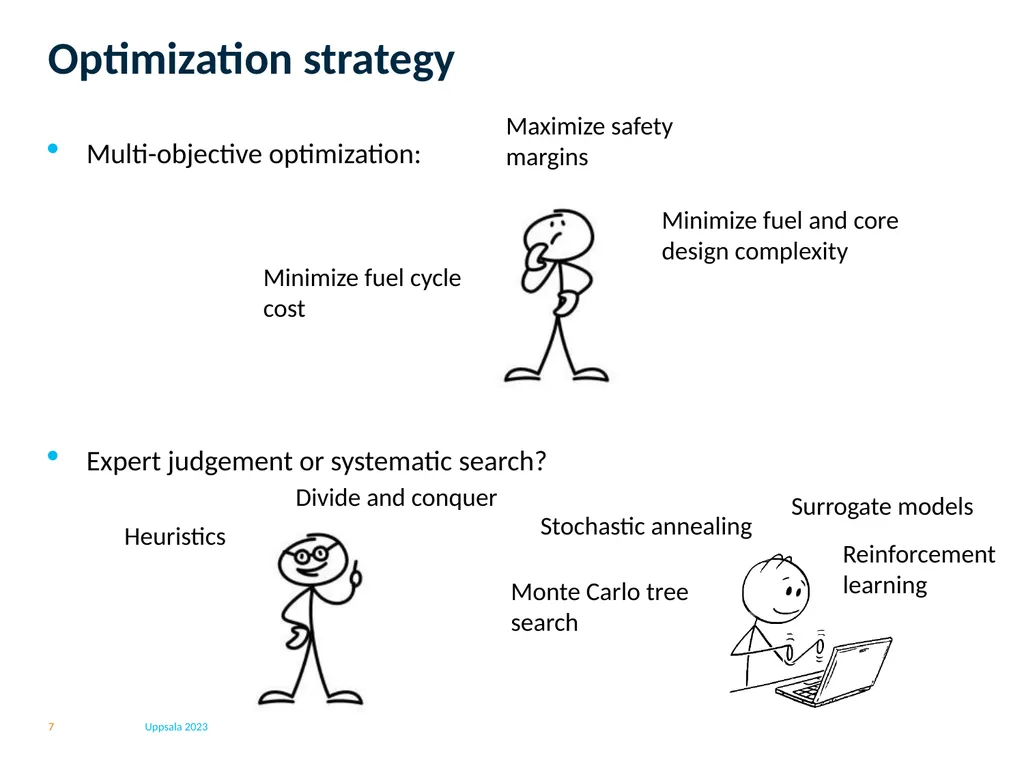
Optimization strategy Uppsala 2023 7 Multi-objective optimization:
Expert judgement or systematic search? Minimize fuel cycle cost Maximize safety margins Minimize fuel and core design complexity Divide and conquer Heuristics Surrogate models Stochastic annealing Monte Carlo tree search Reinforcement learning<br>
Expert judgement or systematic search? Minimize fuel cycle cost Maximize safety margins Minimize fuel and core design complexity Divide and conquer Heuristics Surrogate models Stochastic annealing Monte Carlo tree search Reinforcement learning<br>
08
Milestones Uppsala 2023 8 Working base models for AP300, BWR X-300
Fuel cycle cost calculations for base design
Search space exploration regarding cycle-length, reactivity control simplification, reflector design
Systematic search for optimal design
Appraisal of optimal fuel and core design for Sweden’s SMR strategy<br>
Fuel cycle cost calculations for base design
Search space exploration regarding cycle-length, reactivity control simplification, reflector design
Systematic search for optimal design
Appraisal of optimal fuel and core design for Sweden’s SMR strategy<br>
09
Backup Uppsala 2023 9<br>
10
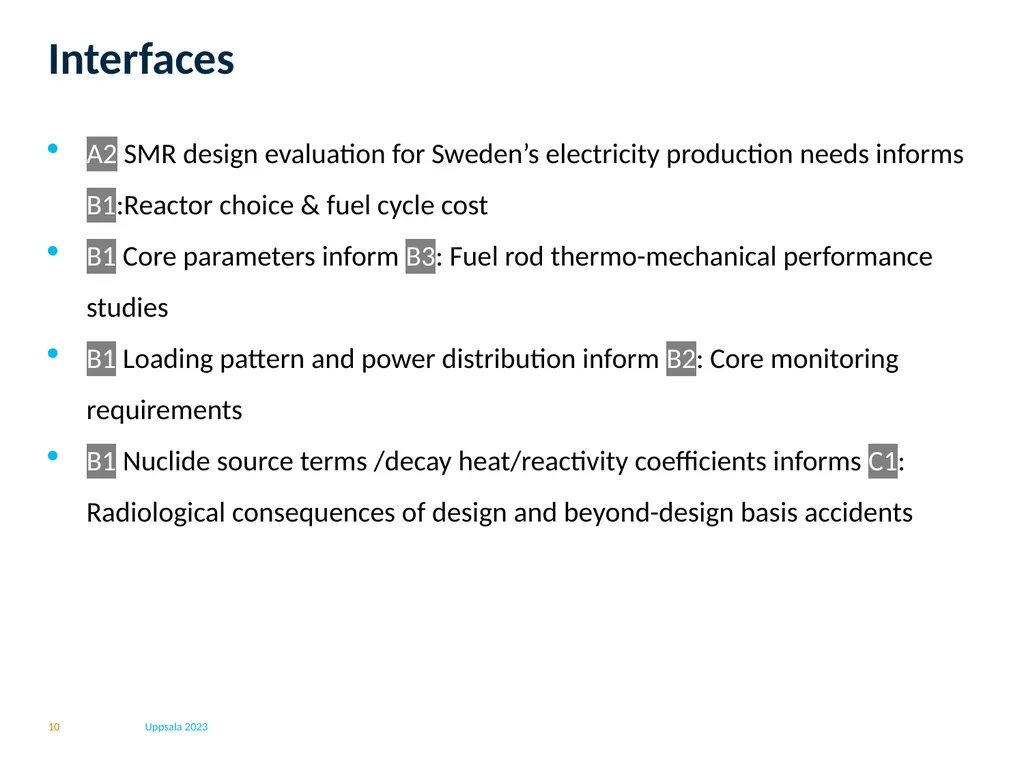
Interfaces Uppsala 2023 10 A2 SMR design evaluation for Sweden’s electricity production needs informs B1:Reactor choice & fuel cycle cost
B1 Core parameters inform B3: Fuel rod thermo-mechanical performance studies
B1 Loading pattern and power distribution inform B2: Core monitoring requirements
B1 Nuclide source terms /decay heat/reactivity coefficients informs C1: Radiological consequences of design and beyond-design basis accidents<br>
B1 Core parameters inform B3: Fuel rod thermo-mechanical performance studies
B1 Loading pattern and power distribution inform B2: Core monitoring requirements
B1 Nuclide source terms /decay heat/reactivity coefficients informs C1: Radiological consequences of design and beyond-design basis accidents<br>
11
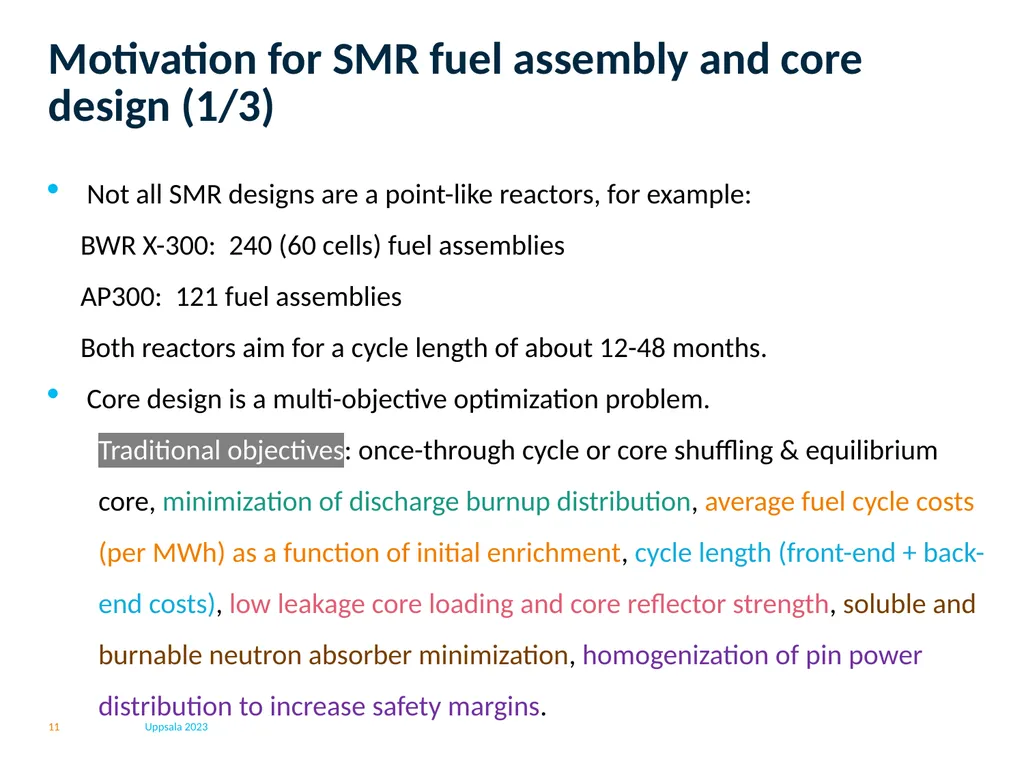
Motivation for SMR fuel assembly and core design (1/3) Uppsala 2023 11 Not all SMR designs are a point-like reactors, for example:
BWR X-300: 240 (60 cells) fuel assemblies
AP300: 121 fuel assemblies
Both reactors aim for a cycle length of about 12-48 months.
Core design is a multi-objective optimization problem.
Traditional objectives: once-through cycle or core shuffling & equilibrium core, minimization of discharge burnup distribution, average fuel cycle costs (per MWh) as a function of initial enrichment, cycle length (front-end + back-end costs), low leakage core loading and core reflector strength, soluble and burnable neutron absorber minimization, homogenization of pin power distribution to increase safety margins.<br>
BWR X-300: 240 (60 cells) fuel assemblies
AP300: 121 fuel assemblies
Both reactors aim for a cycle length of about 12-48 months.
Core design is a multi-objective optimization problem.
Traditional objectives: once-through cycle or core shuffling & equilibrium core, minimization of discharge burnup distribution, average fuel cycle costs (per MWh) as a function of initial enrichment, cycle length (front-end + back-end costs), low leakage core loading and core reflector strength, soluble and burnable neutron absorber minimization, homogenization of pin power distribution to increase safety margins.<br>
12
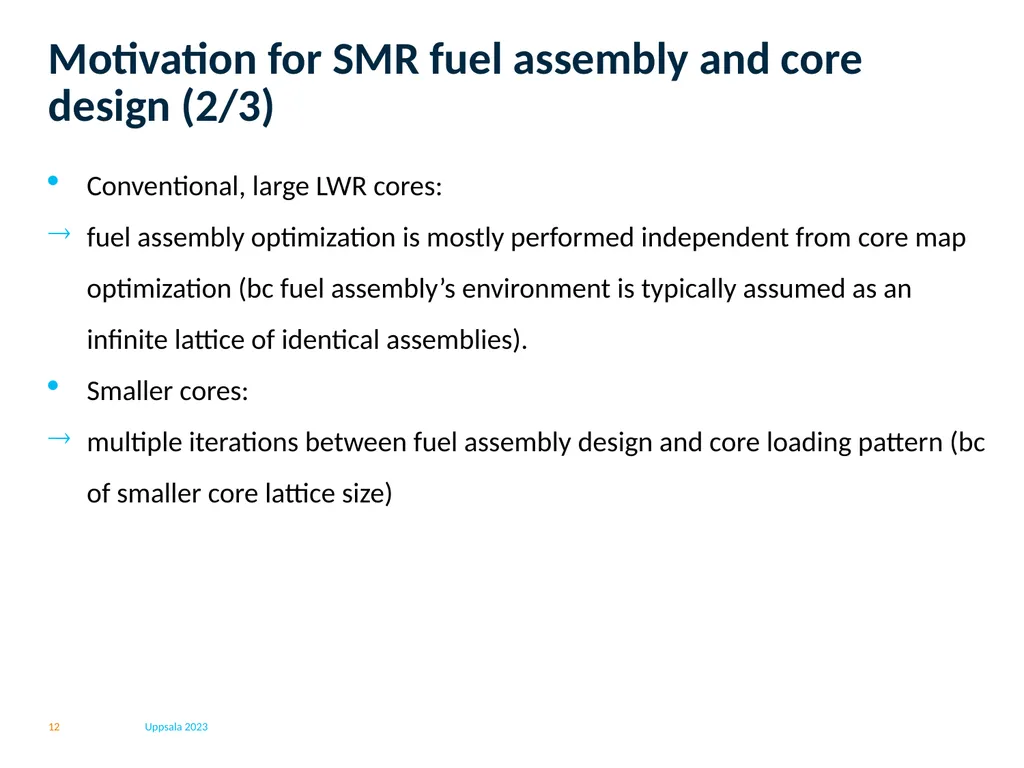
Motivation for SMR fuel assembly and core design (2/3) Uppsala 2023 12 Conventional, large LWR cores:
fuel assembly optimization is mostly performed independent from core map optimization (bc fuel assembly’s environment is typically assumed as an infinite lattice of identical assemblies).
Smaller cores:
multiple iterations between fuel assembly design and core loading pattern (bc of smaller core lattice size)<br>
fuel assembly optimization is mostly performed independent from core map optimization (bc fuel assembly’s environment is typically assumed as an infinite lattice of identical assemblies).
Smaller cores:
multiple iterations between fuel assembly design and core loading pattern (bc of smaller core lattice size)<br>
13
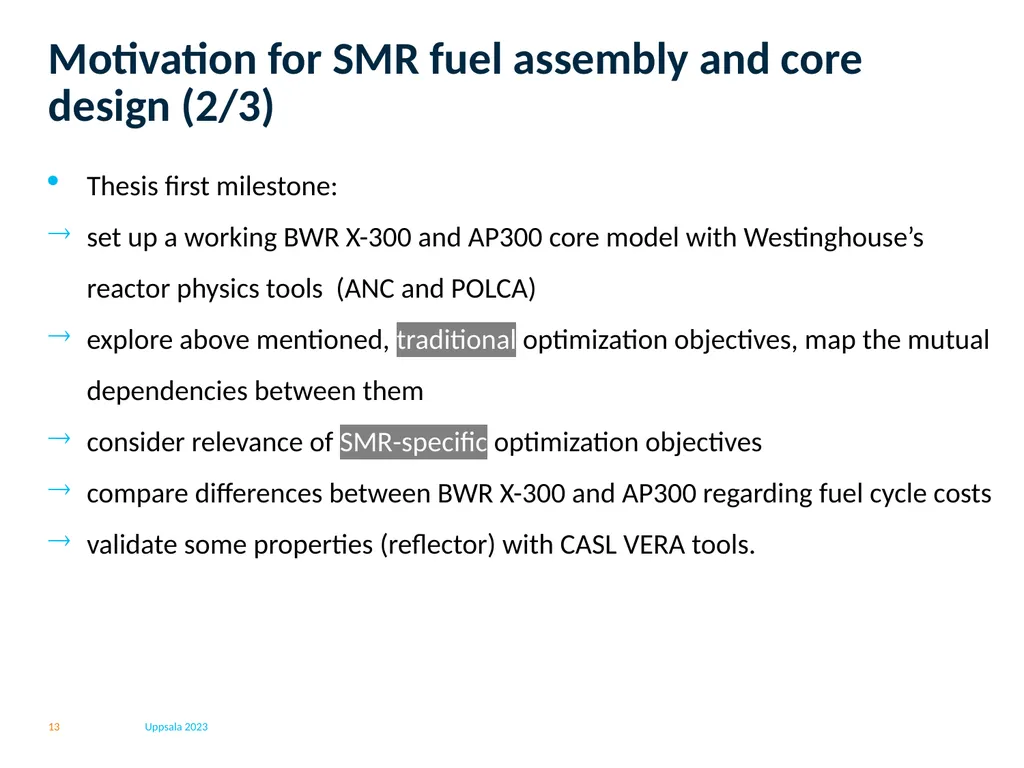
Motivation for SMR fuel assembly and core design (2/3) Uppsala 2023 13 Thesis first milestone:
set up a working BWR X-300 and AP300 core model with Westinghouse’s reactor physics tools (ANC and POLCA)
explore above mentioned, traditional optimization objectives, map the mutual dependencies between them
consider relevance of SMR-specific optimization objectives
compare differences between BWR X-300 and AP300 regarding fuel cycle costs
validate some properties (reflector) with CASL VERA tools.<br>
set up a working BWR X-300 and AP300 core model with Westinghouse’s reactor physics tools (ANC and POLCA)
explore above mentioned, traditional optimization objectives, map the mutual dependencies between them
consider relevance of SMR-specific optimization objectives
compare differences between BWR X-300 and AP300 regarding fuel cycle costs
validate some properties (reflector) with CASL VERA tools.<br>
14
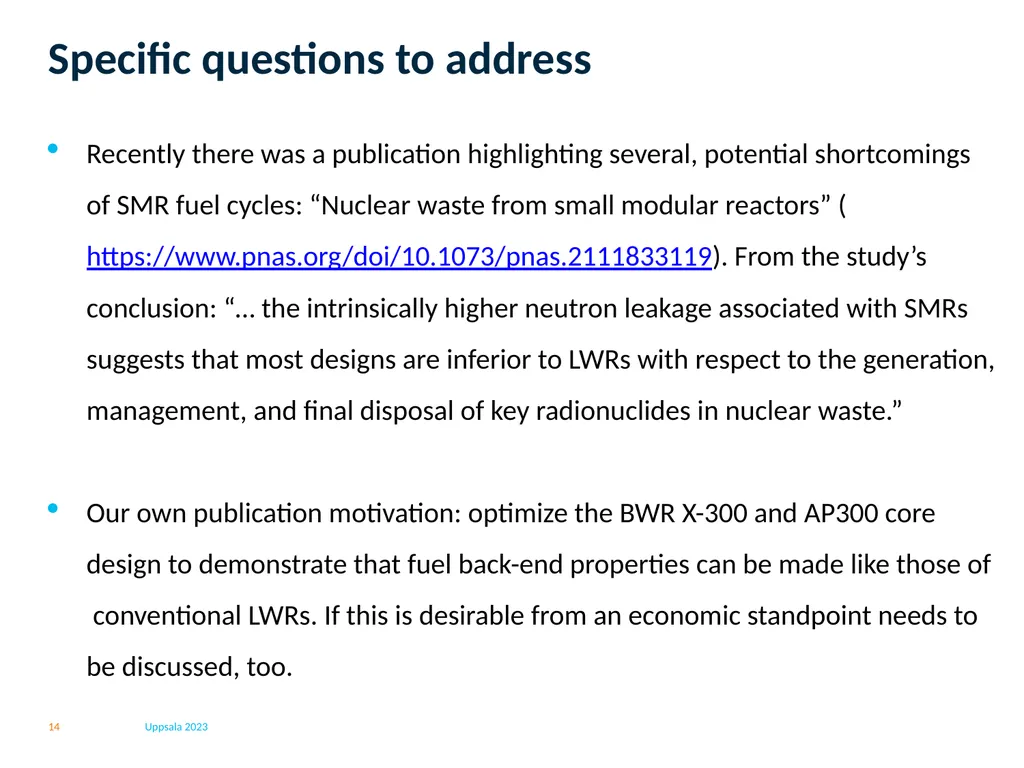
Specific questions to address Uppsala 2023 14 Recently there was a publication highlighting several, potential shortcomings of SMR fuel cycles: “Nuclear waste from small modular reactors” (https://www.pnas.org/doi/10.1073/pnas.2111833119). From the study’s conclusion: “… the intrinsically higher neutron leakage associated with SMRs suggests that most designs are inferior to LWRs with respect to the generation, management, and final disposal of key radionuclides in nuclear waste.”
Our own publication motivation: optimize the BWR X-300 and AP300 core design to demonstrate that fuel back-end properties can be made like those of conventional LWRs. If this is desirable from an economic standpoint needs to be discussed, too.<br>
Our own publication motivation: optimize the BWR X-300 and AP300 core design to demonstrate that fuel back-end properties can be made like those of conventional LWRs. If this is desirable from an economic standpoint needs to be discussed, too.<br>
15
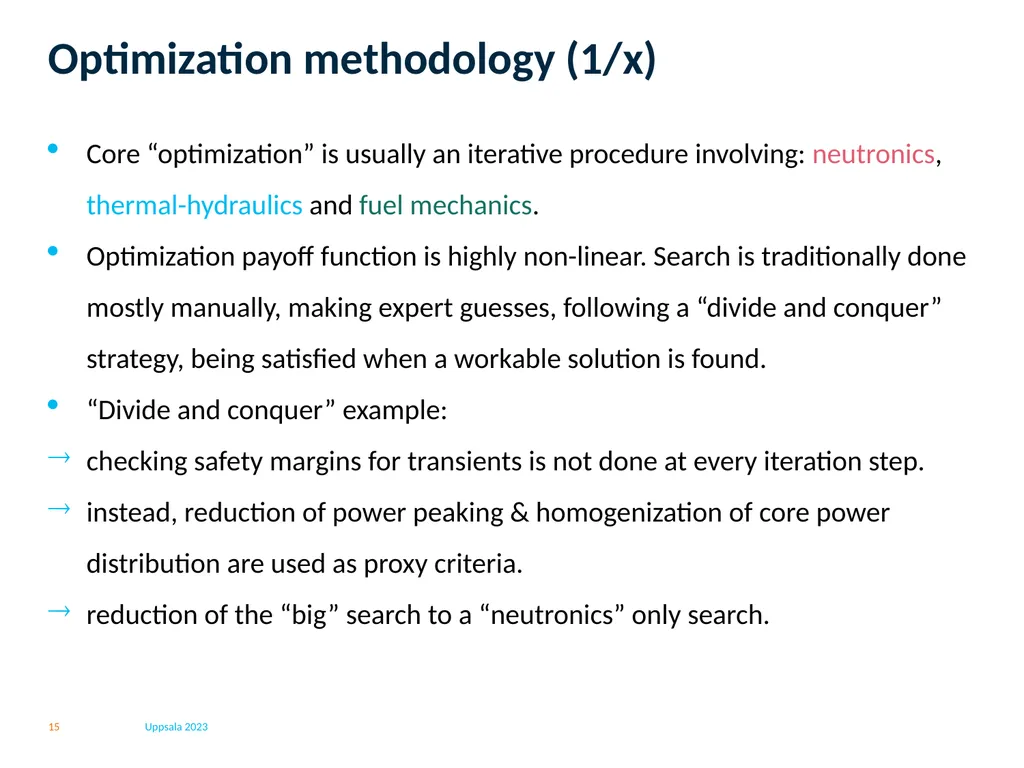
Optimization methodology (1/x) Uppsala 2023 15 Core “optimization” is usually an iterative procedure involving: neutronics, thermal-hydraulics and fuel mechanics.
Optimization payoff function is highly non-linear. Search is traditionally done mostly manually, making expert guesses, following a “divide and conquer” strategy, being satisfied when a workable solution is found.
“Divide and conquer” example:
checking safety margins for transients is not done at every iteration step.
instead, reduction of power peaking & homogenization of core power distribution are used as proxy criteria.
reduction of the “big” search to a “neutronics” only search.<br>
Optimization payoff function is highly non-linear. Search is traditionally done mostly manually, making expert guesses, following a “divide and conquer” strategy, being satisfied when a workable solution is found.
“Divide and conquer” example:
checking safety margins for transients is not done at every iteration step.
instead, reduction of power peaking & homogenization of core power distribution are used as proxy criteria.
reduction of the “big” search to a “neutronics” only search.<br>
16
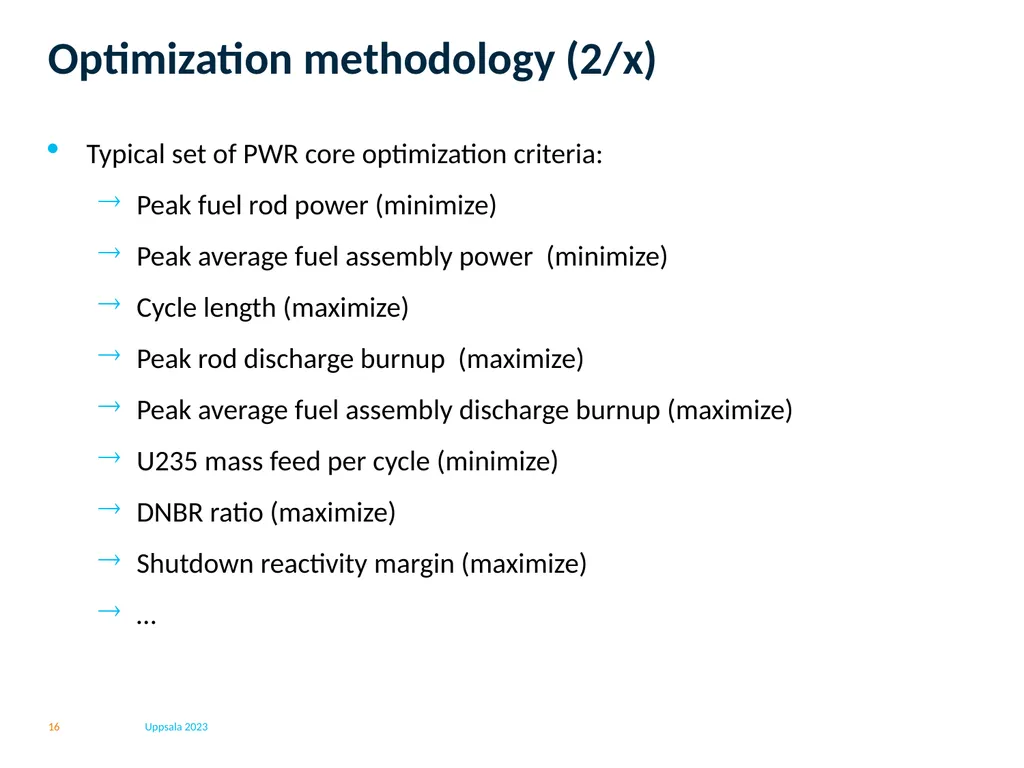
Optimization methodology (2/x) Uppsala 2023 16 Typical set of PWR core optimization criteria:
Peak fuel rod power (minimize)
Peak average fuel assembly power (minimize)
Cycle length (maximize)
Peak rod discharge burnup (maximize)
Peak average fuel assembly discharge burnup (maximize)
U235 mass feed per cycle (minimize)
DNBR ratio (maximize)
Shutdown reactivity margin (maximize)
…<br>
Peak fuel rod power (minimize)
Peak average fuel assembly power (minimize)
Cycle length (maximize)
Peak rod discharge burnup (maximize)
Peak average fuel assembly discharge burnup (maximize)
U235 mass feed per cycle (minimize)
DNBR ratio (maximize)
Shutdown reactivity margin (maximize)
…<br>
17
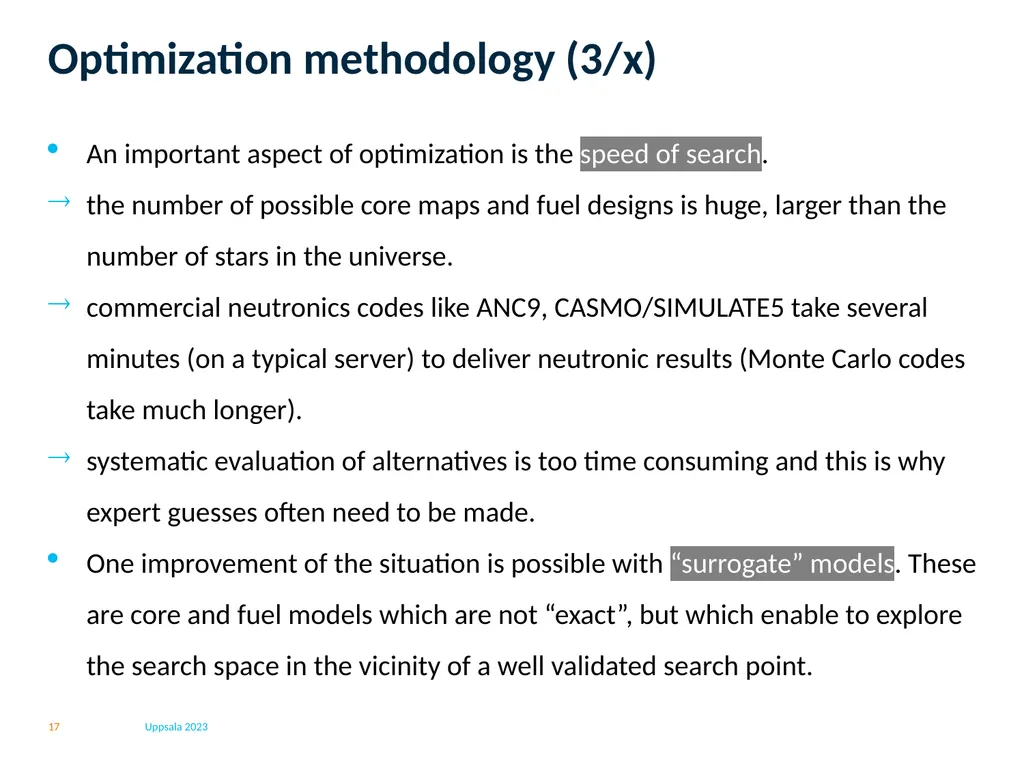
Optimization methodology (3/x) Uppsala 2023 17 An important aspect of optimization is the speed of search.
the number of possible core maps and fuel designs is huge, larger than the number of stars in the universe.
commercial neutronics codes like ANC9, CASMO/SIMULATE5 take several minutes (on a typical server) to deliver neutronic results (Monte Carlo codes take much longer).
systematic evaluation of alternatives is too time consuming and this is why expert guesses often need to be made.
One improvement of the situation is possible with “surrogate” models. These are core and fuel models which are not “exact”, but which enable to explore the search space in the vicinity of a well validated search point.<br>
the number of possible core maps and fuel designs is huge, larger than the number of stars in the universe.
commercial neutronics codes like ANC9, CASMO/SIMULATE5 take several minutes (on a typical server) to deliver neutronic results (Monte Carlo codes take much longer).
systematic evaluation of alternatives is too time consuming and this is why expert guesses often need to be made.
One improvement of the situation is possible with “surrogate” models. These are core and fuel models which are not “exact”, but which enable to explore the search space in the vicinity of a well validated search point.<br>
18
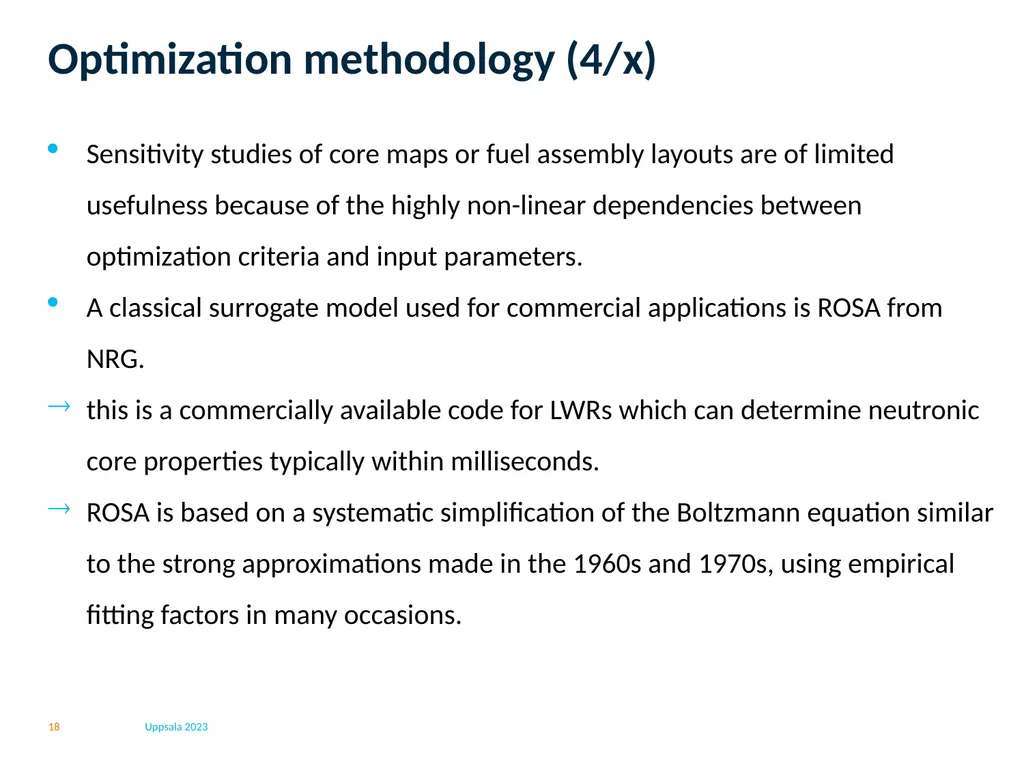
Optimization methodology (4/x) Uppsala 2023 18 Sensitivity studies of core maps or fuel assembly layouts are of limited usefulness because of the highly non-linear dependencies between optimization criteria and input parameters.
A classical surrogate model used for commercial applications is ROSA from NRG.
this is a commercially available code for LWRs which can determine neutronic core properties typically within milliseconds.
ROSA is based on a systematic simplification of the Boltzmann equation similar to the strong approximations made in the 1960s and 1970s, using empirical fitting factors in many occasions.<br>
A classical surrogate model used for commercial applications is ROSA from NRG.
this is a commercially available code for LWRs which can determine neutronic core properties typically within milliseconds.
ROSA is based on a systematic simplification of the Boltzmann equation similar to the strong approximations made in the 1960s and 1970s, using empirical fitting factors in many occasions.<br>
19
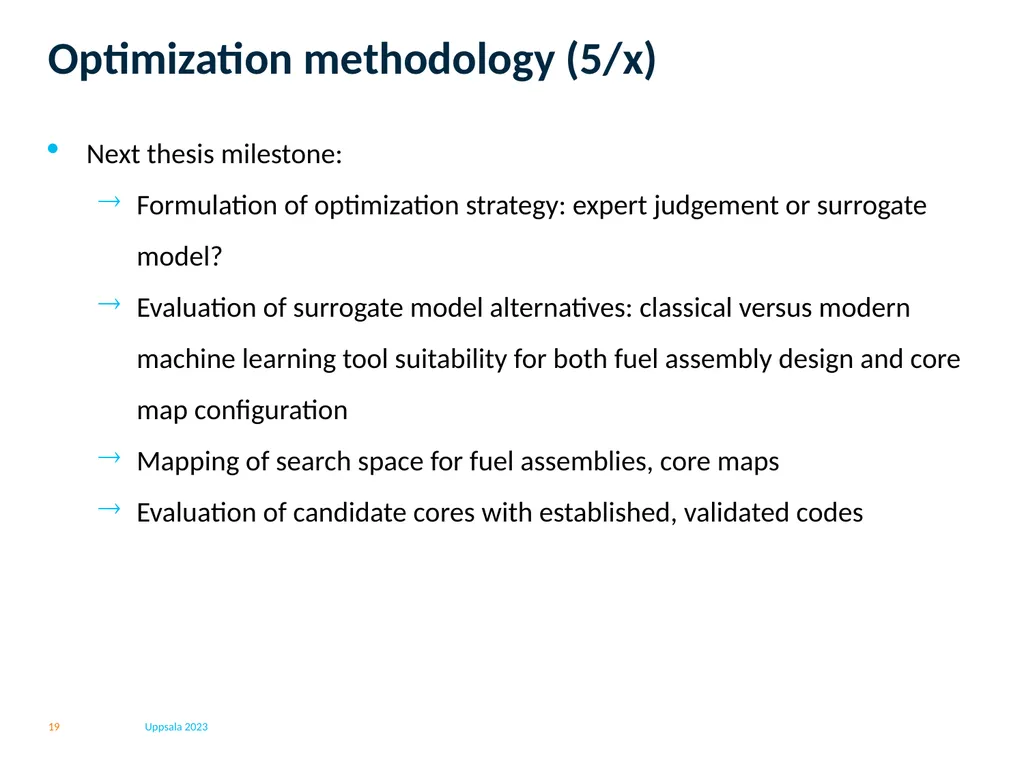
Optimization methodology (5/x) Uppsala 2023 19 Next thesis milestone:
Formulation of optimization strategy: expert judgement or surrogate model?
Evaluation of surrogate model alternatives: classical versus modern machine learning tool suitability for both fuel assembly design and core map configuration
Mapping of search space for fuel assemblies, core maps
Evaluation of candidate cores with established, validated codes<br>
Formulation of optimization strategy: expert judgement or surrogate model?
Evaluation of surrogate model alternatives: classical versus modern machine learning tool suitability for both fuel assembly design and core map configuration
Mapping of search space for fuel assemblies, core maps
Evaluation of candidate cores with established, validated codes<br>
20
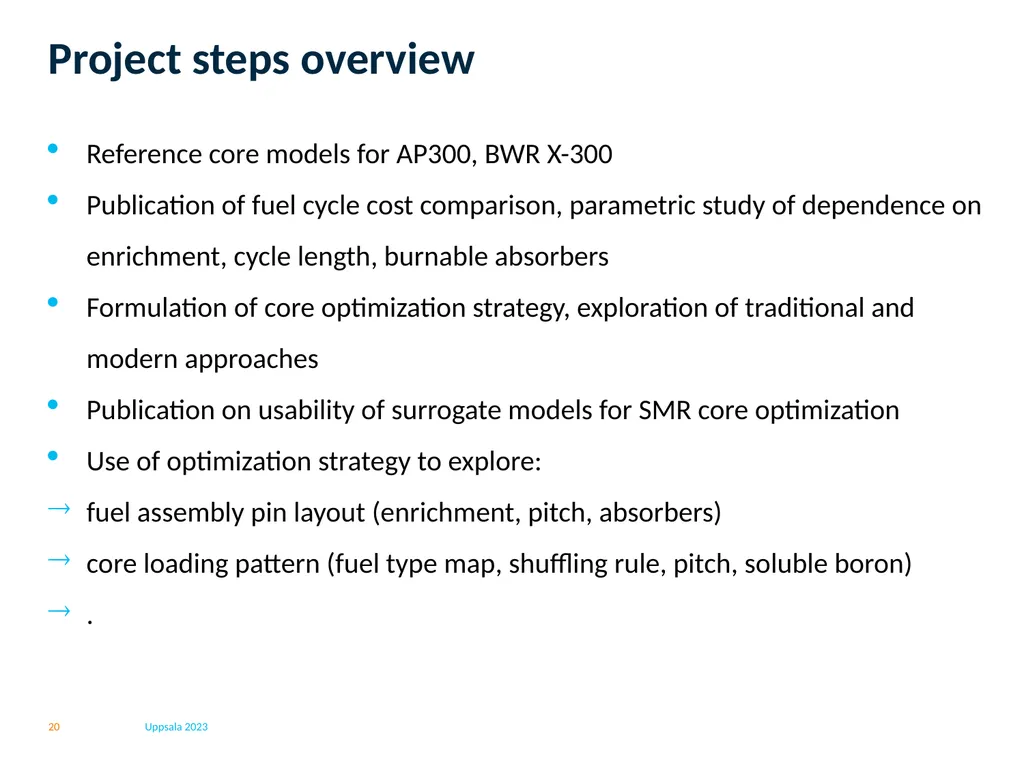
Project steps overview Uppsala 2023 20 Reference core models for AP300, BWR X-300
Publication of fuel cycle cost comparison, parametric study of dependence on enrichment, cycle length, burnable absorbers
Formulation of core optimization strategy, exploration of traditional and modern approaches
Publication on usability of surrogate models for SMR core optimization
Use of optimization strategy to explore:
fuel assembly pin layout (enrichment, pitch, absorbers)
core loading pattern (fuel type map, shuffling rule, pitch, soluble boron)
.<br>
Publication of fuel cycle cost comparison, parametric study of dependence on enrichment, cycle length, burnable absorbers
Formulation of core optimization strategy, exploration of traditional and modern approaches
Publication on usability of surrogate models for SMR core optimization
Use of optimization strategy to explore:
fuel assembly pin layout (enrichment, pitch, absorbers)
core loading pattern (fuel type map, shuffling rule, pitch, soluble boron)
.<br>