
Psychiatry for Finals Dr Eleanor Morris,
FD
Published · 26 slides · 0 views

1 / 1



Description
Psychiatry for Finals Dr Eleanor Morris, Foundation Year 2 The Peer Teaching Society is not liable for false or misleading information. How are you feeling about Psychiatry? Being a good psychiatrist is very different to passing an exam!
Related Topics
Share
Embed code
Download this presentation From Below
"Psychiatry for Finals Dr Eleanor Morris," is the property of its rightful owner. Permission is granted to download and print the materials on this website for personal, non-commercial use only, and to display it on your personal computer provided you do not modify the materials and that you retain all copyright notices contained in the materials. By downloading content from our website, you accept the terms of this agreement.
Presentation Transcript
01
Psychiatry for Finals Dr Eleanor Morris, Foundation Year 2 The Peer Teaching Society is not liable for false or misleading information.<br>
02
How are you feeling about Psychiatry? Being a good psychiatrist is very different to passing an exam!
Pattern recognition (PassMed) is great for simple questions.
When approaching a case in exams, think carefully about: timeline, core symptoms, recent triggers and demographic.
When approaching a case in real life, think about the person in front of you! What are they struggling with? Listen to what they have tried. Listen to how they want things to change. PSYCHIATRY FOR FINALS – DR E MORRIS 2<br>
Pattern recognition (PassMed) is great for simple questions.
When approaching a case in exams, think carefully about: timeline, core symptoms, recent triggers and demographic.
When approaching a case in real life, think about the person in front of you! What are they struggling with? Listen to what they have tried. Listen to how they want things to change. PSYCHIATRY FOR FINALS – DR E MORRIS 2<br>
03
Topics within Psychiatry Anxiety Disorders
Depression/ Bipolar
Psychosis
Addiction
Eating Disorders
Personality Disorders
Somatoform/ Conversion Disorders
Old Age & Dementia
Learning Disability
Autism and ADHD PSYCHIATRY FOR FINALS – DR E MORRIS 3<br>
Depression/ Bipolar
Psychosis
Addiction
Eating Disorders
Personality Disorders
Somatoform/ Conversion Disorders
Old Age & Dementia
Learning Disability
Autism and ADHD PSYCHIATRY FOR FINALS – DR E MORRIS 3<br>
04
Psychiatry can be emotionally challenging…
You are welcome to mute the presentation whenever you feel uncomfortable. Trigger Warnings for this presentation
Case 1: suicide/ self-harm
Case 3: disordered eating/ weight
Case 4: firearms 4<br>
Case 1: suicide/ self-harm
Case 3: disordered eating/ weight
Case 4: firearms 4<br>
05
Case 1 A 21-year-old male patient presents to the community crisis team. He has been recently discharged from hospital for a suicide attempt via ‘cutting’. He describes feeling ‘awful’ and ‘worthless’ most of the time following a relationship break-down six months ago, which has led to him struggling to sleep, leave the house and maintain university studies.
The patient spends a lot of his time reminiscing on the relationship and looking at his ex-partner’s social media. When speaking, he seems tearful and reflects that he used to be a happy person.
Based on the given information, what diagnosis do you feel is most appropriate for this patient?
Agoraphobia
Borderline Personality Disorder
Dependent Personality Disorder
Depressive Episode/ Major Depression
Attention Deficit Hyperactivity Disorder<br>
The patient spends a lot of his time reminiscing on the relationship and looking at his ex-partner’s social media. When speaking, he seems tearful and reflects that he used to be a happy person.
Based on the given information, what diagnosis do you feel is most appropriate for this patient?
Agoraphobia
Borderline Personality Disorder
Dependent Personality Disorder
Depressive Episode/ Major Depression
Attention Deficit Hyperactivity Disorder<br>
06
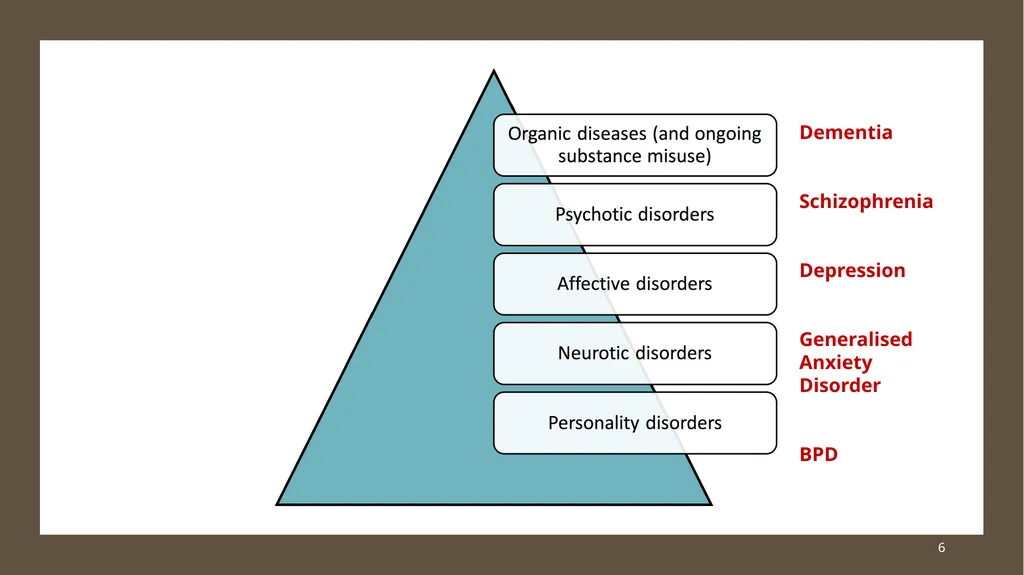
6 Dementia
Schizophrenia
Depression
Generalised Anxiety Disorder
BPD<br>
Schizophrenia
Depression
Generalised Anxiety Disorder
BPD<br>
07
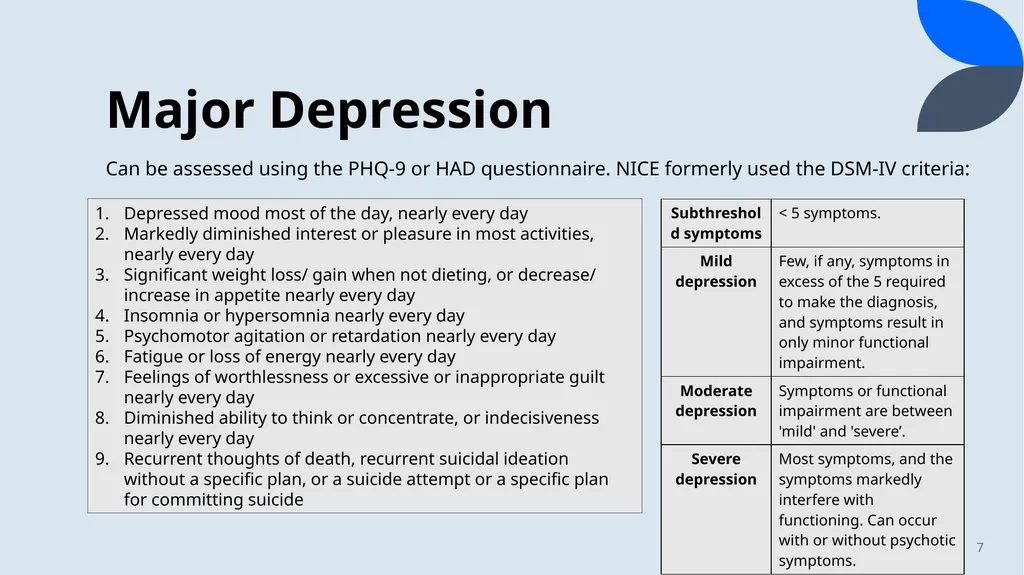
Major Depression Can be assessed using the PHQ-9 or HAD questionnaire. NICE formerly used the DSM-IV criteria: 7 Depressed mood most of the day, nearly every day
Markedly diminished interest or pleasure in most activities, nearly every day
Significant weight loss/ gain when not dieting, or decrease/ increase in appetite nearly every day
Insomnia or hypersomnia nearly every day
Psychomotor agitation or retardation nearly every day
Fatigue or loss of energy nearly every day
Feelings of worthlessness or excessive or inappropriate guilt nearly every day
Diminished ability to think or concentrate, or indecisiveness nearly every day
Recurrent thoughts of death, recurrent suicidal ideation without a specific plan, or a suicide attempt or a specific plan for committing suicide<br>
Markedly diminished interest or pleasure in most activities, nearly every day
Significant weight loss/ gain when not dieting, or decrease/ increase in appetite nearly every day
Insomnia or hypersomnia nearly every day
Psychomotor agitation or retardation nearly every day
Fatigue or loss of energy nearly every day
Feelings of worthlessness or excessive or inappropriate guilt nearly every day
Diminished ability to think or concentrate, or indecisiveness nearly every day
Recurrent thoughts of death, recurrent suicidal ideation without a specific plan, or a suicide attempt or a specific plan for committing suicide<br>
08
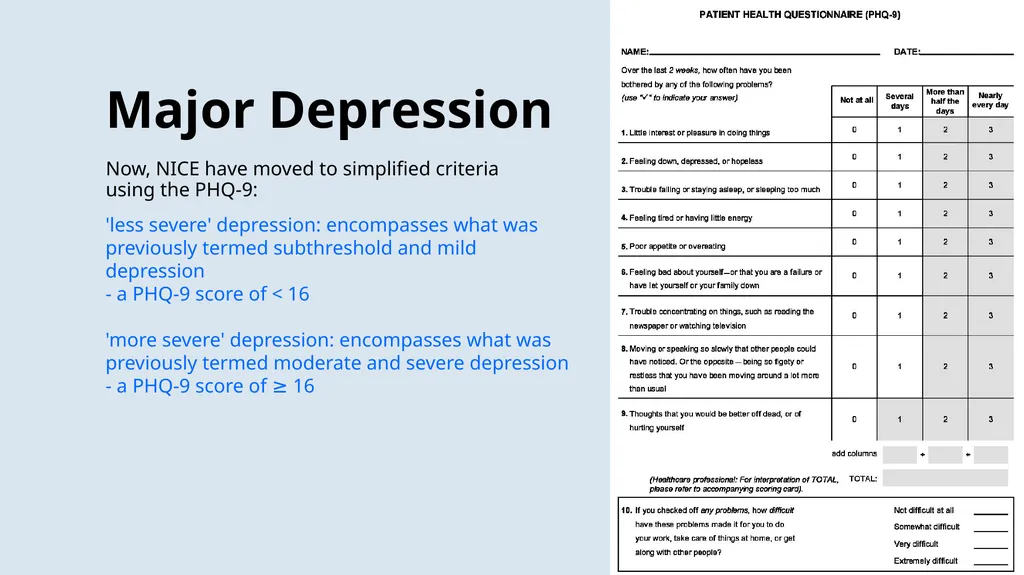
Major Depression Now, NICE have moved to simplified criteria using the PHQ-9: 8 'less severe' depression: encompasses what was previously termed subthreshold and mild depression
- a PHQ-9 score of < 16
'more severe' depression: encompasses what was previously termed moderate and severe depression
- a PHQ-9 score of ≥ 16<br>
- a PHQ-9 score of < 16
'more severe' depression: encompasses what was previously termed moderate and severe depression
- a PHQ-9 score of ≥ 16<br>
09
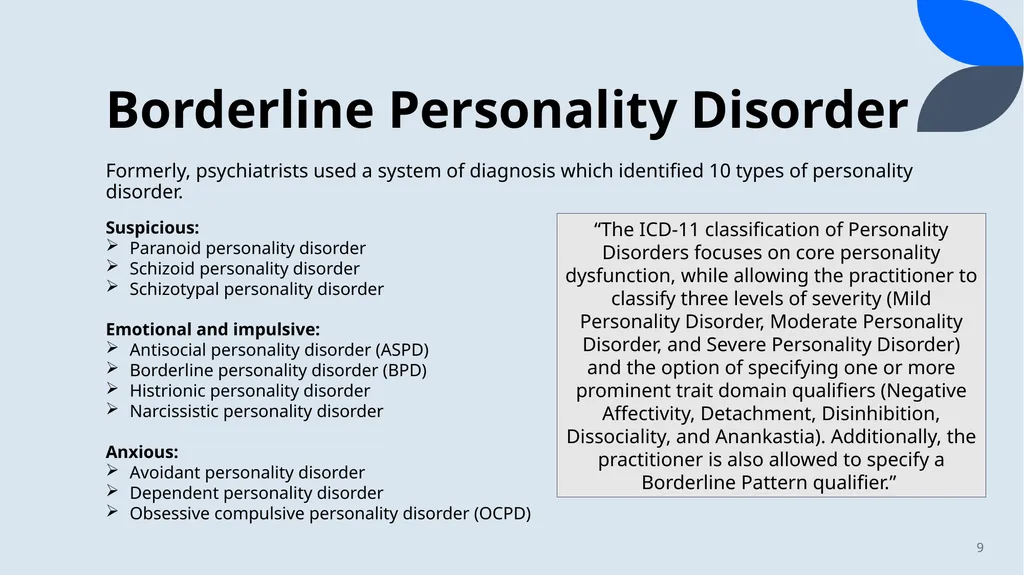
Borderline Personality Disorder Formerly, psychiatrists used a system of diagnosis which identified 10 types of personality disorder.
Suspicious:
Paranoid personality disorder
Schizoid personality disorder
Schizotypal personality disorder
Emotional and impulsive:
Antisocial personality disorder (ASPD)
Borderline personality disorder (BPD)
Histrionic personality disorder
Narcissistic personality disorder
Anxious:
Avoidant personality disorder
Dependent personality disorder
Obsessive compulsive personality disorder (OCPD) 9 “The ICD-11 classification of Personality Disorders focuses on core personality dysfunction, while allowing the practitioner to classify three levels of severity (Mild Personality Disorder, Moderate Personality Disorder, and Severe Personality Disorder) and the option of specifying one or more prominent trait domain qualifiers (Negative Affectivity, Detachment, Disinhibition, Dissociality, and Anankastia). Additionally, the practitioner is also allowed to specify a Borderline Pattern qualifier.”<br>
Suspicious:
Paranoid personality disorder
Schizoid personality disorder
Schizotypal personality disorder
Emotional and impulsive:
Antisocial personality disorder (ASPD)
Borderline personality disorder (BPD)
Histrionic personality disorder
Narcissistic personality disorder
Anxious:
Avoidant personality disorder
Dependent personality disorder
Obsessive compulsive personality disorder (OCPD) 9 “The ICD-11 classification of Personality Disorders focuses on core personality dysfunction, while allowing the practitioner to classify three levels of severity (Mild Personality Disorder, Moderate Personality Disorder, and Severe Personality Disorder) and the option of specifying one or more prominent trait domain qualifiers (Negative Affectivity, Detachment, Disinhibition, Dissociality, and Anankastia). Additionally, the practitioner is also allowed to specify a Borderline Pattern qualifier.”<br>
10
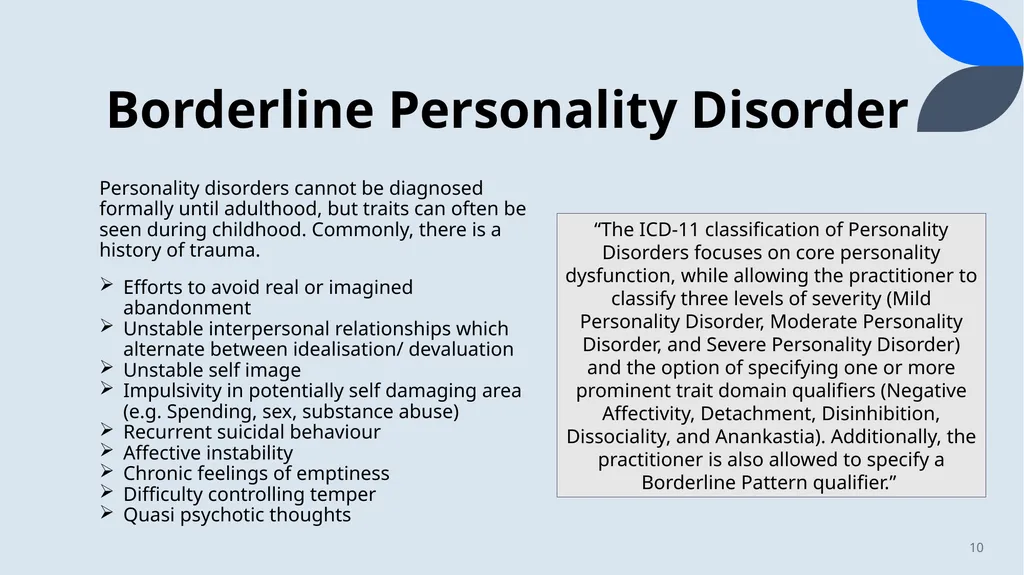
Borderline Personality Disorder Personality disorders cannot be diagnosed formally until adulthood, but traits can often be seen during childhood. Commonly, there is a history of trauma.
Efforts to avoid real or imagined abandonment
Unstable interpersonal relationships which alternate between idealisation/ devaluation
Unstable self image
Impulsivity in potentially self damaging area (e.g. Spending, sex, substance abuse)
Recurrent suicidal behaviour
Affective instability
Chronic feelings of emptiness
Difficulty controlling temper
Quasi psychotic thoughts 10 “The ICD-11 classification of Personality Disorders focuses on core personality dysfunction, while allowing the practitioner to classify three levels of severity (Mild Personality Disorder, Moderate Personality Disorder, and Severe Personality Disorder) and the option of specifying one or more prominent trait domain qualifiers (Negative Affectivity, Detachment, Disinhibition, Dissociality, and Anankastia). Additionally, the practitioner is also allowed to specify a Borderline Pattern qualifier.”<br>
Efforts to avoid real or imagined abandonment
Unstable interpersonal relationships which alternate between idealisation/ devaluation
Unstable self image
Impulsivity in potentially self damaging area (e.g. Spending, sex, substance abuse)
Recurrent suicidal behaviour
Affective instability
Chronic feelings of emptiness
Difficulty controlling temper
Quasi psychotic thoughts 10 “The ICD-11 classification of Personality Disorders focuses on core personality dysfunction, while allowing the practitioner to classify three levels of severity (Mild Personality Disorder, Moderate Personality Disorder, and Severe Personality Disorder) and the option of specifying one or more prominent trait domain qualifiers (Negative Affectivity, Detachment, Disinhibition, Dissociality, and Anankastia). Additionally, the practitioner is also allowed to specify a Borderline Pattern qualifier.”<br>
11
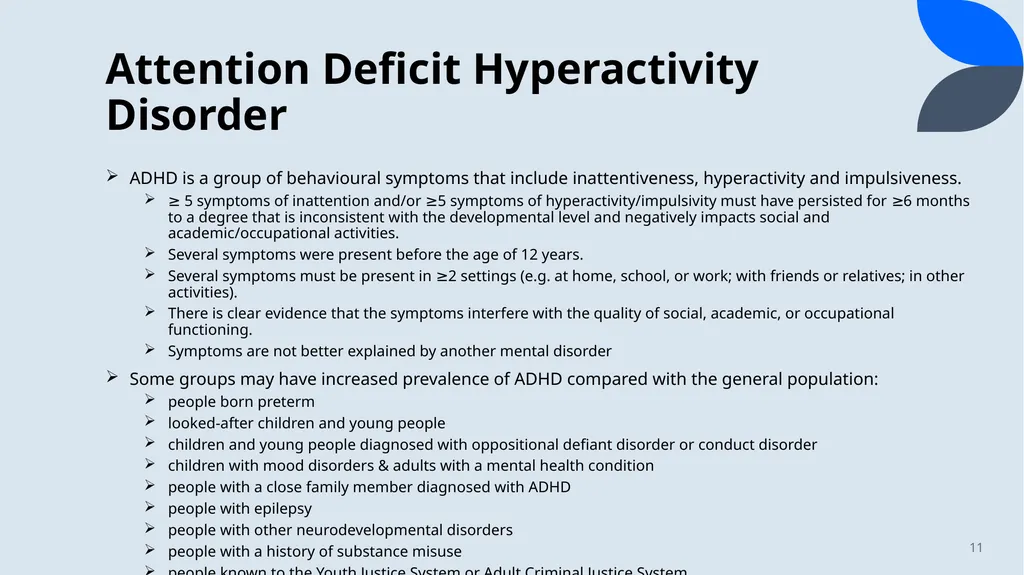
Attention Deficit Hyperactivity Disorder ADHD is a group of behavioural symptoms that include inattentiveness, hyperactivity and impulsiveness.
≥ 5 symptoms of inattention and/or ≥5 symptoms of hyperactivity/impulsivity must have persisted for ≥6 months to a degree that is inconsistent with the developmental level and negatively impacts social and academic/occupational activities.
Several symptoms were present before the age of 12 years.
Several symptoms must be present in ≥2 settings (e.g. at home, school, or work; with friends or relatives; in other activities).
There is clear evidence that the symptoms interfere with the quality of social, academic, or occupational functioning.
Symptoms are not better explained by another mental disorder
Some groups may have increased prevalence of ADHD compared with the general population:
people born preterm
looked-after children and young people
children and young people diagnosed with oppositional defiant disorder or conduct disorder
children with mood disorders & adults with a mental health condition
people with a close family member diagnosed with ADHD
people with epilepsy
people with other neurodevelopmental disorders
people with a history of substance misuse
people known to the Youth Justice System or Adult Criminal Justice System
people with acquired brain injury. 11<br>
≥ 5 symptoms of inattention and/or ≥5 symptoms of hyperactivity/impulsivity must have persisted for ≥6 months to a degree that is inconsistent with the developmental level and negatively impacts social and academic/occupational activities.
Several symptoms were present before the age of 12 years.
Several symptoms must be present in ≥2 settings (e.g. at home, school, or work; with friends or relatives; in other activities).
There is clear evidence that the symptoms interfere with the quality of social, academic, or occupational functioning.
Symptoms are not better explained by another mental disorder
Some groups may have increased prevalence of ADHD compared with the general population:
people born preterm
looked-after children and young people
children and young people diagnosed with oppositional defiant disorder or conduct disorder
children with mood disorders & adults with a mental health condition
people with a close family member diagnosed with ADHD
people with epilepsy
people with other neurodevelopmental disorders
people with a history of substance misuse
people known to the Youth Justice System or Adult Criminal Justice System
people with acquired brain injury. 11<br>
12
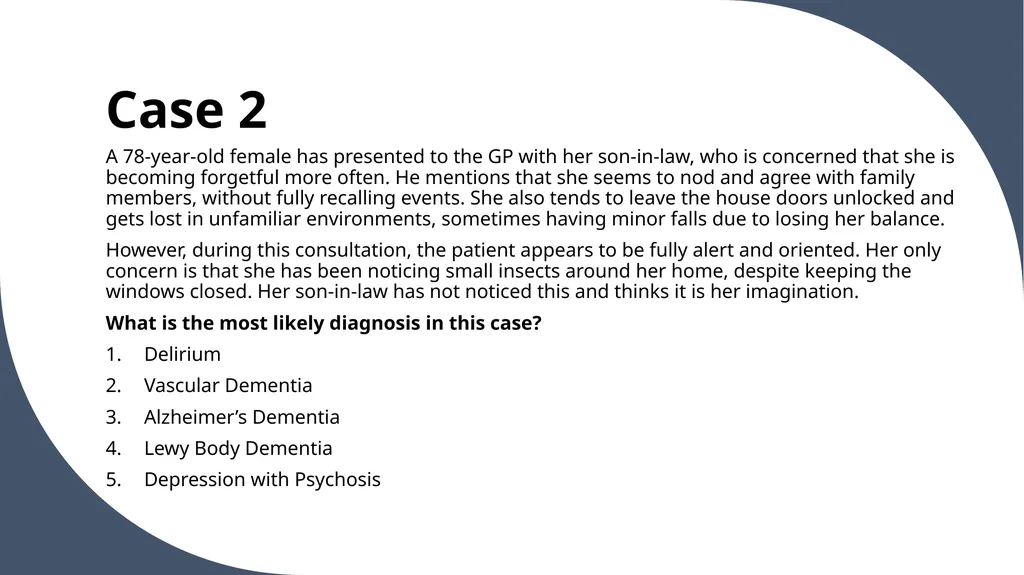
Case 2 A 78-year-old female has presented to the GP with her son-in-law, who is concerned that she is becoming forgetful more often. He mentions that she seems to nod and agree with family members, without fully recalling events. She also tends to leave the house doors unlocked and gets lost in unfamiliar environments, sometimes having minor falls due to losing her balance.
However, during this consultation, the patient appears to be fully alert and oriented. Her only concern is that she has been noticing small insects around her home, despite keeping the windows closed. Her son-in-law has not noticed this and thinks it is her imagination.
What is the most likely diagnosis in this case?
Delirium
Vascular Dementia
Alzheimer’s Dementia
Lewy Body Dementia
Depression with Psychosis<br>
However, during this consultation, the patient appears to be fully alert and oriented. Her only concern is that she has been noticing small insects around her home, despite keeping the windows closed. Her son-in-law has not noticed this and thinks it is her imagination.
What is the most likely diagnosis in this case?
Delirium
Vascular Dementia
Alzheimer’s Dementia
Lewy Body Dementia
Depression with Psychosis<br>
13
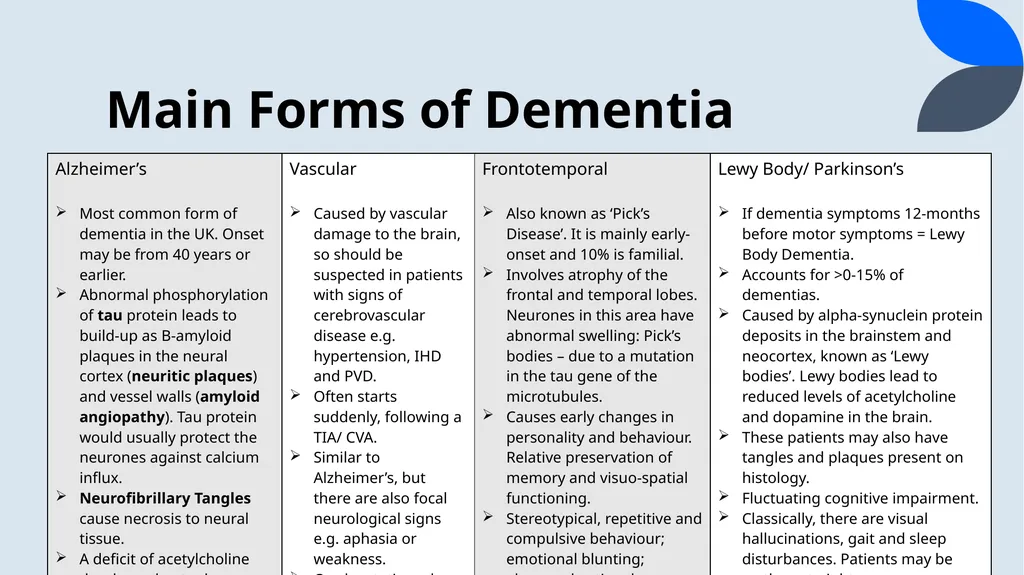
Main Forms of Dementia 13<br>
14
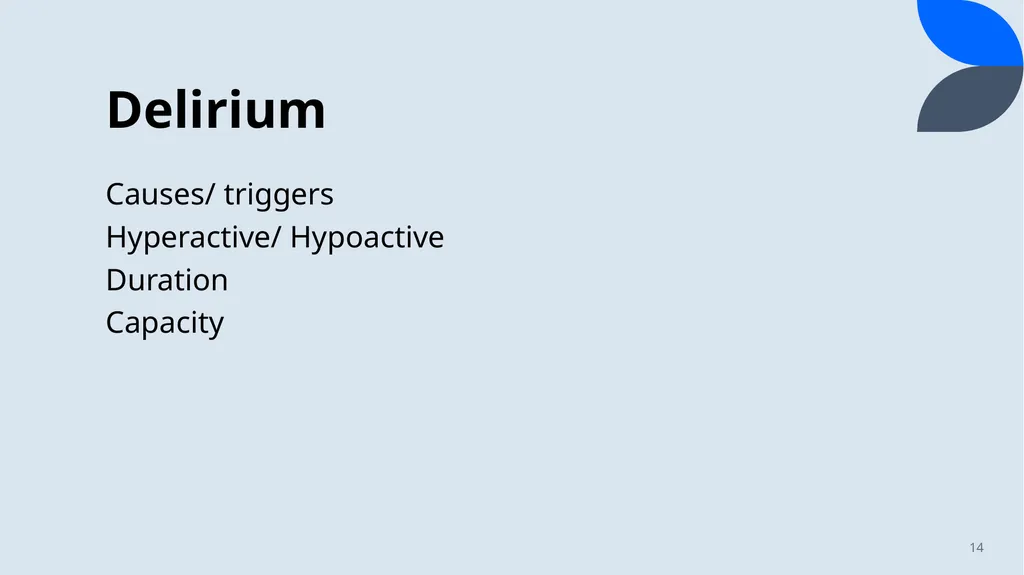
Delirium Causes/ triggers
Hyperactive/ Hypoactive
Duration
Capacity 14<br>
Hyperactive/ Hypoactive
Duration
Capacity 14<br>
15
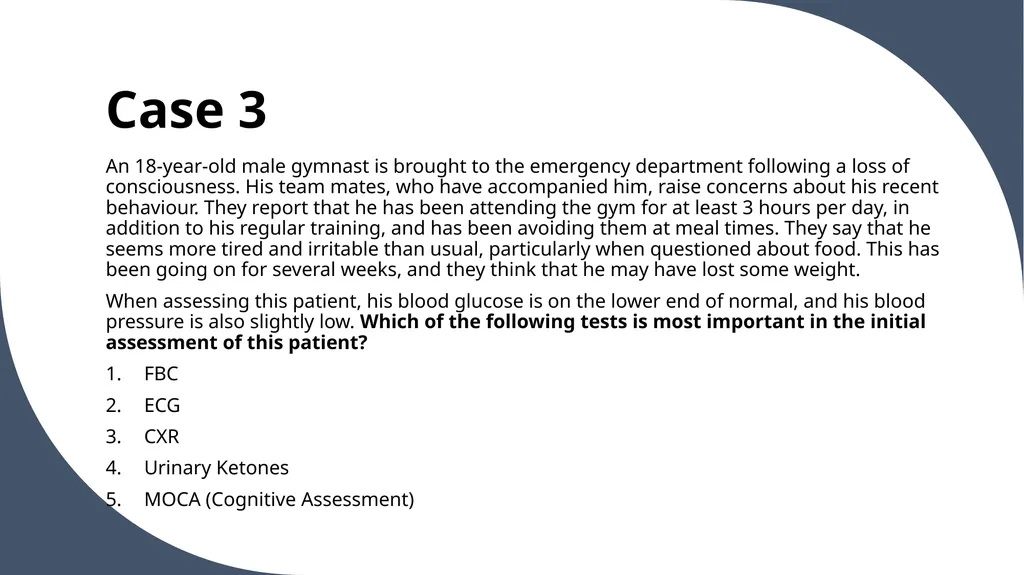
Case 3 An 18-year-old male gymnast is brought to the emergency department following a loss of consciousness. His team mates, who have accompanied him, raise concerns about his recent behaviour. They report that he has been attending the gym for at least 3 hours per day, in addition to his regular training, and has been avoiding them at meal times. They say that he seems more tired and irritable than usual, particularly when questioned about food. This has been going on for several weeks, and they think that he may have lost some weight.
When assessing this patient, his blood glucose is on the lower end of normal, and his blood pressure is also slightly low. Which of the following tests is most important in the initial assessment of this patient?
FBC
ECG
CXR
Urinary Ketones
MOCA (Cognitive Assessment)<br>
When assessing this patient, his blood glucose is on the lower end of normal, and his blood pressure is also slightly low. Which of the following tests is most important in the initial assessment of this patient?
FBC
ECG
CXR
Urinary Ketones
MOCA (Cognitive Assessment)<br>
16
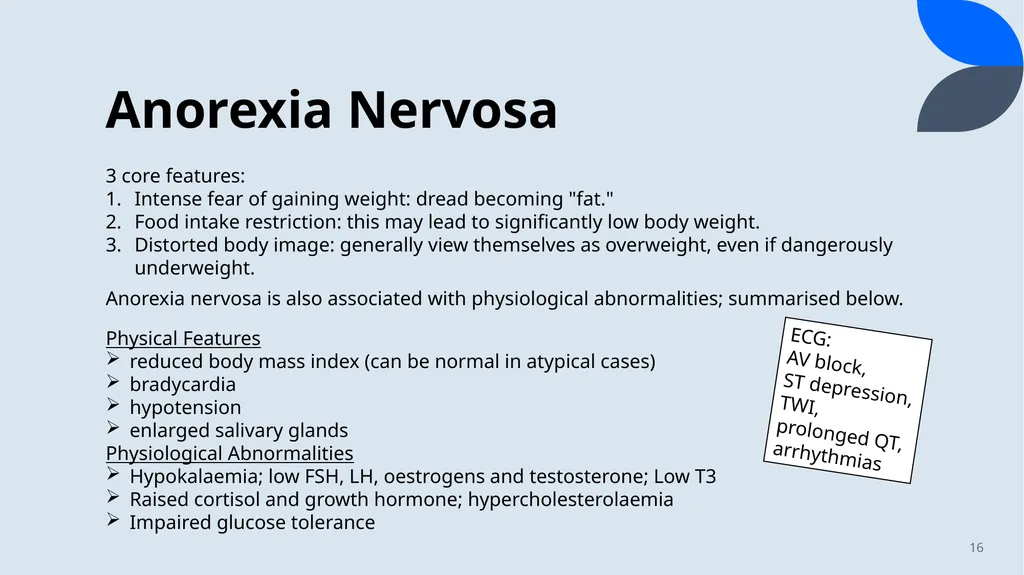
Anorexia Nervosa 3 core features:
Intense fear of gaining weight: dread becoming "fat."
Food intake restriction: this may lead to significantly low body weight.
Distorted body image: generally view themselves as overweight, even if dangerously underweight.
Anorexia nervosa is also associated with physiological abnormalities; summarised below.
Physical Features
reduced body mass index (can be normal in atypical cases)
bradycardia
hypotension
enlarged salivary glands
Physiological Abnormalities
Hypokalaemia; low FSH, LH, oestrogens and testosterone; Low T3
Raised cortisol and growth hormone; hypercholesterolaemia
Impaired glucose tolerance 16 ECG:
AV block,
ST depression,
TWI,
prolonged QT,
arrhythmias<br>
Intense fear of gaining weight: dread becoming "fat."
Food intake restriction: this may lead to significantly low body weight.
Distorted body image: generally view themselves as overweight, even if dangerously underweight.
Anorexia nervosa is also associated with physiological abnormalities; summarised below.
Physical Features
reduced body mass index (can be normal in atypical cases)
bradycardia
hypotension
enlarged salivary glands
Physiological Abnormalities
Hypokalaemia; low FSH, LH, oestrogens and testosterone; Low T3
Raised cortisol and growth hormone; hypercholesterolaemia
Impaired glucose tolerance 16 ECG:
AV block,
ST depression,
TWI,
prolonged QT,
arrhythmias<br>
17
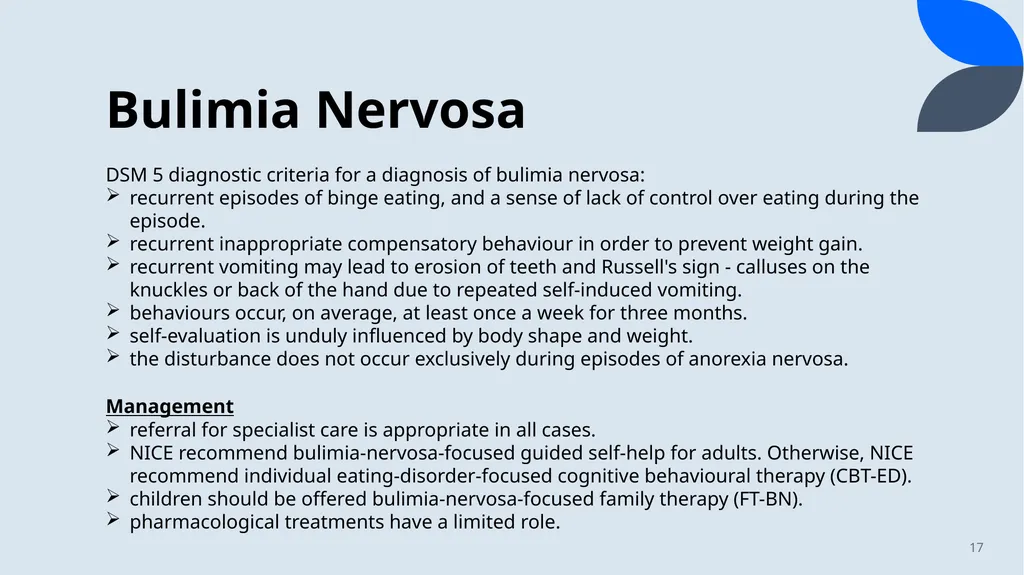
Bulimia Nervosa DSM 5 diagnostic criteria for a diagnosis of bulimia nervosa:
recurrent episodes of binge eating, and a sense of lack of control over eating during the episode.
recurrent inappropriate compensatory behaviour in order to prevent weight gain.
recurrent vomiting may lead to erosion of teeth and Russell's sign - calluses on the knuckles or back of the hand due to repeated self-induced vomiting.
behaviours occur, on average, at least once a week for three months.
self-evaluation is unduly influenced by body shape and weight.
the disturbance does not occur exclusively during episodes of anorexia nervosa.
Management
referral for specialist care is appropriate in all cases.
NICE recommend bulimia-nervosa-focused guided self-help for adults. Otherwise, NICE recommend individual eating-disorder-focused cognitive behavioural therapy (CBT-ED).
children should be offered bulimia-nervosa-focused family therapy (FT-BN).
pharmacological treatments have a limited role. 17<br>
recurrent episodes of binge eating, and a sense of lack of control over eating during the episode.
recurrent inappropriate compensatory behaviour in order to prevent weight gain.
recurrent vomiting may lead to erosion of teeth and Russell's sign - calluses on the knuckles or back of the hand due to repeated self-induced vomiting.
behaviours occur, on average, at least once a week for three months.
self-evaluation is unduly influenced by body shape and weight.
the disturbance does not occur exclusively during episodes of anorexia nervosa.
Management
referral for specialist care is appropriate in all cases.
NICE recommend bulimia-nervosa-focused guided self-help for adults. Otherwise, NICE recommend individual eating-disorder-focused cognitive behavioural therapy (CBT-ED).
children should be offered bulimia-nervosa-focused family therapy (FT-BN).
pharmacological treatments have a limited role. 17<br>
18
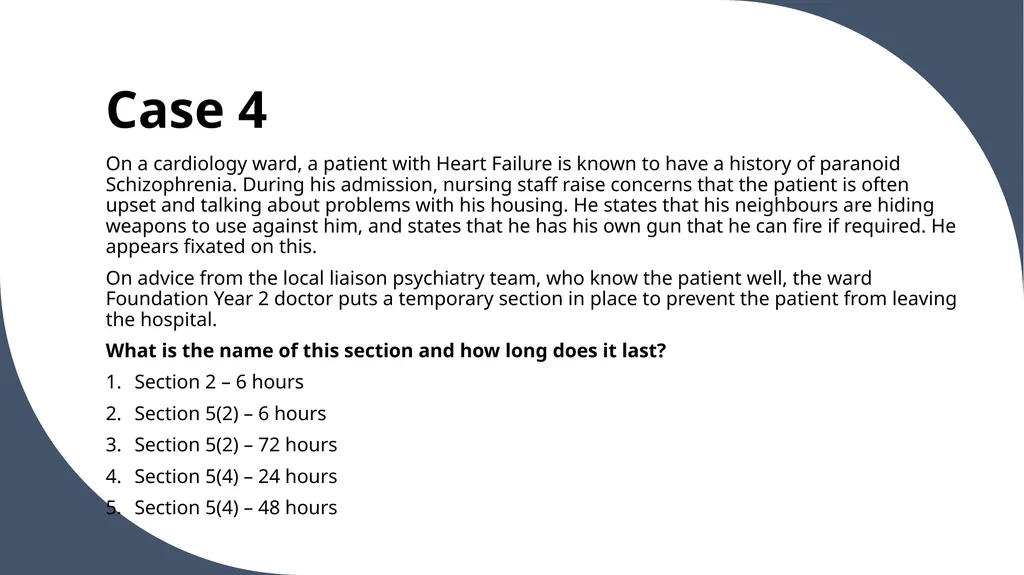
Case 4 On a cardiology ward, a patient with Heart Failure is known to have a history of paranoid Schizophrenia. During his admission, nursing staff raise concerns that the patient is often upset and talking about problems with his housing. He states that his neighbours are hiding weapons to use against him, and states that he has his own gun that he can fire if required. He appears fixated on this.
On advice from the local liaison psychiatry team, who know the patient well, the ward Foundation Year 2 doctor puts a temporary section in place to prevent the patient from leaving the hospital.
What is the name of this section and how long does it last?
Section 2 – 6 hours
Section 5(2) – 6 hours
Section 5(2) – 72 hours
Section 5(4) – 24 hours
Section 5(4) – 48 hours<br>
On advice from the local liaison psychiatry team, who know the patient well, the ward Foundation Year 2 doctor puts a temporary section in place to prevent the patient from leaving the hospital.
What is the name of this section and how long does it last?
Section 2 – 6 hours
Section 5(2) – 6 hours
Section 5(2) – 72 hours
Section 5(4) – 24 hours
Section 5(4) – 48 hours<br>
19
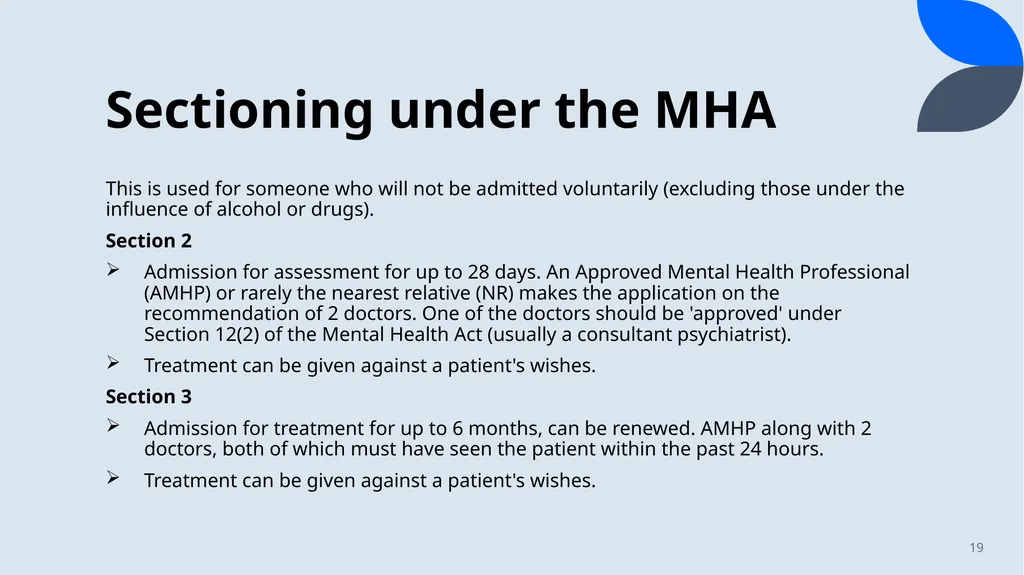
Sectioning under the MHA This is used for someone who will not be admitted voluntarily (excluding those under the influence of alcohol or drugs).
Section 2
Admission for assessment for up to 28 days. An Approved Mental Health Professional (AMHP) or rarely the nearest relative (NR) makes the application on the recommendation of 2 doctors. One of the doctors should be 'approved' under Section 12(2) of the Mental Health Act (usually a consultant psychiatrist).
Treatment can be given against a patient's wishes.
Section 3
Admission for treatment for up to 6 months, can be renewed. AMHP along with 2 doctors, both of which must have seen the patient within the past 24 hours.
Treatment can be given against a patient's wishes. 19<br>
Section 2
Admission for assessment for up to 28 days. An Approved Mental Health Professional (AMHP) or rarely the nearest relative (NR) makes the application on the recommendation of 2 doctors. One of the doctors should be 'approved' under Section 12(2) of the Mental Health Act (usually a consultant psychiatrist).
Treatment can be given against a patient's wishes.
Section 3
Admission for treatment for up to 6 months, can be renewed. AMHP along with 2 doctors, both of which must have seen the patient within the past 24 hours.
Treatment can be given against a patient's wishes. 19<br>
20
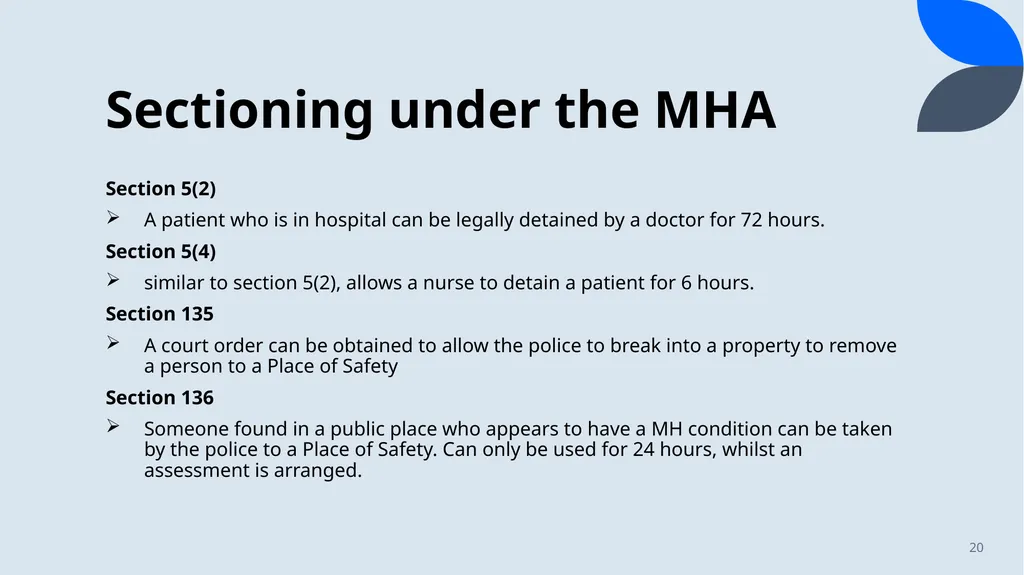
Sectioning under the MHA Section 5(2)
A patient who is in hospital can be legally detained by a doctor for 72 hours.
Section 5(4)
similar to section 5(2), allows a nurse to detain a patient for 6 hours.
Section 135
A court order can be obtained to allow the police to break into a property to remove a person to a Place of Safety
Section 136
Someone found in a public place who appears to have a MH condition can be taken by the police to a Place of Safety. Can only be used for 24 hours, whilst an assessment is arranged. 20<br>
A patient who is in hospital can be legally detained by a doctor for 72 hours.
Section 5(4)
similar to section 5(2), allows a nurse to detain a patient for 6 hours.
Section 135
A court order can be obtained to allow the police to break into a property to remove a person to a Place of Safety
Section 136
Someone found in a public place who appears to have a MH condition can be taken by the police to a Place of Safety. Can only be used for 24 hours, whilst an assessment is arranged. 20<br>
21
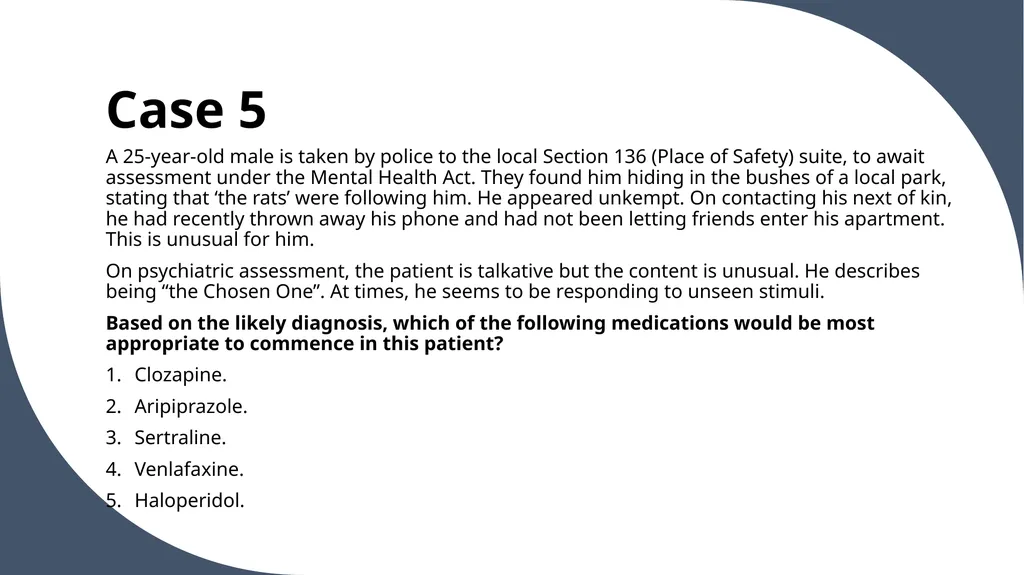
Case 5 A 25-year-old male is taken by police to the local Section 136 (Place of Safety) suite, to await assessment under the Mental Health Act. They found him hiding in the bushes of a local park, stating that ‘the rats’ were following him. He appeared unkempt. On contacting his next of kin, he had recently thrown away his phone and had not been letting friends enter his apartment. This is unusual for him.
On psychiatric assessment, the patient is talkative but the content is unusual. He describes being “the Chosen One”. At times, he seems to be responding to unseen stimuli.
Based on the likely diagnosis, which of the following medications would be most appropriate to commence in this patient?
Clozapine.
Aripiprazole.
Sertraline.
Venlafaxine.
Haloperidol.<br>
On psychiatric assessment, the patient is talkative but the content is unusual. He describes being “the Chosen One”. At times, he seems to be responding to unseen stimuli.
Based on the likely diagnosis, which of the following medications would be most appropriate to commence in this patient?
Clozapine.
Aripiprazole.
Sertraline.
Venlafaxine.
Haloperidol.<br>
22
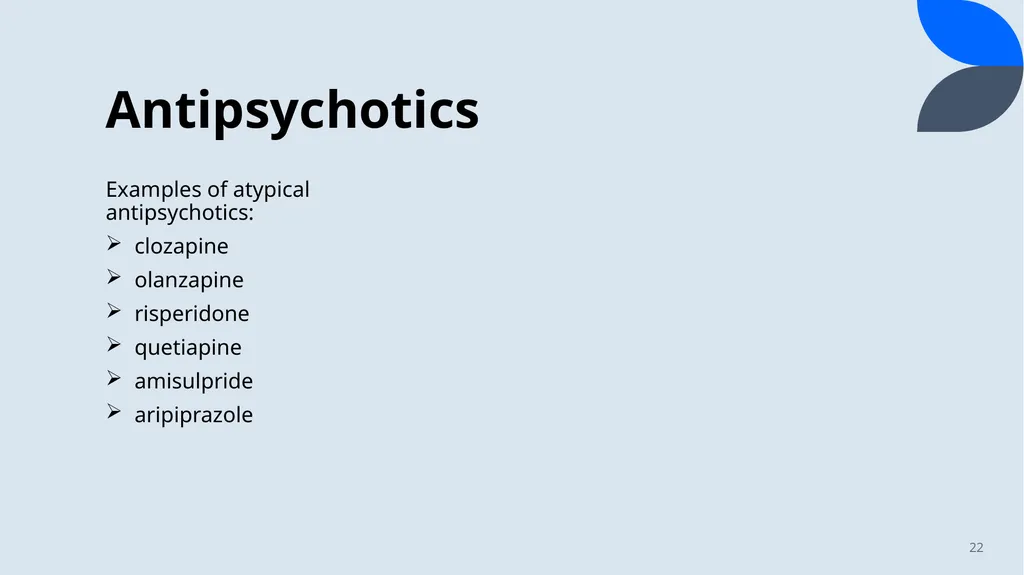
Antipsychotics Examples of atypical antipsychotics:
clozapine
olanzapine
risperidone
quetiapine
amisulpride
aripiprazole 22<br>
clozapine
olanzapine
risperidone
quetiapine
amisulpride
aripiprazole 22<br>
23
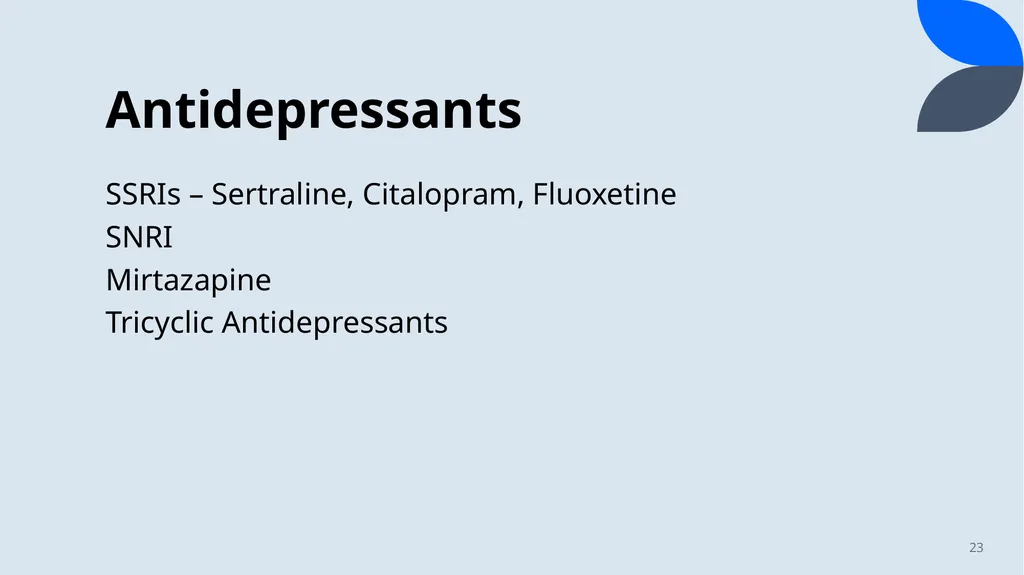
Antidepressants SSRIs – Sertraline, Citalopram, Fluoxetine
SNRI
Mirtazapine
Tricyclic Antidepressants 23<br>
SNRI
Mirtazapine
Tricyclic Antidepressants 23<br>
24
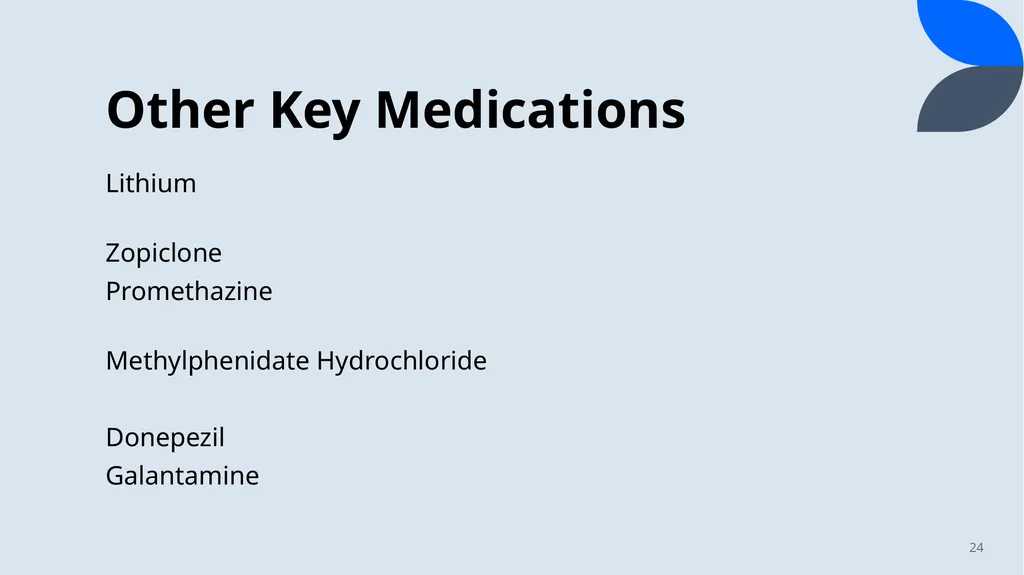
Other Key Medications Lithium
Zopiclone
Promethazine
Methylphenidate Hydrochloride
Donepezil
Galantamine 24<br>
Zopiclone
Promethazine
Methylphenidate Hydrochloride
Donepezil
Galantamine 24<br>
25
Any Questions? eleanorlouise.morris@nhs.net<br>