
Pushing the Limits of Accelerator Efficiency While
BR
Published · 45 slides · 0 views
1 / 1

Description
Pushing the Limits of Accelerator Efficiency While Retaining Programmability Tony Nowatzki, Vinay Gangadhar, Karu Sankaralingam, Greg Wright Vertical Research Group University of Wisconsin Madison Qualcomm 1 Executive Summary 5
Related Topics
Share
Embed code
Download this presentation From Below
"Pushing the Limits of Accelerator Efficiency While" is the property of its rightful owner. Permission is granted to download and print the materials on this website for personal, non-commercial use only, and to display it on your personal computer provided you do not modify the materials and that you retain all copyright notices contained in the materials. By downloading content from our website, you accept the terms of this agreement.
Presentation Transcript
01
Pushing the Limits of Accelerator Efficiency While Retaining Programmability Tony Nowatzki*, Vinay Gangadhar*, Karu Sankaralingam*, Greg Wright+
*Vertical Research Group
University of Wisconsin – Madison
+Qualcomm 1<br>
*Vertical Research Group
University of Wisconsin – Madison
+Qualcomm 1<br>
02
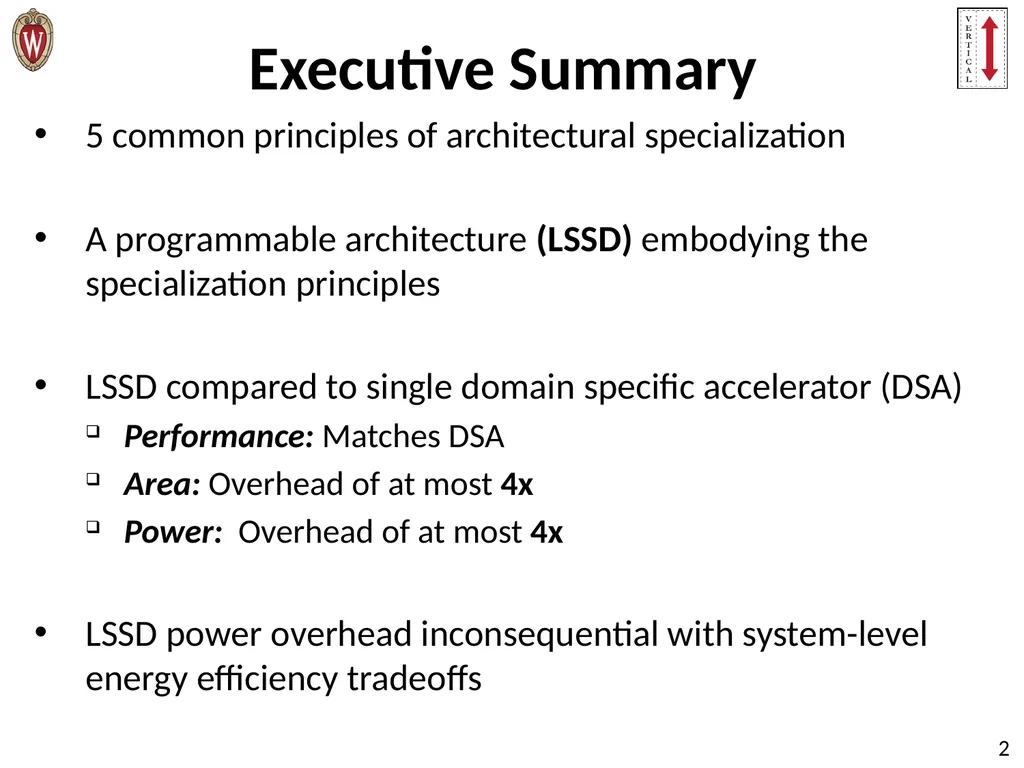
Executive Summary 5 common principles of architectural specialization
A programmable architecture (LSSD) embodying the specialization principles
LSSD compared to single domain specific accelerator (DSA)
Performance: Matches DSA
Area: Overhead of at most 4x
Power: Overhead of at most 4x
LSSD power overhead inconsequential with system-level energy efficiency tradeoffs 2<br>
A programmable architecture (LSSD) embodying the specialization principles
LSSD compared to single domain specific accelerator (DSA)
Performance: Matches DSA
Area: Overhead of at most 4x
Power: Overhead of at most 4x
LSSD power overhead inconsequential with system-level energy efficiency tradeoffs 2<br>
03
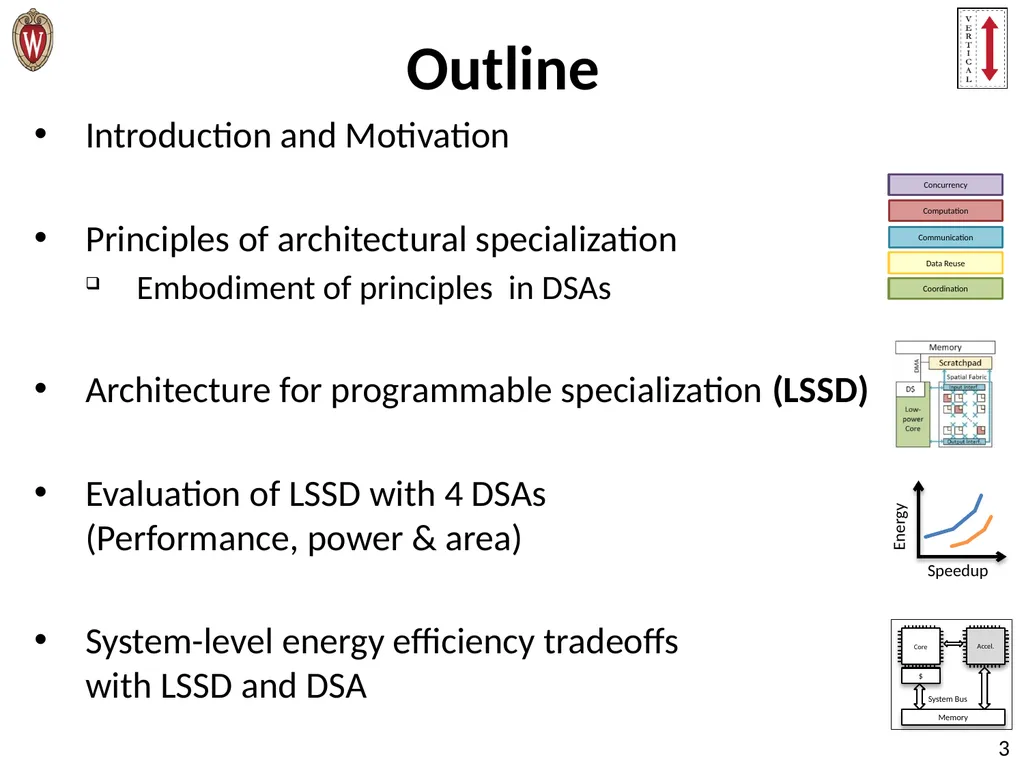
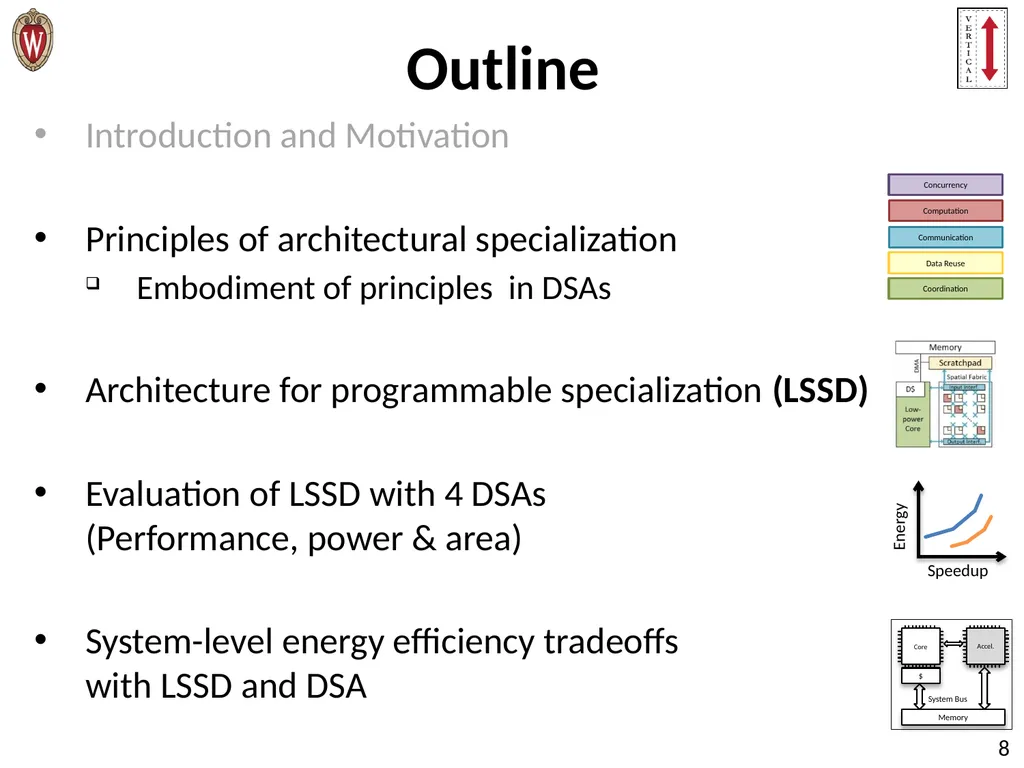
Outline Introduction and Motivation
Principles of architectural specialization
Embodiment of principles in DSAs
Architecture for programmable specialization (LSSD)
Evaluation of LSSD with 4 DSAs (Performance, power & area)
System-level energy efficiency tradeoffs with LSSD and DSA 3<br>
Principles of architectural specialization
Embodiment of principles in DSAs
Architecture for programmable specialization (LSSD)
Evaluation of LSSD with 4 DSAs (Performance, power & area)
System-level energy efficiency tradeoffs with LSSD and DSA 3<br>
04
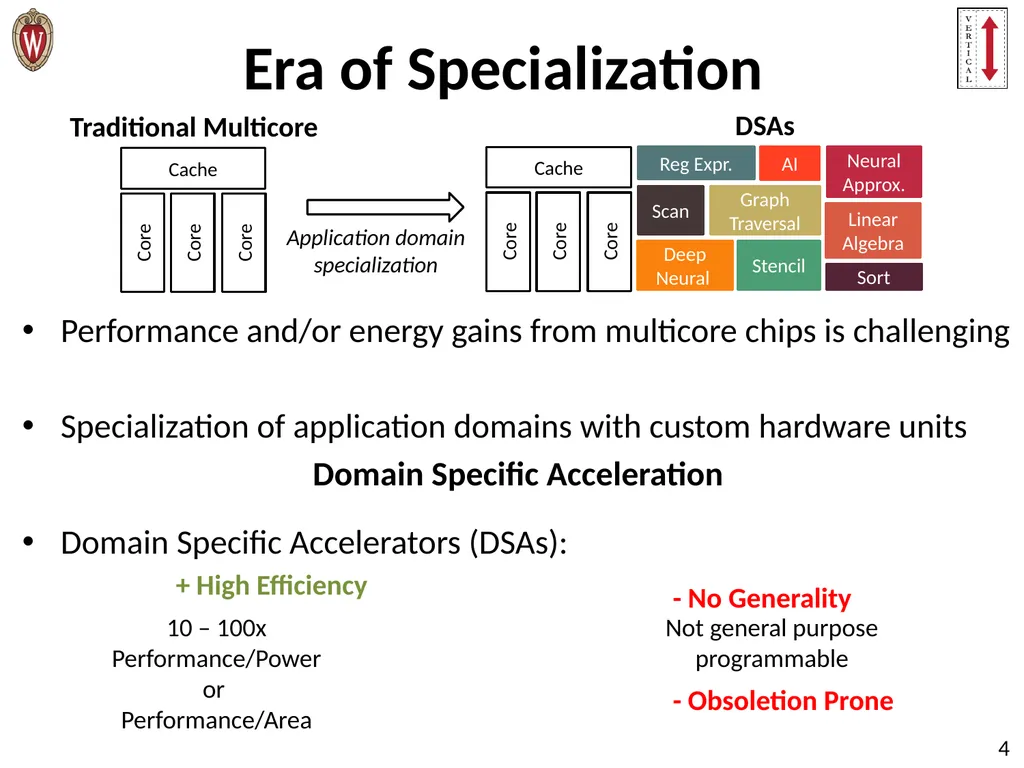
Era of Specialization Performance and/or energy gains from multicore chips is challenging
Specialization of application domains with custom hardware units
Domain Specific Acceleration
Domain Specific Accelerators (DSAs):
+ High Efficiency 4 Traditional Multicore Linear Algebra Neural Approx. Graph Traversal AI Scan Sort Reg Expr. Deep Neural Stencil DSAs Application domain specialization 10 – 100x
Performance/Power
or
Performance/Area Not general purpose programmable - No Generality
- Obsoletion Prone<br>
Specialization of application domains with custom hardware units
Domain Specific Acceleration
Domain Specific Accelerators (DSAs):
+ High Efficiency 4 Traditional Multicore Linear Algebra Neural Approx. Graph Traversal AI Scan Sort Reg Expr. Deep Neural Stencil DSAs Application domain specialization 10 – 100x
Performance/Power
or
Performance/Area Not general purpose programmable - No Generality
- Obsoletion Prone<br>
05
Our Goal:
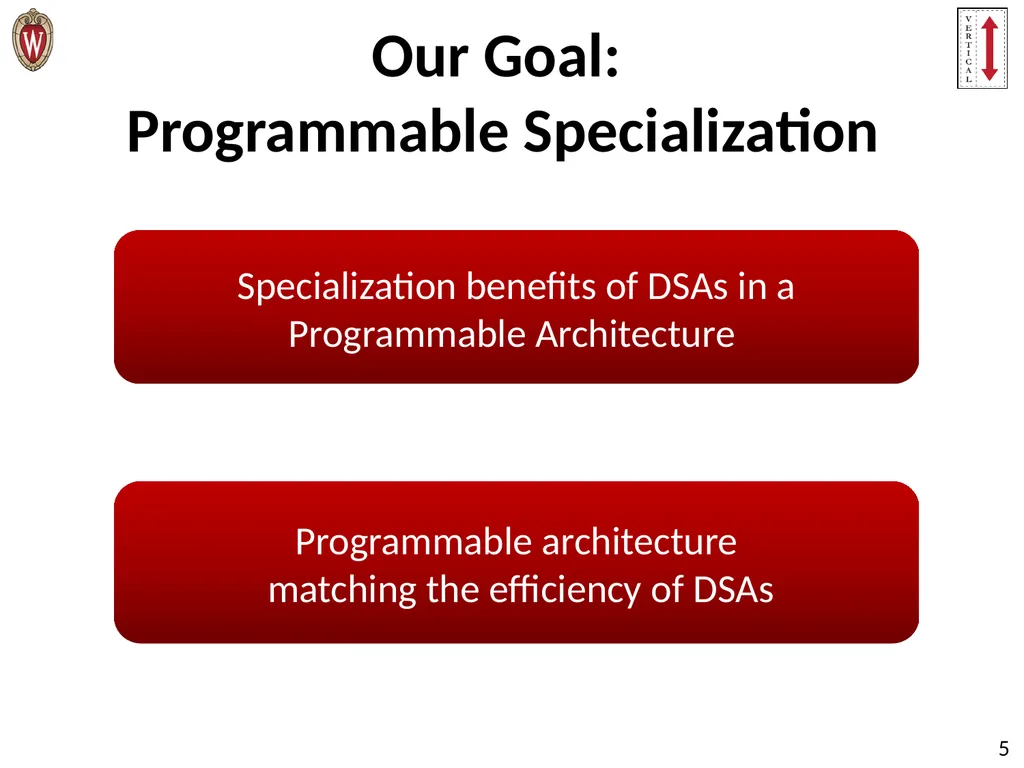
Programmable Specialization 5 Specialization benefits of DSAs in a Programmable Architecture Programmable architecture
matching the efficiency of DSAs<br>
matching the efficiency of DSAs<br>
06
Key Insight: Commonality in
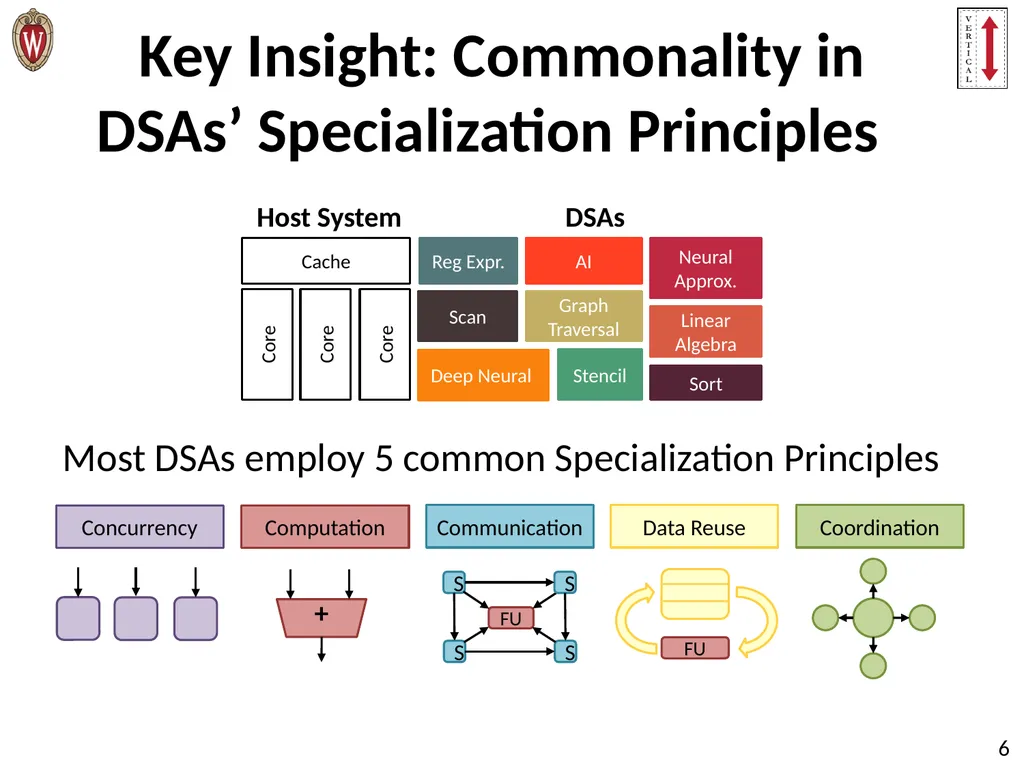
DSAs’ Specialization Principles 6 Most DSAs employ 5 common Specialization Principles Linear Algebra Neural Approx. Graph Traversal AI Scan Sort Reg Expr. Deep Neural Stencil DSAs Host System<br>
07
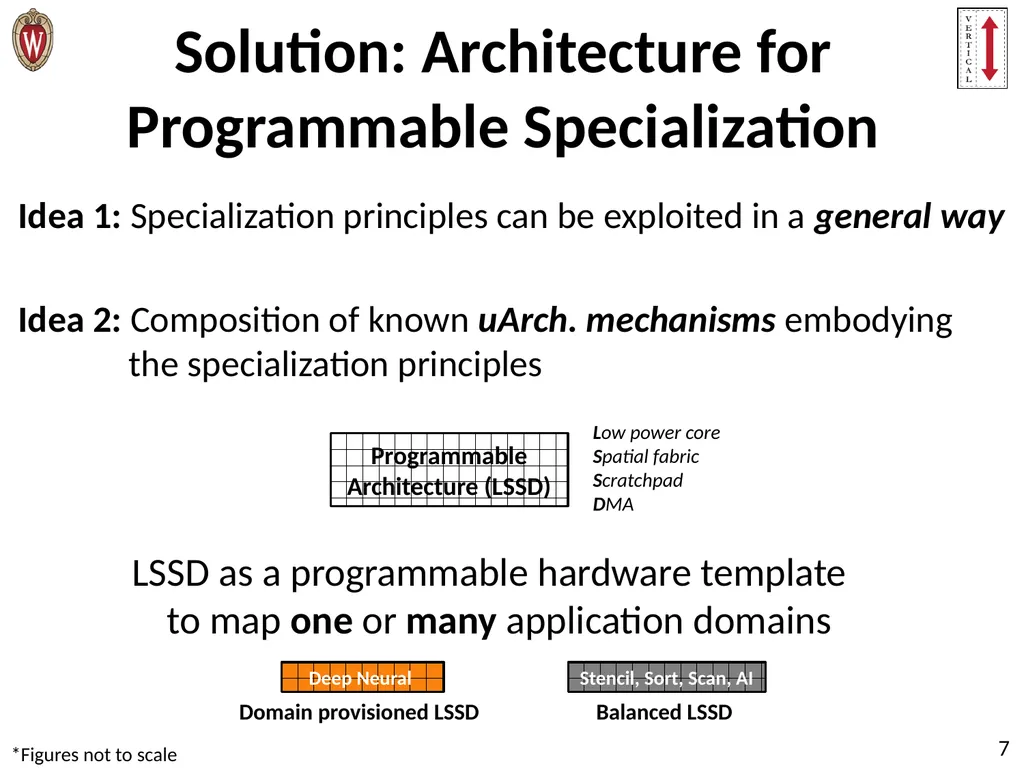
Solution: Architecture for Programmable Specialization Idea 1: Specialization principles can be exploited in a general way
Idea 2: Composition of known uArch. mechanisms embodying the specialization principles 7 LSSD as a programmable hardware template
to map one or many application domains Stencil, Sort, Scan, AI Balanced LSSD Deep Neural Domain provisioned LSSD *Figures not to scale<br>
Idea 2: Composition of known uArch. mechanisms embodying the specialization principles 7 LSSD as a programmable hardware template
to map one or many application domains Stencil, Sort, Scan, AI Balanced LSSD Deep Neural Domain provisioned LSSD *Figures not to scale<br>
08
Outline Introduction and Motivation
Principles of architectural specialization
Embodiment of principles in DSAs
Architecture for programmable specialization (LSSD)
Evaluation of LSSD with 4 DSAs (Performance, power & area)
System-level energy efficiency tradeoffs with LSSD and DSA 8<br>
Principles of architectural specialization
Embodiment of principles in DSAs
Architecture for programmable specialization (LSSD)
Evaluation of LSSD with 4 DSAs (Performance, power & area)
System-level energy efficiency tradeoffs with LSSD and DSA 8<br>
09
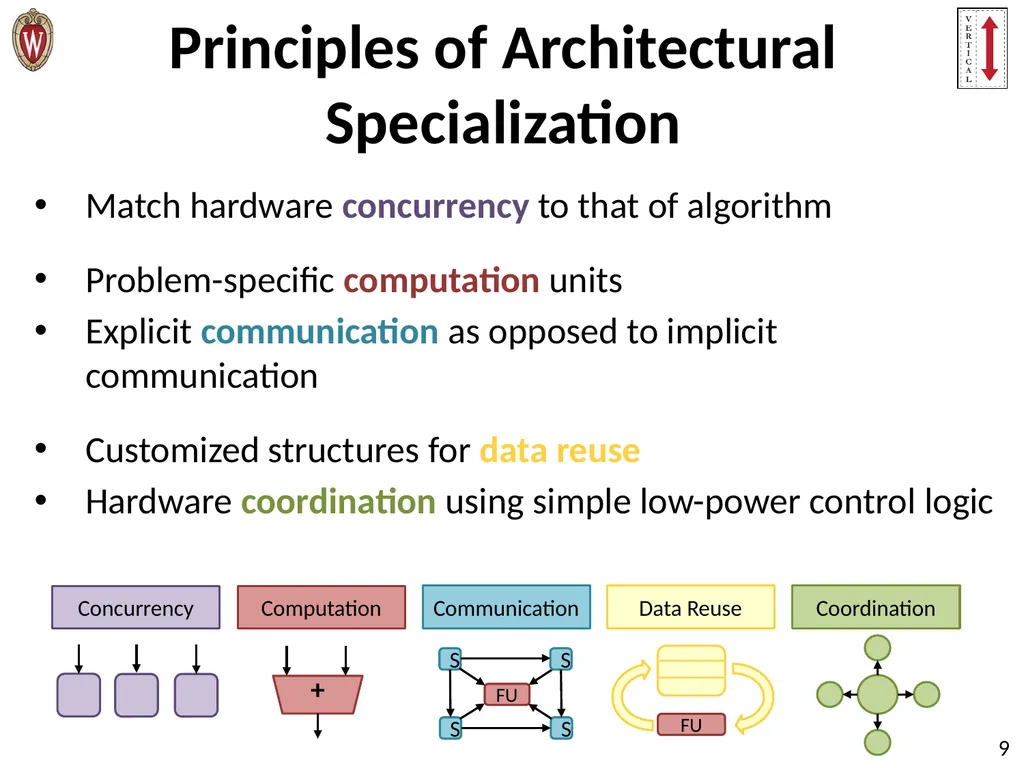
Principles of Architectural Specialization Match hardware concurrency to that of algorithm
Problem-specific computation units
Explicit communication as opposed to implicit communication
Customized structures for data reuse
Hardware coordination using simple low-power control logic 9<br>
Problem-specific computation units
Explicit communication as opposed to implicit communication
Customized structures for data reuse
Hardware coordination using simple low-power control logic 9<br>
10
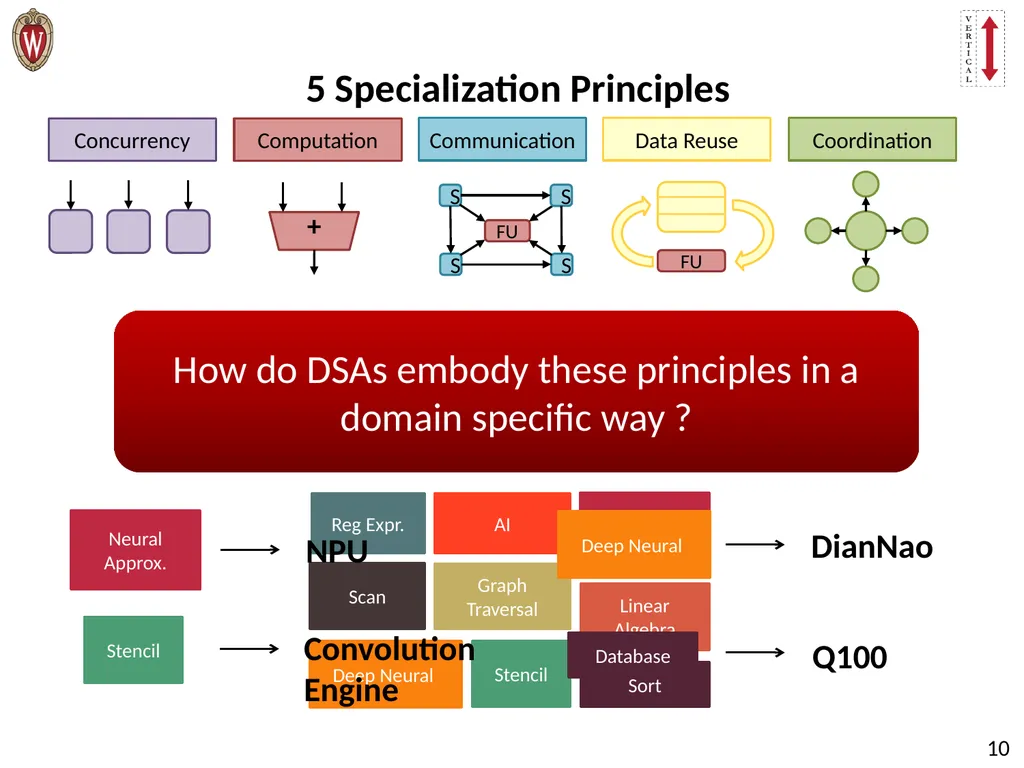
+ S S FU S S FU Computation Data Reuse Concurrency Coordination Communication 5 Specialization Principles 10 How do DSAs embody these principles in a domain specific way ?<br>
11
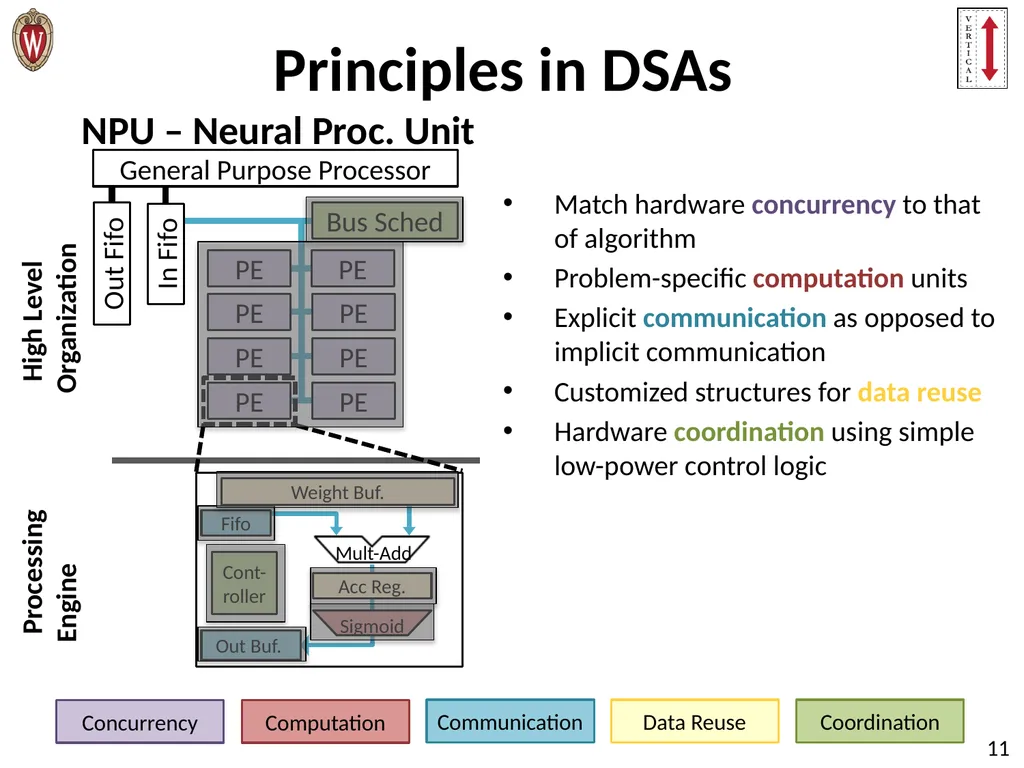
Principles in DSAs 11 Computation Data Reuse Concurrency Coordination Communication High Level
Organization Processing Engine In Fifo Bus Sched Out Fifo General Purpose Processor Weight Buf. Fifo Out Buf. Cont-roller Acc Reg. Sigmoid NPU – Neural Proc. Unit Mult-Add Match hardware concurrency to that of algorithm
Problem-specific computation units
Explicit communication as opposed to implicit communication
Customized structures for data reuse
Hardware coordination using simple low-power control logic<br>
Organization Processing Engine In Fifo Bus Sched Out Fifo General Purpose Processor Weight Buf. Fifo Out Buf. Cont-roller Acc Reg. Sigmoid NPU – Neural Proc. Unit Mult-Add Match hardware concurrency to that of algorithm
Problem-specific computation units
Explicit communication as opposed to implicit communication
Customized structures for data reuse
Hardware coordination using simple low-power control logic<br>
12
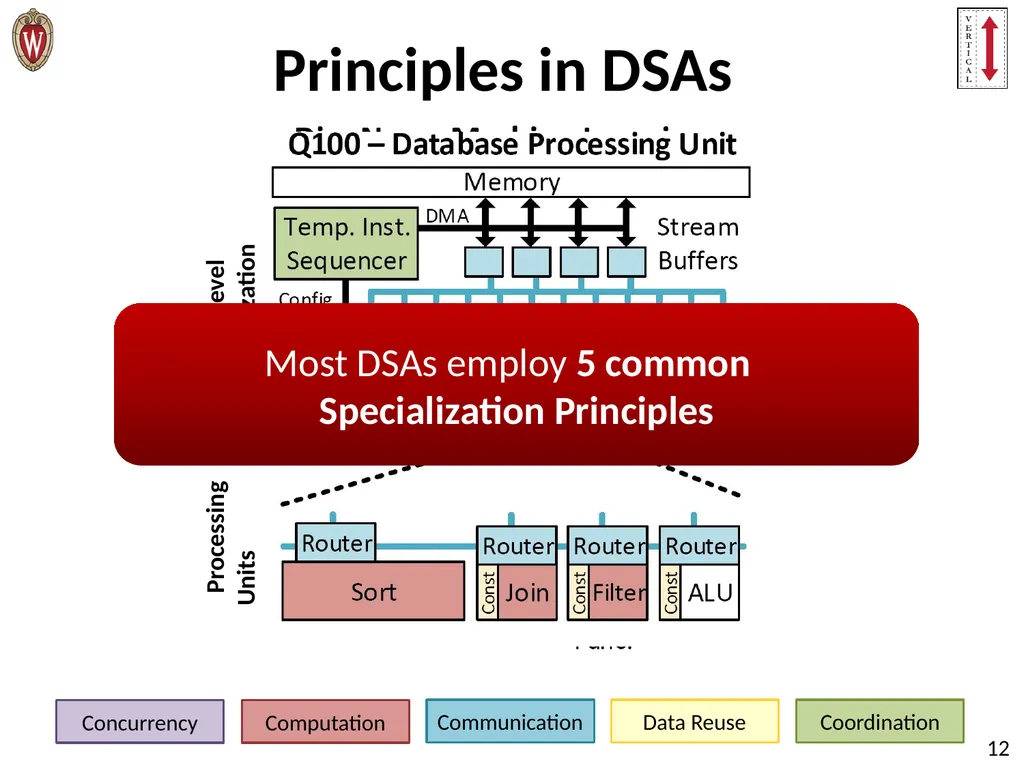
Principles in DSAs 12 High Level
Organization Processing Units Most DSAs employ 5 common
Specialization Principles Computation Data Reuse Concurrency Coordination Communication<br>
Organization Processing Units Most DSAs employ 5 common
Specialization Principles Computation Data Reuse Concurrency Coordination Communication<br>
13
Outline Introduction and Motivation
Principles of architectural specialization
Embodiment of principles in DSAs
Architecture for programmable specialization (LSSD)
Evaluation of LSSD with 4 DSAs (Performance, power & area)
System-level energy efficiency tradeoffs with LSSD and DSA 13<br>
Principles of architectural specialization
Embodiment of principles in DSAs
Architecture for programmable specialization (LSSD)
Evaluation of LSSD with 4 DSAs (Performance, power & area)
System-level energy efficiency tradeoffs with LSSD and DSA 13<br>
14
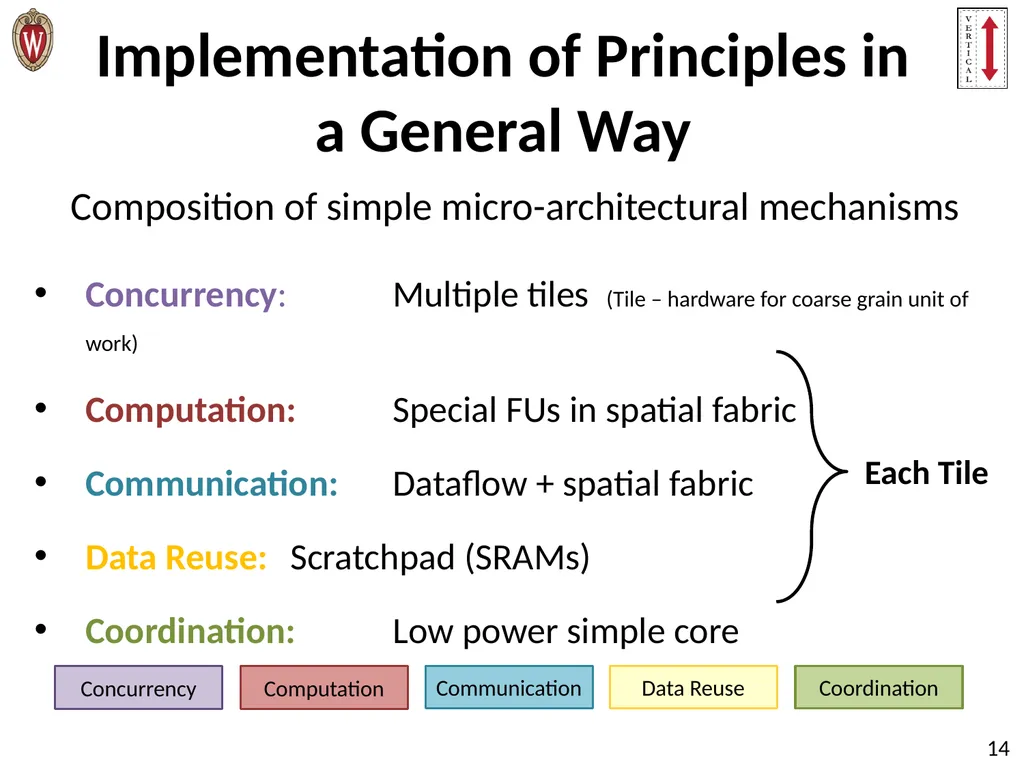
Concurrency: Multiple tiles (Tile – hardware for coarse grain unit of work)
Computation: Special FUs in spatial fabric
Communication: Dataflow + spatial fabric
Data Reuse: Scratchpad (SRAMs)
Coordination: Low power simple core 14 Computation Data Reuse Concurrency Coordination Communication Composition of simple micro-architectural mechanisms Each Tile Implementation of Principles in a General Way<br>
Computation: Special FUs in spatial fabric
Communication: Dataflow + spatial fabric
Data Reuse: Scratchpad (SRAMs)
Coordination: Low power simple core 14 Computation Data Reuse Concurrency Coordination Communication Composition of simple micro-architectural mechanisms Each Tile Implementation of Principles in a General Way<br>
15
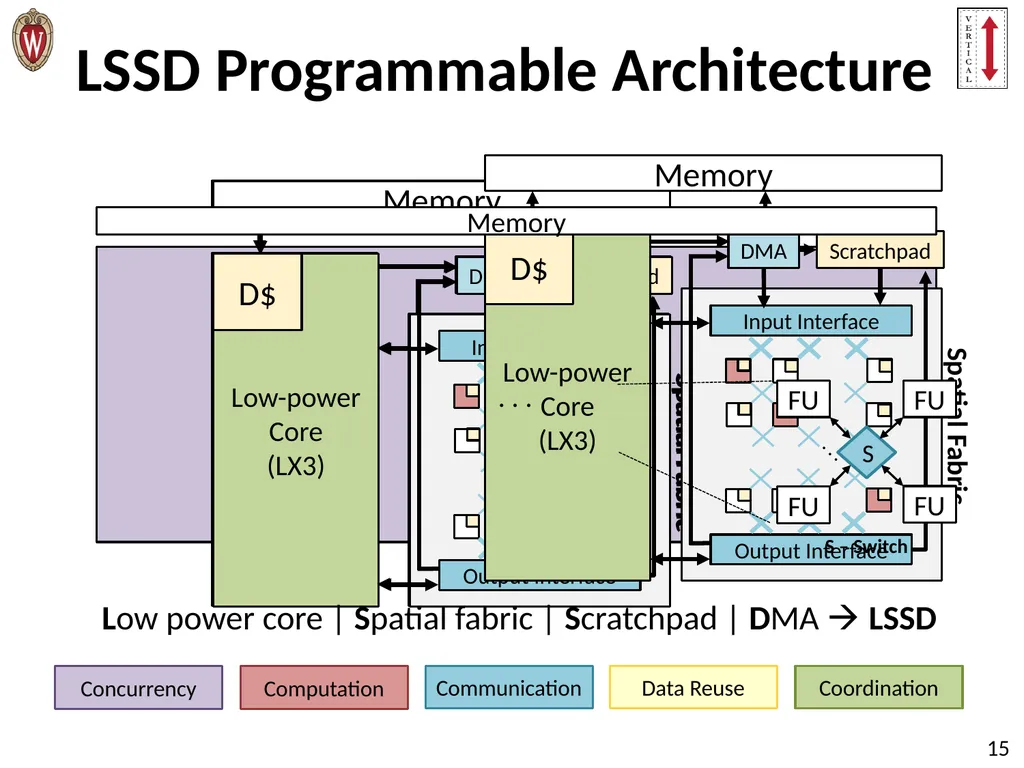
LSSD Programmable Architecture 15 Spatial Fabric Output Interface Input Interface . . . Scratchpad DMA Memory . . . Memory Low power core | Spatial fabric | Scratchpad | DMA LSSD Computation Data Reuse Concurrency Coordination Communication<br>
16
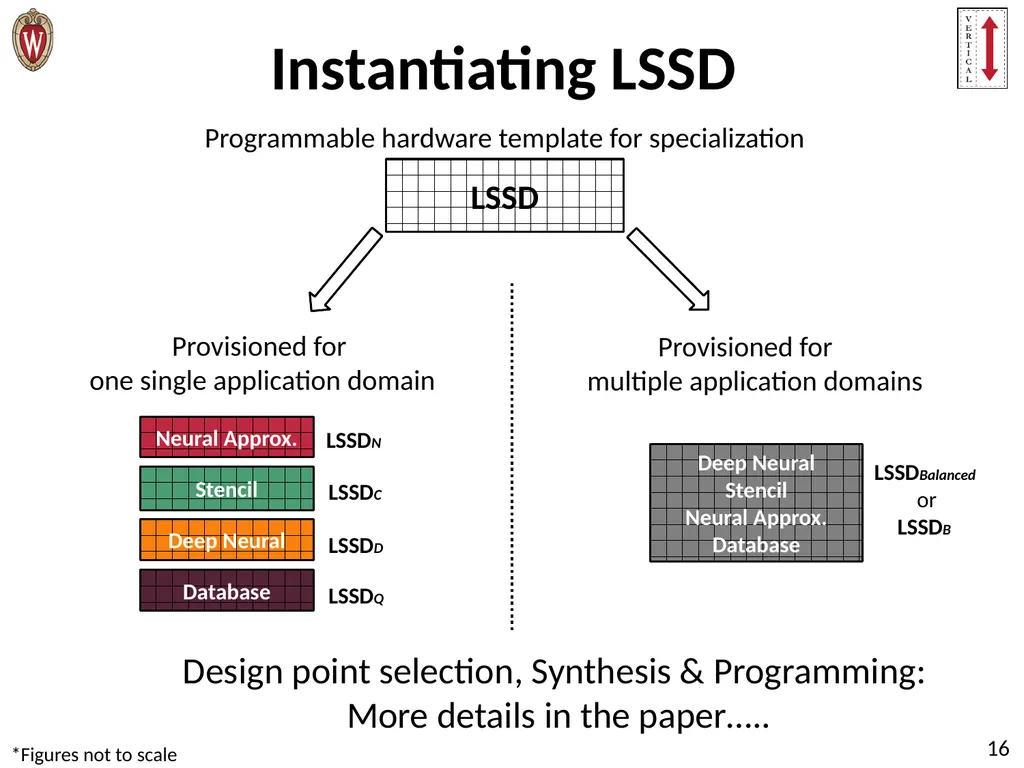
Instantiating LSSD 16 LSSDC LSSD Provisioned for
one single application domain Programmable hardware template for specialization Neural Approx. Deep Neural
Stencil
Neural Approx.
Database Provisioned for
multiple application domains Stencil Deep Neural Database *Figures not to scale LSSDD LSSDQ LSSDN LSSDBalanced
or
LSSDB Design point selection, Synthesis & Programming: More details in the paper…..<br>
one single application domain Programmable hardware template for specialization Neural Approx. Deep Neural
Stencil
Neural Approx.
Database Provisioned for
multiple application domains Stencil Deep Neural Database *Figures not to scale LSSDD LSSDQ LSSDN LSSDBalanced
or
LSSDB Design point selection, Synthesis & Programming: More details in the paper…..<br>
17
Outline Introduction and Motivation
Principles of architectural specialization
Embodiment of principles in DSAs
Architecture for programmable specialization (LSSD)
Evaluation of LSSD with 4 DSAs (Performance, power & area)
System-level energy efficiency tradeoffs with LSSD and DSA 17<br>
Principles of architectural specialization
Embodiment of principles in DSAs
Architecture for programmable specialization (LSSD)
Evaluation of LSSD with 4 DSAs (Performance, power & area)
System-level energy efficiency tradeoffs with LSSD and DSA 17<br>
18
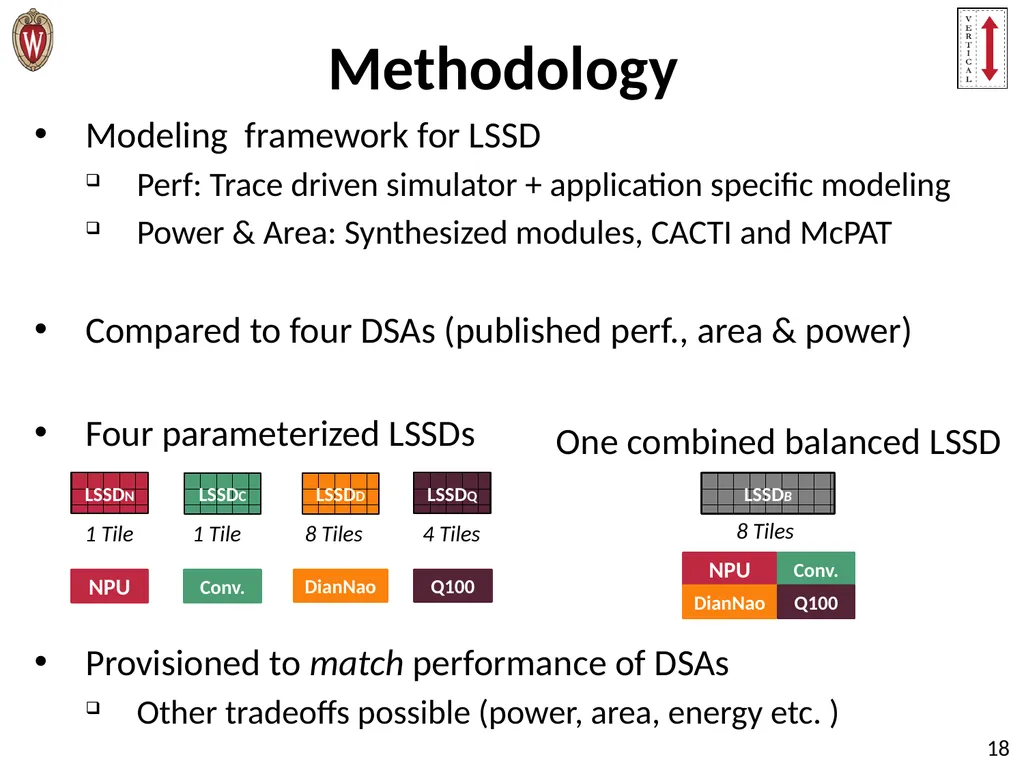
Methodology Modeling framework for LSSD
Perf: Trace driven simulator + application specific modeling
Power & Area: Synthesized modules, CACTI and McPAT
Compared to four DSAs (published perf., area & power)
Four parameterized LSSDs
Provisioned to match performance of DSAs
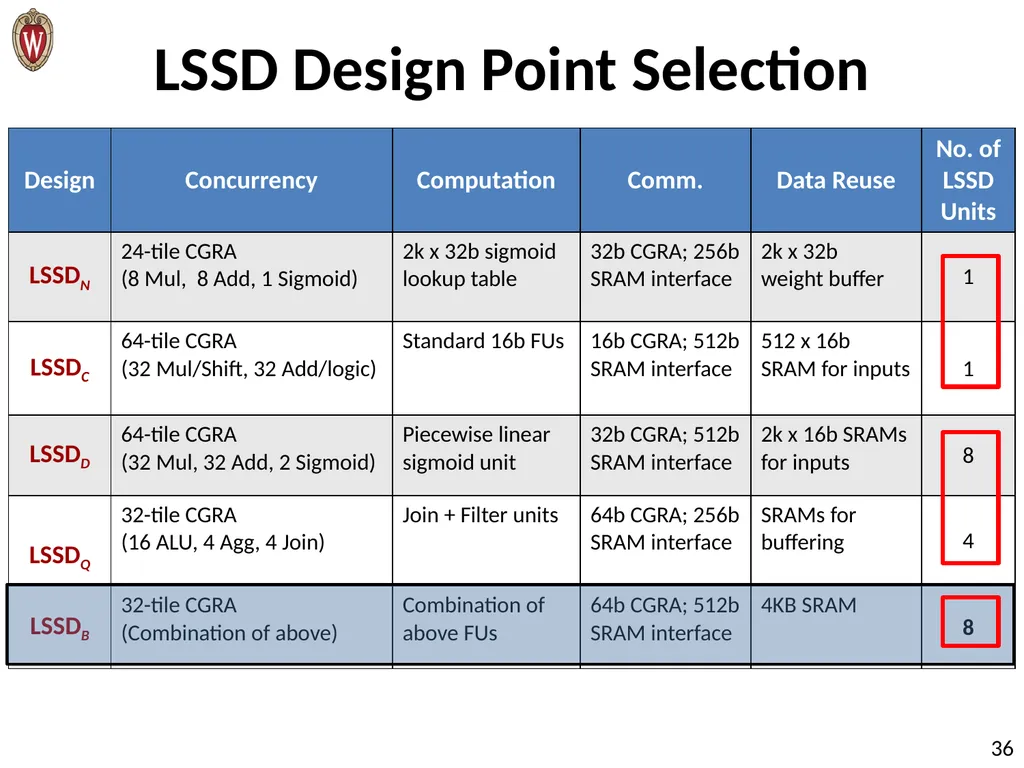
Other tradeoffs possible (power, area, energy etc. ) 18 LSSDN LSSDC LSSDD LSSDQ 1 Tile 1 Tile 8 Tiles 4 Tiles NPU Conv. DianNao Q100 LSSDB NPU Conv. DianNao Q100 8 Tiles One combined balanced LSSD<br>
Perf: Trace driven simulator + application specific modeling
Power & Area: Synthesized modules, CACTI and McPAT
Compared to four DSAs (published perf., area & power)
Four parameterized LSSDs
Provisioned to match performance of DSAs
Other tradeoffs possible (power, area, energy etc. ) 18 LSSDN LSSDC LSSDD LSSDQ 1 Tile 1 Tile 8 Tiles 4 Tiles NPU Conv. DianNao Q100 LSSDB NPU Conv. DianNao Q100 8 Tiles One combined balanced LSSD<br>
19
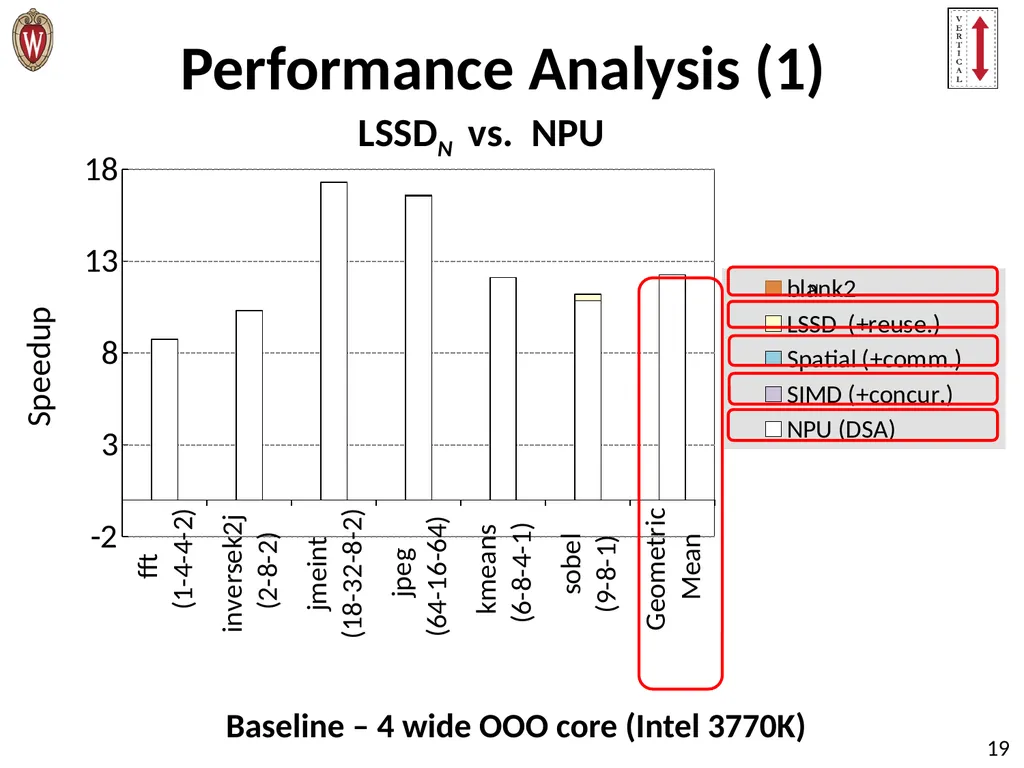
Performance Analysis (1) 19 LSSDN vs. NPU Baseline – 4 wide OOO core (Intel 3770K) N<br>
20
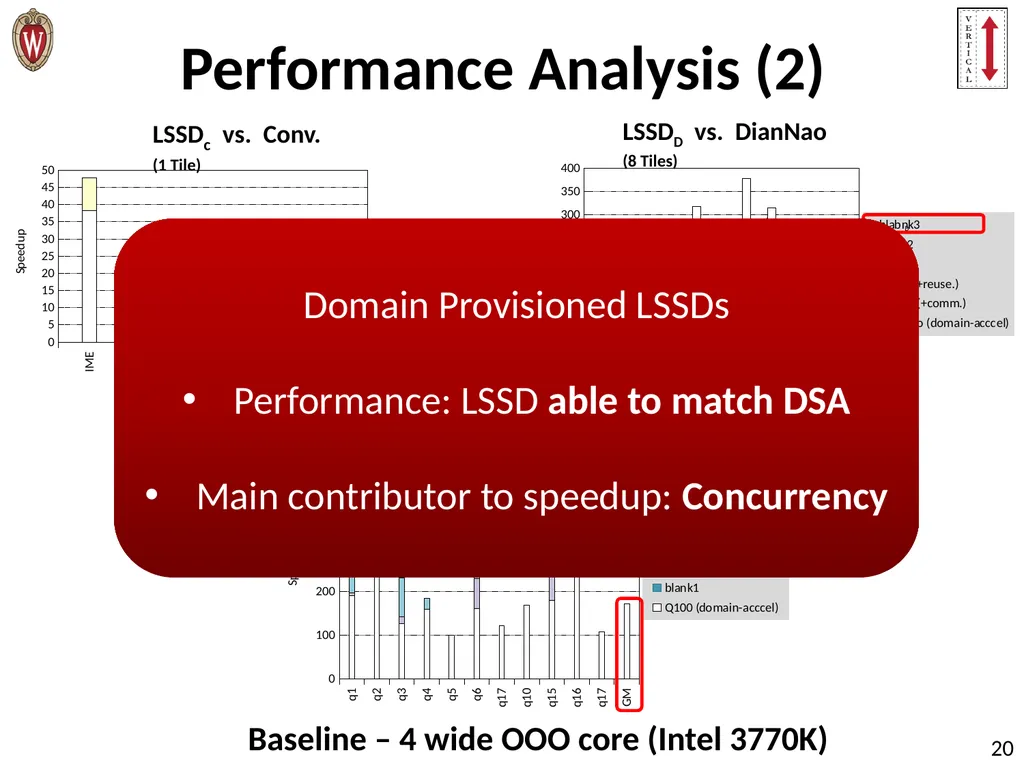
Performance Analysis (2) 20 Baseline – 4 wide OOO core (Intel 3770K) Domain Provisioned LSSDs
Performance: LSSD able to match DSA
Main contributor to speedup: Concurrency<br>
Performance: LSSD able to match DSA
Main contributor to speedup: Concurrency<br>
21
Domain Provisioned LSSDs 21 LSSD area & power compared to a single DSA ?<br>
22
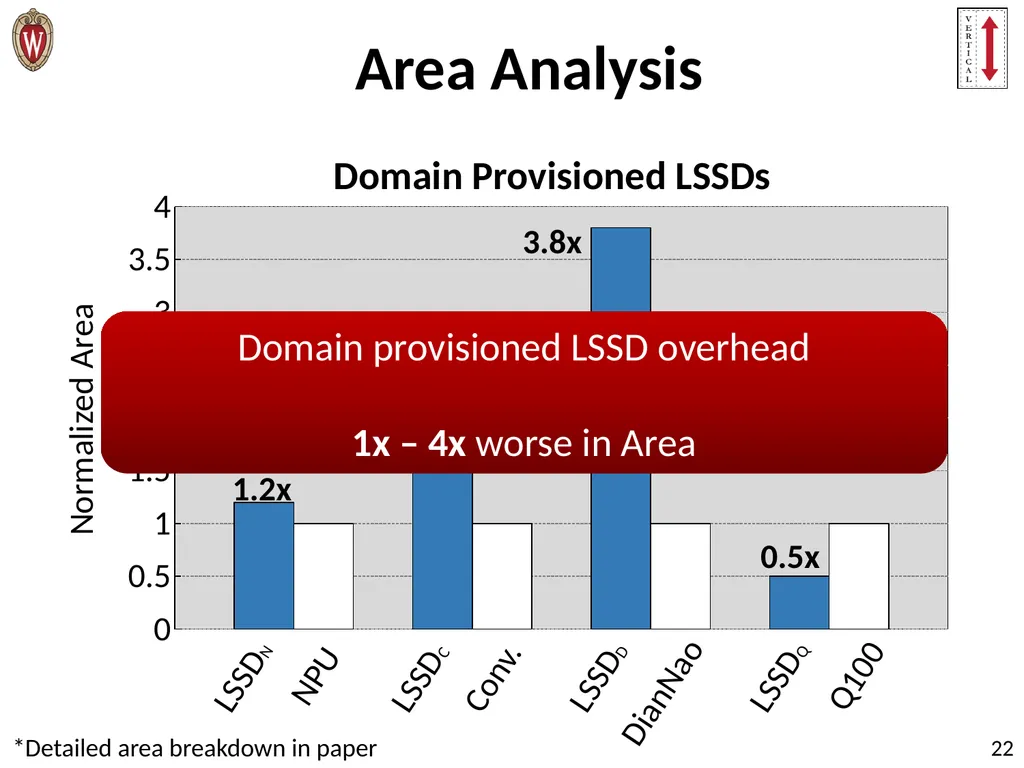
22 Area Analysis 1.2x 1.7x 3.8x 0.5x Domain Provisioned LSSDs Domain provisioned LSSD overhead
1x – 4x worse in Area *Detailed area breakdown in paper<br>
1x – 4x worse in Area *Detailed area breakdown in paper<br>
23
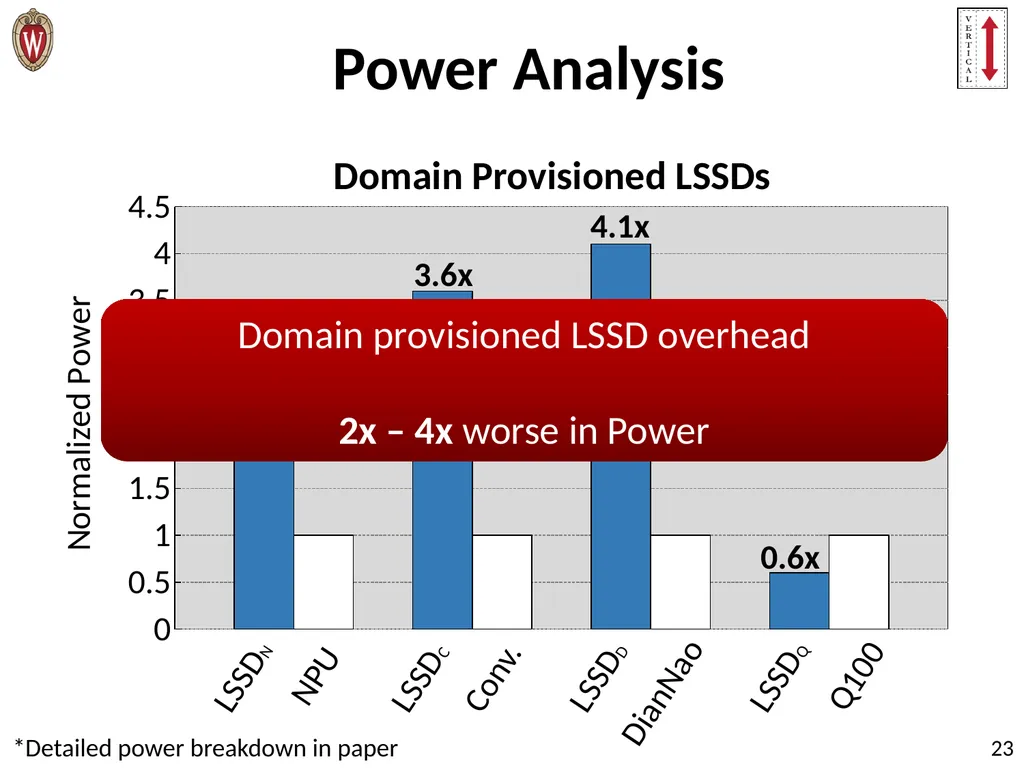
23 Power Analysis 2x 3.6x 4.1x 0.6x Domain Provisioned LSSDs Domain provisioned LSSD overhead
2x – 4x worse in Power *Detailed power breakdown in paper<br>
2x – 4x worse in Power *Detailed power breakdown in paper<br>
24
Balance LSSD design 24 Area and power of LSSDBalanced design, when multiple domains mapped ?<br>
25
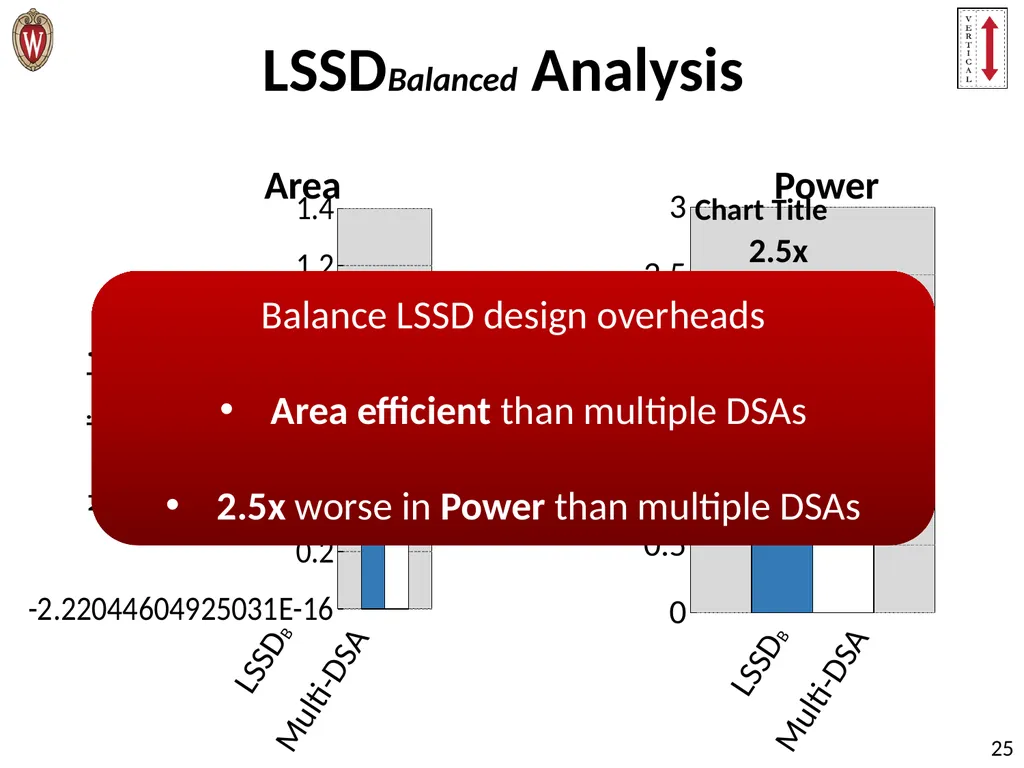
0.6x 2.5x 25 LSSDBalanced Analysis LSSDB Multi-DSA LSSDB Multi-DSA Area Power Balance LSSD design overheads
Area efficient than multiple DSAs
2.5x worse in Power than multiple DSAs<br>
Area efficient than multiple DSAs
2.5x worse in Power than multiple DSAs<br>
26
Outline Introduction and Motivation
Principles of architectural specialization
Embodiment of principles in DSAs
Architecture for programmable specialization (LSSD)
Evaluation of LSSD with 4 DSAs (Performance, power & area)
System-level energy efficiency tradeoffs with LSSD and DSA 26<br>
Principles of architectural specialization
Embodiment of principles in DSAs
Architecture for programmable specialization (LSSD)
Evaluation of LSSD with 4 DSAs (Performance, power & area)
System-level energy efficiency tradeoffs with LSSD and DSA 26<br>
27
LSSD’s power overhead of
2x - 4x matter in a system with accelerator? In what scenarios you want to build
DSA over LSSD? 27<br>
2x - 4x matter in a system with accelerator? In what scenarios you want to build
DSA over LSSD? 27<br>
28
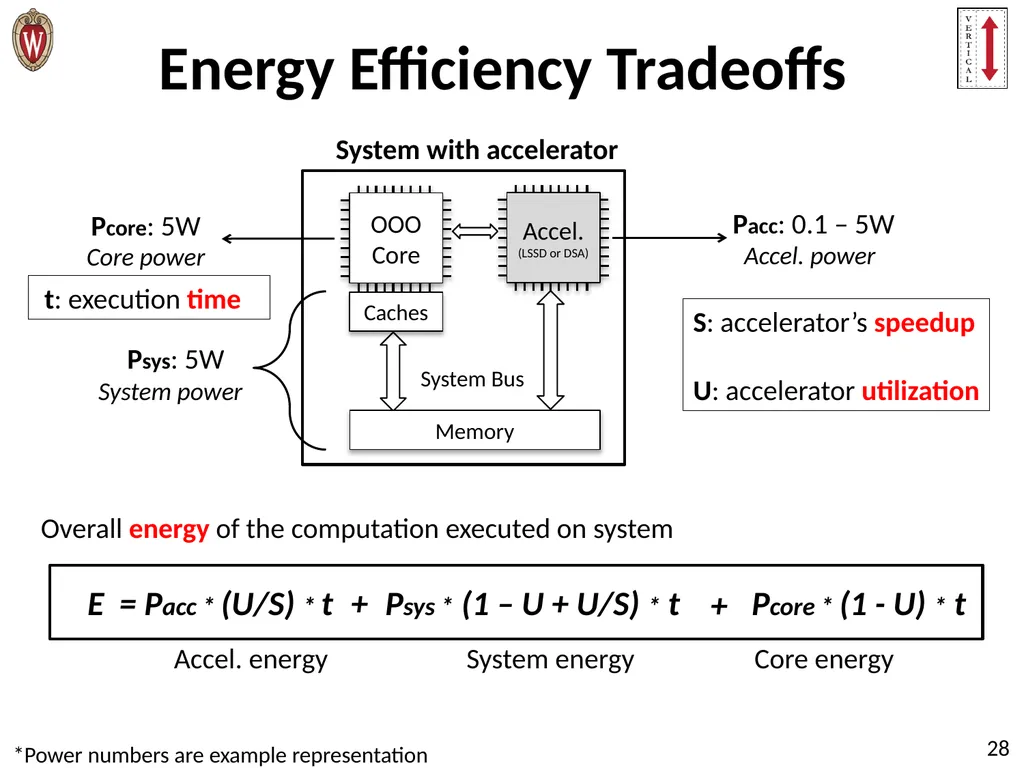
Energy Efficiency Tradeoffs 28 Accel. energy System energy Core energy Pacc * (U/S) * t Pcore * (1 - U) * t Psys * (1 – U + U/S) * t E = + + S: accelerator’s speedup
U: accelerator utilization Overall energy of the computation executed on system *Power numbers are example representation t: execution time<br>
U: accelerator utilization Overall energy of the computation executed on system *Power numbers are example representation t: execution time<br>
29
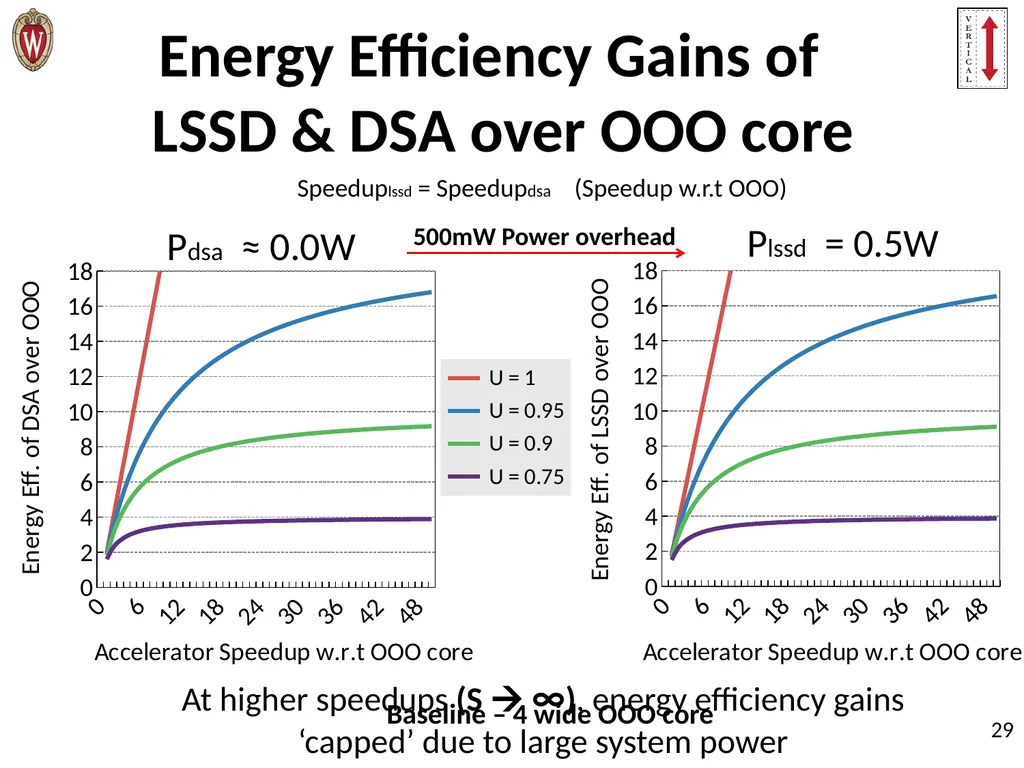
Speeduplssd = Speedupdsa (Speedup w.r.t OOO) 29 Energy Efficiency Gains of
LSSD & DSA over OOO core Pdsa ≈ 0.0W Plssd = 0.5W 500mW Power overhead Baseline – 4 wide OOO core At higher speedups (S ∞), energy efficiency gains ‘capped’ due to large system power<br>
LSSD & DSA over OOO core Pdsa ≈ 0.0W Plssd = 0.5W 500mW Power overhead Baseline – 4 wide OOO core At higher speedups (S ∞), energy efficiency gains ‘capped’ due to large system power<br>
30
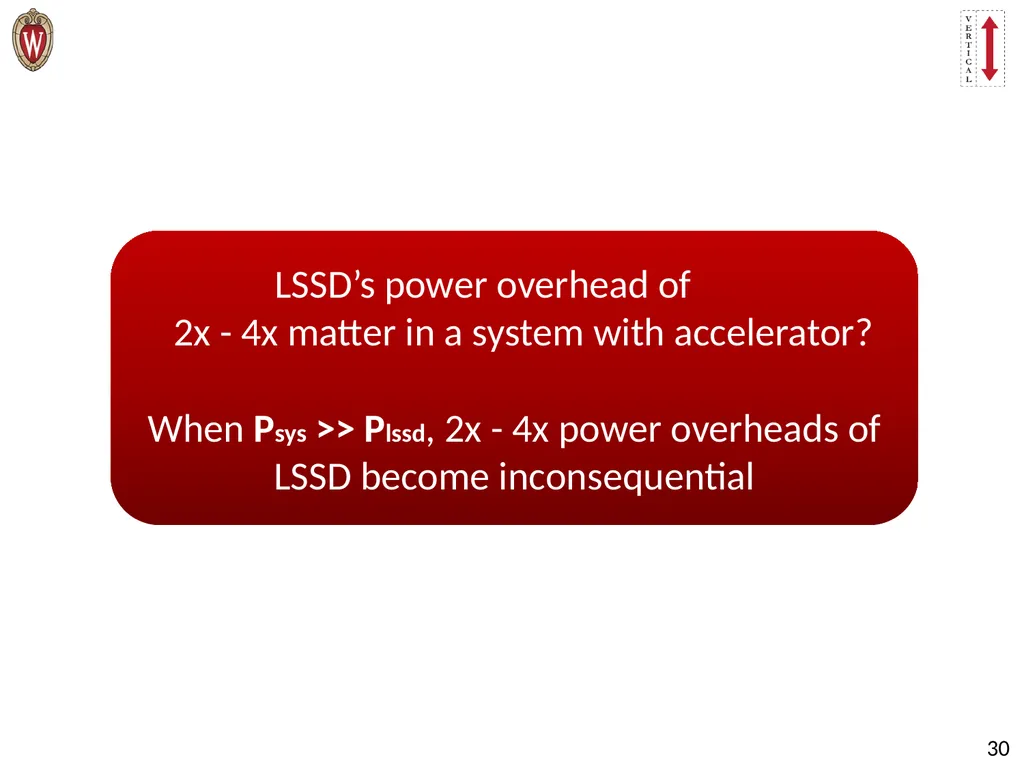
30 LSSD’s power overhead of
2x - 4x matter in a system with accelerator?
When Psys >> Plssd, 2x - 4x power overheads of LSSD become inconsequential<br>
2x - 4x matter in a system with accelerator?
When Psys >> Plssd, 2x - 4x power overheads of LSSD become inconsequential<br>
31
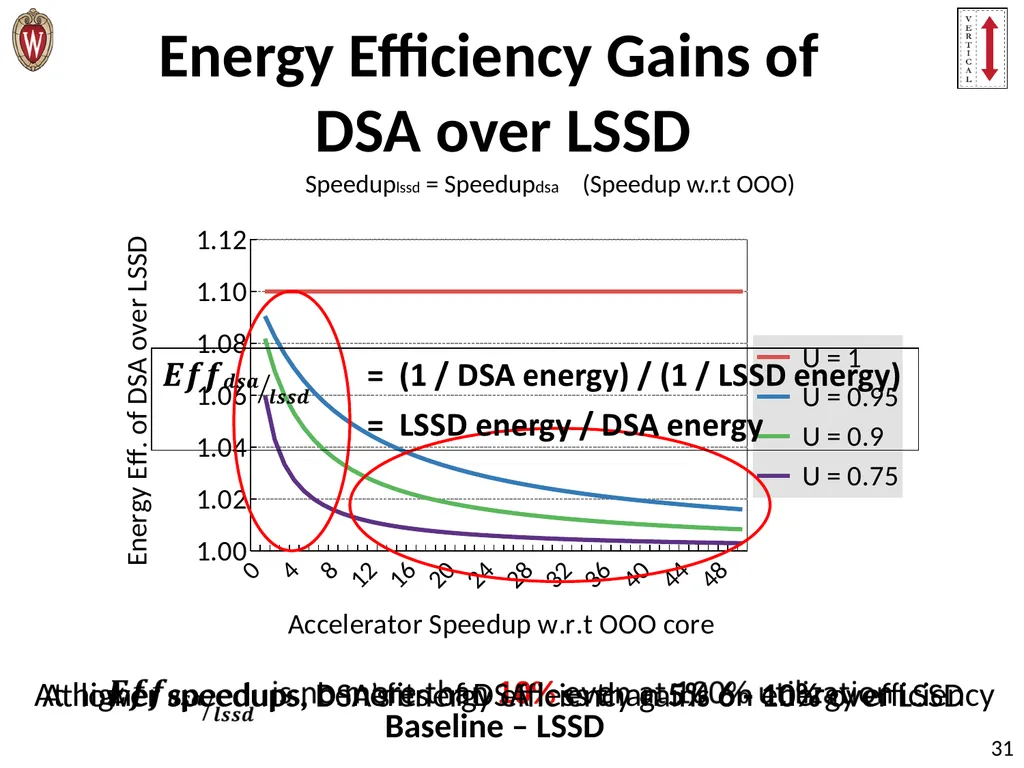
31 Energy Efficiency Gains of
DSA over LSSD Speeduplssd = Speedupdsa (Speedup w.r.t OOO) Baseline – LSSD At lower speedups, DSA’s energy efficiency gains 6 - 10% over LSSD At higher speedups, benefits of DSA less than 5% on energy efficiency<br>
DSA over LSSD Speeduplssd = Speedupdsa (Speedup w.r.t OOO) Baseline – LSSD At lower speedups, DSA’s energy efficiency gains 6 - 10% over LSSD At higher speedups, benefits of DSA less than 5% on energy efficiency<br>
32
32 In what scenarios you want to build
DSA over LSSD?
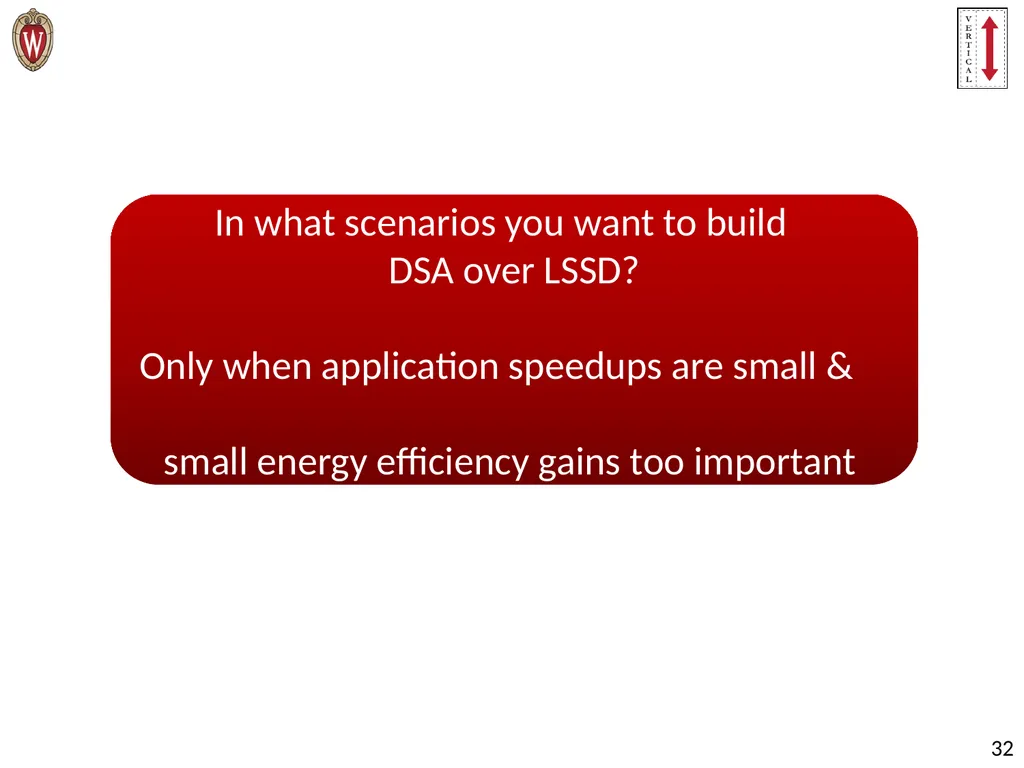
Only when application speedups are small &
small energy efficiency gains too important<br>
DSA over LSSD?
Only when application speedups are small &
small energy efficiency gains too important<br>
33
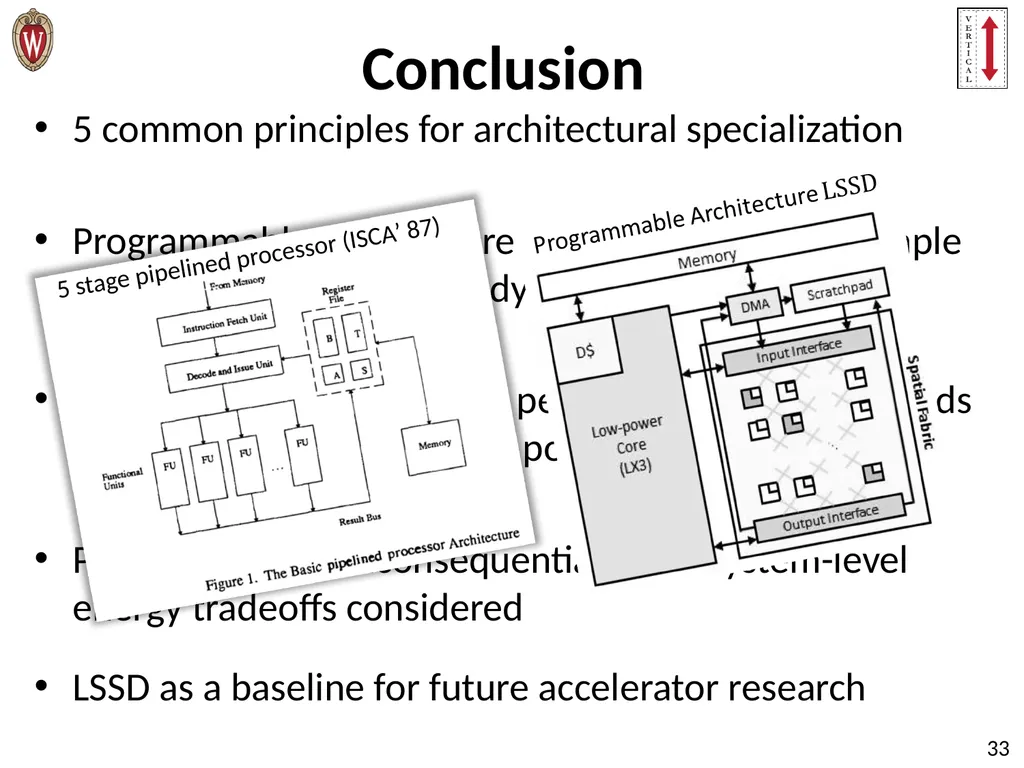
Conclusion 5 common principles for architectural specialization
Programmable architecture (LSSD) composed of simple uArch. mechanisms embodying the principles
LSSD competitive with DSA performance and overheads of only up to 4x in area and power
Power overhead inconsequential when system-level energy tradeoffs considered
LSSD as a baseline for future accelerator research 33 5 stage pipelined processor (ISCA’ 87)<br>
Programmable architecture (LSSD) composed of simple uArch. mechanisms embodying the principles
LSSD competitive with DSA performance and overheads of only up to 4x in area and power
Power overhead inconsequential when system-level energy tradeoffs considered
LSSD as a baseline for future accelerator research 33 5 stage pipelined processor (ISCA’ 87)<br>
34
Back Up Slides 34<br>
35
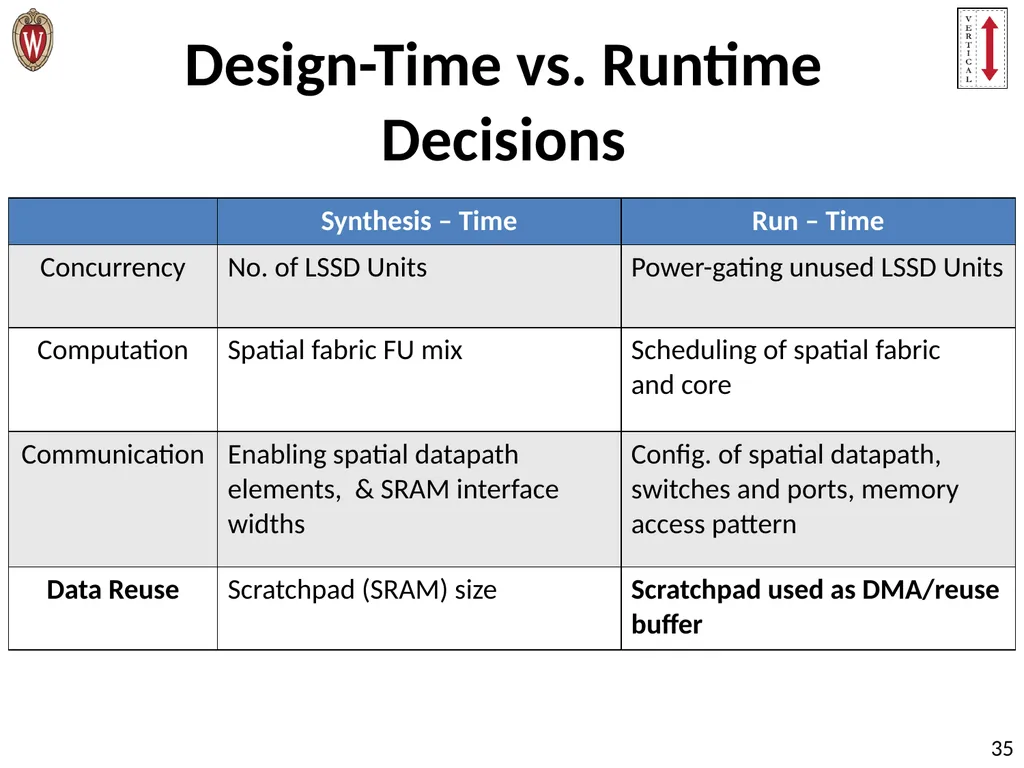
35 Design-Time vs. Runtime Decisions<br>
36
LSSD Design Point Selection 36<br>
37
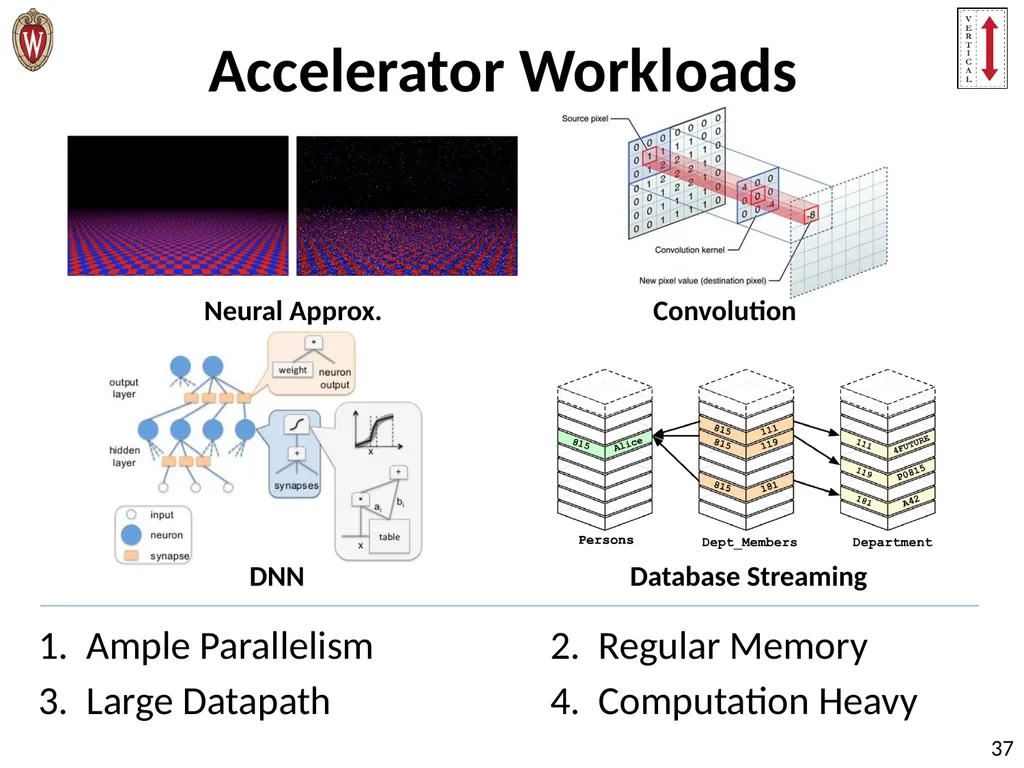
Accelerator Workloads DNN Database Streaming Neural Approx. Convolution 1. Ample Parallelism 2. Regular Memory
3. Large Datapath 4. Computation Heavy 37<br>
3. Large Datapath 4. Computation Heavy 37<br>
38
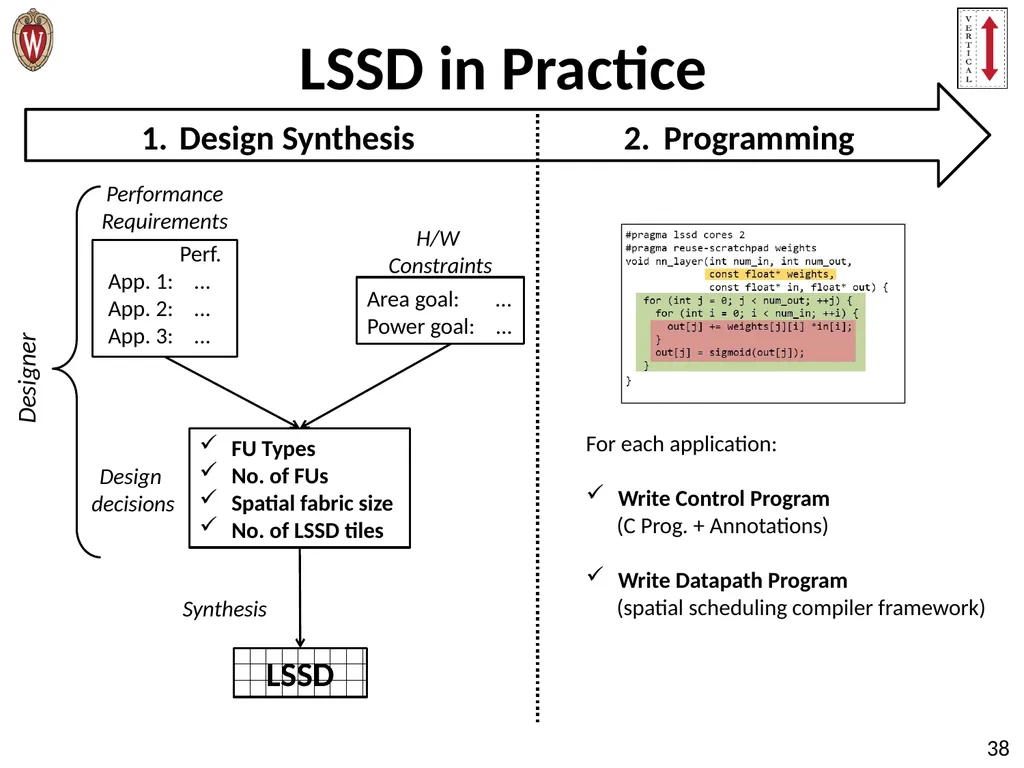
LSSD in Practice 38 Perf.
App. 1: ...
App. 2: ...
App. 3: ... Area goal: ...
Power goal: ... Synthesis Performance
Requirements Design Synthesis FU Types
No. of FUs
Spatial fabric size
No. of LSSD tiles Programming For each application:
Write Control Program
(C Prog. + Annotations)
Write Datapath Program
(spatial scheduling compiler framework) 1. 2. LSSD H/W
Constraints Design
decisions Designer<br>
App. 1: ...
App. 2: ...
App. 3: ... Area goal: ...
Power goal: ... Synthesis Performance
Requirements Design Synthesis FU Types
No. of FUs
Spatial fabric size
No. of LSSD tiles Programming For each application:
Write Control Program
(C Prog. + Annotations)
Write Datapath Program
(spatial scheduling compiler framework) 1. 2. LSSD H/W
Constraints Design
decisions Designer<br>
39
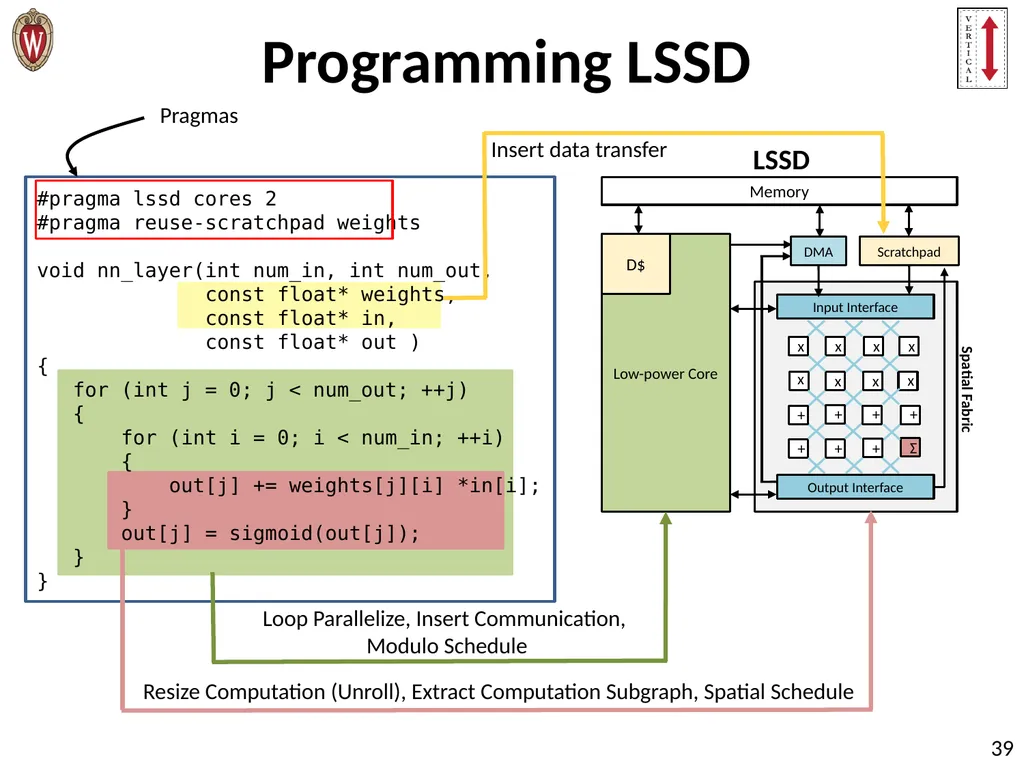
Programming LSSD #pragma lssd cores 2
#pragma reuse-scratchpad weights
void nn_layer(int num_in, int num_out,
const float* weights,
const float* in,
const float* out )
{
for (int j = 0; j < num_out; ++j)
{
for (int i = 0; i < num_in; ++i)
{
out[j] += weights[j][i] *in[i];
}
out[j] = sigmoid(out[j]);
}
} Pragmas Loop Parallelize, Insert Communication,
Modulo Schedule Resize Computation (Unroll), Extract Computation Subgraph, Spatial Schedule LSSD Insert data transfer 39<br>
#pragma reuse-scratchpad weights
void nn_layer(int num_in, int num_out,
const float* weights,
const float* in,
const float* out )
{
for (int j = 0; j < num_out; ++j)
{
for (int i = 0; i < num_in; ++i)
{
out[j] += weights[j][i] *in[i];
}
out[j] = sigmoid(out[j]);
}
} Pragmas Loop Parallelize, Insert Communication,
Modulo Schedule Resize Computation (Unroll), Extract Computation Subgraph, Spatial Schedule LSSD Insert data transfer 39<br>
40
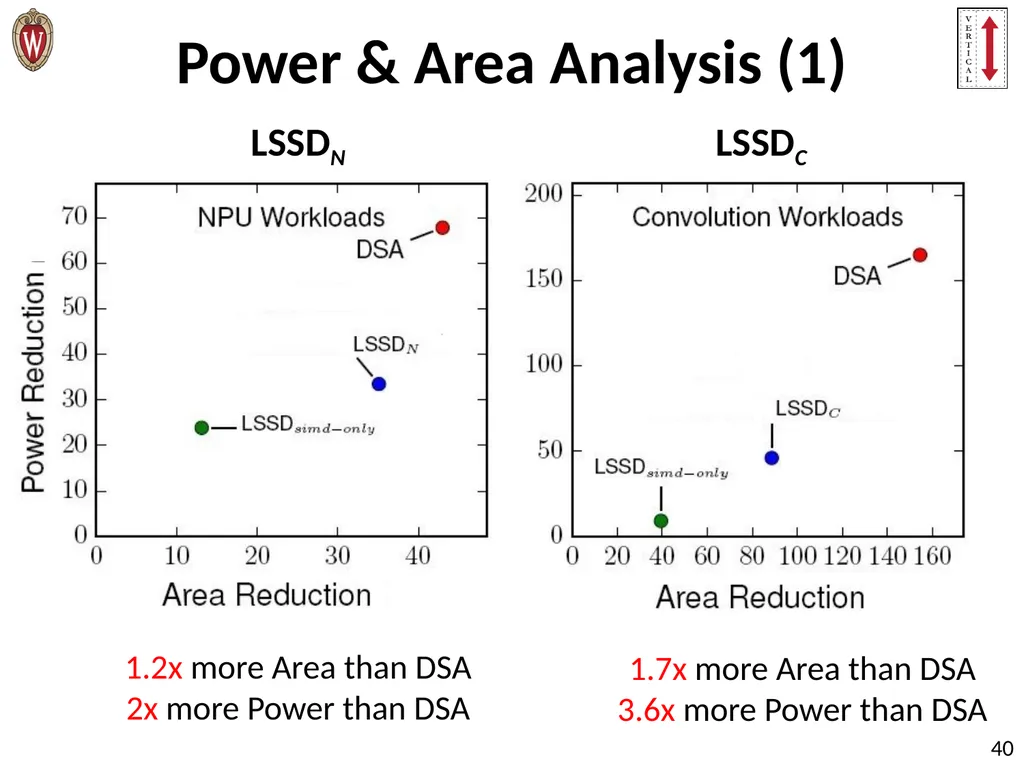
Power & Area Analysis (1) LSSDN 1.2x more Area than DSA
2x more Power than DSA 1.7x more Area than DSA
3.6x more Power than DSA LSSDC 40<br>
2x more Power than DSA 1.7x more Area than DSA
3.6x more Power than DSA LSSDC 40<br>
41
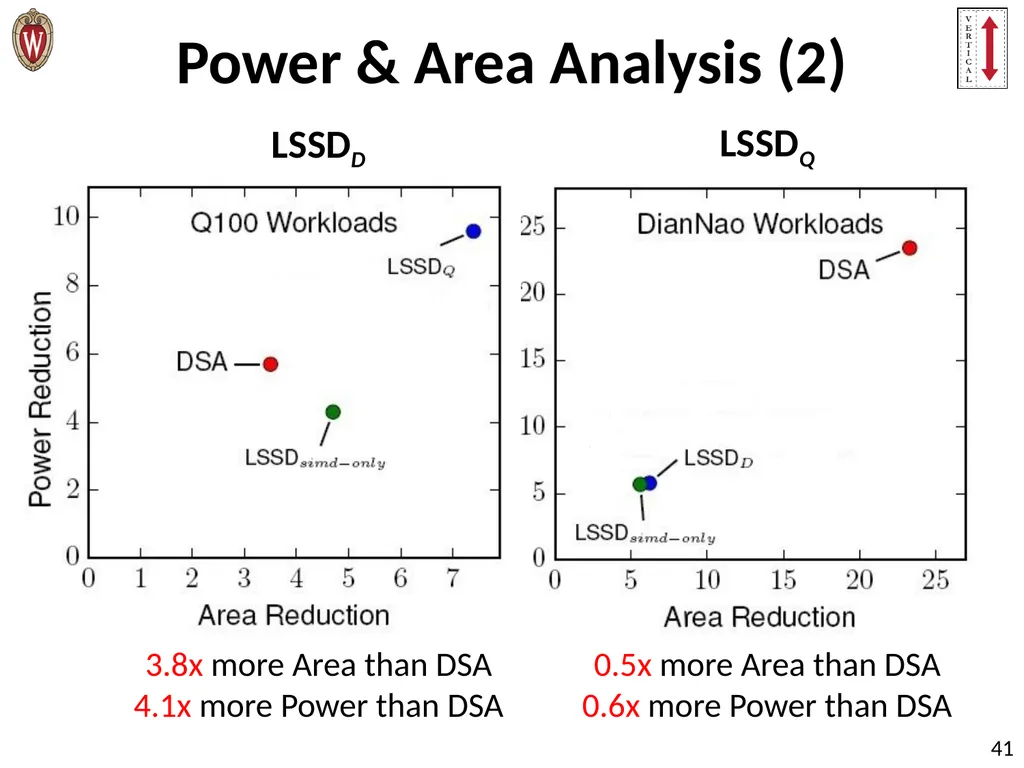
Power & Area Analysis (2) LSSDD 3.8x more Area than DSA
4.1x more Power than DSA 0.5x more Area than DSA
0.6x more Power than DSA LSSDQ 41<br>
4.1x more Power than DSA 0.5x more Area than DSA
0.6x more Power than DSA LSSDQ 41<br>
42
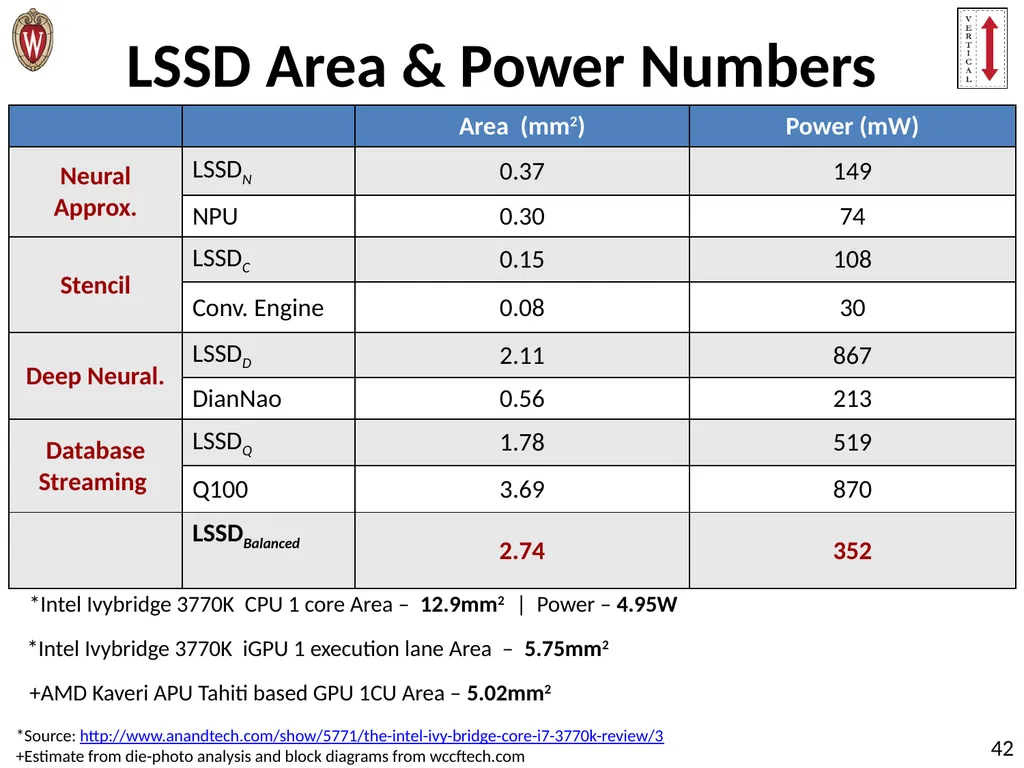
LSSD Area & Power Numbers *Intel Ivybridge 3770K CPU 1 core Area – 12.9mm2 | Power – 4.95W *Source: http://www.anandtech.com/show/5771/the-intel-ivy-bridge-core-i7-3770k-review/3
+Estimate from die-photo analysis and block diagrams from wccftech.com *Intel Ivybridge 3770K iGPU 1 execution lane Area – 5.75mm2 +AMD Kaveri APU Tahiti based GPU 1CU Area – 5.02mm2 42<br>
+Estimate from die-photo analysis and block diagrams from wccftech.com *Intel Ivybridge 3770K iGPU 1 execution lane Area – 5.75mm2 +AMD Kaveri APU Tahiti based GPU 1CU Area – 5.02mm2 42<br>
43
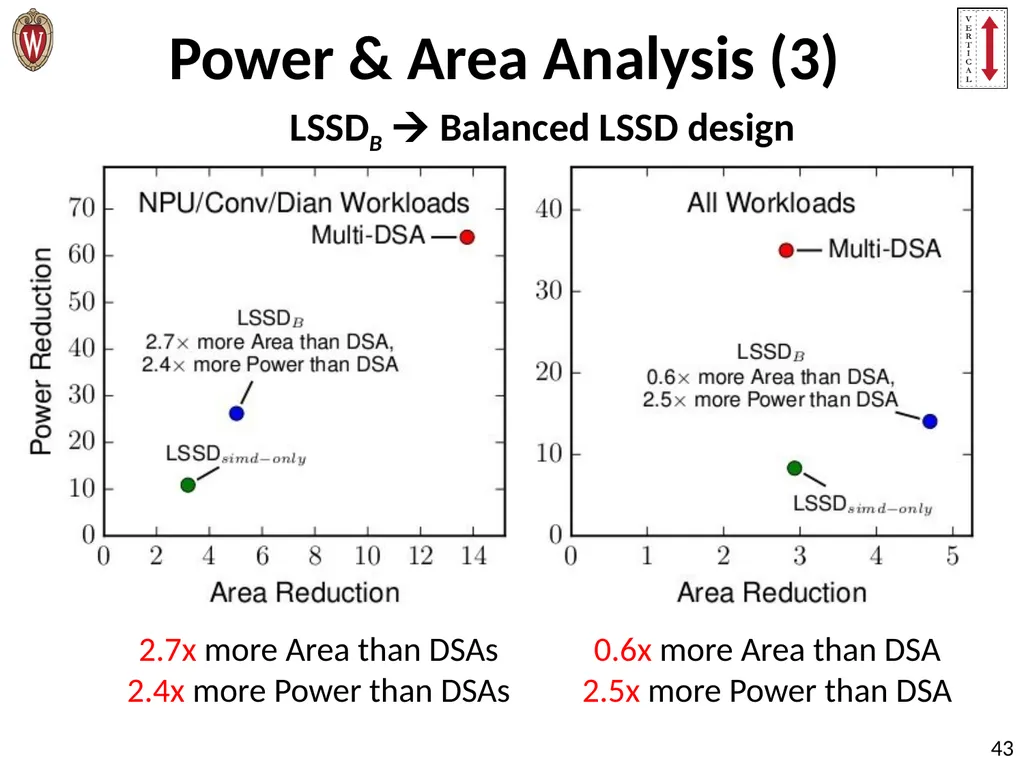
Power & Area Analysis (3) 2.7x more Area than DSAs
2.4x more Power than DSAs 0.6x more Area than DSA
2.5x more Power than DSA LSSDB Balanced LSSD design 43<br>
2.4x more Power than DSAs 0.6x more Area than DSA
2.5x more Power than DSA LSSDB Balanced LSSD design 43<br>
44
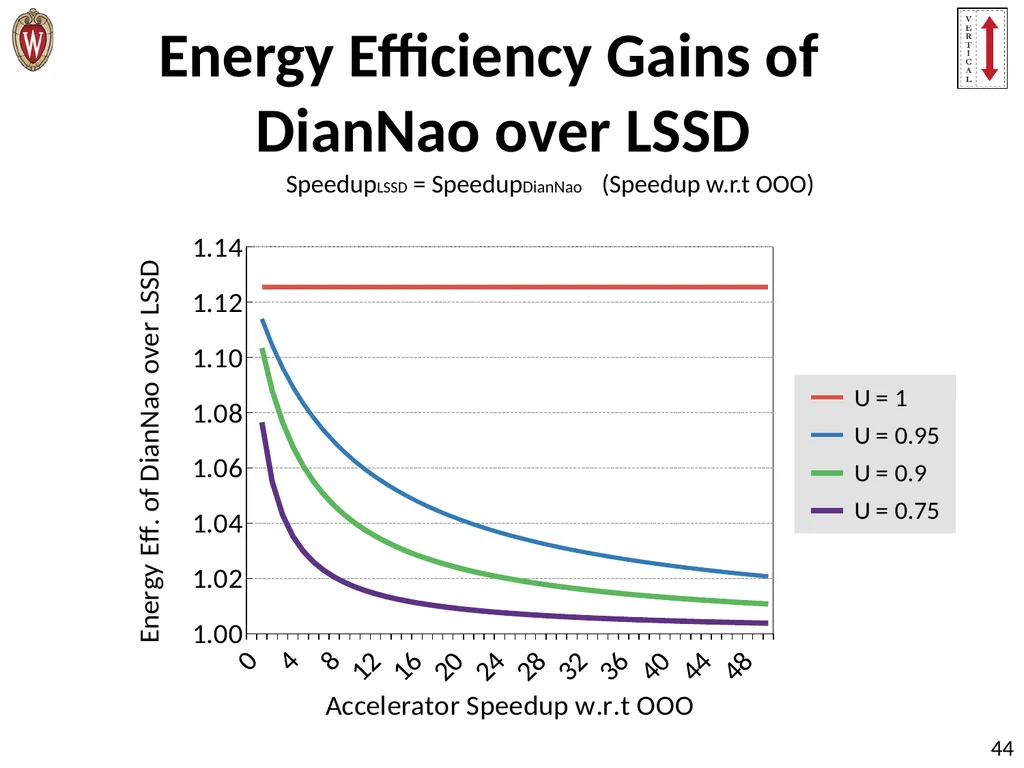
44 Energy Efficiency Gains of
DianNao over LSSD SpeedupLSSD = SpeedupDianNao (Speedup w.r.t OOO)<br>
DianNao over LSSD SpeedupLSSD = SpeedupDianNao (Speedup w.r.t OOO)<br>
45
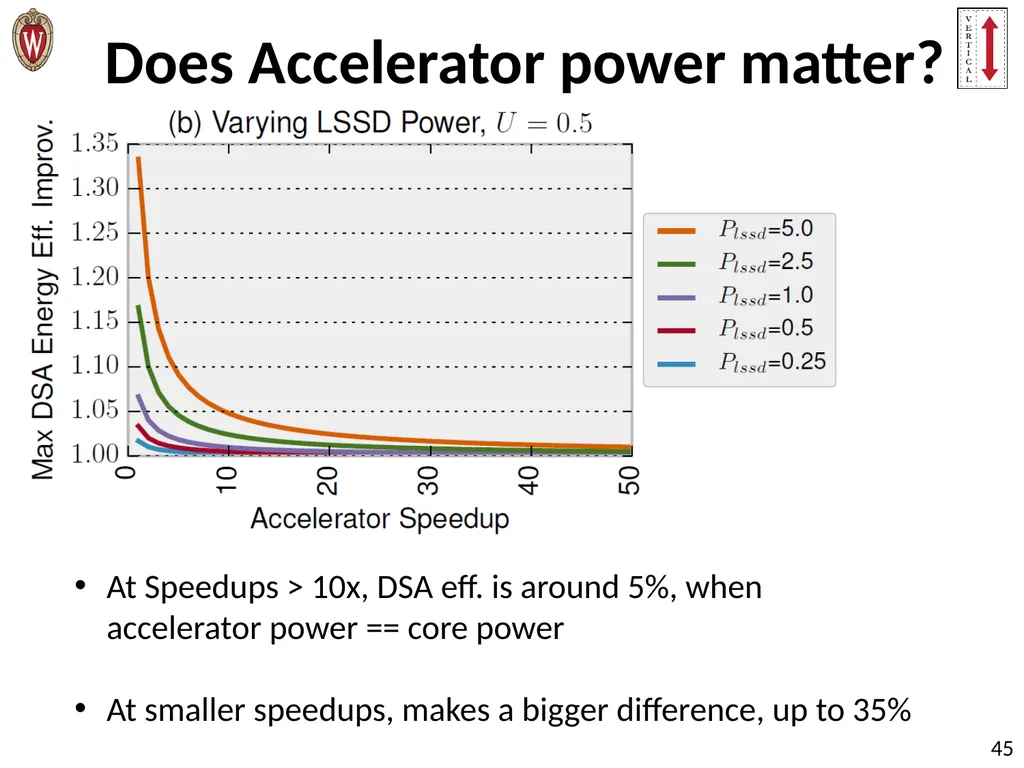
Does Accelerator power matter? At Speedups > 10x, DSA eff. is around 5%, when accelerator power == core power
At smaller speedups, makes a bigger difference, up to 35% 45<br>
At smaller speedups, makes a bigger difference, up to 35% 45<br>