QAQC in Organic Matter (Hydrocarbon) Analysis. Why? Millions of individual compounds with a wide range of chemical and physical properties Complex mixtures susceptible to physical and chemical change, e.g. - evaporation, precipitation,
"QA/QC in Organic Matter (Hydrocarbon) Analysis." is the property of its rightful owner. Permission is granted to
download and print the materials on this website for personal, non-commercial use only, and to display it
on your personal computer provided you do not modify the materials and that you retain all copyright
notices contained in the materials. By downloading content from our website, you accept the terms of this
agreement.
Presentation Transcript
01
QA/QC in Organic Matter (Hydrocarbon) Analysis.
Why?
Millions of individual compounds with a wide range of chemical and physical properties
Complex mixtures susceptible to physical and chemical change, e.g. - evaporation, precipitation, adsorption … - oxidation (O2 …), microbial transformation, photochemistry …
Standard procedures and computer-generated answers are fine … … but do not forget to use your brain during analysis and data evaluation<br>
02
Quality Assurance (QA)
(Sampling)
Appropriate analytical method(s) Sample preparation / Work-up procedure Analysis
Validity of data Certified standards Round-robin tests<br>
The Norwegian Industry Guide to Organic Geochemical Analyses The Analysis Guide contains:
Minimum requirements
Purpose, range of application, terminology
Samples to be analyzed
Procedural requirements
Acceptance criteria and reference samples
Reporting requirements
Recommendations, information
Recommendations and notes
Key references
Figures
The Reporting Guide contains:
General guidelines for reporting and digital data transfer.
NIGOGA is an industry guide and not an official regulation or norm.<br>
05
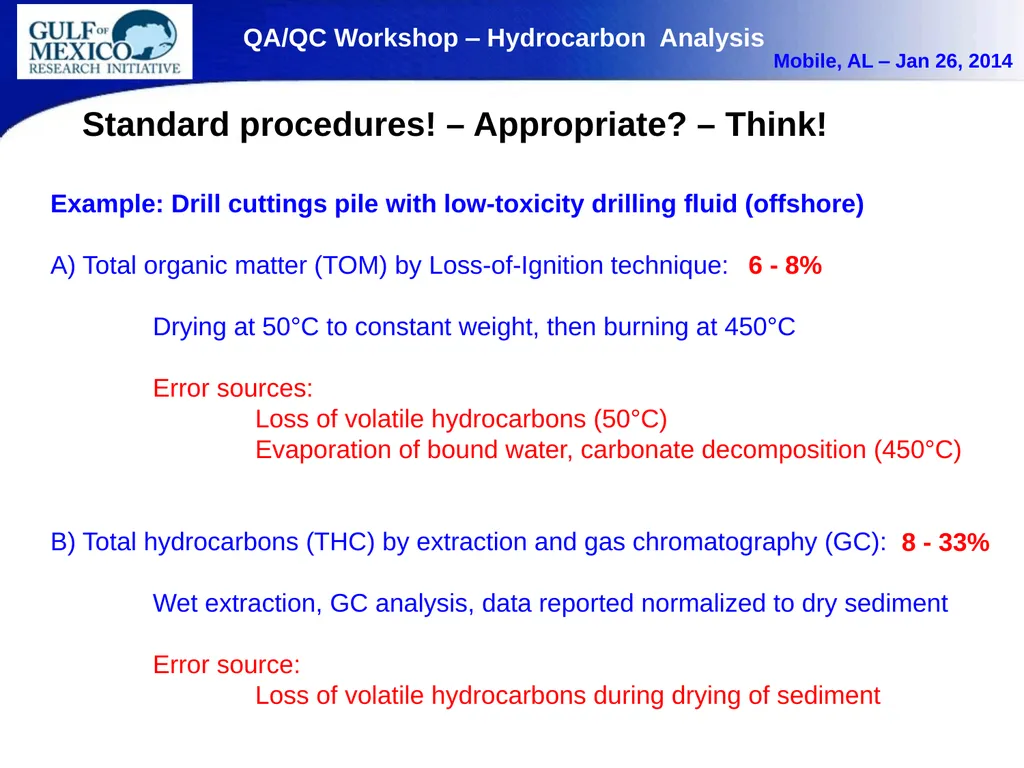
Standard procedures! – Appropriate? – Think! Example: Drill cuttings pile with low-toxicity drilling fluid (offshore)
A) Total organic matter (TOM) by Loss-of-Ignition technique:
Drying at 50°C to constant weight, then burning at 450°C
Error sources:
Loss of volatile hydrocarbons (50°C)
Evaporation of bound water, carbonate decomposition (450°C)
B) Total hydrocarbons (THC) by extraction and gas chromatography (GC):
Wet extraction, GC analysis, data reported normalized to dry sediment
Error source:
Loss of volatile hydrocarbons during drying of sediment 6 - 8% 8 - 33%<br>
06
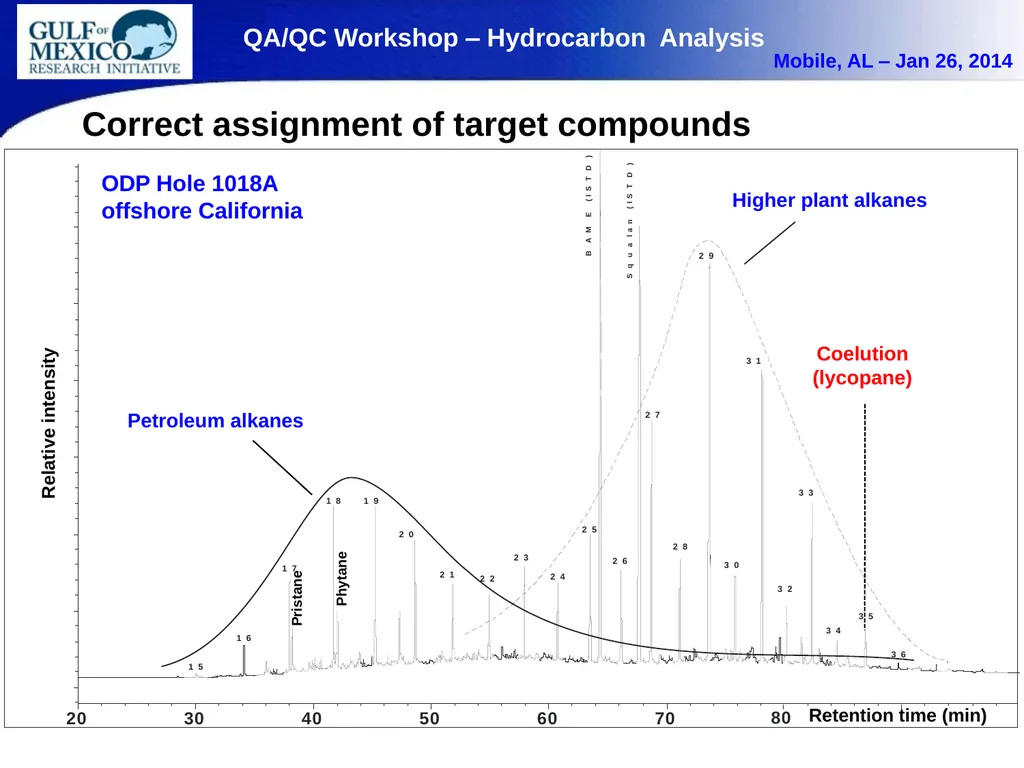
Petroleum alkanes Higher plant alkanes Retention time (min) ODP Hole 1018A
offshore California Coelution
(lycopane) Pristane Phytane Correct assignment of target compounds Relative intensity<br>
07
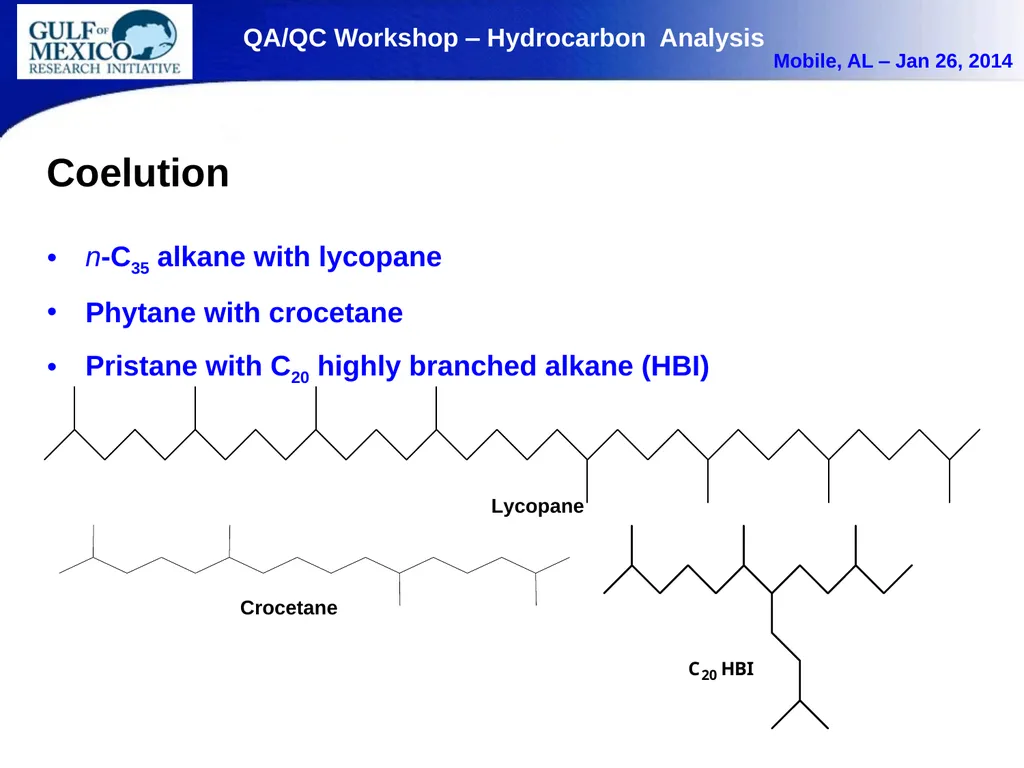
Coelution
n-C35 alkane with lycopane
Phytane with crocetane
Pristane with C20 highly branched alkane (HBI) Crocetane<br>