
Quality System Essential: Inventory Management
KB
Published · 51 slides · 0 views
1 / 1






Description
Quality System Essential: Inventory Management Quality Management of Laboratory Material ISO 15189: 2012 6252018 Labs for Life Project - India 1 Inventory management Quantity Management Ensuring the quantity of supplies as required so as
Related Topics
Share
Embed code
Download this presentation From Below
"Quality System Essential: Inventory Management" is the property of its rightful owner. Permission is granted to download and print the materials on this website for personal, non-commercial use only, and to display it on your personal computer provided you do not modify the materials and that you retain all copyright notices contained in the materials. By downloading content from our website, you accept the terms of this agreement.
Presentation Transcript
01
Quality System Essential:
Inventory Management Quality Management of
Laboratory Material
ISO 15189: 2012 6/25/2018 Labs for Life Project - India 1<br>
Laboratory Material
ISO 15189: 2012 6/25/2018 Labs for Life Project - India 1<br>
02
Inventory management Quantity Management
Ensuring the quantity of supplies as required so as ensure smooth workflow
Serves to prevent stock outs and maintain turnaround times (TAT) 6/25/2018 Labs for Life Project - India 2<br>
Ensuring the quantity of supplies as required so as ensure smooth workflow
Serves to prevent stock outs and maintain turnaround times (TAT) 6/25/2018 Labs for Life Project - India 2<br>
03
Quality management – WHY ? Reliable diagnostic services require monitoring the quality of its inventory flow
Ensuring quality of material is an integral part of quality assurance in the laboratory
The primary error prevention step: Quality Reagents 6/25/2018 Labs for Life Project - India 3<br>
Ensuring quality of material is an integral part of quality assurance in the laboratory
The primary error prevention step: Quality Reagents 6/25/2018 Labs for Life Project - India 3<br>
04
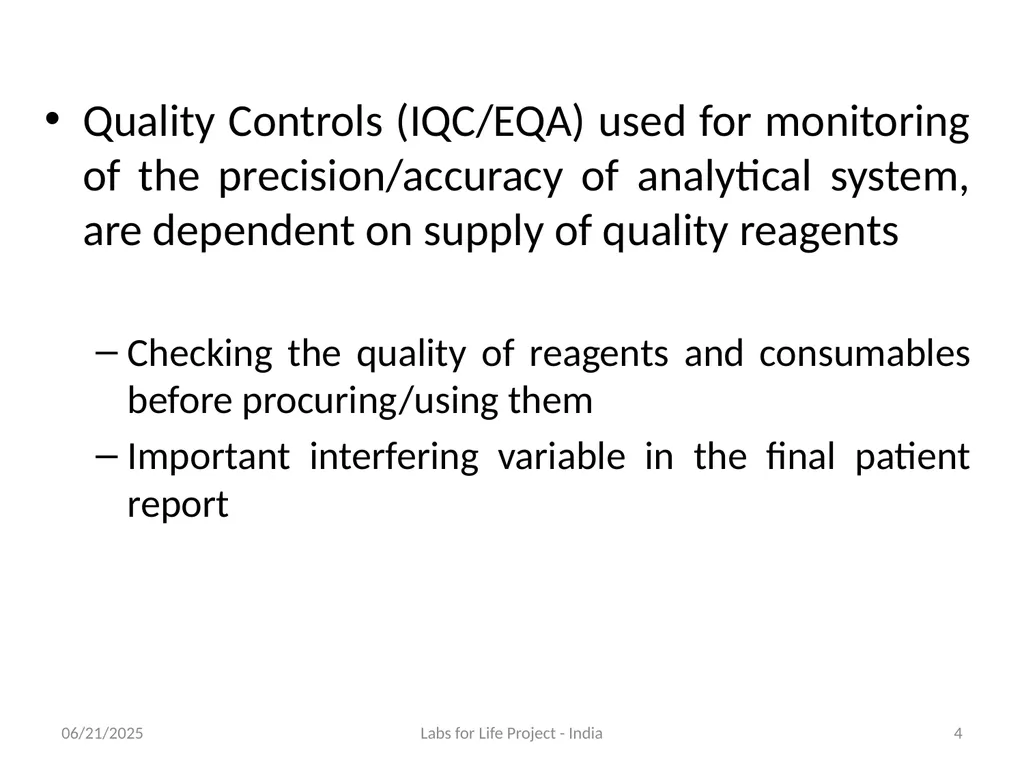
Quality Controls (IQC/EQA) used for monitoring of the precision/accuracy of analytical system, are dependent on supply of quality reagents
Checking the quality of reagents and consumables before procuring/using them
Important interfering variable in the final patient report 6/25/2018 Labs for Life Project - India 4<br>
Checking the quality of reagents and consumables before procuring/using them
Important interfering variable in the final patient report 6/25/2018 Labs for Life Project - India 4<br>
05
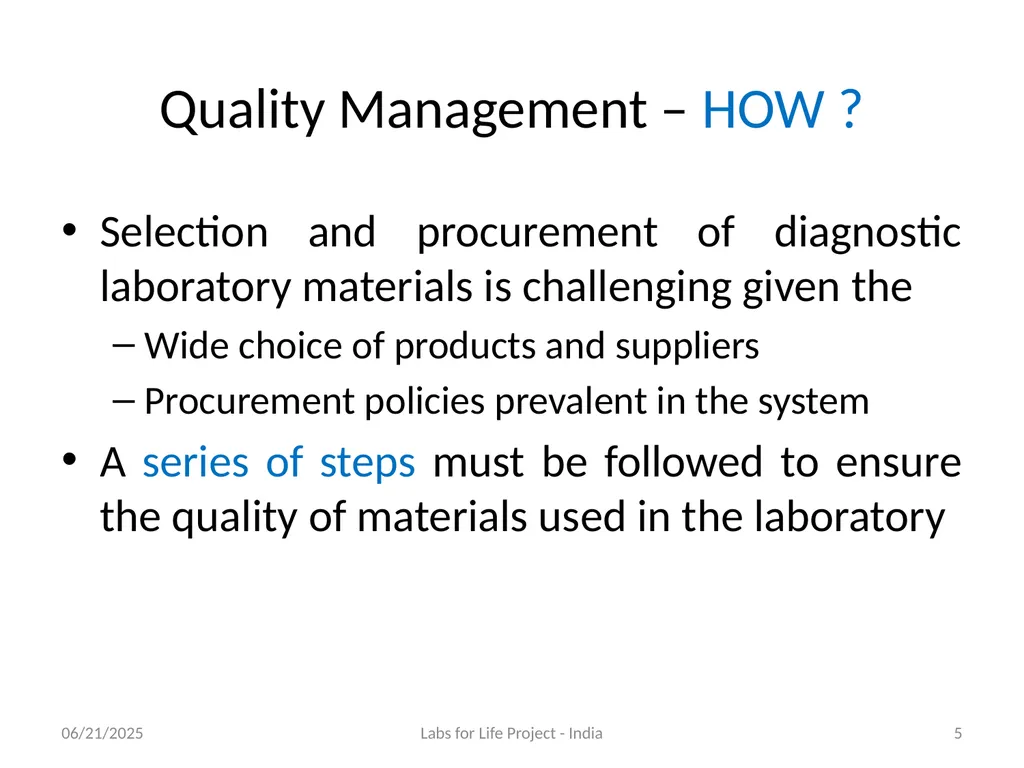
Selection and procurement of diagnostic laboratory materials is challenging given the
Wide choice of products and suppliers
Procurement policies prevalent in the system
A series of steps must be followed to ensure the quality of materials used in the laboratory Quality Management – HOW ? 6/25/2018 Labs for Life Project - India 5<br>
Wide choice of products and suppliers
Procurement policies prevalent in the system
A series of steps must be followed to ensure the quality of materials used in the laboratory Quality Management – HOW ? 6/25/2018 Labs for Life Project - India 5<br>
06
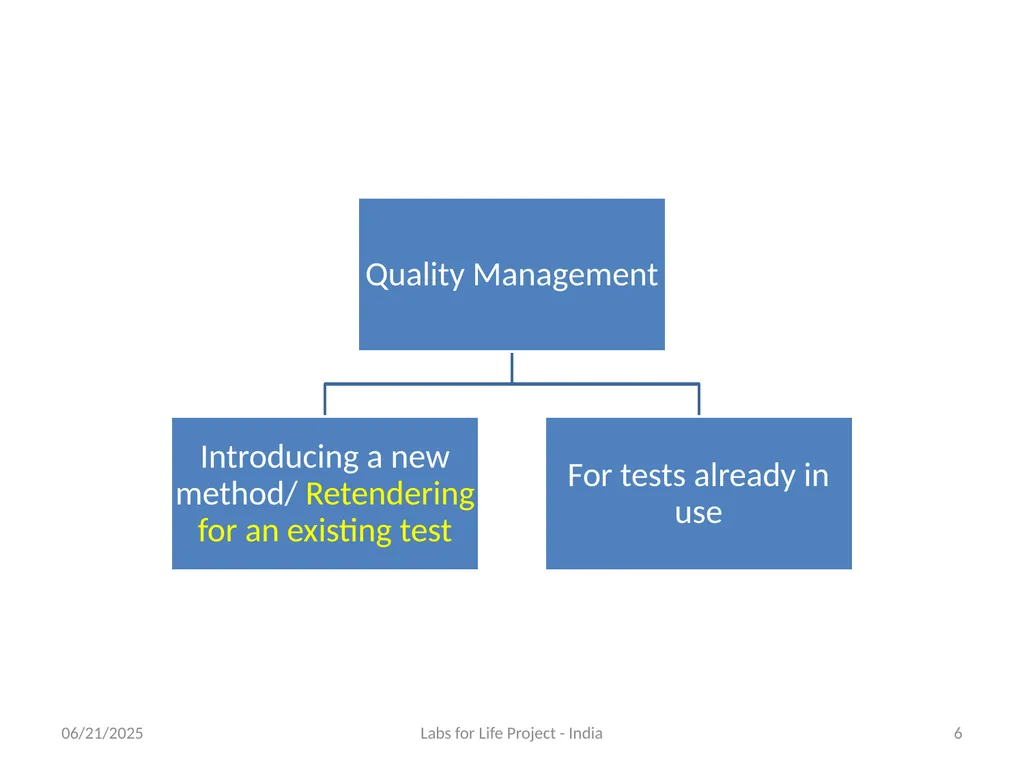
6/25/2018 Labs for Life Project - India 6<br>
07
Understanding Utility and Feasibility 6/25/2018 Labs for Life Project - India 7<br>
08
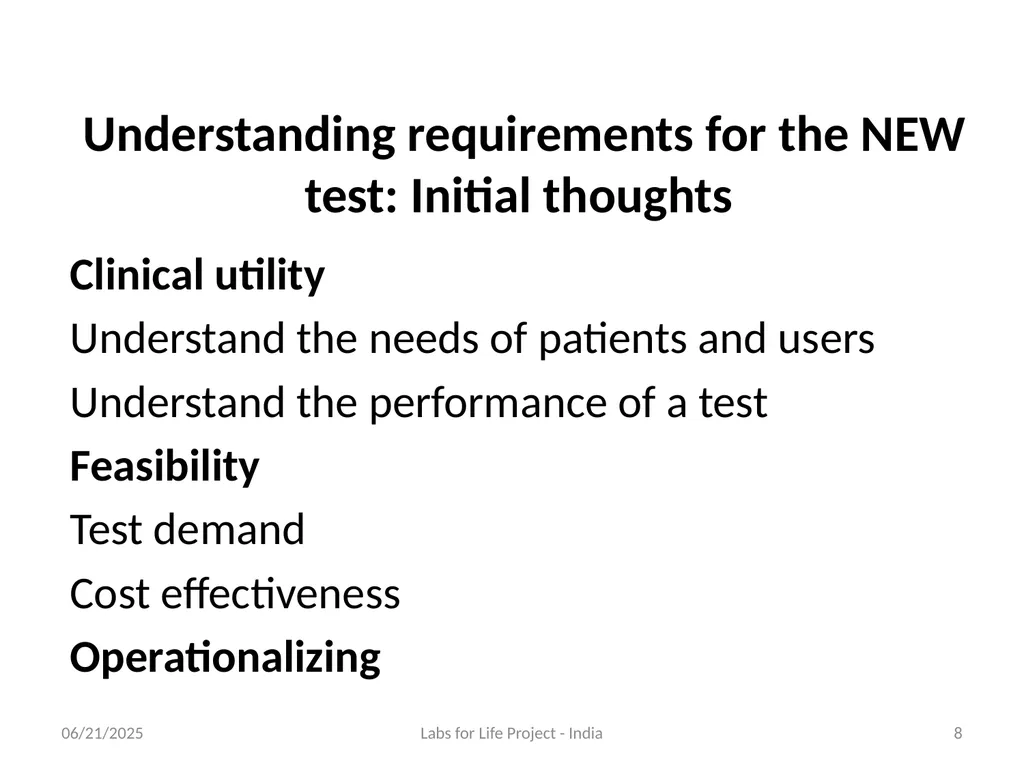
Understanding requirements for the NEW test: Initial thoughts Clinical utility
Understand the needs of patients and users
Understand the performance of a test
Feasibility
Test demand
Cost effectiveness
Operationalizing 6/25/2018 Labs for Life Project - India 8<br>
Understand the needs of patients and users
Understand the performance of a test
Feasibility
Test demand
Cost effectiveness
Operationalizing 6/25/2018 Labs for Life Project - India 8<br>
09
Clinical utility
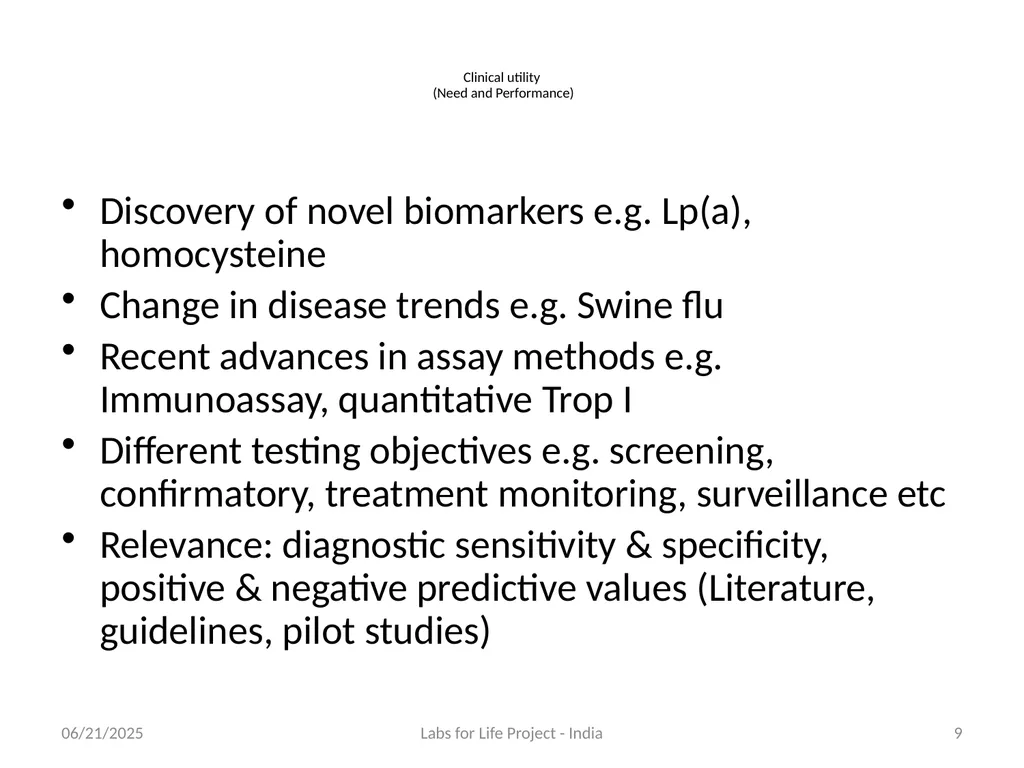
(Need and Performance) Discovery of novel biomarkers e.g. Lp(a), homocysteine
Change in disease trends e.g. Swine flu
Recent advances in assay methods e.g. Immunoassay, quantitative Trop I
Different testing objectives e.g. screening, confirmatory, treatment monitoring, surveillance etc
Relevance: diagnostic sensitivity & specificity, positive & negative predictive values (Literature, guidelines, pilot studies) 6/25/2018 Labs for Life Project - India 9<br>
Change in disease trends e.g. Swine flu
Recent advances in assay methods e.g. Immunoassay, quantitative Trop I
Different testing objectives e.g. screening, confirmatory, treatment monitoring, surveillance etc
Relevance: diagnostic sensitivity & specificity, positive & negative predictive values (Literature, guidelines, pilot studies) 6/25/2018 Labs for Life Project - India 9<br>
10
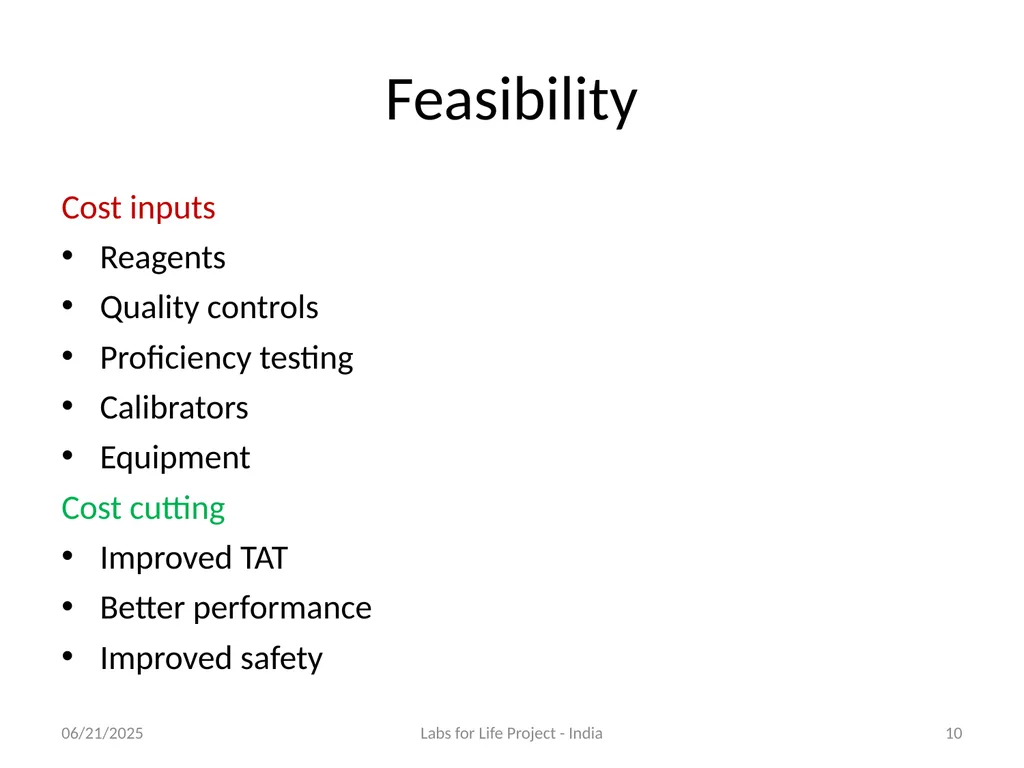
Feasibility Cost inputs
Reagents
Quality controls
Proficiency testing
Calibrators
Equipment
Cost cutting
Improved TAT
Better performance
Improved safety 6/25/2018 Labs for Life Project - India 10<br>
Reagents
Quality controls
Proficiency testing
Calibrators
Equipment
Cost cutting
Improved TAT
Better performance
Improved safety 6/25/2018 Labs for Life Project - India 10<br>
11
Survey the market for products 6/25/2018 Labs for Life Project - India 11<br>
12
Market survey Researching the available test options by interacting with the vendors
Different product kit inserts should be consulted to understand the differences in performance characteristics of the various kits 6/25/2018 Labs for Life Project - India 12<br>
Different product kit inserts should be consulted to understand the differences in performance characteristics of the various kits 6/25/2018 Labs for Life Project - India 12<br>
13
Understand Operationalizing Requirements 6/25/2018 Labs for Life Project - India 13<br>
14
Challenges in Operationalizing Test complexity
Compatibility with current equipment/ infrastructure/LIS
Staffing/training requirements
Space/ Open system/ Closed system
IQC/EQA requirements/ availability
Type and quantity of sample required
Patient/sample preparation required
Pre-analytical acceptance criteria and possible errors
Sample storage criteria 6/25/2018 Labs for Life Project - India 14<br>
Compatibility with current equipment/ infrastructure/LIS
Staffing/training requirements
Space/ Open system/ Closed system
IQC/EQA requirements/ availability
Type and quantity of sample required
Patient/sample preparation required
Pre-analytical acceptance criteria and possible errors
Sample storage criteria 6/25/2018 Labs for Life Project - India 14<br>
15
Initial thoughts…..
Gathering Evidence
Ensuring quality of the manufacturing process 6/25/2018 Labs for Life Project - India 15<br>
Gathering Evidence
Ensuring quality of the manufacturing process 6/25/2018 Labs for Life Project - India 15<br>
16
Ensuring quality of the manufacturing process The specification may request products that have been approved by national and international regulatory agencies e.g. FDA, CE, WHO etc. 6/25/2018 Labs for Life Project - India 16<br>
17
Understanding Performance Specifications stated by manufacturers 6/25/2018 Labs for Life Project - India 17<br>
18
Quality requirements, Fitness for Purpose All laboratory measurements carry some uncertainty/error
Different testing objectives e.g. screening, confirmatory, treatment monitoring, surveillance etc.
Lab must decide the level of error which could be acceptable/ allowable: Quality Specifications 6/25/2018 Labs for Life Project - India 18<br>
Different testing objectives e.g. screening, confirmatory, treatment monitoring, surveillance etc.
Lab must decide the level of error which could be acceptable/ allowable: Quality Specifications 6/25/2018 Labs for Life Project - India 18<br>
19
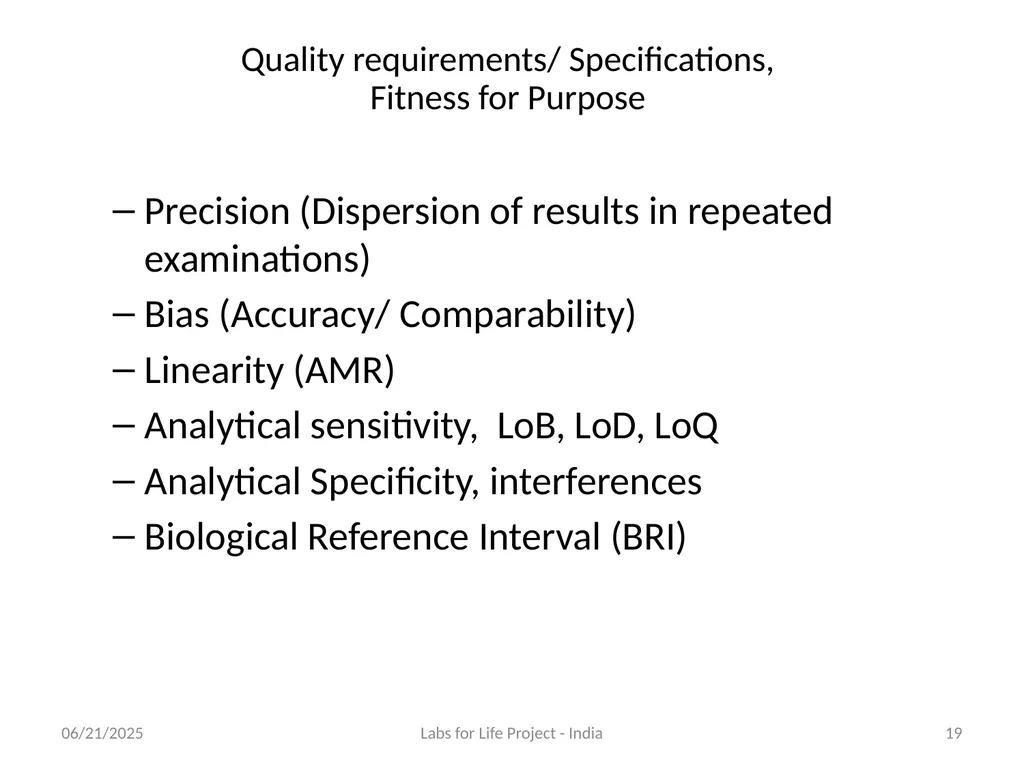
Quality requirements/ Specifications,
Fitness for Purpose Precision (Dispersion of results in repeated examinations)
Bias (Accuracy/ Comparability)
Linearity (AMR)
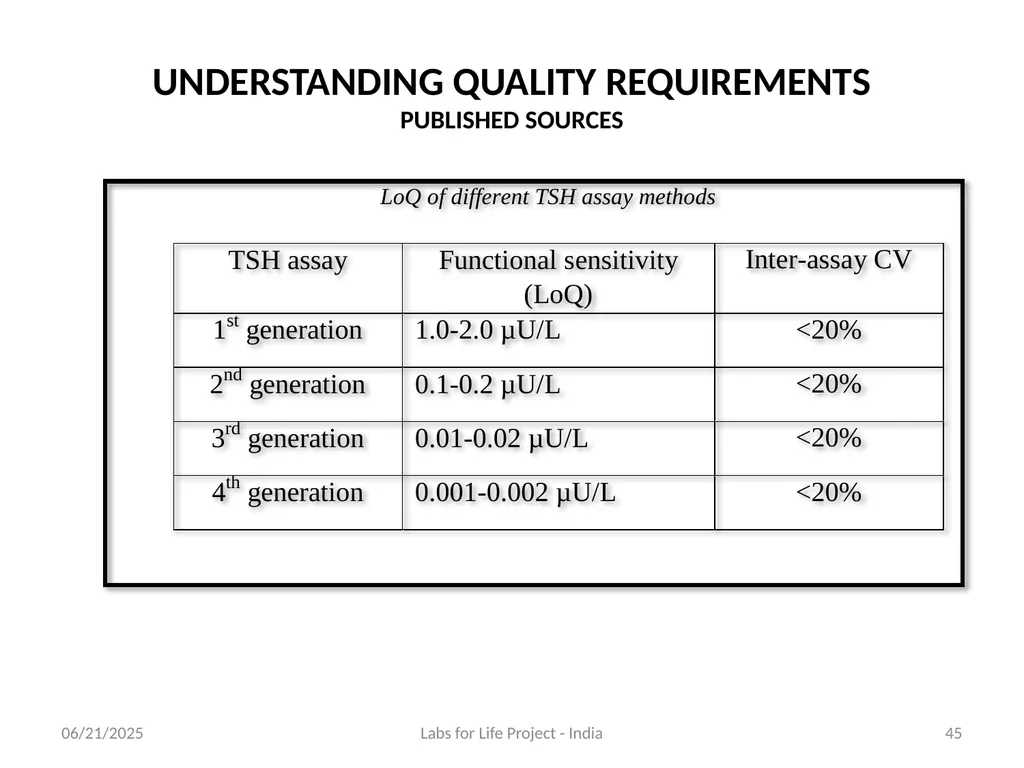
Analytical sensitivity, LoB, LoD, LoQ
Analytical Specificity, interferences
Biological Reference Interval (BRI) 6/25/2018 Labs for Life Project - India 19<br>
Bias (Accuracy/ Comparability)
Linearity (AMR)
Analytical sensitivity, LoB, LoD, LoQ
Analytical Specificity, interferences
Biological Reference Interval (BRI) 6/25/2018 Labs for Life Project - India 19<br>
20
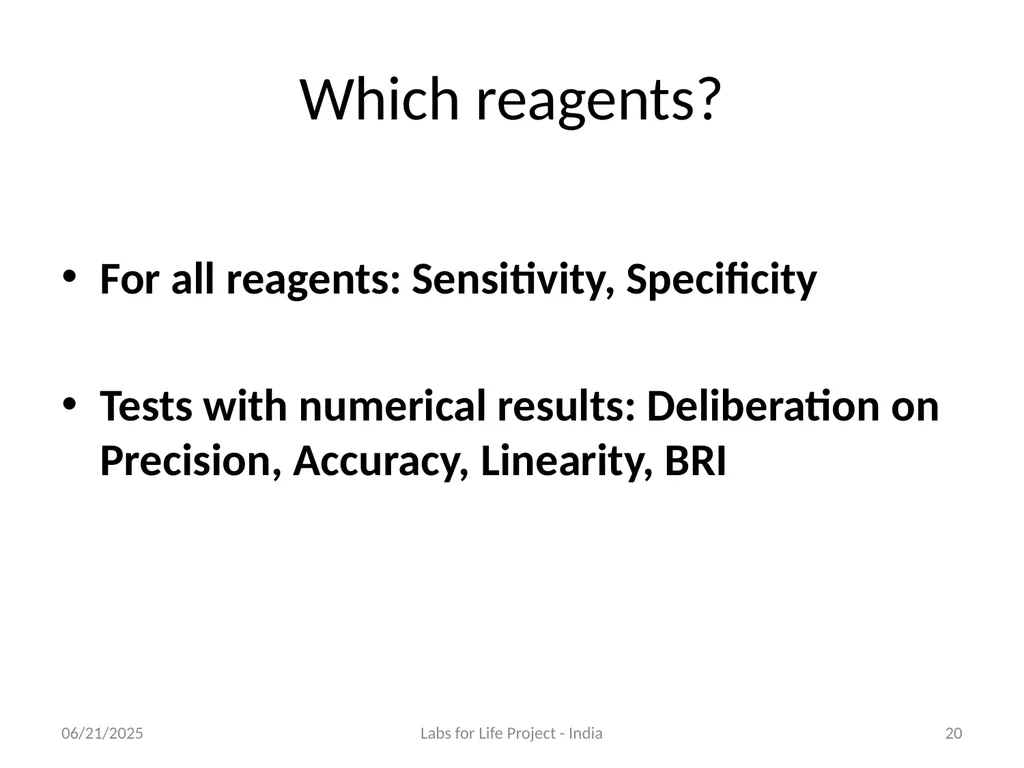
Which reagents? For all reagents: Sensitivity, Specificity
Tests with numerical results: Deliberation on Precision, Accuracy, Linearity, BRI 6/25/2018 Labs for Life Project - India 20<br>
Tests with numerical results: Deliberation on Precision, Accuracy, Linearity, BRI 6/25/2018 Labs for Life Project - India 20<br>
21
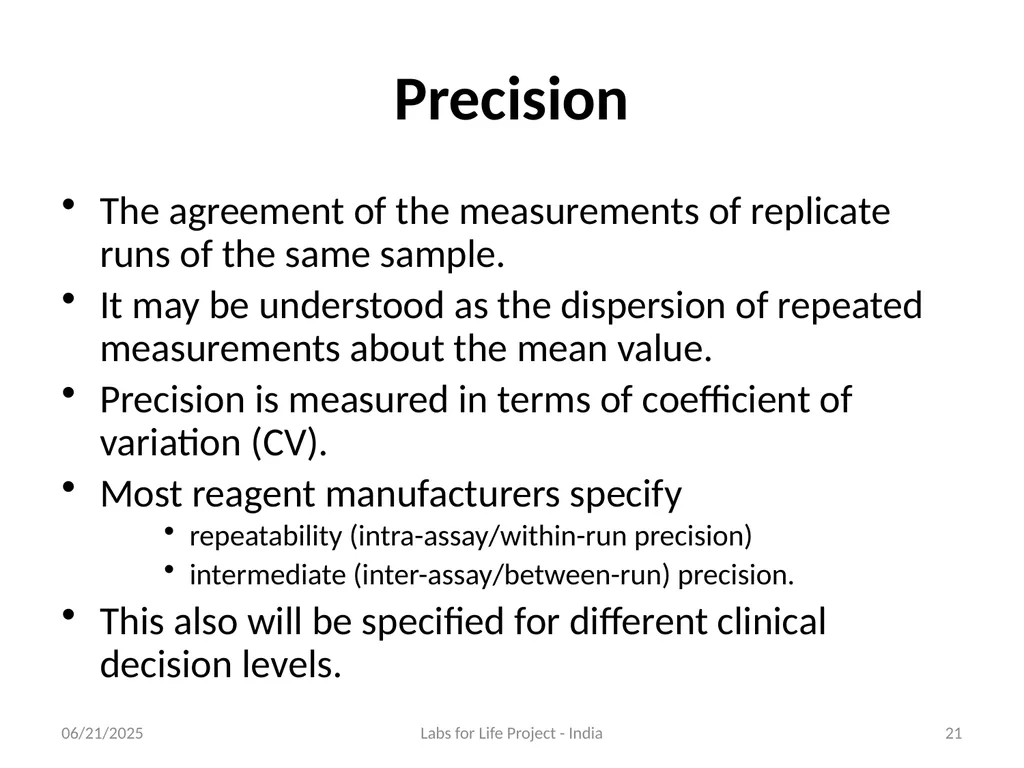
Precision The agreement of the measurements of replicate runs of the same sample.
It may be understood as the dispersion of repeated measurements about the mean value.
Precision is measured in terms of coefficient of variation (CV).
Most reagent manufacturers specify
repeatability (intra-assay/within-run precision)
intermediate (inter-assay/between-run) precision.
This also will be specified for different clinical decision levels. 6/25/2018 Labs for Life Project - India 21<br>
It may be understood as the dispersion of repeated measurements about the mean value.
Precision is measured in terms of coefficient of variation (CV).
Most reagent manufacturers specify
repeatability (intra-assay/within-run precision)
intermediate (inter-assay/between-run) precision.
This also will be specified for different clinical decision levels. 6/25/2018 Labs for Life Project - India 21<br>
22
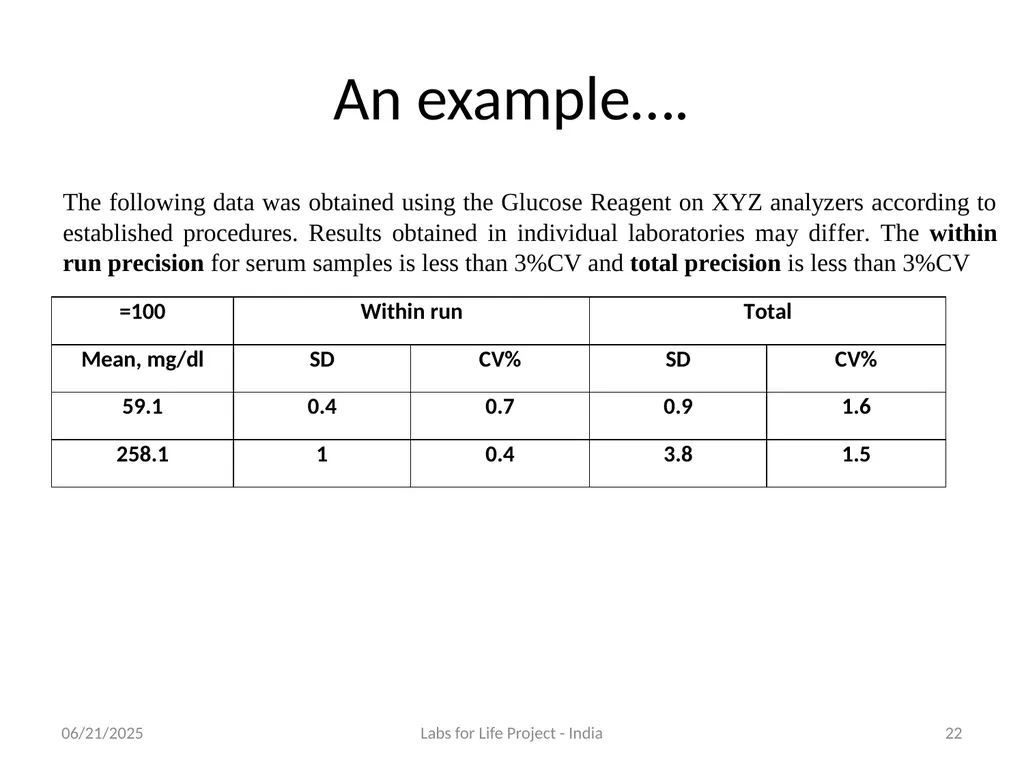
An example…. 6/25/2018 Labs for Life Project - India 22<br>
23
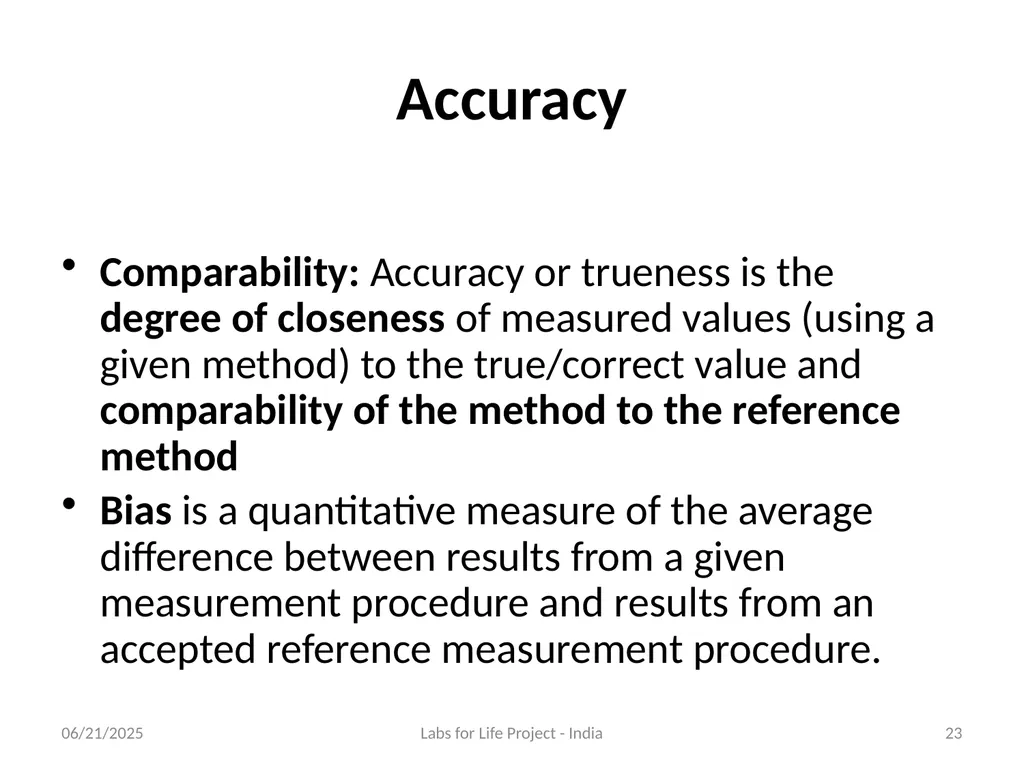
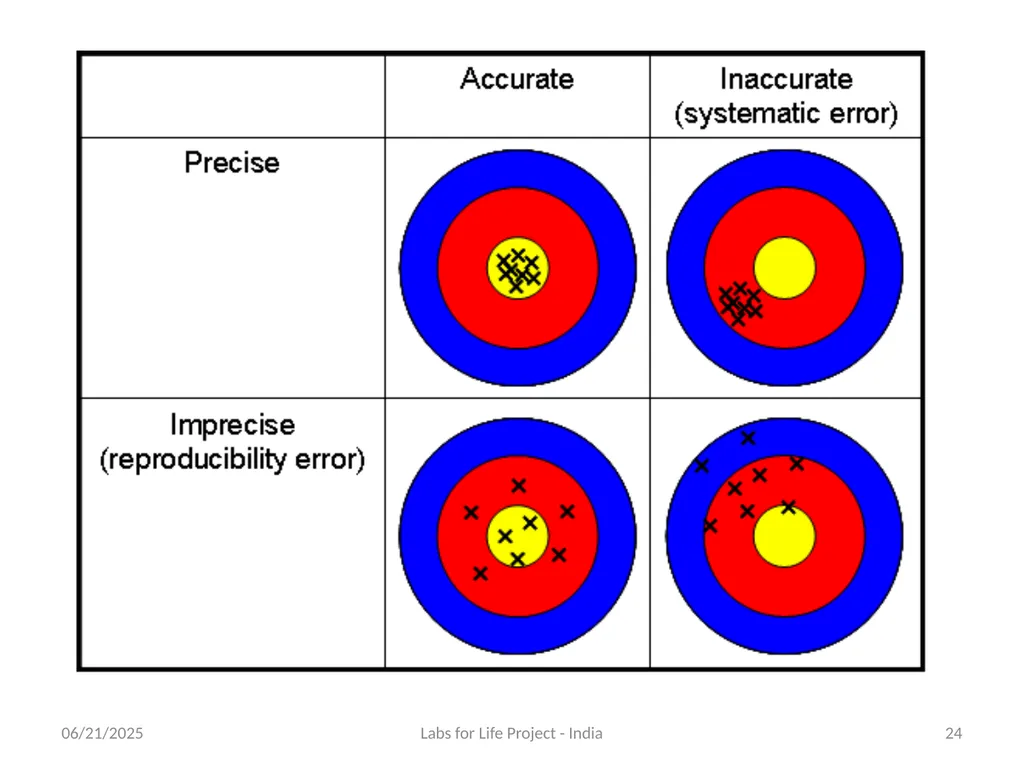
Accuracy Comparability: Accuracy or trueness is the degree of closeness of measured values (using a given method) to the true/correct value and comparability of the method to the reference method
Bias is a quantitative measure of the average difference between results from a given measurement procedure and results from an accepted reference measurement procedure. 6/25/2018 Labs for Life Project - India 23<br>
Bias is a quantitative measure of the average difference between results from a given measurement procedure and results from an accepted reference measurement procedure. 6/25/2018 Labs for Life Project - India 23<br>
24
6/25/2018 Labs for Life Project - India 24<br>
25
How is accuracy denoted on a kit insert? ‘Method comparison’ in the kit insert.
Data from Regression analysis (Correlation Coefficient, Slope, and Intercept)
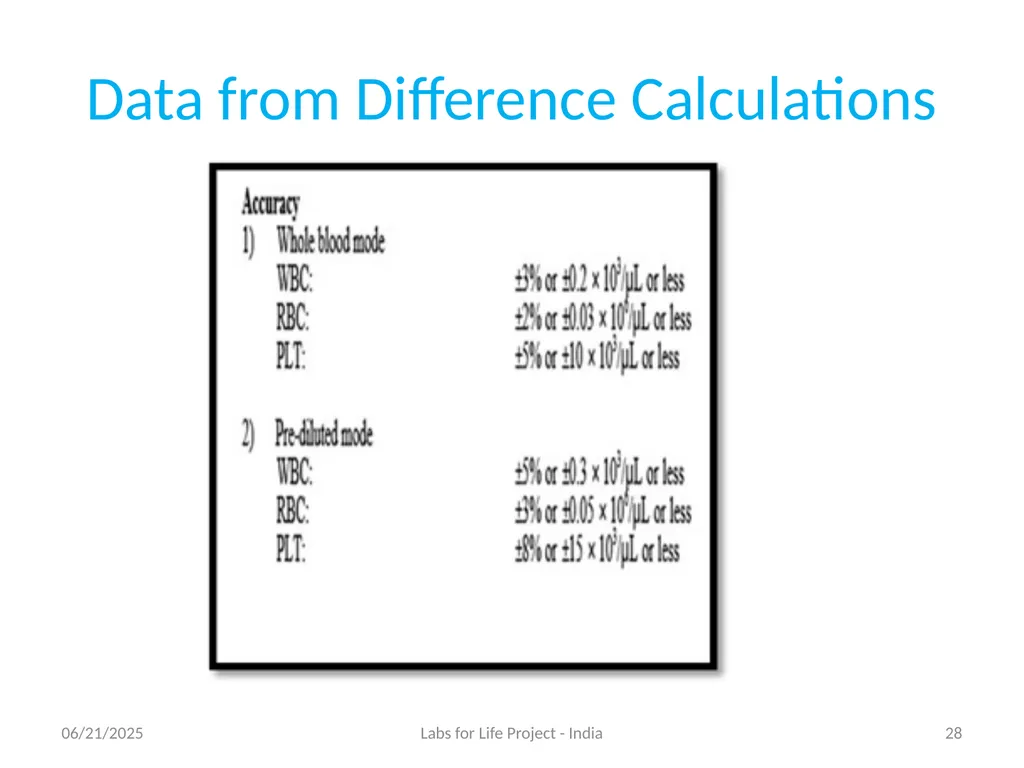
Data from Difference Calculations 6/25/2018 Labs for Life Project - India 25<br>
Data from Regression analysis (Correlation Coefficient, Slope, and Intercept)
Data from Difference Calculations 6/25/2018 Labs for Life Project - India 25<br>
26
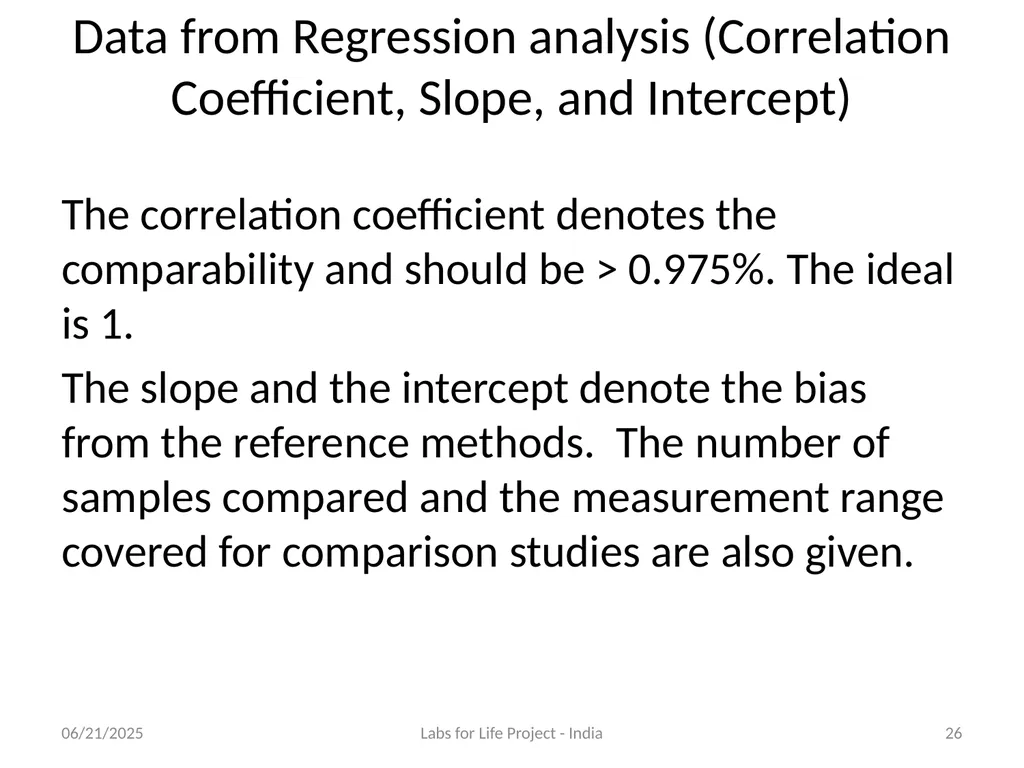
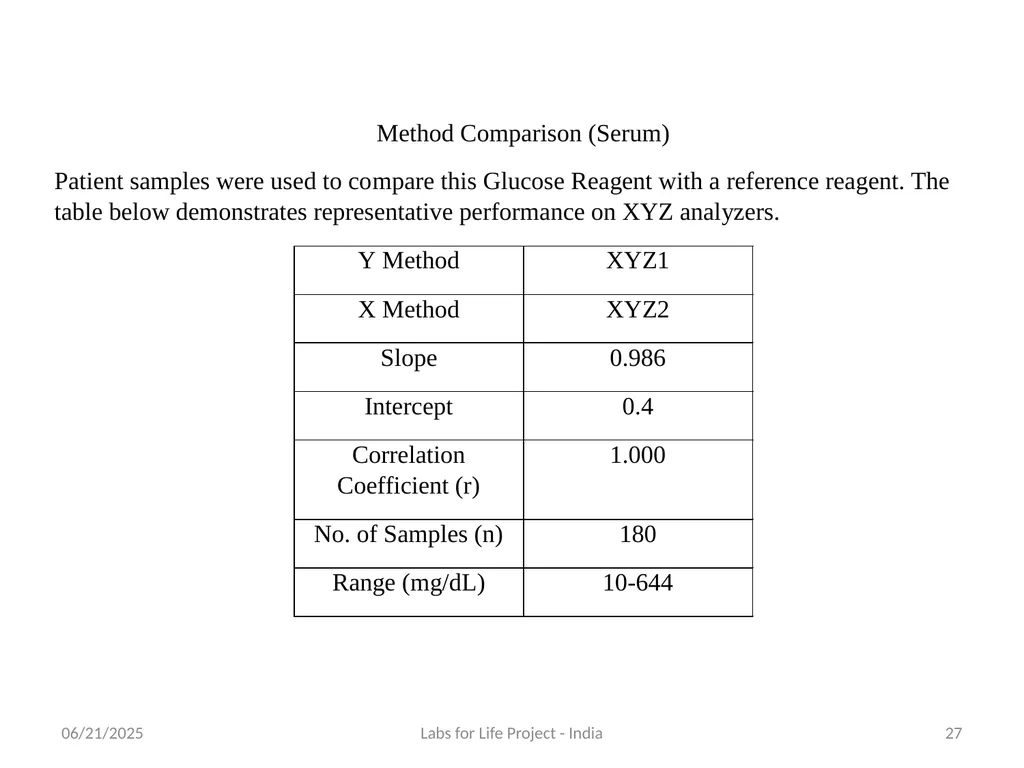
Data from Regression analysis (Correlation Coefficient, Slope, and Intercept) The correlation coefficient denotes the comparability and should be > 0.975%. The ideal is 1.
The slope and the intercept denote the bias from the reference methods. The number of samples compared and the measurement range covered for comparison studies are also given. 6/25/2018 Labs for Life Project - India 26<br>
The slope and the intercept denote the bias from the reference methods. The number of samples compared and the measurement range covered for comparison studies are also given. 6/25/2018 Labs for Life Project - India 26<br>
27
6/25/2018 Labs for Life Project - India 27<br>
28
Data from Difference Calculations 6/25/2018 Labs for Life Project - India 28<br>
29
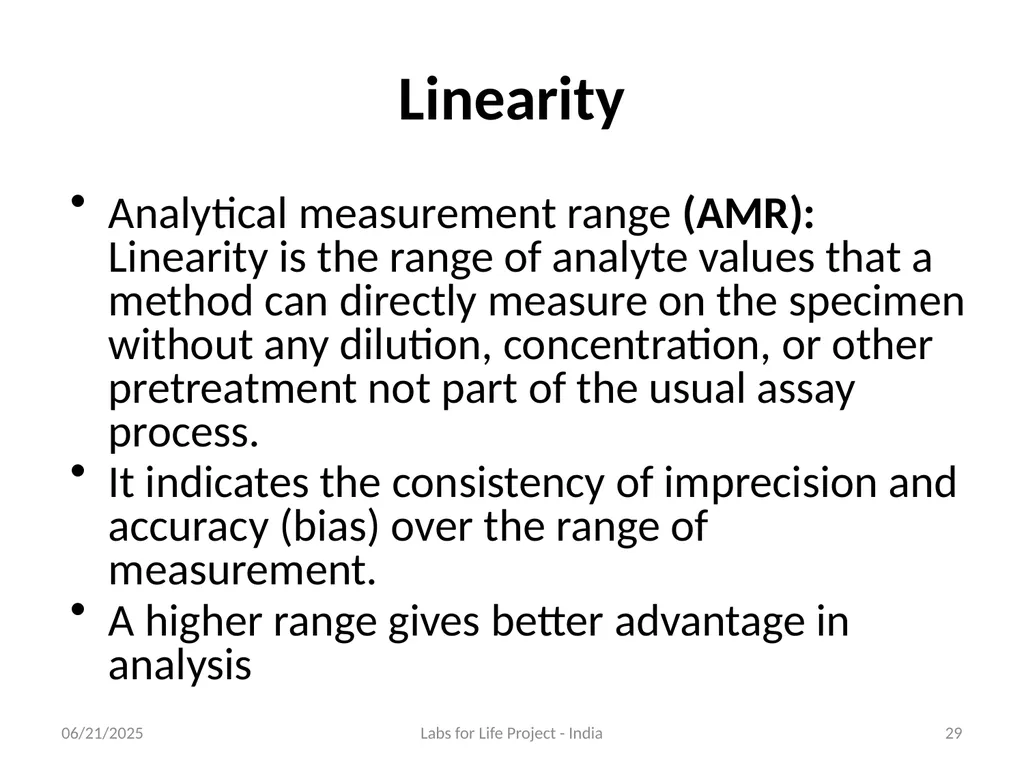
Linearity Analytical measurement range (AMR): Linearity is the range of analyte values that a method can directly measure on the specimen without any dilution, concentration, or other pretreatment not part of the usual assay process.
It indicates the consistency of imprecision and accuracy (bias) over the range of measurement.
A higher range gives better advantage in analysis 6/25/2018 Labs for Life Project - India 29<br>
It indicates the consistency of imprecision and accuracy (bias) over the range of measurement.
A higher range gives better advantage in analysis 6/25/2018 Labs for Life Project - India 29<br>
30
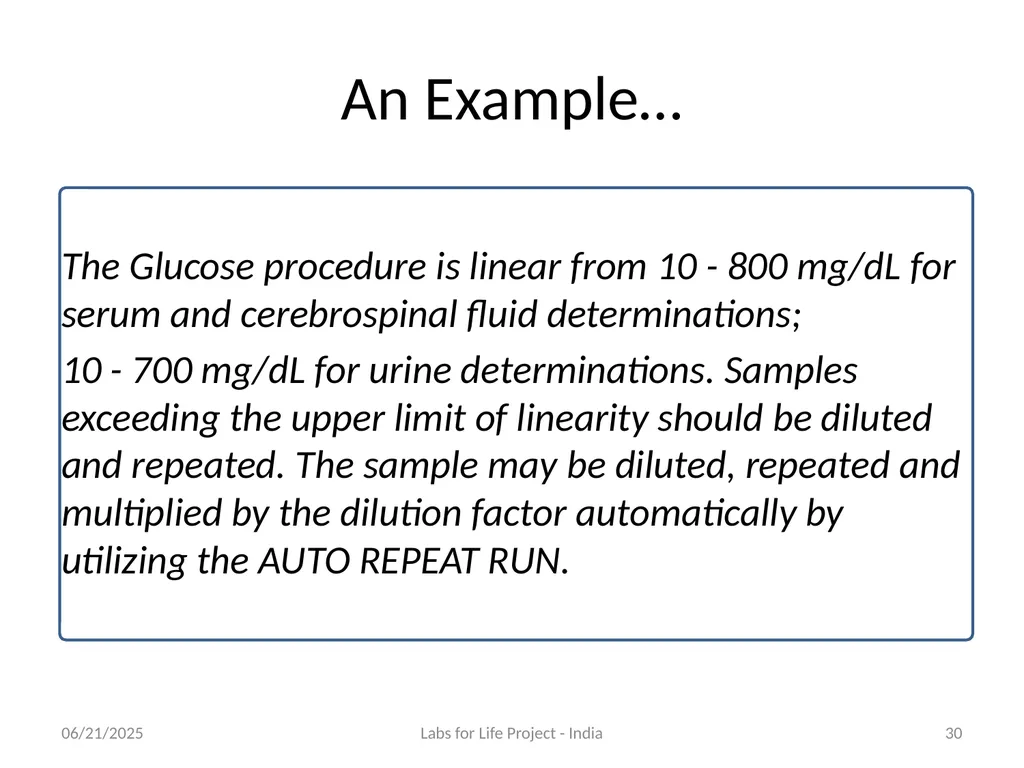
An Example… The Glucose procedure is linear from 10 - 800 mg/dL for serum and cerebrospinal fluid determinations;
10 - 700 mg/dL for urine determinations. Samples exceeding the upper limit of linearity should be diluted and repeated. The sample may be diluted, repeated and multiplied by the dilution factor automatically by utilizing the AUTO REPEAT RUN. 6/25/2018 Labs for Life Project - India 30<br>
10 - 700 mg/dL for urine determinations. Samples exceeding the upper limit of linearity should be diluted and repeated. The sample may be diluted, repeated and multiplied by the dilution factor automatically by utilizing the AUTO REPEAT RUN. 6/25/2018 Labs for Life Project - India 30<br>
31
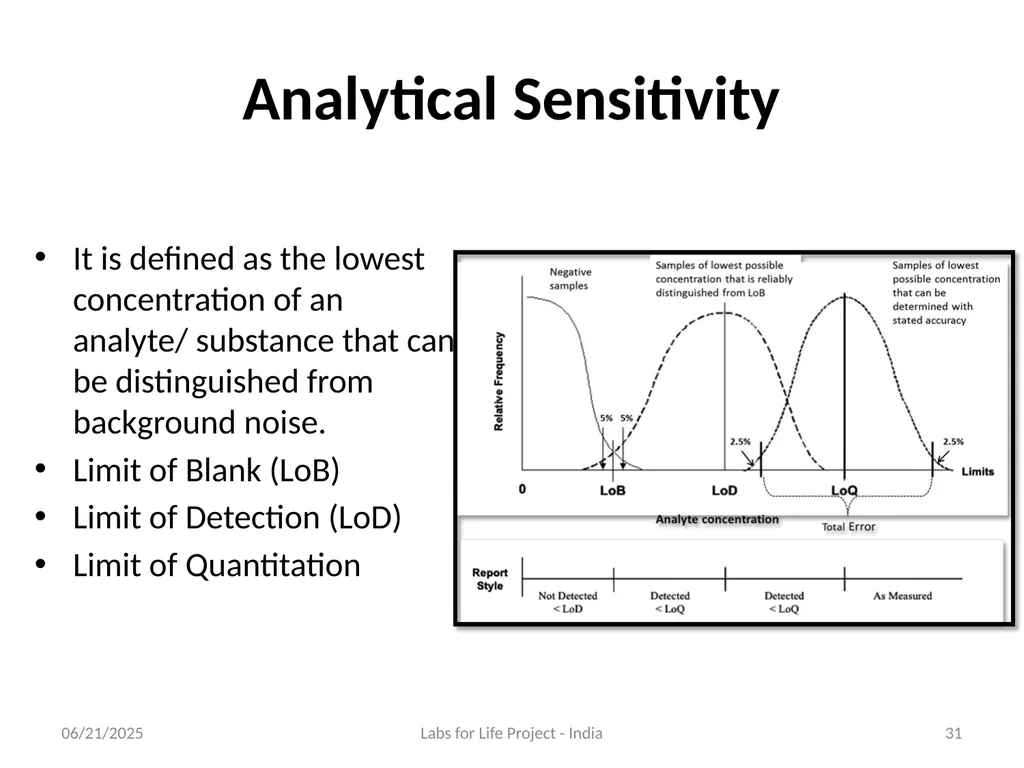
Analytical Sensitivity It is defined as the lowest concentration of an analyte/ substance that can be distinguished from background noise.
Limit of Blank (LoB)
Limit of Detection (LoD)
Limit of Quantitation 6/25/2018 Labs for Life Project - India 31<br>
Limit of Blank (LoB)
Limit of Detection (LoD)
Limit of Quantitation 6/25/2018 Labs for Life Project - India 31<br>
32
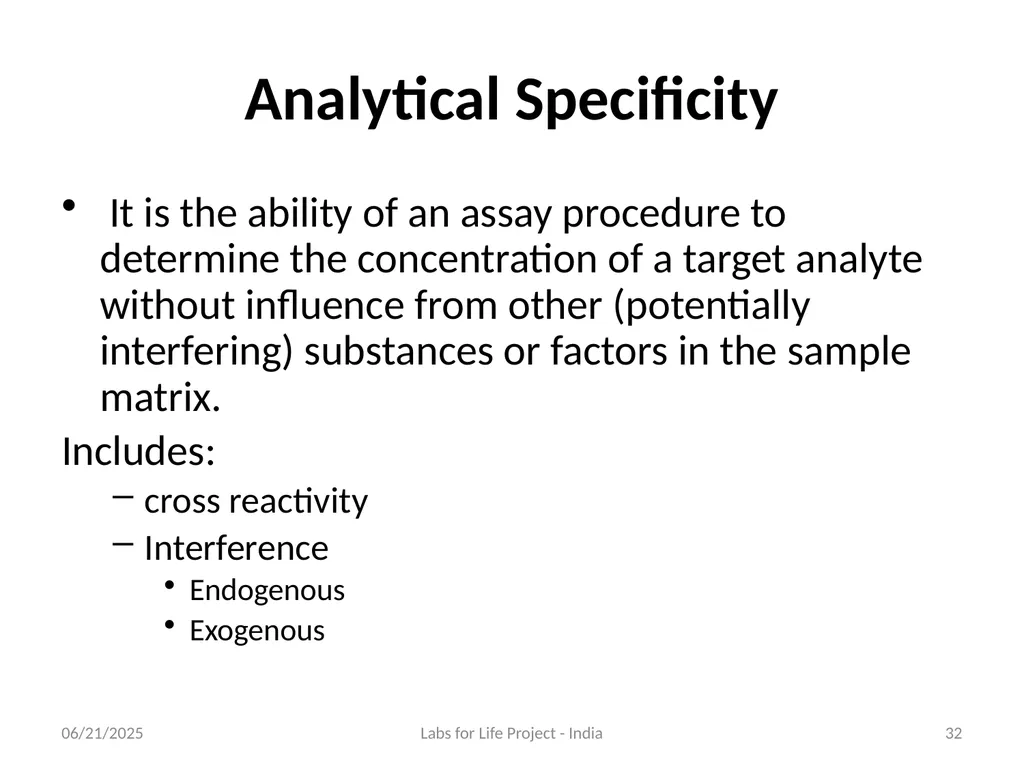
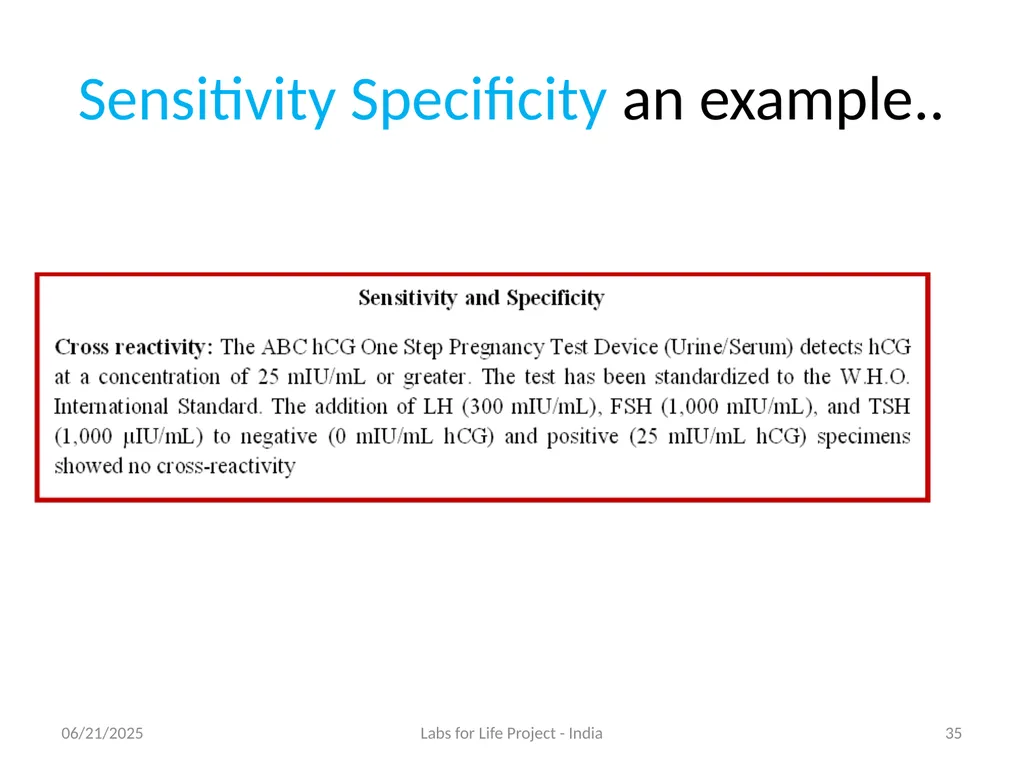
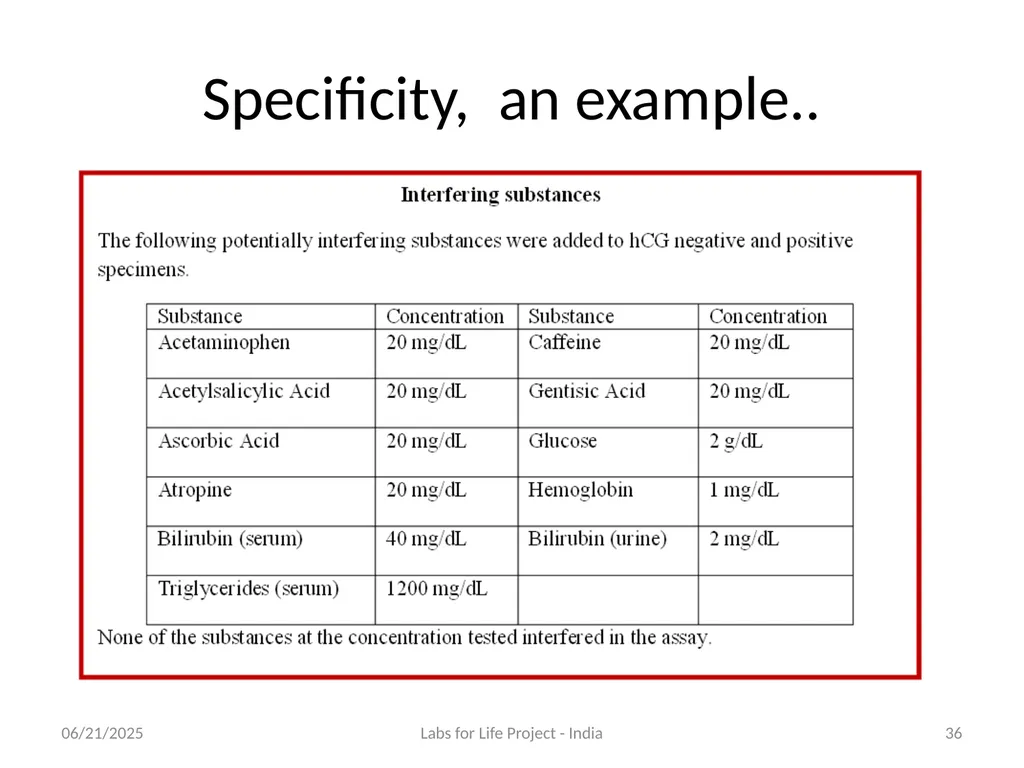
Analytical Specificity It is the ability of an assay procedure to determine the concentration of a target analyte without influence from other (potentially interfering) substances or factors in the sample matrix.
Includes:
cross reactivity
Interference
Endogenous
Exogenous 6/25/2018 Labs for Life Project - India 32<br>
Includes:
cross reactivity
Interference
Endogenous
Exogenous 6/25/2018 Labs for Life Project - India 32<br>
33
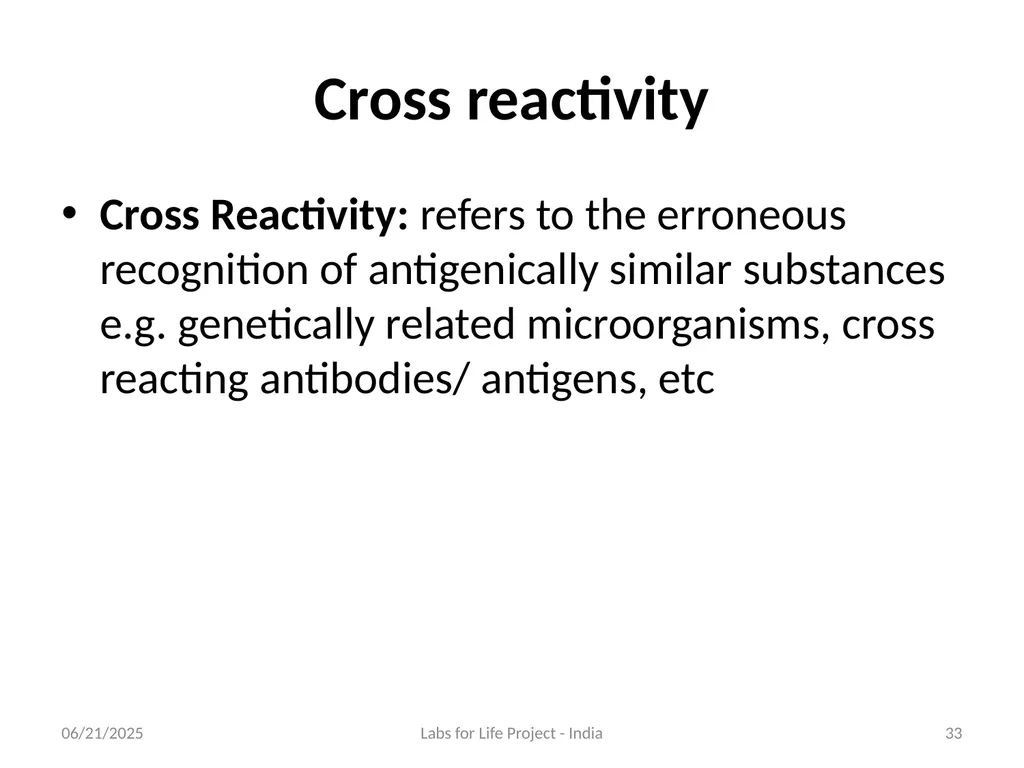
Cross reactivity Cross Reactivity: refers to the erroneous recognition of antigenically similar substances e.g. genetically related microorganisms, cross reacting antibodies/ antigens, etc 6/25/2018 Labs for Life Project - India 33<br>
34
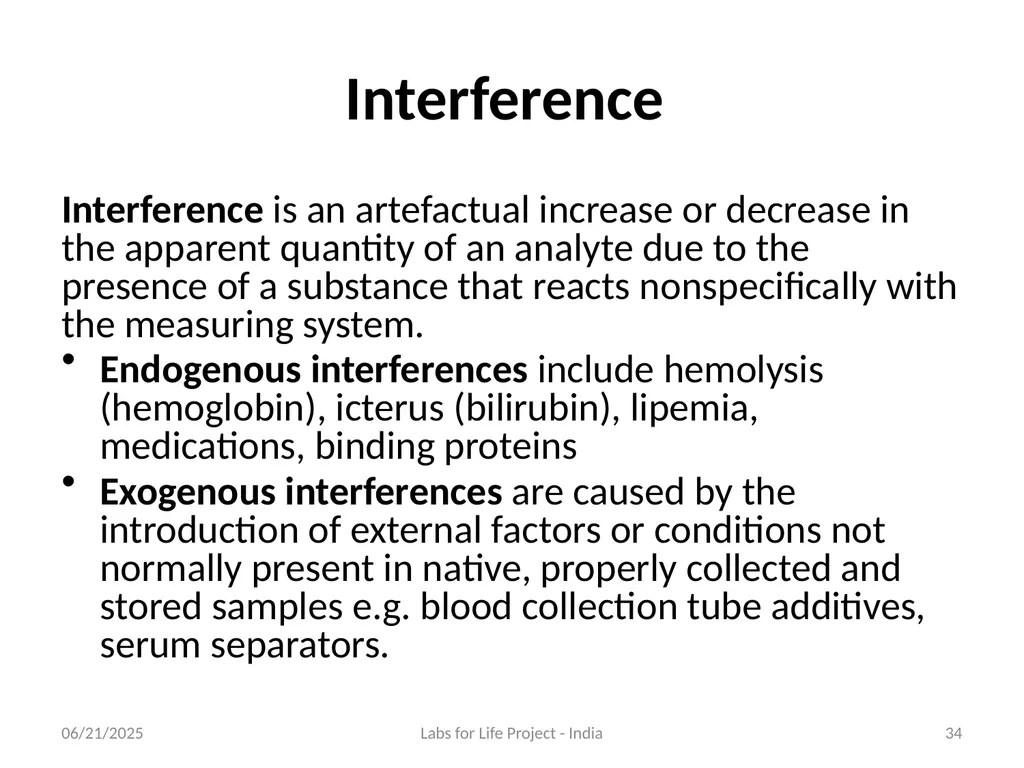
Interference Interference is an artefactual increase or decrease in the apparent quantity of an analyte due to the presence of a substance that reacts nonspecifically with the measuring system.
Endogenous interferences include hemolysis (hemoglobin), icterus (bilirubin), lipemia, medications, binding proteins
Exogenous interferences are caused by the introduction of external factors or conditions not normally present in native, properly collected and stored samples e.g. blood collection tube additives, serum separators. 6/25/2018 Labs for Life Project - India 34<br>
Endogenous interferences include hemolysis (hemoglobin), icterus (bilirubin), lipemia, medications, binding proteins
Exogenous interferences are caused by the introduction of external factors or conditions not normally present in native, properly collected and stored samples e.g. blood collection tube additives, serum separators. 6/25/2018 Labs for Life Project - India 34<br>
35
Sensitivity Specificity an example.. 6/25/2018 Labs for Life Project - India 35<br>
36
Specificity, an example.. 6/25/2018 Labs for Life Project - India 36<br>
37
Biological Reference Intervals When measurement of an analyte is performed in a group of well-defined reference individuals, the central 95% interval of results obtained is referred to as the Biological Reference Interval for that analyte.
It is frequently provided as the interpretive information along with laboratory test results.
It may vary for different demographic samples according to genetic and environmental factors. 6/25/2018 Labs for Life Project - India 37<br>
It is frequently provided as the interpretive information along with laboratory test results.
It may vary for different demographic samples according to genetic and environmental factors. 6/25/2018 Labs for Life Project - India 37<br>
38
Deciding on which reagent to purchase
Quality requirements, Fitness for Purpose
Comparing the Stated Claims against Acceptable Error Specifications 6/25/2018 Labs for Life Project - India 38<br>
Quality requirements, Fitness for Purpose
Comparing the Stated Claims against Acceptable Error Specifications 6/25/2018 Labs for Life Project - India 38<br>
39
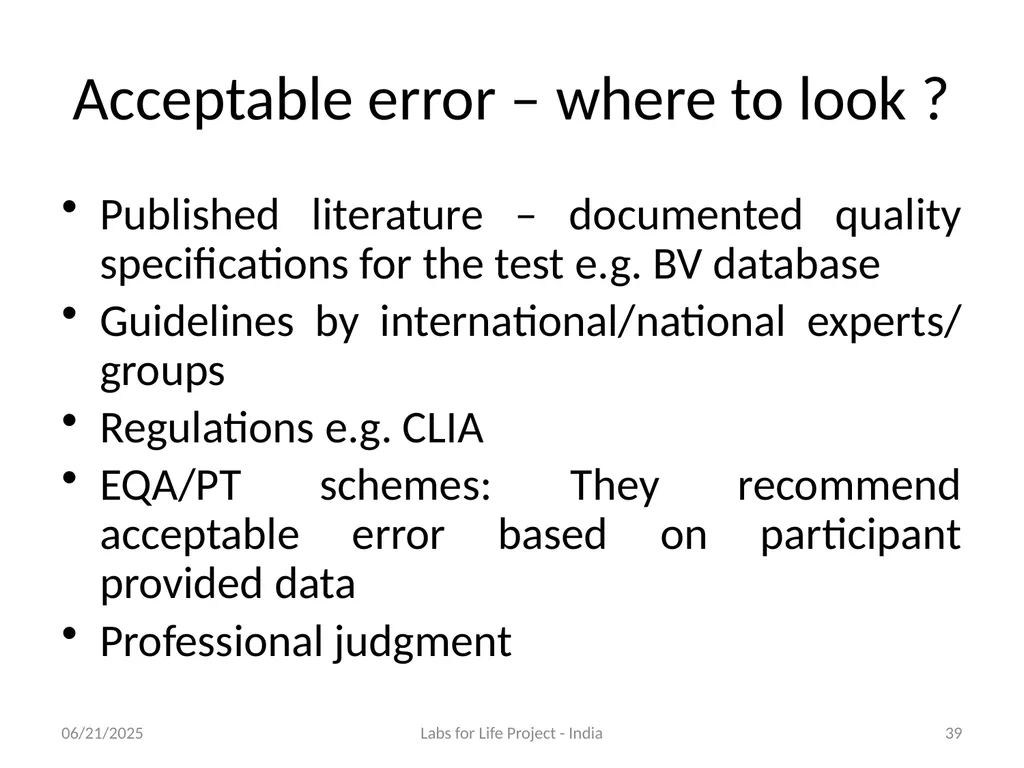
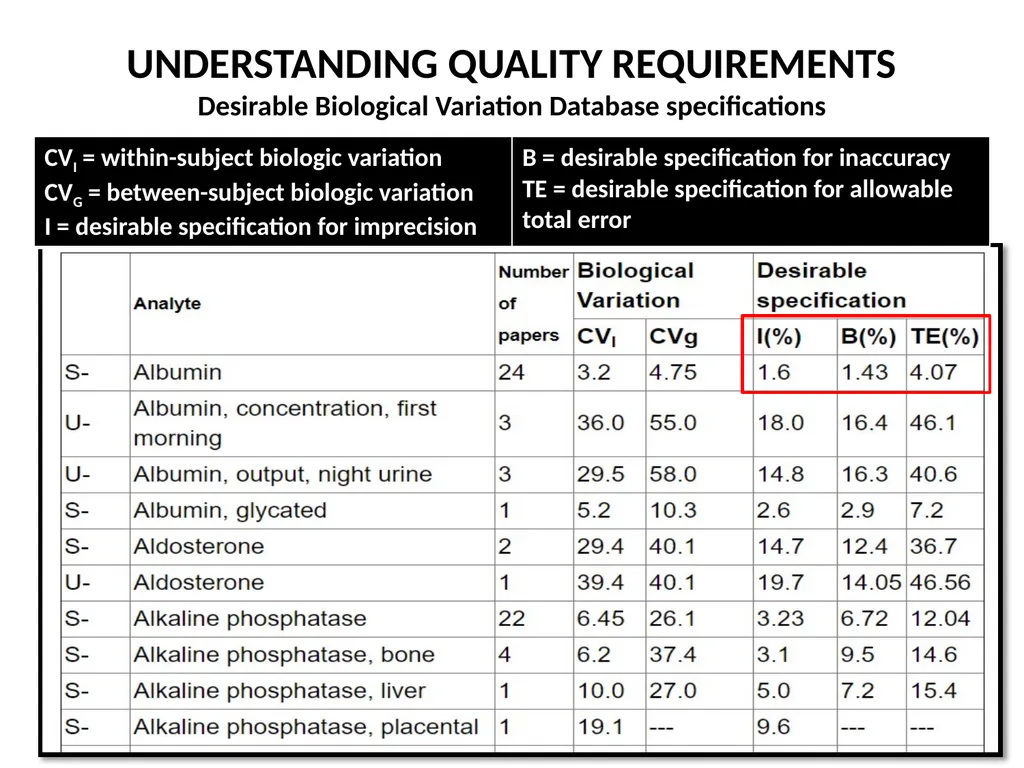
Acceptable error – where to look ? Published literature – documented quality specifications for the test e.g. BV database
Guidelines by international/national experts/ groups
Regulations e.g. CLIA
EQA/PT schemes: They recommend acceptable error based on participant provided data
Professional judgment 6/25/2018 Labs for Life Project - India 39<br>
Guidelines by international/national experts/ groups
Regulations e.g. CLIA
EQA/PT schemes: They recommend acceptable error based on participant provided data
Professional judgment 6/25/2018 Labs for Life Project - India 39<br>
40
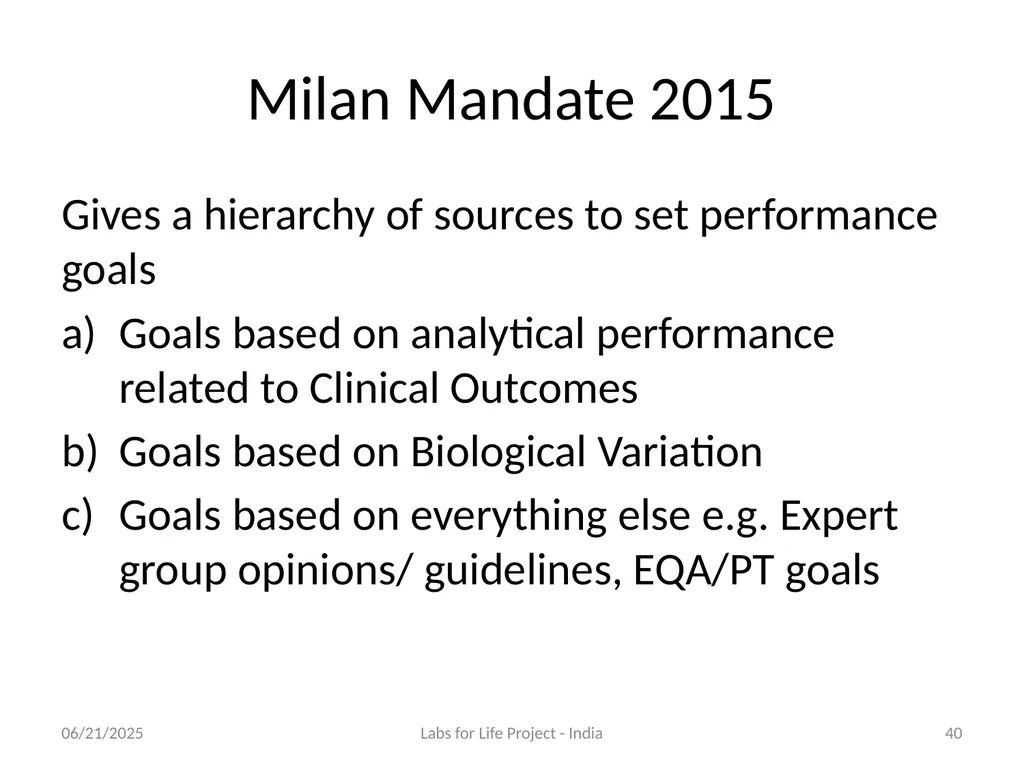
Milan Mandate 2015 Gives a hierarchy of sources to set performance goals
Goals based on analytical performance related to Clinical Outcomes
Goals based on Biological Variation
Goals based on everything else e.g. Expert group opinions/ guidelines, EQA/PT goals 6/25/2018 Labs for Life Project - India 40<br>
Goals based on analytical performance related to Clinical Outcomes
Goals based on Biological Variation
Goals based on everything else e.g. Expert group opinions/ guidelines, EQA/PT goals 6/25/2018 Labs for Life Project - India 40<br>
41
Some resources
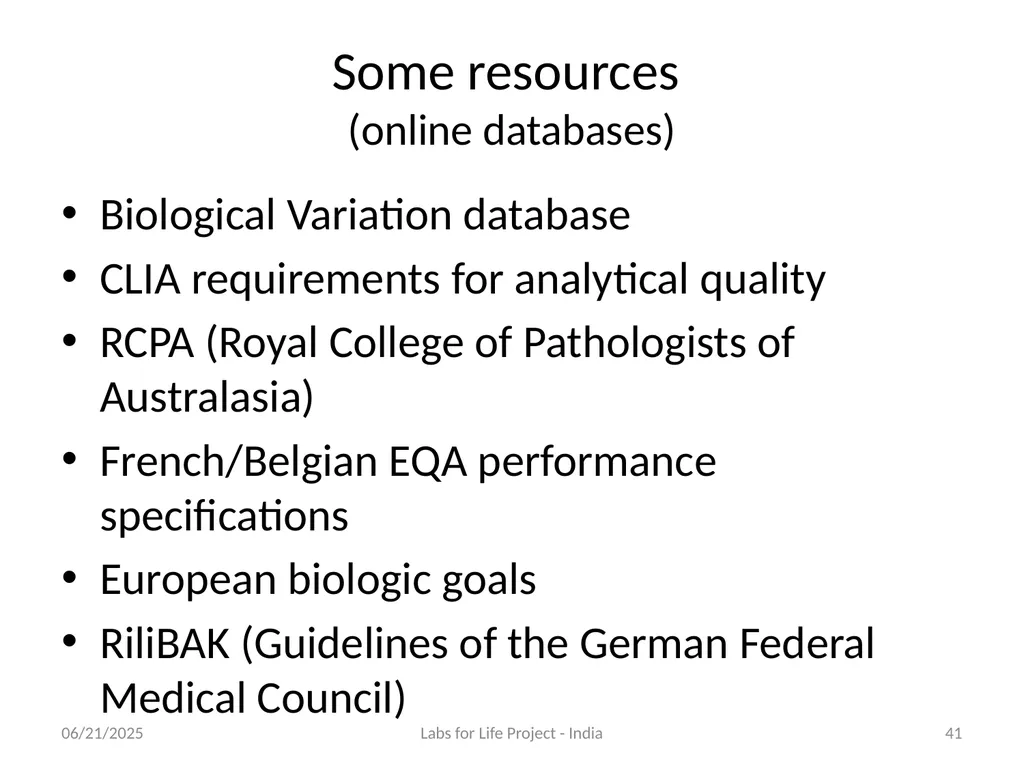
(online databases) Biological Variation database
CLIA requirements for analytical quality
RCPA (Royal College of Pathologists of Australasia)
French/Belgian EQA performance specifications
European biologic goals
RiliBAK (Guidelines of the German Federal Medical Council) 6/25/2018 Labs for Life Project - India 41<br>
CLIA requirements for analytical quality
RCPA (Royal College of Pathologists of Australasia)
French/Belgian EQA performance specifications
European biologic goals
RiliBAK (Guidelines of the German Federal Medical Council) 6/25/2018 Labs for Life Project - India 41<br>
42
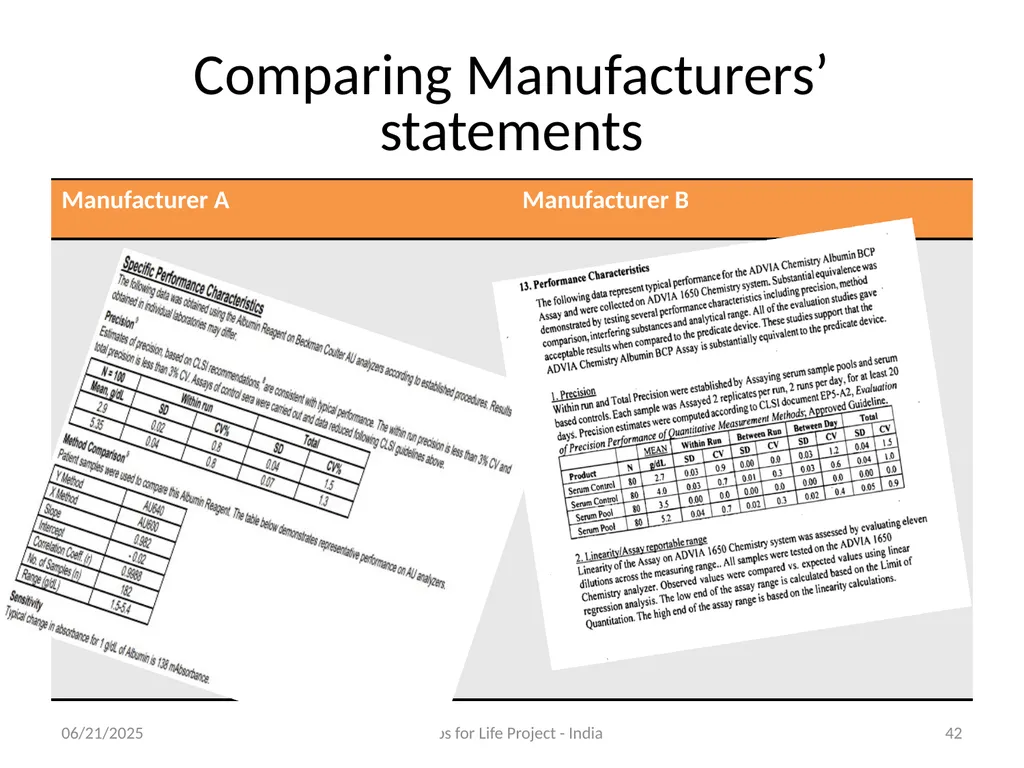
Comparing Manufacturers’ statements 6/25/2018 Labs for Life Project - India 42<br>
43
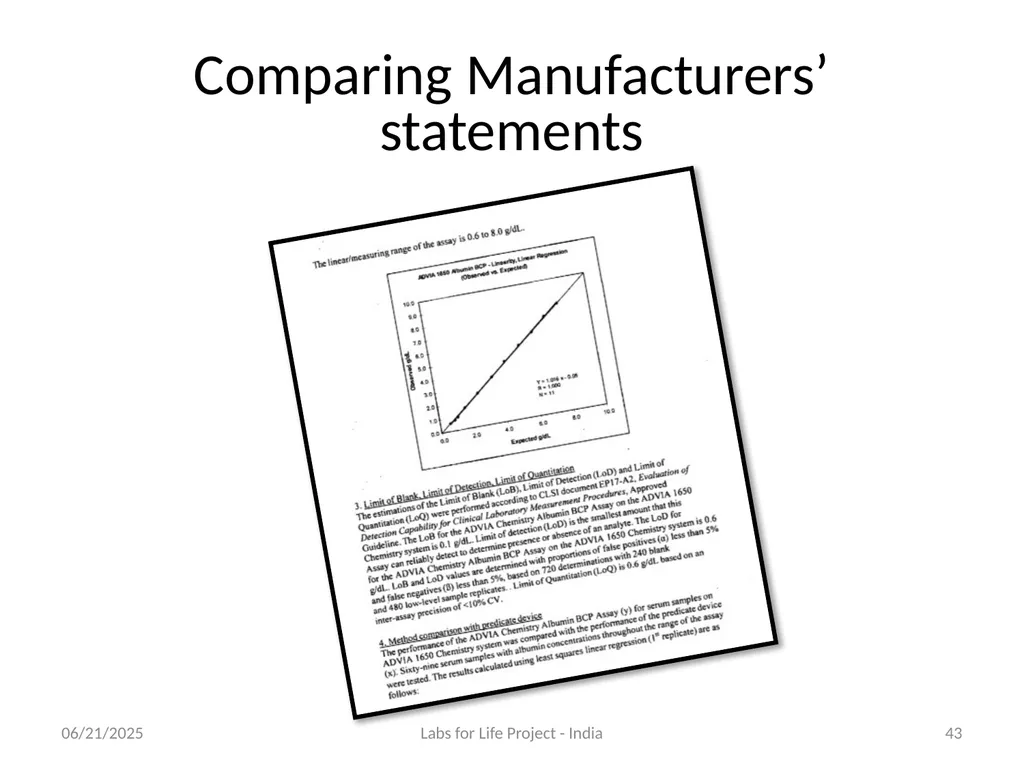
Comparing Manufacturers’ statements 6/25/2018 Labs for Life Project - India 43<br>
44
Understanding QUALITY REQUIREMENTS
Desirable Biological Variation Database specifications 6/25/2018 Labs for Life Project - India 44<br>
45
Understanding QUALITY REQUIREMENTS
Published Sources 6/25/2018 Labs for Life Project - India 45<br>
46
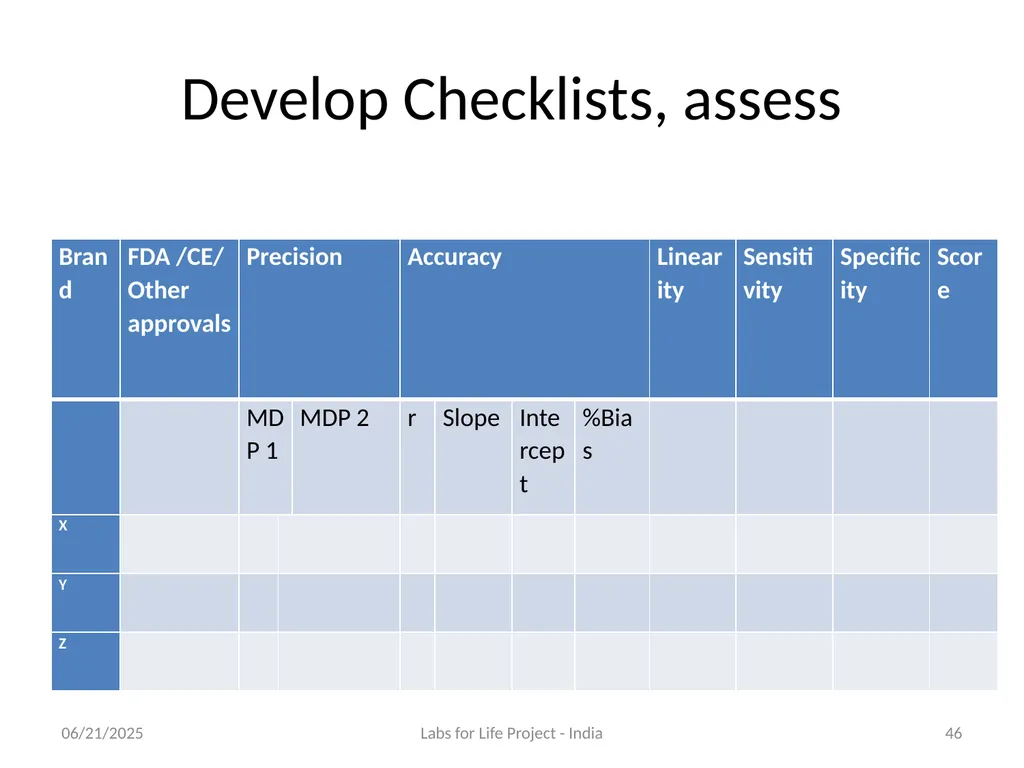
Develop Checklists, assess 6/25/2018 Labs for Life Project - India 46<br>
47
Understanding how to include Commercial aspects 6/25/2018 Labs for Life Project - India 47<br>
48
Extras that you can include into the process: Post-purchase verification process
Quality assurance through acceptance testing
Application support
Complaint resolution mechanisms
Review of agreement
Supplier track record evaluation 6/25/2018 Labs for Life Project - India 48<br>
Quality assurance through acceptance testing
Application support
Complaint resolution mechanisms
Review of agreement
Supplier track record evaluation 6/25/2018 Labs for Life Project - India 48<br>
49
Writing Technical Specifications Correctly, to your advantage Writing Technical Specifications thus includes:
Quality Specifications
Operational Specifications
Commercial Specifications 6/25/2018 Labs for Life Project - India 49<br>
Quality Specifications
Operational Specifications
Commercial Specifications 6/25/2018 Labs for Life Project - India 49<br>
50
Two bid systems The procurement of reagents and consumables generally follows a two-bid system where tenders are invited in two parts
Technical Bid
Price/ Financial Bid 6/25/2018 Labs for Life Project - India 50<br>
Technical Bid
Price/ Financial Bid 6/25/2018 Labs for Life Project - India 50<br>
51
Tips… Maintain transparency
Be objective: minimize extraneous undue influences on the process
Ensure reliability of suppliers, in terms of quality and service
Conclude the process within the shortest possible time span 6/25/2018 Labs for Life Project - India 51<br>
Be objective: minimize extraneous undue influences on the process
Ensure reliability of suppliers, in terms of quality and service
Conclude the process within the shortest possible time span 6/25/2018 Labs for Life Project - India 51<br>