
Radiation hazards & safety Gulshan Kumar MVSc, PhD
LO
Published · 29 slides · 0 views

1 / 1
Description
Radiation hazards safety Gulshan Kumar MVSc, PhD College of Veterinary Science and Animal Husbandry, DUVASU, Mathura-281001 (UP) College of Veterinary Science and Animal Husbandry, DUVASU, Mathura-281001 (UP) College of Veterinary Science
Related Topics
Share
Embed code
Download this presentation From Below
"Radiation hazards & safety Gulshan Kumar MVSc, PhD" is the property of its rightful owner. Permission is granted to download and print the materials on this website for personal, non-commercial use only, and to display it on your personal computer provided you do not modify the materials and that you retain all copyright notices contained in the materials. By downloading content from our website, you accept the terms of this agreement.
Presentation Transcript
01
Radiation hazards & safety Gulshan Kumar
MVSc, PhD College of Veterinary Science and Animal Husbandry, DUVASU, Mathura-281001 (UP)<br>
MVSc, PhD College of Veterinary Science and Animal Husbandry, DUVASU, Mathura-281001 (UP)<br>
02
College of Veterinary Science and Animal Husbandry, DUVASU, Mathura-281001 (UP)<br>
03
College of Veterinary Science and Animal Husbandry, DUVASU, Mathura-281001 (UP)<br>
04
College of Veterinary Science and Animal Husbandry, DUVASU, Mathura-281001 (UP)<br>
05
HAZARDS
Radiation burns.
Cancer.
Leukaemia.
Mutations College of Veterinary Science and Animal Husbandry, DUVASU, Mathura-281001 (UP)<br>
Radiation burns.
Cancer.
Leukaemia.
Mutations College of Veterinary Science and Animal Husbandry, DUVASU, Mathura-281001 (UP)<br>
06
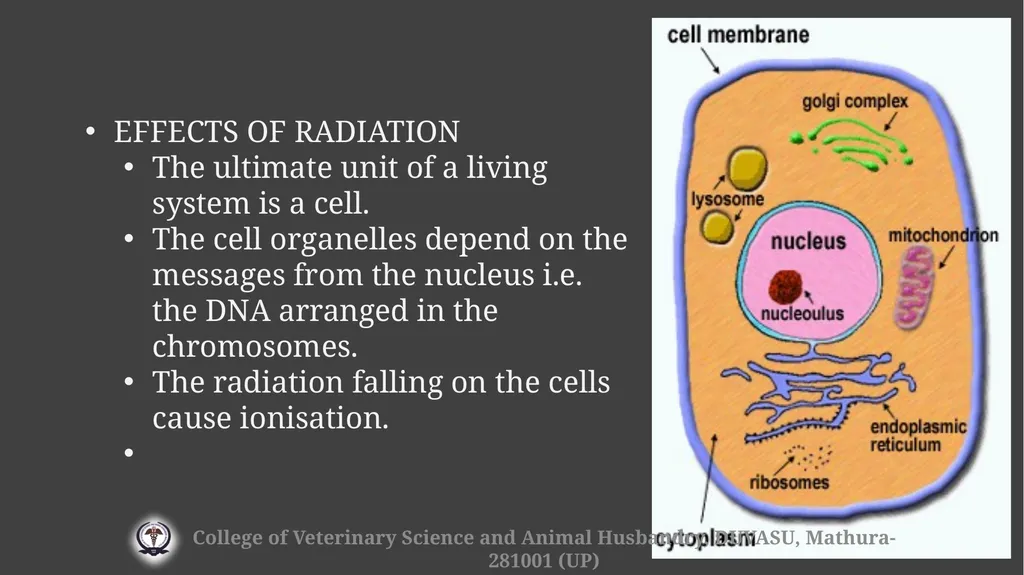
EFFECTS OF RADIATION
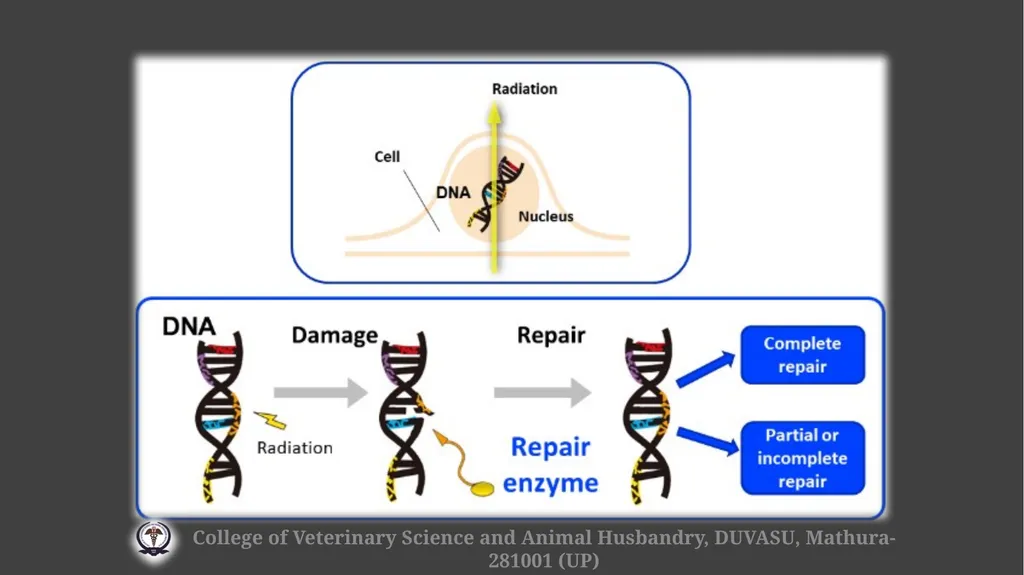
The ultimate unit of a living system is a cell.
The cell organelles depend on the messages from the nucleus i.e. the DNA arranged in the chromosomes.
The radiation falling on the cells cause ionisation. College of Veterinary Science and Animal Husbandry, DUVASU, Mathura-281001 (UP)<br>
The ultimate unit of a living system is a cell.
The cell organelles depend on the messages from the nucleus i.e. the DNA arranged in the chromosomes.
The radiation falling on the cells cause ionisation. College of Veterinary Science and Animal Husbandry, DUVASU, Mathura-281001 (UP)<br>
07
THE DIRECT EFFECTS OF RADIATION
If an x-ray interacts with the DNA molecule, this is considered a direct effect.
Ionizing radiation can disrupt chemical bonds of DNA by breaking the bonds.
A disruption or break and can occur directly in the molecular structure, such as the bond between base-pairs.
Other molecules that contribute to cell function, such as RNA, proteins, and enzymes, may also be affected by the direct effect.
This damage could be properly repaired by cellular mechanisms, improperly repaired causing a genetic mutation, or it could result in the death of the cell. College of Veterinary Science and Animal Husbandry, DUVASU, Mathura-281001 (UP)<br>
If an x-ray interacts with the DNA molecule, this is considered a direct effect.
Ionizing radiation can disrupt chemical bonds of DNA by breaking the bonds.
A disruption or break and can occur directly in the molecular structure, such as the bond between base-pairs.
Other molecules that contribute to cell function, such as RNA, proteins, and enzymes, may also be affected by the direct effect.
This damage could be properly repaired by cellular mechanisms, improperly repaired causing a genetic mutation, or it could result in the death of the cell. College of Veterinary Science and Animal Husbandry, DUVASU, Mathura-281001 (UP)<br>
08
THE DIRECT vs INDIRECT EFFECT OF RADIATION
Direct -ionizing radiation interacts with DNA, creating immediate damage. The cell could either: die, repair itself, or be altered creating a mutation.
Indirect -ionizing radiation interacts with water molecules within the cell, which produces free radicals and oxidizing agents. These reactive chemical agents can then go on to damage the DNA causing a genetic mutation, or it could result in the death of the cell. College of Veterinary Science and Animal Husbandry, DUVASU, Mathura-281001 (UP)<br>
Direct -ionizing radiation interacts with DNA, creating immediate damage. The cell could either: die, repair itself, or be altered creating a mutation.
Indirect -ionizing radiation interacts with water molecules within the cell, which produces free radicals and oxidizing agents. These reactive chemical agents can then go on to damage the DNA causing a genetic mutation, or it could result in the death of the cell. College of Veterinary Science and Animal Husbandry, DUVASU, Mathura-281001 (UP)<br>
09
College of Veterinary Science and Animal Husbandry, DUVASU, Mathura-281001 (UP)<br>
10
THE INDIRECT EFFECTS OF RADIATION
Most of the damage to DNA molecules is accomplished through the indirect effect.
When x-rays hit a water molecule they ionise the water molecule.
Ions and free radicals are produced. They possess large amount of energy to break chemical bonds in vitally important molecules e.g. DNA molecule, changing its structure.
Since the x-ray interacted with the water molecule before the DNA was involved, this is considered an indirect effect. College of Veterinary Science and Animal Husbandry, DUVASU, Mathura-281001 (UP)<br>
Most of the damage to DNA molecules is accomplished through the indirect effect.
When x-rays hit a water molecule they ionise the water molecule.
Ions and free radicals are produced. They possess large amount of energy to break chemical bonds in vitally important molecules e.g. DNA molecule, changing its structure.
Since the x-ray interacted with the water molecule before the DNA was involved, this is considered an indirect effect. College of Veterinary Science and Animal Husbandry, DUVASU, Mathura-281001 (UP)<br>
11
……THE INDIRECT EFFECTS OF RADIATION
The living body consists of 70- 90% water.
The ionization of pure water leads to fast moving free electron and a +vely charged molecule.
This decomposition of water due to ionising radiation is called Radiolysis of water thereby producing “free radicals.”
Free Radical: An atom or molecule that has an unpaired electron in the valence shell, making it “highly reactive.”
Both peroxyl radicals and hydrogen peroxide are oxidizing agents that alter biological molecules and cause cell destruction. College of Veterinary Science and Animal Husbandry, DUVASU, Mathura-281001 (UP)<br>
The living body consists of 70- 90% water.
The ionization of pure water leads to fast moving free electron and a +vely charged molecule.
This decomposition of water due to ionising radiation is called Radiolysis of water thereby producing “free radicals.”
Free Radical: An atom or molecule that has an unpaired electron in the valence shell, making it “highly reactive.”
Both peroxyl radicals and hydrogen peroxide are oxidizing agents that alter biological molecules and cause cell destruction. College of Veterinary Science and Animal Husbandry, DUVASU, Mathura-281001 (UP)<br>
12
……THE INDIRECT EFFECTS OF RADIATION
In the nucleic acid (DNA), there may be a
1. Change or loss of base.
2. Disruption of hydrogen bonds between DNA strands.
3. Breakage of one or both DNA strands.
4. Cross-linkage of DNA strands within the helix to other DNA or proteins. College of Veterinary Science and Animal Husbandry, DUVASU, Mathura-281001 (UP)<br>
In the nucleic acid (DNA), there may be a
1. Change or loss of base.
2. Disruption of hydrogen bonds between DNA strands.
3. Breakage of one or both DNA strands.
4. Cross-linkage of DNA strands within the helix to other DNA or proteins. College of Veterinary Science and Animal Husbandry, DUVASU, Mathura-281001 (UP)<br>
13
THE CELLULAR EFFECTS OF RADIATION
The possible cellular effects are:
Cells undamaged: ionization alters the structure of the cells but has no overall negative effect.
Sublethal injury: cells are damaged by ionization but the damage is repaired.
Mutation: cell injury may be incorrectly repaired, and cell function is altered or the cell may reproduce at an uncontrolled rate (cancer).
Cell death: the cell damage is so extensive that the cell is no longer able to reproduce. College of Veterinary Science and Animal Husbandry, DUVASU, Mathura-281001 (UP)<br>
The possible cellular effects are:
Cells undamaged: ionization alters the structure of the cells but has no overall negative effect.
Sublethal injury: cells are damaged by ionization but the damage is repaired.
Mutation: cell injury may be incorrectly repaired, and cell function is altered or the cell may reproduce at an uncontrolled rate (cancer).
Cell death: the cell damage is so extensive that the cell is no longer able to reproduce. College of Veterinary Science and Animal Husbandry, DUVASU, Mathura-281001 (UP)<br>
14
THE CELLULAR EFFECTS OF RADIATION
Cells cycle:
More damage results when the cell is irradiated during the G1 or early S portion of the cell cycle (before DNA synthesis);
The damaged DNA (chromosome) will be duplicated during DNA synthesis and will result in a break in both arms of the chromosome at the next mitosis. (G1 = gap phase 1 in which nuclear components are replicated; S = synthesis phase- DNA is synthesized during the last 2/3 of this phase; G2 = gap phase 2, a preparatory stage to cell division; M = mitosis, during which cells divide Cell most sensitive to radiation.) College of Veterinary Science and Animal Husbandry, DUVASU, Mathura-281001 (UP)<br>
Cells cycle:
More damage results when the cell is irradiated during the G1 or early S portion of the cell cycle (before DNA synthesis);
The damaged DNA (chromosome) will be duplicated during DNA synthesis and will result in a break in both arms of the chromosome at the next mitosis. (G1 = gap phase 1 in which nuclear components are replicated; S = synthesis phase- DNA is synthesized during the last 2/3 of this phase; G2 = gap phase 2, a preparatory stage to cell division; M = mitosis, during which cells divide Cell most sensitive to radiation.) College of Veterinary Science and Animal Husbandry, DUVASU, Mathura-281001 (UP)<br>
15
Cell-sensitivity:
Cells that are more easily damaged by radiation are radio-sensitive.
Cells with high reproductive rate (many mitoses)
Undifferentiated (immature)
Cells with high metabolic rate
Examples of radio-sensitive cells: Lymphocytes, germ cells, basal cells of skin and mucosa, and erythroblasts. College of Veterinary Science and Animal Husbandry, DUVASU, Mathura-281001 (UP)<br>
Cells that are more easily damaged by radiation are radio-sensitive.
Cells with high reproductive rate (many mitoses)
Undifferentiated (immature)
Cells with high metabolic rate
Examples of radio-sensitive cells: Lymphocytes, germ cells, basal cells of skin and mucosa, and erythroblasts. College of Veterinary Science and Animal Husbandry, DUVASU, Mathura-281001 (UP)<br>
16
Cell-sensitivity:
Cells that are not as susceptible to damage from radiation are radio-resistant.
Cells with low reproductive rate (only few mitoses)
Well differentiated (mature)
Cells with low metabolic rate
Examples of radio-resistant cells: Nerve and muscle cells. College of Veterinary Science and Animal Husbandry, DUVASU, Mathura-281001 (UP)<br>
Cells that are not as susceptible to damage from radiation are radio-resistant.
Cells with low reproductive rate (only few mitoses)
Well differentiated (mature)
Cells with low metabolic rate
Examples of radio-resistant cells: Nerve and muscle cells. College of Veterinary Science and Animal Husbandry, DUVASU, Mathura-281001 (UP)<br>
17
Stochastic and Deterministic effects:
Stochastic effect: occurs by chance, usually without a threshold level of dose. The probability of a stochastic effect is increased with increasing doses, but the severity of the response is not proportional to the dose. E.g. genetic mutations, leukaemia, cancer, etc.
Deterministic effect: health effects that increase in severity with increasing dose above a threshold level. Usually associated with a relatively high dose delivered over a short period of time. E.g. skin injury, hair loss and cataract formation. College of Veterinary Science and Animal Husbandry, DUVASU, Mathura-281001 (UP)<br>
Stochastic effect: occurs by chance, usually without a threshold level of dose. The probability of a stochastic effect is increased with increasing doses, but the severity of the response is not proportional to the dose. E.g. genetic mutations, leukaemia, cancer, etc.
Deterministic effect: health effects that increase in severity with increasing dose above a threshold level. Usually associated with a relatively high dose delivered over a short period of time. E.g. skin injury, hair loss and cataract formation. College of Veterinary Science and Animal Husbandry, DUVASU, Mathura-281001 (UP)<br>
18
Short term effects: Within few days or weeks, determined by sensitivity of tissue parenchymal cells. Highly radiosensitive cells as bone marrow or mucous membrane show quick effects
Long term effects: Seen after months or years from exposure, loss of parenchymal cells and replaced by fibrous connective tissue, caused by death of replicating cells and by damage to the fine vasculature. Both radiosensitive and radioresistant parenchymal cells will be replaced by fibrous connective tissue. College of Veterinary Science and Animal Husbandry, DUVASU, Mathura-281001 (UP)<br>
Long term effects: Seen after months or years from exposure, loss of parenchymal cells and replaced by fibrous connective tissue, caused by death of replicating cells and by damage to the fine vasculature. Both radiosensitive and radioresistant parenchymal cells will be replaced by fibrous connective tissue. College of Veterinary Science and Animal Husbandry, DUVASU, Mathura-281001 (UP)<br>
19
Acute Exposure
Exposure of the whole body to a large dose over a short period of time (< 1 hour)
Hematopoietic (or blood) Syndrome –there will be observable decreases in blood cell count at doses of about 100 rad;
Gastrointestinal (or GI) Syndrome –a dose of about 500 rad will result in nausea, vomiting, and diarrhea; and
Central Nervous System (CNS) Syndrome –a dose of about 2,000 rad will affect the muscle and brain function of the central nervous system.
“Radiation sickness” College of Veterinary Science and Animal Husbandry, DUVASU, Mathura-281001 (UP)<br>
Exposure of the whole body to a large dose over a short period of time (< 1 hour)
Hematopoietic (or blood) Syndrome –there will be observable decreases in blood cell count at doses of about 100 rad;
Gastrointestinal (or GI) Syndrome –a dose of about 500 rad will result in nausea, vomiting, and diarrhea; and
Central Nervous System (CNS) Syndrome –a dose of about 2,000 rad will affect the muscle and brain function of the central nervous system.
“Radiation sickness” College of Veterinary Science and Animal Husbandry, DUVASU, Mathura-281001 (UP)<br>
20
Delayed Effects of radiation
Shortening of life span, Leukaemia, malignant tumours, cataract, induration and atrophy of skin, CT and lungs College of Veterinary Science and Animal Husbandry, DUVASU, Mathura-281001 (UP)<br>
Shortening of life span, Leukaemia, malignant tumours, cataract, induration and atrophy of skin, CT and lungs College of Veterinary Science and Animal Husbandry, DUVASU, Mathura-281001 (UP)<br>
21
Radiation Safety
Distance: double the distance, exposure reduced by a factor of 4.
Barriers-concrete, aprons, etc
Use of appropriate exposure factors
Monitoring devices College of Veterinary Science and Animal Husbandry, DUVASU, Mathura-281001 (UP)<br>
Distance: double the distance, exposure reduced by a factor of 4.
Barriers-concrete, aprons, etc
Use of appropriate exposure factors
Monitoring devices College of Veterinary Science and Animal Husbandry, DUVASU, Mathura-281001 (UP)<br>
22
Basic radiation safety rules for diagnostic radiology:
Remove personnel from the room who are not involved in the procedure.
Never permit anyone younger than 18 years of age, or pregnant women, in the room during the examination.
Rotate personnel to minimize exposure to any one person.
Proper positioning of the patient rather than manual restraint.
Use anaesthesia or tranquilization for patient restraint when possible.
Never permit any part of the body to be in the primary beam, whether protected by gloves or aprons or not.
Never handhold an x-ray tube, x-ray machine, or cassette.
Always wear protective aprons when assisting in positioning an animal College of Veterinary Science and Animal Husbandry, DUVASU, Mathura-281001 (UP)<br>
Remove personnel from the room who are not involved in the procedure.
Never permit anyone younger than 18 years of age, or pregnant women, in the room during the examination.
Rotate personnel to minimize exposure to any one person.
Proper positioning of the patient rather than manual restraint.
Use anaesthesia or tranquilization for patient restraint when possible.
Never permit any part of the body to be in the primary beam, whether protected by gloves or aprons or not.
Never handhold an x-ray tube, x-ray machine, or cassette.
Always wear protective aprons when assisting in positioning an animal College of Veterinary Science and Animal Husbandry, DUVASU, Mathura-281001 (UP)<br>
23
……….Basic radiation safety rules for diagnostic radiology:
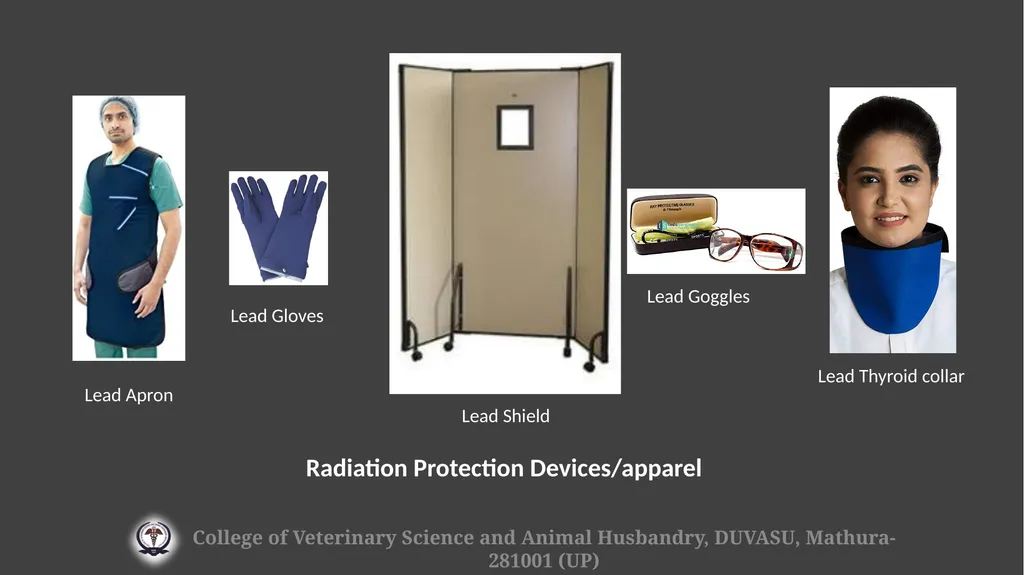
Protective gloves if hands are placed near the primary beam.
Consider use of protective goggles if work level is heavy. (These glasses provide 0.25 mm Pb equivalent protection and offer protection to the lens of the eye.)
Thyroid shields. These are “mini-aprons” worn around the neck and to protect the thyroid gland.
Collimation of the x-ray machine.
Use the fastest film-screen combinations that are compatible with the production of diagnostic radiographs.
All personnel -radiation badges outside the lead apron.
Plan the procedure carefully, and double-check machine settings. College of Veterinary Science and Animal Husbandry, DUVASU, Mathura-281001 (UP)<br>
Protective gloves if hands are placed near the primary beam.
Consider use of protective goggles if work level is heavy. (These glasses provide 0.25 mm Pb equivalent protection and offer protection to the lens of the eye.)
Thyroid shields. These are “mini-aprons” worn around the neck and to protect the thyroid gland.
Collimation of the x-ray machine.
Use the fastest film-screen combinations that are compatible with the production of diagnostic radiographs.
All personnel -radiation badges outside the lead apron.
Plan the procedure carefully, and double-check machine settings. College of Veterinary Science and Animal Husbandry, DUVASU, Mathura-281001 (UP)<br>
24
College of Veterinary Science and Animal Husbandry, DUVASU, Mathura-281001 (UP) Lead Apron Lead Gloves Lead Shield Lead Goggles Lead Thyroid collar Radiation Protection Devices/apparel<br>
25
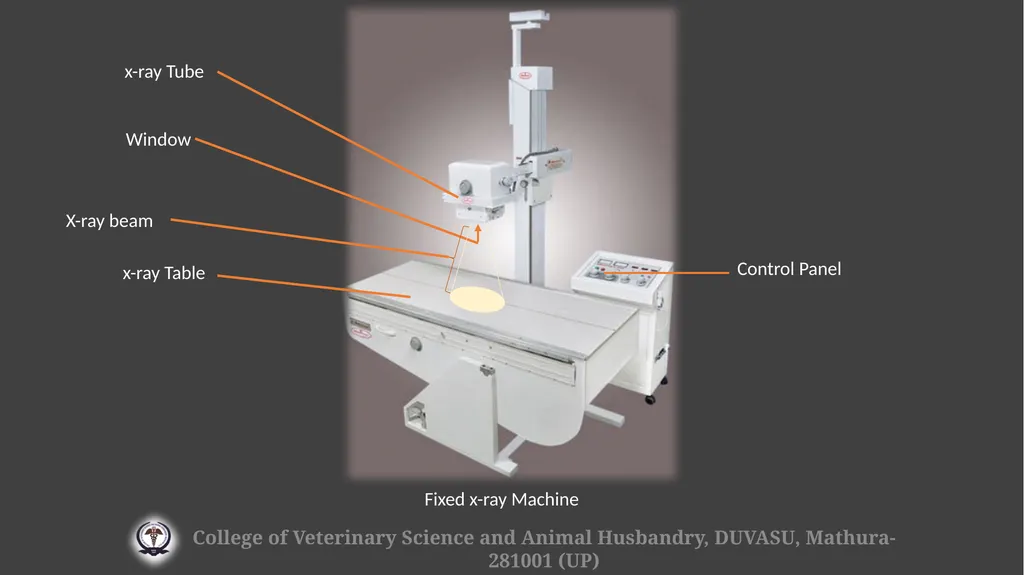
College of Veterinary Science and Animal Husbandry, DUVASU, Mathura-281001 (UP) Fixed x-ray Machine x-ray Tube Control Panel x-ray Table Window X-ray beam<br>
26
College of Veterinary Science and Animal Husbandry, DUVASU, Mathura-281001 (UP) Regulatory Requirements for Diagnostic Radiology Facilities
As per the Atomic Energy Regulatory Board of India (AERB)<br>
As per the Atomic Energy Regulatory Board of India (AERB)<br>
27
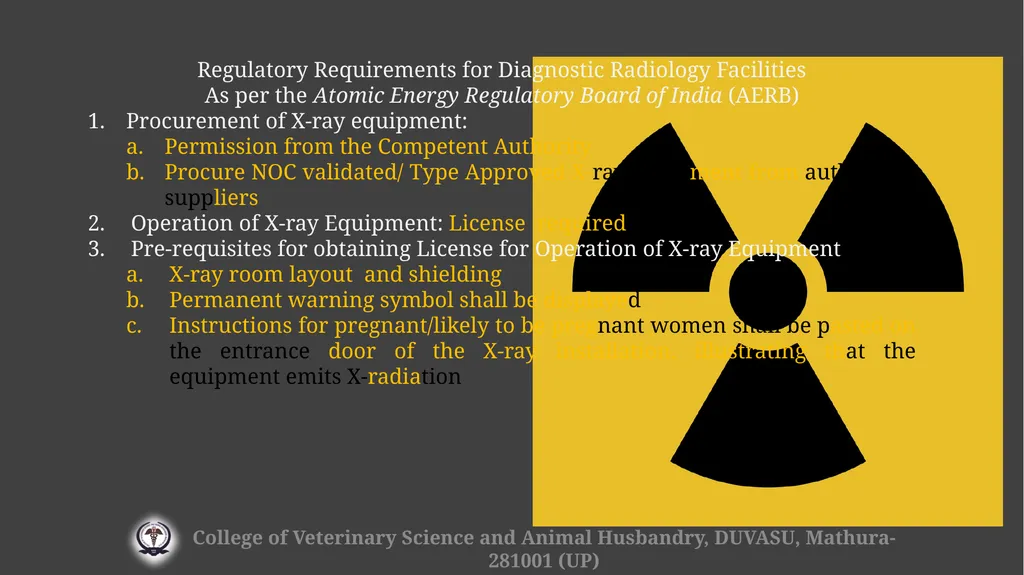
College of Veterinary Science and Animal Husbandry, DUVASU, Mathura-281001 (UP) Regulatory Requirements for Diagnostic Radiology Facilities
As per the Atomic Energy Regulatory Board of India (AERB)
Procurement of X-ray equipment:
Permission from the Competent Authority
Procure NOC validated/ Type Approved X-ray equipment from authorized suppliers
Operation of X-ray Equipment: License required
Pre-requisites for obtaining License for Operation of X-ray Equipment
X-ray room layout and shielding
Permanent warning symbol shall be displayed
Instructions for pregnant/likely to be pregnant women shall be pasted on the entrance door of the X-ray installation, illustrating that the equipment emits X-radiation<br>
As per the Atomic Energy Regulatory Board of India (AERB)
Procurement of X-ray equipment:
Permission from the Competent Authority
Procure NOC validated/ Type Approved X-ray equipment from authorized suppliers
Operation of X-ray Equipment: License required
Pre-requisites for obtaining License for Operation of X-ray Equipment
X-ray room layout and shielding
Permanent warning symbol shall be displayed
Instructions for pregnant/likely to be pregnant women shall be pasted on the entrance door of the X-ray installation, illustrating that the equipment emits X-radiation<br>
28
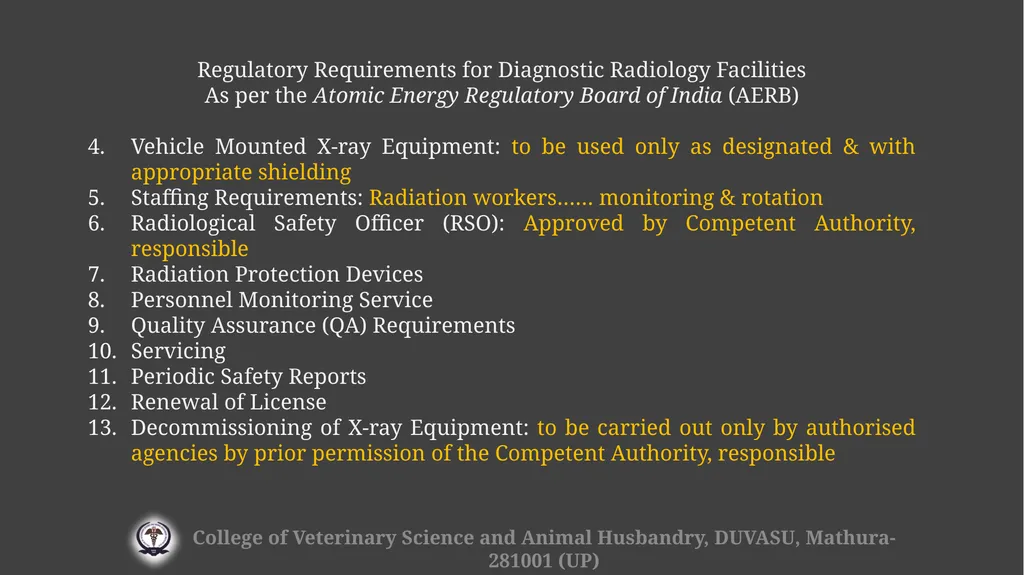
College of Veterinary Science and Animal Husbandry, DUVASU, Mathura-281001 (UP) Regulatory Requirements for Diagnostic Radiology Facilities
As per the Atomic Energy Regulatory Board of India (AERB)
Vehicle Mounted X-ray Equipment: to be used only as designated & with appropriate shielding
Staffing Requirements: Radiation workers…… monitoring & rotation
Radiological Safety Officer (RSO): Approved by Competent Authority, responsible
Radiation Protection Devices
Personnel Monitoring Service
Quality Assurance (QA) Requirements
Servicing
Periodic Safety Reports
Renewal of License
Decommissioning of X-ray Equipment: to be carried out only by authorised agencies by prior permission of the Competent Authority, responsible<br>
As per the Atomic Energy Regulatory Board of India (AERB)
Vehicle Mounted X-ray Equipment: to be used only as designated & with appropriate shielding
Staffing Requirements: Radiation workers…… monitoring & rotation
Radiological Safety Officer (RSO): Approved by Competent Authority, responsible
Radiation Protection Devices
Personnel Monitoring Service
Quality Assurance (QA) Requirements
Servicing
Periodic Safety Reports
Renewal of License
Decommissioning of X-ray Equipment: to be carried out only by authorised agencies by prior permission of the Competent Authority, responsible<br>
29
College of Veterinary Science and Animal Husbandry, DUVASU, Mathura-281001 (UP) Regulatory Requirements for Diagnostic Radiology Facilities
Link for the Atomic Energy Regulatory Board of India (AERB)
https://aerb.gov.in/<br>
Link for the Atomic Energy Regulatory Board of India (AERB)
https://aerb.gov.in/<br>