Religious Expression & State Regulation Overview &
Description: Religious Expression State Regulation Overview Legislative Update Anna Mackin Assistant Attorney General General Litigation Division Views expressed are those of the presenters, do not constitute legal advice, and are not official
Related Topics
Download Presentation
"Religious Expression & State Regulation Overview &" is the property of its rightful owner. Permission is granted to download and print the materials on this website for personal, non-commercial use only, and to display it on your personal computer provided you do not modify the materials and that you retain all copyright notices contained in the materials. By downloading content from our website, you accept the terms of this agreement.
Presentation Transcript
slide1. Religious Expression& State RegulationOverview & Legislative Update Anna Mackin
Assistant Attorney General
General Litigation Division Views expressed are those of the presenters, do not constitute legal advice, and are not official opinions of the Office of the Texas Attorney General.<br>

slide2. “Congress shall make no law respecting an establishment of religion, or prohibiting the free exercise thereof; or abridging the freedom of speech, or of the press; or the right of the people peaceably to assemble, and to petition the Government for a redress of grievances.”
U.S. Const. amend. I The Genesis<br>
slide3. Under the (old) “Lemon” test, government action violates the Establishment Clause if it:
Does not have a predominantly secular purpose
Has the purpose or effect of advancing or inhibiting religion, or
Fosters excessive government entanglement with religion
Lemon v. Kurtzman, 403 U.S. 602, 612-13 (1971) Establishment Clause<br>
slide4. “While the Lemon Court ambitiously attempted to find a grand unified theory of the Establishment Clause, in later cases, we have taken a more modest approach that focuses on the particular issue at hand and looks to history for guidance.”
American Legion v. American Humanist Association, 139 S. Ct. 2067, 2087 (2019) Establishment Clause<br>
slide5. “The opening of sessions of legislative and other deliberative public bodies with prayer is deeply embedded in the history and tradition of this country.”
The Establishment Clause prohibits such prayer being “exploited to proselytize or advance any one, or to disparage any other, faith or belief.”
Marsh v. Chambers, 463 U.S. 783, 785, 786 (1983) Prayer<br>
slide6. “The Court’s inquiry, then, must be to determine whether the prayer practice . . . fits within the tradition long followed in Congress and the state legislatures.”
Town of Greece, N.Y. v. Galloway, 572 U.S. 565, 573 (2014)
“The practice begun by the First Congress stands out as an example of respect and tolerance for differing views, an honest endeavor to achieve inclusivity and nondiscrimination, and a recognition of the important role that religion plays in the lives of many Americans. Where categories of monuments, symbols, and practices with a longstanding history follow in that tradition, they are likewise constitutional.”
Am. Legion v. Am. Humanist Ass’n, 139 S. Ct. at 2089 Prayer<br>
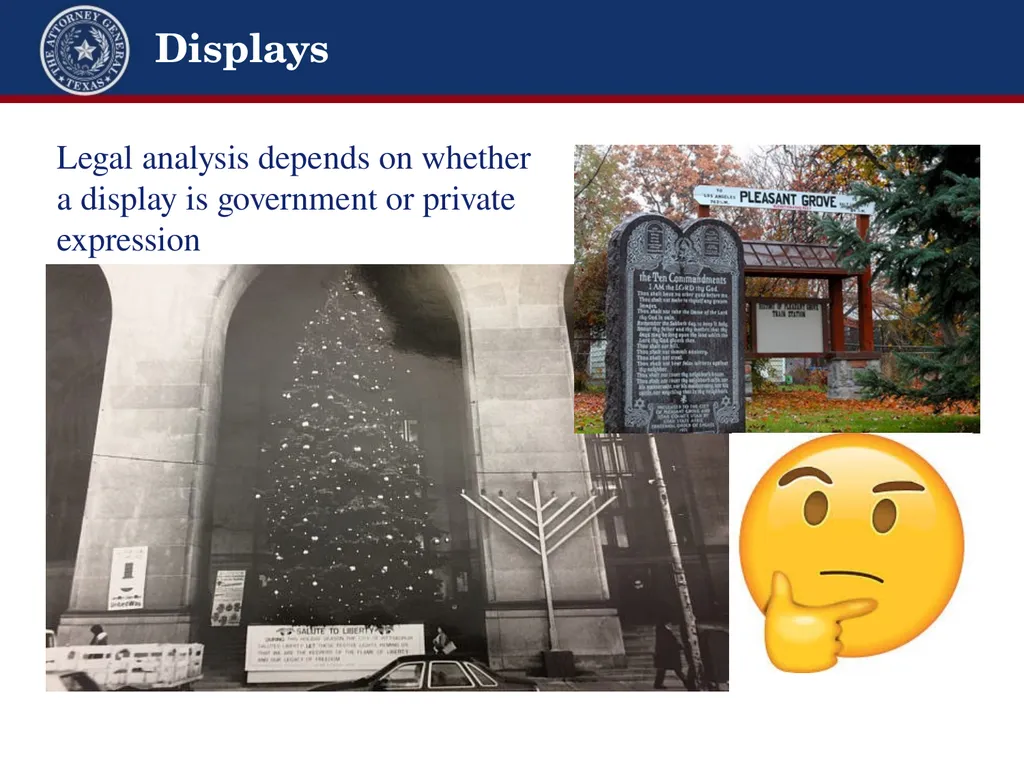
slide7. Displays Legal analysis depends on whether
a display is government or private
expression<br>
slide8. Factors
Historically used to communicate with public
Likely identified with government
Degree of government control
Standard
Must satisfy Establishment Clause
Free Speech Clause does not apply (but use caution) Is a Display Government Speech?<br>
slide9. Examples of Government Speech
15 donated monuments in public park, Pleasant Grove City v. Summum, 555 U.S. 460 (2009)
State license plates, Walker v. Texas Div., Sons of Confederate Veterans, 135 S. Ct. 2239 (2015)
Ads by statutorily established beef-promotion board, Johanns v. Livestock Mktg. Ass’n, 544 U.S. 550 (2005) Is a Display Government Speech?<br>
slide10. “The First Amendment forbids the government to regulate speech in ways that favor some viewpoints or ideas at the expense of others, but imposing a requirement of viewpoint-neutrality on government speech would be paralyzing. When a government entity embarks on a course of action, it necessarily takes a particular viewpoint and rejects others. The Free Speech Clause does not require government to maintain viewpoint neutrality when its officers and employees speak about that venture.”
Matal v. Tam, 137 S. Ct. 1744, 1757 (2017) Is a Display Government Speech?<br>
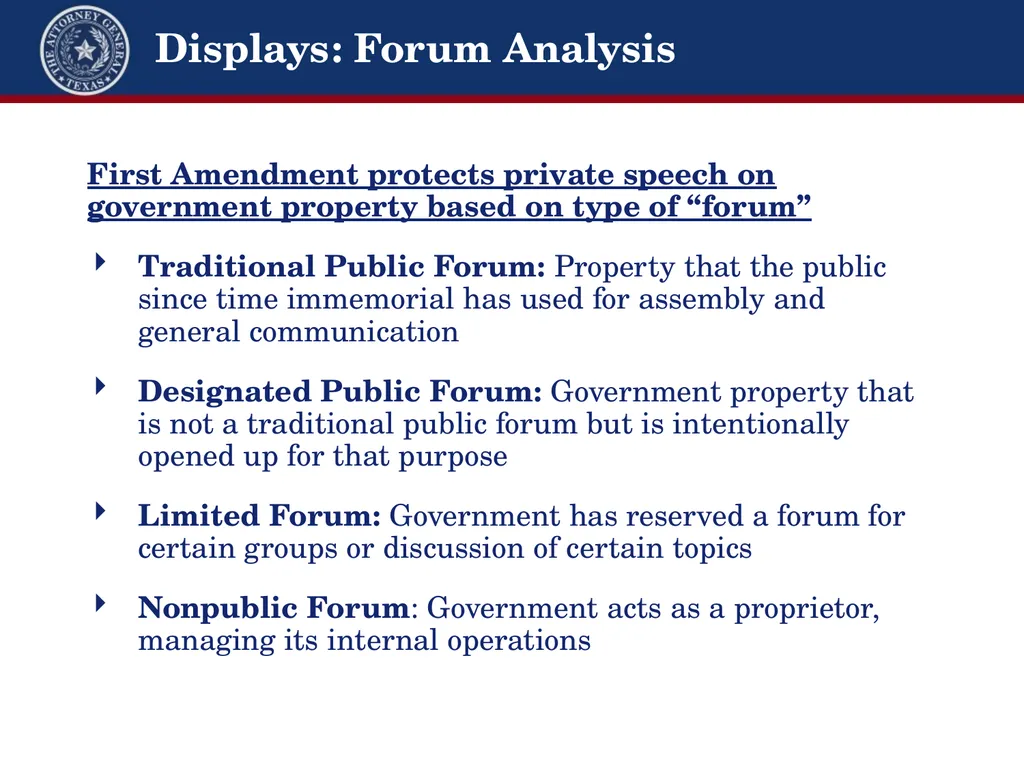
slide11. First Amendment protects private speech on government property based on type of “forum”
Traditional Public Forum: Property that the public since time immemorial has used for assembly and general communication
Designated Public Forum: Government property that is not a traditional public forum but is intentionally opened up for that purpose
Limited Forum: Government has reserved a forum for certain groups or discussion of certain topics
Nonpublic Forum: Government acts as a proprietor, managing its internal operations Displays: Forum Analysis<br>
slide12. In a traditional public forum or a designated public forum:
“[r]easonable time, place, and manner restrictions are allowed, but any restriction based on the content of the speech must satisfy strict scrutiny . . . the restriction must be narrowly tailored to serve a compelling government interest, and restrictions based on viewpoint are prohibited.”
Pleasant Grove City v. Summum, 555 U.S. 467, 468 (2009) Displays: Forum Analysis<br>
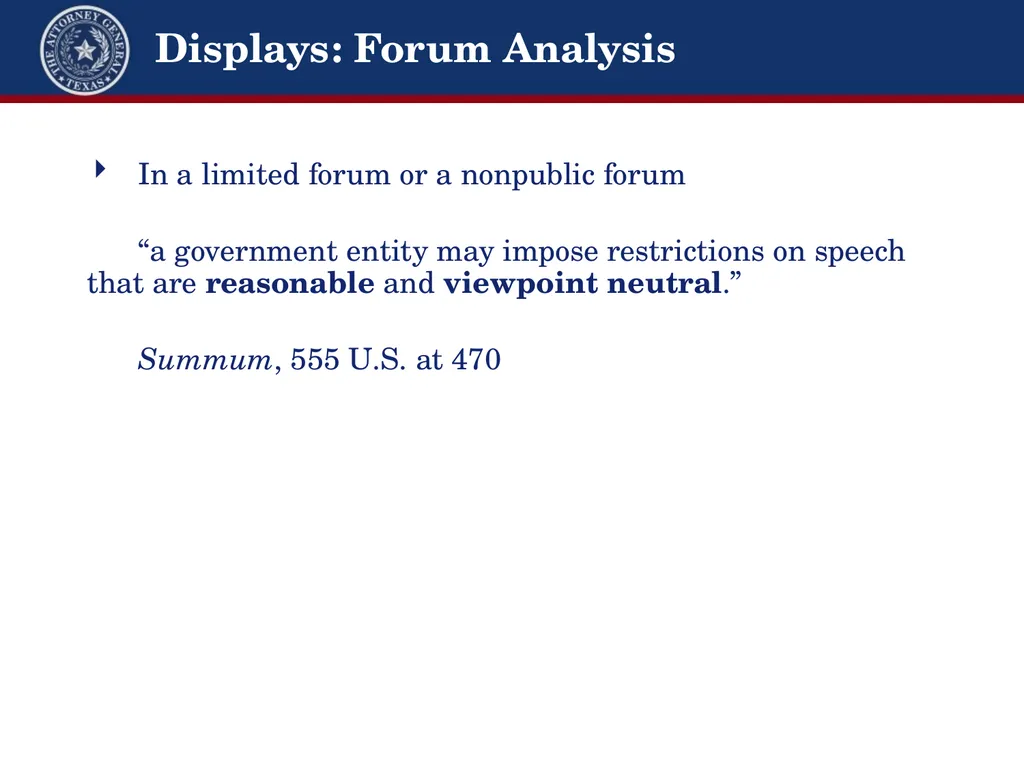
slide13. In a limited forum or a nonpublic forum
“a government entity may impose restrictions on speech that are reasonable and viewpoint neutral.”
Summum, 555 U.S. at 470 Displays: Forum Analysis<br>
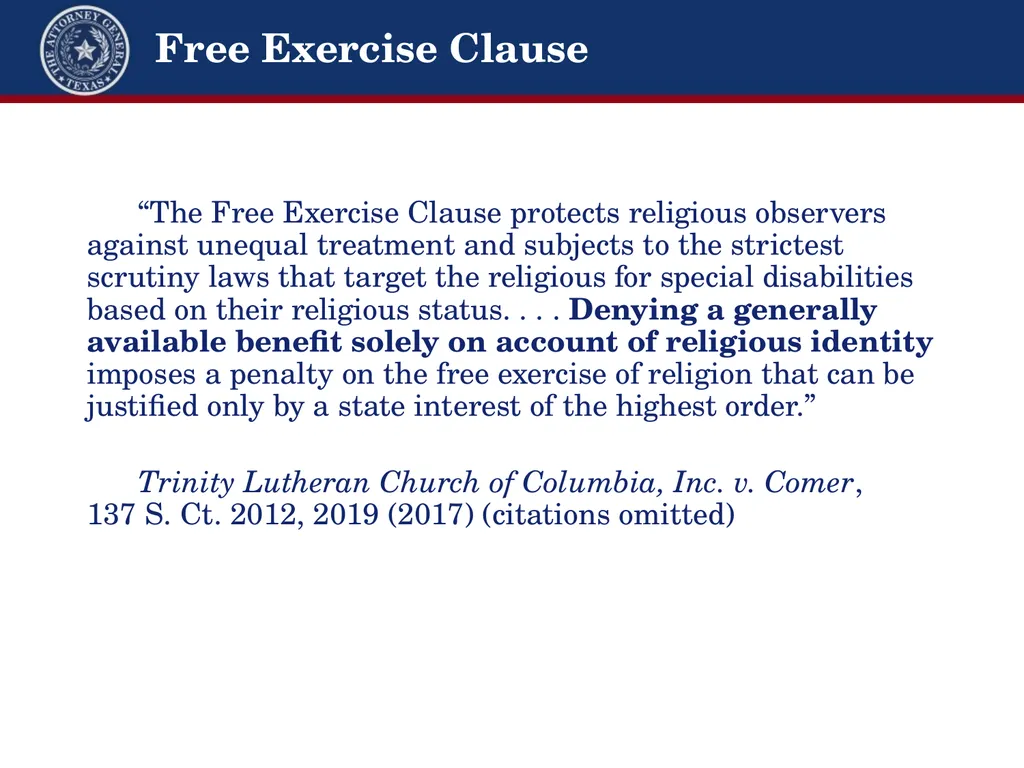
slide14. “The Free Exercise Clause protects religious observers against unequal treatment and subjects to the strictest scrutiny laws that target the religious for special disabilities based on their religious status. . . . Denying a generally available benefit solely on account of religious identity imposes a penalty on the free exercise of religion that can be justified only by a state interest of the highest order.”
Trinity Lutheran Church of Columbia, Inc. v. Comer, 137 S. Ct. 2012, 2019 (2017) (citations omitted) Free Exercise Clause<br>
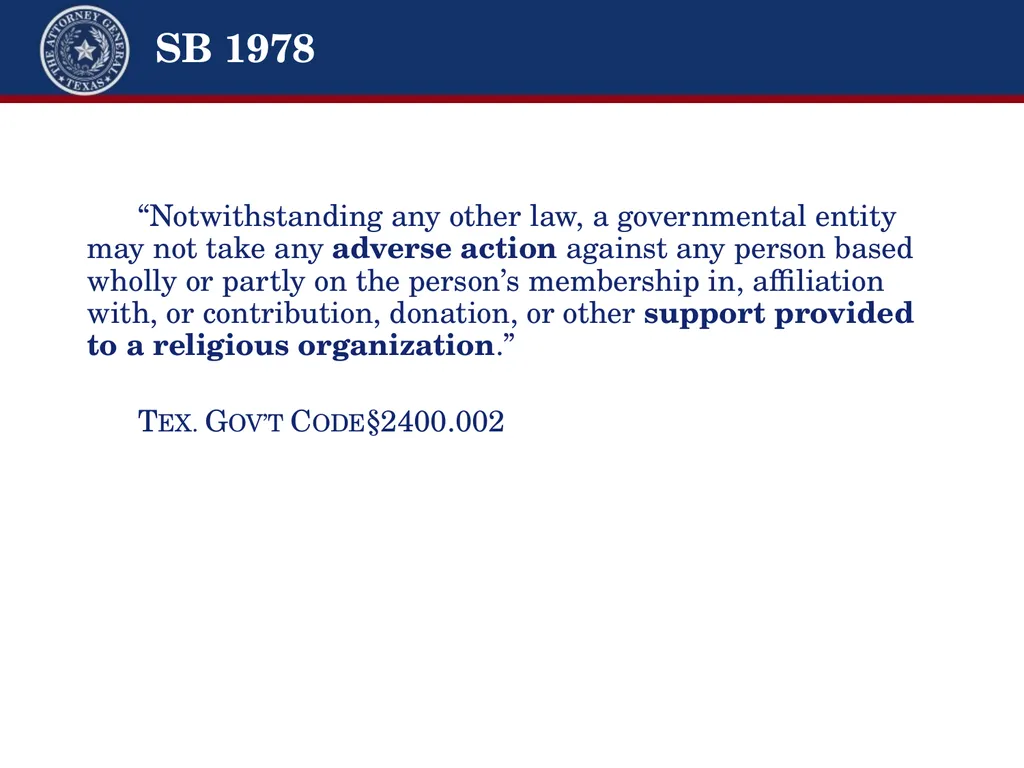
slide15. “Notwithstanding any other law, a governmental entity may not take any adverse action against any person based wholly or partly on the person’s membership in, affiliation with, or contribution, donation, or other support provided to a religious organization.”
Tex. Gov’t Code§2400.002 SB 1978<br>
slide16. “Adverse action” means any action taken by a governmental entity to:
withhold, reduce, exclude, terminate, or otherwise deny any grant, contract, subcontract, cooperative agreement, loan, scholarship, license, registration, accreditation, employment, or other similar status from or to a person;
withhold, reduce, exclude, terminate, or otherwise deny any benefit provided under a benefit program from or to a person;
alter in any way the tax treatment of, cause any tax, penalty, or payment assessment against, or deny, delay, or revoke a tax exemption of a person;
disallow a tax deduction for any charitable contribution . . .
deny admission to, equal treatment in, or eligibility for a degree from an educational program or institution to a person; or
withhold, reduce, exclude, terminate, or otherwise deny access to a property, educational institution, speech forum, or charitable fund-raising campaign from or to a person.
Tex. Gov’t Code§2400.001(1) SB 1978<br>
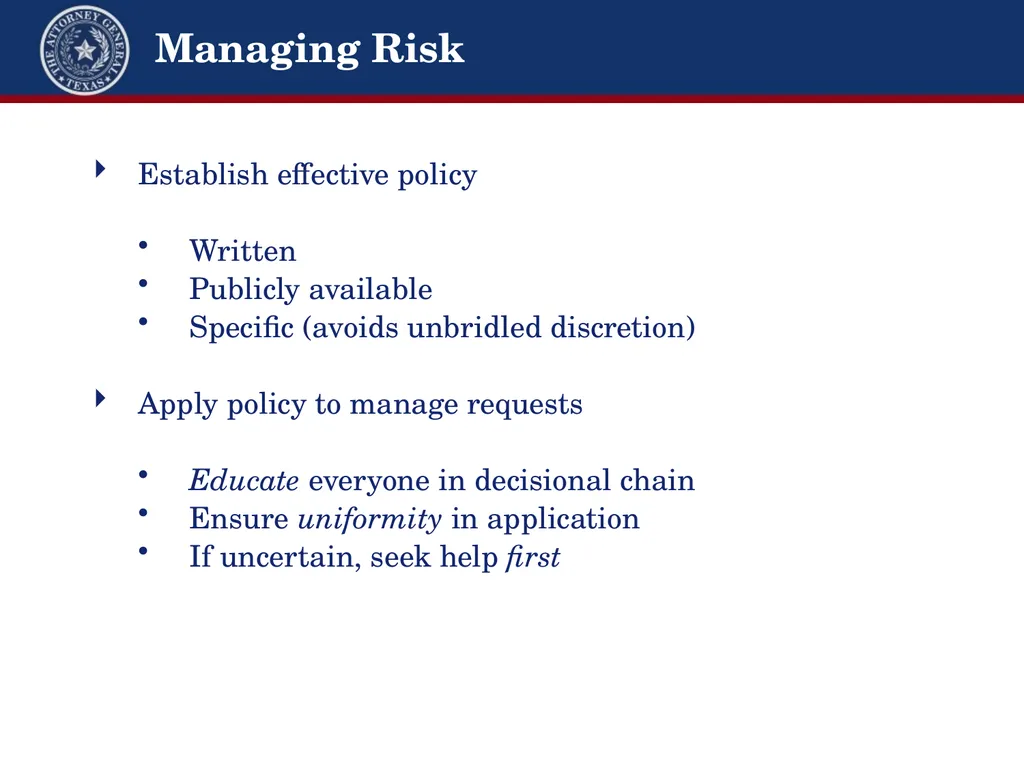
slide17. Establish effective policy
Written
Publicly available
Specific (avoids unbridled discretion)
Apply policy to manage requests
Educate everyone in decisional chain
Ensure uniformity in application
If uncertain, seek help first Managing Risk<br>
slide18. Religious Expression& State RegulationOverview & Legislative Update Anna Mackin
Assistant Attorney General
General Litigation Division Views expressed are those of the presenters, do not constitute legal advice, and are not official opinions of the Office of the Texas Attorney General.<br>
Assistant Attorney General
General Litigation Division Views expressed are those of the presenters, do not constitute legal advice, and are not official opinions of the Office of the Texas Attorney General.<br>
slide2. “Congress shall make no law respecting an establishment of religion, or prohibiting the free exercise thereof; or abridging the freedom of speech, or of the press; or the right of the people peaceably to assemble, and to petition the Government for a redress of grievances.”
U.S. Const. amend. I The Genesis<br>
slide3. Under the (old) “Lemon” test, government action violates the Establishment Clause if it:
Does not have a predominantly secular purpose
Has the purpose or effect of advancing or inhibiting religion, or
Fosters excessive government entanglement with religion
Lemon v. Kurtzman, 403 U.S. 602, 612-13 (1971) Establishment Clause<br>
slide4. “While the Lemon Court ambitiously attempted to find a grand unified theory of the Establishment Clause, in later cases, we have taken a more modest approach that focuses on the particular issue at hand and looks to history for guidance.”
American Legion v. American Humanist Association, 139 S. Ct. 2067, 2087 (2019) Establishment Clause<br>
slide5. “The opening of sessions of legislative and other deliberative public bodies with prayer is deeply embedded in the history and tradition of this country.”
The Establishment Clause prohibits such prayer being “exploited to proselytize or advance any one, or to disparage any other, faith or belief.”
Marsh v. Chambers, 463 U.S. 783, 785, 786 (1983) Prayer<br>
slide6. “The Court’s inquiry, then, must be to determine whether the prayer practice . . . fits within the tradition long followed in Congress and the state legislatures.”
Town of Greece, N.Y. v. Galloway, 572 U.S. 565, 573 (2014)
“The practice begun by the First Congress stands out as an example of respect and tolerance for differing views, an honest endeavor to achieve inclusivity and nondiscrimination, and a recognition of the important role that religion plays in the lives of many Americans. Where categories of monuments, symbols, and practices with a longstanding history follow in that tradition, they are likewise constitutional.”
Am. Legion v. Am. Humanist Ass’n, 139 S. Ct. at 2089 Prayer<br>
slide7. Displays Legal analysis depends on whether
a display is government or private
expression<br>
slide8. Factors
Historically used to communicate with public
Likely identified with government
Degree of government control
Standard
Must satisfy Establishment Clause
Free Speech Clause does not apply (but use caution) Is a Display Government Speech?<br>
slide9. Examples of Government Speech
15 donated monuments in public park, Pleasant Grove City v. Summum, 555 U.S. 460 (2009)
State license plates, Walker v. Texas Div., Sons of Confederate Veterans, 135 S. Ct. 2239 (2015)
Ads by statutorily established beef-promotion board, Johanns v. Livestock Mktg. Ass’n, 544 U.S. 550 (2005) Is a Display Government Speech?<br>
slide10. “The First Amendment forbids the government to regulate speech in ways that favor some viewpoints or ideas at the expense of others, but imposing a requirement of viewpoint-neutrality on government speech would be paralyzing. When a government entity embarks on a course of action, it necessarily takes a particular viewpoint and rejects others. The Free Speech Clause does not require government to maintain viewpoint neutrality when its officers and employees speak about that venture.”
Matal v. Tam, 137 S. Ct. 1744, 1757 (2017) Is a Display Government Speech?<br>
slide11. First Amendment protects private speech on government property based on type of “forum”
Traditional Public Forum: Property that the public since time immemorial has used for assembly and general communication
Designated Public Forum: Government property that is not a traditional public forum but is intentionally opened up for that purpose
Limited Forum: Government has reserved a forum for certain groups or discussion of certain topics
Nonpublic Forum: Government acts as a proprietor, managing its internal operations Displays: Forum Analysis<br>
slide12. In a traditional public forum or a designated public forum:
“[r]easonable time, place, and manner restrictions are allowed, but any restriction based on the content of the speech must satisfy strict scrutiny . . . the restriction must be narrowly tailored to serve a compelling government interest, and restrictions based on viewpoint are prohibited.”
Pleasant Grove City v. Summum, 555 U.S. 467, 468 (2009) Displays: Forum Analysis<br>
slide13. In a limited forum or a nonpublic forum
“a government entity may impose restrictions on speech that are reasonable and viewpoint neutral.”
Summum, 555 U.S. at 470 Displays: Forum Analysis<br>
slide14. “The Free Exercise Clause protects religious observers against unequal treatment and subjects to the strictest scrutiny laws that target the religious for special disabilities based on their religious status. . . . Denying a generally available benefit solely on account of religious identity imposes a penalty on the free exercise of religion that can be justified only by a state interest of the highest order.”
Trinity Lutheran Church of Columbia, Inc. v. Comer, 137 S. Ct. 2012, 2019 (2017) (citations omitted) Free Exercise Clause<br>
slide15. “Notwithstanding any other law, a governmental entity may not take any adverse action against any person based wholly or partly on the person’s membership in, affiliation with, or contribution, donation, or other support provided to a religious organization.”
Tex. Gov’t Code§2400.002 SB 1978<br>
slide16. “Adverse action” means any action taken by a governmental entity to:
withhold, reduce, exclude, terminate, or otherwise deny any grant, contract, subcontract, cooperative agreement, loan, scholarship, license, registration, accreditation, employment, or other similar status from or to a person;
withhold, reduce, exclude, terminate, or otherwise deny any benefit provided under a benefit program from or to a person;
alter in any way the tax treatment of, cause any tax, penalty, or payment assessment against, or deny, delay, or revoke a tax exemption of a person;
disallow a tax deduction for any charitable contribution . . .
deny admission to, equal treatment in, or eligibility for a degree from an educational program or institution to a person; or
withhold, reduce, exclude, terminate, or otherwise deny access to a property, educational institution, speech forum, or charitable fund-raising campaign from or to a person.
Tex. Gov’t Code§2400.001(1) SB 1978<br>
slide17. Establish effective policy
Written
Publicly available
Specific (avoids unbridled discretion)
Apply policy to manage requests
Educate everyone in decisional chain
Ensure uniformity in application
If uncertain, seek help first Managing Risk<br>
slide18. Religious Expression& State RegulationOverview & Legislative Update Anna Mackin
Assistant Attorney General
General Litigation Division Views expressed are those of the presenters, do not constitute legal advice, and are not official opinions of the Office of the Texas Attorney General.<br>