Renaissance Gallery Walk How did Renaissance artists change our idea of perspective? (Hint: perspective is the art of drawing or painting on a 2D surface in such a way as to give the image depth and realism) Renaissance Art:
"Renaissance Gallery Walk “How did Renaissance" is the property of its rightful owner. Permission is granted to
download and print the materials on this website for personal, non-commercial use only, and to display it
on your personal computer provided you do not modify the materials and that you retain all copyright
notices contained in the materials. By downloading content from our website, you accept the terms of this
agreement.
Presentation Transcript
01
Renaissance Gallery Walk “How did Renaissance artists change our idea of perspective?”
(Hint: perspective is the art of drawing or painting on a 2D surface in such a way as to give the image depth and realism)<br>
02
Renaissance Art: Characteristics Focused on secular or non-religious subjects
Treated religious subjects differently (new poses and emotions)
More realistic and lifelike
Clear emotions
Used techniques like perspective and detailed backgrounds to bring paintings to life
Created sculptures that were 3D and looked like real people<br>
03
Gallery Walk For each image, make observations about what you notice on your graphic organizer
As you analyze each image, think about how it represents some of the new characteristics of art that emerged during the Renaissance
On the back of handout, choose your favorite image and reflect on what it tells us about art during the Renaissance
*FYI: some Renaissance art included nude figures – don’t be childish about it*<br>
04
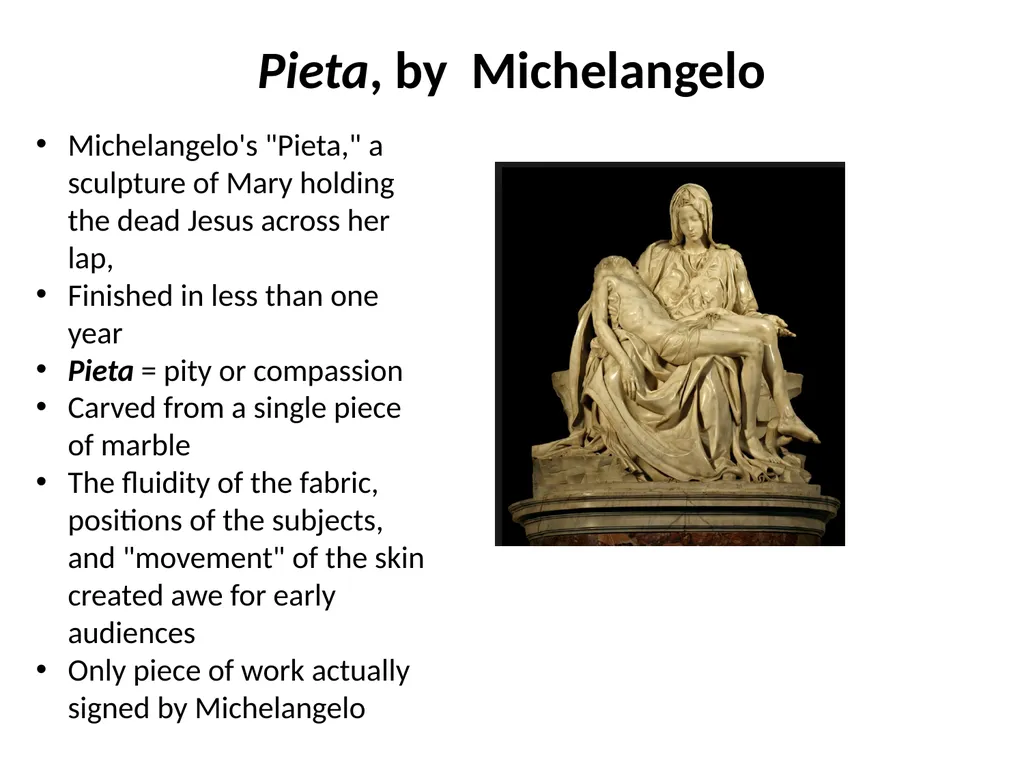
Pieta, by Michelangelo Michelangelo's "Pieta," a sculpture of Mary holding the dead Jesus across her lap,
Finished in less than one year
Pieta = pity or compassion
Carved from a single piece of marble
The fluidity of the fabric, positions of the subjects, and "movement" of the skin created awe for early audiences
Only piece of work actually signed by Michelangelo<br>
05
Self-Portraits, by Albrecht Dürer The German artist Albrecht Dürer (1471-1528) was one of the greatest figures of the Northern Renaissance.
Image 1: Self-portrait of Dürer in 1484, when the artist was 13
Image 2: Self-portrait of Dürer at age 22
Image 3: Self-portrait of Dürer in 1500, shortly before his 29th birthday. Unlike his earlier self-portraits, Dürer’s self-portrait of 1500 depicts the artist faced squarely toward the viewer — a pose usually reserved at that time for images of Christ.<br>
06
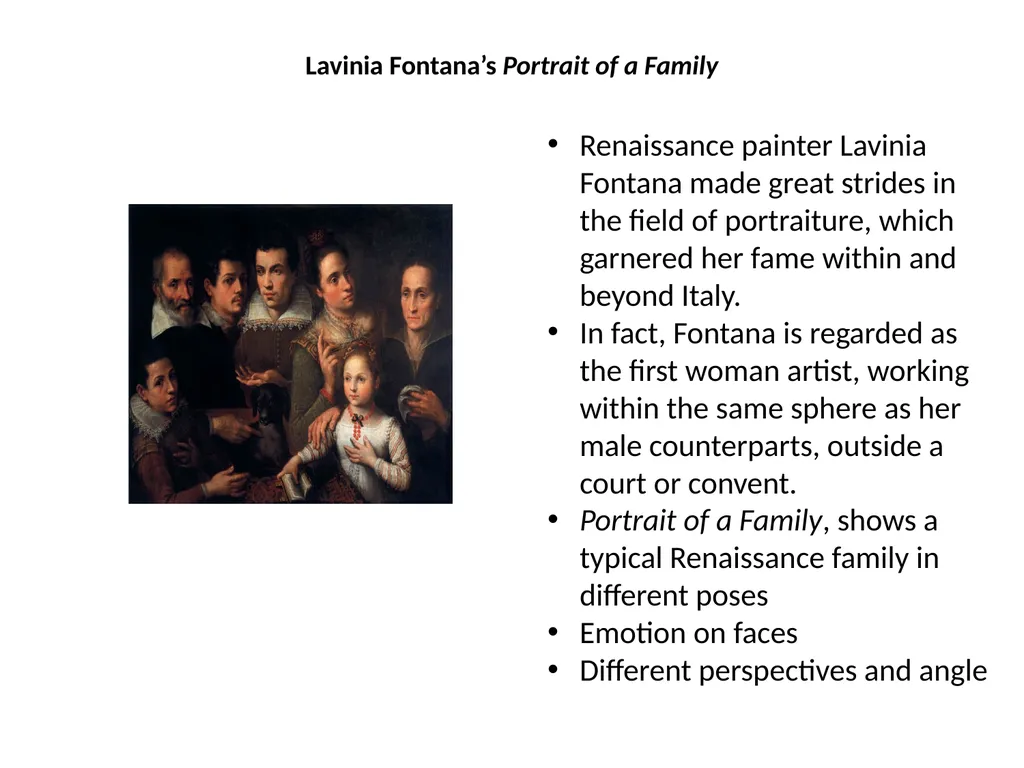
Lavinia Fontana’s Portrait of a Family Renaissance painter Lavinia Fontana made great strides in the field of portraiture, which garnered her fame within and beyond Italy.
In fact, Fontana is regarded as the first woman artist, working within the same sphere as her male counterparts, outside a court or convent.
Portrait of a Family, shows a typical Renaissance family in different poses
Emotion on faces
Different perspectives and angle<br>
07
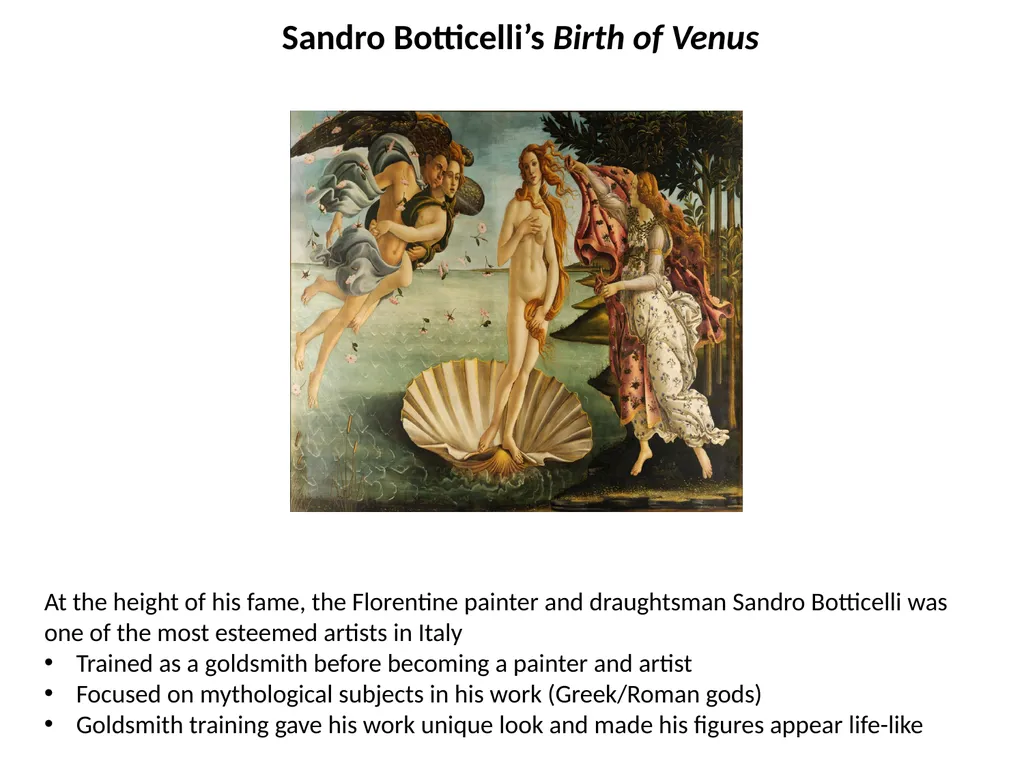
Sandro Botticelli’s Birth of Venus At the height of his fame, the Florentine painter and draughtsman Sandro Botticelli was one of the most esteemed artists in Italy
Trained as a goldsmith before becoming a painter and artist
Focused on mythological subjects in his work (Greek/Roman gods)
Goldsmith training gave his work unique look and made his figures appear life-like<br>