
Representing the LCA Music Client: Song Rights
SB
Published · 52 slides · 0 views

1 / 1



Description
Representing the LCA Music Client: Song Rights LCAs Video Law Library Speakers: Barry Irwin Irwin IP Peter Strand Leavens, Strand Glover What is a Song? Musical Work: Original works of authorship consisting of music and lyrics
Related Topics
Share
Embed code
Download this presentation From Below
"Representing the LCA Music Client: Song Rights" is the property of its rightful owner. Permission is granted to download and print the materials on this website for personal, non-commercial use only, and to display it on your personal computer provided you do not modify the materials and that you retain all copyright notices contained in the materials. By downloading content from our website, you accept the terms of this agreement.
Presentation Transcript
01
Representing the LCA Music Client:
Song Rights LCA’s Video Law Library Speakers: Barry Irwin | Irwin IP
Peter Strand | Leavens, Strand & Glover<br>
Song Rights LCA’s Video Law Library Speakers: Barry Irwin | Irwin IP
Peter Strand | Leavens, Strand & Glover<br>
02
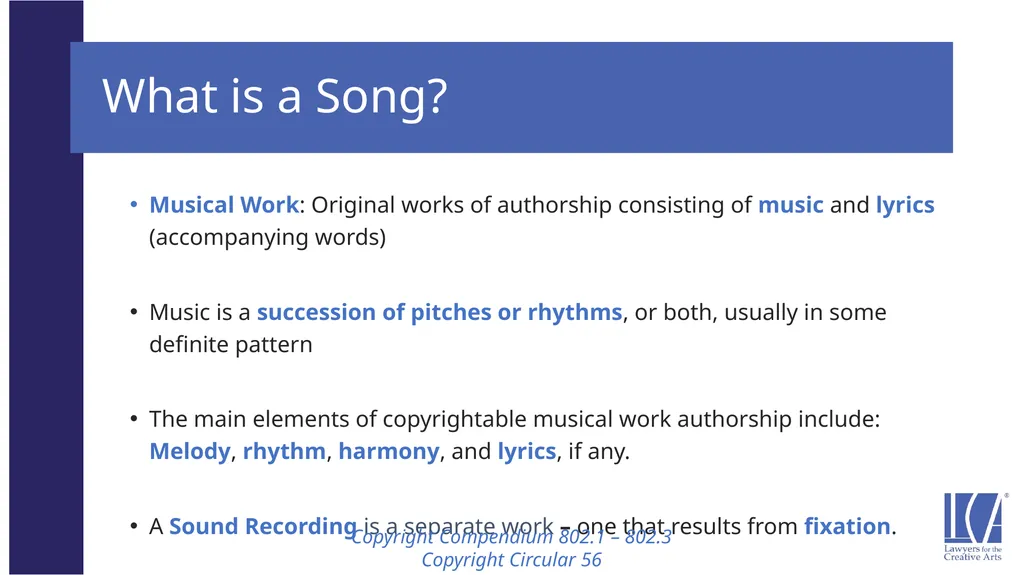
What is a Song? Musical Work: Original works of authorship consisting of music and lyrics (accompanying words)
Music is a succession of pitches or rhythms, or both, usually in some definite pattern
The main elements of copyrightable musical work authorship include: Melody, rhythm, harmony, and lyrics, if any.
A Sound Recording is a separate work – one that results from fixation. Copyright Compendium 802.1 – 802.3
Copyright Circular 56<br>
Music is a succession of pitches or rhythms, or both, usually in some definite pattern
The main elements of copyrightable musical work authorship include: Melody, rhythm, harmony, and lyrics, if any.
A Sound Recording is a separate work – one that results from fixation. Copyright Compendium 802.1 – 802.3
Copyright Circular 56<br>
03
Melody Definition: a succession of tones or notes that constitute the tune of a song.
Examples: the tune of “Mary Had A Little Lamb” or “Happy Birthday” Copyright Compendium 802.3(a)<br>
Examples: the tune of “Mary Had A Little Lamb” or “Happy Birthday” Copyright Compendium 802.3(a)<br>
04
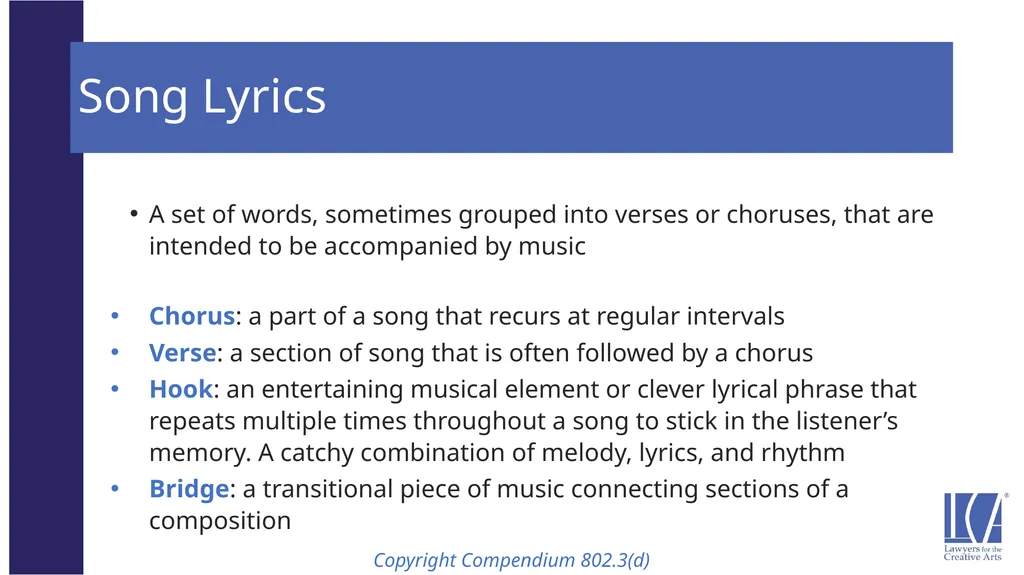
Song Lyrics A set of words, sometimes grouped into verses or choruses, that are intended to be accompanied by music
Chorus: a part of a song that recurs at regular intervals
Verse: a section of song that is often followed by a chorus
Hook: an entertaining musical element or clever lyrical phrase that repeats multiple times throughout a song to stick in the listener’s memory. A catchy combination of melody, lyrics, and rhythm
Bridge: a transitional piece of music connecting sections of a composition Copyright Compendium 802.3(d)<br>
Chorus: a part of a song that recurs at regular intervals
Verse: a section of song that is often followed by a chorus
Hook: an entertaining musical element or clever lyrical phrase that repeats multiple times throughout a song to stick in the listener’s memory. A catchy combination of melody, lyrics, and rhythm
Bridge: a transitional piece of music connecting sections of a composition Copyright Compendium 802.3(d)<br>
05
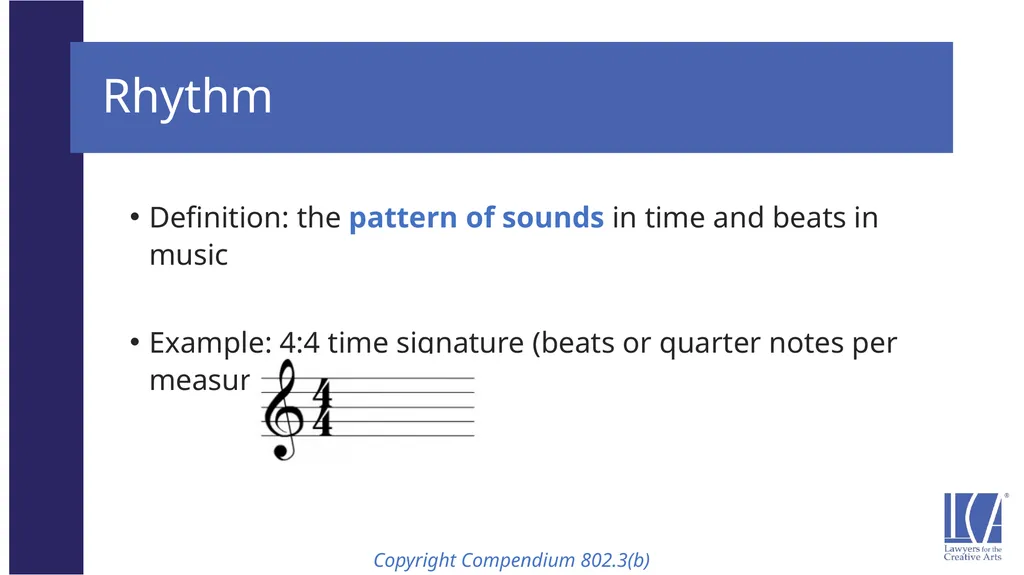
Rhythm Definition: the pattern of sounds in time and beats in music
Example: 4:4 time signature (beats or quarter notes per measure) Copyright Compendium 802.3(b)<br>
Example: 4:4 time signature (beats or quarter notes per measure) Copyright Compendium 802.3(b)<br>
06
Harmony Definition: the simultaneous notes or chords that support a melody
Example: singing “Mary Had a Little Lamb,” at the same time at a higher pitch than the original melody Copyright Compendium 802.3(c)<br>
Example: singing “Mary Had a Little Lamb,” at the same time at a higher pitch than the original melody Copyright Compendium 802.3(c)<br>
07
What Makes a Song Recognizable? Strong melodic hook
a catchy combination of melody, lyrics, and rhythm that gets stuck in the listener’s head
Lyrics that have a theme, repetition, or a rhyming scheme<br>
a catchy combination of melody, lyrics, and rhythm that gets stuck in the listener’s head
Lyrics that have a theme, repetition, or a rhyming scheme<br>
08
Copyright Basics Copyright protections gives the song owner exclusive rights to:
Copy / Reproduce
Adapt / Create Derivative Works
Publish / Distribute
Perform the work publicly
Including by digital transmission
Display – the public showing of a copyrighted work 17 U.S. Code § 106 - Exclusive rights in copyrighted works<br>
Copy / Reproduce
Adapt / Create Derivative Works
Publish / Distribute
Perform the work publicly
Including by digital transmission
Display – the public showing of a copyrighted work 17 U.S. Code § 106 - Exclusive rights in copyrighted works<br>
09
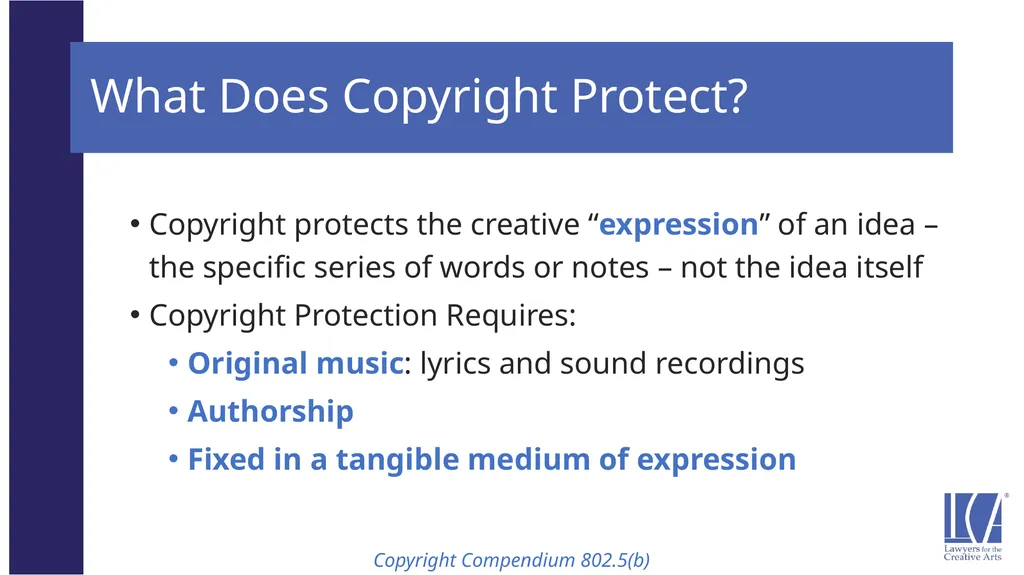
What Does Copyright Protect? Copyright protects the creative “expression” of an idea – the specific series of words or notes – not the idea itself
Copyright Protection Requires:
Original music: lyrics and sound recordings
Authorship
Fixed in a tangible medium of expression Copyright Compendium 802.5(b)<br>
Copyright Protection Requires:
Original music: lyrics and sound recordings
Authorship
Fixed in a tangible medium of expression Copyright Compendium 802.5(b)<br>
10
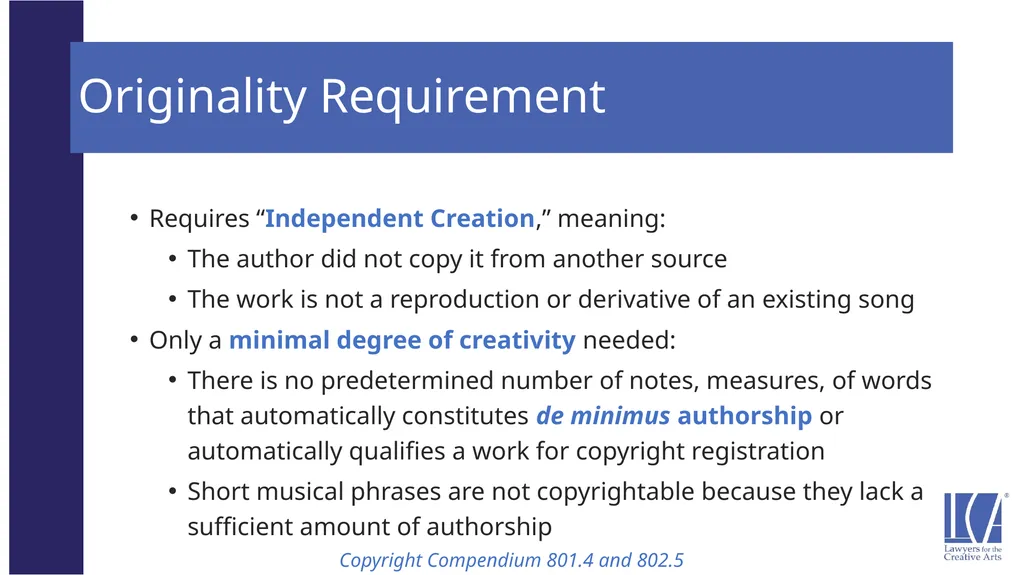
Originality Requirement Requires “Independent Creation,” meaning:
The author did not copy it from another source
The work is not a reproduction or derivative of an existing song
Only a minimal degree of creativity needed:
There is no predetermined number of notes, measures, of words that automatically constitutes de minimus authorship or automatically qualifies a work for copyright registration
Short musical phrases are not copyrightable because they lack a sufficient amount of authorship Copyright Compendium 801.4 and 802.5<br>
The author did not copy it from another source
The work is not a reproduction or derivative of an existing song
Only a minimal degree of creativity needed:
There is no predetermined number of notes, measures, of words that automatically constitutes de minimus authorship or automatically qualifies a work for copyright registration
Short musical phrases are not copyrightable because they lack a sufficient amount of authorship Copyright Compendium 801.4 and 802.5<br>
11
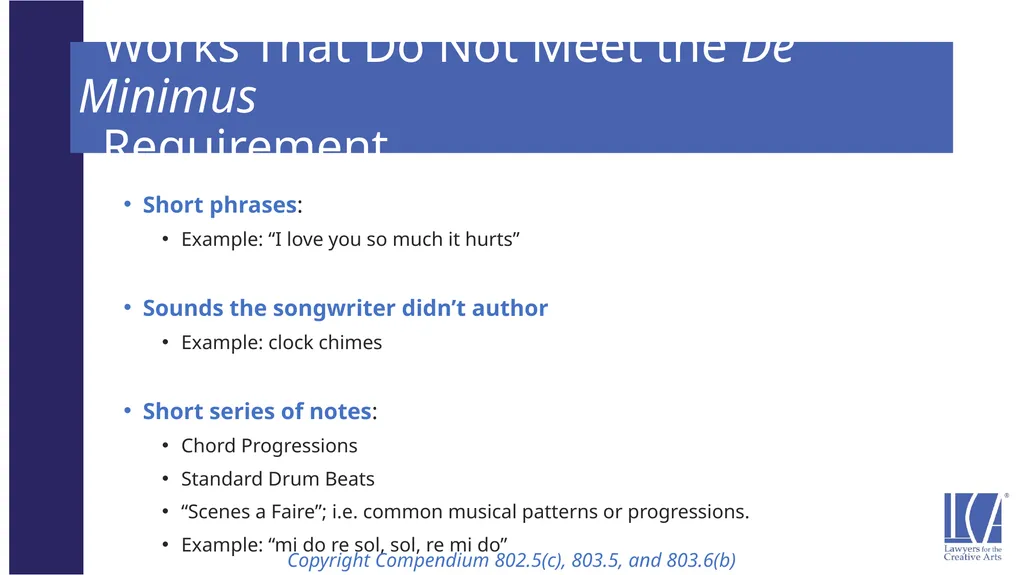
Works That Do Not Meet the De Minimus
Requirement Short phrases:
Example: “I love you so much it hurts”
Sounds the songwriter didn’t author
Example: clock chimes
Short series of notes:
Chord Progressions
Standard Drum Beats
“Scenes a Faire”; i.e. common musical patterns or progressions.
Example: “mi do re sol, sol, re mi do” Copyright Compendium 802.5(c), 803.5, and 803.6(b)<br>
Example: “I love you so much it hurts”
Sounds the songwriter didn’t author
Example: clock chimes
Short series of notes:
Chord Progressions
Standard Drum Beats
“Scenes a Faire”; i.e. common musical patterns or progressions.
Example: “mi do re sol, sol, re mi do” Copyright Compendium 802.5(c), 803.5, and 803.6(b)<br>
12
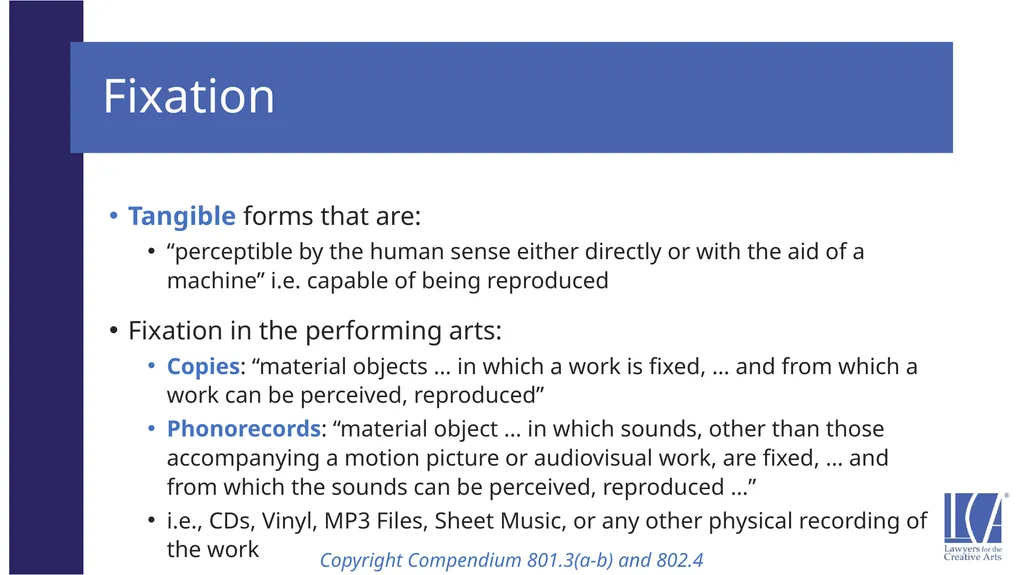
Fixation Tangible forms that are:
“perceptible by the human sense either directly or with the aid of a machine” i.e. capable of being reproduced
Fixation in the performing arts:
Copies: “material objects … in which a work is fixed, … and from which a work can be perceived, reproduced”
Phonorecords: “material object … in which sounds, other than those accompanying a motion picture or audiovisual work, are fixed, … and from which the sounds can be perceived, reproduced …”
i.e., CDs, Vinyl, MP3 Files, Sheet Music, or any other physical recording of the work Copyright Compendium 801.3(a-b) and 802.4<br>
“perceptible by the human sense either directly or with the aid of a machine” i.e. capable of being reproduced
Fixation in the performing arts:
Copies: “material objects … in which a work is fixed, … and from which a work can be perceived, reproduced”
Phonorecords: “material object … in which sounds, other than those accompanying a motion picture or audiovisual work, are fixed, … and from which the sounds can be perceived, reproduced …”
i.e., CDs, Vinyl, MP3 Files, Sheet Music, or any other physical recording of the work Copyright Compendium 801.3(a-b) and 802.4<br>
13
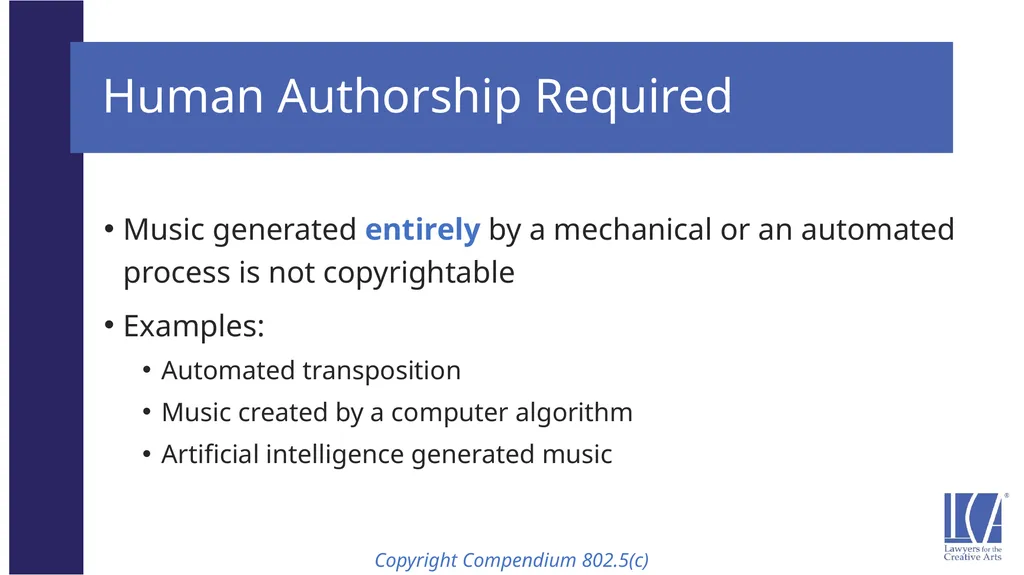
Human Authorship Required Music generated entirely by a mechanical or an automated process is not copyrightable
Examples:
Automated transposition
Music created by a computer algorithm
Artificial intelligence generated music Copyright Compendium 802.5(c)<br>
Examples:
Automated transposition
Music created by a computer algorithm
Artificial intelligence generated music Copyright Compendium 802.5(c)<br>
14
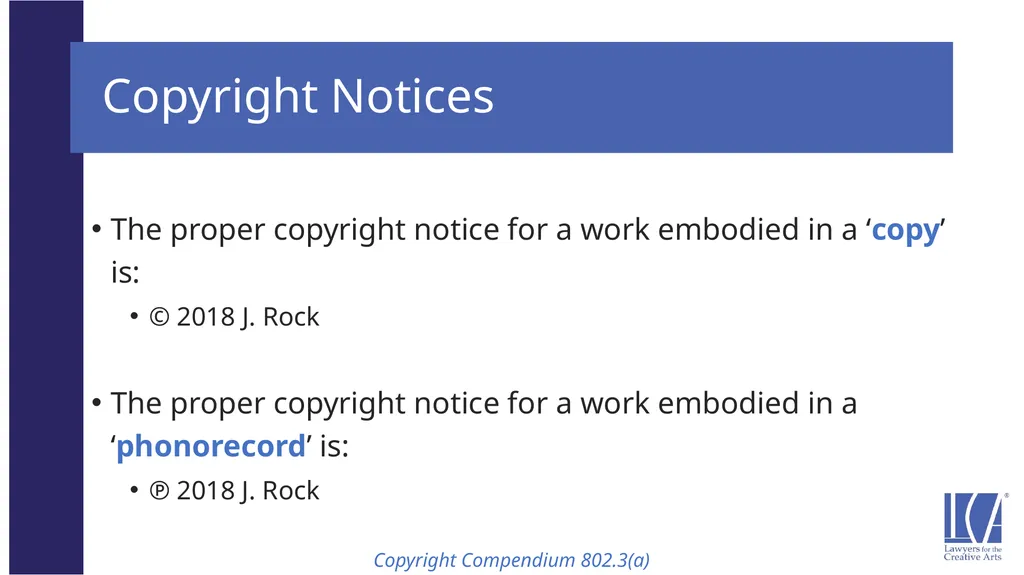
Copyright Notices The proper copyright notice for a work embodied in a ‘copy’ is:
© 2018 J. Rock
The proper copyright notice for a work embodied in a ‘phonorecord’ is:
℗ 2018 J. Rock Copyright Compendium 802.3(a)<br>
© 2018 J. Rock
The proper copyright notice for a work embodied in a ‘phonorecord’ is:
℗ 2018 J. Rock Copyright Compendium 802.3(a)<br>
15
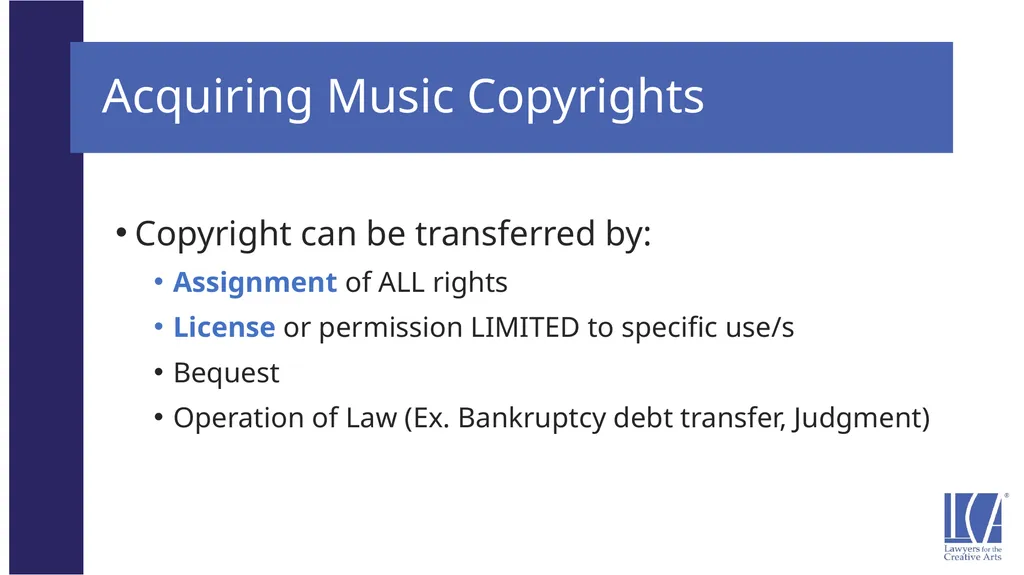
Acquiring Music Copyrights Copyright can be transferred by:
Assignment of ALL rights
License or permission LIMITED to specific use/s
Bequest
Operation of Law (Ex. Bankruptcy debt transfer, Judgment)<br>
Assignment of ALL rights
License or permission LIMITED to specific use/s
Bequest
Operation of Law (Ex. Bankruptcy debt transfer, Judgment)<br>
16
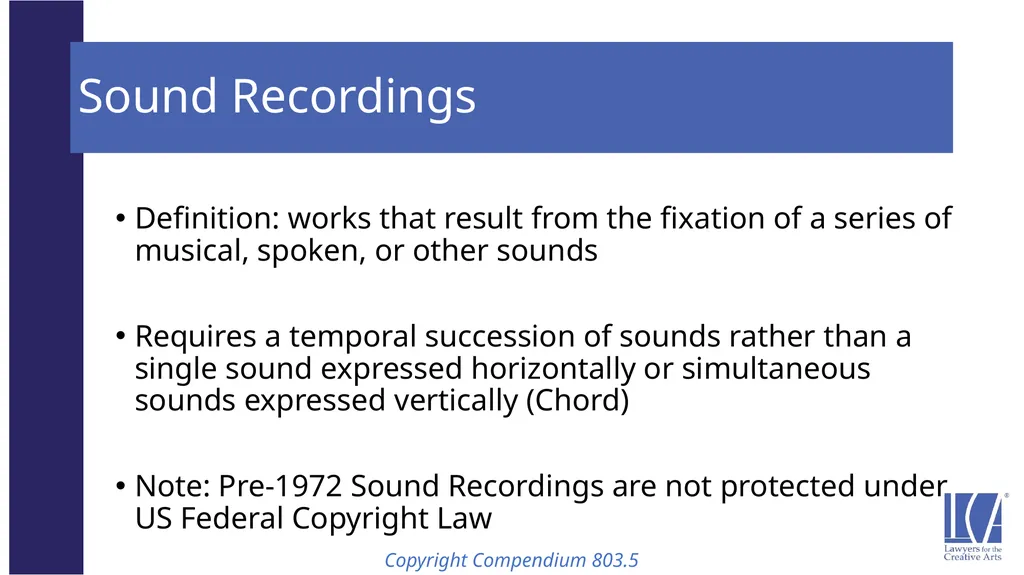
Sound Recordings Definition: works that result from the fixation of a series of musical, spoken, or other sounds
Requires a temporal succession of sounds rather than a single sound expressed horizontally or simultaneous sounds expressed vertically (Chord)
Note: Pre-1972 Sound Recordings are not protected under US Federal Copyright Law Copyright Compendium 803.5<br>
Requires a temporal succession of sounds rather than a single sound expressed horizontally or simultaneous sounds expressed vertically (Chord)
Note: Pre-1972 Sound Recordings are not protected under US Federal Copyright Law Copyright Compendium 803.5<br>
17
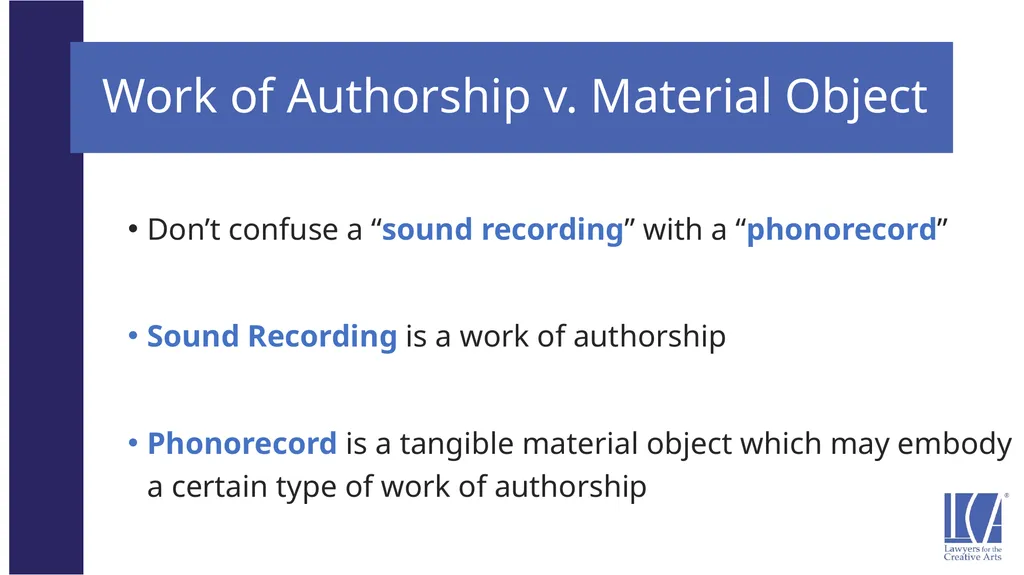
Work of Authorship v. Material Object Don’t confuse a “sound recording” with a “phonorecord”
Sound Recording is a work of authorship
Phonorecord is a tangible material object which may embody a certain type of work of authorship<br>
Sound Recording is a work of authorship
Phonorecord is a tangible material object which may embody a certain type of work of authorship<br>
18
Copies and Phonorecords - §101 “Copies” are material objects, other than “phonorecords”, in which a work is fixed by any method now known or later developed, and from which the work can be perceived, reproduced, or otherwise communicated, either directly or with the aid of a machine or device.<br>
19
Copies and Phonorecords - §101 “Phonorecords” are material objects in which sounds, other than those accompanying a motion picture or other audiovisual work, are fixed by any method now known or later developed, and from which the sounds can be perceived, reproduced, or otherwise communicated, either directly or with the aid of a machine or device.<br>
20
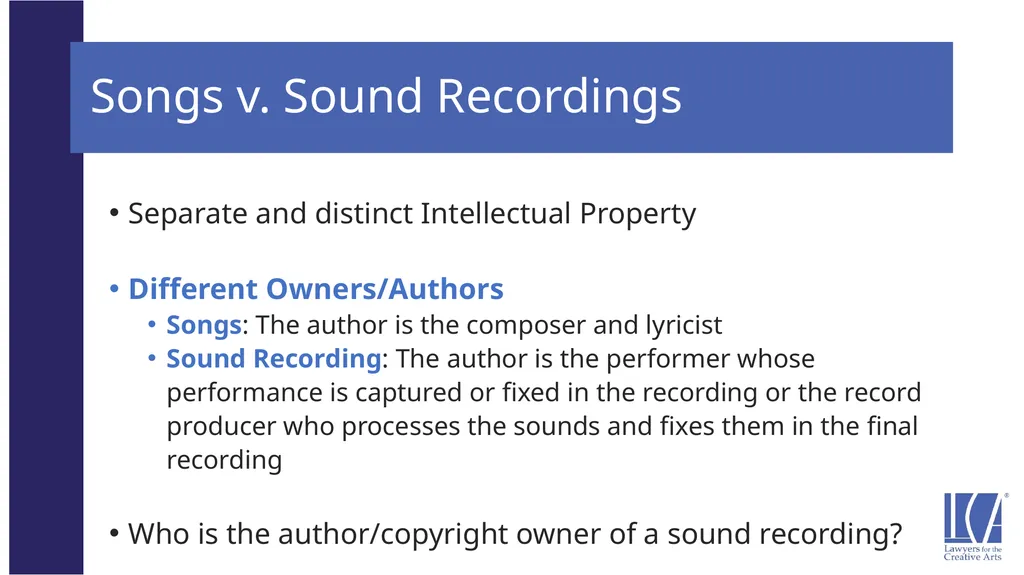
Songs v. Sound Recordings Separate and distinct Intellectual Property
Different Owners/Authors
Songs: The author is the composer and lyricist
Sound Recording: The author is the performer whose performance is captured or fixed in the recording or the record producer who processes the sounds and fixes them in the final recording
Who is the author/copyright owner of a sound recording?<br>
Different Owners/Authors
Songs: The author is the composer and lyricist
Sound Recording: The author is the performer whose performance is captured or fixed in the recording or the record producer who processes the sounds and fixes them in the final recording
Who is the author/copyright owner of a sound recording?<br>
21
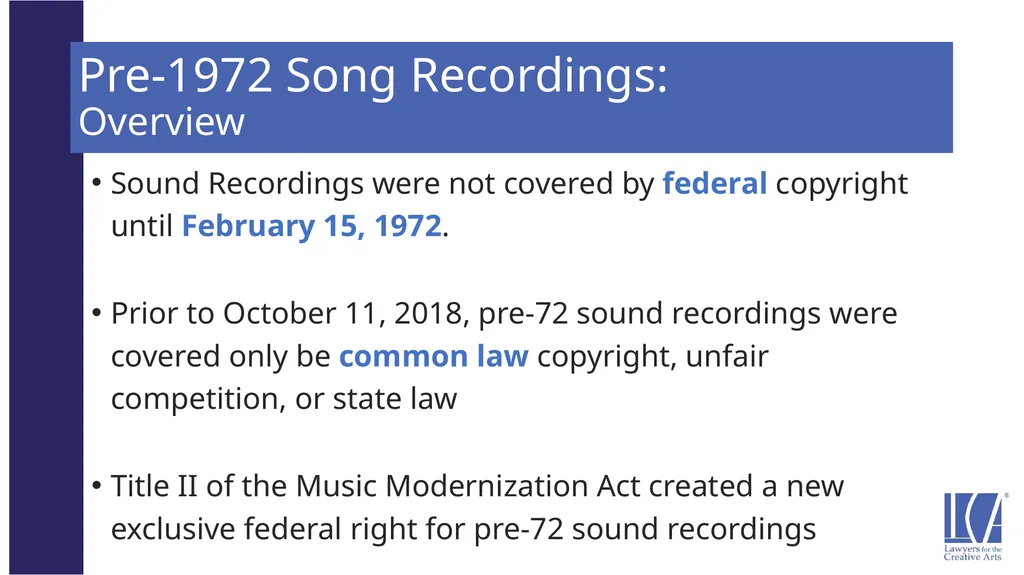
Pre-1972 Song Recordings:
Overview Sound Recordings were not covered by federal copyright until February 15, 1972.
Prior to October 11, 2018, pre-72 sound recordings were covered only be common law copyright, unfair competition, or state law
Title II of the Music Modernization Act created a new exclusive federal right for pre-72 sound recordings<br>
Prior to October 11, 2018, pre-72 sound recordings were covered only be common law copyright, unfair competition, or state law
Title II of the Music Modernization Act created a new exclusive federal right for pre-72 sound recordings<br>
22
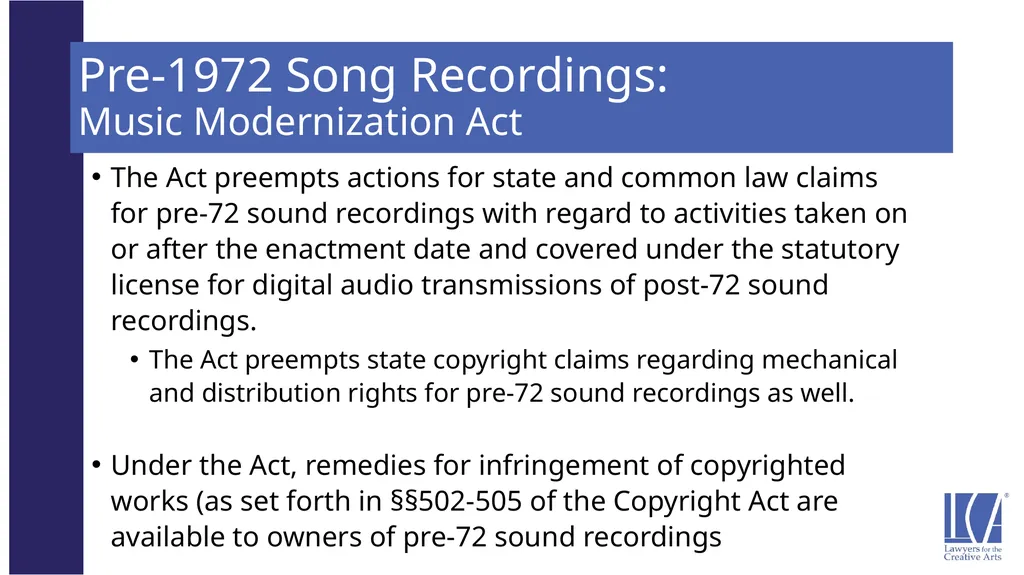
The Act preempts actions for state and common law claims for pre-72 sound recordings with regard to activities taken on or after the enactment date and covered under the statutory license for digital audio transmissions of post-72 sound recordings.
The Act preempts state copyright claims regarding mechanical and distribution rights for pre-72 sound recordings as well.
Under the Act, remedies for infringement of copyrighted works (as set forth in §§502-505 of the Copyright Act are available to owners of pre-72 sound recordings Pre-1972 Song Recordings: Music Modernization Act<br>
The Act preempts state copyright claims regarding mechanical and distribution rights for pre-72 sound recordings as well.
Under the Act, remedies for infringement of copyrighted works (as set forth in §§502-505 of the Copyright Act are available to owners of pre-72 sound recordings Pre-1972 Song Recordings: Music Modernization Act<br>
23
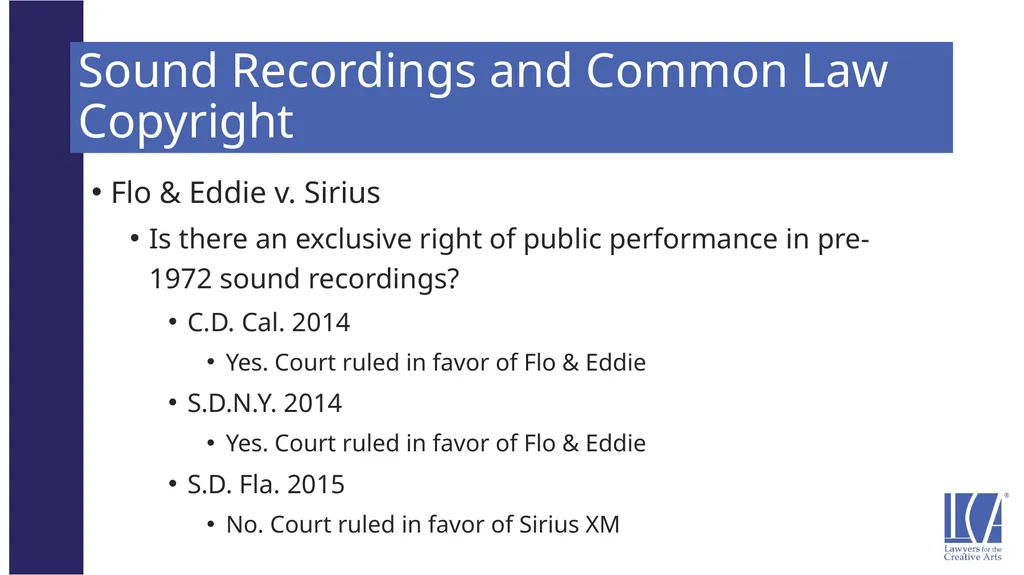
Sound Recordings and Common Law Copyright Flo & Eddie v. Sirius
Is there an exclusive right of public performance in pre-1972 sound recordings?
C.D. Cal. 2014
Yes. Court ruled in favor of Flo & Eddie
S.D.N.Y. 2014
Yes. Court ruled in favor of Flo & Eddie
S.D. Fla. 2015
No. Court ruled in favor of Sirius XM<br>
Is there an exclusive right of public performance in pre-1972 sound recordings?
C.D. Cal. 2014
Yes. Court ruled in favor of Flo & Eddie
S.D.N.Y. 2014
Yes. Court ruled in favor of Flo & Eddie
S.D. Fla. 2015
No. Court ruled in favor of Sirius XM<br>
24
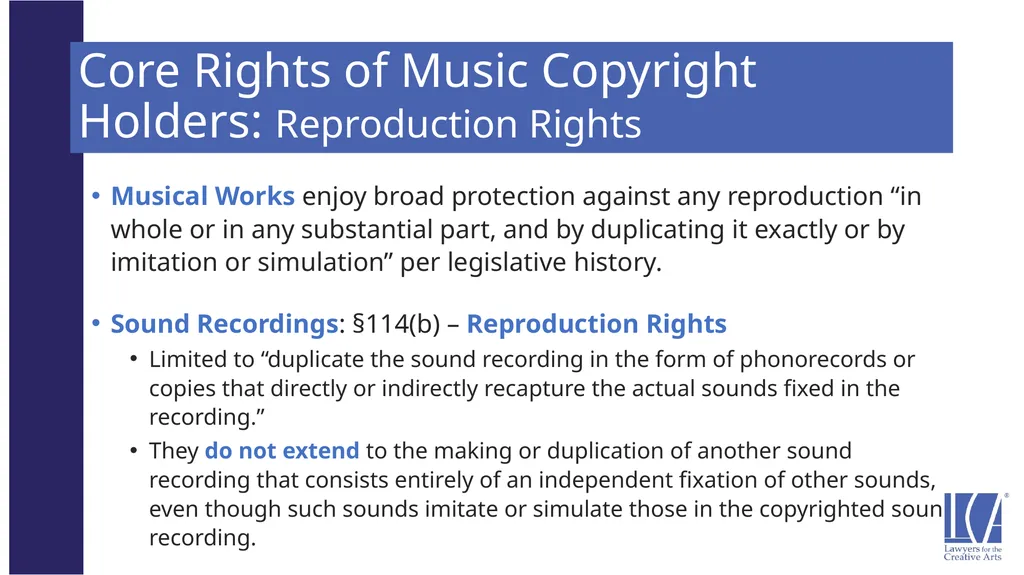
Core Rights of Music Copyright Holders: Reproduction Rights Musical Works enjoy broad protection against any reproduction “in whole or in any substantial part, and by duplicating it exactly or by imitation or simulation” per legislative history.
Sound Recordings: §114(b) – Reproduction Rights
Limited to “duplicate the sound recording in the form of phonorecords or copies that directly or indirectly recapture the actual sounds fixed in the recording.”
They do not extend to the making or duplication of another sound recording that consists entirely of an independent fixation of other sounds, even though such sounds imitate or simulate those in the copyrighted sound recording.<br>
Sound Recordings: §114(b) – Reproduction Rights
Limited to “duplicate the sound recording in the form of phonorecords or copies that directly or indirectly recapture the actual sounds fixed in the recording.”
They do not extend to the making or duplication of another sound recording that consists entirely of an independent fixation of other sounds, even though such sounds imitate or simulate those in the copyrighted sound recording.<br>
25
Core Rights of Music Copyright Holders:
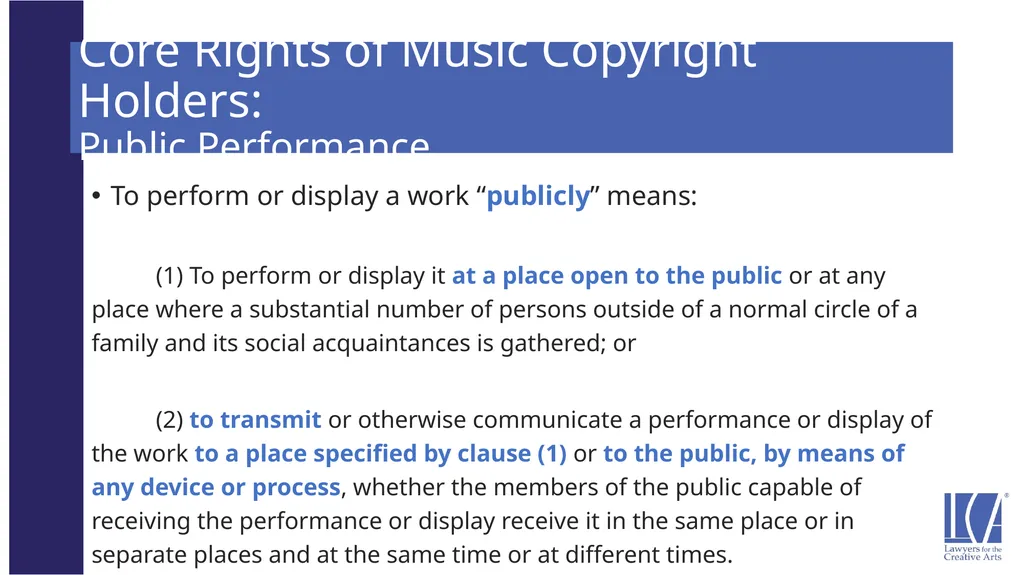
Public Performance To perform or display a work “publicly” means:
(1) To perform or display it at a place open to the public or at any place where a substantial number of persons outside of a normal circle of a family and its social acquaintances is gathered; or
(2) to transmit or otherwise communicate a performance or display of the work to a place specified by clause (1) or to the public, by means of any device or process, whether the members of the public capable of receiving the performance or display receive it in the same place or in separate places and at the same time or at different times.<br>
(1) To perform or display it at a place open to the public or at any place where a substantial number of persons outside of a normal circle of a family and its social acquaintances is gathered; or
(2) to transmit or otherwise communicate a performance or display of the work to a place specified by clause (1) or to the public, by means of any device or process, whether the members of the public capable of receiving the performance or display receive it in the same place or in separate places and at the same time or at different times.<br>
26
Core Rights of Music Copyright Holders:
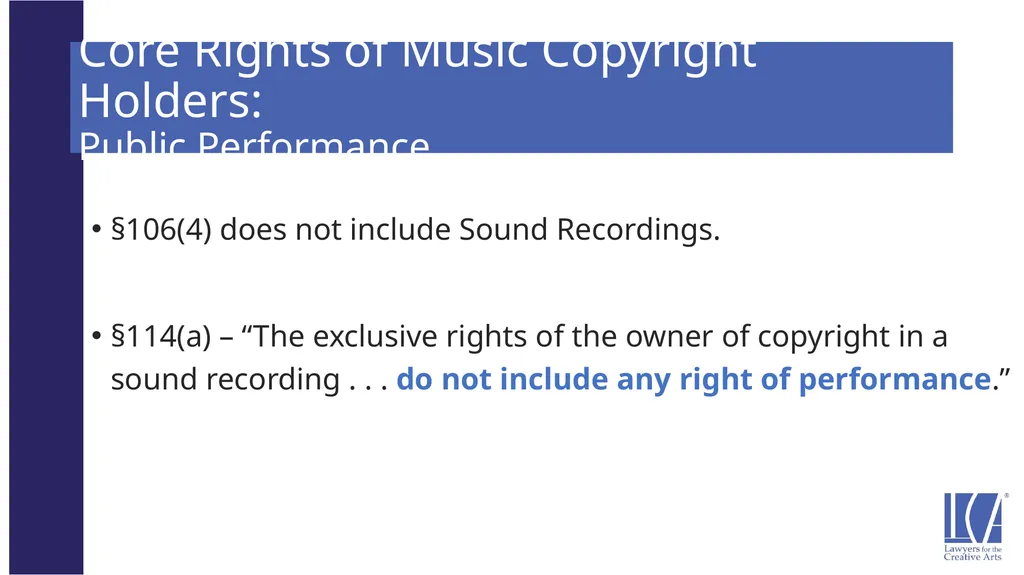
Public Performance §106(4) does not include Sound Recordings.
§114(a) – “The exclusive rights of the owner of copyright in a sound recording . . . do not include any right of performance.”<br>
§114(a) – “The exclusive rights of the owner of copyright in a sound recording . . . do not include any right of performance.”<br>
27
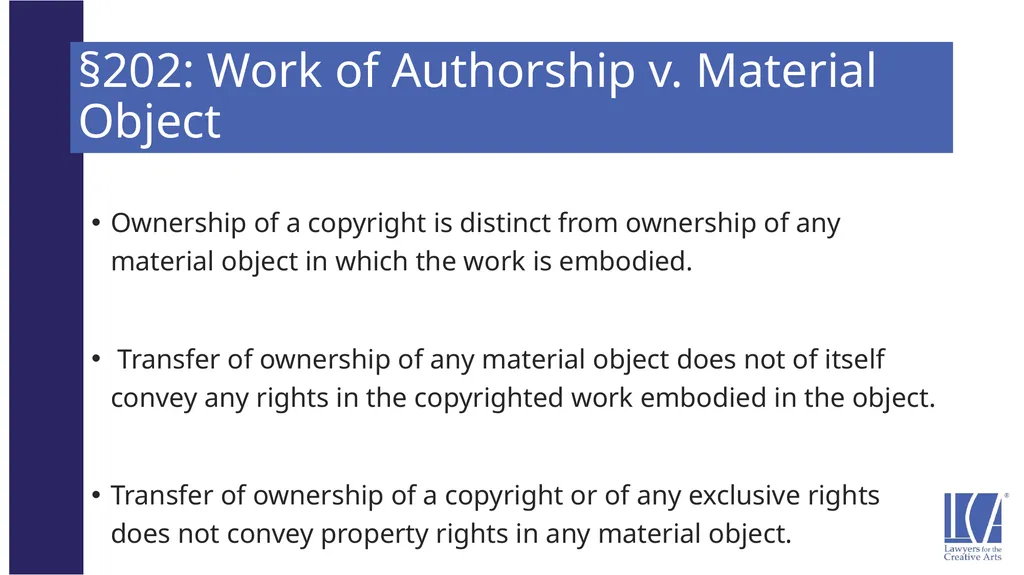
§202: Work of Authorship v. Material Object Ownership of a copyright is distinct from ownership of any material object in which the work is embodied.
Transfer of ownership of any material object does not of itself convey any rights in the copyrighted work embodied in the object.
Transfer of ownership of a copyright or of any exclusive rights does not convey property rights in any material object.<br>
Transfer of ownership of any material object does not of itself convey any rights in the copyrighted work embodied in the object.
Transfer of ownership of a copyright or of any exclusive rights does not convey property rights in any material object.<br>
28
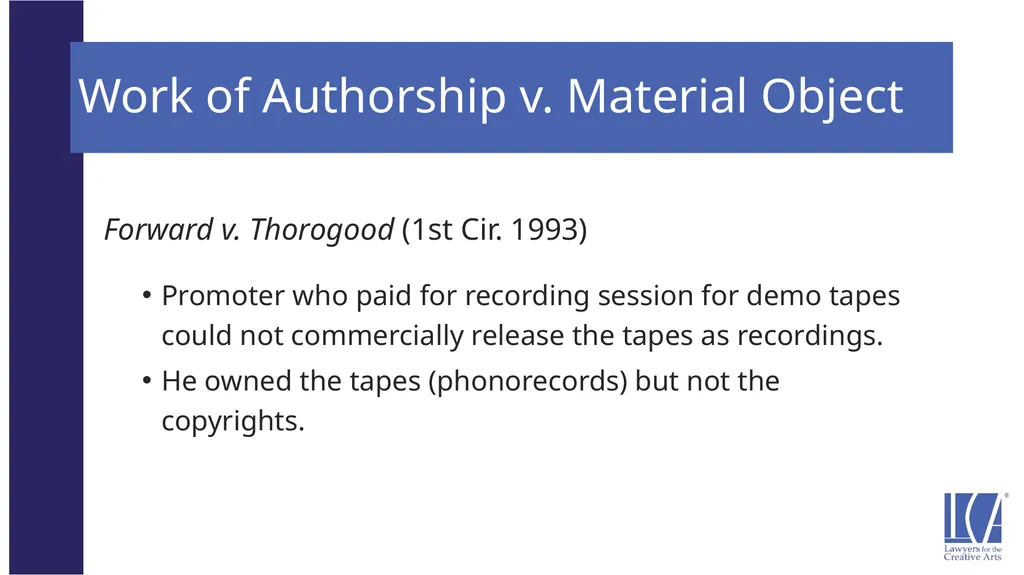
Work of Authorship v. Material Object Forward v. Thorogood (1st Cir. 1993)
Promoter who paid for recording session for demo tapes could not commercially release the tapes as recordings.
He owned the tapes (phonorecords) but not the copyrights.<br>
Promoter who paid for recording session for demo tapes could not commercially release the tapes as recordings.
He owned the tapes (phonorecords) but not the copyrights.<br>
29
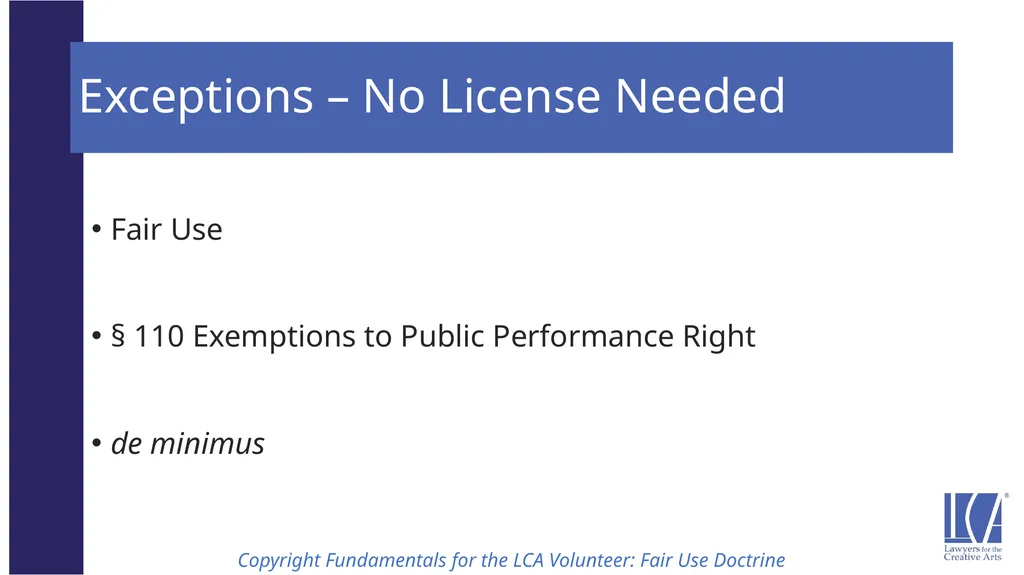
Exceptions – No License Needed Fair Use
§ 110 Exemptions to Public Performance Right
de minimus Copyright Fundamentals for the LCA Volunteer: Fair Use Doctrine<br>
§ 110 Exemptions to Public Performance Right
de minimus Copyright Fundamentals for the LCA Volunteer: Fair Use Doctrine<br>
30
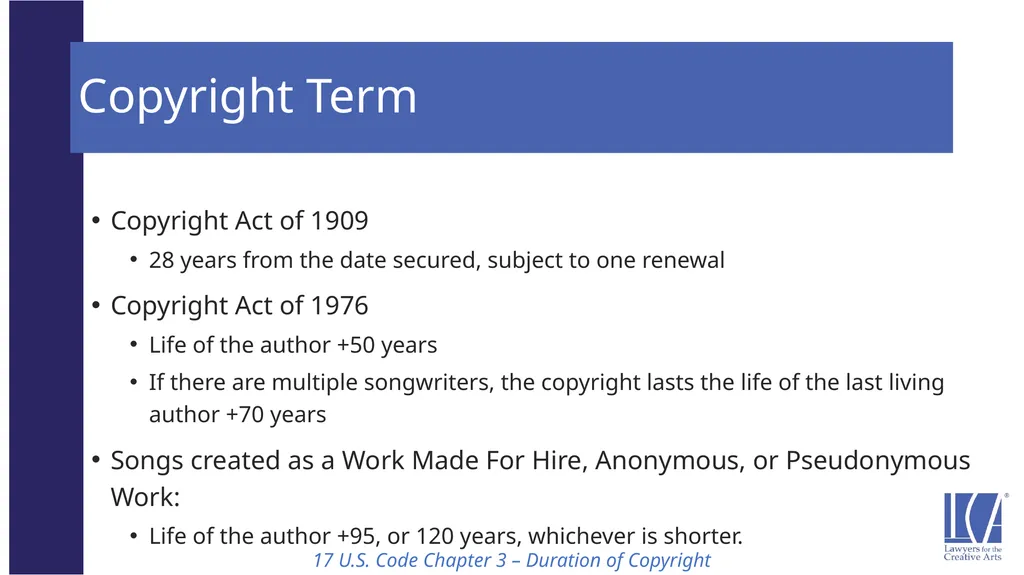
Copyright Term Copyright Act of 1909
28 years from the date secured, subject to one renewal
Copyright Act of 1976
Life of the author +50 years
If there are multiple songwriters, the copyright lasts the life of the last living author +70 years
Songs created as a Work Made For Hire, Anonymous, or Pseudonymous Work:
Life of the author +95, or 120 years, whichever is shorter. 17 U.S. Code Chapter 3 – Duration of Copyright<br>
28 years from the date secured, subject to one renewal
Copyright Act of 1976
Life of the author +50 years
If there are multiple songwriters, the copyright lasts the life of the last living author +70 years
Songs created as a Work Made For Hire, Anonymous, or Pseudonymous Work:
Life of the author +95, or 120 years, whichever is shorter. 17 U.S. Code Chapter 3 – Duration of Copyright<br>
31
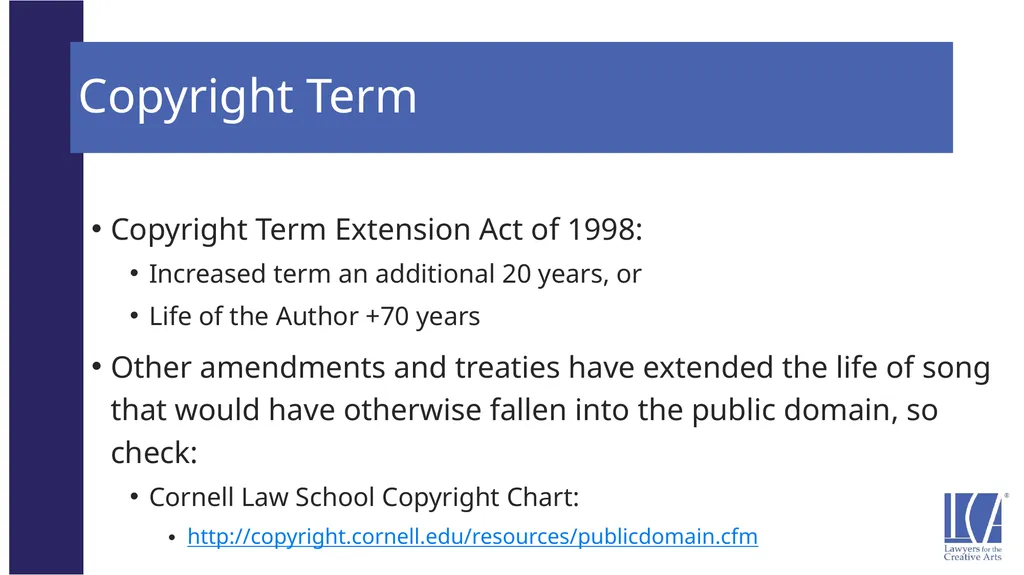
Copyright Term Copyright Term Extension Act of 1998:
Increased term an additional 20 years, or
Life of the Author +70 years
Other amendments and treaties have extended the life of song that would have otherwise fallen into the public domain, so check:
Cornell Law School Copyright Chart:
http://copyright.cornell.edu/resources/publicdomain.cfm<br>
Increased term an additional 20 years, or
Life of the Author +70 years
Other amendments and treaties have extended the life of song that would have otherwise fallen into the public domain, so check:
Cornell Law School Copyright Chart:
http://copyright.cornell.edu/resources/publicdomain.cfm<br>
32
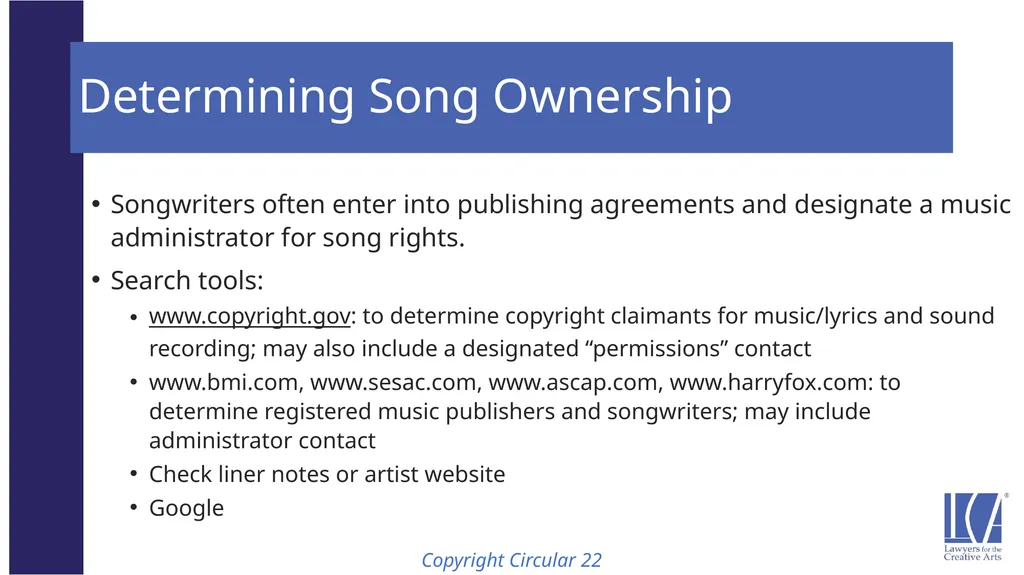
Determining Song Ownership Songwriters often enter into publishing agreements and designate a music administrator for song rights.
Search tools:
www.copyright.gov: to determine copyright claimants for music/lyrics and sound recording; may also include a designated “permissions” contact
www.bmi.com, www.sesac.com, www.ascap.com, www.harryfox.com: to determine registered music publishers and songwriters; may include administrator contact
Check liner notes or artist website
Google Copyright Circular 22<br>
Search tools:
www.copyright.gov: to determine copyright claimants for music/lyrics and sound recording; may also include a designated “permissions” contact
www.bmi.com, www.sesac.com, www.ascap.com, www.harryfox.com: to determine registered music publishers and songwriters; may include administrator contact
Check liner notes or artist website
Google Copyright Circular 22<br>
33
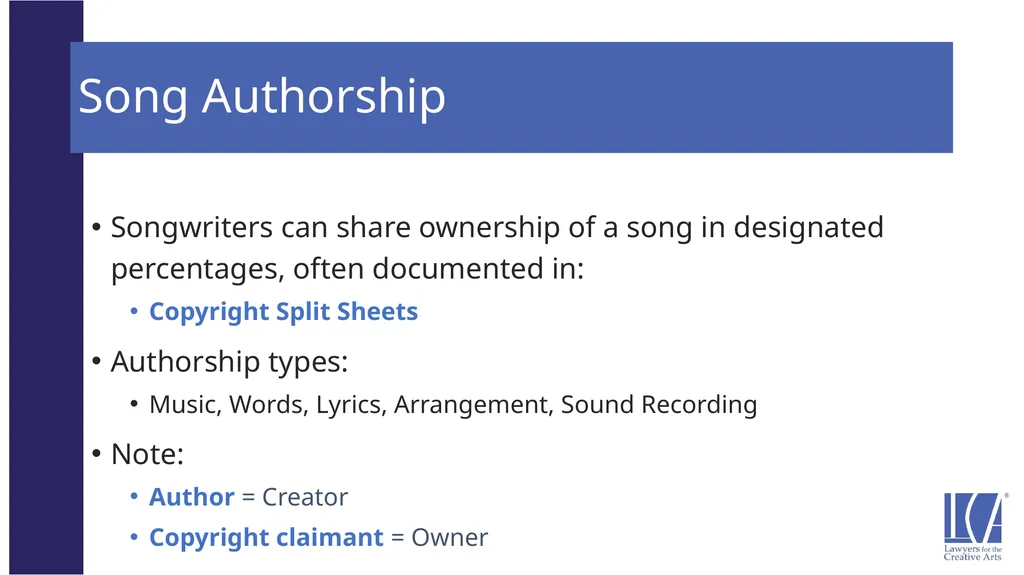
Song Authorship Songwriters can share ownership of a song in designated percentages, often documented in:
Copyright Split Sheets
Authorship types:
Music, Words, Lyrics, Arrangement, Sound Recording
Note:
Author = Creator
Copyright claimant = Owner<br>
Copyright Split Sheets
Authorship types:
Music, Words, Lyrics, Arrangement, Sound Recording
Note:
Author = Creator
Copyright claimant = Owner<br>
34
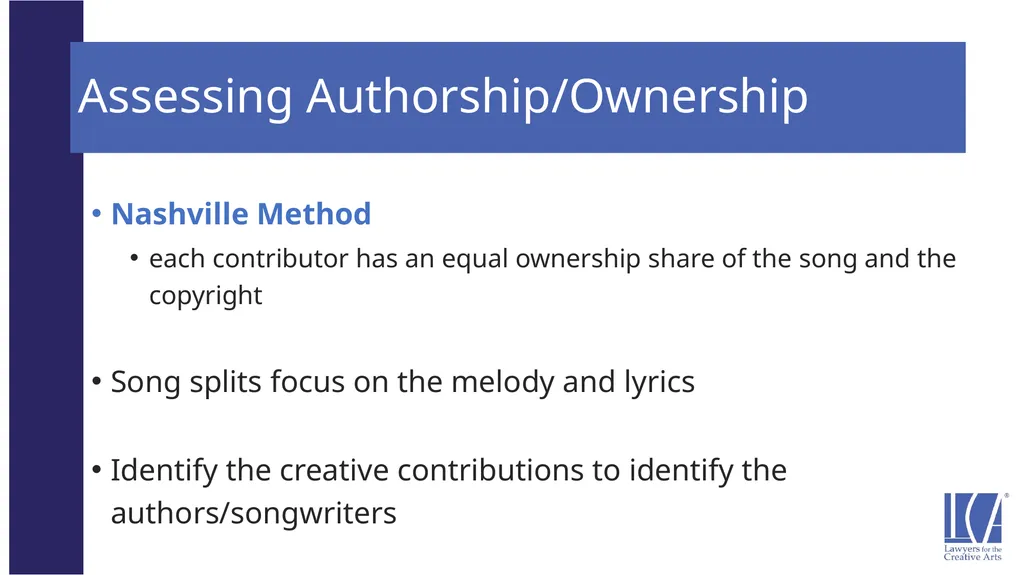
Assessing Authorship/Ownership Nashville Method
each contributor has an equal ownership share of the song and the copyright
Song splits focus on the melody and lyrics
Identify the creative contributions to identify the authors/songwriters<br>
each contributor has an equal ownership share of the song and the copyright
Song splits focus on the melody and lyrics
Identify the creative contributions to identify the authors/songwriters<br>
35
Joint Authorship Works prepared by two or more authors with the intention that their contributions be merged into inseparable or interdependent parts of a whole
Absent an agreement to the contrary, each joint author has an undivided pro rata ownership interest in the whole work
Each joint author can authorize use of the joint work without the other authors’ permission or consent subject to a duty to account to and pay to each author, his or her pro rata share of any compensation received for the use of the joint work
Example: ‘Bad Blood’ by Taylor Swift
Authors on Copyright Application: Taylor Swift, Max Martin, and Shellback Copyright Compendium 801.6, 505
17 U.S. Code § 101<br>
Absent an agreement to the contrary, each joint author has an undivided pro rata ownership interest in the whole work
Each joint author can authorize use of the joint work without the other authors’ permission or consent subject to a duty to account to and pay to each author, his or her pro rata share of any compensation received for the use of the joint work
Example: ‘Bad Blood’ by Taylor Swift
Authors on Copyright Application: Taylor Swift, Max Martin, and Shellback Copyright Compendium 801.6, 505
17 U.S. Code § 101<br>
36
Types of Joint Works Song – Musical Composition
A collaboration between two or more songwriters to create a song
Sound Recordings – Master
A collaboration between artists or artists and a producer to create sound recordings<br>
A collaboration between two or more songwriters to create a song
Sound Recordings – Master
A collaboration between artists or artists and a producer to create sound recordings<br>
37
Work Made For Hire If a song or sound recording is created as a Work Made For Hire:
the author and claimant = the person or business commissioning the work - not the actual songwriter!
What music or sound recording/s counts as a Work Made For Hire?
prepared by an employee within the scope of his or her employment
specially ordered for a certain use with an express written agreement signed by both parties that the work is a work made for hire.
Work of Authorship MUST be one of nine categories under the Copyright Act
Does not include music as a single work but can include collections or compilations of music
In the 7th Circuit, you must sign a work for hire contract “before the work commences” for it to be enforceable.<br>
the author and claimant = the person or business commissioning the work - not the actual songwriter!
What music or sound recording/s counts as a Work Made For Hire?
prepared by an employee within the scope of his or her employment
specially ordered for a certain use with an express written agreement signed by both parties that the work is a work made for hire.
Work of Authorship MUST be one of nine categories under the Copyright Act
Does not include music as a single work but can include collections or compilations of music
In the 7th Circuit, you must sign a work for hire contract “before the work commences” for it to be enforceable.<br>
38
Derivatives A work based upon one or more preexisting works that may be recast, transformed, or adapted. Only copyrightable elements are the new and original elements. Copyright Compendium 801.8, 802.6<br>
39
Derivative Musical Works:
Overview Derivative Musical Work: A work based upon one or more
preexisting works. Needs sufficient new original authorship.
When sufficient new harmonies or instrumentation are added, the musical arrangement can be registered as a derivative work:
Harmonization: addition of chords or musical lines to a melody
Instrumentation: the distribution or redistribution of harmonic elements among different instruments
Adaptation: reworking of musical elements (melody, lyrics, rhythm, harmony)
Examples: a new arrangement of a musical work; new or revised song lyrics<br>
When sufficient new harmonies or instrumentation are added, the musical arrangement can be registered as a derivative work:
Harmonization: addition of chords or musical lines to a melody
Instrumentation: the distribution or redistribution of harmonic elements among different instruments
Adaptation: reworking of musical elements (melody, lyrics, rhythm, harmony)
Examples: a new arrangement of a musical work; new or revised song lyrics<br>
40
Derivative Sound Recordings:
Overview Derivative Sound Recording: A sound recording that is based on preexisting sounds that have been rearranged, remixed, or otherwise altered in sequence or quality
Remix: A recombination of audio tracks from a preexisting sound recording.
Sampling: The incorporation of a fragment or snippet from a preexisting track into a new track.
Mashups: A track formed by combining elements from two or more preexisting works.
Mixtapes: A compilation of preexisting tracks. Copyright Compendium 803.6<br>
Remix: A recombination of audio tracks from a preexisting sound recording.
Sampling: The incorporation of a fragment or snippet from a preexisting track into a new track.
Mashups: A track formed by combining elements from two or more preexisting works.
Mixtapes: A compilation of preexisting tracks. Copyright Compendium 803.6<br>
41
Derivative Sound Recordings:
Copyrightable Authorship To be registrable, a derivative sound recording must contain a sufficient amount of new, creative sound recording authorship
A sound-alike recording is not copyrightable unless it contains new, original and sufficiently creative authorship to support a new registration Copyright Compendium 803.6<br>
A sound-alike recording is not copyrightable unless it contains new, original and sufficiently creative authorship to support a new registration Copyright Compendium 803.6<br>
42
Compilations Works formed by the collection and assembling of preexisting materials or of data that are selected, coordinated, or arranged in such a way that the resulting work as a whole constitutes an original work of authorship. Copyright Compendium 801.9<br>
43
Collective Works A work in which a number of contributions, consisting of separate and independent works in themselves, are assembled into a collective whole Copyright Compendium 801.10 and 509<br>
44
Songwriting Income Licensing
Mechanical (Compulsory) License
Synchronization License
Public Performance License
PROs: ASCAP, BMI, SEASAC, GMR<br>
Mechanical (Compulsory) License
Synchronization License
Public Performance License
PROs: ASCAP, BMI, SEASAC, GMR<br>
45
Beat Makers A beat maker is someone who makes beats and sells them to artists who then arrange the beat and other musical components to make a song
Beats are usually genre-specific: hip-hop, rap, R&B, etc.
Songwriter: a person who writes popular songs or music<br>
Beats are usually genre-specific: hip-hop, rap, R&B, etc.
Songwriter: a person who writes popular songs or music<br>
46
Producers Producer produces, records, and mixes the masters.
Supervise the music project by controlling recording sessions, offer suggestions to song arrangements, and put ideas from musicians and beat makers into play.
Producers also uses best efforts to secure a record label or distribution agreement for the artist.
Will expect a % of any advances in income in connection with the secured contract.<br>
Supervise the music project by controlling recording sessions, offer suggestions to song arrangements, and put ideas from musicians and beat makers into play.
Producers also uses best efforts to secure a record label or distribution agreement for the artist.
Will expect a % of any advances in income in connection with the secured contract.<br>
47
Producer Agreements Treat the contributions of the producer in the same manner as the contributions of a recording artist
The contributions may need to be defined as works made for hire, or assigned to the artist or record company
Producer’s role in the production of the sound recording is copyrightable
Without a written agreement, the Producer will be at least a co-owner of the copyright in the sound recording Model Producer’s Agreement<br>
The contributions may need to be defined as works made for hire, or assigned to the artist or record company
Producer’s role in the production of the sound recording is copyrightable
Without a written agreement, the Producer will be at least a co-owner of the copyright in the sound recording Model Producer’s Agreement<br>
48
Split Sheets A brief songwriter agreement detailing the percentages of ownership attributed to each person involved in writing a song.
It will also often designate credit
Ie. Words & Music by …
Absent an agreement to the contrary, each person involved in writing a song has an undivided pro rata ownership interest in the whole work. Model Split Sheet Co-Songwriters Agreement<br>
It will also often designate credit
Ie. Words & Music by …
Absent an agreement to the contrary, each person involved in writing a song has an undivided pro rata ownership interest in the whole work. Model Split Sheet Co-Songwriters Agreement<br>
49
Publishing Agreements Single Song Agreement
Songwriter assigns copyright ownership of song to publisher in return for services such as promotion, administration, and collection and accounting of proceeds.
Exclusive Songwriter Agreement
All compositions created by the songwriter during the term of the agreement will be assigned to the publishing company.
Copublishing Agreement – Two scenarios
When two or more writers collaborate in the creation of a composition.
When a publishing company with greater administrative resources obtains a co-ownership interest in the composition through an assignment of a partial interest from the original publisher.
Administration Agreement
Contract for administrative services such as licensing, as well as collection and accounting of proceeds. Model Exclusive Songwriter Agreement<br>
Songwriter assigns copyright ownership of song to publisher in return for services such as promotion, administration, and collection and accounting of proceeds.
Exclusive Songwriter Agreement
All compositions created by the songwriter during the term of the agreement will be assigned to the publishing company.
Copublishing Agreement – Two scenarios
When two or more writers collaborate in the creation of a composition.
When a publishing company with greater administrative resources obtains a co-ownership interest in the composition through an assignment of a partial interest from the original publisher.
Administration Agreement
Contract for administrative services such as licensing, as well as collection and accounting of proceeds. Model Exclusive Songwriter Agreement<br>
50
Lawyers for the Creative Arts is an Illinois nonprofit organization providing pro bono legal services to individuals and organizations engaged in all areas of the arts – the visual, music, performing and literary arts, as well as arts education and nonprofit organizations in general. Services are provided by LCA staff and a roster of volunteer attorneys experienced in all areas of law which affect the arts. LCA also provides mediation and facilitation services through its Patricia Felch Arts Mediation Service and numerous educational outreach programs. To apply for legal help on your arts-related matters, complete the form at www.law-arts.org/application. About LCA<br>
51
This project is partially supported by a CityArts Grant from the City of Chicago Department of Cultural Affairs & Special Events, and by the Chicago Community Trust. Other funding gratefully acknowledged from Alphawood Foundation, The Chicago Bar Foundation, Gaylord and Dorothy Donnelley Foundation, The Richard H. Driehaus Foundation, and the Illinois Arts Council, a State Agency. About LCA<br>
52
Thanks for viewing For more information on this topic, as well as model agreements, please see the Supplementary Materials included with this CLE program.
Please check out the remainder of our series on Representing the LCA Music Client and the rest of the LCA Video Law Library.<br>
Please check out the remainder of our series on Representing the LCA Music Client and the rest of the LCA Video Law Library.<br>