
Required Staff Training 1 May 2022 2 Volunteers
LD
Published · 38 slides · 0 views

1 / 1







Description
Required Staff Training 1 May 2022 2 Volunteers Serving Americas Communities, Saving Lives, and Shaping Futures. Leaders foster a culture that emphasizes a team mentality while maintaining high standards and accomplishing the mission.
Related Topics
Share
Embed code
Download this presentation From Below
"Required Staff Training 1 May 2022 2 Volunteers" is the property of its rightful owner. Permission is granted to download and print the materials on this website for personal, non-commercial use only, and to display it on your personal computer provided you do not modify the materials and that you retain all copyright notices contained in the materials. By downloading content from our website, you accept the terms of this agreement.
Presentation Transcript
01
Required Staff Training 1 May 2022<br>
02
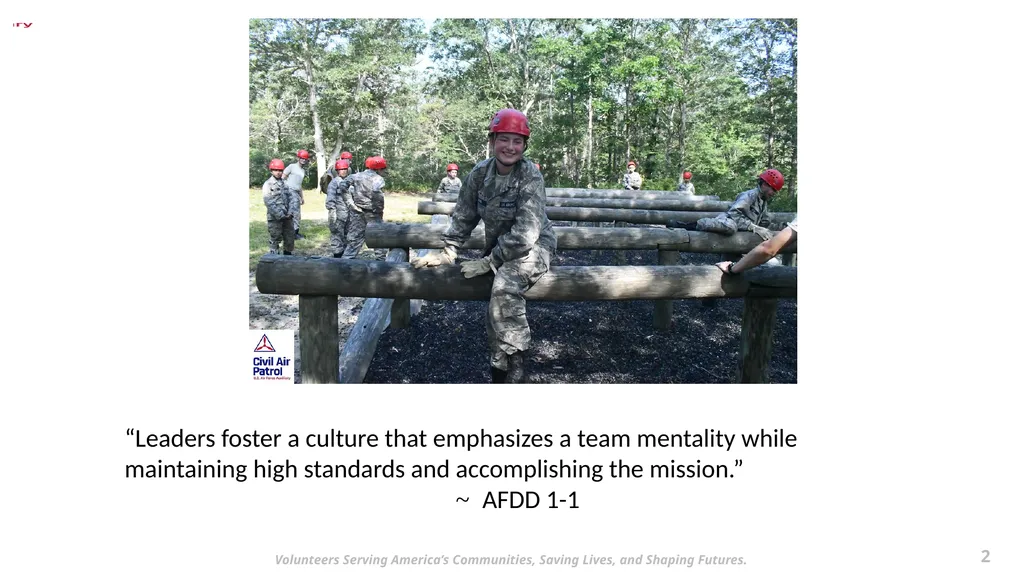
2 Volunteers Serving America’s Communities, Saving Lives, and Shaping Futures. “Leaders foster a culture that emphasizes a team mentality while maintaining high standards and accomplishing the mission.”
~ AFDD 1-1<br>
~ AFDD 1-1<br>
03
In this class, we will:
Discuss the Cadet Protection paradigm
Define appropriate intensity levels
Analyze the spirit and the letter of the CPP
Learn proper reporting procedures
Apply Operational Risk Management
Work through a number of case studies 3 Overview Volunteers Serving America’s Communities, Saving Lives, and Shaping Futures.<br>
04
What is the primary purpose of the Cadet Protection Policy? 4 Cadet Protection Paradigm Volunteers Serving America’s Communities, Saving Lives, and Shaping Futures.<br>
05
What is the primary purpose of the Cadet Protection Policy?
TO PROTECT CADETS 5 Cadet Protection Paradigm Volunteers Serving America’s Communities, Saving Lives, and Shaping Futures.<br>
TO PROTECT CADETS 5 Cadet Protection Paradigm Volunteers Serving America’s Communities, Saving Lives, and Shaping Futures.<br>
06
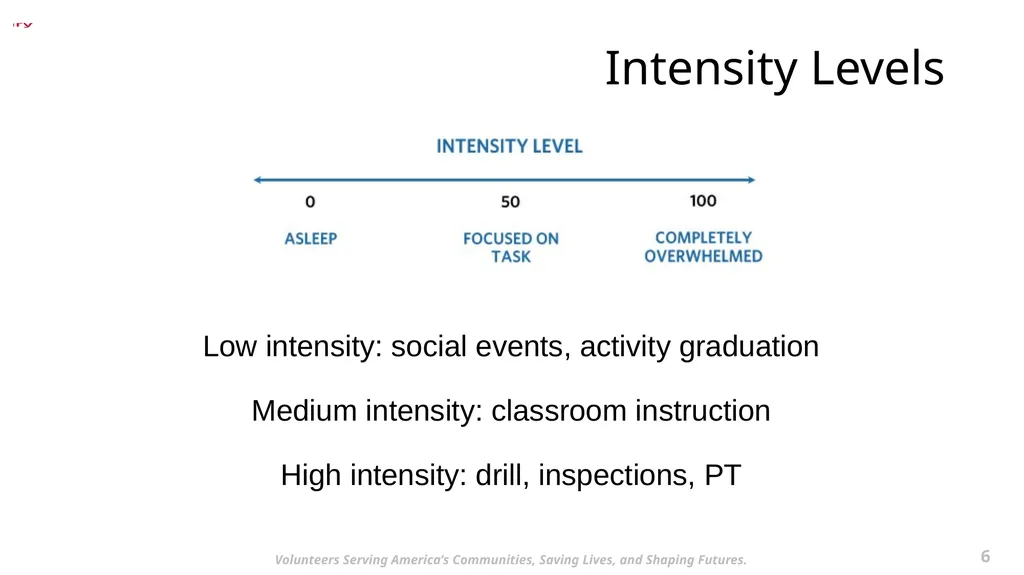
Low intensity: social events, activity graduation
Medium intensity: classroom instruction
High intensity: drill, inspections, PT 6 Intensity Levels Volunteers Serving America’s Communities, Saving Lives, and Shaping Futures.<br>
Medium intensity: classroom instruction
High intensity: drill, inspections, PT 6 Intensity Levels Volunteers Serving America’s Communities, Saving Lives, and Shaping Futures.<br>
07
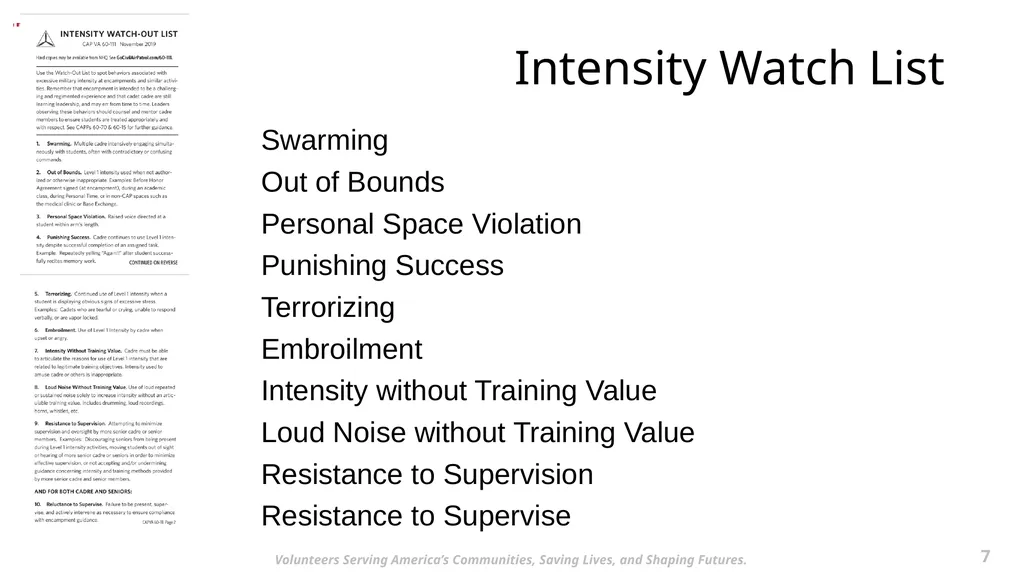
Swarming
Out of Bounds
Personal Space Violation
Punishing Success
Terrorizing
Embroilment
Intensity without Training Value
Loud Noise without Training Value
Resistance to Supervision
Resistance to Supervise 7 Intensity Watch List Volunteers Serving America’s Communities, Saving Lives, and Shaping Futures.<br>
08
CAP defines abuse in CAPR 60-2:
“Any recent act or failure to act on the part of a parent or caretaker (e.g. CAP adult leader) that results in death, serious physical or emotional harm, sexual abuse, or exploitation, or alternatively, an act or failure to act that presents an imminent risk of serious harm.” 8 Definition of Abuse Volunteers Serving America’s Communities, Saving Lives, and Shaping Futures.<br>
“Any recent act or failure to act on the part of a parent or caretaker (e.g. CAP adult leader) that results in death, serious physical or emotional harm, sexual abuse, or exploitation, or alternatively, an act or failure to act that presents an imminent risk of serious harm.” 8 Definition of Abuse Volunteers Serving America’s Communities, Saving Lives, and Shaping Futures.<br>
09
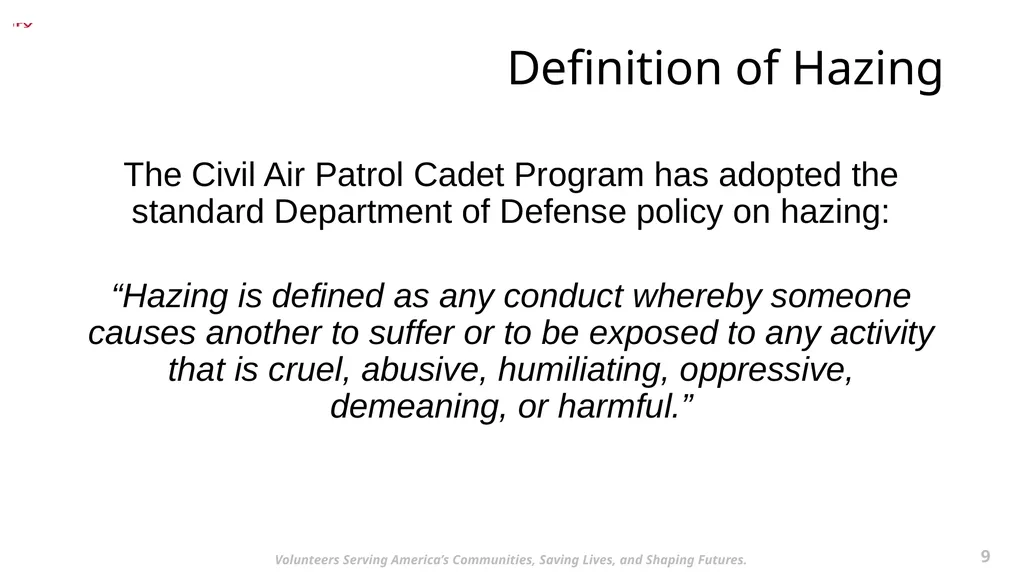
The Civil Air Patrol Cadet Program has adopted the standard Department of Defense policy on hazing:
“Hazing is defined as any conduct whereby someone causes another to suffer or to be exposed to any activity that is cruel, abusive, humiliating, oppressive, demeaning, or harmful.” 9 Definition of Hazing Volunteers Serving America’s Communities, Saving Lives, and Shaping Futures.<br>
“Hazing is defined as any conduct whereby someone causes another to suffer or to be exposed to any activity that is cruel, abusive, humiliating, oppressive, demeaning, or harmful.” 9 Definition of Hazing Volunteers Serving America’s Communities, Saving Lives, and Shaping Futures.<br>
10
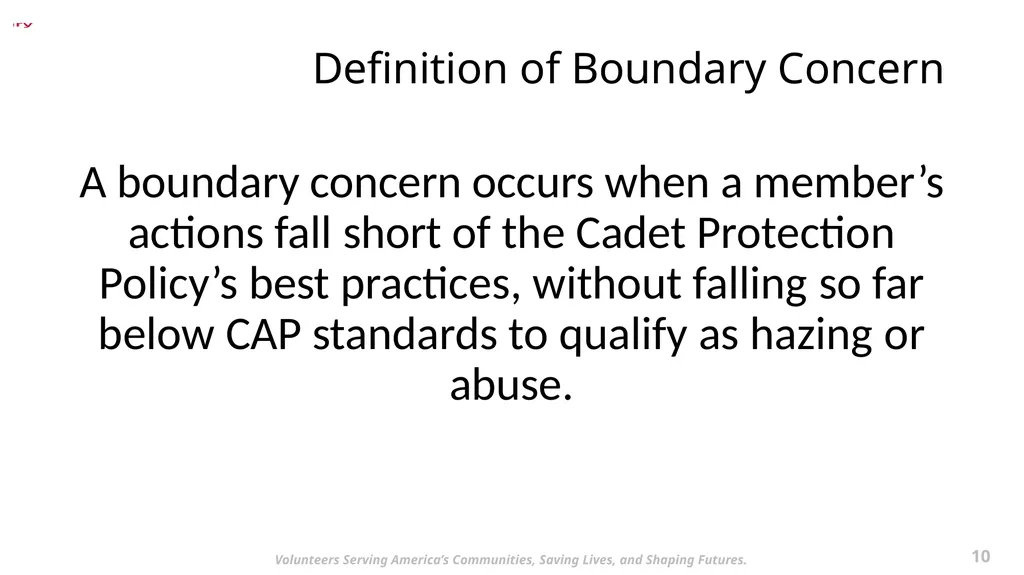
A boundary concern occurs when a member’s actions fall short of the Cadet Protection Policy’s best practices, without falling so far below CAP standards to qualify as hazing or abuse. 10 Definition of Boundary Concern Volunteers Serving America’s Communities, Saving Lives, and Shaping Futures.<br>
11
If the Letter is “cruel, abusive, humiliating, oppressive, demeaning, or harmful,” what is the Spirit? 11 The Spirit and the Letter Volunteers Serving America’s Communities, Saving Lives, and Shaping Futures.<br>
12
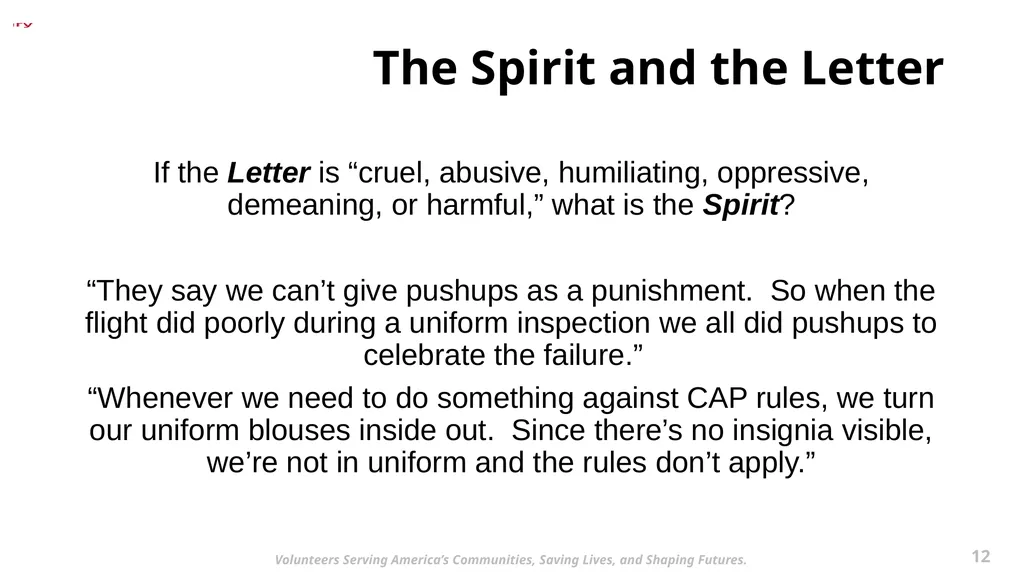
If the Letter is “cruel, abusive, humiliating, oppressive, demeaning, or harmful,” what is the Spirit?
“They say we can’t give pushups as a punishment. So when the flight did poorly during a uniform inspection we all did pushups to celebrate the failure.”
“Whenever we need to do something against CAP rules, we turn our uniform blouses inside out. Since there’s no insignia visible, we’re not in uniform and the rules don’t apply.” 12 The Spirit and the Letter Volunteers Serving America’s Communities, Saving Lives, and Shaping Futures.<br>
13
The Rule of St. Benedict: 13 The Spirit and the Letter Volunteers Serving America’s Communities, Saving Lives, and Shaping Futures. “Arrange everything so that the strong have something to yearn for, and the weak nothing to run from.”<br>
14
Why do you think some people choose not to report CPP violations?
Is it ever okay not to report an incident?
What if I report the incident to my direct superior but nothing is done about it?
What if the person violating the CPP is in my chain of command?
Is it ever okay to skip links in the chain of command, even if they aren’t personally involved in the CPP violation? 14 Reporting Volunteers Serving America’s Communities, Saving Lives, and Shaping Futures.<br>
15
Adult members who develop a reasonable, good faith suspicion or belief that a cadet has been sexually abused, exploited, physically abused, neglected, or emotionally abused will first ensure that the cadet is safe from imminent harm.
The member will then contact the wing commander, who will notify the general counsel and a wing legal officer. 15 Abuse Reporting Procedures Volunteers Serving America’s Communities, Saving Lives, and Shaping Futures.<br>
The member will then contact the wing commander, who will notify the general counsel and a wing legal officer. 15 Abuse Reporting Procedures Volunteers Serving America’s Communities, Saving Lives, and Shaping Futures.<br>
16
If you see a boundary concern, step forward and redirect the undesired behavior.
Usually, a friendly reminder is all that is needed. Sometimes extra training on the spot or refresher training on the Cadet Protection Policy is necessary.
Chronic violators should receive progressive disciplinary actions, such as a written warning, suspension, and finally in the rarest instances, membership termination. 16 Boundary Concern Procedures Volunteers Serving America’s Communities, Saving Lives, and Shaping Futures.<br>
17
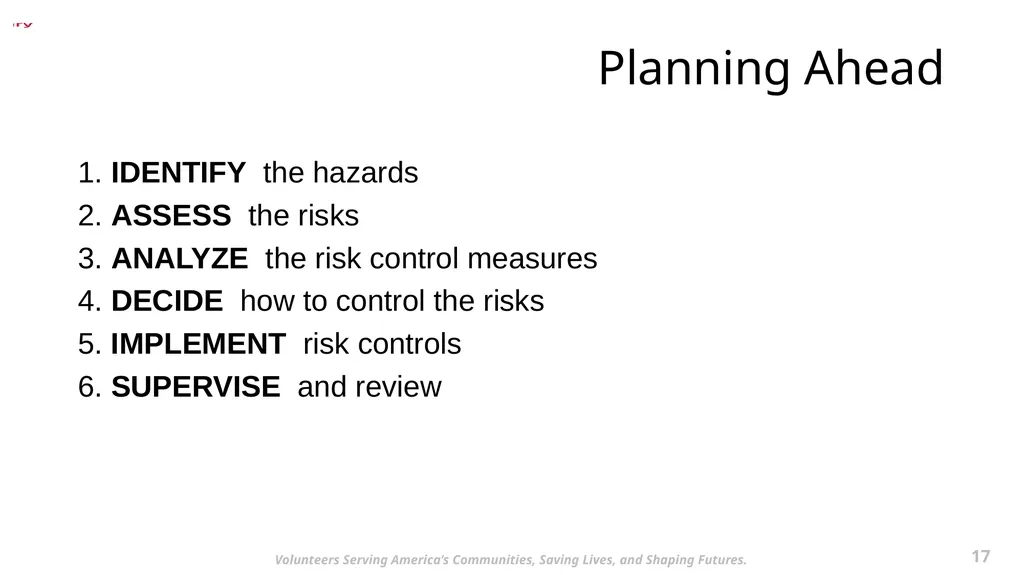
1. IDENTIFY the hazards
2. ASSESS the risks
3. ANALYZE the risk control measures
4. DECIDE how to control the risks
5. IMPLEMENT risk controls
6. SUPERVISE and review 17 Planning Ahead Volunteers Serving America’s Communities, Saving Lives, and Shaping Futures.<br>
2. ASSESS the risks
3. ANALYZE the risk control measures
4. DECIDE how to control the risks
5. IMPLEMENT risk controls
6. SUPERVISE and review 17 Planning Ahead Volunteers Serving America’s Communities, Saving Lives, and Shaping Futures.<br>
18
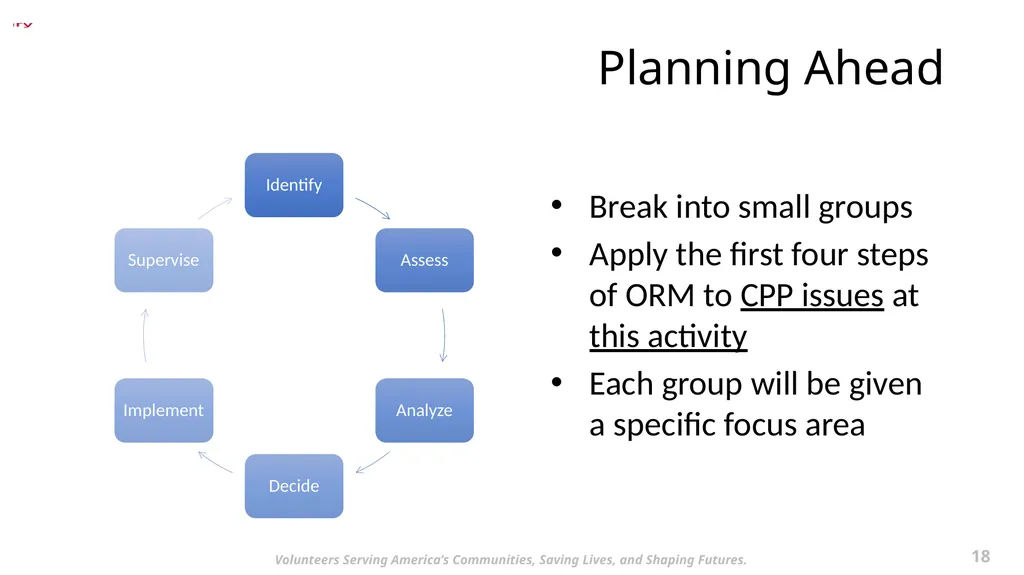
18 Planning Ahead Volunteers Serving America’s Communities, Saving Lives, and Shaping Futures. Break into small groups
Apply the first four steps of ORM to CPP issues at this activity
Each group will be given a specific focus area<br>
Apply the first four steps of ORM to CPP issues at this activity
Each group will be given a specific focus area<br>
19
1. What hazards were identified?
2. How likely are the hazards? What’s would be the severity of the hazards?
3.What could be done to reduce the probability or severity of the hazards?
4. What are your recommendations to reduce risk? 19 Risk Management Report Back Volunteers Serving America’s Communities, Saving Lives, and Shaping Futures.<br>
20
What safety strategies are in place to reduce the COVID-19 risks at this activity? 20 Review COVID Plan Volunteers Serving America’s Communities, Saving Lives, and Shaping Futures.<br>
21
We will now apply CPP concepts to specific scenarios
- Discuss in small groups
- Present findings to entire group 21 Case Studies Volunteers Serving America’s Communities, Saving Lives, and Shaping Futures.<br>
- Discuss in small groups
- Present findings to entire group 21 Case Studies Volunteers Serving America’s Communities, Saving Lives, and Shaping Futures.<br>
22
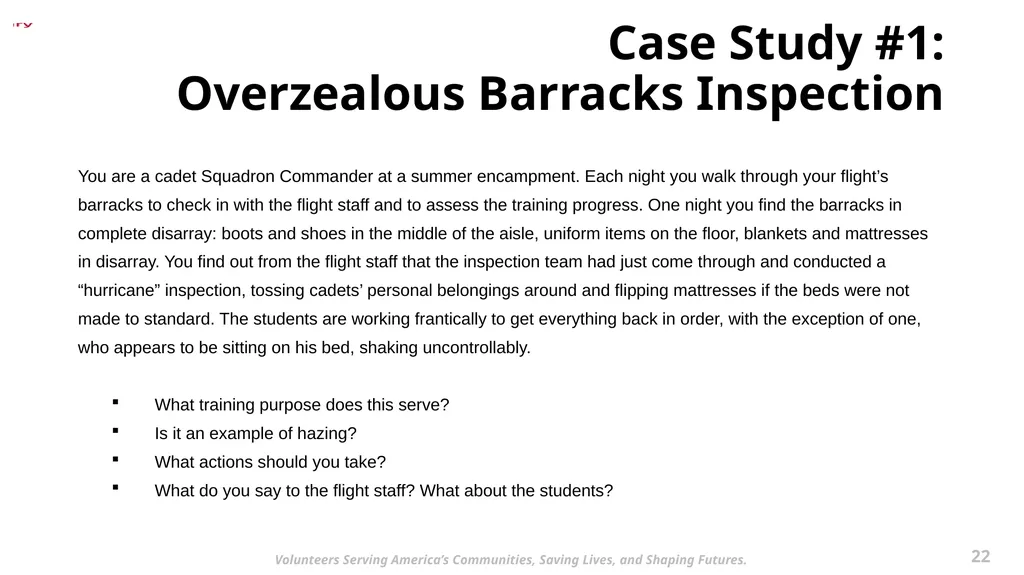
You are a cadet Squadron Commander at a summer encampment. Each night you walk through your flight’s barracks to check in with the flight staff and to assess the training progress. One night you find the barracks in complete disarray: boots and shoes in the middle of the aisle, uniform items on the floor, blankets and mattresses in disarray. You find out from the flight staff that the inspection team had just come through and conducted a “hurricane” inspection, tossing cadets’ personal belongings around and flipping mattresses if the beds were not made to standard. The students are working frantically to get everything back in order, with the exception of one, who appears to be sitting on his bed, shaking uncontrollably.
What training purpose does this serve?
Is it an example of hazing?
What actions should you take?
What do you say to the flight staff? What about the students? 22 Case Study #1: Overzealous Barracks Inspection Volunteers Serving America’s Communities, Saving Lives, and Shaping Futures.<br>
What training purpose does this serve?
Is it an example of hazing?
What actions should you take?
What do you say to the flight staff? What about the students? 22 Case Study #1: Overzealous Barracks Inspection Volunteers Serving America’s Communities, Saving Lives, and Shaping Futures.<br>
23
The Zulu Flight Guidon Bearer has left the guidon behind twice. The first time, the Cadet Commander gave it back, explaining that it was not just the Guidon Bearer’s responsibility; the flight needed to work together as a team to keep track of the guidon. When the guidon gets left behind a second time, the Cadet Commander and Cadet Deputy Commander decide that there needs to be a consequence. This time, the Cadet Commander returns the guidon to Zulu Flight, furled with duct tape. He says, “Until you can figure out how to work as a team, nobody needs to know who you are.” Several of the cadets are very upset. They feel that their flight is being singled out and treated unfairly.
What training purpose does this serve?
Is it an example of hazing?
How would you address the flight’s concerns?
What are some other consequences the Cadet Commander could have imposed? 23 Case Study #2: Building a Team Volunteers Serving America’s Communities, Saving Lives, and Shaping Futures.<br>
What training purpose does this serve?
Is it an example of hazing?
How would you address the flight’s concerns?
What are some other consequences the Cadet Commander could have imposed? 23 Case Study #2: Building a Team Volunteers Serving America’s Communities, Saving Lives, and Shaping Futures.<br>
24
Three of the students in your flight left their training manuals in the dining hall after lunch. You’re really frustrated, because this is not the first time you’ve had to address this issue with your flight. While venting to a Flight Commander from another flight, he tells you that the night before he had his entire flight work together to complete a total of 200 push-ups and 400 flutter kicks by lights out that night in order to earn back the training manual belonging to one of his students. He explained that his Flight Sergeant thought they might get in trouble for hazing, but that his Training Officer said it was okay because they took a poll and the students all agreed to do the push-ups and flutter kicks.
What training purpose does this serve?
Is it an example of hazing?
Since this method of teaching responsibility seems to be condoned at this activity, would you choose to use it, too?
If you do believe this is an example of hazing, who do you report it to, since at least one senior member approves of it? 24 Case Study #3: Taking Responsibility Volunteers Serving America’s Communities, Saving Lives, and Shaping Futures.<br>
25
A cadet seems to have misplaced her flight cap. She looked through all of her belongings and searched high and low throughout the barracks, but it’s nowhere to be found. You’re already running behind schedule, and you can’t wait around for one person to make everyone late. You instruct her to leave without the flight cap, but to walk around all day with her left hand over her head whenever she’s outside, so she’ll be “under cover.”
What training purpose does this serve?
Is it an example of hazing?
What are some alternative consequences for being out of uniform?
What other methods can be used to teach cadets to take responsibility for their belongings? 25 Case Study #4: Under Cover Volunteers Serving America’s Communities, Saving Lives, and Shaping Futures.<br>
26
From the very first announcements, the expectations were clear: cell phones, mp3 players, and other electronic devices would not be permitted at this activity. During in-processing, senior members conducted contraband inspections for unauthorized items and asked each cadet individually to report any unauthorized items they might have brought with them. Those items would then be collected, labeled, and kept in a secure location for the duration of the activity. Anyone who failed to report any unauthorized items during in-processing would be sent home for lying.
A few days into the course, during one of the classes, the Activity Director hears an odd sound. He recognizes it immediately as the sound of a cell phone that has been set to vibrate, instead of ringing, but he can’t determine the source of the sound. As soon as the class is over, he announces that there will be no personal time, no talking during meals, and the cadets will do two sessions of standard PT per day instead of a standard PT session in the morning and a relaxed game of Ultimate Frisbee in the evening.
What training purpose does this serve?
Is it an example of hazing?
Is this an appropriate use of group punishment? 26 Case Study #5: Contraband Collection Volunteers Serving America’s Communities, Saving Lives, and Shaping Futures.<br>
27
During the final standby inspection of the encampment, C/2d Lt Smith’s room fails miserably. He tells the inspector that he spent so much time helping his students prepare their rooms that he didn’t have enough time to get his own room in order. The inspector doesn’t buy it. Whatever else might have happened, the Flight Commander clearly failed to meet the standards. The inspector tells the cadet: “Are you kidding me? There’s really no excuse for this, Smith. I mean, you couldn’t even figure out the shoe line? Lead by example, Smith. Your room should be the best one in these barracks. I really expected better from you.”
What training purpose does this serve?
Is it an example of hazing?
What are some other ways the inspector could have handled this situation? 27 Case Study #6: Leading by Example Volunteers Serving America’s Communities, Saving Lives, and Shaping Futures.<br>
What training purpose does this serve?
Is it an example of hazing?
What are some other ways the inspector could have handled this situation? 27 Case Study #6: Leading by Example Volunteers Serving America’s Communities, Saving Lives, and Shaping Futures.<br>
28
It’s Friday of the first full week of encampment, and the cadets still can’t seem to figure out how to stand at Parade, REST or how to stay in step while performing Eyes, RIGHT. The Commandant of Cadets orders the cadet command staff to continue practicing until they get it right. Afternoons get pretty hot in July, and most of the cadets’ canteens are empty with nowhere to refill them. Two cadets have already passed out, but they still have not taken a break in over 45 minutes.
What training purpose does this serve?
Is it an example of hazing?
What would you do if you were a flight commander?
What if you were the public affairs officer, completely removed from the direct chain of command? 28 Case Study #7: In the Heat of the Moment Volunteers Serving America’s Communities, Saving Lives, and Shaping Futures.<br>
29
You walk into the bathroom, and it is completely trashed: toilet paper on the floor, trash in the sink, and graffiti that says “CAP rules” in one of the stalls. Immediately, you are furious. You walk back out and call the barracks to Attention, demanding to know who did it. When nobody takes responsibility, you order the entire group to scrub the entire latrine—including all of the toilets—with no cleaner and no gloves.
What training purpose does this serve?
Is it an example of hazing? 29 Case Study #8a: Cleaning Detail (Part 1) Volunteers Serving America’s Communities, Saving Lives, and Shaping Futures.<br>
What training purpose does this serve?
Is it an example of hazing? 29 Case Study #8a: Cleaning Detail (Part 1) Volunteers Serving America’s Communities, Saving Lives, and Shaping Futures.<br>
30
By the time the cadets finish the cleaning detail, you’ve calmed down considerably. You begin to think that you might have overreacted.
What do you do when you realize you’ve gone too far?
When you talk with the Activity Director, he asks you what you think an appropriate response would have been. What do you tell him? 30 Case Study #8b: Cleaning Detail (Part 2) Volunteers Serving America’s Communities, Saving Lives, and Shaping Futures.<br>
31
Two cadets were caught running around doing “spirit missions” after lights out. The commander said he would deal with it in the morning, but handed the cadets over to the cadet staff to “deal with” until then. The two cadets were ordered to scrub the kitchen until the next morning, with only two 5-minute breaks and no sleep.
What training purpose does this serve?
Is it an example of hazing?
Hazing or not, who bears the most responsibility for this incident? 31 Case Study #9: Team Spirit Volunteers Serving America’s Communities, Saving Lives, and Shaping Futures.<br>
What training purpose does this serve?
Is it an example of hazing?
Hazing or not, who bears the most responsibility for this incident? 31 Case Study #9: Team Spirit Volunteers Serving America’s Communities, Saving Lives, and Shaping Futures.<br>
32
2d Lt Brown is a former cadet who recently returned to your squadron after four years on active duty as an Army Ranger. With his experience, he has become a great resource: helpful, approachable, and a great mentor. He quickly became popular with cadets and senior members alike.
You and the other cadet staff have been very frustrated with one particular cadet, a 14-year-old C/A1C. He’s never been defiant, but sometimes he makes sarcastic remarks at inappropriate times and he often needs to be reminded of simple directions multiple times. While out on a Wing-level FTX, he smarts off to 2d Lt Brown, who responds by saying, “Come on, let’s do some push-ups.” 2d Lt Brown and the cadet drop together and they both do 10 push-ups.
What training purpose does this serve?
Is it an example of hazing?
Should you report it? If so, who do you report it to? 2d Lt Brown and the C/A1C are both in your squadron, but the incident occurred at a wing-level activity. 32 Case Study #10a: To Blow the Whistle (Part 1) Volunteers Serving America’s Communities, Saving Lives, and Shaping Futures.<br>
33
You weren’t actually there when the “let’s do some push-ups” incident occurred, but you heard about it later from your squadron’s cadet First Sergeant. He mentioned it while bringing you up to speed on the attitudinal cadet’s progress, smiling as he said, “He had it coming.” Based on your understanding of the Cadet Protection Policy, you believe that this is an incident of hazing.
Should you report the incident, even though you weren’t actually a witness?
How do you work with the First Sergeant on this issue, considering his opinion about the cadet and the incident? 33 Case Study #10b: To Blow the Whistle (Part 2) Volunteers Serving America’s Communities, Saving Lives, and Shaping Futures.<br>
34
Zulu Flight can’t seem to make it out the door on time for breakfast in the mornings. The Zulu Flight Staff recognizes that the cadets need some help developing time management skills, so they have devised a plan to assist them.
During hygiene time, the Flight Staff rushed the students through the showers. The Flight Sergeant stood just outside the shower room yelling at them that they had one minute to shower, while the Flight Commander kept time. They decided to be nice by really giving the students two minutes, instead of one. Tomorrow they plan on waking their flight 15 minutes before the scheduled wake up time, to ensure that they have plenty of time to prepare for the morning’s first event.
What training purpose does this serve?
Is it an example of hazing?
As a staff member not assigned to Zulu Flight, what would you do if you heard about this plan? 34 Case Study #11: Time Management Volunteers Serving America’s Communities, Saving Lives, and Shaping Futures.<br>
35
C/CMSgt Wright is on top of the world. He’s wanted to be First Sergeant at an activity outside his squadron ever since his first Encampment and now it’s his time to shine. He wants to make an impression on the cadets, so every time he addresses them, he does so loudly. “I never yell,” he likes to say, “I merely speak in a tone which ensures that I will not be misunderstood, misheard, or ignored.” The Chief has already been mentored several times by those in his chain of command. He seems to understand now that while yelling isn’t always bad, he was doing it excessively.
Much to the Chief’s surprise—and delight—his Training Officer’s advice that whispering can be just as effective is true. You couldn’t hear what he whispered to cadets during inspections, but the Chief approaches you to brag about the level of discipline under his watch: “When a cadet isn’t standing at Attention properly, I like to sneak up behind ‘em and just whisper a few sentences. Works every time! They straighten right up. But just to keep ‘em on their toes, after whispering, sometimes I yell suddenly, just to see ‘em jump.”
What training purpose does this serve?
Is it an example of hazing?
How would you respond to the Chief’s statement that he yells “just to see ‘em jump”? 35 Case Study #12: Scare Tactics Volunteers Serving America’s Communities, Saving Lives, and Shaping Futures.<br>
36
If your team wins this volleyball game, you’ll advance to finals. The stakes are high, but the team generally works well together on the court. As the pressure builds, the volleyball team captain becomes more competitive. She has been playing volleyball since she was 8, so it’s serious business to her.
There are two cadets on the team who are particularly uncoordinated. If they don’t miss the volleyball altogether, they always seem to hit it the wrong direction. You overhear the team captain talking to them before the game, telling them that they’d better figure it out so they don’t ruin it for everyone else. Once the game begins, she’s particularly sarcastic whenever the two “weakest links,” as she calls them, try to go for the ball.
What training purpose does this serve?
Is it an example of hazing?
How do you think the team captain’s attitude and behavior affect the rest of the team? 36 Case Study #13: Mind Games Volunteers Serving America’s Communities, Saving Lives, and Shaping Futures.<br>
37
Everyone has noticed that one particular cadet, a quiet C/SSgt who just turned 14, is beginning to smell. The other cadets have already been complaining about it and his roommate informed you that the cadet hasn’t showered in three days. You pull him aside at the beginning of personal time and ask him—in a straightforward way, but with a kind tone—if he’s been taking care of his hygiene needs. At first he tells you that he’s fine, but with a little prodding, he explains that he’s uncomfortable taking communal showers. While he doesn’t come right out and mention it, you infer that he’s nervous about developmental differences between him and the other boys.
Do communal showers present a violation of CAP’s Cadet Protection Policy?
What can you do to help the cadet adjust? 37 Case Study #14: Personal Hygiene Volunteers Serving America’s Communities, Saving Lives, and Shaping Futures.<br>
Do communal showers present a violation of CAP’s Cadet Protection Policy?
What can you do to help the cadet adjust? 37 Case Study #14: Personal Hygiene Volunteers Serving America’s Communities, Saving Lives, and Shaping Futures.<br>
38
The best leaders take care of their followers while living the Core Values of Integrity, Respect, Excellence, and Volunteer Service. 38 The Bottom Line Volunteers Serving America’s Communities, Saving Lives, and Shaping Futures.<br>