Resilience and Emergencies Division (RED) Plans to support local-level cyber preparedness Alice Reeves James Young Delivering local level multi-agency cyber resilience Who is RED and what do we do? Enable Resilient Localities Provide
"Resilience and Emergencies Division (RED) Plans to" is the property of its rightful owner. Permission is granted to
download and print the materials on this website for personal, non-commercial use only, and to display it
on your personal computer provided you do not modify the materials and that you retain all copyright
notices contained in the materials. By downloading content from our website, you accept the terms of this
agreement.
Presentation Transcript
01
Resilience and Emergencies Division (RED) Plans to support local-level cyber preparedness
Alice Reeves James Young Delivering local level multi-agency cyber resilience<br>
02
Who is RED and what do we do? Enable
Resilient
Localities Provide
government
support
when emergencies
do occur Ensure
preparedness for
high impact or
wide area
emergencies Discharge our
lead government
department
responsibilities
e.g. recovery MHCLG’s Resilience & Emergencies Division (RED) is responsible for the UK Government’s resilience function below the national level. Its role is to: Multi-sector local preparedness supports national resilience<br>
03
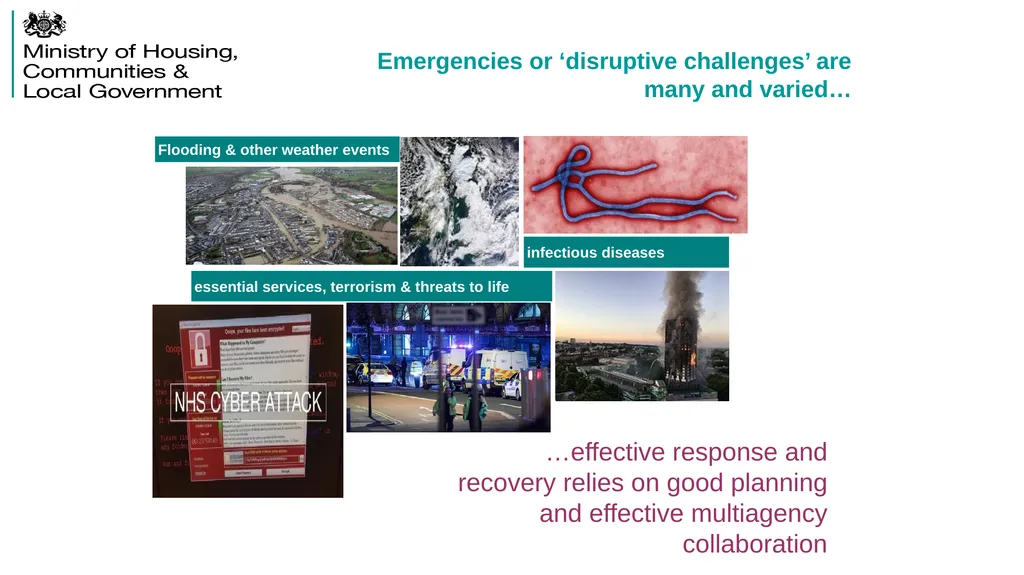
Emergencies or ‘disruptive challenges’ are many and varied… Flooding & other weather events infectious diseases essential services, terrorism & threats to life …effective response and recovery relies on good planning and effective multiagency collaboration<br>
04
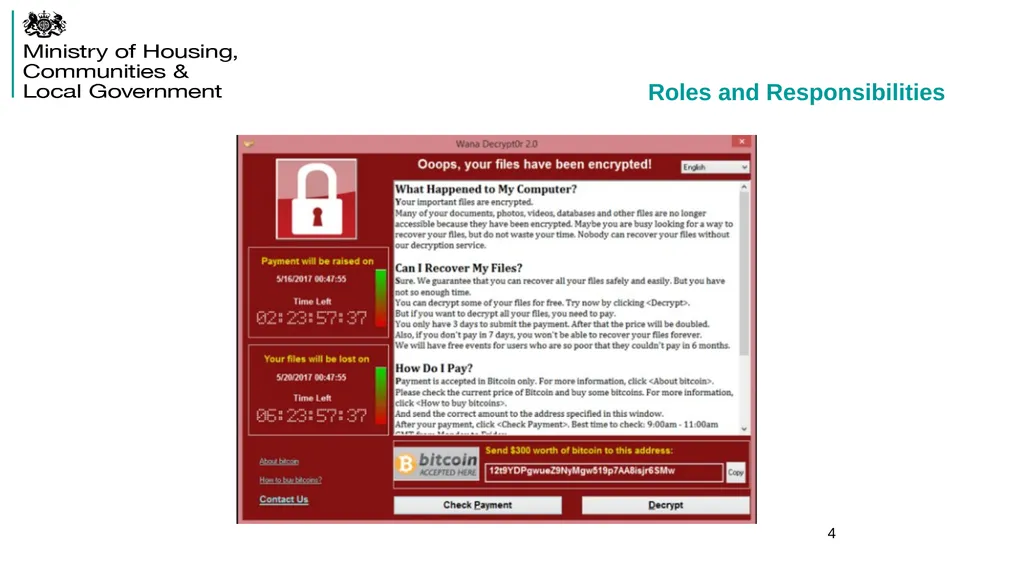
Roles and Responsibilities 4<br>
05
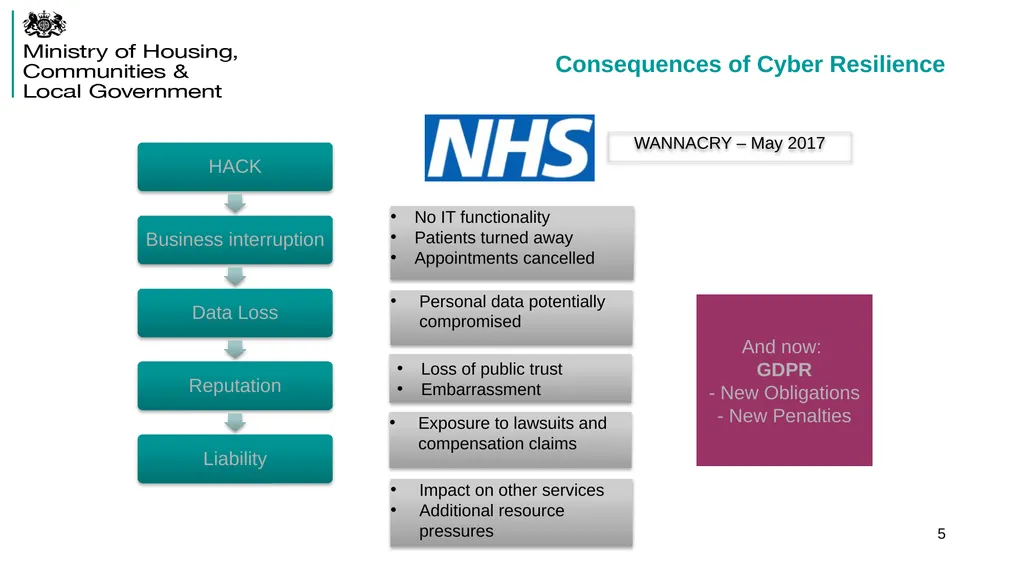
Consequences of Cyber Resilience 5 Exposure to lawsuits and compensation claims Loss of public trust
Embarrassment Personal data potentially compromised No IT functionality
Patients turned away
Appointments cancelled And now:
GDPR
- New Obligations
- New Penalties Impact on other services
Additional resource pressures WANNACRY – May 2017<br>
06
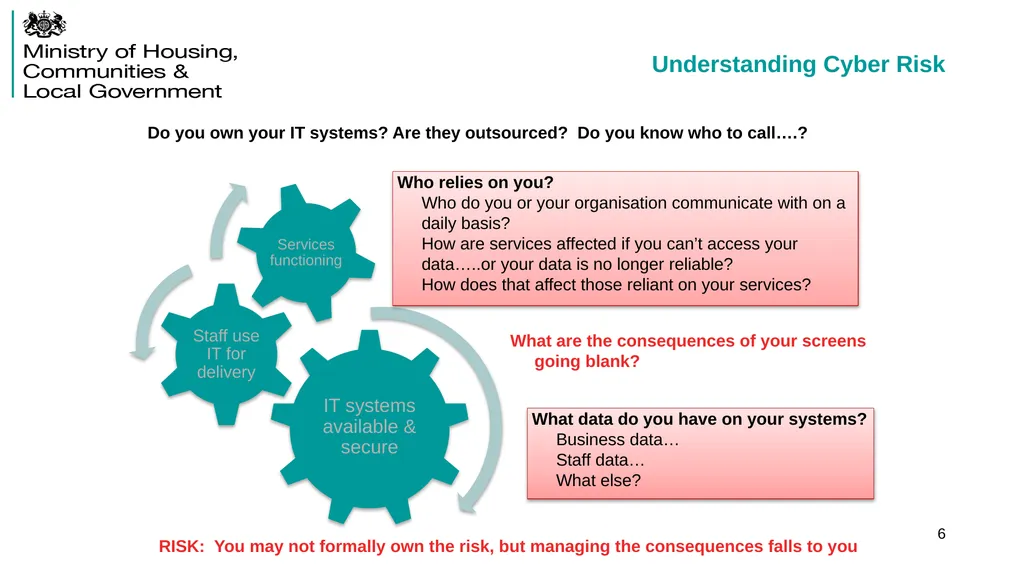
Understanding Cyber Risk 6 What data do you have on your systems?
Business data…
Staff data…
What else? Do you own your IT systems? Are they outsourced? Do you know who to call….? Who relies on you?
Who do you or your organisation communicate with on a daily basis?
How are services affected if you can’t access your data…..or your data is no longer reliable?
How does that affect those reliant on your services? What are the consequences of your screens going blank? RISK: You may not formally own the risk, but managing the consequences falls to you<br>
07
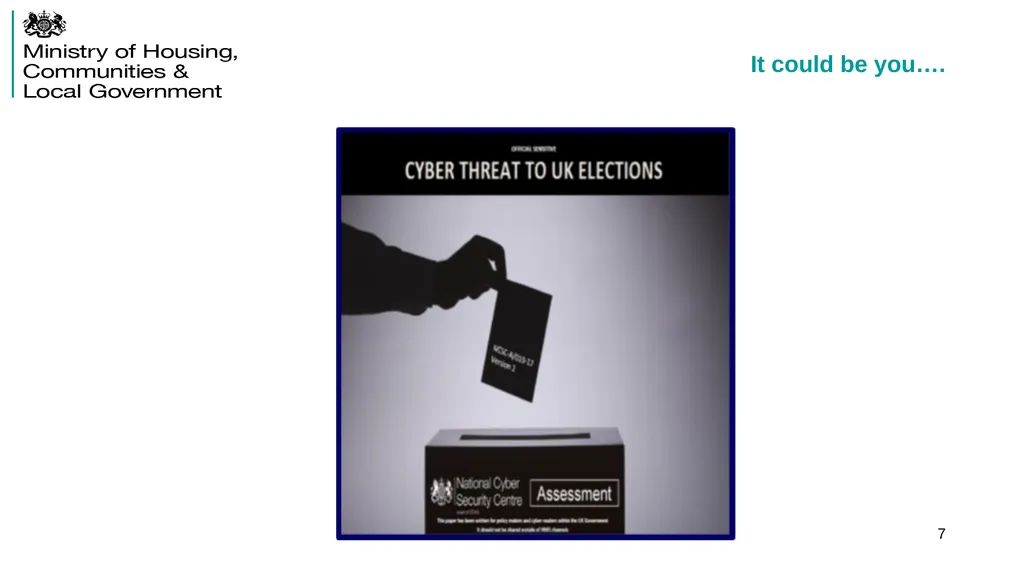
It could be you…. 7<br>
08
Local Resilience Forum Landscape LRF secretariats were asked some basic questions in August about their Cyber preparedness. The findings from this survey will help us target further work and give a baseline for current capabilities. We found:
Most LRFs have completed some kind of risk assessment for cyber.
A small number of LRFs have prepared a cyber specific response plan. A larger number of LRFs are relying on generic response plans.
Some LRFs have conduced an exercise with a cyber scenario or component.
A number of LRFs have had briefings or discussions around cyber, the need for specific training was generally thought more appropriate for individual organisations.
Challenges include the pressures from other work, a view that this is an individual organisational issue or that it requires specific technical knowledge. 8<br>
09
RED Cyber Resilience (18 month programme) Develop a self-sustaining cyber resilience capabilities for LRFs, including cyber incident response
Identify and share good practice
Strengthen cyber security awareness, training, risk assessment and exercising
Support effective LRF response arrangements and aligning these with central government arrangements
Encourage centres of excellence and links to existing networks such as Warning and Reporting Points (WARPs)
Supporting access to wider National Cyber Security Programme services and solutions. 9<br>
10
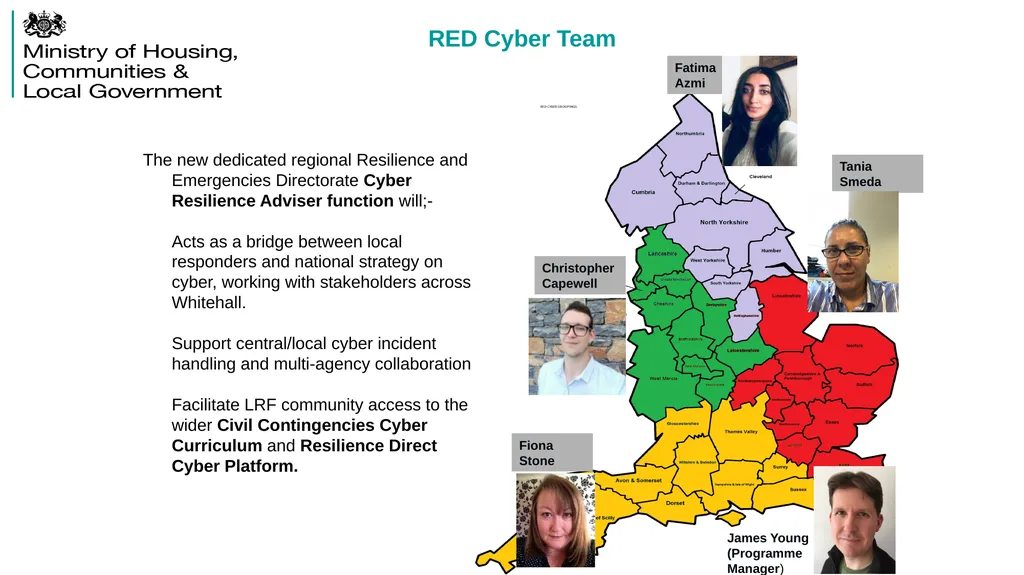
RED Cyber Team The new dedicated regional Resilience and Emergencies Directorate Cyber Resilience Adviser function will;-
Acts as a bridge between local responders and national strategy on cyber, working with stakeholders across Whitehall.
Support central/local cyber incident handling and multi-agency collaboration
Facilitate LRF community access to the wider Civil Contingencies Cyber Curriculum and Resilience Direct Cyber Platform. 10 James Young
(Programme Manager) Fatima Azmi Christopher Capewell Fiona Stone Tania Smeda<br>
11
Cyber Guidance for LRFs Linked to the national guidance and response arrangements a bespoke set of templates will be worked up in conjunction with the LRF community around the following areas:
Risk and Vulnerability Assessment for LRFs
Planning Assumptions
Response and Incident Reporting Templates
Assurance framework building on the new Cyber Resilience Standard
RED Cyber team will also be able to help LRFs run multi-agency Cyber exercises at the LRF level.<br>
12
National Training Scheme Offer Developing Underpinning Cyber Resilience Knowledge
Cyber Landscape: overview of a baseline common understanding of the current cyber landscape.
Guidance & Support: signpost to authoritative sources of guidance and support.
Cyber Threat: provide a detailed understanding of the cyber threat trajectory.
Capability: outline the core components of a cyber resilience capability.
2. Developing Cyber Resilience Capability
People, Processes & Technology (day-to-day): outline the core components to develop a cyber resilience programme.
Resilience, Preparedness & planning: integrate existing resilience arrangements with cyber resilience issues.
Embedding Cyber Resilience: raise cyber resilience awareness and education within their organisations.
3. Integrating Cyber Resilience into wider LRF Incident Management Capability
Incident Management: To develop a clear understand of the requirement for an effective incident management capability.
Crisis Management & Communications: To embed the take-up of crisis management requirements during a cyber incident.
Business Continuity: Establish an appreciation of how business continuity complements cyber resilience.
Recovery: Outline the requirements for effect recovery planning<br>
13
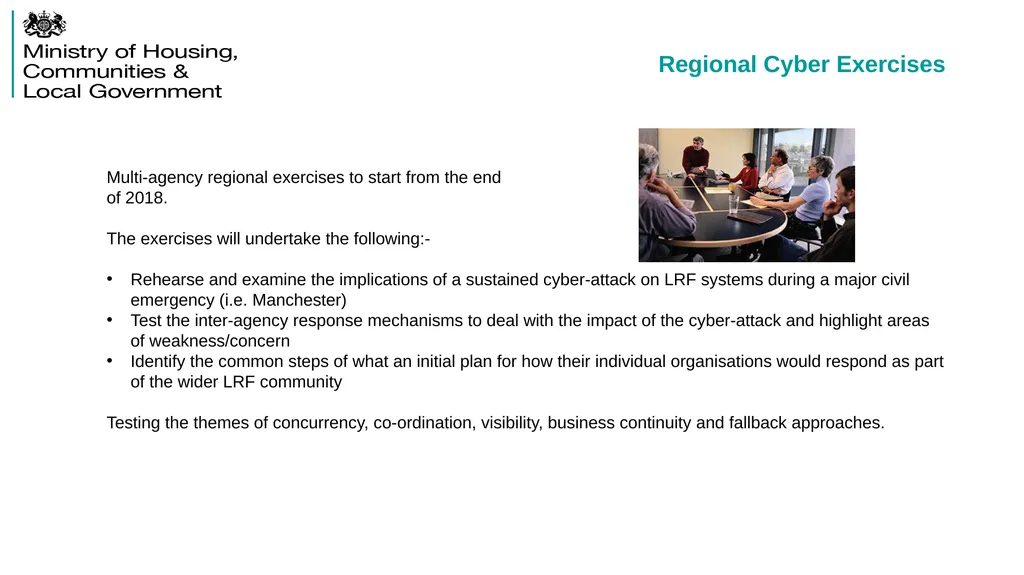
Regional Cyber Exercises Multi-agency regional exercises to start from the end
of 2018.
The exercises will undertake the following:-
Rehearse and examine the implications of a sustained cyber-attack on LRF systems during a major civil emergency (i.e. Manchester)
Test the inter-agency response mechanisms to deal with the impact of the cyber-attack and highlight areas of weakness/concern
Identify the common steps of what an initial plan for how their individual organisations would respond as part of the wider LRF community
Testing the themes of concurrency, co-ordination, visibility, business continuity and fallback approaches.<br>
14
Forward Look WHAT NEXT?
New tools and applications
Connected smart street lighting
Waste management
Water management
New streams of data
Sensor networks: air quality, noise, traffic, buildings
Social Media
More uses for data analytics:
Machine learning / Artificial Intelligence
Edge computing
Facial Recognition
Chatbots 14<br>
15
Smart places and connected communities What does this mean for cyber resilience?
New vulnerabilities
New types of risk
A need for new tools and new skills
A need for developing understanding of risk
WHAT DO WE NEED TO KNOW?
What support and guidance the local public sector needs to use these new applications successfully and gain the benefits for citizens, local businesses and staff 15<br>
16
Thank you! Alice Reeves alice.reeves@communities.gsi.gov.uk James Young jamesk.young@communities.gsi.gov.uk<br>