
Resolving Difficult Behavior in Children and



Description: Resolving Difficult Behavior in Children and Adolescents Teachable Proven Behavior Changing Techniques Tips Presented by: Steven T. Olivas, PhD, HSP Twitter: steveolivas Podcasts: The Commute; Wrong Wronger and 10 Minutes to
Related Topics
Download Presentation
"Resolving Difficult Behavior in Children and" is the property of its rightful owner. Permission is granted to download and print the materials on this website for personal, non-commercial use only, and to display it on your personal computer provided you do not modify the materials and that you retain all copyright notices contained in the materials. By downloading content from our website, you accept the terms of this agreement.
Presentation Transcript
slide1. Resolving Difficult Behavior in Children and Adolescents – Teachable Proven Behavior Changing Techniques & Tips Presented by:
Steven T. Olivas, PhD, HSP
Twitter: @steveolivas
Podcasts: “The Commute”; “Wrong & Wronger”
and “10 Minutes to Save Your Marriage”
On iTunes, Stitcher, SoundCloud, and iHeartRadio<br>
slide2. Dr. Steve Olivas Licensed Psychologist in Private Practice, Nashville, TN
M.S. From The University of Wisconsin – Whitewater
Dual Emphases:
Chemical Dependency Counseling
Marriage & Family Counseling
PhD, Counseling Psychology – The University of Oklahoma (1996)
Treating Children and Teens since 1990
Author, Bad Kids… or Bad Behavior? (2008)
and When Good Kids Go Bad (2012)<br>
slide3. Background Aristotle’s Perspective
Pavlov & Classical Conditioning
Thorndike’s “Law of Effect”
B.F. Skinner & Operant Conditioning
Reinforcement
Positive
Negative
Punishment
Positive
Negative<br>
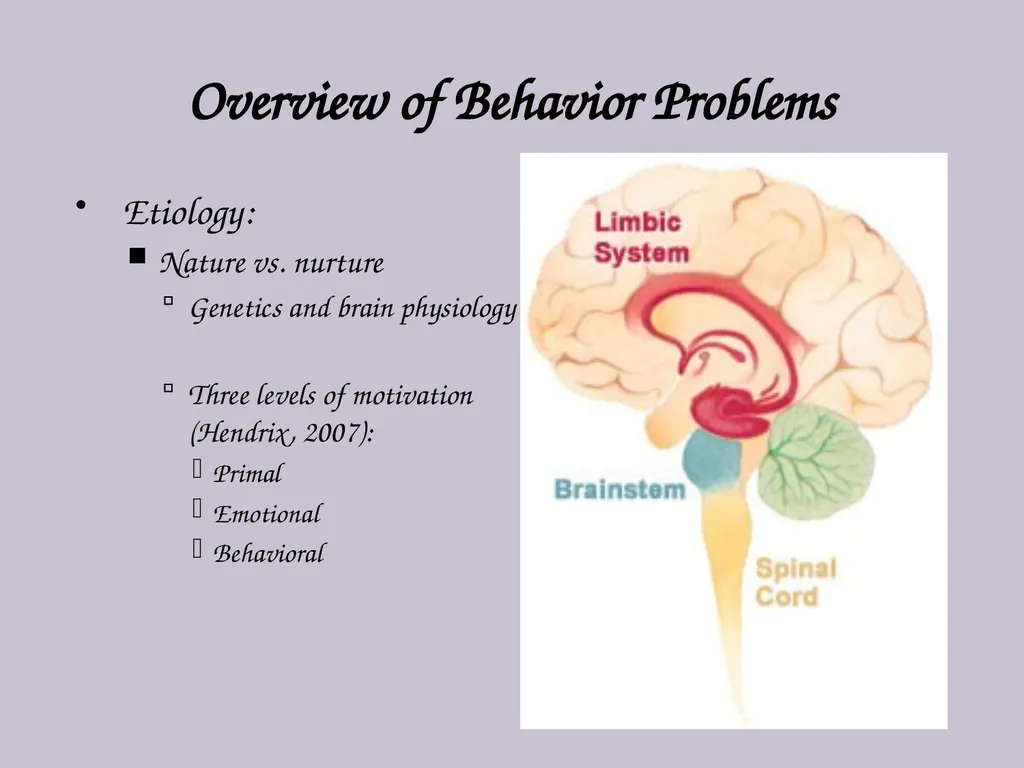
slide4. Overview of Behavior Problems Etiology:
Nature vs. nurture
Genetics and brain physiology
Three levels of motivation (Hendrix, 2007):
Primal
Emotional
Behavioral<br>
slide5. Etiology: Hormonal Issues Testosterone (ADHD/Aggression/ODD)
Thyroid Hormone
Hyperthyroid (Anxiety or ADHD)
Hypothyroid (Depression)
Menarche/Estrogen-Progesterone (Bi-Polar)<br>
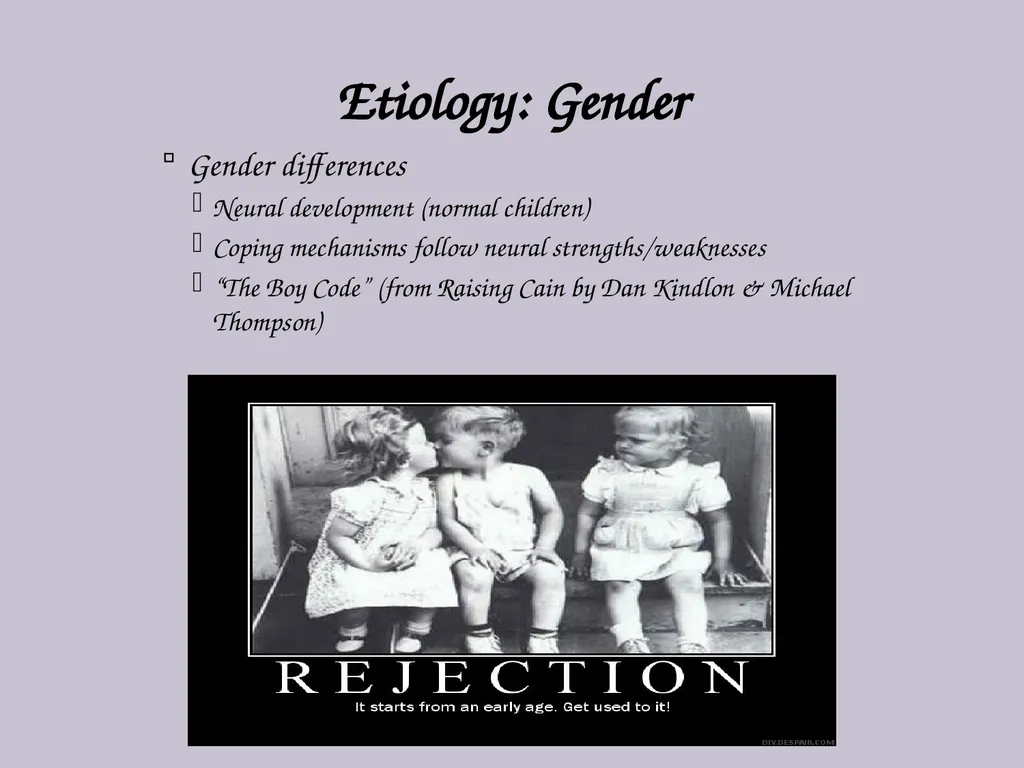
slide6. Etiology: Gender Gender differences
Neural development (normal children)
Coping mechanisms follow neural strengths/weaknesses
“The Boy Code” (from Raising Cain by Dan Kindlon & Michael Thompson)<br>
slide7. DSM-V Associated Diagnoses Oppositional Defiant Disorder (ODD)
Often loses temper
Argues with adults
Deliberately annoys others
Is touchy or easily annoyed
Is angry, resentful, spiteful, or vindictive
Blames others for his or her misbehaviors
Often actively defies or refuses to comply with rules or requests
Modulate Eye Contact
Grant Power or Control
Escalation Recreates Trauma<br>
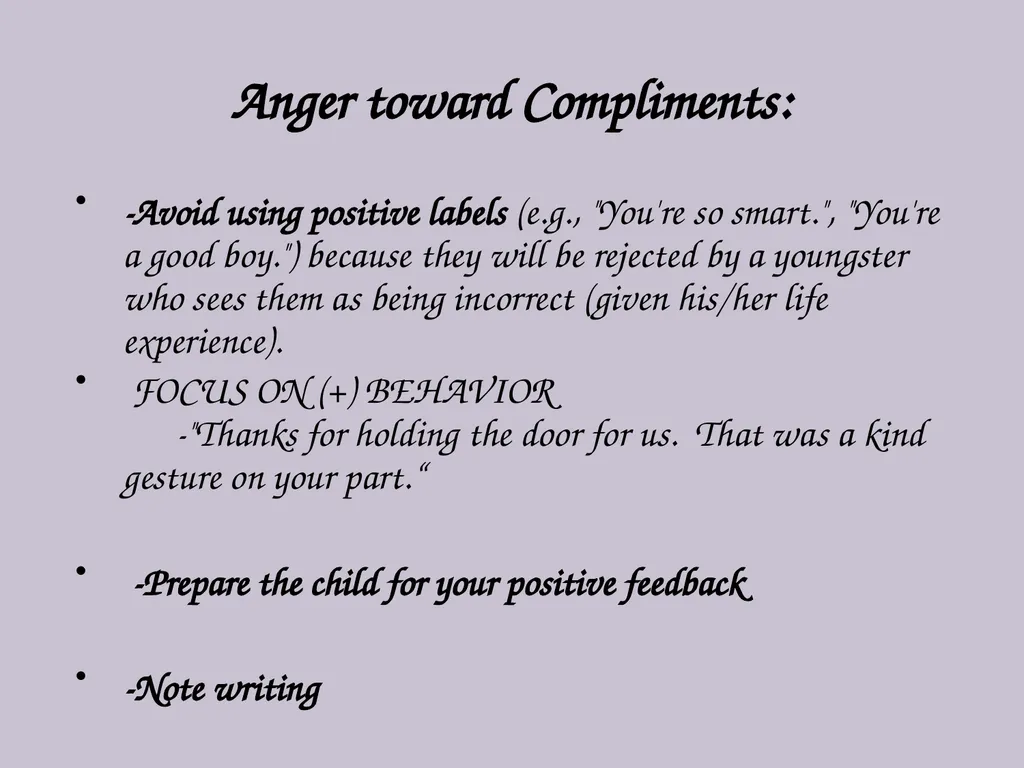
slide8. Anger toward Compliments: -Avoid using positive labels (e.g., "You're so smart.", "You're a good boy.") because they will be rejected by a youngster who sees them as being incorrect (given his/her life experience).
FOCUS ON (+) BEHAVIOR -"Thanks for holding the door for us. That was a kind gesture on your part.“
-Prepare the child for your positive feedback
-Note writing<br>
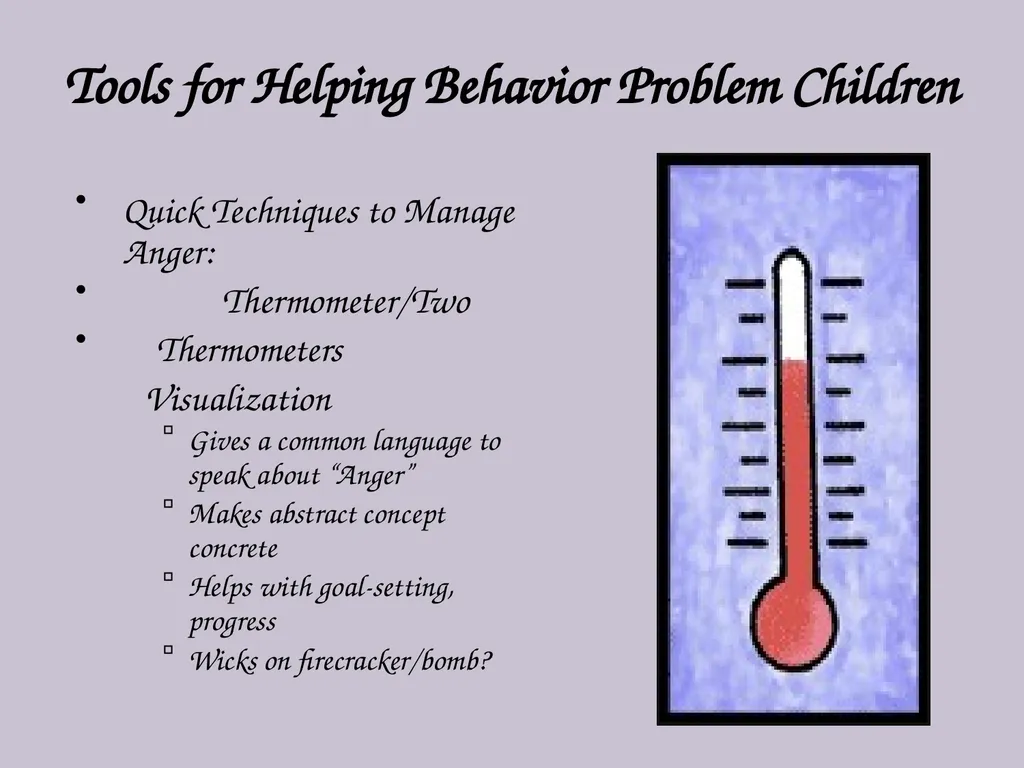
slide9. Tools for Helping Behavior Problem Children Quick Techniques to Manage Anger:
Thermometer/Two
Thermometers
Visualization
Gives a common language to speak about “Anger”
Makes abstract concept concrete
Helps with goal-setting, progress
Wicks on firecracker/bomb?<br>
slide10. Tools for Helping Behavior Problem Children Quick Techniques to Manage Anger
Standing 8 count (Minahan & Rappaport, 2012)
Simple, tested technique
“Thinking” part of the brain comes back and pushes out the “Emotional” part of the brain
How this process works – “It doesn’t matter” (build broader structure)
Cooling off Period<br>
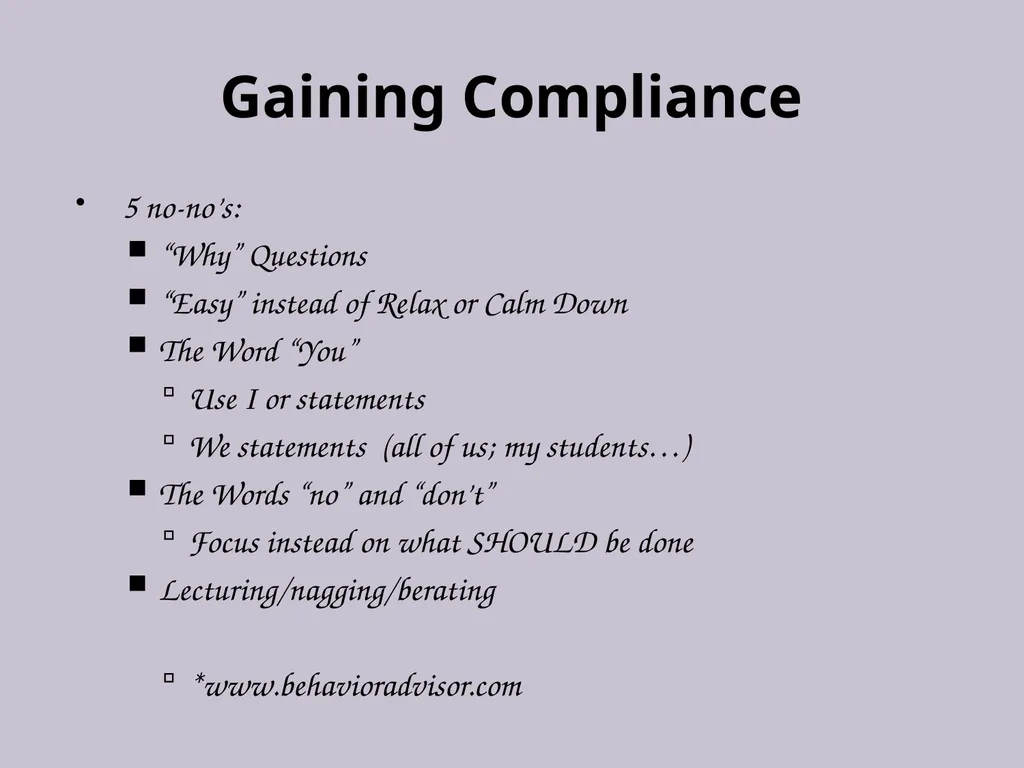
slide11. Gaining Compliance 5 no-no’s:
“Why” Questions
“Easy” instead of Relax or Calm Down
The Word “You”
Use I or statements
We statements (all of us; my students…)
The Words “no” and “don’t”
Focus instead on what SHOULD be done
Lecturing/nagging/berating
*www.behavioradvisor.com<br>
slide12. After An Aggressive Act: (After s/he has "cooled down")
DEBRIEF HIM/HER:
-"Why were you willing to: -hurt another?" -fight?"
-"What was your purpose in that situation?"
-"How else could you have attained that goal?"<br>
slide13. Monday Morning Quarterback -Where and when did it happen? -Who was present? -What event(s) preceded the action?
Interrupt the antecedent aftermath
Clicker?
-What behavioral signals did the youngster show before the outburst? -What actions were taken to prevent the crisis & were they effective? -What factors influenced/supported this behavior?<br>
slide14. Tools for Helping Behavior Problem Children Quick Techniques to Manage Anger:
The peace table
Goal: To build EMPATHY
Changes for older/younger kids
Opportunity for group interaction
Victim empathy?<br>
slide15. Tools for Helping Behavior Problem Children Quick Techniques to Build Empathy & Manage Anger
Actor/Observer
Ross (1977)/Jones (1967) “Fundamental Attribution Error”
Dispositional vs. Situational Attribution<br>
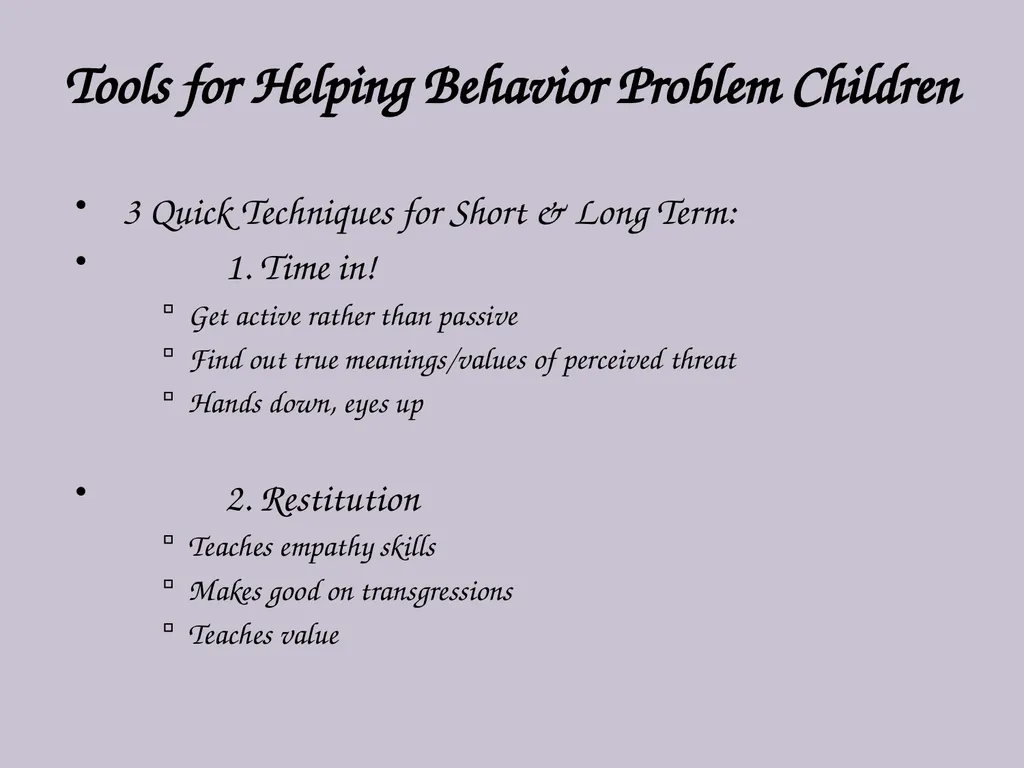
slide16. Tools for Helping Behavior Problem Children 3 Quick Techniques for Short & Long Term:
1. Time in!
Get active rather than passive
Find out true meanings/values of perceived threat
Hands down, eyes up
2. Restitution
Teaches empathy skills
Makes good on transgressions
Teaches value<br>
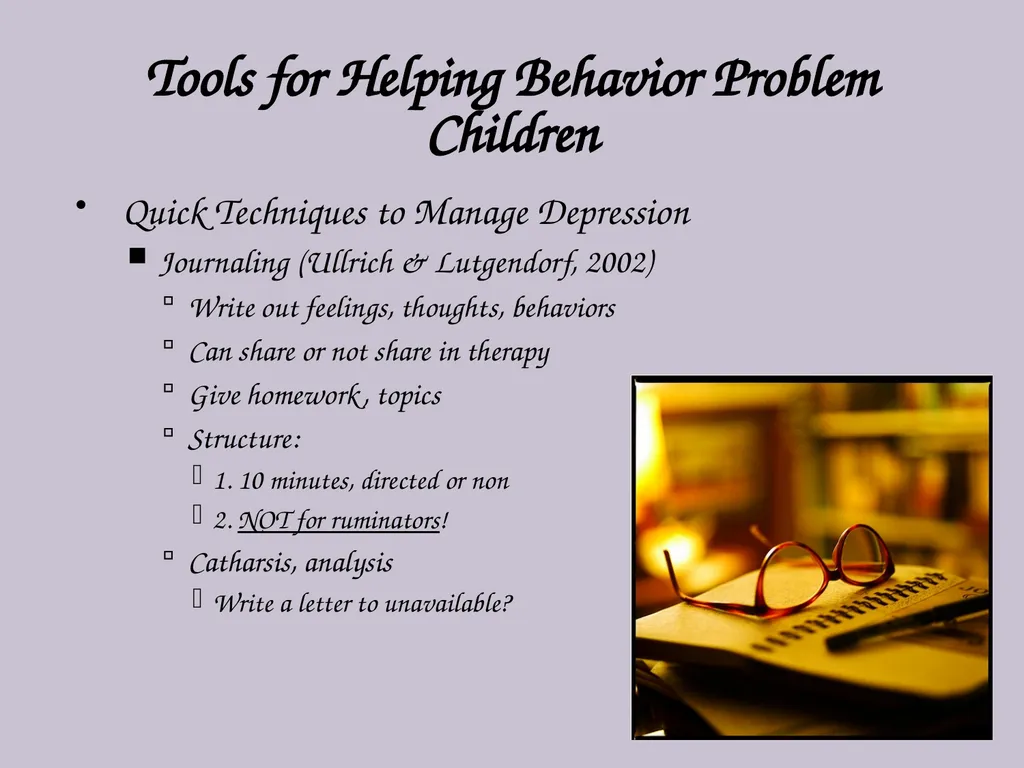
slide17. Tools for Helping Behavior Problem Children Quick Techniques to Manage Depression
Journaling (Ullrich & Lutgendorf, 2002)
Write out feelings, thoughts, behaviors
Can share or not share in therapy
Give homework, topics
Structure:
1. 10 minutes, directed or non
2. NOT for ruminators!
Catharsis, analysis
Write a letter to unavailable?<br>
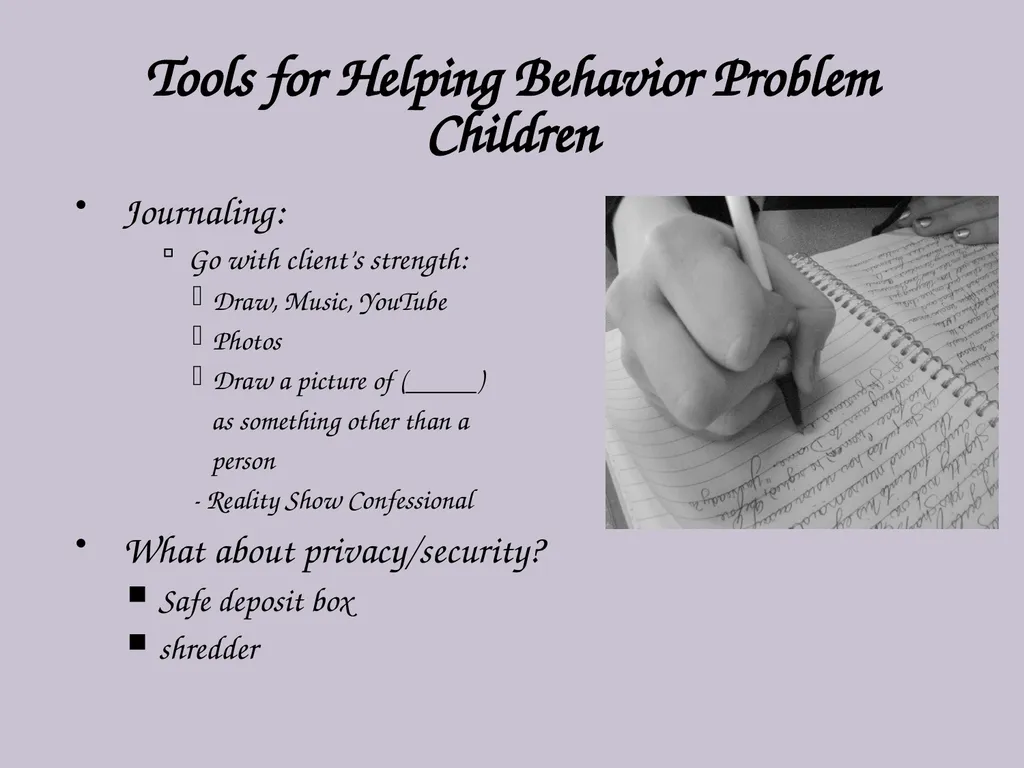
slide18. Tools for Helping Behavior Problem Children Journaling:
Go with client’s strength:
Draw, Music, YouTube
Photos
Draw a picture of (_____)
as something other than a
person
- Reality Show Confessional
What about privacy/security?
Safe deposit box
shredder<br>
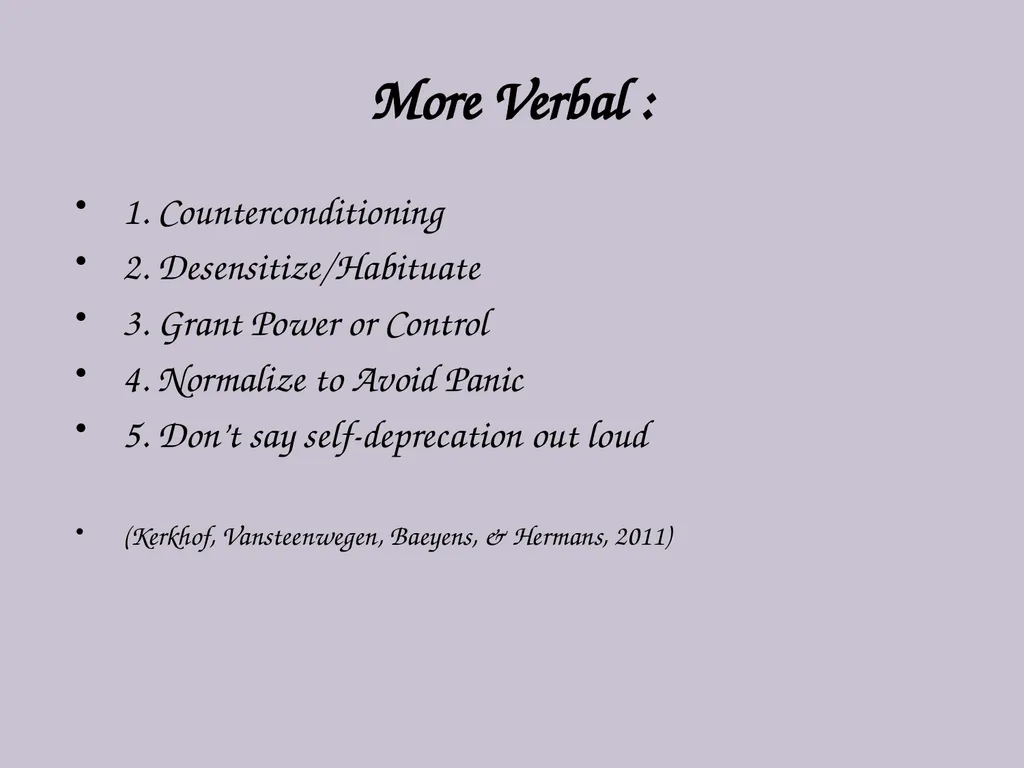
slide19. More Verbal : 1. Counterconditioning
2. Desensitize/Habituate
3. Grant Power or Control
4. Normalize to Avoid Panic
5. Don’t say self-deprecation out loud
(Kerkhof, Vansteenwegen, Baeyens, & Hermans, 2011)<br>
slide20. Tools for Helping Behavior Problem Children (Grief) Gestalt Techniques
Depersonalizing via second person
“Describe” rather than “Explain”
Locating the problem (non-verbal - visceral/physical)
Hi-light and emphasize to draw attention and create baseline
Progressive muscle or Parasympathetic response<br>
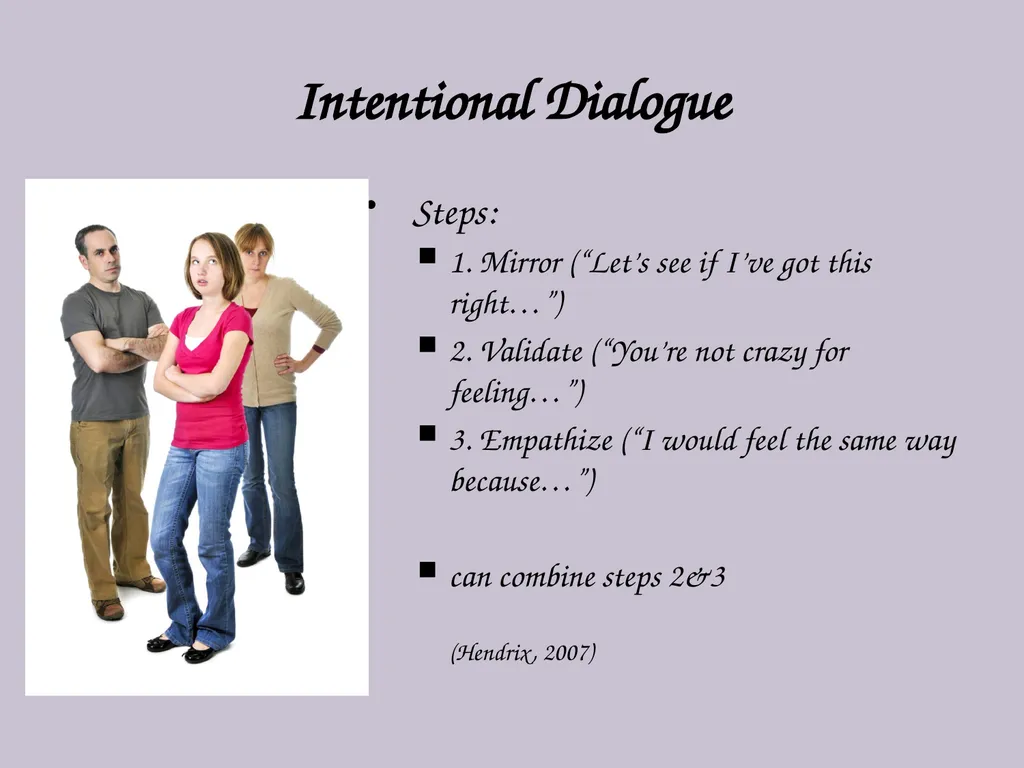
slide21. Intentional Dialogue Steps:
1. Mirror (“Let’s see if I’ve got this right…”)
2. Validate (“You’re not crazy for feeling…”)
3. Empathize (“I would feel the same way because…”)
can combine steps 2&3
(Hendrix, 2007)<br>
slide22. Adults in the Child’s World: Parents Concrete behavioral interventions in the home
The Listening Jar
Works with warning system
Listen on the first try, 2 nuggets
Second try, 1… Third try – none AND T/O
Progressively larger
Jars
Prizes<br>
slide23. Adults in the Child’s World: Teachers Immediate relief in the classroom
Set-up
Similar to parents (demonstrate (+) expectations, “Catch” them being good)
Greet at the door
Rules/Expectations posted & consulted
Use Teacher as Reinforcer!
Functionalize Behavior
“The Parent Trap”<br>
slide24. Limitations of Research and Potential Risks: 1. There is no “One Size Fits All” for any treatment modality
2. Please seek consultation or supervision if you experience unexpected difficulties when implementing strategies
3. Without appropriate training, use of interventions can pose risk of potential harm to clients<br>
slide25. References Bloomquist, M.L. (2006). Skills Training for Children with
Behavior Problems, Revised Edition: A Parent and
Practitioner Guidebook. Guilford Press: New York, NY.
Boyes, A. (2018). The Healthy Mind Toolkit: Simple Strategies to Get Out of Your Own Way and Enjoy Your Life. Perigee/Penguin: New York, NY.
,
Briesmeister, J.M. & Schaefer, C.E. (1997). Handbook of
Parent Training: Parents as Co-Therapists for
Children’s Behavior Problems. John Wiley & Sons, Inc.: New York, NY.
Doll, C., McLaughlin, T.F., & Barretto, A. (2013). The Token Ecoonomy: A recent review and evaluation. International Journal of Basics and Applied Science, 2(1),. 131-149.
Grandin, T., & Panek, R. (2013). The Autistoc Brain: Helping Different Kinds of Minds Succeed. First mariner Books/Houghin-Mifflin: New York, NY.
Haley, J. (1991). Problem-Solving Therapy (2nd ed.). Jossey-Bass, Inc.: san Francisco, CA.<br>
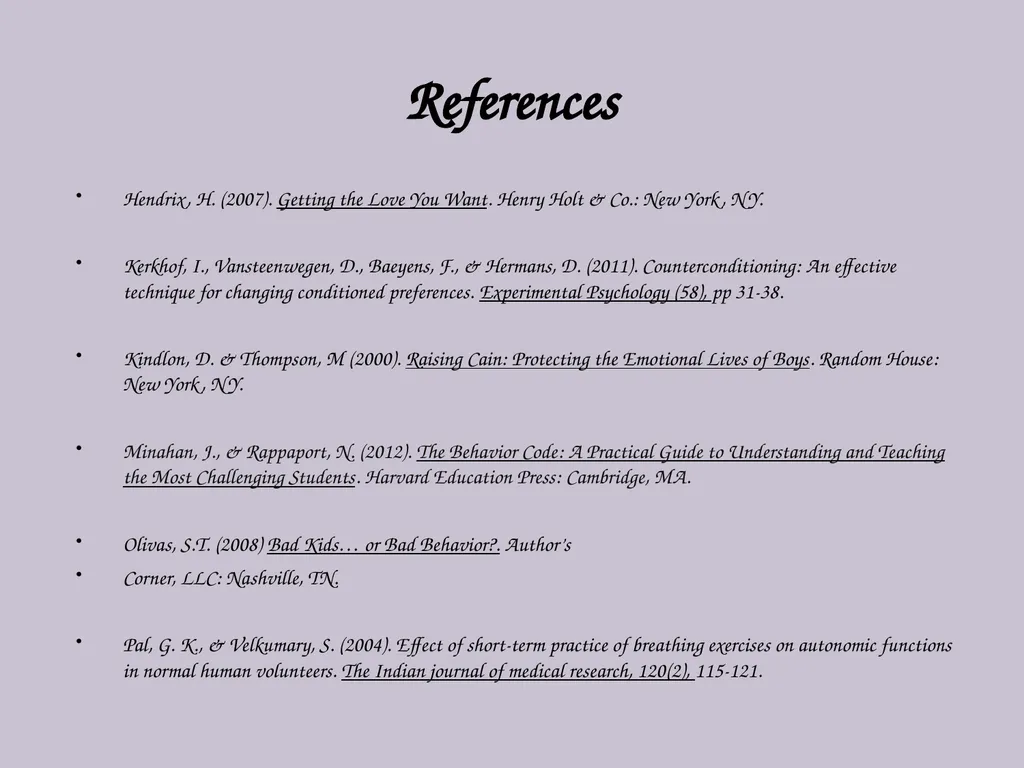
slide26. References Hendrix, H. (2007). Getting the Love You Want. Henry Holt & Co.: New York, NY.
Kerkhof, I., Vansteenwegen, D., Baeyens, F., & Hermans, D. (2011). Counterconditioning: An effective technique for changing conditioned preferences. Experimental Psychology (58), pp 31-38.
Kindlon, D. & Thompson, M (2000). Raising Cain: Protecting the Emotional Lives of Boys. Random House: New York, NY.
Minahan, J., & Rappaport, N. (2012). The Behavior Code: A Practical Guide to Understanding and Teaching the Most Challenging Students. Harvard Education Press: Cambridge, MA.
Olivas, S.T. (2008) Bad Kids… or Bad Behavior?. Author’s
Corner, LLC: Nashville, TN.
Pal, G. K., & Velkumary, S. (2004). Effect of short-term practice of breathing exercises on autonomic functions in normal human volunteers. The Indian journal of medical research, 120(2), 115-121.<br>
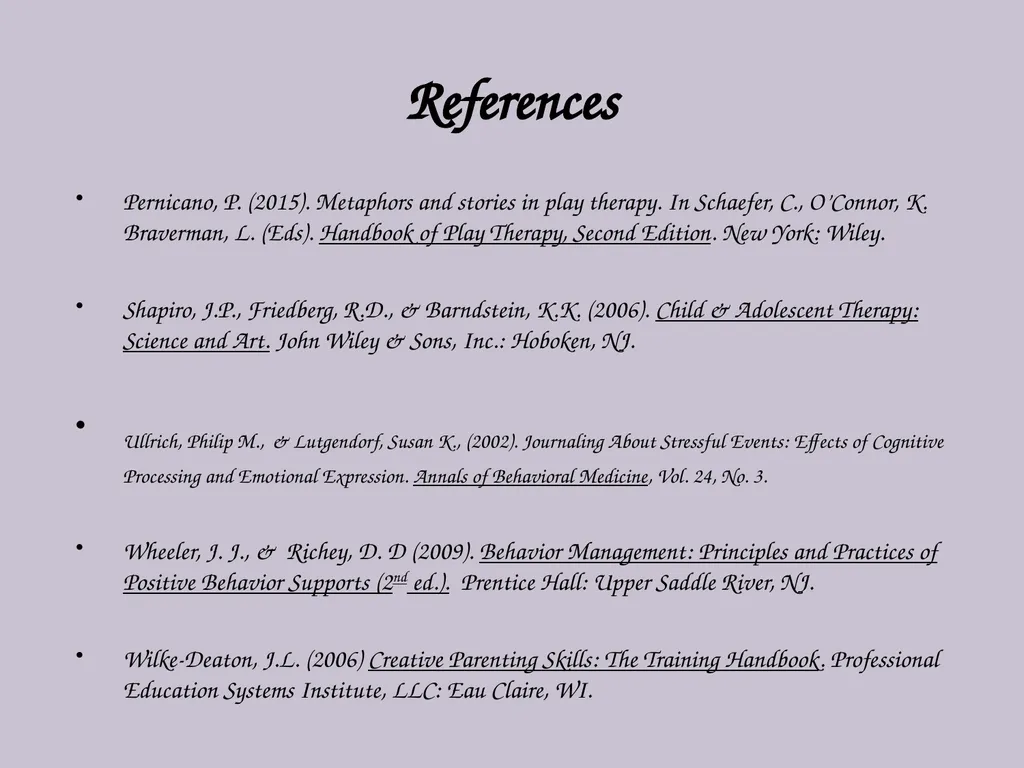
slide27. References Pernicano, P. (2015). Metaphors and stories in play therapy. In Schaefer, C., O’Connor, K. Braverman, L. (Eds). Handbook of Play Therapy, Second Edition. New York: Wiley.
Shapiro, J.P., Friedberg, R.D., & Barndstein, K.K. (2006). Child & Adolescent Therapy: Science and Art. John Wiley & Sons, Inc.: Hoboken, NJ.
Ullrich, Philip M., & Lutgendorf, Susan K., (2002). Journaling About Stressful Events: Effects of Cognitive Processing and Emotional Expression. Annals of Behavioral Medicine, Vol. 24, No. 3.
Wheeler, J. J., & Richey, D. D (2009). Behavior Management: Principles and Practices of Positive Behavior Supports (2nd ed.). Prentice Hall: Upper Saddle River, NJ.
Wilke-Deaton, J.L. (2006) Creative Parenting Skills: The Training Handbook. Professional Education Systems Institute, LLC: Eau Claire, WI.<br>
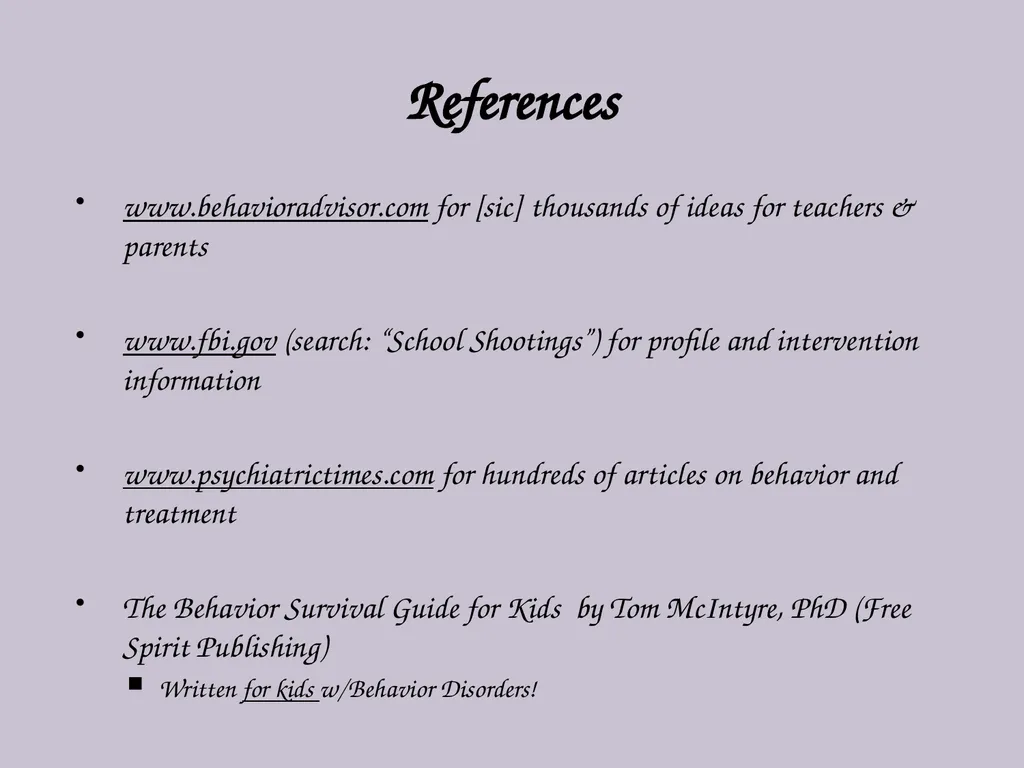
slide28. References www.behavioradvisor.com for [sic] thousands of ideas for teachers & parents
www.fbi.gov (search: “School Shootings”) for profile and intervention information
www.psychiatrictimes.com for hundreds of articles on behavior and treatment
The Behavior Survival Guide for Kids by Tom McIntyre, PhD (Free Spirit Publishing)
Written for kids w/Behavior Disorders!<br>
slide29. Contact for Future Consultations: Steve Olivas, PhD
6949 Charlotte Pike
Suite 203
Nashville, TN 37209
(615) 473-5909 (cell)
Web: www.doctorstevetherapy.com
Email : dr.steve.o@hotmail.com
Follow on Twitter:
@steveolivas<br>
Steven T. Olivas, PhD, HSP
Twitter: @steveolivas
Podcasts: “The Commute”; “Wrong & Wronger”
and “10 Minutes to Save Your Marriage”
On iTunes, Stitcher, SoundCloud, and iHeartRadio<br>
slide2. Dr. Steve Olivas Licensed Psychologist in Private Practice, Nashville, TN
M.S. From The University of Wisconsin – Whitewater
Dual Emphases:
Chemical Dependency Counseling
Marriage & Family Counseling
PhD, Counseling Psychology – The University of Oklahoma (1996)
Treating Children and Teens since 1990
Author, Bad Kids… or Bad Behavior? (2008)
and When Good Kids Go Bad (2012)<br>
slide3. Background Aristotle’s Perspective
Pavlov & Classical Conditioning
Thorndike’s “Law of Effect”
B.F. Skinner & Operant Conditioning
Reinforcement
Positive
Negative
Punishment
Positive
Negative<br>
slide4. Overview of Behavior Problems Etiology:
Nature vs. nurture
Genetics and brain physiology
Three levels of motivation (Hendrix, 2007):
Primal
Emotional
Behavioral<br>
slide5. Etiology: Hormonal Issues Testosterone (ADHD/Aggression/ODD)
Thyroid Hormone
Hyperthyroid (Anxiety or ADHD)
Hypothyroid (Depression)
Menarche/Estrogen-Progesterone (Bi-Polar)<br>
slide6. Etiology: Gender Gender differences
Neural development (normal children)
Coping mechanisms follow neural strengths/weaknesses
“The Boy Code” (from Raising Cain by Dan Kindlon & Michael Thompson)<br>
slide7. DSM-V Associated Diagnoses Oppositional Defiant Disorder (ODD)
Often loses temper
Argues with adults
Deliberately annoys others
Is touchy or easily annoyed
Is angry, resentful, spiteful, or vindictive
Blames others for his or her misbehaviors
Often actively defies or refuses to comply with rules or requests
Modulate Eye Contact
Grant Power or Control
Escalation Recreates Trauma<br>
slide8. Anger toward Compliments: -Avoid using positive labels (e.g., "You're so smart.", "You're a good boy.") because they will be rejected by a youngster who sees them as being incorrect (given his/her life experience).
FOCUS ON (+) BEHAVIOR -"Thanks for holding the door for us. That was a kind gesture on your part.“
-Prepare the child for your positive feedback
-Note writing<br>
slide9. Tools for Helping Behavior Problem Children Quick Techniques to Manage Anger:
Thermometer/Two
Thermometers
Visualization
Gives a common language to speak about “Anger”
Makes abstract concept concrete
Helps with goal-setting, progress
Wicks on firecracker/bomb?<br>
slide10. Tools for Helping Behavior Problem Children Quick Techniques to Manage Anger
Standing 8 count (Minahan & Rappaport, 2012)
Simple, tested technique
“Thinking” part of the brain comes back and pushes out the “Emotional” part of the brain
How this process works – “It doesn’t matter” (build broader structure)
Cooling off Period<br>
slide11. Gaining Compliance 5 no-no’s:
“Why” Questions
“Easy” instead of Relax or Calm Down
The Word “You”
Use I or statements
We statements (all of us; my students…)
The Words “no” and “don’t”
Focus instead on what SHOULD be done
Lecturing/nagging/berating
*www.behavioradvisor.com<br>
slide12. After An Aggressive Act: (After s/he has "cooled down")
DEBRIEF HIM/HER:
-"Why were you willing to: -hurt another?" -fight?"
-"What was your purpose in that situation?"
-"How else could you have attained that goal?"<br>
slide13. Monday Morning Quarterback -Where and when did it happen? -Who was present? -What event(s) preceded the action?
Interrupt the antecedent aftermath
Clicker?
-What behavioral signals did the youngster show before the outburst? -What actions were taken to prevent the crisis & were they effective? -What factors influenced/supported this behavior?<br>
slide14. Tools for Helping Behavior Problem Children Quick Techniques to Manage Anger:
The peace table
Goal: To build EMPATHY
Changes for older/younger kids
Opportunity for group interaction
Victim empathy?<br>
slide15. Tools for Helping Behavior Problem Children Quick Techniques to Build Empathy & Manage Anger
Actor/Observer
Ross (1977)/Jones (1967) “Fundamental Attribution Error”
Dispositional vs. Situational Attribution<br>
slide16. Tools for Helping Behavior Problem Children 3 Quick Techniques for Short & Long Term:
1. Time in!
Get active rather than passive
Find out true meanings/values of perceived threat
Hands down, eyes up
2. Restitution
Teaches empathy skills
Makes good on transgressions
Teaches value<br>
slide17. Tools for Helping Behavior Problem Children Quick Techniques to Manage Depression
Journaling (Ullrich & Lutgendorf, 2002)
Write out feelings, thoughts, behaviors
Can share or not share in therapy
Give homework, topics
Structure:
1. 10 minutes, directed or non
2. NOT for ruminators!
Catharsis, analysis
Write a letter to unavailable?<br>
slide18. Tools for Helping Behavior Problem Children Journaling:
Go with client’s strength:
Draw, Music, YouTube
Photos
Draw a picture of (_____)
as something other than a
person
- Reality Show Confessional
What about privacy/security?
Safe deposit box
shredder<br>
slide19. More Verbal : 1. Counterconditioning
2. Desensitize/Habituate
3. Grant Power or Control
4. Normalize to Avoid Panic
5. Don’t say self-deprecation out loud
(Kerkhof, Vansteenwegen, Baeyens, & Hermans, 2011)<br>
slide20. Tools for Helping Behavior Problem Children (Grief) Gestalt Techniques
Depersonalizing via second person
“Describe” rather than “Explain”
Locating the problem (non-verbal - visceral/physical)
Hi-light and emphasize to draw attention and create baseline
Progressive muscle or Parasympathetic response<br>
slide21. Intentional Dialogue Steps:
1. Mirror (“Let’s see if I’ve got this right…”)
2. Validate (“You’re not crazy for feeling…”)
3. Empathize (“I would feel the same way because…”)
can combine steps 2&3
(Hendrix, 2007)<br>
slide22. Adults in the Child’s World: Parents Concrete behavioral interventions in the home
The Listening Jar
Works with warning system
Listen on the first try, 2 nuggets
Second try, 1… Third try – none AND T/O
Progressively larger
Jars
Prizes<br>
slide23. Adults in the Child’s World: Teachers Immediate relief in the classroom
Set-up
Similar to parents (demonstrate (+) expectations, “Catch” them being good)
Greet at the door
Rules/Expectations posted & consulted
Use Teacher as Reinforcer!
Functionalize Behavior
“The Parent Trap”<br>
slide24. Limitations of Research and Potential Risks: 1. There is no “One Size Fits All” for any treatment modality
2. Please seek consultation or supervision if you experience unexpected difficulties when implementing strategies
3. Without appropriate training, use of interventions can pose risk of potential harm to clients<br>
slide25. References Bloomquist, M.L. (2006). Skills Training for Children with
Behavior Problems, Revised Edition: A Parent and
Practitioner Guidebook. Guilford Press: New York, NY.
Boyes, A. (2018). The Healthy Mind Toolkit: Simple Strategies to Get Out of Your Own Way and Enjoy Your Life. Perigee/Penguin: New York, NY.
,
Briesmeister, J.M. & Schaefer, C.E. (1997). Handbook of
Parent Training: Parents as Co-Therapists for
Children’s Behavior Problems. John Wiley & Sons, Inc.: New York, NY.
Doll, C., McLaughlin, T.F., & Barretto, A. (2013). The Token Ecoonomy: A recent review and evaluation. International Journal of Basics and Applied Science, 2(1),. 131-149.
Grandin, T., & Panek, R. (2013). The Autistoc Brain: Helping Different Kinds of Minds Succeed. First mariner Books/Houghin-Mifflin: New York, NY.
Haley, J. (1991). Problem-Solving Therapy (2nd ed.). Jossey-Bass, Inc.: san Francisco, CA.<br>
slide26. References Hendrix, H. (2007). Getting the Love You Want. Henry Holt & Co.: New York, NY.
Kerkhof, I., Vansteenwegen, D., Baeyens, F., & Hermans, D. (2011). Counterconditioning: An effective technique for changing conditioned preferences. Experimental Psychology (58), pp 31-38.
Kindlon, D. & Thompson, M (2000). Raising Cain: Protecting the Emotional Lives of Boys. Random House: New York, NY.
Minahan, J., & Rappaport, N. (2012). The Behavior Code: A Practical Guide to Understanding and Teaching the Most Challenging Students. Harvard Education Press: Cambridge, MA.
Olivas, S.T. (2008) Bad Kids… or Bad Behavior?. Author’s
Corner, LLC: Nashville, TN.
Pal, G. K., & Velkumary, S. (2004). Effect of short-term practice of breathing exercises on autonomic functions in normal human volunteers. The Indian journal of medical research, 120(2), 115-121.<br>
slide27. References Pernicano, P. (2015). Metaphors and stories in play therapy. In Schaefer, C., O’Connor, K. Braverman, L. (Eds). Handbook of Play Therapy, Second Edition. New York: Wiley.
Shapiro, J.P., Friedberg, R.D., & Barndstein, K.K. (2006). Child & Adolescent Therapy: Science and Art. John Wiley & Sons, Inc.: Hoboken, NJ.
Ullrich, Philip M., & Lutgendorf, Susan K., (2002). Journaling About Stressful Events: Effects of Cognitive Processing and Emotional Expression. Annals of Behavioral Medicine, Vol. 24, No. 3.
Wheeler, J. J., & Richey, D. D (2009). Behavior Management: Principles and Practices of Positive Behavior Supports (2nd ed.). Prentice Hall: Upper Saddle River, NJ.
Wilke-Deaton, J.L. (2006) Creative Parenting Skills: The Training Handbook. Professional Education Systems Institute, LLC: Eau Claire, WI.<br>
slide28. References www.behavioradvisor.com for [sic] thousands of ideas for teachers & parents
www.fbi.gov (search: “School Shootings”) for profile and intervention information
www.psychiatrictimes.com for hundreds of articles on behavior and treatment
The Behavior Survival Guide for Kids by Tom McIntyre, PhD (Free Spirit Publishing)
Written for kids w/Behavior Disorders!<br>
slide29. Contact for Future Consultations: Steve Olivas, PhD
6949 Charlotte Pike
Suite 203
Nashville, TN 37209
(615) 473-5909 (cell)
Web: www.doctorstevetherapy.com
Email : dr.steve.o@hotmail.com
Follow on Twitter:
@steveolivas<br>