
Review of BAS Learning progression Item design



Description: Review of BAS Learning progression Item design OutcomesScoring Assessment quality Outline Overview of BEAR Assessment System A comprehensive, integrated system for assessing, interpreting, and monitoring student performance Tools for
Related Topics
Download Presentation
"Review of BAS Learning progression Item design" is the property of its rightful owner. Permission is granted to download and print the materials on this website for personal, non-commercial use only, and to display it on your personal computer provided you do not modify the materials and that you retain all copyright notices contained in the materials. By downloading content from our website, you accept the terms of this agreement.
Presentation Transcript
slide1. Review of BAS
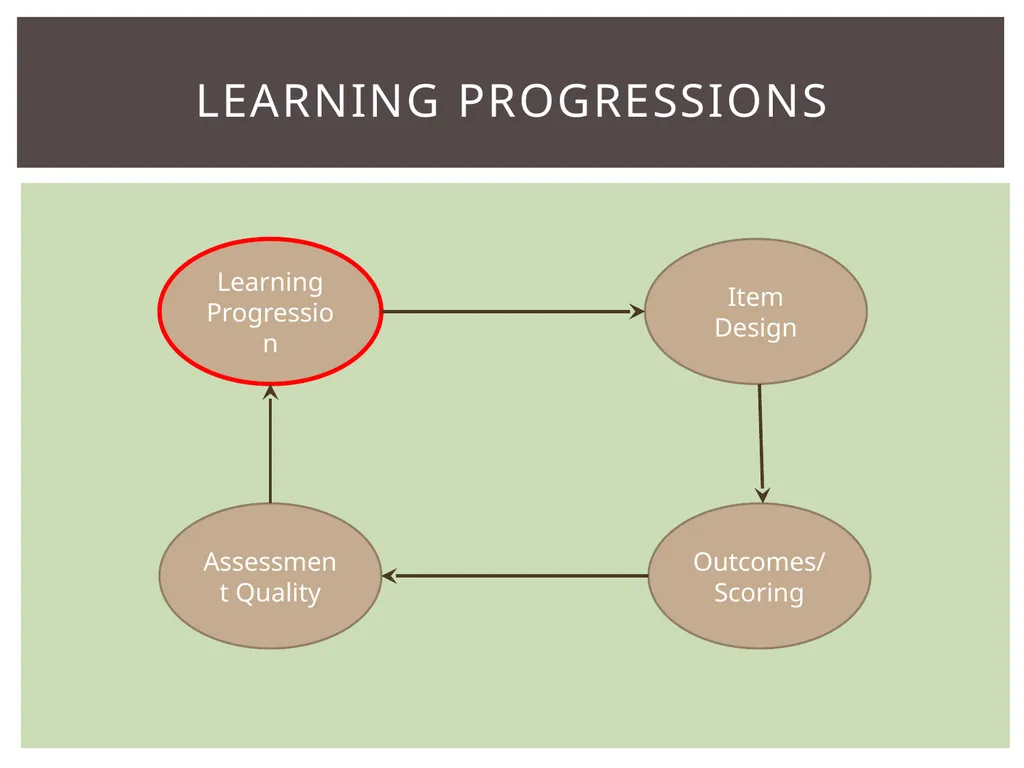
Learning progression
Item design
Outcomes/Scoring
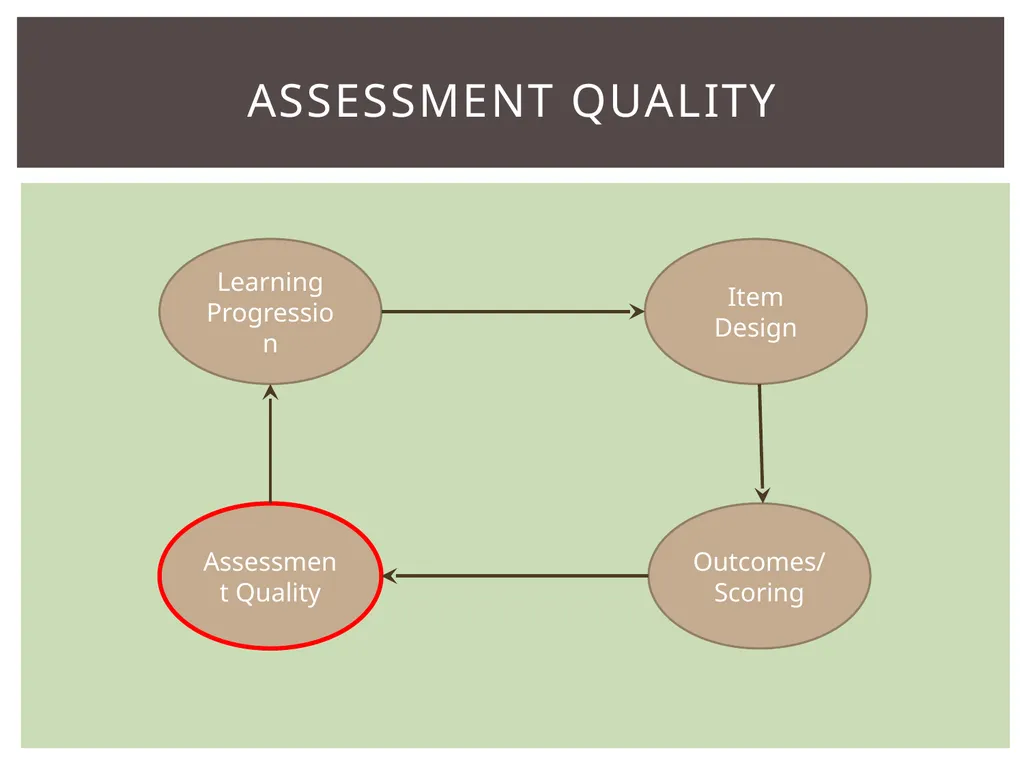
Assessment quality
Outline Overview of BEAR Assessment System<br>
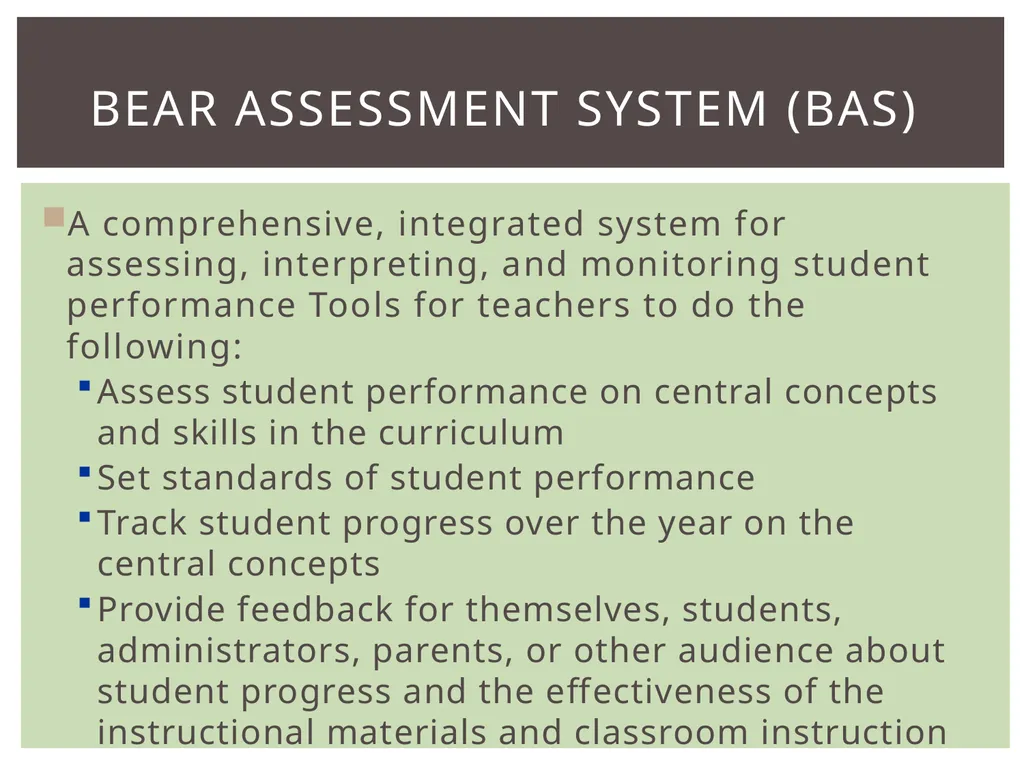
slide2. A comprehensive, integrated system for assessing, interpreting, and monitoring student performance Tools for teachers to do the following:
Assess student performance on central concepts and skills in the curriculum
Set standards of student performance
Track student progress over the year on the central concepts
Provide feedback for themselves, students, administrators, parents, or other audience about student progress and the effectiveness of the instructional materials and classroom instruction BEAR Assessment system (BAS)<br>
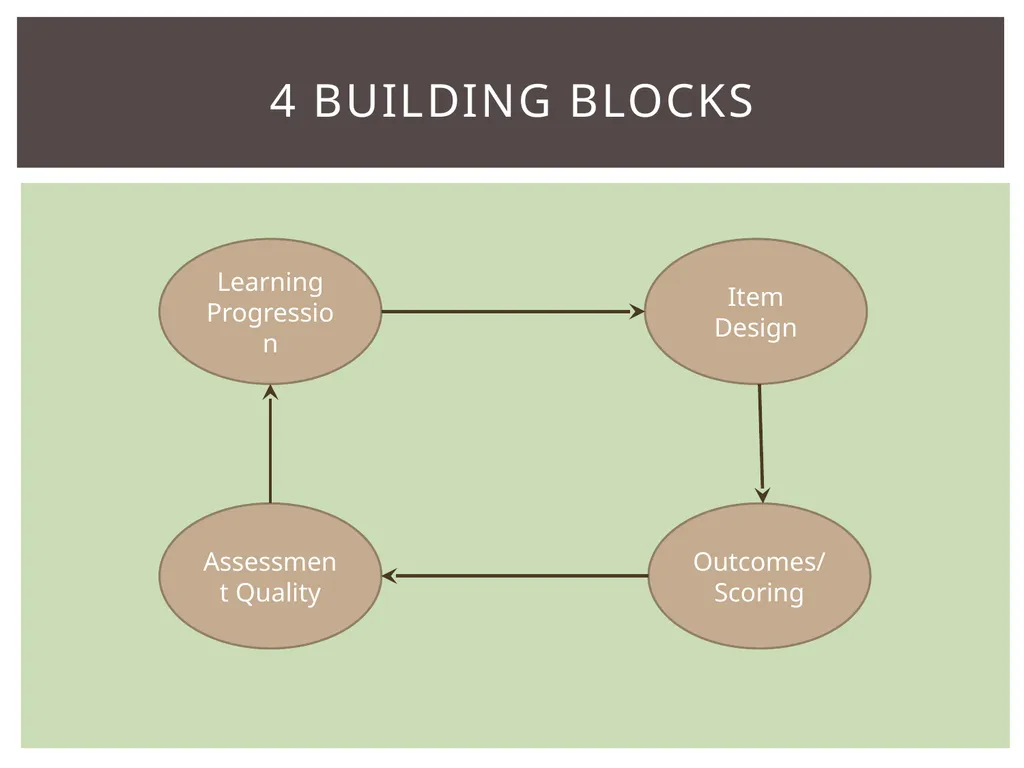
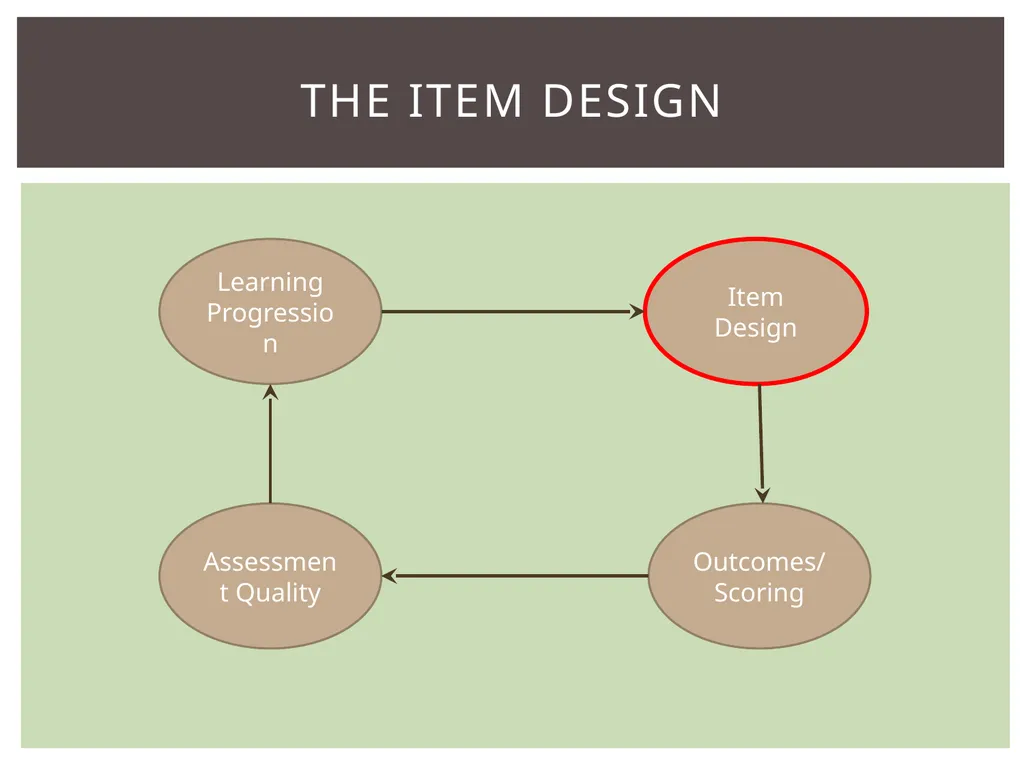
slide3. 4 building blocks Learning Progression Item Design Outcomes/Scoring Assessment Quality<br>
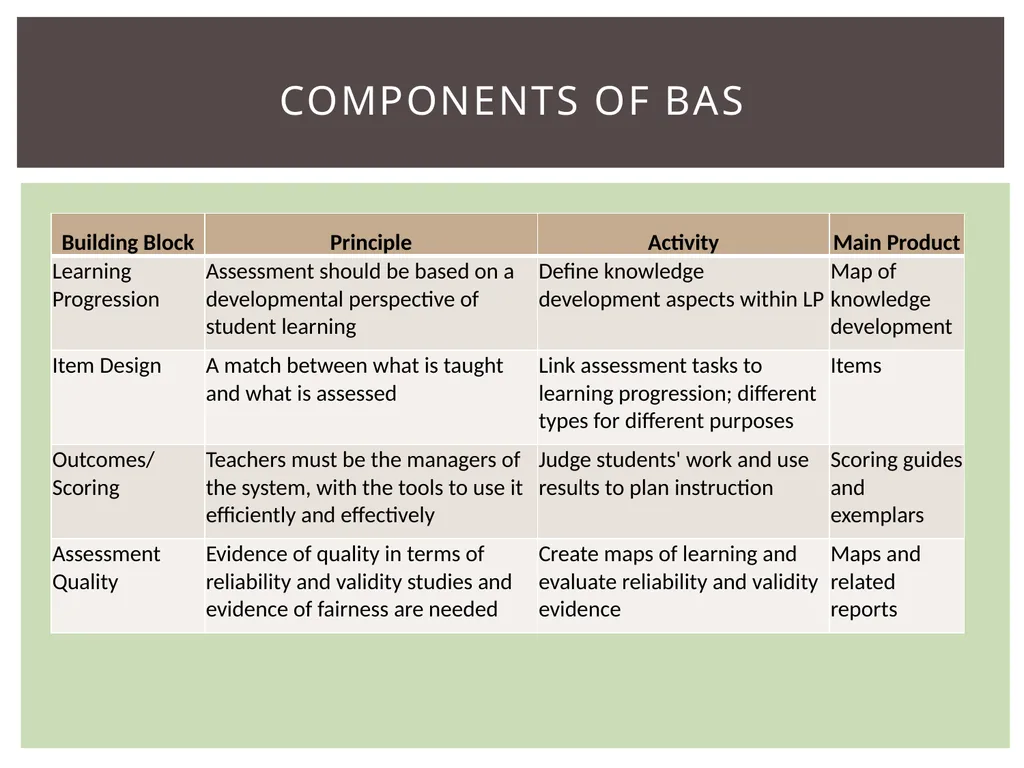
slide4. Components of bas<br>
slide5. Provides information about students’ progress “just in time” to reteach or expand when necessary
Allows diagnosis of individual students who are having difficulty or who are ready for more in-depth material
Provides deeper understanding of where students really are – for example, do they understand conceptually, or have they simply learned a set of steps?
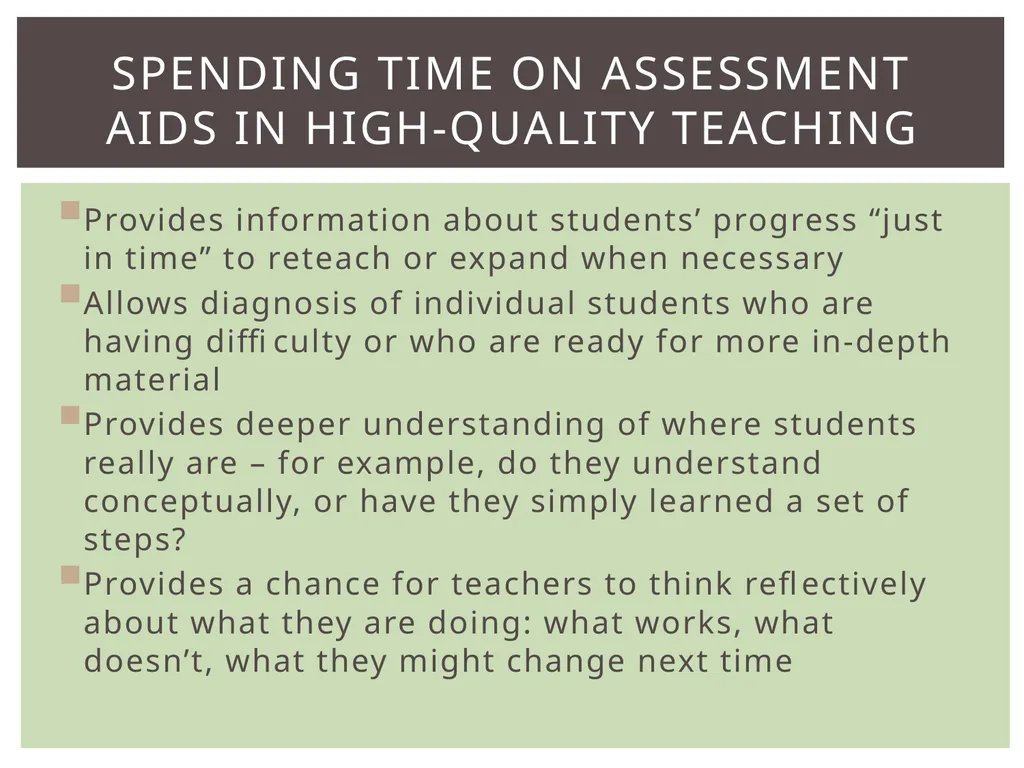
Provides a chance for teachers to think reflectively about what they are doing: what works, what doesn’t, what they might change next time Spending time on assessment aids in high-quality teaching<br>
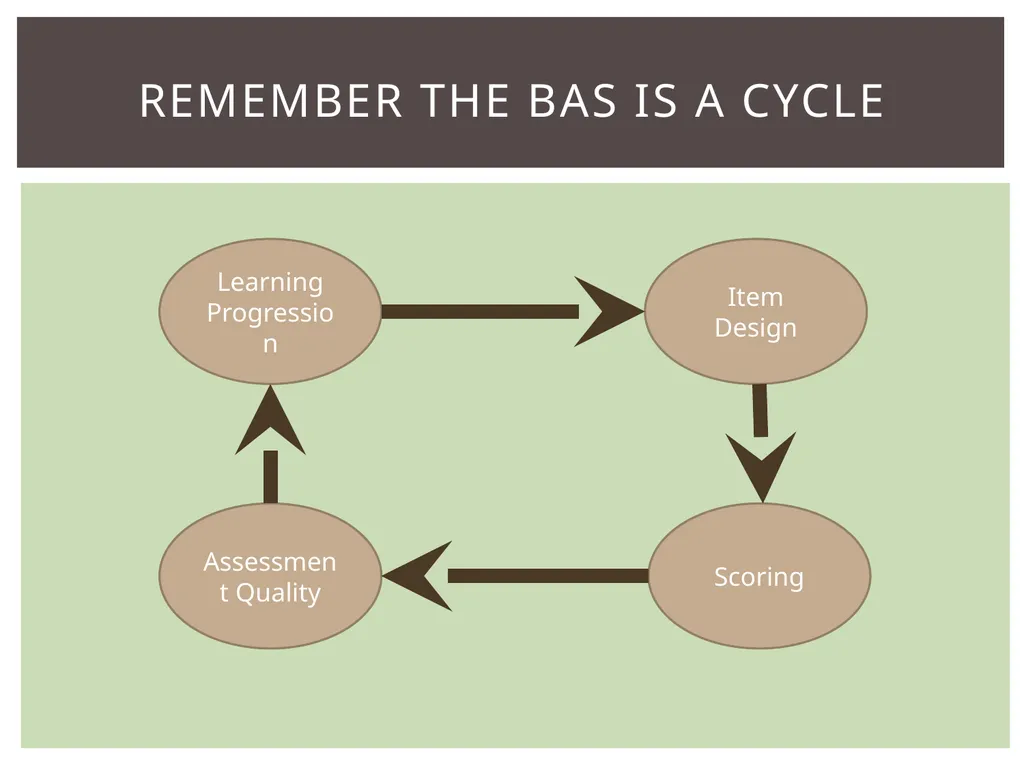
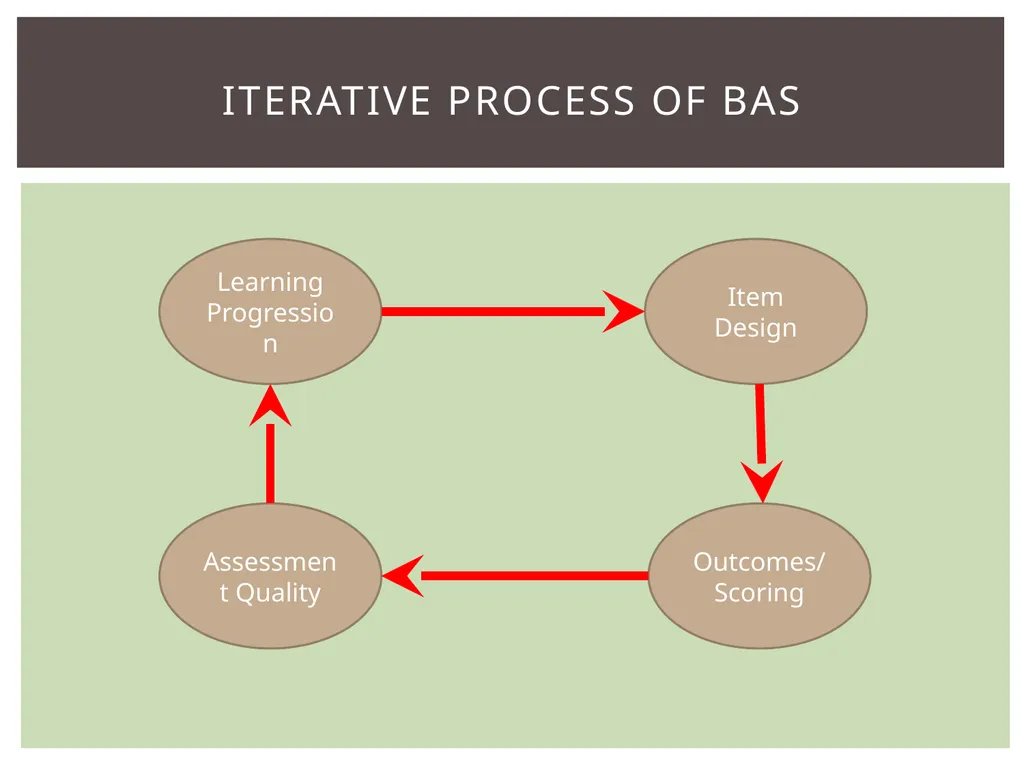
slide6. Remember the BAS is a cycle Learning Progression Item Design Scoring Assessment Quality<br>
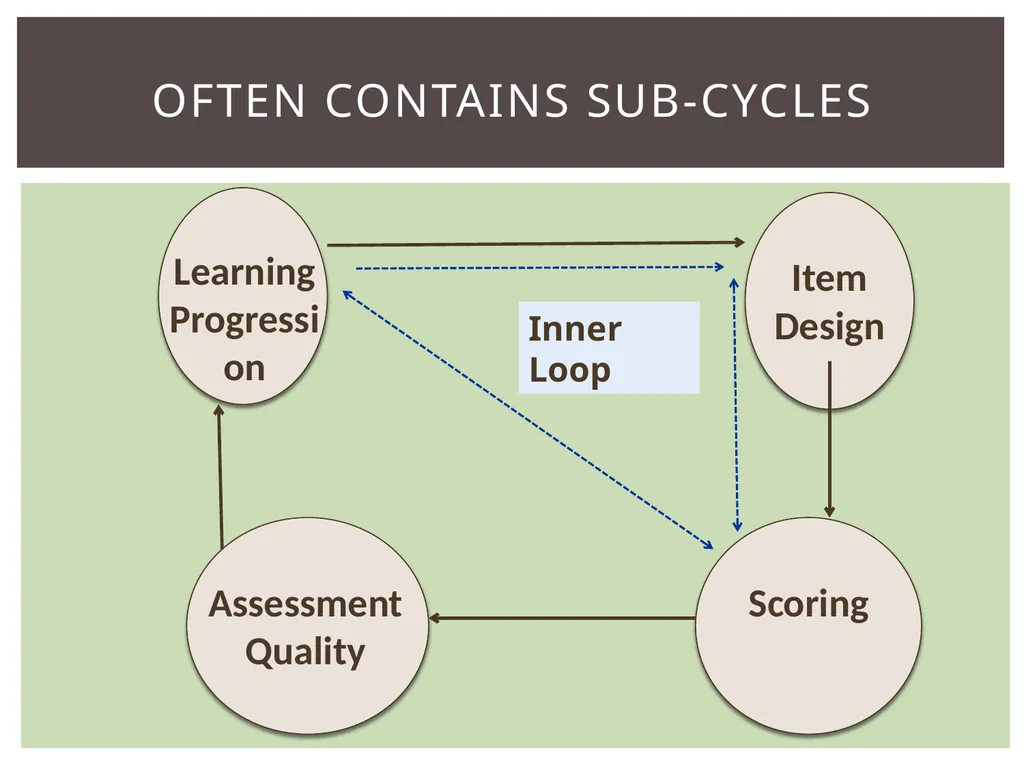
slide7. Often contains sub-cycles<br>
slide8. Reasons for the cyclical nature Begins with theory-based ideas for LP levels, item design, order, and so on
Makes extensive use of empirical evidence to improve on theory and relate to actual practice
Draws heavily on ideas of validity evidence and the improvement of validity (i.e. response processes, internal structure, etc.)<br>
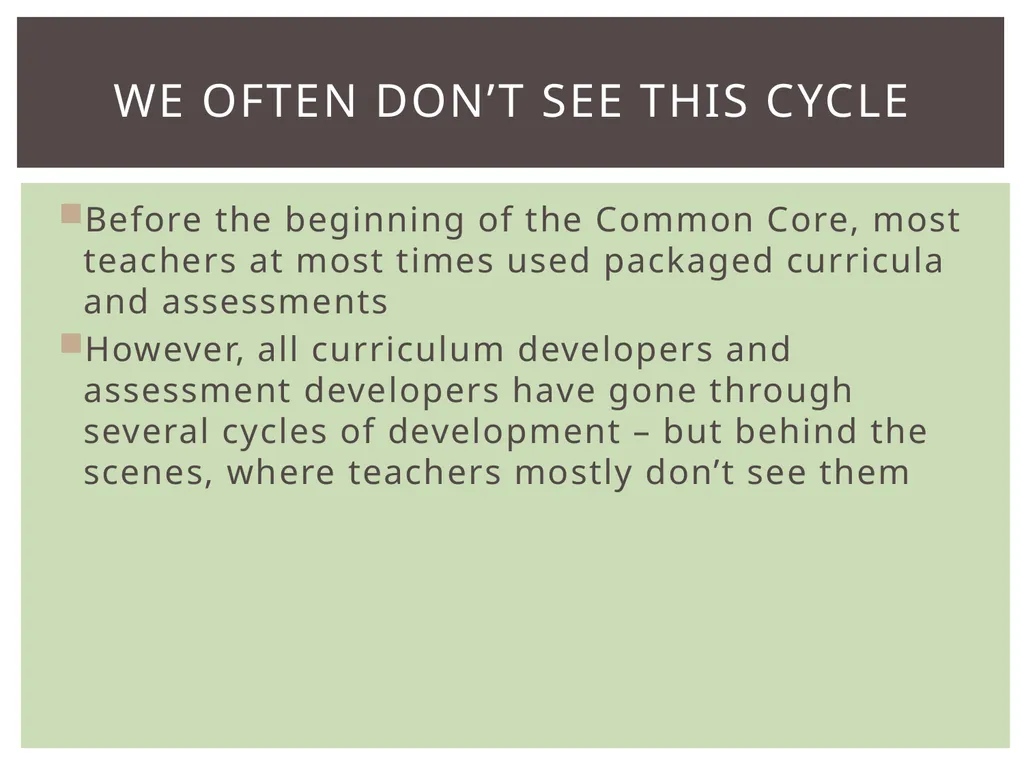
slide9. We often don’t see this cycle Before the beginning of the Common Core, most teachers at most times used packaged curricula and assessments
However, all curriculum developers and assessment developers have gone through several cycles of development – but behind the scenes, where teachers mostly don’t see them<br>
slide10. Learning Progressions Learning Progression Item Design Outcomes/Scoring Assessment Quality<br>
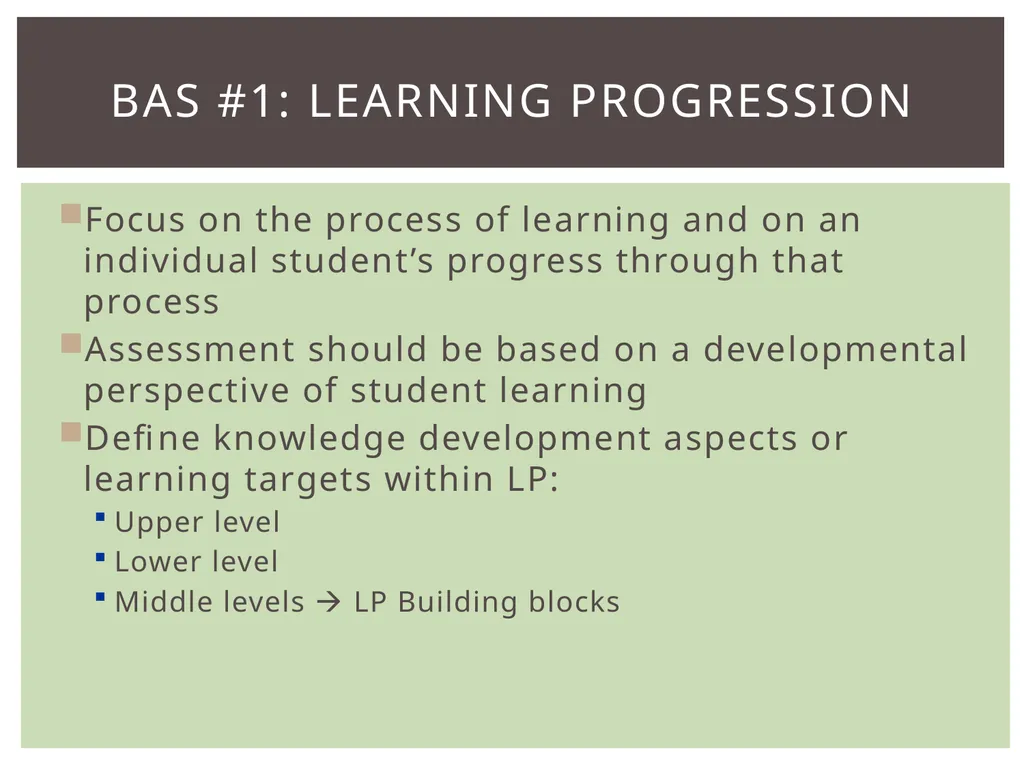
slide11. Focus on the process of learning and on an individual student’s progress through that process
Assessment should be based on a developmental perspective of student learning
Define knowledge development aspects or learning targets within LP:
Upper level
Lower level
Middle levels LP Building blocks BAS #1: Learning Progression<br>
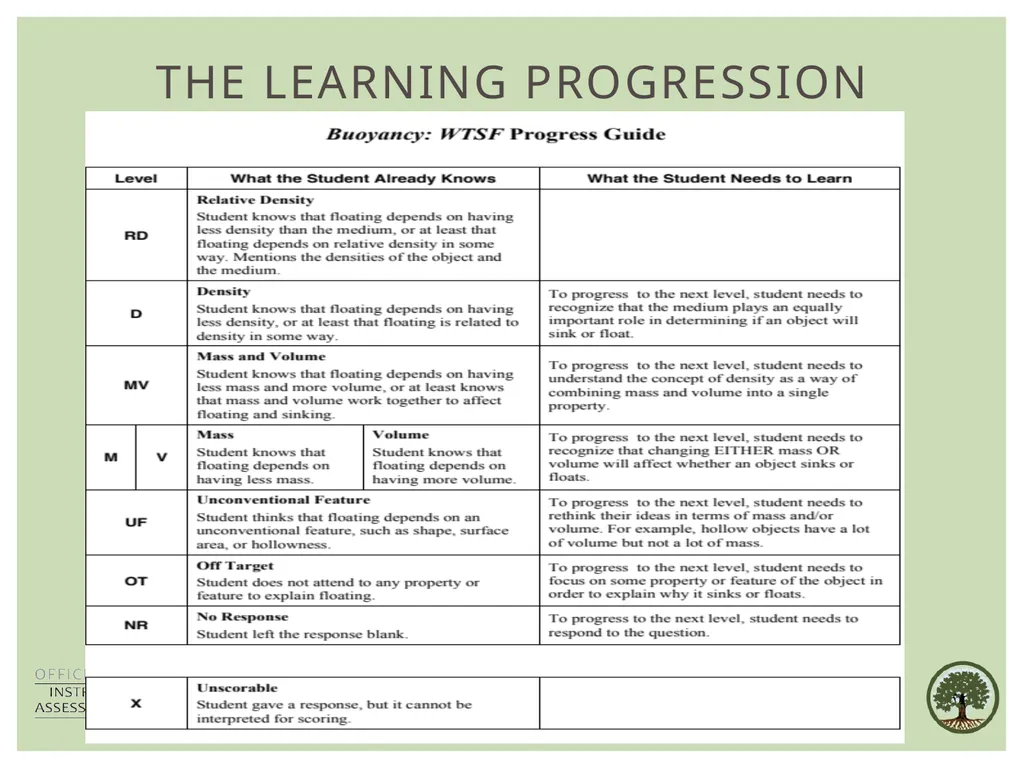
slide12. Example based on measurement of student understanding of density and buoyancy
Accompanied a curriculum called “Why Things Sink and Float”
Science unit designed for middle school classrooms An example learning progression<br>
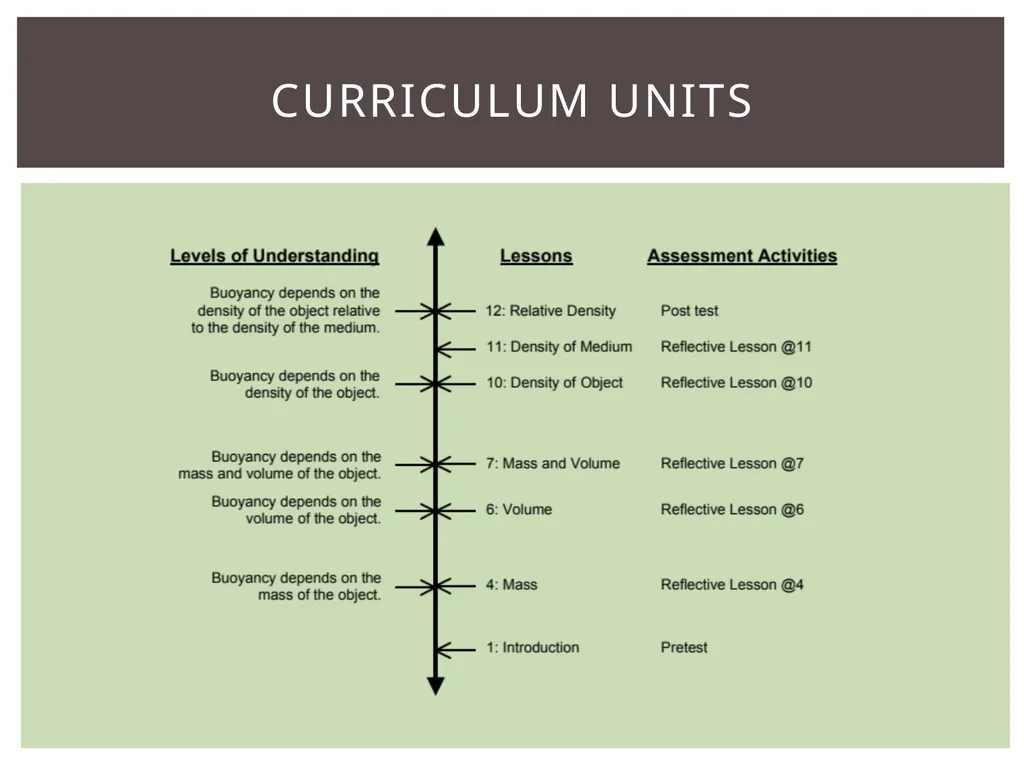
slide13. Curriculum units<br>
slide14. The learning progression<br>
slide15. The item design Learning Progression Item Design Outcomes/Scoring Assessment Quality<br>
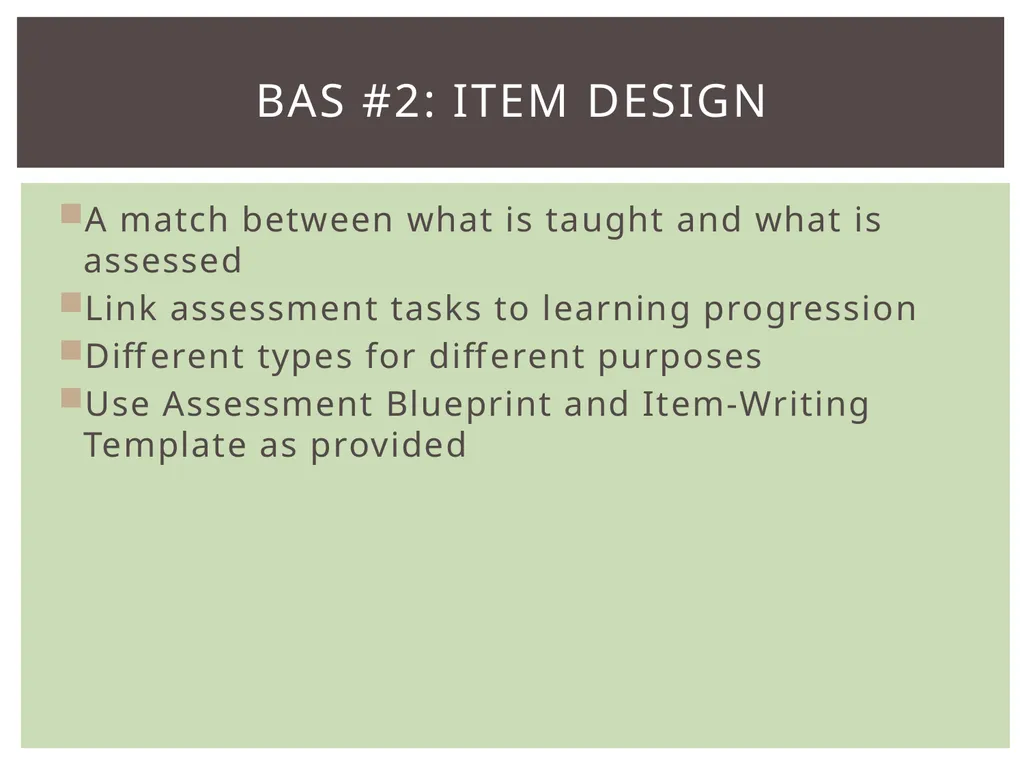
slide16. A match between what is taught and what is assessed
Link assessment tasks to learning progression
Different types for different purposes
Use Assessment Blueprint and Item-Writing Template as provided BAS #2: Item Design<br>
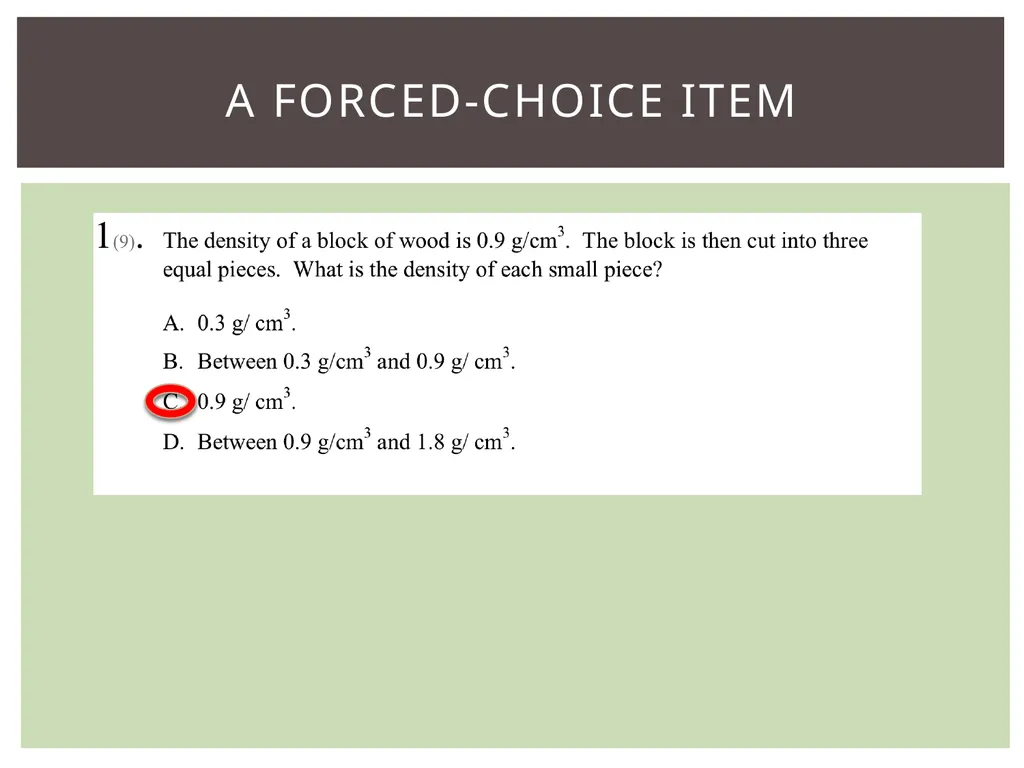
slide17. A forced-choice item<br>
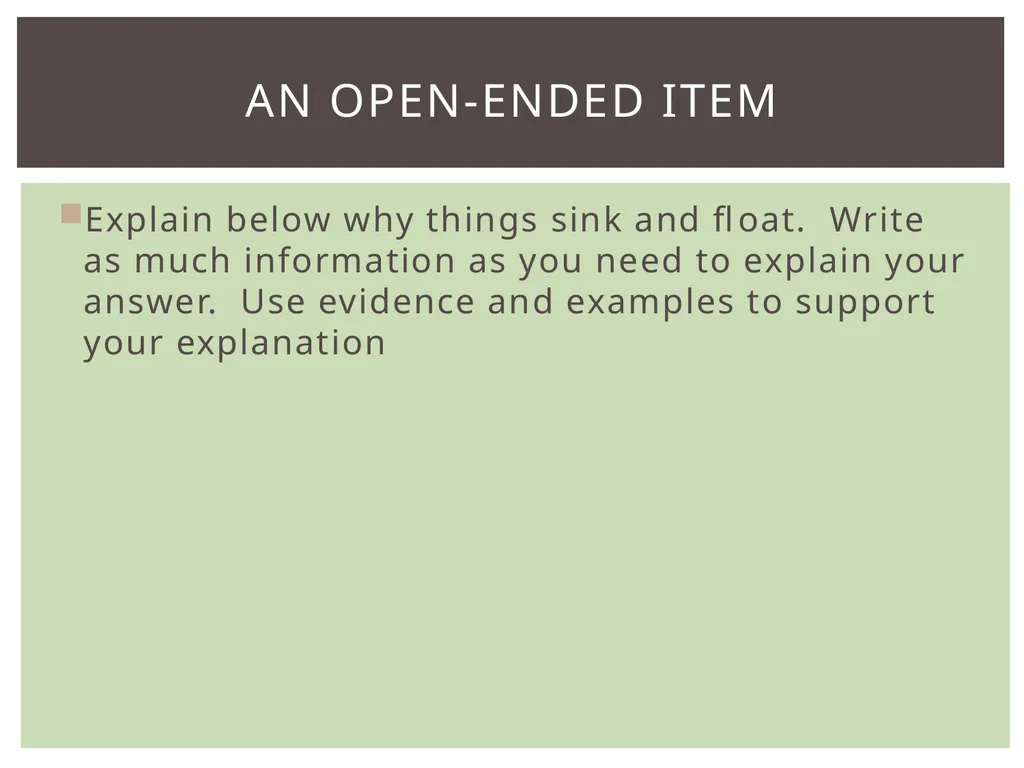
slide18. Explain below why things sink and float. Write as much information as you need to explain your answer. Use evidence and examples to support your explanation An Open-ended item<br>
slide19. What is the most important reason why things sink and float? An ordered multiple choice item<br>
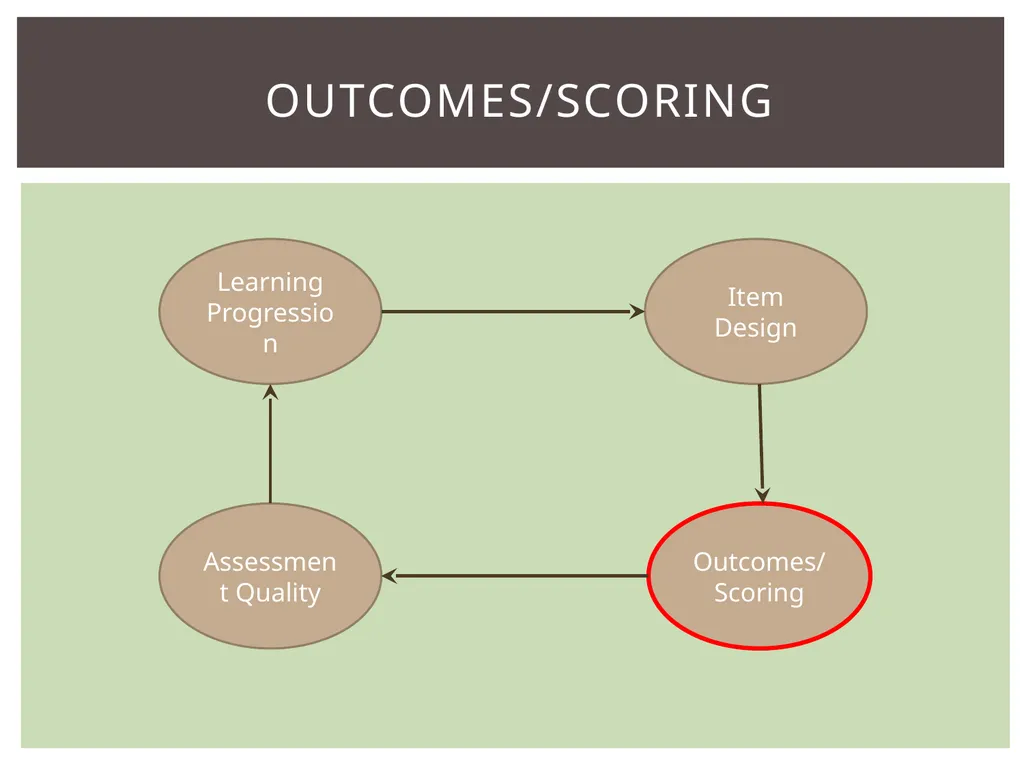
slide20. outcomES/Scoring Learning Progression Item Design Outcomes/Scoring Assessment Quality<br>
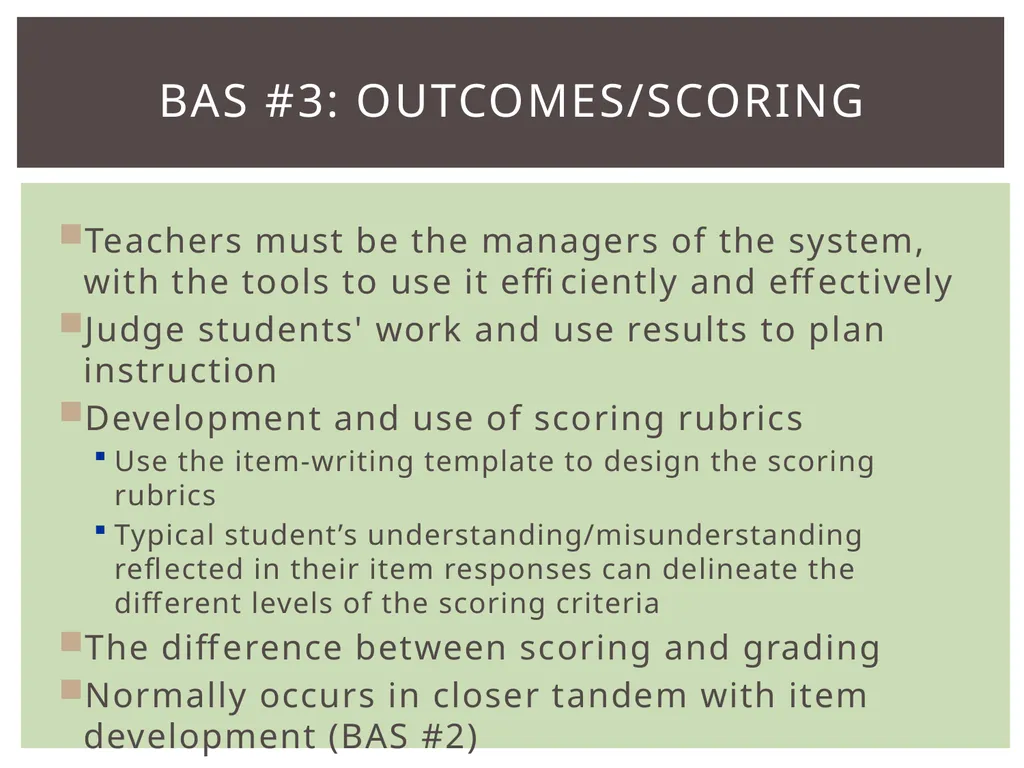
slide21. Teachers must be the managers of the system, with the tools to use it efficiently and effectively
Judge students' work and use results to plan instruction
Development and use of scoring rubrics
Use the item-writing template to design the scoring rubrics
Typical student’s understanding/misunderstanding reflected in their item responses can delineate the different levels of the scoring criteria
The difference between scoring and grading
Normally occurs in closer tandem with item development (BAS #2) BAS #3: Outcomes/Scoring<br>
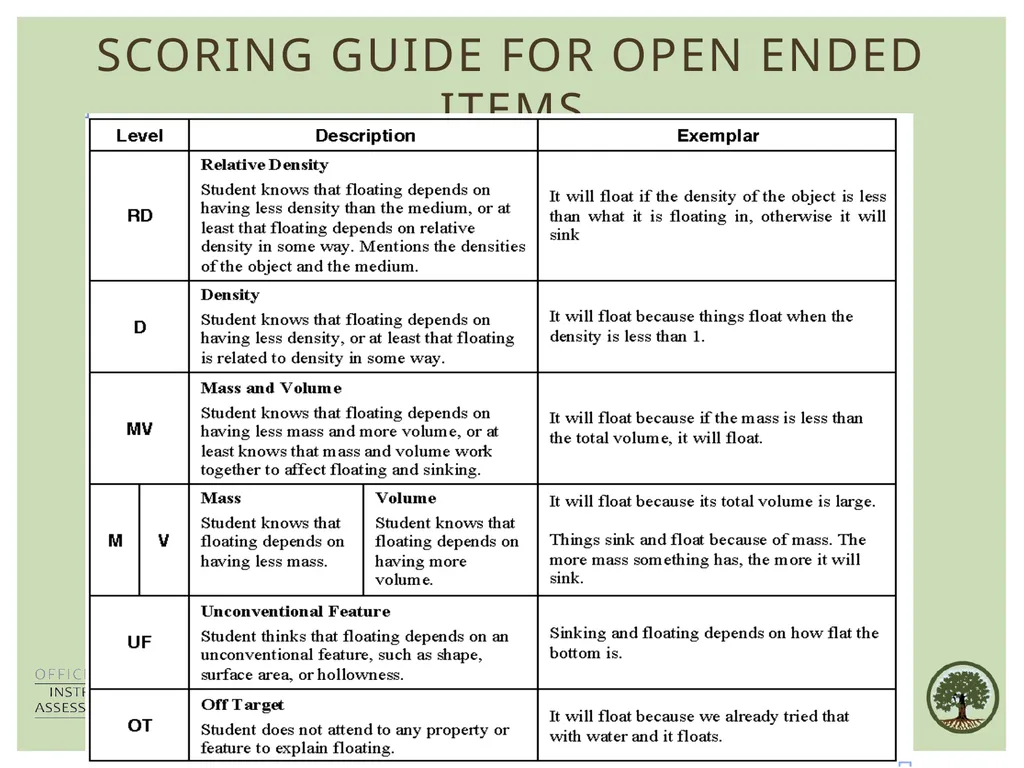
slide22. Scoring Guide for open ended items<br>
slide23. Assessment quality Learning Progression Item Design Outcomes/Scoring Assessment Quality<br>
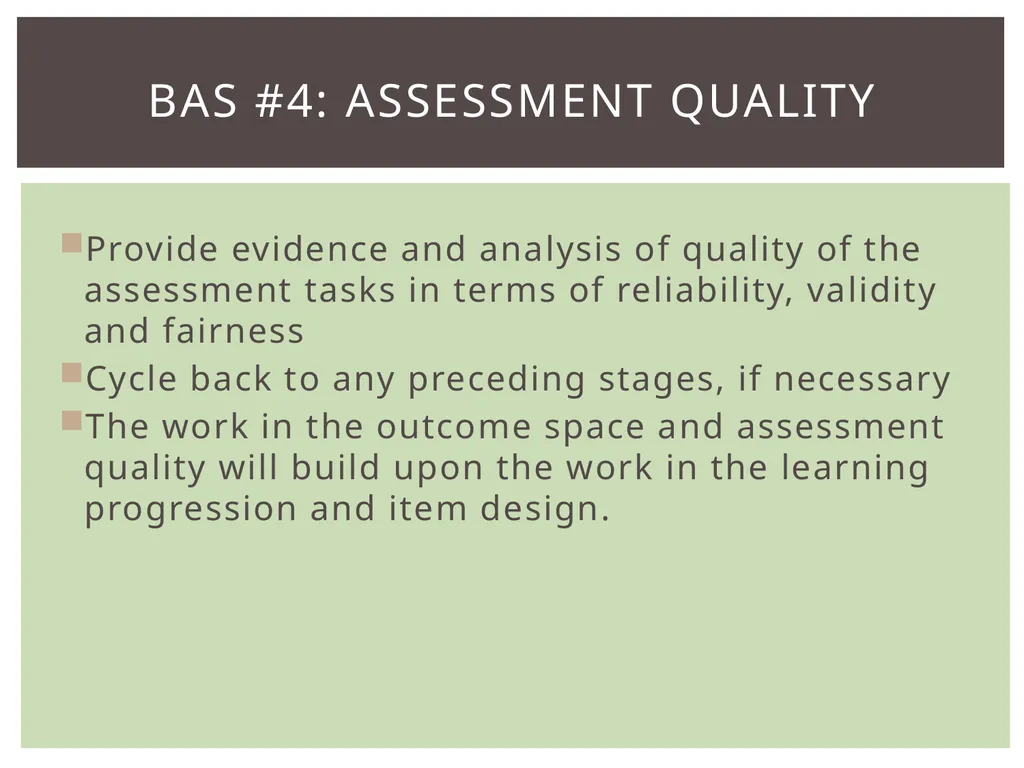
slide24. Provide evidence and analysis of quality of the assessment tasks in terms of reliability, validity and fairness
Cycle back to any preceding stages, if necessary
The work in the outcome space and assessment quality will build upon the work in the learning progression and item design. BAS #4: Assessment Quality<br>
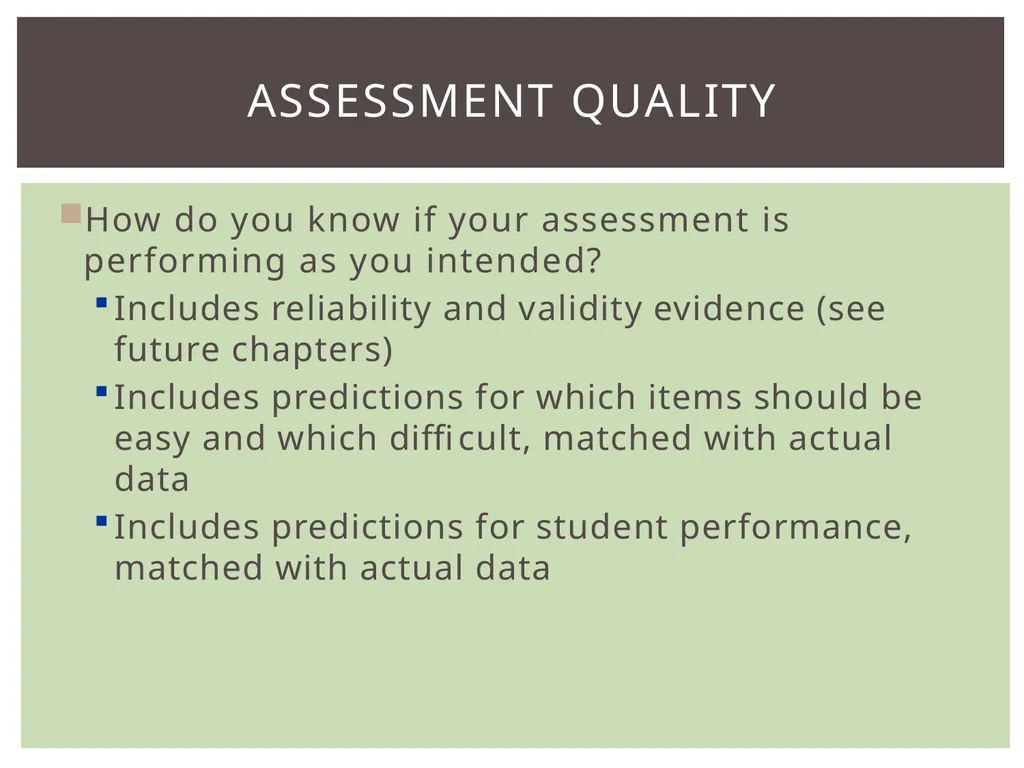
slide25. Assessment Quality How do you know if your assessment is performing as you intended?
Includes reliability and validity evidence (see future chapters)
Includes predictions for which items should be easy and which difficult, matched with actual data
Includes predictions for student performance, matched with actual data<br>
slide26. Iterative process of bas Learning Progression Item Design Outcomes/Scoring Assessment Quality<br>
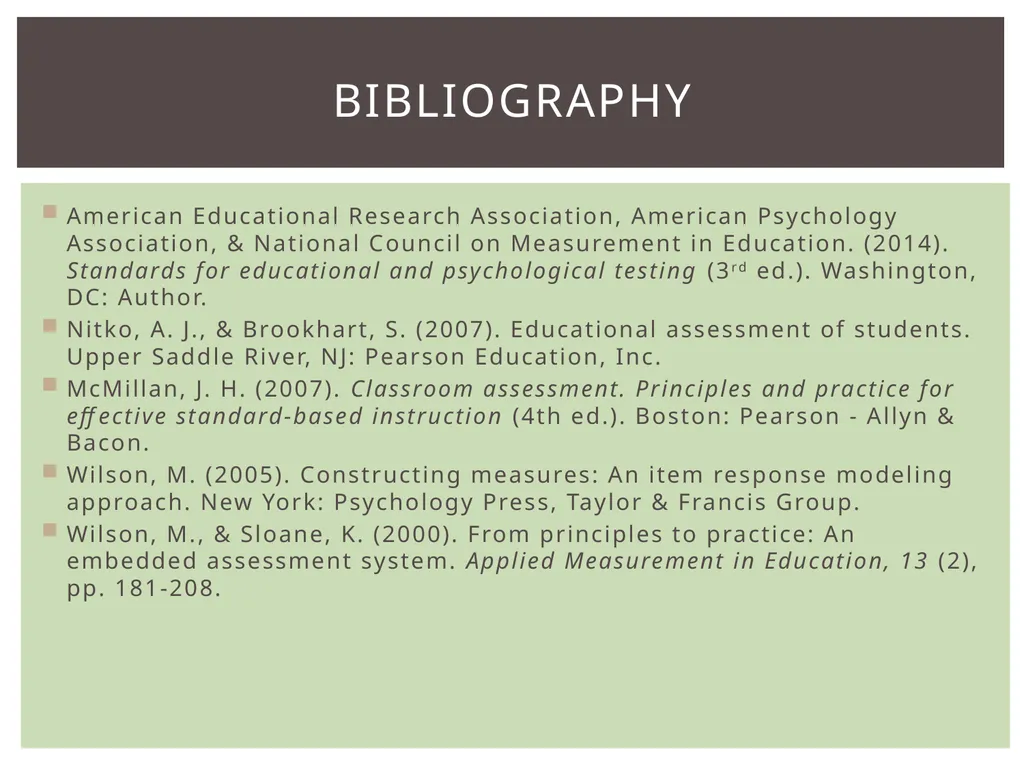
slide27. American Educational Research Association, American Psychology Association, & National Council on Measurement in Education. (2014). Standards for educational and psychological testing (3rd ed.). Washington, DC: Author.
Nitko, A. J., & Brookhart, S. (2007). Educational assessment of students. Upper Saddle River, NJ: Pearson Education, Inc.
McMillan, J. H. (2007). Classroom assessment. Principles and practice for effective standard-based instruction (4th ed.). Boston: Pearson - Allyn & Bacon.
Wilson, M. (2005). Constructing measures: An item response modeling approach. New York: Psychology Press, Taylor & Francis Group.
Wilson, M., & Sloane, K. (2000). From principles to practice: An embedded assessment system. Applied Measurement in Education, 13 (2), pp. 181-208. Bibliography<br>
slide28. Overview of BEAR Assessment System PPT by the Oregon Department of Education and Berkeley Evaluation and Assessment Research Center is licensed under a CC BY 4.0.
You are free to:
Share — copy and redistribute the material in any medium or format
Adapt — remix, transform, and build upon the material
Under the following terms:
Attribution — You must give appropriate credit, provide a link to the license, and indicate if changes were made. You may do so in any reasonable manner, but not in any way that suggests the licensor endorses you or your use.
NonCommercial — You may not use the material for commercial purposes.
ShareAlike — If you remix, transform, or build upon the material, you must distribute your contributions under the same license as the original.
Oregon Department of Education welcomes editing of these resources and would greatly appreciate being able to learn from the changes made. To share an edited version of this resource, please contact Cristen McLean, cristen.mclean@state.or.us. Creative Commons License<br>
Learning progression
Item design
Outcomes/Scoring
Assessment quality
Outline Overview of BEAR Assessment System<br>
slide2. A comprehensive, integrated system for assessing, interpreting, and monitoring student performance Tools for teachers to do the following:
Assess student performance on central concepts and skills in the curriculum
Set standards of student performance
Track student progress over the year on the central concepts
Provide feedback for themselves, students, administrators, parents, or other audience about student progress and the effectiveness of the instructional materials and classroom instruction BEAR Assessment system (BAS)<br>
slide3. 4 building blocks Learning Progression Item Design Outcomes/Scoring Assessment Quality<br>
slide4. Components of bas<br>
slide5. Provides information about students’ progress “just in time” to reteach or expand when necessary
Allows diagnosis of individual students who are having difficulty or who are ready for more in-depth material
Provides deeper understanding of where students really are – for example, do they understand conceptually, or have they simply learned a set of steps?
Provides a chance for teachers to think reflectively about what they are doing: what works, what doesn’t, what they might change next time Spending time on assessment aids in high-quality teaching<br>
slide6. Remember the BAS is a cycle Learning Progression Item Design Scoring Assessment Quality<br>
slide7. Often contains sub-cycles<br>
slide8. Reasons for the cyclical nature Begins with theory-based ideas for LP levels, item design, order, and so on
Makes extensive use of empirical evidence to improve on theory and relate to actual practice
Draws heavily on ideas of validity evidence and the improvement of validity (i.e. response processes, internal structure, etc.)<br>
slide9. We often don’t see this cycle Before the beginning of the Common Core, most teachers at most times used packaged curricula and assessments
However, all curriculum developers and assessment developers have gone through several cycles of development – but behind the scenes, where teachers mostly don’t see them<br>
slide10. Learning Progressions Learning Progression Item Design Outcomes/Scoring Assessment Quality<br>
slide11. Focus on the process of learning and on an individual student’s progress through that process
Assessment should be based on a developmental perspective of student learning
Define knowledge development aspects or learning targets within LP:
Upper level
Lower level
Middle levels LP Building blocks BAS #1: Learning Progression<br>
slide12. Example based on measurement of student understanding of density and buoyancy
Accompanied a curriculum called “Why Things Sink and Float”
Science unit designed for middle school classrooms An example learning progression<br>
slide13. Curriculum units<br>
slide14. The learning progression<br>
slide15. The item design Learning Progression Item Design Outcomes/Scoring Assessment Quality<br>
slide16. A match between what is taught and what is assessed
Link assessment tasks to learning progression
Different types for different purposes
Use Assessment Blueprint and Item-Writing Template as provided BAS #2: Item Design<br>
slide17. A forced-choice item<br>
slide18. Explain below why things sink and float. Write as much information as you need to explain your answer. Use evidence and examples to support your explanation An Open-ended item<br>
slide19. What is the most important reason why things sink and float? An ordered multiple choice item<br>
slide20. outcomES/Scoring Learning Progression Item Design Outcomes/Scoring Assessment Quality<br>
slide21. Teachers must be the managers of the system, with the tools to use it efficiently and effectively
Judge students' work and use results to plan instruction
Development and use of scoring rubrics
Use the item-writing template to design the scoring rubrics
Typical student’s understanding/misunderstanding reflected in their item responses can delineate the different levels of the scoring criteria
The difference between scoring and grading
Normally occurs in closer tandem with item development (BAS #2) BAS #3: Outcomes/Scoring<br>
slide22. Scoring Guide for open ended items<br>
slide23. Assessment quality Learning Progression Item Design Outcomes/Scoring Assessment Quality<br>
slide24. Provide evidence and analysis of quality of the assessment tasks in terms of reliability, validity and fairness
Cycle back to any preceding stages, if necessary
The work in the outcome space and assessment quality will build upon the work in the learning progression and item design. BAS #4: Assessment Quality<br>
slide25. Assessment Quality How do you know if your assessment is performing as you intended?
Includes reliability and validity evidence (see future chapters)
Includes predictions for which items should be easy and which difficult, matched with actual data
Includes predictions for student performance, matched with actual data<br>
slide26. Iterative process of bas Learning Progression Item Design Outcomes/Scoring Assessment Quality<br>
slide27. American Educational Research Association, American Psychology Association, & National Council on Measurement in Education. (2014). Standards for educational and psychological testing (3rd ed.). Washington, DC: Author.
Nitko, A. J., & Brookhart, S. (2007). Educational assessment of students. Upper Saddle River, NJ: Pearson Education, Inc.
McMillan, J. H. (2007). Classroom assessment. Principles and practice for effective standard-based instruction (4th ed.). Boston: Pearson - Allyn & Bacon.
Wilson, M. (2005). Constructing measures: An item response modeling approach. New York: Psychology Press, Taylor & Francis Group.
Wilson, M., & Sloane, K. (2000). From principles to practice: An embedded assessment system. Applied Measurement in Education, 13 (2), pp. 181-208. Bibliography<br>
slide28. Overview of BEAR Assessment System PPT by the Oregon Department of Education and Berkeley Evaluation and Assessment Research Center is licensed under a CC BY 4.0.
You are free to:
Share — copy and redistribute the material in any medium or format
Adapt — remix, transform, and build upon the material
Under the following terms:
Attribution — You must give appropriate credit, provide a link to the license, and indicate if changes were made. You may do so in any reasonable manner, but not in any way that suggests the licensor endorses you or your use.
NonCommercial — You may not use the material for commercial purposes.
ShareAlike — If you remix, transform, or build upon the material, you must distribute your contributions under the same license as the original.
Oregon Department of Education welcomes editing of these resources and would greatly appreciate being able to learn from the changes made. To share an edited version of this resource, please contact Cristen McLean, cristen.mclean@state.or.us. Creative Commons License<br>