Section 6 Fall Protection Rescue plan Disclaimer
Description: Section 6 Fall Protection Rescue plan Disclaimer This material was produced under grant number SH-31198-SH7 from the Occupational Safety and Health Administration, U.S. Department of Labor. It does not necessarily reflect the views or
Related Topics
Download Presentation
"Section 6 Fall Protection Rescue plan Disclaimer" is the property of its rightful owner. Permission is granted to download and print the materials on this website for personal, non-commercial use only, and to display it on your personal computer provided you do not modify the materials and that you retain all copyright notices contained in the materials. By downloading content from our website, you accept the terms of this agreement.
Presentation Transcript
slide1. Section 6 Fall Protection Rescue plan<br>
slide2. Disclaimer This material was produced under grant number SH-31198-SH7 from the Occupational Safety and Health Administration, U.S. Department of Labor. It does not necessarily reflect the views or policies of the U.S. Department of Labor, nor does mention of trade names, commercial products, or organizations imply endorsement by the U.S. Government.
This presentation is intended to discuss Federal Regulations only - your individual State requirements may be more stringent as many states operate their own state OSHA and they may have adopted construction standards that are different from information presented in this training. If you live in a state with an OSHA approved state plan, you should contact your local administrator for further information on the standards applicable in your state.
These materials are meant for informational purposes only.
No representation is made as to the thoroughness of the presentation.<br>
slide3. Disclaimer, cont. It is not the intent to provide compliance-based training in this presentation, the intent is more to address hazard awareness in the residential construction (i.e. home building) industry, and to recognize the overlapping hazards present in many construction workplaces.
Photos shown in this presentation may depict situations that are not in compliance with applicable OSHA/safety requirements.
No legal advice is offered or implied, and no attorney-client relationship is intended or established. If legal advice or other expert assistance is required the services of a competent professional person should be sought.
It is the responsibility of the employer and its employees to comply with all pertinent OSHA/safety rules and regulations in the jurisdiction in which they work.<br>
slide4. Copyright Information © 2018 This material is the copyrighted property of the Job-Site Safety Institute and the National Association of Home Builders. By federal regulation, OSHA reserves a license to use and disseminate such material for the purpose of promoting safety and health in the workplace. The Job-Site Safety Institute and the National Association of Home Builders hereby authorizes employers and workplace safety and health professionals to use this material, distributed by or through OSHA, in their workplaces or practices in accordance with the guidance contained in the material.
To this end, permission is granted to use such copyrighted material solely for non-commercial, instructional, personal, or scholarly purposes. The material may be used and incorporated into other workplace safety and health programs on the condition that no fee may be charged for the subsequent use of the material. Use of the material for any other purpose, particularly commercial use, without the prior, express written permission of the copyright owner/s is prohibited. Furthermore, any modification to the material is prohibited without the prior, express written permission of the copyright owners.<br>
slide5. Learning Objectives: Section 6 Learn the importance of implementing a plan to rescue workers who experience a fall.
Learn about the hazards of not quickly rescuing a suspended worker.
Discuss sample procedures in a fall protection rescue plan.<br>
slide6. Fall Protection Rescue Plan Describes the steps taken to rescue a fallen worker, even if they are wearing a PFAS.
Sample Procedures Include:
Ensuring the plan can safely rescue a suspended worker within 3-4 minutes of falling.
Contacting appropriate emergency personnel.
Using ladders or other methods to rescue worker.<br>
slide7. Fall Protection Rescue Plan, cont. Most rescues fail because there is no thought to how we would rescue a worker in the event of a fall.
Think whether you have the proper equipment on-site to rescue a fallen worker.<br>
slide8. Fall Protection Rescue Plan, cont. Are your employees trained in basic first-aid?
Are there adequate first-aid supplies available?
Is there a hospital or urgent care facility nearby?
Do you know where it is located?
Is the address and phone number of nearest emergency care center posted and do employees know where this is located?<br>
slide9. Fall Protection Rescue Plan, cont. Suspended workers are at risk of suspension trauma.
Prolonged suspension from fall arrest systems can cause orthostatic intolerance, which, in turn, can result in serious physical injury, or potentially, death.
Rescue workers within minutes to prevent pooling of blood in lower extremities/orthostatic intolerance.<br>
slide10. Fall Protection Rescue Plan, cont. Research indicates that suspension in a fall arrest device can result in unconsciousness, followed by death, in less than 30 minutes.
Rescue suspended workers as quickly as possible.
Be aware of signs and symptoms of orthostatic intolerance.
Suspended workers with head injuries or who are unconscious are particularly at risk.
Be aware of factors that can increase the risk of suspension trauma.<br>
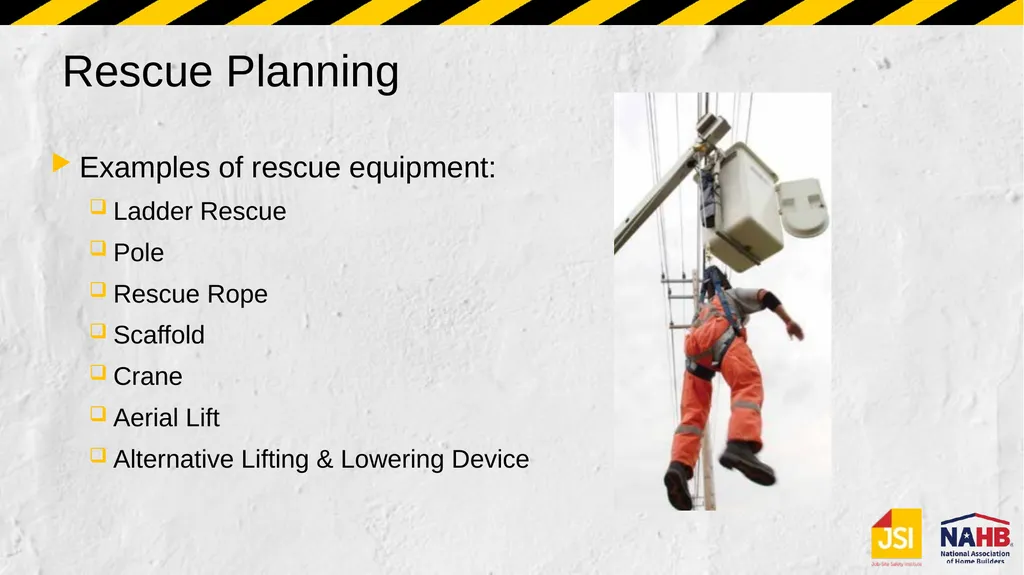
slide11. Rescue Planning Examples of rescue equipment:
Ladder Rescue
Pole
Rescue Rope
Scaffold
Crane
Aerial Lift
Alternative Lifting & Lowering Device<br>
slide12. Rescue Training Employees should be trained to:
Understand and be able to evaluate the risks associated with working at heights.
Must be trained and competent in the use of fall protection equipment prior to conducting work at heights.
To report unsafe conditions or behaviors.
To be familiar with and understand the company’s rescue plan to provide prompt rescue in the event of an arrested fall event.<br>
slide13. Plan for Self-Rescue If the proper fall protection is used, 90% of workers will be able to perform a Self-Rescue, which should include these steps:
1. Climbing back up to the level from which he fell (from a few inches to 2-3 feet).
2. Returning to the floor or ground to be evaluated for possible medical attention per OSHA.
3. Removing all components of fall arrest system impacted by the fall event from service and documenting (bag and tag) the components with name, date and activity at time of fall and giving the equipment to management.<br>
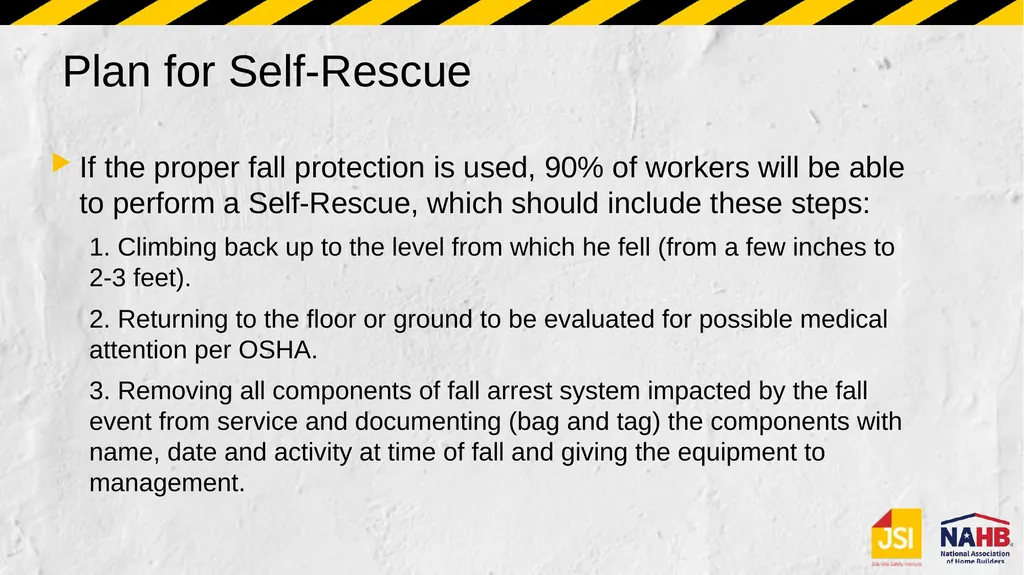
slide14. Examples of Self-Rescue Devices Self-rescue ladder attachment. This can be added to your harness as part of a PFAS.<br>
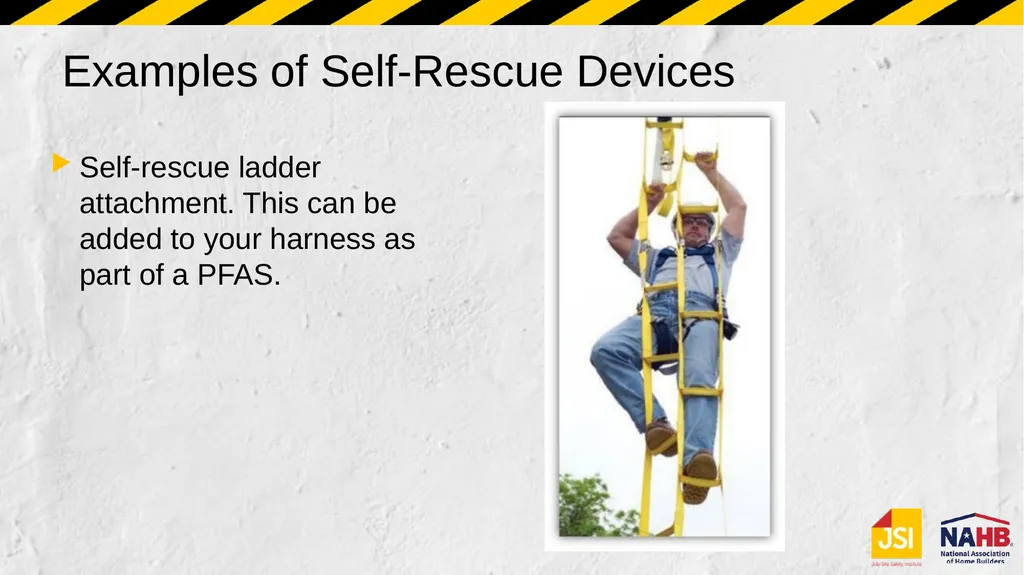
slide15. Examples of Self-Rescue Devices, cont. Self-Rescue system is a harness mounted backpack containing a controlled descent device.
In event of a fall, the user pulls a shoulder strap mounted release cord lowering the fallen worker safely to the ground.<br>
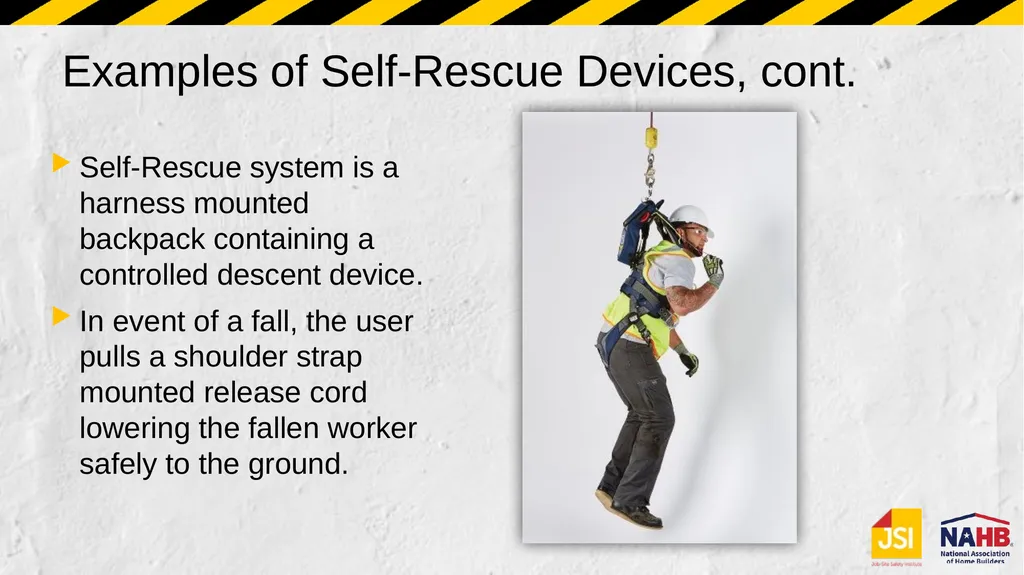
slide16. Examples of Rescue Devices A rescue pole allows a coworker to attach to your d-ring and safely lower you to the ground.<br>
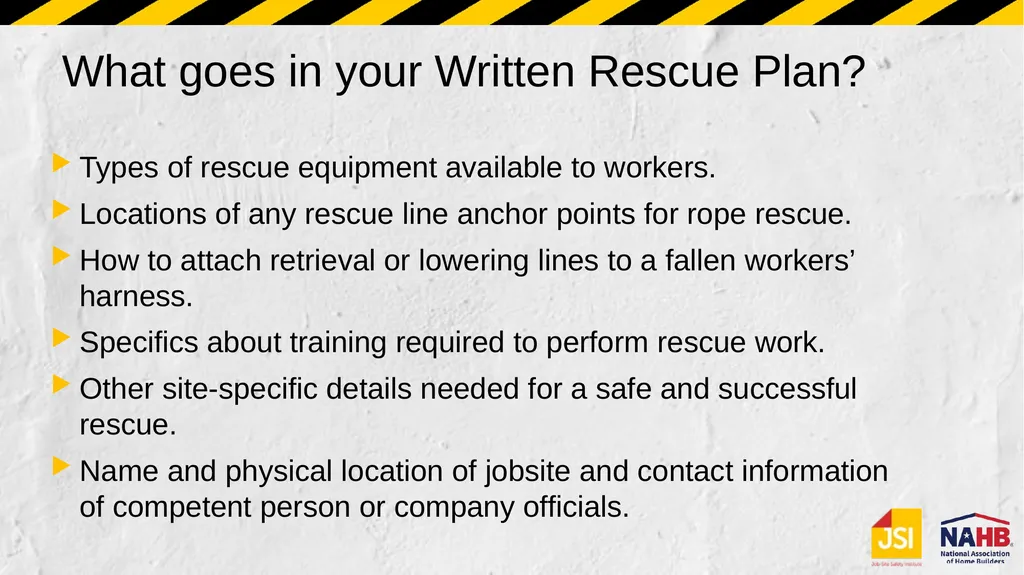
slide17. What goes in your Written Rescue Plan? Types of rescue equipment available to workers.
Locations of any rescue line anchor points for rope rescue.
How to attach retrieval or lowering lines to a fallen workers’ harness.
Specifics about training required to perform rescue work.
Other site-specific details needed for a safe and successful rescue.
Name and physical location of jobsite and contact information of competent person or company officials.<br>
slide18. Have questions? Need More Information? Call NAHB’s toll-free phone “Technical Assistance Hotline” at: 1-800-368-5242.

Send an email to: safety@nahb.org
Visit: nahb.org/safety | jssafety.org<br>
slide19. Thanks for Participating! Post test Next……<br>
slide2. Disclaimer This material was produced under grant number SH-31198-SH7 from the Occupational Safety and Health Administration, U.S. Department of Labor. It does not necessarily reflect the views or policies of the U.S. Department of Labor, nor does mention of trade names, commercial products, or organizations imply endorsement by the U.S. Government.
This presentation is intended to discuss Federal Regulations only - your individual State requirements may be more stringent as many states operate their own state OSHA and they may have adopted construction standards that are different from information presented in this training. If you live in a state with an OSHA approved state plan, you should contact your local administrator for further information on the standards applicable in your state.
These materials are meant for informational purposes only.
No representation is made as to the thoroughness of the presentation.<br>
slide3. Disclaimer, cont. It is not the intent to provide compliance-based training in this presentation, the intent is more to address hazard awareness in the residential construction (i.e. home building) industry, and to recognize the overlapping hazards present in many construction workplaces.
Photos shown in this presentation may depict situations that are not in compliance with applicable OSHA/safety requirements.
No legal advice is offered or implied, and no attorney-client relationship is intended or established. If legal advice or other expert assistance is required the services of a competent professional person should be sought.
It is the responsibility of the employer and its employees to comply with all pertinent OSHA/safety rules and regulations in the jurisdiction in which they work.<br>
slide4. Copyright Information © 2018 This material is the copyrighted property of the Job-Site Safety Institute and the National Association of Home Builders. By federal regulation, OSHA reserves a license to use and disseminate such material for the purpose of promoting safety and health in the workplace. The Job-Site Safety Institute and the National Association of Home Builders hereby authorizes employers and workplace safety and health professionals to use this material, distributed by or through OSHA, in their workplaces or practices in accordance with the guidance contained in the material.
To this end, permission is granted to use such copyrighted material solely for non-commercial, instructional, personal, or scholarly purposes. The material may be used and incorporated into other workplace safety and health programs on the condition that no fee may be charged for the subsequent use of the material. Use of the material for any other purpose, particularly commercial use, without the prior, express written permission of the copyright owner/s is prohibited. Furthermore, any modification to the material is prohibited without the prior, express written permission of the copyright owners.<br>
slide5. Learning Objectives: Section 6 Learn the importance of implementing a plan to rescue workers who experience a fall.
Learn about the hazards of not quickly rescuing a suspended worker.
Discuss sample procedures in a fall protection rescue plan.<br>
slide6. Fall Protection Rescue Plan Describes the steps taken to rescue a fallen worker, even if they are wearing a PFAS.
Sample Procedures Include:
Ensuring the plan can safely rescue a suspended worker within 3-4 minutes of falling.
Contacting appropriate emergency personnel.
Using ladders or other methods to rescue worker.<br>
slide7. Fall Protection Rescue Plan, cont. Most rescues fail because there is no thought to how we would rescue a worker in the event of a fall.
Think whether you have the proper equipment on-site to rescue a fallen worker.<br>
slide8. Fall Protection Rescue Plan, cont. Are your employees trained in basic first-aid?
Are there adequate first-aid supplies available?
Is there a hospital or urgent care facility nearby?
Do you know where it is located?
Is the address and phone number of nearest emergency care center posted and do employees know where this is located?<br>
slide9. Fall Protection Rescue Plan, cont. Suspended workers are at risk of suspension trauma.
Prolonged suspension from fall arrest systems can cause orthostatic intolerance, which, in turn, can result in serious physical injury, or potentially, death.
Rescue workers within minutes to prevent pooling of blood in lower extremities/orthostatic intolerance.<br>
slide10. Fall Protection Rescue Plan, cont. Research indicates that suspension in a fall arrest device can result in unconsciousness, followed by death, in less than 30 minutes.
Rescue suspended workers as quickly as possible.
Be aware of signs and symptoms of orthostatic intolerance.
Suspended workers with head injuries or who are unconscious are particularly at risk.
Be aware of factors that can increase the risk of suspension trauma.<br>
slide11. Rescue Planning Examples of rescue equipment:
Ladder Rescue
Pole
Rescue Rope
Scaffold
Crane
Aerial Lift
Alternative Lifting & Lowering Device<br>
slide12. Rescue Training Employees should be trained to:
Understand and be able to evaluate the risks associated with working at heights.
Must be trained and competent in the use of fall protection equipment prior to conducting work at heights.
To report unsafe conditions or behaviors.
To be familiar with and understand the company’s rescue plan to provide prompt rescue in the event of an arrested fall event.<br>
slide13. Plan for Self-Rescue If the proper fall protection is used, 90% of workers will be able to perform a Self-Rescue, which should include these steps:
1. Climbing back up to the level from which he fell (from a few inches to 2-3 feet).
2. Returning to the floor or ground to be evaluated for possible medical attention per OSHA.
3. Removing all components of fall arrest system impacted by the fall event from service and documenting (bag and tag) the components with name, date and activity at time of fall and giving the equipment to management.<br>
slide14. Examples of Self-Rescue Devices Self-rescue ladder attachment. This can be added to your harness as part of a PFAS.<br>
slide15. Examples of Self-Rescue Devices, cont. Self-Rescue system is a harness mounted backpack containing a controlled descent device.
In event of a fall, the user pulls a shoulder strap mounted release cord lowering the fallen worker safely to the ground.<br>
slide16. Examples of Rescue Devices A rescue pole allows a coworker to attach to your d-ring and safely lower you to the ground.<br>
slide17. What goes in your Written Rescue Plan? Types of rescue equipment available to workers.
Locations of any rescue line anchor points for rope rescue.
How to attach retrieval or lowering lines to a fallen workers’ harness.
Specifics about training required to perform rescue work.
Other site-specific details needed for a safe and successful rescue.
Name and physical location of jobsite and contact information of competent person or company officials.<br>
slide18. Have questions? Need More Information? Call NAHB’s toll-free phone “Technical Assistance Hotline” at: 1-800-368-5242.
Send an email to: safety@nahb.org
Visit: nahb.org/safety | jssafety.org<br>
slide19. Thanks for Participating! Post test Next……<br>