Sequence Labeling for Part of Speech and Named Entities Part of Speech Tagging Parts of Speech From the earliest linguistic traditions (Yaska and Panini 5th C. BCE, Aristotle 4th C. BCE), the idea that words can be classified into
"Sequence Labeling for Part of Speech and Named" is the property of its rightful owner. Permission is granted to
download and print the materials on this website for personal, non-commercial use only, and to display it
on your personal computer provided you do not modify the materials and that you retain all copyright
notices contained in the materials. By downloading content from our website, you accept the terms of this
agreement.
Presentation Transcript
01
Sequence Labeling for Part of Speech and Named Entities Part of Speech Tagging<br>
02
Parts of Speech From the earliest linguistic traditions (Yaska and Panini 5th C. BCE, Aristotle 4th C. BCE), the idea that words can be classified into grammatical categories
part of speech, word classes, POS, POS tags
8 parts of speech attributed to Dionysius Thrax of Alexandria (c. 1st C. BCE):
noun, verb, pronoun, preposition, adverb, conjunction, participle, article
These categories are relevant for NLP today.<br>
03
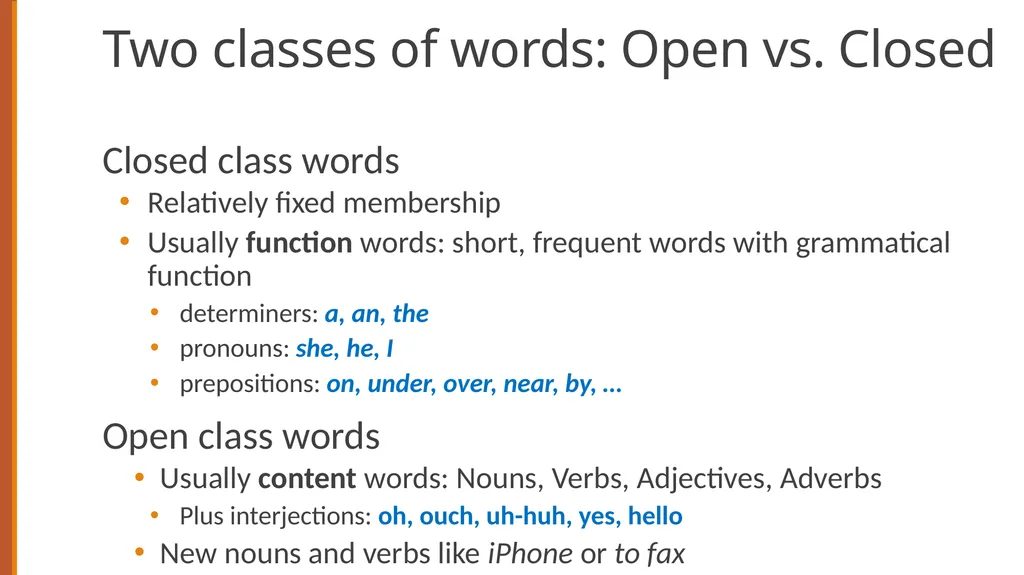
Two classes of words: Open vs. Closed Closed class words
Relatively fixed membership
Usually function words: short, frequent words with grammatical function
determiners: a, an, the
pronouns: she, he, I
prepositions: on, under, over, near, by, …
Open class words
Usually content words: Nouns, Verbs, Adjectives, Adverbs
Plus interjections: oh, ouch, uh-huh, yes, hello
New nouns and verbs like iPhone or to fax<br>
04
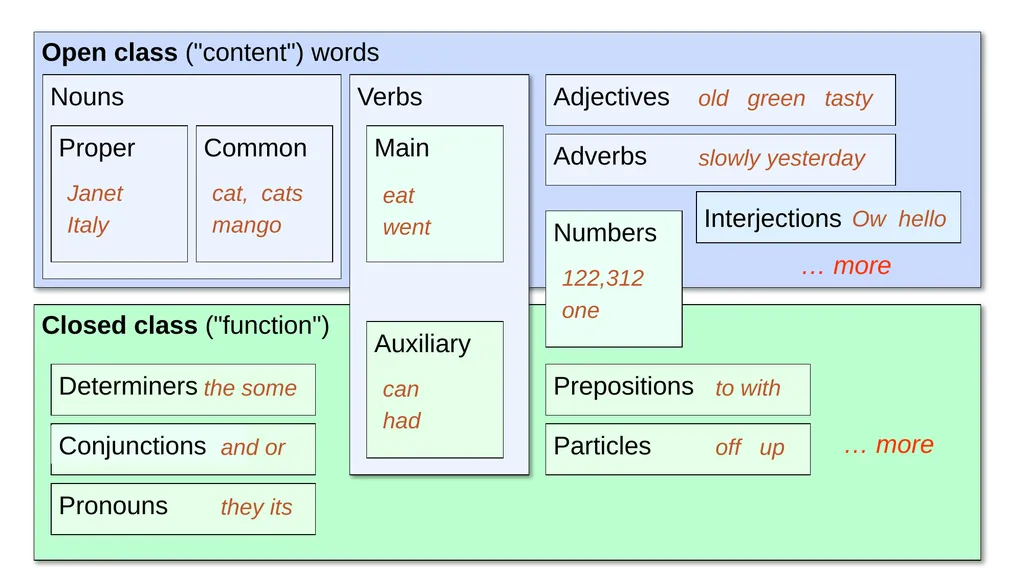
Open class ("content") words Closed class ("function") Nouns Verbs Proper Common Auxiliary Main Adjectives Adverbs Prepositions Particles Determiners Conjunctions Pronouns … more … more Janet
Italy cat, cats
mango eat
went can
had old green tasty slowly yesterday to with off up the some and or they its Numbers 122,312
one Interjections Ow hello<br>
05
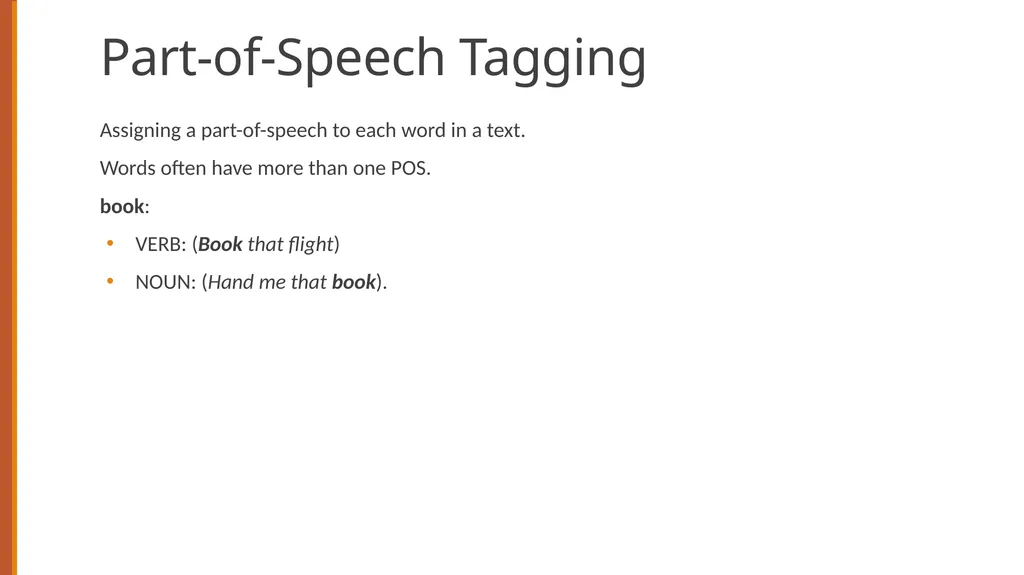
Part-of-Speech Tagging Assigning a part-of-speech to each word in a text.
Words often have more than one POS.
book:
VERB: (Book that flight)
NOUN: (Hand me that book).<br>
06
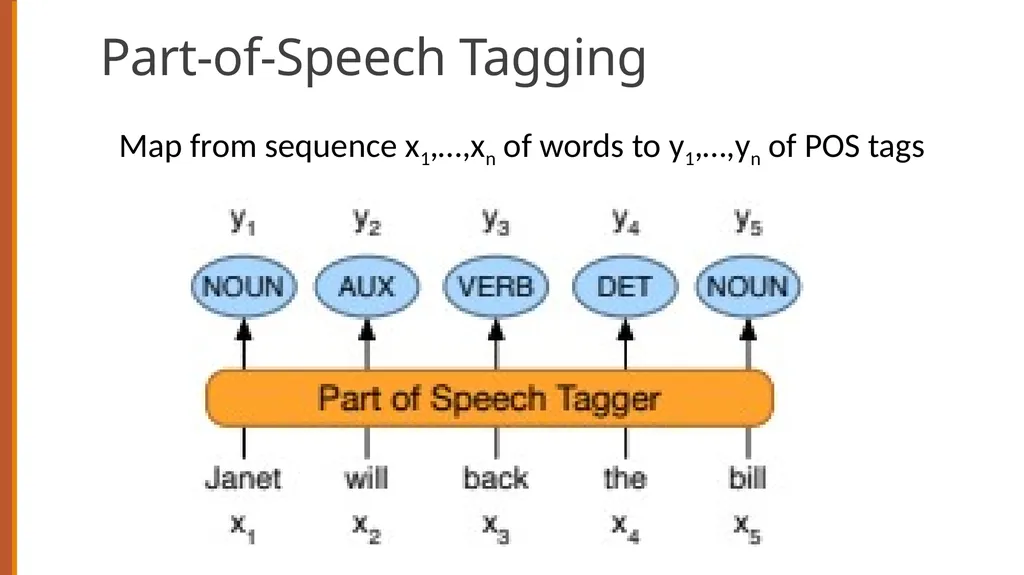
Part-of-Speech Tagging Map from sequence x1,…,xn of words to y1,…,yn of POS tags<br>
07
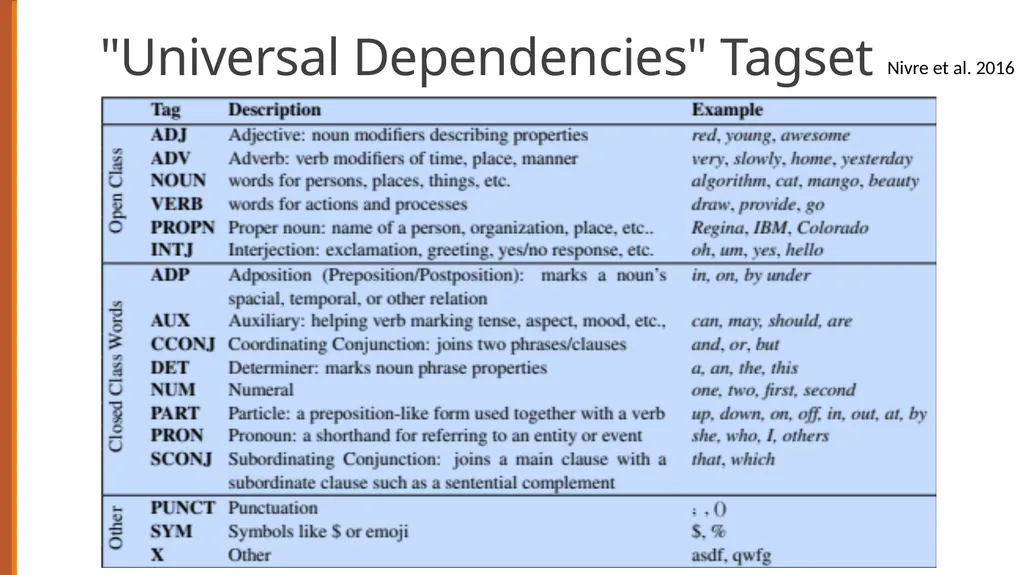
"Universal Dependencies" Tagset Nivre et al. 2016<br>
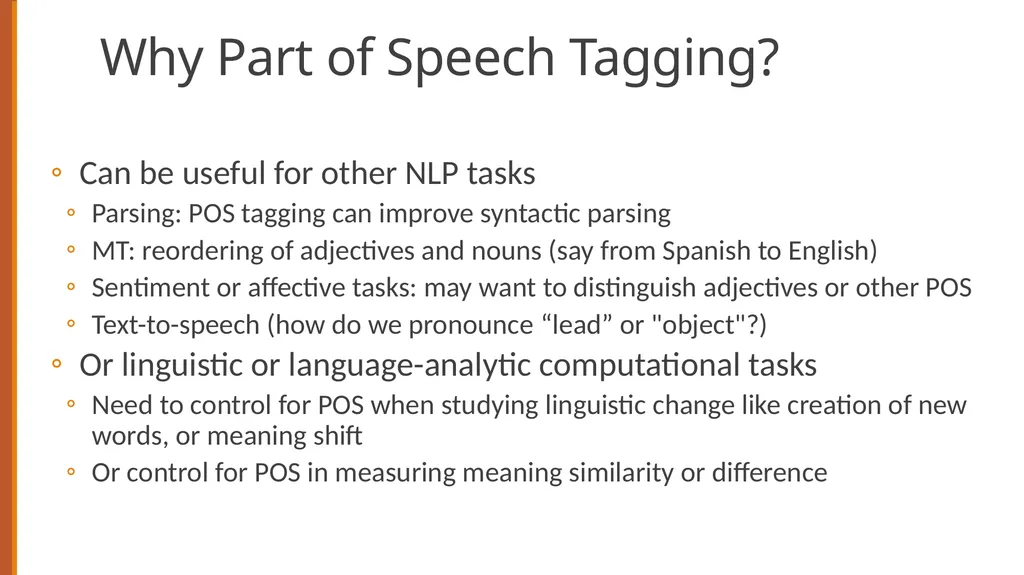
Why Part of Speech Tagging? Can be useful for other NLP tasks
Parsing: POS tagging can improve syntactic parsing
MT: reordering of adjectives and nouns (say from Spanish to English)
Sentiment or affective tasks: may want to distinguish adjectives or other POS
Text-to-speech (how do we pronounce “lead” or "object"?)
Or linguistic or language-analytic computational tasks
Need to control for POS when studying linguistic change like creation of new words, or meaning shift
Or control for POS in measuring meaning similarity or difference<br>
10
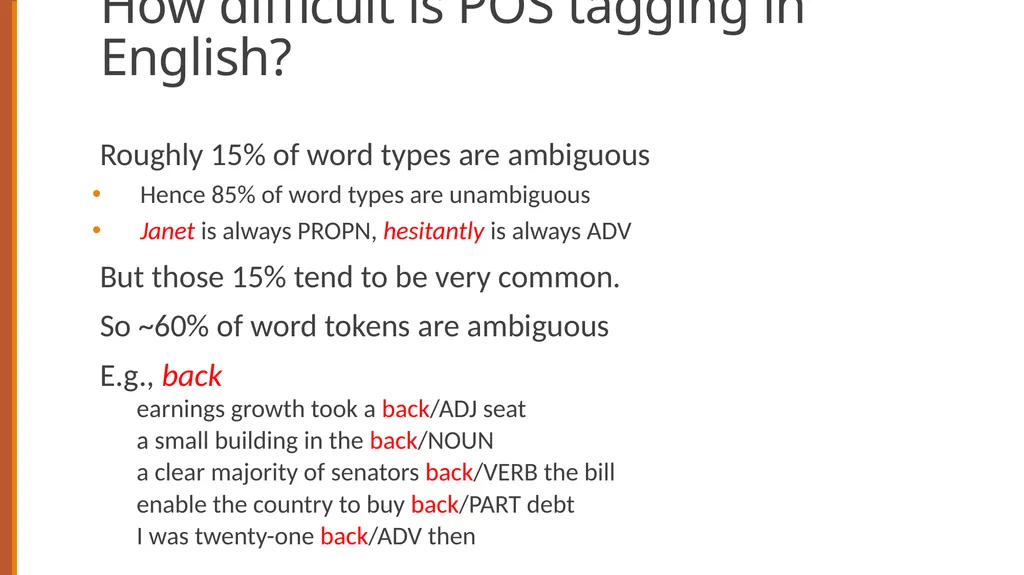
How difficult is POS tagging in English? Roughly 15% of word types are ambiguous
Hence 85% of word types are unambiguous
Janet is always PROPN, hesitantly is always ADV
But those 15% tend to be very common.
So ~60% of word tokens are ambiguous
E.g., back
earnings growth took a back/ADJ seat
a small building in the back/NOUN
a clear majority of senators back/VERB the bill
enable the country to buy back/PART debt
I was twenty-one back/ADV then<br>
11
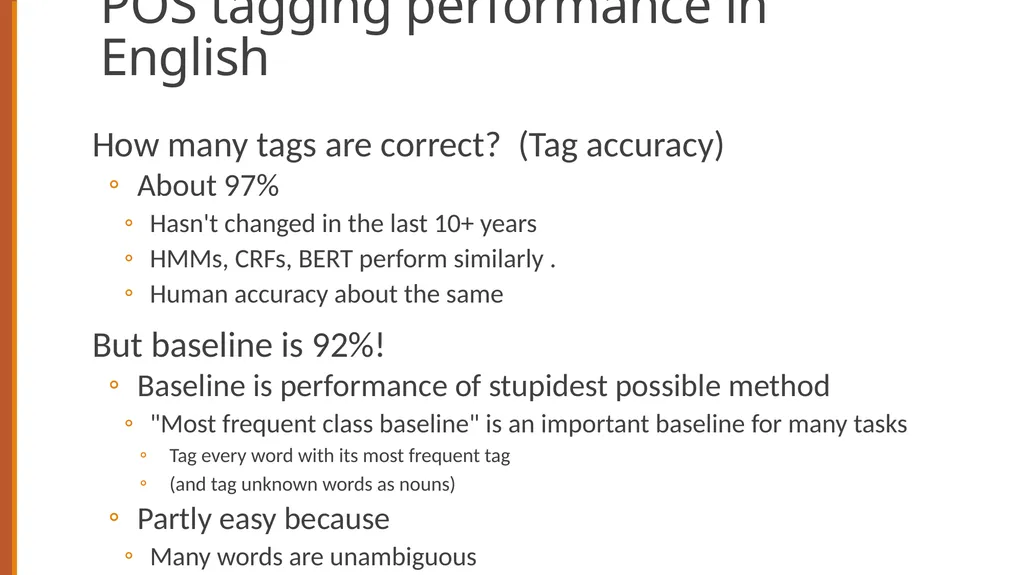
POS tagging performance in English How many tags are correct? (Tag accuracy)
About 97%
Hasn't changed in the last 10+ years
HMMs, CRFs, BERT perform similarly .
Human accuracy about the same
But baseline is 92%!
Baseline is performance of stupidest possible method
"Most frequent class baseline" is an important baseline for many tasks
Tag every word with its most frequent tag
(and tag unknown words as nouns)
Partly easy because
Many words are unambiguous<br>
12
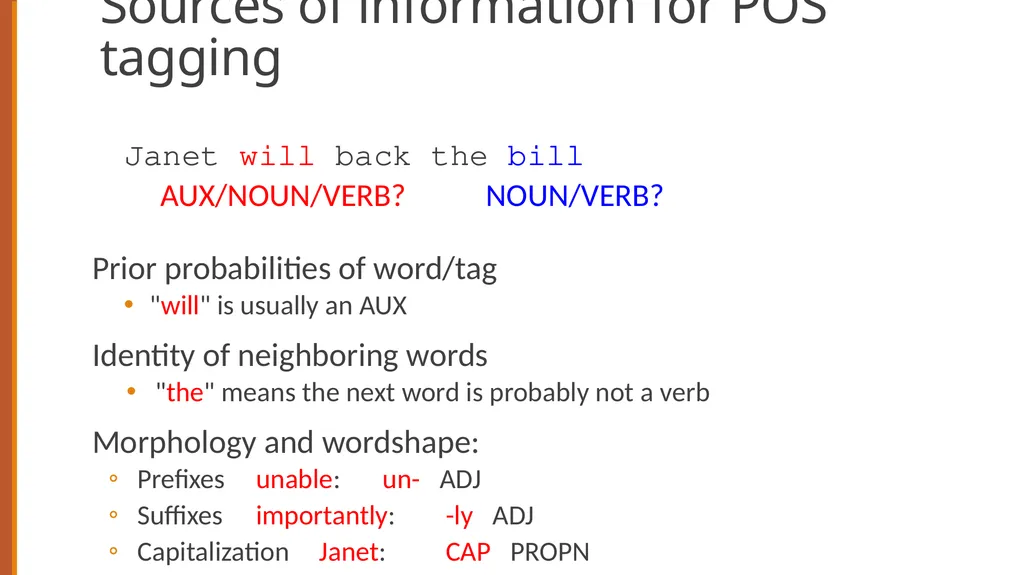
Sources of information for POS tagging Janet will back the bill
AUX/NOUN/VERB? NOUN/VERB?
Prior probabilities of word/tag
"will" is usually an AUX
Identity of neighboring words
"the" means the next word is probably not a verb
Morphology and wordshape:
Prefixes unable: un- ADJ
Suffixes importantly: -ly ADJ
Capitalization Janet: CAP PROPN<br>
13
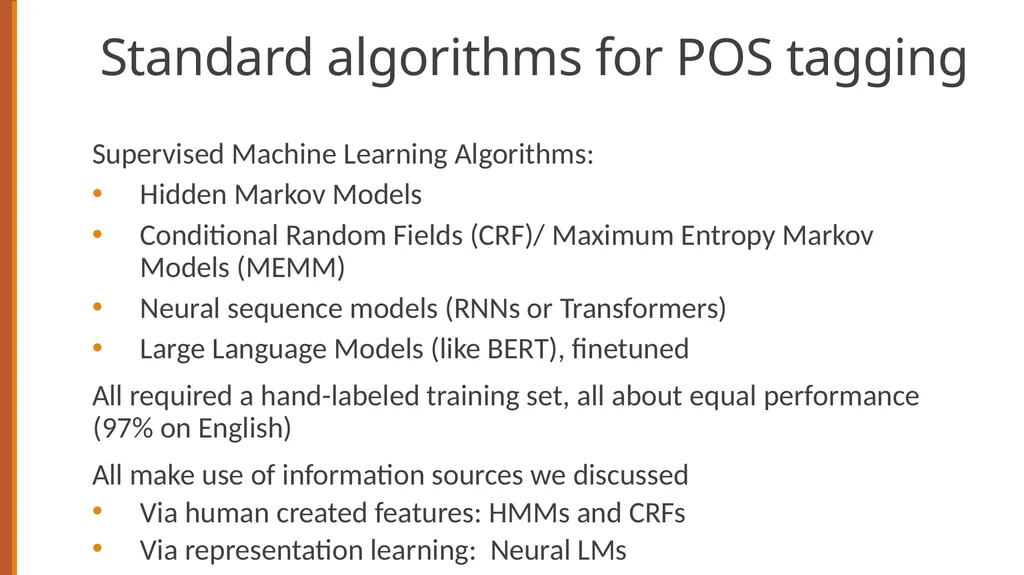
Standard algorithms for POS tagging Supervised Machine Learning Algorithms:
Hidden Markov Models
Conditional Random Fields (CRF)/ Maximum Entropy Markov Models (MEMM)
Neural sequence models (RNNs or Transformers)
Large Language Models (like BERT), finetuned
All required a hand-labeled training set, all about equal performance (97% on English)
All make use of information sources we discussed
Via human created features: HMMs and CRFs
Via representation learning: Neural LMs<br>
14
Sequence Labeling for Part of Speech and Named Entities Part of Speech Tagging<br>
15
Sequence Labeling for Part of Speech and Named Entities Named Entity Recognition (NER)<br>
16
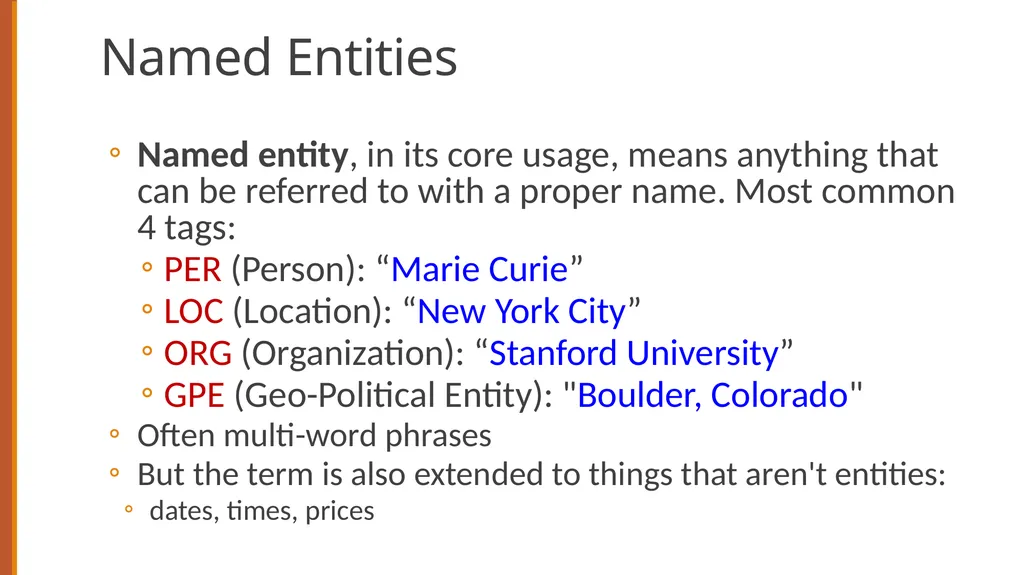
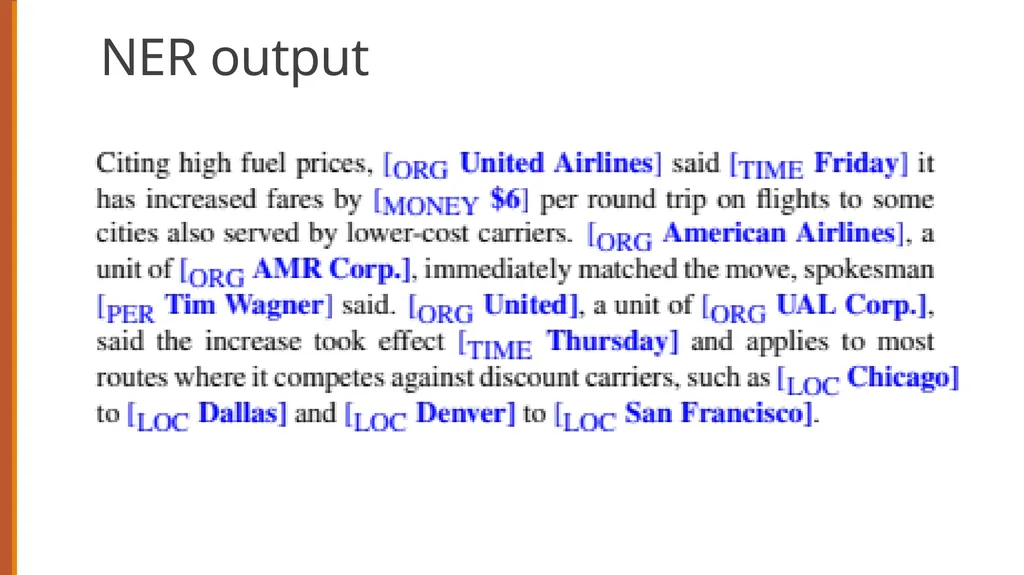
Named Entities Named entity, in its core usage, means anything that can be referred to with a proper name. Most common 4 tags:
PER (Person): “Marie Curie”
LOC (Location): “New York City”
ORG (Organization): “Stanford University”
GPE (Geo-Political Entity): "Boulder, Colorado"
Often multi-word phrases
But the term is also extended to things that aren't entities:
dates, times, prices<br>
17
Named Entity tagging The task of named entity recognition (NER):
find spans of text that constitute proper names
tag the type of the entity.<br>
18
NER output<br>
19
Why NER? Sentiment analysis: consumer’s sentiment toward a particular company or person?
Question Answering: answer questions about an entity?
Information Extraction: Extracting facts about entities from text.<br>
20
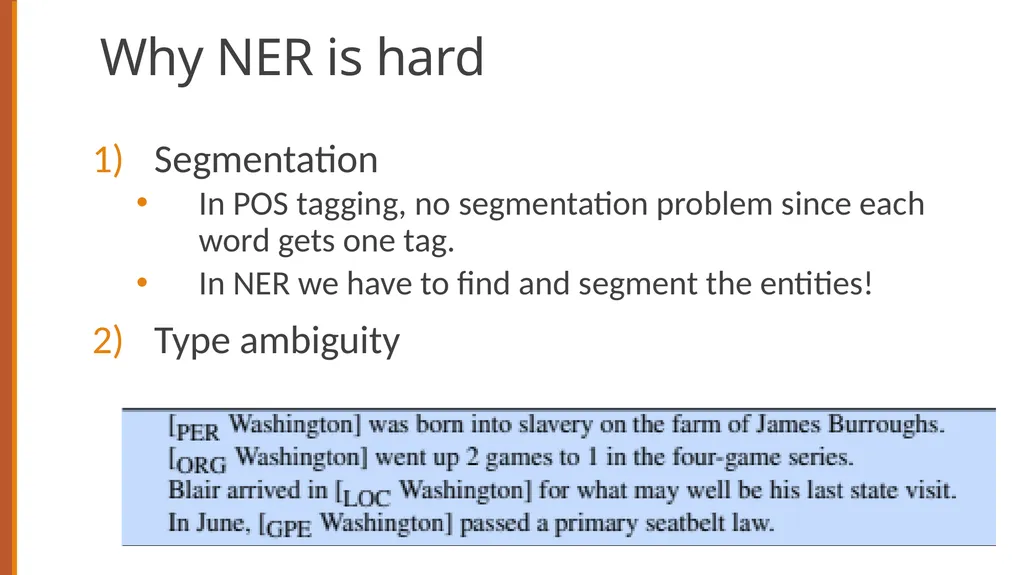
Why NER is hard Segmentation
In POS tagging, no segmentation problem since each word gets one tag.
In NER we have to find and segment the entities!
Type ambiguity<br>
21
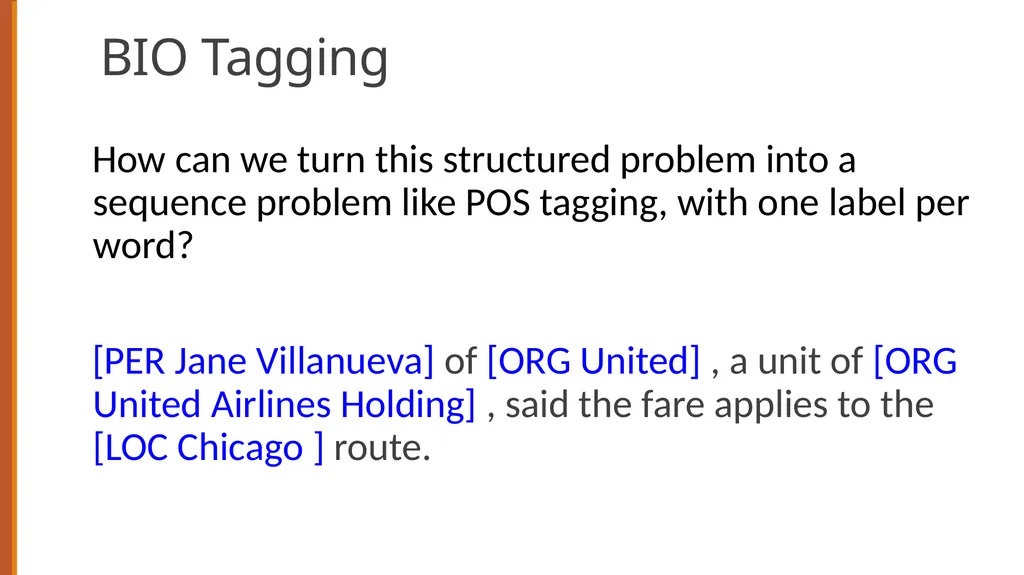
BIO Tagging How can we turn this structured problem into a sequence problem like POS tagging, with one label per word?
[PER Jane Villanueva] of [ORG United] , a unit of [ORG United Airlines Holding] , said the fare applies to the [LOC Chicago ] route.<br>
22
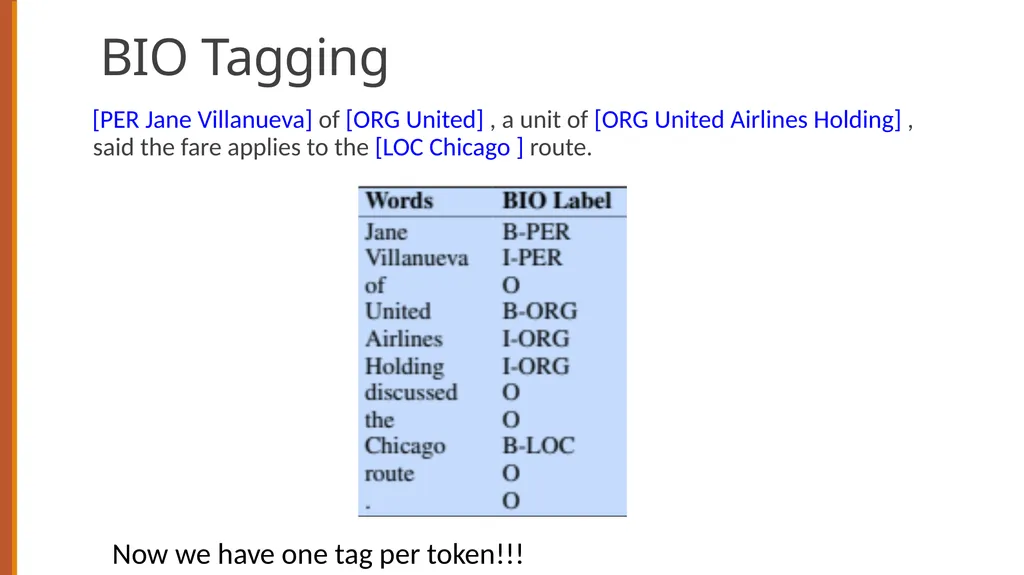
BIO Tagging [PER Jane Villanueva] of [ORG United] , a unit of [ORG United Airlines Holding] , said the fare applies to the [LOC Chicago ] route. Now we have one tag per token!!!<br>
23
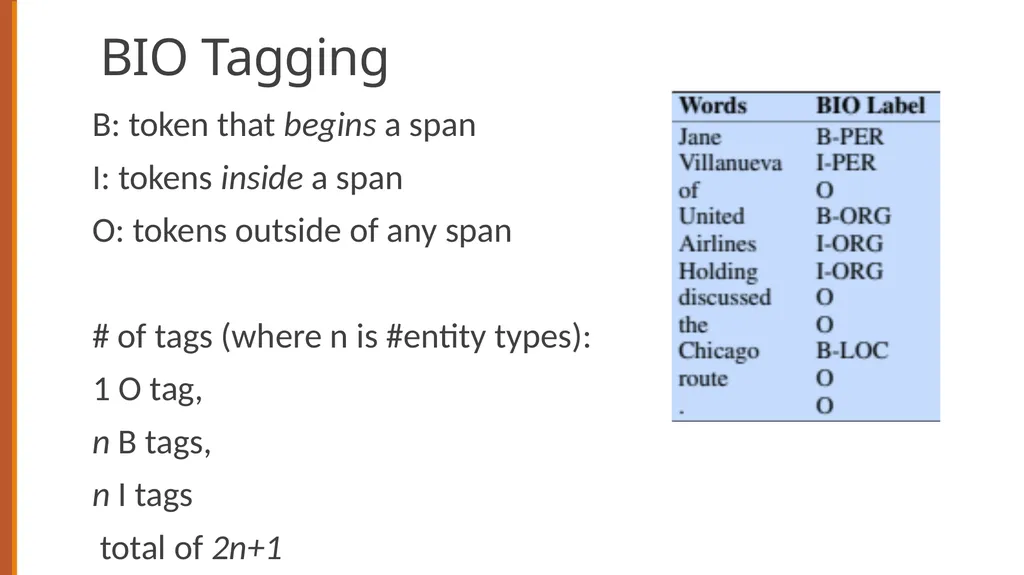
BIO Tagging B: token that begins a span
I: tokens inside a span
O: tokens outside of any span
# of tags (where n is #entity types):
1 O tag,
n B tags,
n I tags
total of 2n+1<br>
24
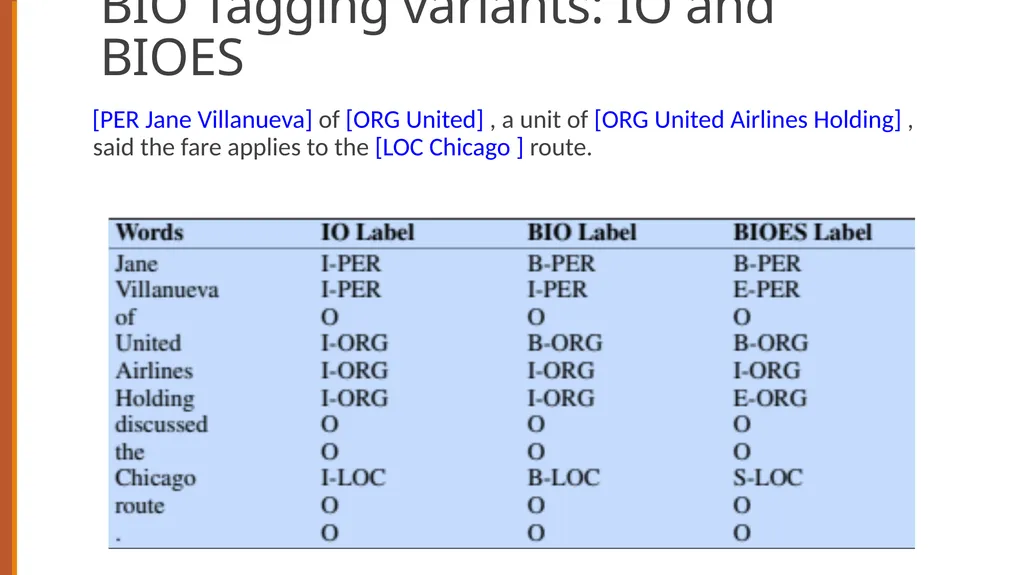
BIO Tagging variants: IO and BIOES [PER Jane Villanueva] of [ORG United] , a unit of [ORG United Airlines Holding] , said the fare applies to the [LOC Chicago ] route.<br>
25
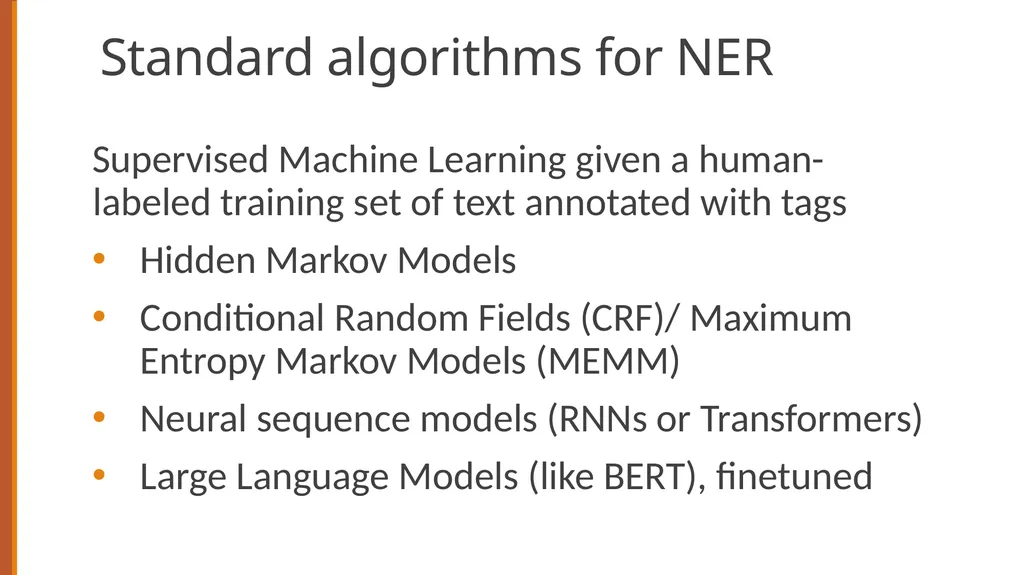
Standard algorithms for NER Supervised Machine Learning given a human-labeled training set of text annotated with tags
Hidden Markov Models
Conditional Random Fields (CRF)/ Maximum Entropy Markov Models (MEMM)
Neural sequence models (RNNs or Transformers)
Large Language Models (like BERT), finetuned<br>
26
Sequence Labeling for Part of Speech and Named Entities Named Entity Recognition (NER)<br>