
Social System Meaning, Elements, Characteristics
PC
Published · 70 slides · 0 views
1 / 1





Description
Social System Meaning, Elements, Characteristics and Types Sr. Jisha Chakkunny M PG Department of Sociology The term system implies an orderly arrangement, an interrelationship of parts. In the arrangement, every part has a fixed place
Related Topics
Share
Embed code
Download this presentation From Below
"Social System Meaning, Elements, Characteristics" is the property of its rightful owner. Permission is granted to download and print the materials on this website for personal, non-commercial use only, and to display it on your personal computer provided you do not modify the materials and that you retain all copyright notices contained in the materials. By downloading content from our website, you accept the terms of this agreement.
Presentation Transcript
01
Social System Meaning, Elements, Characteristics and Types Sr. Jisha Chakkunny M
PG Department of Sociology<br>
PG Department of Sociology<br>
02
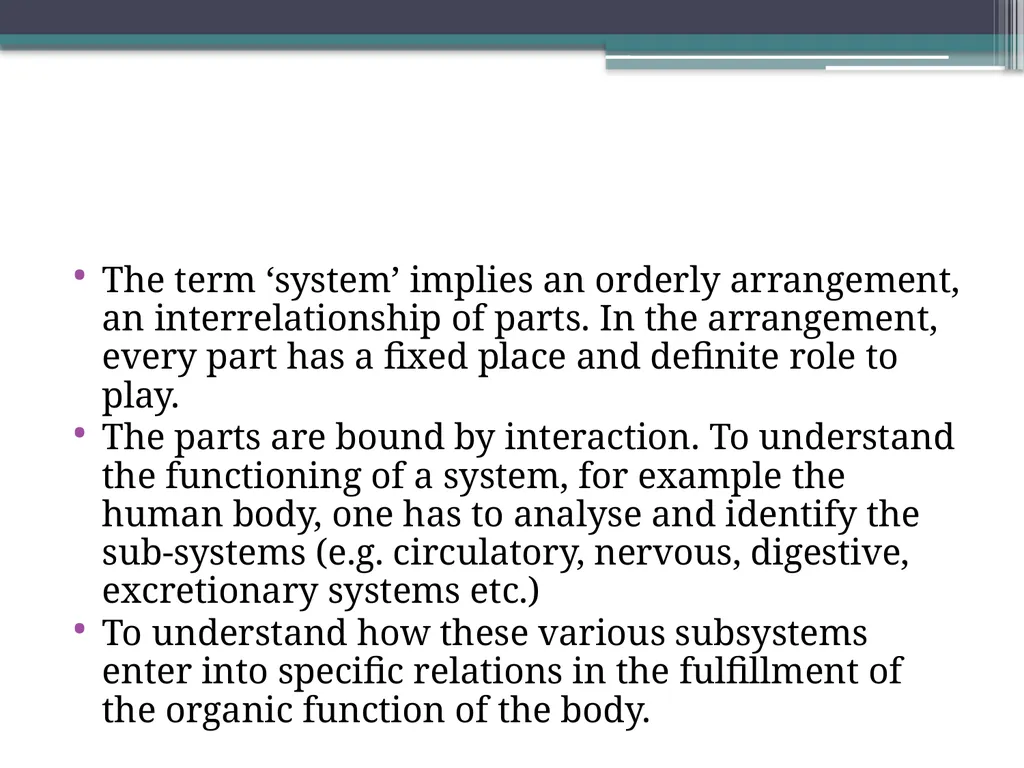
The term ‘system’ implies an orderly arrangement, an interrelationship of parts. In the arrangement, every part has a fixed place and definite role to play.
The parts are bound by interaction. To understand the functioning of a system, for example the human body, one has to analyse and identify the sub-systems (e.g. circulatory, nervous, digestive, excretionary systems etc.)
To understand how these various subsystems enter into specific relations in the fulfillment of the organic function of the body.<br>
The parts are bound by interaction. To understand the functioning of a system, for example the human body, one has to analyse and identify the sub-systems (e.g. circulatory, nervous, digestive, excretionary systems etc.)
To understand how these various subsystems enter into specific relations in the fulfillment of the organic function of the body.<br>
03
Social system may be described as an arrangement of social interactions based on shared norms and values.<br>
04
Meaning of Social System: It is Talcott Parsons who has given the concept of ‘system’ current in modern sociology.
Social system refers to’ an orderly arrangement, an inter relationships of parts.
Society is a system of usages, authority and mutuality based on “We” felling and likeness. Differences within the society are not excluded.<br>
Social system refers to’ an orderly arrangement, an inter relationships of parts.
Society is a system of usages, authority and mutuality based on “We” felling and likeness. Differences within the society are not excluded.<br>
05
Definition A social system may be defined, after Parsons, a plurality of social actors who are engaged in more or less stable interaction “according to shared cultural norms and meanings” Individuals constitute the basic interaction units.
But the interacting units may be groups or organisation of individuals within the system.<br>
But the interacting units may be groups or organisation of individuals within the system.<br>
06
The social system, according to Charles P. Loomis, is composed of the patterned interaction of visual actors whose’ relation to each other are mutually oriented through the definition of the mediation of pattern of structured and shared symbols and expectations.<br>
07
Social system is a comprehensive arrangement.
It takes its orbit all the diverse subsystems such as the economic, political, religious and others and their interrelation too.
Social systems are bound by environment such as geography. And this differentiates one system from another.<br>
It takes its orbit all the diverse subsystems such as the economic, political, religious and others and their interrelation too.
Social systems are bound by environment such as geography. And this differentiates one system from another.<br>
08
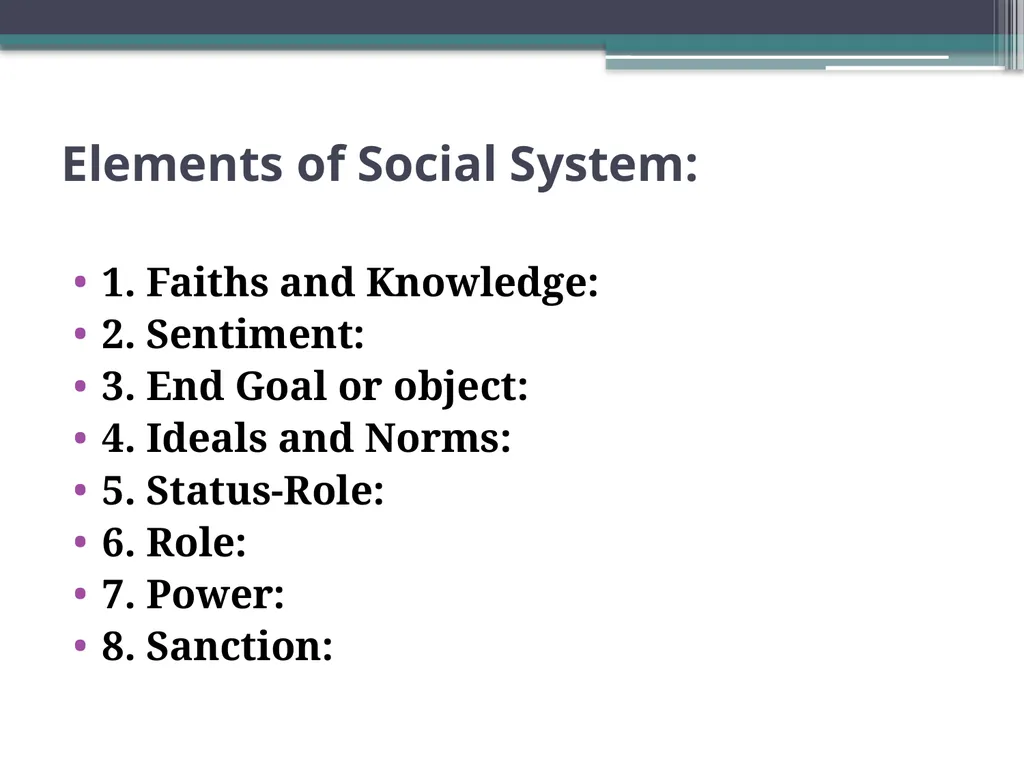
Elements of Social System: 1. Faiths and Knowledge:
2. Sentiment:
3. End Goal or object:
4. Ideals and Norms:
5. Status-Role:
6. Role:
7. Power:
8. Sanction:<br>
2. Sentiment:
3. End Goal or object:
4. Ideals and Norms:
5. Status-Role:
6. Role:
7. Power:
8. Sanction:<br>
09
1. Faiths and Knowledge: The faiths and knowledge brings about the uniformity in the behaviour. They act as controlling agency of different types of human societies.<br>
10
2. Sentiment: Man does not live by reason alone. Sentiments – filial, social, notional etc. have played immense role in investing society with continuity.
It is directly linked with the culture of the people.<br>
It is directly linked with the culture of the people.<br>
11
3. End Goal or object: Man is born social and dependent. He has to meet his requirements and fulfill his obligations.
Man and society exist between needs and satisfactions, end and goal.
These determine the nature of social system. They provided the pathway of progress, and the receding horizons.<br>
Man and society exist between needs and satisfactions, end and goal.
These determine the nature of social system. They provided the pathway of progress, and the receding horizons.<br>
12
4. Ideals and Norms: The society lays down certain norms and ideals for keeping the social system intact and for determining the various functions of different units.
These norms prescribe the rules and regulations on the basis of which individuals or persons may acquire their cultural goals and aims.<br>
These norms prescribe the rules and regulations on the basis of which individuals or persons may acquire their cultural goals and aims.<br>
13
5. Status-Role: Every individual in society is functional. He goes by status-role relation. It may come to the individual by virtue of his birth, sex, caste, or age. One may achieve it on the basis of service rendered<br>
14
6. Role: Role is the external expression of the status. While discharging certain jobs or doing certain things, every individual keeps in his mind his status.
This thing leads to social integration, organization and unity in the social system.<br>
This thing leads to social integration, organization and unity in the social system.<br>
15
7. Power: Conflict is a part of social system, and order is its aim.
It is implicit, therefore, that some should be invested with the power to punish the guilty and reward those who set an example.<br>
It is implicit, therefore, that some should be invested with the power to punish the guilty and reward those who set an example.<br>
16
8. Sanction: It implies confirmation by the superior in authority, of the acts done be the subordinate or the imposition of penalty for the infringement of the command.
The acts done or not done according to norms may bring reward and punishment.<br>
The acts done or not done according to norms may bring reward and punishment.<br>
17
Characteristics of Social System: Social system has certain characteristics. These characteristics are as follows:
1. System is connected with the plurality of Individual actors:
It means that a system or social system cannot be borne as a result of the activity of one individual. It is the result of the activities of various individuals.
For system, or social system, interaction of several individuals has to be there.<br>
1. System is connected with the plurality of Individual actors:
It means that a system or social system cannot be borne as a result of the activity of one individual. It is the result of the activities of various individuals.
For system, or social system, interaction of several individuals has to be there.<br>
18
2. Aim and Object: Human interactions or activities of the individual actors should not be aimless or without object. These activities have to be according to certain aims and objects.<br>
19
3. Order and Pattern amongst various Constituent Units: It has to be according to a pattern, arrangement and order.
The underlined unity amongst various constituent units brings about ‘social system’.<br>
The underlined unity amongst various constituent units brings about ‘social system’.<br>
20
4. Functional Relationship is the Basis of Unity: Different constituent units have a unity in order to form a system.
This unity is based on functional relations.
As a result of functional relationships between different constituent units an integrated whole is created and this is known as social system.<br>
This unity is based on functional relations.
As a result of functional relationships between different constituent units an integrated whole is created and this is known as social system.<br>
21
5. Physical or Environmental Aspect of Social System: It means that every social system is connected with a definite geographical area or place, time, society etc.<br>
22
6. Linked with Cultural System: Social system is also linked with cultural system.
It means that cultural system bring about unity amongst different members of the society on the basis of cultures, traditions, religions etc.<br>
It means that cultural system bring about unity amongst different members of the society on the basis of cultures, traditions, religions etc.<br>
23
7. Expressed and implied Aims and Objects: Social system is also linked with expressed and implied aims.
It means that social system is the coming together of different individual actors who are motivated by their aims and objectives and their needs.<br>
It means that social system is the coming together of different individual actors who are motivated by their aims and objectives and their needs.<br>
24
8. Characteristics of Adjustment: Social system has the characteristic of adjustment.
It is a dynamic phenomenon which is influenced by the changes caused in the social form.<br>
It is a dynamic phenomenon which is influenced by the changes caused in the social form.<br>
25
9. Order, Pattern and Balance: Social system has the characteristics of pattern, order and balance.
Social system is not an integrated whole but putting together of different units.<br>
Social system is not an integrated whole but putting together of different units.<br>
26
Maintenance of Social System: A social system is maintained by the various mechanisms of social control.
These mechanisms maintain the equilibrium between the various processes of social interaction.<br>
These mechanisms maintain the equilibrium between the various processes of social interaction.<br>
27
In brief, these mechanisms may be classified in the following categories: 1. Socialization.
2. Social control.<br>
2. Social control.<br>
28
(1) Socialization: It is process by which an individual is adjusted with the conventional pattern of social behaviour. A child by birth is neither social nor unsocial. But the process of socialization develops him into a functioning member of society. He adjusts himself with the social situations conforming with social norms, values and standards.<br>
29
(2) Social Control: social control is also a system of measures by which society moulds its members to conform with the approved pattern of social behaviour.
According to Parsons, there are two types of elements which exist in every system. These are integrative and disintegrative and create obstacles in the advancement of integration.<br>
According to Parsons, there are two types of elements which exist in every system. These are integrative and disintegrative and create obstacles in the advancement of integration.<br>
30
Functions of Social System: Social system is a functional arrangement. It would not exist if it were not so. Its functional character ensures social stability and continuity.
The functional character of society, Parsons has discussed in depth. Other sociologists such as Robert F. Bales too have discussed it.<br>
The functional character of society, Parsons has discussed in depth. Other sociologists such as Robert F. Bales too have discussed it.<br>
31
It is generally agreed that the social system has four primary functional problems to attend. These are:
1. Adaptation,
2. Goal attainment,
3. Integration,
4. Latent Pattern-Maintenance.<br>
1. Adaptation,
2. Goal attainment,
3. Integration,
4. Latent Pattern-Maintenance.<br>
32
1. Adaptation: Adaptability of social system to the changing environment is essential.
a social system is the result of geographical environment and a long drawn historical process which by necessity gives it permanence and rigidity.
It need be a flexible and functional phenomenon.<br>
a social system is the result of geographical environment and a long drawn historical process which by necessity gives it permanence and rigidity.
It need be a flexible and functional phenomenon.<br>
33
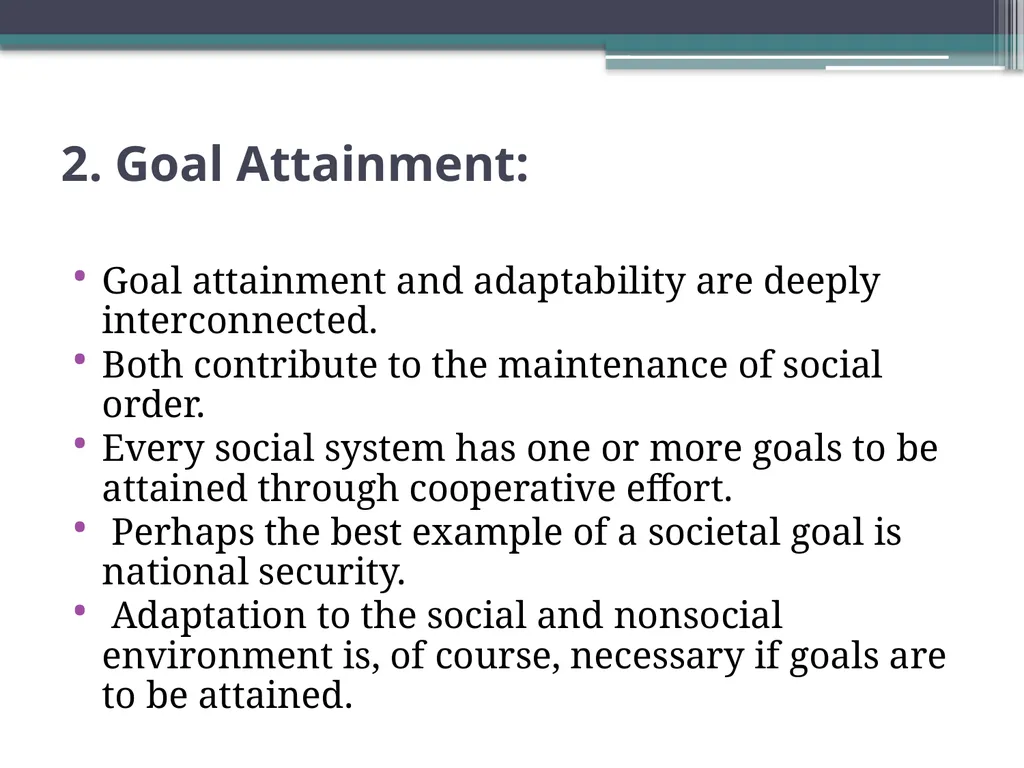
2. Goal Attainment: Goal attainment and adaptability are deeply interconnected.
Both contribute to the maintenance of social order.
Every social system has one or more goals to be attained through cooperative effort.
Perhaps the best example of a societal goal is national security.
Adaptation to the social and nonsocial environment is, of course, necessary if goals are to be attained.<br>
Both contribute to the maintenance of social order.
Every social system has one or more goals to be attained through cooperative effort.
Perhaps the best example of a societal goal is national security.
Adaptation to the social and nonsocial environment is, of course, necessary if goals are to be attained.<br>
34
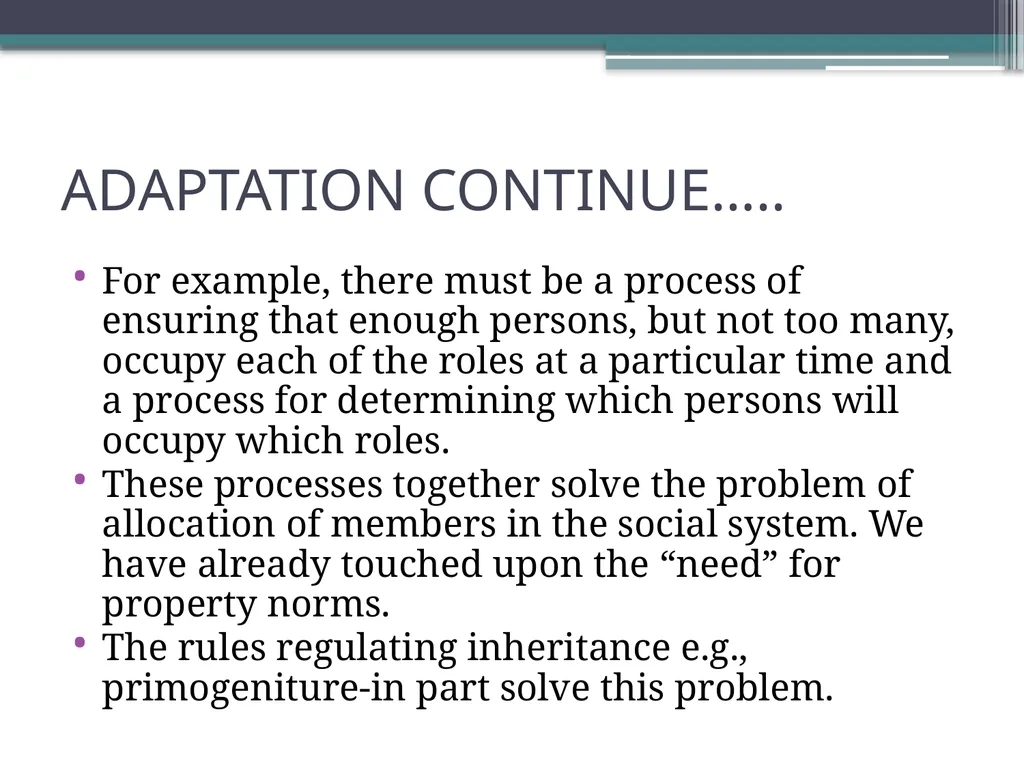
ADAPTATION CONTINUE….. For example, there must be a process of ensuring that enough persons, but not too many, occupy each of the roles at a particular time and a process for determining which persons will occupy which roles.
These processes together solve the problem of allocation of members in the social system. We have already touched upon the “need” for property norms.
The rules regulating inheritance e.g., primogeniture-in part solve this problem.<br>
These processes together solve the problem of allocation of members in the social system. We have already touched upon the “need” for property norms.
The rules regulating inheritance e.g., primogeniture-in part solve this problem.<br>
35
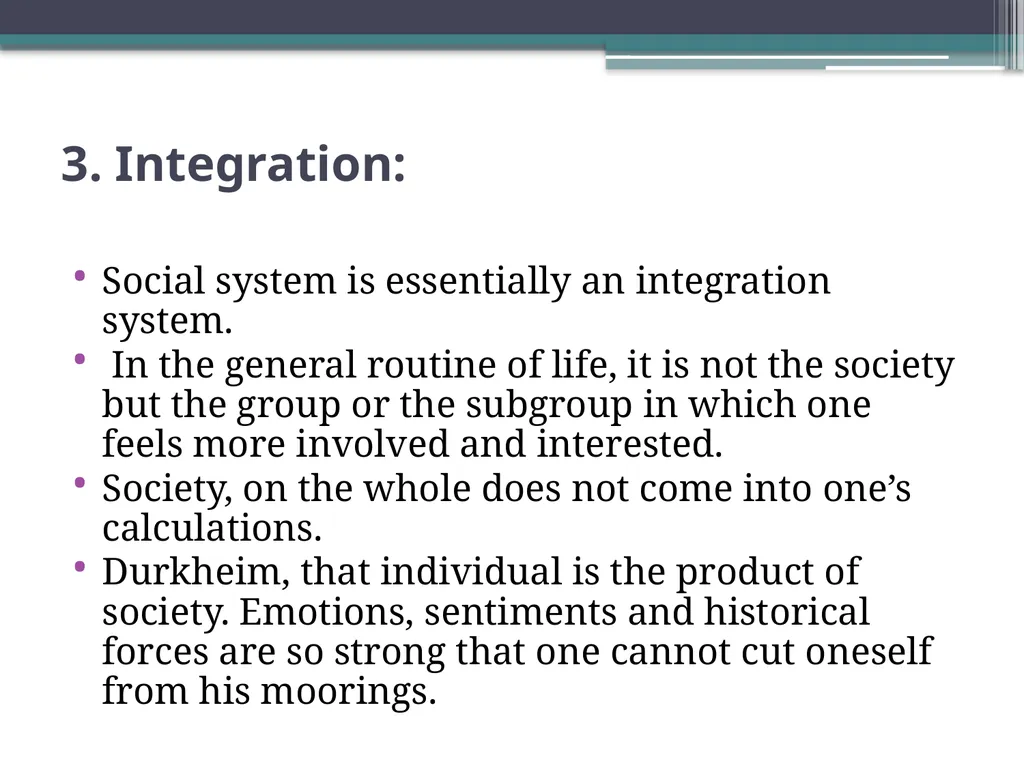
3. Integration: Social system is essentially an integration system.
In the general routine of life, it is not the society but the group or the subgroup in which one feels more involved and interested.
Society, on the whole does not come into one’s calculations.
Durkheim, that individual is the product of society. Emotions, sentiments and historical forces are so strong that one cannot cut oneself from his moorings.<br>
In the general routine of life, it is not the society but the group or the subgroup in which one feels more involved and interested.
Society, on the whole does not come into one’s calculations.
Durkheim, that individual is the product of society. Emotions, sentiments and historical forces are so strong that one cannot cut oneself from his moorings.<br>
36
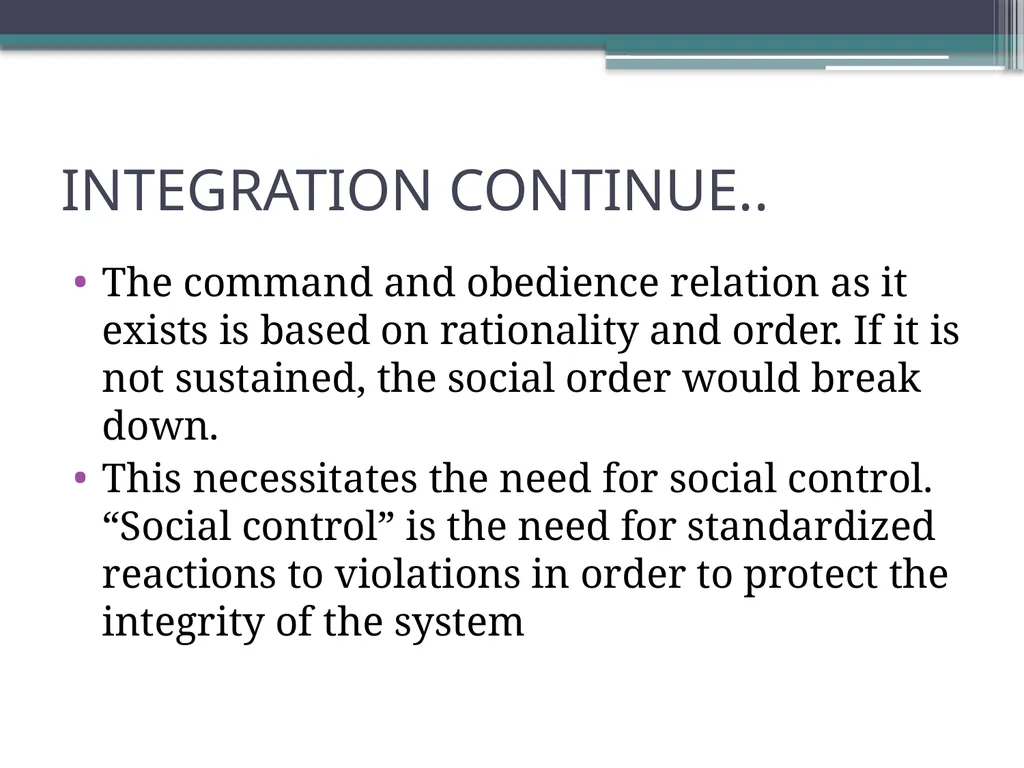
INTEGRATION CONTINUE.. The command and obedience relation as it exists is based on rationality and order. If it is not sustained, the social order would break down.
This necessitates the need for social control. “Social control” is the need for standardized reactions to violations in order to protect the integrity of the system<br>
This necessitates the need for social control. “Social control” is the need for standardized reactions to violations in order to protect the integrity of the system<br>
37
4. Latent Pattern-maintenance: Pattern maintenance and tension management is the primary function of social system.
In absence of appropriate effort in this direction maintenance and continuity of social order is not possible.
In fact within every social system there is the in built mechanism for the purpose.<br>
In absence of appropriate effort in this direction maintenance and continuity of social order is not possible.
In fact within every social system there is the in built mechanism for the purpose.<br>
38
LATENT PATTERN MAINTANENECE….. Every individual and subgroup learns the patterns in the process of the internalization of norms and values.
It is to invest the actors with appropriate attitude and respect towards norms and institution, that the socialization works.
Society has the responsibility, like a family, to keep its members functional, to relieve them of anxiety, to encourage those who would be detrimental to the entire system.
The decline of societies has been very much because the pattern maintenance and tension management mechanism has often failed.<br>
It is to invest the actors with appropriate attitude and respect towards norms and institution, that the socialization works.
Society has the responsibility, like a family, to keep its members functional, to relieve them of anxiety, to encourage those who would be detrimental to the entire system.
The decline of societies has been very much because the pattern maintenance and tension management mechanism has often failed.<br>
39
Social structure Social structure, in sociology, the distinctive, stable arrangement of institutions whereby human beings in a society interact and live together. Social structure is often treated together with the concept of social change, which deals with the forces that change the social structure and the organization of society.<br>
40
the term social structure refers to regularities in social life, its application is inconsistent.
For example, the term is sometimes wrongly applied when other concepts such as custom, tradition, role, or norm would be more accurate.<br>
For example, the term is sometimes wrongly applied when other concepts such as custom, tradition, role, or norm would be more accurate.<br>
41
Studies of social structure attempt to explain such matters as integration and trends in inequality.
In the study of these phenomena, sociologists analyze organizations, social categories (such as age groups), or rates (such as of crime or birth).
This approach, sometimes called formal sociology, does not refer directly to individual behaviour or interpersonal interaction.
Therefore, the study of social structure is not considered a behavioral science; at this level, the analysis is too abstract.<br>
In the study of these phenomena, sociologists analyze organizations, social categories (such as age groups), or rates (such as of crime or birth).
This approach, sometimes called formal sociology, does not refer directly to individual behaviour or interpersonal interaction.
Therefore, the study of social structure is not considered a behavioral science; at this level, the analysis is too abstract.<br>
42
Social structure is sometimes defined simply as patterned social relations—those regular and repetitive aspects of the interactions between the members of a given social entity.<br>
43
The term structure has been applied to human societies since the 19th century.
Before that time, its use was more common in other fields such as construction or biology.<br>
Before that time, its use was more common in other fields such as construction or biology.<br>
44
According to Marx, the basic structure of society is economic, or material, and this structure influences the rest of social life, which is defined as nonmaterial, spiritual, or ideological.<br>
45
The biological connotations of the term structure are evident in the work of British philosopher Herbert Spencer. He and other social theorists of the 19th and early 20th centuries conceived of society as an organism comprising interdependent parts that form a structure similar to the anatomy of a living body.<br>
46
In the most general way, social structure is identified by those features of a social entity (a society or a group within a society) that persist over time, are interrelated, and influence both the functioning of the entity as a whole and the activities of its individual members.<br>
47
The origin of contemporary sociological references to social structure can be traced to Émile Durkheim, who argued that parts of society are interdependent and that this interdependency imposes structure on the behaviour of institutions and their members<br>
48
. In other words, Durkheim believed that individual human behaviour is shaped by external forces.
Similarly, American anthropologist George P. Murdock, in his book Social Structure (1949), examined kinship systems in preliterate societies and used social structure as a taxonomic device for classifying, comparing, and correlating various aspects of kinship systems.<br>
Similarly, American anthropologist George P. Murdock, in his book Social Structure (1949), examined kinship systems in preliterate societies and used social structure as a taxonomic device for classifying, comparing, and correlating various aspects of kinship systems.<br>
49
Social Structure Definition According to Radcliff-Brown social structure is a part of the social structure of all social relations of person to person. In the study of social structure the concrete reality with which we are concerned is the set of actually existing relations at a given moment of time that link together certain human beings.<br>
50
According to Talcott Parsons, the term social structure applies to the particular arrangement of the interrelated institutions, agencies and social patterns as well as the statuses and roles which each person assumes in the group. Parsons has tried to explain the concept of social structure in abstract form. All the units of social structure that is institutions, agencies, social patterns, statuses and roles are invisible and intangible and hence are abstract.<br>
51
According to Maclver and Page the various modes of grouping together comprise the complex pattern of the social structure. They have also regarded that social structure is abstract which is composed of several groups like family, church, class, caste, state or community etc.<br>
52
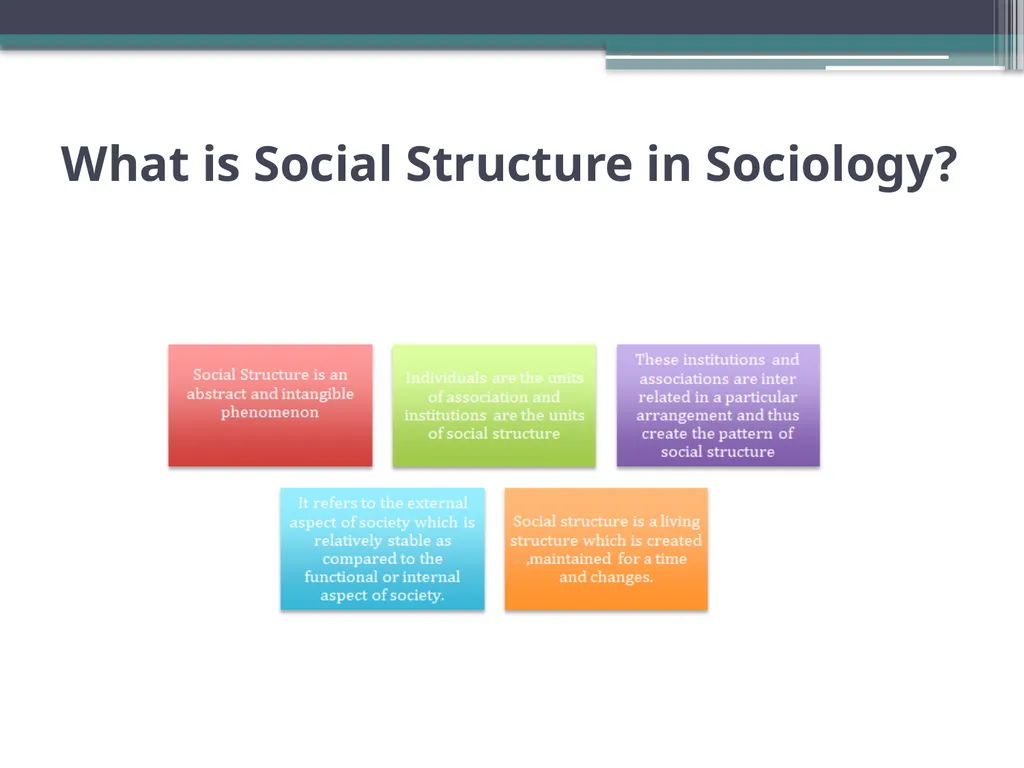
What is Social Structure in Sociology?<br>
53
Social structure is an abstract entity.
Its parts are dynamic and constantly changing.
They are spatially widespread and therefore difficult to see as wholes.
Social structure denotes patterns which change more slowly than the particular personnel who constitute them.<br>
Its parts are dynamic and constantly changing.
They are spatially widespread and therefore difficult to see as wholes.
Social structure denotes patterns which change more slowly than the particular personnel who constitute them.<br>
54
Actually the proper functioning of social structure depends upon proper assignments of roles and statues.
The integration and coordination of the different parts of social structure depend upon conformity of social norms.
The stability of a social structure depends upon the effectiveness of its sanction system.<br>
The integration and coordination of the different parts of social structure depend upon conformity of social norms.
The stability of a social structure depends upon the effectiveness of its sanction system.<br>
55
The successful working of social structure depends upon the realisation of his duties by the individuals and his efforts to fulfil these duties.<br>
56
SOCIAL ROLE Man is a social animal.
Human beings interact with each other in their day-to-day lives
Social roles include a defined set of actions assigned to every individual in the society
The status of each person can be relative to those of others. Status of a person can be of two types, either Ascribed (assigned to a person by birth) or Achieved (earned through effort).
Each person in a given social status is expected to have certain responsibilities in the society. These expectations on people of a given social status, in terms of behaviour, obligations and rights are called ‘Social Roles’.<br>
Human beings interact with each other in their day-to-day lives
Social roles include a defined set of actions assigned to every individual in the society
The status of each person can be relative to those of others. Status of a person can be of two types, either Ascribed (assigned to a person by birth) or Achieved (earned through effort).
Each person in a given social status is expected to have certain responsibilities in the society. These expectations on people of a given social status, in terms of behaviour, obligations and rights are called ‘Social Roles’.<br>
57
A role (also rôle or social role) is a set of connected behaviors, rights, obligations, beliefs, and norms as conceptualized by people in a social situation.
It is an expected or free or continuously changing behavior and may have a given individual social status or social position.<br>
It is an expected or free or continuously changing behavior and may have a given individual social status or social position.<br>
58
Characteristics of the Role: 1. Action Aspect of Status:
The role is in fact the action aspect of status. In involves various types of actions that a person has to perform in accordance with the expectations of the society.<br>
The role is in fact the action aspect of status. In involves various types of actions that a person has to perform in accordance with the expectations of the society.<br>
59
2. Changing Concept of Role: Social roles as already stated, are in accordance with the social values, ideals, patterns etc. These ideals, values and objects change and so the concept of the role also changes.<br>
60
3. Roles are not Performed 100% for the Fulfillment of the Expectations: It is not possible for anyone to perform his role fully in accordance with the expectations of the society.<br>
61
4. Difference in the Importance of Role: From the socio-cultural point of view all the roles are not equally important. Some of the roles are more important while the others are less.<br>
62
There are different concepts related to Social Roles. Role conflict: Role conflict refers to the situation that happens when a person is expected to act in contradictory roles in everyday life. The conflicts can either be a product of contradictory interests or when there exists different norms on what the responsibilities of a particular role are. Role conflicts happen in personal as well as professional life. An example of role conflict is the situation that occurs when a working mother is judged to not fit into the role of a “good wife”.
Role Distancing: Role distancing refers to the practice of distancing oneself from a role. For example, an actor may have to put into practice the concept of role distancing very often, between professional and personal perspectives.<br>
Role Distancing: Role distancing refers to the practice of distancing oneself from a role. For example, an actor may have to put into practice the concept of role distancing very often, between professional and personal perspectives.<br>
63
Role exit: The process of discontinuing from a role in order to establish a new one. An example is the transformation of an individual into a parent.
Role expectation: This refers to the set of actions that are expected from a person playing a certain role. For instance, each profession has a specific set of roles that are expected from them.
Role performance: Role performance is a term that refers to the level of performance of a person with respect to the role that s/he is assigned with.<br>
Role expectation: This refers to the set of actions that are expected from a person playing a certain role. For instance, each profession has a specific set of roles that are expected from them.
Role performance: Role performance is a term that refers to the level of performance of a person with respect to the role that s/he is assigned with.<br>
64
Role reversal: It refers to the act of people exchanging their roles with each other. For examples, a psychologist can at time seek help from a close friend or relative.
Role segregation: Refers to the separating of role partners from each other. For examples, a judge of Court would not appear for a case which s/he has personal connections with.
Role set: It refers to the cumulative set of roles that an individual has, from various roles that s/he plays.<br>
Role segregation: Refers to the separating of role partners from each other. For examples, a judge of Court would not appear for a case which s/he has personal connections with.
Role set: It refers to the cumulative set of roles that an individual has, from various roles that s/he plays.<br>
65
Role strain: This refers to the stress that a person experiences in meeting expectations and obligations associated with any role. An example is when a person is working on a laptop, but wishes to cook food for his children at the same time.
Role taking: The act of assuming to take up the role of another person so as to understand things from their point of view. An example is while an advocate tries to think from the point of view of the accused while examining a case.<br>
Role taking: The act of assuming to take up the role of another person so as to understand things from their point of view. An example is while an advocate tries to think from the point of view of the accused while examining a case.<br>
66
Agency-Structure Agency-making individual choices based on free-will
Structure-cultural and structural influences operate in the decision making process – How society is organized – Society is patterned<br>
Structure-cultural and structural influences operate in the decision making process – How society is organized – Society is patterned<br>
67
Agency- Social Structure Agency: ability to act independently of structure
Social Structure: pre-existing social arrangements that shape behavior.<br>
Social Structure: pre-existing social arrangements that shape behavior.<br>
68
Agency-making individual choices based on free-will
Structure-cultural and structural influences operate in the decision making process<br>
Structure-cultural and structural influences operate in the decision making process<br>
69
Reference: Herton and Hunt, Sociology, Mcgraw - Hill International, Singapore 1984
Andreas Hess, Concept of Social Stratification, European and American Models, Palgrave, Houndmills, NY , 2001
Giddens, Anthony, Capitalisation and Modern Social Theory, University Press Cambridge, 1971
Smelser, N.J.The Sociology of Economic Life, Prentice Hall, New Delhi - 1988.
Haralombos, M, and Heald, R.M. Sociology: Themes and Perspectives, Oxford. Delhi - 1980.
Randall Collins, Theoretical Sociology, Harcourt Brace and Company, Florida, 1996.<br>
Andreas Hess, Concept of Social Stratification, European and American Models, Palgrave, Houndmills, NY , 2001
Giddens, Anthony, Capitalisation and Modern Social Theory, University Press Cambridge, 1971
Smelser, N.J.The Sociology of Economic Life, Prentice Hall, New Delhi - 1988.
Haralombos, M, and Heald, R.M. Sociology: Themes and Perspectives, Oxford. Delhi - 1980.
Randall Collins, Theoretical Sociology, Harcourt Brace and Company, Florida, 1996.<br>
70
THANK YOU<br>