
Societies in Central Islamic Lands Tribal
A
Published · 23 slides · 0 views

1 / 1



Description
Societies in Central Islamic Lands Tribal Background Origin of Jewish and other Tribes The first mention of Jews in the areas of modern-day Saudi Arabia dates back, by some accounts, to the time of the First Temple. Immigration to the
Related Topics
Share
Embed code
Download this presentation From Below
"Societies in Central Islamic Lands Tribal" is the property of its rightful owner. Permission is granted to download and print the materials on this website for personal, non-commercial use only, and to display it on your personal computer provided you do not modify the materials and that you retain all copyright notices contained in the materials. By downloading content from our website, you accept the terms of this agreement.
Presentation Transcript
01
Societies in Central Islamic Lands Tribal Background<br>
02
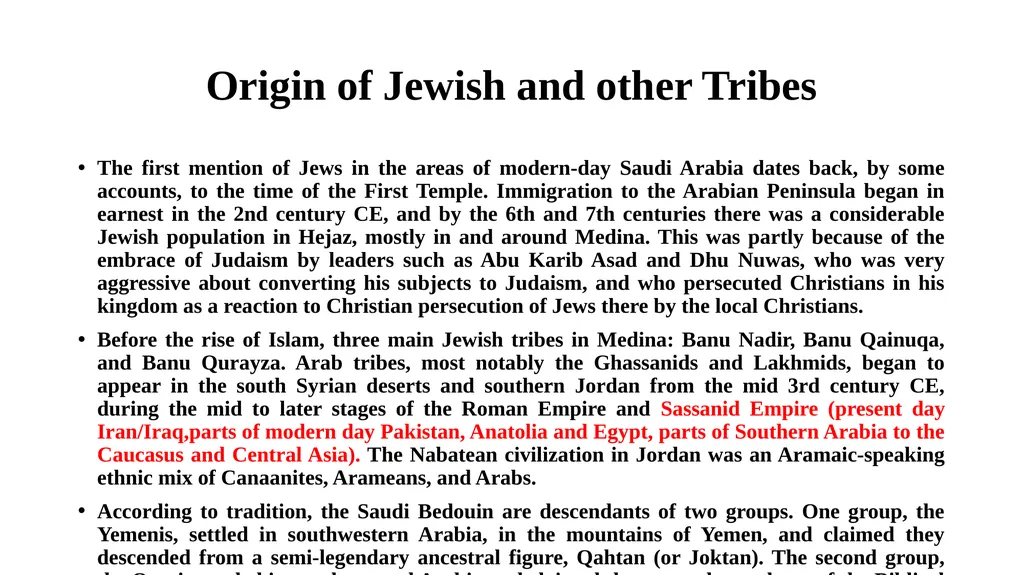
Origin of Jewish and other Tribes The first mention of Jews in the areas of modern-day Saudi Arabia dates back, by some accounts, to the time of the First Temple. Immigration to the Arabian Peninsula began in earnest in the 2nd century CE, and by the 6th and 7th centuries there was a considerable Jewish population in Hejaz, mostly in and around Medina. This was partly because of the embrace of Judaism by leaders such as Abu Karib Asad and Dhu Nuwas, who was very aggressive about converting his subjects to Judaism, and who persecuted Christians in his kingdom as a reaction to Christian persecution of Jews there by the local Christians.
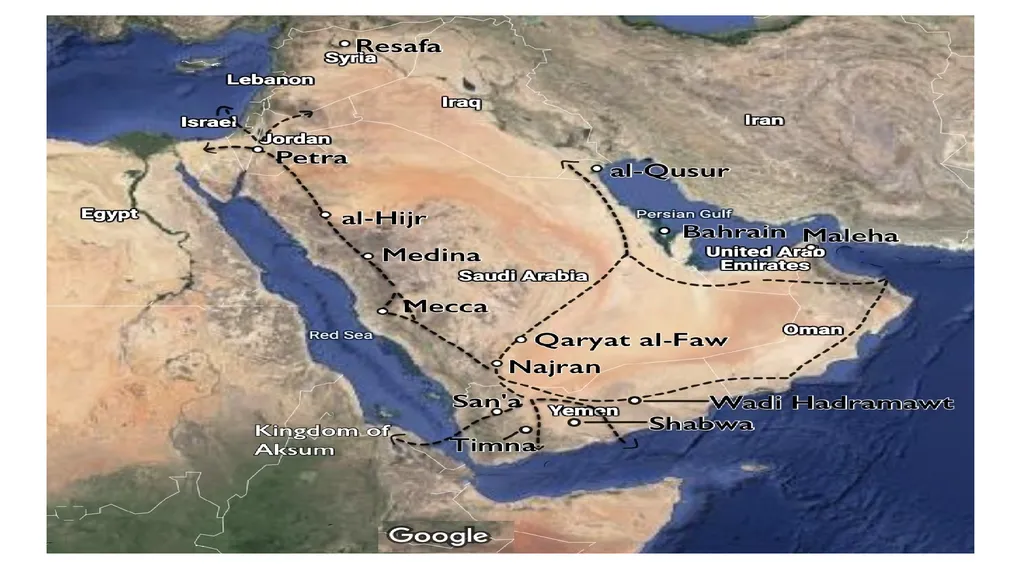
Before the rise of Islam, three main Jewish tribes in Medina: Banu Nadir, Banu Qainuqa, and Banu Qurayza. Arab tribes, most notably the Ghassanids and Lakhmids, began to appear in the south Syrian deserts and southern Jordan from the mid 3rd century CE, during the mid to later stages of the Roman Empire and Sassanid Empire (present day Iran/Iraq,parts of modern day Pakistan, Anatolia and Egypt, parts of Southern Arabia to the Caucasus and Central Asia). The Nabatean civilization in Jordan was an Aramaic-speaking ethnic mix of Canaanites, Arameans, and Arabs.
According to tradition, the Saudi Bedouin are descendants of two groups. One group, the Yemenis, settled in southwestern Arabia, in the mountains of Yemen, and claimed they descended from a semi-legendary ancestral figure, Qahtan (or Joktan). The second group, the Qaysis, settled in north-central Arabia and claimed they were descendants of the Biblical Ishmael.<br>
Before the rise of Islam, three main Jewish tribes in Medina: Banu Nadir, Banu Qainuqa, and Banu Qurayza. Arab tribes, most notably the Ghassanids and Lakhmids, began to appear in the south Syrian deserts and southern Jordan from the mid 3rd century CE, during the mid to later stages of the Roman Empire and Sassanid Empire (present day Iran/Iraq,parts of modern day Pakistan, Anatolia and Egypt, parts of Southern Arabia to the Caucasus and Central Asia). The Nabatean civilization in Jordan was an Aramaic-speaking ethnic mix of Canaanites, Arameans, and Arabs.
According to tradition, the Saudi Bedouin are descendants of two groups. One group, the Yemenis, settled in southwestern Arabia, in the mountains of Yemen, and claimed they descended from a semi-legendary ancestral figure, Qahtan (or Joktan). The second group, the Qaysis, settled in north-central Arabia and claimed they were descendants of the Biblical Ishmael.<br>
03
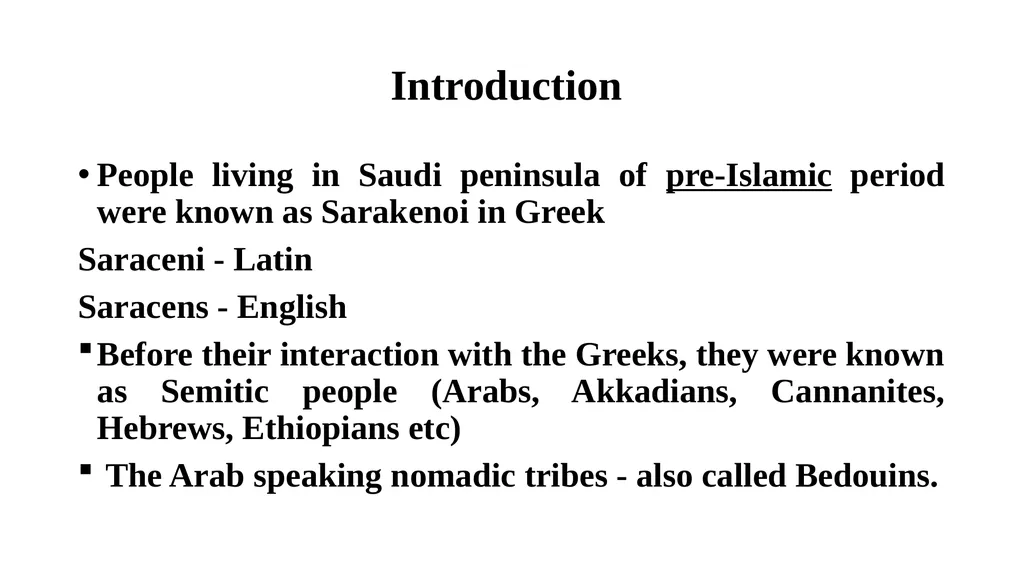
Introduction People living in Saudi peninsula of pre-Islamic period were known as Sarakenoi in Greek
Saraceni - Latin
Saracens - English
Before their interaction with the Greeks, they were known as Semitic people (Arabs, Akkadians, Cannanites, Hebrews, Ethiopians etc)
The Arab speaking nomadic tribes - also called Bedouins.<br>
Saraceni - Latin
Saracens - English
Before their interaction with the Greeks, they were known as Semitic people (Arabs, Akkadians, Cannanites, Hebrews, Ethiopians etc)
The Arab speaking nomadic tribes - also called Bedouins.<br>
04
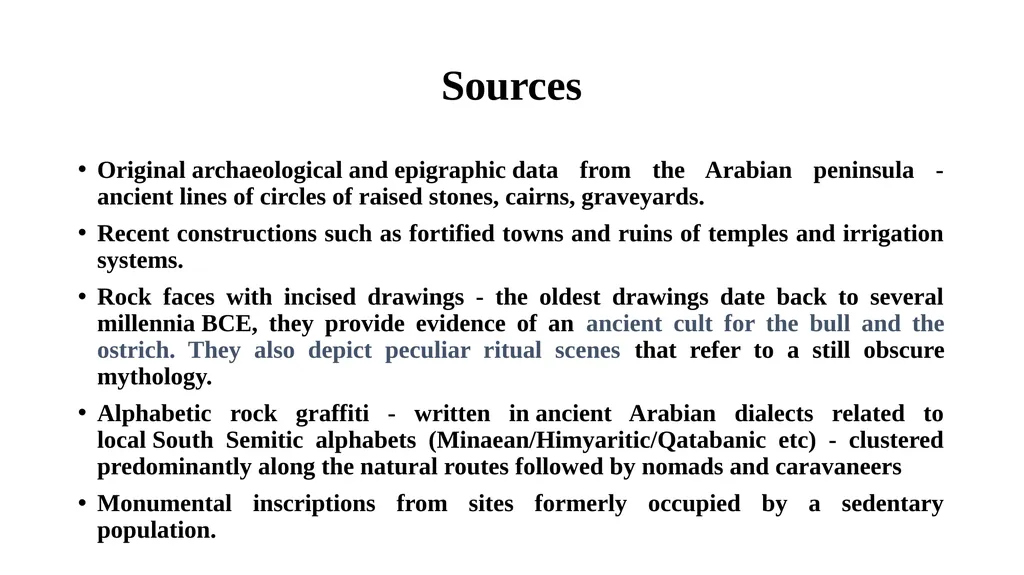
Sources Original archaeological and epigraphic data from the Arabian peninsula - ancient lines of circles of raised stones, cairns, graveyards.
Recent constructions such as fortified towns and ruins of temples and irrigation systems.
Rock faces with incised drawings - the oldest drawings date back to several millennia BCE, they provide evidence of an ancient cult for the bull and the ostrich. They also depict peculiar ritual scenes that refer to a still obscure mythology.
Alphabetic rock graffiti - written in ancient Arabian dialects related to local South Semitic alphabets (Minaean/Himyaritic/Qatabanic etc) - clustered predominantly along the natural routes followed by nomads and caravaneers
Monumental inscriptions from sites formerly occupied by a sedentary population.<br>
Recent constructions such as fortified towns and ruins of temples and irrigation systems.
Rock faces with incised drawings - the oldest drawings date back to several millennia BCE, they provide evidence of an ancient cult for the bull and the ostrich. They also depict peculiar ritual scenes that refer to a still obscure mythology.
Alphabetic rock graffiti - written in ancient Arabian dialects related to local South Semitic alphabets (Minaean/Himyaritic/Qatabanic etc) - clustered predominantly along the natural routes followed by nomads and caravaneers
Monumental inscriptions from sites formerly occupied by a sedentary population.<br>
05
Cairns Graveyards Graffiti<br>
06
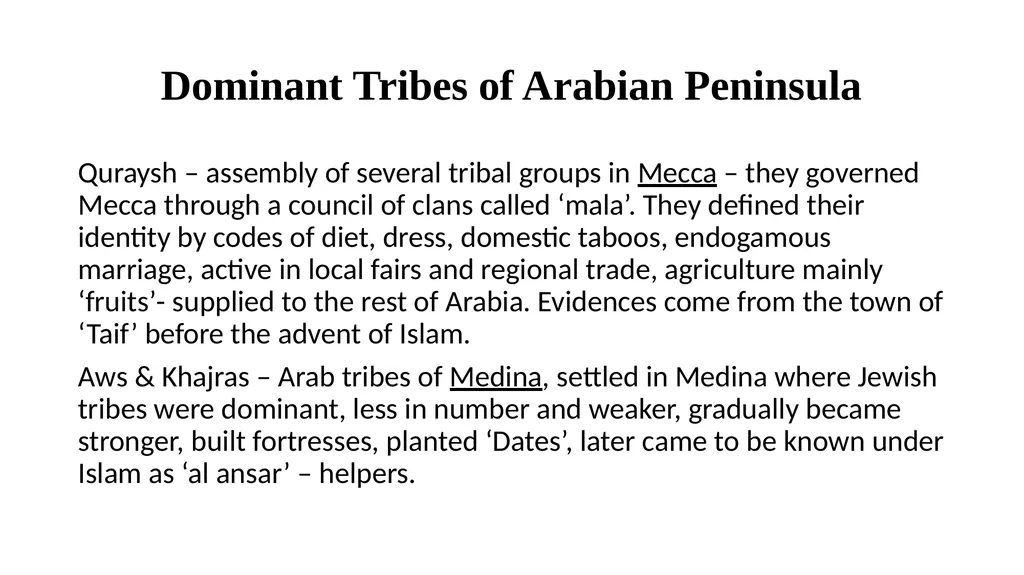
Dominant Tribes of Arabian Peninsula Quraysh – assembly of several tribal groups in Mecca – they governed Mecca through a council of clans called ‘mala’. They defined their identity by codes of diet, dress, domestic taboos, endogamous marriage, active in local fairs and regional trade, agriculture mainly ‘fruits’- supplied to the rest of Arabia. Evidences come from the town of ‘Taif’ before the advent of Islam.
Aws & Khajras – Arab tribes of Medina, settled in Medina where Jewish tribes were dominant, less in number and weaker, gradually became stronger, built fortresses, planted ‘Dates’, later came to be known under Islam as ‘al ansar’ – helpers.<br>
Aws & Khajras – Arab tribes of Medina, settled in Medina where Jewish tribes were dominant, less in number and weaker, gradually became stronger, built fortresses, planted ‘Dates’, later came to be known under Islam as ‘al ansar’ – helpers.<br>
07
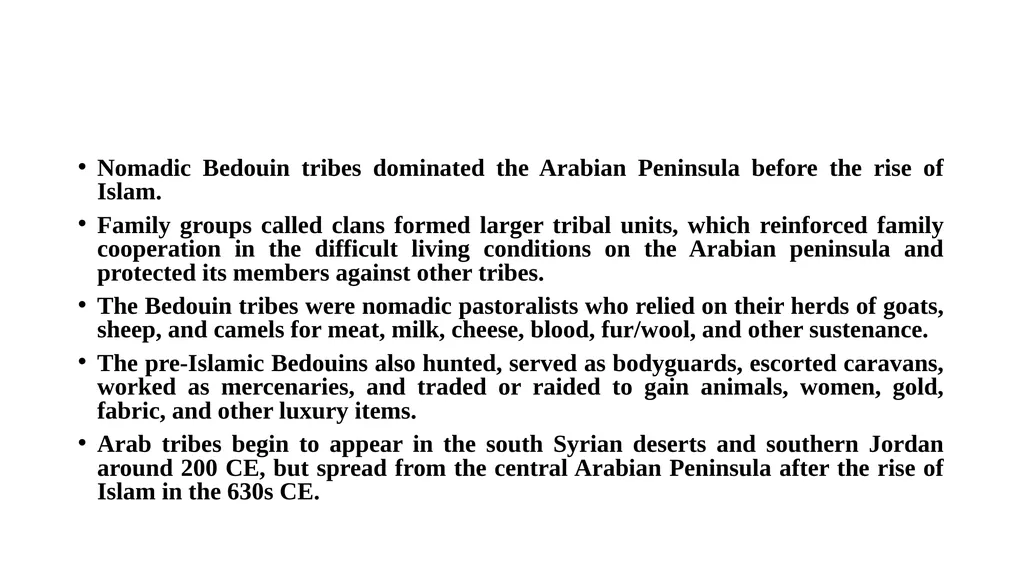
Nomadic Bedouin tribes dominated the Arabian Peninsula before the rise of Islam.
Family groups called clans formed larger tribal units, which reinforced family cooperation in the difficult living conditions on the Arabian peninsula and protected its members against other tribes.
The Bedouin tribes were nomadic pastoralists who relied on their herds of goats, sheep, and camels for meat, milk, cheese, blood, fur/wool, and other sustenance.
The pre-Islamic Bedouins also hunted, served as bodyguards, escorted caravans, worked as mercenaries, and traded or raided to gain animals, women, gold, fabric, and other luxury items.
Arab tribes begin to appear in the south Syrian deserts and southern Jordan around 200 CE, but spread from the central Arabian Peninsula after the rise of Islam in the 630s CE.<br>
Family groups called clans formed larger tribal units, which reinforced family cooperation in the difficult living conditions on the Arabian peninsula and protected its members against other tribes.
The Bedouin tribes were nomadic pastoralists who relied on their herds of goats, sheep, and camels for meat, milk, cheese, blood, fur/wool, and other sustenance.
The pre-Islamic Bedouins also hunted, served as bodyguards, escorted caravans, worked as mercenaries, and traded or raided to gain animals, women, gold, fabric, and other luxury items.
Arab tribes begin to appear in the south Syrian deserts and southern Jordan around 200 CE, but spread from the central Arabian Peninsula after the rise of Islam in the 630s CE.<br>
08
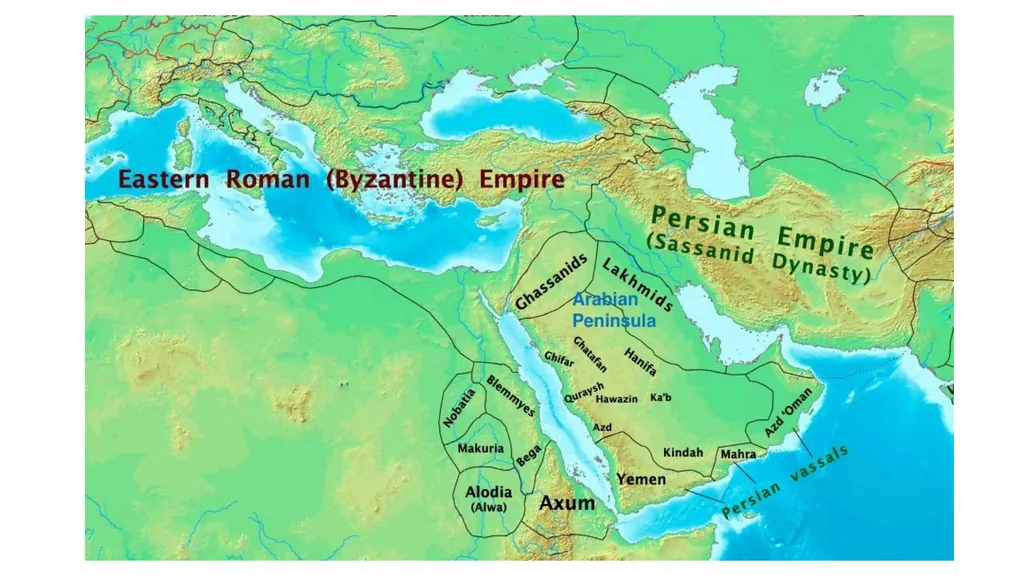
Tribes in the Arabian Peninsula c. 600 CE. Approximate locations of some of the important tribes and Empire of the Arabian Peninsula before the dawn of Islam. Family groups called clans formed larger tribal units, which reinforced family cooperation in the difficulty living conditions on the Arabian peninsula and protected its members against other tribes.<br>
09
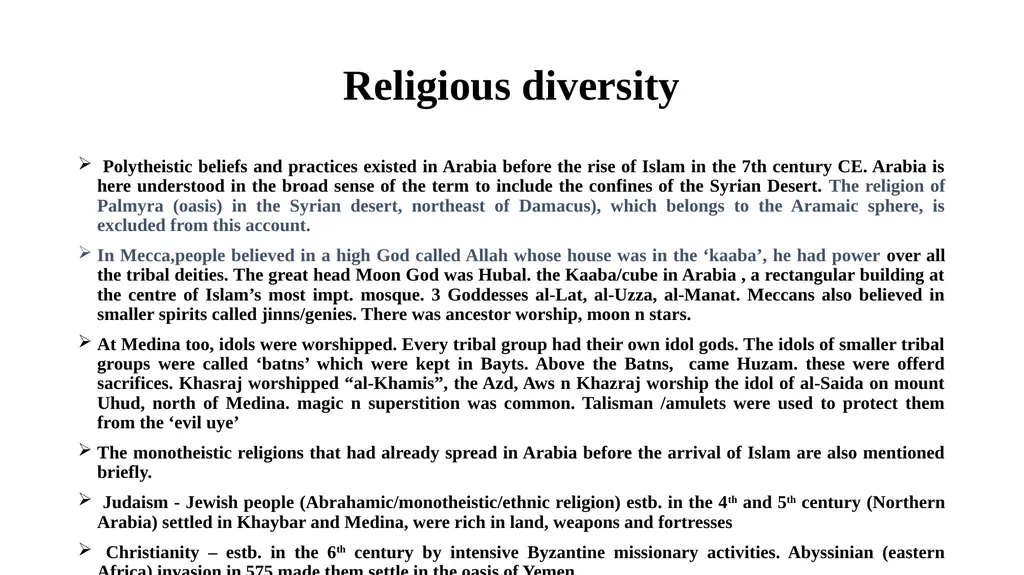
Religious diversity Polytheistic beliefs and practices existed in Arabia before the rise of Islam in the 7th century CE. Arabia is here understood in the broad sense of the term to include the confines of the Syrian Desert. The religion of Palmyra (oasis) in the Syrian desert, northeast of Damacus), which belongs to the Aramaic sphere, is excluded from this account.
In Mecca,people believed in a high God called Allah whose house was in the ‘kaaba’, he had power over all the tribal deities. The great head Moon God was Hubal. the Kaaba/cube in Arabia , a rectangular building at the centre of Islam’s most impt. mosque. 3 Goddesses al-Lat, al-Uzza, al-Manat. Meccans also believed in smaller spirits called jinns/genies. There was ancestor worship, moon n stars.
At Medina too, idols were worshipped. Every tribal group had their own idol gods. The idols of smaller tribal groups were called ‘batns’ which were kept in Bayts. Above the Batns, came Huzam. these were offerd sacrifices. Khasraj worshipped “al-Khamis”, the Azd, Aws n Khazraj worship the idol of al-Saida on mount Uhud, north of Medina. magic n superstition was common. Talisman /amulets were used to protect them from the ‘evil uye’
The monotheistic religions that had already spread in Arabia before the arrival of Islam are also mentioned briefly.
Judaism - Jewish people (Abrahamic/monotheistic/ethnic religion) estb. in the 4th and 5th century (Northern Arabia) settled in Khaybar and Medina, were rich in land, weapons and fortresses
Christianity – estb. in the 6th century by intensive Byzantine missionary activities. Abyssinian (eastern Africa) invasion in 575 made them settle in the oasis of Yemen.<br>
In Mecca,people believed in a high God called Allah whose house was in the ‘kaaba’, he had power over all the tribal deities. The great head Moon God was Hubal. the Kaaba/cube in Arabia , a rectangular building at the centre of Islam’s most impt. mosque. 3 Goddesses al-Lat, al-Uzza, al-Manat. Meccans also believed in smaller spirits called jinns/genies. There was ancestor worship, moon n stars.
At Medina too, idols were worshipped. Every tribal group had their own idol gods. The idols of smaller tribal groups were called ‘batns’ which were kept in Bayts. Above the Batns, came Huzam. these were offerd sacrifices. Khasraj worshipped “al-Khamis”, the Azd, Aws n Khazraj worship the idol of al-Saida on mount Uhud, north of Medina. magic n superstition was common. Talisman /amulets were used to protect them from the ‘evil uye’
The monotheistic religions that had already spread in Arabia before the arrival of Islam are also mentioned briefly.
Judaism - Jewish people (Abrahamic/monotheistic/ethnic religion) estb. in the 4th and 5th century (Northern Arabia) settled in Khaybar and Medina, were rich in land, weapons and fortresses
Christianity – estb. in the 6th century by intensive Byzantine missionary activities. Abyssinian (eastern Africa) invasion in 575 made them settle in the oasis of Yemen.<br>
10
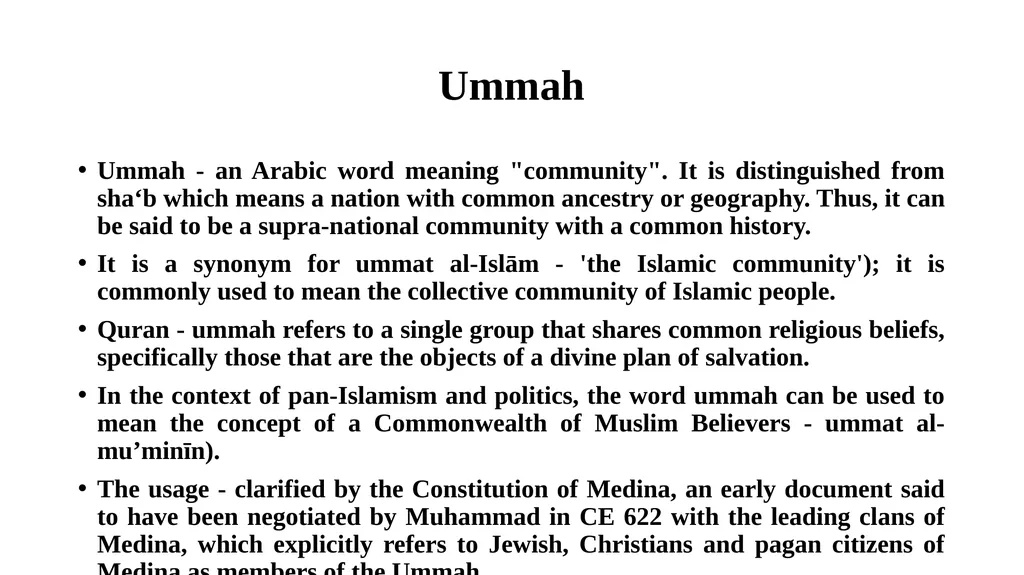
Ummah Ummah - an Arabic word meaning "community". It is distinguished from shaʻb which means a nation with common ancestry or geography. Thus, it can be said to be a supra-national community with a common history.
It is a synonym for ummat al-Islām - 'the Islamic community'); it is commonly used to mean the collective community of Islamic people.
Quran - ummah refers to a single group that shares common religious beliefs, specifically those that are the objects of a divine plan of salvation.
In the context of pan-Islamism and politics, the word ummah can be used to mean the concept of a Commonwealth of Muslim Believers - ummat al-muʼminīn).
The usage - clarified by the Constitution of Medina, an early document said to have been negotiated by Muhammad in CE 622 with the leading clans of Medina, which explicitly refers to Jewish, Christians and pagan citizens of Medina as members of the Ummah.<br>
It is a synonym for ummat al-Islām - 'the Islamic community'); it is commonly used to mean the collective community of Islamic people.
Quran - ummah refers to a single group that shares common religious beliefs, specifically those that are the objects of a divine plan of salvation.
In the context of pan-Islamism and politics, the word ummah can be used to mean the concept of a Commonwealth of Muslim Believers - ummat al-muʼminīn).
The usage - clarified by the Constitution of Medina, an early document said to have been negotiated by Muhammad in CE 622 with the leading clans of Medina, which explicitly refers to Jewish, Christians and pagan citizens of Medina as members of the Ummah.<br>
11
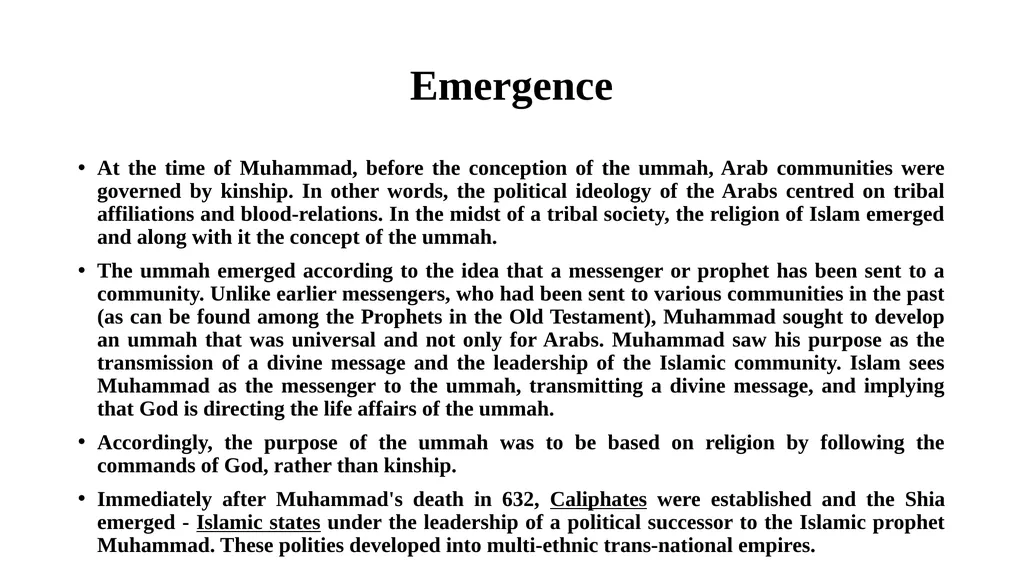
Emergence At the time of Muhammad, before the conception of the ummah, Arab communities were governed by kinship. In other words, the political ideology of the Arabs centred on tribal affiliations and blood-relations. In the midst of a tribal society, the religion of Islam emerged and along with it the concept of the ummah.
The ummah emerged according to the idea that a messenger or prophet has been sent to a community. Unlike earlier messengers, who had been sent to various communities in the past (as can be found among the Prophets in the Old Testament), Muhammad sought to develop an ummah that was universal and not only for Arabs. Muhammad saw his purpose as the transmission of a divine message and the leadership of the Islamic community. Islam sees Muhammad as the messenger to the ummah, transmitting a divine message, and implying that God is directing the life affairs of the ummah.
Accordingly, the purpose of the ummah was to be based on religion by following the commands of God, rather than kinship.
Immediately after Muhammad's death in 632, Caliphates were established and the Shia emerged - Islamic states under the leadership of a political successor to the Islamic prophet Muhammad. These polities developed into multi-ethnic trans-national empires.<br>
The ummah emerged according to the idea that a messenger or prophet has been sent to a community. Unlike earlier messengers, who had been sent to various communities in the past (as can be found among the Prophets in the Old Testament), Muhammad sought to develop an ummah that was universal and not only for Arabs. Muhammad saw his purpose as the transmission of a divine message and the leadership of the Islamic community. Islam sees Muhammad as the messenger to the ummah, transmitting a divine message, and implying that God is directing the life affairs of the ummah.
Accordingly, the purpose of the ummah was to be based on religion by following the commands of God, rather than kinship.
Immediately after Muhammad's death in 632, Caliphates were established and the Shia emerged - Islamic states under the leadership of a political successor to the Islamic prophet Muhammad. These polities developed into multi-ethnic trans-national empires.<br>
12
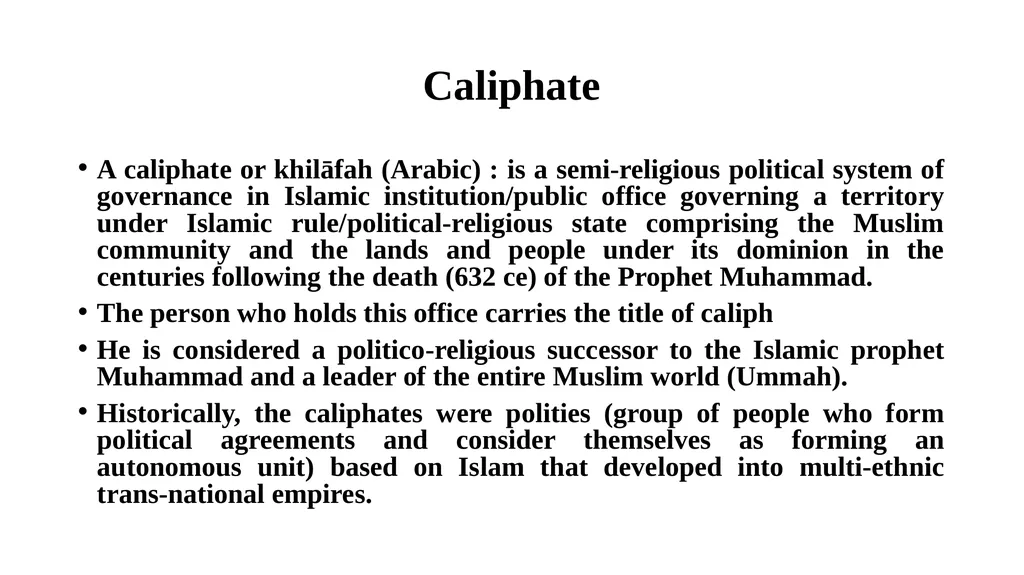
Caliphate A caliphate or khilāfah (Arabic) : is a semi-religious political system of governance in Islamic institution/public office governing a territory under Islamic rule/political-religious state comprising the Muslim community and the lands and people under its dominion in the centuries following the death (632 ce) of the Prophet Muhammad.
The person who holds this office carries the title of caliph
He is considered a politico-religious successor to the Islamic prophet Muhammad and a leader of the entire Muslim world (Ummah).
Historically, the caliphates were polities (group of people who form political agreements and consider themselves as forming an autonomous unit) based on Islam that developed into multi-ethnic trans-national empires.<br>
The person who holds this office carries the title of caliph
He is considered a politico-religious successor to the Islamic prophet Muhammad and a leader of the entire Muslim world (Ummah).
Historically, the caliphates were polities (group of people who form political agreements and consider themselves as forming an autonomous unit) based on Islam that developed into multi-ethnic trans-national empires.<br>
13
A short history of Caliphate The importance of the Caliphate fluctuated throughout the history of Islam. The institution survived for over a thousand years. Often acting as little more than a symbolic figurehead, the formal office of Caliph remained from the death of Muhammad in 632 until the Ottoman Caliphate was formally dismantled in 1924.
During the medieval period, three major caliphates succeeded each other:
the Rashidun Caliphate (632–661),
the Umayyad Caliphate (661–750),
the Abbasid Caliphate (750–1517).
In the fourth major caliphate, the Ottoman Caliphate, the rulers of the Ottoman Empire claimed caliphal authority from 1517 and maintained Sunni Islam as the official religion. A few other Muslim states, almost all hereditary monarchies like the Abbasid caliphs under protection of the Mamluk Sultanate (Cairo) and the Ayyubid Caliphate, have claimed to be caliphates. The first caliph was Abu Bakr and the last caliph was Abdulmejid II.<br>
During the medieval period, three major caliphates succeeded each other:
the Rashidun Caliphate (632–661),
the Umayyad Caliphate (661–750),
the Abbasid Caliphate (750–1517).
In the fourth major caliphate, the Ottoman Caliphate, the rulers of the Ottoman Empire claimed caliphal authority from 1517 and maintained Sunni Islam as the official religion. A few other Muslim states, almost all hereditary monarchies like the Abbasid caliphs under protection of the Mamluk Sultanate (Cairo) and the Ayyubid Caliphate, have claimed to be caliphates. The first caliph was Abu Bakr and the last caliph was Abdulmejid II.<br>
14
The first four Rashidun Caliphs (Abu Bakr, Umar, Uthman and Ali) became the majority Sunni sect.
Under the Rāshidun each region (Sultanate, Wilayah, or Emirate) of the Caliphate had its own governor (Sultan, Wāli or Emir). Muāwiyah, a relative of Uthman and governor (Wali) of Syria, succeeded Ali as Caliph. Muāwiyah transformed the caliphate into a hereditary office, thus founding the Umayyad dynasty.
In areas which were previously under Sasanian Empire or Byzantine rule, the Caliphs lowered taxes, provided greater local autonomy (to their delegated governors), greater religious freedom for Jews, and some indigenous Christians, and brought peace to people demoralised and disaffected by the casualties and heavy taxation that resulted from the decades of Byzantine-Persian warfare.<br>
Under the Rāshidun each region (Sultanate, Wilayah, or Emirate) of the Caliphate had its own governor (Sultan, Wāli or Emir). Muāwiyah, a relative of Uthman and governor (Wali) of Syria, succeeded Ali as Caliph. Muāwiyah transformed the caliphate into a hereditary office, thus founding the Umayyad dynasty.
In areas which were previously under Sasanian Empire or Byzantine rule, the Caliphs lowered taxes, provided greater local autonomy (to their delegated governors), greater religious freedom for Jews, and some indigenous Christians, and brought peace to people demoralised and disaffected by the casualties and heavy taxation that resulted from the decades of Byzantine-Persian warfare.<br>
15
Successors of Muhammad After the death of Muhammad, a gathering of the Ansar (natives of Medina) took place in the Saqifah (courtyard) of the Banu Sa'ida clan. The purpose of the meeting was for the Ansar to decide a new leader, with the intentional exclusion of the Muhajirun (migrants from Mecca)
Hearing this, Abu Bakr and Umar, both prominent companions of Muhammad, were concerned of a coup and hastened to the gathering. There, Abu Bakr addressed the men with a warning that an attempt to elect a leader outside of Muhammad's own tribe, the Quraysh, would likely result in dissension. He then took Umar and another companion, Abu Ubaidah ibn al-Jarrah, by the hand and offered them to the Ansar as potential choices. He was countered with the suggestion that the Quraysh and the Ansar choose a leader each from among themselves, and rule jointly. Umar hastily took Abu Bakr's hand and swore his own allegiance to the latter, an example followed by the gathered men.
Abu Bakr was near-universally accepted as head of the Muslim community (under the title of Caliph). Several companions, eg, Ali ibn Abi Talib, initially refused to acknowledge his authority. Ali may have been reasonably expected to assume leadership, being both cousin and son-in-law to Muhammad.
The theologian Ibrahim al-Nakhai stated that Ali also had support among the Ansar for his succession, explained by the genealogical links he shared with them. Abu Bakr later sent Umar to confront Ali to gain his allegiance, resulting in an altercation which may have involved violence. However, after six months the group made peace with Abu Bakr and Ali offered him his fealty.<br>
Hearing this, Abu Bakr and Umar, both prominent companions of Muhammad, were concerned of a coup and hastened to the gathering. There, Abu Bakr addressed the men with a warning that an attempt to elect a leader outside of Muhammad's own tribe, the Quraysh, would likely result in dissension. He then took Umar and another companion, Abu Ubaidah ibn al-Jarrah, by the hand and offered them to the Ansar as potential choices. He was countered with the suggestion that the Quraysh and the Ansar choose a leader each from among themselves, and rule jointly. Umar hastily took Abu Bakr's hand and swore his own allegiance to the latter, an example followed by the gathered men.
Abu Bakr was near-universally accepted as head of the Muslim community (under the title of Caliph). Several companions, eg, Ali ibn Abi Talib, initially refused to acknowledge his authority. Ali may have been reasonably expected to assume leadership, being both cousin and son-in-law to Muhammad.
The theologian Ibrahim al-Nakhai stated that Ali also had support among the Ansar for his succession, explained by the genealogical links he shared with them. Abu Bakr later sent Umar to confront Ali to gain his allegiance, resulting in an altercation which may have involved violence. However, after six months the group made peace with Abu Bakr and Ali offered him his fealty.<br>
16
Rashidun Caliphate Abu Bakr nominated Umar as his successor on his deathbed. he became the second caliph. Umar was killed by a Persian slave Abu Lu'lu'a Firuz.
He was succeded by Uthman, through election by a council of electors (majlis). Uthman was again killed by members of a disaffected group. Ali then took control but was not universally accepted as caliph by the governors of Egypt and later by some of his own guard. He faced two major rebellions. He was assassinated by Abd-al-Rahman ibn Muljam, a Khawarij. Ali ruled only five years. This period is known as the Fitna, or the first Islamic civil war. The followers of Ali later became the Shi'a ("shiaat Ali", partisans of Ali. minority sect of Islam and reject the legitimacy of the first 3 caliphs. The followers of all four Rāshidun Caliphs (Abu Bakr, Umar, Uthman and Ali) became the majority Sunni sect.
Under the Rāshidun each region (Sultanate, Wilayah, or Emirate) of the Caliphate had its own governor (Sultan, Wāli or Emir). Muāwiyah, a relative of Uthman and governor (Wali) of Syria, succeeded Ali as Caliph. Muāwiyah transformed the caliphate into a hereditary office and founded the Umayyad dynasty in 661, Damascus
In areas which were previously under Sasanian Empire (Iran) or Byzantine rule, the Caliphs lowered taxes, provided greater local autonomy (to their delegated governors), greater religious freedom for Jews, and some indigenous Christians, and brought peace to peoples demoralised and disaffected by the casualties and heavy taxation that resulted from the decades of Byzantine-Persian warfare (602-628)<br>
He was succeded by Uthman, through election by a council of electors (majlis). Uthman was again killed by members of a disaffected group. Ali then took control but was not universally accepted as caliph by the governors of Egypt and later by some of his own guard. He faced two major rebellions. He was assassinated by Abd-al-Rahman ibn Muljam, a Khawarij. Ali ruled only five years. This period is known as the Fitna, or the first Islamic civil war. The followers of Ali later became the Shi'a ("shiaat Ali", partisans of Ali. minority sect of Islam and reject the legitimacy of the first 3 caliphs. The followers of all four Rāshidun Caliphs (Abu Bakr, Umar, Uthman and Ali) became the majority Sunni sect.
Under the Rāshidun each region (Sultanate, Wilayah, or Emirate) of the Caliphate had its own governor (Sultan, Wāli or Emir). Muāwiyah, a relative of Uthman and governor (Wali) of Syria, succeeded Ali as Caliph. Muāwiyah transformed the caliphate into a hereditary office and founded the Umayyad dynasty in 661, Damascus
In areas which were previously under Sasanian Empire (Iran) or Byzantine rule, the Caliphs lowered taxes, provided greater local autonomy (to their delegated governors), greater religious freedom for Jews, and some indigenous Christians, and brought peace to peoples demoralised and disaffected by the casualties and heavy taxation that resulted from the decades of Byzantine-Persian warfare (602-628)<br>
17
Umayyad Caliphate Beginning with the Umayyads, the title of the caliph became hereditary. Under the Umayyads, the Caliphate grew rapidly in territory, incorporating the Caucasus (region betwn Black Sea and Caspian Sea comprising Armenia, Ajerbaijan, Georgia, parts of Southern Russia), Transoxiana (Central Asia-Usbekistan, western Tajikistan, western Kyrgyztan, north western Turkmenistan n Southern Kazakhsthan), Sindh-Pak, the Maghreb (North west Africa comprising Algeria, Libya, Mauritania, Morocco n Tunisia) and most of the Iberian Peninsula (Al-Andalus-modern Spain n Portugal area) into the Muslim world. At its greatest extent, the Umayyad Caliphate covered 5.17 million square miles (13,400,000 km2), making it the largest empire the world had yet seen and the sixth-largest ever to exist in history.
Geographically, the empire was divided into several provinces, the borders of which changed numerous times during the Umayyad reign.[citation needed] Each province had a governor appointed by the caliph. However, for a variety of reasons, including that they were not elected by Shura and suggestions of impious behaviour, the Umayyad dynasty was not universally supported within the Muslim community.[citation needed] Some supported prominent early Muslims like Zubayr ibn al-Awwam; others felt that only members of Muhammad's clan, the Banu Hashim, or his own lineage, the descendants of Ali, should rule.[citation needed]
There were numerous rebellions against the Umayyads, as well as splits within the Umayyad ranks (notably, the rivalry between Yaman and Qays).[citation needed] At the command of Yazid son of Muawiya, an army led by Umar ibn Saad, a commander by the name of Shimr Ibn Thil-Jawshan killed Ali's son Hussein and his family at the Battle of Karbala in 680, solidifying the Shia-Sunni split.[25] Eventually, supporters of the Banu Hashim and the supporters of the lineage of Ali united to bring down the Umayyads in 750. However, the Shi‘at ‘Alī, "the Party of Ali", were again disappointed when the Abbasid dynasty took power, as the Abbasids were descended from Muhammad's uncle, ‘Abbas ibn ‘Abd al-Muttalib and not from Ali.<br>
Geographically, the empire was divided into several provinces, the borders of which changed numerous times during the Umayyad reign.[citation needed] Each province had a governor appointed by the caliph. However, for a variety of reasons, including that they were not elected by Shura and suggestions of impious behaviour, the Umayyad dynasty was not universally supported within the Muslim community.[citation needed] Some supported prominent early Muslims like Zubayr ibn al-Awwam; others felt that only members of Muhammad's clan, the Banu Hashim, or his own lineage, the descendants of Ali, should rule.[citation needed]
There were numerous rebellions against the Umayyads, as well as splits within the Umayyad ranks (notably, the rivalry between Yaman and Qays).[citation needed] At the command of Yazid son of Muawiya, an army led by Umar ibn Saad, a commander by the name of Shimr Ibn Thil-Jawshan killed Ali's son Hussein and his family at the Battle of Karbala in 680, solidifying the Shia-Sunni split.[25] Eventually, supporters of the Banu Hashim and the supporters of the lineage of Ali united to bring down the Umayyads in 750. However, the Shi‘at ‘Alī, "the Party of Ali", were again disappointed when the Abbasid dynasty took power, as the Abbasids were descended from Muhammad's uncle, ‘Abbas ibn ‘Abd al-Muttalib and not from Ali.<br>
18
Abbasid Caliphate in Baghdad Mustansiriya Madrasah in Baghdad
In 750, the Umayyad dynasty was overthrown by another family of Meccan origin, the Abbasids. Their time represented a scientific, cultural and religious flowering.[citation needed] Islamic art and music also flourished significantly during their reign. Their major city and capital Baghdad began to flourish as a center of knowledge, culture and trade. This period of cultural fruition ended in 1258 with the sack of Baghdad by the Mongols under Hulagu Khan. The Abbasid Caliphate had however lost its effective power outside Iraq already by c. 920. By 945, the loss of power became official when the Buyids conquered Baghdad and all of Iraq. The empire fell apart and its parts were ruled for the next century by local dynasties.
In the 9th century, the Abbasids created an army loyal only to their caliphate, composed predominantly of Turkic Cuman, Circassian and Georgian slave origin known as Mamluks. By 1250 the Mamluks came to power in Egypt. The Mamluk army, though often viewed negatively, both helped and hurt the caliphate. Early on, it provided the government with a stable force to address domestic and foreign problems. However, creation of this foreign army and al-Mu'tasim's transfer of the capital from Baghdad to Samarra created a division between the caliphate and the peoples they claimed to rule. In addition, the power of the Mamluks steadily grew until Ar-Radi (934–41) was constrained to hand over most of the royal functions to Muhammad ibn Ra'iq.<br>
In 750, the Umayyad dynasty was overthrown by another family of Meccan origin, the Abbasids. Their time represented a scientific, cultural and religious flowering.[citation needed] Islamic art and music also flourished significantly during their reign. Their major city and capital Baghdad began to flourish as a center of knowledge, culture and trade. This period of cultural fruition ended in 1258 with the sack of Baghdad by the Mongols under Hulagu Khan. The Abbasid Caliphate had however lost its effective power outside Iraq already by c. 920. By 945, the loss of power became official when the Buyids conquered Baghdad and all of Iraq. The empire fell apart and its parts were ruled for the next century by local dynasties.
In the 9th century, the Abbasids created an army loyal only to their caliphate, composed predominantly of Turkic Cuman, Circassian and Georgian slave origin known as Mamluks. By 1250 the Mamluks came to power in Egypt. The Mamluk army, though often viewed negatively, both helped and hurt the caliphate. Early on, it provided the government with a stable force to address domestic and foreign problems. However, creation of this foreign army and al-Mu'tasim's transfer of the capital from Baghdad to Samarra created a division between the caliphate and the peoples they claimed to rule. In addition, the power of the Mamluks steadily grew until Ar-Radi (934–41) was constrained to hand over most of the royal functions to Muhammad ibn Ra'iq.<br>
19
Ali’s reign and rise of the Ummayad dynasty Ali's reign - plagued by turmoil and internal strife.
The Persians - infiltrated the two armies and attacked the other army causing chaos and internal hatred between the companions at the Battle of Siffin that lasted several months, resulting in a stalemate.
To avoid further bloodshed, Ali agreed to negotiate with Mu'awiyah. This caused a faction of approximately 4,000 people, who would come to be known as the Kharijites, to abandon the fight. After defeating the Kharijites at the Battle of Nahrawan, Ali was later assassinated by the Kharijite Ibn Muljam. Ali's son Hasan was elected as the next caliph, but abdicated in favor of Mu'awiyah a few months later to avoid any conflict within the Muslims. Mu'awiyah became the sixth caliph, establishing the Umayyad Dynasty, named after the great-grandfather of Uthman and Mu'awiyah, Umayya ibn Abd Shams.<br>
The Persians - infiltrated the two armies and attacked the other army causing chaos and internal hatred between the companions at the Battle of Siffin that lasted several months, resulting in a stalemate.
To avoid further bloodshed, Ali agreed to negotiate with Mu'awiyah. This caused a faction of approximately 4,000 people, who would come to be known as the Kharijites, to abandon the fight. After defeating the Kharijites at the Battle of Nahrawan, Ali was later assassinated by the Kharijite Ibn Muljam. Ali's son Hasan was elected as the next caliph, but abdicated in favor of Mu'awiyah a few months later to avoid any conflict within the Muslims. Mu'awiyah became the sixth caliph, establishing the Umayyad Dynasty, named after the great-grandfather of Uthman and Mu'awiyah, Umayya ibn Abd Shams.<br>
20
Ummayad Caliphate (661-750) The Caliphate, 622–750
Expansion under Muhammad, 622–632, Expansion during the Rashidun Caliphs, 632–661, Expansion during the Umayyad Caliphate, 661–750
Beginning with the Umayyads, the title of the caliph became hereditary. Under the Umayyads, the Caliphate grew rapidly in territory, incorporating the Caucasus, Transoxiana, Sindh, the Maghreb and most of the Iberian Peninsula (Al-Andalus) into the Muslim world. At its greatest extent, the Umayyad Caliphate covered 5.17 million square miles (13,400,000 km2), making it the largest empire the world had yet seen and the sixth-largest ever to exist in history.
Geographically, the empire was divided into several provinces, the borders of which changed numerous times during the Umayyad reign. Each province had a governor appointed by the caliph. However, for a variety of reasons, including that they were not elected by Shura and suggestions of impious behaviour, the Umayyad dynasty was not universally supported within the Muslim community. Some supported prominent early Muslims like Zubayr ibn al-Awwam; others felt that only members of Muhammad's clan, the Banu Hashim, or his own lineage, the descendants of Ali, should rule.
There were numerous rebellions against the Umayyads, as well as splits within the Umayyad ranks (notably, the rivalry between Yaman and Qays). At the command of Yazid son of Muawiya, an army led by Umar ibn Saad, a commander by the name of Shimr Ibn Thil-Jawshan killed Ali's son Hussein and his family at the Battle of Karbala in 680, solidifying the Shia-Sunni split. Eventually, supporters of the Banu Hashim and the supporters of the lineage of Ali united to bring down the Umayyads in 750. However, the Shi‘at ‘Alī, "the Party of Ali", were again disappointed when the Abbasid dynasty took power, as the Abbasids were descended from Muhammad's uncle, ‘Abbas ibn ‘Abd al-Muttalib and not from Ali.<br>
Expansion under Muhammad, 622–632, Expansion during the Rashidun Caliphs, 632–661, Expansion during the Umayyad Caliphate, 661–750
Beginning with the Umayyads, the title of the caliph became hereditary. Under the Umayyads, the Caliphate grew rapidly in territory, incorporating the Caucasus, Transoxiana, Sindh, the Maghreb and most of the Iberian Peninsula (Al-Andalus) into the Muslim world. At its greatest extent, the Umayyad Caliphate covered 5.17 million square miles (13,400,000 km2), making it the largest empire the world had yet seen and the sixth-largest ever to exist in history.
Geographically, the empire was divided into several provinces, the borders of which changed numerous times during the Umayyad reign. Each province had a governor appointed by the caliph. However, for a variety of reasons, including that they were not elected by Shura and suggestions of impious behaviour, the Umayyad dynasty was not universally supported within the Muslim community. Some supported prominent early Muslims like Zubayr ibn al-Awwam; others felt that only members of Muhammad's clan, the Banu Hashim, or his own lineage, the descendants of Ali, should rule.
There were numerous rebellions against the Umayyads, as well as splits within the Umayyad ranks (notably, the rivalry between Yaman and Qays). At the command of Yazid son of Muawiya, an army led by Umar ibn Saad, a commander by the name of Shimr Ibn Thil-Jawshan killed Ali's son Hussein and his family at the Battle of Karbala in 680, solidifying the Shia-Sunni split. Eventually, supporters of the Banu Hashim and the supporters of the lineage of Ali united to bring down the Umayyads in 750. However, the Shi‘at ‘Alī, "the Party of Ali", were again disappointed when the Abbasid dynasty took power, as the Abbasids were descended from Muhammad's uncle, ‘Abbas ibn ‘Abd al-Muttalib and not from Ali.<br>
21
Abbasid Caliphate (750-1517), Baghdad Abbasid Caliphs at Baghdad
Mustansiriya Madrasah in Baghdad
In 750, the Umayyad dynasty was overthrown by another family of Meccan origin, the Abbasids. Their time represented a scientific, cultural and religious flowering.[citation needed] Islamic art and music also flourished significantly during their reign. Their major city and capital Baghdad began to flourish as a center of knowledge, culture and trade. This period of cultural fruition ended in 1258 with the sack of Baghdad by the Mongols under Hulagu Khan. The Abbasid Caliphate had however lost its effective power outside Iraq already by c. 920.[31] By 945, the loss of power became official when the Buyids conquered Baghdad and all of Iraq. The empire fell apart and its parts were ruled for the next century by local dynasties.[32]
In the 9th century, the Abbasids created an army loyal only to their caliphate, composed predominantly of Turkic Cuman, Circassian and Georgian slave origin known as Mamluks.[33][34] By 1250 the Mamluks came to power in Egypt. The Mamluk army, though often viewed negatively, both helped and hurt the caliphate. Early on, it provided the government with a stable force to address domestic and foreign problems. However, creation of this foreign army and al-Mu'tasim's transfer of the capital from Baghdad to Samarra created a division between the caliphate and the peoples they claimed to rule. In addition, the power of the Mamluks steadily grew until Ar-Radi (934–41) was constrained to hand over most of the royal functions to Muhammad ibn Ra'iq.<br>
Mustansiriya Madrasah in Baghdad
In 750, the Umayyad dynasty was overthrown by another family of Meccan origin, the Abbasids. Their time represented a scientific, cultural and religious flowering.[citation needed] Islamic art and music also flourished significantly during their reign. Their major city and capital Baghdad began to flourish as a center of knowledge, culture and trade. This period of cultural fruition ended in 1258 with the sack of Baghdad by the Mongols under Hulagu Khan. The Abbasid Caliphate had however lost its effective power outside Iraq already by c. 920.[31] By 945, the loss of power became official when the Buyids conquered Baghdad and all of Iraq. The empire fell apart and its parts were ruled for the next century by local dynasties.[32]
In the 9th century, the Abbasids created an army loyal only to their caliphate, composed predominantly of Turkic Cuman, Circassian and Georgian slave origin known as Mamluks.[33][34] By 1250 the Mamluks came to power in Egypt. The Mamluk army, though often viewed negatively, both helped and hurt the caliphate. Early on, it provided the government with a stable force to address domestic and foreign problems. However, creation of this foreign army and al-Mu'tasim's transfer of the capital from Baghdad to Samarra created a division between the caliphate and the peoples they claimed to rule. In addition, the power of the Mamluks steadily grew until Ar-Radi (934–41) was constrained to hand over most of the royal functions to Muhammad ibn Ra'iq.<br>