
Step 1 Read the prompt 3 times Step 2 S
JO
Published · 20 slides · 0 views

1 / 1






Description
Step 1 Read the prompt 3 times Step 2 S ubject N umber of Parts A ction word P eriod of time I nclude words in essay Step 3 Write everything you can about the subject. Step 4 Read each Document and write a summary phrase. Doc 1 Doc 2 Doc
Related Topics
Share
Embed code
Download this presentation From Below
"Step 1 Read the prompt 3 times Step 2 S" is the property of its rightful owner. Permission is granted to download and print the materials on this website for personal, non-commercial use only, and to display it on your personal computer provided you do not modify the materials and that you retain all copyright notices contained in the materials. By downloading content from our website, you accept the terms of this agreement.
Presentation Transcript
01
Step 1 Read the prompt 3 times<br>
02
Step 2 S ubject
N umber of Parts
A ction word
P eriod of time
I nclude words in essay<br>
N umber of Parts
A ction word
P eriod of time
I nclude words in essay<br>
03
Step 3 Write everything you can about the subject.<br>
04
Step 4 Read each Document and write a summary phrase.
Doc 1 =
Doc 2=
Doc 3=
Doc 4=
Doc 5=
Doc 6=
Doc7 =<br>
Doc 1 =
Doc 2=
Doc 3=
Doc 4=
Doc 5=
Doc 6=
Doc7 =<br>
05
Step 5 Plan/ Outline
Intro = Thesis Statement with or without context
Body 1 =
Body 2 =
Body 3 =
Conclusion = Synthesis or Context<br>
Intro = Thesis Statement with or without context
Body 1 =
Body 2 =
Body 3 =
Conclusion = Synthesis or Context<br>
06
Step 6 Write a Thesis.<br>
07
Step 7 Write DBQ.<br>
08
Prompt on page 64 Analyze the similarities and differences in the various influences and approaches toward unity in the English Colonies in the period of the 17th and early 18th century.<br>
09
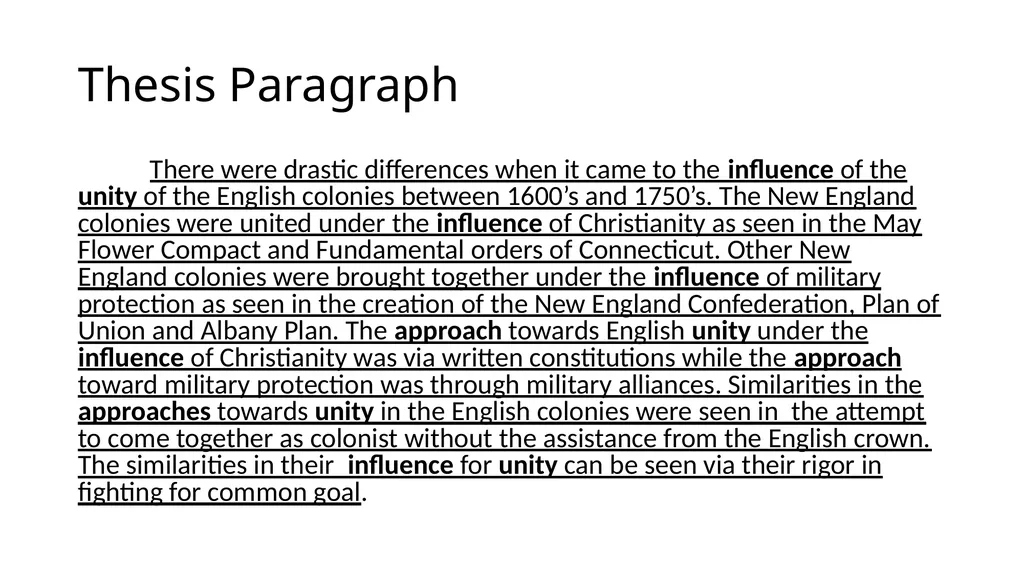
Thesis Paragraph There were drastic differences when it came to the influence of the unity of the English colonies between 1600’s and 1750’s. The New England colonies were united under the influence of Christianity as seen in the May Flower Compact and Fundamental orders of Connecticut. Other New England colonies were brought together under the influence of military protection as seen in the creation of the New England Confederation, Plan of Union and Albany Plan. The approach towards English unity under the influence of Christianity was via written constitutions while the approach toward military protection was through military alliances. Similarities in the approaches towards unity in the English colonies were seen in the attempt to come together as colonist without the assistance from the English crown. The similarities in their influence for unity can be seen via their rigor in fighting for common goal.<br>
10
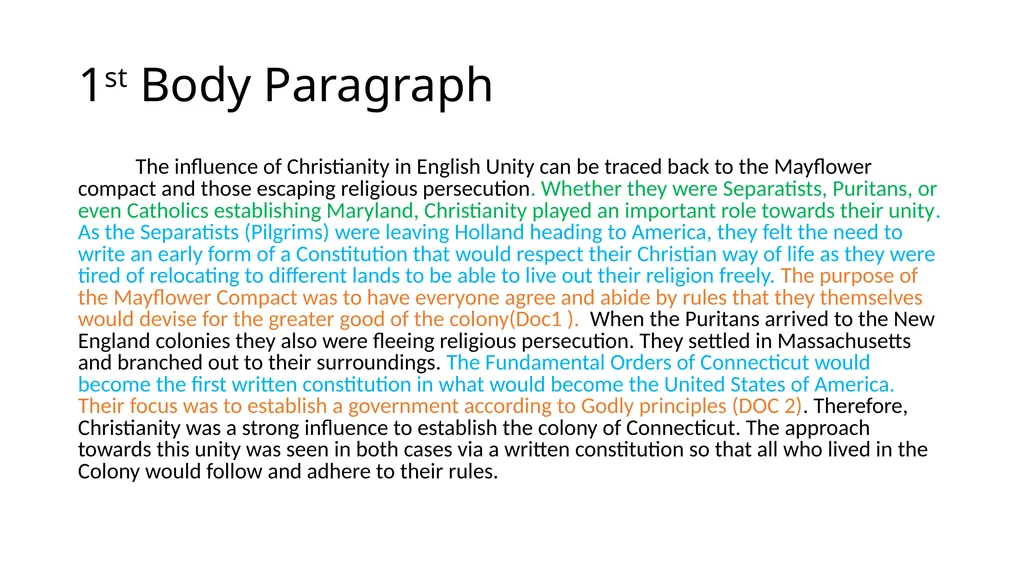
1st Body Paragraph The influence of Christianity in English Unity can be traced back to the Mayflower compact and those escaping religious persecution. Whether they were Separatists, Puritans, or even Catholics establishing Maryland, Christianity played an important role towards their unity. As the Separatists (Pilgrims) were leaving Holland heading to America, they felt the need to write an early form of a Constitution that would respect their Christian way of life as they were tired of relocating to different lands to be able to live out their religion freely. The purpose of the Mayflower Compact was to have everyone agree and abide by rules that they themselves would devise for the greater good of the colony(Doc1 ). When the Puritans arrived to the New England colonies they also were fleeing religious persecution. They settled in Massachusetts and branched out to their surroundings. The Fundamental Orders of Connecticut would become the first written constitution in what would become the United States of America. Their focus was to establish a government according to Godly principles (DOC 2). Therefore, Christianity was a strong influence to establish the colony of Connecticut. The approach towards this unity was seen in both cases via a written constitution so that all who lived in the Colony would follow and adhere to their rules.<br>
11
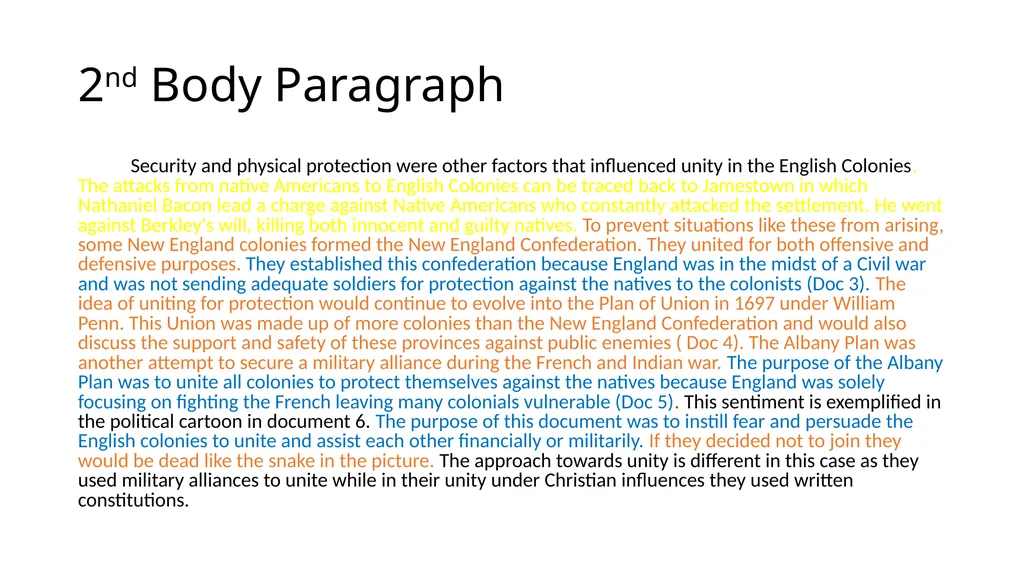
2nd Body Paragraph Security and physical protection were other factors that influenced unity in the English Colonies. The attacks from native Americans to English Colonies can be traced back to Jamestown in which Nathaniel Bacon lead a charge against Native Americans who constantly attacked the settlement. He went against Berkley's will, killing both innocent and guilty natives. To prevent situations like these from arising, some New England colonies formed the New England Confederation. They united for both offensive and defensive purposes. They established this confederation because England was in the midst of a Civil war and was not sending adequate soldiers for protection against the natives to the colonists (Doc 3). The idea of uniting for protection would continue to evolve into the Plan of Union in 1697 under William Penn. This Union was made up of more colonies than the New England Confederation and would also discuss the support and safety of these provinces against public enemies ( Doc 4). The Albany Plan was another attempt to secure a military alliance during the French and Indian war. The purpose of the Albany Plan was to unite all colonies to protect themselves against the natives because England was solely focusing on fighting the French leaving many colonials vulnerable (Doc 5). This sentiment is exemplified in the political cartoon in document 6. The purpose of this document was to instill fear and persuade the English colonies to unite and assist each other financially or militarily. If they decided not to join they would be dead like the snake in the picture. The approach towards unity is different in this case as they used military alliances to unite while in their unity under Christian influences they used written constitutions.<br>
12
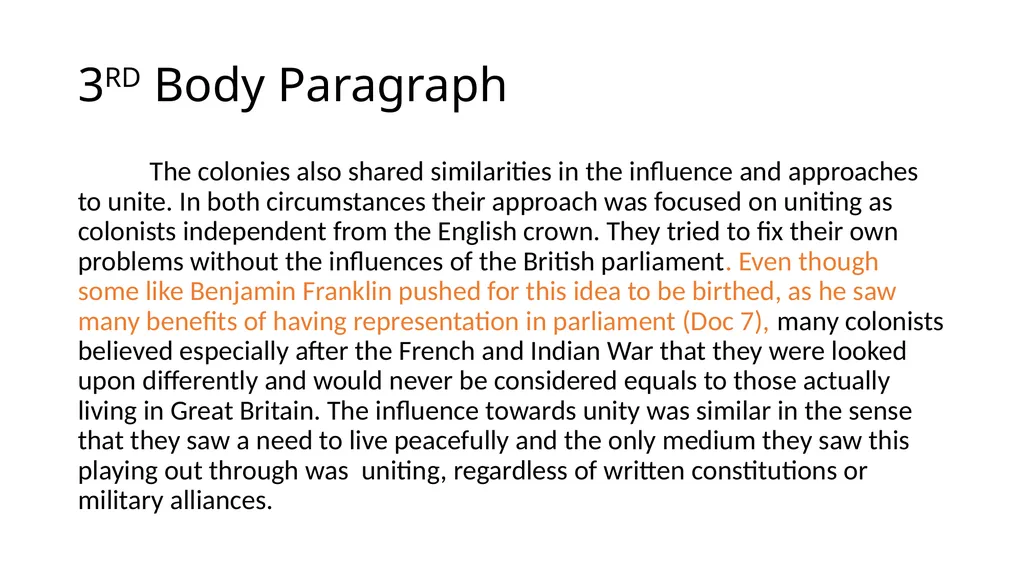
3RD Body Paragraph The colonies also shared similarities in the influence and approaches to unite. In both circumstances their approach was focused on uniting as colonists independent from the English crown. They tried to fix their own problems without the influences of the British parliament. Even though some like Benjamin Franklin pushed for this idea to be birthed, as he saw many benefits of having representation in parliament (Doc 7), many colonists believed especially after the French and Indian War that they were looked upon differently and would never be considered equals to those actually living in Great Britain. The influence towards unity was similar in the sense that they saw a need to live peacefully and the only medium they saw this playing out through was uniting, regardless of written constitutions or military alliances.<br>
13
Conclusion Unity between English Colonies would exemplify after the French and Indian War. After this war the British were left with massive debt and decided that those who should pay for those debts would be the colonists. The British believed they were the ones that mostly benefited from the victory. They began imposing taxes on the colonies without the colonies' consent in acts such as the Sugar Act, and Stamp Act. The colonists were infuriated and began to unite under the “no taxation without representation” influence via congresses and meetings. Their strength in unity ultimately led to their Independence during the American Revolution.<br>
14
Thesis for prompt on page 549. There were drastic changes in U.S. policy in 1917 that were consistent with traditional American values. The values of fighting for democracy, gaining economic opportunities, and rendering civil liberties for the greater good all demonstrate these values.<br>
15
The idea that the U.S. involvement in WWI violated American traditional values and that there was a hidden agenda before getting involved is partially true. Values such as fighting for democracy and gaining economic opportunities demonstrate that the U.S. didn’t violate these values as America has been fond of democracy and prosperity since its creation. However, rendering civil liberties goes against these values but were given up for the greater good of living in a democracy in order to not be ruled by an autocratic government. The change from neutrality to war came about after the sinking of the Lusitania and the interception of the Zimmerman telegram which were valid reasons to declare war.<br>
16
Body 1: Fighting for Democracy The traditional American value of fighting for democracy has been evident throughout U.S. history, as recently seen in the Spanish American war where with the help of yellow journalism America assisted Cuba in gaining independence. Democracy is the pinnacle of American society, and therefore, when Europe was on the verge of losing it, and Germany kept on sinking American vessels such as the Lusitania and tried to ally themselves with Mexico (British intelligence intercepted the Zimmerman note), Wilson had no other option than to address congress and declare war on Germany (Doc.3). His justification for war was to “make the world safe for democracy”. In order to gain support for fighting for democracy in Europe, Americans needed to be sold on this idea. President Wilson appointed George Creel to head the Committee of Public Information to convince the American public to support the war. Creel hired the best writers, artists and actors to create this convincing propaganda as seen in Document 5. The poster appeals to the patriotism of men during that time period. Other committees were developed such as the Food Administration under Herbert Hoover that encouraged American to grow “victory” gardens, and the Fuel Administration which created daylight savings to support the war effort. Influential leaders such as Teddy Roosevelt also encouraged Americans to support these committees by doing their part (Doc. 7). He directed his anger towards those who opposed the war and wanted them to get onboard.<br>
17
Body 2: Economic opportunity “The business of America is business” as stated by President Coolidge defines the value and truth of how America values economic prosperity. Economic opportunity is as much as a traditional American value as fighting for democracy. This can be seen in America’s drive in settling the West under the influence of Manifest Destiny and the emergence of industrialization and finding new markets to buy and obtain raw materials through imperialistic efforts. President Wilson might have disguised his true reasons to go to war as fighting for democracy however, out of the many sacrifices that are made in war America emerged as a world power. Unfortunately, it takes war to achieve economic prosperity as seen in the increase of exports vs imports during the war. The government forced private businesses to manufacture war supplies to then ship to American allies and soldiers overseas creating this economic boom ( Doc. 2). Many, like Senator George Norris (Doc. 4) argued against going to war believing that human life was worth more than economic prosperity, however, if America could have benefited economically by “fighting for democracy” (which was the more politically correct reason) who is to blame America for gaining economic prosperity at the same time they were fighting in a “moral” war? Americans valued economic prosperity and if there was a way to improve America’s standard of living they were willing to fight for this economic opportunity as seen in the outcome of WWI.<br>
18
Body 3: Civil Liberties Civil liberties such as freedom of speech, freedom of the press, freedom of religion are traditional American values as well. These rights were violated during WWI as seen in the Sedition and Espionage Acts which imprisoned many Americans including Eugene V. Debs presidential candidate of the Socialist Party for speaking out against the war and government. Many pacifist and socialist like Norman Thomas (Doc 6) argued against these violations of freedoms reasoning that the U.S. was hypocritical in fighting for other countries’ and their democracies' while taking away Americans rights and in this case forced them go to war (Selective Service Act) that they did not believe in. Even though civil liberties were violated, they were taken away for the greater good so that the latter values such as fighting for democracy and economic opportunity could exist.<br>
19
Conclusion There were drastic changes in U.S. policy in 1917 that were consistent with traditional American values. The values of fighting for democracy, gaining economic opportunities, and rendering civil liberties for the greater good all demonstrate these values. The aspect of rendering civil liberties for the greater good is a continuity of American History as seen during the French Revolution with the Sedition Acts of not being able criticize the government during wartime. Abraham Lincoln during the Civil War did away with Habeas Corpus which took away the right of knowing why one was being detained. Finally, during WWII over 100,000 Japanese Americans were taken to internment camps because they were accused of being spies.<br>
20
There were great similarities and differences that influenced the unity of the English colonies throughout the 1600- 1750’s. These similarities include being ruled by the consent of the governed along with Christian influence and unifying and creating military alliances in times of need. However, a major difference that would hinder this unity was the attempt to form a centralized government in which many colonists were hesitant as they valued their colonies' sovereignty.<br>