
Stop, Think and Go Instructor Sample Activities
AM
Published · 44 slides · 0 views
1 / 1
Description
Stop, Think and Go Instructor Sample Activities 9102026 1 My Life Has Value Objectives: To help students understand that life has value To help students understand what gives their lives value To help students recognize that what they
Related Topics
Download this presentation From Below
"Stop, Think and Go Instructor Sample Activities" is the property of its rightful owner. Permission is granted to download and print the materials on this website for personal, non-commercial use only, and to display it on your personal computer provided you do not modify the materials and that you retain all copyright notices contained in the materials. By downloading content from our website, you accept the terms of this agreement.
Share
Embed code
Presentation Transcript
01
Stop, Think and Go Instructor Sample Activities 9/10/2026 1<br>
02
My Life Has Value Objectives:
To help students understand that life has value
To help students understand what gives their lives value
To help students recognize that what they care for will care for them
Group Size: Any size classroom
Time Required: 15-30 minutes
Materials: $100 bill ($20 bill may be used) 9/10/2026 2<br>
To help students understand that life has value
To help students understand what gives their lives value
To help students recognize that what they care for will care for them
Group Size: Any size classroom
Time Required: 15-30 minutes
Materials: $100 bill ($20 bill may be used) 9/10/2026 2<br>
03
My Life has Value - Introduction Most students understand the value of money, but they are less likely to understand how to equate (measure) value in themselves. The purpose of this activity is to help your students recognize that life has value, to discover value in themselves, and to recognize the importance of caring for what they value.
Driving can be a fun and purposeful activity. It can give people their independence, help them to become self-sufficient, and support their recreational interests. Driving also is a dangerous activity, one that is responsible for much human suffering, injury, permanent disability, death, and untold property damage.
If we value human life, then we must care for what we value by making caring choices. When drivers care for themselves, their passengers and other roadway users, they enhance safety. 9/10/2026 3<br>
Driving can be a fun and purposeful activity. It can give people their independence, help them to become self-sufficient, and support their recreational interests. Driving also is a dangerous activity, one that is responsible for much human suffering, injury, permanent disability, death, and untold property damage.
If we value human life, then we must care for what we value by making caring choices. When drivers care for themselves, their passengers and other roadway users, they enhance safety. 9/10/2026 3<br>
04
My Life has Value - Process Present your students with the following situation. Have them form a circle (standing) and then place a $100.00 bill in the center of the floor. As they are looking down at the bill, tell them to imagine that it belongs to them. Having noticed the bill, ask them what they would do, leave it there or pick it up.
Most students will tell you that they would pick it up. Ask them their reason for picking up the money and where they would put it. Most students will tell you they would retrieve the money because it has value and that they would secure it in a safe place.
Now ask for a volunteer to stand where the $100.00 bill was located. Tell your students to imagine that they are now looking at themselves. Then say to them, "You all know that money has value, but how do you equate value in yourselves?" Give them some time to respond and then ask them, "What are you doing to take care of yourself?" 9/10/2026 4<br>
Most students will tell you that they would pick it up. Ask them their reason for picking up the money and where they would put it. Most students will tell you they would retrieve the money because it has value and that they would secure it in a safe place.
Now ask for a volunteer to stand where the $100.00 bill was located. Tell your students to imagine that they are now looking at themselves. Then say to them, "You all know that money has value, but how do you equate value in yourselves?" Give them some time to respond and then ask them, "What are you doing to take care of yourself?" 9/10/2026 4<br>
05
My Life has Value – Process – Slide Two If they don't know what gives them value, ask them how many would be willing to give up their eyesight for the $100.00 bill.
Help your students to recognize that people only care for what they value. People who value their eyes will take care of them. 9/10/2026 5<br>
Help your students to recognize that people only care for what they value. People who value their eyes will take care of them. 9/10/2026 5<br>
06
My Life has Value - Discussion Imagine sharing the roadway with people who do not recognize value in themselves or other people. What would our highways be like and what would it be like to drive on them?
How can you make a difference? What driving choices are you willing to make to care for yourself and other roadway users?
Driver Education is a course in caring. What does the statement mean to you, and do you agree with it? Explain. 9/10/2026 6<br>
How can you make a difference? What driving choices are you willing to make to care for yourself and other roadway users?
Driver Education is a course in caring. What does the statement mean to you, and do you agree with it? Explain. 9/10/2026 6<br>
07
My Life has Value - Homework Have your students observe the driving behaviors of others at intersections, on the open road, at railroad crossings, cross walks, stop signs, traffic lights, snow or water covered roads, etc. How many people are making caring choices and how many people demonstrate a disregard for human life?
Have your students read and clip articles from newspapers reporting roadway crashes. Ask them to describe these crashes and the driving choices that caused them to occur.
Finally, ask your students to draw some of their own conclusions regarding the state of highway safety in this country. Ask them whether they plan to increase the danger on our highways or contribute to highway safety by making caring choices? 9/10/2026 7<br>
Have your students read and clip articles from newspapers reporting roadway crashes. Ask them to describe these crashes and the driving choices that caused them to occur.
Finally, ask your students to draw some of their own conclusions regarding the state of highway safety in this country. Ask them whether they plan to increase the danger on our highways or contribute to highway safety by making caring choices? 9/10/2026 7<br>
08
The Chair Jump Objectives:
To help students recognize that people act without thinking and often lose what they value most
To help students understand the importance of thinking before they jump (act)
Group Size: Any size classroom
Time Required: 15-30 minutes
Materials: A sturdy chair 9/10/2026 8<br>
To help students recognize that people act without thinking and often lose what they value most
To help students understand the importance of thinking before they jump (act)
Group Size: Any size classroom
Time Required: 15-30 minutes
Materials: A sturdy chair 9/10/2026 8<br>
09
The Chair Jump - Introduction Impress upon your students that life does have value. We would not be a society of laws, social institutions, consumer protection agencies, medical research, technological advances, and highway safety programs if life did not have value.
We could become a much safer society if people would make caring choices by using all safety information, resources, and technology at their disposal. This strongly applies to highway safety.
The Chair Jump exercise effectively illustrates that many drivers do not think before they act and jeopardize the very elements of life and living they value most. Unfortunately, too many people only recognize, after the fact, what they have sacrificed and then it is too late to prevent the preventable.
Impress upon your students that all their choices have the potential for either helping or hurting themselves and others. They need to choose wisely by thinking before they act. 9/10/2026 9<br>
We could become a much safer society if people would make caring choices by using all safety information, resources, and technology at their disposal. This strongly applies to highway safety.
The Chair Jump exercise effectively illustrates that many drivers do not think before they act and jeopardize the very elements of life and living they value most. Unfortunately, too many people only recognize, after the fact, what they have sacrificed and then it is too late to prevent the preventable.
Impress upon your students that all their choices have the potential for either helping or hurting themselves and others. They need to choose wisely by thinking before they act. 9/10/2026 9<br>
10
The Chair Jump - Process Select a responsible student for this exercise, one who listens to instructions and follows directions.
Place a solid four-legged chair on non-skid material (carpet) and hold it from sliding during this exercise.
Invite a student volunteer to come to the front of the room and sit in the armless chair provided. Tell the class that our volunteer will do as instructed and that today we want this person to stand on the seat of the chair. On the count of three (1-2-3), this person is to jump from the chair to the floor (landing on his/her feet). After the first jump, the volunteer is again instructed to stand on the chair and to jump once again on the count of three, but this time land on his/her face.
Ask your class why they think the volunteer did not make the second jump. The answer is that this person values his/her face and therefore made a caring choice to protect what he/she values. This person paused long enough to think about how this choice would impact his/her life. The moral of this activity is to think before you leap. Too many people in life are chair jumpers. They fail to see the danger in their actions until it is too late to do anything about it. 9/10/2026 10<br>
Place a solid four-legged chair on non-skid material (carpet) and hold it from sliding during this exercise.
Invite a student volunteer to come to the front of the room and sit in the armless chair provided. Tell the class that our volunteer will do as instructed and that today we want this person to stand on the seat of the chair. On the count of three (1-2-3), this person is to jump from the chair to the floor (landing on his/her feet). After the first jump, the volunteer is again instructed to stand on the chair and to jump once again on the count of three, but this time land on his/her face.
Ask your class why they think the volunteer did not make the second jump. The answer is that this person values his/her face and therefore made a caring choice to protect what he/she values. This person paused long enough to think about how this choice would impact his/her life. The moral of this activity is to think before you leap. Too many people in life are chair jumpers. They fail to see the danger in their actions until it is too late to do anything about it. 9/10/2026 10<br>
11
The Chair Jump - Discussion What do you value about yourself, others, and the environment that you would protect at all cost?
What are some driving choices that people have made without thinking?
Some “chair jump” choices are: passing on double lines; running red lights; failure to stop at stop signs; drinking and driving; failure to scan intersections before making a turn; and, driving at excessive speed.
Sometimes drivers lose the very things they value most when they "act without thinking.“ What are some of those losses?
What is one thing you can do before you “jump”? 9/10/2026 11<br>
What are some driving choices that people have made without thinking?
Some “chair jump” choices are: passing on double lines; running red lights; failure to stop at stop signs; drinking and driving; failure to scan intersections before making a turn; and, driving at excessive speed.
Sometimes drivers lose the very things they value most when they "act without thinking.“ What are some of those losses?
What is one thing you can do before you “jump”? 9/10/2026 11<br>
12
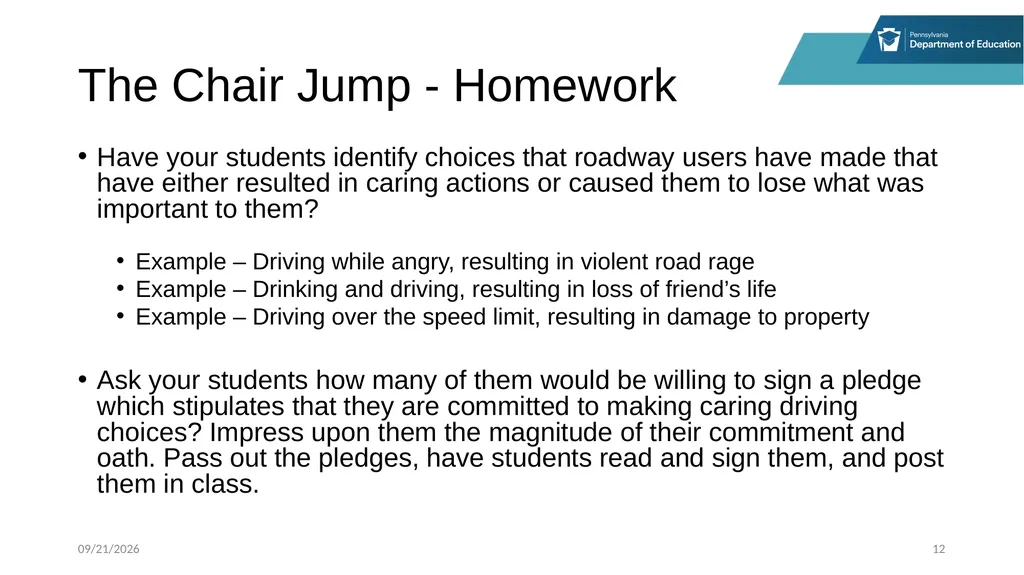
The Chair Jump - Homework Have your students identify choices that roadway users have made that have either resulted in caring actions or caused them to lose what was important to them?
Example – Driving while angry, resulting in violent road rage
Example – Drinking and driving, resulting in loss of friend’s life
Example – Driving over the speed limit, resulting in damage to property
Ask your students how many of them would be willing to sign a pledge which stipulates that they are committed to making caring driving choices? Impress upon them the magnitude of their commitment and oath. Pass out the pledges, have students read and sign them, and post them in class. 9/10/2026 12<br>
Example – Driving while angry, resulting in violent road rage
Example – Drinking and driving, resulting in loss of friend’s life
Example – Driving over the speed limit, resulting in damage to property
Ask your students how many of them would be willing to sign a pledge which stipulates that they are committed to making caring driving choices? Impress upon them the magnitude of their commitment and oath. Pass out the pledges, have students read and sign them, and post them in class. 9/10/2026 12<br>
13
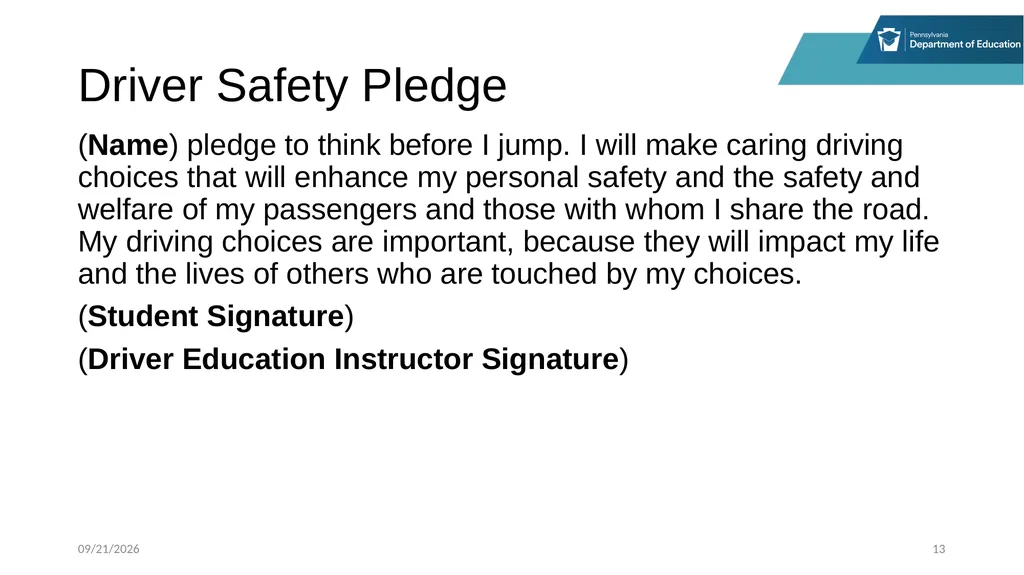
Driver Safety Pledge (Name) pledge to think before I jump. I will make caring driving choices that will enhance my personal safety and the safety and welfare of my passengers and those with whom I share the road. My driving choices are important, because they will impact my life and the lives of others who are touched by my choices.
(Student Signature)
(Driver Education Instructor Signature) 9/10/2026 13<br>
(Student Signature)
(Driver Education Instructor Signature) 9/10/2026 13<br>
14
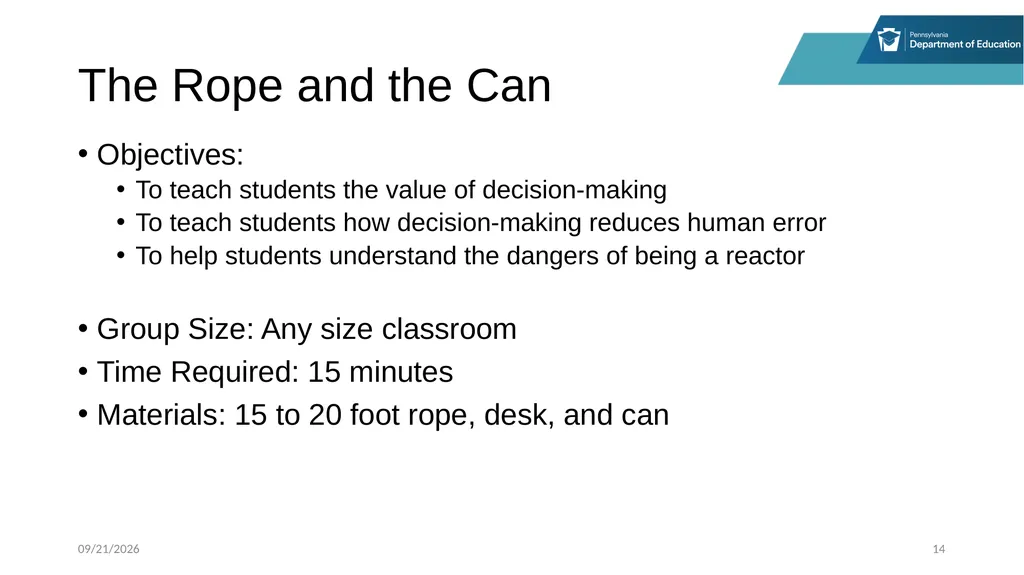
The Rope and the Can Objectives:
To teach students the value of decision-making
To teach students how decision-making reduces human error
To help students understand the dangers of being a reactor
Group Size: Any size classroom
Time Required: 15 minutes
Materials: 15 to 20 foot rope, desk, and can 9/10/2026 14<br>
To teach students the value of decision-making
To teach students how decision-making reduces human error
To help students understand the dangers of being a reactor
Group Size: Any size classroom
Time Required: 15 minutes
Materials: 15 to 20 foot rope, desk, and can 9/10/2026 14<br>
15
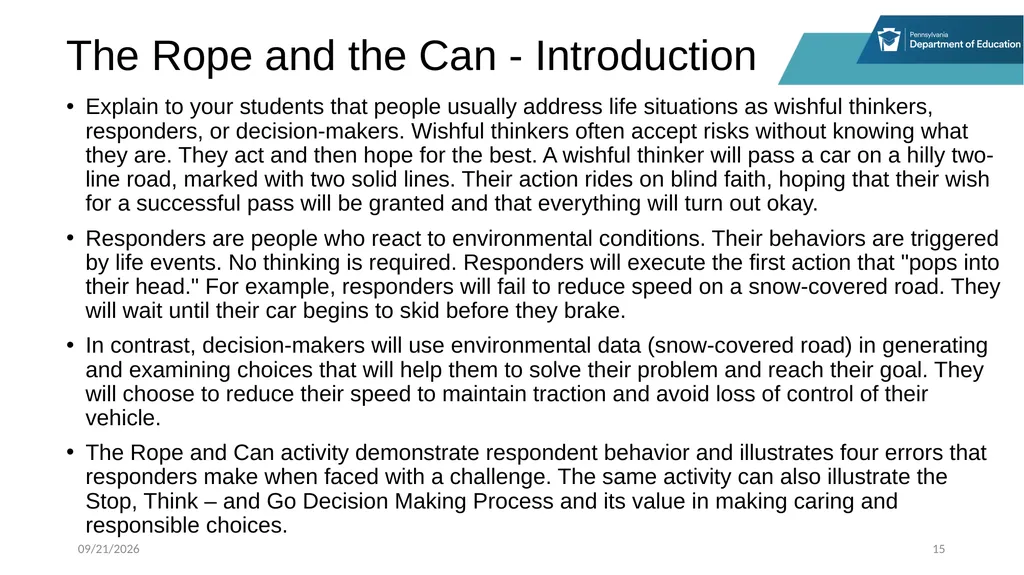
The Rope and the Can - Introduction Explain to your students that people usually address life situations as wishful thinkers, responders, or decision-makers. Wishful thinkers often accept risks without knowing what they are. They act and then hope for the best. A wishful thinker will pass a car on a hilly two-line road, marked with two solid lines. Their action rides on blind faith, hoping that their wish for a successful pass will be granted and that everything will turn out okay.
Responders are people who react to environmental conditions. Their behaviors are triggered by life events. No thinking is required. Responders will execute the first action that "pops into their head." For example, responders will fail to reduce speed on a snow-covered road. They will wait until their car begins to skid before they brake.
In contrast, decision-makers will use environmental data (snow-covered road) in generating and examining choices that will help them to solve their problem and reach their goal. They will choose to reduce their speed to maintain traction and avoid loss of control of their vehicle.
The Rope and Can activity demonstrate respondent behavior and illustrates four errors that responders make when faced with a challenge. The same activity can also illustrate the Stop, Think – and Go Decision Making Process and its value in making caring and responsible choices. 9/10/2026 15<br>
Responders are people who react to environmental conditions. Their behaviors are triggered by life events. No thinking is required. Responders will execute the first action that "pops into their head." For example, responders will fail to reduce speed on a snow-covered road. They will wait until their car begins to skid before they brake.
In contrast, decision-makers will use environmental data (snow-covered road) in generating and examining choices that will help them to solve their problem and reach their goal. They will choose to reduce their speed to maintain traction and avoid loss of control of their vehicle.
The Rope and Can activity demonstrate respondent behavior and illustrates four errors that responders make when faced with a challenge. The same activity can also illustrate the Stop, Think – and Go Decision Making Process and its value in making caring and responsible choices. 9/10/2026 15<br>
16
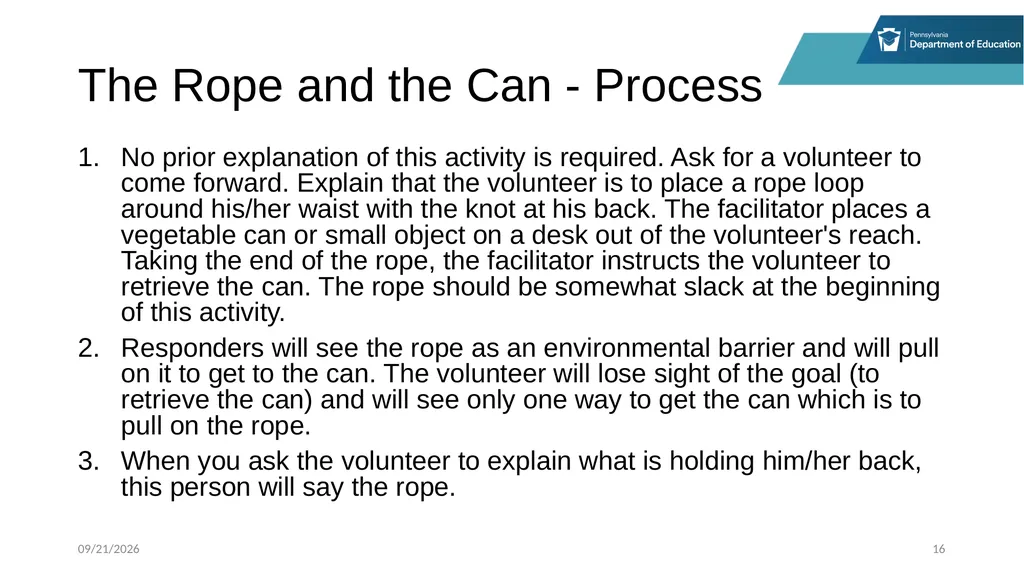
The Rope and the Can - Process No prior explanation of this activity is required. Ask for a volunteer to come forward. Explain that the volunteer is to place a rope loop around his/her waist with the knot at his back. The facilitator places a vegetable can or small object on a desk out of the volunteer's reach. Taking the end of the rope, the facilitator instructs the volunteer to retrieve the can. The rope should be somewhat slack at the beginning of this activity.
Responders will see the rope as an environmental barrier and will pull on it to get to the can. The volunteer will lose sight of the goal (to retrieve the can) and will see only one way to get the can which is to pull on the rope.
When you ask the volunteer to explain what is holding him/her back, this person will say the rope. 9/10/2026 16<br>
Responders will see the rope as an environmental barrier and will pull on it to get to the can. The volunteer will lose sight of the goal (to retrieve the can) and will see only one way to get the can which is to pull on the rope.
When you ask the volunteer to explain what is holding him/her back, this person will say the rope. 9/10/2026 16<br>
17
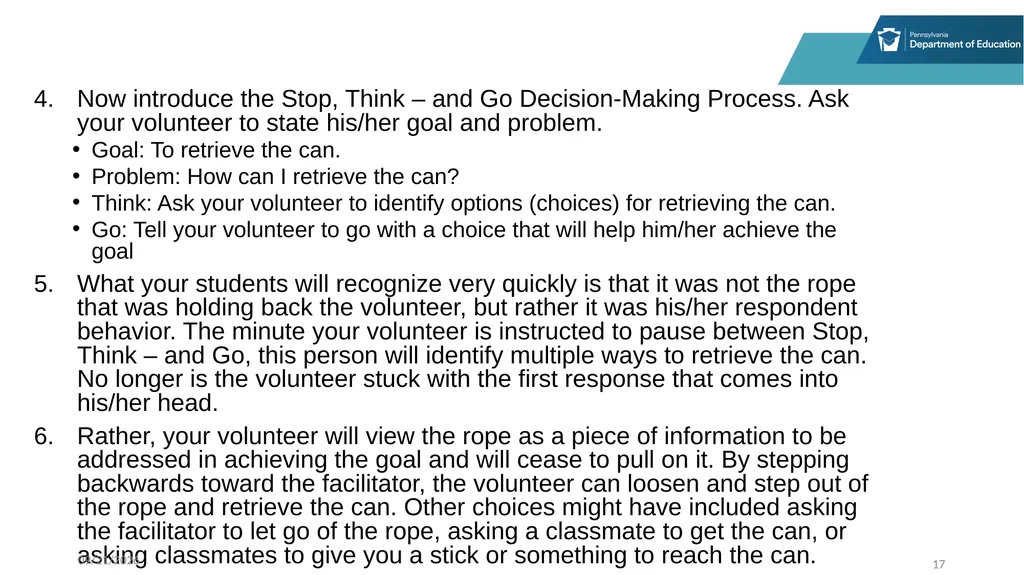
The Rope and the Can Process – Slide Two Now introduce the Stop, Think – and Go Decision-Making Process. Ask your volunteer to state his/her goal and problem.
Goal: To retrieve the can.
Problem: How can I retrieve the can?
Think: Ask your volunteer to identify options (choices) for retrieving the can.
Go: Tell your volunteer to go with a choice that will help him/her achieve the goal
What your students will recognize very quickly is that it was not the rope that was holding back the volunteer, but rather it was his/her respondent behavior. The minute your volunteer is instructed to pause between Stop, Think – and Go, this person will identify multiple ways to retrieve the can. No longer is the volunteer stuck with the first response that comes into his/her head.
Rather, your volunteer will view the rope as a piece of information to be addressed in achieving the goal and will cease to pull on it. By stepping backwards toward the facilitator, the volunteer can loosen and step out of the rope and retrieve the can. Other choices might have included asking the facilitator to let go of the rope, asking a classmate to get the can, or asking classmates to give you a stick or something to reach the can. 9/10/2026 17<br>
Goal: To retrieve the can.
Problem: How can I retrieve the can?
Think: Ask your volunteer to identify options (choices) for retrieving the can.
Go: Tell your volunteer to go with a choice that will help him/her achieve the goal
What your students will recognize very quickly is that it was not the rope that was holding back the volunteer, but rather it was his/her respondent behavior. The minute your volunteer is instructed to pause between Stop, Think – and Go, this person will identify multiple ways to retrieve the can. No longer is the volunteer stuck with the first response that comes into his/her head.
Rather, your volunteer will view the rope as a piece of information to be addressed in achieving the goal and will cease to pull on it. By stepping backwards toward the facilitator, the volunteer can loosen and step out of the rope and retrieve the can. Other choices might have included asking the facilitator to let go of the rope, asking a classmate to get the can, or asking classmates to give you a stick or something to reach the can. 9/10/2026 17<br>
18
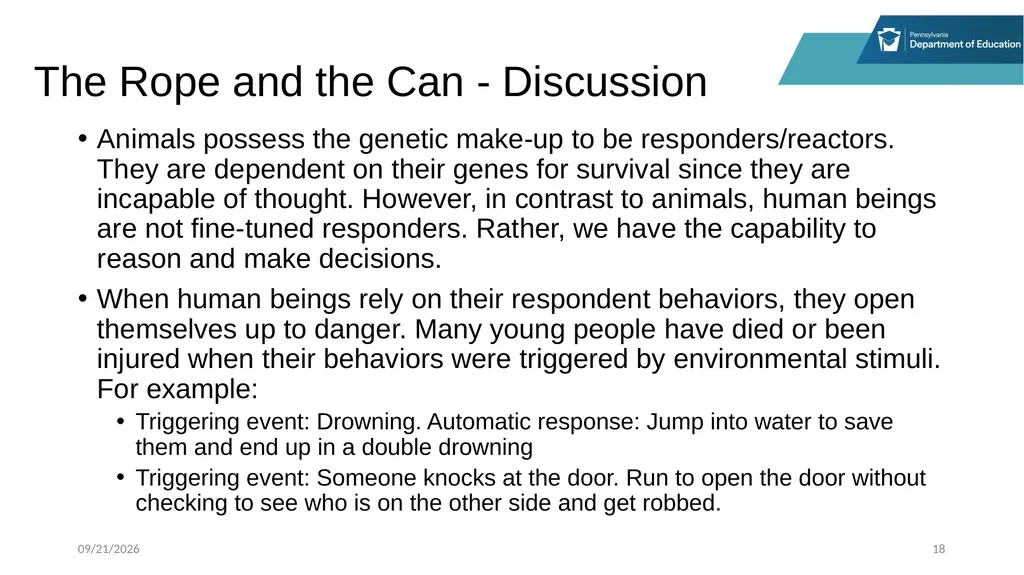
The Rope and the Can - Discussion Animals possess the genetic make-up to be responders/reactors. They are dependent on their genes for survival since they are incapable of thought. However, in contrast to animals, human beings are not fine-tuned responders. Rather, we have the capability to reason and make decisions.
When human beings rely on their respondent behaviors, they open themselves up to danger. Many young people have died or been injured when their behaviors were triggered by environmental stimuli. For example:
Triggering event: Drowning. Automatic response: Jump into water to save them and end up in a double drowning
Triggering event: Someone knocks at the door. Run to open the door without checking to see who is on the other side and get robbed. 9/10/2026 18<br>
When human beings rely on their respondent behaviors, they open themselves up to danger. Many young people have died or been injured when their behaviors were triggered by environmental stimuli. For example:
Triggering event: Drowning. Automatic response: Jump into water to save them and end up in a double drowning
Triggering event: Someone knocks at the door. Run to open the door without checking to see who is on the other side and get robbed. 9/10/2026 18<br>
19
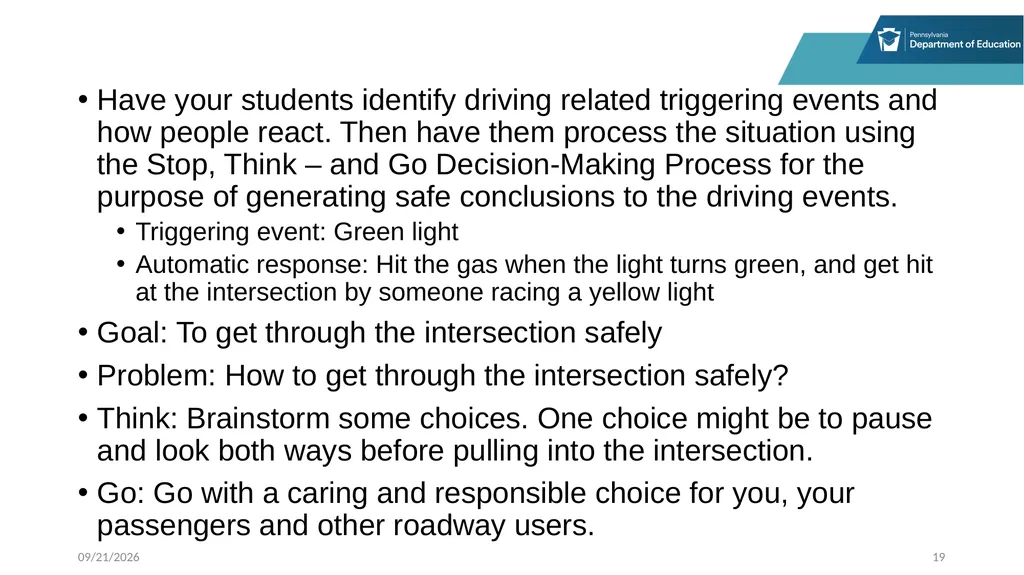
The Rope and the Can Discussion – Slide Two Have your students identify driving related triggering events and how people react. Then have them process the situation using the Stop, Think – and Go Decision-Making Process for the purpose of generating safe conclusions to the driving events.
Triggering event: Green light
Automatic response: Hit the gas when the light turns green, and get hit at the intersection by someone racing a yellow light
Goal: To get through the intersection safely
Problem: How to get through the intersection safely?
Think: Brainstorm some choices. One choice might be to pause and look both ways before pulling into the intersection.
Go: Go with a caring and responsible choice for you, your passengers and other roadway users. 9/10/2026 19<br>
Triggering event: Green light
Automatic response: Hit the gas when the light turns green, and get hit at the intersection by someone racing a yellow light
Goal: To get through the intersection safely
Problem: How to get through the intersection safely?
Think: Brainstorm some choices. One choice might be to pause and look both ways before pulling into the intersection.
Go: Go with a caring and responsible choice for you, your passengers and other roadway users. 9/10/2026 19<br>
20
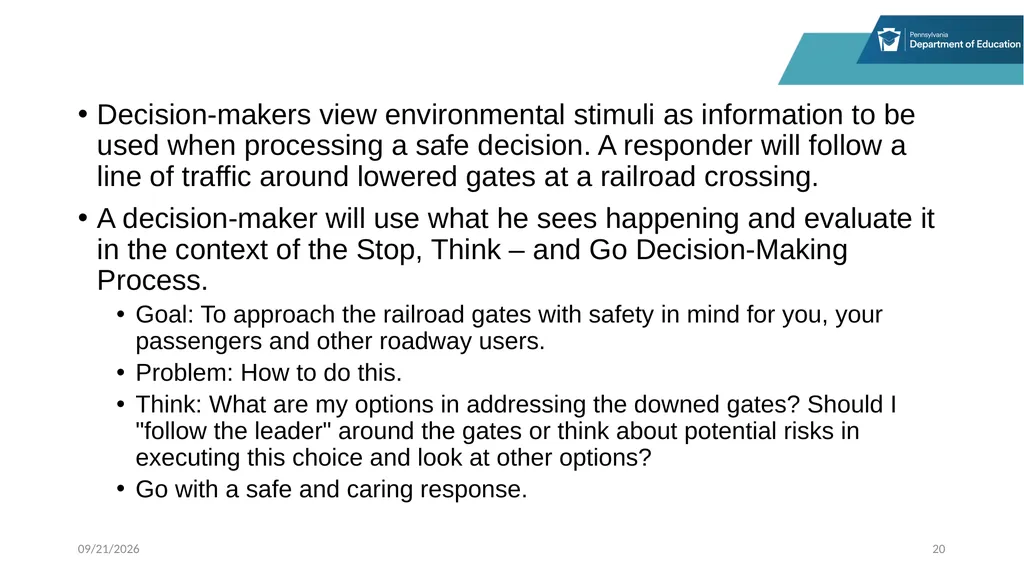
The Rope and the Can Discussion – Slide Three Decision-makers view environmental stimuli as information to be used when processing a safe decision. A responder will follow a line of traffic around lowered gates at a railroad crossing.
A decision-maker will use what he sees happening and evaluate it in the context of the Stop, Think – and Go Decision-Making Process.
Goal: To approach the railroad gates with safety in mind for you, your passengers and other roadway users.
Problem: How to do this.
Think: What are my options in addressing the downed gates? Should I "follow the leader" around the gates or think about potential risks in executing this choice and look at other options?
Go with a safe and caring response. 9/10/2026 20<br>
A decision-maker will use what he sees happening and evaluate it in the context of the Stop, Think – and Go Decision-Making Process.
Goal: To approach the railroad gates with safety in mind for you, your passengers and other roadway users.
Problem: How to do this.
Think: What are my options in addressing the downed gates? Should I "follow the leader" around the gates or think about potential risks in executing this choice and look at other options?
Go with a safe and caring response. 9/10/2026 20<br>
21
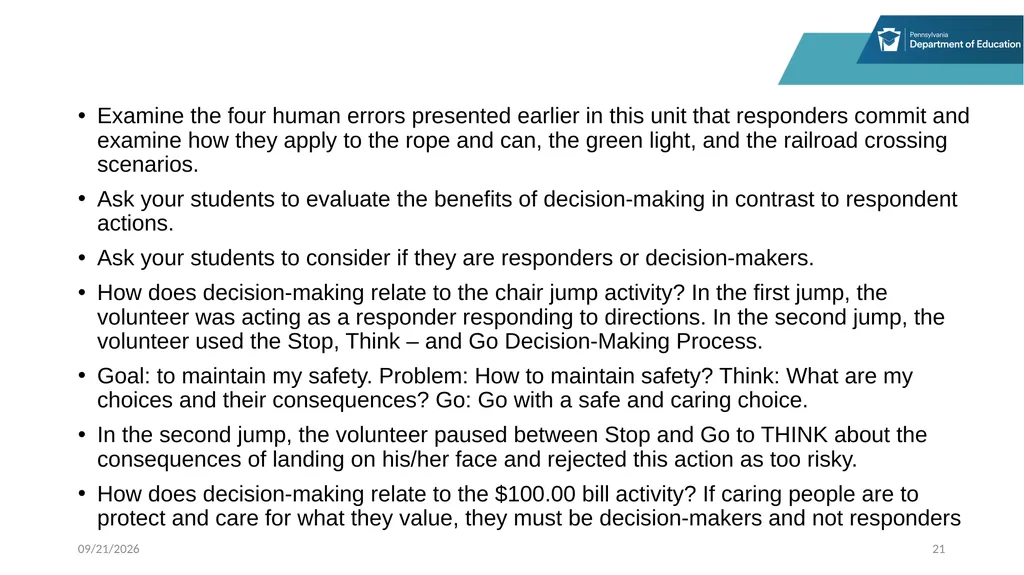
The Rope and the Can Discussion – Slide Four Examine the four human errors presented earlier in this unit that responders commit and examine how they apply to the rope and can, the green light, and the railroad crossing scenarios.
Ask your students to evaluate the benefits of decision-making in contrast to respondent actions.
Ask your students to consider if they are responders or decision-makers.
How does decision-making relate to the chair jump activity? In the first jump, the volunteer was acting as a responder responding to directions. In the second jump, the volunteer used the Stop, Think – and Go Decision-Making Process.
Goal: to maintain my safety. Problem: How to maintain safety? Think: What are my choices and their consequences? Go: Go with a safe and caring choice.
In the second jump, the volunteer paused between Stop and Go to THINK about the consequences of landing on his/her face and rejected this action as too risky.
How does decision-making relate to the $100.00 bill activity? If caring people are to protect and care for what they value, they must be decision-makers and not responders 9/10/2026 21<br>
Ask your students to evaluate the benefits of decision-making in contrast to respondent actions.
Ask your students to consider if they are responders or decision-makers.
How does decision-making relate to the chair jump activity? In the first jump, the volunteer was acting as a responder responding to directions. In the second jump, the volunteer used the Stop, Think – and Go Decision-Making Process.
Goal: to maintain my safety. Problem: How to maintain safety? Think: What are my choices and their consequences? Go: Go with a safe and caring choice.
In the second jump, the volunteer paused between Stop and Go to THINK about the consequences of landing on his/her face and rejected this action as too risky.
How does decision-making relate to the $100.00 bill activity? If caring people are to protect and care for what they value, they must be decision-makers and not responders 9/10/2026 21<br>
22
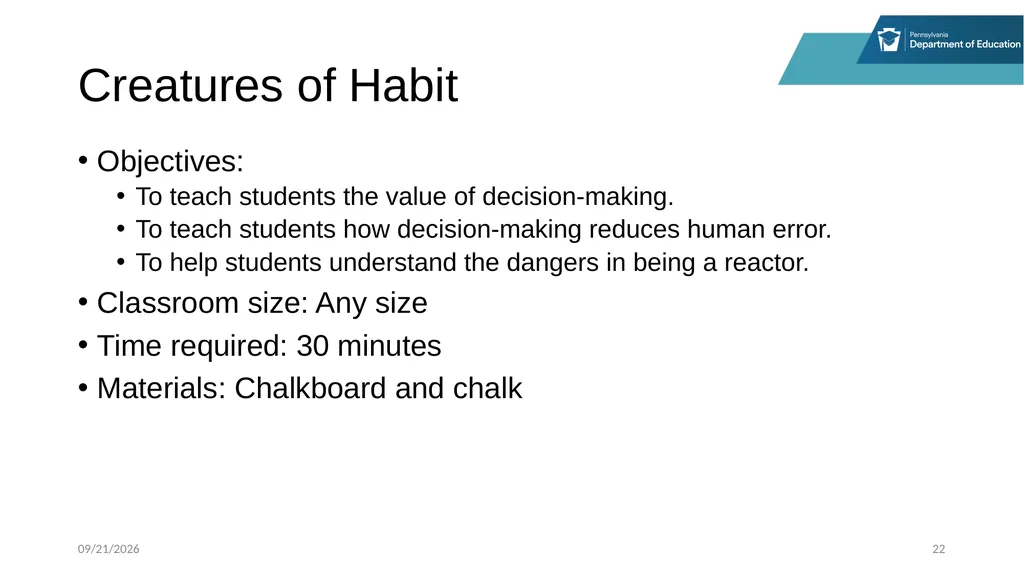
Creatures of Habit Objectives:
To teach students the value of decision-making.
To teach students how decision-making reduces human error.
To help students understand the dangers in being a reactor.
Classroom size: Any size
Time required: 30 minutes
Materials: Chalkboard and chalk 9/10/2026 22<br>
To teach students the value of decision-making.
To teach students how decision-making reduces human error.
To help students understand the dangers in being a reactor.
Classroom size: Any size
Time required: 30 minutes
Materials: Chalkboard and chalk 9/10/2026 22<br>
23
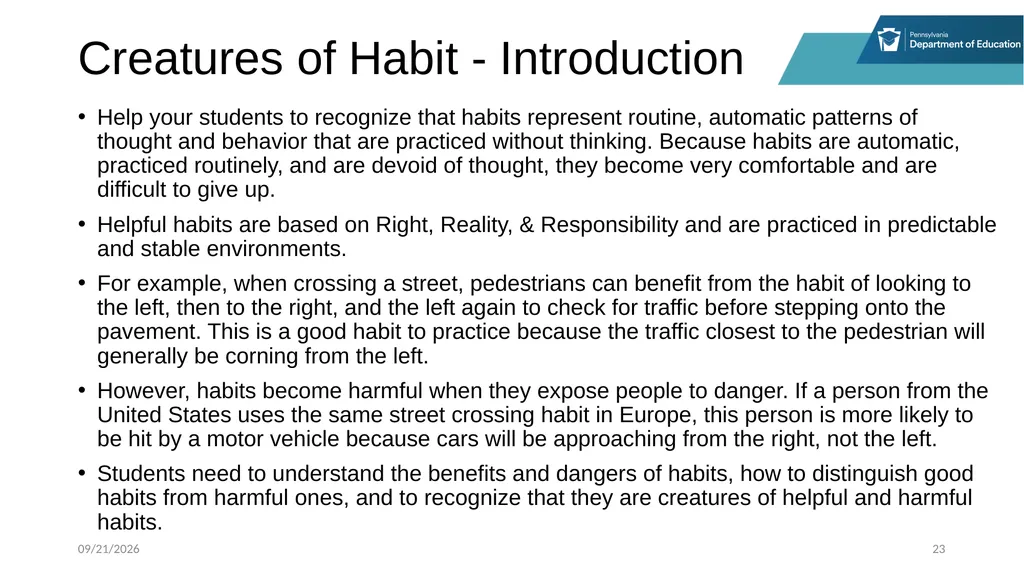
Creatures of Habit - Introduction Help your students to recognize that habits represent routine, automatic patterns of thought and behavior that are practiced without thinking. Because habits are automatic, practiced routinely, and are devoid of thought, they become very comfortable and are difficult to give up.
Helpful habits are based on Right, Reality, & Responsibility and are practiced in predictable and stable environments.
For example, when crossing a street, pedestrians can benefit from the habit of looking to the left, then to the right, and the left again to check for traffic before stepping onto the pavement. This is a good habit to practice because the traffic closest to the pedestrian will generally be corning from the left.
However, habits become harmful when they expose people to danger. If a person from the United States uses the same street crossing habit in Europe, this person is more likely to be hit by a motor vehicle because cars will be approaching from the right, not the left.
Students need to understand the benefits and dangers of habits, how to distinguish good habits from harmful ones, and to recognize that they are creatures of helpful and harmful habits. 9/10/2026 23<br>
Helpful habits are based on Right, Reality, & Responsibility and are practiced in predictable and stable environments.
For example, when crossing a street, pedestrians can benefit from the habit of looking to the left, then to the right, and the left again to check for traffic before stepping onto the pavement. This is a good habit to practice because the traffic closest to the pedestrian will generally be corning from the left.
However, habits become harmful when they expose people to danger. If a person from the United States uses the same street crossing habit in Europe, this person is more likely to be hit by a motor vehicle because cars will be approaching from the right, not the left.
Students need to understand the benefits and dangers of habits, how to distinguish good habits from harmful ones, and to recognize that they are creatures of helpful and harmful habits. 9/10/2026 23<br>
24
Creatures of Habit - Process Ask your students to stand facing you. Tell them to stretch their arms to the side and raise them to shoulder height with their palms down. Tell them to drop their dominant arm to their side. While in this position, using their one outstretched arm for balance, have them work their lowered arm and hand down the outside of their leg and touch their ankle.
Most students will perform this task without bending their knees even though the task is easier to perform with their knees bent. Because of past experiences, most students have developed the habit of toe touching with their knees straight. Demonstrate for your students, ankle touching while bending your knees.
Another activity to illustrate habit is arm folding. Ask your students to fold their arms over their chest. Ask them to reverse the fold. Most people need to stop and think about what they are doing. For most students, the first way they folded their arms is more comfortable than the second due to habit. 9/10/2026 24<br>
Most students will perform this task without bending their knees even though the task is easier to perform with their knees bent. Because of past experiences, most students have developed the habit of toe touching with their knees straight. Demonstrate for your students, ankle touching while bending your knees.
Another activity to illustrate habit is arm folding. Ask your students to fold their arms over their chest. Ask them to reverse the fold. Most people need to stop and think about what they are doing. For most students, the first way they folded their arms is more comfortable than the second due to habit. 9/10/2026 24<br>
25
Creatures of Habit - Discussion Ask your students to indicate why most of them performed the ankle touching behavior with straight knees when they could have more easily performed the task with their knees bent. The answer is habit. They programmed themselves to perform the behavior with their knees straight.
Have your students brainstorm a variety of driving related habits:
Adjusting mirrors and driver's seat before starting the car
Checking tire pressure, oil level, and other fluid levels
Wearing a seat belt
Not coming to a complete stop at intersections
Speeding
Tailgating
Eating and driving
Leaving keys in the car
Not locking doors 9/10/2026 25<br>
Have your students brainstorm a variety of driving related habits:
Adjusting mirrors and driver's seat before starting the car
Checking tire pressure, oil level, and other fluid levels
Wearing a seat belt
Not coming to a complete stop at intersections
Speeding
Tailgating
Eating and driving
Leaving keys in the car
Not locking doors 9/10/2026 25<br>
26
Creatures of Habit Discussion – Slide Two Ask your students how they can distinguish helpful habits from harmful habits. Answer: Harmful habits are not based on Right, Reality, and Responsibility. There is no evidence to support the benefits of those habits. The habits have negative consequences and are not practiced by responsible drivers. Helpful habits are practiced in routine, unchanging, and predictable environments. They are based on the 3R’s. If the driving situation is constantly changing, drivers must Use their decision-making skills in determining the best course of action to take.
Have your students classify helpful and harmful driving habits using the generated list of driving habits. Ask them to filter each habit through the Right, Reality, & Responsibility filters in making their determination.
Ask your students to explain what personal benefits they can derive from habits.
Ask your students to identify driving habits they would like to have.
Ask your students to name harmful driving habits they wish to avoid. 9/10/2026 26<br>
Have your students classify helpful and harmful driving habits using the generated list of driving habits. Ask them to filter each habit through the Right, Reality, & Responsibility filters in making their determination.
Ask your students to explain what personal benefits they can derive from habits.
Ask your students to identify driving habits they would like to have.
Ask your students to name harmful driving habits they wish to avoid. 9/10/2026 26<br>
27
Awareness of Risk Objective: To help students identify driving risk factors
Group Size: Small discussion groups of four to five people
Materials Needed: None 9/10/2026 27<br>
Group Size: Small discussion groups of four to five people
Materials Needed: None 9/10/2026 27<br>
28
Awareness of Risk – Introduction The purpose of this activity is to help your students understand that driving is a dangerous activity due to the many risk factors that impact the driving experience. Before students can become effective risk managers, they must first become aware of the risks. 9/10/2026 28<br>
29
Awareness of Risk - Process Explain to your students the meaning of risk and risk factors. Answer: Risk refers to the degree of personal danger to which one is exposed when participating in a hazardous activity. Risk factors relate to those elements that have the potential for causing injury, death or property damage.
Explore with your students that driving a motor vehicle is a complex and dangerous activity involving the interaction of four key variables: driver, motor vehicle, roadway conditions, and other roadway users. Each of these variables presents risk factors that have the potential for causing motor vehicle crashes. Ask your students to brainstorm a list of crash causing risk factors for each of the mentioned variables. 9/10/2026 29<br>
Explore with your students that driving a motor vehicle is a complex and dangerous activity involving the interaction of four key variables: driver, motor vehicle, roadway conditions, and other roadway users. Each of these variables presents risk factors that have the potential for causing motor vehicle crashes. Ask your students to brainstorm a list of crash causing risk factors for each of the mentioned variables. 9/10/2026 29<br>
30
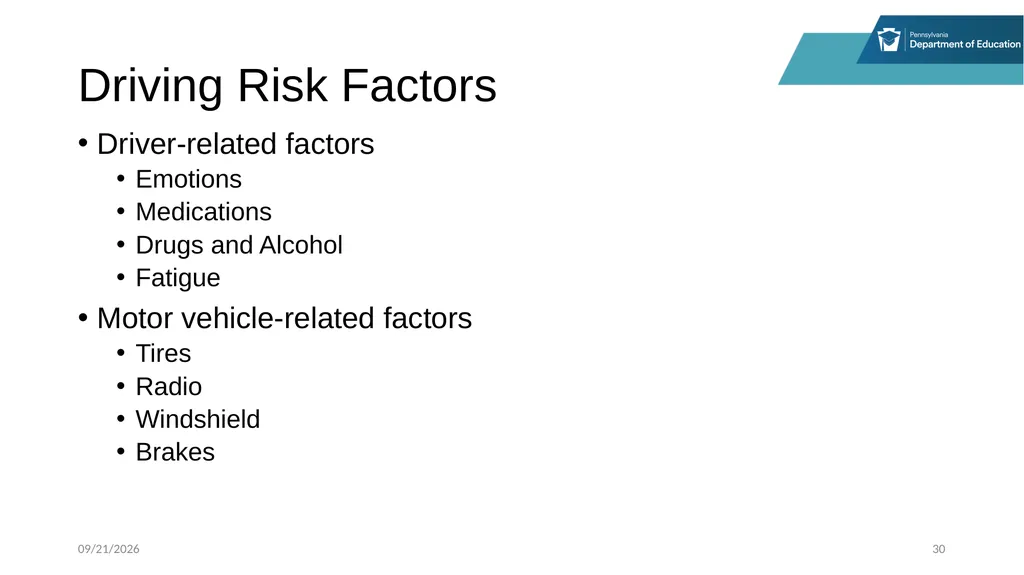
Driving Risk Factors Driver-related factors
Emotions
Medications
Drugs and Alcohol
Fatigue
Motor vehicle-related factors
Tires
Radio
Windshield
Brakes 9/10/2026 30<br>
Emotions
Medications
Drugs and Alcohol
Fatigue
Motor vehicle-related factors
Tires
Radio
Windshield
Brakes 9/10/2026 30<br>
31
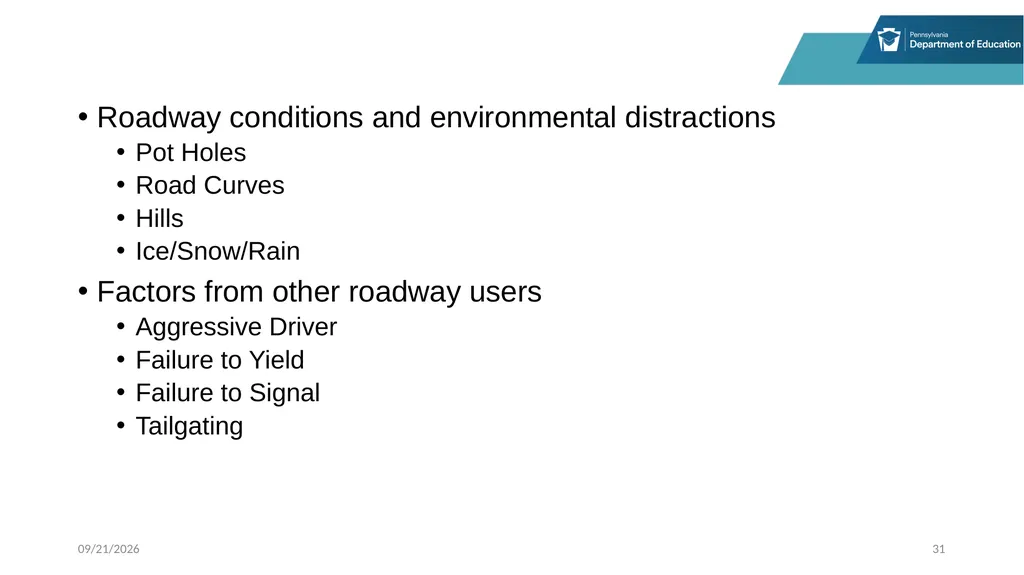
Driving Risk Factors – Slide Two Roadway conditions and environmental distractions
Pot Holes
Road Curves
Hills
Ice/Snow/Rain
Factors from other roadway users
Aggressive Driver
Failure to Yield
Failure to Signal
Tailgating 9/10/2026 31<br>
Pot Holes
Road Curves
Hills
Ice/Snow/Rain
Factors from other roadway users
Aggressive Driver
Failure to Yield
Failure to Signal
Tailgating 9/10/2026 31<br>
32
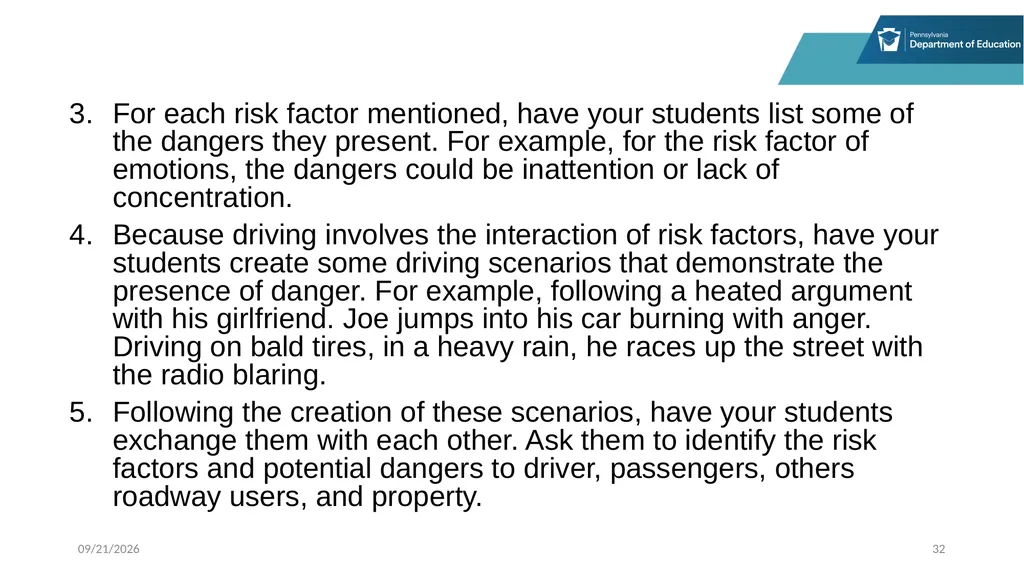
Driving Risk Factors – Slide Three For each risk factor mentioned, have your students list some of the dangers they present. For example, for the risk factor of emotions, the dangers could be inattention or lack of concentration.
Because driving involves the interaction of risk factors, have your students create some driving scenarios that demonstrate the presence of danger. For example, following a heated argument with his girlfriend. Joe jumps into his car burning with anger. Driving on bald tires, in a heavy rain, he races up the street with the radio blaring.
Following the creation of these scenarios, have your students exchange them with each other. Ask them to identify the risk factors and potential dangers to driver, passengers, others roadway users, and property. 9/10/2026 32<br>
Because driving involves the interaction of risk factors, have your students create some driving scenarios that demonstrate the presence of danger. For example, following a heated argument with his girlfriend. Joe jumps into his car burning with anger. Driving on bald tires, in a heavy rain, he races up the street with the radio blaring.
Following the creation of these scenarios, have your students exchange them with each other. Ask them to identify the risk factors and potential dangers to driver, passengers, others roadway users, and property. 9/10/2026 32<br>
33
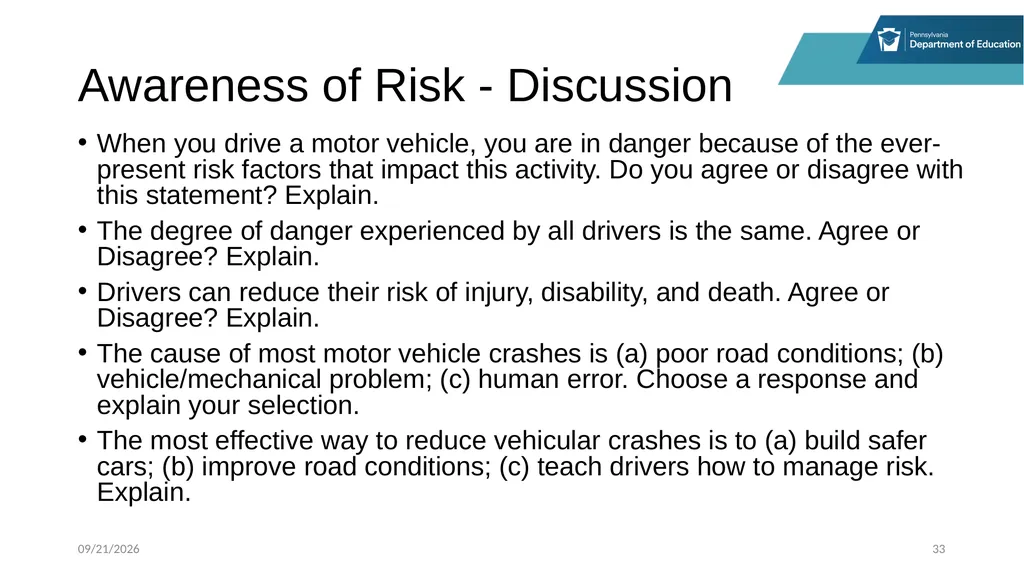
Awareness of Risk - Discussion When you drive a motor vehicle, you are in danger because of the ever-present risk factors that impact this activity. Do you agree or disagree with this statement? Explain.
The degree of danger experienced by all drivers is the same. Agree or Disagree? Explain.
Drivers can reduce their risk of injury, disability, and death. Agree or Disagree? Explain.
The cause of most motor vehicle crashes is (a) poor road conditions; (b) vehicle/mechanical problem; (c) human error. Choose a response and explain your selection.
The most effective way to reduce vehicular crashes is to (a) build safer cars; (b) improve road conditions; (c) teach drivers how to manage risk. Explain. 9/10/2026 33<br>
The degree of danger experienced by all drivers is the same. Agree or Disagree? Explain.
Drivers can reduce their risk of injury, disability, and death. Agree or Disagree? Explain.
The cause of most motor vehicle crashes is (a) poor road conditions; (b) vehicle/mechanical problem; (c) human error. Choose a response and explain your selection.
The most effective way to reduce vehicular crashes is to (a) build safer cars; (b) improve road conditions; (c) teach drivers how to manage risk. Explain. 9/10/2026 33<br>
34
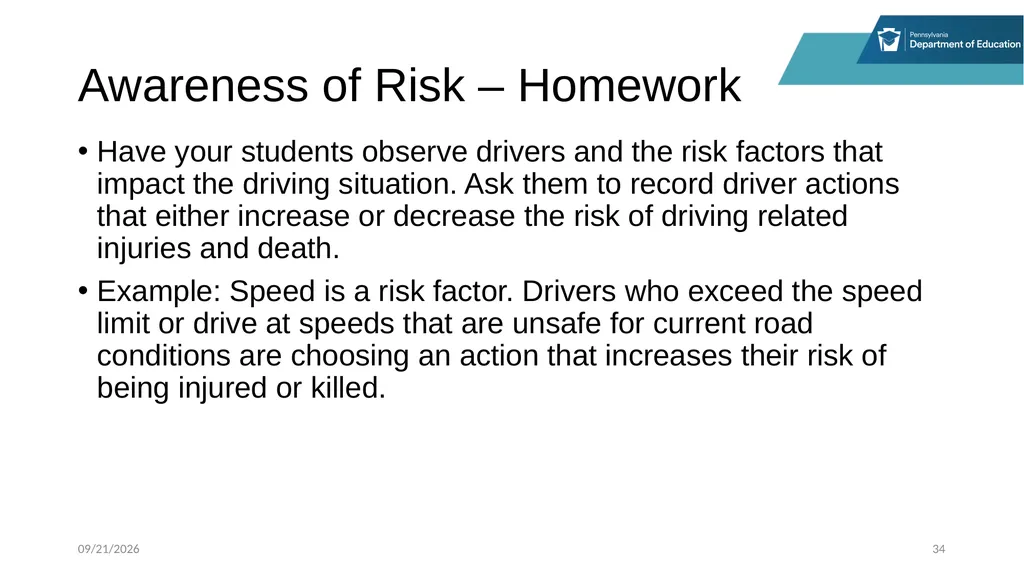
Awareness of Risk – Homework Have your students observe drivers and the risk factors that impact the driving situation. Ask them to record driver actions that either increase or decrease the risk of driving related injuries and death.
Example: Speed is a risk factor. Drivers who exceed the speed limit or drive at speeds that are unsafe for current road conditions are choosing an action that increases their risk of being injured or killed. 9/10/2026 34<br>
Example: Speed is a risk factor. Drivers who exceed the speed limit or drive at speeds that are unsafe for current road conditions are choosing an action that increases their risk of being injured or killed. 9/10/2026 34<br>
35
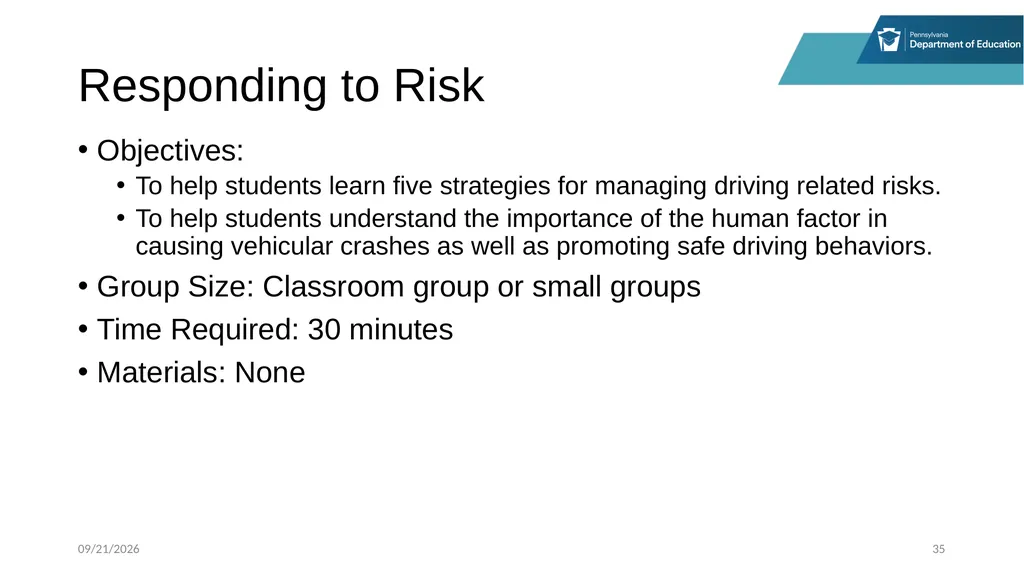
Responding to Risk Objectives:
To help students learn five strategies for managing driving related risks.
To help students understand the importance of the human factor in causing vehicular crashes as well as promoting safe driving behaviors.
Group Size: Classroom group or small groups
Time Required: 30 minutes
Materials: None 9/10/2026 35<br>
To help students learn five strategies for managing driving related risks.
To help students understand the importance of the human factor in causing vehicular crashes as well as promoting safe driving behaviors.
Group Size: Classroom group or small groups
Time Required: 30 minutes
Materials: None 9/10/2026 35<br>
36
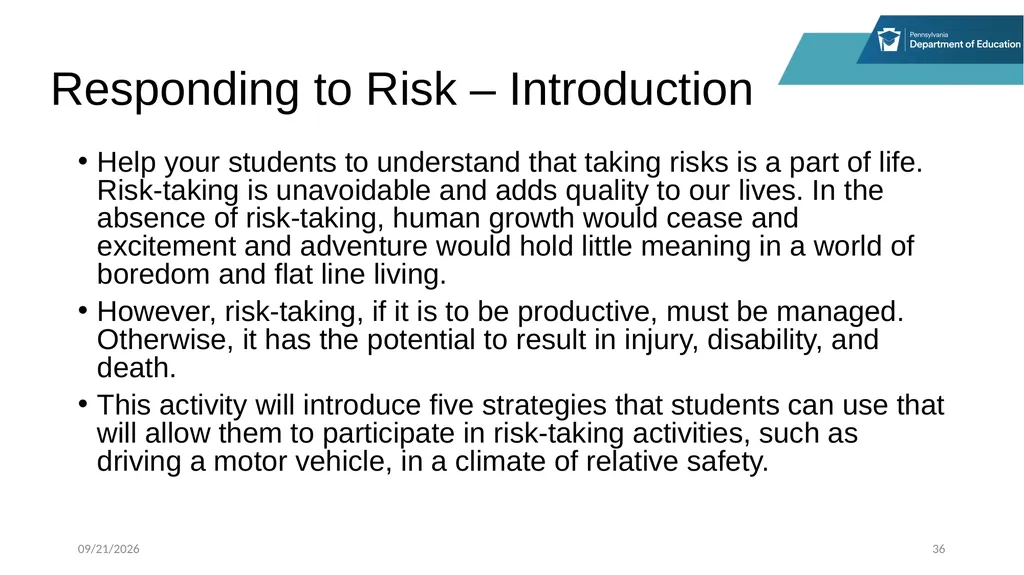
Responding to Risk – Introduction Help your students to understand that taking risks is a part of life. Risk-taking is unavoidable and adds quality to our lives. In the absence of risk-taking, human growth would cease and excitement and adventure would hold little meaning in a world of boredom and flat line living.
However, risk-taking, if it is to be productive, must be managed. Otherwise, it has the potential to result in injury, disability, and death.
This activity will introduce five strategies that students can use that will allow them to participate in risk-taking activities, such as driving a motor vehicle, in a climate of relative safety. 9/10/2026 36<br>
However, risk-taking, if it is to be productive, must be managed. Otherwise, it has the potential to result in injury, disability, and death.
This activity will introduce five strategies that students can use that will allow them to participate in risk-taking activities, such as driving a motor vehicle, in a climate of relative safety. 9/10/2026 36<br>
37
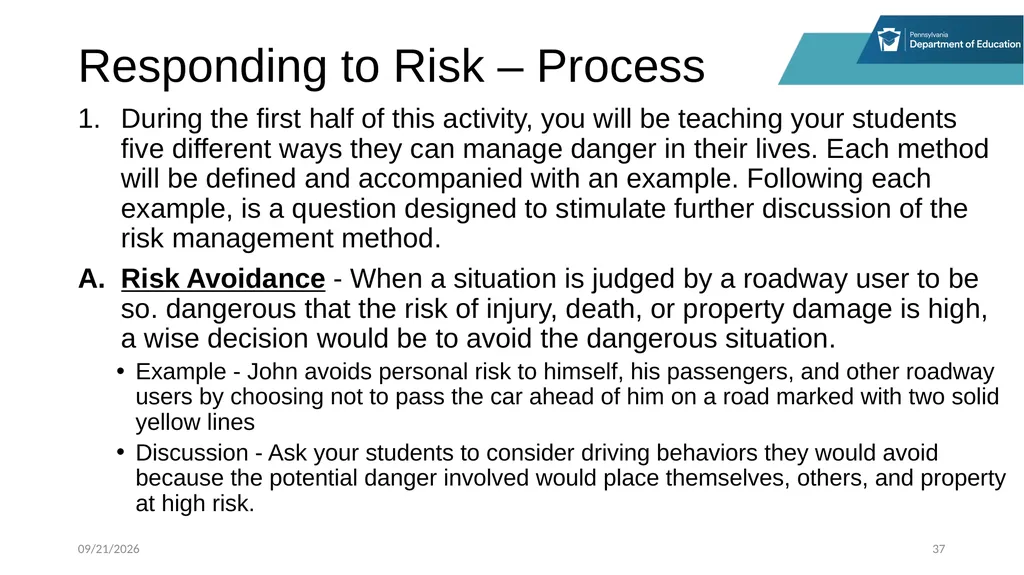
Responding to Risk – Process During the first half of this activity, you will be teaching your students five different ways they can manage danger in their lives. Each method will be defined and accompanied with an example. Following each example, is a question designed to stimulate further discussion of the risk management method.
Risk Avoidance - When a situation is judged by a roadway user to be so. dangerous that the risk of injury, death, or property damage is high, a wise decision would be to avoid the dangerous situation.
Example - John avoids personal risk to himself, his passengers, and other roadway users by choosing not to pass the car ahead of him on a road marked with two solid yellow lines
Discussion - Ask your students to consider driving behaviors they would avoid because the potential danger involved would place themselves, others, and property at high risk. 9/10/2026 37<br>
Risk Avoidance - When a situation is judged by a roadway user to be so. dangerous that the risk of injury, death, or property damage is high, a wise decision would be to avoid the dangerous situation.
Example - John avoids personal risk to himself, his passengers, and other roadway users by choosing not to pass the car ahead of him on a road marked with two solid yellow lines
Discussion - Ask your students to consider driving behaviors they would avoid because the potential danger involved would place themselves, others, and property at high risk. 9/10/2026 37<br>
38
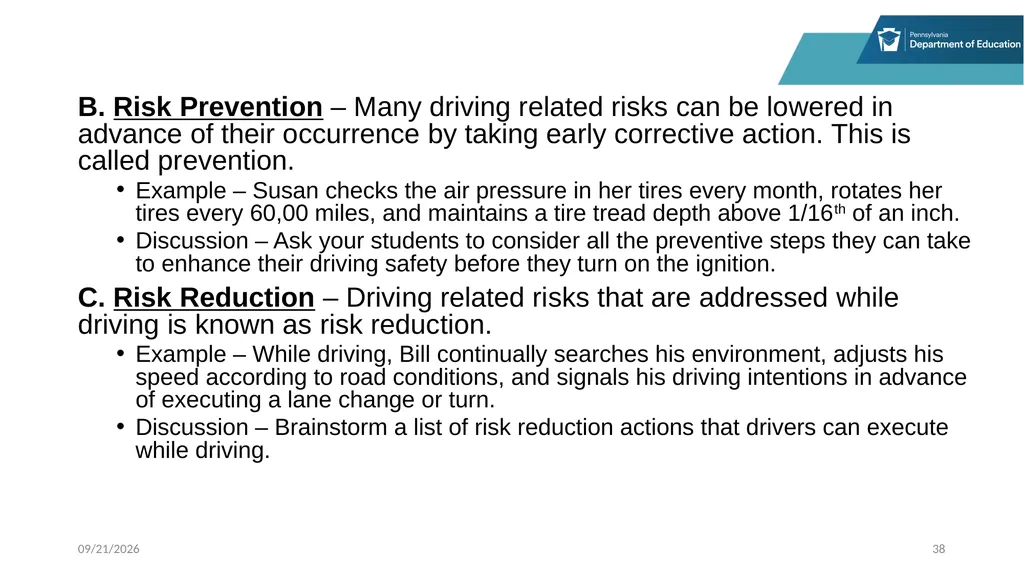
Responding to Risk – Slide Two B. Risk Prevention – Many driving related risks can be lowered in advance of their occurrence by taking early corrective action. This is called prevention.
Example – Susan checks the air pressure in her tires every month, rotates her tires every 60,00 miles, and maintains a tire tread depth above 1/16th of an inch.
Discussion – Ask your students to consider all the preventive steps they can take to enhance their driving safety before they turn on the ignition.
C. Risk Reduction – Driving related risks that are addressed while driving is known as risk reduction.
Example – While driving, Bill continually searches his environment, adjusts his speed according to road conditions, and signals his driving intentions in advance of executing a lane change or turn.
Discussion – Brainstorm a list of risk reduction actions that drivers can execute while driving. 9/10/2026 38<br>
Example – Susan checks the air pressure in her tires every month, rotates her tires every 60,00 miles, and maintains a tire tread depth above 1/16th of an inch.
Discussion – Ask your students to consider all the preventive steps they can take to enhance their driving safety before they turn on the ignition.
C. Risk Reduction – Driving related risks that are addressed while driving is known as risk reduction.
Example – While driving, Bill continually searches his environment, adjusts his speed according to road conditions, and signals his driving intentions in advance of executing a lane change or turn.
Discussion – Brainstorm a list of risk reduction actions that drivers can execute while driving. 9/10/2026 38<br>
39
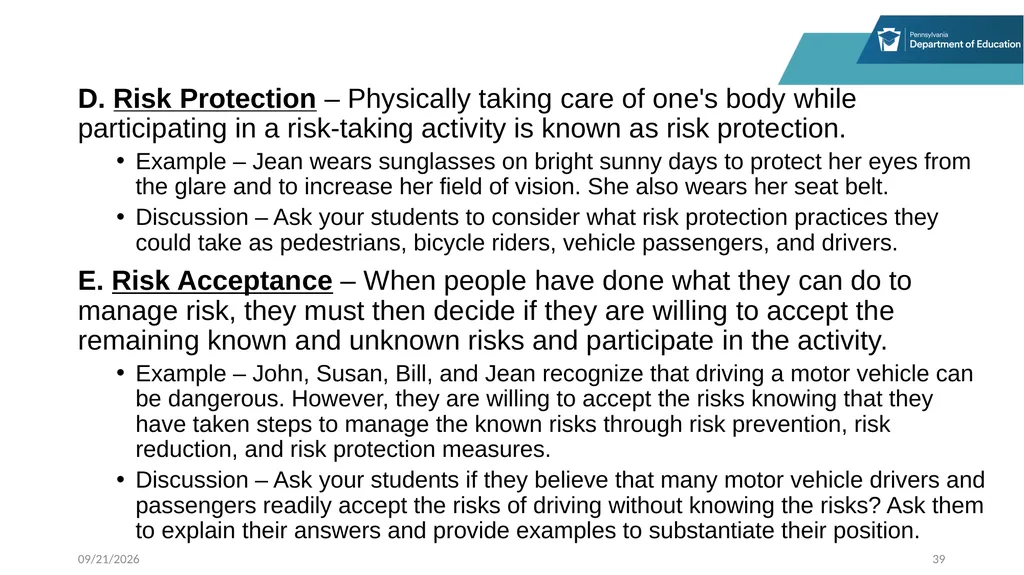
Responding to Risk – Slide Three D. Risk Protection – Physically taking care of one's body while participating in a risk-taking activity is known as risk protection.
Example – Jean wears sunglasses on bright sunny days to protect her eyes from the glare and to increase her field of vision. She also wears her seat belt.
Discussion – Ask your students to consider what risk protection practices they could take as pedestrians, bicycle riders, vehicle passengers, and drivers.
E. Risk Acceptance – When people have done what they can do to manage risk, they must then decide if they are willing to accept the remaining known and unknown risks and participate in the activity.
Example – John, Susan, Bill, and Jean recognize that driving a motor vehicle can be dangerous. However, they are willing to accept the risks knowing that they have taken steps to manage the known risks through risk prevention, risk reduction, and risk protection measures.
Discussion – Ask your students if they believe that many motor vehicle drivers and passengers readily accept the risks of driving without knowing the risks? Ask them to explain their answers and provide examples to substantiate their position. 9/10/2026 39<br>
Example – Jean wears sunglasses on bright sunny days to protect her eyes from the glare and to increase her field of vision. She also wears her seat belt.
Discussion – Ask your students to consider what risk protection practices they could take as pedestrians, bicycle riders, vehicle passengers, and drivers.
E. Risk Acceptance – When people have done what they can do to manage risk, they must then decide if they are willing to accept the remaining known and unknown risks and participate in the activity.
Example – John, Susan, Bill, and Jean recognize that driving a motor vehicle can be dangerous. However, they are willing to accept the risks knowing that they have taken steps to manage the known risks through risk prevention, risk reduction, and risk protection measures.
Discussion – Ask your students if they believe that many motor vehicle drivers and passengers readily accept the risks of driving without knowing the risks? Ask them to explain their answers and provide examples to substantiate their position. 9/10/2026 39<br>
40
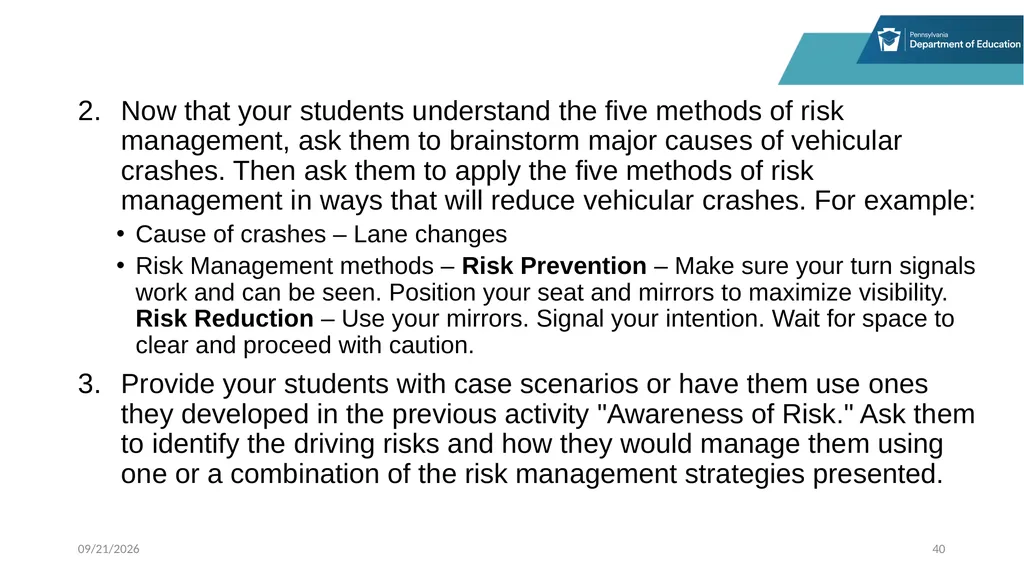
Responding to Risk – Slide Four Now that your students understand the five methods of risk management, ask them to brainstorm major causes of vehicular crashes. Then ask them to apply the five methods of risk management in ways that will reduce vehicular crashes. For example:
Cause of crashes – Lane changes
Risk Management methods – Risk Prevention – Make sure your turn signals work and can be seen. Position your seat and mirrors to maximize visibility. Risk Reduction – Use your mirrors. Signal your intention. Wait for space to clear and proceed with caution.
Provide your students with case scenarios or have them use ones they developed in the previous activity "Awareness of Risk." Ask them to identify the driving risks and how they would manage them using one or a combination of the risk management strategies presented. 9/10/2026 40<br>
Cause of crashes – Lane changes
Risk Management methods – Risk Prevention – Make sure your turn signals work and can be seen. Position your seat and mirrors to maximize visibility. Risk Reduction – Use your mirrors. Signal your intention. Wait for space to clear and proceed with caution.
Provide your students with case scenarios or have them use ones they developed in the previous activity "Awareness of Risk." Ask them to identify the driving risks and how they would manage them using one or a combination of the risk management strategies presented. 9/10/2026 40<br>
41
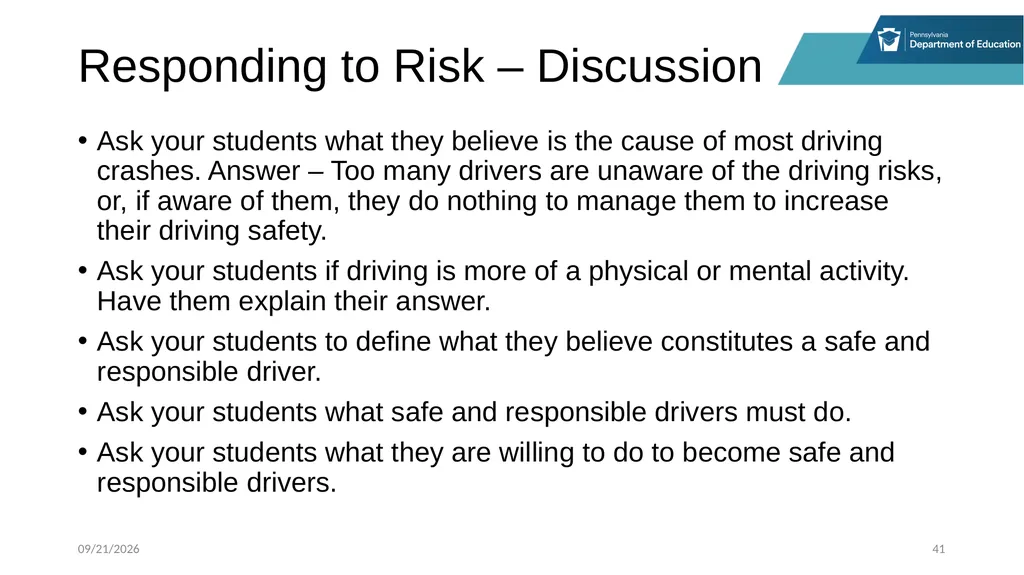
Responding to Risk – Discussion Ask your students what they believe is the cause of most driving crashes. Answer – Too many drivers are unaware of the driving risks, or, if aware of them, they do nothing to manage them to increase their driving safety.
Ask your students if driving is more of a physical or mental activity. Have them explain their answer.
Ask your students to define what they believe constitutes a safe and responsible driver.
Ask your students what safe and responsible drivers must do.
Ask your students what they are willing to do to become safe and responsible drivers. 9/10/2026 41<br>
Ask your students if driving is more of a physical or mental activity. Have them explain their answer.
Ask your students to define what they believe constitutes a safe and responsible driver.
Ask your students what safe and responsible drivers must do.
Ask your students what they are willing to do to become safe and responsible drivers. 9/10/2026 41<br>
42
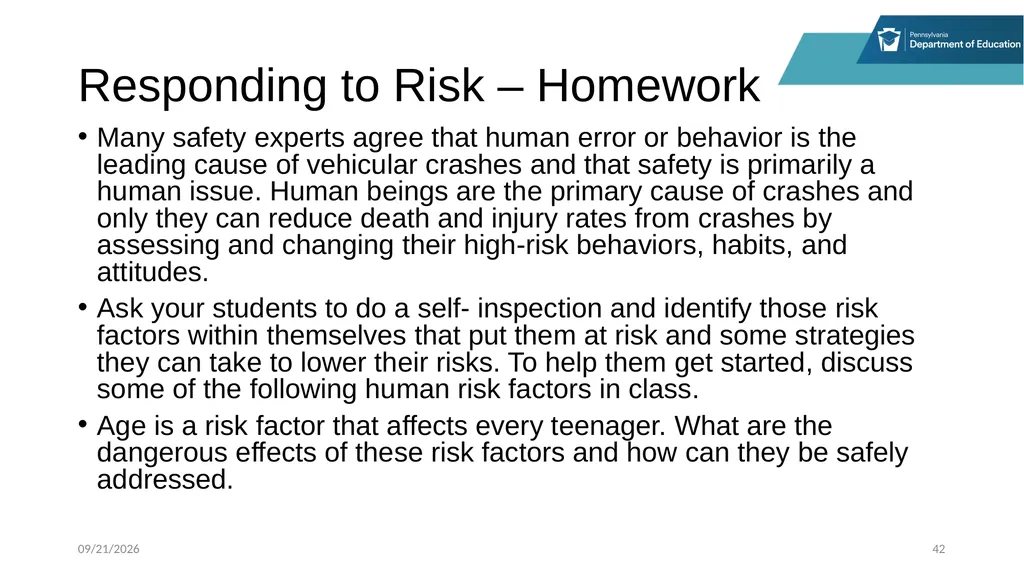
Responding to Risk – Homework Many safety experts agree that human error or behavior is the leading cause of vehicular crashes and that safety is primarily a human issue. Human beings are the primary cause of crashes and only they can reduce death and injury rates from crashes by assessing and changing their high-risk behaviors, habits, and attitudes.
Ask your students to do a self- inspection and identify those risk factors within themselves that put them at risk and some strategies they can take to lower their risks. To help them get started, discuss some of the following human risk factors in class.
Age is a risk factor that affects every teenager. What are the dangerous effects of these risk factors and how can they be safely addressed. 9/10/2026 42<br>
Ask your students to do a self- inspection and identify those risk factors within themselves that put them at risk and some strategies they can take to lower their risks. To help them get started, discuss some of the following human risk factors in class.
Age is a risk factor that affects every teenager. What are the dangerous effects of these risk factors and how can they be safely addressed. 9/10/2026 42<br>
43
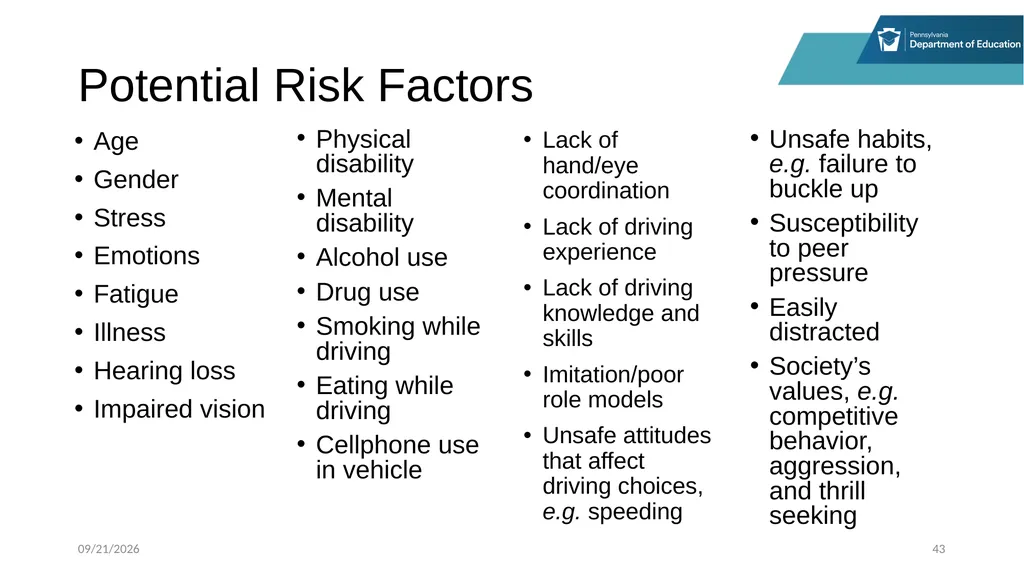
Potential Risk Factors Age
Gender
Stress
Emotions
Fatigue
Illness
Hearing loss
Impaired vision Physical disability
Mental disability
Alcohol use
Drug use
Smoking while driving
Eating while driving
Cellphone use in vehicle Lack of hand/eye coordination
Lack of driving experience
Lack of driving knowledge and skills
Imitation/poor role models
Unsafe attitudes that affect driving choices, e.g. speeding Unsafe habits, e.g. failure to buckle up
Susceptibility to peer pressure
Easily distracted
Society’s values, e.g. competitive behavior, aggression, and thrill seeking 9/10/2026 43<br>
Gender
Stress
Emotions
Fatigue
Illness
Hearing loss
Impaired vision Physical disability
Mental disability
Alcohol use
Drug use
Smoking while driving
Eating while driving
Cellphone use in vehicle Lack of hand/eye coordination
Lack of driving experience
Lack of driving knowledge and skills
Imitation/poor role models
Unsafe attitudes that affect driving choices, e.g. speeding Unsafe habits, e.g. failure to buckle up
Susceptibility to peer pressure
Easily distracted
Society’s values, e.g. competitive behavior, aggression, and thrill seeking 9/10/2026 43<br>
44
Contact/Mission For more information on the (the topic of the presentation) please visit PDE’s website at https://www.pa.gov/agencies/education/programs-and-services/instruction/elementary-and-secondary-education/curriculum/driver-and-safety-education 9/10/2026 44<br>