Strategic Management Unit-4 Topic- Corporate portfolio analysis Strategic plan Is a document which provides information regarding the different elements of strategic management and the manner in which an organization and its strategists
"Strategic Management Unit-4 Topic- Corporate" is the property of its rightful owner. Permission is granted to
download and print the materials on this website for personal, non-commercial use only, and to display it
on your personal computer provided you do not modify the materials and that you retain all copyright
notices contained in the materials. By downloading content from our website, you accept the terms of this
agreement.
Strategic plan Is a document which provides information regarding the different elements of strategic management and the manner in which an organization and its strategists propose to put the strategies into action.<br>
03
Contingencies strategies Are formulated in advance to deal with uncertainties that are a natural part of the business.
Contingency strategies plays a proactive role in dealing with emergencies and disasters.
Sometimes even unforeseen but fortuitous circumstances that prove to be lucky for organization, can call for contingency strategies.<br>
04
Corporate portfolio analysis Could be defined as a set of techniques that help strategists in taking strategic decisions with regard to individual products or businesses in a firm’s portfolio.
The main advantage of this technique in a multi-product, multi-business firm is that resources could be targeted at the corporate level to those businesses that possess the greatest potential for creating competitive advantage.
CPA techniques are Boston Consulting Group(BCG) or product portfolio, General Electric’s Nine-cell matrix, Hofer’s Product market evolution, Directional policy and The Strategic position and action evaluation matrix.<br>
05
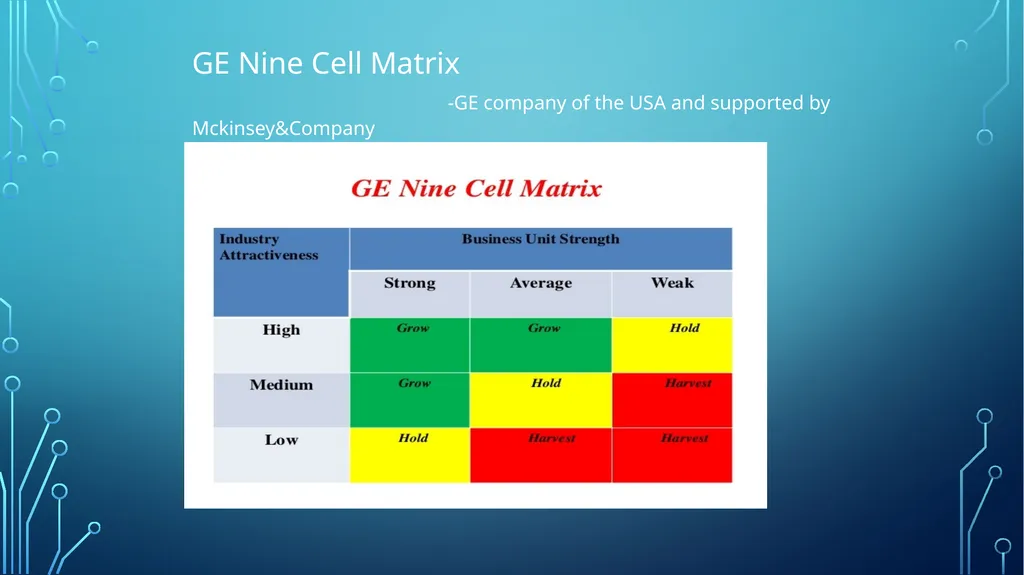
GE Nine Cell Matrix
-GE company of the USA and supported by Mckinsey&Company<br>
06
Ge nine cell matrix Vertical axis represents industry attractiveness, which is weighted composite rating based on eight different factors.
These factors are market size and growth rate, industry profit margin, competitive intensity, seasonality, cyclicality, economies of scale, technology and social, environmental, legal and human impacts.
Horizontal axis represents business strength/competitive position, which is again a weighted composite rating based on seven factors.
These factors are relative market share, profit margins, ability to compete on price and quality, knowledge of customers and market, competitive strengths and weaknesses, technological capability and caliber of management.<br>
07
Ge nine cell matrix The two composite values are plotted for each business in a company’s portfolio.
Nine cells of GE matrix are grouped on the basis of low to high industrial attractiveness and weak to strong business strength.
Three zones of three cells each, are made, denoting diff. combination represented by green, yellow and red colours.
For this reason, the GE matrix is also known as the stoplight strategy matrix.<br>
08
Ge nine cell matrix Green zone – ‘go ahead’, to grow and build – expansion strategy – attract major investment Yellow zone – ‘wait and see’, to hold and maintain – stability strategy and consolidation Red zone – ‘stop’ – retrenchment strategy – divestment and liquidation<br>
09
Advantages and disadvantages of ge nine cell matrix ADVANTAGES
It incorporates a large variety of strategic variables like the market share and industry size.
Is also a powerful analytical tool to channel corporate resources to businesses that combine medium to high industry attractiveness with average to strong business strength/competitive position.
DISADVANTAGE
Is that it only provides broad strategic prescriptions rather than the specifics of business strategy.<br>
10
Advantages of corporate portfolio analysis Develop feasible strategic alternatives and to allocate resources to among them.
More perceptive understanding of the business
Leading to better strategic decisions.<br>
11
Disadvantages of corporate portfolio analysis An assessment of business in terms of just two dimensions of market share and industry growth can be misleading as a number of other factors need to be taken into account.
The relation between relative market share and cost saving is not directly proportional; companies with low market share and focused on a market niche could have low operations cost.
A high market share in a low growth industry does not necessarily result in a large cash flow.
None of the portfolio techniques treat the source of value creation from diversification strategies.<br>