
Stress Awareness House Keeping & Introductions


Description: Stress Awareness House Keeping Introductions Introducing yourselves Name Role What do you hope to gain from todays training? Aims of The Session What is stress and why do we need to tackle it? Understand how the body reacts to stress.
Related Topics
Download Presentation
"Stress Awareness House Keeping & Introductions" is the property of its rightful owner. Permission is granted to download and print the materials on this website for personal, non-commercial use only, and to display it on your personal computer provided you do not modify the materials and that you retain all copyright notices contained in the materials. By downloading content from our website, you accept the terms of this agreement.
Presentation Transcript
slide1. Stress Awareness<br>
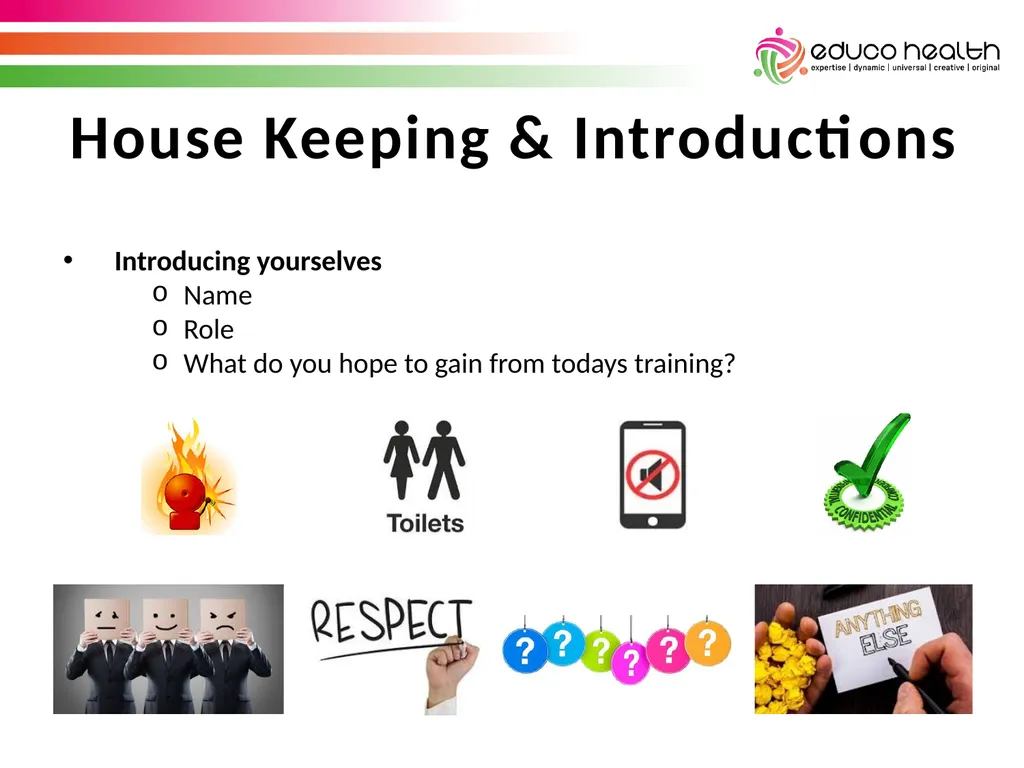
slide2. House Keeping & Introductions Introducing yourselves
Name
Role
What do you hope to gain from todays training?<br>
slide3. Aims of The Session What is stress and why do we need to tackle it?
Understand how the body reacts to stress.
Understand the impact stress can have on us, our mental health and ability to function at work.
Understand the importance of talking about mental health and how to have wellbeing conversations.
Introduce a number of tools available to build resilience and reduce stress.<br>
slide4. What Is Stress? Stress is the feeling of being under too much mental or emotional pressure. Pressure turns into stress when you feel unable to cope. ... Stress causes a surge of hormones in your body. These stress hormones are released to enable you to deal with pressures or threats – the so-called "fight or flight" response.
(NHS Direct 2017)<br>
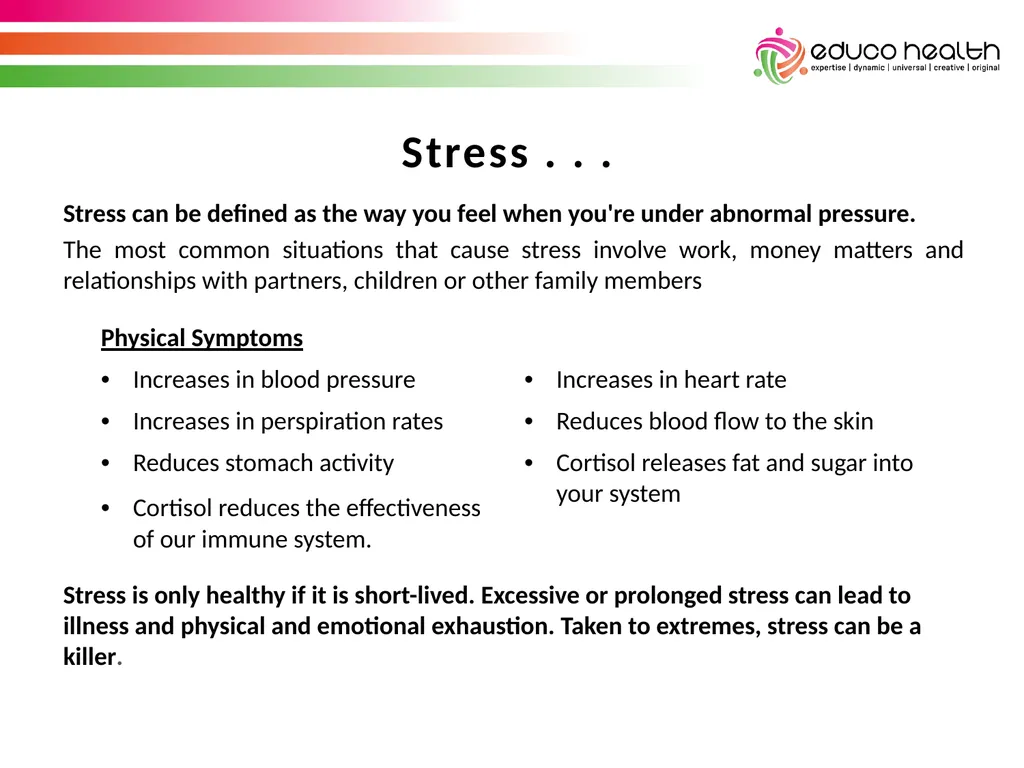
slide5. Stress . . . Stress can be defined as the way you feel when you're under abnormal pressure.
The most common situations that cause stress involve work, money matters and relationships with partners, children or other family members
Stress is only healthy if it is short-lived. Excessive or prolonged stress can lead to illness and physical and emotional exhaustion. Taken to extremes, stress can be a killer.<br>
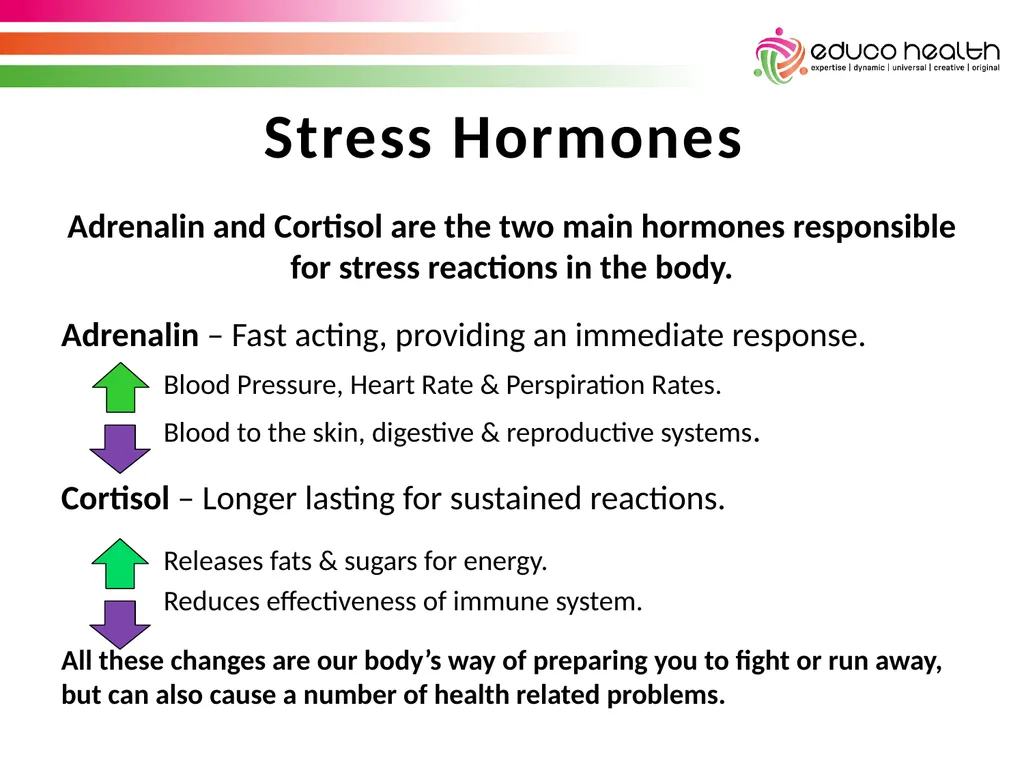
slide6. Adrenalin and Cortisol are the two main hormones responsible for stress reactions in the body.
Adrenalin – Fast acting, providing an immediate response.
Blood Pressure, Heart Rate & Perspiration Rates.
Blood to the skin, digestive & reproductive systems.
Cortisol – Longer lasting for sustained reactions.
Releases fats & sugars for energy.
Reduces effectiveness of immune system.
All these changes are our body’s way of preparing you to fight or run away, but can also cause a number of health related problems. Stress Hormones<br>
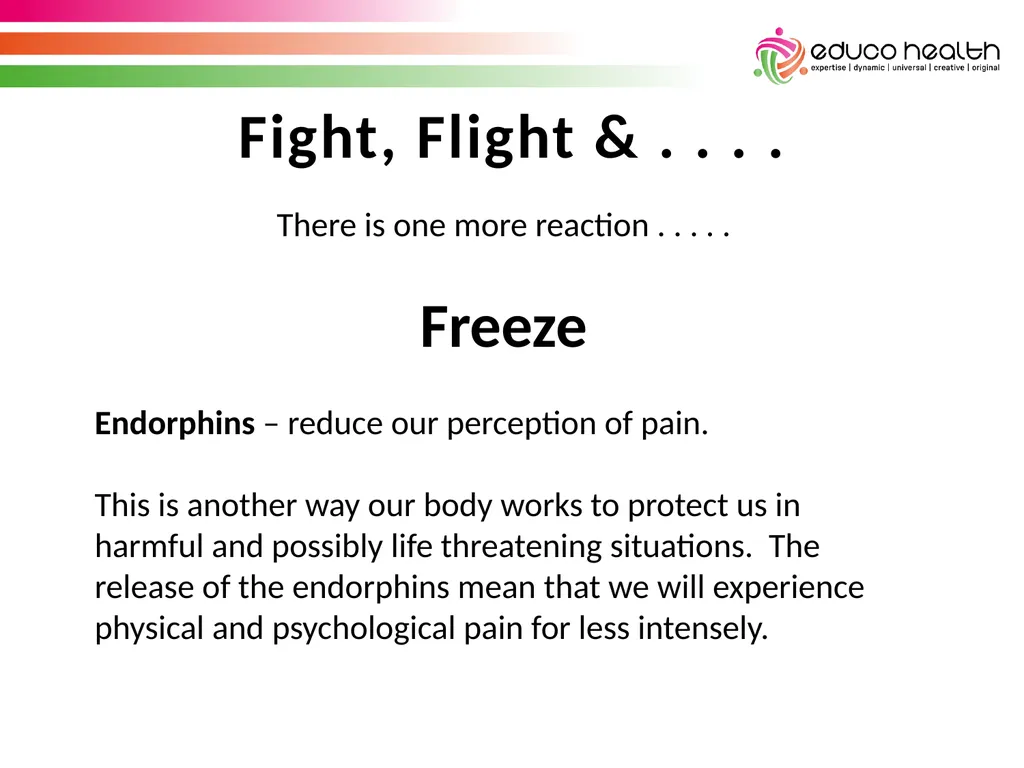
slide7. Fight, Flight & . . . . There is one more reaction . . . . .
Freeze
Endorphins – reduce our perception of pain.
This is another way our body works to protect us in harmful and possibly life threatening situations. The release of the endorphins mean that we will experience physical and psychological pain for less intensely.<br>
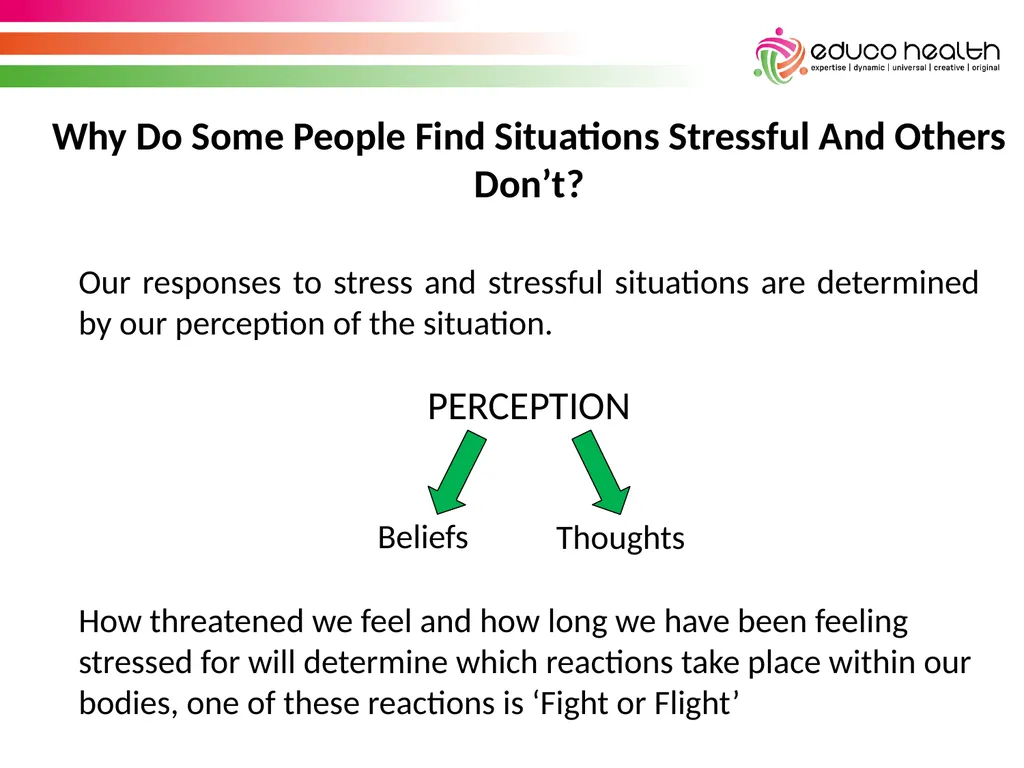
slide9. Why Do Some People Find Situations Stressful And Others Don’t? Our responses to stress and stressful situations are determined by our perception of the situation.
PERCEPTION
How threatened we feel and how long we have been feeling stressed for will determine which reactions take place within our bodies, one of these reactions is ‘Fight or Flight’ Beliefs Thoughts<br>
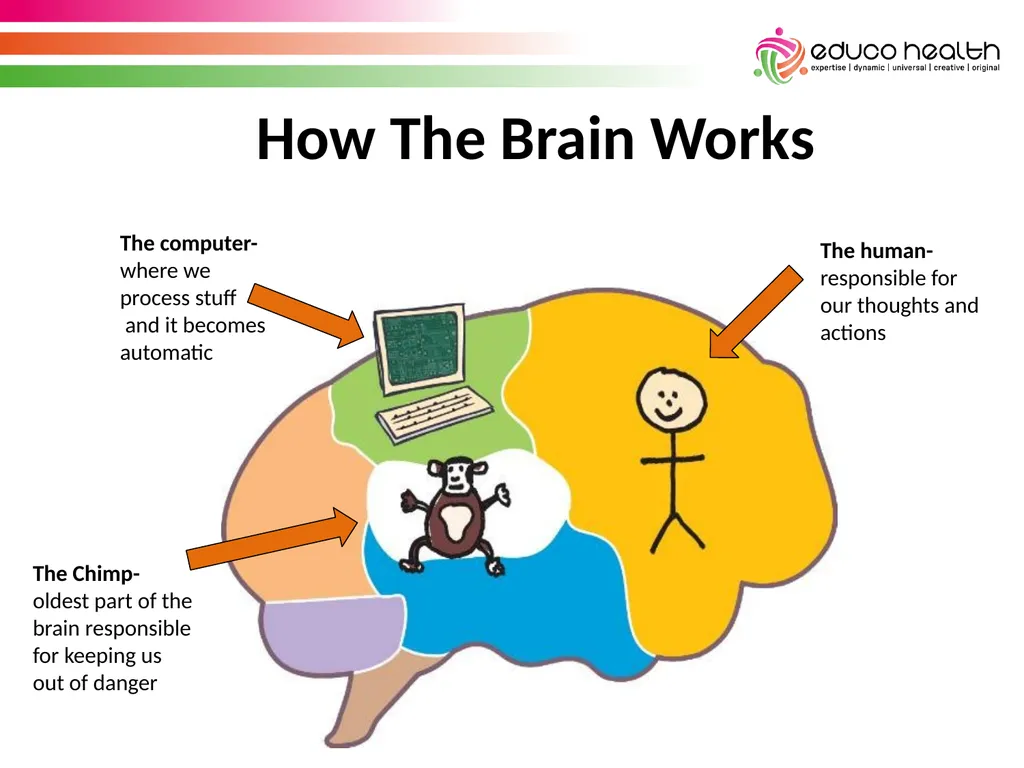
slide10. How The Brain Works The Chimp- oldest part of the brain responsible for keeping us out of danger The human- responsible for our thoughts and actions The computer- where we process stuff
and it becomes automatic<br>
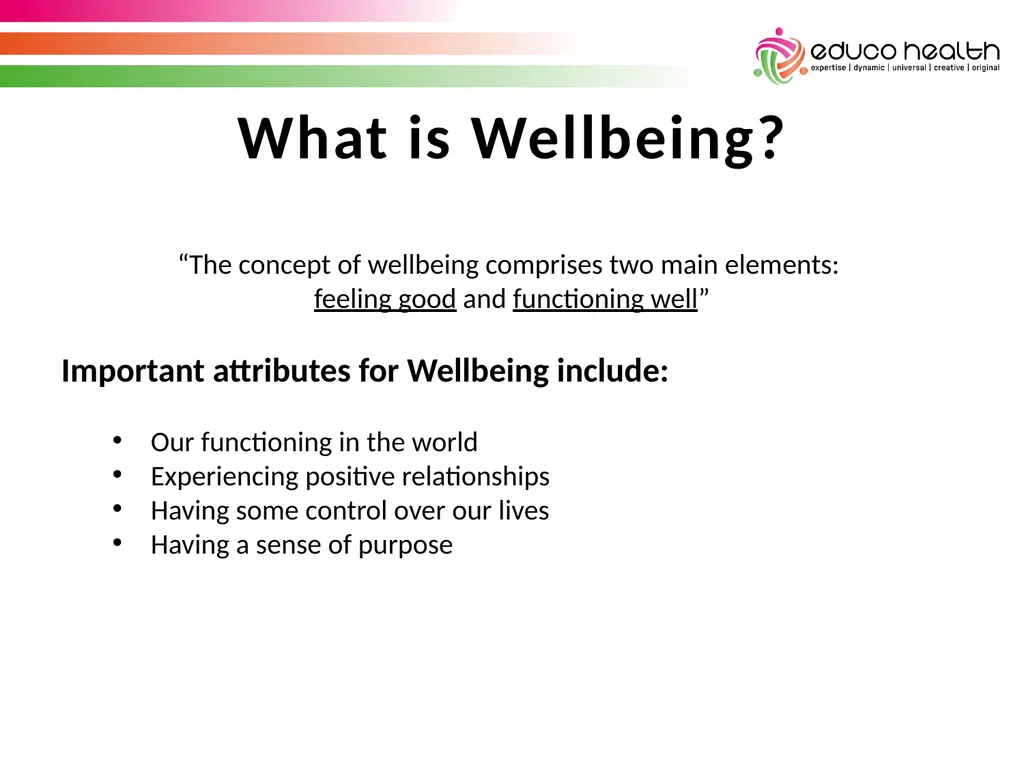
slide11. What is Wellbeing? “The concept of wellbeing comprises two main elements:
feeling good and functioning well”
Important attributes for Wellbeing include:
Our functioning in the world
Experiencing positive relationships
Having some control over our lives
Having a sense of purpose<br>
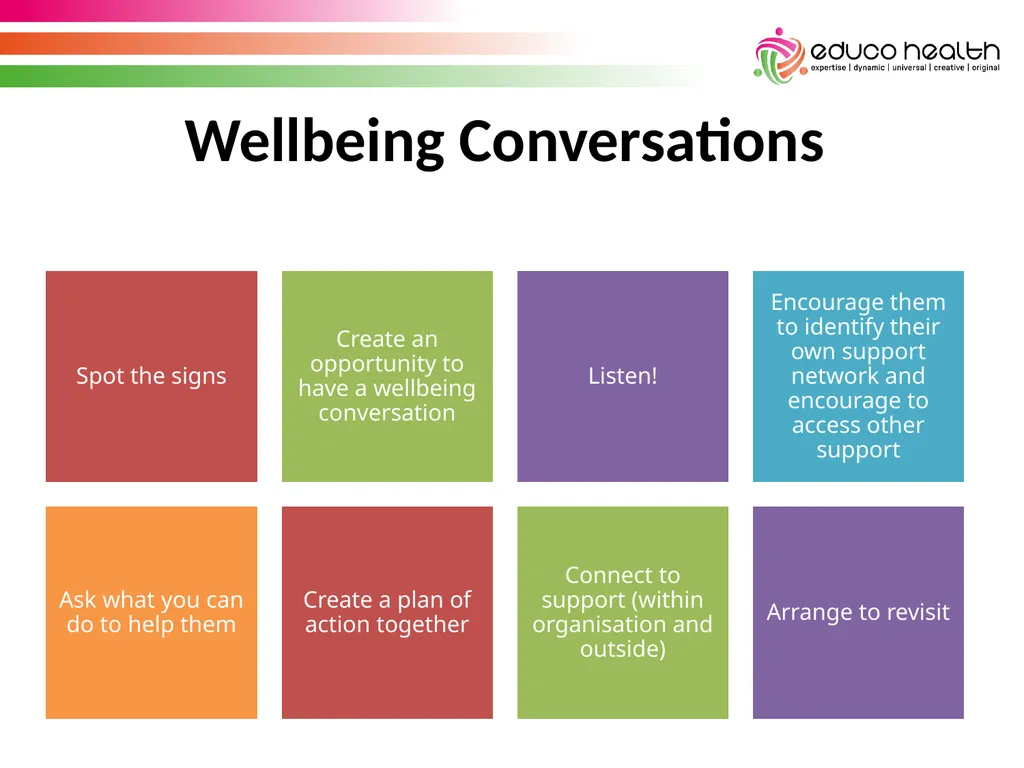
slide12. Wellbeing Conversations<br>
slide13. Looking after your own wellbeing Research from Anna Freud indicates that taking the following steps can be important in the promotion and maintenance of mental wellbeing:
Knowing personal limits and having the ability to say “no” when necessary
Identifying supportive people that’s you have in your network- Create a buddy system
Talking is key- speak to someone before your leave school
Debrief and detach -Before you leave school/college for the week, identify the thing that’s bothered you most during the week and arrange to consult with someone before you leave –the weekend is yours, make sure you don’t take what isn’t needed home with you!<br>
slide14. Stress Management Practical Tips For Managing Our Own Stress
5 Ways To Wellbeing (New Economics Foundation, for Gov.uk)
Stress Less Schedule (Dr Kirsch American Institute of Stress)
7 11 Breathing (The Human Givens Institute)
Wellness Action Plan (WAPs)(Professor Chris Williams, University of Glasgow)
Access to Work (Remploy)
Recommended Reading (Books on Prescription)
Mobile Phone & Desk Top Apps<br>
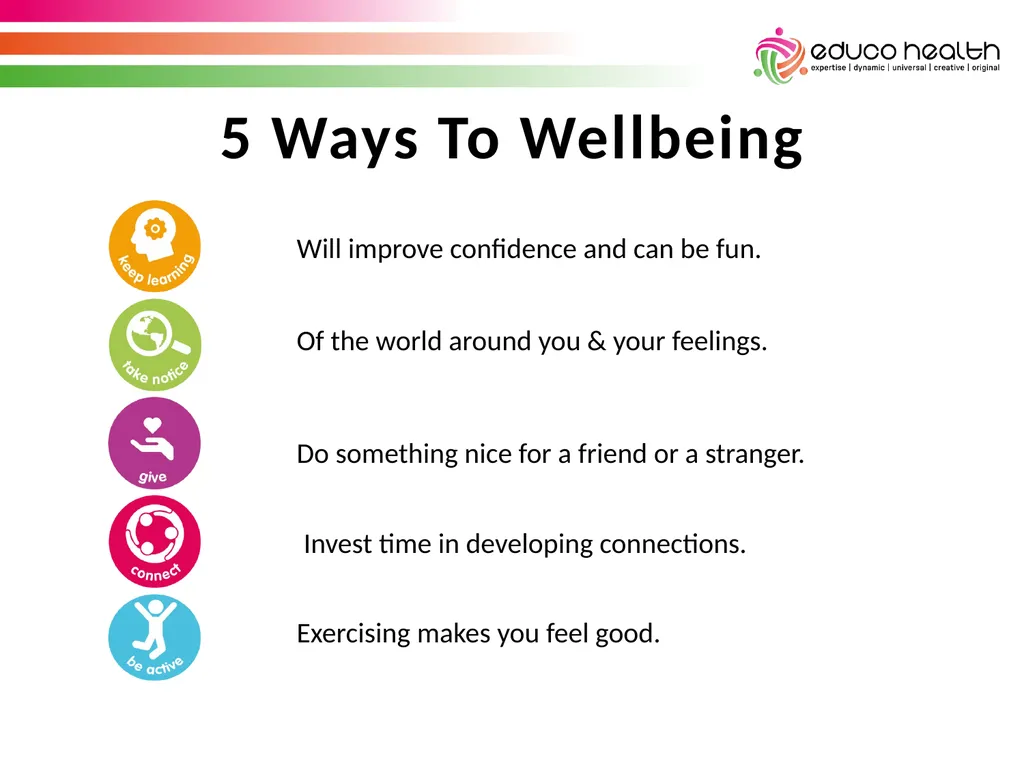
slide15. 5 Ways To Wellbeing Will improve confidence and can be fun.
Of the world around you & your feelings.
Do something nice for a friend or a stranger.
Invest time in developing connections.
Exercising makes you feel good.<br>
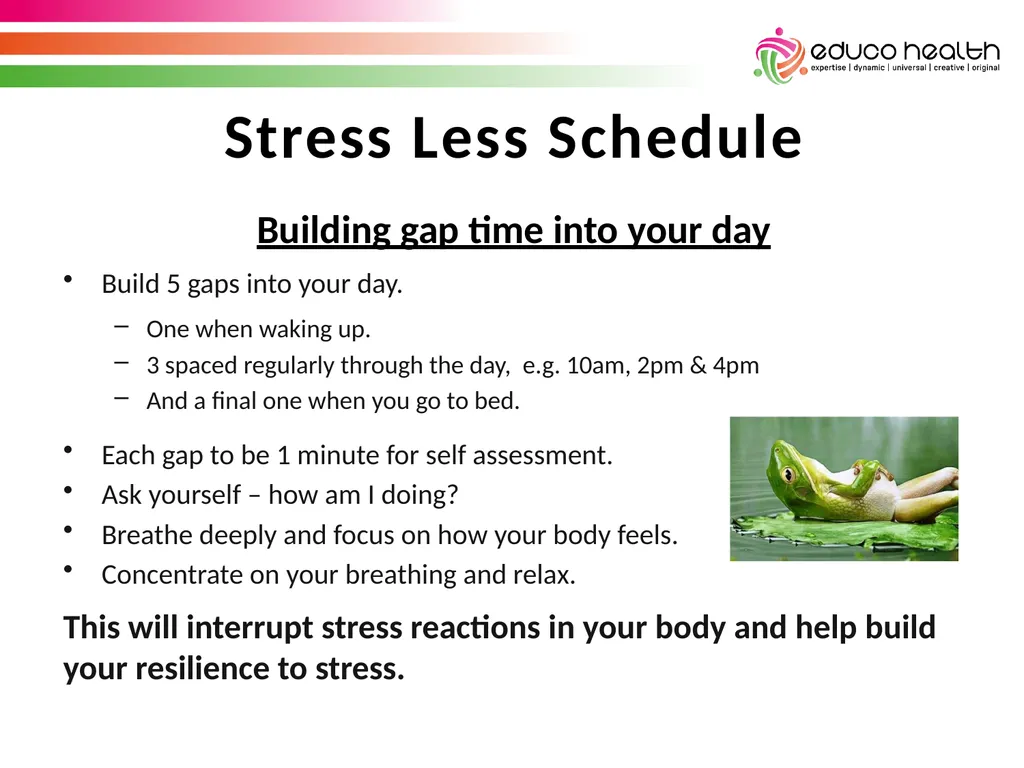
slide16. Stress Less Schedule Building gap time into your day
Build 5 gaps into your day.
One when waking up.
3 spaced regularly through the day, e.g. 10am, 2pm & 4pm
And a final one when you go to bed.
Each gap to be 1 minute for self assessment.
Ask yourself – how am I doing?
Breathe deeply and focus on how your body feels.
Concentrate on your breathing and relax.
This will interrupt stress reactions in your body and help build your resilience to stress.<br>
slide17. 7 – 11 Breathing<br>
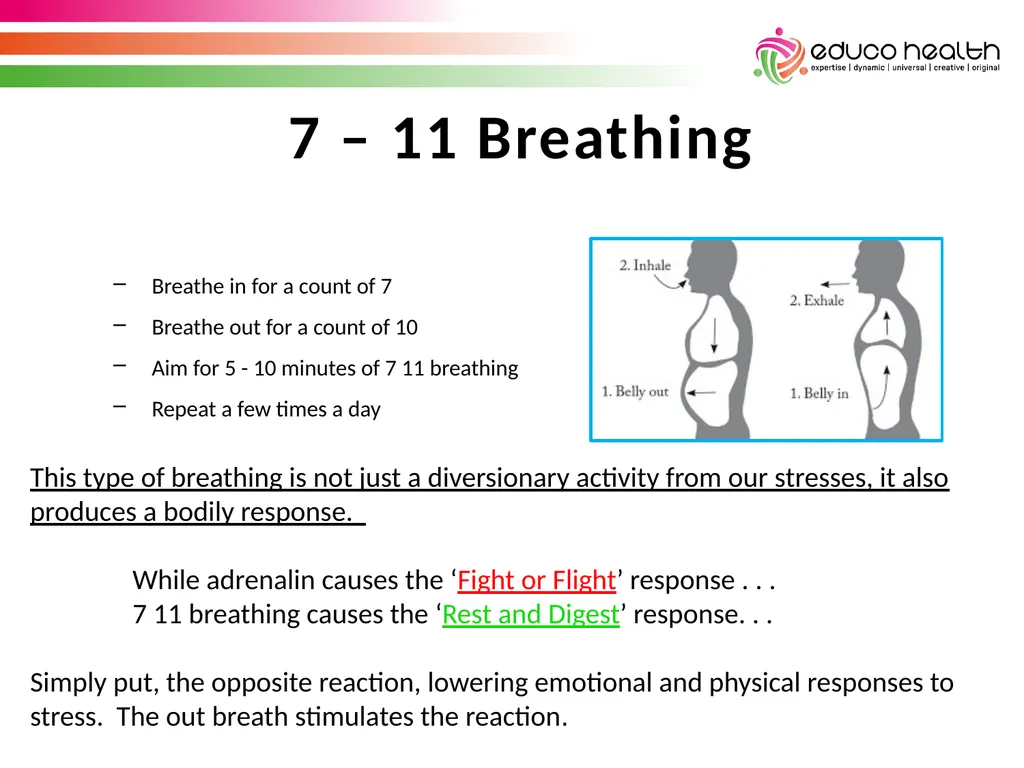
slide18. 7 – 11 Breathing Breathe in for a count of 7
Breathe out for a count of 10
Aim for 5 - 10 minutes of 7 11 breathing
Repeat a few times a day
This type of breathing is not just a diversionary activity from our stresses, it also produces a bodily response.
While adrenalin causes the ‘Fight or Flight’ response . . .
7 11 breathing causes the ‘Rest and Digest’ response. . .
Simply put, the opposite reaction, lowering emotional and physical responses to stress. The out breath stimulates the reaction.<br>
slide19. Wellness Action Plan https://www.mind.org.uk/workplace/mental-health-at-work/taking-care-of-your-staff/employer-resources/wellness-action-plan-download/<br>
slide20. The WAPs are a personalised, practical tool we can all use – whether we have a mental health problem or not – to help us identify what keeps us well at work, what causes us to become unwell and the support we would like to receive from our manager to boost our wellbeing or support us through a recovery.
www.mind.org.uk Wellness Action Plan<br>
slide21. Support for Staff Schools in Mind is a free network for school staff hosted by Anna Freud, the network shares academic and clinical expertise regarding wellbeing and mental health issues for schools
www.mentalhealthyschools.org.uk
www.mindfulteachers.org
www.remploy.co.uk/ Access to work mental health support services
Education Support Free 24/7 helpline: 08000 562 561
Education support offer counselling<br>
slide22. Access to Work Mental Health Support Service This confidential service delivered by Remploy is funded by the Department for Work and Pensions and is available at no charge to any employees with depression, anxiety, stress or other mental health issues affecting their work.<br>
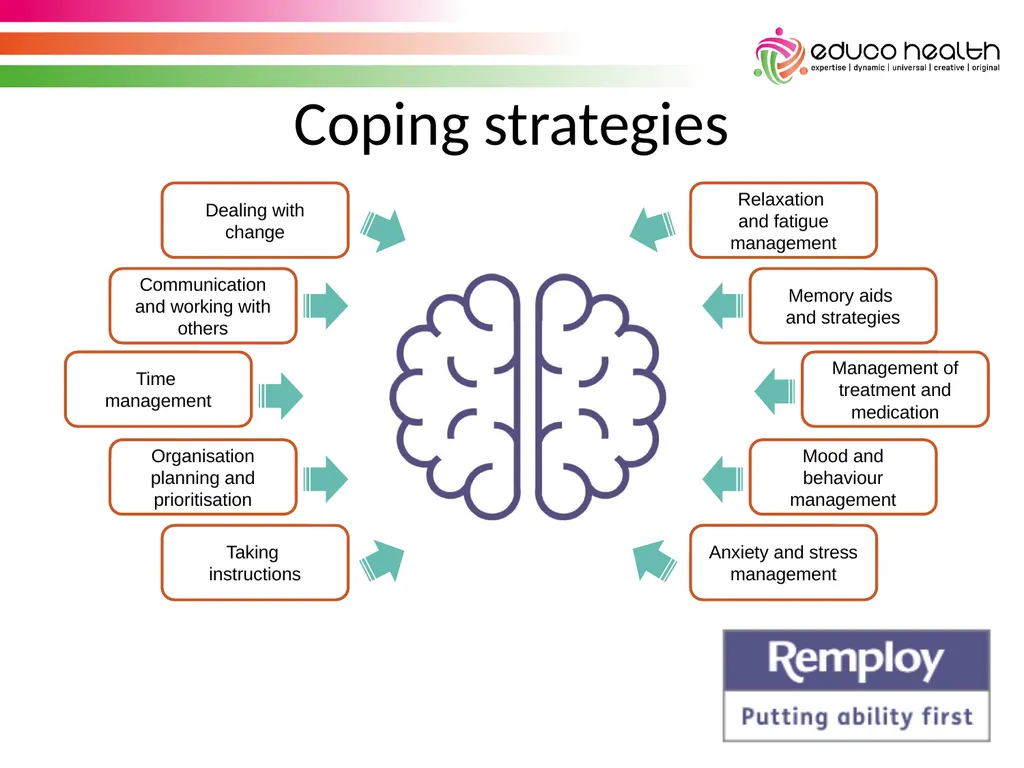
slide23. Dealing with change Communication and working with others Time management Organisation planning and prioritisation Taking instructions Relaxation and fatigue management Memory aids and strategies Management of treatment and medication Mood and behaviour management Anxiety and stress management Coping strategies<br>
slide24. Access to Work Mental Health Support Service Our specialist advisers provide:
Tailored work-focused mental health support for nine months
Suitable coping strategies
A support plan to keep them in, or return to work
Ideas for workplace adjustments to help them fulfil their role
Practical advice to support those with a mental health condition https://www.remploy.co.uk/employers/mental-health-and-wellbeing/workplace-mental-health-support-service-employers<br>
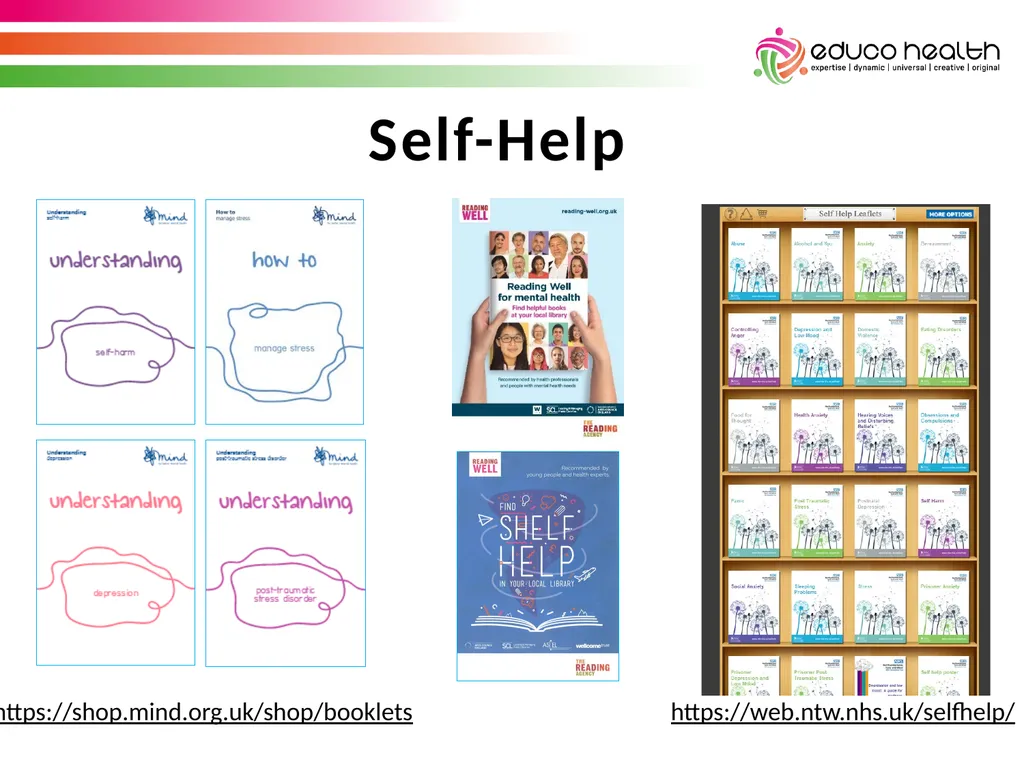
slide25. Self-Help https://web.ntw.nhs.uk/selfhelp/ https://shop.mind.org.uk/shop/booklets<br>
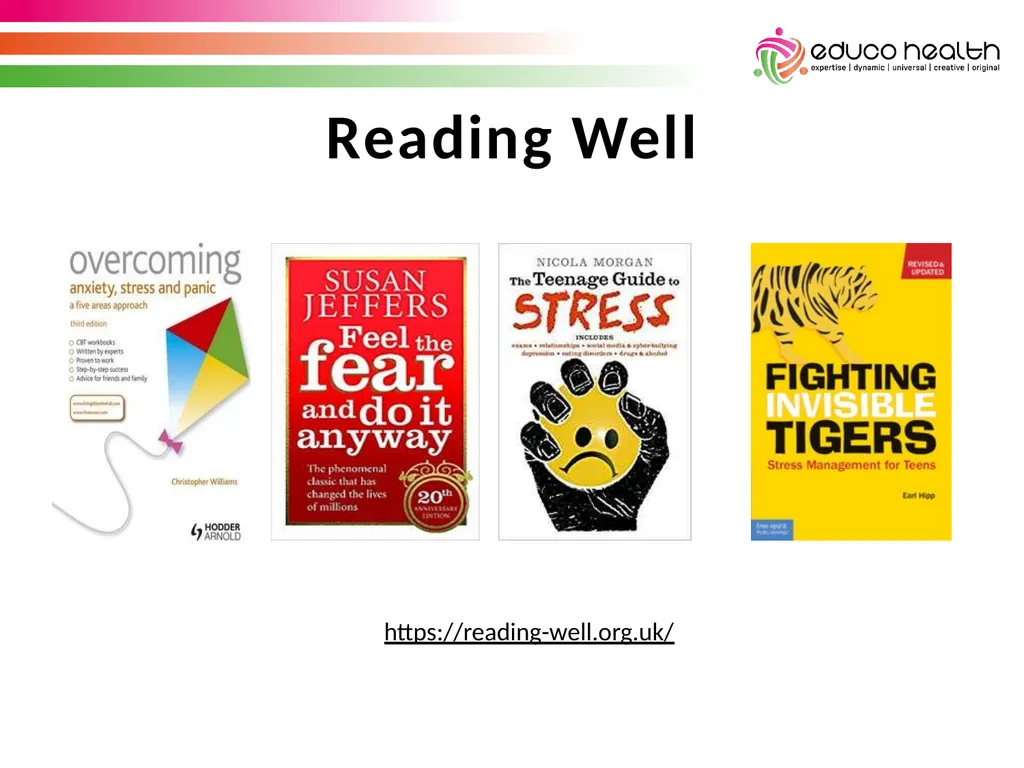
slide26. Reading Well https://reading-well.org.uk/<br>
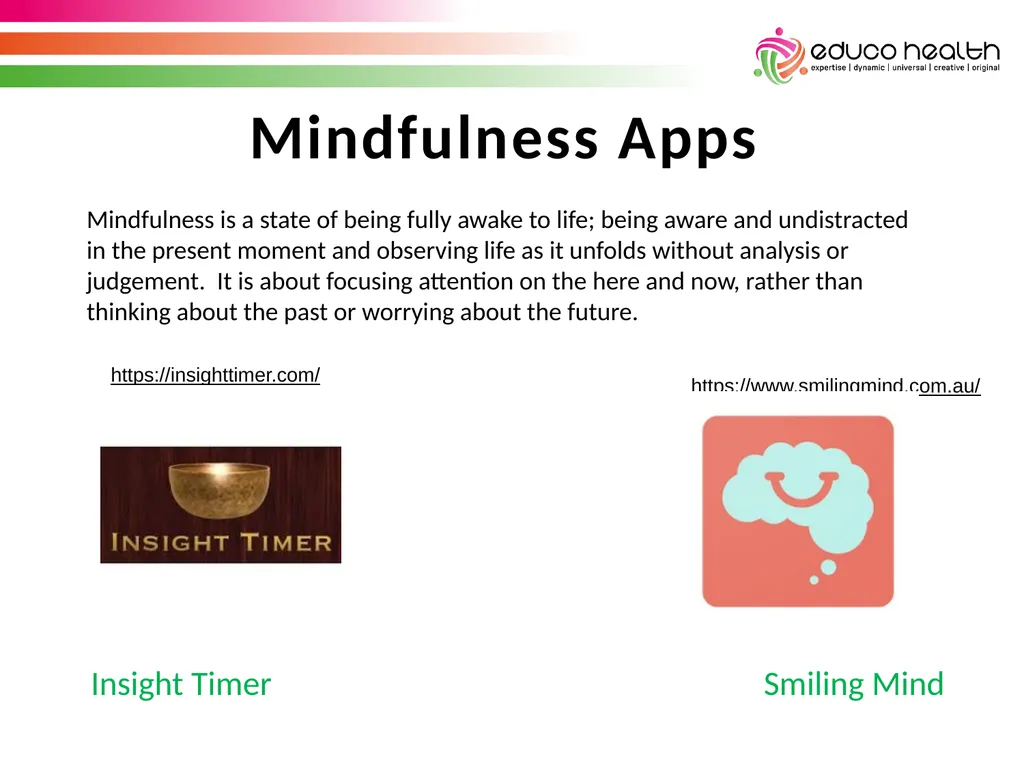
slide27. Mindfulness Apps Mindfulness is a state of being fully awake to life; being aware and undistracted in the present moment and observing life as it unfolds without analysis or judgement. It is about focusing attention on the here and now, rather than thinking about the past or worrying about the future. https://insighttimer.com/ Insight Timer https://www.smilingmind.com.au/ Smiling Mind<br>
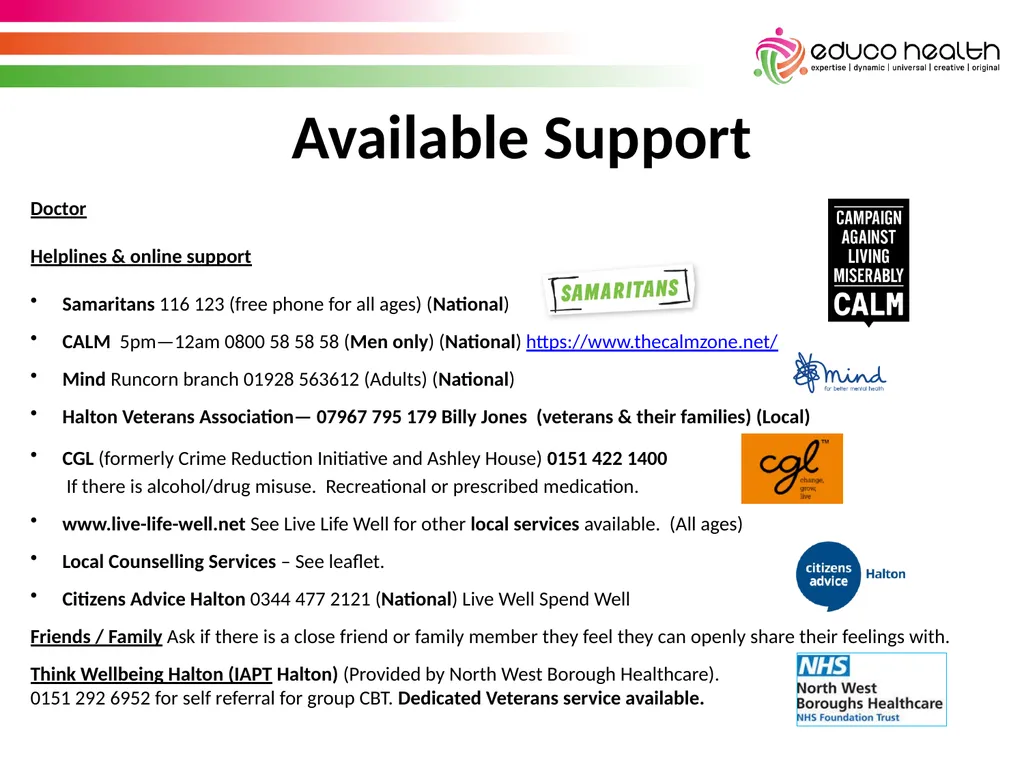
slide28. Available Support Doctor
Helplines & online support
Samaritans 116 123 (free phone for all ages) (National)
CALM 5pm—12am 0800 58 58 58 (Men only) (National) https://www.thecalmzone.net/
Mind Runcorn branch 01928 563612 (Adults) (National)
Halton Veterans Association— 07967 795 179 Billy Jones (veterans & their families) (Local)
CGL (formerly Crime Reduction Initiative and Ashley House) 0151 422 1400
If there is alcohol/drug misuse. Recreational or prescribed medication.
www.live-life-well.net See Live Life Well for other local services available. (All ages)
Local Counselling Services – See leaflet.
Citizens Advice Halton 0344 477 2121 (National) Live Well Spend Well
Friends / Family Ask if there is a close friend or family member they feel they can openly share their feelings with.
Think Wellbeing Halton (IAPT Halton) (Provided by North West Borough Healthcare).
0151 292 6952 for self referral for group CBT. Dedicated Veterans service available.<br>
slide29. www.halton.gov.uk/mhinfopoint Mental Health Info Point<br>
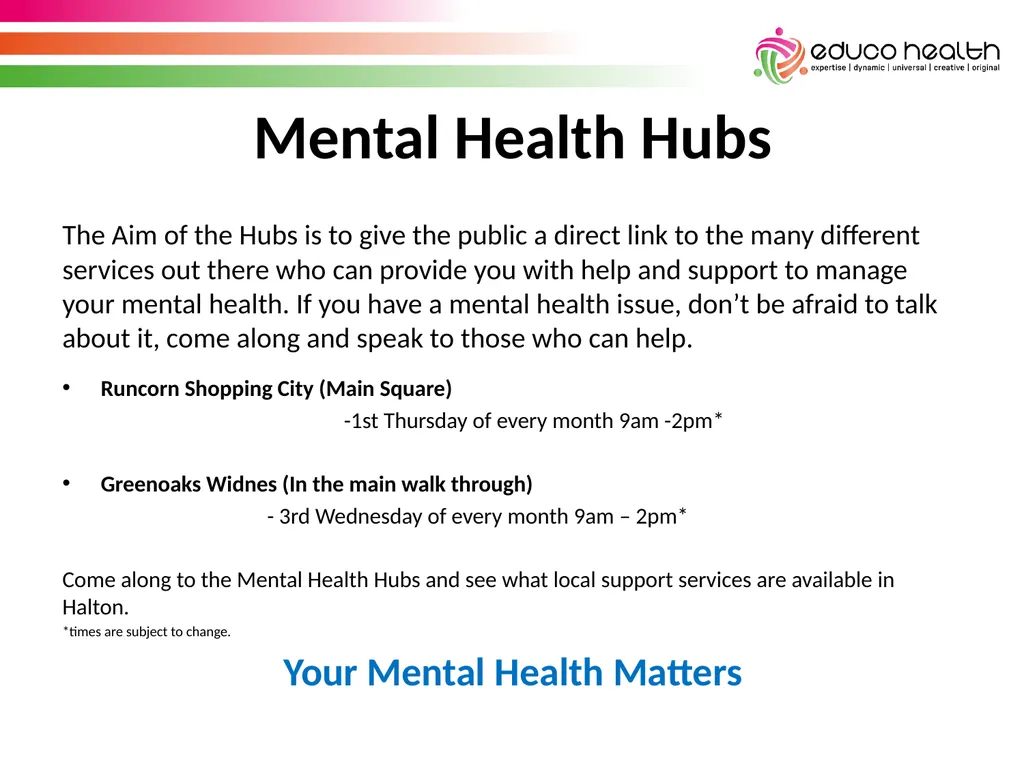
slide30. Mental Health Hubs The Aim of the Hubs is to give the public a direct link to the many different services out there who can provide you with help and support to manage your mental health. If you have a mental health issue, don’t be afraid to talk about it, come along and speak to those who can help.
Runcorn Shopping City (Main Square)
-1st Thursday of every month 9am -2pm*
Greenoaks Widnes (In the main walk through)
- 3rd Wednesday of every month 9am – 2pm*
Come along to the Mental Health Hubs and see what local support services are available in Halton.
*times are subject to change.
Your Mental Health Matters<br>
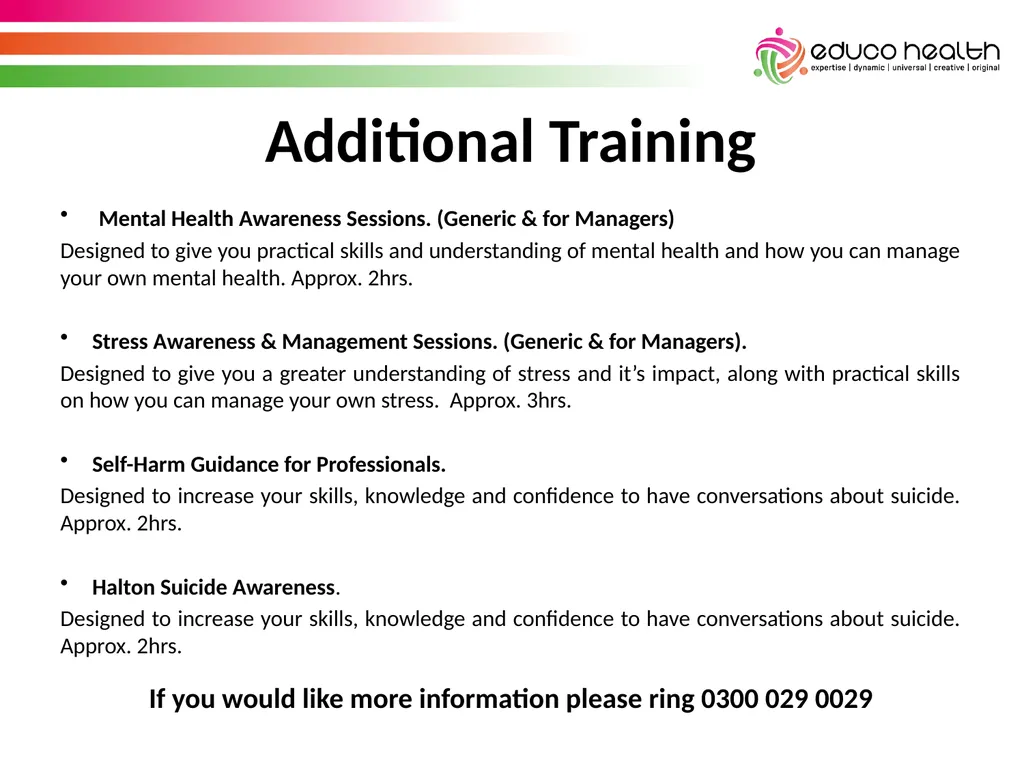
slide31. Additional Training Mental Health Awareness Sessions. (Generic & for Managers)
Designed to give you practical skills and understanding of mental health and how you can manage your own mental health. Approx. 2hrs.
Stress Awareness & Management Sessions. (Generic & for Managers).
Designed to give you a greater understanding of stress and it’s impact, along with practical skills on how you can manage your own stress. Approx. 3hrs.
Self-Harm Guidance for Professionals.
Designed to increase your skills, knowledge and confidence to have conversations about suicide. Approx. 2hrs.
Halton Suicide Awareness.
Designed to increase your skills, knowledge and confidence to have conversations about suicide. Approx. 2hrs.
If you would like more information please ring 0300 029 0029<br>
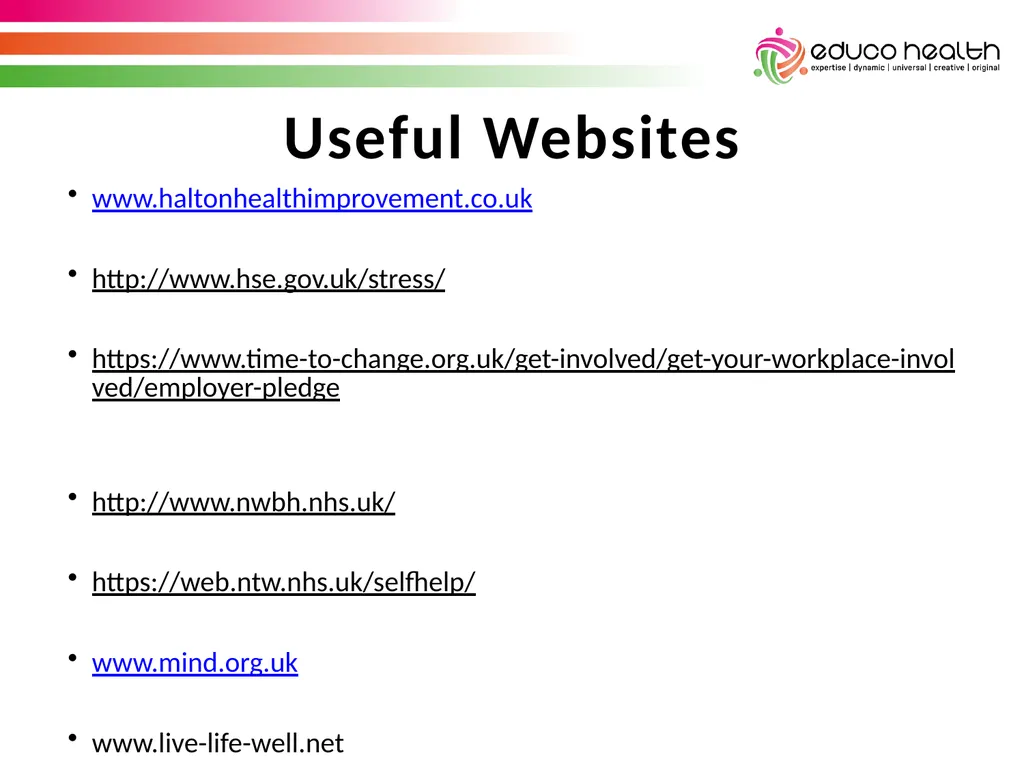
slide32. Useful Websites www.haltonhealthimprovement.co.uk
http://www.hse.gov.uk/stress/
https://www.time-to-change.org.uk/get-involved/get-your-workplace-involved/employer-pledge
http://www.nwbh.nhs.uk/
https://web.ntw.nhs.uk/selfhelp/
www.mind.org.uk
www.live-life-well.net<br>
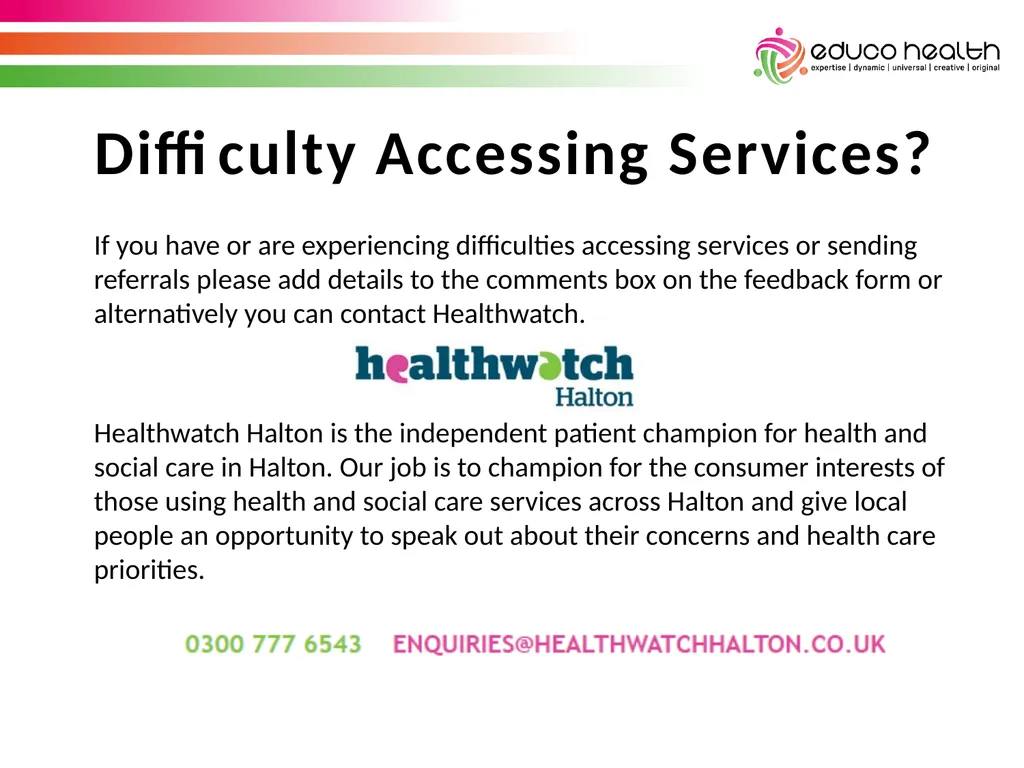
slide33. Difficulty Accessing Services? If you have or are experiencing difficulties accessing services or sending referrals please add details to the comments box on the feedback form or alternatively you can contact Healthwatch.
Healthwatch Halton is the independent patient champion for health and social care in Halton. Our job is to champion for the consumer interests of those using health and social care services across Halton and give local people an opportunity to speak out about their concerns and health care priorities.<br>
slide2. House Keeping & Introductions Introducing yourselves
Name
Role
What do you hope to gain from todays training?<br>
slide3. Aims of The Session What is stress and why do we need to tackle it?
Understand how the body reacts to stress.
Understand the impact stress can have on us, our mental health and ability to function at work.
Understand the importance of talking about mental health and how to have wellbeing conversations.
Introduce a number of tools available to build resilience and reduce stress.<br>
slide4. What Is Stress? Stress is the feeling of being under too much mental or emotional pressure. Pressure turns into stress when you feel unable to cope. ... Stress causes a surge of hormones in your body. These stress hormones are released to enable you to deal with pressures or threats – the so-called "fight or flight" response.
(NHS Direct 2017)<br>
slide5. Stress . . . Stress can be defined as the way you feel when you're under abnormal pressure.
The most common situations that cause stress involve work, money matters and relationships with partners, children or other family members
Stress is only healthy if it is short-lived. Excessive or prolonged stress can lead to illness and physical and emotional exhaustion. Taken to extremes, stress can be a killer.<br>
slide6. Adrenalin and Cortisol are the two main hormones responsible for stress reactions in the body.
Adrenalin – Fast acting, providing an immediate response.
Blood Pressure, Heart Rate & Perspiration Rates.
Blood to the skin, digestive & reproductive systems.
Cortisol – Longer lasting for sustained reactions.
Releases fats & sugars for energy.
Reduces effectiveness of immune system.
All these changes are our body’s way of preparing you to fight or run away, but can also cause a number of health related problems. Stress Hormones<br>
slide7. Fight, Flight & . . . . There is one more reaction . . . . .
Freeze
Endorphins – reduce our perception of pain.
This is another way our body works to protect us in harmful and possibly life threatening situations. The release of the endorphins mean that we will experience physical and psychological pain for less intensely.<br>
slide9. Why Do Some People Find Situations Stressful And Others Don’t? Our responses to stress and stressful situations are determined by our perception of the situation.
PERCEPTION
How threatened we feel and how long we have been feeling stressed for will determine which reactions take place within our bodies, one of these reactions is ‘Fight or Flight’ Beliefs Thoughts<br>
slide10. How The Brain Works The Chimp- oldest part of the brain responsible for keeping us out of danger The human- responsible for our thoughts and actions The computer- where we process stuff
and it becomes automatic<br>
slide11. What is Wellbeing? “The concept of wellbeing comprises two main elements:
feeling good and functioning well”
Important attributes for Wellbeing include:
Our functioning in the world
Experiencing positive relationships
Having some control over our lives
Having a sense of purpose<br>
slide12. Wellbeing Conversations<br>
slide13. Looking after your own wellbeing Research from Anna Freud indicates that taking the following steps can be important in the promotion and maintenance of mental wellbeing:
Knowing personal limits and having the ability to say “no” when necessary
Identifying supportive people that’s you have in your network- Create a buddy system
Talking is key- speak to someone before your leave school
Debrief and detach -Before you leave school/college for the week, identify the thing that’s bothered you most during the week and arrange to consult with someone before you leave –the weekend is yours, make sure you don’t take what isn’t needed home with you!<br>
slide14. Stress Management Practical Tips For Managing Our Own Stress
5 Ways To Wellbeing (New Economics Foundation, for Gov.uk)
Stress Less Schedule (Dr Kirsch American Institute of Stress)
7 11 Breathing (The Human Givens Institute)
Wellness Action Plan (WAPs)(Professor Chris Williams, University of Glasgow)
Access to Work (Remploy)
Recommended Reading (Books on Prescription)
Mobile Phone & Desk Top Apps<br>
slide15. 5 Ways To Wellbeing Will improve confidence and can be fun.
Of the world around you & your feelings.
Do something nice for a friend or a stranger.
Invest time in developing connections.
Exercising makes you feel good.<br>
slide16. Stress Less Schedule Building gap time into your day
Build 5 gaps into your day.
One when waking up.
3 spaced regularly through the day, e.g. 10am, 2pm & 4pm
And a final one when you go to bed.
Each gap to be 1 minute for self assessment.
Ask yourself – how am I doing?
Breathe deeply and focus on how your body feels.
Concentrate on your breathing and relax.
This will interrupt stress reactions in your body and help build your resilience to stress.<br>
slide17. 7 – 11 Breathing<br>
slide18. 7 – 11 Breathing Breathe in for a count of 7
Breathe out for a count of 10
Aim for 5 - 10 minutes of 7 11 breathing
Repeat a few times a day
This type of breathing is not just a diversionary activity from our stresses, it also produces a bodily response.
While adrenalin causes the ‘Fight or Flight’ response . . .
7 11 breathing causes the ‘Rest and Digest’ response. . .
Simply put, the opposite reaction, lowering emotional and physical responses to stress. The out breath stimulates the reaction.<br>
slide19. Wellness Action Plan https://www.mind.org.uk/workplace/mental-health-at-work/taking-care-of-your-staff/employer-resources/wellness-action-plan-download/<br>
slide20. The WAPs are a personalised, practical tool we can all use – whether we have a mental health problem or not – to help us identify what keeps us well at work, what causes us to become unwell and the support we would like to receive from our manager to boost our wellbeing or support us through a recovery.
www.mind.org.uk Wellness Action Plan<br>
slide21. Support for Staff Schools in Mind is a free network for school staff hosted by Anna Freud, the network shares academic and clinical expertise regarding wellbeing and mental health issues for schools
www.mentalhealthyschools.org.uk
www.mindfulteachers.org
www.remploy.co.uk/ Access to work mental health support services
Education Support Free 24/7 helpline: 08000 562 561
Education support offer counselling<br>
slide22. Access to Work Mental Health Support Service This confidential service delivered by Remploy is funded by the Department for Work and Pensions and is available at no charge to any employees with depression, anxiety, stress or other mental health issues affecting their work.<br>
slide23. Dealing with change Communication and working with others Time management Organisation planning and prioritisation Taking instructions Relaxation and fatigue management Memory aids and strategies Management of treatment and medication Mood and behaviour management Anxiety and stress management Coping strategies<br>
slide24. Access to Work Mental Health Support Service Our specialist advisers provide:
Tailored work-focused mental health support for nine months
Suitable coping strategies
A support plan to keep them in, or return to work
Ideas for workplace adjustments to help them fulfil their role
Practical advice to support those with a mental health condition https://www.remploy.co.uk/employers/mental-health-and-wellbeing/workplace-mental-health-support-service-employers<br>
slide25. Self-Help https://web.ntw.nhs.uk/selfhelp/ https://shop.mind.org.uk/shop/booklets<br>
slide26. Reading Well https://reading-well.org.uk/<br>
slide27. Mindfulness Apps Mindfulness is a state of being fully awake to life; being aware and undistracted in the present moment and observing life as it unfolds without analysis or judgement. It is about focusing attention on the here and now, rather than thinking about the past or worrying about the future. https://insighttimer.com/ Insight Timer https://www.smilingmind.com.au/ Smiling Mind<br>
slide28. Available Support Doctor
Helplines & online support
Samaritans 116 123 (free phone for all ages) (National)
CALM 5pm—12am 0800 58 58 58 (Men only) (National) https://www.thecalmzone.net/
Mind Runcorn branch 01928 563612 (Adults) (National)
Halton Veterans Association— 07967 795 179 Billy Jones (veterans & their families) (Local)
CGL (formerly Crime Reduction Initiative and Ashley House) 0151 422 1400
If there is alcohol/drug misuse. Recreational or prescribed medication.
www.live-life-well.net See Live Life Well for other local services available. (All ages)
Local Counselling Services – See leaflet.
Citizens Advice Halton 0344 477 2121 (National) Live Well Spend Well
Friends / Family Ask if there is a close friend or family member they feel they can openly share their feelings with.
Think Wellbeing Halton (IAPT Halton) (Provided by North West Borough Healthcare).
0151 292 6952 for self referral for group CBT. Dedicated Veterans service available.<br>
slide29. www.halton.gov.uk/mhinfopoint Mental Health Info Point<br>
slide30. Mental Health Hubs The Aim of the Hubs is to give the public a direct link to the many different services out there who can provide you with help and support to manage your mental health. If you have a mental health issue, don’t be afraid to talk about it, come along and speak to those who can help.
Runcorn Shopping City (Main Square)
-1st Thursday of every month 9am -2pm*
Greenoaks Widnes (In the main walk through)
- 3rd Wednesday of every month 9am – 2pm*
Come along to the Mental Health Hubs and see what local support services are available in Halton.
*times are subject to change.
Your Mental Health Matters<br>
slide31. Additional Training Mental Health Awareness Sessions. (Generic & for Managers)
Designed to give you practical skills and understanding of mental health and how you can manage your own mental health. Approx. 2hrs.
Stress Awareness & Management Sessions. (Generic & for Managers).
Designed to give you a greater understanding of stress and it’s impact, along with practical skills on how you can manage your own stress. Approx. 3hrs.
Self-Harm Guidance for Professionals.
Designed to increase your skills, knowledge and confidence to have conversations about suicide. Approx. 2hrs.
Halton Suicide Awareness.
Designed to increase your skills, knowledge and confidence to have conversations about suicide. Approx. 2hrs.
If you would like more information please ring 0300 029 0029<br>
slide32. Useful Websites www.haltonhealthimprovement.co.uk
http://www.hse.gov.uk/stress/
https://www.time-to-change.org.uk/get-involved/get-your-workplace-involved/employer-pledge
http://www.nwbh.nhs.uk/
https://web.ntw.nhs.uk/selfhelp/
www.mind.org.uk
www.live-life-well.net<br>
slide33. Difficulty Accessing Services? If you have or are experiencing difficulties accessing services or sending referrals please add details to the comments box on the feedback form or alternatively you can contact Healthwatch.
Healthwatch Halton is the independent patient champion for health and social care in Halton. Our job is to champion for the consumer interests of those using health and social care services across Halton and give local people an opportunity to speak out about their concerns and health care priorities.<br>