
STRUCTURING THE ARGUMENT OF A THEORETICAL PAPER IN
TA
Published · 47 slides · 0 views

1 / 1



Description
STRUCTURING THE ARGUMENT OF A THEORETICAL PAPER IN THE SOCIAL SCIENCES Richard Parncutt Centre for Systematic Musicology, Uni Graz, Austria Further detail here: homepage.uni-graz.atderichard.parncuttteachingtheoretical-papers Thanks to
Related Topics
Share
Embed code
Download this presentation From Below
"STRUCTURING THE ARGUMENT OF A THEORETICAL PAPER IN" is the property of its rightful owner. Permission is granted to download and print the materials on this website for personal, non-commercial use only, and to display it on your personal computer provided you do not modify the materials and that you retain all copyright notices contained in the materials. By downloading content from our website, you accept the terms of this agreement.
Presentation Transcript
01
STRUCTURING THE ARGUMENT
OF A THEORETICAL PAPER
IN THE SOCIAL SCIENCES
Richard Parncutt
Centre for Systematic Musicology, Uni Graz, Austria
Further detail here:
homepage.uni-graz.at/de/richard.parncutt/teaching/theoretical-papers/
Thanks to students in Musikologie Graz who contributed to the development of this approach!
Florian Eckl, Johannes Lehner, Manuela Marin, Margit Painsi, Sonja Zechner and others<br>
02
Part 1. Introduction<br>
03
Most important thing taught at university? Ability
To approach any issue in any discipline
To apply current knowledge to new questions and “create knowledge”
To become independent and “find your voice”
As important as content
foundations, literature, methods…
Important part of democracy
E.g. political advertising before election campaigns
Further info: Wikipedia on “Critical thinking” Critical thinking clear, careful, complex, constructive, collegial, caring, courageous credible!<br>
To approach any issue in any discipline
To apply current knowledge to new questions and “create knowledge”
To become independent and “find your voice”
As important as content
foundations, literature, methods…
Important part of democracy
E.g. political advertising before election campaigns
Further info: Wikipedia on “Critical thinking” Critical thinking clear, careful, complex, constructive, collegial, caring, courageous credible!<br>
04
Unclear questions, unclear answers
some examples from music psychology How should we manage this uncertainty?
evolutionary function of music
nature of musical talent, emotion
perceptual status of roots, tonics
effect of music on intelligence
trance, ecstasy, peak experiences, flow
association between music and spirituality
music, migration, integration, identity<br>
evolutionary function of music
nature of musical talent, emotion
perceptual status of roots, tonics
effect of music on intelligence
trance, ecstasy, peak experiences, flow
association between music and spirituality
music, migration, integration, identity<br>
05
The main thesis of this talk Students should learn general principles of
critical thinking
argumentation
theory development
and apply them to their own research<br>
critical thinking
argumentation
theory development
and apply them to their own research<br>
06
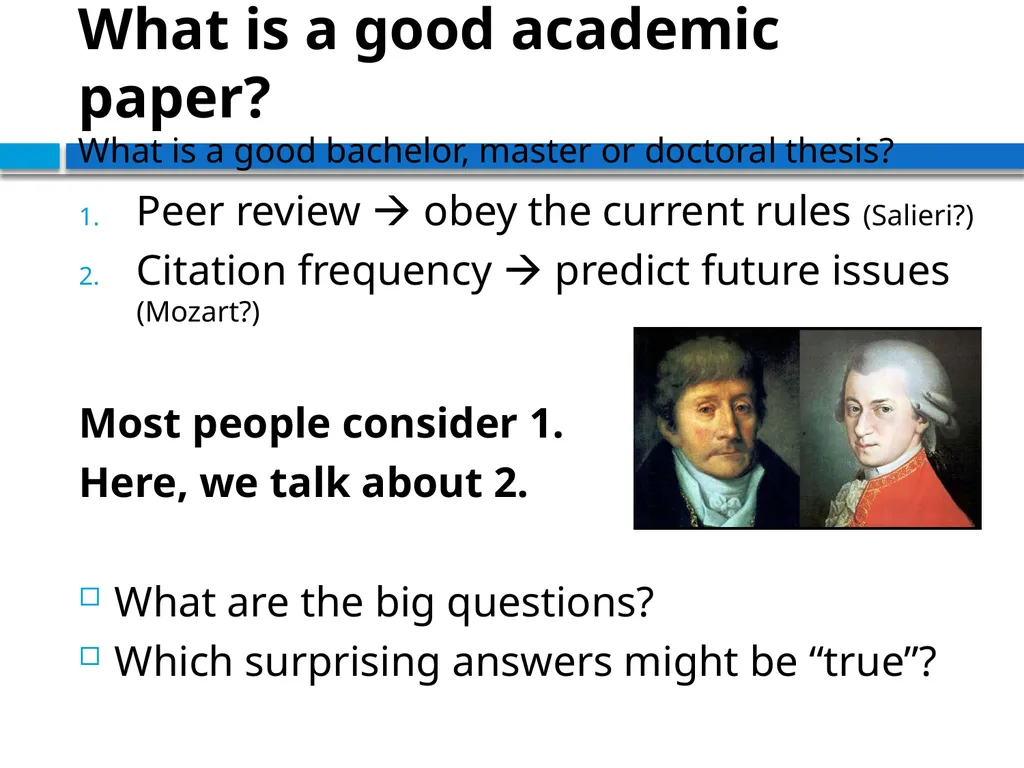
Peer review obey the current rules (Salieri?)
Citation frequency predict future issues (Mozart?)
Most people consider 1.
Here, we talk about 2.
What are the big questions?
Which surprising answers might be “true”? What is a good academic paper? What is a good bachelor, master or doctoral thesis?<br>
Citation frequency predict future issues (Mozart?)
Most people consider 1.
Here, we talk about 2.
What are the big questions?
Which surprising answers might be “true”? What is a good academic paper? What is a good bachelor, master or doctoral thesis?<br>
07
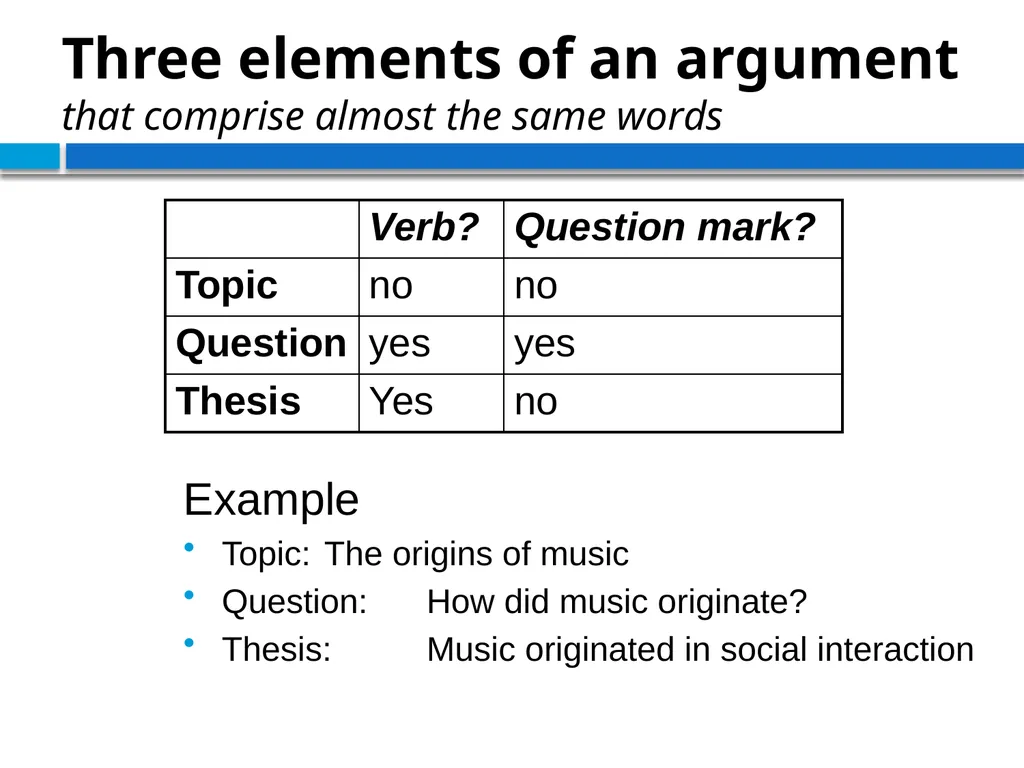
Three elements of an argument
that comprise almost the same words Example
Topic: The origins of music
Question: How did music originate?
Thesis: Music originated in social interaction<br>
Topic: The origins of music
Question: How did music originate?
Thesis: Music originated in social interaction<br>
08
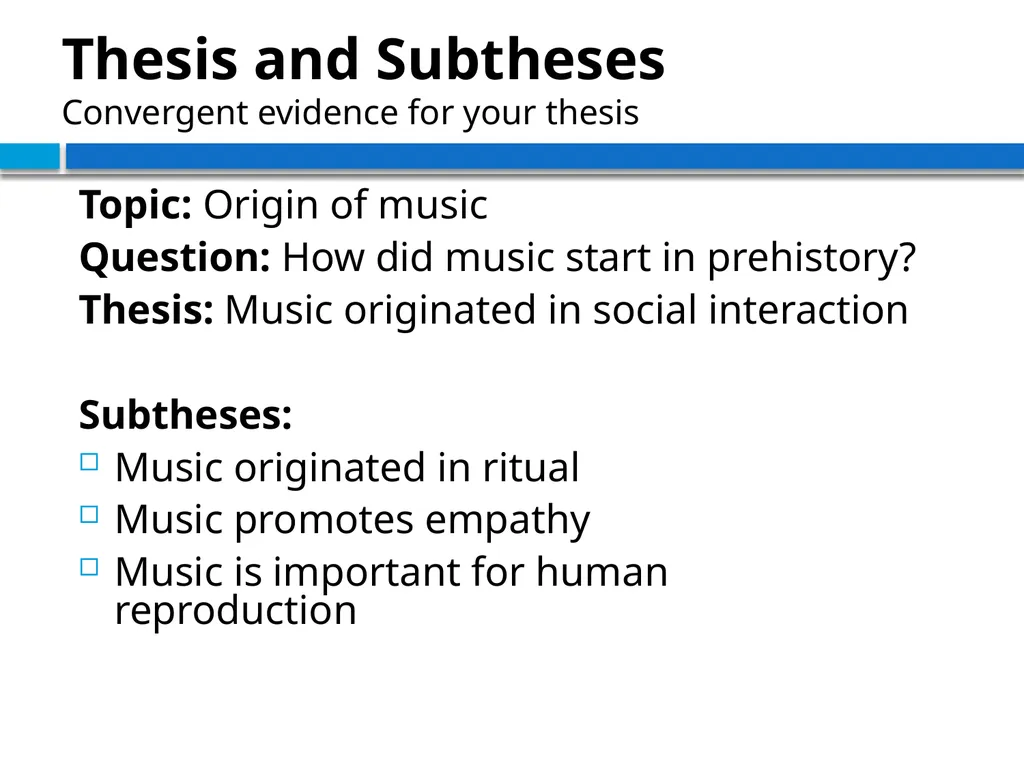
Thesis and Subtheses
Convergent evidence for your thesis Topic: Origin of music
Question: How did music start in prehistory?
Thesis: Music originated in social interaction
Subtheses:
Music originated in ritual
Music promotes empathy
Music is important for human reproduction<br>
Question: How did music start in prehistory?
Thesis: Music originated in social interaction
Subtheses:
Music originated in ritual
Music promotes empathy
Music is important for human reproduction<br>
09
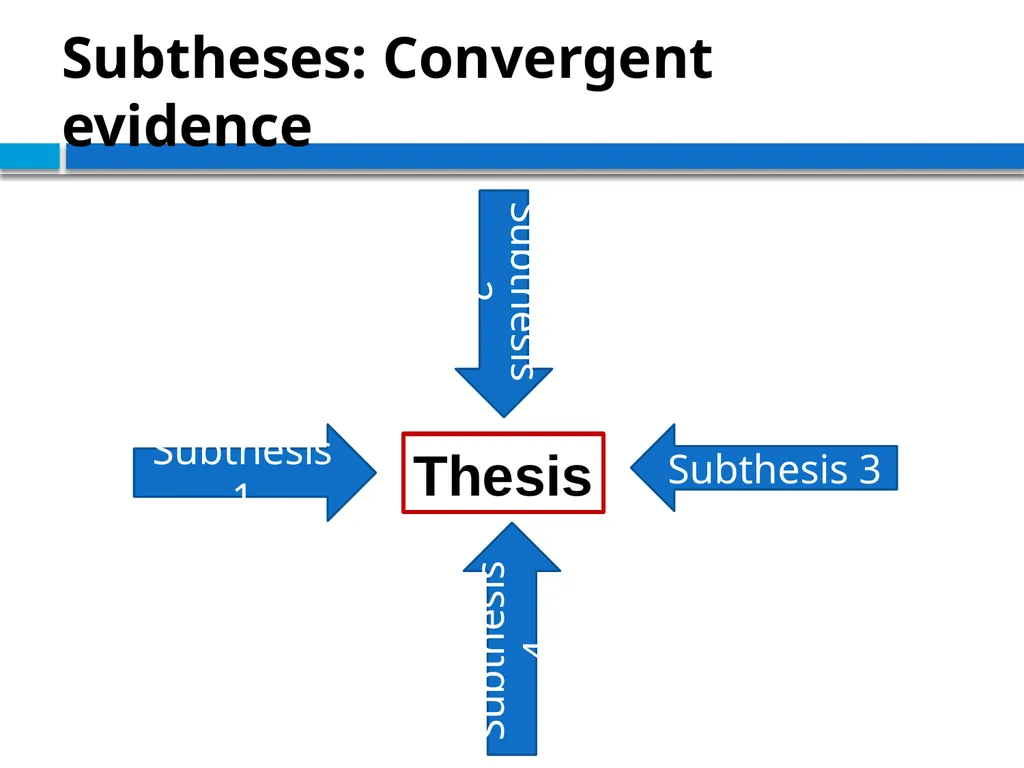
Subtheses: Convergent evidence Subthesis 1 Subthesis 4 Subthesis 2 Subthesis 3 Thesis<br>
10
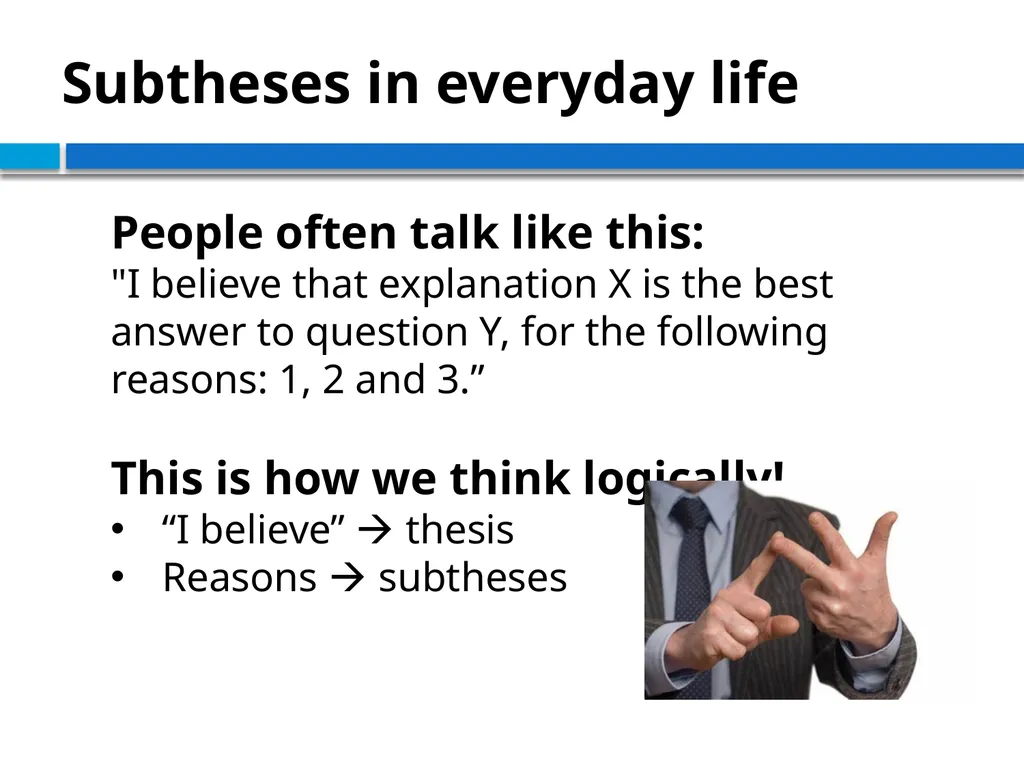
Subtheses in everyday life People often talk like this:
"I believe that explanation X is the best answer to question Y, for the following reasons: 1, 2 and 3.”
This is how we think logically!
“I believe” thesis
Reasons subtheses<br>
"I believe that explanation X is the best answer to question Y, for the following reasons: 1, 2 and 3.”
This is how we think logically!
“I believe” thesis
Reasons subtheses<br>
11
Exercise Fill the gaps
for your own current seminar paper or thesis
(or any other topic)
Topic:
Main question:
Main thesis:
Subtheses:<br>
for your own current seminar paper or thesis
(or any other topic)
Topic:
Main question:
Main thesis:
Subtheses:<br>
12
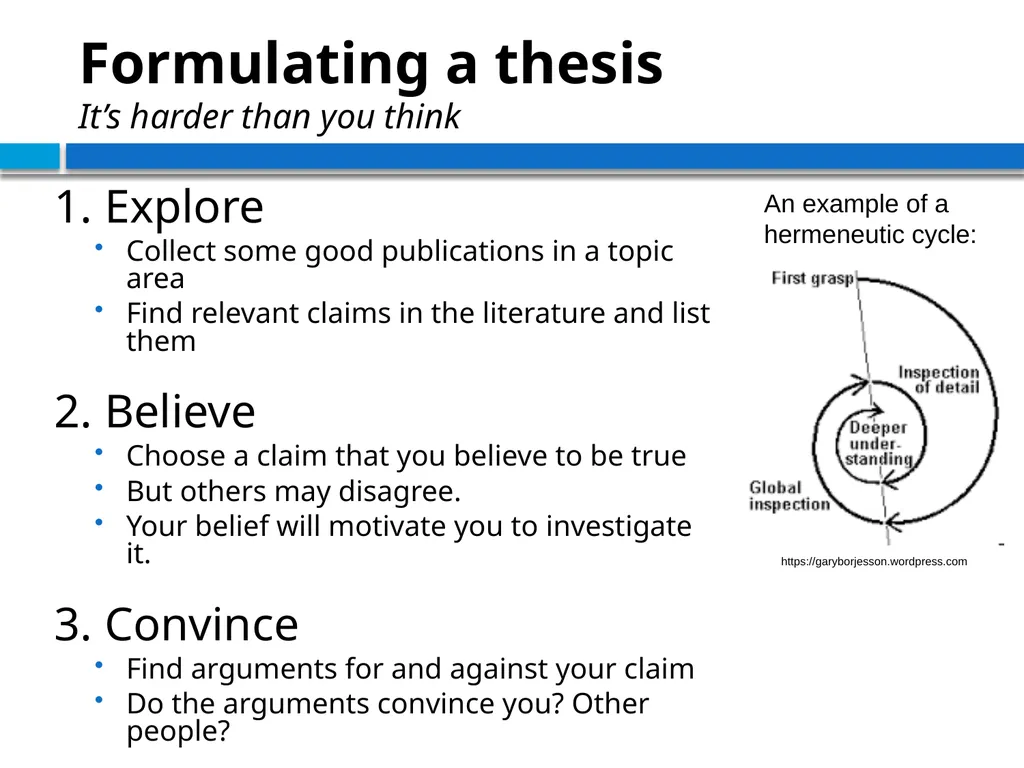
Formulating a thesis
It’s harder than you think 1. Explore
Collect some good publications in a topic area
Find relevant claims in the literature and list them
2. Believe
Choose a claim that you believe to be true
But others may disagree.
Your belief will motivate you to investigate it.
3. Convince
Find arguments for and against your claim
Do the arguments convince you? Other people?
If you/they are not convinced, return to 1 or 2!
Go around the cycle several times! https://garyborjesson.wordpress.com An example of a hermeneutic cycle:<br>
Collect some good publications in a topic area
Find relevant claims in the literature and list them
2. Believe
Choose a claim that you believe to be true
But others may disagree.
Your belief will motivate you to investigate it.
3. Convince
Find arguments for and against your claim
Do the arguments convince you? Other people?
If you/they are not convinced, return to 1 or 2!
Go around the cycle several times! https://garyborjesson.wordpress.com An example of a hermeneutic cycle:<br>
13
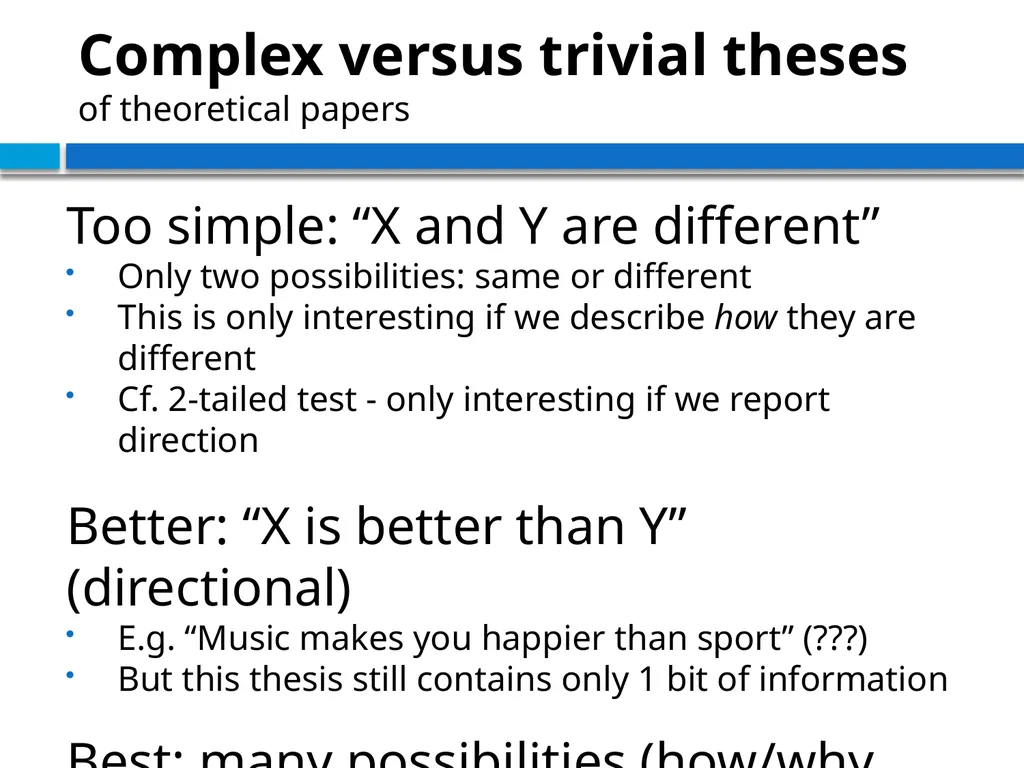
Too simple: “X and Y are different”
Only two possibilities: same or different
This is only interesting if we describe how they are different
Cf. 2-tailed test - only interesting if we report direction
Better: “X is better than Y” (directional)
E.g. “Music makes you happier than sport” (???)
But this thesis still contains only 1 bit of information
Best: many possibilities (how/why questions)
Cf. Likert scale (many answers) versus 2AFC (yes/no)
“how” or “why” question ( multidimensional answer) Complex versus trivial theses of theoretical papers<br>
Only two possibilities: same or different
This is only interesting if we describe how they are different
Cf. 2-tailed test - only interesting if we report direction
Better: “X is better than Y” (directional)
E.g. “Music makes you happier than sport” (???)
But this thesis still contains only 1 bit of information
Best: many possibilities (how/why questions)
Cf. Likert scale (many answers) versus 2AFC (yes/no)
“how” or “why” question ( multidimensional answer) Complex versus trivial theses of theoretical papers<br>
14
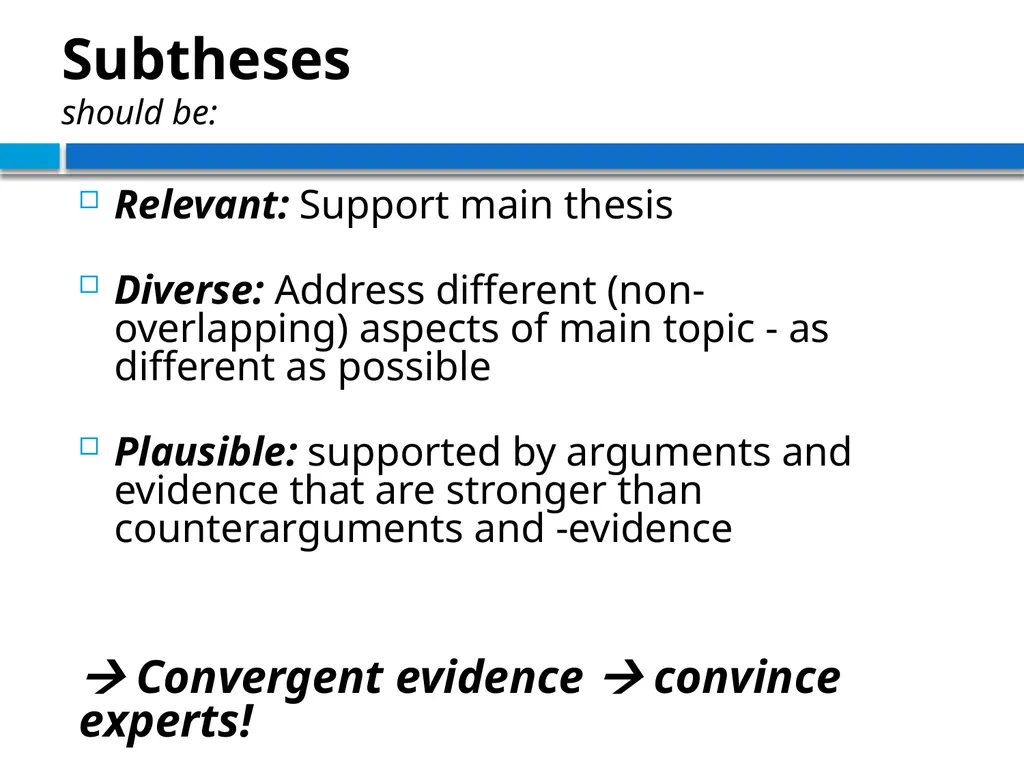
Subtheses
should be: Relevant: Support main thesis
Diverse: Address different (non-overlapping) aspects of main topic - as different as possible
Plausible: supported by arguments and evidence that are stronger than counterarguments and -evidence
Convergent evidence convince experts!<br>
Diverse: Address different (non-overlapping) aspects of main topic - as different as possible
Plausible: supported by arguments and evidence that are stronger than counterarguments and -evidence
Convergent evidence convince experts!<br>
15
Introductory sentence
Main question, main thesis
(first subtopic:) first subthesis
(second subtopic:) second subthesis
(third subtopic:) third subthesis
Main counterargument and rebuttal
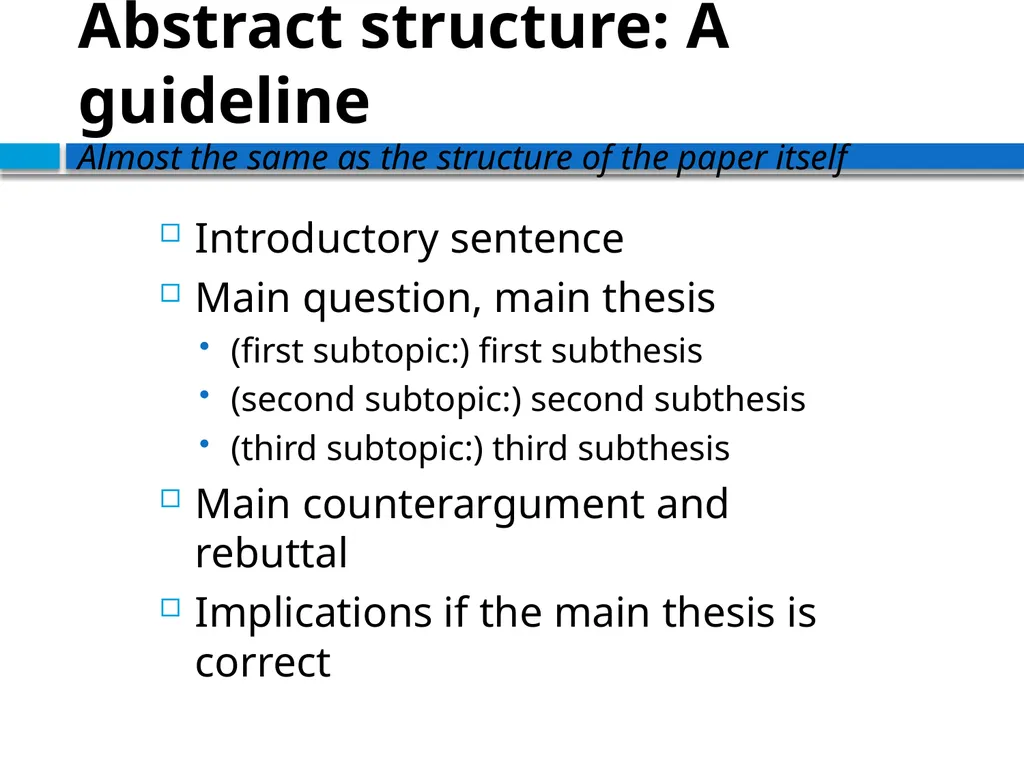
Implications if the main thesis is correct Abstract structure: A guideline Almost the same as the structure of the paper itself<br>
Main question, main thesis
(first subtopic:) first subthesis
(second subtopic:) second subthesis
(third subtopic:) third subthesis
Main counterargument and rebuttal
Implications if the main thesis is correct Abstract structure: A guideline Almost the same as the structure of the paper itself<br>
16
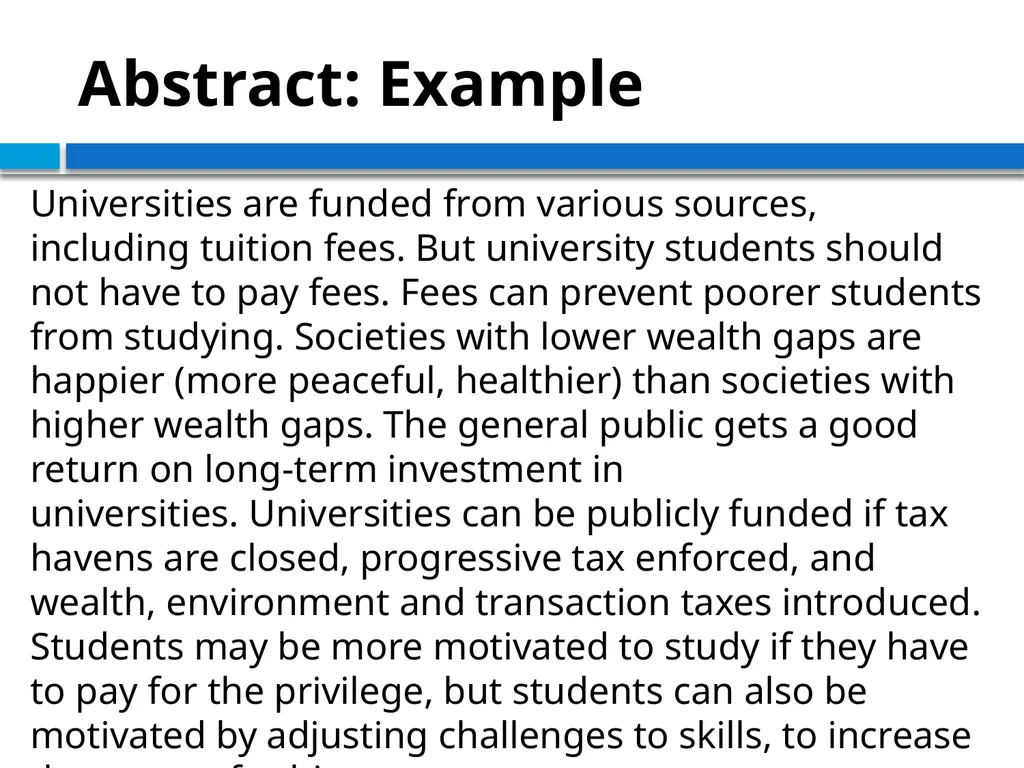
Universities are funded from various sources, including tuition fees. But university students should not have to pay fees. Fees can prevent poorer students from studying. Societies with lower wealth gaps are happier (more peaceful, healthier) than societies with higher wealth gaps. The general public gets a good return on long-term investment in universities. Universities can be publicly funded if tax havens are closed, progressive tax enforced, and wealth, environment and transaction taxes introduced. Students may be more motivated to study if they have to pay for the privilege, but students can also be motivated by adjusting challenges to skills, to increase the sense of achievement. Abstract: Example<br>
17
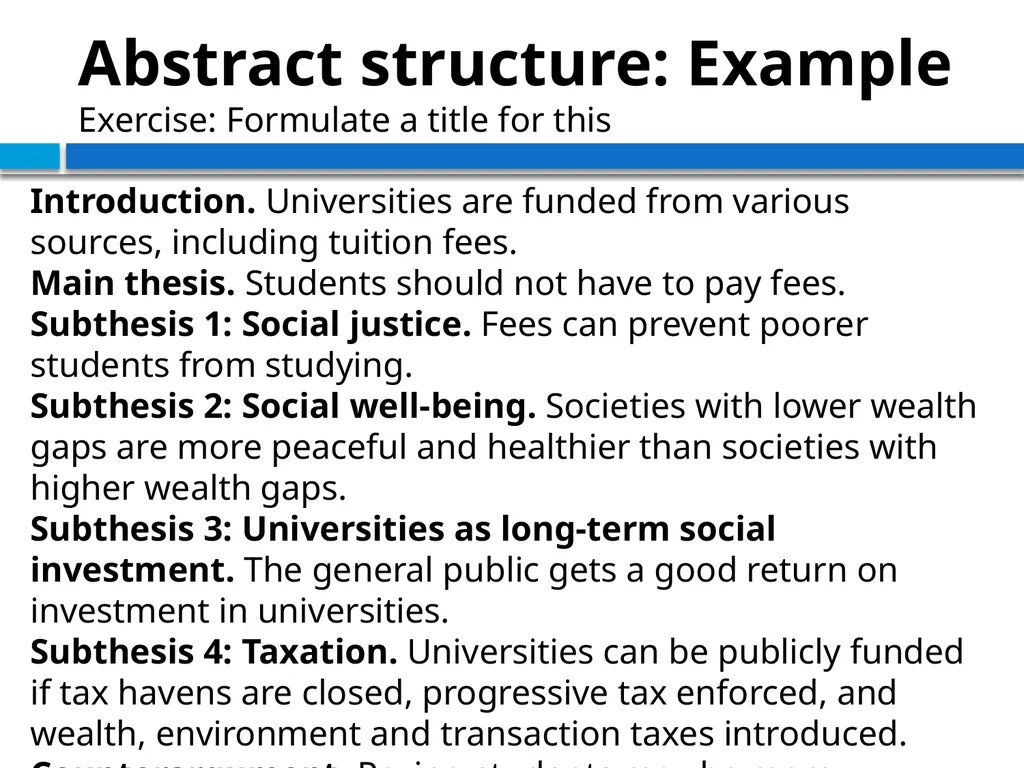
Introduction. Universities are funded from various sources, including tuition fees.
Main thesis. Students should not have to pay fees.
Subthesis 1: Social justice. Fees can prevent poorer students from studying.
Subthesis 2: Social well-being. Societies with lower wealth gaps are more peaceful and healthier than societies with higher wealth gaps.
Subthesis 3: Universities as long-term social investment. The general public gets a good return on investment in universities.
Subthesis 4: Taxation. Universities can be publicly funded if tax havens are closed, progressive tax enforced, and wealth, environment and transaction taxes introduced.
Counterargument. Paying students may be more motivated to study.
Rebuttal. Students can be motivated by adjusting challenges to skills. Abstract structure: Example Exercise: Formulate a title for this<br>
Main thesis. Students should not have to pay fees.
Subthesis 1: Social justice. Fees can prevent poorer students from studying.
Subthesis 2: Social well-being. Societies with lower wealth gaps are more peaceful and healthier than societies with higher wealth gaps.
Subthesis 3: Universities as long-term social investment. The general public gets a good return on investment in universities.
Subthesis 4: Taxation. Universities can be publicly funded if tax havens are closed, progressive tax enforced, and wealth, environment and transaction taxes introduced.
Counterargument. Paying students may be more motivated to study.
Rebuttal. Students can be motivated by adjusting challenges to skills. Abstract structure: Example Exercise: Formulate a title for this<br>
18
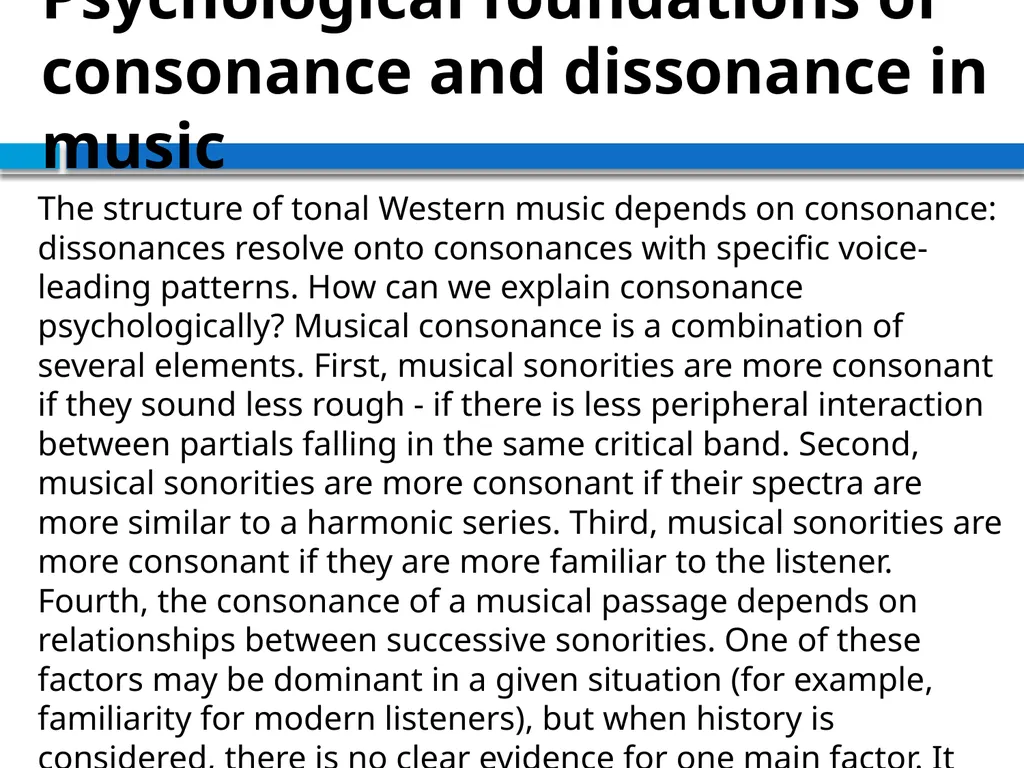
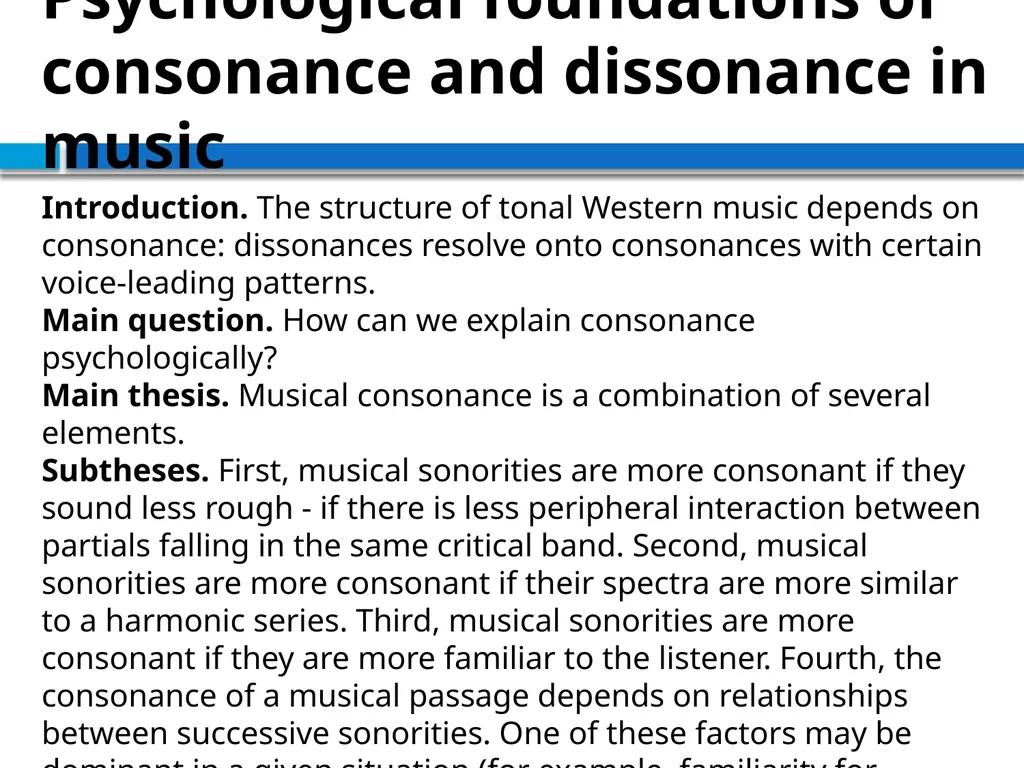
The structure of tonal Western music depends on consonance: dissonances resolve onto consonances with specific voice-leading patterns. How can we explain consonance psychologically? Musical consonance is a combination of several elements. First, musical sonorities are more consonant if they sound less rough - if there is less peripheral interaction between partials falling in the same critical band. Second, musical sonorities are more consonant if their spectra are more similar to a harmonic series. Third, musical sonorities are more consonant if they are more familiar to the listener. Fourth, the consonance of a musical passage depends on relationships between successive sonorities. One of these factors may be dominant in a given situation (for example, familiarity for modern listeners), but when history is considered, there is no clear evidence for one main factor. It follows that traditional Pythagorean ratio-based concepts of consonance should be abandoned. Psychological foundations of consonance and dissonance in music<br>
19
Introduction. The structure of tonal Western music depends on consonance: dissonances resolve onto consonances with certain voice-leading patterns.
Main question. How can we explain consonance psychologically?
Main thesis. Musical consonance is a combination of several elements.
Subtheses. First, musical sonorities are more consonant if they sound less rough - if there is less peripheral interaction between partials falling in the same critical band. Second, musical sonorities are more consonant if their spectra are more similar to a harmonic series. Third, musical sonorities are more consonant if they are more familiar to the listener. Fourth, the consonance of a musical passage depends on relationships between successive sonorities. One of these factors may be dominant in a given situation (for example, familiarity for modern listeners), but when history is considered, there is no clear evidence for one main factor.
Implications. On this basis, traditional Pythagorean ratio-based concepts of consonance should be abandoned. Psychological foundations of consonance and dissonance in music<br>
Main question. How can we explain consonance psychologically?
Main thesis. Musical consonance is a combination of several elements.
Subtheses. First, musical sonorities are more consonant if they sound less rough - if there is less peripheral interaction between partials falling in the same critical band. Second, musical sonorities are more consonant if their spectra are more similar to a harmonic series. Third, musical sonorities are more consonant if they are more familiar to the listener. Fourth, the consonance of a musical passage depends on relationships between successive sonorities. One of these factors may be dominant in a given situation (for example, familiarity for modern listeners), but when history is considered, there is no clear evidence for one main factor.
Implications. On this basis, traditional Pythagorean ratio-based concepts of consonance should be abandoned. Psychological foundations of consonance and dissonance in music<br>
20
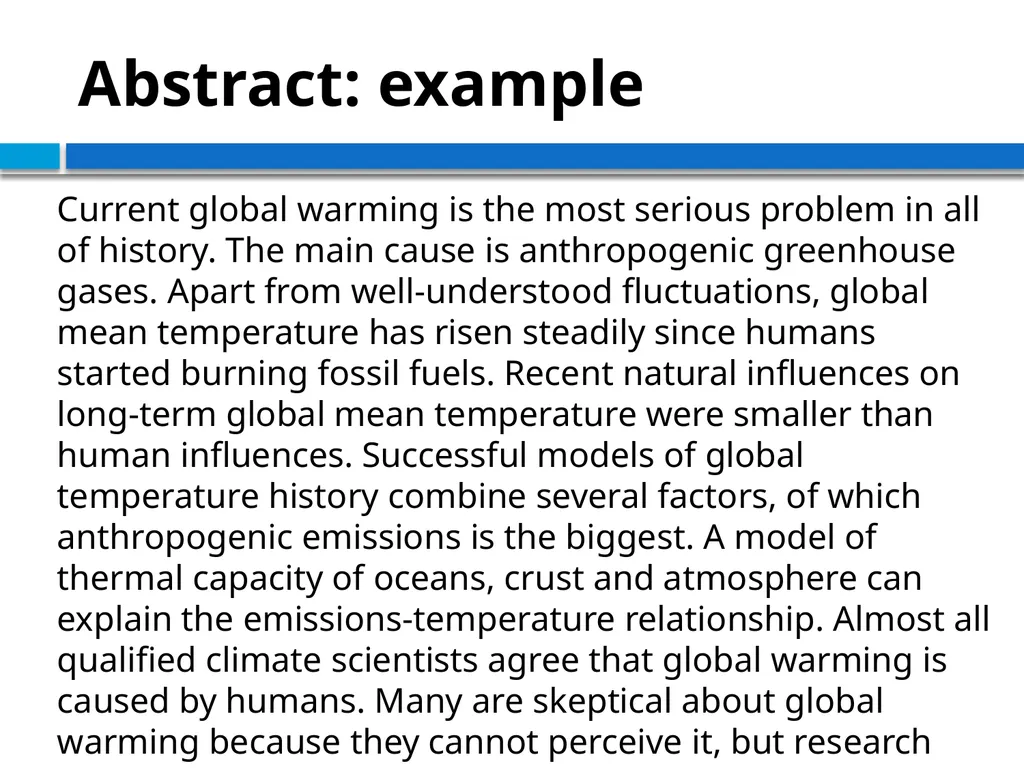
Current global warming is the most serious problem in all of history. The main cause is anthropogenic greenhouse gases. Apart from well-understood fluctuations, global mean temperature has risen steadily since humans started burning fossil fuels. Recent natural influences on long-term global mean temperature were smaller than human influences. Successful models of global temperature history combine several factors, of which anthropogenic emissions is the biggest. A model of thermal capacity of oceans, crust and atmosphere can explain the emissions-temperature relationship. Almost all qualified climate scientists agree that global warming is caused by humans. Many are skeptical about global warming because they cannot perceive it, but research shows the effects are already serious. Urgent and radical political action is required to prevent global warming exceeding 2°C later this century. Abstract: example<br>
21
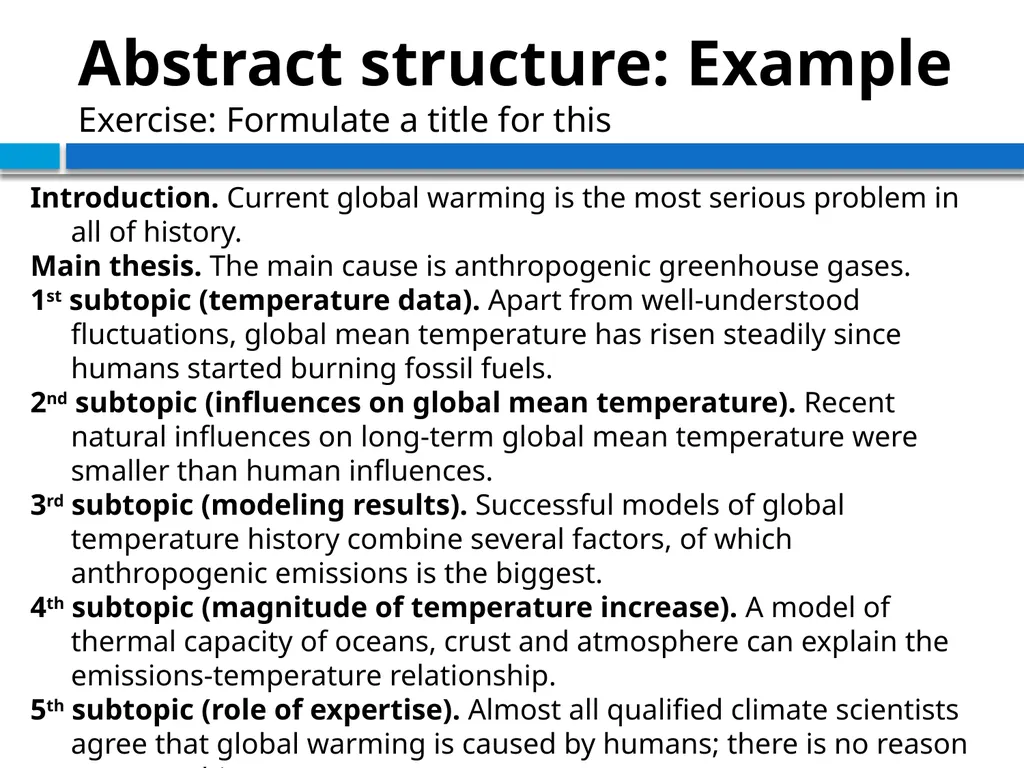
Introduction. Current global warming is the most serious problem in all of history.
Main thesis. The main cause is anthropogenic greenhouse gases.
1st subtopic (temperature data). Apart from well-understood fluctuations, global mean temperature has risen steadily since humans started burning fossil fuels.
2nd subtopic (influences on global mean temperature). Recent natural influences on long-term global mean temperature were smaller than human influences.
3rd subtopic (modeling results). Successful models of global temperature history combine several factors, of which anthropogenic emissions is the biggest.
4th subtopic (magnitude of temperature increase). A model of thermal capacity of oceans, crust and atmosphere can explain the emissions-temperature relationship.
5th subtopic (role of expertise). Almost all qualified climate scientists agree that global warming is caused by humans; there is no reason to expect bias.
Counterargument and rebuttal. Many are skeptical about global warming because they cannot perceive it, but research shows the effects are already serious.
Implications. Urgent and radical political action is required to prevent global warming exceeding 2°C later this century. Abstract structure: Example Exercise: Formulate a title for this<br>
Main thesis. The main cause is anthropogenic greenhouse gases.
1st subtopic (temperature data). Apart from well-understood fluctuations, global mean temperature has risen steadily since humans started burning fossil fuels.
2nd subtopic (influences on global mean temperature). Recent natural influences on long-term global mean temperature were smaller than human influences.
3rd subtopic (modeling results). Successful models of global temperature history combine several factors, of which anthropogenic emissions is the biggest.
4th subtopic (magnitude of temperature increase). A model of thermal capacity of oceans, crust and atmosphere can explain the emissions-temperature relationship.
5th subtopic (role of expertise). Almost all qualified climate scientists agree that global warming is caused by humans; there is no reason to expect bias.
Counterargument and rebuttal. Many are skeptical about global warming because they cannot perceive it, but research shows the effects are already serious.
Implications. Urgent and radical political action is required to prevent global warming exceeding 2°C later this century. Abstract structure: Example Exercise: Formulate a title for this<br>
22
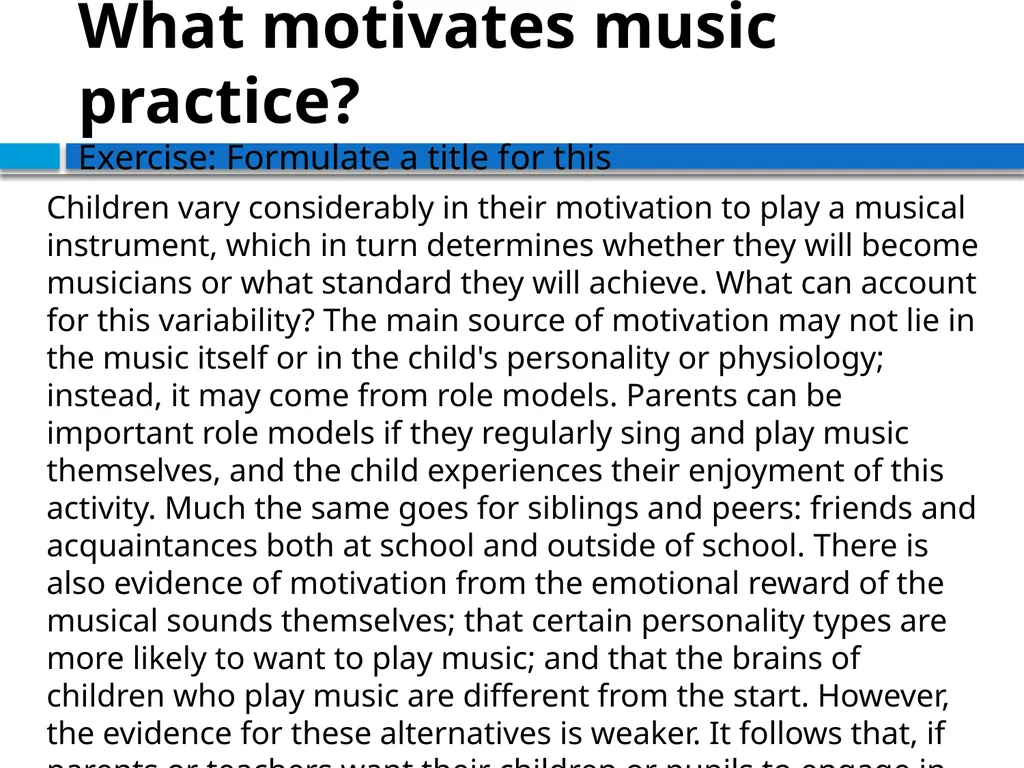
Children vary considerably in their motivation to play a musical instrument, which in turn determines whether they will become musicians or what standard they will achieve. What can account for this variability? The main source of motivation may not lie in the music itself or in the child's personality or physiology; instead, it may come from role models. Parents can be important role models if they regularly sing and play music themselves, and the child experiences their enjoyment of this activity. Much the same goes for siblings and peers: friends and acquaintances both at school and outside of school. There is also evidence of motivation from the emotional reward of the musical sounds themselves; that certain personality types are more likely to want to play music; and that the brains of children who play music are different from the start. However, the evidence for these alternatives is weaker. It follows that, if parents or teachers want their children or pupils to engage in music, they must do so themselves, and genuinely enjoy doing so. What motivates music practice?
Exercise: Formulate a title for this<br>
23
Analyse abstracts found in Google Scholar
Clearly structured?
Concise?
Informative? Exercise<br>
Clearly structured?
Concise?
Informative? Exercise<br>
24
Include as much useful information as possible
Write very concisely: Try out different formulations of every sentence, and find the shortest formulations.
Be informative! Talk about
Content (questions, theses etc.)
Not contents (sections and topics)
Not structure (“the introduction addresses…”) How to write an abstract Exercise: Write your own<br>
Write very concisely: Try out different formulations of every sentence, and find the shortest formulations.
Be informative! Talk about
Content (questions, theses etc.)
Not contents (sections and topics)
Not structure (“the introduction addresses…”) How to write an abstract Exercise: Write your own<br>
25
Part 2: Theory<br>
26
The construction of “knowledge”
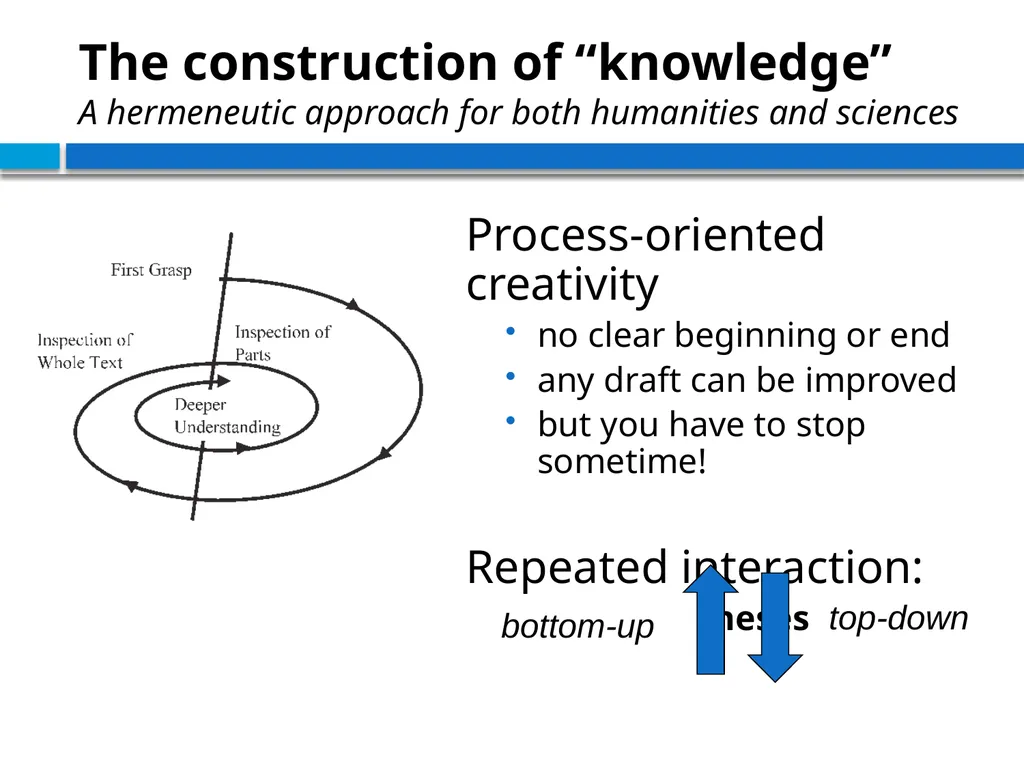
A hermeneutic approach for both humanities and sciences Process-oriented creativity
no clear beginning or end
any draft can be improved
but you have to stop sometime!
Repeated interaction:
theses
evidence bottom-up top-down<br>
no clear beginning or end
any draft can be improved
but you have to stop sometime!
Repeated interaction:
theses
evidence bottom-up top-down<br>
27
What do researchers do?
Search for “truth”? (idealistic)
Try to convince others? (pragmatic)
2 is the only measurable criterion for 1!
Only 2 has “impact”!
Research students must learn:
to convince other researchers
if proven wrong, to accept advice
essential for survival in any academic career!
Further reading: Wikipedia “impact factor”, “peer review” Argument versus Truth<br>
Search for “truth”? (idealistic)
Try to convince others? (pragmatic)
2 is the only measurable criterion for 1!
Only 2 has “impact”!
Research students must learn:
to convince other researchers
if proven wrong, to accept advice
essential for survival in any academic career!
Further reading: Wikipedia “impact factor”, “peer review” Argument versus Truth<br>
28
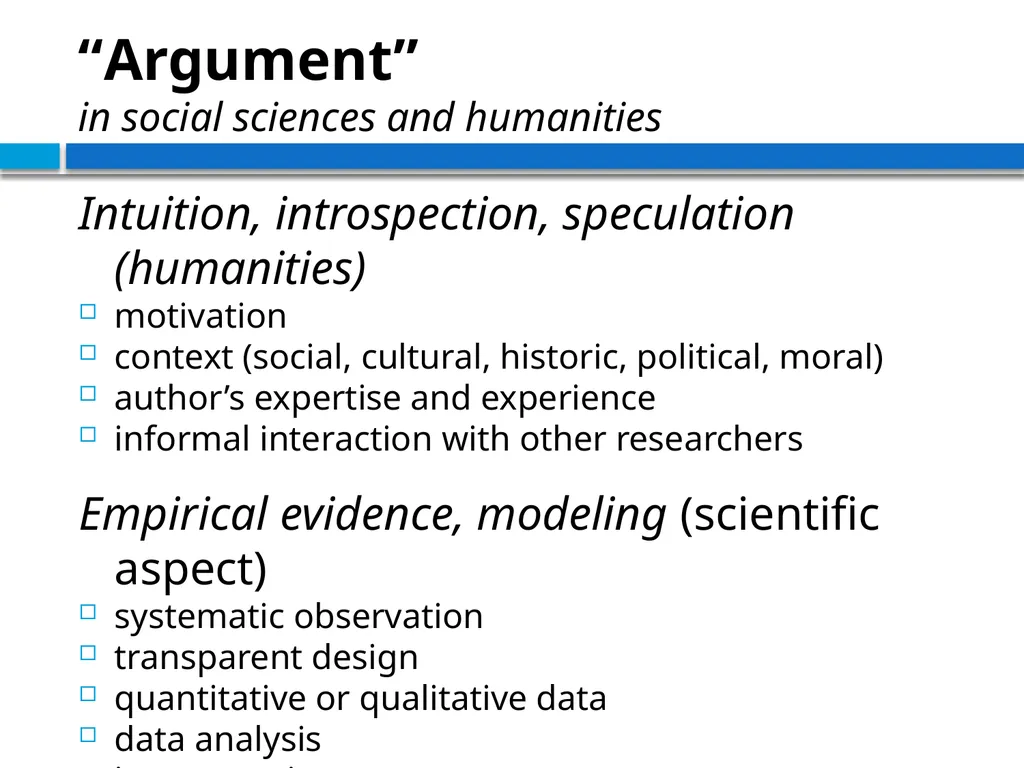
“Argument”
in social sciences and humanities Intuition, introspection, speculation (humanities)
motivation
context (social, cultural, historic, political, moral)
author’s expertise and experience
informal interaction with other researchers
Empirical evidence, modeling (scientific aspect)
systematic observation
transparent design
quantitative or qualitative data
data analysis
interpretation<br>
motivation
context (social, cultural, historic, political, moral)
author’s expertise and experience
informal interaction with other researchers
Empirical evidence, modeling (scientific aspect)
systematic observation
transparent design
quantitative or qualitative data
data analysis
interpretation<br>
29
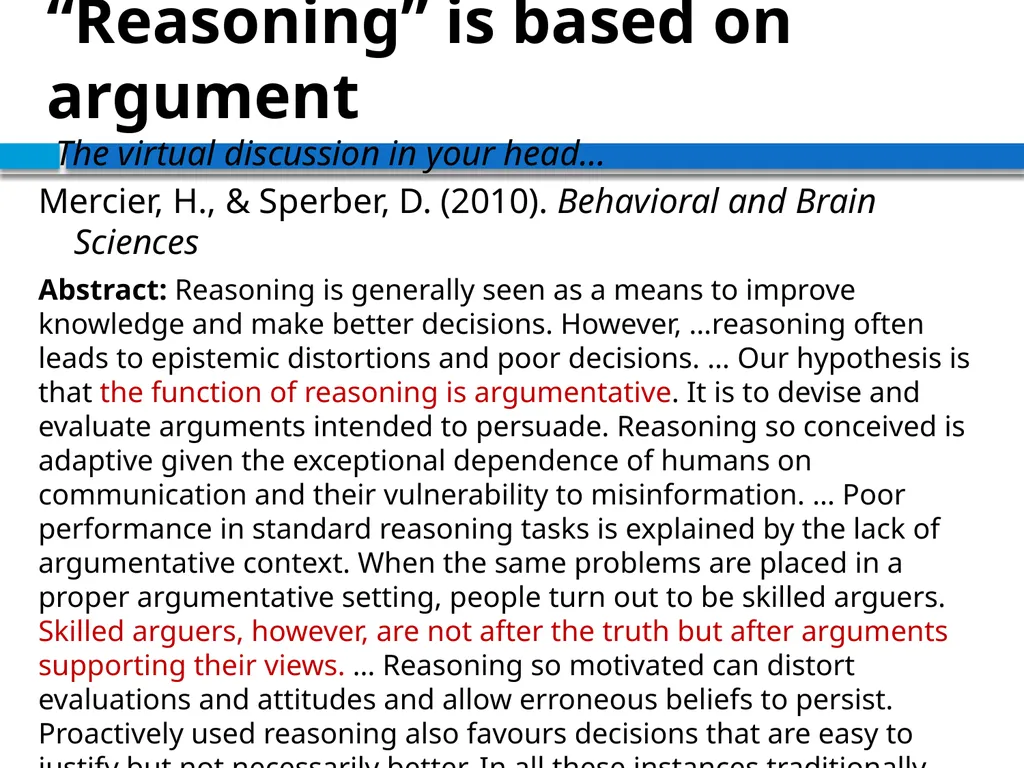
Mercier, H., & Sperber, D. (2010). Behavioral and Brain Sciences
Abstract: Reasoning is generally seen as a means to improve knowledge and make better decisions. However, …reasoning often leads to epistemic distortions and poor decisions. … Our hypothesis is that the function of reasoning is argumentative. It is to devise and evaluate arguments intended to persuade. Reasoning so conceived is adaptive given the exceptional dependence of humans on communication and their vulnerability to misinformation. … Poor performance in standard reasoning tasks is explained by the lack of argumentative context. When the same problems are placed in a proper argumentative setting, people turn out to be skilled arguers. Skilled arguers, however, are not after the truth but after arguments supporting their views. … Reasoning so motivated can distort evaluations and attitudes and allow erroneous beliefs to persist. Proactively used reasoning also favours decisions that are easy to justify but not necessarily better. In all these instances traditionally described as failures or flaws, reasoning does exactly what can be expected of an argumentative device: look for arguments that support a given conclusion, and favour conclusions for which arguments can be found. “Reasoning” is based on argument The virtual discussion in your head…<br>
Abstract: Reasoning is generally seen as a means to improve knowledge and make better decisions. However, …reasoning often leads to epistemic distortions and poor decisions. … Our hypothesis is that the function of reasoning is argumentative. It is to devise and evaluate arguments intended to persuade. Reasoning so conceived is adaptive given the exceptional dependence of humans on communication and their vulnerability to misinformation. … Poor performance in standard reasoning tasks is explained by the lack of argumentative context. When the same problems are placed in a proper argumentative setting, people turn out to be skilled arguers. Skilled arguers, however, are not after the truth but after arguments supporting their views. … Reasoning so motivated can distort evaluations and attitudes and allow erroneous beliefs to persist. Proactively used reasoning also favours decisions that are easy to justify but not necessarily better. In all these instances traditionally described as failures or flaws, reasoning does exactly what can be expected of an argumentative device: look for arguments that support a given conclusion, and favour conclusions for which arguments can be found. “Reasoning” is based on argument The virtual discussion in your head…<br>
30
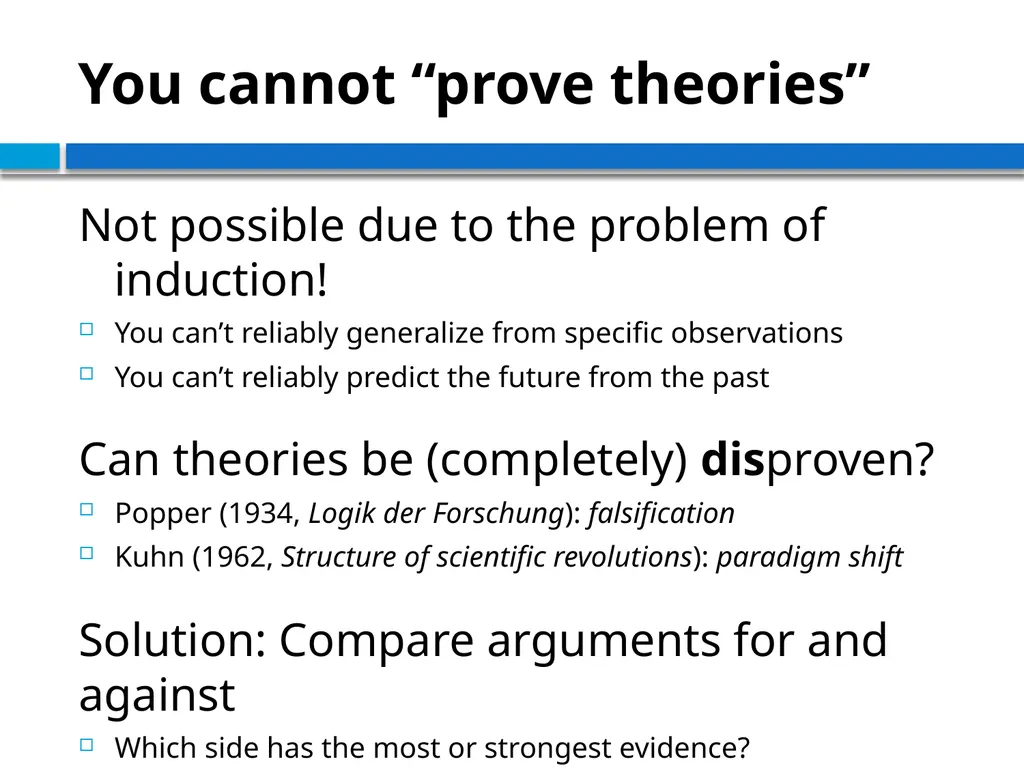
You cannot “prove theories” Not possible due to the problem of induction!
You can’t reliably generalize from specific observations
You can’t reliably predict the future from the past
Can theories be (completely) disproven?
Popper (1934, Logik der Forschung): falsification
Kuhn (1962, Structure of scientific revolutions): paradigm shift
Solution: Compare arguments for and against
Which side has the most or strongest evidence?
Further reading. Wikipedia “Problem of induction”<br>
You can’t reliably generalize from specific observations
You can’t reliably predict the future from the past
Can theories be (completely) disproven?
Popper (1934, Logik der Forschung): falsification
Kuhn (1962, Structure of scientific revolutions): paradigm shift
Solution: Compare arguments for and against
Which side has the most or strongest evidence?
Further reading. Wikipedia “Problem of induction”<br>
31
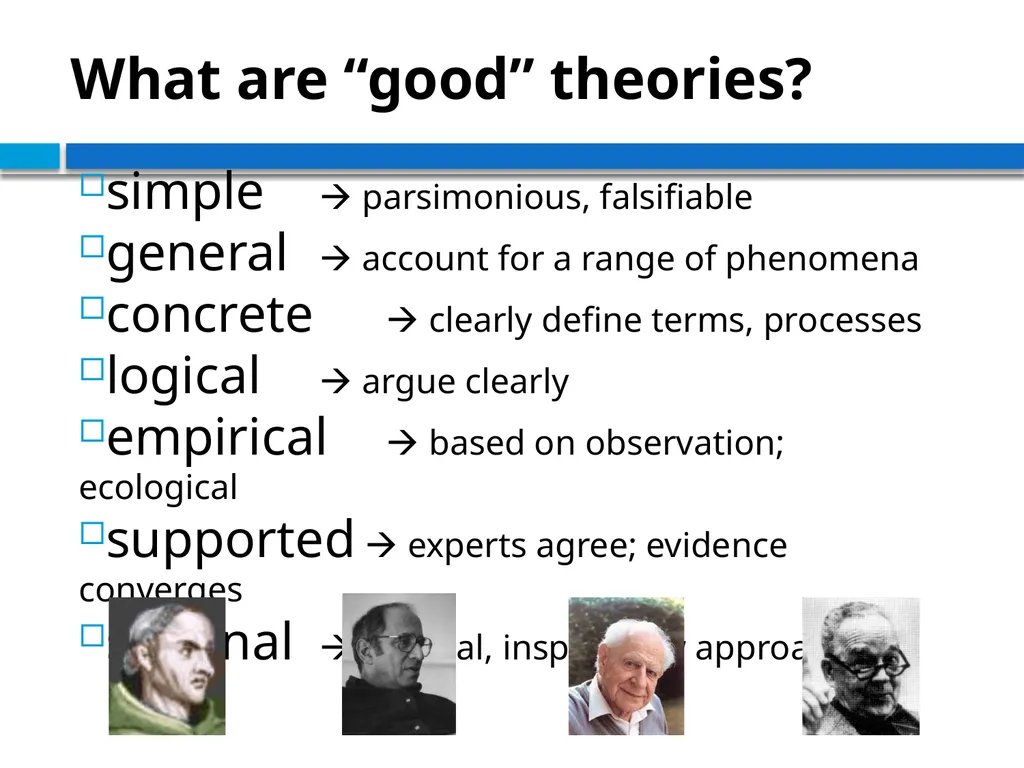
What are “good” theories? simple parsimonious, falsifiable
general account for a range of phenomena
concrete clearly define terms, processes
logical argue clearly
empirical based on observation; ecological
supported experts agree; evidence converges
seminal original, inspire new approaches
Ockham Kuhn Popper Gibson<br>
general account for a range of phenomena
concrete clearly define terms, processes
logical argue clearly
empirical based on observation; ecological
supported experts agree; evidence converges
seminal original, inspire new approaches
Ockham Kuhn Popper Gibson<br>
32
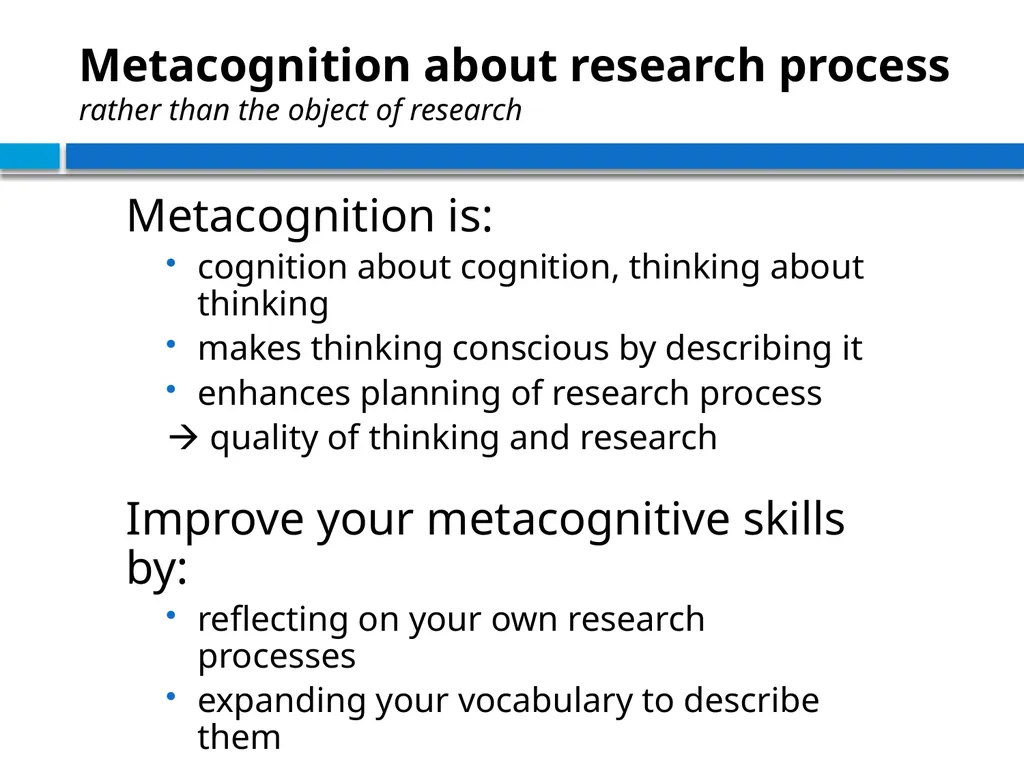
Metacognition about research process
rather than the object of research Metacognition is:
cognition about cognition, thinking about thinking
makes thinking conscious by describing it
enhances planning of research process
quality of thinking and research
Improve your metacognitive skills by:
reflecting on your own research processes
expanding your vocabulary to describe them
building structures to organise and analyse them<br>
cognition about cognition, thinking about thinking
makes thinking conscious by describing it
enhances planning of research process
quality of thinking and research
Improve your metacognitive skills by:
reflecting on your own research processes
expanding your vocabulary to describe them
building structures to organise and analyse them<br>
33
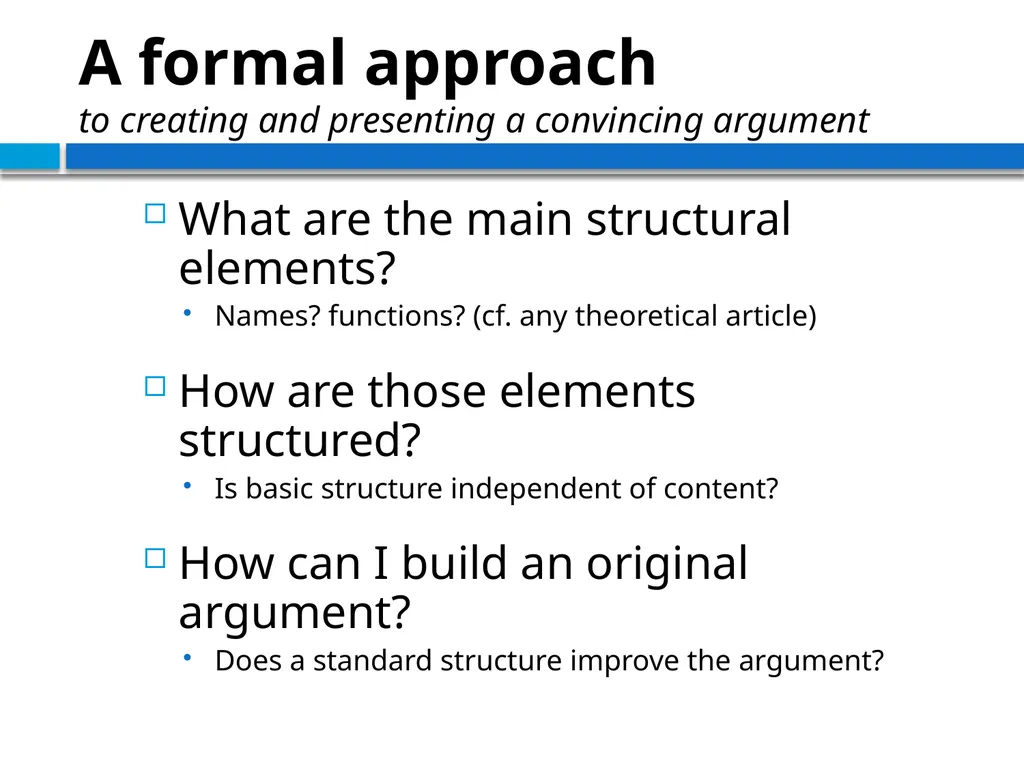
A formal approach
to creating and presenting a convincing argument What are the main structural elements?
Names? functions? (cf. any theoretical article)
How are those elements structured?
Is basic structure independent of content?
How can I build an original argument?
Does a standard structure improve the argument?<br>
Names? functions? (cf. any theoretical article)
How are those elements structured?
Is basic structure independent of content?
How can I build an original argument?
Does a standard structure improve the argument?<br>
34
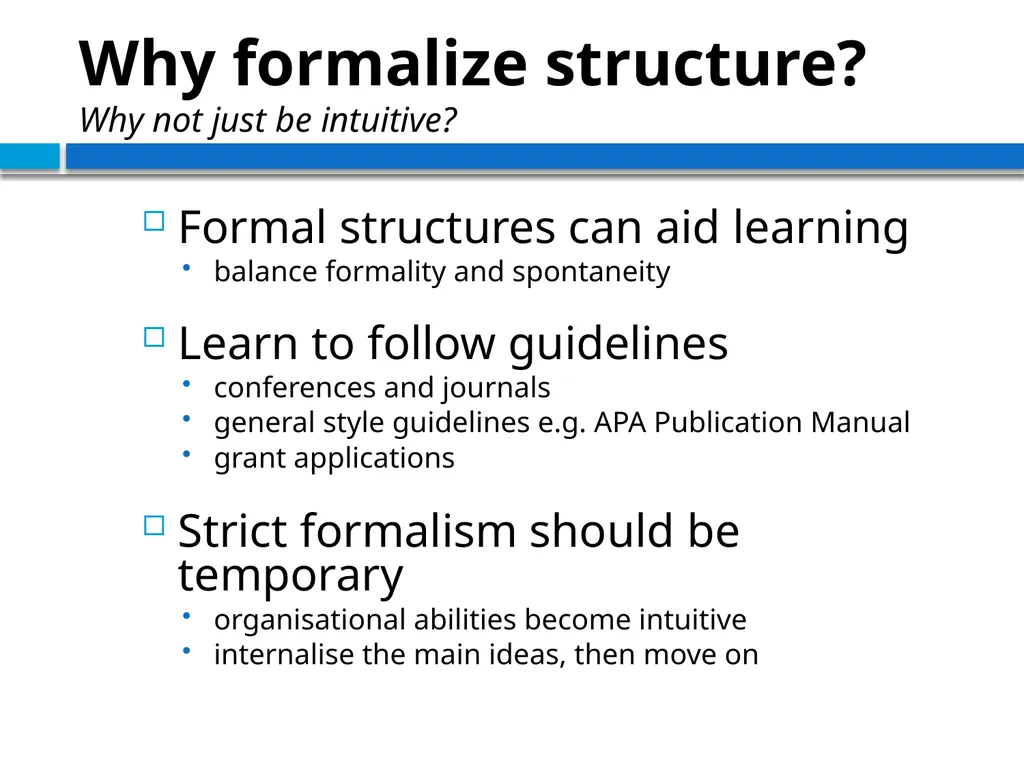
Why formalize structure?
Why not just be intuitive? Formal structures can aid learning
balance formality and spontaneity
Learn to follow guidelines
conferences and journals
general style guidelines e.g. APA Publication Manual
grant applications
Strict formalism should be temporary
organisational abilities become intuitive
internalise the main ideas, then move on<br>
balance formality and spontaneity
Learn to follow guidelines
conferences and journals
general style guidelines e.g. APA Publication Manual
grant applications
Strict formalism should be temporary
organisational abilities become intuitive
internalise the main ideas, then move on<br>
35
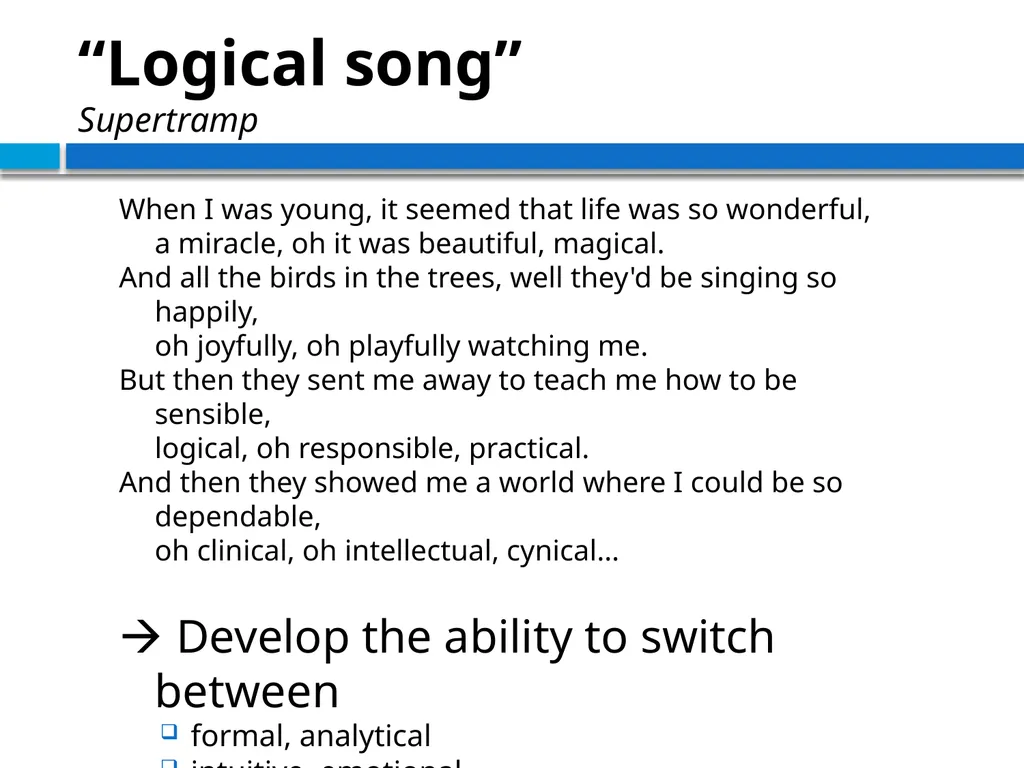
When I was young, it seemed that life was so wonderful,
a miracle, oh it was beautiful, magical.
And all the birds in the trees, well they'd be singing so happily, oh joyfully, oh playfully watching me.
But then they sent me away to teach me how to be sensible, logical, oh responsible, practical.
And then they showed me a world where I could be so dependable, oh clinical, oh intellectual, cynical…
Develop the ability to switch between
formal, analytical
intuitive, emotional
Practice both the formal and the intuitive balance!
Intuition: let spontaneous thoughts lead you to new insights. “Logical song” Supertramp<br>
And all the birds in the trees, well they'd be singing so happily, oh joyfully, oh playfully watching me.
But then they sent me away to teach me how to be sensible, logical, oh responsible, practical.
And then they showed me a world where I could be so dependable, oh clinical, oh intellectual, cynical…
Develop the ability to switch between
formal, analytical
intuitive, emotional
Practice both the formal and the intuitive balance!
Intuition: let spontaneous thoughts lead you to new insights. “Logical song” Supertramp<br>
36
Giving a talk or writing a paper with a clear an argument: A guideline What kind of argument?
Complex qualitative arguments
Theoretical papers
In what disciplines?
academic or political
social sciences
By whom?
advanced students
alone or in teams<br>
Complex qualitative arguments
Theoretical papers
In what disciplines?
academic or political
social sciences
By whom?
advanced students
alone or in teams<br>
37
Prerequisities
for using this guideline To understand and apply this guideline, students need:
Basic academic writing skills
conventions of presentation: headings, citations etc.
Motivation to develop advanced writing skills
quality of argument, clarity of thinking, analytic approach
Background knowledge in relevant disciplines
or the time and motivation to read a lot quickly ;-)
About 20 good, relevant literature sources
or the time and motivation to find and read them<br>
Basic academic writing skills
conventions of presentation: headings, citations etc.
Motivation to develop advanced writing skills
quality of argument, clarity of thinking, analytic approach
Background knowledge in relevant disciplines
or the time and motivation to read a lot quickly ;-)
About 20 good, relevant literature sources
or the time and motivation to find and read them<br>
38
2 structures — 1 argument Surface structure (narrative)
structure of a paper or talk
temporal presentation
linear, one-dimensional
Deep structure (logical content)
mental structure when you understand
semantic representation
hierarchical, multidimensional<br>
structure of a paper or talk
temporal presentation
linear, one-dimensional
Deep structure (logical content)
mental structure when you understand
semantic representation
hierarchical, multidimensional<br>
39
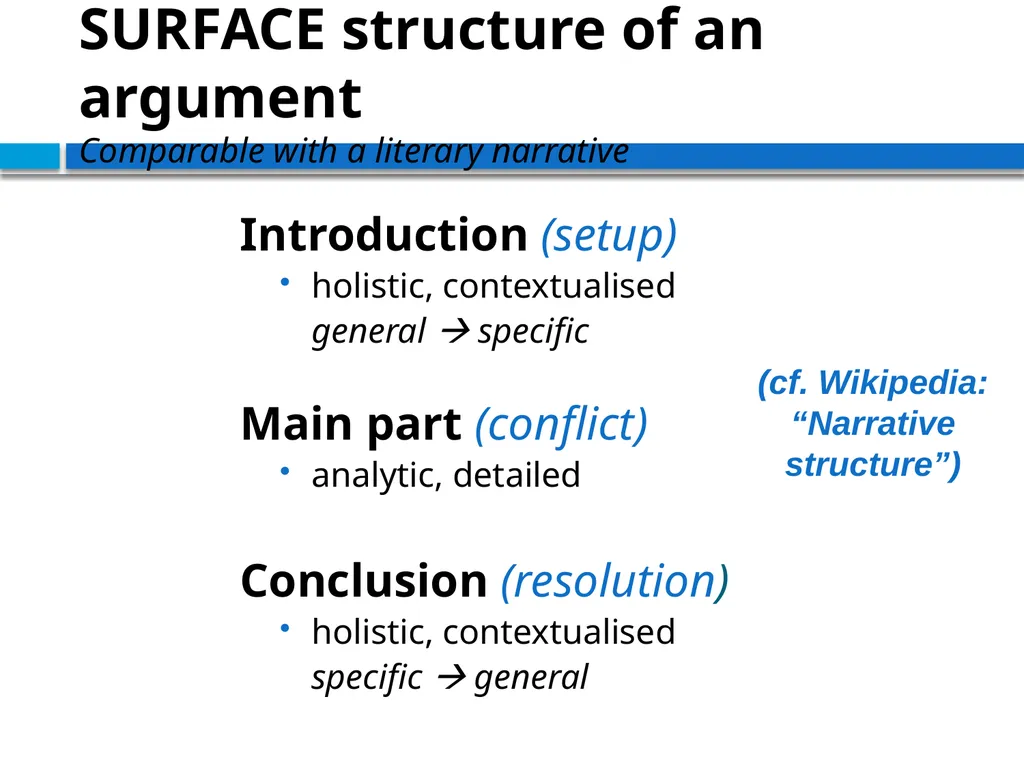
SURFACE structure of an argument
Comparable with a literary narrative Introduction (setup)
holistic, contextualised
general specific
Main part (conflict)
analytic, detailed
Conclusion (resolution)
holistic, contextualised
specific general (cf. Wikipedia: “Narrative structure”)<br>
holistic, contextualised
general specific
Main part (conflict)
analytic, detailed
Conclusion (resolution)
holistic, contextualised
specific general (cf. Wikipedia: “Narrative structure”)<br>
40
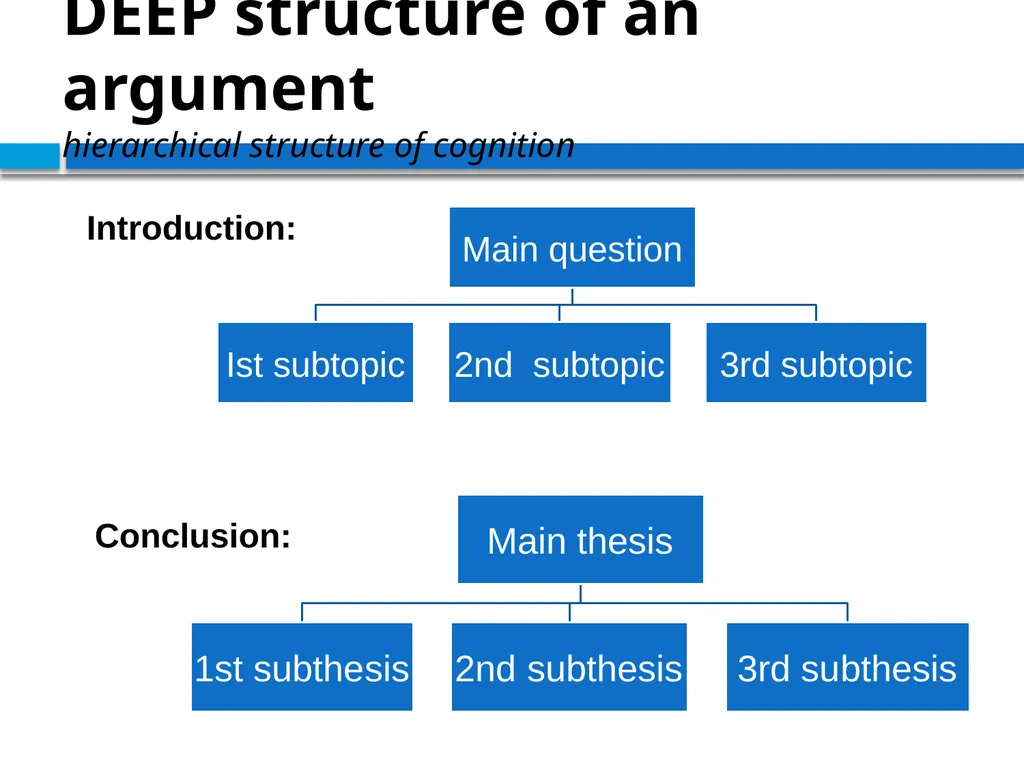
DEEP structure of an argument
hierarchical structure of cognition Introduction: Conclusion:<br>
41
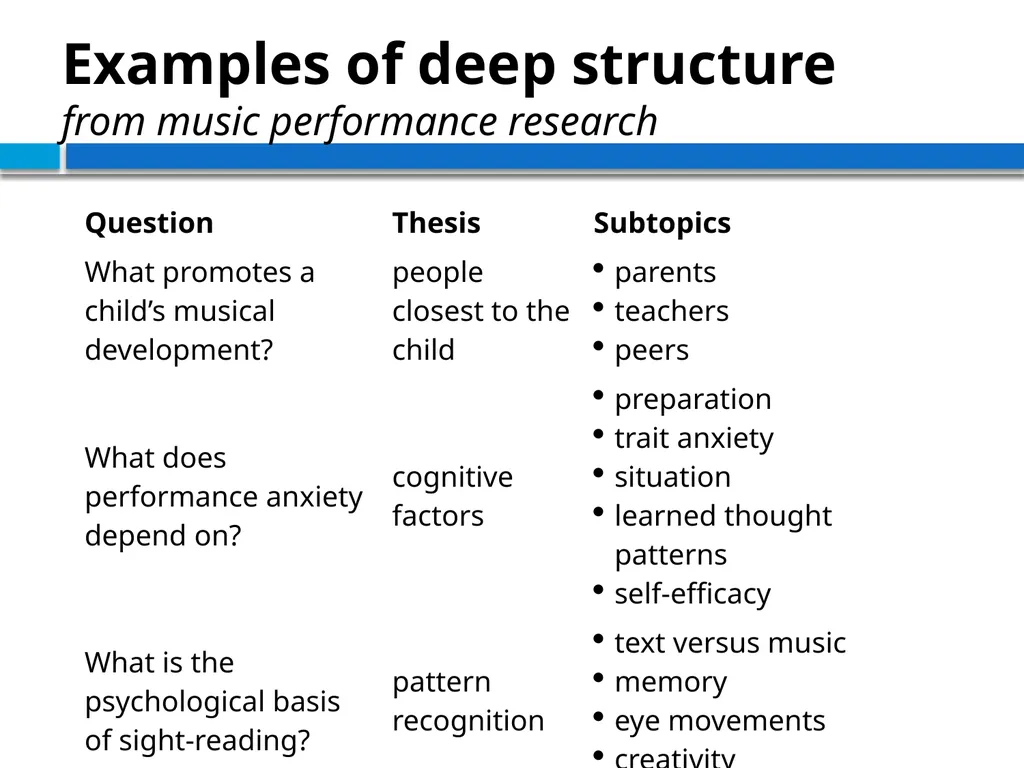
Examples of deep structure
from music performance research<br>
42
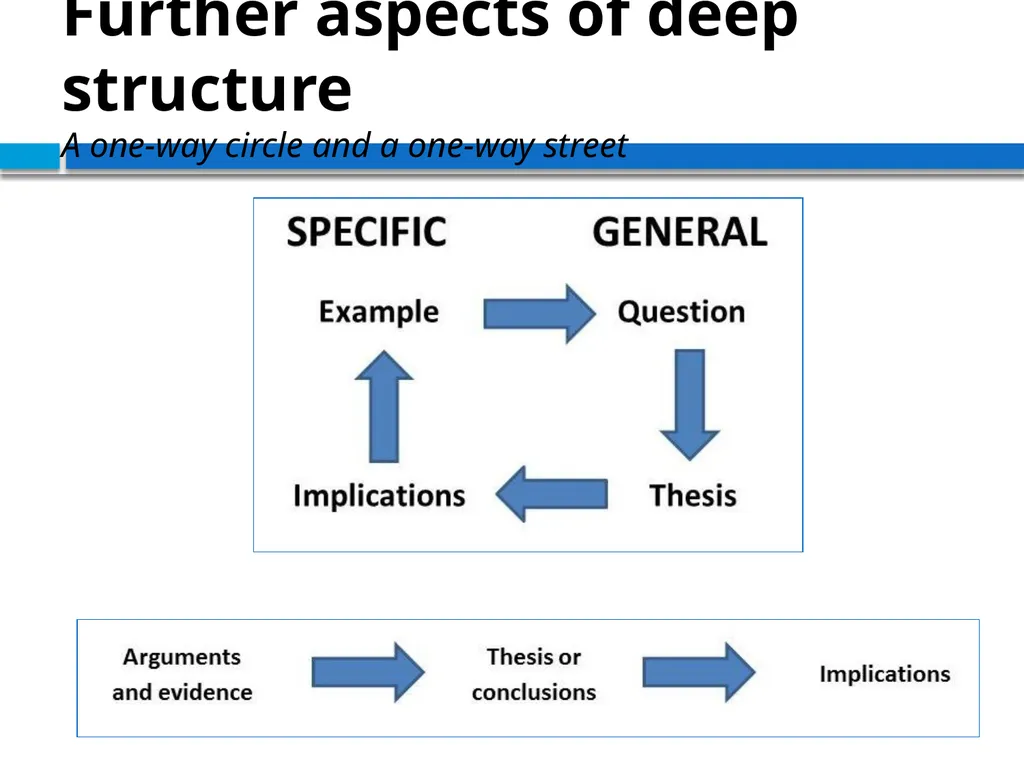
Further aspects of deep structure
A one-way circle and a one-way street<br>
43
Part 3. Writing a talk or paper<br>
44
Start with argument_talk.ppt
Fill in the material
Maintain the basic structure Preparing a talk<br>
Fill in the material
Maintain the basic structure Preparing a talk<br>
45
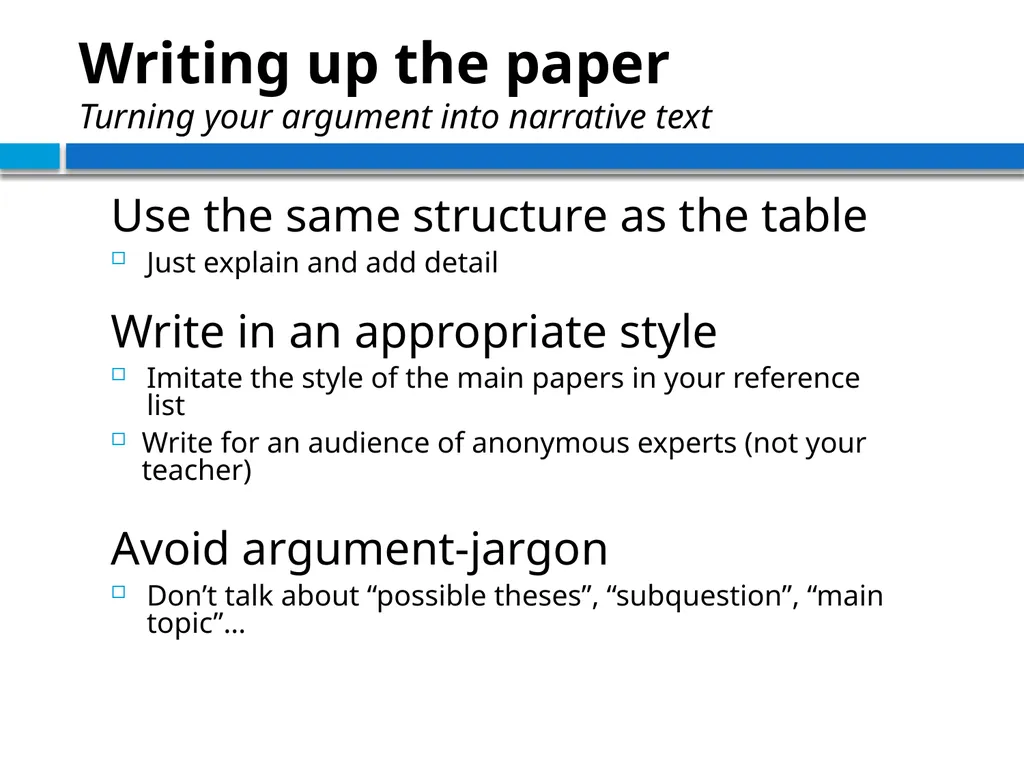
Writing up the paper
Turning your argument into narrative text Use the same structure as the table
Just explain and add detail
Write in an appropriate style
Imitate the style of the main papers in your reference list
Write for an audience of anonymous experts (not your teacher)
Avoid argument-jargon
Don’t talk about “possible theses”, “subquestion”, “main topic”…<br>
Just explain and add detail
Write in an appropriate style
Imitate the style of the main papers in your reference list
Write for an audience of anonymous experts (not your teacher)
Avoid argument-jargon
Don’t talk about “possible theses”, “subquestion”, “main topic”…<br>
46
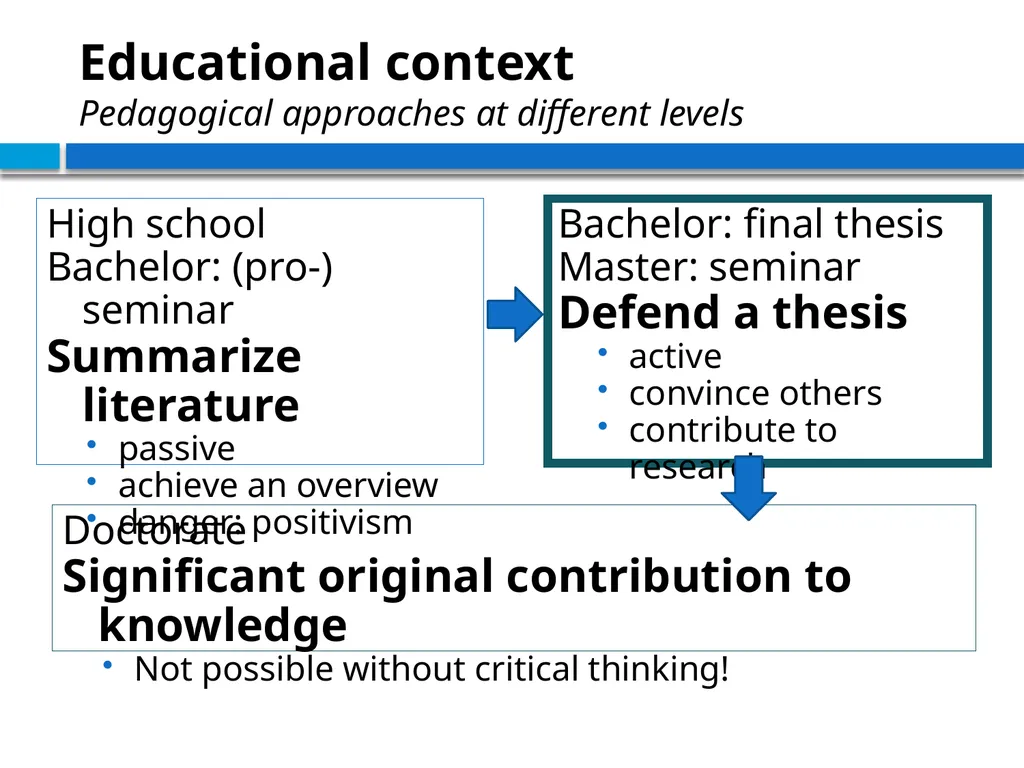
Educational context
Pedagogical approaches at different levels High school
Bachelor: (pro-) seminar
Summarize literature
passive
achieve an overview
danger: positivism Bachelor: final thesis
Master: seminar
Defend a thesis
active
convince others
contribute to research Doctorate
Significant original contribution to knowledge
Not possible without critical thinking!<br>
Bachelor: (pro-) seminar
Summarize literature
passive
achieve an overview
danger: positivism Bachelor: final thesis
Master: seminar
Defend a thesis
active
convince others
contribute to research Doctorate
Significant original contribution to knowledge
Not possible without critical thinking!<br>
47
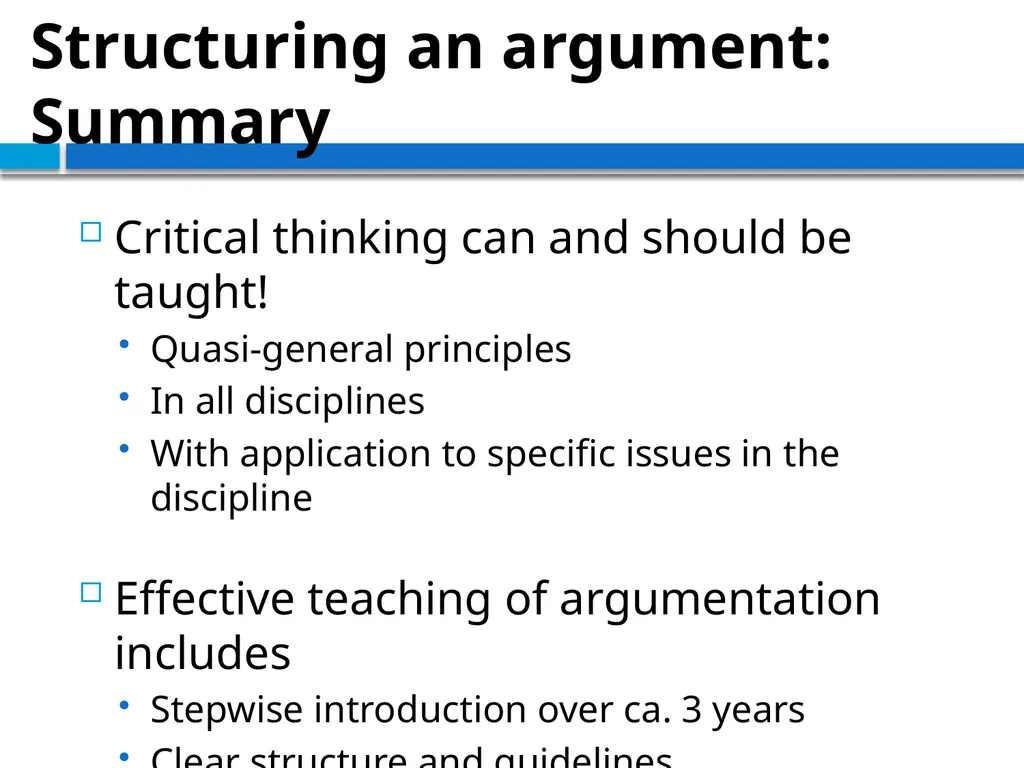
Critical thinking can and should be taught!
Quasi-general principles
In all disciplines
With application to specific issues in the discipline
Effective teaching of argumentation includes
Stepwise introduction over ca. 3 years
Clear structure and guidelines
Flexibility & discussion of approach (metacognition) Structuring an argument: Summary<br>
Quasi-general principles
In all disciplines
With application to specific issues in the discipline
Effective teaching of argumentation includes
Stepwise introduction over ca. 3 years
Clear structure and guidelines
Flexibility & discussion of approach (metacognition) Structuring an argument: Summary<br>