Subject: Entrepreneurship N5 Topic: Module 6 Labour relations Lecturer: Mr. Popane Labour Relations Outcomes. Explain concept such as collective bargaining, mediation and arbitration Compile a list of labour legislation that is applicable
"Subject: Entrepreneurship N5 Topic: Module 6" is the property of its rightful owner. Permission is granted to
download and print the materials on this website for personal, non-commercial use only, and to display it
on your personal computer provided you do not modify the materials and that you retain all copyright
notices contained in the materials. By downloading content from our website, you accept the terms of this
agreement.
Presentation Transcript
01
Subject: Entrepreneurship N5
Topic: Module 6 Labour relations
Lecturer: Mr. Popane<br>
02
Labour Relations Outcomes.
Explain concept such as collective bargaining, mediation and arbitration
Compile a list of labour legislation that is applicable on a small business and give example of each.
Decide on the correct disciplinary action given a specific violation of the business’s disciplinary code.
Discuss the importance of good labour relations in any business.<br>
03
Labour Relations Introduction
In this module we will discuss the rights of employers and employees as how their relationship is regulated by law.
The relationship between an owner/manger and his or her staff is vital part in the successful running of any business. The labour Relation Act (127 of 1998) or LRA spells out the rights of the different parties and provides a framework to regulate relationships between these parties. The Act promotes the right to fair labour practices, to form and join trade unions and employers’ organizations, to organize and bargain collectively, and to strike and lock out. Act also protects employers and employees from discrimination and victimization if they exercise these rights.<br>
04
Trade Unions<br>
05
Trade Unions Trade Unions are formed when employees in specific business, industry, trade or career unite with the aim of organizing the relations between them and their employers. This organization of employees, strives to promote the social, economical and political interests of these employees. Employees are free to join a trade union and an employer cannot prevent him or her from doing so or dismissing (firing) an employee for joining a Union.
The labour Relation Act shows the following rights for Trade Unions.
Access to the workplace
Subscriptions
Elections
Unions Duties
Disclosure
The Act protects employees and job seekers in the following ways:
It prevents employers from victimizing (taking advantage of employees ) employees or job seekers because of their trade unions.
It prevents employers from favoring employees in some way to prevent from joining a union.<br>
06
Trade Unions Employer’s organization
These are formed when employers in the same industry group together in more or less the same way as the unions do.
The Act protects employers in the following ways.
Employers cannot be pressured into the joining a specific employers’ organization
Pressure cannot be put onto employers not exercise any right made by the Act.
Collective Bargaining
Collective bargaining is an important way of regulating labour relations and of determining employees’ wages and benefits.
Collective bargaining takes place when trade unions and employers negotiate or try to settle dispute on employment issues.<br>
07
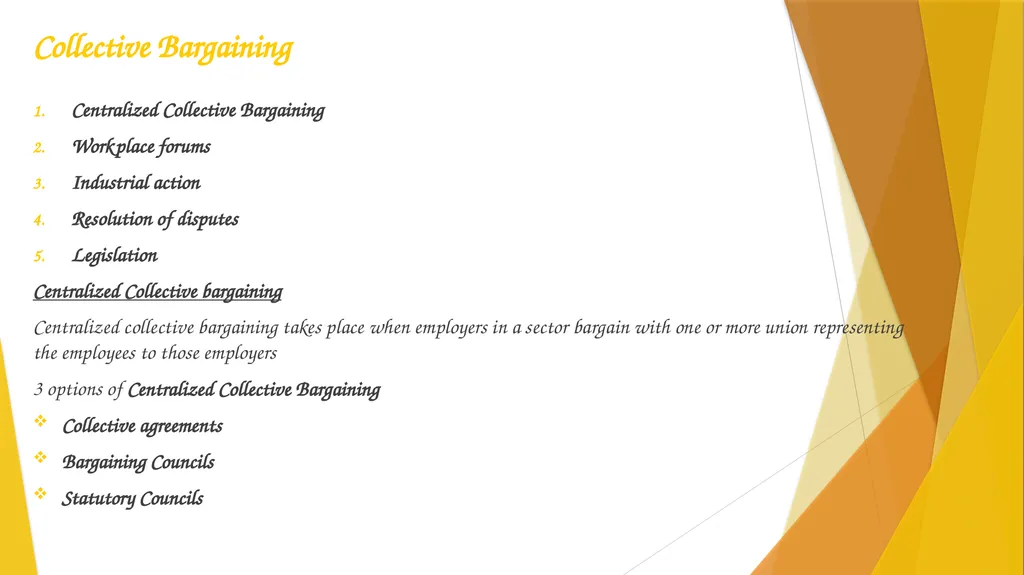
Collective Bargaining Centralized Collective Bargaining
Workplace forums
Industrial action
Resolution of disputes
Legislation
Centralized Collective bargaining
Centralized collective bargaining takes place when employers in a sector bargain with one or more union representing the employees to those employers
3 options of Centralized Collective Bargaining
Collective agreements
Bargaining Councils
Statutory Councils<br>
08
Workplace forums These forums are committees of employees elected by employees in the workplace. The meet on regular basis with employers for consultation on workplace issues. They do not replace collective bargaining but deal with matters that could be resolved through consultation rather than collective bargaining . Workplace forums have the following functions:
To promote the interest of all employees in the workplace (interest like increase in salaries and safe working conditions.)
To enhance efficiency in the workplace.
To be consulted by the employer on certain matters.
Participate in joint decision-making on other matters.<br>
09
Workplace forum A workplace forum should be considered by the employer on the following points.
Restructuring of the workplace (changes in the workplace)
Plans to close
Mergers and transfer of ownership ( joining with another companies)
Dismissal of employees for operational reason (firing of employees)
Exemptions from any collective agreement or law (things left out from collective agreement)
Job grading ( determining the worth of a job)
Criteria for merit increase and bonuses ( the requirements needed to get bonuses)
Education and training ( are these things given)
Product development plans (might have a negative/positive effect on jobs)
Export promotions (might have a negative /positive effect on jobs)<br>
10
Industrial Actions The LRA grants employees the right to strike and employers the right to lock out employees. The reason for a strike or lockdown must be to solve a grievance or dispute about a matter of mutual interest that concerns employers and employees.
Issues that a Strike and lockout may be held.
Wage increases
A demand to establish a joint bargaining council
A demand to recognize a union as collective bargaining agent
A demand to organizational rights
A demand to negotiate unilateral changes to working conditions
An unprotected strike or lockout by the other party.<br>
11
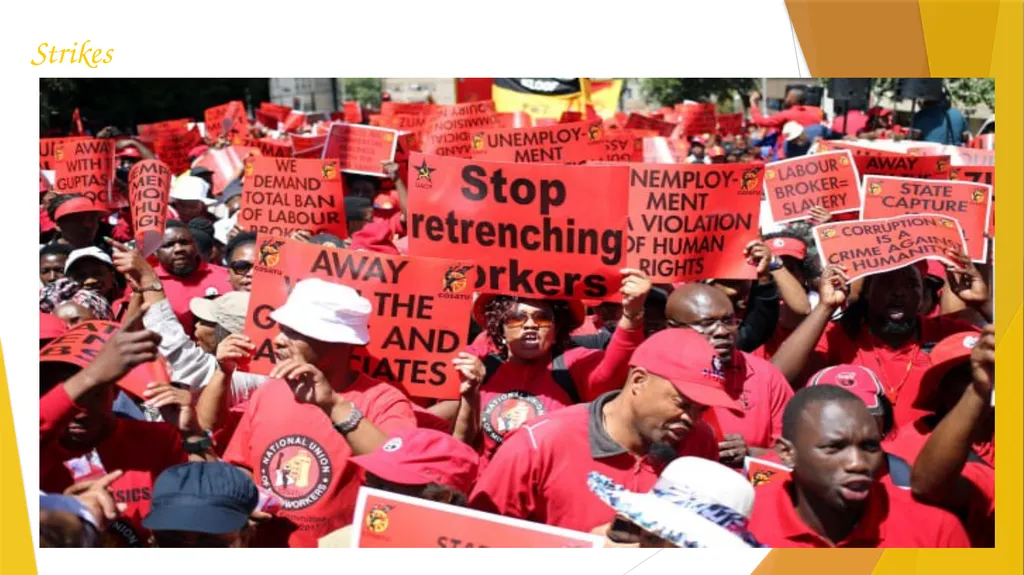
Strike – Strike takes places when 2 or more employees act with common work-related purpose. Actions include partial or complete refused to work or obstruction of work through go–slow.
Lockout
Lockout happens when an employer physically exclude employees from the workplace<br>
12
Strikes<br>
13
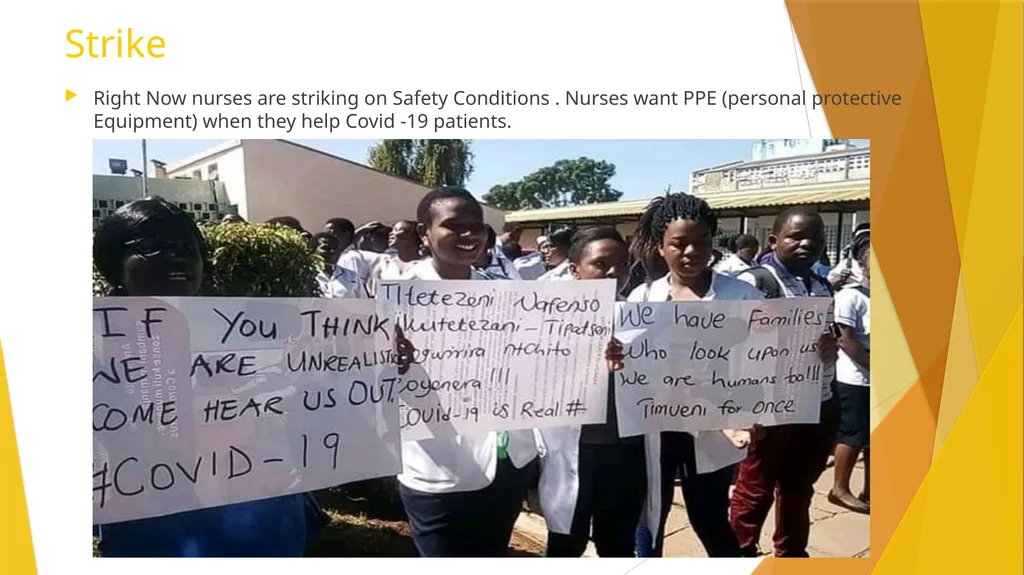
Strike Right Now nurses are striking on Safety Conditions . Nurses want PPE (personal protective Equipment) when they help Covid -19 patients.<br>
14
Lockout<br>
15
Resolution of disputes There are 2 Types.
Conciliation
Arbitration or adjudication by the labour Court or Industrial action
Arbitration
Adjudication (labour court disputes)
Industrial Actions
The CCMA role is resolving disputes
The Commission for Conciliation, Mediation and Arbitration (CCMA) is a dispute resolution body established in terms of the LRA. The aim of the CCMA is to restoring sound labour and industrial relations within the South Africa.<br>
16
Legislation Types of Legislation that governs the workplace.
Labour Relations Act (LRA) (127 of 1998)
Basic Conditions of Employment Act (BCEA) (75 of 1997)
Compensation for Occupational Injuries and Diseases Act (COIDA) (130 of 1993)
Unemployment Insurance Act (UIF) (63 of 2001)
Occupational Health and Safety Act (OHS) (85 of 1993)<br>
17
Grievance procedure Every business should have its own grievance procedure, which must be in line with the LRA. Employees should be informed about the procedure and must have the freedom to make use of it
Disciplinary measure in a business
Management will discipline employees who do not perform according to the set standards. Each business should have a disciplinary code, which can serve as a guideline that can be imposed on workers who violate standards, rules and regulations.
(Disciplinary behavior example going to work drunk, Sexual harassment on female colleagues or using business equipment for personal use.)
The END!!!!!!!<br>
18
End of Module 5 Try and Do Activity 1 page 106 and Activity 3 on page 111 for Friday. PLZ stay safe and stay home !!!!!!!!!<br>