
Succession Planning for Small and Medium

Description: Succession Planning for Small and Medium Enterprises Presentation of the REsearch Findings Entrepreneurships and Start-Ups Services Branch Ministry of Economic Development and Growth Ministry of Research, Innovation and Science 19th May
Related Topics
Download Presentation
"Succession Planning for Small and Medium" is the property of its rightful owner. Permission is granted to download and print the materials on this website for personal, non-commercial use only, and to display it on your personal computer provided you do not modify the materials and that you retain all copyright notices contained in the materials. By downloading content from our website, you accept the terms of this agreement.
Presentation Transcript
slide1. Succession Planning for Small and Medium Enterprises
Presentation of the REsearch Findings Entrepreneurships and Start-Ups Services Branch
Ministry of Economic Development and Growth
Ministry of Research, Innovation and Science
19th May 2017
Shore Consulting
www.shore.ca<br>
slide2. Agenda/ Outline Introductions
Study Goals & Activities
Framework
Approach
Key Findings
Policy Options
Discussion - Q&A 2<br>
slide3. Study Goals and Activities What is Succession Planning?
Succession planning is the set of important considerations and processes involved in preparation for the transfer, sale or closure of a business (whether planned or sudden) from its current owner to a successor (individual or group).
Goals
Gain a better understanding of the issues associated with succession planning.
Examine the current state of succession planning and the potential economic and social impacts of retiring SME owners in communities across Ontario.
Activities
Stakeholder interviews
Jurisdictional scan
Policy options 3<br>
slide4. 4<br>
slide5. Approach Timeline – Study conducted from mid-Fall 2016 to April 2017
Jurisdictional scan – selected Canadian provinces (Alberta, British Columbia, Quebec and Ontario) as well as Australia, New Zealand, Europe/European Commission, Ireland, UK, US.
Context, policies, programs, strategies and services used by governments and other key stakeholders to support SME business owners with succession planning.
Challenges and barriers faced by SMEs or governments.
Potential impacts from a lack of, or poor, succession planning.
Interviews – 40 key stakeholders across Ontario (business support organizations, owners with succession planning experience, government officials and subject matter experts).
Potential social and economic impacts.
Challenges, barriers and opportunities.
Opportunities for potential government interventions.
Analysis
Development of Policy Options for Ontario 5<br>
slide6. SMEs major contributors to Canadian and Ontario economies
As private sector employers - 415,000 SMEs in Ontario employing almost 4 million workers (Statistics Canada).
As generators of revenue - SMEs contribute to roughly 39% of Ontario’s GDP (Statistics Canada).
SME owners are retiring
In 2011, almost 50% of all SME owners in Canada were between 50 and 64 years of age (59% in 2014).
CFIB 2013 survey indicates that 75% of Canadian business owners will exit their business before 2022. 6 Context<br>
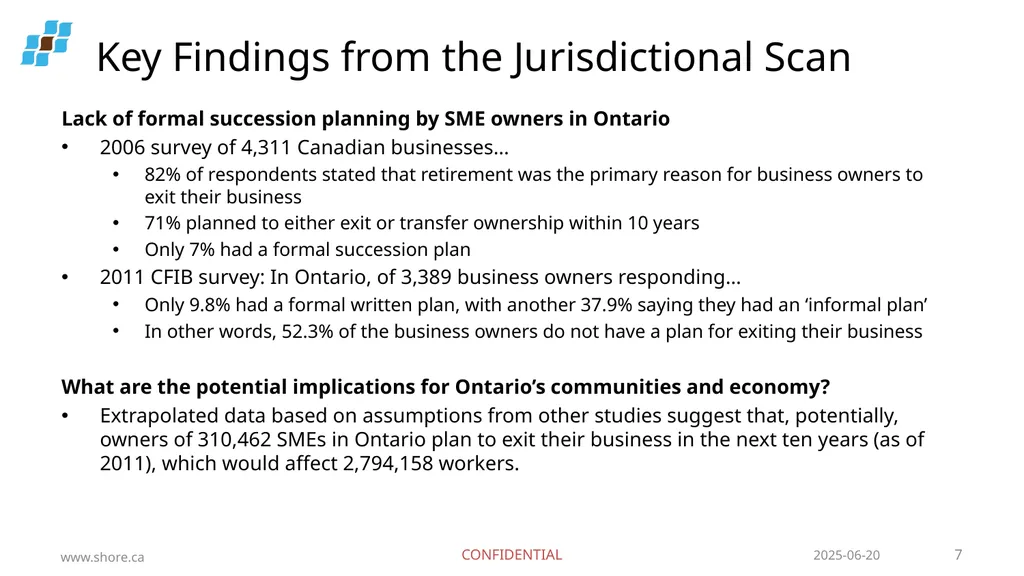
slide7. Lack of formal succession planning by SME owners in Ontario
2006 survey of 4,311 Canadian businesses…
82% of respondents stated that retirement was the primary reason for business owners to exit their business
71% planned to either exit or transfer ownership within 10 years
Only 7% had a formal succession plan
2011 CFIB survey: In Ontario, of 3,389 business owners responding…
Only 9.8% had a formal written plan, with another 37.9% saying they had an ‘informal plan’
In other words, 52.3% of the business owners do not have a plan for exiting their business
What are the potential implications for Ontario’s communities and economy?
Extrapolated data based on assumptions from other studies suggest that, potentially, owners of 310,462 SMEs in Ontario plan to exit their business in the next ten years (as of 2011), which would affect 2,794,158 workers. 17/05/2017 CONFIDENTIAL 7 Key Findings from the Jurisdictional Scan<br>
slide8. Key Findings from the Jurisdictional Scan Experiences of the other jurisdictions are similar with regard to the aging demographic profile of SME owners in Ontario.
Governments and other key stakeholders increasingly aware that successful succession planning and business transfers are critical to sustaining businesses and the local economies and communities in which they operate.
The major types of challenges to successful succession planning identified in the jurisdictional scan cluster into six categories:
Finding relevant information
Limited knowledge of succession planning and business transfers
Finding a successor
Emotional challenges
Scope of work of SME support personnel
Financial challenges, taxation, legal and legislative/regulatory restrictions 8<br>
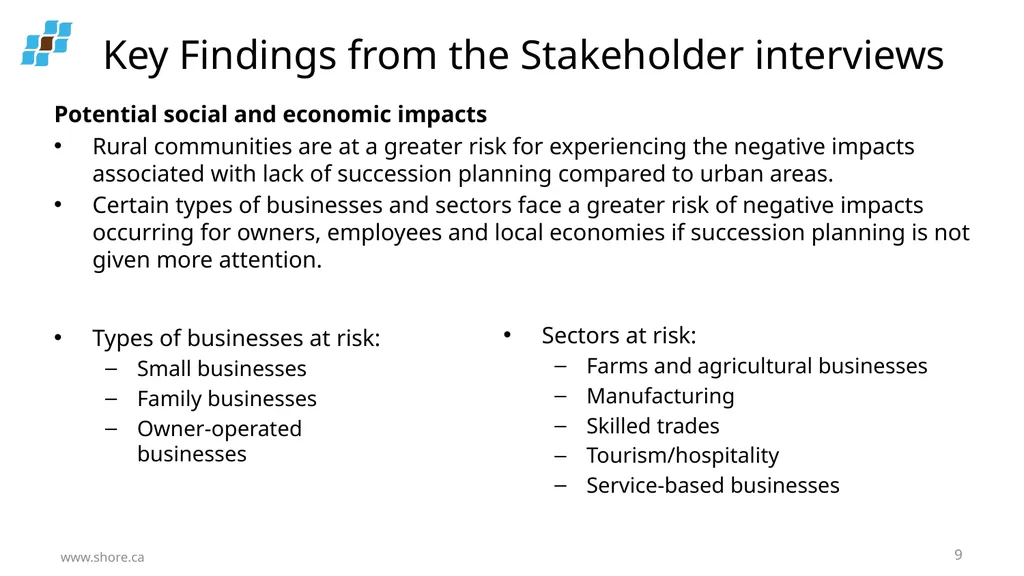
slide9. Key Findings from the Stakeholder interviews Potential social and economic impacts
Rural communities are at a greater risk for experiencing the negative impacts associated with lack of succession planning compared to urban areas.
Certain types of businesses and sectors face a greater risk of negative impacts occurring for owners, employees and local economies if succession planning is not given more attention. 9 Types of businesses at risk:
Small businesses
Family businesses
Owner-operated businesses Sectors at risk:
Farms and agricultural businesses
Manufacturing
Skilled trades
Tourism/hospitality
Service-based businesses<br>
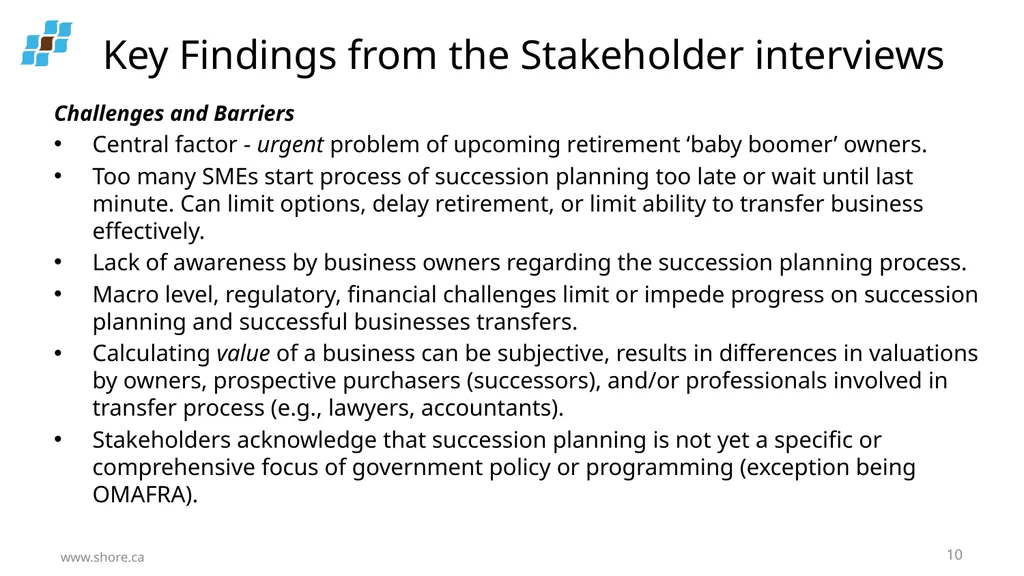
slide10. Key Findings from the Stakeholder interviews Challenges and Barriers
Central factor - urgent problem of upcoming retirement ‘baby boomer’ owners.
Too many SMEs start process of succession planning too late or wait until last minute. Can limit options, delay retirement, or limit ability to transfer business effectively.
Lack of awareness by business owners regarding the succession planning process.
Macro level, regulatory, financial challenges limit or impede progress on succession planning and successful businesses transfers.
Calculating value of a business can be subjective, results in differences in valuations by owners, prospective purchasers (successors), and/or professionals involved in transfer process (e.g., lawyers, accountants).
Stakeholders acknowledge that succession planning is not yet a specific or comprehensive focus of government policy or programming (exception being OMAFRA). 10<br>
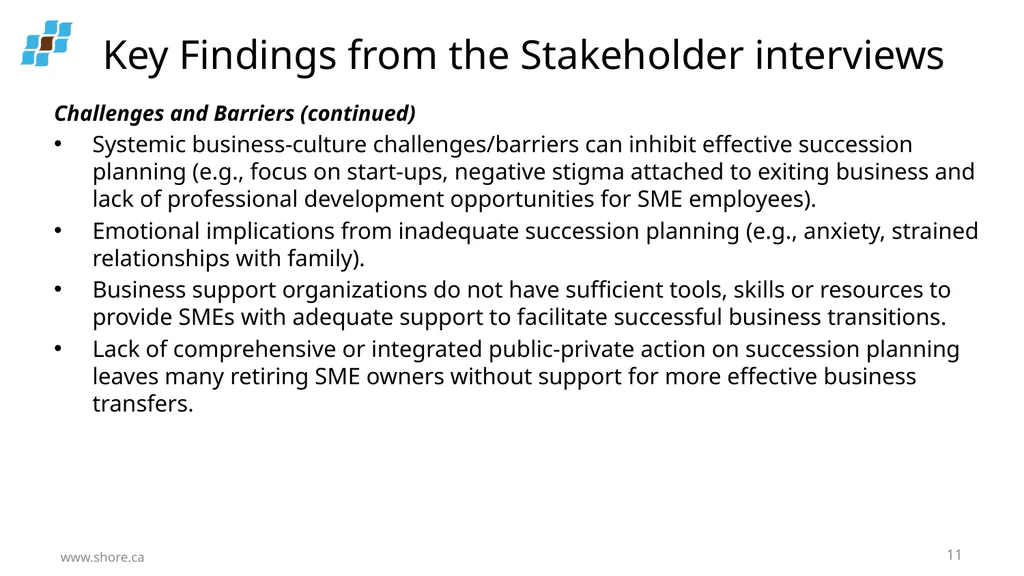
slide11. Key Findings from the Stakeholder interviews Challenges and Barriers (continued)
Systemic business-culture challenges/barriers can inhibit effective succession planning (e.g., focus on start-ups, negative stigma attached to exiting business and lack of professional development opportunities for SME employees).
Emotional implications from inadequate succession planning (e.g., anxiety, strained relationships with family).
Business support organizations do not have sufficient tools, skills or resources to provide SMEs with adequate support to facilitate successful business transitions.
Lack of comprehensive or integrated public-private action on succession planning leaves many retiring SME owners without support for more effective business transfers. 11<br>
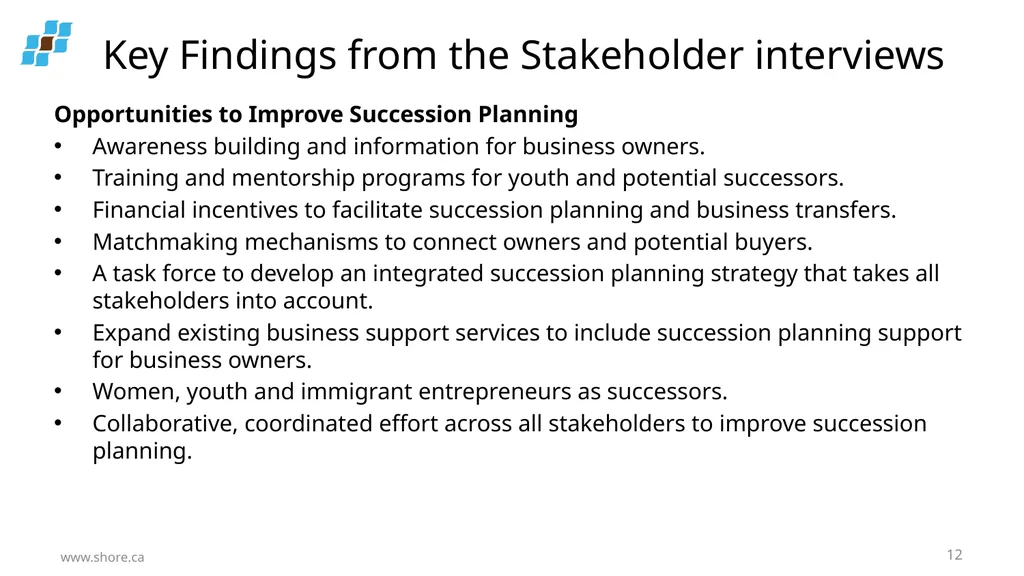
slide12. Key Findings from the Stakeholder interviews Opportunities to Improve Succession Planning
Awareness building and information for business owners.
Training and mentorship programs for youth and potential successors.
Financial incentives to facilitate succession planning and business transfers.
Matchmaking mechanisms to connect owners and potential buyers.
A task force to develop an integrated succession planning strategy that takes all stakeholders into account.
Expand existing business support services to include succession planning support for business owners.
Women, youth and immigrant entrepreneurs as successors.
Collaborative, coordinated effort across all stakeholders to improve succession planning. 12<br>
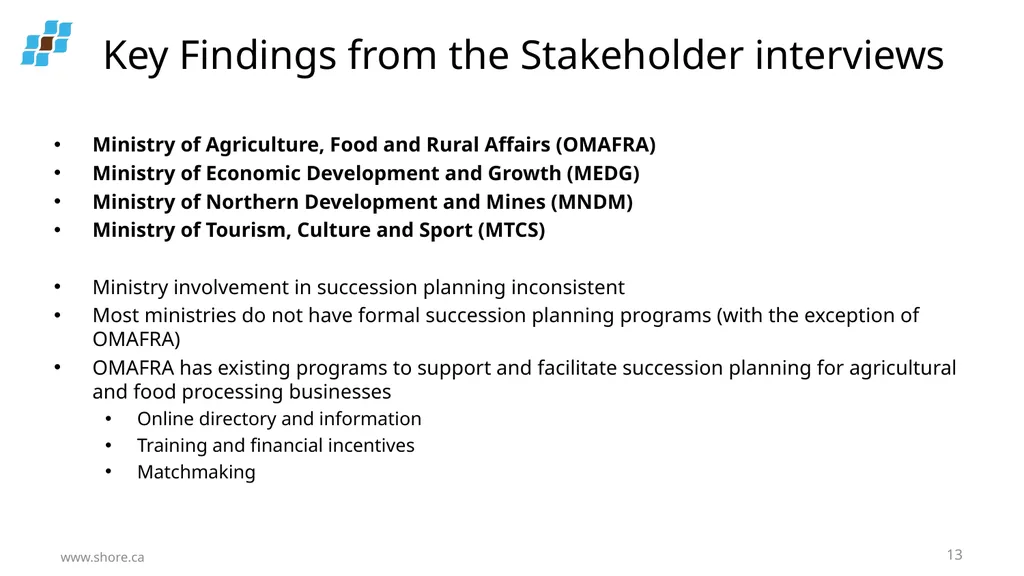
slide13. Key Findings from the Stakeholder interviews Ministry of Agriculture, Food and Rural Affairs (OMAFRA)
Ministry of Economic Development and Growth (MEDG)
Ministry of Northern Development and Mines (MNDM)
Ministry of Tourism, Culture and Sport (MTCS)
Ministry involvement in succession planning inconsistent
Most ministries do not have formal succession planning programs (with the exception of OMAFRA)
OMAFRA has existing programs to support and facilitate succession planning for agricultural and food processing businesses
Online directory and information
Training and financial incentives
Matchmaking 13<br>
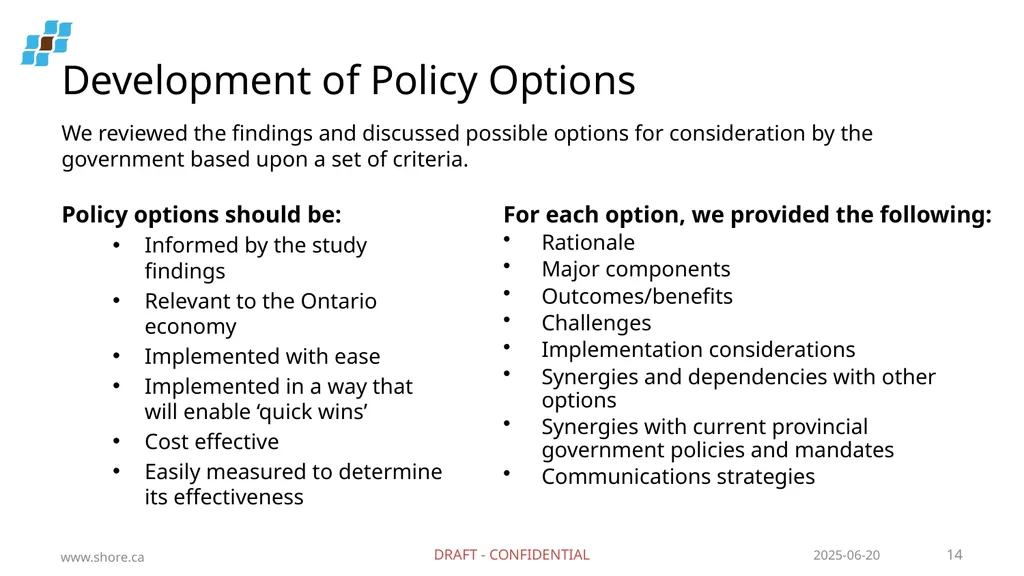
slide14. Policy options should be:
Informed by the study findings
Relevant to the Ontario economy
Implemented with ease
Implemented in a way that will enable ‘quick wins’
Cost effective
Easily measured to determine its effectiveness For each option, we provided the following:
Rationale
Major components
Outcomes/benefits
Challenges
Implementation considerations
Synergies and dependencies with other options
Synergies with current provincial government policies and mandates
Communications strategies 17/05/2017 DRAFT - CONFIDENTIAL 14 We reviewed the findings and discussed possible options for consideration by the government based upon a set of criteria. Development of Policy Options<br>
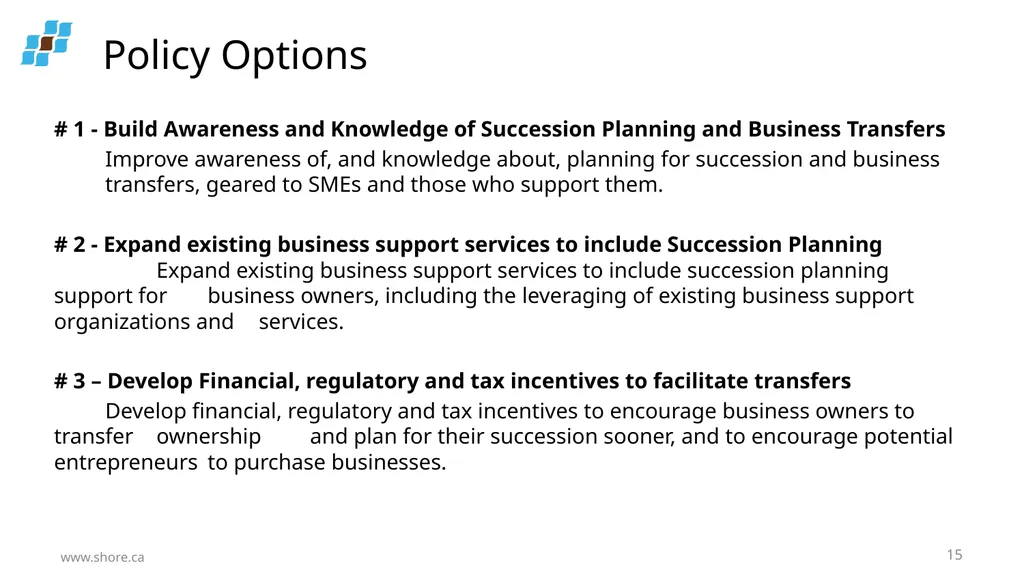
slide15. Policy Options # 1 - Build Awareness and Knowledge of Succession Planning and Business Transfers
Improve awareness of, and knowledge about, planning for succession and business transfers, geared to SMEs and those who support them.
# 2 - Expand existing business support services to include Succession Planning Expand existing business support services to include succession planning support for business owners, including the leveraging of existing business support organizations and services.
# 3 – Develop Financial, regulatory and tax incentives to facilitate transfers
Develop financial, regulatory and tax incentives to encourage business owners to transfer ownership and plan for their succession sooner, and to encourage potential entrepreneurs to purchase businesses. 15<br>
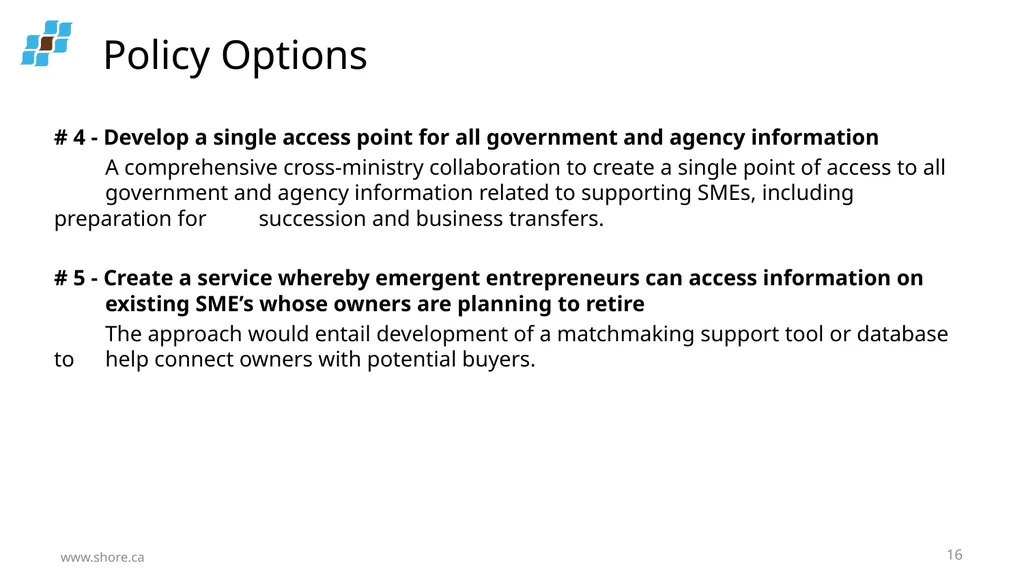
slide16. Policy Options # 4 - Develop a single access point for all government and agency information
A comprehensive cross-ministry collaboration to create a single point of access to all government and agency information related to supporting SMEs, including preparation for succession and business transfers.
# 5 - Create a service whereby emergent entrepreneurs can access information on existing SME’s whose owners are planning to retire
The approach would entail development of a matchmaking support tool or database to help connect owners with potential buyers. 16<br>
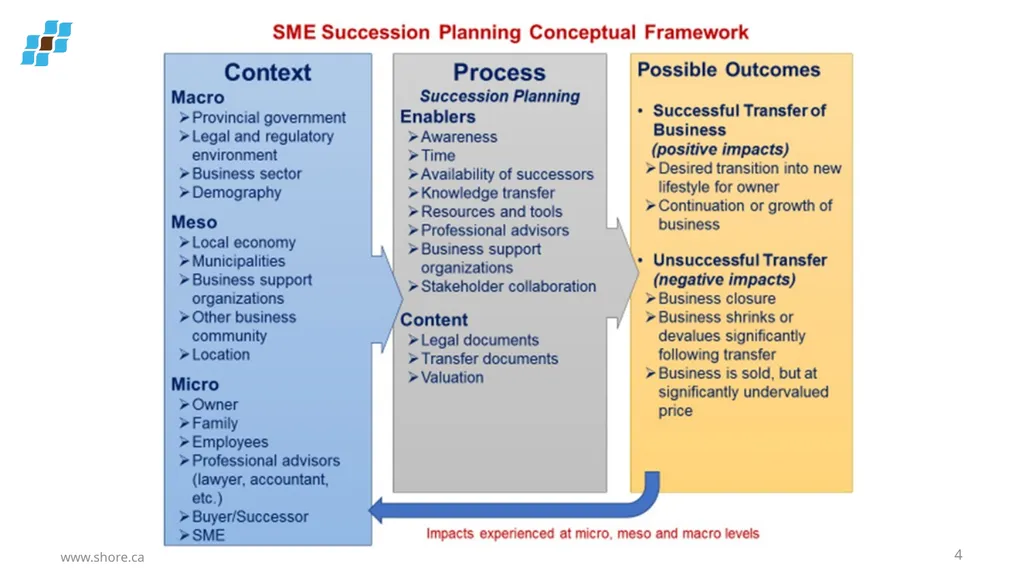
slide17. Questions and Comments Succession planning is multi-faceted – macro, meso and micro contextual considerations and impacts.
Is there a need for empirical data that show the actual impact of poor, or no, succession planning? If so, how can these data be collected?
What is the optimal approach for provincial government involvement in the succession planning ‘space’?
Are some policy options more important than others? If so, which ones?
What role can different ministries play?
How can different ministries best work together on succession planning? 17<br>
Ministry of Economic Development and Growth
Ministry of Research, Innovation and Science
19th May 2017
Shore Consulting
www.shore.ca<br>
slide2. Agenda/ Outline Introductions
Study Goals & Activities
Framework
Approach
Key Findings
Policy Options
Discussion - Q&A 2<br>
slide3. Study Goals and Activities What is Succession Planning?
Succession planning is the set of important considerations and processes involved in preparation for the transfer, sale or closure of a business (whether planned or sudden) from its current owner to a successor (individual or group).
Goals
Gain a better understanding of the issues associated with succession planning.
Examine the current state of succession planning and the potential economic and social impacts of retiring SME owners in communities across Ontario.
Activities
Stakeholder interviews
Jurisdictional scan
Policy options 3<br>
slide4. 4<br>
slide5. Approach Timeline – Study conducted from mid-Fall 2016 to April 2017
Jurisdictional scan – selected Canadian provinces (Alberta, British Columbia, Quebec and Ontario) as well as Australia, New Zealand, Europe/European Commission, Ireland, UK, US.
Context, policies, programs, strategies and services used by governments and other key stakeholders to support SME business owners with succession planning.
Challenges and barriers faced by SMEs or governments.
Potential impacts from a lack of, or poor, succession planning.
Interviews – 40 key stakeholders across Ontario (business support organizations, owners with succession planning experience, government officials and subject matter experts).
Potential social and economic impacts.
Challenges, barriers and opportunities.
Opportunities for potential government interventions.
Analysis
Development of Policy Options for Ontario 5<br>
slide6. SMEs major contributors to Canadian and Ontario economies
As private sector employers - 415,000 SMEs in Ontario employing almost 4 million workers (Statistics Canada).
As generators of revenue - SMEs contribute to roughly 39% of Ontario’s GDP (Statistics Canada).
SME owners are retiring
In 2011, almost 50% of all SME owners in Canada were between 50 and 64 years of age (59% in 2014).
CFIB 2013 survey indicates that 75% of Canadian business owners will exit their business before 2022. 6 Context<br>
slide7. Lack of formal succession planning by SME owners in Ontario
2006 survey of 4,311 Canadian businesses…
82% of respondents stated that retirement was the primary reason for business owners to exit their business
71% planned to either exit or transfer ownership within 10 years
Only 7% had a formal succession plan
2011 CFIB survey: In Ontario, of 3,389 business owners responding…
Only 9.8% had a formal written plan, with another 37.9% saying they had an ‘informal plan’
In other words, 52.3% of the business owners do not have a plan for exiting their business
What are the potential implications for Ontario’s communities and economy?
Extrapolated data based on assumptions from other studies suggest that, potentially, owners of 310,462 SMEs in Ontario plan to exit their business in the next ten years (as of 2011), which would affect 2,794,158 workers. 17/05/2017 CONFIDENTIAL 7 Key Findings from the Jurisdictional Scan<br>
slide8. Key Findings from the Jurisdictional Scan Experiences of the other jurisdictions are similar with regard to the aging demographic profile of SME owners in Ontario.
Governments and other key stakeholders increasingly aware that successful succession planning and business transfers are critical to sustaining businesses and the local economies and communities in which they operate.
The major types of challenges to successful succession planning identified in the jurisdictional scan cluster into six categories:
Finding relevant information
Limited knowledge of succession planning and business transfers
Finding a successor
Emotional challenges
Scope of work of SME support personnel
Financial challenges, taxation, legal and legislative/regulatory restrictions 8<br>
slide9. Key Findings from the Stakeholder interviews Potential social and economic impacts
Rural communities are at a greater risk for experiencing the negative impacts associated with lack of succession planning compared to urban areas.
Certain types of businesses and sectors face a greater risk of negative impacts occurring for owners, employees and local economies if succession planning is not given more attention. 9 Types of businesses at risk:
Small businesses
Family businesses
Owner-operated businesses Sectors at risk:
Farms and agricultural businesses
Manufacturing
Skilled trades
Tourism/hospitality
Service-based businesses<br>
slide10. Key Findings from the Stakeholder interviews Challenges and Barriers
Central factor - urgent problem of upcoming retirement ‘baby boomer’ owners.
Too many SMEs start process of succession planning too late or wait until last minute. Can limit options, delay retirement, or limit ability to transfer business effectively.
Lack of awareness by business owners regarding the succession planning process.
Macro level, regulatory, financial challenges limit or impede progress on succession planning and successful businesses transfers.
Calculating value of a business can be subjective, results in differences in valuations by owners, prospective purchasers (successors), and/or professionals involved in transfer process (e.g., lawyers, accountants).
Stakeholders acknowledge that succession planning is not yet a specific or comprehensive focus of government policy or programming (exception being OMAFRA). 10<br>
slide11. Key Findings from the Stakeholder interviews Challenges and Barriers (continued)
Systemic business-culture challenges/barriers can inhibit effective succession planning (e.g., focus on start-ups, negative stigma attached to exiting business and lack of professional development opportunities for SME employees).
Emotional implications from inadequate succession planning (e.g., anxiety, strained relationships with family).
Business support organizations do not have sufficient tools, skills or resources to provide SMEs with adequate support to facilitate successful business transitions.
Lack of comprehensive or integrated public-private action on succession planning leaves many retiring SME owners without support for more effective business transfers. 11<br>
slide12. Key Findings from the Stakeholder interviews Opportunities to Improve Succession Planning
Awareness building and information for business owners.
Training and mentorship programs for youth and potential successors.
Financial incentives to facilitate succession planning and business transfers.
Matchmaking mechanisms to connect owners and potential buyers.
A task force to develop an integrated succession planning strategy that takes all stakeholders into account.
Expand existing business support services to include succession planning support for business owners.
Women, youth and immigrant entrepreneurs as successors.
Collaborative, coordinated effort across all stakeholders to improve succession planning. 12<br>
slide13. Key Findings from the Stakeholder interviews Ministry of Agriculture, Food and Rural Affairs (OMAFRA)
Ministry of Economic Development and Growth (MEDG)
Ministry of Northern Development and Mines (MNDM)
Ministry of Tourism, Culture and Sport (MTCS)
Ministry involvement in succession planning inconsistent
Most ministries do not have formal succession planning programs (with the exception of OMAFRA)
OMAFRA has existing programs to support and facilitate succession planning for agricultural and food processing businesses
Online directory and information
Training and financial incentives
Matchmaking 13<br>
slide14. Policy options should be:
Informed by the study findings
Relevant to the Ontario economy
Implemented with ease
Implemented in a way that will enable ‘quick wins’
Cost effective
Easily measured to determine its effectiveness For each option, we provided the following:
Rationale
Major components
Outcomes/benefits
Challenges
Implementation considerations
Synergies and dependencies with other options
Synergies with current provincial government policies and mandates
Communications strategies 17/05/2017 DRAFT - CONFIDENTIAL 14 We reviewed the findings and discussed possible options for consideration by the government based upon a set of criteria. Development of Policy Options<br>
slide15. Policy Options # 1 - Build Awareness and Knowledge of Succession Planning and Business Transfers
Improve awareness of, and knowledge about, planning for succession and business transfers, geared to SMEs and those who support them.
# 2 - Expand existing business support services to include Succession Planning Expand existing business support services to include succession planning support for business owners, including the leveraging of existing business support organizations and services.
# 3 – Develop Financial, regulatory and tax incentives to facilitate transfers
Develop financial, regulatory and tax incentives to encourage business owners to transfer ownership and plan for their succession sooner, and to encourage potential entrepreneurs to purchase businesses. 15<br>
slide16. Policy Options # 4 - Develop a single access point for all government and agency information
A comprehensive cross-ministry collaboration to create a single point of access to all government and agency information related to supporting SMEs, including preparation for succession and business transfers.
# 5 - Create a service whereby emergent entrepreneurs can access information on existing SME’s whose owners are planning to retire
The approach would entail development of a matchmaking support tool or database to help connect owners with potential buyers. 16<br>
slide17. Questions and Comments Succession planning is multi-faceted – macro, meso and micro contextual considerations and impacts.
Is there a need for empirical data that show the actual impact of poor, or no, succession planning? If so, how can these data be collected?
What is the optimal approach for provincial government involvement in the succession planning ‘space’?
Are some policy options more important than others? If so, which ones?
What role can different ministries play?
How can different ministries best work together on succession planning? 17<br>