
Supervisor and HR Partner’s Guide to Reasonable
KL
Published · 40 slides · 0 views

1 / 1






Description
Supervisor and HR Partners Guide to Reasonable Workplace Accommodations Erin Metz Senior Accessibility Specialist May 5, 2025 Agenda The University of Michigan is committed to fostering an inclusive environment where accessibility and the
Related Topics
Share
Embed code
Download this presentation From Below
"Supervisor and HR Partner’s Guide to Reasonable" is the property of its rightful owner. Permission is granted to download and print the materials on this website for personal, non-commercial use only, and to display it on your personal computer provided you do not modify the materials and that you retain all copyright notices contained in the materials. By downloading content from our website, you accept the terms of this agreement.
Presentation Transcript
01
Supervisor and HR Partner’s Guide to Reasonable Workplace Accommodations Erin Metz
Senior Accessibility Specialist
May 5, 2025<br>
Senior Accessibility Specialist
May 5, 2025<br>
02
Agenda The University of Michigan is committed to fostering an inclusive environment where accessibility and the needs of individuals with disabilities are prioritized, ensuring equitable opportunities for all members of our diverse community. This workshop will cover:
General background information on the ADA and its protections
The Interactive Process
Frequently Asked Questions<br>
General background information on the ADA and its protections
The Interactive Process
Frequently Asked Questions<br>
03
The Americans with Disabilities Act (ADA)<br>
04
What Is the ADA?
The Americans with Disabilities Act (1990) and the Amendments Act (2008) Prohibits discrimination and harassment against an individual with a disability (IWD) in employment, public places, public education, etc.
Protects individuals from discrimination based on association with an IWD.
Creates an affirmative duty to provide a reasonable accommodation (to deny a reasonable accommodation is discriminatory).<br>
Protects individuals from discrimination based on association with an IWD.
Creates an affirmative duty to provide a reasonable accommodation (to deny a reasonable accommodation is discriminatory).<br>
05
U-M Disability Related Policies: SPG 201.35 and SPG 601.20 Nondiscrimination Policy (201.35):
“The University of Michigan is committed to a policy of equal opportunity for all persons and does not discriminate on the basis of race, color, national origin, age, marital status, sex, sexual orientation, gender identity, gender expression, disability, religion, height, weight, or veteran status in employment, educational programs and activities, and admissions.”
Electronic Information and Technology Accessibility Policy (601.20):
All EIT used, created, and procured for use by U-M "should provide equal access and be as effective, available, and usable for individuals with disabilities as for those who do not have disabilities.”<br>
“The University of Michigan is committed to a policy of equal opportunity for all persons and does not discriminate on the basis of race, color, national origin, age, marital status, sex, sexual orientation, gender identity, gender expression, disability, religion, height, weight, or veteran status in employment, educational programs and activities, and admissions.”
Electronic Information and Technology Accessibility Policy (601.20):
All EIT used, created, and procured for use by U-M "should provide equal access and be as effective, available, and usable for individuals with disabilities as for those who do not have disabilities.”<br>
06
The Interactive Process Background<br>
07
Disability Definition A physical or mental impairment that substantially limits one or more major life activity.
Substantial limitation is determined by comparison to an average person in the general population.
Major life activities include: bending, breathing, caring for self, concentrating, hearing, interacting with others, learning, lifting, sitting, speaking, standing, thinking, walking, working, etc.
This includes people who have a record of such an impairment, even if they do not currently have a disability.
It also includes individuals who do not have a disability, but are regarded as such.<br>
Substantial limitation is determined by comparison to an average person in the general population.
Major life activities include: bending, breathing, caring for self, concentrating, hearing, interacting with others, learning, lifting, sitting, speaking, standing, thinking, walking, working, etc.
This includes people who have a record of such an impairment, even if they do not currently have a disability.
It also includes individuals who do not have a disability, but are regarded as such.<br>
08
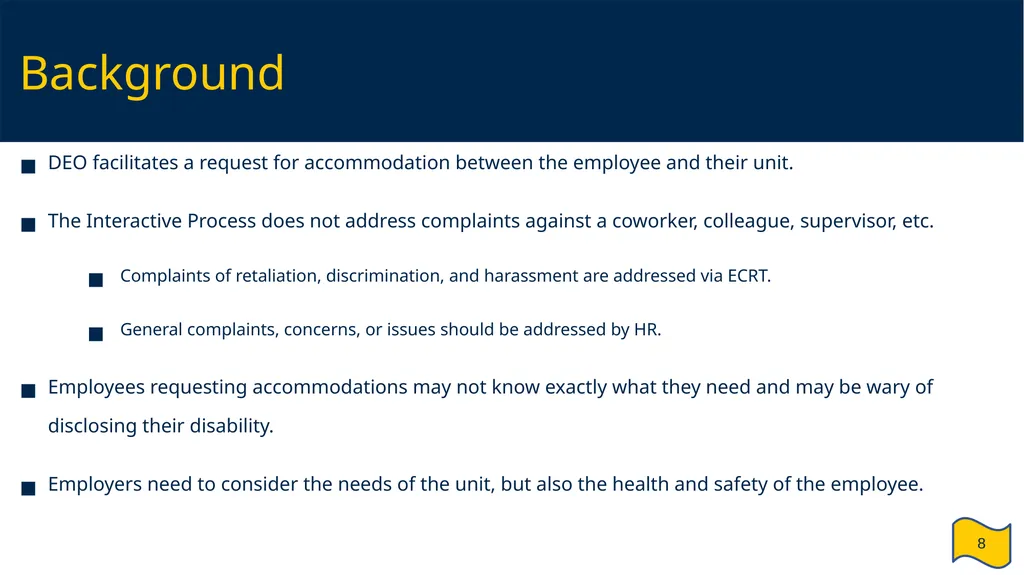
Background DEO facilitates a request for accommodation between the employee and their unit.
The Interactive Process does not address complaints against a coworker, colleague, supervisor, etc.
Complaints of retaliation, discrimination, and harassment are addressed via ECRT.
General complaints, concerns, or issues should be addressed by HR.
Employees requesting accommodations may not know exactly what they need and may be wary of disclosing their disability.
Employers need to consider the needs of the unit, but also the health and safety of the employee.<br>
The Interactive Process does not address complaints against a coworker, colleague, supervisor, etc.
Complaints of retaliation, discrimination, and harassment are addressed via ECRT.
General complaints, concerns, or issues should be addressed by HR.
Employees requesting accommodations may not know exactly what they need and may be wary of disclosing their disability.
Employers need to consider the needs of the unit, but also the health and safety of the employee.<br>
09
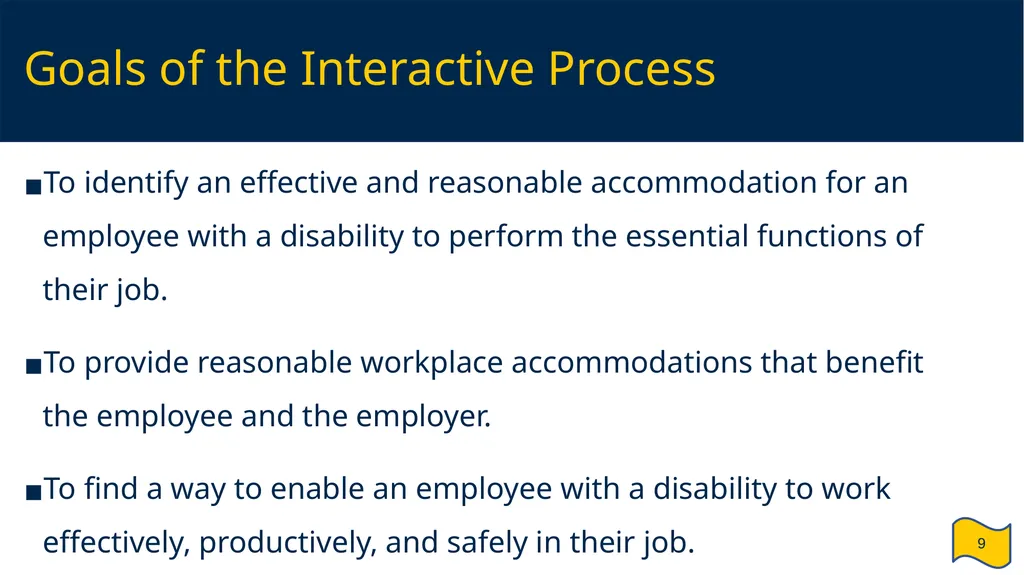
Goals of the Interactive Process To identify an effective and reasonable accommodation for an employee with a disability to perform the essential functions of their job.
To provide reasonable workplace accommodations that benefit the employee and the employer.
To find a way to enable an employee with a disability to work effectively, productively, and safely in their job.<br>
To provide reasonable workplace accommodations that benefit the employee and the employer.
To find a way to enable an employee with a disability to work effectively, productively, and safely in their job.<br>
10
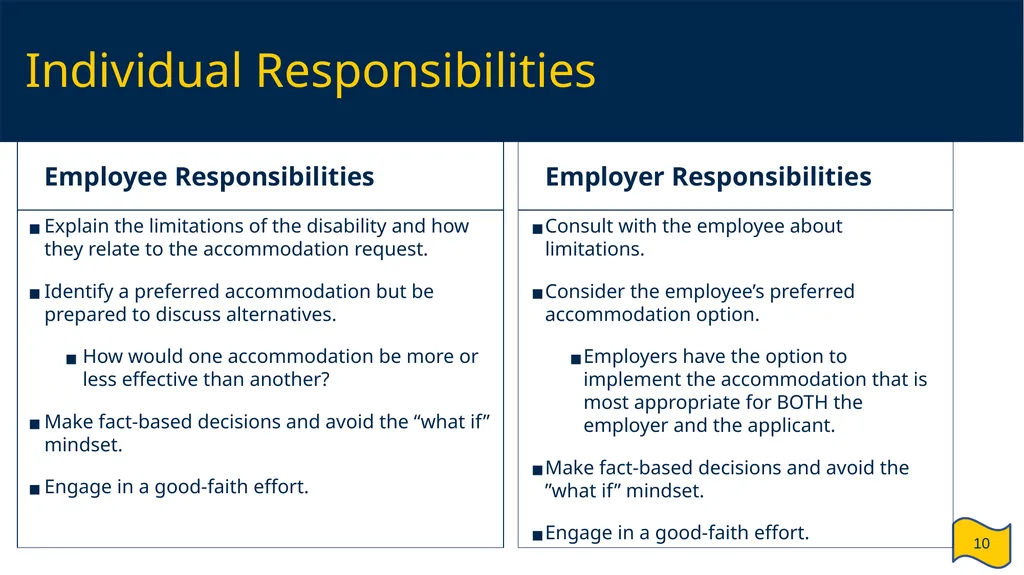
Individual Responsibilities Employee Responsibilities Explain the limitations of the disability and how they relate to the accommodation request.
Identify a preferred accommodation but be prepared to discuss alternatives.
How would one accommodation be more or less effective than another?
Make fact-based decisions and avoid the “what if” mindset.
Engage in a good-faith effort. Employer Responsibilities Consult with the employee about limitations.
Consider the employee’s preferred accommodation option.
Employers have the option to implement the accommodation that is most appropriate for BOTH the employer and the applicant.
Make fact-based decisions and avoid the ”what if” mindset.
Engage in a good-faith effort.<br>
Identify a preferred accommodation but be prepared to discuss alternatives.
How would one accommodation be more or less effective than another?
Make fact-based decisions and avoid the “what if” mindset.
Engage in a good-faith effort. Employer Responsibilities Consult with the employee about limitations.
Consider the employee’s preferred accommodation option.
Employers have the option to implement the accommodation that is most appropriate for BOTH the employer and the applicant.
Make fact-based decisions and avoid the ”what if” mindset.
Engage in a good-faith effort.<br>
11
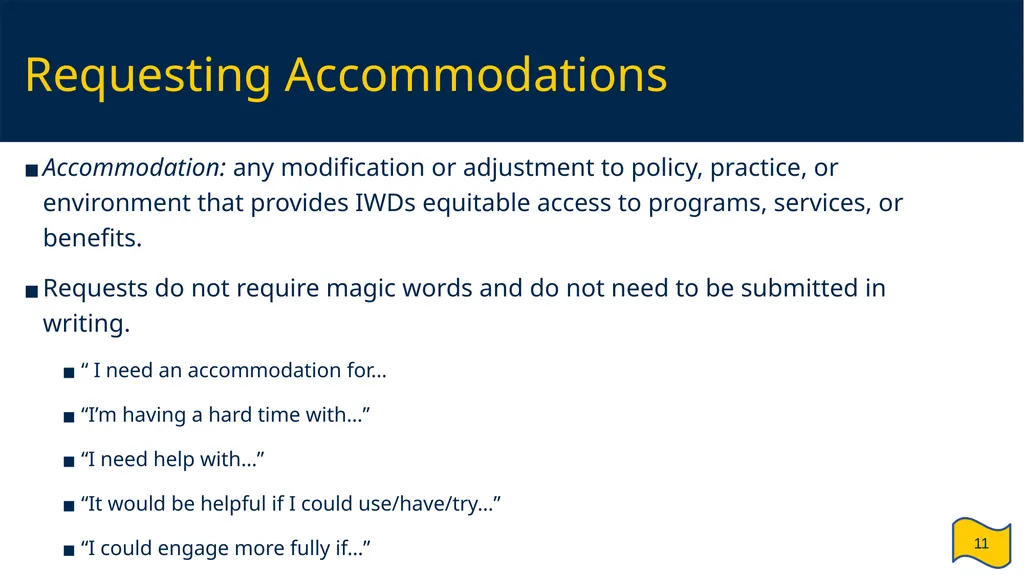
Requesting Accommodations Accommodation: any modification or adjustment to policy, practice, or environment that provides IWDs equitable access to programs, services, or benefits.
Requests do not require magic words and do not need to be submitted in writing.
“ I need an accommodation for…
“I’m having a hard time with…”
“I need help with…”
“It would be helpful if I could use/have/try…”
“I could engage more fully if…”<br>
Requests do not require magic words and do not need to be submitted in writing.
“ I need an accommodation for…
“I’m having a hard time with…”
“I need help with…”
“It would be helpful if I could use/have/try…”
“I could engage more fully if…”<br>
12
4 Steps to Accommodation Engaging in the Interactive Process<br>
13
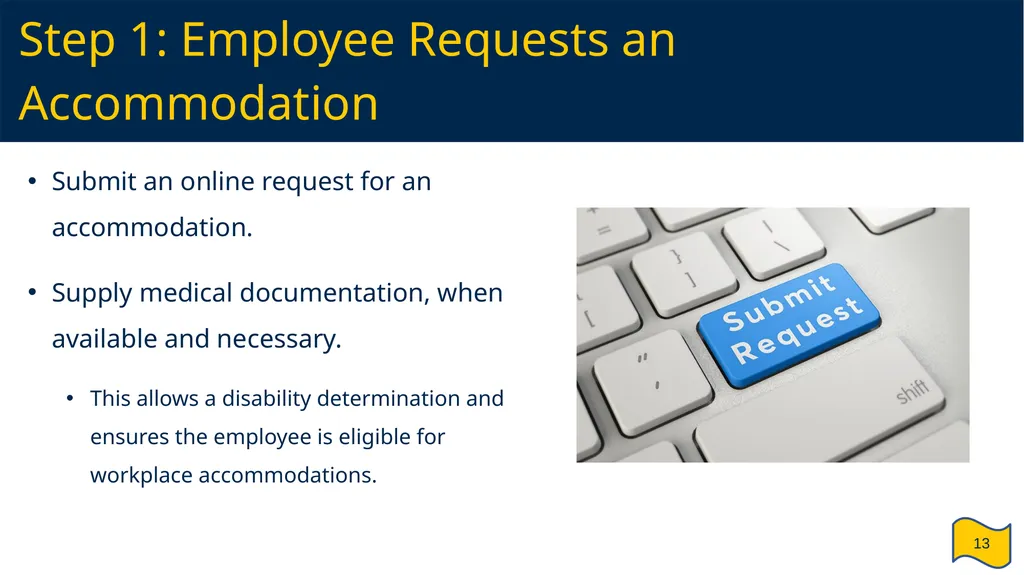
Step 1: Employee Requests an Accommodation Submit an online request for an accommodation.
Supply medical documentation, when available and necessary.
This allows a disability determination and ensures the employee is eligible for workplace accommodations.<br>
Supply medical documentation, when available and necessary.
This allows a disability determination and ensures the employee is eligible for workplace accommodations.<br>
14
Medical Documentation Medical documentation is needed unless the disability and need for accommodation is obvious.
Medical documentation should include:
Diagnosis
Limitations/restrictions/barriers
Recommendations
Length of need<br>
Medical documentation should include:
Diagnosis
Limitations/restrictions/barriers
Recommendations
Length of need<br>
15
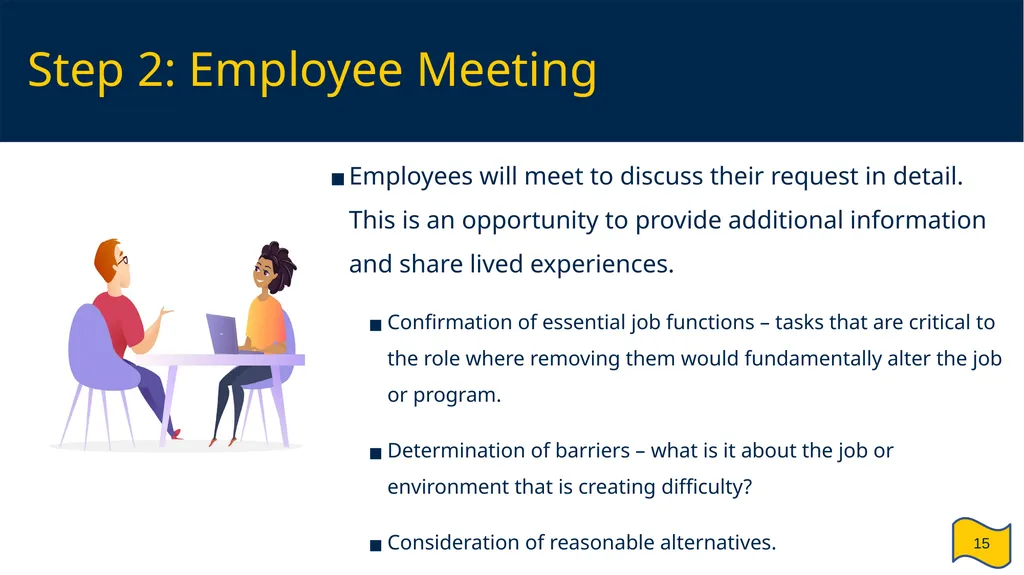
Step 2: Employee Meeting Employees will meet to discuss their request in detail. This is an opportunity to provide additional information and share lived experiences.
Confirmation of essential job functions – tasks that are critical to the role where removing them would fundamentally alter the job or program.
Determination of barriers – what is it about the job or environment that is creating difficulty?
Consideration of reasonable alternatives.<br>
Confirmation of essential job functions – tasks that are critical to the role where removing them would fundamentally alter the job or program.
Determination of barriers – what is it about the job or environment that is creating difficulty?
Consideration of reasonable alternatives.<br>
16
Essential Job Functions Essential job functions are job duties an employee must perform.
These are not incidental, extra, or secondary job duties.
Examples of essential job functions:
A truck driver must have the ability to operate/drive a truck.
An office assistant must be able to enter information into a database.
Examples of non-essential job functions:
A truck driver scheduling meetings.
An office assistant watering office plants.<br>
These are not incidental, extra, or secondary job duties.
Examples of essential job functions:
A truck driver must have the ability to operate/drive a truck.
An office assistant must be able to enter information into a database.
Examples of non-essential job functions:
A truck driver scheduling meetings.
An office assistant watering office plants.<br>
17
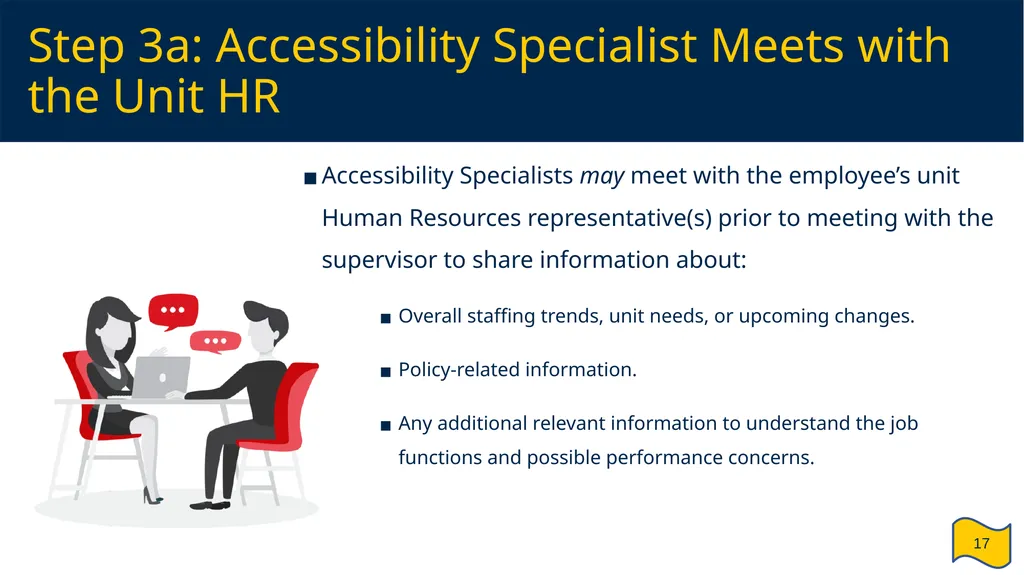
Step 3a: Accessibility Specialist Meets with the Unit HR Accessibility Specialists may meet with the employee’s unit Human Resources representative(s) prior to meeting with the supervisor to share information about:
Overall staffing trends, unit needs, or upcoming changes.
Policy-related information.
Any additional relevant information to understand the job functions and possible performance concerns.<br>
Overall staffing trends, unit needs, or upcoming changes.
Policy-related information.
Any additional relevant information to understand the job functions and possible performance concerns.<br>
18
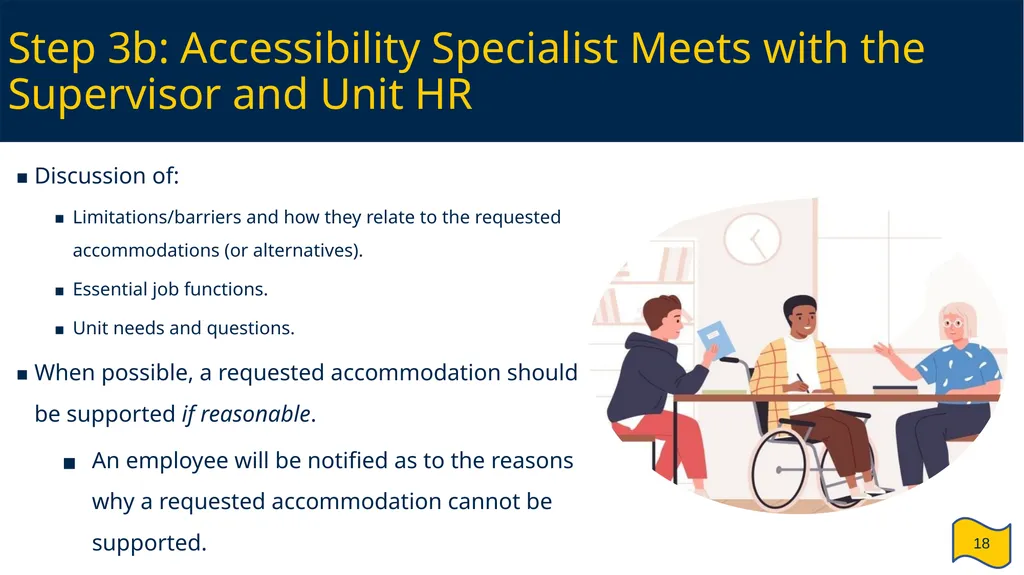
Step 3b: Accessibility Specialist Meets with the Supervisor and Unit HR Discussion of:
Limitations/barriers and how they relate to the requested accommodations (or alternatives).
Essential job functions.
Unit needs and questions.
When possible, a requested accommodation should be supported if reasonable.
An employee will be notified as to the reasons why a requested accommodation cannot be supported.<br>
Limitations/barriers and how they relate to the requested accommodations (or alternatives).
Essential job functions.
Unit needs and questions.
When possible, a requested accommodation should be supported if reasonable.
An employee will be notified as to the reasons why a requested accommodation cannot be supported.<br>
19
Determining Reasonableness All accommodations are assessed on a case-by-case basis.
Medical necessity is NOT the threshold for determination.
If multiple accommodations are effective, the unit can choose which effective and reasonable accommodation to implement. Exceptions:
Direct threat to health and/or safety.
Modification of essential job functions.
Undue hardship:
Nature and cost (not likely to apply to U-M as it is based on the financial resources of the university as a whole).
Resources, size, number of employees, location.
Impact of the accommodation on the operation and resources.<br>
Medical necessity is NOT the threshold for determination.
If multiple accommodations are effective, the unit can choose which effective and reasonable accommodation to implement. Exceptions:
Direct threat to health and/or safety.
Modification of essential job functions.
Undue hardship:
Nature and cost (not likely to apply to U-M as it is based on the financial resources of the university as a whole).
Resources, size, number of employees, location.
Impact of the accommodation on the operation and resources.<br>
20
Step 4: Finalize the Accommodation Draft documents will be issued to the unit and the employee to review.
This provides an additional opportunity to ensure the employee’s needs are being met in an effective way without posing a burden to the unit’s operations.
Accommodation documents will be finalized with a copy sent to all parties involved with a copy stored with DEO.<br>
This provides an additional opportunity to ensure the employee’s needs are being met in an effective way without posing a burden to the unit’s operations.
Accommodation documents will be finalized with a copy sent to all parties involved with a copy stored with DEO.<br>
21
Accommodation Examples Modify or provide equipment: Sit-to-stand desk, ergonomic chair, noise-canceling headphones, other functional equipment.
Modify a work schedule: Flexible start and/or end times, alter a break schedule, provide additional breaks, utilize a hybrid schedule.
Provide accessible software: Speech to text, large format, organizational programs, time management software, note taking software.
Alter a uniform/attire: Allow headwear, allow facial hair, fabric modifications.<br>
Modify a work schedule: Flexible start and/or end times, alter a break schedule, provide additional breaks, utilize a hybrid schedule.
Provide accessible software: Speech to text, large format, organizational programs, time management software, note taking software.
Alter a uniform/attire: Allow headwear, allow facial hair, fabric modifications.<br>
22
Implementing an Accommodation Save the accommodation document somewhere secure, but accessible when needed. It should be stored separately from the employee’s personnel file.
Create a plan for communication:
Determine how the accommodation should be implemented, and then implement it promptly.
Create clear and concise expectations.
Know who to contact when questions arise.
Check in regularly to make sure the accommodation is working as expected.<br>
Create a plan for communication:
Determine how the accommodation should be implemented, and then implement it promptly.
Create clear and concise expectations.
Know who to contact when questions arise.
Check in regularly to make sure the accommodation is working as expected.<br>
23
Monitoring Accommodations Check on effectiveness:
Is the accommodation working as expected?
Maintain the accommodation:
It should continue to be utilized unless the employee states otherwise.
Restrict medical inquiries:
Don’t ask for updated documentation if there is no need
Document findings:
Effective/not effective, needs amendment, change in need, change in business operations, etc.<br>
Is the accommodation working as expected?
Maintain the accommodation:
It should continue to be utilized unless the employee states otherwise.
Restrict medical inquiries:
Don’t ask for updated documentation if there is no need
Document findings:
Effective/not effective, needs amendment, change in need, change in business operations, etc.<br>
24
Keys to Effective Accommodations Open-mindedness
Communication
Documentation<br>
Communication
Documentation<br>
25
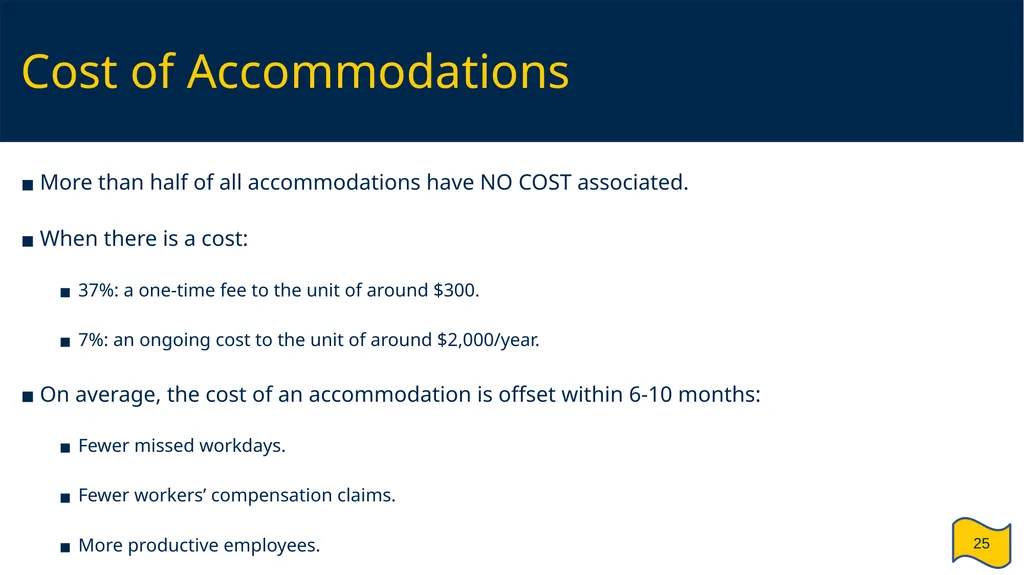
Cost of Accommodations More than half of all accommodations have NO COST associated.
When there is a cost:
37%: a one-time fee to the unit of around $300.
7%: an ongoing cost to the unit of around $2,000/year.
On average, the cost of an accommodation is offset within 6-10 months:
Fewer missed workdays.
Fewer workers’ compensation claims.
More productive employees.<br>
When there is a cost:
37%: a one-time fee to the unit of around $300.
7%: an ongoing cost to the unit of around $2,000/year.
On average, the cost of an accommodation is offset within 6-10 months:
Fewer missed workdays.
Fewer workers’ compensation claims.
More productive employees.<br>
26
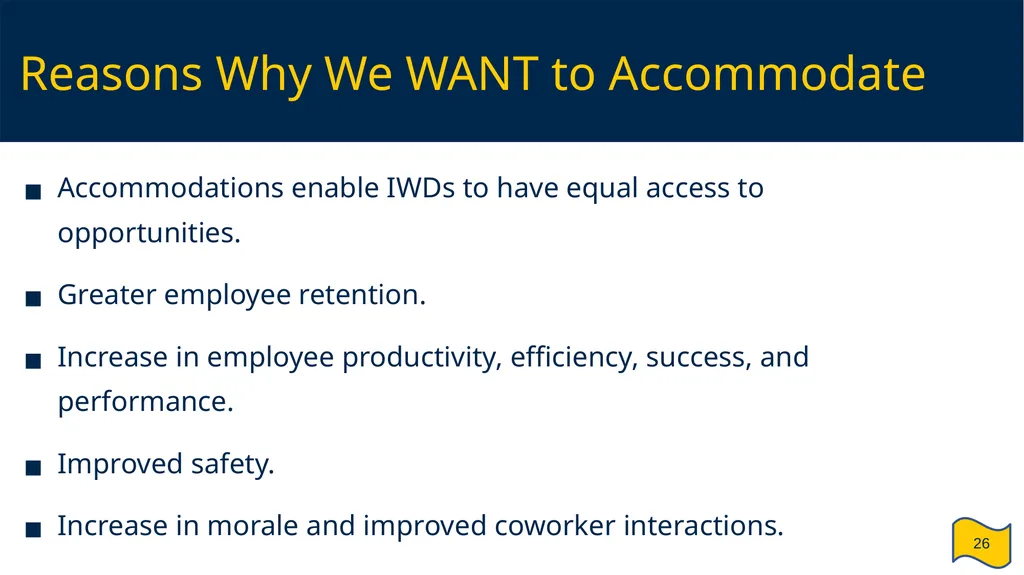
Reasons Why We WANT to Accommodate Accommodations enable IWDs to have equal access to opportunities.
Greater employee retention.
Increase in employee productivity, efficiency, success, and performance.
Improved safety.
Increase in morale and improved coworker interactions.<br>
Greater employee retention.
Increase in employee productivity, efficiency, success, and performance.
Improved safety.
Increase in morale and improved coworker interactions.<br>
27
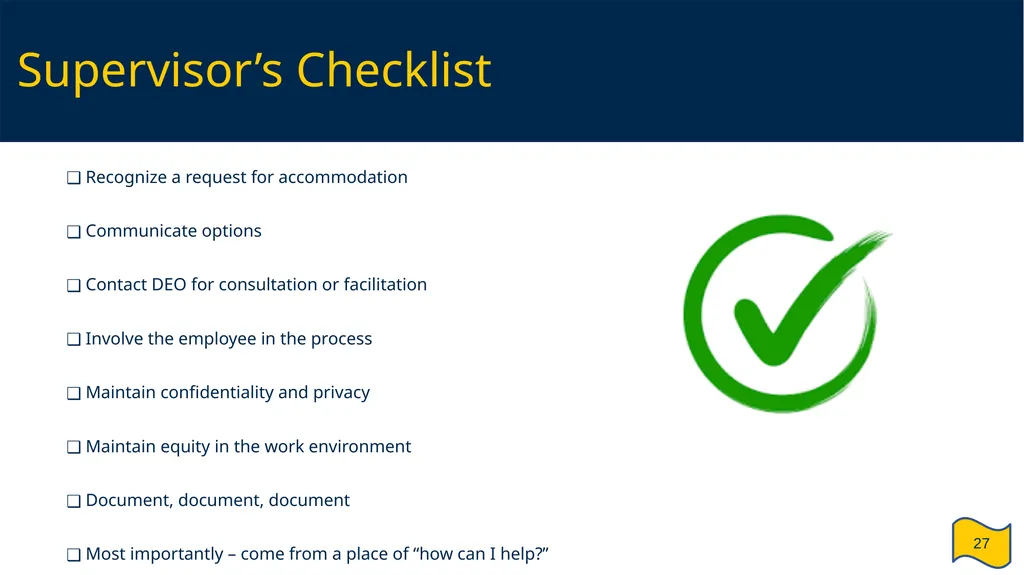
Supervisor’s Checklist Recognize a request for accommodation
Communicate options
Contact DEO for consultation or facilitation
Involve the employee in the process
Maintain confidentiality and privacy
Maintain equity in the work environment
Document, document, document
Most importantly – come from a place of “how can I help?”<br>
Communicate options
Contact DEO for consultation or facilitation
Involve the employee in the process
Maintain confidentiality and privacy
Maintain equity in the work environment
Document, document, document
Most importantly – come from a place of “how can I help?”<br>
28
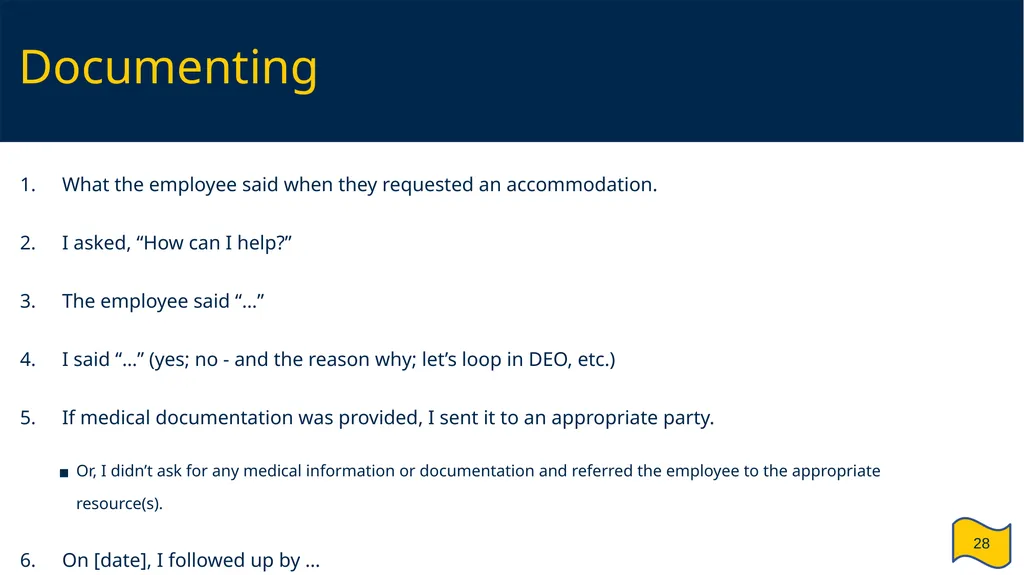
Documenting What the employee said when they requested an accommodation.
I asked, “How can I help?”
The employee said “…”
I said “…” (yes; no - and the reason why; let’s loop in DEO, etc.)
If medical documentation was provided, I sent it to an appropriate party.
Or, I didn’t ask for any medical information or documentation and referred the employee to the appropriate resource(s).
On [date], I followed up by …<br>
I asked, “How can I help?”
The employee said “…”
I said “…” (yes; no - and the reason why; let’s loop in DEO, etc.)
If medical documentation was provided, I sent it to an appropriate party.
Or, I didn’t ask for any medical information or documentation and referred the employee to the appropriate resource(s).
On [date], I followed up by …<br>
29
Frequently Asked Questions<br>
30
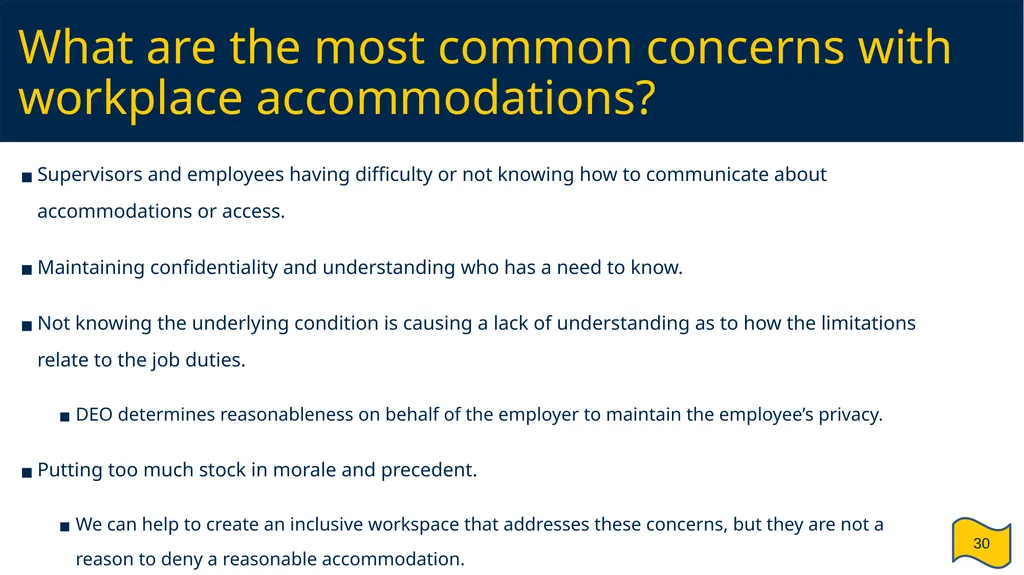
What are the most common concerns with workplace accommodations? Supervisors and employees having difficulty or not knowing how to communicate about accommodations or access.
Maintaining confidentiality and understanding who has a need to know.
Not knowing the underlying condition is causing a lack of understanding as to how the limitations relate to the job duties.
DEO determines reasonableness on behalf of the employer to maintain the employee’s privacy.
Putting too much stock in morale and precedent.
We can help to create an inclusive workspace that addresses these concerns, but they are not a reason to deny a reasonable accommodation.<br>
Maintaining confidentiality and understanding who has a need to know.
Not knowing the underlying condition is causing a lack of understanding as to how the limitations relate to the job duties.
DEO determines reasonableness on behalf of the employer to maintain the employee’s privacy.
Putting too much stock in morale and precedent.
We can help to create an inclusive workspace that addresses these concerns, but they are not a reason to deny a reasonable accommodation.<br>
31
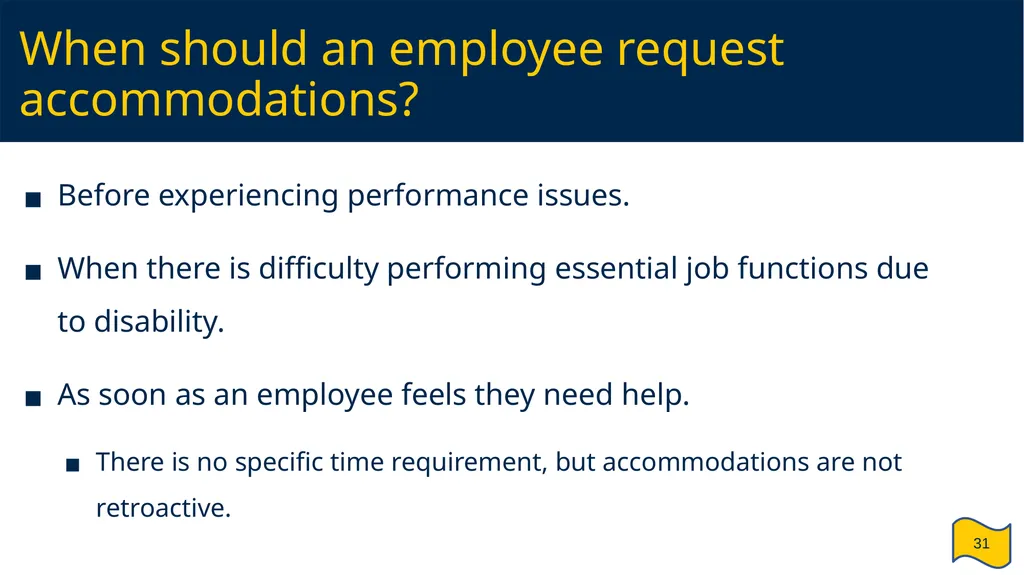
When should an employee request accommodations? Before experiencing performance issues.
When there is difficulty performing essential job functions due to disability.
As soon as an employee feels they need help.
There is no specific time requirement, but accommodations are not retroactive.<br>
When there is difficulty performing essential job functions due to disability.
As soon as an employee feels they need help.
There is no specific time requirement, but accommodations are not retroactive.<br>
32
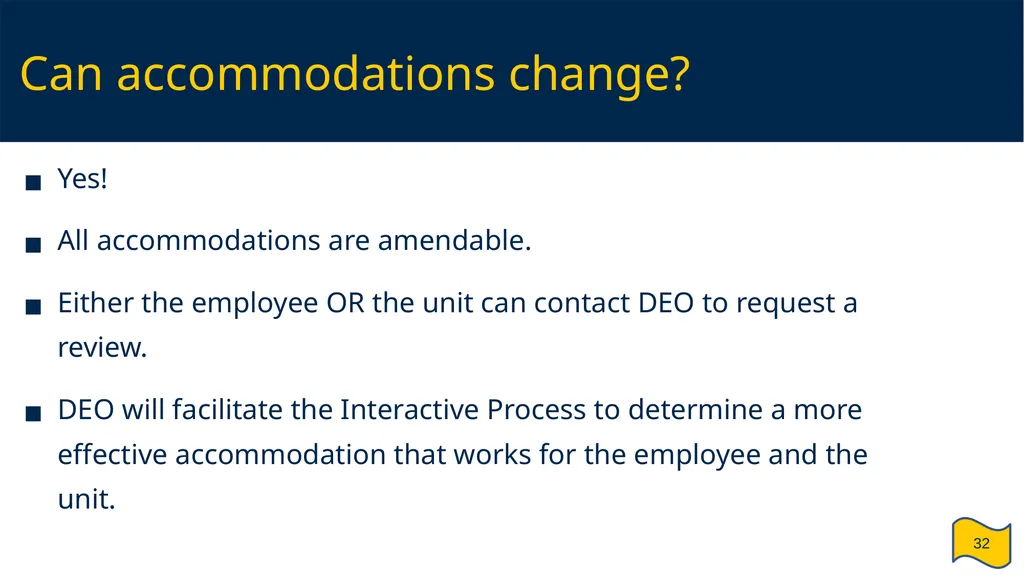
Can accommodations change? Yes!
All accommodations are amendable.
Either the employee OR the unit can contact DEO to request a review.
DEO will facilitate the Interactive Process to determine a more effective accommodation that works for the employee and the unit.<br>
All accommodations are amendable.
Either the employee OR the unit can contact DEO to request a review.
DEO will facilitate the Interactive Process to determine a more effective accommodation that works for the employee and the unit.<br>
33
What accommodation information can be shared? The accommodation document should be shared on a need-to-know basis only.
Other supervisors the employee reports to.
Someone who handles scheduling.
Someone who handles purchasing of items or equipment.
Supervisors and managers can share work-related restrictions.
Lifting/carrying restrictions, sitting or standing time restrictions, etc.
Sharing that an employee has an accommodation is also sharing that employee’s private disability information.<br>
Other supervisors the employee reports to.
Someone who handles scheduling.
Someone who handles purchasing of items or equipment.
Supervisors and managers can share work-related restrictions.
Lifting/carrying restrictions, sitting or standing time restrictions, etc.
Sharing that an employee has an accommodation is also sharing that employee’s private disability information.<br>
34
How can I respond to coworkers asking about accommodations? Respect the privacy of your coworkers, just as you would want your privacy respected.
We’re acting for legitimate business purposes.
We are complying with legal obligations.
We have a policy of assisting any employee who encounters difficulties in the workplace.
We can discuss your specific needs privately.<br>
We’re acting for legitimate business purposes.
We are complying with legal obligations.
We have a policy of assisting any employee who encounters difficulties in the workplace.
We can discuss your specific needs privately.<br>
35
Can I expect IWDs to perform equally as those without disabilities? Yes.
An employee with a disability must meet the same production and performance standards as their non-disabled coworkers in the same job.
Keep in mind accommodations may be necessary to assist an employee in meeting production or performance standards.
Supervisors should give clear and concise expectations regarding quality of work.<br>
An employee with a disability must meet the same production and performance standards as their non-disabled coworkers in the same job.
Keep in mind accommodations may be necessary to assist an employee in meeting production or performance standards.
Supervisors should give clear and concise expectations regarding quality of work.<br>
36
Must I rescind discipline after disclosure? No - accommodations are not retroactive.
However, if this is the first time the employee has cited a disability as the cause of the need for discipline, the supervisor should provide:
Information about reasonable accommodations.
Clear and concise expectations for performance and productivity standards.
A supervisor cannot refuse to engage in the Interactive Process or provide accommodations as a result of the discipline.<br>
However, if this is the first time the employee has cited a disability as the cause of the need for discipline, the supervisor should provide:
Information about reasonable accommodations.
Clear and concise expectations for performance and productivity standards.
A supervisor cannot refuse to engage in the Interactive Process or provide accommodations as a result of the discipline.<br>
37
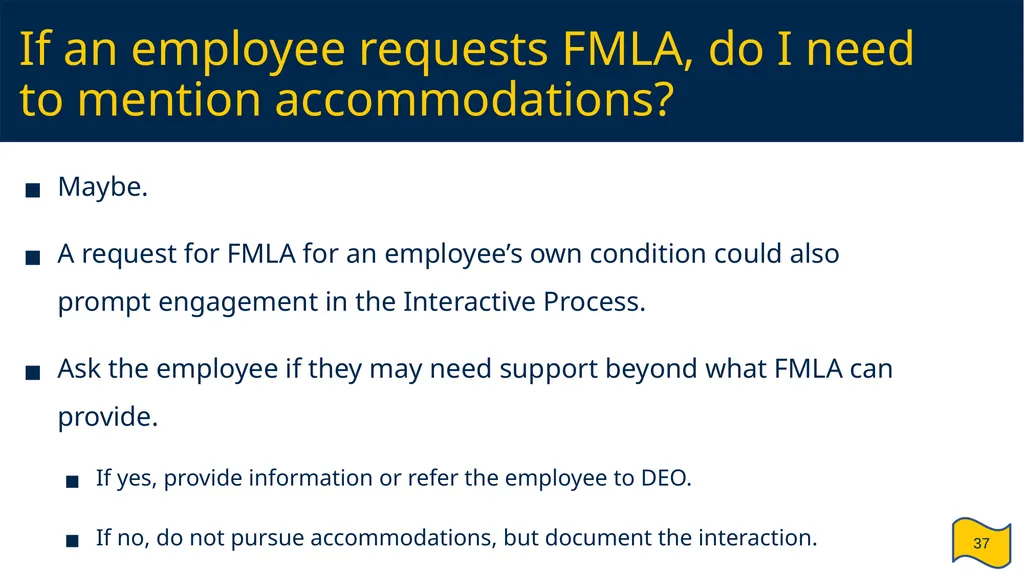
If an employee requests FMLA, do I need to mention accommodations? Maybe.
A request for FMLA for an employee’s own condition could also prompt engagement in the Interactive Process.
Ask the employee if they may need support beyond what FMLA can provide.
If yes, provide information or refer the employee to DEO.
If no, do not pursue accommodations, but document the interaction.<br>
A request for FMLA for an employee’s own condition could also prompt engagement in the Interactive Process.
Ask the employee if they may need support beyond what FMLA can provide.
If yes, provide information or refer the employee to DEO.
If no, do not pursue accommodations, but document the interaction.<br>
38
Can I ask employees with known disabilities if they need an accommodation? Yes.
Alternatively, a supervisor may prefer to ask if there are any steps that can be taken to enable the employee to improve performance or conduct without mentioning accommodation or the employee’s disability.
“How can I help?”
“How can I support you?”
“How can we make the environment more inclusive?”
Be prepared to offer resources or a referral to DEO.<br>
Alternatively, a supervisor may prefer to ask if there are any steps that can be taken to enable the employee to improve performance or conduct without mentioning accommodation or the employee’s disability.
“How can I help?”
“How can I support you?”
“How can we make the environment more inclusive?”
Be prepared to offer resources or a referral to DEO.<br>
39
Wrap Up<br>
40
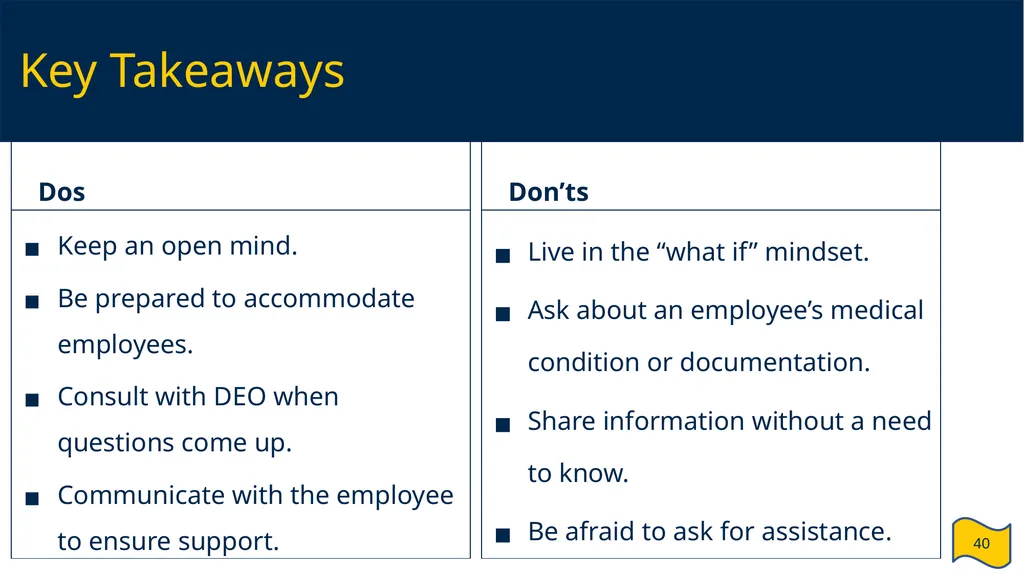
Key Takeaways Dos Keep an open mind.
Be prepared to accommodate employees.
Consult with DEO when questions come up.
Communicate with the employee to ensure support. Don’ts Live in the “what if” mindset.
Ask about an employee’s medical condition or documentation.
Share information without a need to know.
Be afraid to ask for assistance.<br>
Be prepared to accommodate employees.
Consult with DEO when questions come up.
Communicate with the employee to ensure support. Don’ts Live in the “what if” mindset.
Ask about an employee’s medical condition or documentation.
Share information without a need to know.
Be afraid to ask for assistance.<br>