Swinburnes design argument Michael Lacewing enquiriesalevelphilosophy.co.uk (c) Michael Lacewing Life Isnt life amazing? Organs serve a purpose heart pump blood, eye seeing We understand parts of an organ in relation to serving
"Swinburne’s design argument Michael Lacewing" is the property of its rightful owner. Permission is granted to
download and print the materials on this website for personal, non-commercial use only, and to display it
on your personal computer provided you do not modify the materials and that you retain all copyright
notices contained in the materials. By downloading content from our website, you accept the terms of this
agreement.
Presentation Transcript
01
Swinburne’s design argument Michael Lacewing
enquiries@alevelphilosophy.co.uk (c) Michael Lacewing<br>
02
Life Isn’t life amazing?
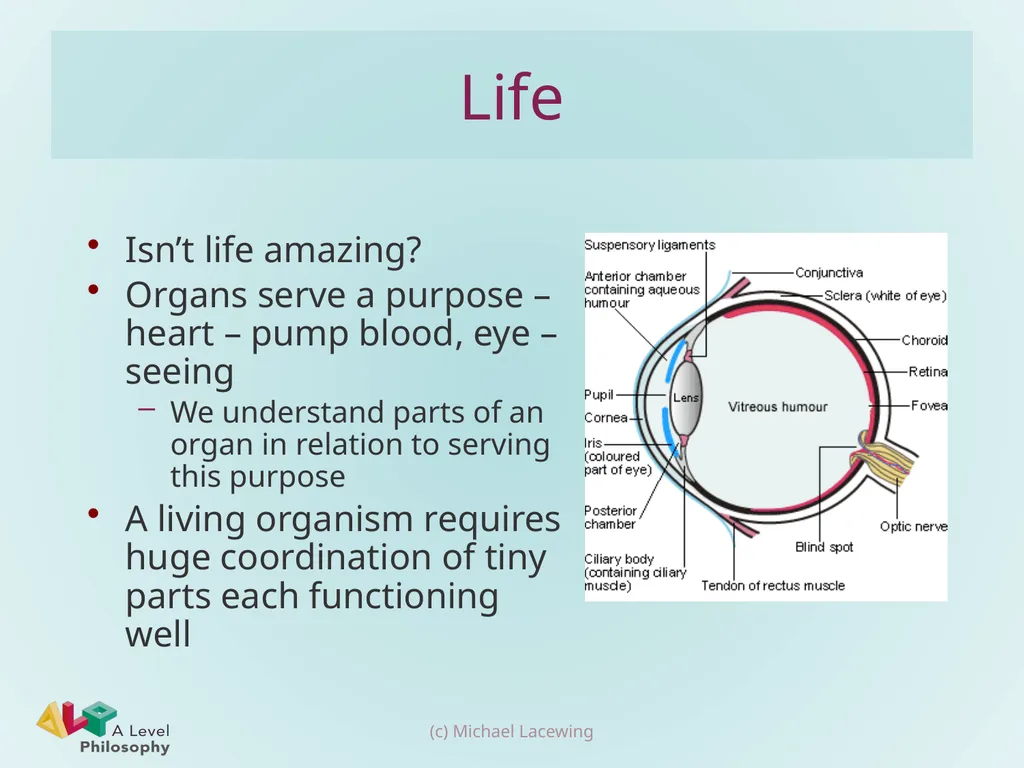
Organs serve a purpose – heart – pump blood, eye – seeing
We understand parts of an organ in relation to serving this purpose
A living organism requires huge coordination of tiny parts each functioning well (c) Michael Lacewing<br>
03
Design The universe didn’t have to be like this – there could have been no order, no regularity
Order of this kind, the way parts work together for a purpose, can indicate design
If life involves design, by definition, there must be a designer (c) Michael Lacewing<br>
04
Two types of order Spatial order: the organisation of parts to serve a purpose (discussed by Paley and Hume)
E.g. the eye
Temporal order: the orderliness in the way one thing follows another.
These temporal regularities are the laws of nature. (c) Michael Lacewing<br>
05
The argument from design The argument from design infers the existence of a designer from the evidence of design in the world
Swinburne: It works better appealing to temporal order than spatial order
We can explain spatial order by emergence from disorder through evolution
But what explains the laws of nature and their operation?
And laws are universal, while order in the universe is more clear in some parts than others (c) Michael Lacewing<br>
06
Science is inadequate Science can’t explain scientific laws, because all scientific explanations presuppose laws.
(To explain life, we want to explain the very specific laws that allow for the existence of life.)
Either there is some other explanation of them, or the whole way the universe is, is complete coincidence. (c) Michael Lacewing<br>
07
Personal explanation We can explain the universe if we give a personal explanation in terms of a designer
We use explanations in terms of persons - what we want, believe, intend - all the time.
This type of explanation accounts for regularities in succession – things come about because someone intentionally brings them about
These are not explanations that make use of scientific laws. (c) Michael Lacewing<br>
08
Swinburne’s argument There are some temporal regularities, e.g. related to human actions, that are explained in terms of persons.
There are other temporal regularities, e.g. related to the laws of nature, that are similar to those explained in terms of persons.
We can, by analogy, explain the regularities relating to the laws of nature in terms of persons.
There is no scientific explanation of the laws of nature. (c) Michael Lacewing<br>
09
Swinburne’s argument (As far as we know, there are only two types of explanation – scientific and personal.)
Therefore, there is no better explanation of the regularities relating to the laws of nature than the explanation in terms of persons.
Therefore, the regularities relating to the laws of nature are produced by a person (a designer).
Therefore, such a person, who can act on the entire universe, exists. (c) Michael Lacewing<br>
10
Hume’s objections, Swinburne’s replies Why think that though - a ‘tiny, weak, limited cause’ which moves the bodies of animals – is a better explanation than something else?
Reply: because other explanations rely on the laws of nature which they don’t explain
Obj: Could there be an alternative explanation?
E.g. Suppose matter is finite and time is infinite. Then all arrangements of matter will occur, by chance, over time
Reply: This supposes that there are no laws of nature.
And we have no reason to think the laws of nature alter by chance over time – this is a worse explanation (c) Michael Lacewing<br>
11
Arguing from a unique case Hume on causation: whenever you have the cause, you get the effect
‘Constant conjunction’
So you can’t know from a single instance, what causes what. Repeated experience is necessary to infer a causal relation.
The universe is unique. So we cannot infer its cause.
We can only infer a designer in cases in which we have repeated experience of something being brought about by a designer (c) Michael Lacewing<br>
12
Swinburne’s reply Reply: But cosmologists have drawn many conclusions about the universe
Uniqueness is relative to how something is described (c) Michael Lacewing<br>
13
Best explanation If there is no other explanation, then a designer is, technically, the ‘best’ explanation
But is it good enough to be acceptable?
Ockham’s razor: ‘Do not multiply entities beyond necessity’
But the designer, although a new entity, is introduced through necessity
But now we need to explain the designer
A mind is as ordered as nature, and will need explanation. ‘What explains God?’ is no better than ‘What explains scientific laws?’ (c) Michael Lacewing<br>
14
Best explanation Reply: A good explanation may posit something unexplained. This happens in science all the time, e.g. subatomic particles. That we can’t explain the designer is no objection.
But then why not stop with unexplained laws of nature?
Because with the designer, we can explain them – it is better to explain more than less (c) Michael Lacewing<br>
15
Multiverse theory If there are lots of universes, one of them would have laws of nature that support complex order (e.g. life).
Lottery:
It’s incredibly unlikely, before the draw, that whoever wins will win.
But someone will win.
With enough chances, the incredibly unlikely can become inevitable.
But are there lots of universes? What’s the evidence? (c) Michael Lacewing<br>
16
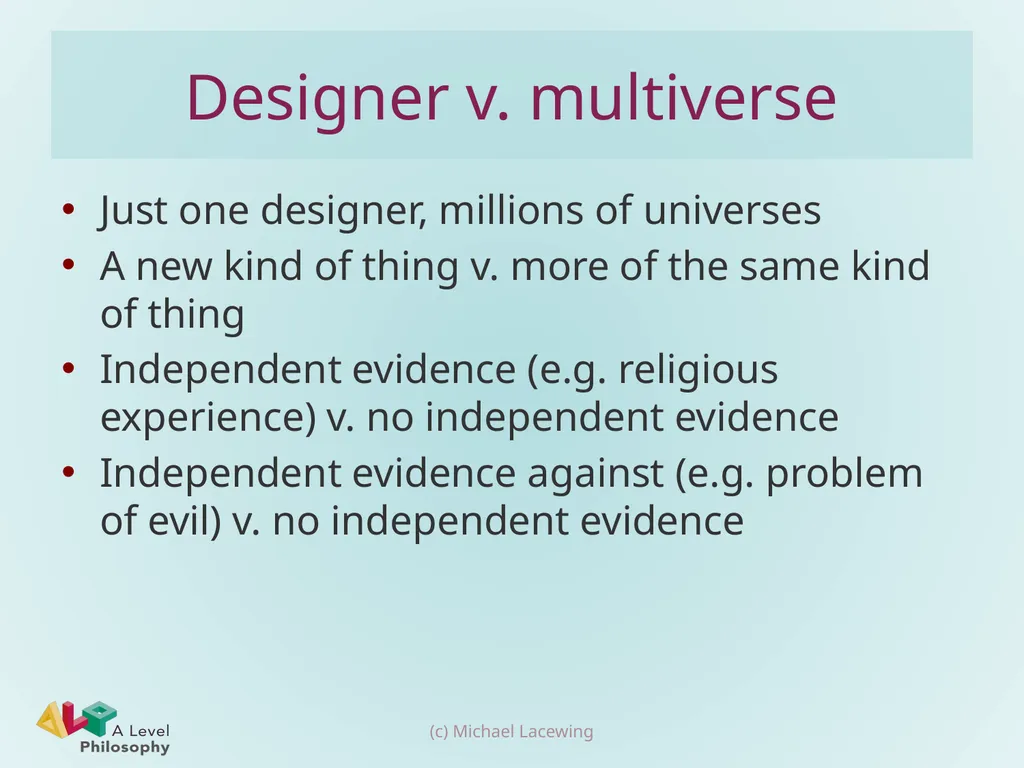
Designer v. multiverse Just one designer, millions of universes
A new kind of thing v. more of the same kind of thing
Independent evidence (e.g. religious experience) v. no independent evidence
Independent evidence against (e.g. problem of evil) v. no independent evidence (c) Michael Lacewing<br>