Tactical Field Care 3f Casualty Collection Point Operations Caring for Wounded Hostile Combatants Tactical Combat Casualty Care for Medical Personnel August 2018 (Based on TCCC-MP Guidelines 180801) The opinions or assertions contained
"Tactical Field Care 3f Casualty Collection Point" is the property of its rightful owner. Permission is granted to
download and print the materials on this website for personal, non-commercial use only, and to display it
on your personal computer provided you do not modify the materials and that you retain all copyright
notices contained in the materials. By downloading content from our website, you accept the terms of this
agreement.
Presentation Transcript
01
Tactical Field Care 3f
Casualty Collection Point Operations
Caring for Wounded Hostile Combatants Tactical Combat Casualty Care for Medical Personnel August 2018 (Based on TCCC-MP Guidelines 180801)<br>
02
“The opinions or assertions contained herein are the private views of the authors and are not to be construed as official or as reflecting the views of the Departments of the Army, Air Force, Navy or the Department of Defense.”
There are no conflict of interest disclosures. Disclaimer<br>
03
LEARNING OBJECTIVES Terminal Learning Objective
Identify the procedures for setting up and running casualty collection points (CCPs).
Enabling Learning Objectives
Identify the key factors in selecting locations for casualty collection points.
Describe the responsibilities and procedures for operating CCPs.<br>
04
LEARNING OBJECTIVES Terminal Learning Objective
Identify the correct procedures managing wounded hostile combatants in Tactical Field Care.
Enabling Learning Objectives
Describe the need for proper prisoner handling and security procedures for wounded hostile combatants in TFC.
Describe the ongoing threat from hostile intent.
Identify the need to provide care as to friendly forces once the prisoner is secure.<br>
05
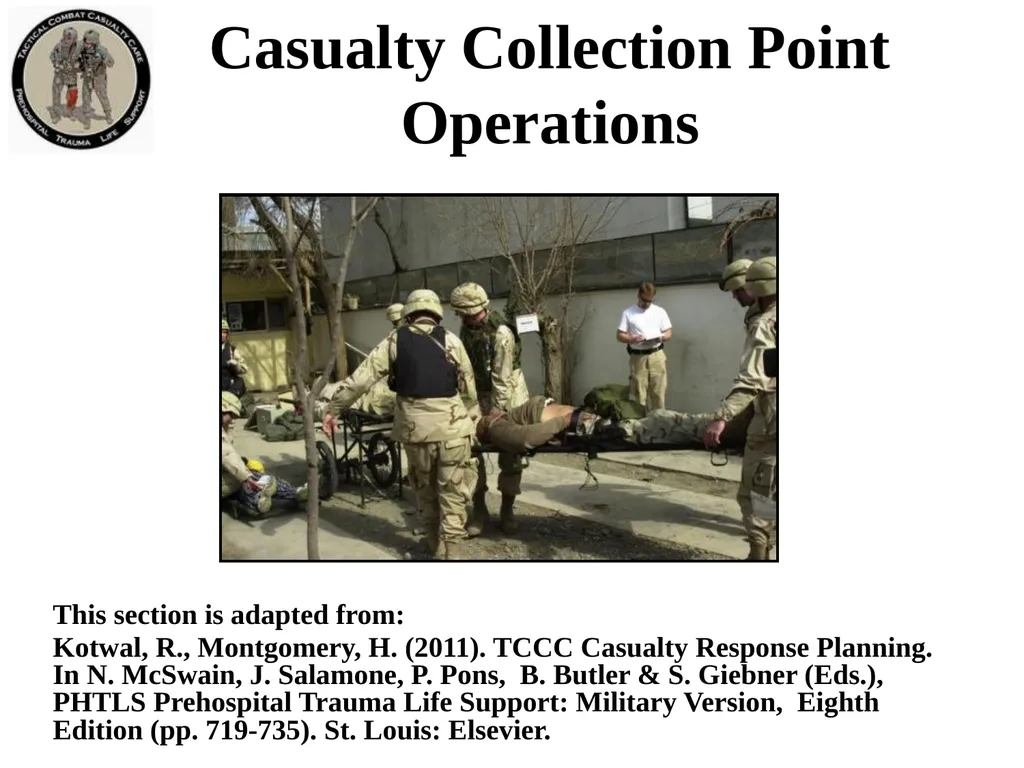
This section is adapted from:
Kotwal, R., Montgomery, H. (2011). TCCC Casualty Response Planning. In N. McSwain, J. Salamone, P. Pons, B. Butler & S. Giebner (Eds.), PHTLS Prehospital Trauma Life Support: Military Version, Eighth Edition (pp. 719-735). St. Louis: Elsevier. Casualty Collection Point Operations<br>
06
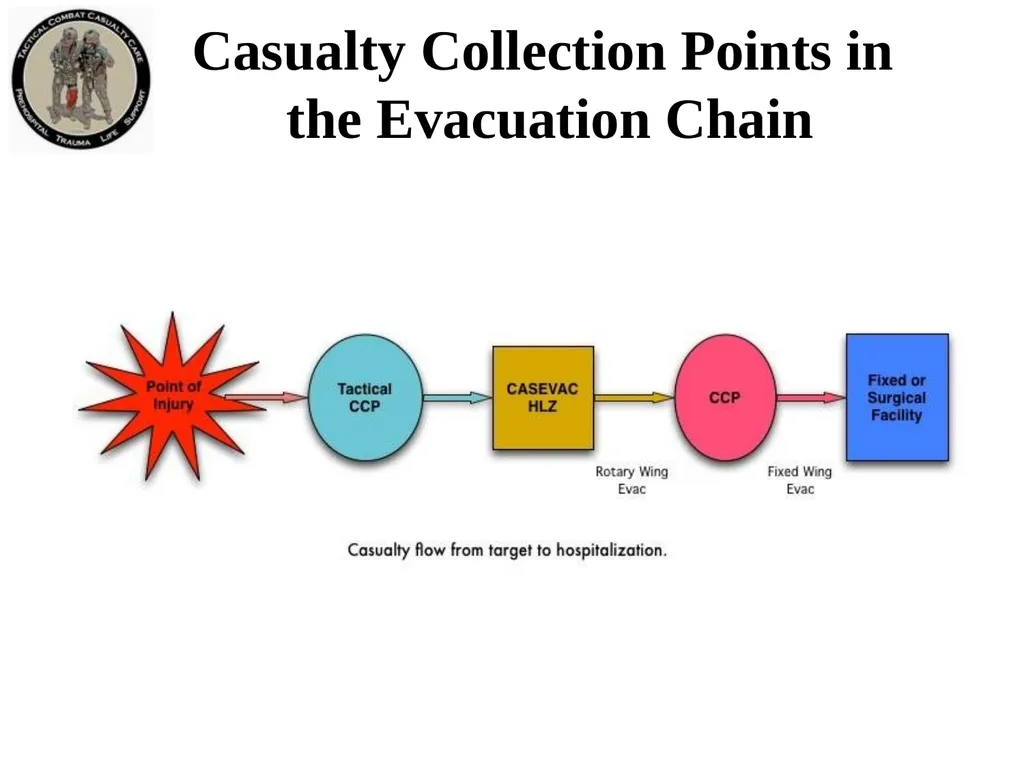
Casualty Collection Points in the Evacuation Chain<br>
07
CCP Site Selection Should be reasonably close to the fight.
Located near areas where casualties are likely to occur.
Must provide cover and concealment from the enemy.
Inside a building or on hardstand (an exclusive CCP building limits confusion).
Should have access to evacuation routes (foot, vehicle, aircraft).
Proximal to “Lines of Drift” or paths across terrain that are the most likely to be used when going from one place to another.<br>
08
Adjacent to Tactical Choke Points (breeches, HLZ’s, etc.)
Avoid natural or enemy choke points.
Choose an area providing passive security (inside the perimeter).
Good drainage
Accessible to evacuation assets
Expandable if casualty load increases CCP Site Selection (continued)<br>
09
CCP Operational Guidelines Typically, a First Sergeant (1SG) or Platoon Sergeant (PSG), or equivalent, is given responsibility for casualty flow and everything outside the CCP:
Provides for CCP structure and organization (color coded with chemlights).
Maintains command & control and battlefield situational awareness.
Controls aid & litter teams, and provides security. Continued…<br>
10
First Sergeant (1SG), Platoon Sergeant (PSG) or equivalent:
Strips, bags, tags, organizes, and maintains casualties’ tactical gear outside of treatment area.
Accountable for tracking casualties and equipment into and out of CCP and reports to higher command.
Moves casualties through CCP entrance/exit choke point which should be marked with an IR chemlight. CCP Operational Guidelines Continued…<br>
11
Medical personnel are responsible for everything inside the CCP:
Triage officer sorts and organizes casualties at choke point into appropriate treatment categories.
Medical officers and medics organize medical equipment and supplies and treat casualties.
EMTs, First Responders, and Aid &Litter Teams assist with treatment and packaging of casualties. CCP Operational Guidelines Continued…<br>
12
Casualties with minor injuries should remain with their original elements or assist with CCP security if possible.
Those killed in action should remain with their original elements. CCP Operational Guidelines<br>
13
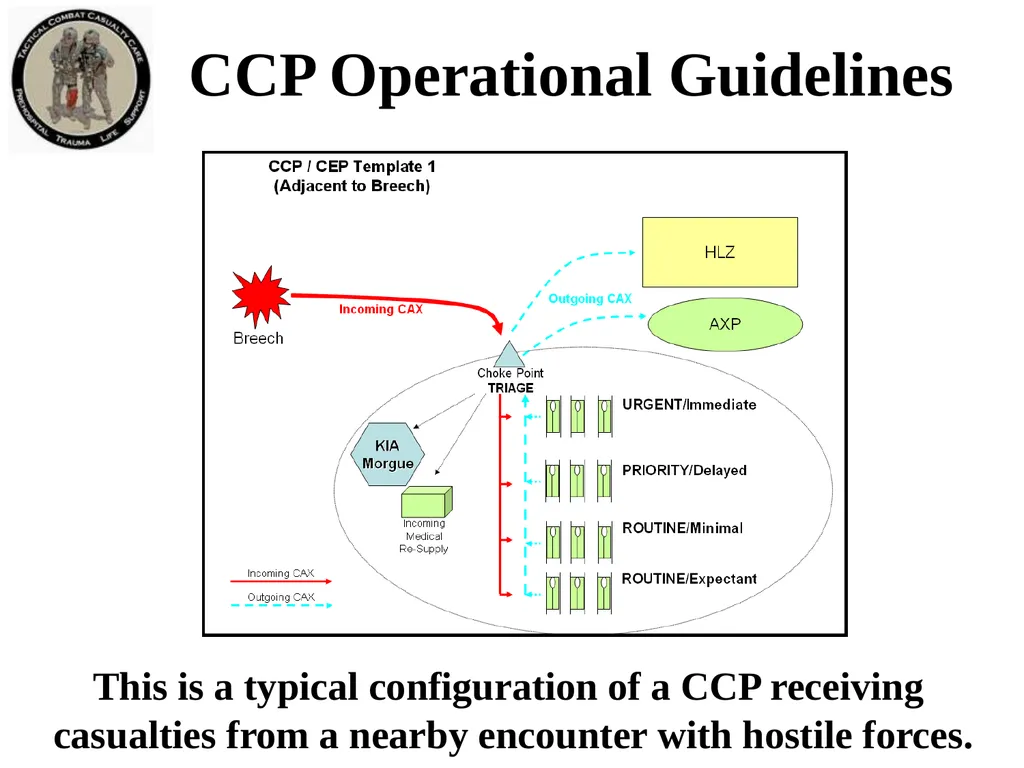
CCP Operational Guidelines This is a typical configuration of a CCP receiving
casualties from a nearby encounter with hostile forces.<br>
14
Questions?<br>
15
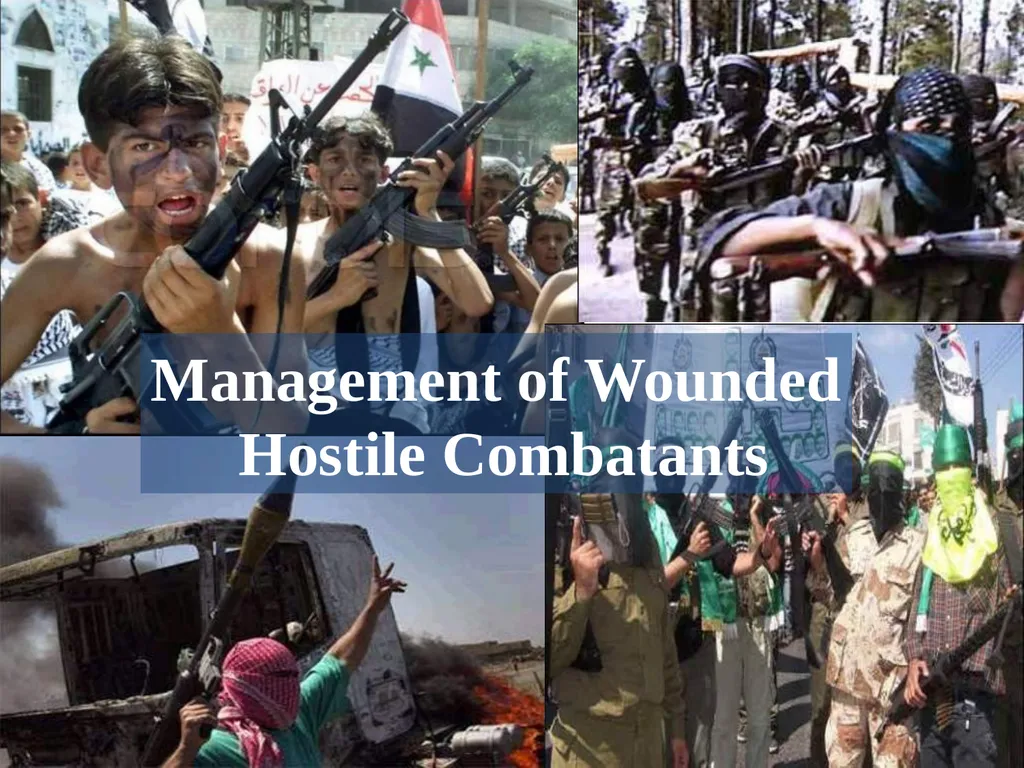
Management of Wounded
Hostile Combatants<br>
16
No medical care during Care Under Fire
Though wounded, enemy personnel may still act as hostile combatants.
May employ any weapons or detonate any ordnance they are carrying
Enemy casualties are hostile combatants until they:
Indicate surrender
Drop all weapons
Are proven to no longer pose a threat Care for Wounded Hostile Combatants<br>
17
Combat medical personnel should not attempt to provide medical care until sure that the wounded hostile combatant has been rendered safe by other members of the unit.
Restrain with flex cuffs or other devices if not already done.
Search for weapons and/or ordnance.
Silence to prevent communication with other hostile combatants. Care for Wounded Hostile Combatants<br>
18
Segregate from other captured hostile combatants.
Safeguard from further injury.
Care as per TFC guidelines for U.S. forces after the steps above are accomplished.
Speed to the rear as medically
and tactically feasible Care for Wounded Hostile Combatants<br>