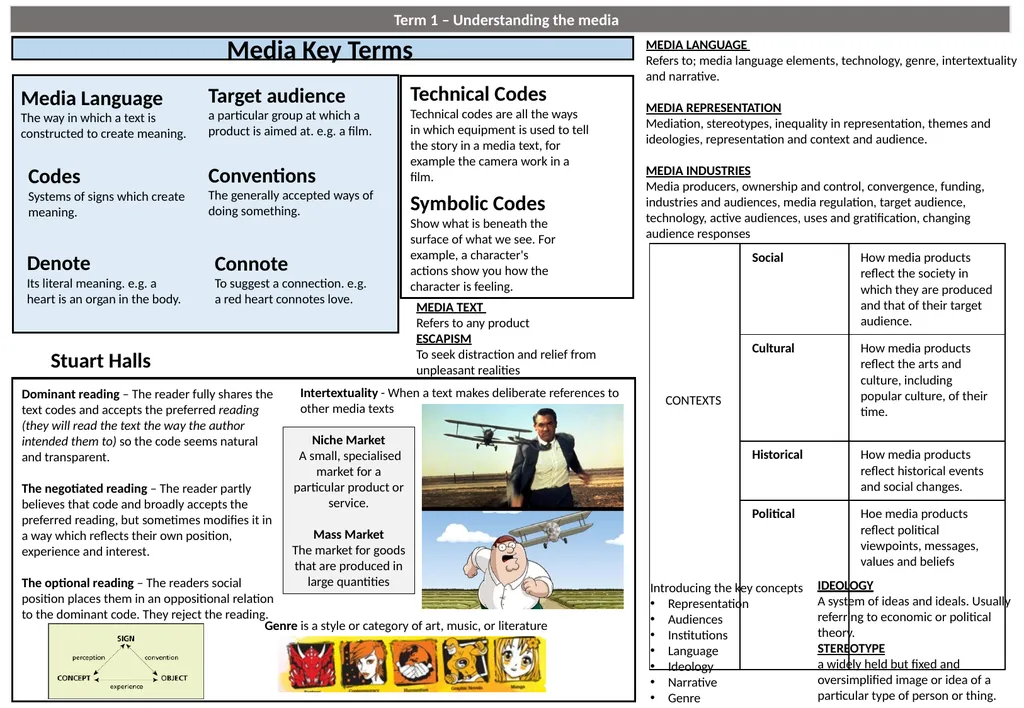
Term 1 – Understanding the media Media Key Terms
Description: Term 1 Understanding the media Media Key Terms Introducing the key concepts Representation Audiences Institutions Language Ideology Narrative Genre MEDIA TEXT Refers to any product ESCAPISM To seek distraction and relief from unpleasant
Related Topics
Download Presentation
"Term 1 – Understanding the media Media Key Terms" is the property of its rightful owner. Permission is granted to download and print the materials on this website for personal, non-commercial use only, and to display it on your personal computer provided you do not modify the materials and that you retain all copyright notices contained in the materials. By downloading content from our website, you accept the terms of this agreement.
Presentation Transcript
slide1. Term 1 – Understanding the media Media Key Terms Introducing the key concepts
Representation
Audiences
Institutions
Language
Ideology
Narrative
Genre MEDIA TEXT
Refers to any product
ESCAPISM
To seek distraction and relief from unpleasant realities Stuart Halls MEDIA LANGUAGE
Refers to; media language elements, technology, genre, intertextuality and narrative.
MEDIA REPRESENTATION
Mediation, stereotypes, inequality in representation, themes and ideologies, representation and context and audience.
MEDIA INDUSTRIES
Media producers, ownership and control, convergence, funding, industries and audiences, media regulation, target audience, technology, active audiences, uses and gratification, changing audience responses IDEOLOGY
A system of ideas and ideals. Usually referring to economic or political theory.
STEREOTYPE
a widely held but fixed and oversimplified image or idea of a particular type of person or thing. Niche Market
A small, specialised market for a particular product or service.
Mass Market
The market for goods that are produced in large quantities Genre is a style or category of art, music, or literature<br>
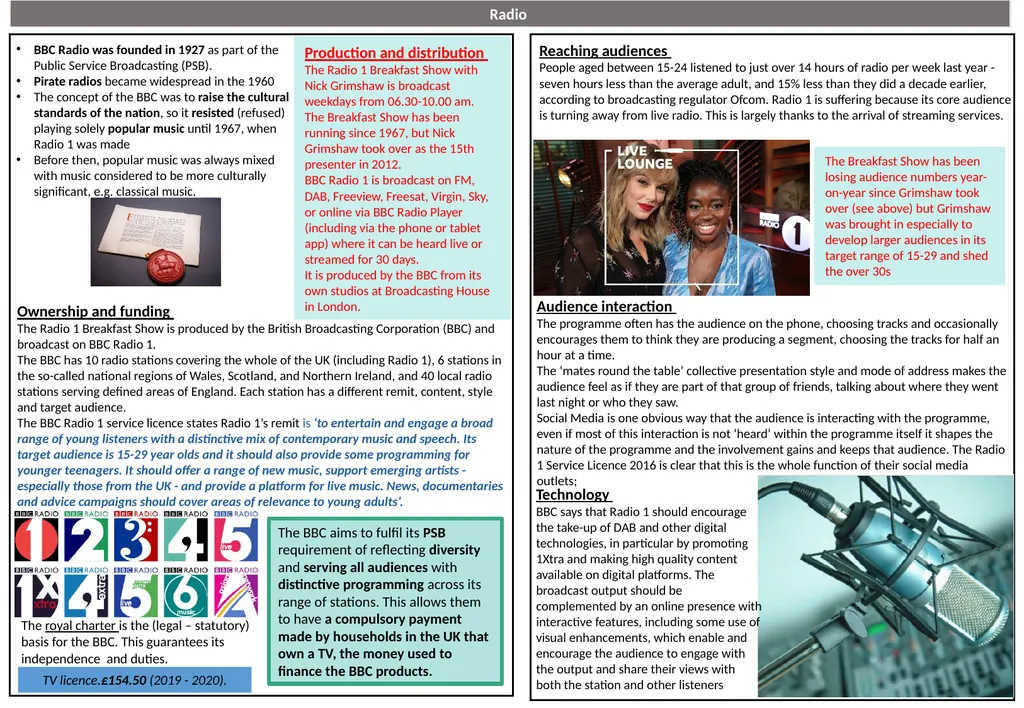
slide2. Radio Production and distribution
The Radio 1 Breakfast Show with Nick Grimshaw is broadcast weekdays from 06.30-10.00 am.
The Breakfast Show has been running since 1967, but Nick Grimshaw took over as the 15th presenter in 2012.
BBC Radio 1 is broadcast on FM, DAB, Freeview, Freesat, Virgin, Sky, or online via BBC Radio Player (including via the phone or tablet app) where it can be heard live or streamed for 30 days.
It is produced by the BBC from its own studios at Broadcasting House in London. Ownership and funding
The Radio 1 Breakfast Show is produced by the British Broadcasting Corporation (BBC) and broadcast on BBC Radio 1.
The BBC has 10 radio stations covering the whole of the UK (including Radio 1), 6 stations in the so-called national regions of Wales, Scotland, and Northern Ireland, and 40 local radio stations serving defined areas of England. Each station has a different remit, content, style and target audience.
The BBC Radio 1 service licence states Radio 1’s remit is ‘to entertain and engage a broad range of young listeners with a distinctive mix of contemporary music and speech. Its target audience is 15-29 year olds and it should also provide some programming for younger teenagers. It should offer a range of new music, support emerging artists - especially those from the UK - and provide a platform for live music. News, documentaries and advice campaigns should cover areas of relevance to young adults’. Reaching audiences
People aged between 15-24 listened to just over 14 hours of radio per week last year - seven hours less than the average adult, and 15% less than they did a decade earlier, according to broadcasting regulator Ofcom. Radio 1 is suffering because its core audience is turning away from live radio. This is largely thanks to the arrival of streaming services. Audience interaction
The programme often has the audience on the phone, choosing tracks and occasionally encourages them to think they are producing a segment, choosing the tracks for half an hour at a time.
The ‘mates round the table’ collective presentation style and mode of address makes the audience feel as if they are part of that group of friends, talking about where they went last night or who they saw.
Social Media is one obvious way that the audience is interacting with the programme, even if most of this interaction is not ‘heard’ within the programme itself it shapes the nature of the programme and the involvement gains and keeps that audience. The Radio 1 Service Licence 2016 is clear that this is the whole function of their social media outlets; The Breakfast Show has been losing audience numbers year-on-year since Grimshaw took over (see above) but Grimshaw was brought in especially to develop larger audiences in its target range of 15-29 and shed the over 30s Technology
BBC says that Radio 1 should encourage the take-up of DAB and other digital technologies, in particular by promoting 1Xtra and making high quality content available on digital platforms. The broadcast output should be complemented by an online presence with interactive features, including some use of visual enhancements, which enable and encourage the audience to engage with the output and share their views with both the station and other listeners BBC Radio was founded in 1927 as part of the Public Service Broadcasting (PSB).
Pirate radios became widespread in the 1960
The concept of the BBC was to raise the cultural standards of the nation, so it resisted (refused) playing solely popular music until 1967, when Radio 1 was made
Before then, popular music was always mixed with music considered to be more culturally significant, e.g. classical music. The BBC aims to fulfil its PSB requirement of reflecting diversity and serving all audiences with distinctive programming across its range of stations. This allows them to have a compulsory payment made by households in the UK that own a TV, the money used to finance the BBC products. The royal charter is the (legal – statutory) basis for the BBC. This guarantees its independence and duties. TV licence.£154.50 (2019 - 2020).<br>

Representation
Audiences
Institutions
Language
Ideology
Narrative
Genre MEDIA TEXT
Refers to any product
ESCAPISM
To seek distraction and relief from unpleasant realities Stuart Halls MEDIA LANGUAGE
Refers to; media language elements, technology, genre, intertextuality and narrative.
MEDIA REPRESENTATION
Mediation, stereotypes, inequality in representation, themes and ideologies, representation and context and audience.
MEDIA INDUSTRIES
Media producers, ownership and control, convergence, funding, industries and audiences, media regulation, target audience, technology, active audiences, uses and gratification, changing audience responses IDEOLOGY
A system of ideas and ideals. Usually referring to economic or political theory.
STEREOTYPE
a widely held but fixed and oversimplified image or idea of a particular type of person or thing. Niche Market
A small, specialised market for a particular product or service.
Mass Market
The market for goods that are produced in large quantities Genre is a style or category of art, music, or literature<br>
slide2. Radio Production and distribution
The Radio 1 Breakfast Show with Nick Grimshaw is broadcast weekdays from 06.30-10.00 am.
The Breakfast Show has been running since 1967, but Nick Grimshaw took over as the 15th presenter in 2012.
BBC Radio 1 is broadcast on FM, DAB, Freeview, Freesat, Virgin, Sky, or online via BBC Radio Player (including via the phone or tablet app) where it can be heard live or streamed for 30 days.
It is produced by the BBC from its own studios at Broadcasting House in London. Ownership and funding
The Radio 1 Breakfast Show is produced by the British Broadcasting Corporation (BBC) and broadcast on BBC Radio 1.
The BBC has 10 radio stations covering the whole of the UK (including Radio 1), 6 stations in the so-called national regions of Wales, Scotland, and Northern Ireland, and 40 local radio stations serving defined areas of England. Each station has a different remit, content, style and target audience.
The BBC Radio 1 service licence states Radio 1’s remit is ‘to entertain and engage a broad range of young listeners with a distinctive mix of contemporary music and speech. Its target audience is 15-29 year olds and it should also provide some programming for younger teenagers. It should offer a range of new music, support emerging artists - especially those from the UK - and provide a platform for live music. News, documentaries and advice campaigns should cover areas of relevance to young adults’. Reaching audiences
People aged between 15-24 listened to just over 14 hours of radio per week last year - seven hours less than the average adult, and 15% less than they did a decade earlier, according to broadcasting regulator Ofcom. Radio 1 is suffering because its core audience is turning away from live radio. This is largely thanks to the arrival of streaming services. Audience interaction
The programme often has the audience on the phone, choosing tracks and occasionally encourages them to think they are producing a segment, choosing the tracks for half an hour at a time.
The ‘mates round the table’ collective presentation style and mode of address makes the audience feel as if they are part of that group of friends, talking about where they went last night or who they saw.
Social Media is one obvious way that the audience is interacting with the programme, even if most of this interaction is not ‘heard’ within the programme itself it shapes the nature of the programme and the involvement gains and keeps that audience. The Radio 1 Service Licence 2016 is clear that this is the whole function of their social media outlets; The Breakfast Show has been losing audience numbers year-on-year since Grimshaw took over (see above) but Grimshaw was brought in especially to develop larger audiences in its target range of 15-29 and shed the over 30s Technology
BBC says that Radio 1 should encourage the take-up of DAB and other digital technologies, in particular by promoting 1Xtra and making high quality content available on digital platforms. The broadcast output should be complemented by an online presence with interactive features, including some use of visual enhancements, which enable and encourage the audience to engage with the output and share their views with both the station and other listeners BBC Radio was founded in 1927 as part of the Public Service Broadcasting (PSB).
Pirate radios became widespread in the 1960
The concept of the BBC was to raise the cultural standards of the nation, so it resisted (refused) playing solely popular music until 1967, when Radio 1 was made
Before then, popular music was always mixed with music considered to be more culturally significant, e.g. classical music. The BBC aims to fulfil its PSB requirement of reflecting diversity and serving all audiences with distinctive programming across its range of stations. This allows them to have a compulsory payment made by households in the UK that own a TV, the money used to finance the BBC products. The royal charter is the (legal – statutory) basis for the BBC. This guarantees its independence and duties. TV licence.£154.50 (2019 - 2020).<br>