Thank you for using this resource. We hope it helps you, and your pupils! This advice may help. PowerPoints cover more than one lesson The PowerPoint presentation matches a section in the planning provided for this unit of work. This is
"Thank you for using this resource. We hope it" is the property of its rightful owner. Permission is granted to
download and print the materials on this website for personal, non-commercial use only, and to display it
on your personal computer provided you do not modify the materials and that you retain all copyright
notices contained in the materials. By downloading content from our website, you accept the terms of this
agreement.
Presentation Transcript
01
Thank you for using this resource. We hope it helps you, and your pupils! This advice may help.
PowerPoints cover more than one lesson
The PowerPoint presentation matches a section in the planning provided for this unit of work. This is likely to contain material for more than one lesson. It is important not to speed through the slides without completing suggested activities or discussion. Most sections in the planning, and the matching PowerPoints, will cover two lessons.
Please make sure you prepare and plan with staff
It is critical that delivery, style and speed reflect the needs and responses of pupils. The resource has been designed to support teachers, not to replace you! If this resource is provided as supporting material for HLTAs, cover teachers or non-specialists, please ensure you prepare them carefully and plan with them.
We recommend you use the detailed planning as well as this PowerPoint
This PowerPoint is designed to be used with the detailed planning written to support the RE syllabus ‘Believing and Belonging’. We strongly recommend that you use the PowerPoint in conjunction with the planning. Please ask us how to access this if you do not have it.
To feed back and for further support and to access webinar training please email enquiries@penninelearning.com. Dear Teacher…<br>
02
About this unit: In this Pathway Two unit on expressing beliefs, pupils will explore how symbols are used when welcoming new life. They will study initiation rites from Christianity, Islam and Sikhism including infant baptism, the naam karan and the aqiqah, and be aware that there are other rituals and ceremonies as well, including non-religious ceremonies. They will discover the symbolic food, objects and practices that can be used when welcoming new babies into communities. Pupils will be given the opportunity to reflect on the concepts of wishes and promises. They will compare and contrast different approaches to welcoming new life.
Where this lesson fits: In this first presentation we explore how we welcome a new person into our class and how the symbols and routines in our school help us to feel welcome.
Points to note: SEND adaptations-use a visual timetable as a reference for daily routines (good practice for all children).
Further lesson notes and additional ideas may be found in the notes section of some slides (normal or presenter view).
Enrichment ideas: lived experience; ideally, ask pupils to interview a new pupil or member of staff to find out how they were welcomed into the school.
Outdoor learning: Look at how we enter the school / classroom from outside and what symbols are welcoming us. Notes for teachers<br>
03
Slide 8: After sharing experiences, ask pupils to bring in a photograph of themselves as a baby for the next session.
Slide 9: Lived experience- ideally, ask pupils to interview a new child or member of staff to find out how they were welcomed into the school. Use the spider diagram to record how they were welcomed or pupils’ ideas for how they could welcome someone.
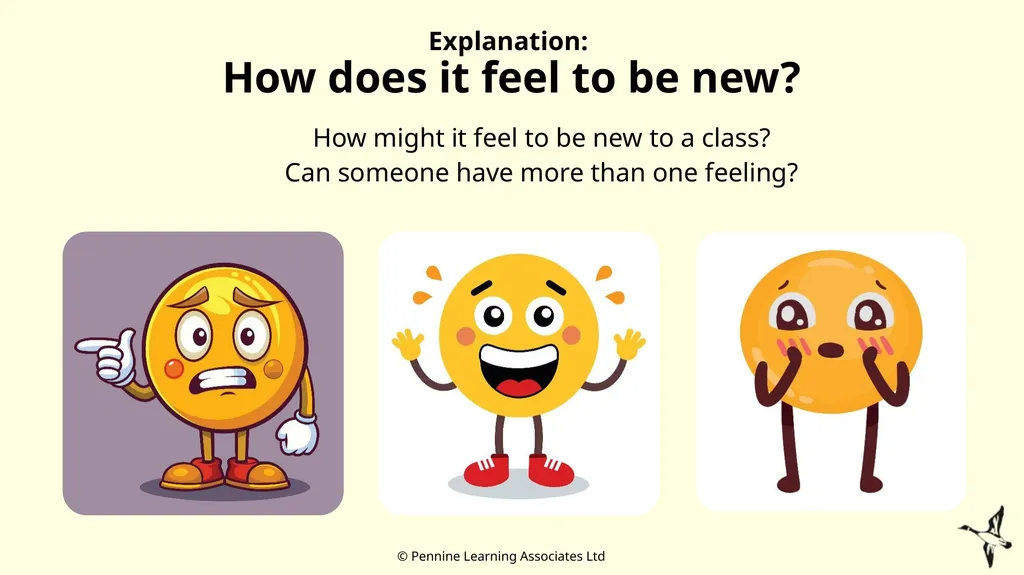
Slide 10: A doll or teddy could be used as a new class member. Discuss why we can feel nervous yet excited at the same time when we arrive somewhere new.
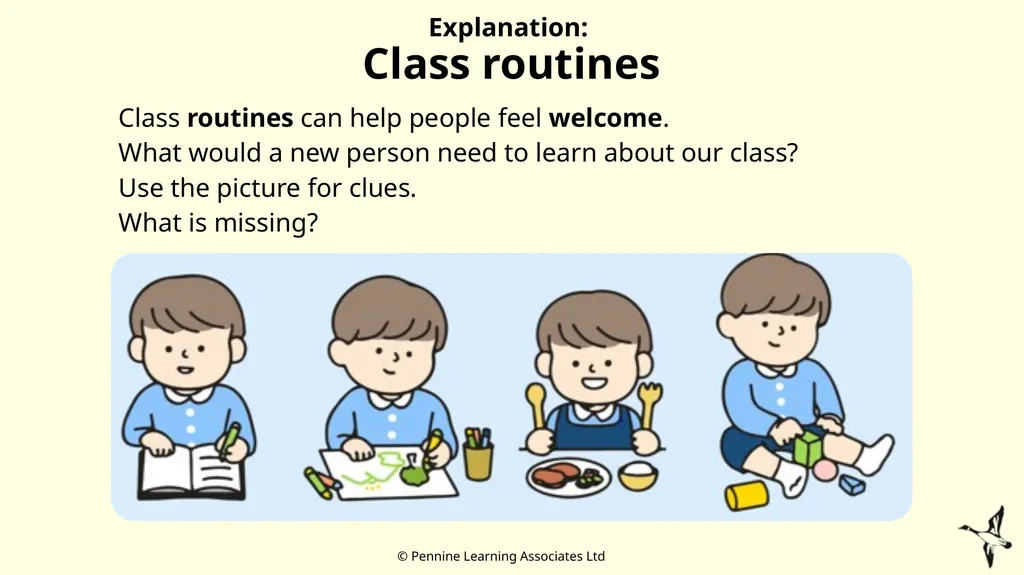
Slide 11: Encourage pupils to identify their own class routines that a new pupil would need to learn such as where to put their things. This slide could be personalised with a picture timetable of a typical day in class (SEND adaptation and beneficial to all).
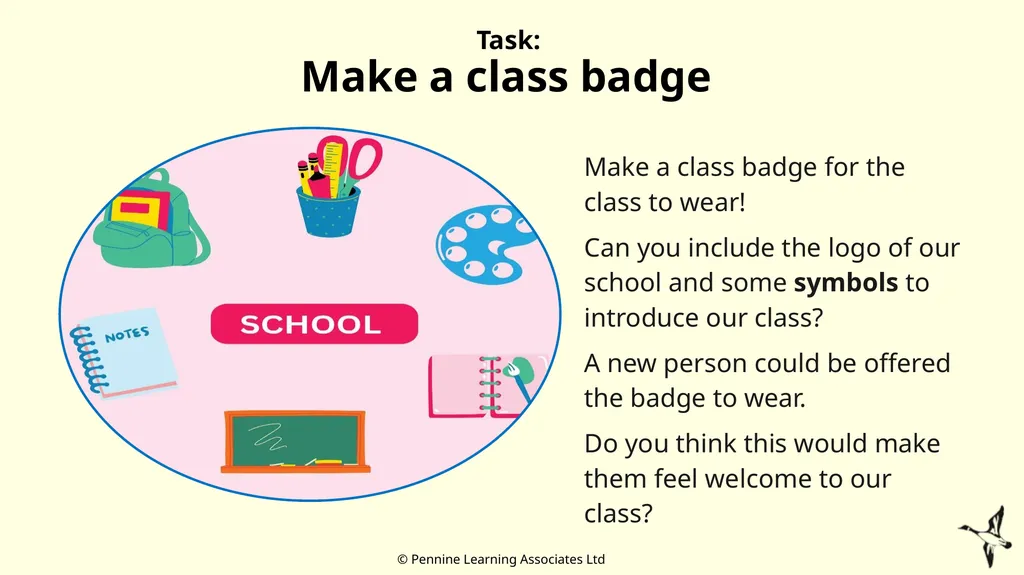
Slide 12: Show pupils the school logo and talk about what could be symbols of your class, for example hands to show we are kind, heart to show love, football because we like sport etc. This outline can be printed for pupils to design their own class badge.
Slide 13: A tablet could be used for photographing symbols special to the school such as the logo, motto, trophies or school records.
Slide 15: Give each pupil a post-it note and encourage them to draw or write a way that they could welcome someone e.g. with a hug, smile, showing someone round, asking them about themselves, sharing a toy etc. Gather the post it notes and read them together. You could use the outline for the pupils to stick them on.
Slide 16: Children's explanations could be recorded as assessment of the learning objective. Notes for teachers<br>
04
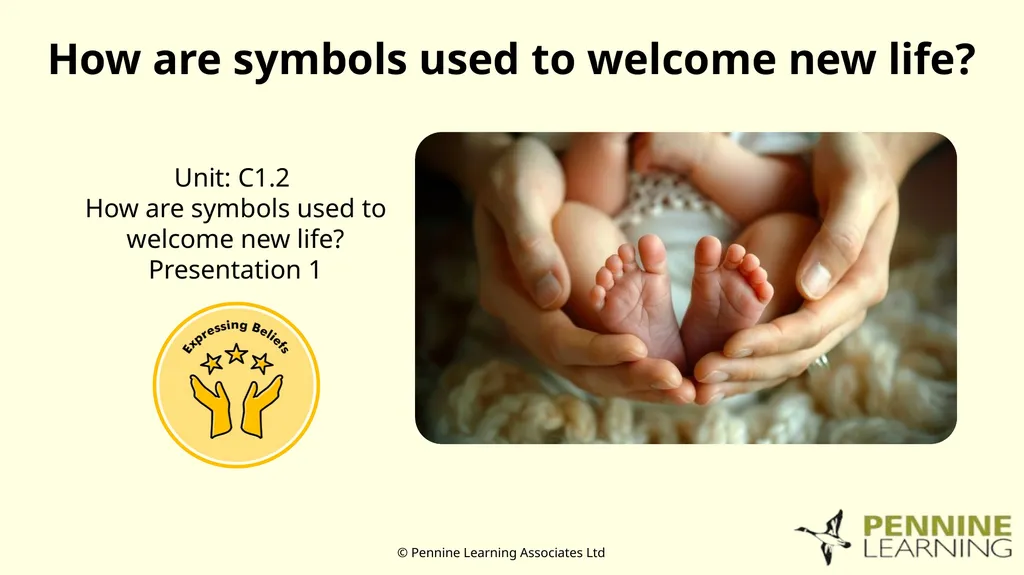
Unit: C1.2
How are symbols used to welcome new life?
Presentation 1 How are symbols used to welcome new life?<br>
05
How this presentation links to the pathway:
This presentation shows how we have special symbols and routines in our school. We learn about how and why we should welcome new people. Key Stage 1
Through investigating how beliefs are expressed, pupils should learn that:
people sometimes give different meanings to words when they are writing about their religious beliefs and feelings.
People have created stories, symbols, art and music with different meanings so that they can express their beliefs. Pathway 2: Expressing Beliefs<br>
06
Identify symbols and routines in school Explain how we welcome people to our class and why this is important Learning objectives<br>
07
Key words<br>
08
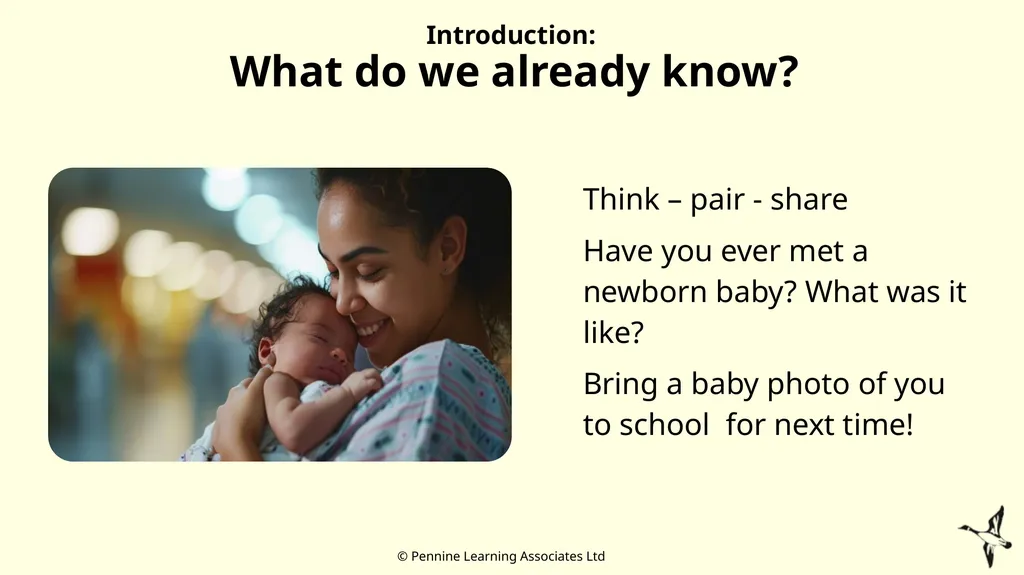
Think – pair - share
Have you ever met a newborn baby? What was it like?
Bring a baby photo of you to school for next time! Introduction: What do we already know?<br>
09
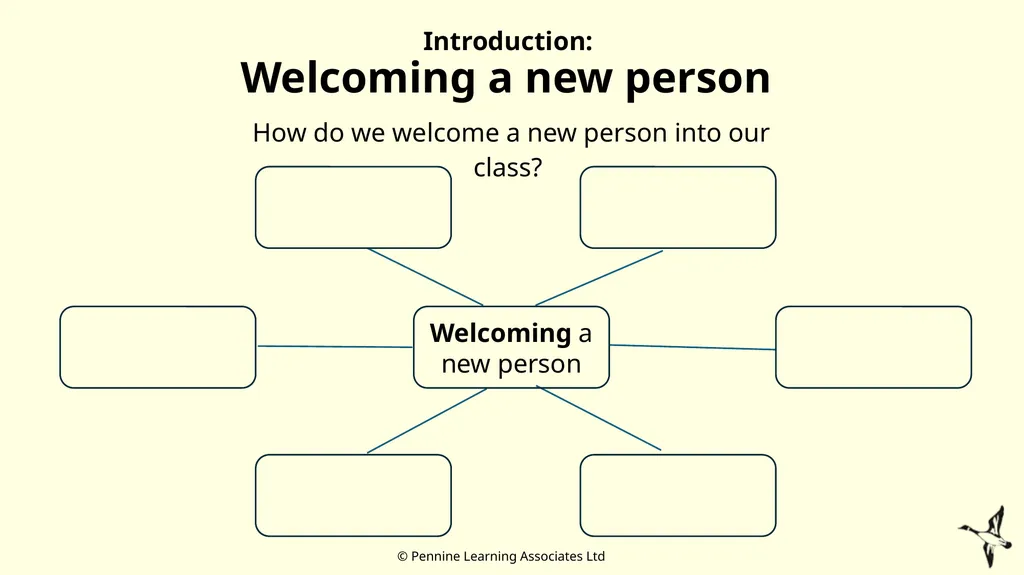
Welcoming a new person How do we welcome a new person into our class? Introduction: Welcoming a new person<br>
10
How might it feel to be new to a class?
Can someone have more than one feeling? Explanation: How does it feel to be new?<br>
11
Class routines can help people feel welcome.
What would a new person need to learn about our class?
Use the picture for clues.
What is missing? Explanation: Class routines<br>
12
Make a class badge for the class to wear!
Can you include the logo of our school and some symbols to introduce our class?
A new person could be offered the badge to wear.
Do you think this would make them feel welcome to our class? Task: Make a class badge<br>
13
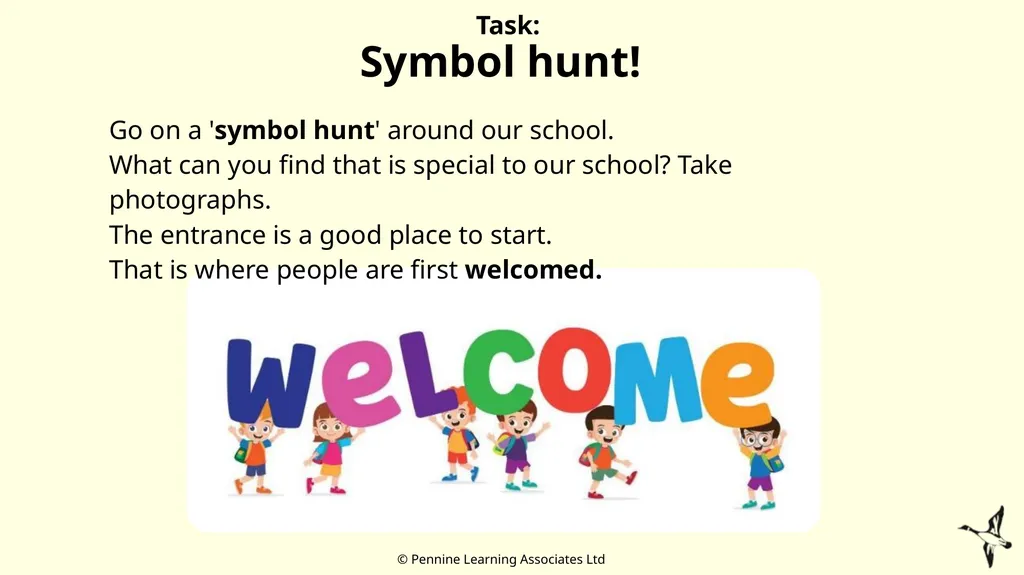
Go on a 'symbol hunt' around our school.
What can you find that is special to our school? Take photographs.
The entrance is a good place to start.
That is where people are first welcomed. Task: Symbol hunt!<br>
14
Learning summary<br>
15
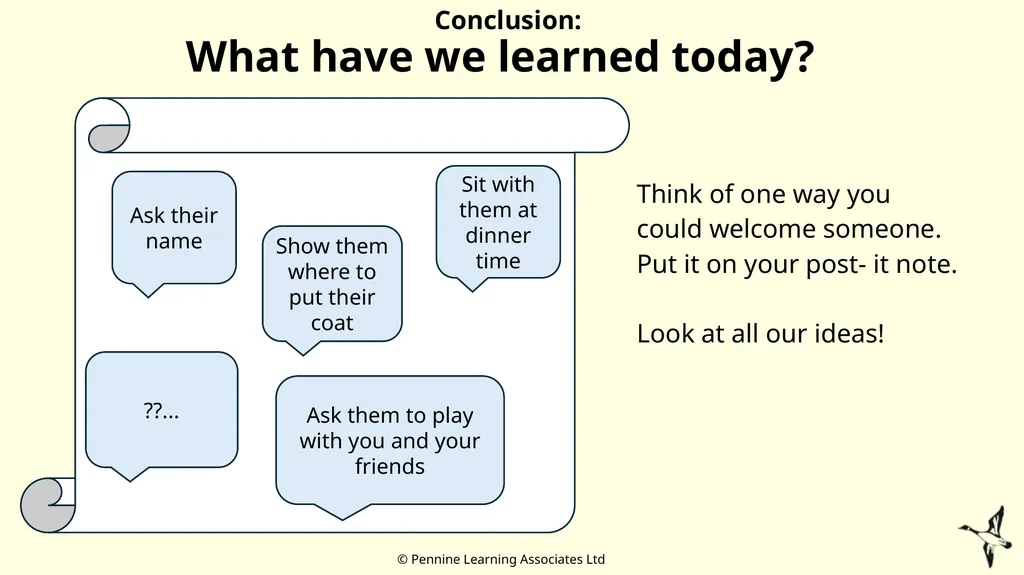
??... Ask them to play with you and your friends Sit with them at dinner time Show them where to put their coat Ask their name Think of one way you could welcome someone.
Put it on your post- it note.
Look at all our ideas! Conclusion: What have we learned today?<br>
16
Have you ever been new somewhere?
How did it feel?
What did you do?
Why do you think it is important to welcome someone new? Time to think<br>
17
All pictures reproduced under professional licence from Vecteezy. Acknowledgments<br>