The argument from design: God Michael Lacewing enquiriesalevelphilosophy.co.uk (c) Michael Lacewing Life Isnt life amazing? Organs serve a purpose heart pump blood, eye seeing We understand parts of an organ in relation to serving
"The argument from design: God Michael Lacewing" is the property of its rightful owner. Permission is granted to
download and print the materials on this website for personal, non-commercial use only, and to display it
on your personal computer provided you do not modify the materials and that you retain all copyright
notices contained in the materials. By downloading content from our website, you accept the terms of this
agreement.
Presentation Transcript
01
The argument from design: God Michael Lacewing
enquiries@alevelphilosophy.co.uk (c) Michael Lacewing<br>
02
Life Isn’t life amazing?
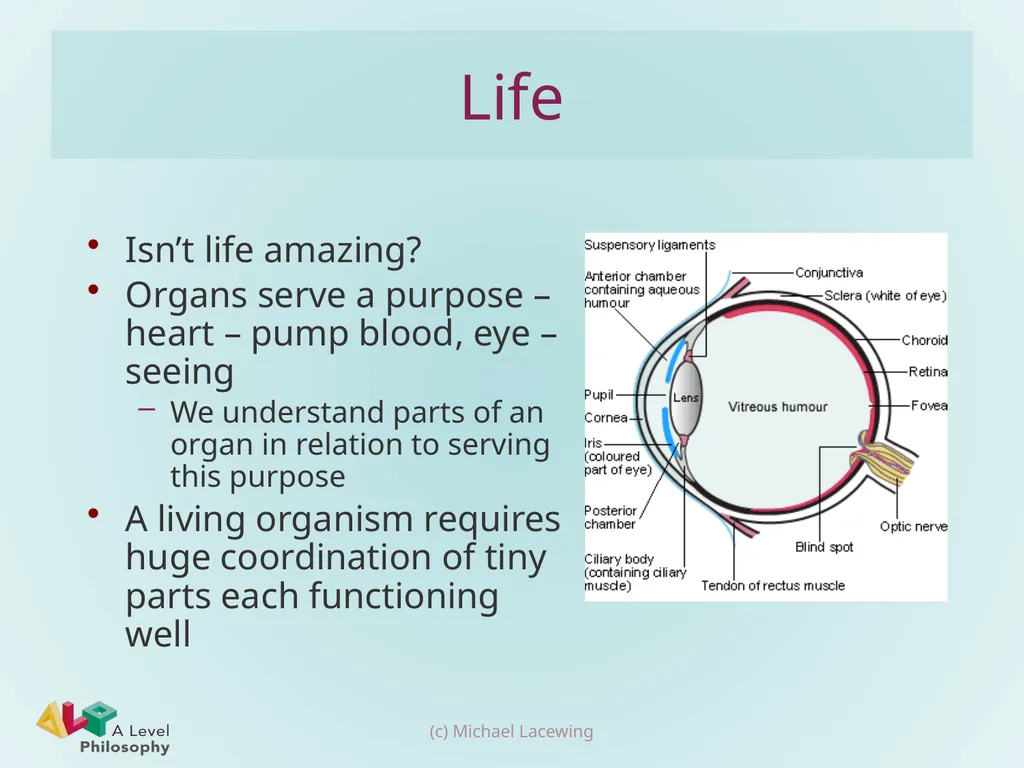
Organs serve a purpose – heart – pump blood, eye – seeing
We understand parts of an organ in relation to serving this purpose
A living organism requires huge coordination of tiny parts each functioning well (c) Michael Lacewing<br>
03
The argument from design The argument from design argues from the order and regularity that we see in the universe to the existence of a God that designed the universe.
Paley, Hume and Swinburne all agree that even if we could infer the existence of a designer of the universe, it is an extra step to argue that the designer is God. (c) Michael Lacewing<br>
04
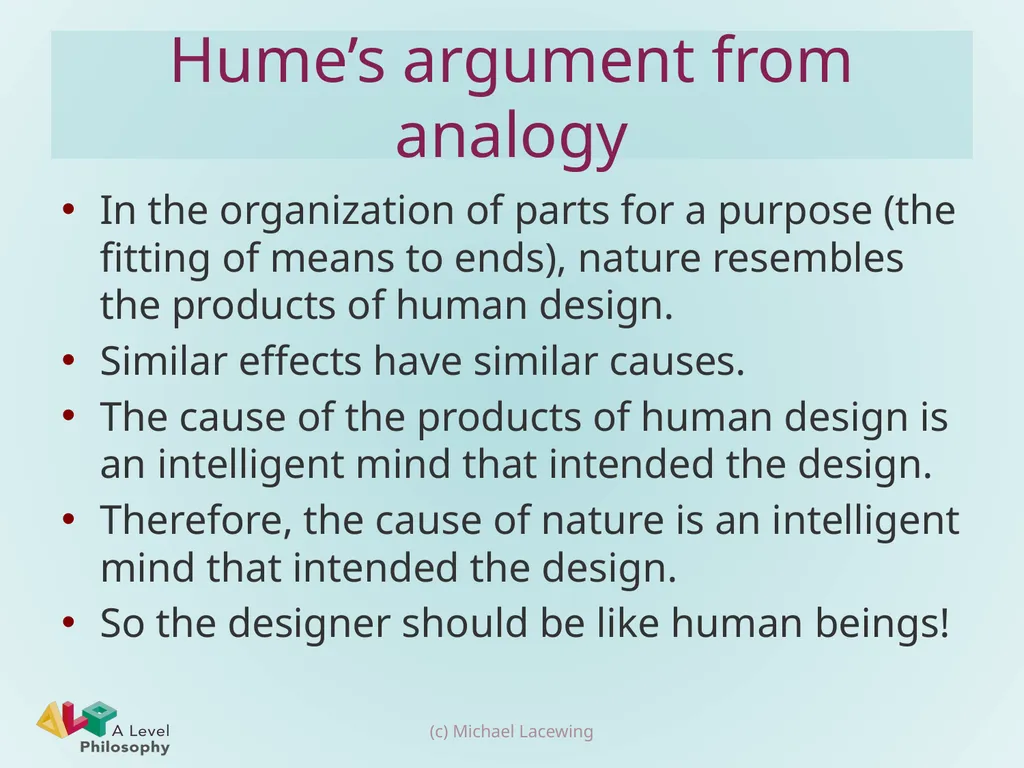
Hume’s argument from analogy In the organization of parts for a purpose (the fitting of means to ends), nature resembles the products of human design.
Similar effects have similar causes.
The cause of the products of human design is an intelligent mind that intended the design.
Therefore, the cause of nature is an intelligent mind that intended the design.
So the designer should be like human beings! (c) Michael Lacewing<br>
05
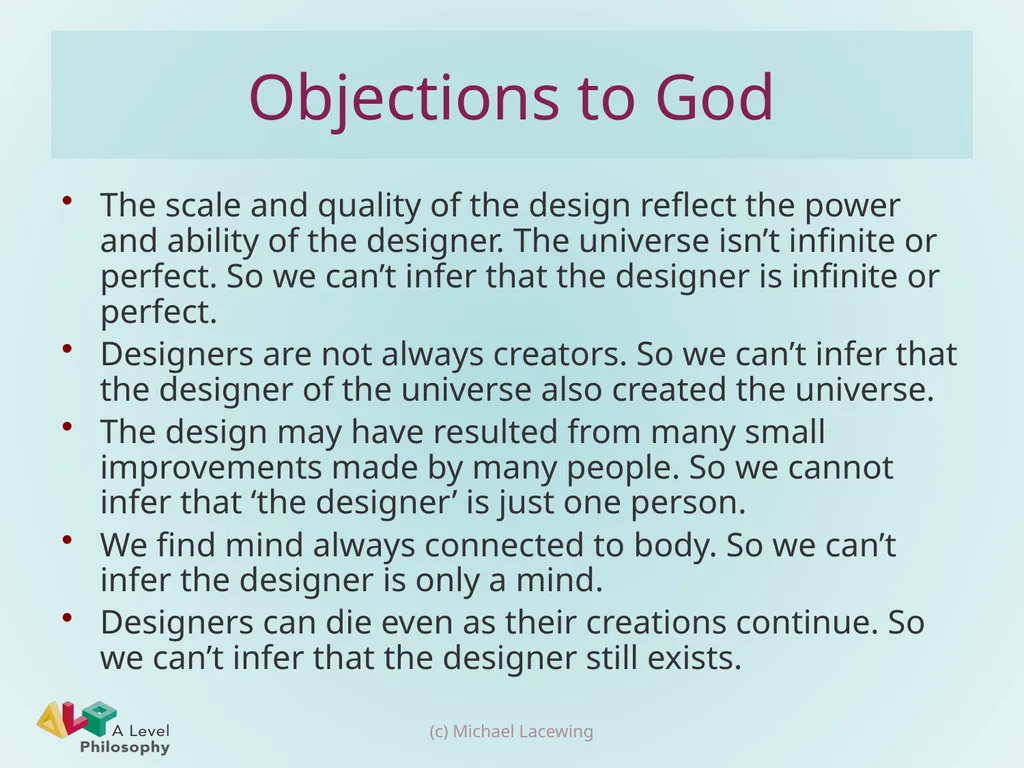
Objections to God The scale and quality of the design reflect the power and ability of the designer. The universe isn’t infinite or perfect. So we can’t infer that the designer is infinite or perfect.
Designers are not always creators. So we can’t infer that the designer of the universe also created the universe.
The design may have resulted from many small improvements made by many people. So we cannot infer that ‘the designer’ is just one person.
We find mind always connected to body. So we can’t infer the designer is only a mind.
Designers can die even as their creations continue. So we can’t infer that the designer still exists. (c) Michael Lacewing<br>
06
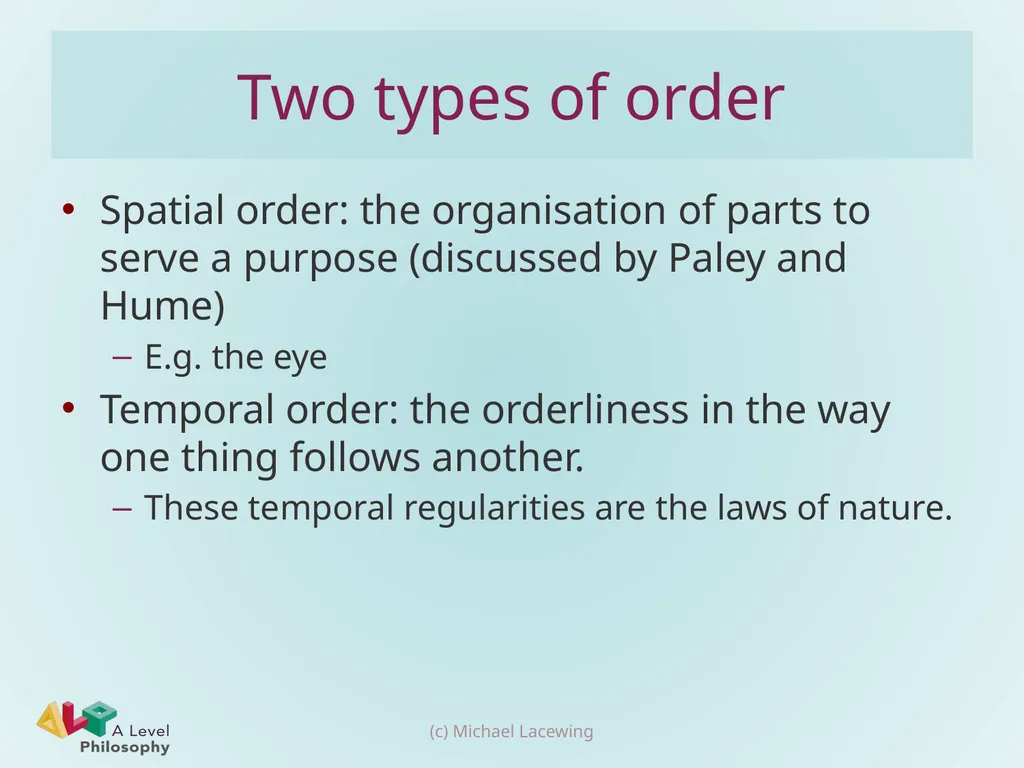
Two types of order Spatial order: the organisation of parts to serve a purpose (discussed by Paley and Hume)
E.g. the eye
Temporal order: the orderliness in the way one thing follows another.
These temporal regularities are the laws of nature. (c) Michael Lacewing<br>
07
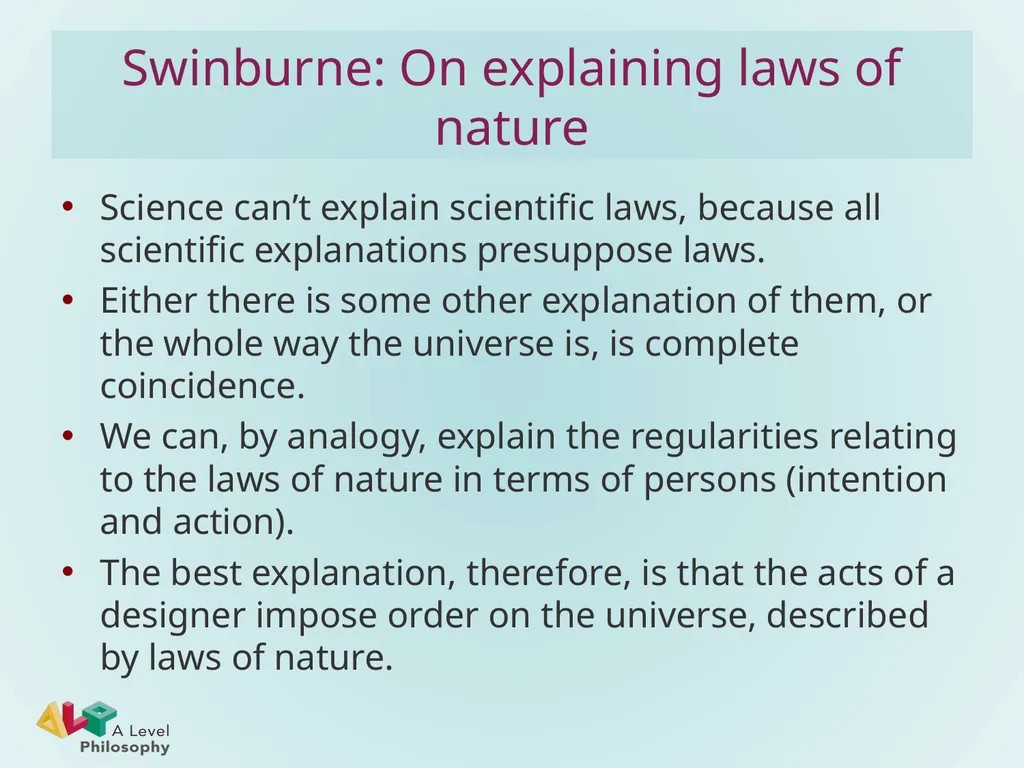
Swinburne: On explaining laws of nature Science can’t explain scientific laws, because all scientific explanations presuppose laws.
Either there is some other explanation of them, or the whole way the universe is, is complete coincidence.
We can, by analogy, explain the regularities relating to the laws of nature in terms of persons (intention and action).
The best explanation, therefore, is that the acts of a designer impose order on the universe, described by laws of nature.<br>
08
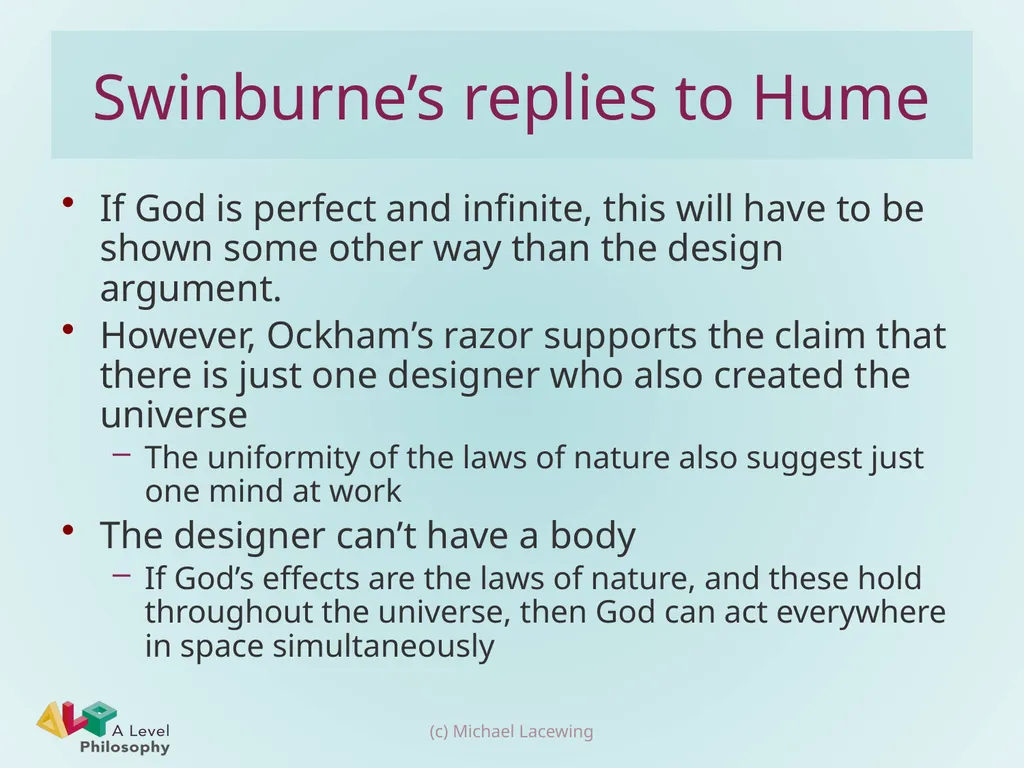
Swinburne’s replies to Hume If God is perfect and infinite, this will have to be shown some other way than the design argument.
However, Ockham’s razor supports the claim that there is just one designer who also created the universe
The uniformity of the laws of nature also suggest just one mind at work
The designer can’t have a body
If God’s effects are the laws of nature, and these hold throughout the universe, then God can act everywhere in space simultaneously (c) Michael Lacewing<br>
09
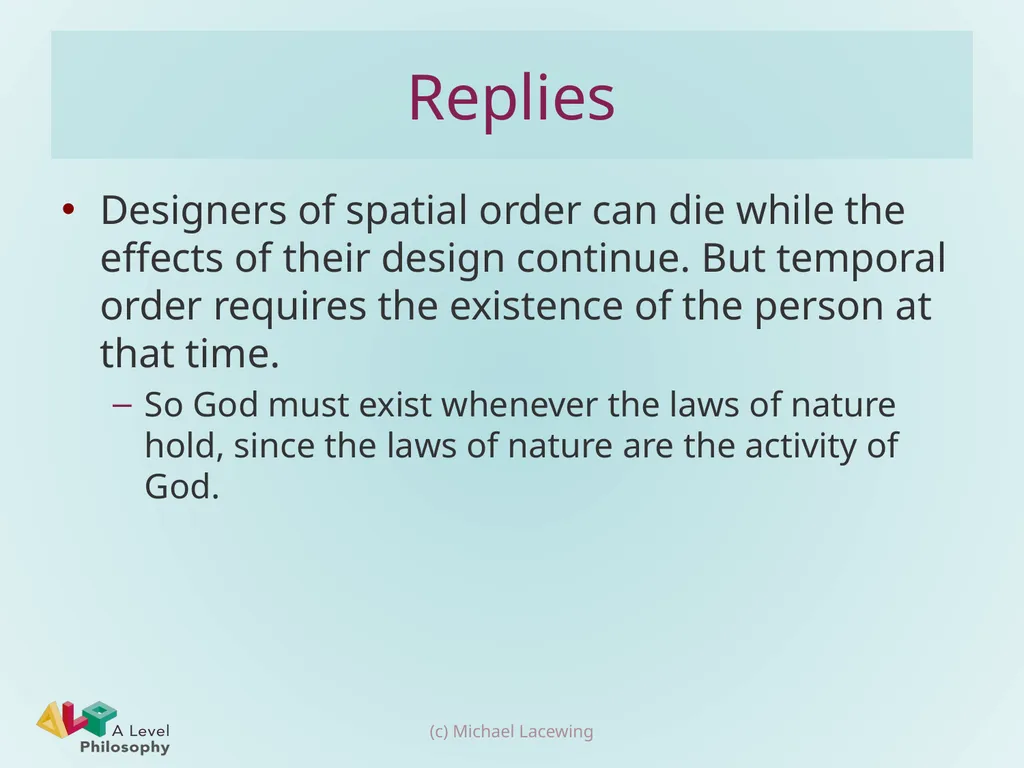
Replies Designers of spatial order can die while the effects of their design continue. But temporal order requires the existence of the person at that time.
So God must exist whenever the laws of nature hold, since the laws of nature are the activity of God. (c) Michael Lacewing<br>