The Importance of Engineering and Technology in Nation Building The Role Public and Private Sector Ahmed Siyad, SomaliREN Ahmed.siyadsomaliren.org Twitter: adsiyad Outline The Global Imperative The Fourth Industrial Revolution 4IR
"The Importance of Engineering and Technology in" is the property of its rightful owner. Permission is granted to
download and print the materials on this website for personal, non-commercial use only, and to display it
on your personal computer provided you do not modify the materials and that you retain all copyright
notices contained in the materials. By downloading content from our website, you accept the terms of this
agreement.
Presentation Transcript
01
The Importance of Engineering and Technology in Nation Building The Role Public and Private Sector Ahmed Siyad,
SomaliREN
Ahmed.siyad@somaliren.org
Twitter: @adsiyad<br>
02
Outline The Global Imperative
The Fourth Industrial Revolution – 4IR
Digital Transformation as Sustainable Development Pathway
Key trends and issues
Digital Preparedness
Key elements in digital transformation
Progress and challenges in the Somalia ICT Sector
Brief history, current situation and challenges
Priorities for governments and private sector
Conclusion<br>
03
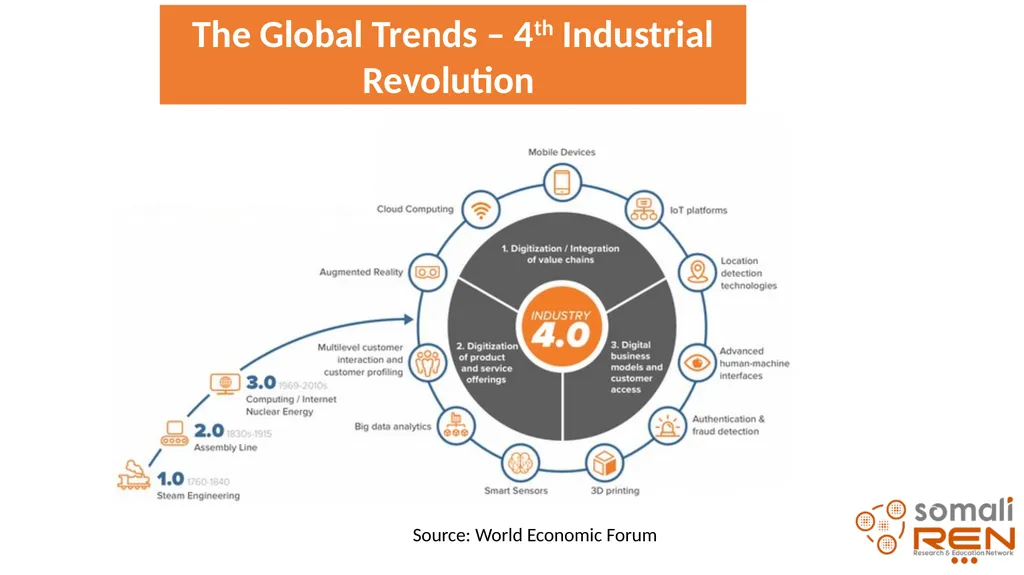
The Global Trends – 4th Industrial Revolution Source: World Economic Forum<br>
04
Digital Transformation as Sustainable Development Pathway Source: un.org<br>
05
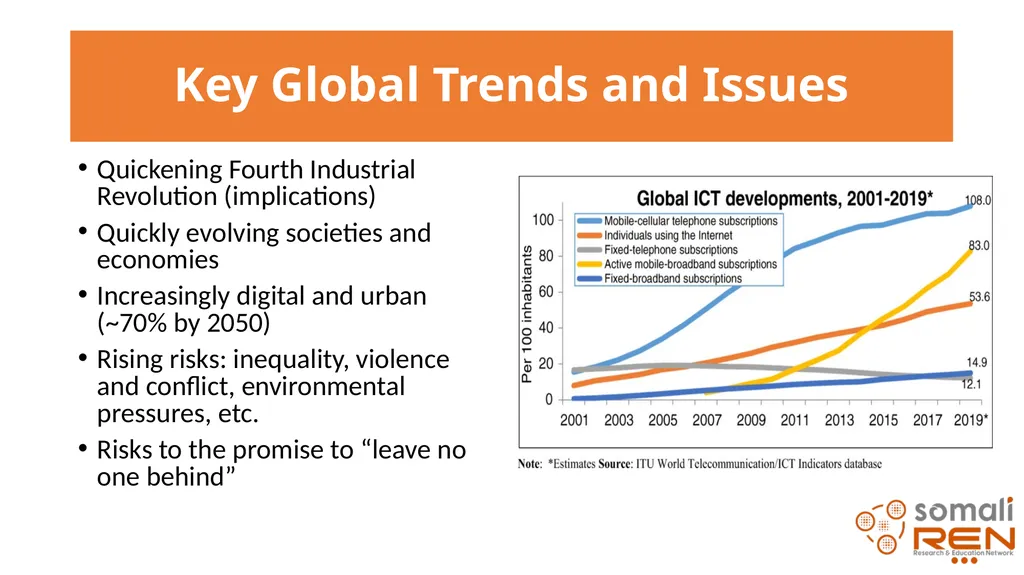
Key Global Trends and Issues Quickening Fourth Industrial Revolution (implications)
Quickly evolving societies and economies
Increasingly digital and urban (~70% by 2050)
Rising risks: inequality, violence and conflict, environmental pressures, etc.
Risks to the promise to “leave no one behind”<br>
06
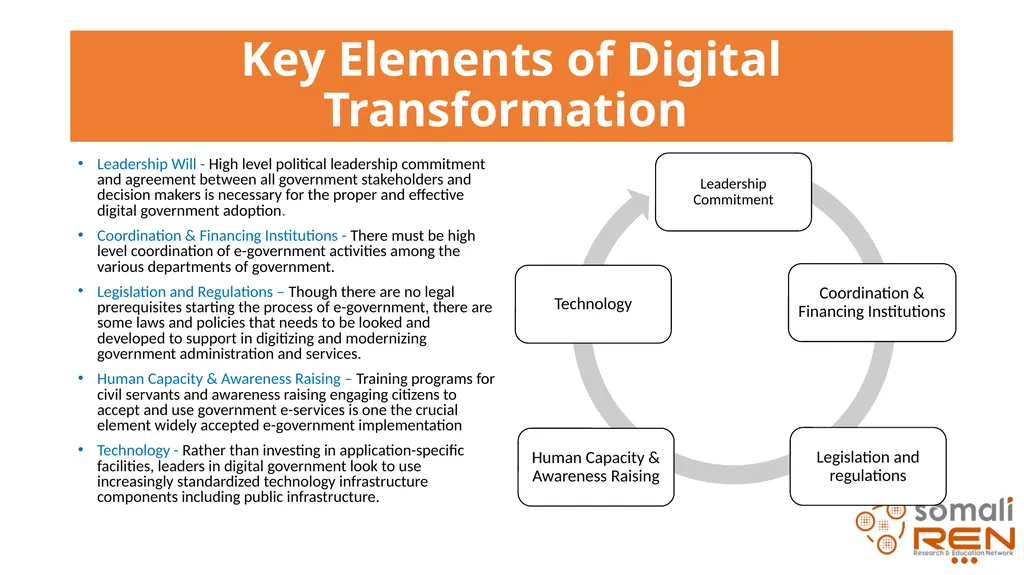
Key Elements of Digital Transformation Leadership Will - High level political leadership commitment and agreement between all government stakeholders and decision makers is necessary for the proper and effective digital government adoption.
Coordination & Financing Institutions - There must be high level coordination of e-government activities among the various departments of government.
Legislation and Regulations – Though there are no legal prerequisites starting the process of e-government, there are some laws and policies that needs to be looked and developed to support in digitizing and modernizing government administration and services.
Human Capacity & Awareness Raising – Training programs for civil servants and awareness raising engaging citizens to accept and use government e-services is one the crucial element widely accepted e-government implementation
Technology - Rather than investing in application-specific facilities, leaders in digital government look to use increasingly standardized technology infrastructure components including public infrastructure.<br>
07
Are We Really Ready??<br>
08
Where we came from… From 1998-2005 (based on my personal experience)
$1/minute for International calls – 10mins = $10
$1/hour per user for 64kb/s International bandwidth (Internet)
3 main Telecom operators through out the country
Xeer-jajab was used ICT market regulation
There was no proper Internet Service providers ( except cybercafé)
Very view (almost none) local Computer Science and Telecom graduates - mainly depend on foreign engineers
Fixed landlines (PSTN) was used as primary voice communication<br>
09
Where we are now (2021).. Two submarine Fiber landing stations in Mogadishu, Berbera, Bosaso
Approximately of 90% mobile coverage with 52% subscription/users (Source WB and ITU Report 2019)
Less than $100/Mb/s for dedicated Internet capacity and $30/Mb/s for shared capacity
Very cheap Mobile data ($1/1GB) – cheapest in East Africa
Stable Mobile Money Business (e-VC, e-Dahab, ZAAD, Sahal, Premier Wallet etc.)
Initial stage e-banking and e-commerce business
Newly established ICT regulation agency – NCA, MoCT<br>
10
But we’re still behind in… ICT Market regulation – no effective ICT policy and regulations
Digital preparedness – Internet penetration rate is lower than 3% (source: World Bank and ITU global ICT indicator database, 2018 report)
Fair ICT market competition – Monopolism
There are no accredited or recognized engineering professional boards
No national digital agenda – leadership commitment towards digital society and
Digital skill gap – government and academia/private corporation is needed<br>
11
Everyone has a role to play!<br>
12
Government … Almost every aspect of the Digital Roadmap requires government action.<br>
13
Private sector This is not only a matter of the private sector’s social obligation,
but of mutual benefit.<br>
14
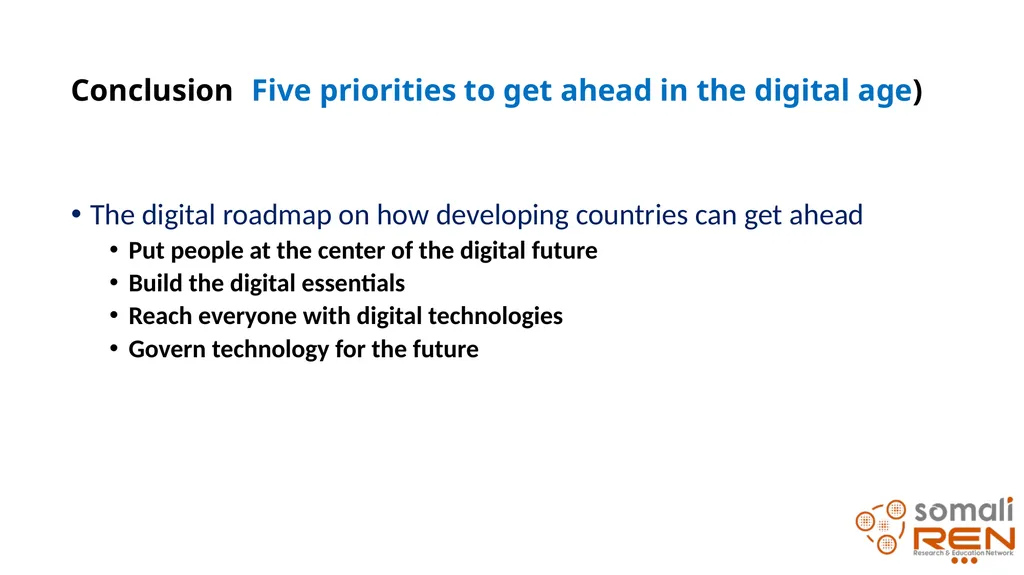
Conclusion (Five priorities to get ahead in the digital age) The digital roadmap on how developing countries can get ahead
Put people at the center of the digital future
Build the digital essentials
Reach everyone with digital technologies
Govern technology for the future<br>
15
Mahadsanidiin Presentation can be found @ https://sorer.somaliren.org.so/<br>