
The Inbetweeners Key messages and recommendations
PT
Published · 24 slides · 0 views
1 / 1


Description
The Inbetweeners Key messages and recommendations A review of the barriers and facilitators in the process of the transition of children and young people with complex chronic health conditions into adult health services To explore the
Related Topics
Share
Embed code
Download this presentation From Below
"The Inbetweeners Key messages and recommendations" is the property of its rightful owner. Permission is granted to download and print the materials on this website for personal, non-commercial use only, and to display it on your personal computer provided you do not modify the materials and that you retain all copyright notices contained in the materials. By downloading content from our website, you accept the terms of this agreement.
Presentation Transcript
01
The Inbetweeners Key messages and recommendations A review of the barriers and facilitators in the process of the transition of children and young people with complex chronic health conditions into adult health services<br>
02
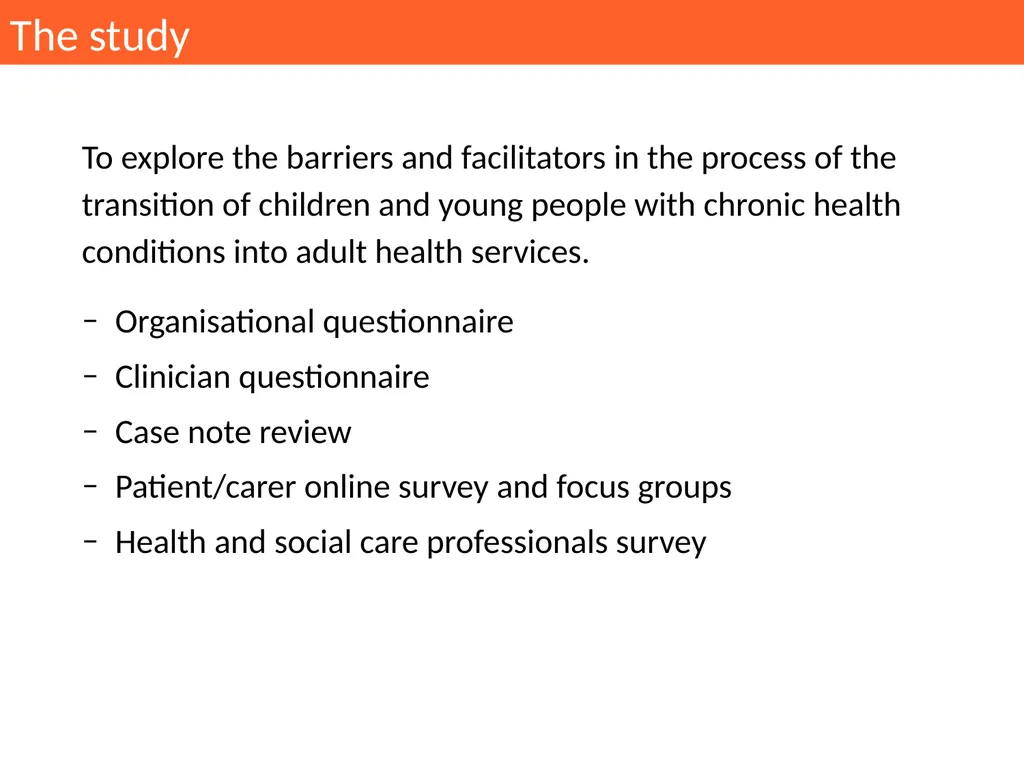
To explore the barriers and facilitators in the process of the transition of children and young people with chronic health conditions into adult health services.
Organisational questionnaire
Clinician questionnaire
Case note review
Patient/carer online survey and focus groups
Health and social care professionals survey The study<br>
Organisational questionnaire
Clinician questionnaire
Case note review
Patient/carer online survey and focus groups
Health and social care professionals survey The study<br>
03
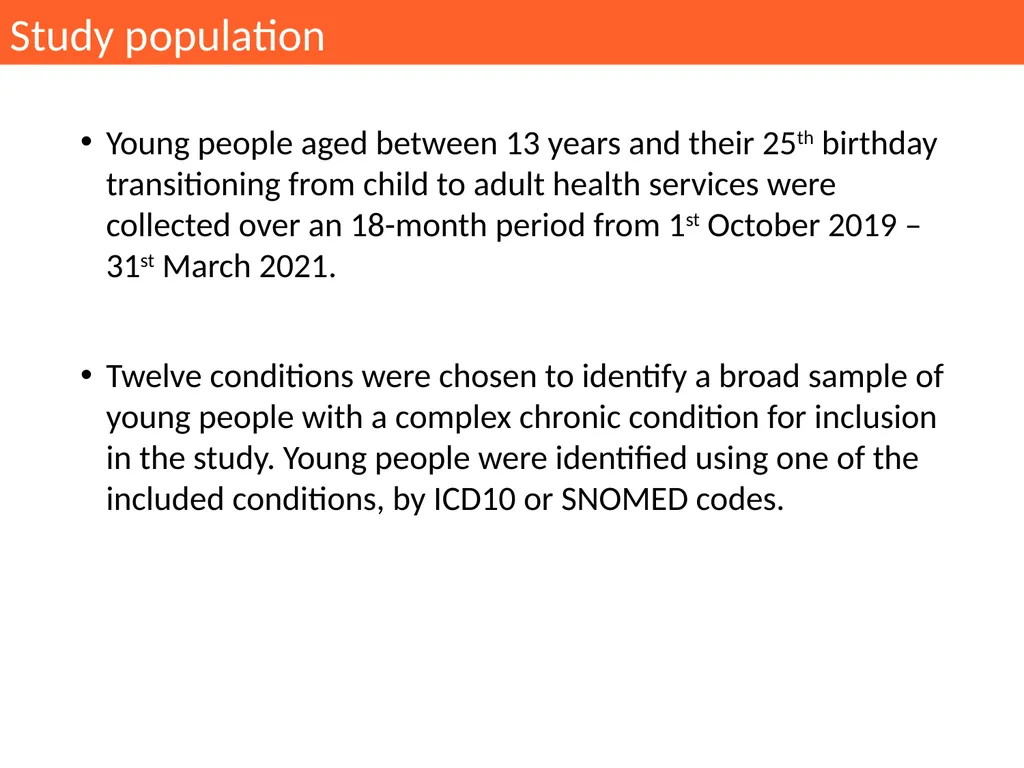
Young people aged between 13 years and their 25th birthday transitioning from child to adult health services were collected over an 18-month period from 1st October 2019 – 31st March 2021.
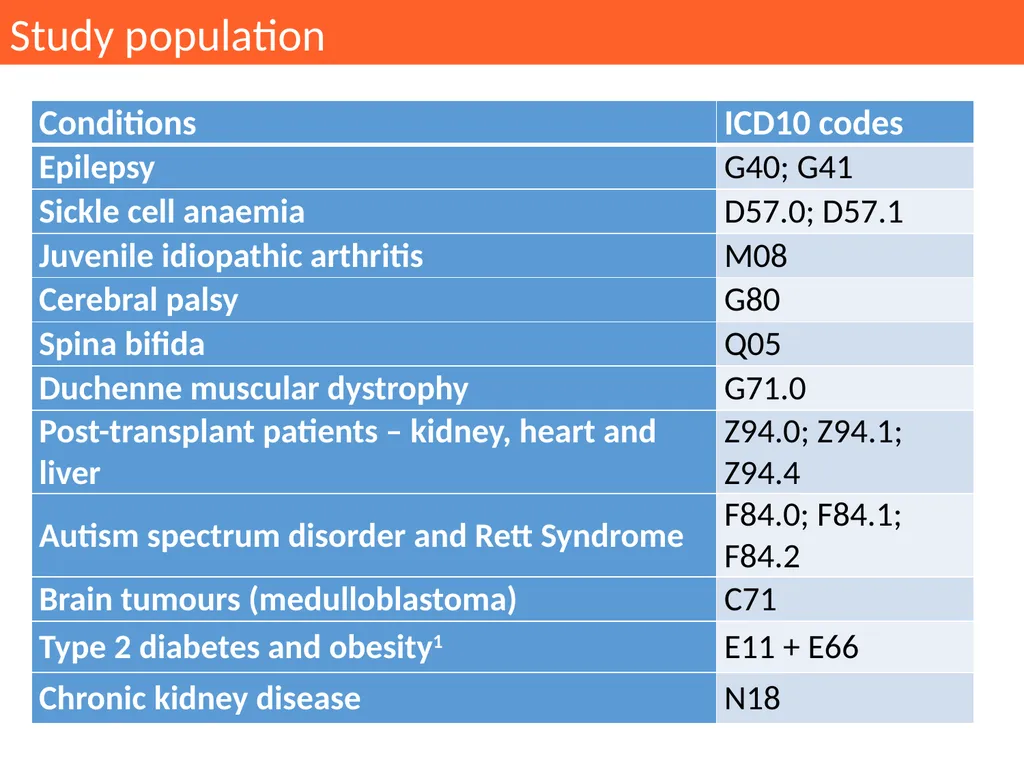
Twelve conditions were chosen to identify a broad sample of young people with a complex chronic condition for inclusion in the study. Young people were identified using one of the included conditions, by ICD10 or SNOMED codes. Study population<br>
Twelve conditions were chosen to identify a broad sample of young people with a complex chronic condition for inclusion in the study. Young people were identified using one of the included conditions, by ICD10 or SNOMED codes. Study population<br>
04
Study population<br>
05
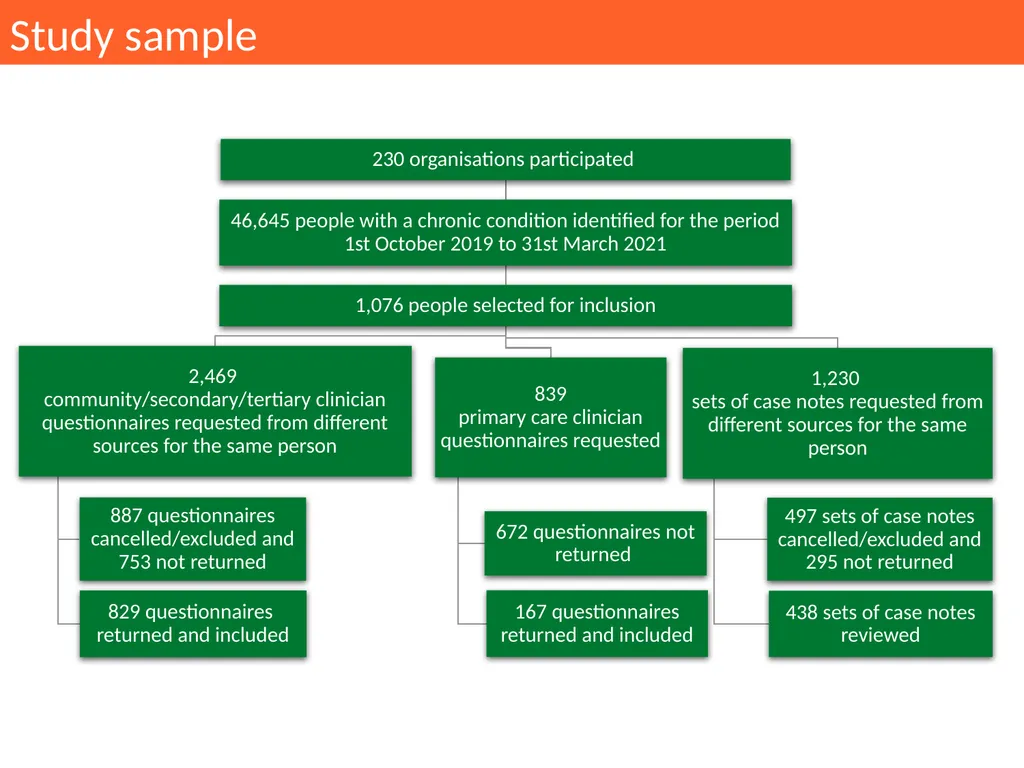
Study sample<br>
06
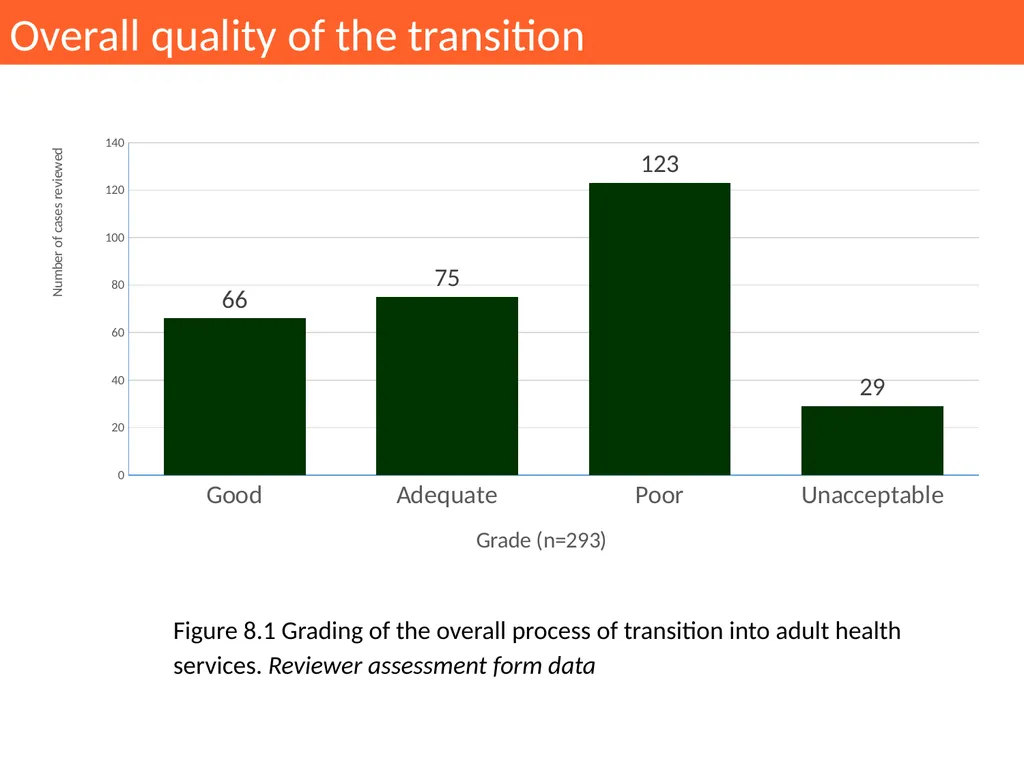
Overall quality of the transition Figure 8.1 Grading of the overall process of transition into adult health services. Reviewer assessment form data<br>
07
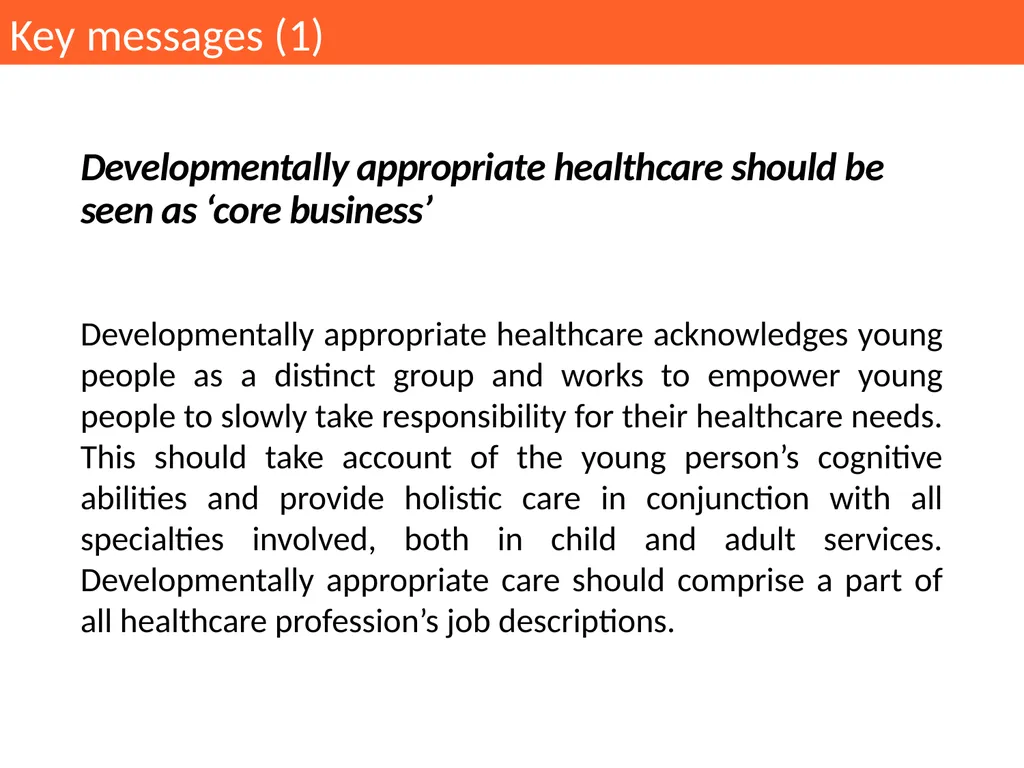
Developmentally appropriate healthcare should be seen as ‘core business’ Key messages (1) Developmentally appropriate healthcare acknowledges young people as a distinct group and works to empower young people to slowly take responsibility for their healthcare needs. This should take account of the young person’s cognitive abilities and provide holistic care in conjunction with all specialties involved, both in child and adult services. Developmentally appropriate care should comprise a part of all healthcare profession’s job descriptions.<br>
08
Patients and parent carers should be involved in healthcare planning Key messages (2) NICE recommends that individual plans regarding transition are co-produced with the young person, and where appropriate the parent carer. This includes ensuring that patients are coping into are correspondence and are part of the team facilitating the transition process by being invited to all multidisciplinary transition meetings.<br>
09
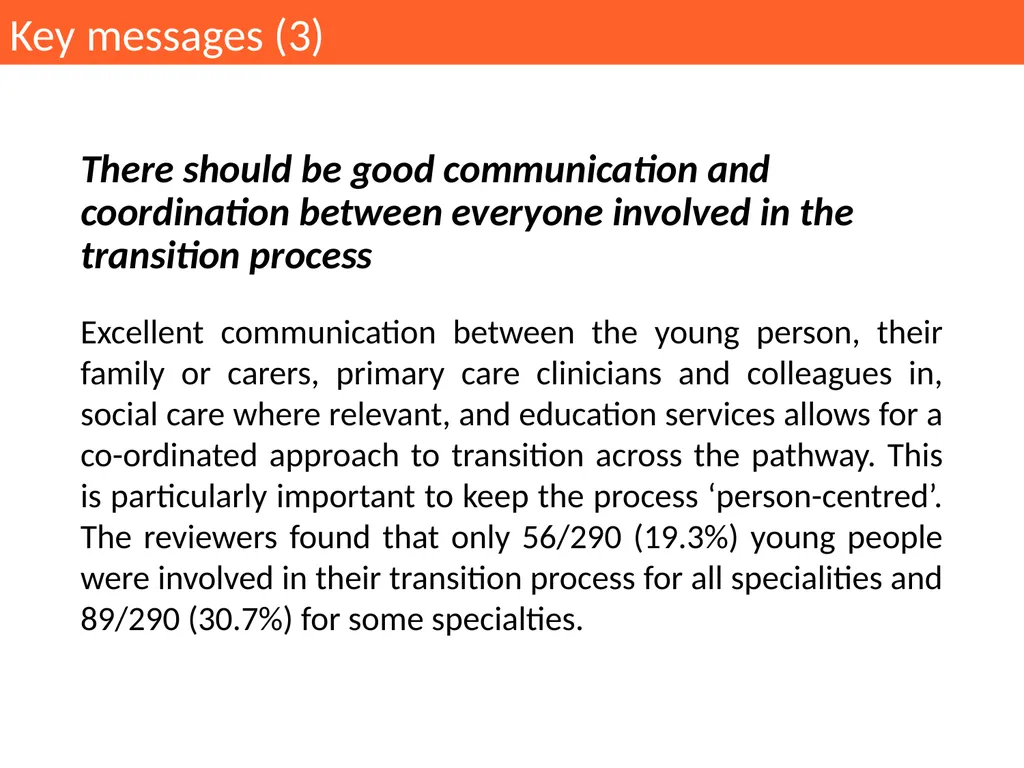
There should be good communication and coordination between everyone involved in the transition process Key messages (3) Excellent communication between the young person, their family or carers, primary care clinicians and colleagues in, social care where relevant, and education services allows for a co-ordinated approach to transition across the pathway. This is particularly important to keep the process ‘person-centred’. The reviewers found that only 56/290 (19.3%) young people were involved in their transition process for all specialities and 89/290 (30.7%) for some specialties.<br>
10
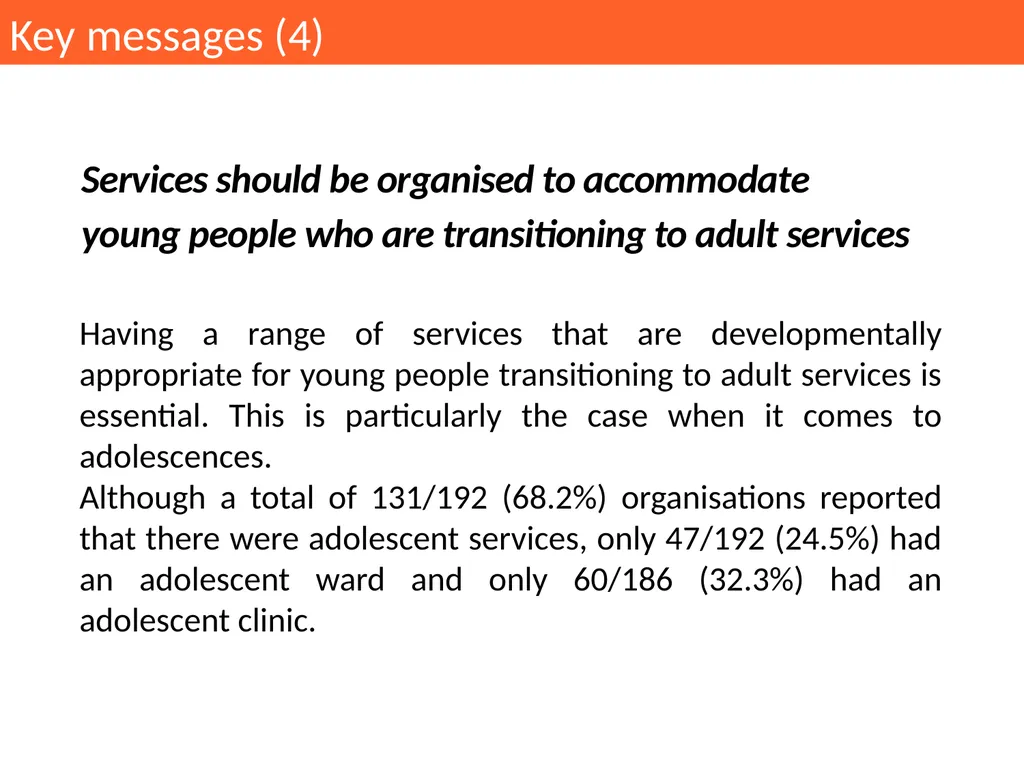
Services should be organised to accommodate young people who are transitioning to adult services Key messages (4) Having a range of services that are developmentally appropriate for young people transitioning to adult services is essential. This is particularly the case when it comes to adolescences.
Although a total of 131/192 (68.2%) organisations reported that there were adolescent services, only 47/192 (24.5%) had an adolescent ward and only 60/186 (32.3%) had an adolescent clinic.<br>
Although a total of 131/192 (68.2%) organisations reported that there were adolescent services, only 47/192 (24.5%) had an adolescent ward and only 60/186 (32.3%) had an adolescent clinic.<br>
11
Strong leadership is needed from all senior members of the healthcare organisation. This includes commissioning bodies when it comes to implementing and supporting the transition process by providing sufficient funds for infrastructure and sufficient time in job plans for staff involved in the transition process. Key messages (5) As the transition process can incorporate many specialties, sites, and individuals a lead clinician should take accountability for the young person’s transitional care. Senior executive board members should support the lead clinician through the development and publication of transition strategies and policies.<br>
12
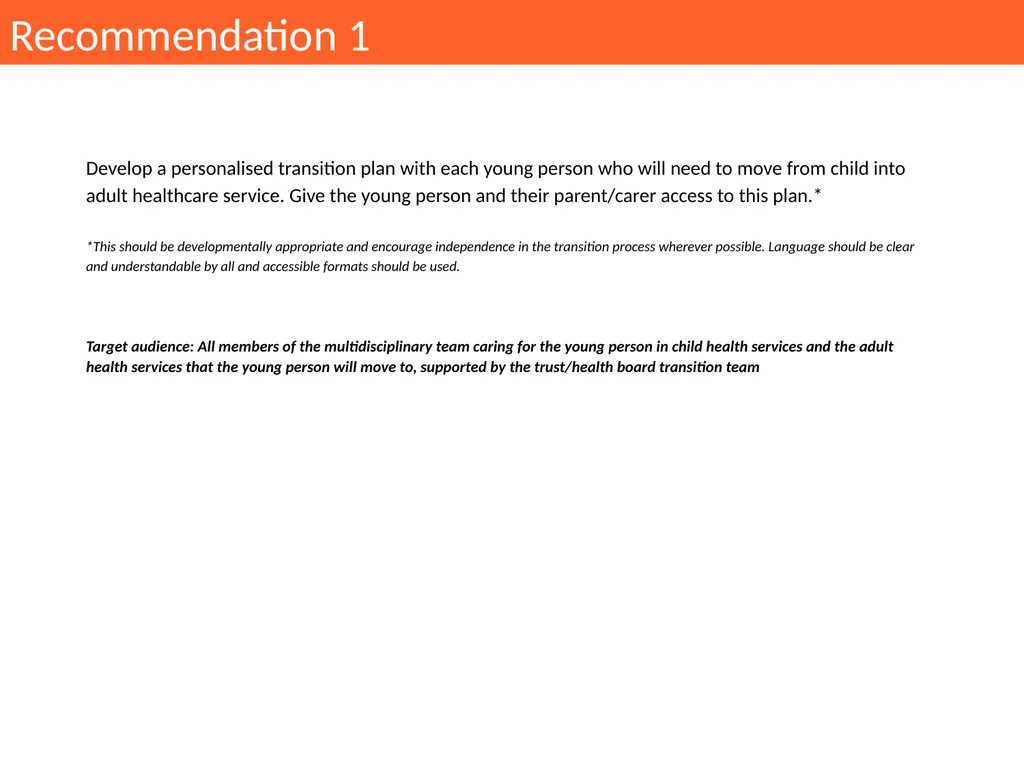
Develop a personalised transition plan with each young person who will need to move from child into adult healthcare service. Give the young person and their parent/carer access to this plan.*
*This should be developmentally appropriate and encourage independence in the transition process wherever possible. Language should be clear and understandable by all and accessible formats should be used.
Target audience: All members of the multidisciplinary team caring for the young person in child health services and the adult health services that the young person will move to, supported by the trust/health board transition team Recommendation 1<br>
13
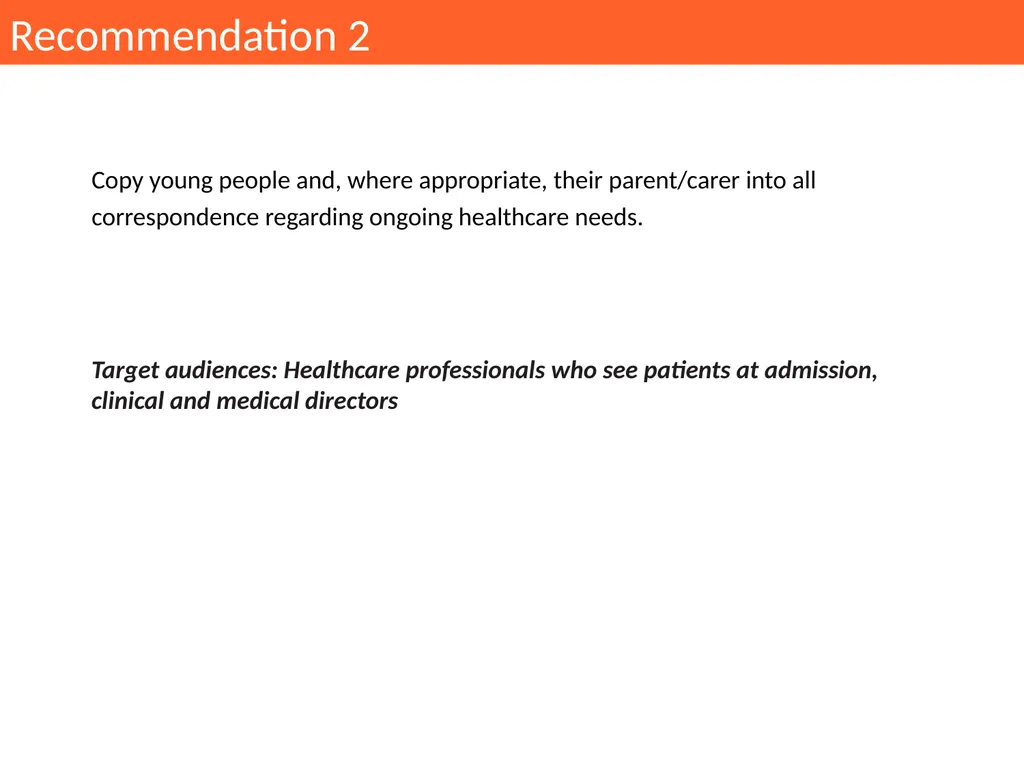
Copy young people and, where appropriate, their parent/carer into all correspondence regarding ongoing healthcare needs. Recommendation 2 Target audiences: Healthcare professionals who see patients at admission, clinical and medical directors<br>
14
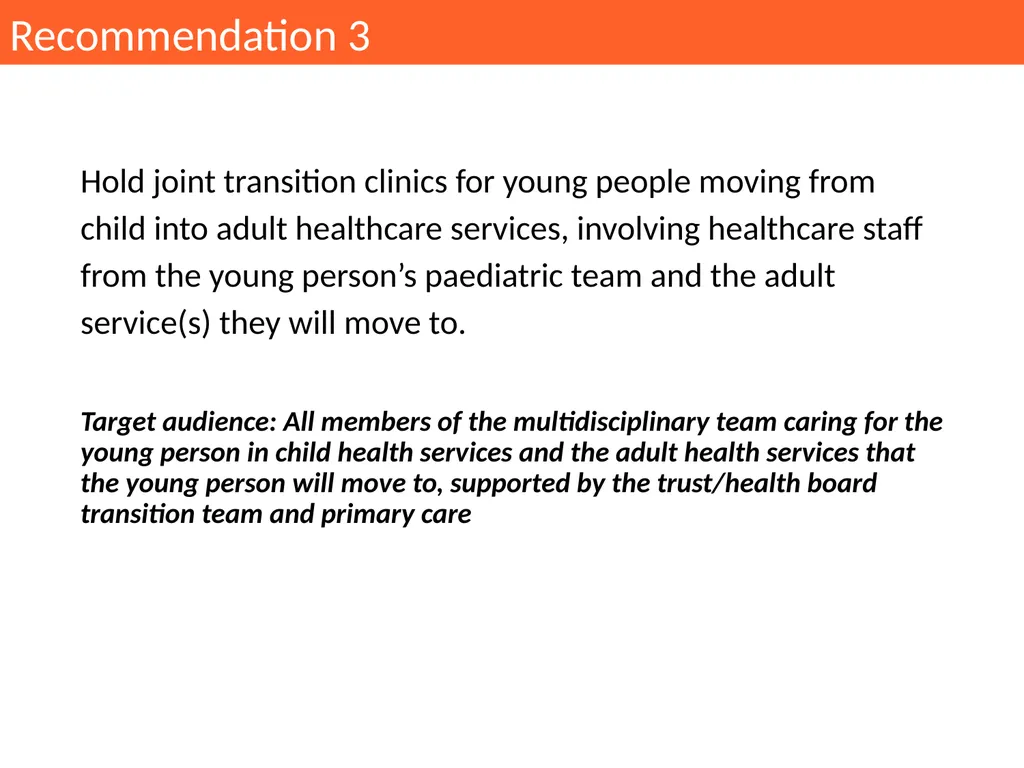
Hold joint transition clinics for young people moving from child into adult healthcare services, involving healthcare staff from the young person’s paediatric team and the adult service(s) they will move to.
Target audience: All members of the multidisciplinary team caring for the young person in child health services and the adult health services that the young person will move to, supported by the trust/health board transition team and primary care Recommendation 3<br>
Target audience: All members of the multidisciplinary team caring for the young person in child health services and the adult health services that the young person will move to, supported by the trust/health board transition team and primary care Recommendation 3<br>
15
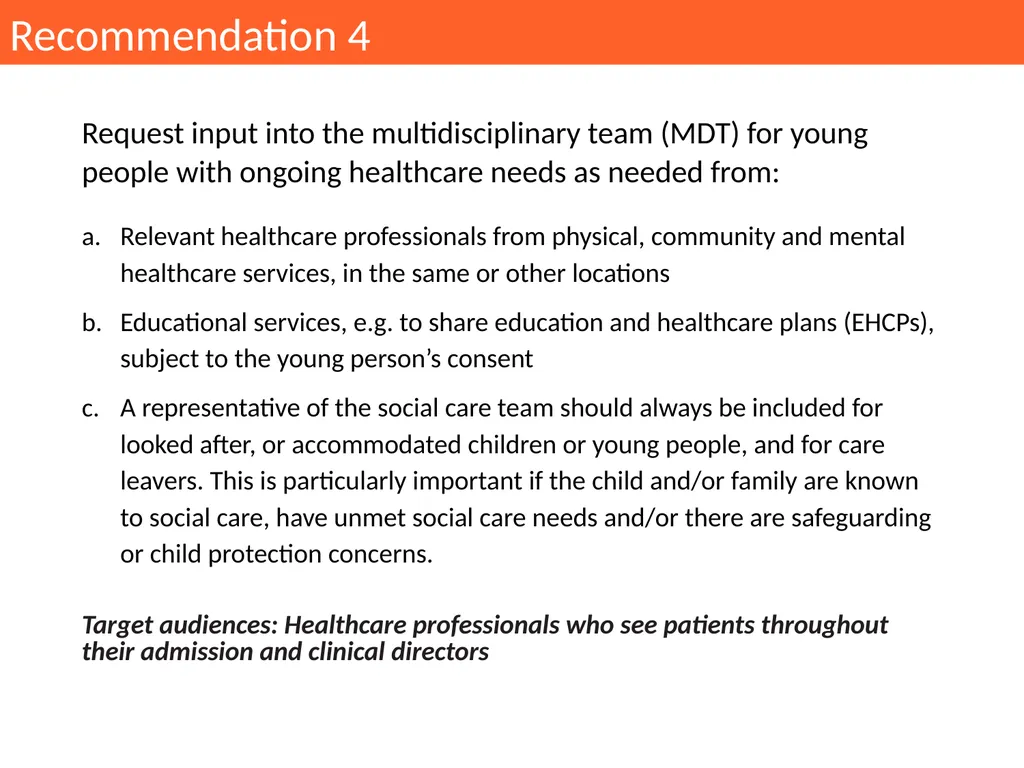
Request input into the multidisciplinary team (MDT) for young people with ongoing healthcare needs as needed from:
Relevant healthcare professionals from physical, community and mental healthcare services, in the same or other locations
Educational services, e.g. to share education and healthcare plans (EHCPs), subject to the young person’s consent
A representative of the social care team should always be included for looked after, or accommodated children or young people, and for care leavers. This is particularly important if the child and/or family are known to social care, have unmet social care needs and/or there are safeguarding or child protection concerns.
Target audiences: Healthcare professionals who see patients throughout their admission and clinical directors Recommendation 4<br>
16
Involve primary care throughout the transition process from child to adult healthcare services to:
Provide continuity of care for young people who are discharged to primary care if there is no equivalent healthcare professional in adult services
Address any wider health concerns unrelated to the young person’s long-term condition.
Target audiences: Healthcare professionals who see patients at, and throughout, their admission, pharmacists, and clinical directors Recommendation 5<br>
17
Convene an overarching trust/health board transition team to provide a ‘one stop shop’ model of holistic care for young people moving from child into adult healthcare services.
Target audience: Executive boards and clinical leads of all trusts/health boards Recommendation 6<br>
Target audience: Executive boards and clinical leads of all trusts/health boards Recommendation 6<br>
18
Implement an overarching trust/health board transition policy for all young people with ongoing healthcare needs.
Target audience: Executive boards and clinical leads of all trusts/health boards, with support from the transition team Recommendation 7<br>
Target audience: Executive boards and clinical leads of all trusts/health boards, with support from the transition team Recommendation 7<br>
19
Ensure transition from child into adult healthcare services is in the job plan for all members of the multidisciplinary team working in all child and adult specialties delivering clinical care to children and young people with ongoing healthcare needs.
Target audience: Executive boards and clinical leads of all trusts/health boards, with support from the transition team Recommendation 8<br>
Target audience: Executive boards and clinical leads of all trusts/health boards, with support from the transition team Recommendation 8<br>
20
Ensure staff in all organisations complete training in developmentally appropriate healthcare and the transition from child to adult healthcare services. The content should be tailored to the job role and the degree of involvement with children and young people.
Target audience: Executive boards and clinical leads of all trusts/health boards, with support from the transition team Recommendation 9<br>
Target audience: Executive boards and clinical leads of all trusts/health boards, with support from the transition team Recommendation 9<br>
21
Ensure that all young people who may need to move from child into adult healthcare services can be identified as such on electronic patient systems, across all healthcare sectors*.
*A standardised set of codes would support this.
Target audience: NHS England, Digital Health and Care Wales and Northern Ireland Statistics and Research Agency with support from trust/health board executive committees and commissioners Recommendation 10<br>
*A standardised set of codes would support this.
Target audience: NHS England, Digital Health and Care Wales and Northern Ireland Statistics and Research Agency with support from trust/health board executive committees and commissioners Recommendation 10<br>
22
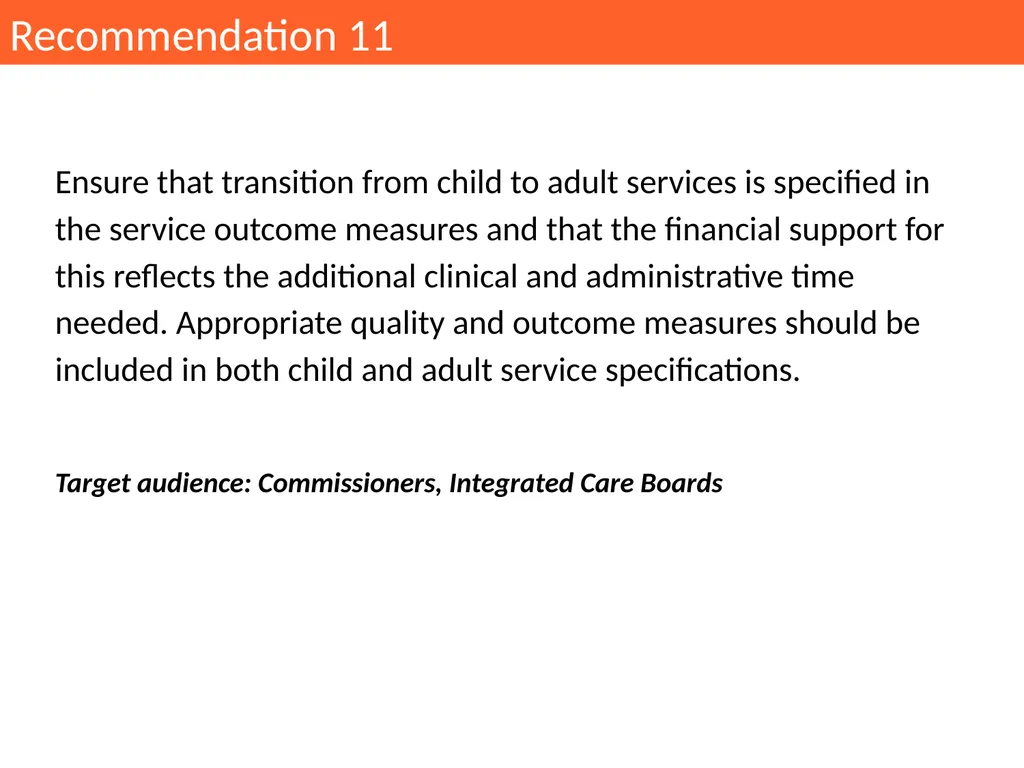
Ensure that transition from child to adult services is specified in the service outcome measures and that the financial support for this reflects the additional clinical and administrative time needed. Appropriate quality and outcome measures should be included in both child and adult service specifications.
Target audience: Commissioners, Integrated Care Boards Recommendation 11<br>
Target audience: Commissioners, Integrated Care Boards Recommendation 11<br>
23
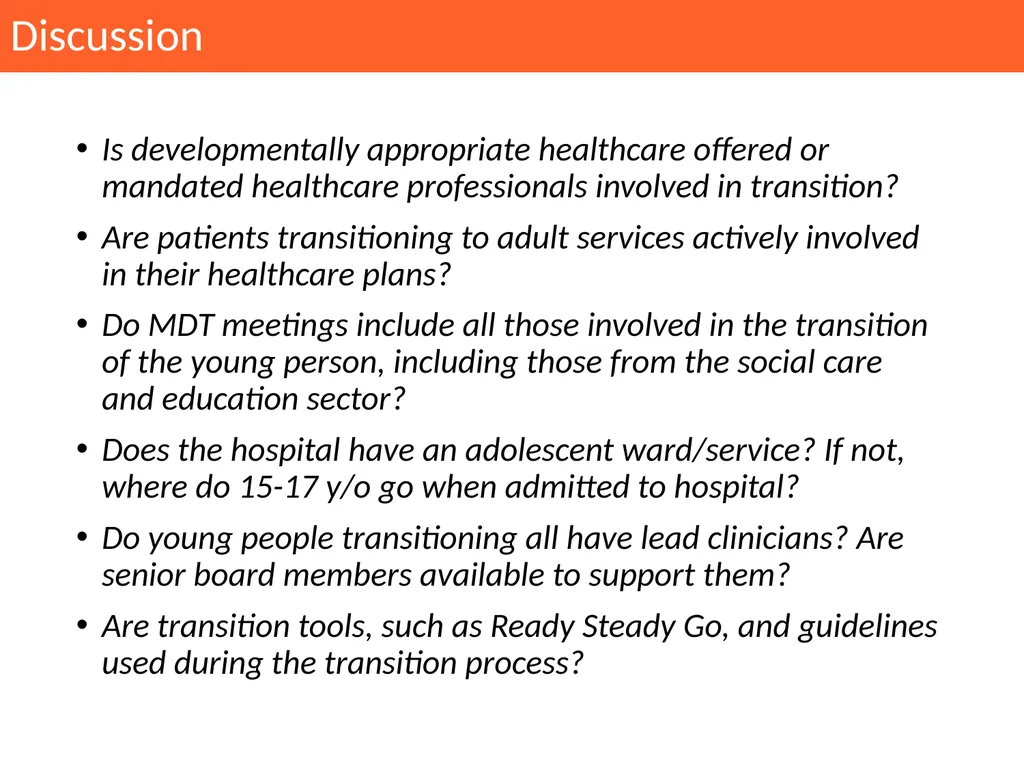
Discussion Is developmentally appropriate healthcare offered or mandated healthcare professionals involved in transition?
Are patients transitioning to adult services actively involved in their healthcare plans?
Do MDT meetings include all those involved in the transition of the young person, including those from the social care and education sector?
Does the hospital have an adolescent ward/service? If not, where do 15-17 y/o go when admitted to hospital?
Do young people transitioning all have lead clinicians? Are senior board members available to support them?
Are transition tools, such as Ready Steady Go, and guidelines used during the transition process?<br>
24
The Inbetweeners Full report, summary and implementation tools are be found at
https://www.ncepod.org.uk/2023transition.html<br>
https://www.ncepod.org.uk/2023transition.html<br>