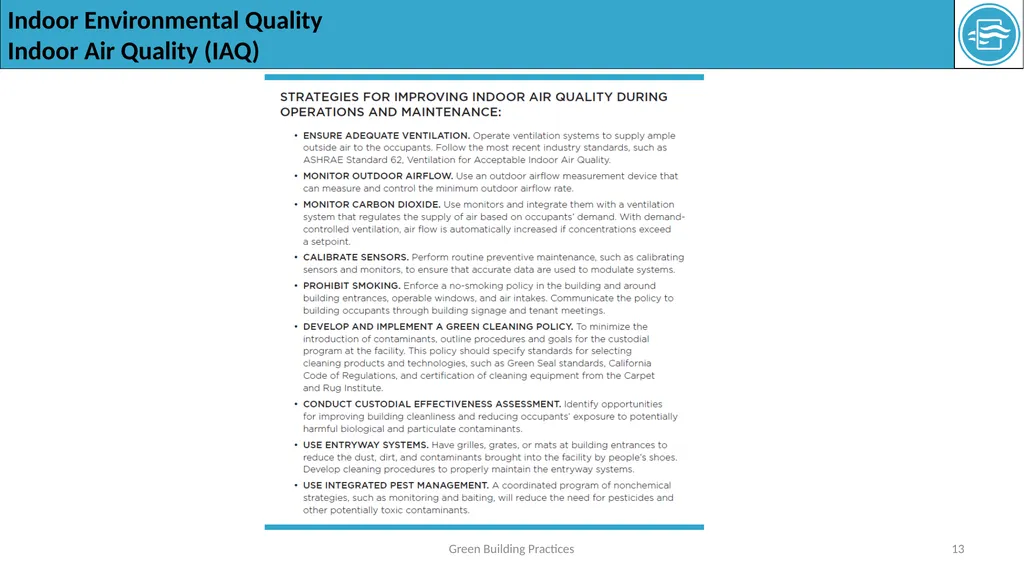
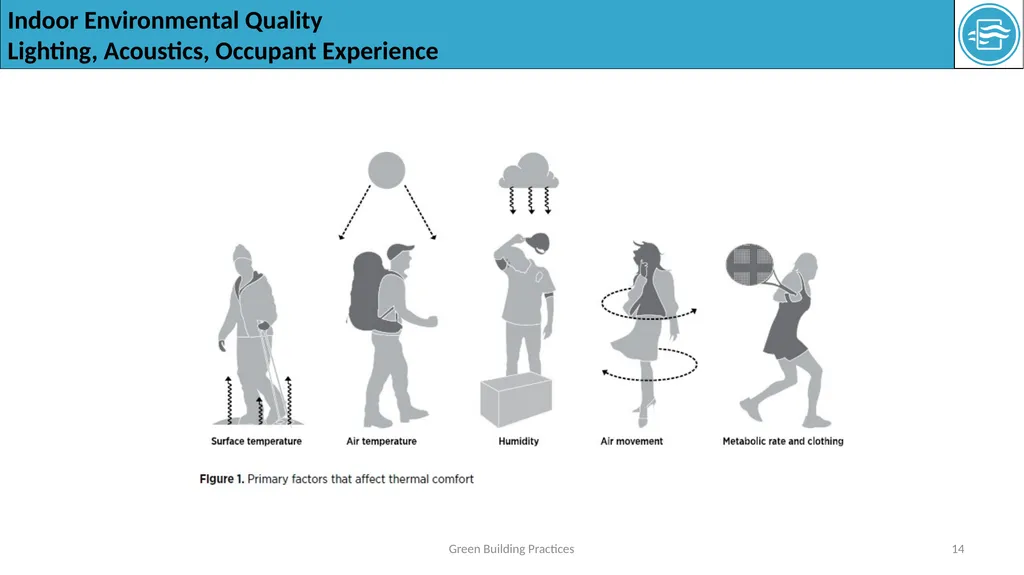
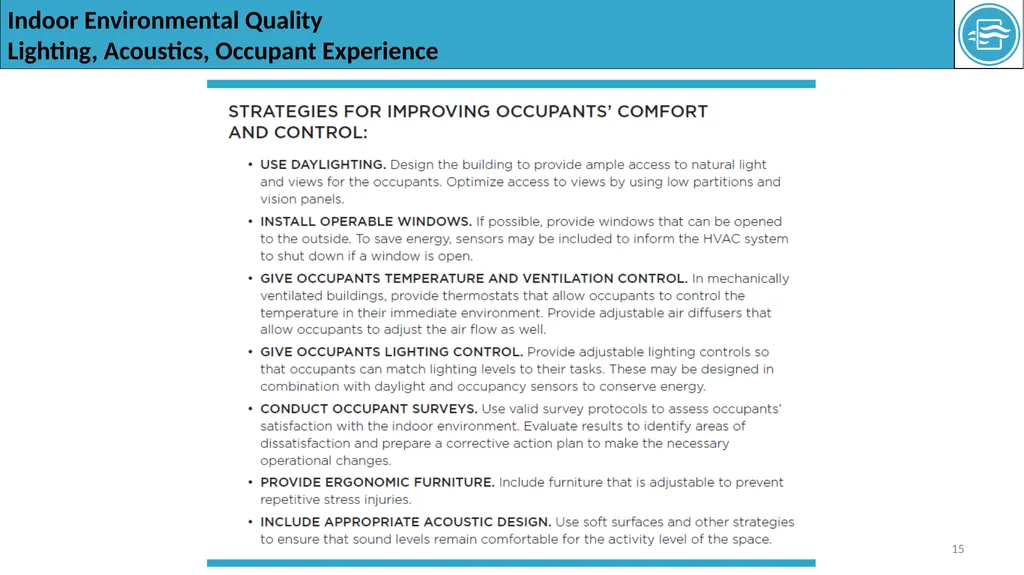
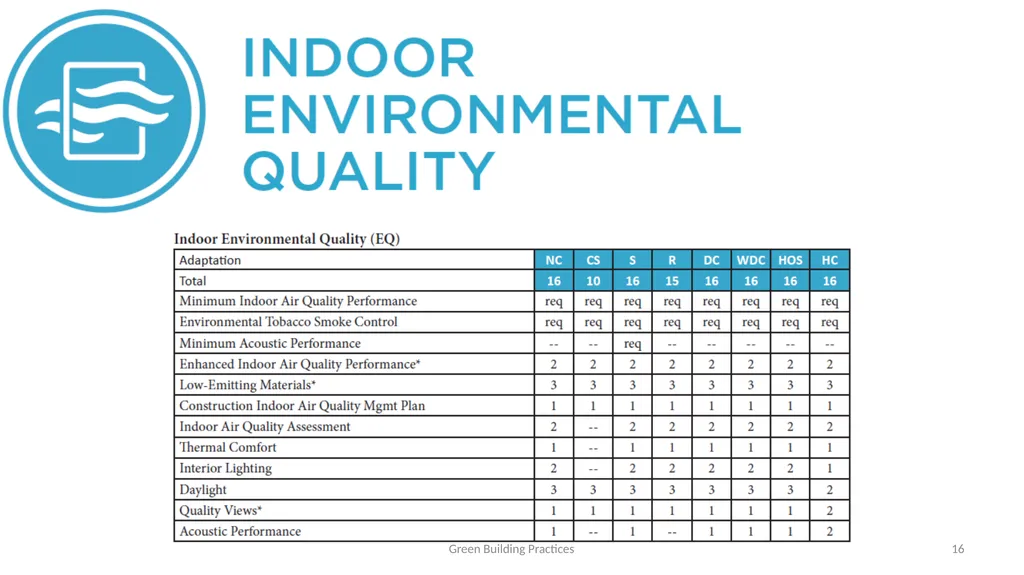
The Indoor Environmental Quality (EQ) category addresses: Indoor Air Quality Thermal, visual, and acoustic comfort Green Building Practices 1 High-quality indoor environments: Enhance productivity Decrease absenteeism Improve the buildings
"The Indoor Environmental Quality (EQ) category" is the property of its rightful owner. Permission is granted to
download and print the materials on this website for personal, non-commercial use only, and to display it
on your personal computer provided you do not modify the materials and that you retain all copyright
notices contained in the materials. By downloading content from our website, you accept the terms of this
agreement.
Presentation Transcript
01
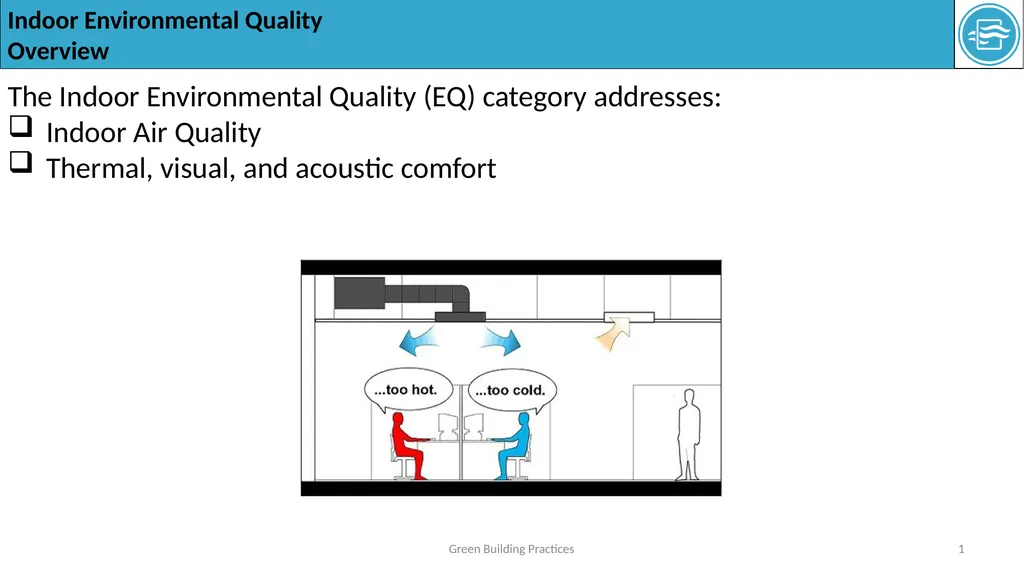
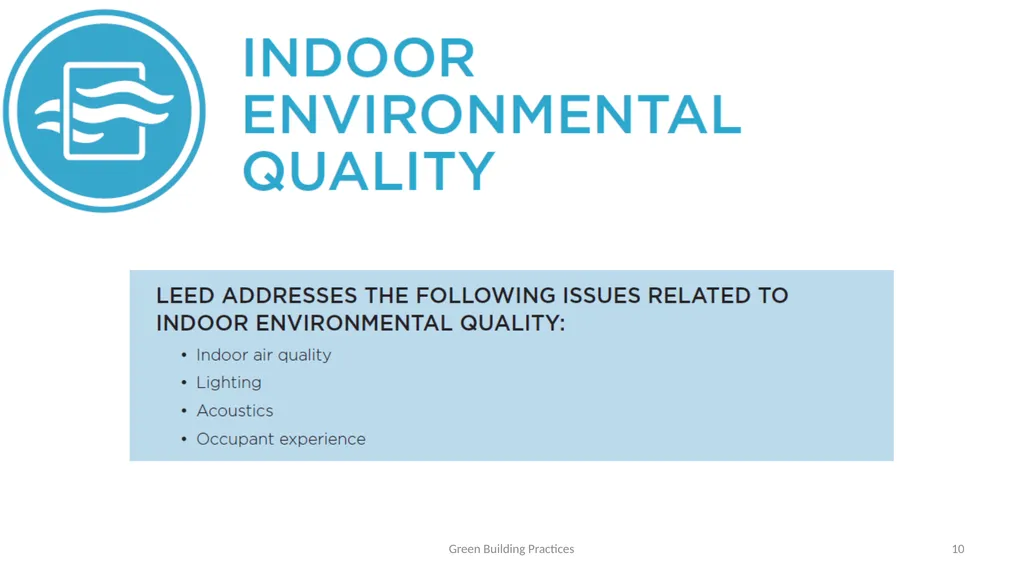
The Indoor Environmental Quality (EQ) category addresses:
Indoor Air Quality
Thermal, visual, and acoustic comfort Green Building Practices 1<br>
02
High-quality indoor environments:
Enhance productivity
Decrease absenteeism
Improve the building’s value
Reduce liability for building designers and owners Green Building Practices 2<br>
03
The Indoor Environmental Quality (EQ) category addresses:
Indoor Air Quality
Thermal, visual, and acoustic comfort Green Building Practices 3<br>
04
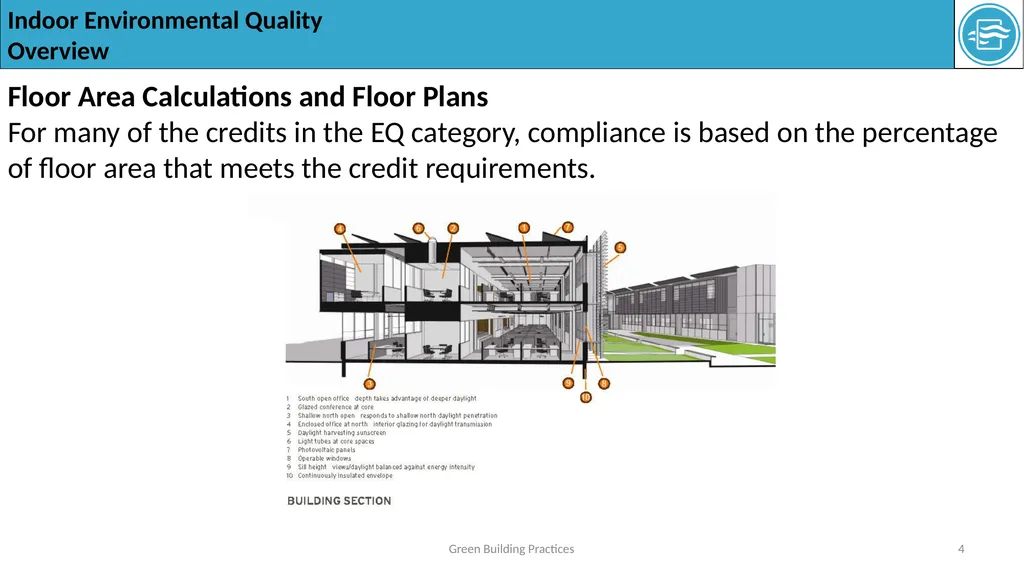
Floor Area Calculations and Floor Plans
For many of the credits in the EQ category, compliance is based on the percentage of floor area that meets the credit requirements. Green Building Practices 4<br>
05
Space categorization
Occupied versus unoccupied space
All spaces in a building must be categorized as either occupied or unoccupied.
Occupied spaces are enclosed areas intended for human activities.
Unoccupied spaces are places intended primarily for other purposes; they are occupied only occasionally and for short periods of time—in other words, they are inactive areas. Green Building Practices 5<br>
06
Regularly versus nonregularly occupied spaces
Occupied spaces are further classified as regularly occupied or nonregularly occupied, based on the duration of the occupancy.
Regularly occupied spaces are enclosed areas where people normally spend time, defined as more than one hour of continuous occupancy per person per day, on average; the occupants may be seated or standing as they work, study, or perform other activities. Green Building Practices 6<br>
07
For spaces that are not used daily, the classification should be based on the time a typical occupant spends in the space when it is in use.
For example, a computer workstation may be largely vacant throughout the month, but when it is occupied, a worker spends one to five hours there. It would then be considered regularly occupied because that length of time is sufficient to affect the person’s well-being, and he or she would have an expectation of thermal comfort and control over the environment. Green Building Practices 7<br>
08
Occupied Space Subcategories
Occupied spaces, or portions of an occupied space, are further categorized as individual or shared multioccupant, based on the number of occupants and their activities.
An individual occupant space is an area where someone performs distinct tasks.
A shared multioccupant space is a place of congregation or a place where people pursue overlapping or collaborative tasks. Green Building Practices 8<br>
09
Occupied Space Subcategories
Occupied spaces can also be classified as densely or non-densely occupied, based on the concentration of occupants in the space.
A densely occupied space has a design occupant density of 25 people or more per 1,000 square feet, or 40 square feet or less per person.
Occupied spaces with a lower density are non-densely occupied. Green Building Practices 9<br>