03
WWI brought about a new political order in the region that has lasted to this very day.
the creation of the current state system in the region
On December 18, 1914, Great Britain unilaterally declared the establishment of a protectorate over Egypt
By the early 1920s, Turkey was an independent republic
North African provinces had all been occupied
Asiatic Arab provinces had been divided into what would become separate states
a large part of the Arabian peninsula had been united under the control of the Saudi dynasty
A variety of nationalisms --Turkish, Arab, Syrian, Egyptian-- spread throughout the region<br>
04
Background The Ottoman Empire, a modernizing state in the 19th century, sought to establish a sovereign state and to enjoy full membership in the international state system
A member of the Concert of Europe since 1856 and the end of the Crimean War
Diplomatic, political and political losses since 1878 country in financial ruin and demoralized<br>
05
In the face of those losses, a radical leadership emerged, organizing itself as the Committee of Union and Progress
Belief that only military power could preserve the Empire
In the context of the Balkan Wars in 1911-13, the CUP seized control in 1913<br>
06
The Ottoman government first thought of the War as a European affair
The Entente Powers promised the protection of the Ottoman Empire’s territorial integrity
Promise rejected by the Ottomans: privy to exchanges that indicated otherwise
Russian ambassador’s note of August 6, 1914: “the Ottoman Empire be kept neutral until that point in time when circumstances permit our own firm entrance into the Straits.”
Biggest Ottoman fear: the European war might precipitate Russian seizure of Istanbul and the Straights<br>
07
A minority within the CUP hoped for closer ties to France and Russia
Majority favored the Triple Alliance
CUP proposed alliance with the Central Powers or the Empire would side with the Entente
Germans feared loss of investments and of a chance to gain a sphere of dominance in the Near East
A German-Ottoman alliance was signed on August 2, 1914
The Ottomans thought of it more as a defensive alliance<br>
08
A naval attack on Russia, October 27-31, 1914
Precipitation of the Empire’s entry into the war
Russian retaliation at the Ottoman-Russian borders
British and French warships opened fire at Ottoman troops in Çanakkale south of the Dardanelles and in Aqaba in Jordan<br>
09
The Battle of Gallipoli: an attempt by the Allied Powers to control the sea route from Europe to Russia
A naval attack followed by land invasion on April 1925
Participation of French and British troops and divisions of ANZAC (Australian and New Zealand Army Corps)
Fierce Ottoman resistance
Lack of Allies’ knowledge of the terrain of the battle
Evacuation in December 1915<br>
10
Calamities of the War The war known also as The Famine war
Devastation in the region
4 out of every 5 Ottoman citizens died as non-combatant
In Mount Lebanon: famine killed about half the population
Causes: Entente’s blockade, snowy winters, locusts, conscription, war requisition, currency devaluation, official inefficiency<br>
11
Calamities The Ethnic Cleansing of Armenians
Between 800-000 and a million and a half Armenians perished
The debate over the genocidal aspects surrounding the death of Armenians<br>
12
In the meantime, the Entente powers began to maneuver to claim the spoils of war in the event of a victory
Starting in 1915: negotiations of secret treaties
1915: the Arab revolt
The British promised the Emir of Mecca, Sharif Husayn, gold, guns and an independent Arab state in Ottoman territories in return for a revolt against the Ottoman government<br>
13
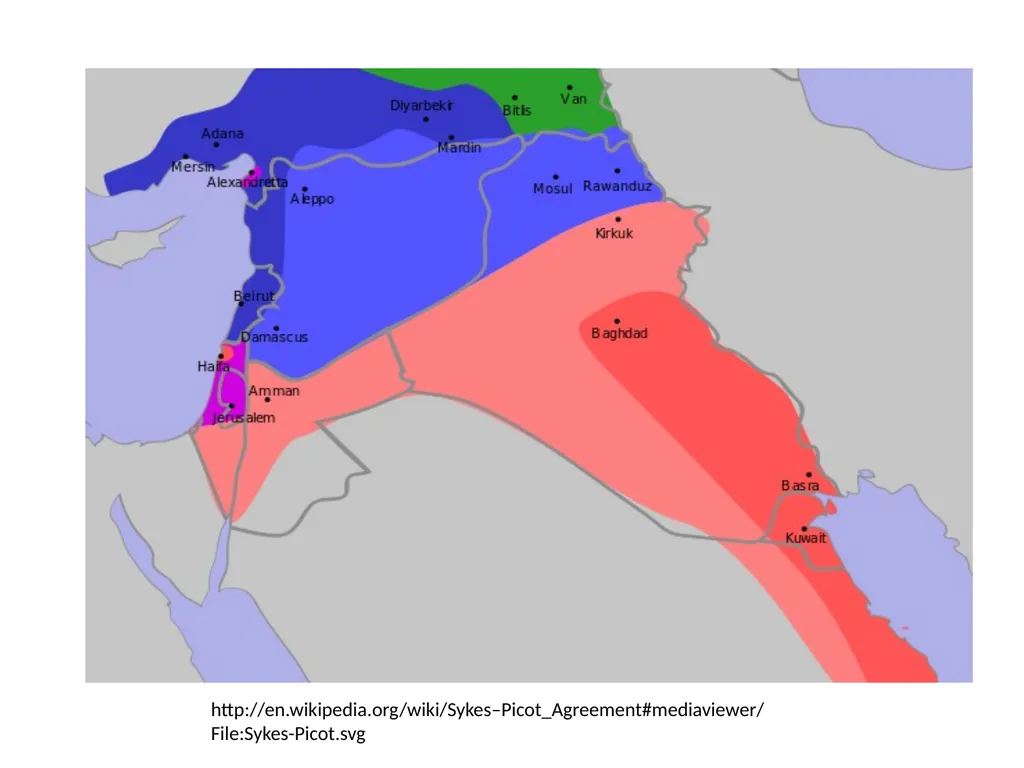
Sykes-Picot agreement: secret agreement between France and Britain to divide up most of the Arab Middle East between them
the treaty awarded France a large zone of direct control stretching along the Syrian coast from southern Lebanon into Anatolia and a sphere of exclusive indirect influence in the Syrian interior. Britain gained Iraq and a zone from Gaza to Kirkuk
In another treaty, Russia was promised the Turkish straits<br>
14
http://en.wikipedia.org/wiki/Sykes–Picot_Agreement#mediaviewer/File:Sykes-Picot.svg<br>
15
Another pledge but made openly: the Balfour declaration of November 1917 for a ‘national home’ in Palestine for Jews around the world
the Palestinian mandate: was not a distinctive administrative entity during the Ottoman era but was regarded as part of southern Syria and was divided by the late 19th century between the provinces of Beirut and Damascus with the special administrative unit of Jerusalem
The British capture of Jerusalem in December 1917 detached Palestine from Ottoman rule and led to its being placed under British military occupation from 1917 to 1920
In 1920: Britain was awarded the mandate for Palestine and the military government was replaced by a civilian administration<br>
16
Paris meeting: creation of the League of Nations with its charter sanctioning French and British designs for the Levant and Mesopotamia => France got the mandate for the territory that now includes Syria and Lebanon while Britain got the mandate for the territory that now includes Israel, the Palestinian Occupied Territories, Jordan and Iraq
the inhabitants of the region were never seriously consulted about their future<br>
17
the mandate system: a thinly disguised imperialism
absolute rights of France and Britain over the internal affairs of their mandates, both economically and politically
the creation of Iraq by joining three Ottoman provinces: Baghdad, Mosul and Basra
creation of Lebanon, what the French thought would be a permanent Christian enclave
the Palestine mandate divided Palestine into separate regions, one that would be Israel/Occupied Territories and another that would become Jordan<br>
18
In the wake of the Arab revolt: troops under the command of Amir Faysal had occupied Damascus
The French opposed Faysal and sent an army to Damascus to depose him
The British reacted passively to the dismissal of their client
another son of Sharif Husayn, ‘Abd allah, marched north from his home in Mecca to avenge his brother’s humiliation
persuaded by the British to remain in the town of Amman
the Cairo Conference in 1921: Palestine mandate divided into 2 parts: one, east of the Jordan River, called trans-Jordan and given to Abd Allah and closed to Zionist immigration
After independence in 1946, trans-Jordan became the Hashemite kingdom of Jordan
Faysal granted the throne of Iraq. His descendants ruled Iraq until 1958.<br>
19
Modern Turkey Entente power’s occupation of Istanbul
1920: Treaty of Sevres
formally severed Turkish connections between Turkish and non-Turkish regions
Divided Western Anatolia among Greece, Italy, and France
Expansive Greek ambitions
Resistance in unoccupied Anatolia by the “Committees for the Defense of Rights”<br>
20
Mustafa Kemal dispateched from Istanbul to suppress the Committees
Instead, he took charge of the rebellion
Foreign troops ousted
Mustafa Kemal adopted the name “Ataturk”, father of the Turks
Guided the establishment of a Turkish republic in Anatolia<br>
21
Ataturk abolished the caliphate, established a secular state and latinized the Turkish alphabet
He granted women the right to vote in 1934 (11 years before France did)
Unabashed westernization
Expanded the role of the state and spread one official ideology
Relatively free elections<br>
22
The dark side of nationalism:
“Population transfer”:under guidelines set by the League of Nations, about a million and a half Christian Turks forced out of the country
About half a million Greek Muslims went to Turkey
Suppression of Kurdish separatism
“Turkification” of Kurds and Arabs<br>
23
Growing opposition to uncompromising secularism since the 1950s<br>