04
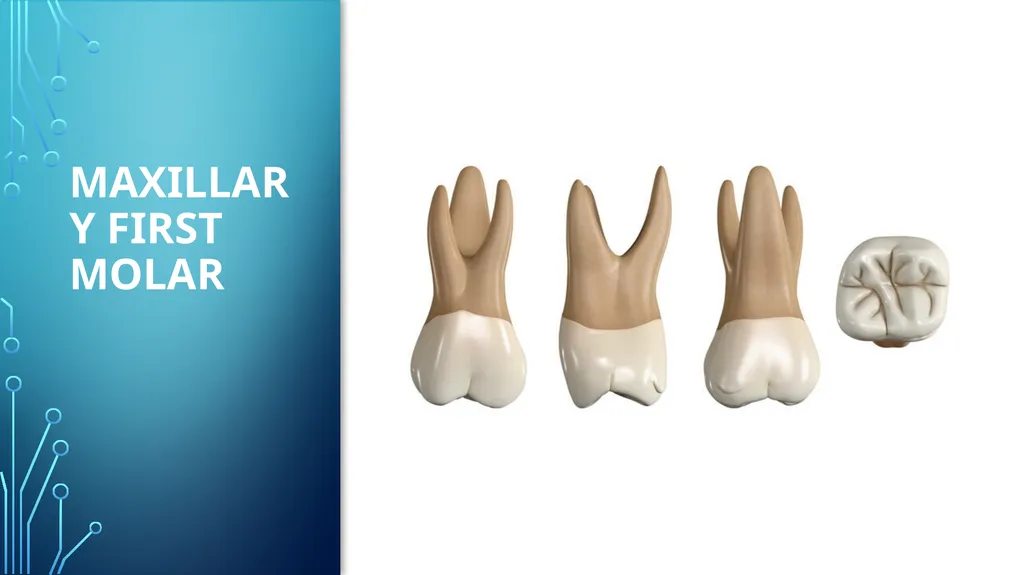
Maxillary First Molar<br>
05
General Characteristics Arch position: 6th tooth from midline
Mesially, contacts primary 2nd molar and later 2nd premolar
Largest tooth in maxillary arch
Largest crown in mouth
Least variable in anatomic form among max molars<br>
06
Cont.. The crown of this tooth is wider buccolingually than mesiodistally.
the crown is relatively short, it is broad both mesiodistally and buccolingually, which gives the occlusal surface its generous dimensions.
The maxillary first molar is normally the largest tooth in the maxillary arch.
It has four well-developed functioning cusps and one supplemental cusp of little practical use.<br>
07
Cont.. The four large cusps are the mesiobuccal, the distobuccal, the mesiolingual, and the distolingual.
A supplemental cusp is called the cusp or tubercle of Carabelli.
This morphological trait can take the form of a well-developed fifth cusp, or it can grade down to a series of grooves, depressions, or pits on the mesial portion of the lingual surface.
This trait has been used to distinguish populations.<br>
08
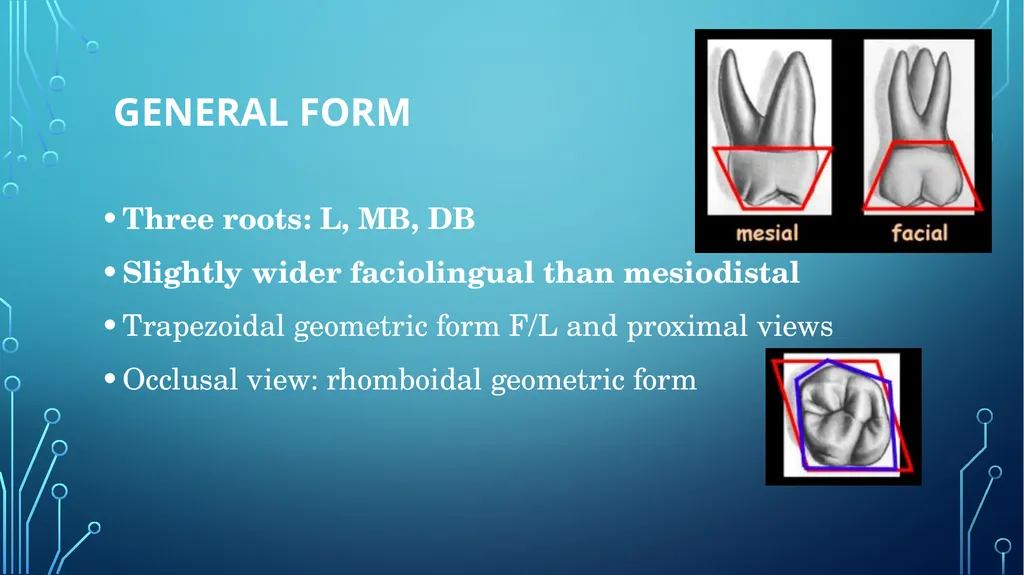
General form Three roots: L, MB, DB
Slightly wider faciolingual than mesiodistal
Trapezoidal geometric form F/L and proximal views
Occlusal view: rhomboidal geometric form<br>
09
DETAILED DESCRIPTION OF THE MAXILLARY FIRST MOLAR FROM ALL ASPECTS<br>
10
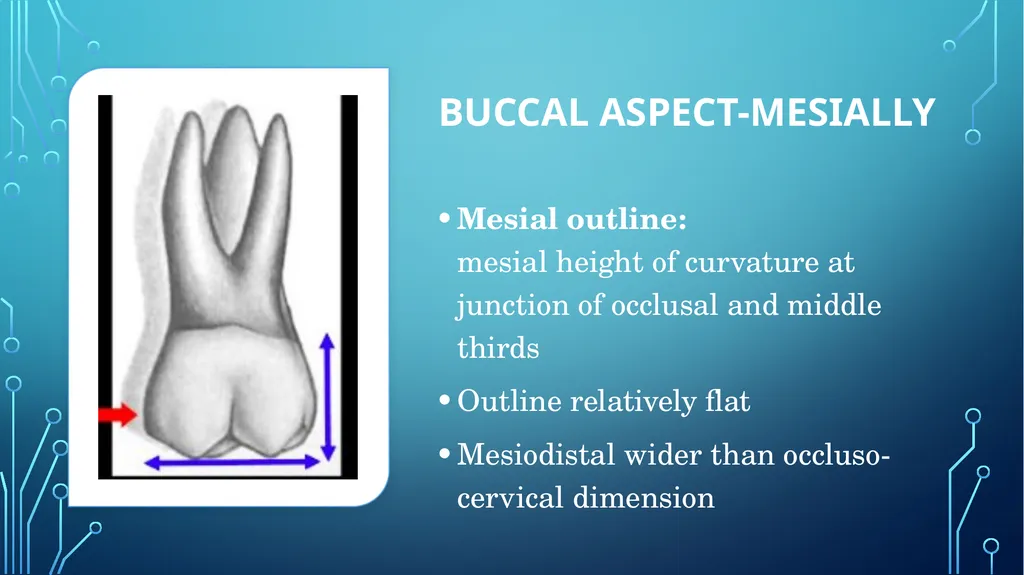
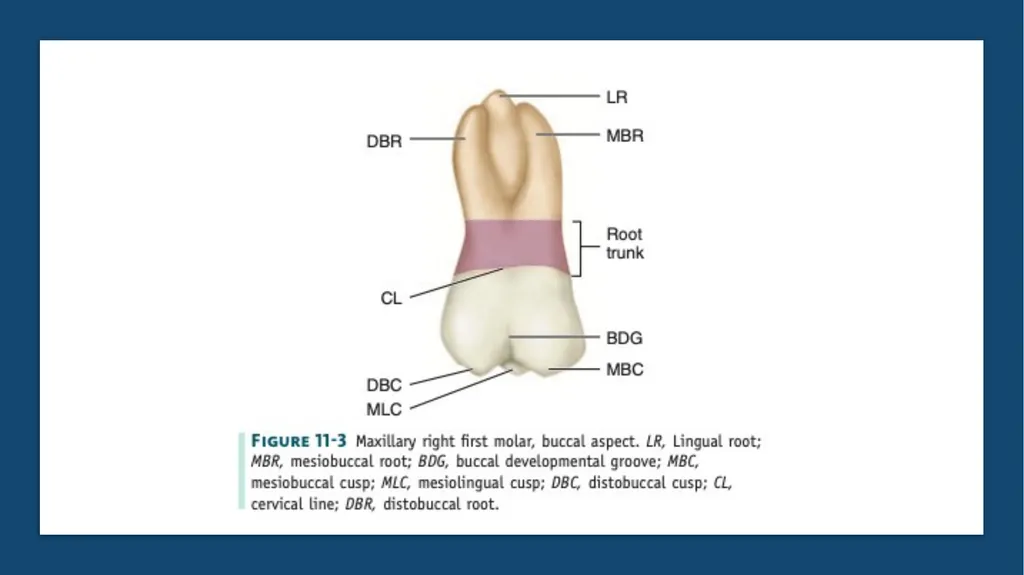
Buccal aspect-mesially Mesial outline:�mesial height of curvature at junction of occlusal and middle thirds
Outline relatively flat
Mesiodistal wider than occluso-cervical dimension<br>
11
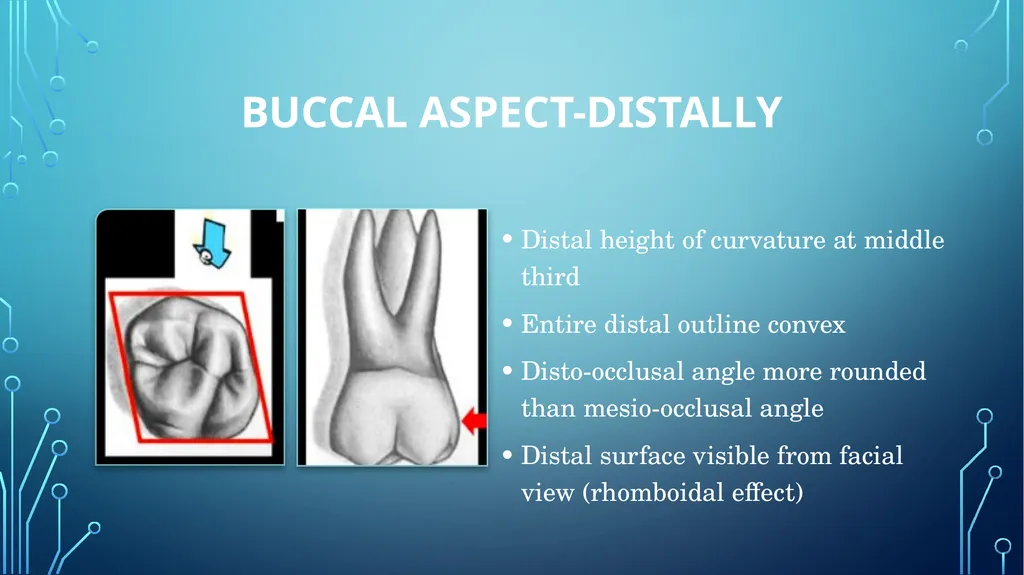
Buccal aspect-distally Distal height of curvature at middle third
Entire distal outline convex
Disto-occlusal angle more rounded than mesio-occlusal angle
Distal surface visible from facial view (rhomboidal effect)<br>
12
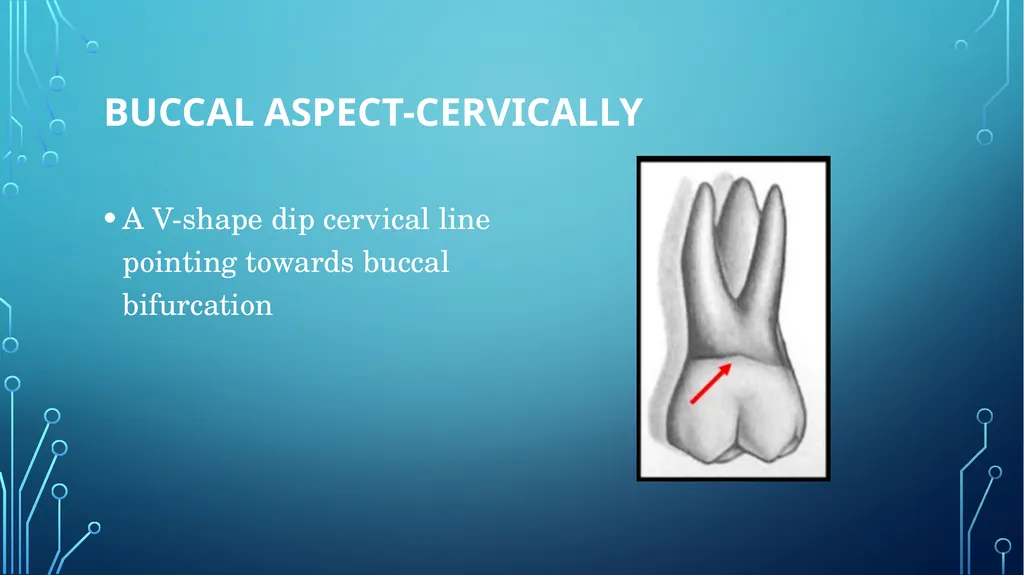
Buccal aspect-cervically A V-shape dip cervical line pointing towards buccal bifurcation<br>
13
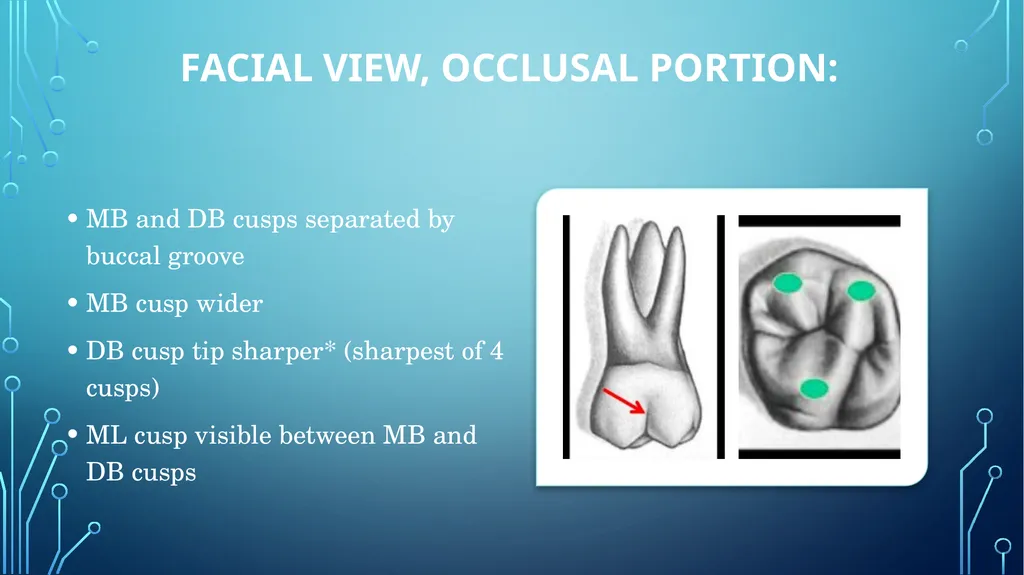
Facial view, occlusal portion: MB and DB cusps separated by buccal groove
MB cusp wider
DB cusp tip sharper* (sharpest of 4 cusps)
ML cusp visible between MB and DB cusps<br>
14
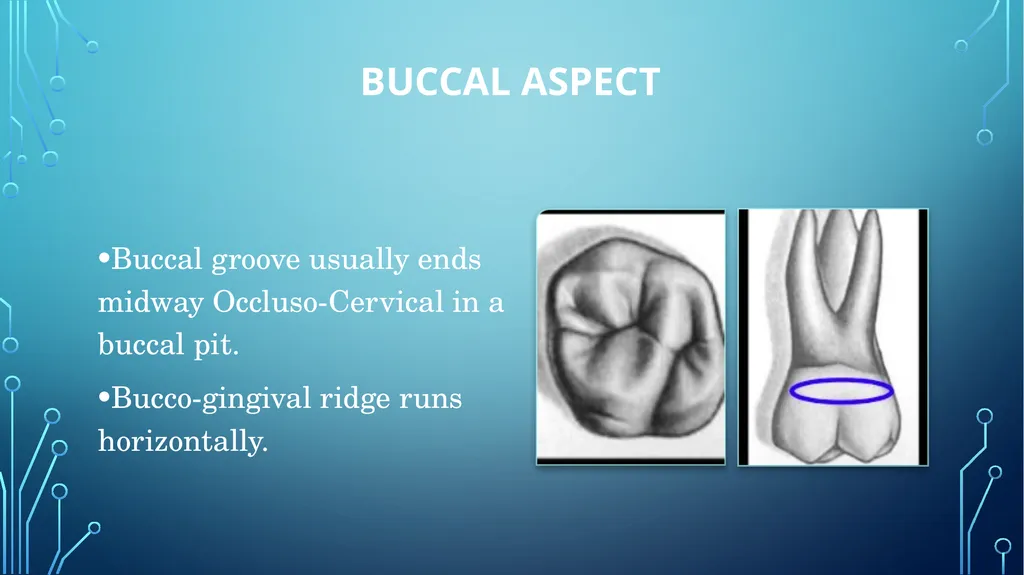
Buccal aspect Buccal groove usually ends midway Occluso-Cervical in a buccal pit.
Bucco-gingival ridge runs horizontally.<br>
15
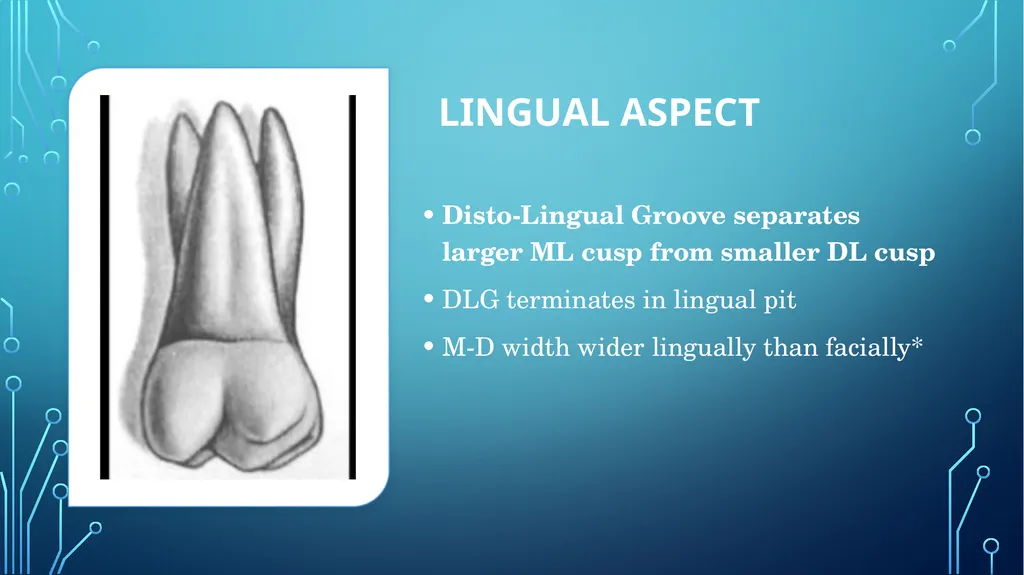
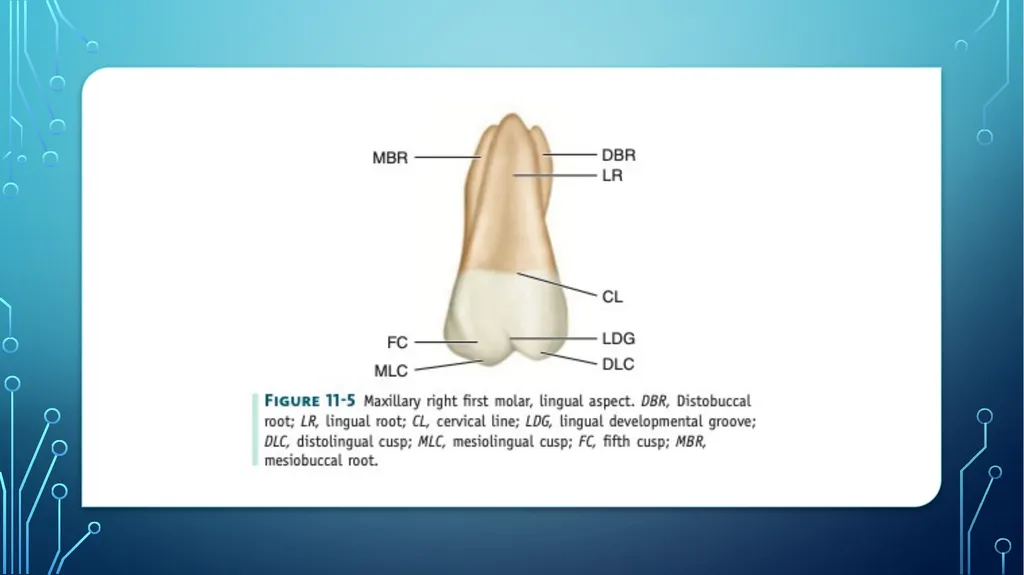
Lingual aspect Disto-Lingual Groove separates larger ML cusp from smaller DL cusp
DLG terminates in lingual pit
M-D width wider lingually than facially*<br>
16
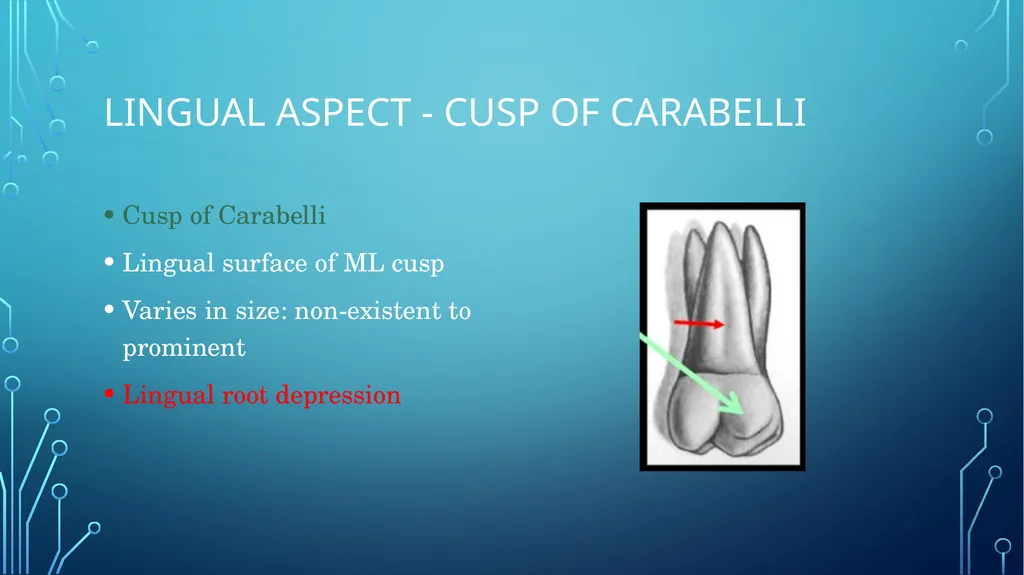
Lingual aspect - Cusp of Carabelli Cusp of Carabelli
Lingual surface of ML cusp
Varies in size: non-existent to prominent
Lingual root depression<br>
17
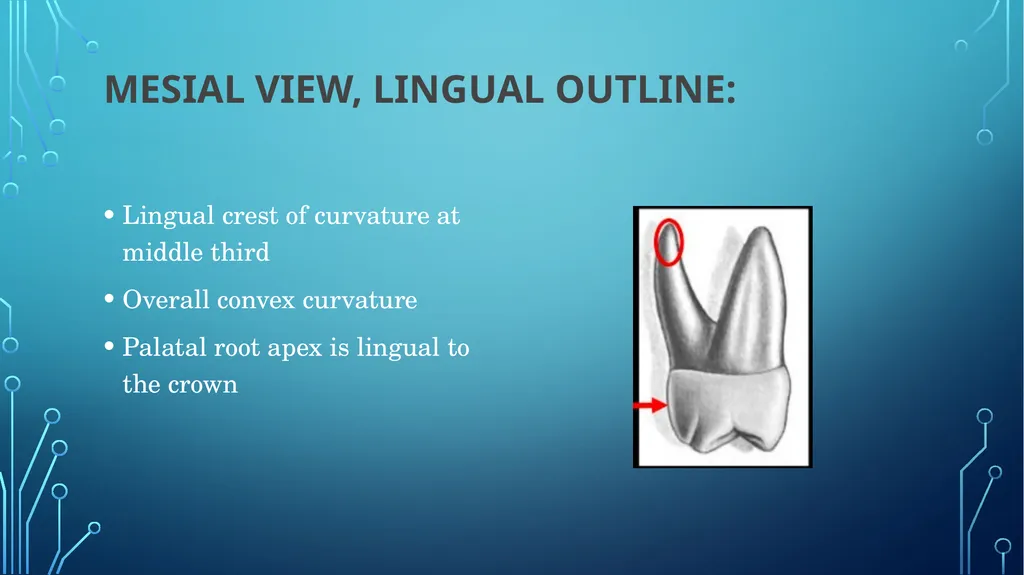
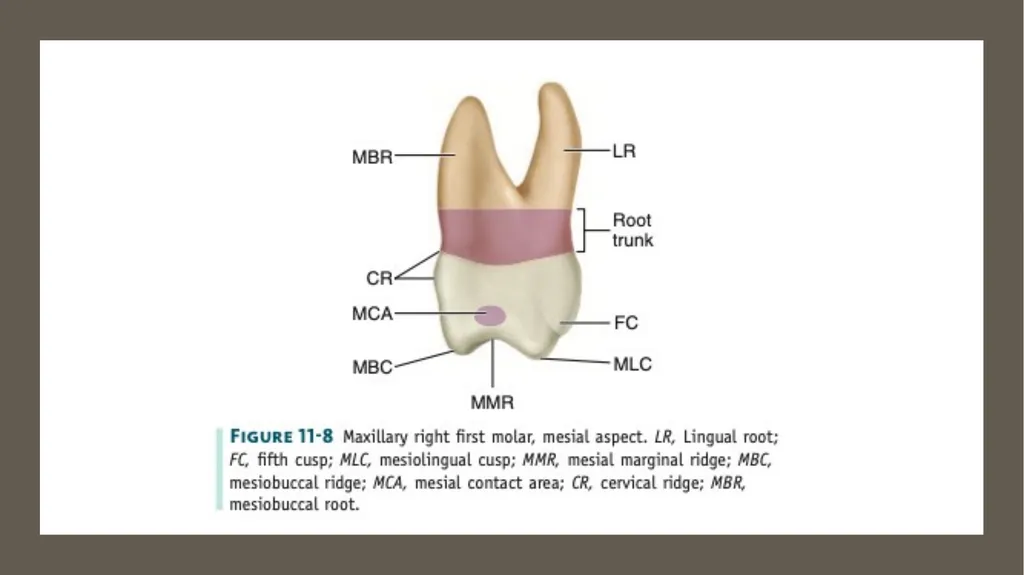
Mesial view, lingual outline: Lingual crest of curvature at middle third
Overall convex curvature
Palatal root apex is lingual to the crown<br>
18
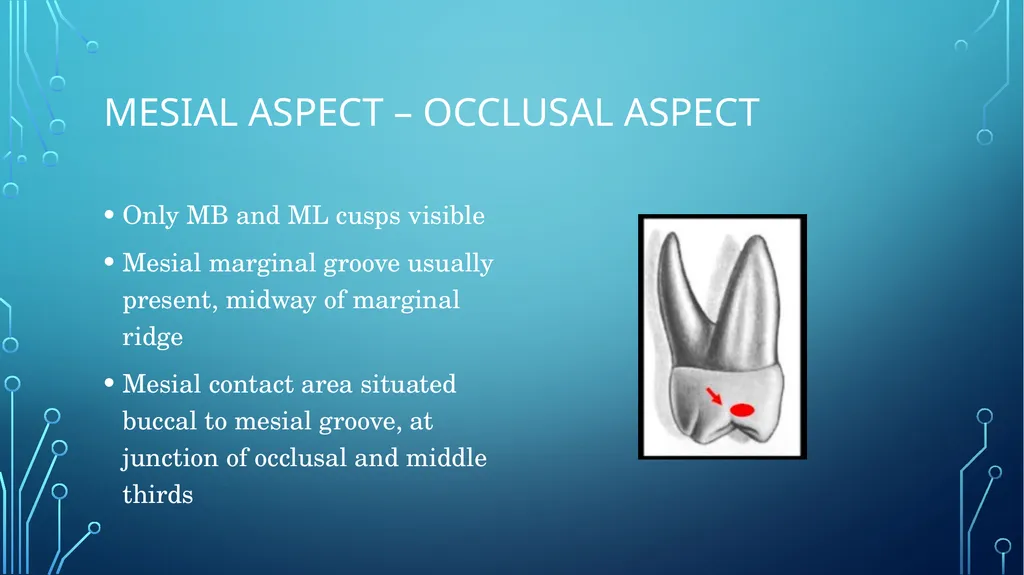
Mesial aspect – occlusal aspect Only MB and ML cusps visible
Mesial marginal groove usually present, midway of marginal ridge
Mesial contact area situated buccal to mesial groove, at junction of occlusal and middle thirds<br>
19
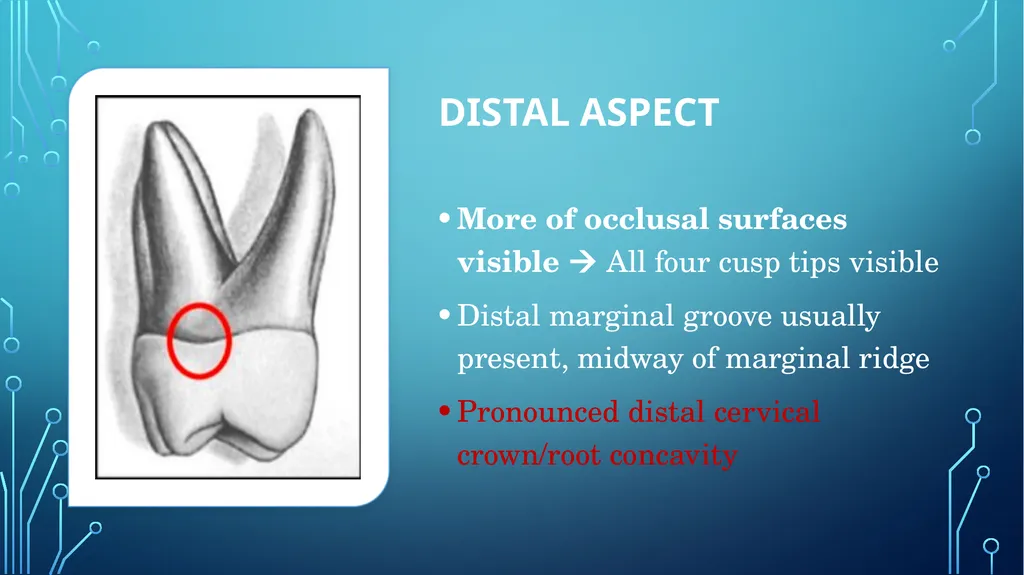
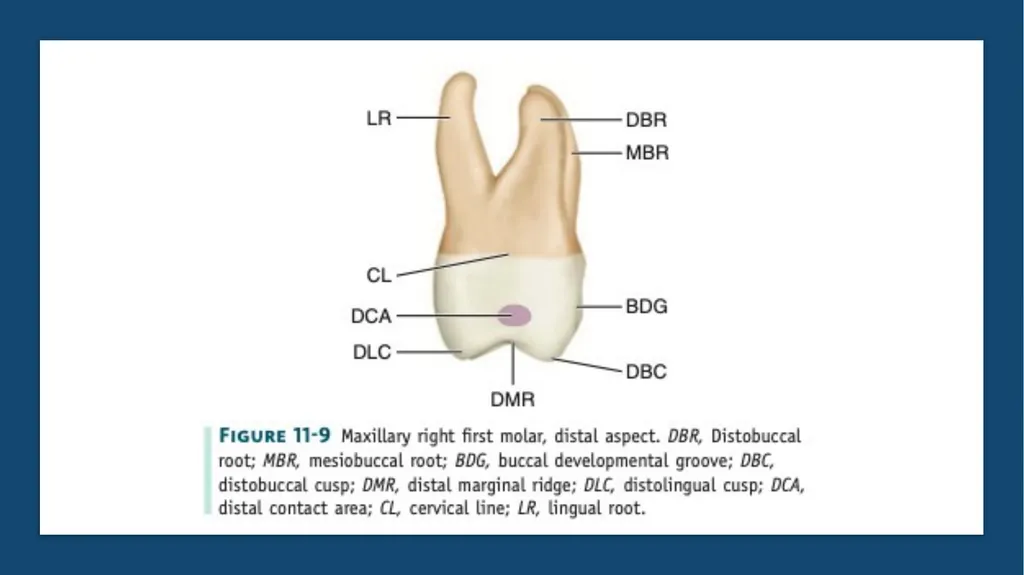
Distal aspect More of occlusal surfaces visible All four cusp tips visible
Distal marginal groove usually present, midway of marginal ridge
Pronounced distal cervical crown/root concavity<br>
20
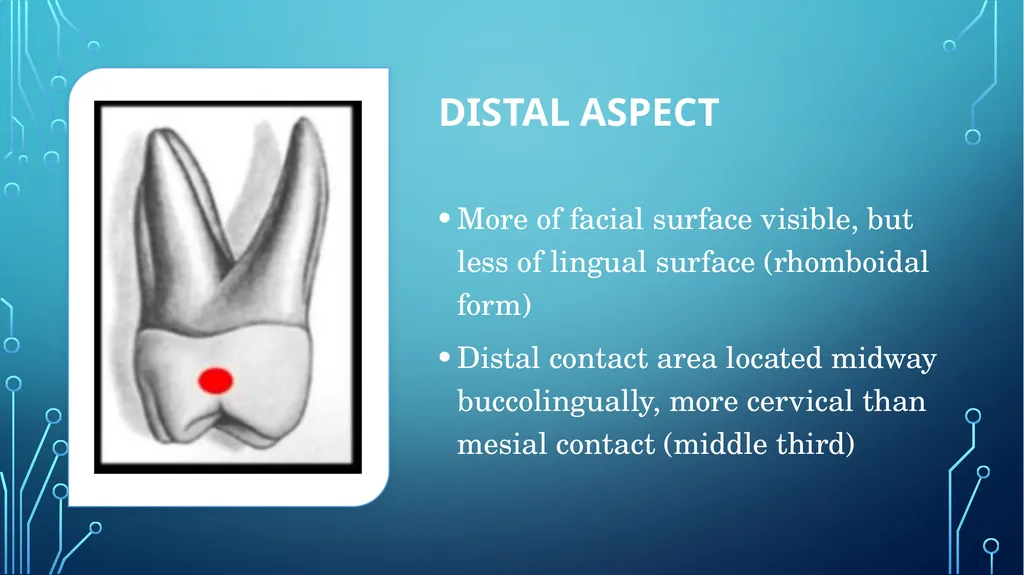
Distal aspect More of facial surface visible, but less of lingual surface (rhomboidal form)
Distal contact area located midway buccolingually, more cervical than mesial contact (middle third)<br>
21
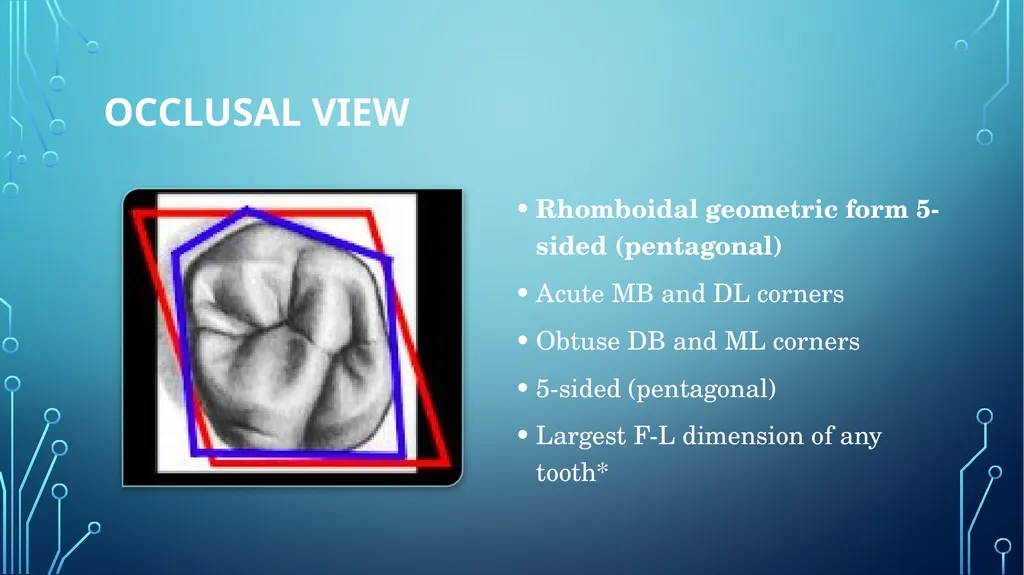
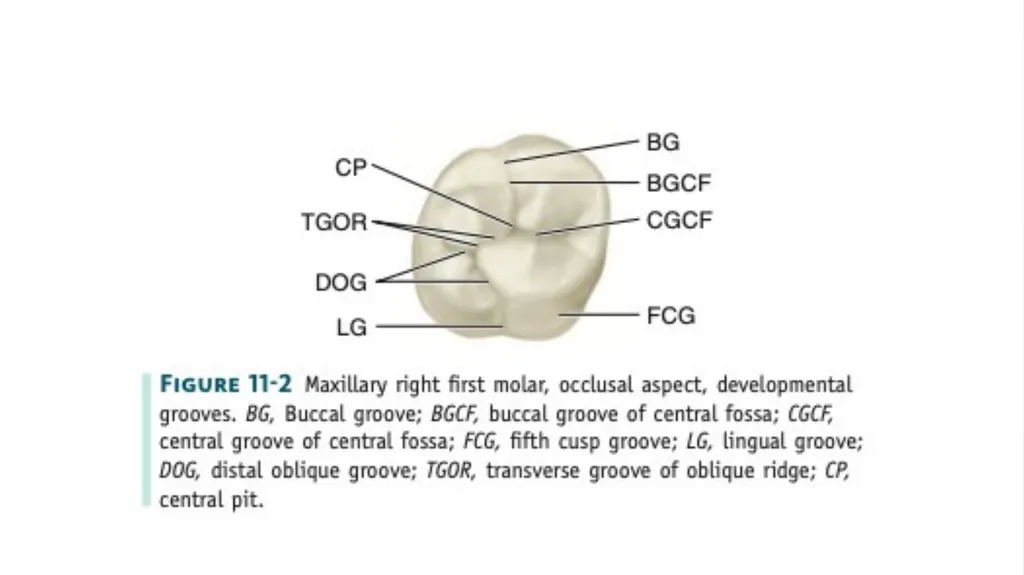
Occlusal View Rhomboidal geometric form 5-sided (pentagonal)
Acute MB and DL corners
Obtuse DB and ML corners
5-sided (pentagonal)
Largest F-L dimension of any tooth*<br>
22
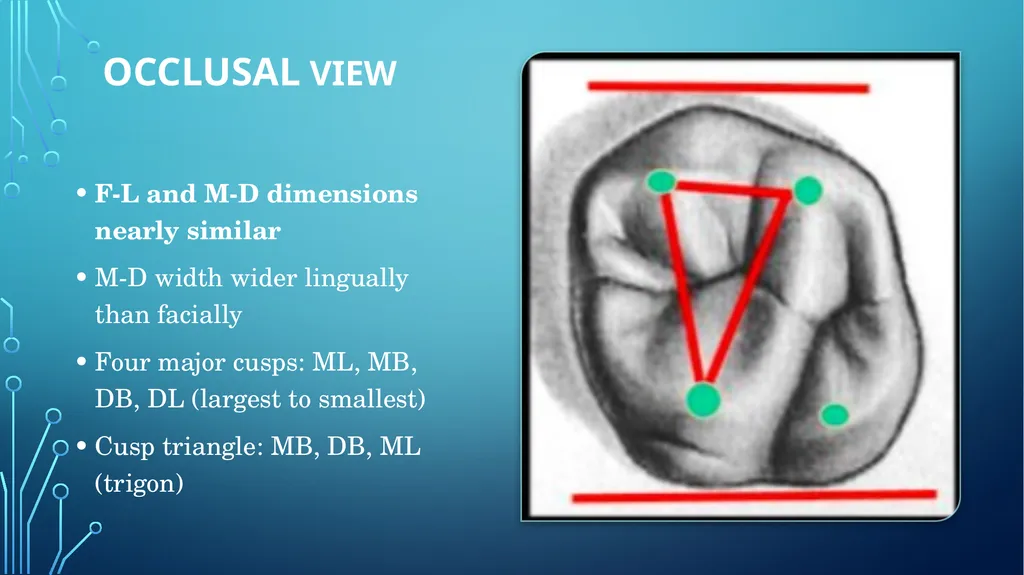
Occlusal view F-L and M-D dimensions nearly similar
M-D width wider lingually than facially
Four major cusps: ML, MB, DB, DL (largest to smallest)
Cusp triangle: MB, DB, ML (trigon)<br>
23
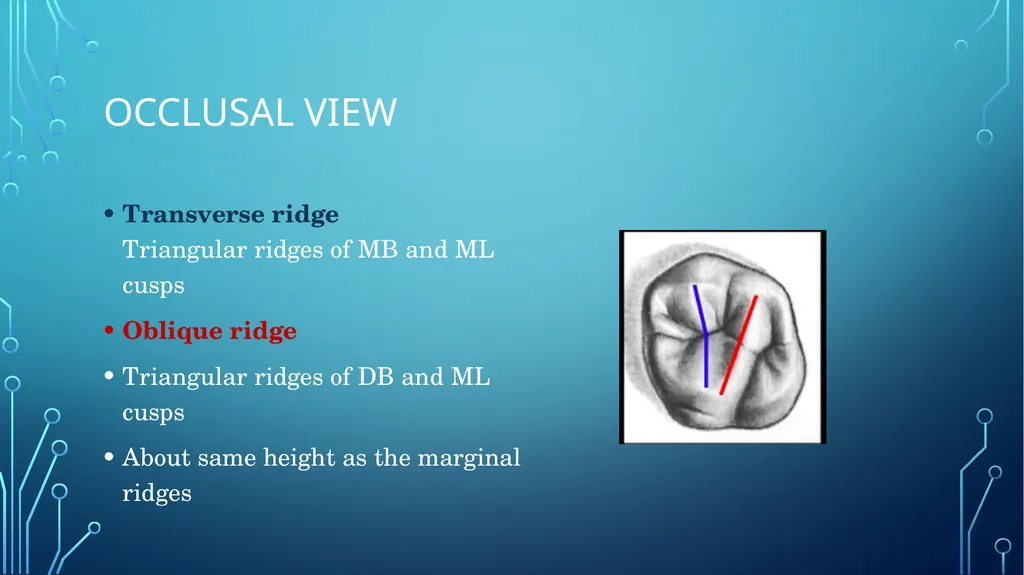
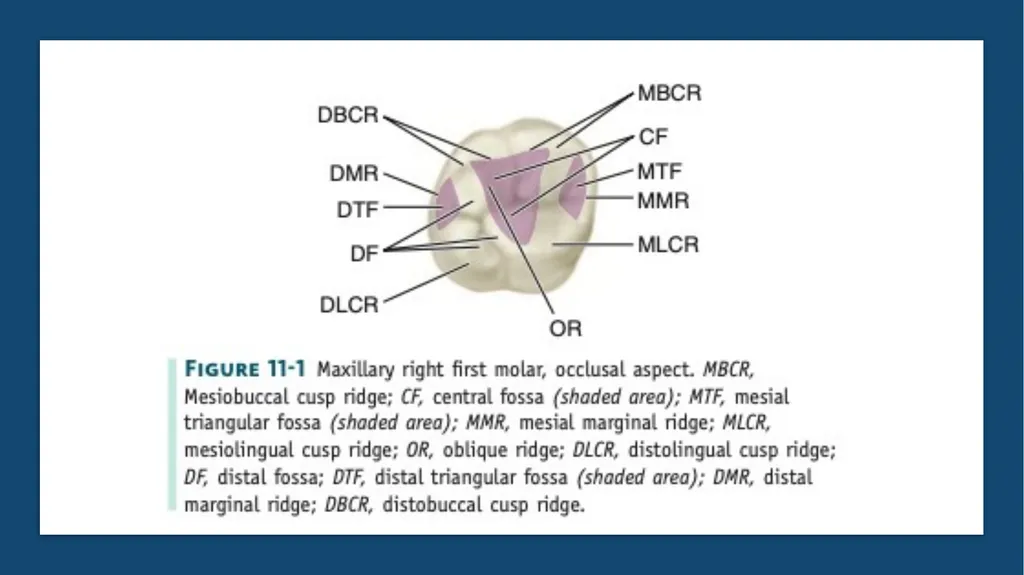
Occlusal view Transverse ridge�Triangular ridges of MB and ML cusps
Oblique ridge
Triangular ridges of DB and ML cusps
About same height as the marginal ridges<br>
24
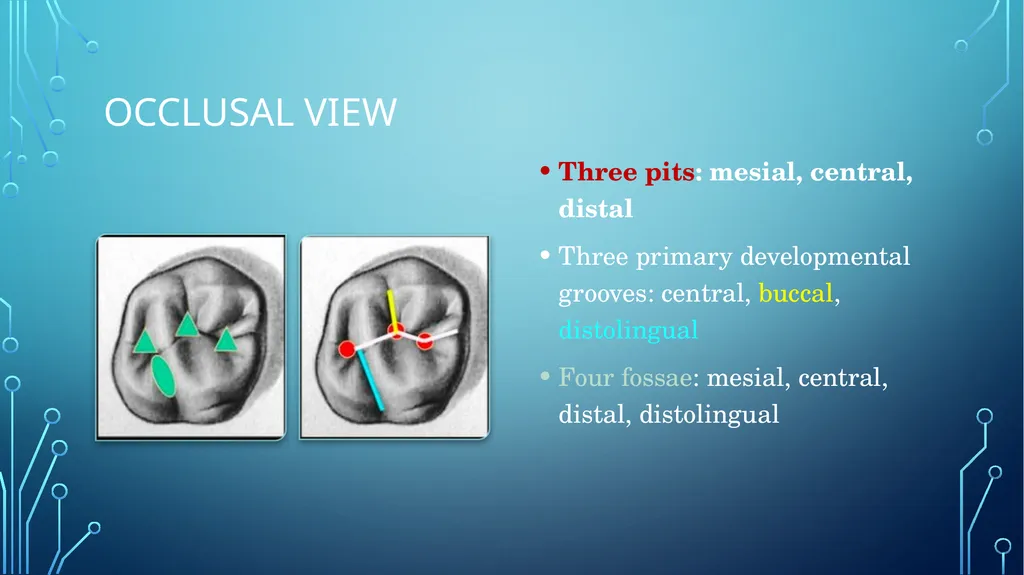
Occlusal view Three pits: mesial, central, distal
Three primary developmental grooves: central, buccal, distolingual
Four fossae: mesial, central, distal, distolingual<br>
25
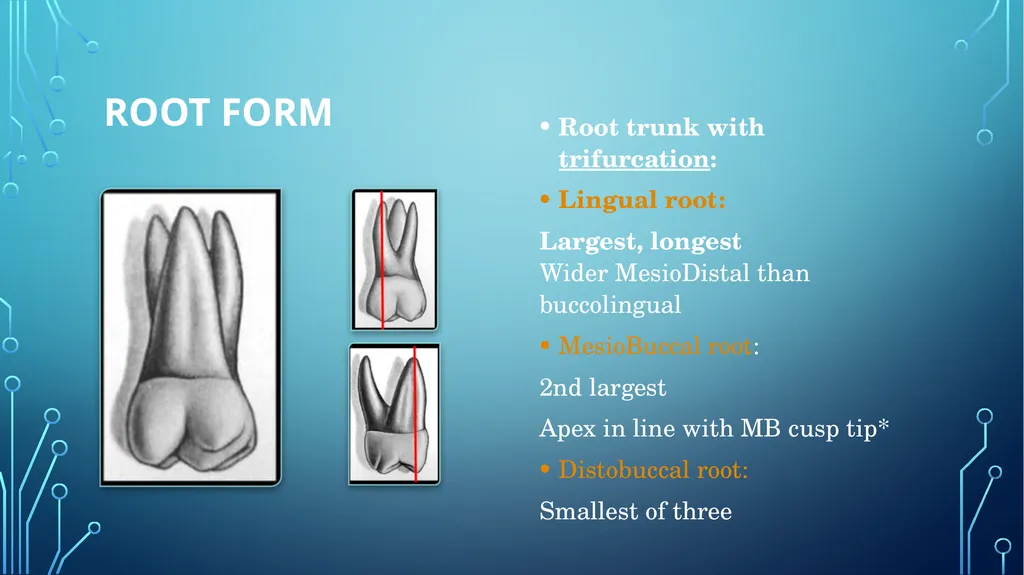
Root Form Root trunk with trifurcation:
Lingual root:
Largest, longest�Wider MesioDistal than buccolingual
MesioBuccal root:
2nd largest
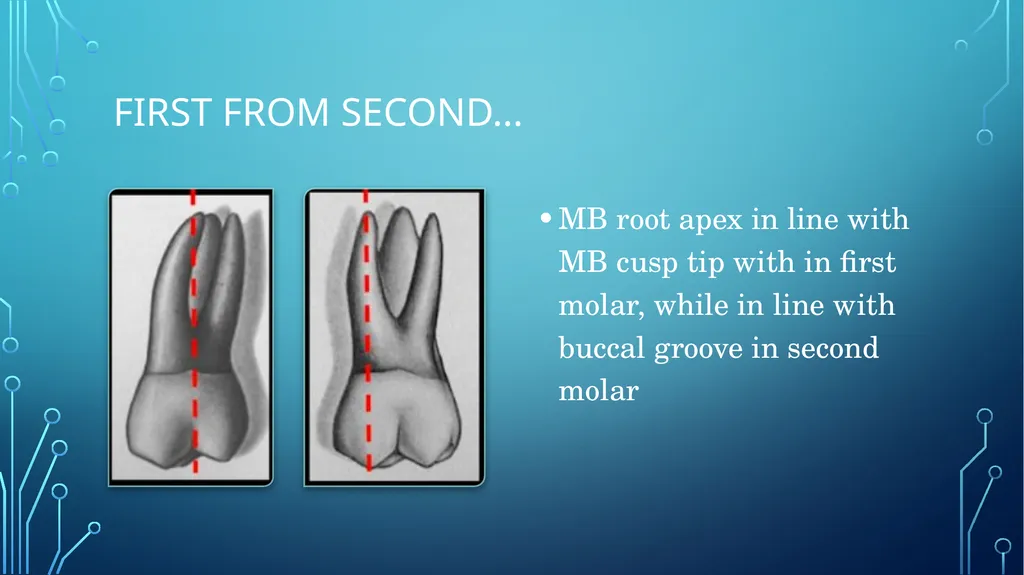
Apex in line with MB cusp tip*
Distobuccal root:
Smallest of three<br>
26
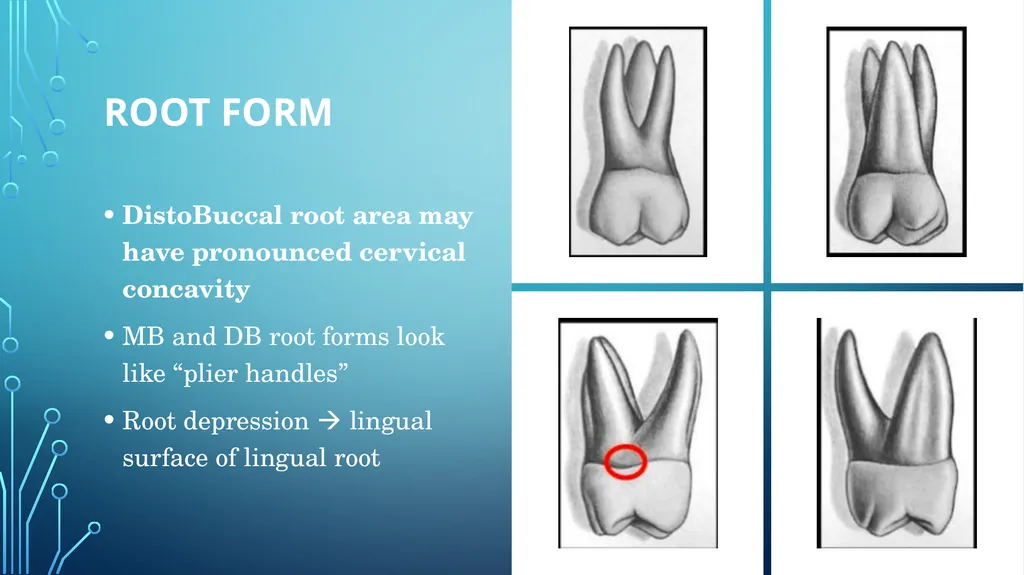
Root form DistoBuccal root area may have pronounced cervical concavity
MB and DB root forms look like “plier handles”
Root depression lingual surface of lingual root<br>
27
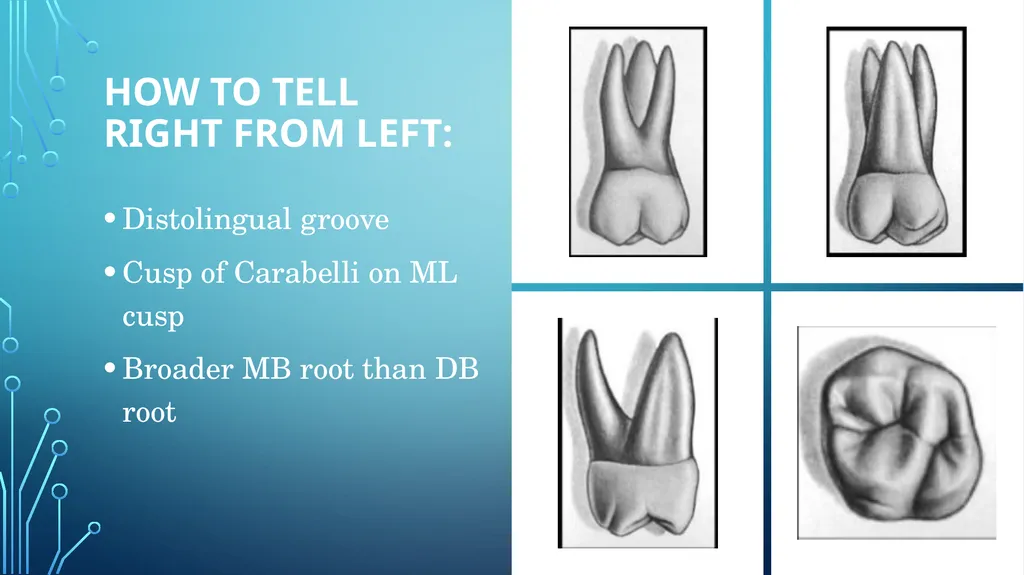
How To Tell Right From Left: Distolingual groove
Cusp of Carabelli on ML cusp
Broader MB root than DB root<br>
28
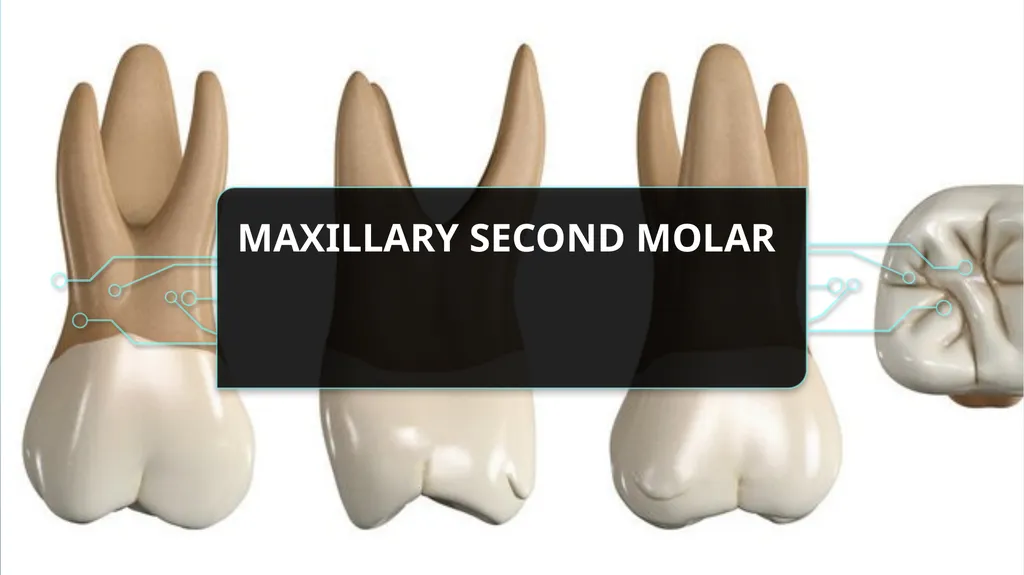
Maxillary second Molar<br>
29
General Characteristics<br>
30
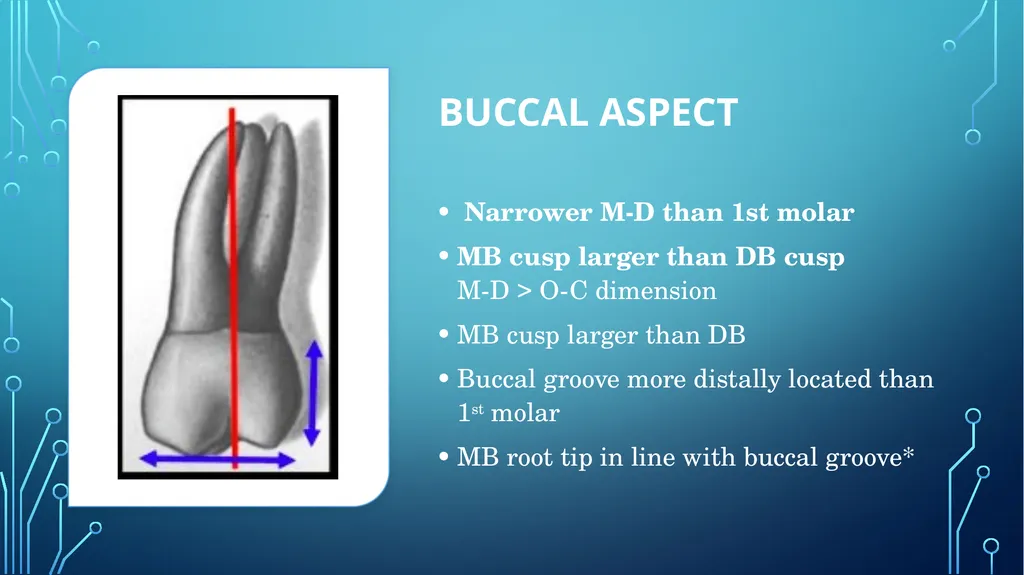
Buccal aspect Narrower M-D than 1st molar
MB cusp larger than DB cusp�M-D > O-C dimension
MB cusp larger than DB
Buccal groove more distally located than 1st molar
MB root tip in line with buccal groove*<br>
31
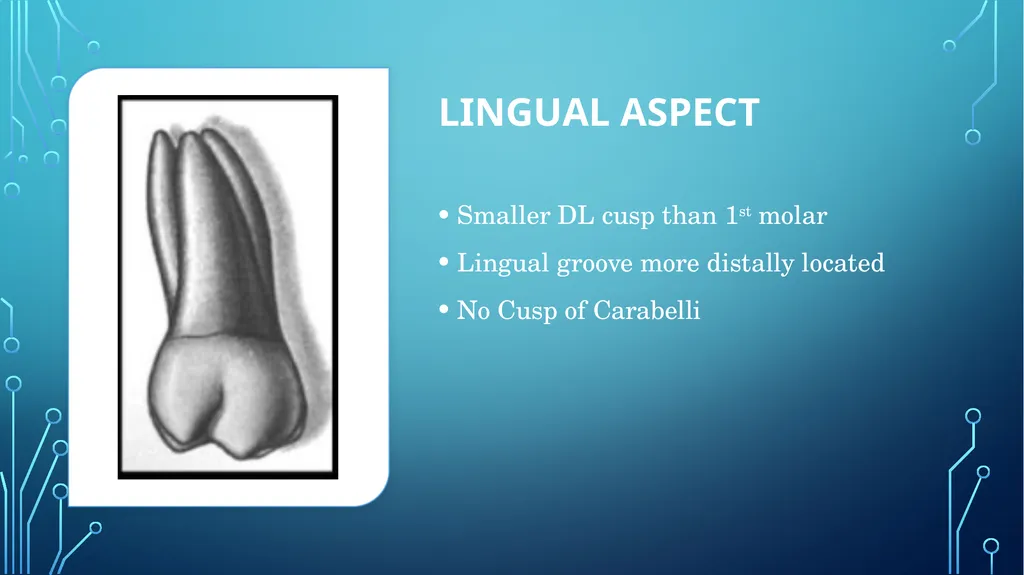
Lingual aspect Smaller DL cusp than 1st molar
Lingual groove more distally located
No Cusp of Carabelli<br>
32
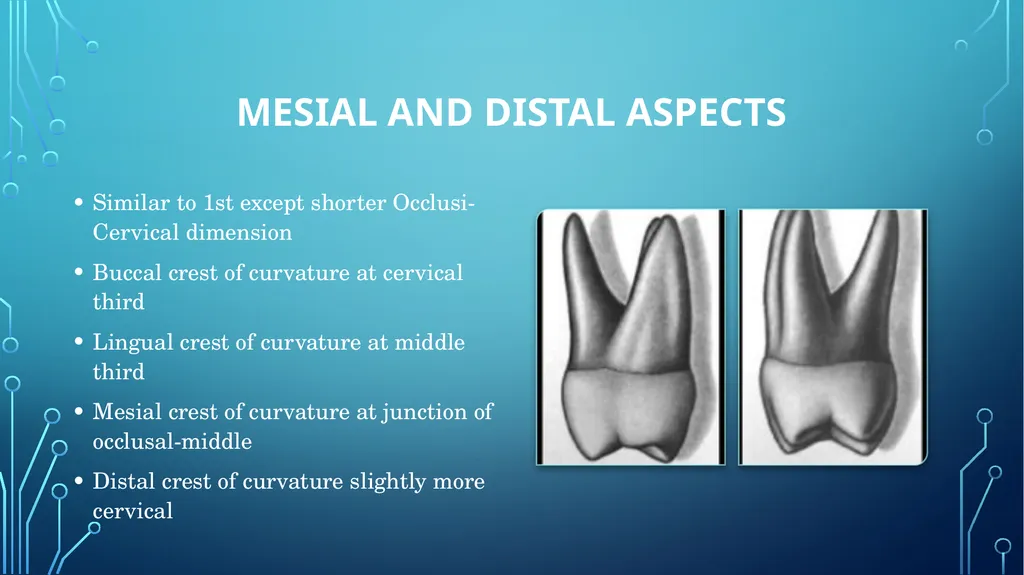
Mesial and Distal aspects Similar to 1st except shorter Occlusi-Cervical dimension
Buccal crest of curvature at cervical third
Lingual crest of curvature at middle third
Mesial crest of curvature at junction of occlusal-middle
Distal crest of curvature slightly more cervical<br>
33
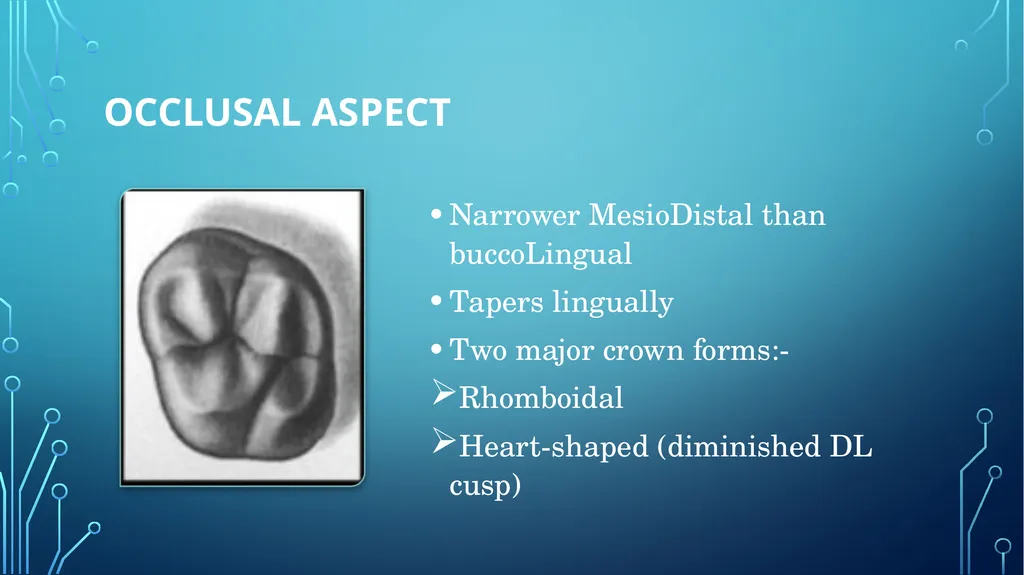
Occlusal aspect Narrower MesioDistal than buccoLingual
Tapers lingually
Two major crown forms:-
Rhomboidal
Heart-shaped (diminished DL cusp)<br>
34
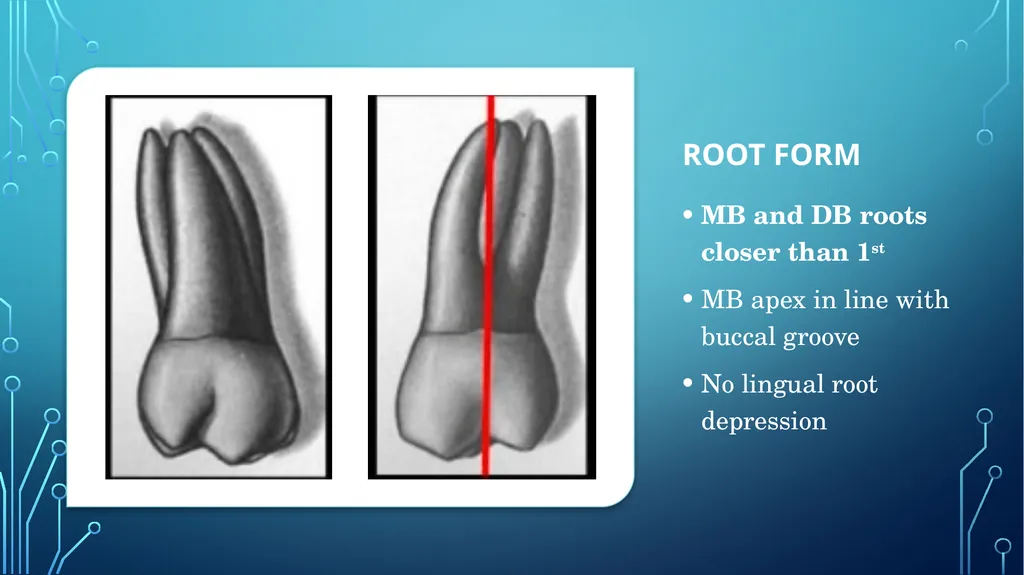
Root Form MB and DB roots closer than 1st
MB apex in line with buccal groove
No lingual root depression<br>
35
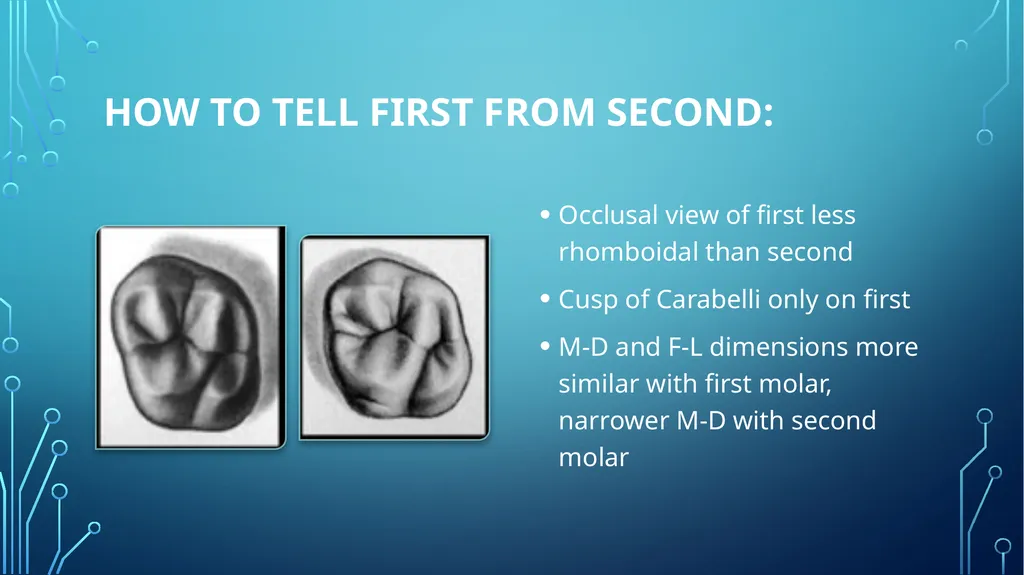
How To Tell First From Second: Occlusal view of first less rhomboidal than second
Cusp of Carabelli only on first
M-D and F-L dimensions more similar with first molar, narrower M-D with second molar<br>
36
First from second... MB root apex in line with MB cusp tip with in first molar, while in line with buccal groove in second molar<br>
37
Maxillary third molar<br>
38
General Characteristics<br>
39
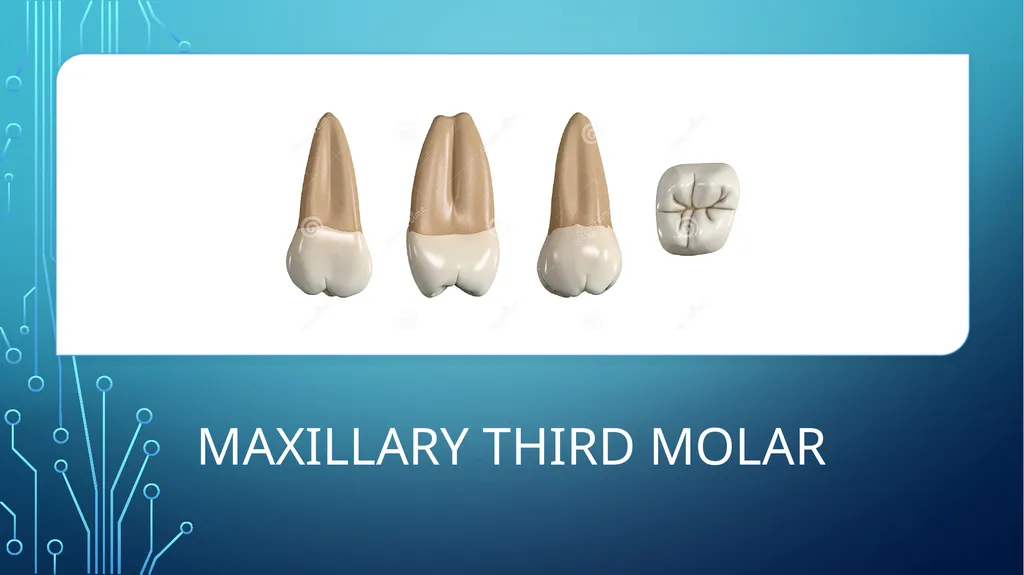
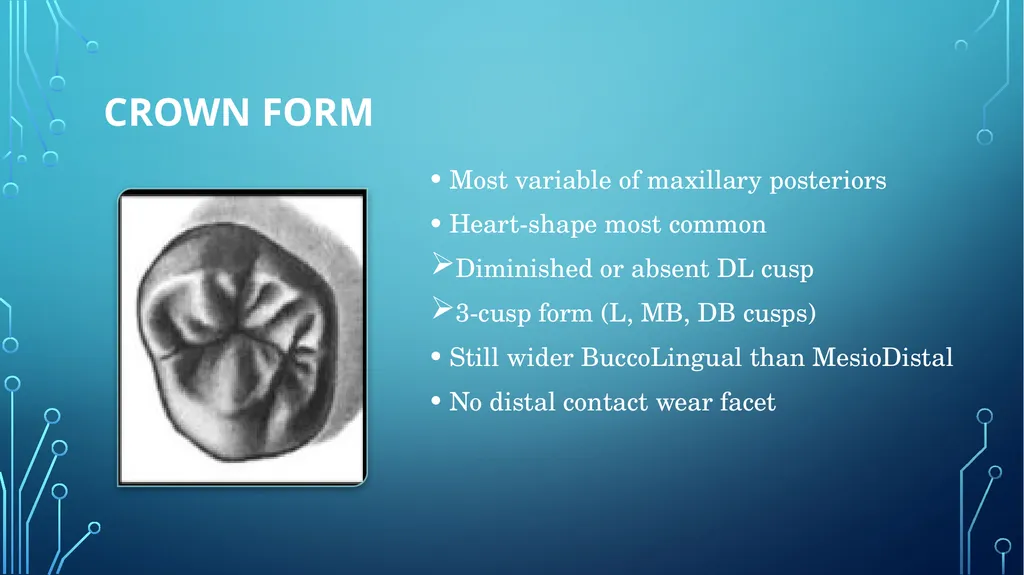
Crown Form Most variable of maxillary posteriors
Heart-shape most common
Diminished or absent DL cusp
3-cusp form (L, MB, DB cusps)
Still wider BuccoLingual than MesioDistal
No distal contact wear facet<br>
40
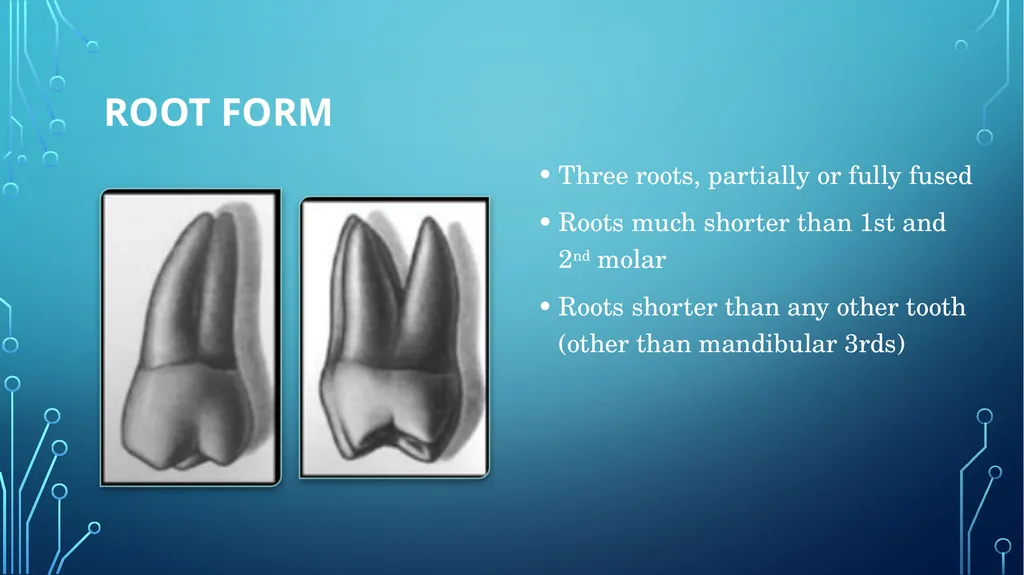
Root Form Three roots, partially or fully fused
Roots much shorter than 1st and 2nd molar
Roots shorter than any other tooth (other than mandibular 3rds)<br>
41
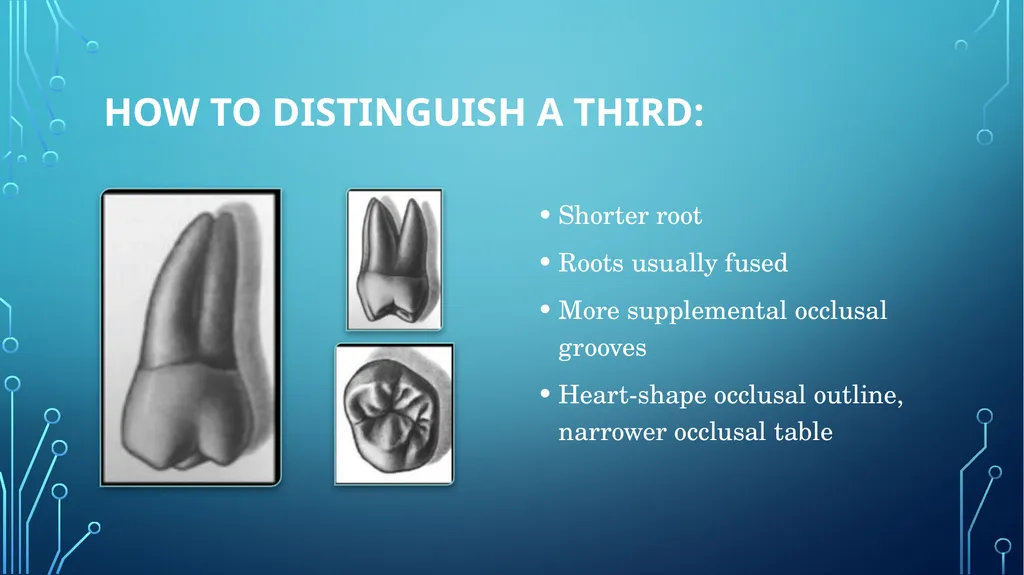
How To Distinguish a Third: Shorter root
Roots usually fused
More supplemental occlusal grooves
Heart-shape occlusal outline, narrower occlusal table<br>
42
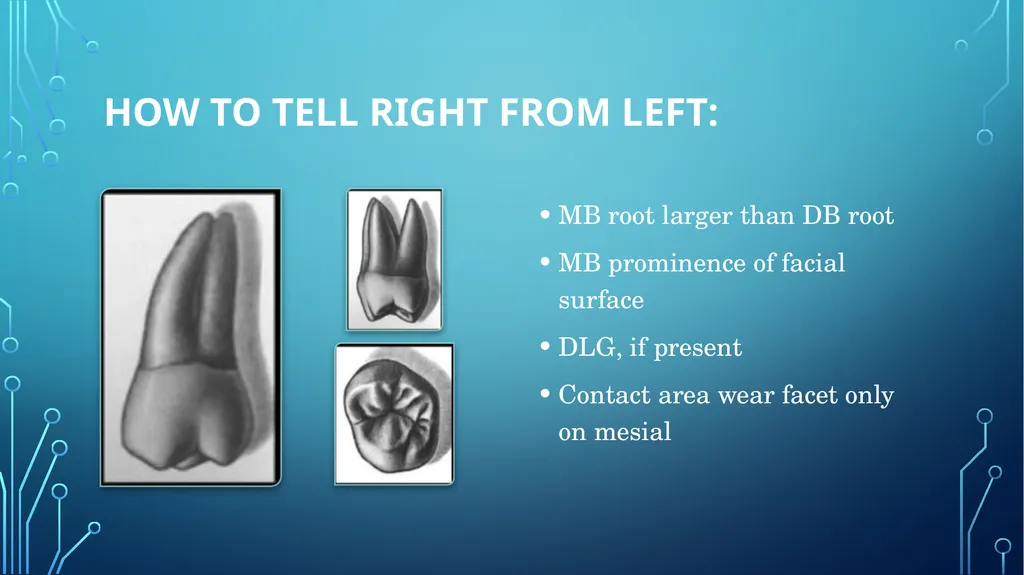
How To Tell Right From Left: MB root larger than DB root
MB prominence of facial surface
DLG, if present
Contact area wear facet only on mesial<br>
44
thank you for listening<br>