The Problems of Constructing Time Series of Russian Supply and Use tables for use in international projects Edward Baranov Igor Kim Dmitry Piontkovski Elena Staritsyna XVI April International Academic Conference on Economic and Social
"The Problems of Constructing Time Series of" is the property of its rightful owner. Permission is granted to
download and print the materials on this website for personal, non-commercial use only, and to display it
on your personal computer provided you do not modify the materials and that you retain all copyright
notices contained in the materials. By downloading content from our website, you accept the terms of this
agreement.
Presentation Transcript
01
The Problems of Constructing Time Series of Russian Supply and Use tables for use in international projects
Edward Baranov
Igor Kim
Dmitry Piontkovski
Elena Staritsyna
XVI April International Academic Conference on Economic and Social Development
National Research University Higher School of Economics (HSE)
April 7-10, 2015<br>
02
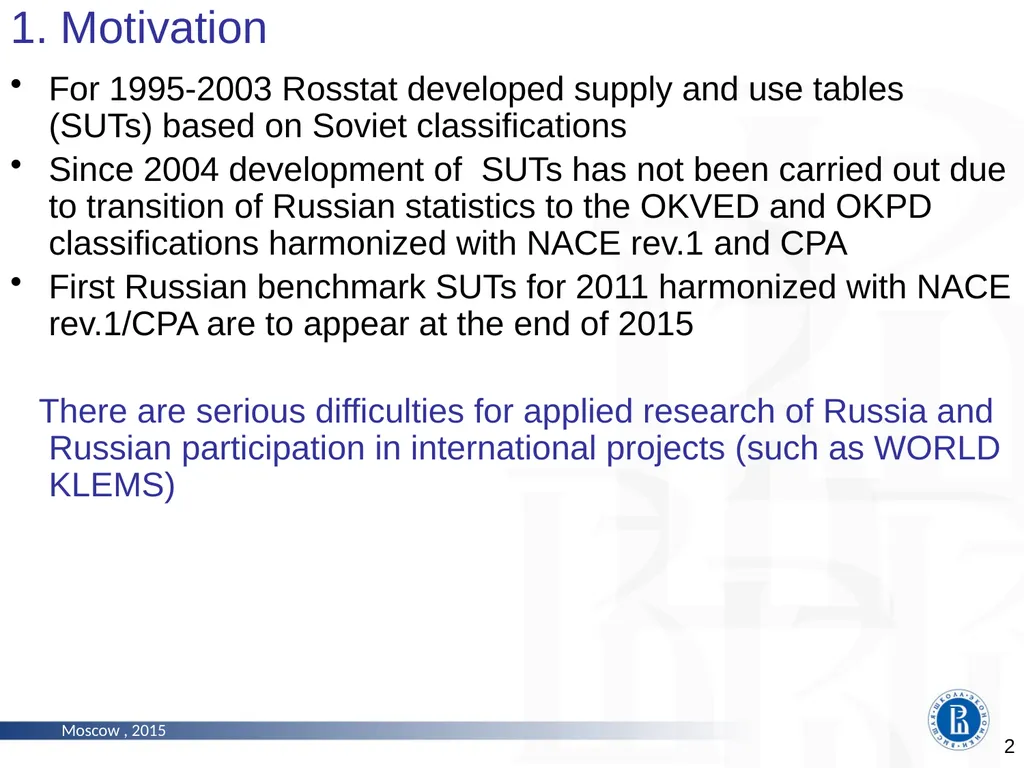
Moscow , 2015 1. Motivation For 1995-2003 Rosstat developed supply and use tables (SUTs) based on Soviet classifications
Since 2004 development of SUTs has not been carried out due to transition of Russian statistics to the OKVED and OKPD classifications harmonized with NACE rev.1 and CPA
First Russian benchmark SUTs for 2011 harmonized with NACE rev.1/CPA are to appear at the end of 2015
There are serious difficulties for applied research of Russia and Russian participation in international projects (such as WORLD KLEMS) 2<br>
03
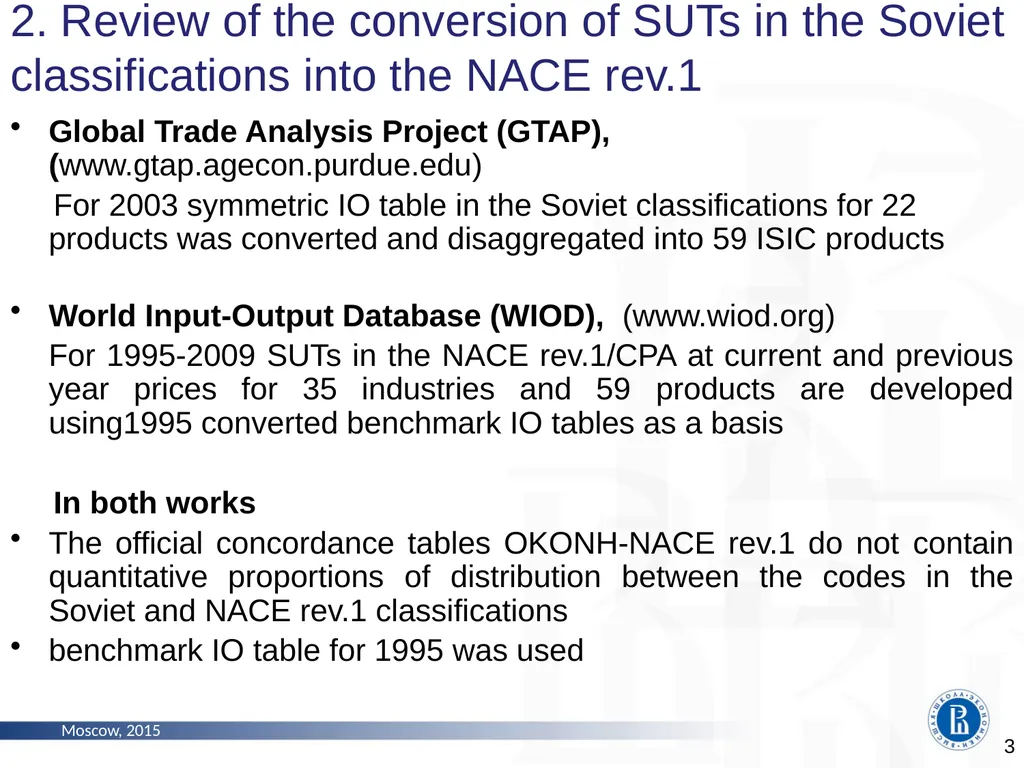
Moscow, 2015 2. Review of the conversion of SUTs in the Soviet classifications into the NACE rev.1 Global Trade Analysis Project (GTAP), (www.gtap.agecon.purdue.edu)
For 2003 symmetric IO table in the Soviet classifications for 22 products was converted and disaggregated into 59 ISIC products
World Input-Output Database (WIOD), (www.wiod.org)
For 1995-2009 SUTs in the NACE rev.1/CPA at current and previous year prices for 35 industries and 59 products are developed using1995 converted benchmark IO tables as a basis
In both works
The official concordance tables OKONH-NACE rev.1 do not contain quantitative proportions of distribution between the codes in the Soviet and NACE rev.1 classifications
benchmark IO table for 1995 was used 3<br>
04
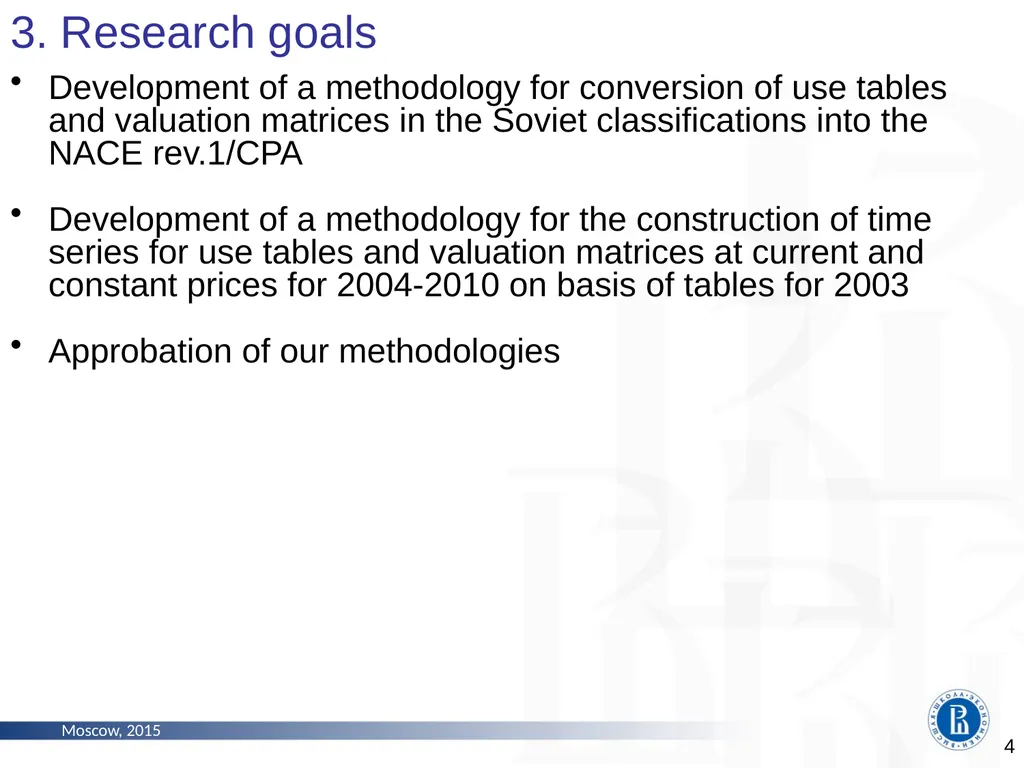
Moscow, 2015 3. Research goals Development of a methodology for conversion of use tables and valuation matrices in the Soviet classifications into the NACE rev.1/CPA
Development of a methodology for the construction of time series for use tables and valuation matrices at current and constant prices for 2004-2010 on basis of tables for 2003
Approbation of our methodologies 4<br>
05
Moscow, 2015 4. Why 2003? Last full set of aggregate use tables and valuation matrices in the Soviet classifications
First expenditure approach GDP and disaggregated data of production account in the NACE rev.1
Unpublished disaggregated use table at purchasers’ prices in the soviet classifications from Rosstat
Unpublished production matrix in the NACE rev.1 from Rosstat
Detail data on the production of hundreds of specifics products 5<br>
06
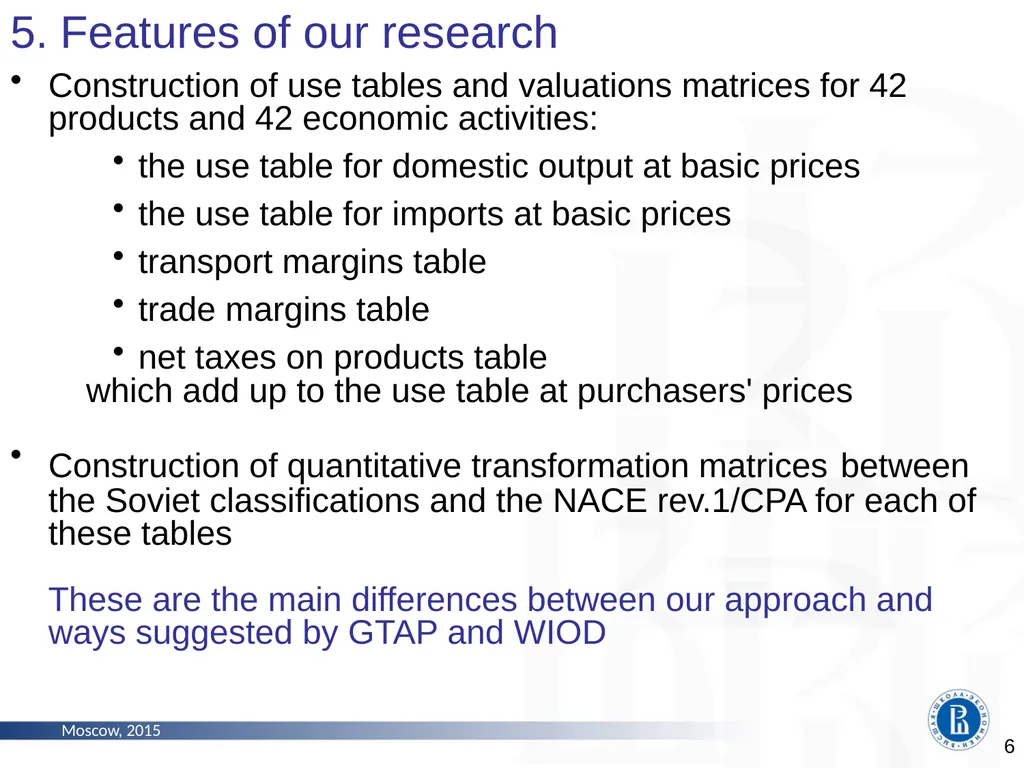
Moscow, 2015 5. Features of our research Construction of use tables and valuations matrices for 42 products and 42 economic activities:
the use table for domestic output at basic prices
the use table for imports at basic prices
transport margins table
trade margins table
net taxes on products table
which add up to the use table at purchasers' prices
Construction of quantitative transformation matrices between the Soviet classifications and the NACE rev.1/CPA for each of these tables
These are the main differences between our approach and ways suggested by GTAP and WIOD 6<br>
07
Moscow, 2015 6. Problems of converting from Soviet classifications to the NACE rev.1/CPA Fundamental differences between the Soviet and NACE rev.1/CPA classifications
Methodological changes in trade margins
Considerable differences between data on production account in the Soviet classifications and NACE rev.1
Incompleteness of the initial data for converting tables into the rev.1/CPA 7<br>
08
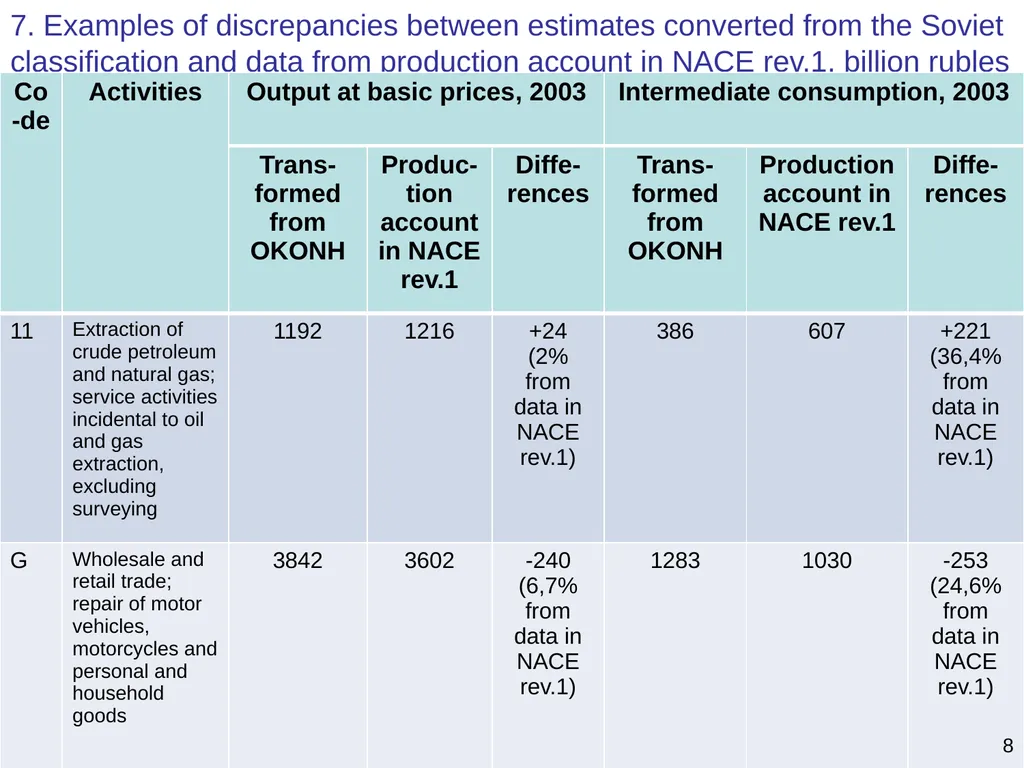
7. Examples of discrepancies between estimates converted from the Soviet classification and data from production account in NACE rev.1, billion rubles 8<br>
09
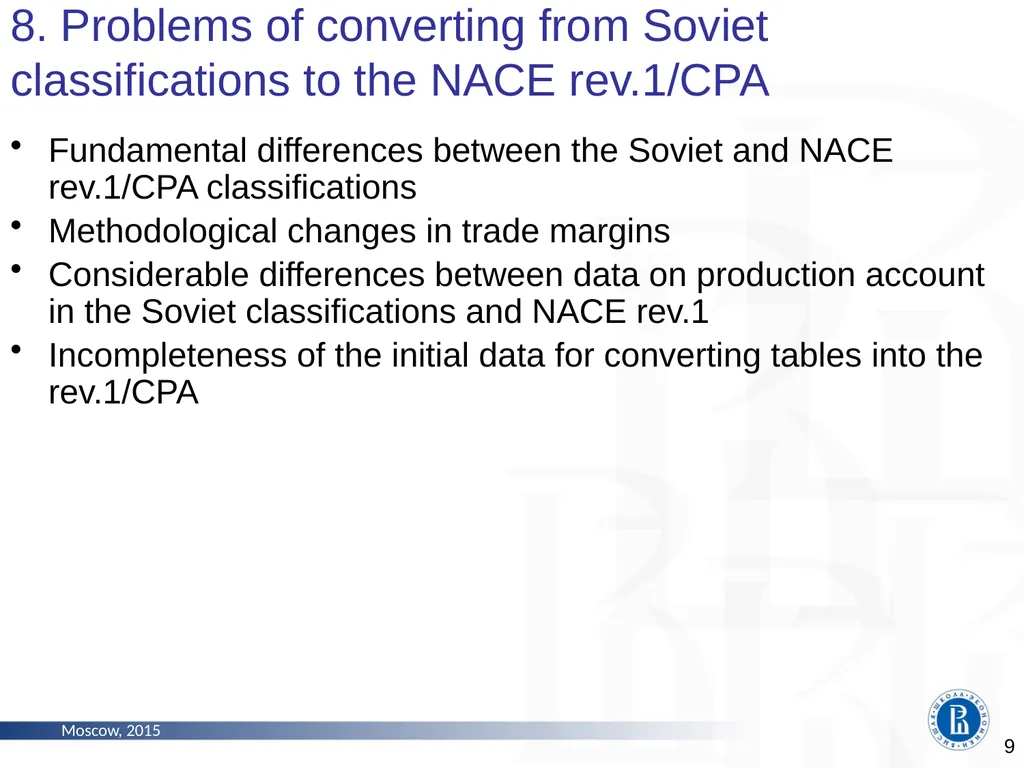
Moscow, 2015 8. Problems of converting from Soviet classifications to the NACE rev.1/CPA Fundamental differences between the Soviet and NACE rev.1/CPA classifications
Methodological changes in trade margins
Considerable differences between data on production account in the Soviet classifications and NACE rev.1
Incompleteness of the initial data for converting tables into the rev.1/CPA 9<br>
10
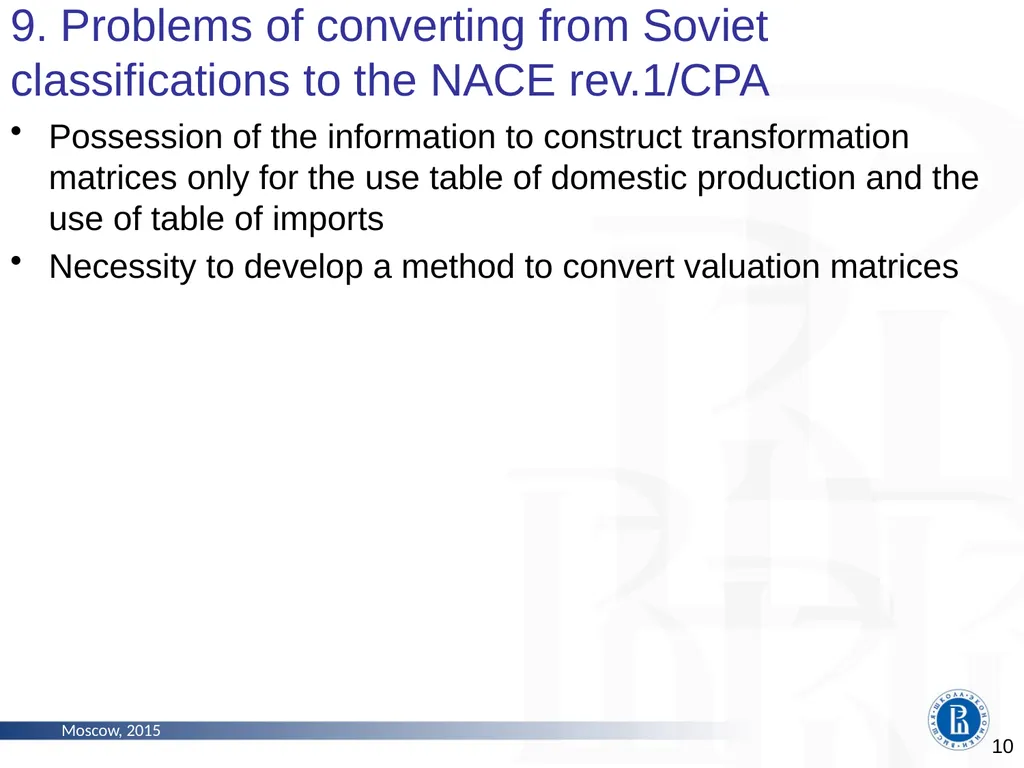
Moscow, 2015 9. Problems of converting from Soviet classifications to the NACE rev.1/CPA Possession of the information to construct transformation matrices only for the use table of domestic production and the use of table of imports
Necessity to develop a method to convert valuation matrices 10<br>
11
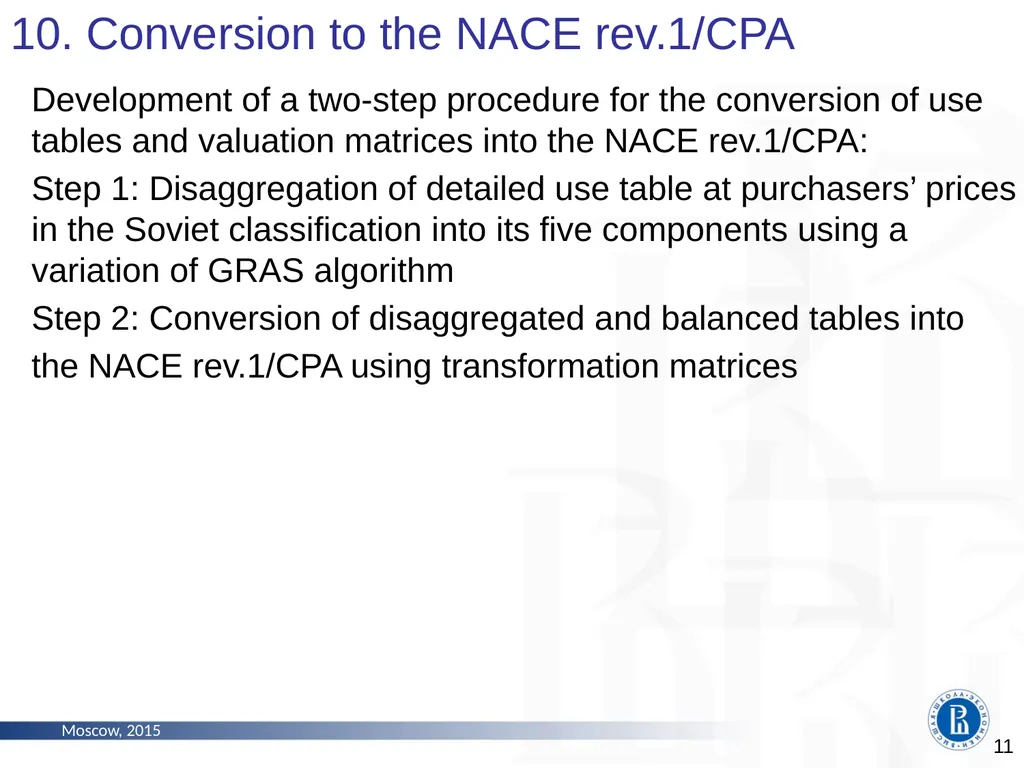
Moscow, 2015 10. Conversion to the NACE rev.1/CPA Development of a two-step procedure for the conversion of use tables and valuation matrices into the NACE rev.1/CPA:
Step 1: Disaggregation of detailed use table at purchasers’ prices in the Soviet classification into its five components using a variation of GRAS algorithm
Step 2: Conversion of disaggregated and balanced tables into
the NACE rev.1/CPA using transformation matrices 11<br>
12
Moscow, 2015 11. Disaggregation of detailed use table at purchasers’ prices Data: detailed (95 x 115) use tables at purchasers’ prices, row and column totals for use tables at basic prices and all valuation tables, aggregated data for all five tables (in the form of 25 x 25 tables).
Problem: to construct the five tables at the detailed level
Solution: a 4-proportional balancing (using GRAS algorithm in the version of Lenzen et al., 2009) of a 3D table of size 5 x 95 x 115 based on expert approximations of all 5 tables as benchmarks 12<br>
13
Moscow, 2015 12. Information for constructing time series of use tables at basic prices and valuation matrices Production accounts for 69 types of activity and expenditure approach GDP
Unpublished detailed production matrices in the NACE rev.1
Export and import data in the detailed nomenclature from Federal Customs Service and the Bank of Russia
Converted use tables at basic prices and valuation matrices for 2003 13<br>
14
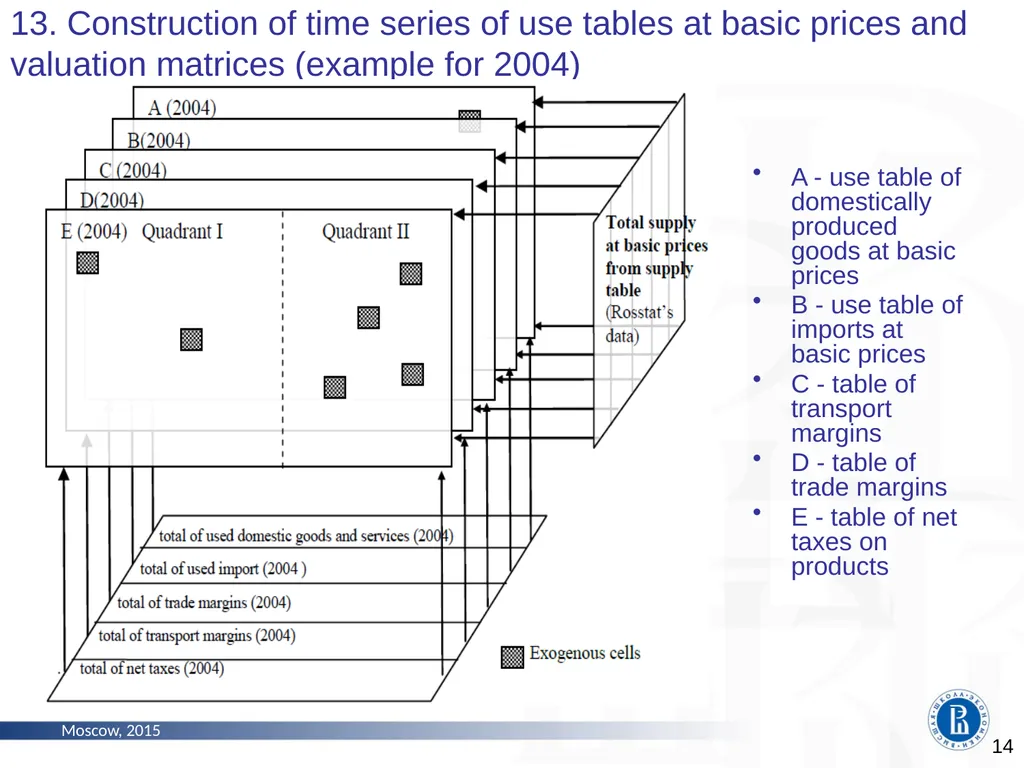
Moscow, 2015 13. Construction of time series of use tables at basic prices and valuation matrices (example for 2004) 14 A - use table of domestically produced goods at basic prices
B - use table of imports at basic prices
C - table of transport margins
D - table of trade margins
E - table of net taxes on products<br>
15
Moscow, 2015 14. Features of methodological approach for constructing time series Application of RAS method and data for 2003 to calculate column totals for matrices of intermediate consumption and final demand of each of five tables
Row totals of valuation matrices were calculated expertly
Some figures were defined exogenously for table of net taxes (due to the annual changes in the tax and customs legislation)
Application of RAS method to calculate rectangular matrices (for intermediate consumption and final demand) of each of five tables for subsequent years 15<br>
16
Moscow, 2015 15. Deriving use tables and valuation matrices at constant prices For goods, the retrospective series of producer price indices in NACE are only for aggregate products
For services, official data is only available for freight tariffs and communication services
Therefore, we plan to construct deflators for more disaggregated products (using unpublished information)
The application of the same deflator for all uses of product 16<br>
17
Moscow, 2015 16. Further work Testing different projection methods (apart from RAS) in order to select the most preferred for Russia
The examination of backward projection possibilities for the period prior to 2003 (a lack of totals from the SNA in the NACE rev. 1/CPA for the period before 2002 have to be taken into account)
After the publication of detailed Russian SUT for 2011 by Rosstat, all our time-series need to be reconsidered 17<br>