
THE RED FLAGS RULE Detecting, Preventing, and
TG
Published · 20 slides · 0 views
1 / 1
Description
THE RED FLAGS RULE Detecting, Preventing, and Mitigating Identity Theft Training for Ball State Universitys Identity Theft Protection Program What is the Red Flag Rule? Congress passed the Fair and Accurate Credit Transactions Act of 2003
Related Topics
Share
Embed code
Download this presentation From Below
"THE RED FLAGS RULE Detecting, Preventing, and" is the property of its rightful owner. Permission is granted to download and print the materials on this website for personal, non-commercial use only, and to display it on your personal computer provided you do not modify the materials and that you retain all copyright notices contained in the materials. By downloading content from our website, you accept the terms of this agreement.
Presentation Transcript
01
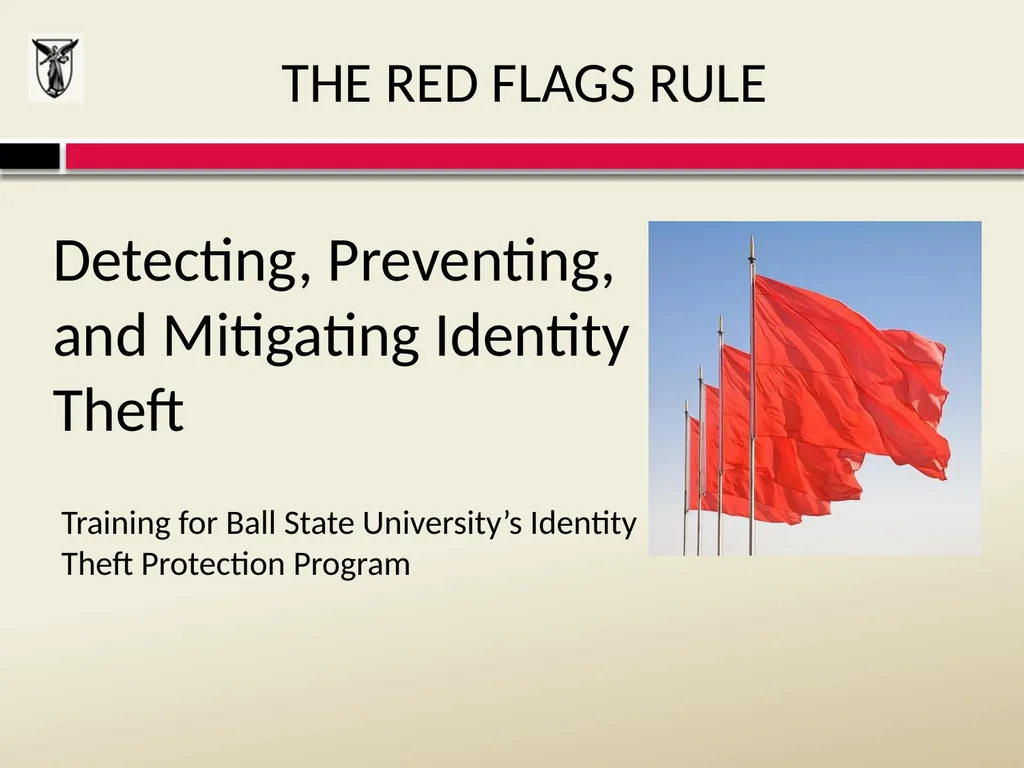
THE RED FLAGS RULE Detecting, Preventing, and Mitigating Identity Theft Training for Ball State University’s Identity Theft Protection Program<br>
02
What is the Red Flag Rule? Congress passed the Fair and Accurate Credit Transactions Act of 2003 (“FACT Act”) which amended the Fair Credit Reporting Act (“FRCA”) to require the Federal Trade Commission and other federal agencies to adopt identity theft red flags rules and guidelines
Pursuant to this legislation, the Federal Trade Commission issued regulations known as the Red Flag Rules, 16 CRF § 681.1 et seq.
Generally, the Red Flags Rules require financial institutions and creditors that maintain covered accounts to develop and implement a written Identity Theft Prevention Program.<br>
Pursuant to this legislation, the Federal Trade Commission issued regulations known as the Red Flag Rules, 16 CRF § 681.1 et seq.
Generally, the Red Flags Rules require financial institutions and creditors that maintain covered accounts to develop and implement a written Identity Theft Prevention Program.<br>
03
Why must Ball State comply with the Red Flag Rules? The Red Flag Rules require “financial institutions” and “creditors” to conduct periodic risk assessment.
While Ball State may not be a financial institution in the typical sense, under the law this determination is not based on the industry or sector of an organization, but rather on whether an organization’s business activities fall within the relevant definitions.<br>
While Ball State may not be a financial institution in the typical sense, under the law this determination is not based on the industry or sector of an organization, but rather on whether an organization’s business activities fall within the relevant definitions.<br>
04
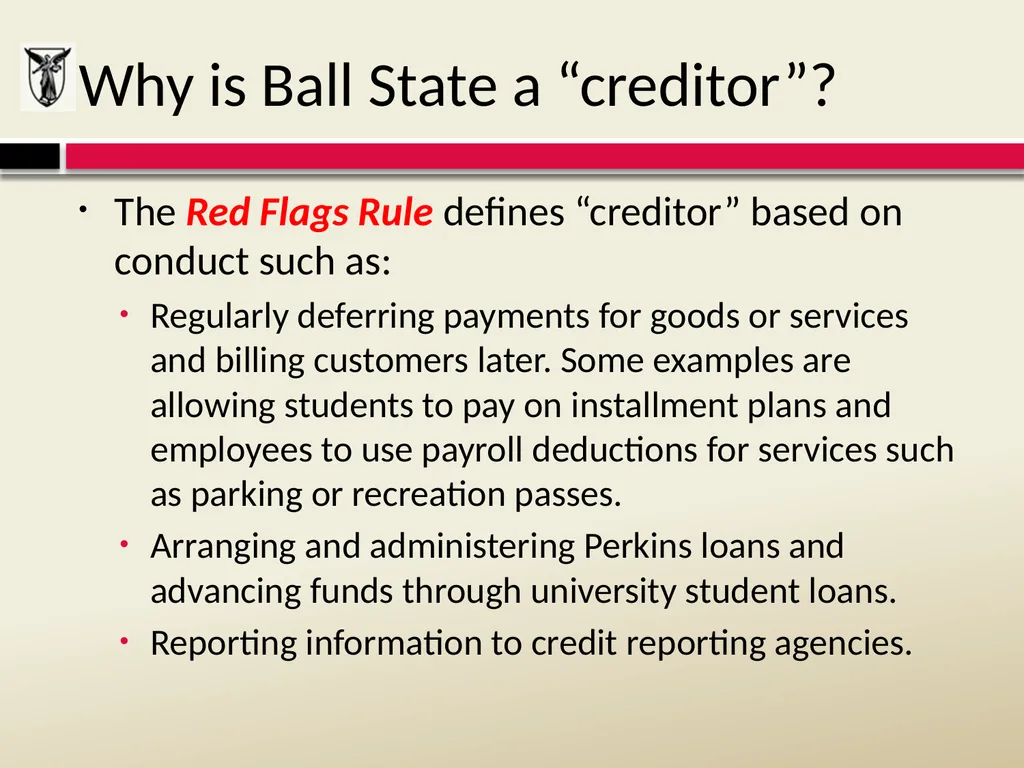
Why is Ball State a “creditor”? The Red Flags Rule defines “creditor” based on conduct such as:
Regularly deferring payments for goods or services and billing customers later. Some examples are allowing students to pay on installment plans and employees to use payroll deductions for services such as parking or recreation passes.
Arranging and administering Perkins loans and advancing funds through university student loans.
Reporting information to credit reporting agencies.<br>
Regularly deferring payments for goods or services and billing customers later. Some examples are allowing students to pay on installment plans and employees to use payroll deductions for services such as parking or recreation passes.
Arranging and administering Perkins loans and advancing funds through university student loans.
Reporting information to credit reporting agencies.<br>
05
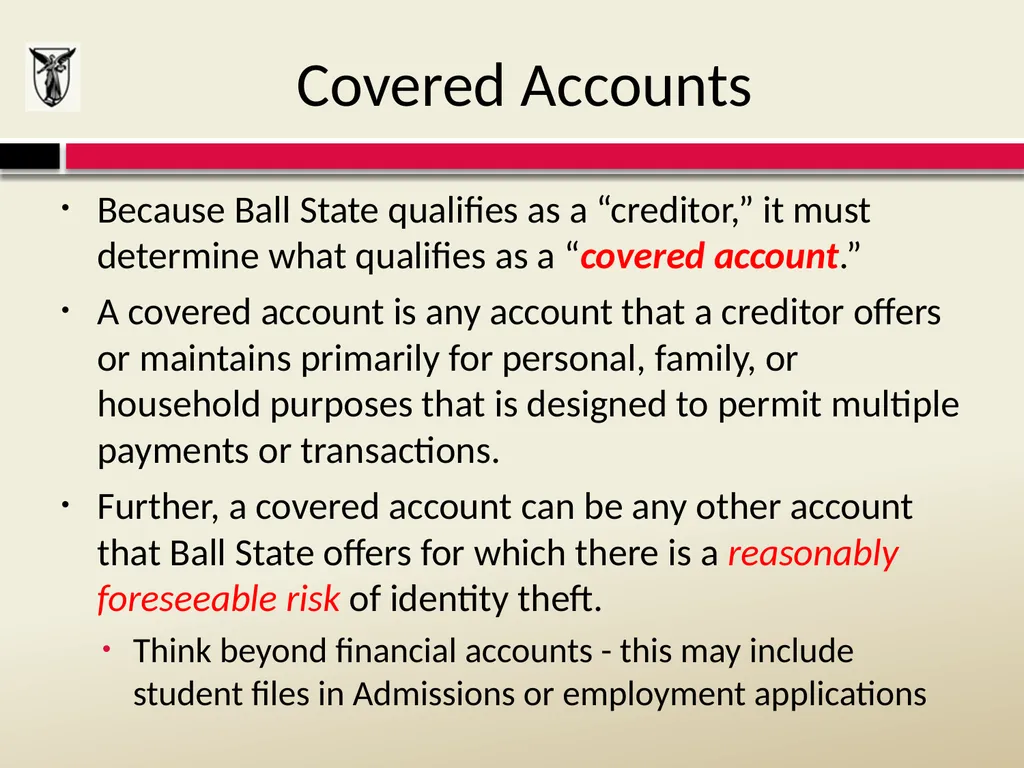
Covered Accounts Because Ball State qualifies as a “creditor,” it must determine what qualifies as a “covered account.”
A covered account is any account that a creditor offers or maintains primarily for personal, family, or household purposes that is designed to permit multiple payments or transactions.
Further, a covered account can be any other account that Ball State offers for which there is a reasonably foreseeable risk of identity theft.
Think beyond financial accounts - this may include student files in Admissions or employment applications<br>
A covered account is any account that a creditor offers or maintains primarily for personal, family, or household purposes that is designed to permit multiple payments or transactions.
Further, a covered account can be any other account that Ball State offers for which there is a reasonably foreseeable risk of identity theft.
Think beyond financial accounts - this may include student files in Admissions or employment applications<br>
06
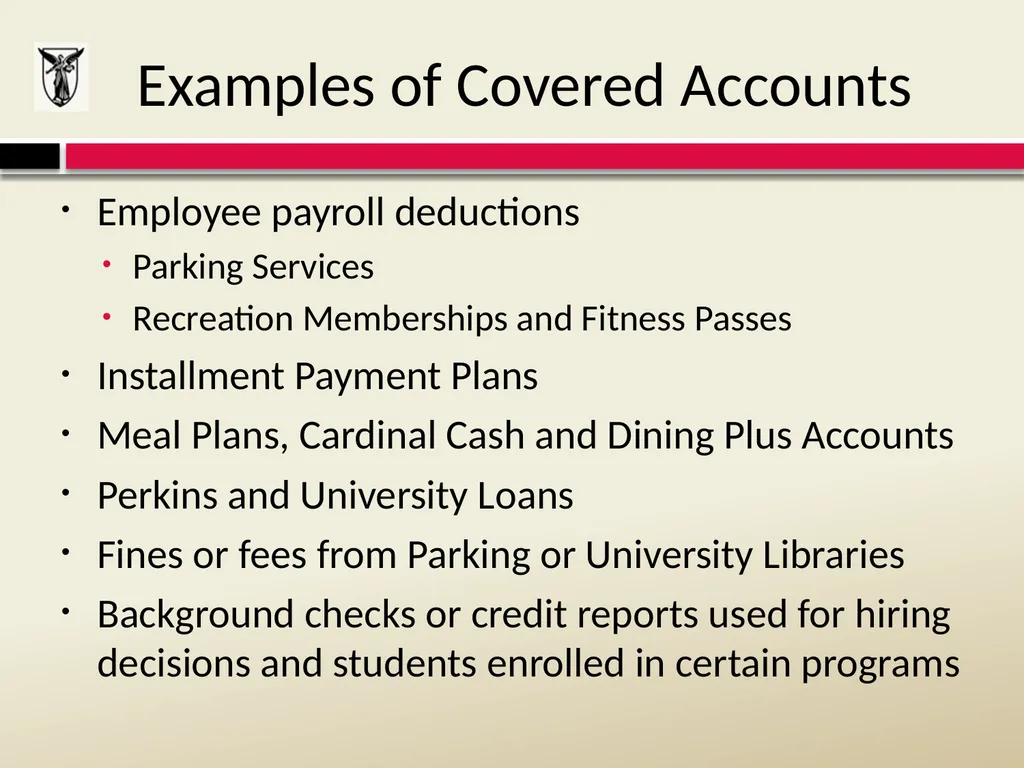
Examples of Covered Accounts Employee payroll deductions
Parking Services
Recreation Memberships and Fitness Passes
Installment Payment Plans
Meal Plans, Cardinal Cash and Dining Plus Accounts
Perkins and University Loans
Fines or fees from Parking or University Libraries
Background checks or credit reports used for hiring decisions and students enrolled in certain programs<br>
Parking Services
Recreation Memberships and Fitness Passes
Installment Payment Plans
Meal Plans, Cardinal Cash and Dining Plus Accounts
Perkins and University Loans
Fines or fees from Parking or University Libraries
Background checks or credit reports used for hiring decisions and students enrolled in certain programs<br>
07
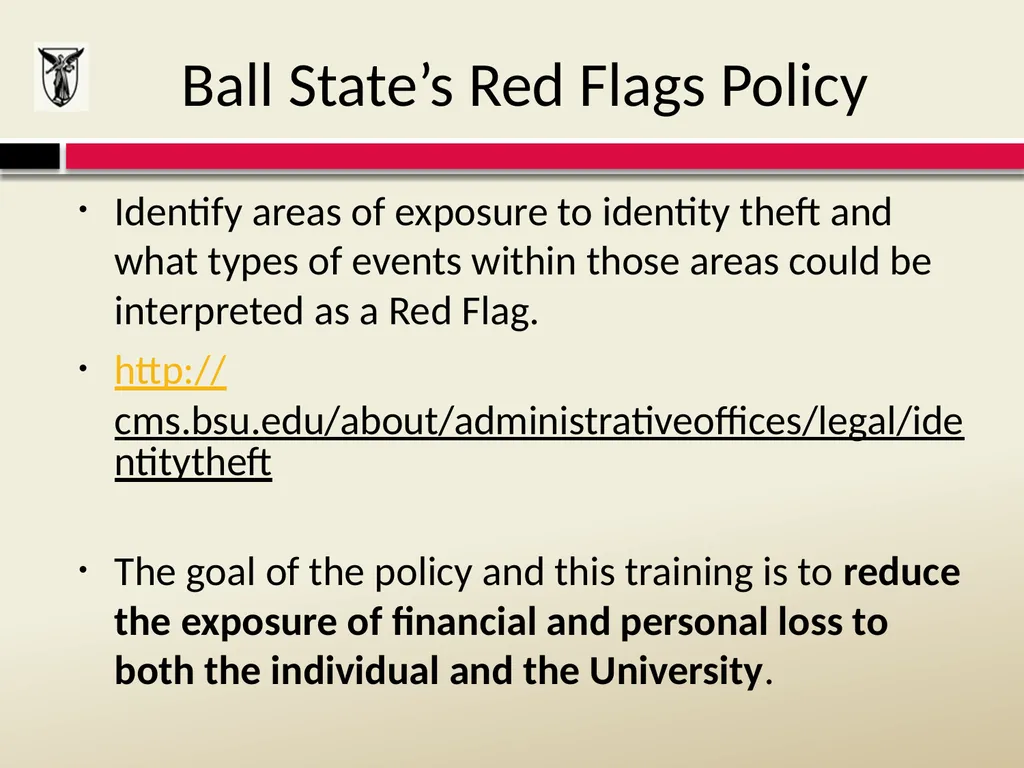
Ball State’s Red Flags Policy Identify areas of exposure to identity theft and what types of events within those areas could be interpreted as a Red Flag.
http://cms.bsu.edu/about/administrativeoffices/legal/identitytheft
The goal of the policy and this training is to reduce the exposure of financial and personal loss to both the individual and the University.<br>
http://cms.bsu.edu/about/administrativeoffices/legal/identitytheft
The goal of the policy and this training is to reduce the exposure of financial and personal loss to both the individual and the University.<br>
08
How Do You Comply? Step #1: Identify what constitutes a “Red Flag”
Step #2: Detect Red Flags in accounts and operations
Step #3: Prevent and Mitigate Identify Theft
Step #4: Update and Administer the Program<br>
Step #2: Detect Red Flags in accounts and operations
Step #3: Prevent and Mitigate Identify Theft
Step #4: Update and Administer the Program<br>
09
Step #1: What constitutes a Red Flag? Red Flags are potential patterns, practices, or activities indicating the possibility of identity theft.
In simple terms, a Red Flag is an indication that a fraudulent transaction or event could be occurring as a result of identity theft.
Red Flags come in five general categories
Notifications and Warnings from Consumer Reporting Agencies
Suspicious Documents
Suspicious Personal Identifying Information
Suspicious Covered Account Activity
Alerts from Others<br>
In simple terms, a Red Flag is an indication that a fraudulent transaction or event could be occurring as a result of identity theft.
Red Flags come in five general categories
Notifications and Warnings from Consumer Reporting Agencies
Suspicious Documents
Suspicious Personal Identifying Information
Suspicious Covered Account Activity
Alerts from Others<br>
10
Step #1: Notifications and Warnings from Consumer Reporting Agencies (cont.) Fraud alert included with a consumer credit report from a credit bureau
Notice of credit freeze
Notice of address discrepancy
Report of unusual credit activity, such as an increased number of accounts or inquiries<br>
Notice of credit freeze
Notice of address discrepancy
Report of unusual credit activity, such as an increased number of accounts or inquiries<br>
11
Step #1: Suspicious Documents (cont.) Documents provided for identification appear to be altered or forged
Photograph on ID does not match the appearance of the individual
Information on the ID does not match the information provided by the person opening the account
Application appears forged, altered, or destroyed and reassembled
Signatures on multiple documents do not match<br>
Photograph on ID does not match the appearance of the individual
Information on the ID does not match the information provided by the person opening the account
Application appears forged, altered, or destroyed and reassembled
Signatures on multiple documents do not match<br>
12
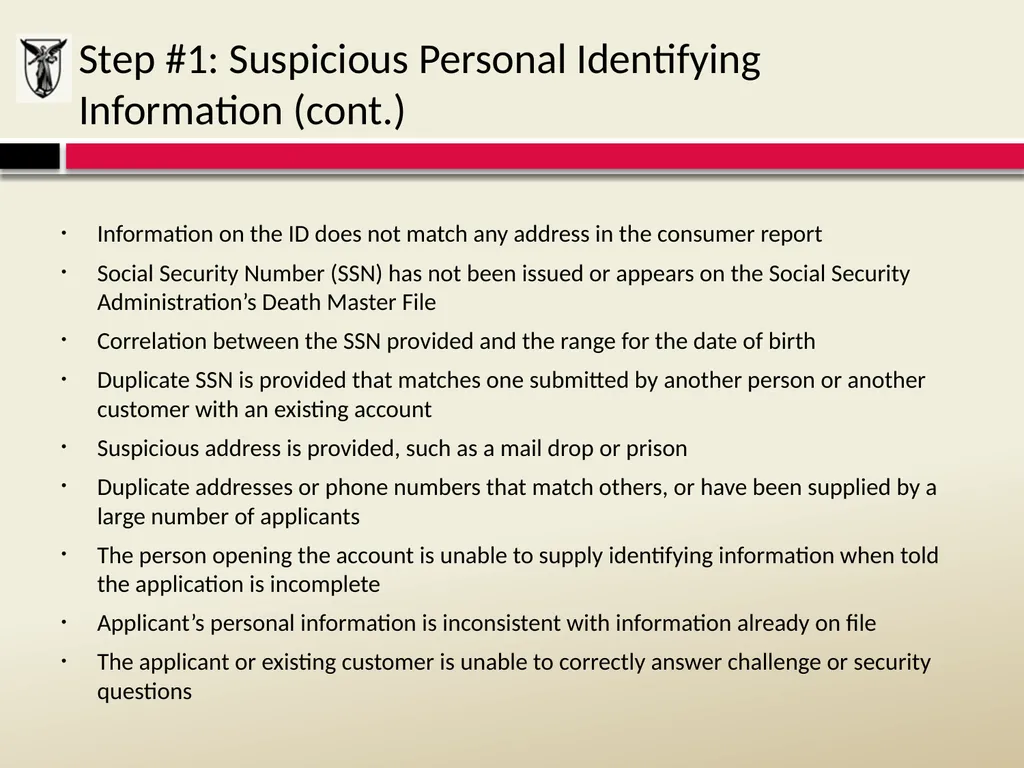
Step #1: Suspicious Personal Identifying Information (cont.) Information on the ID does not match any address in the consumer report
Social Security Number (SSN) has not been issued or appears on the Social Security Administration’s Death Master File
Correlation between the SSN provided and the range for the date of birth
Duplicate SSN is provided that matches one submitted by another person or another customer with an existing account
Suspicious address is provided, such as a mail drop or prison
Duplicate addresses or phone numbers that match others, or have been supplied by a large number of applicants
The person opening the account is unable to supply identifying information when told the application is incomplete
Applicant’s personal information is inconsistent with information already on file
The applicant or existing customer is unable to correctly answer challenge or security questions<br>
Social Security Number (SSN) has not been issued or appears on the Social Security Administration’s Death Master File
Correlation between the SSN provided and the range for the date of birth
Duplicate SSN is provided that matches one submitted by another person or another customer with an existing account
Suspicious address is provided, such as a mail drop or prison
Duplicate addresses or phone numbers that match others, or have been supplied by a large number of applicants
The person opening the account is unable to supply identifying information when told the application is incomplete
Applicant’s personal information is inconsistent with information already on file
The applicant or existing customer is unable to correctly answer challenge or security questions<br>
13
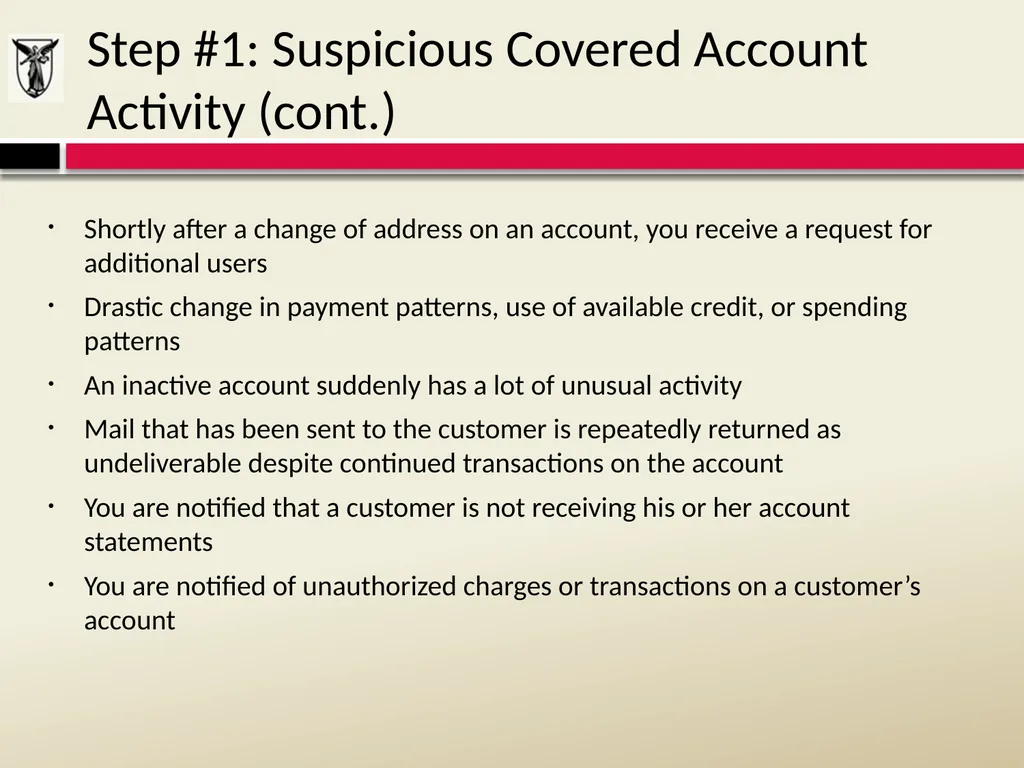
Step #1: Suspicious Covered Account Activity (cont.) Shortly after a change of address on an account, you receive a request for additional users
Drastic change in payment patterns, use of available credit, or spending patterns
An inactive account suddenly has a lot of unusual activity
Mail that has been sent to the customer is repeatedly returned as undeliverable despite continued transactions on the account
You are notified that a customer is not receiving his or her account statements
You are notified of unauthorized charges or transactions on a customer’s account<br>
Drastic change in payment patterns, use of available credit, or spending patterns
An inactive account suddenly has a lot of unusual activity
Mail that has been sent to the customer is repeatedly returned as undeliverable despite continued transactions on the account
You are notified that a customer is not receiving his or her account statements
You are notified of unauthorized charges or transactions on a customer’s account<br>
14
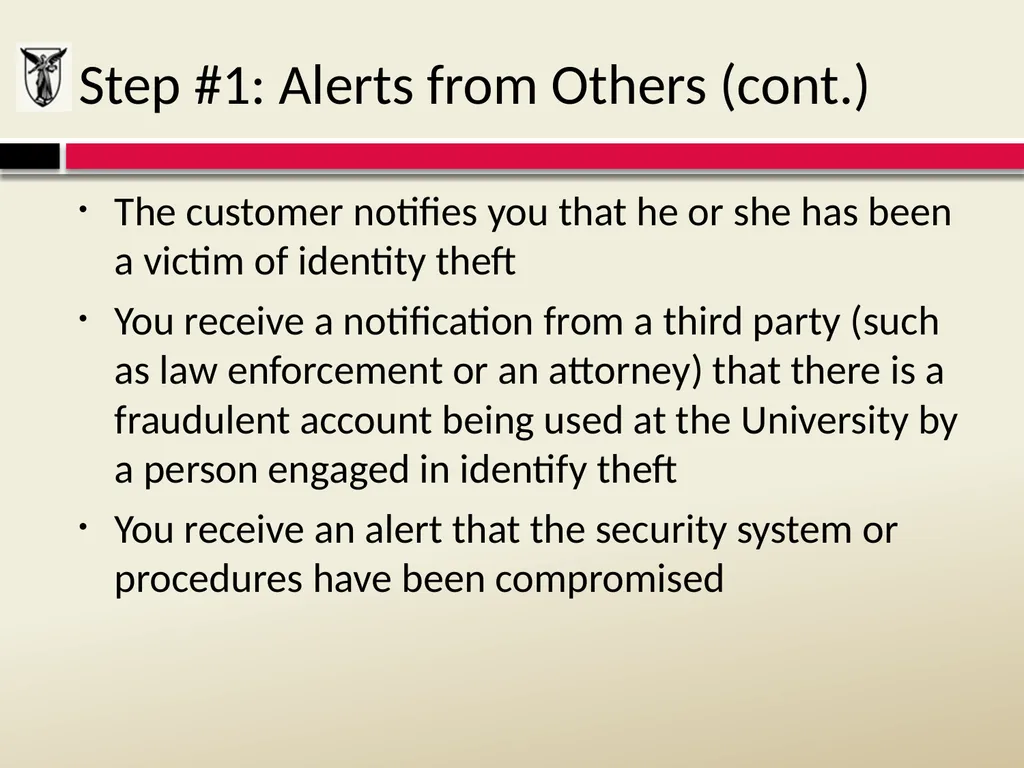
Step #1: Alerts from Others (cont.) The customer notifies you that he or she has been a victim of identity theft
You receive a notification from a third party (such as law enforcement or an attorney) that there is a fraudulent account being used at the University by a person engaged in identify theft
You receive an alert that the security system or procedures have been compromised<br>
You receive a notification from a third party (such as law enforcement or an attorney) that there is a fraudulent account being used at the University by a person engaged in identify theft
You receive an alert that the security system or procedures have been compromised<br>
15
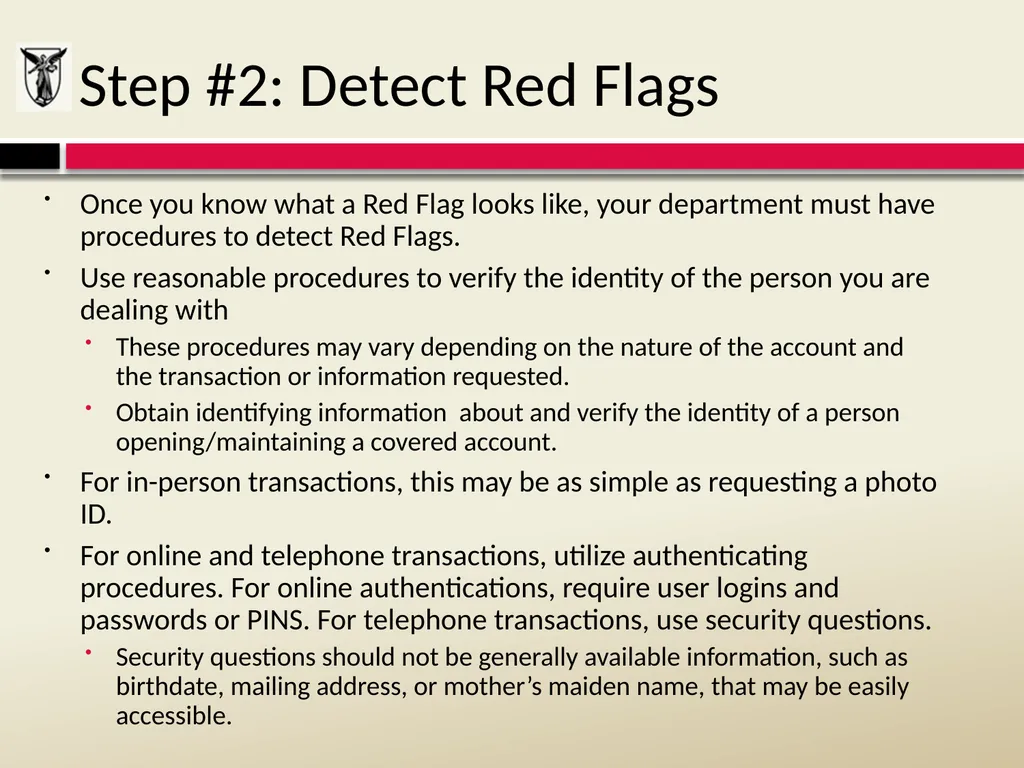
Step #2: Detect Red Flags Once you know what a Red Flag looks like, your department must have procedures to detect Red Flags.
Use reasonable procedures to verify the identity of the person you are dealing with
These procedures may vary depending on the nature of the account and the transaction or information requested.
Obtain identifying information about and verify the identity of a person opening/maintaining a covered account.
For in-person transactions, this may be as simple as requesting a photo ID.
For online and telephone transactions, utilize authenticating procedures. For online authentications, require user logins and passwords or PINS. For telephone transactions, use security questions.
Security questions should not be generally available information, such as birthdate, mailing address, or mother’s maiden name, that may be easily accessible.<br>
Use reasonable procedures to verify the identity of the person you are dealing with
These procedures may vary depending on the nature of the account and the transaction or information requested.
Obtain identifying information about and verify the identity of a person opening/maintaining a covered account.
For in-person transactions, this may be as simple as requesting a photo ID.
For online and telephone transactions, utilize authenticating procedures. For online authentications, require user logins and passwords or PINS. For telephone transactions, use security questions.
Security questions should not be generally available information, such as birthdate, mailing address, or mother’s maiden name, that may be easily accessible.<br>
16
Step #2: Detect Red Flags (cont.) Some transactions may not be appropriate to complete via telephone or online and may require in-person authentication. Refer customers to the appropriate process.
Refuse to complete a transaction if proper identification cannot be provided:
For example, a student requests a new BSU ID card, but has no form of picture identification. If you cannot match the identification with information/pictures on file, refuse to issue a new ID until proper identification can be provided.
Customer presents a photo ID that does not match his or her appearance. You may need to ask for another form of ID, hold the ID, and possibly contact the Department Red Flags Administrator if appears that someone is impersonating the student or employee.<br>
Refuse to complete a transaction if proper identification cannot be provided:
For example, a student requests a new BSU ID card, but has no form of picture identification. If you cannot match the identification with information/pictures on file, refuse to issue a new ID until proper identification can be provided.
Customer presents a photo ID that does not match his or her appearance. You may need to ask for another form of ID, hold the ID, and possibly contact the Department Red Flags Administrator if appears that someone is impersonating the student or employee.<br>
17
Step #3: Prevent and Mitigate Identity Theft Preventing Identity Theft
Limit access to electronic and paper files containing personal information; only those employees who have a need to access the information should be permitted to.
Electronic files should be accessed via a unique user login; employees should not share logins
File cabinets and/or offices containing paper records should be kept locked
Destroy documents or electronic files according to the department’s retention schedule when the information is no longer needed. Keep only the information necessary for University purposes.
Provide clear notice when any form of communication is not secure. For example, email should not be used to transmit Social Security numbers.<br>
Limit access to electronic and paper files containing personal information; only those employees who have a need to access the information should be permitted to.
Electronic files should be accessed via a unique user login; employees should not share logins
File cabinets and/or offices containing paper records should be kept locked
Destroy documents or electronic files according to the department’s retention schedule when the information is no longer needed. Keep only the information necessary for University purposes.
Provide clear notice when any form of communication is not secure. For example, email should not be used to transmit Social Security numbers.<br>
18
Step #3: Prevent and Mitigate Identify Theft (cont.) Mitigating Identify Theft
The goal is always to prevent identity theft by using secure systems and following best practices described above; however, if identity theft is discovered reduce the exposure and liability of both the customer and the University by reporting the activity to your Department Red Flags Administrator:
Report known or suspected fraudulent activity to your department administrator utilizing an Incident Report Form
Gather all related documentation
Provide appropriate contact information
Your Department Red Flags Administrator will send the report to the University Red Flags Program Administrator<br>
The goal is always to prevent identity theft by using secure systems and following best practices described above; however, if identity theft is discovered reduce the exposure and liability of both the customer and the University by reporting the activity to your Department Red Flags Administrator:
Report known or suspected fraudulent activity to your department administrator utilizing an Incident Report Form
Gather all related documentation
Provide appropriate contact information
Your Department Red Flags Administrator will send the report to the University Red Flags Program Administrator<br>
19
Step #3: Prevent and Mitigate Identity Theft (cont.) Take immediate action:
Depending on the nature of the account and/or transaction, your department should have procedures in place to take appropriate immediate action if an activity appears to be fraudulent.
For example, do you know when and how to:
Follow-up to confirm the identity or authorization for unusual activity
Cancel or refuse to complete a transaction
Notify your Departmental Red Flags Administrator of suspect activity<br>
Depending on the nature of the account and/or transaction, your department should have procedures in place to take appropriate immediate action if an activity appears to be fraudulent.
For example, do you know when and how to:
Follow-up to confirm the identity or authorization for unusual activity
Cancel or refuse to complete a transaction
Notify your Departmental Red Flags Administrator of suspect activity<br>
20
Step #4: Update and Administer the Program While the University and the Red Flags Administrator will update the campus-wide policy and programs, individual departments should work to update and implement processes based on current trends and risks.
Train your relevant staff; identify employees at many levels who can play a key role in deterrence and detection and make sure they have completed this training as well as training specific to their role.
Know your environment: which accounts in your department are covered or susceptible to identity theft?
Have new accounts been created or old accounts updated? What type of information do they contain?
What do identity thieves want and how do they get it?<br>
Train your relevant staff; identify employees at many levels who can play a key role in deterrence and detection and make sure they have completed this training as well as training specific to their role.
Know your environment: which accounts in your department are covered or susceptible to identity theft?
Have new accounts been created or old accounts updated? What type of information do they contain?
What do identity thieves want and how do they get it?<br>