
This work was funded by the National Forum/Higher
CM
Published · 31 slides · 0 views

1 / 1


Description
This work was funded by the National ForumHigher Education Authority under the Teaching and Learning Enhancement Fund. It is licensed under a Creative Commons Attribution-NonCommercial Share-Alike 4.0 International License. For more
Related Topics
Share
Embed code
Download this presentation From Below
"This work was funded by the National Forum/Higher" is the property of its rightful owner. Permission is granted to download and print the materials on this website for personal, non-commercial use only, and to display it on your personal computer provided you do not modify the materials and that you retain all copyright notices contained in the materials. By downloading content from our website, you accept the terms of this agreement.
Presentation Transcript
01
This work was funded by the National Forum/Higher Education Authority under the Teaching and Learning Enhancement Fund.
It is licensed under a Creative Commons Attribution-NonCommercial Share-Alike 4.0 International License.
For more details, please visit: https://www.tcd.ie/academicpractice/resources/education-for-sustainable-development/teaching-materials-for-esd/
Image: Roszie (edited), Pixabay licence Teaching Materials for ESD
Problem Framing in Sustainability: prevention, Mitigation and Adaptation
Workshop Slides<br>
02
Prework/preparation: MUST complete before workshop Problem Framing in Sustainability: prevention, Mitigation and Adaptation In preparation for today’s workshop you were asked to complete tasks related to each of three perspectives.
They are available in folder ‘Problem Framing in Sustainability: prevention, Mitigation and Adaptation’.
Perspective 1 Climate Migration [Immigration]: Infrastructure [housing/education/healthcare] - [LMS/VLE]
Perspective 2 Climate Migration [Immigration]: Social tensions [job competition, social services, and cultural integration] - [LMS/VLE]
Perspective 3 Climate Migration [Immigration]: Environmental Degradation [Land and water usage; and challenging waste and emissions management systems. [LMS/VLE]
Each contains questions related to development of a problem frame AND a problem statement viewed from three perspectives on the case study in turn: Infrastructure, Social tensions and Environmental degradation.
Each 'test’/survey presents prompt questions for the scenario posed. Please remember that these activities do not have 'Right' and 'Wrong' answers. They are completed individually prior to attending the workshop.
As you will need a record of your response to the prompt questions for engagement in workshop activities, please ensure that you photograph, take a screen shot or print a record of your responses before you 'submit'. Thank you. 2<br>
03
Prework/preparation: Ideally review videos before the workshop Problem Framing in Sustainability: Prevention, Mitigation and Adaptation Videos for this theme (also available via the webpage below with fuller video descriptions):
Part 1: Characteristics of, and Factors Influencing, Complex Systems
Part 2: Problem Framing and Problem Statements for Sustainability Challenges
Part 3: Risk Management Strategies for Solution-oriented Approaches to Prevention, Mitigation and Adaption Resources for this theme on the Centre for Academic Practice, Trinity College website
The theme of ‘Problem Framing in Sustainability: Prevention, Mitigation and Adaptation’ is used to introduce the concepts of problem framing and problem statements, in the context of risk mitigation and adaptation, and to explore how risk management strategies to address current and future challenges related to climate change might be developed. Housing and shelter, and income and work impacts on global equity are considered. Climate migration further to sea-level rise frames the scenarios used in the workshop. 3<br>
04
Problem Framing in Sustainability: prevention, Mitigation and Adaptation Facilitation of Workshop [Add facilitator’s name here]
[Add facilitator’s title here]
[Add module/associated course details here as needed] [PLACEHOLDER]
The Barton and Grant – ‘A health map for the local human habitat (2006)’ diagram can be downloaded from
https://www.researchgate.net/figure/The-health-map_fig1_6647677
(DOI:10.1177/1466424006070466)
and added to this slide instead of this placeholder box (it is not available for distribution under a Creative Commons licence) 4<br>
05
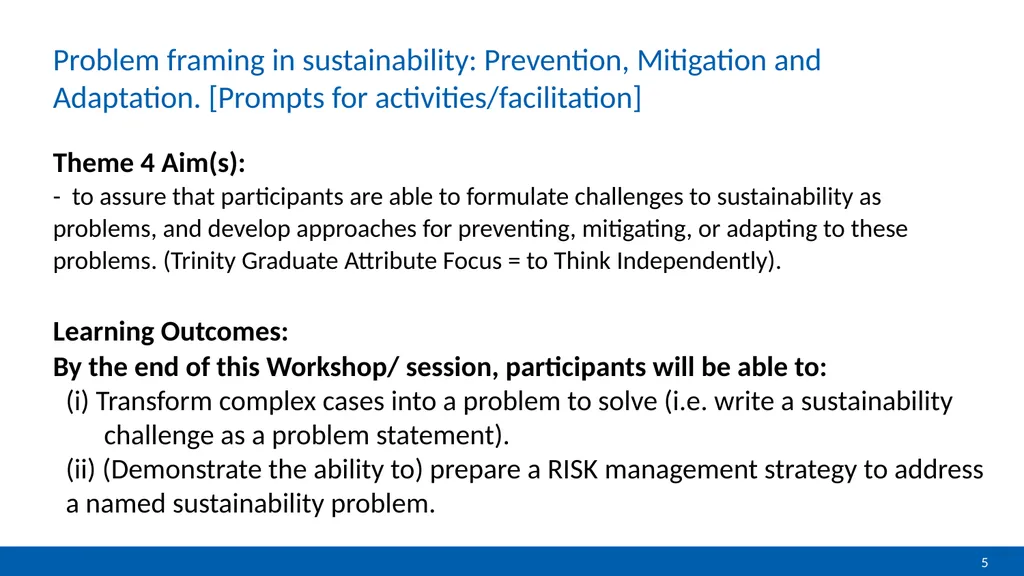
Problem framing in sustainability: Prevention, Mitigation and Adaptation. [Prompts for activities/facilitation] Theme 4 Aim(s):
- to assure that participants are able to formulate challenges to sustainability as problems, and develop approaches for preventing, mitigating, or adapting to these problems. (Trinity Graduate Attribute Focus = to Think Independently).
Learning Outcomes:
By the end of this Workshop/ session, participants will be able to:
(i) Transform complex cases into a problem to solve (i.e. write a sustainability challenge as a problem statement).
(ii) (Demonstrate the ability to) prepare a RISK management strategy to address a named sustainability problem. 5<br>
06
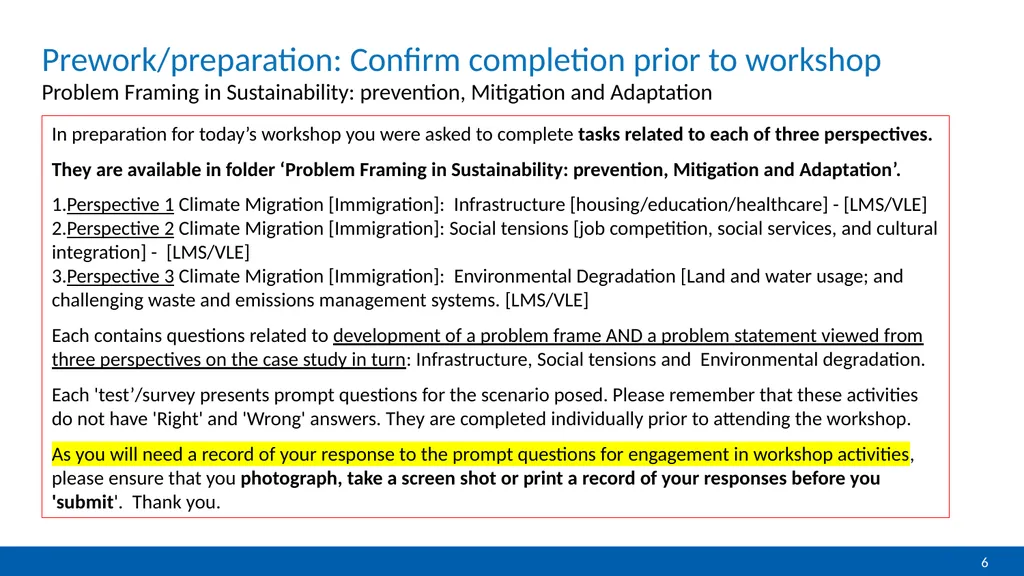
Prework/preparation: Confirm completion prior to workshop Problem Framing in Sustainability: prevention, Mitigation and Adaptation In preparation for today’s workshop you were asked to complete tasks related to each of three perspectives.
They are available in folder ‘Problem Framing in Sustainability: prevention, Mitigation and Adaptation’.
Perspective 1 Climate Migration [Immigration]: Infrastructure [housing/education/healthcare] - [LMS/VLE]
Perspective 2 Climate Migration [Immigration]: Social tensions [job competition, social services, and cultural integration] - [LMS/VLE]
Perspective 3 Climate Migration [Immigration]: Environmental Degradation [Land and water usage; and challenging waste and emissions management systems. [LMS/VLE]
Each contains questions related to development of a problem frame AND a problem statement viewed from three perspectives on the case study in turn: Infrastructure, Social tensions and Environmental degradation.
Each 'test’/survey presents prompt questions for the scenario posed. Please remember that these activities do not have 'Right' and 'Wrong' answers. They are completed individually prior to attending the workshop.
As you will need a record of your response to the prompt questions for engagement in workshop activities, please ensure that you photograph, take a screen shot or print a record of your responses before you 'submit'. Thank you. 6<br>
07
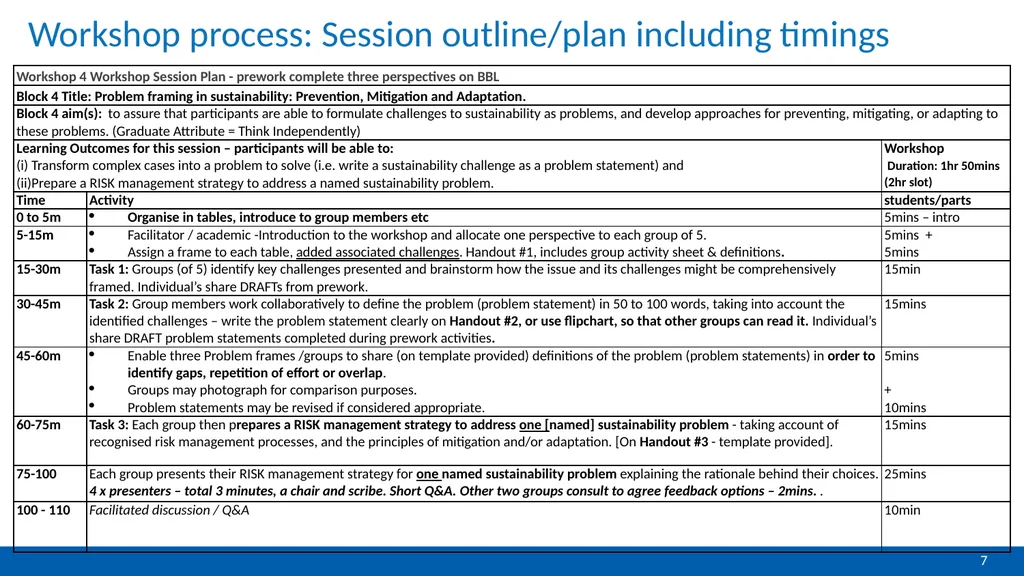
Workshop process: Session outline/plan including timings 7<br>
08
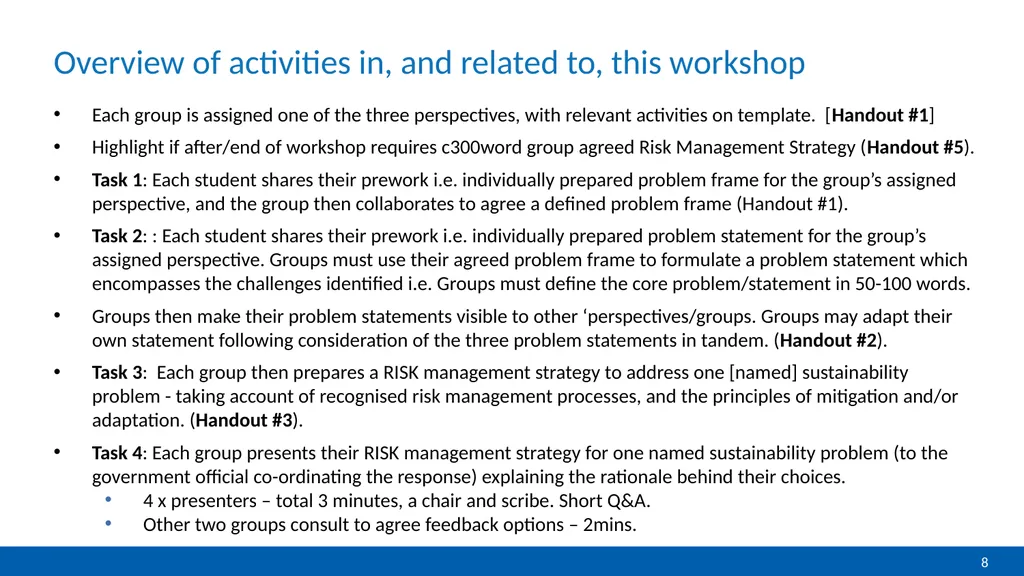
Overview of activities in, and related to, this workshop Each group is assigned one of the three perspectives, with relevant activities on template. [Handout #1]
Highlight if after/end of workshop requires c300word group agreed Risk Management Strategy (Handout #5).
Task 1: Each student shares their prework i.e. individually prepared problem frame for the group’s assigned perspective, and the group then collaborates to agree a defined problem frame (Handout #1).
Task 2: : Each student shares their prework i.e. individually prepared problem statement for the group’s assigned perspective. Groups must use their agreed problem frame to formulate a problem statement which encompasses the challenges identified i.e. Groups must define the core problem/statement in 50-100 words.
Groups then make their problem statements visible to other ‘perspectives/groups. Groups may adapt their own statement following consideration of the three problem statements in tandem. (Handout #2).
Task 3: Each group then prepares a RISK management strategy to address one [named] sustainability problem - taking account of recognised risk management processes, and the principles of mitigation and/or adaptation. (Handout #3).
Task 4: Each group presents their RISK management strategy for one named sustainability problem (to the government official co-ordinating the response) explaining the rationale behind their choices.
4 x presenters – total 3 minutes, a chair and scribe. Short Q&A.
Other two groups consult to agree feedback options – 2mins. 8<br>
09
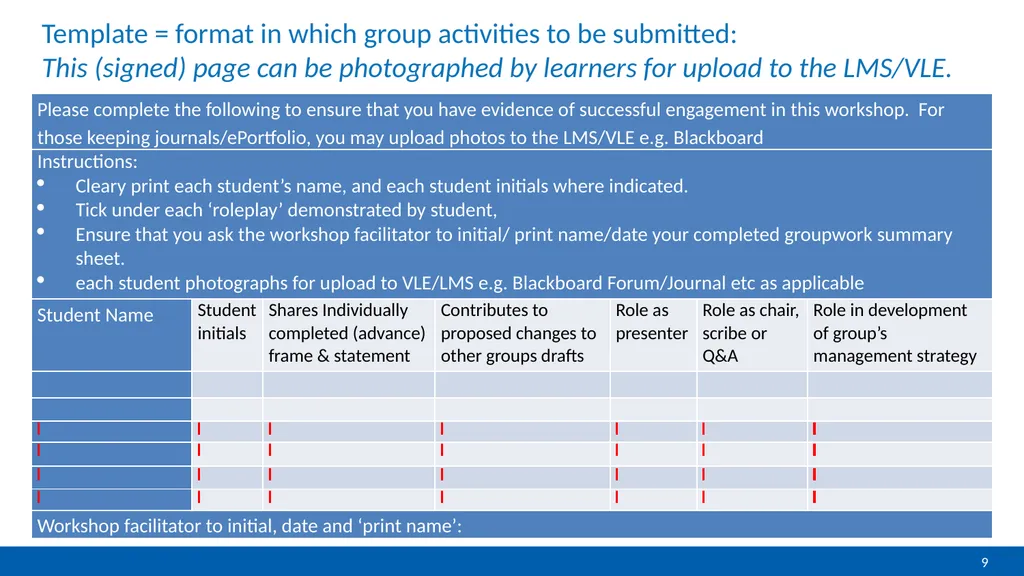
Template = format in which group activities to be submitted:
This (signed) page can be photographed by learners for upload to the LMS/VLE. 9<br>
10
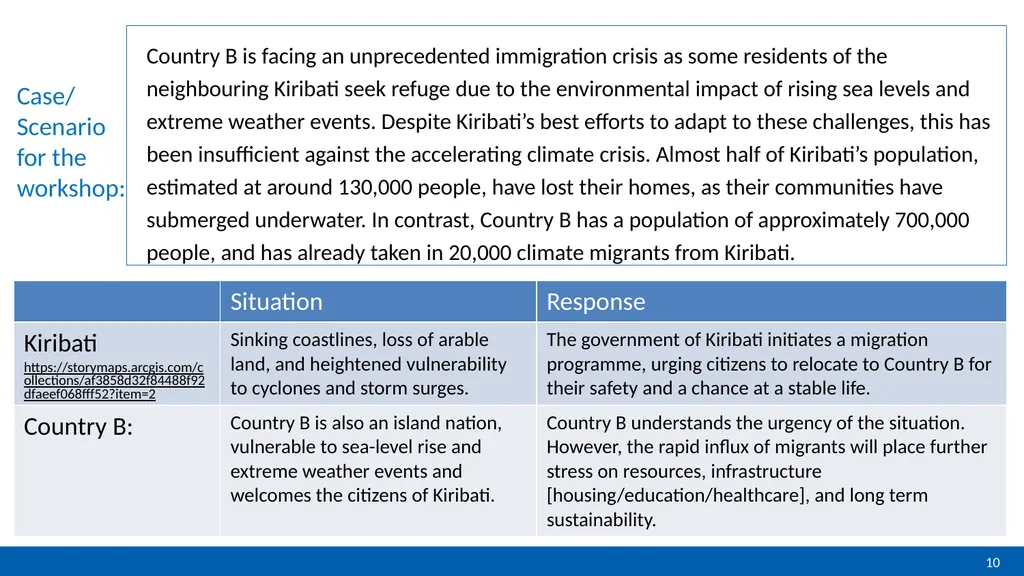
Case/ Scenario for the workshop: Country B is facing an unprecedented immigration crisis as some residents of the neighbouring Kiribati seek refuge due to the environmental impact of rising sea levels and extreme weather events. Despite Kiribati’s best efforts to adapt to these challenges, this has been insufficient against the accelerating climate crisis. Almost half of Kiribati’s population, estimated at around 130,000 people, have lost their homes, as their communities have submerged underwater. In contrast, Country B has a population of approximately 700,000 people, and has already taken in 20,000 climate migrants from Kiribati. 10<br>
11
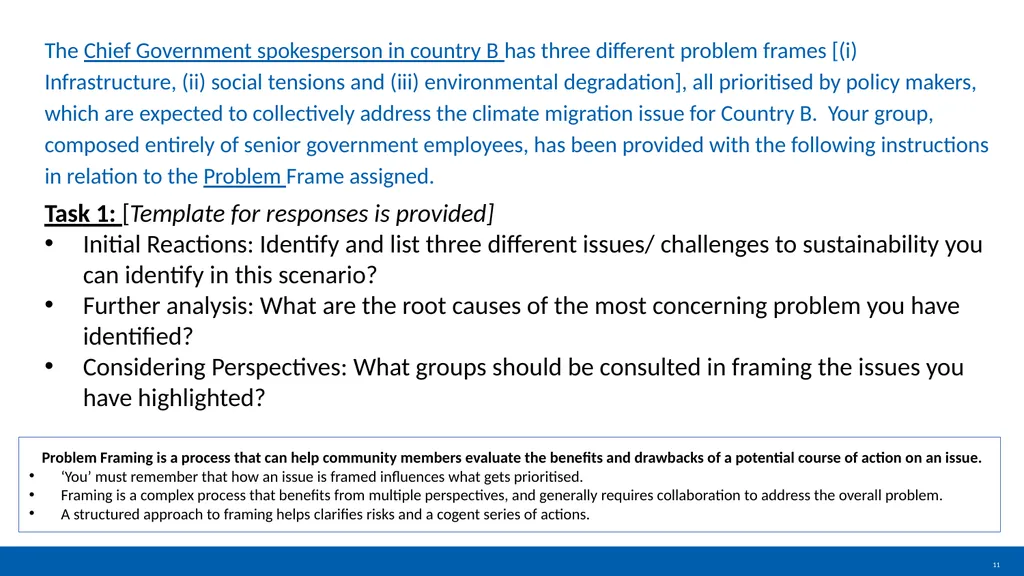
Scenario – Chief Government Spokesperson The Chief Government spokesperson in country B has three different problem frames [(i) Infrastructure, (ii) social tensions and (iii) environmental degradation], all prioritised by policy makers, which are expected to collectively address the climate migration issue for Country B. Your group, composed entirely of senior government employees, has been provided with the following instructions in relation to the Problem Frame assigned. Task 1: [Template for responses is provided]
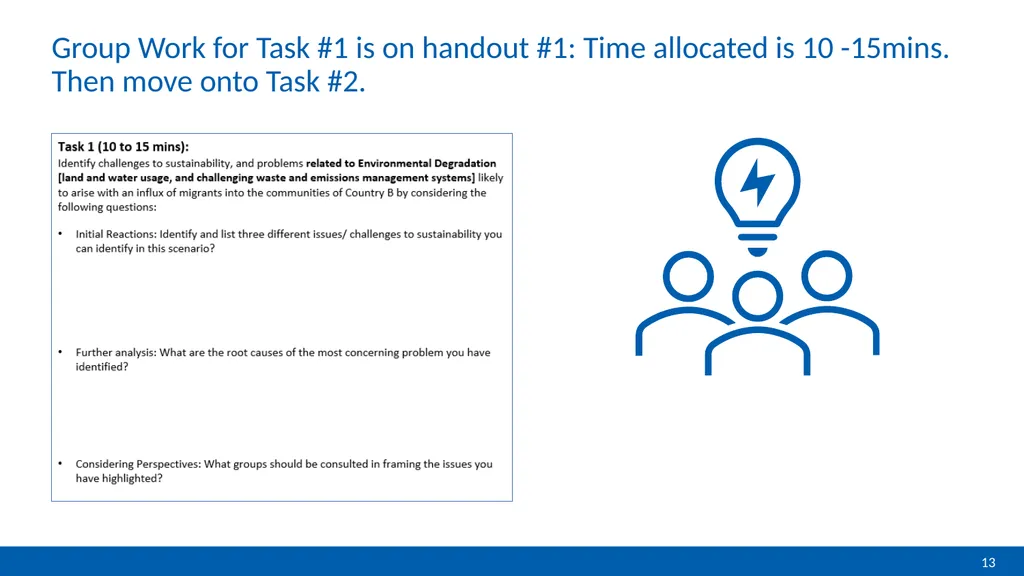
Initial Reactions: Identify and list three different issues/ challenges to sustainability you can identify in this scenario?
Further analysis: What are the root causes of the most concerning problem you have identified?
Considering Perspectives: What groups should be consulted in framing the issues you have highlighted? Problem Framing is a process that can help community members evaluate the benefits and drawbacks of a potential course of action on an issue.
‘You’ must remember that how an issue is framed influences what gets prioritised.
Framing is a complex process that benefits from multiple perspectives, and generally requires collaboration to address the overall problem.
A structured approach to framing helps clarifies risks and a cogent series of actions. 11<br>
12
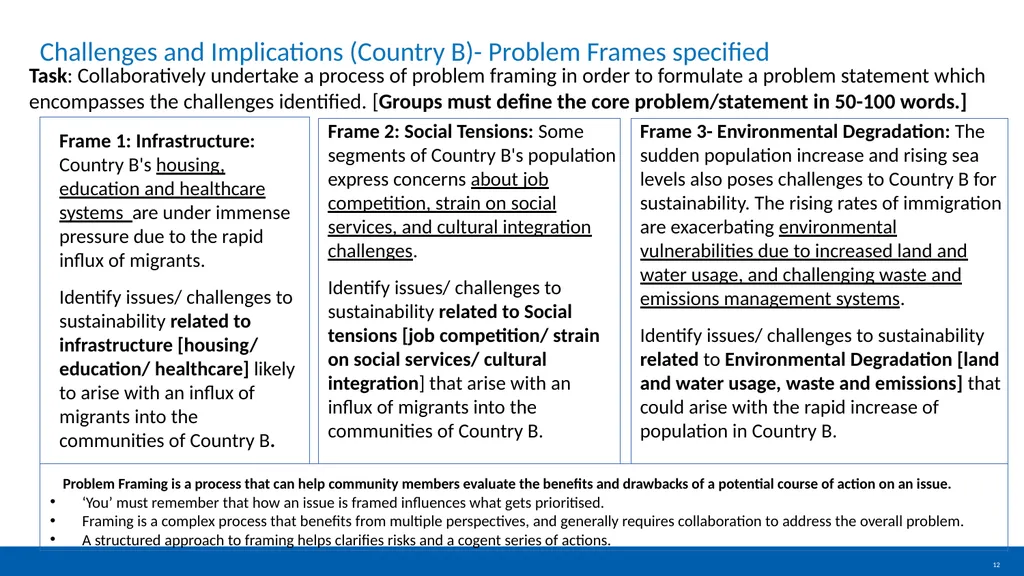
Challenges and Implications (Country B)- Problem Frames specified Task: Collaboratively undertake a process of problem framing in order to formulate a problem statement which encompasses the challenges identified. [Groups must define the core problem/statement in 50-100 words.] Frame 1: Infrastructure: Country B's housing, education and healthcare systems are under immense pressure due to the rapid influx of migrants.
Identify issues/ challenges to sustainability related to infrastructure [housing/ education/ healthcare] likely to arise with an influx of migrants into the communities of Country B. Frame 2: Social Tensions: Some segments of Country B's population express concerns about job competition, strain on social services, and cultural integration challenges.
Identify issues/ challenges to sustainability related to Social tensions [job competition/ strain on social services/ cultural integration] that arise with an influx of migrants into the communities of Country B. Frame 3- Environmental Degradation: The sudden population increase and rising sea levels also poses challenges to Country B for sustainability. The rising rates of immigration are exacerbating environmental vulnerabilities due to increased land and water usage, and challenging waste and emissions management systems.
Identify issues/ challenges to sustainability related to Environmental Degradation [land and water usage, waste and emissions] that could arise with the rapid increase of population in Country B. Problem Framing is a process that can help community members evaluate the benefits and drawbacks of a potential course of action on an issue.
‘You’ must remember that how an issue is framed influences what gets prioritised.
Framing is a complex process that benefits from multiple perspectives, and generally requires collaboration to address the overall problem.
A structured approach to framing helps clarifies risks and a cogent series of actions. 12<br>
13
Group Work for Task #1 is on handout #1: Time allocated is 10 -15mins.
Then move onto Task #2. 13<br>
14
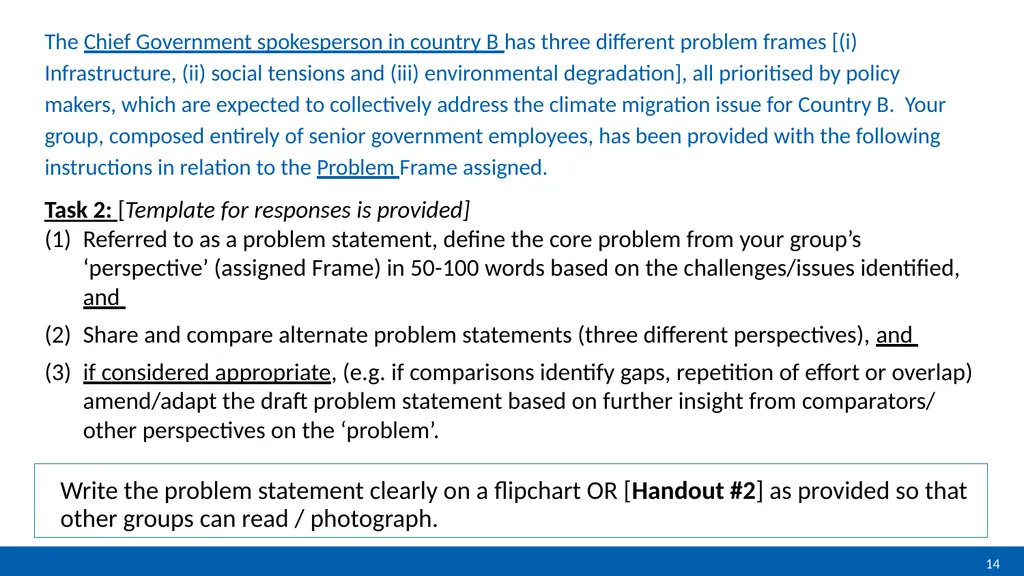
Scenario – Chief Government Spokesperson B The Chief Government spokesperson in country B has three different problem frames [(i) Infrastructure, (ii) social tensions and (iii) environmental degradation], all prioritised by policy makers, which are expected to collectively address the climate migration issue for Country B. Your group, composed entirely of senior government employees, has been provided with the following instructions in relation to the Problem Frame assigned. Task 2: [Template for responses is provided]
Referred to as a problem statement, define the core problem from your group’s ‘perspective’ (assigned Frame) in 50-100 words based on the challenges/issues identified, and
Share and compare alternate problem statements (three different perspectives), and
if considered appropriate, (e.g. if comparisons identify gaps, repetition of effort or overlap) amend/adapt the draft problem statement based on further insight from comparators/ other perspectives on the ‘problem’. Write the problem statement clearly on a flipchart OR [Handout #2] as provided so that other groups can read / photograph. 14<br>
15
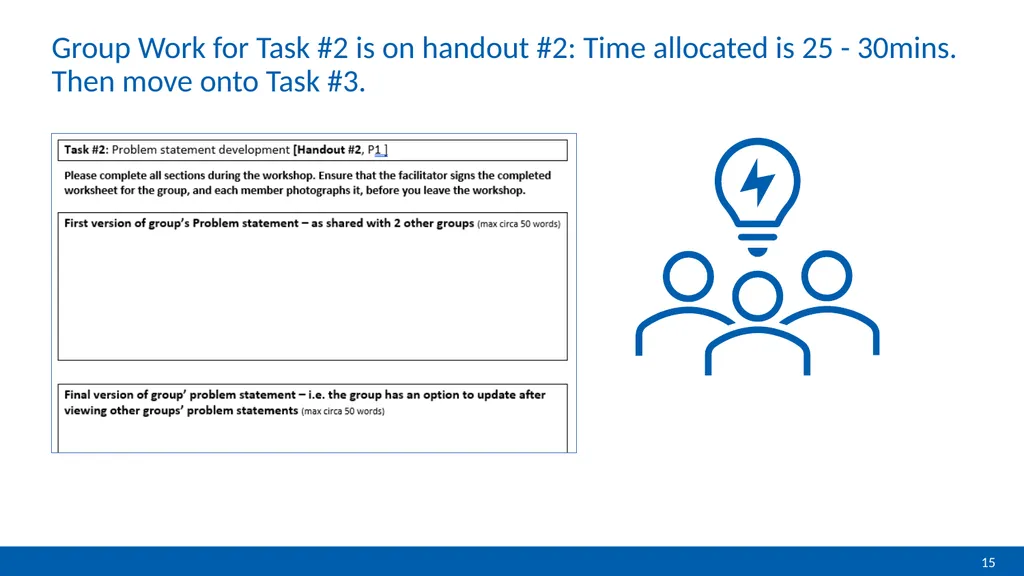
Group Work for Task #2 is on handout #2: Time allocated is 25 - 30mins.
Then move onto Task #3. 15<br>
16
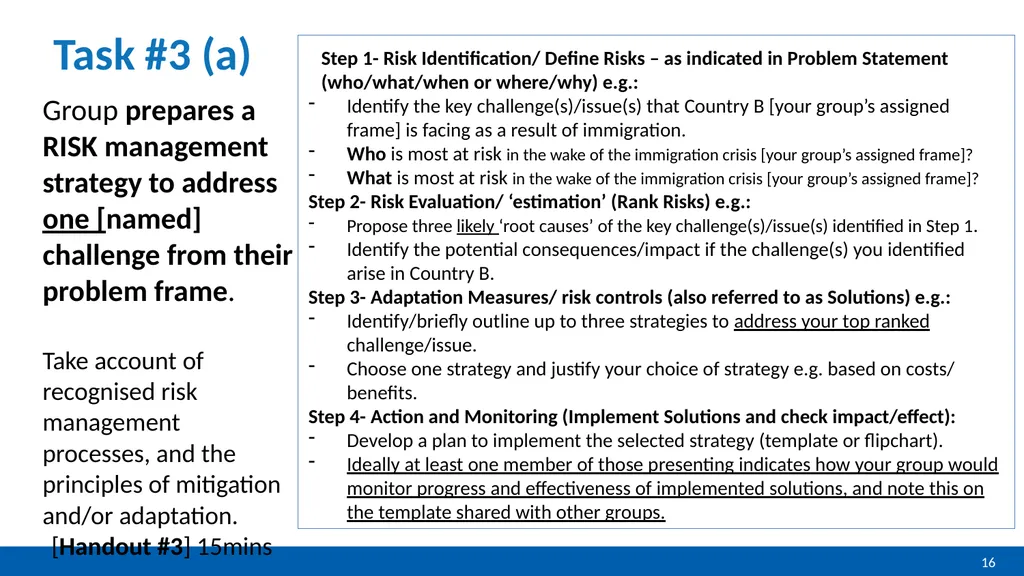
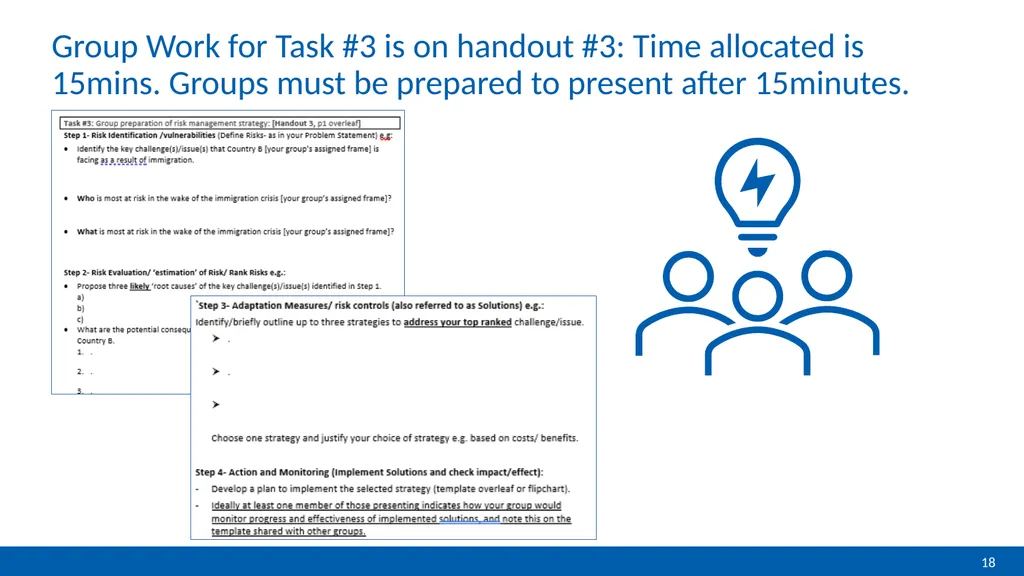
Task #3 (a) Group prepares a RISK management strategy to address one [named] challenge from their problem frame.
Take account of recognised risk management processes, and the principles of mitigation and/or adaptation.
[Handout #3] 15mins Step 1- Risk Identification/ Define Risks – as indicated in Problem Statement (who/what/when or where/why) e.g.:
Identify the key challenge(s)/issue(s) that Country B [your group’s assigned frame] is facing as a result of immigration.
Who is most at risk in the wake of the immigration crisis [your group’s assigned frame]?
What is most at risk in the wake of the immigration crisis [your group’s assigned frame]?
Step 2- Risk Evaluation/ ‘estimation’ (Rank Risks) e.g.:
Propose three likely ‘root causes’ of the key challenge(s)/issue(s) identified in Step 1.
Identify the potential consequences/impact if the challenge(s) you identified arise in Country B.
Step 3- Adaptation Measures/ risk controls (also referred to as Solutions) e.g.:
Identify/briefly outline up to three strategies to address your top ranked challenge/issue.
Choose one strategy and justify your choice of strategy e.g. based on costs/ benefits.
Step 4- Action and Monitoring (Implement Solutions and check impact/effect):
Develop a plan to implement the selected strategy (template or flipchart).
Ideally at least one member of those presenting indicates how your group would monitor progress and effectiveness of implemented solutions, and note this on the template shared with other groups. 16<br>
17
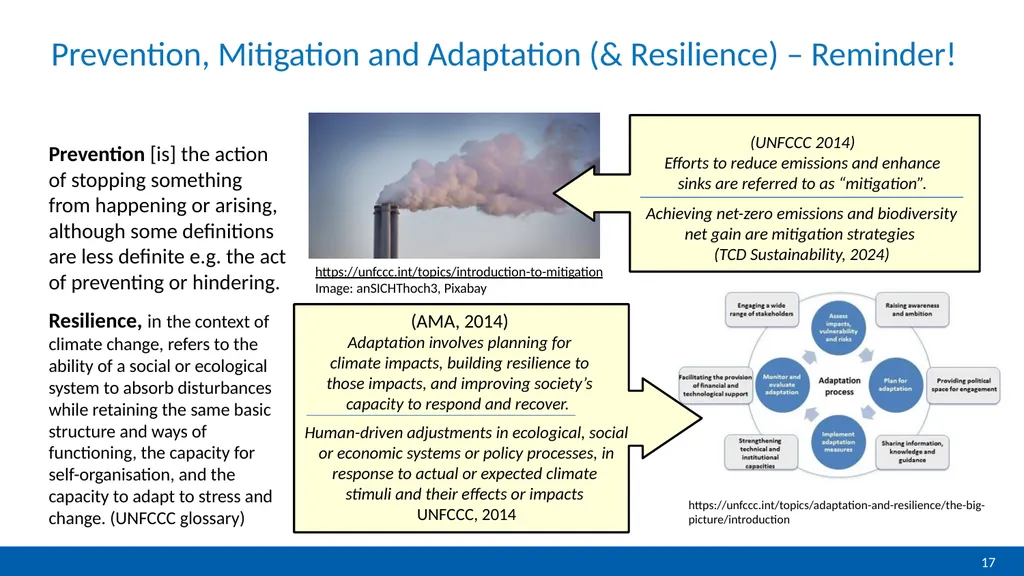
Prevention, Mitigation and Adaptation (& Resilience) – Reminder! Prevention [is] the action of stopping something from happening or arising, although some definitions are less definite e.g. the act of preventing or hindering.
Resilience, in the context of climate change, refers to the ability of a social or ecological system to absorb disturbances while retaining the same basic structure and ways of functioning, the capacity for self-organisation, and the capacity to adapt to stress and change. (UNFCCC glossary) https://unfccc.int/topics/introduction-to-mitigation
Image: anSICHThoch3, Pixabay (UNFCCC 2014)
Efforts to reduce emissions and enhance sinks are referred to as “mitigation”. Achieving net-zero emissions and biodiversity net gain are mitigation strategies
(TCD Sustainability, 2024) (AMA, 2014)
Adaptation involves planning for climate impacts, building resilience to those impacts, and improving society’s capacity to respond and recover. Human-driven adjustments in ecological, social or economic systems or policy processes, in response to actual or expected climate
stimuli and their effects or impacts
UNFCCC, 2014 https://unfccc.int/topics/adaptation-and-resilience/the-big-picture/introduction 17<br>
18
Group Work for Task #3 is on handout #3: Time allocated is 15mins. Groups must be prepared to present after 15minutes. 18<br>
19
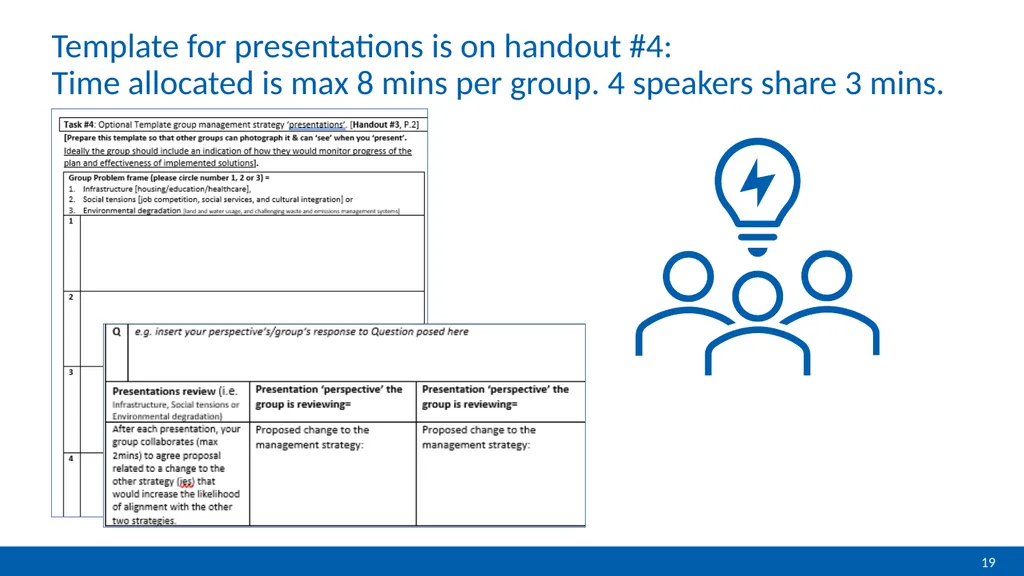
Template for presentations is on handout #4:
Time allocated is max 8 mins per group. 4 speakers share 3 mins. 19<br>
20
Slides (4) aligned with Theme’s Videos & Workshop pack
-aligned with Videos by Dr John Gallagher, 2024 and/or Theme Workshop pack, available at:
www.tcd.ie/academicpractice/resources/education-for-sustainable-development/teaching-materials-for-esd/ Guidance notes for learners
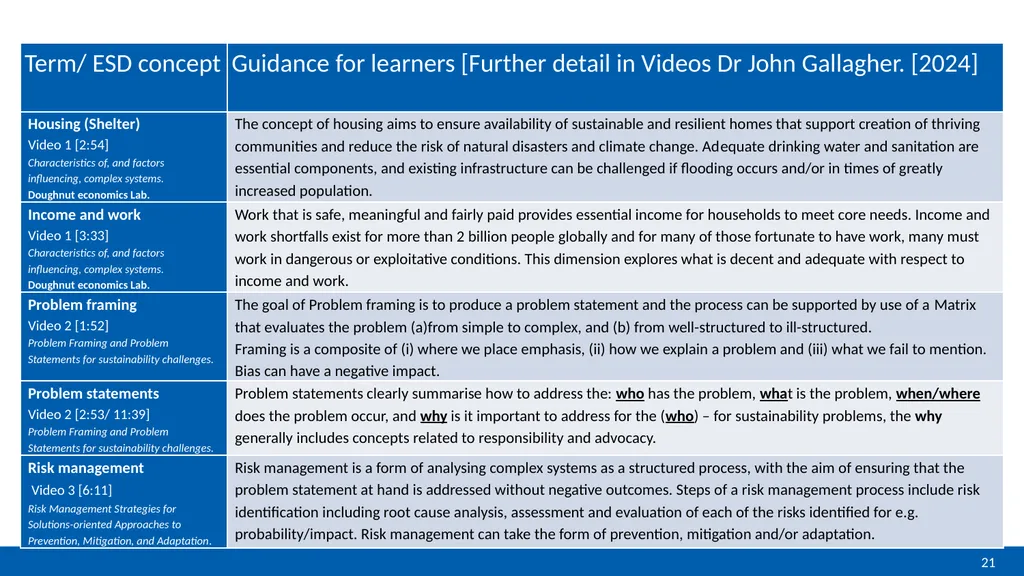
Raworth’s Housing & Shelter, and Income & Work.
Problem Framing, Problem Statements and Risk Management.
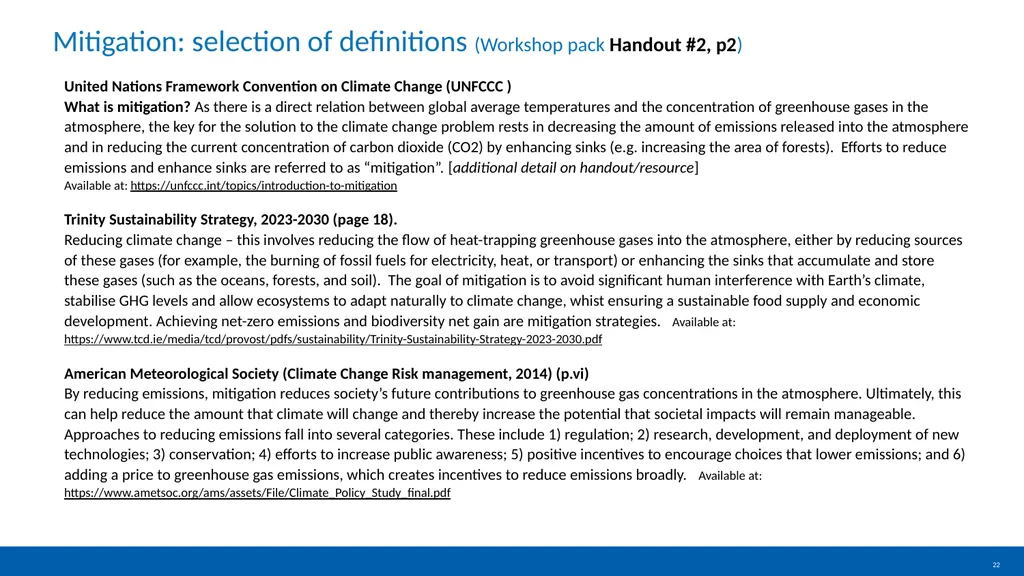
Selection of definitions for Mitigation
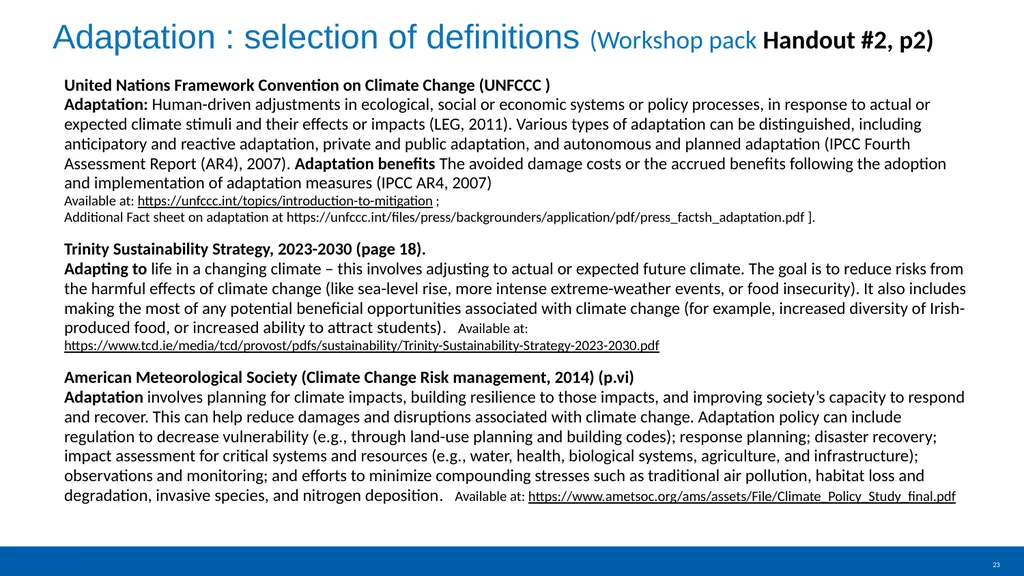
Selection of definitions for Adaptation
Significance of Climate migration further to sea-level rise as a case study.
Facilitator checklist (Assessment process)
The Final section = wrap-up and prompts for reflection (3 slides) 20<br>
21
Guidance for Learners – Term/ESD Concept 21<br>
22
Mitigation: selection of definitions (Workshop pack Handout #2, p2) United Nations Framework Convention on Climate Change (UNFCCC )
What is mitigation? As there is a direct relation between global average temperatures and the concentration of greenhouse gases in the atmosphere, the key for the solution to the climate change problem rests in decreasing the amount of emissions released into the atmosphere and in reducing the current concentration of carbon dioxide (CO2) by enhancing sinks (e.g. increasing the area of forests). Efforts to reduce emissions and enhance sinks are referred to as “mitigation”. [additional detail on handout/resource]
Available at: https://unfccc.int/topics/introduction-to-mitigation
Trinity Sustainability Strategy, 2023-2030 (page 18).
Reducing climate change – this involves reducing the flow of heat-trapping greenhouse gases into the atmosphere, either by reducing sources of these gases (for example, the burning of fossil fuels for electricity, heat, or transport) or enhancing the sinks that accumulate and store these gases (such as the oceans, forests, and soil). The goal of mitigation is to avoid significant human interference with Earth’s climate, stabilise GHG levels and allow ecosystems to adapt naturally to climate change, whist ensuring a sustainable food supply and economic development. Achieving net-zero emissions and biodiversity net gain are mitigation strategies. Available at: https://www.tcd.ie/media/tcd/provost/pdfs/sustainability/Trinity-Sustainability-Strategy-2023-2030.pdf
American Meteorological Society (Climate Change Risk management, 2014) (p.vi)
By reducing emissions, mitigation reduces society’s future contributions to greenhouse gas concentrations in the atmosphere. Ultimately, this can help reduce the amount that climate will change and thereby increase the potential that societal impacts will remain manageable. Approaches to reducing emissions fall into several categories. These include 1) regulation; 2) research, development, and deployment of new technologies; 3) conservation; 4) efforts to increase public awareness; 5) positive incentives to encourage choices that lower emissions; and 6) adding a price to greenhouse gas emissions, which creates incentives to reduce emissions broadly. Available at: https://www.ametsoc.org/ams/assets/File/Climate_Policy_Study_final.pdf 22<br>
23
Adaptation : selection of definitions (Workshop pack Handout #2, p2) United Nations Framework Convention on Climate Change (UNFCCC )
Adaptation: Human-driven adjustments in ecological, social or economic systems or policy processes, in response to actual or expected climate stimuli and their effects or impacts (LEG, 2011). Various types of adaptation can be distinguished, including anticipatory and reactive adaptation, private and public adaptation, and autonomous and planned adaptation (IPCC Fourth Assessment Report (AR4), 2007). Adaptation benefits The avoided damage costs or the accrued benefits following the adoption and implementation of adaptation measures (IPCC AR4, 2007)
Available at: https://unfccc.int/topics/introduction-to-mitigation ;
Additional Fact sheet on adaptation at https://unfccc.int/files/press/backgrounders/application/pdf/press_factsh_adaptation.pdf ].
Trinity Sustainability Strategy, 2023-2030 (page 18).
Adapting to life in a changing climate – this involves adjusting to actual or expected future climate. The goal is to reduce risks from the harmful effects of climate change (like sea-level rise, more intense extreme-weather events, or food insecurity). It also includes making the most of any potential beneficial opportunities associated with climate change (for example, increased diversity of Irish-produced food, or increased ability to attract students). Available at: https://www.tcd.ie/media/tcd/provost/pdfs/sustainability/Trinity-Sustainability-Strategy-2023-2030.pdf
American Meteorological Society (Climate Change Risk management, 2014) (p.vi)
Adaptation involves planning for climate impacts, building resilience to those impacts, and improving society’s capacity to respond and recover. This can help reduce damages and disruptions associated with climate change. Adaptation policy can include regulation to decrease vulnerability (e.g., through land-use planning and building codes); response planning; disaster recovery; impact assessment for critical systems and resources (e.g., water, health, biological systems, agriculture, and infrastructure); observations and monitoring; and efforts to minimize compounding stresses such as traditional air pollution, habitat loss and degradation, invasive species, and nitrogen deposition. Available at: https://www.ametsoc.org/ams/assets/File/Climate_Policy_Study_final.pdf 23<br>
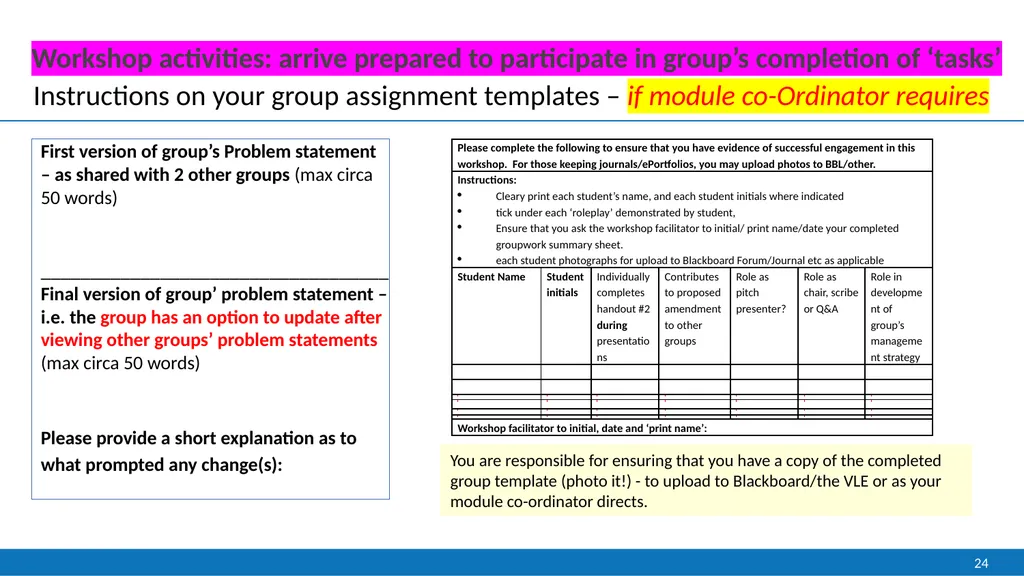
24
Workshop activities: arrive prepared to participate in group’s completion of ‘tasks’ Instructions on your group assignment templates – if module co-Ordinator requires First version of group’s Problem statement – as shared with 2 other groups (max circa 50 words)
___________________________________Final version of group’ problem statement – i.e. the group has an option to update after viewing other groups’ problem statements (max circa 50 words)
Please provide a short explanation as to what prompted any change(s): You are responsible for ensuring that you have a copy of the completed group template (photo it!) - to upload to Blackboard/the VLE or as your module co-ordinator directs.<br>
25
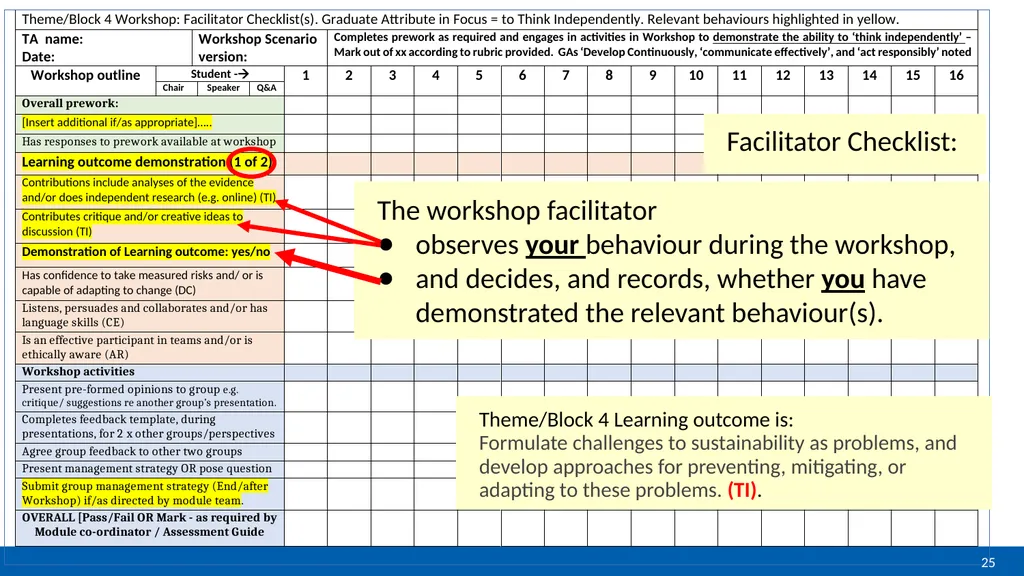
Theme 4 Facilitator Checklist – Graduate Attribute in Focus Facilitator Checklist: The workshop facilitator
observes your behaviour during the workshop,
and decides, and records, whether you have demonstrated the relevant behaviour(s). Theme/Block 4 Learning outcome is:
Formulate challenges to sustainability as problems, and develop approaches for preventing, mitigating, or adapting to these problems. (TI). 25<br>
26
Wrapup and discussion Significance of Climate migration (from Kiribati) following Sea-level rise as a case study.
Prompts for further reflection 26<br>
Prompts for further reflection 26<br>
27
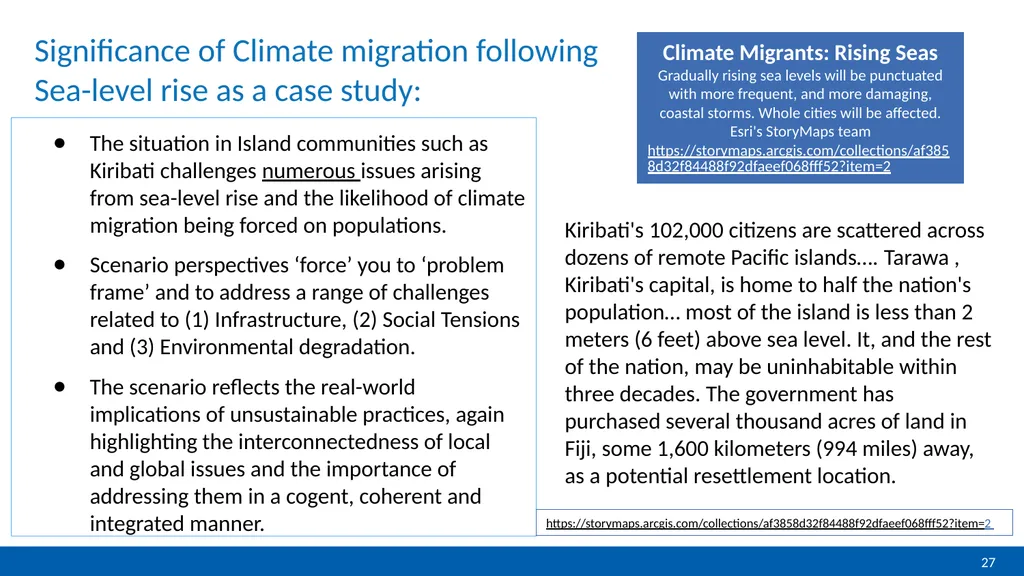
Significance of Climate migration following Sea-level rise as a case study: The situation in Island communities such as Kiribati challenges numerous issues arising from sea-level rise and the likelihood of climate migration being forced on populations.
Scenario perspectives ‘force’ you to ‘problem frame’ and to address a range of challenges related to (1) Infrastructure, (2) Social Tensions and (3) Environmental degradation.
The scenario reflects the real-world implications of unsustainable practices, again highlighting the interconnectedness of local and global issues and the importance of addressing them in a cogent, coherent and integrated manner. Climate Migrants: Rising Seas
Gradually rising sea levels will be punctuated with more frequent, and more damaging, coastal storms. Whole cities will be affected.
Esri's StoryMaps team
https://storymaps.arcgis.com/collections/af3858d32f84488f92dfaeef068fff52?item=2 Kiribati's 102,000 citizens are scattered across dozens of remote Pacific islands…. Tarawa , Kiribati's capital, is home to half the nation's population… most of the island is less than 2 meters (6 feet) above sea level. It, and the rest of the nation, may be uninhabitable within three decades. The government has purchased several thousand acres of land in Fiji, some 1,600 kilometers (994 miles) away, as a potential resettlement location. https://storymaps.arcgis.com/collections/af3858d32f84488f92dfaeef068fff52?item=2 27<br>
28
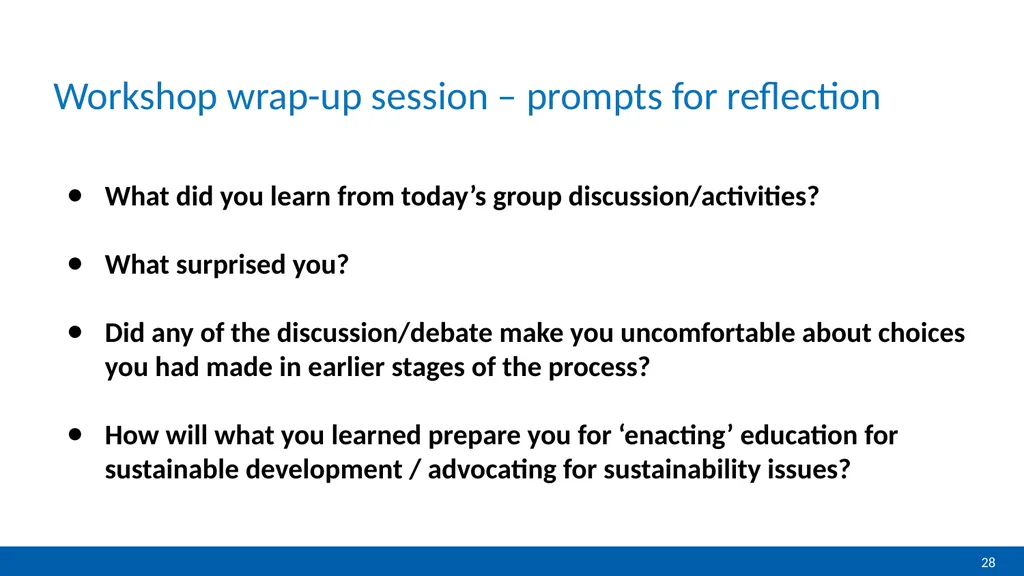
Workshop wrap-up session – prompts for reflection What did you learn from today’s group discussion/activities?
What surprised you?
Did any of the discussion/debate make you uncomfortable about choices you had made in earlier stages of the process?
How will what you learned prepare you for ‘enacting’ education for sustainable development / advocating for sustainability issues? 28<br>
What surprised you?
Did any of the discussion/debate make you uncomfortable about choices you had made in earlier stages of the process?
How will what you learned prepare you for ‘enacting’ education for sustainable development / advocating for sustainability issues? 28<br>
29
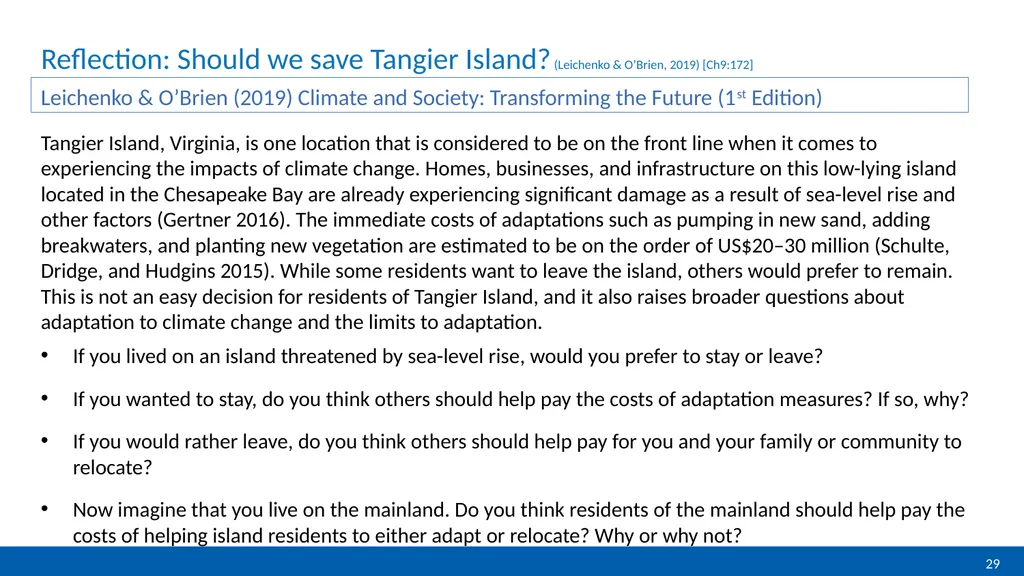
Reflection: Should we save Tangier Island? (Leichenko & O’Brien, 2019) [Ch9:172] Leichenko & O’Brien (2019) Climate and Society: Transforming the Future (1st Edition) Tangier Island, Virginia, is one location that is considered to be on the front line when it comes to experiencing the impacts of climate change. Homes, businesses, and infrastructure on this low-lying island located in the Chesapeake Bay are already experiencing significant damage as a result of sea-level rise and other factors (Gertner 2016). The immediate costs of adaptations such as pumping in new sand, adding breakwaters, and planting new vegetation are estimated to be on the order of US$20–30 million (Schulte, Dridge, and Hudgins 2015). While some residents want to leave the island, others would prefer to remain. This is not an easy decision for residents of Tangier Island, and it also raises broader questions about adaptation to climate change and the limits to adaptation.
If you lived on an island threatened by sea-level rise, would you prefer to stay or leave?
If you wanted to stay, do you think others should help pay the costs of adaptation measures? If so, why?
If you would rather leave, do you think others should help pay for you and your family or community to relocate?
Now imagine that you live on the mainland. Do you think residents of the mainland should help pay the costs of helping island residents to either adapt or relocate? Why or why not? 29<br>
30
Questions? [Reminder to use discussion Forums on the LMS/VLE for Q&A with teachers/facilitators.]
[Add facilitator contact details here] 30<br>
[Add facilitator contact details here] 30<br>
31
Acknowledgements These materials are derived from development of a module, Enacting Education for Sustainable Development, co-developed by members of Trinity College Dublin’s academic staff, Carlos Rocha, Cicely Roche, Clare Kelly, Felix Mezzanotte, John Gallagher and Sarah-Jane Cullinane as part of their roles as Fellows in Education for Sustainable Development in 2023-2024 – and Trinity College Dublin students Freddie Fallon, Maryam Yabo, Tom Hegarty and William Reynolds as part of their roles as Education for Sustainable Development Interns in 2023-2024.
This work was funded by the National Forum/Higher Education Authority under the Strategic Alignment of Teaching and Learning Enhancement Fund. These materials are shared under a Creative Commons Attribution-NonCommercial-Sharealike 4.0 International License (CC BY-NC-SA 4.0). This means that you can reuse, adapt, and build on these materials, providing attribution is given to the creators and providing you share the modified material under identical terms. You may not use the material for commercial purposes. For more details, visit:
https://www.tcd.ie/academicpractice/resources/education-for-sustainable-development/teaching-materials-for-esd/ 31<br>