
Trade relations between Bulgaria and China


Description: Trade relations between Bulgaria and China Bulgaria China trade and investment relations 23.06.2023 Economic Research Institute at Bulgarian Academy of Sciences (ERI BAS) Bulgaria-China Trade Relations The development of trade and
Related Topics
Download Presentation
"Trade relations between Bulgaria and China" is the property of its rightful owner. Permission is granted to download and print the materials on this website for personal, non-commercial use only, and to display it on your personal computer provided you do not modify the materials and that you retain all copyright notices contained in the materials. By downloading content from our website, you accept the terms of this agreement.
Presentation Transcript
slide1. Trade relations between Bulgaria and China Bulgaria – China trade and investment relations
23.06.2023
Economic Research Institute at Bulgarian Academy of Sciences (ERI BAS)<br>
slide2. Bulgaria-China Trade Relations The development of trade and economic relations between Bulgaria and China are considered in the context of Bulgaria's membership in the European Union,
and the fact that China is a EU strategic partner,
as well as within the framework of the Cooperation Initiative between China and the countries of Central and Eastern Europe launched by the Chinese government in 2011,
and the Belt and Road Initiative launched by Chinese President Xi Jinping in autumn 2013. (Now “14+1”).
The EU is China's largest trading partner. China and the EU hold annual Summits. On December 30, 2020, the EU and China announced the conclusion in principle of negotiations on the EU-China Comprehensive Agreement on Investment (negotiations started in 2013).<br>
slide3. Main achievements of the book "Bulgaria-China trade and investment relations“ Have been revealed China economic and trade reforms carried out over the past 40 years, which have elevated China to the 2nd world economic power and a leading exporter of goods in the international trade market.
Have been evaluated the trade relations of China with the main trading partners, the EU and the USA, as well as the contradictions and trade perspective between the trade partners with the rise of protectionism in the international trade and economic relations.
The reasons for the weak growth of Bulgaria-China trade have been underlined, as well as the potential for trade between Bulgaria and China has been identified.<br>
slide4. Main achievements of the book "Bulgaria-China trade and investment relations“. On the basis of empirical data obtained from “field research”, real conclusions have been drawn about the investment activity of China in Bulgaria, and valuable scientific and practical recommendations have been given.
Empirical research shows significant resilience of Chinese companies - despite various difficulties they show enviable flexibility and this gives a prospect for expanding their activity in Bulgaria.
The experience of the first Chinese investors in Bulgaria, the failure of large projects and the passive Bulgarian state policy limit the possibilities of attracting new promising Chinese investments. The data shows that even the most skeptical European countries have more FDI from China, as a relative share of their total investment compared to Bulgaria. The potential for growth of FDI from China in Bulgaria is significant.
The thesis is confirmed that with its targeted economic policy, China manages to regulate both incoming and outgoing trade flows and investments from the country, and this is achieved with the help of various instruments - the direct impact on state-owned companies, financial and non-financial incentives, legislative restrictions and political influence.<br>
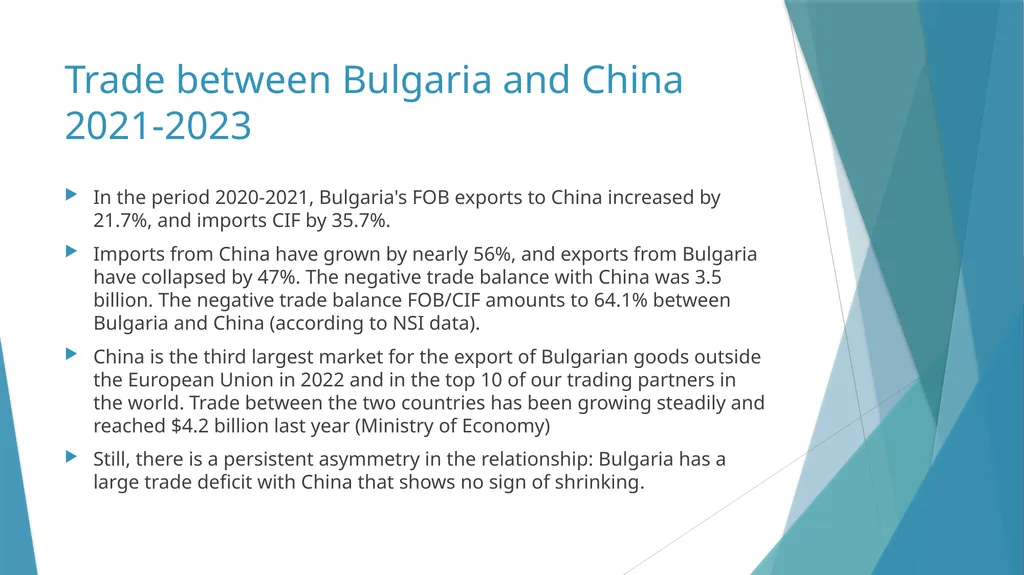
slide5. Trade between Bulgaria and China 2021-2023 In the period 2020-2021, Bulgaria's FOB exports to China increased by 21.7%, and imports CIF by 35.7%.
Imports from China have grown by nearly 56%, and exports from Bulgaria have collapsed by 47%. The negative trade balance with China was 3.5 billion. The negative trade balance FOB/CIF amounts to 64.1% between Bulgaria and China (according to NSI data).
China is the third largest market for the export of Bulgarian goods outside the European Union in 2022 and in the top 10 of our trading partners in the world. Trade between the two countries has been growing steadily and reached $4.2 billion last year (Ministry of Economy)
Still, there is a persistent asymmetry in the relationship: Bulgaria has a large trade deficit with China that shows no sign of shrinking.<br>
slide6. Exports, imports and trade balance of Bulgaria with China in the period January - April 2022 and 2023 (Millions EUR) Source: NSI<br>
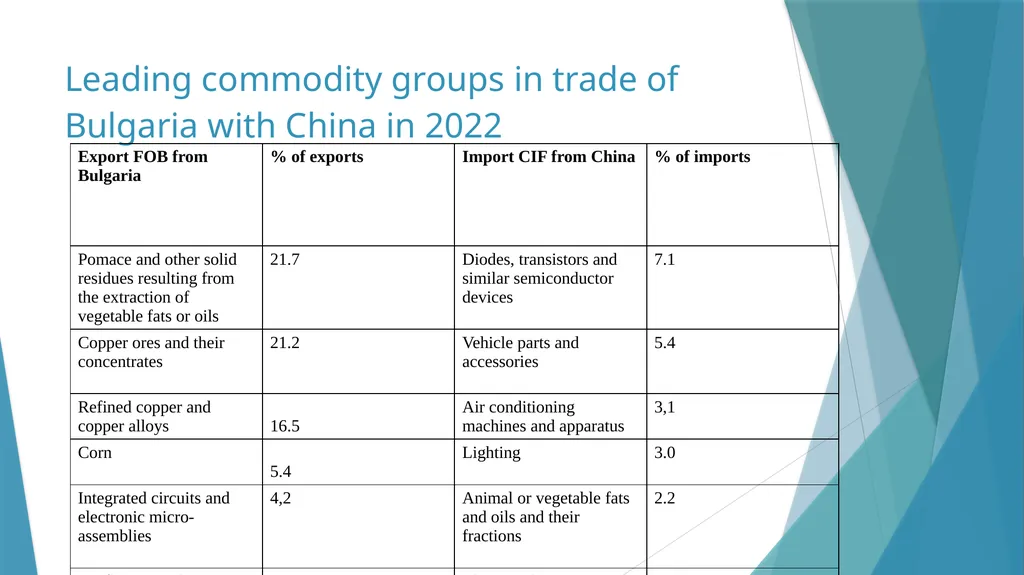
slide7. Leading commodity groups in trade of Bulgaria with China in 2022<br>
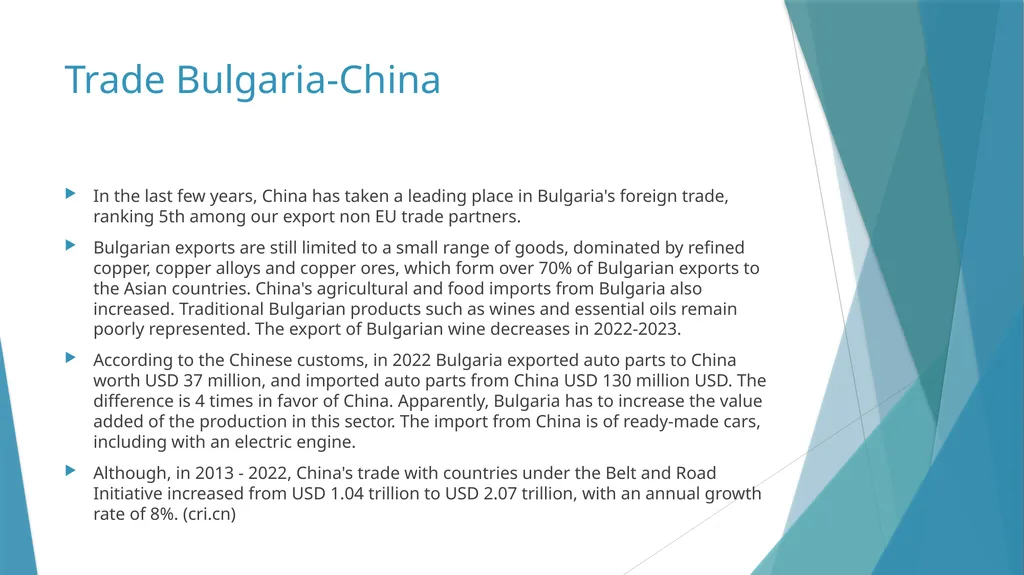
slide8. Trade Bulgaria-China In the last few years, China has taken a leading place in Bulgaria's foreign trade, ranking 5th among our export non EU trade partners.
Bulgarian exports are still limited to a small range of goods, dominated by refined copper, copper alloys and copper ores, which form over 70% of Bulgarian exports to the Asian countries. China's agricultural and food imports from Bulgaria also increased. Traditional Bulgarian products such as wines and essential oils remain poorly represented. The export of Bulgarian wine decreases in 2022-2023.
According to the Chinese customs, in 2022 Bulgaria exported auto parts to China worth USD 37 million, and imported auto parts from China USD 130 million USD. The difference is 4 times in favor of China. Apparently, Bulgaria has to increase the value added of the production in this sector. The import from China is of ready-made cars, including with an electric engine.
Although, in 2013 - 2022, China's trade with countries under the Belt and Road Initiative increased from USD 1.04 trillion to USD 2.07 trillion, with an annual growth rate of 8%. (cri.cn)<br>
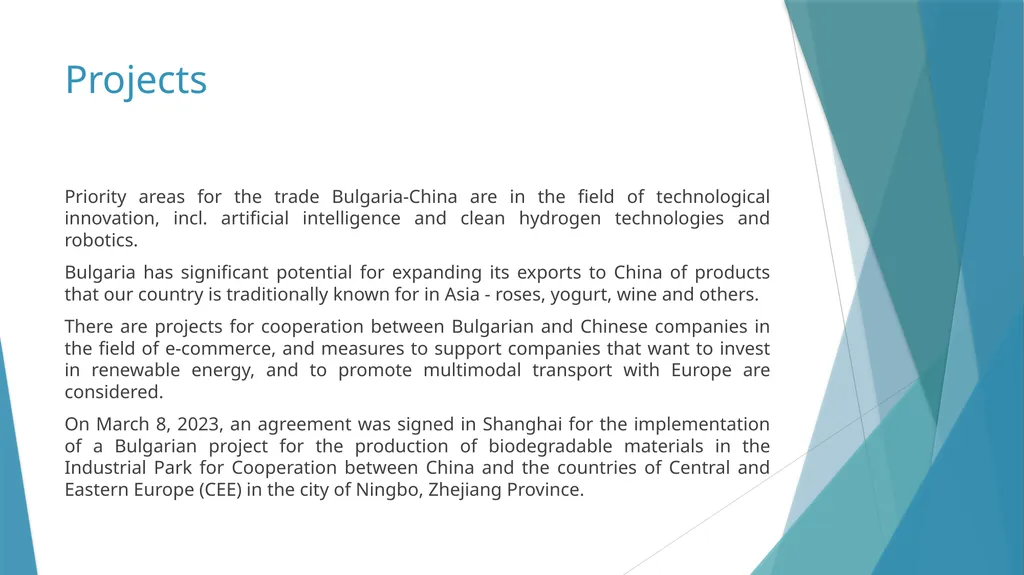
slide9. Projects Priority areas for the trade Bulgaria-China are in the field of technological innovation, incl. artificial intelligence and clean hydrogen technologies and robotics.
Bulgaria has significant potential for expanding its exports to China of products that our country is traditionally known for in Asia - roses, yogurt, wine and others.
There are projects for cooperation between Bulgarian and Chinese companies in the field of e-commerce, and measures to support companies that want to invest in renewable energy, and to promote multimodal transport with Europe are considered.
On March 8, 2023, an agreement was signed in Shanghai for the implementation of a Bulgarian project for the production of biodegradable materials in the Industrial Park for Cooperation between China and the countries of Central and Eastern Europe (CEE) in the city of Ningbo, Zhejiang Province.<br>
slide10. Conclusion The drop in transport prices and the devaluation of the Yuan (CNY) with 18% strengthen the prerequisites for China to increase its exports to Bulgaria. Bulgarian companies must be supported in their export policies toward China, since Bulgarian goods are less competitive compared with Chinese goods.
The trade relations between Bulgaria and China are characterized by a curious paradox. On the one hand, they show stability and consistency, regardless of changes of governments in power, but on the other hand, in economic and trade terms, Bulgaria behaves the most distantly in relation to stimulate and increase the trade with China.<br>
23.06.2023
Economic Research Institute at Bulgarian Academy of Sciences (ERI BAS)<br>
slide2. Bulgaria-China Trade Relations The development of trade and economic relations between Bulgaria and China are considered in the context of Bulgaria's membership in the European Union,
and the fact that China is a EU strategic partner,
as well as within the framework of the Cooperation Initiative between China and the countries of Central and Eastern Europe launched by the Chinese government in 2011,
and the Belt and Road Initiative launched by Chinese President Xi Jinping in autumn 2013. (Now “14+1”).
The EU is China's largest trading partner. China and the EU hold annual Summits. On December 30, 2020, the EU and China announced the conclusion in principle of negotiations on the EU-China Comprehensive Agreement on Investment (negotiations started in 2013).<br>
slide3. Main achievements of the book "Bulgaria-China trade and investment relations“ Have been revealed China economic and trade reforms carried out over the past 40 years, which have elevated China to the 2nd world economic power and a leading exporter of goods in the international trade market.
Have been evaluated the trade relations of China with the main trading partners, the EU and the USA, as well as the contradictions and trade perspective between the trade partners with the rise of protectionism in the international trade and economic relations.
The reasons for the weak growth of Bulgaria-China trade have been underlined, as well as the potential for trade between Bulgaria and China has been identified.<br>
slide4. Main achievements of the book "Bulgaria-China trade and investment relations“. On the basis of empirical data obtained from “field research”, real conclusions have been drawn about the investment activity of China in Bulgaria, and valuable scientific and practical recommendations have been given.
Empirical research shows significant resilience of Chinese companies - despite various difficulties they show enviable flexibility and this gives a prospect for expanding their activity in Bulgaria.
The experience of the first Chinese investors in Bulgaria, the failure of large projects and the passive Bulgarian state policy limit the possibilities of attracting new promising Chinese investments. The data shows that even the most skeptical European countries have more FDI from China, as a relative share of their total investment compared to Bulgaria. The potential for growth of FDI from China in Bulgaria is significant.
The thesis is confirmed that with its targeted economic policy, China manages to regulate both incoming and outgoing trade flows and investments from the country, and this is achieved with the help of various instruments - the direct impact on state-owned companies, financial and non-financial incentives, legislative restrictions and political influence.<br>
slide5. Trade between Bulgaria and China 2021-2023 In the period 2020-2021, Bulgaria's FOB exports to China increased by 21.7%, and imports CIF by 35.7%.
Imports from China have grown by nearly 56%, and exports from Bulgaria have collapsed by 47%. The negative trade balance with China was 3.5 billion. The negative trade balance FOB/CIF amounts to 64.1% between Bulgaria and China (according to NSI data).
China is the third largest market for the export of Bulgarian goods outside the European Union in 2022 and in the top 10 of our trading partners in the world. Trade between the two countries has been growing steadily and reached $4.2 billion last year (Ministry of Economy)
Still, there is a persistent asymmetry in the relationship: Bulgaria has a large trade deficit with China that shows no sign of shrinking.<br>
slide6. Exports, imports and trade balance of Bulgaria with China in the period January - April 2022 and 2023 (Millions EUR) Source: NSI<br>
slide7. Leading commodity groups in trade of Bulgaria with China in 2022<br>
slide8. Trade Bulgaria-China In the last few years, China has taken a leading place in Bulgaria's foreign trade, ranking 5th among our export non EU trade partners.
Bulgarian exports are still limited to a small range of goods, dominated by refined copper, copper alloys and copper ores, which form over 70% of Bulgarian exports to the Asian countries. China's agricultural and food imports from Bulgaria also increased. Traditional Bulgarian products such as wines and essential oils remain poorly represented. The export of Bulgarian wine decreases in 2022-2023.
According to the Chinese customs, in 2022 Bulgaria exported auto parts to China worth USD 37 million, and imported auto parts from China USD 130 million USD. The difference is 4 times in favor of China. Apparently, Bulgaria has to increase the value added of the production in this sector. The import from China is of ready-made cars, including with an electric engine.
Although, in 2013 - 2022, China's trade with countries under the Belt and Road Initiative increased from USD 1.04 trillion to USD 2.07 trillion, with an annual growth rate of 8%. (cri.cn)<br>
slide9. Projects Priority areas for the trade Bulgaria-China are in the field of technological innovation, incl. artificial intelligence and clean hydrogen technologies and robotics.
Bulgaria has significant potential for expanding its exports to China of products that our country is traditionally known for in Asia - roses, yogurt, wine and others.
There are projects for cooperation between Bulgarian and Chinese companies in the field of e-commerce, and measures to support companies that want to invest in renewable energy, and to promote multimodal transport with Europe are considered.
On March 8, 2023, an agreement was signed in Shanghai for the implementation of a Bulgarian project for the production of biodegradable materials in the Industrial Park for Cooperation between China and the countries of Central and Eastern Europe (CEE) in the city of Ningbo, Zhejiang Province.<br>
slide10. Conclusion The drop in transport prices and the devaluation of the Yuan (CNY) with 18% strengthen the prerequisites for China to increase its exports to Bulgaria. Bulgarian companies must be supported in their export policies toward China, since Bulgarian goods are less competitive compared with Chinese goods.
The trade relations between Bulgaria and China are characterized by a curious paradox. On the one hand, they show stability and consistency, regardless of changes of governments in power, but on the other hand, in economic and trade terms, Bulgaria behaves the most distantly in relation to stimulate and increase the trade with China.<br>