04
01 What is Trauma?<br>
05
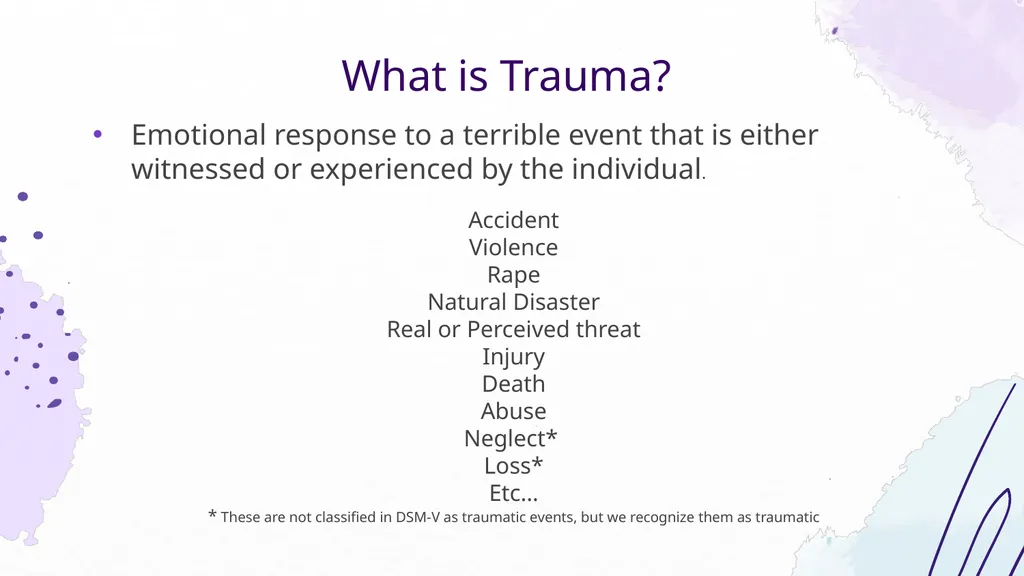
Emotional response to a terrible event that is either witnessed or experienced by the individual.
Accident
Violence
Rape
Natural Disaster
Real or Perceived threat
Injury
Death
Abuse
Neglect*
Loss*
Etc…
* These are not classified in DSM-V as traumatic events, but we recognize them as traumatic What is Trauma?<br>
06
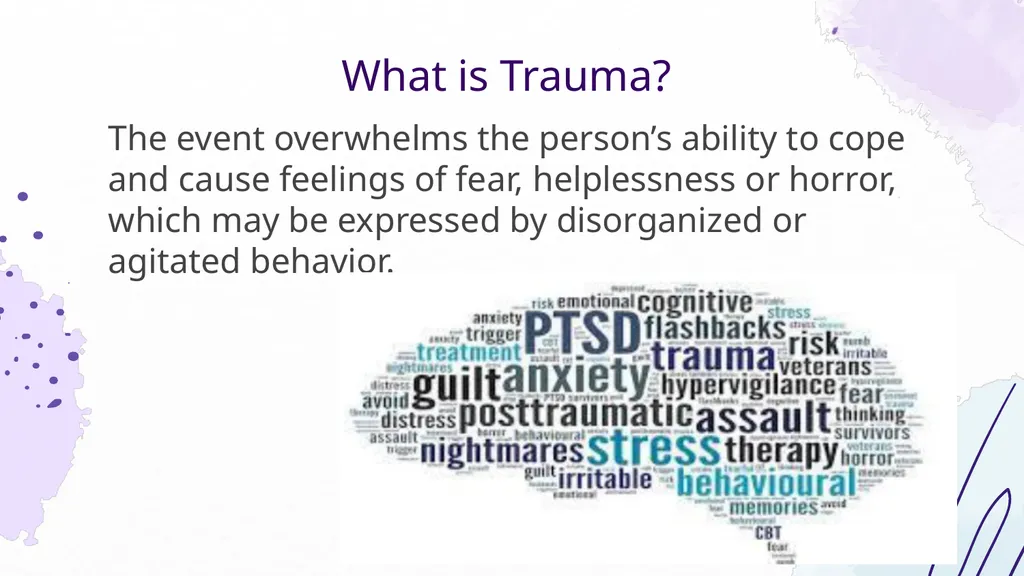
The event overwhelms the person’s ability to cope and cause feelings of fear, helplessness or horror, which may be expressed by disorganized or agitated behavior. What is Trauma?<br>
07
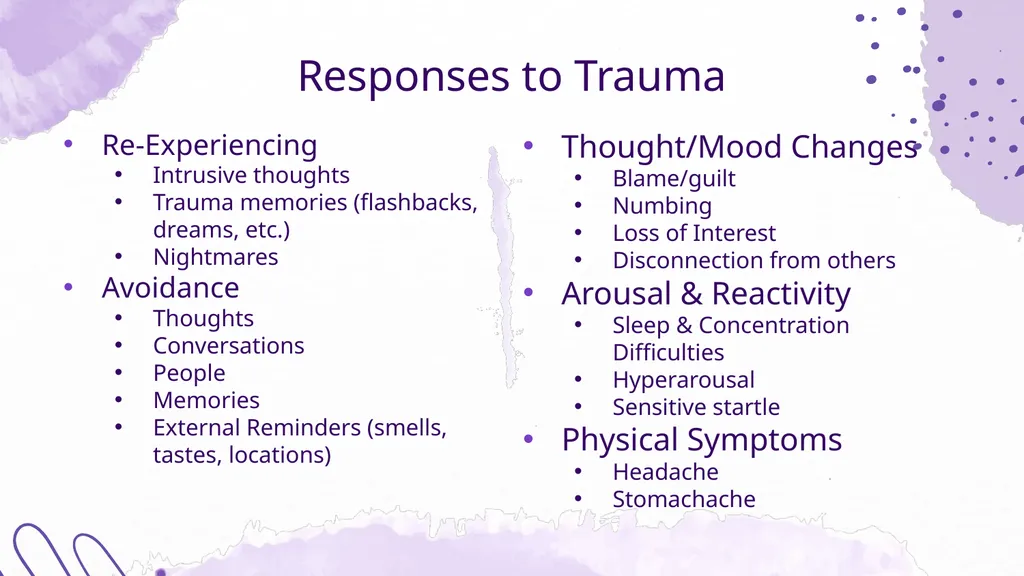
Re-Experiencing
Intrusive thoughts
Trauma memories (flashbacks, dreams, etc.)
Nightmares
Avoidance
Thoughts
Conversations
People
Memories
External Reminders (smells, tastes, locations) Thought/Mood Changes
Blame/guilt
Numbing
Loss of Interest
Disconnection from others
Arousal & Reactivity
Sleep & Concentration Difficulties
Hyperarousal
Sensitive startle
Physical Symptoms
Headache
Stomachache Responses to Trauma<br>
08
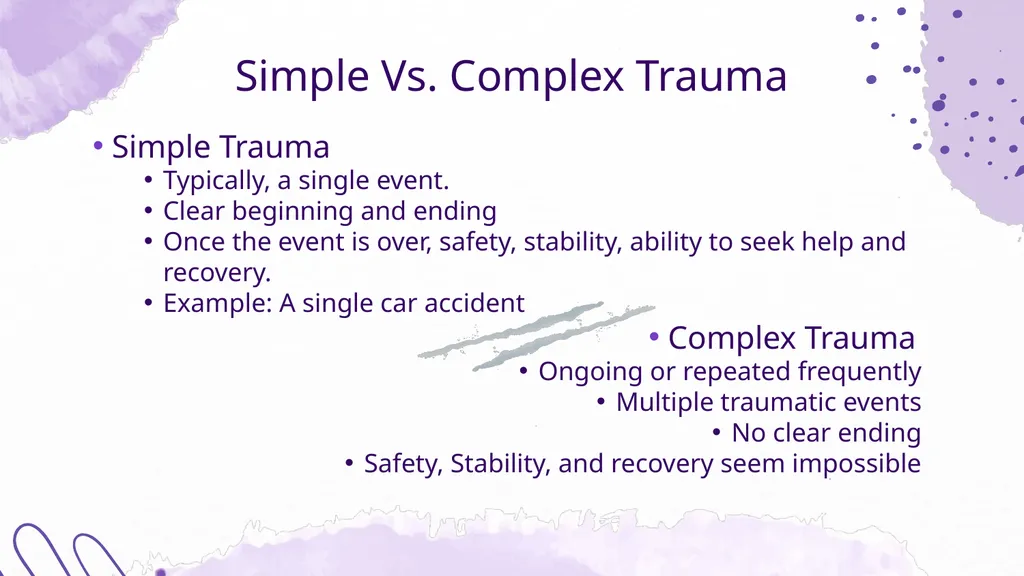
Simple Trauma
Typically, a single event.
Clear beginning and ending
Once the event is over, safety, stability, ability to seek help and recovery.
Example: A single car accident
Complex Trauma
Ongoing or repeated frequently
Multiple traumatic events
No clear ending
Safety, Stability, and recovery seem impossible Simple Vs. Complex Trauma<br>
09
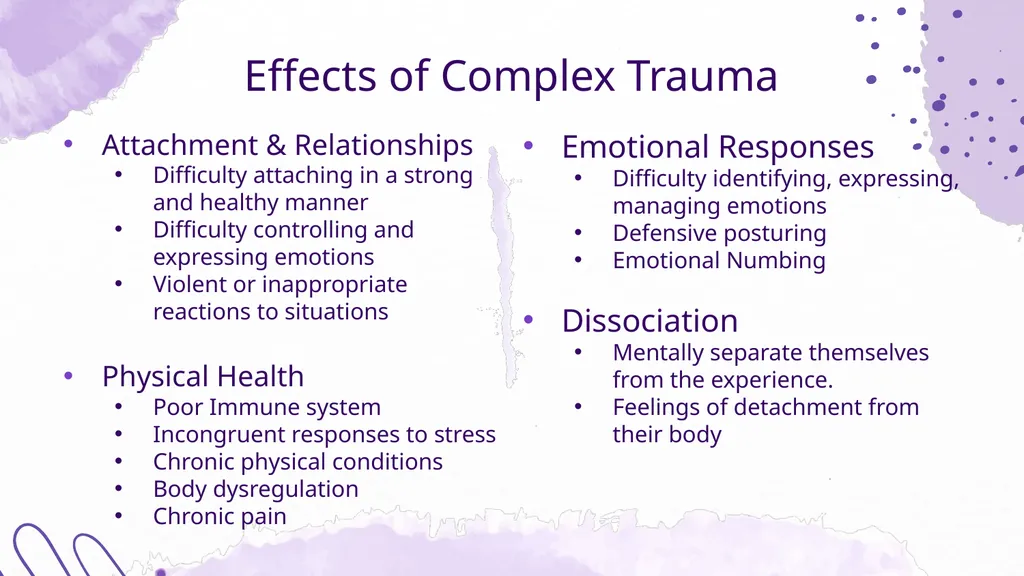
Attachment & Relationships
Difficulty attaching in a strong and healthy manner
Difficulty controlling and expressing emotions
Violent or inappropriate reactions to situations
Physical Health
Poor Immune system
Incongruent responses to stress
Chronic physical conditions
Body dysregulation
Chronic pain Emotional Responses
Difficulty identifying, expressing, managing emotions
Defensive posturing
Emotional Numbing
Dissociation
Mentally separate themselves from the experience.
Feelings of detachment from their body Effects of Complex Trauma<br>
10
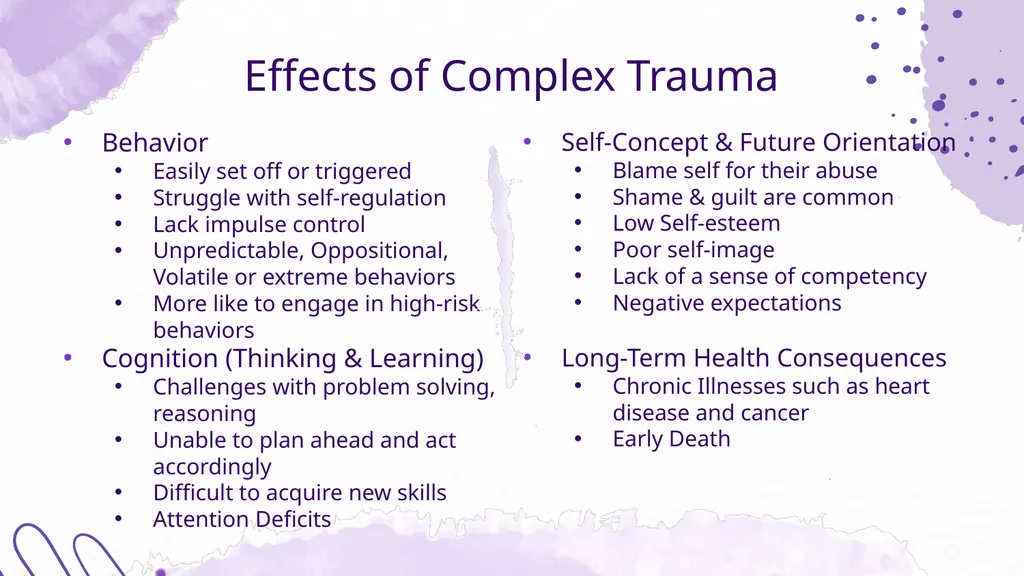
Behavior
Easily set off or triggered
Struggle with self-regulation
Lack impulse control
Unpredictable, Oppositional, Volatile or extreme behaviors
More like to engage in high-risk behaviors
Cognition (Thinking & Learning)
Challenges with problem solving, reasoning
Unable to plan ahead and act accordingly
Difficult to acquire new skills
Attention Deficits Self-Concept & Future Orientation
Blame self for their abuse
Shame & guilt are common
Low Self-esteem
Poor self-image
Lack of a sense of competency
Negative expectations
Long-Term Health Consequences
Chronic Illnesses such as heart disease and cancer
Early Death Effects of Complex Trauma<br>
11
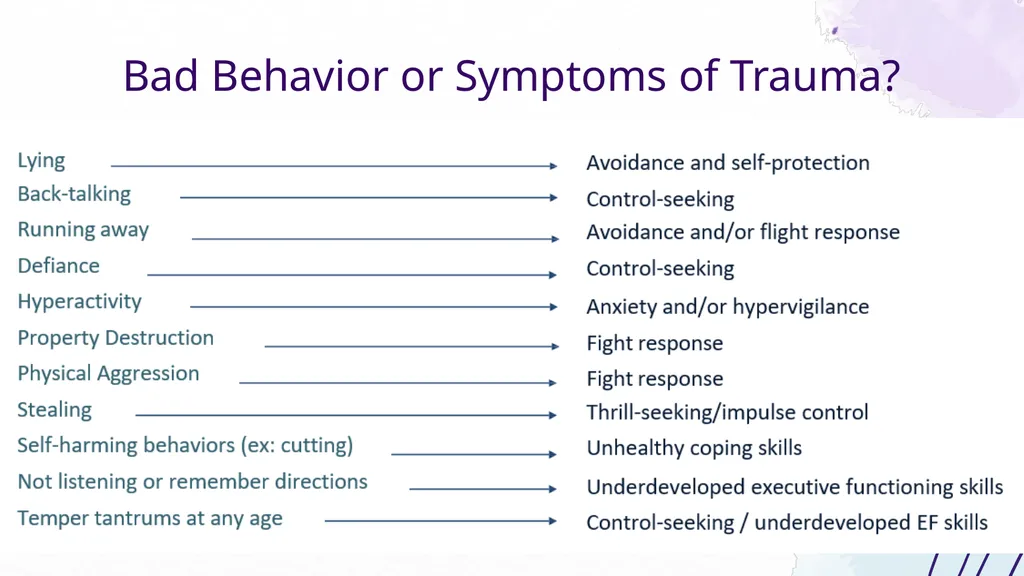
Bad Behavior or Symptoms of Trauma?<br>
12
02 The Brain Basics<br>
14
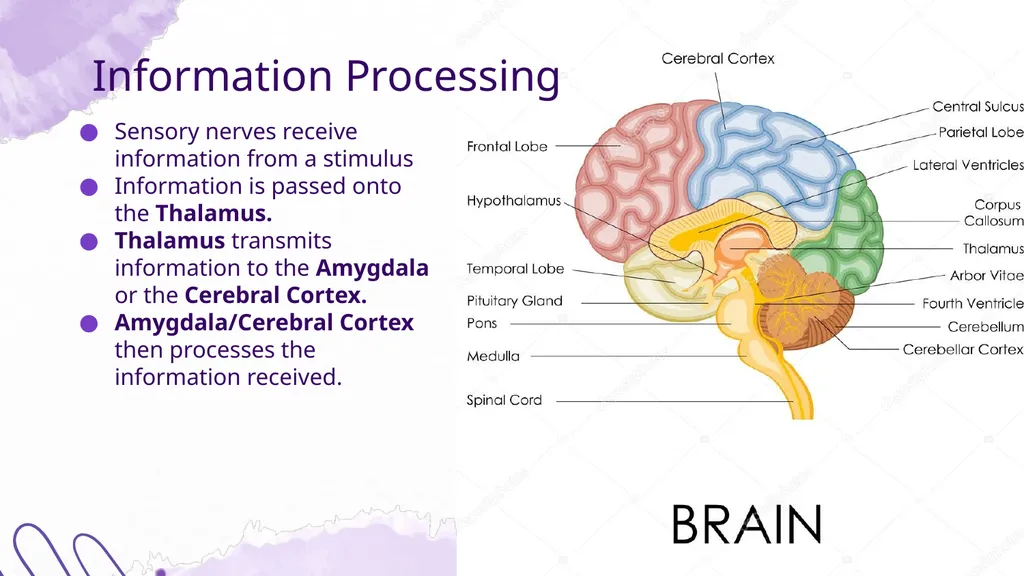
Sensory nerves receive information from a stimulus
Information is passed onto the Thalamus.
Thalamus transmits information to the Amygdala or the Cerebral Cortex.
Amygdala/Cerebral Cortex then processes the information received. Information Processing<br>
15
Thalamus- Gateway for all sensory information except smell.
Main objective is to share sensory information with as much of the brain as possible, as fast as possible.
Amygdala is the shortest and fastest path.
Cerebral Cortex is the slow and long path.
Amygdala- responsible for emotional responses
Key in the formation of memories
Attaches emotional content to memories.
Involved in fear/threat detection
Hypothalamus- Enacts the will of the amygdala
Regulates autonomic functions
Controls body’s response to stress
Hippocampus- Involved in learning and memory
Responsible for autobiographical memory
Impaired function when under stress Limbic System<br>
16
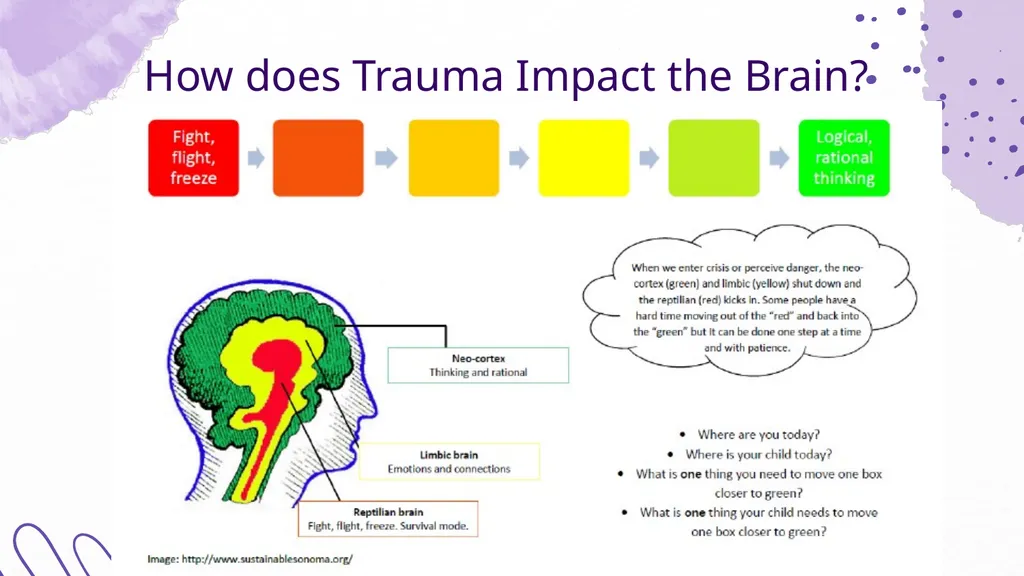
How does Trauma Impact the Brain?<br>
17
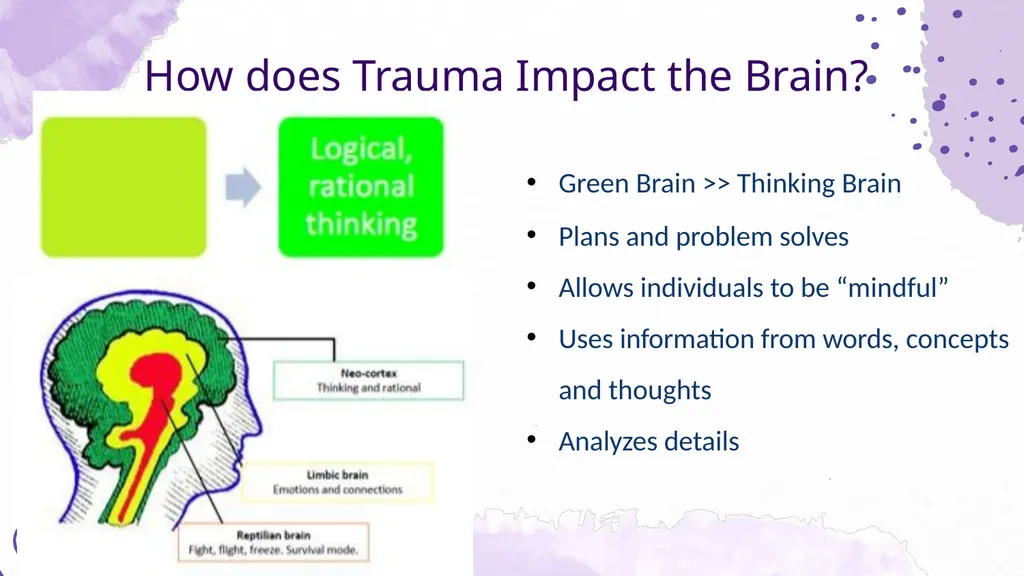
How does Trauma Impact the Brain? Green Brain >> Thinking Brain
Plans and problem solves
Allows individuals to be “mindful”
Uses information from words, concepts
and thoughts
Analyzes details<br>
18
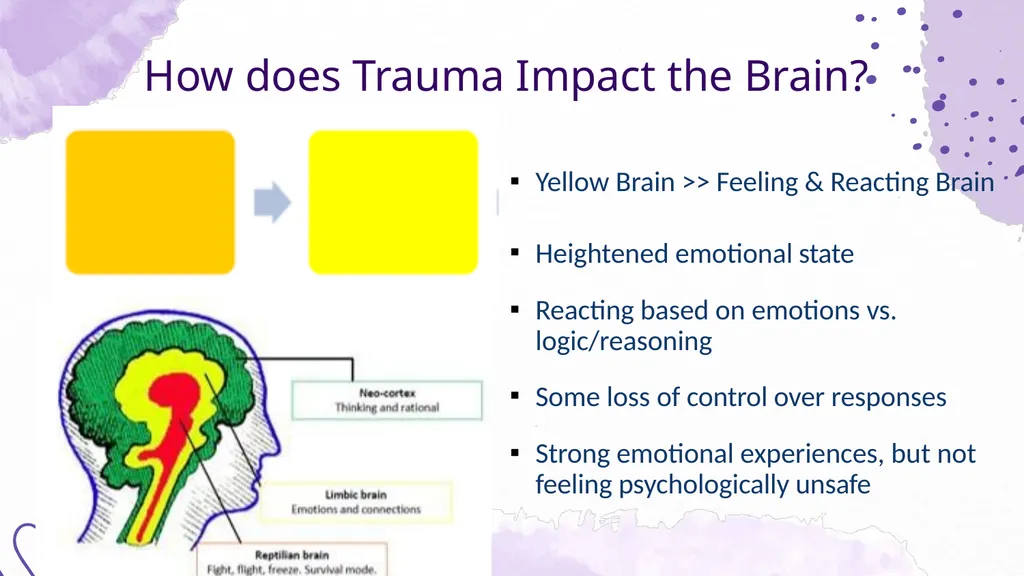
How does Trauma Impact the Brain? Yellow Brain >> Feeling & Reacting Brain
Heightened emotional state
Reacting based on emotions vs. logic/reasoning
Some loss of control over responses
Strong emotional experiences, but not feeling psychologically unsafe<br>
19
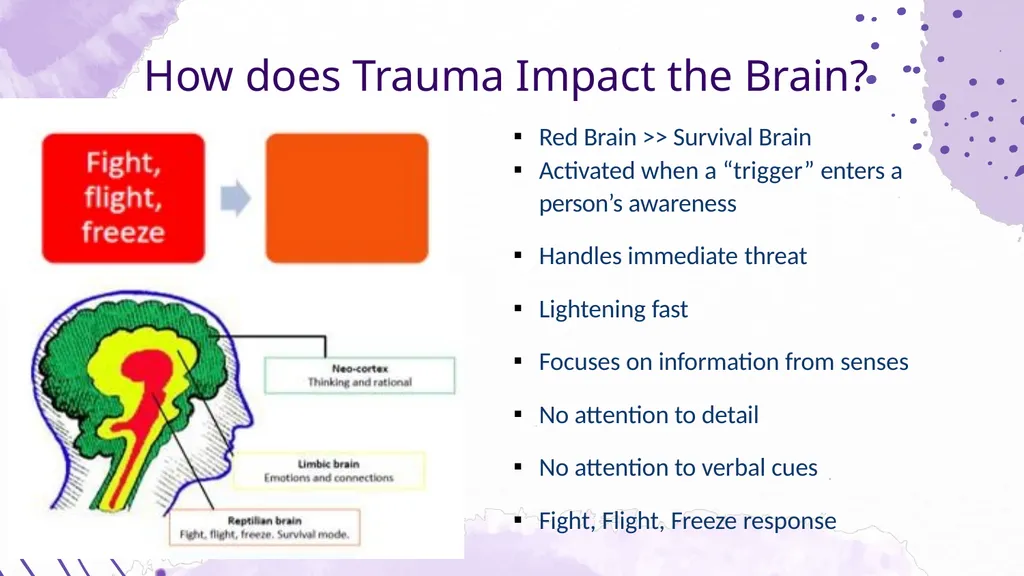
How does Trauma Impact the Brain? Red Brain >> Survival Brain
Activated when a “trigger” enters a
person’s awareness
Handles immediate threat
Lightening fast
Focuses on information from senses
No attention to detail
No attention to verbal cues
Fight, Flight, Freeze response<br>
22
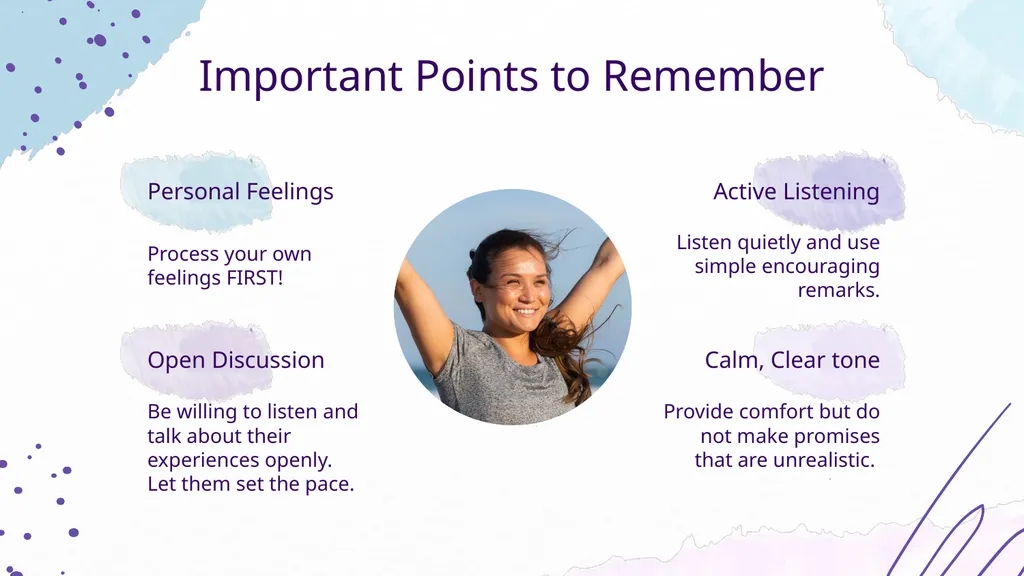
Important Points to Remember Personal Feelings Process your own feelings FIRST! Active Listening Listen quietly and use simple encouraging remarks. Open Discussion Be willing to listen and talk about their experiences openly. Let them set the pace. Calm, Clear tone Provide comfort but do not make promises that are unrealistic.<br>
23
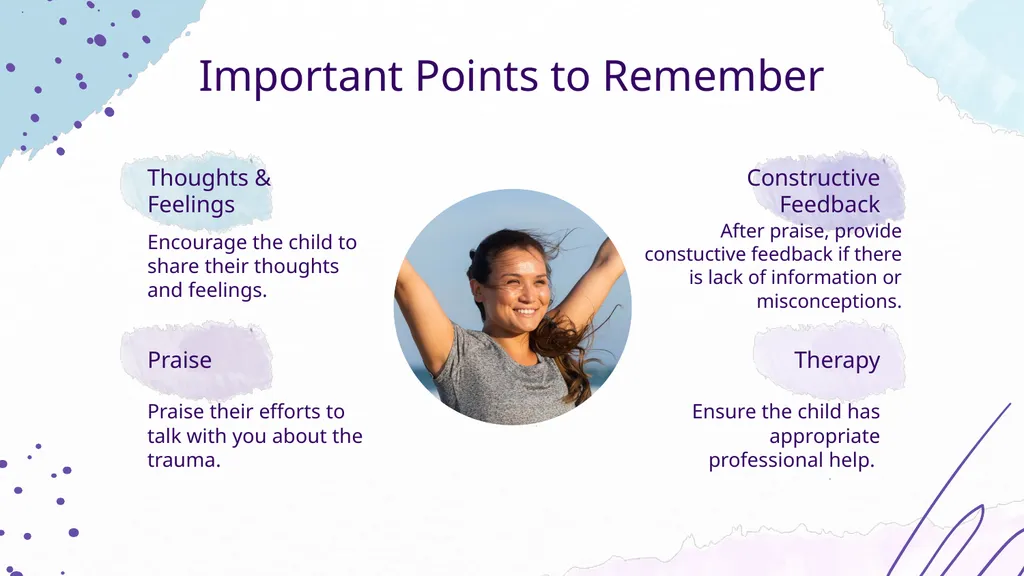
Important Points to Remember Thoughts & Feelings Encourage the child to share their thoughts and feelings. Constructive Feedback After praise, provide constuctive feedback if there is lack of information or misconceptions. Praise Praise their efforts to talk with you about the trauma. Therapy Ensure the child has appropriate professional help.<br>
24
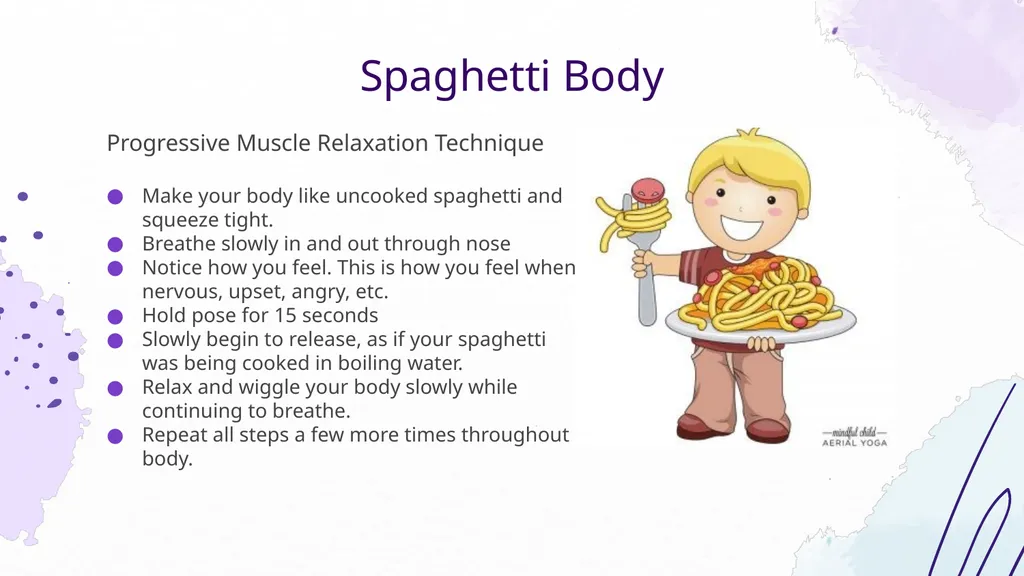
Progressive Muscle Relaxation Technique
Make your body like uncooked spaghetti and squeeze tight.
Breathe slowly in and out through nose
Notice how you feel. This is how you feel when nervous, upset, angry, etc.
Hold pose for 15 seconds
Slowly begin to release, as if your spaghetti was being cooked in boiling water.
Relax and wiggle your body slowly while continuing to breathe.
Repeat all steps a few more times throughout body. Spaghetti Body<br>
25
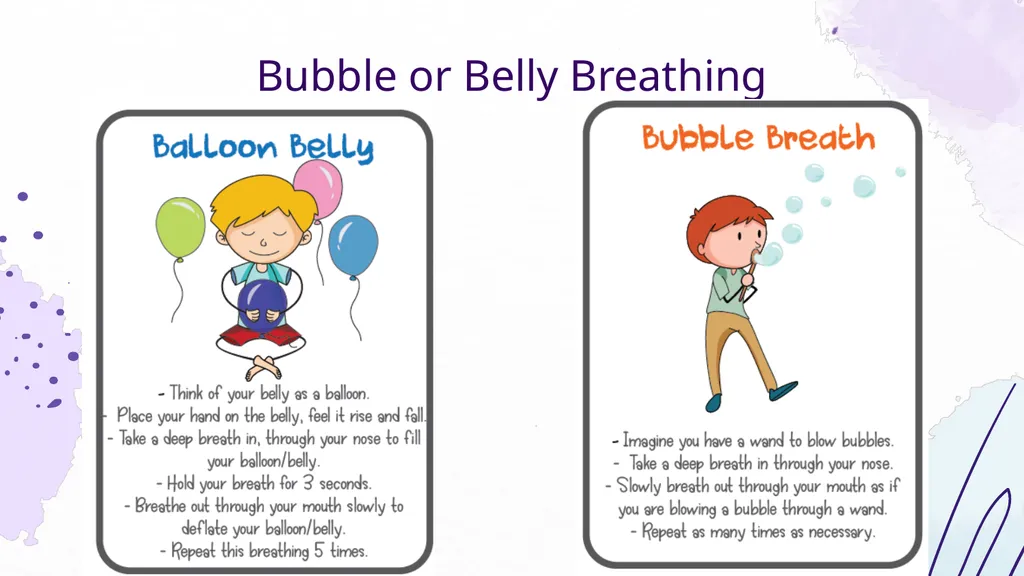
Bubble or Belly Breathing<br>
26
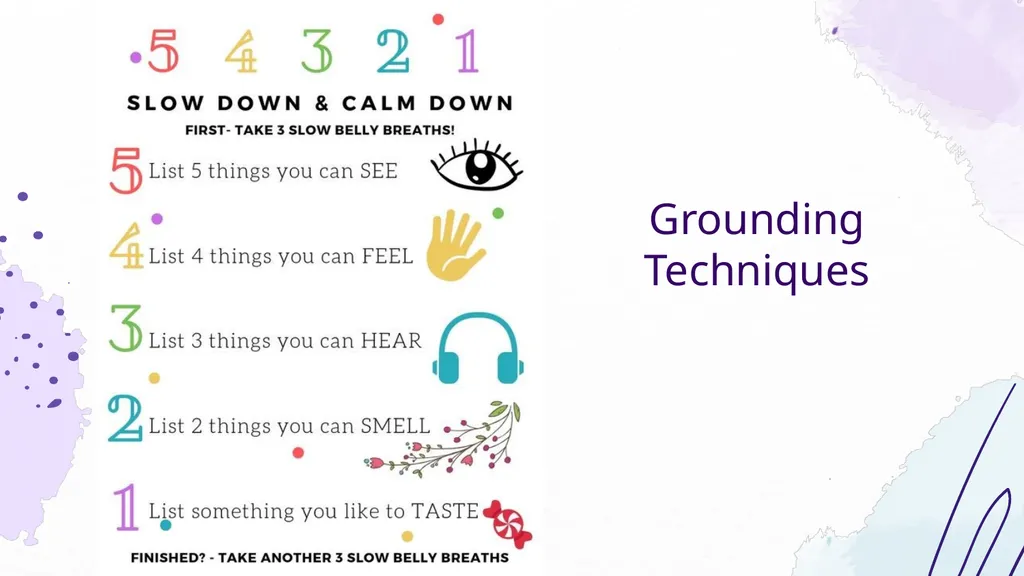
Grounding Techniques<br>
27
Mindfulness For Kids<br>
29
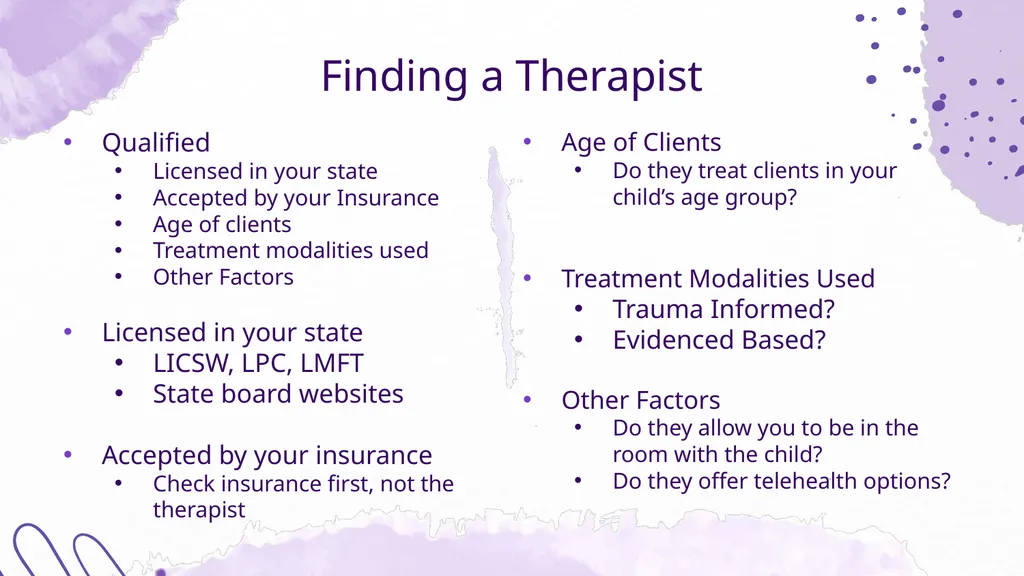
Qualified
Licensed in your state
Accepted by your Insurance
Age of clients
Treatment modalities used
Other Factors
Licensed in your state
LICSW, LPC, LMFT
State board websites
Accepted by your insurance
Check insurance first, not the therapist Age of Clients
Do they treat clients in your child’s age group?
Treatment Modalities Used
Trauma Informed?
Evidenced Based?
Other Factors
Do they allow you to be in the room with the child?
Do they offer telehealth options? Finding a Therapist<br>
30
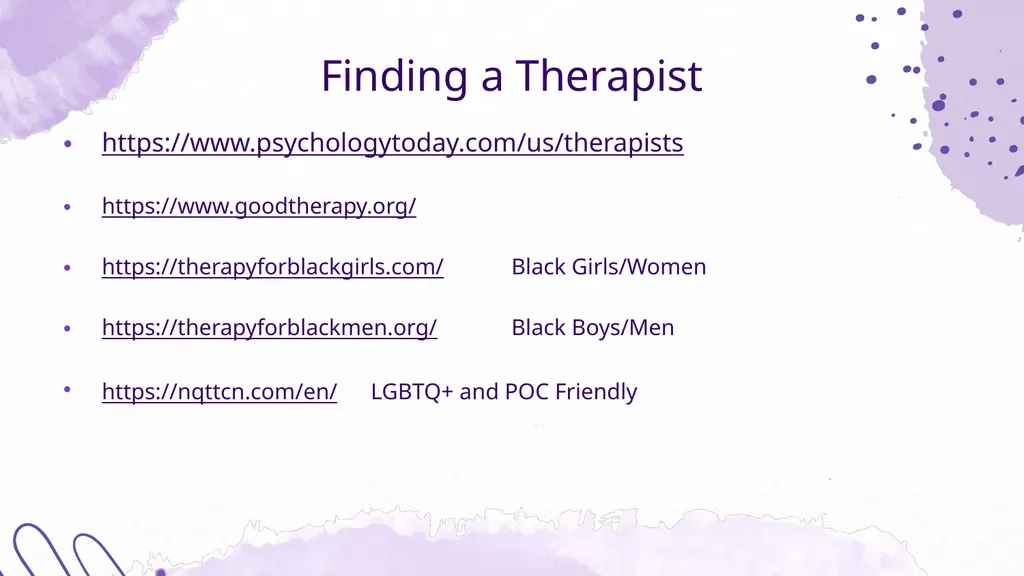
https://www.psychologytoday.com/us/therapists
https://www.goodtherapy.org/
https://therapyforblackgirls.com/ Black Girls/Women
https://therapyforblackmen.org/ Black Boys/Men
https://nqttcn.com/en/ LGBTQ+ and POC Friendly Finding a Therapist<br>
32
“I am not what has happened to me. I am what I choose to become.” Carl Jung<br>
33
THANKS Shannon Kish McElroy, LICSW, PIP, CCTP
smcelroyatfame#@gmail.com
256-203-6542<br>