04
Endemic in developing and under-developed cattle rearing countries-Africa, parts of Asia and some middle eastern countries.
Ongoing Eradication Programs in- UK, USA, NZ, Japan, Mexico,.
TB free countries- Australia, Iceland, Denmark, Sweden, Norway, Finland, Austria, Switzerland, Luxembourg, Latvia, Slovakia, Lithuania, Estonia, the Czech Republic, Canada, Singapore, Jamaica, Barbados and Israel.<br>
05
Transmission ANIMAL-ANIMAL
Horizontal transmission- inhalation of aerosols(cats, badgers), by ingestion(calves, pigs, cats, ferrets), or through breaks in the skin (cats, badgers).
Shedding of bacteria in- faces, milk, discharging lesions, saliva, vaginal fluids, semen and urine. (later stages of disease)
Close, prolonged contact of healthy animals with infected animal
Intensive livestock farming;
Extensive livestock farming (vaccination centers, AI Centers, Dipping tanks, Auction markets, transportation, ponds, wells and streams, in tropical areas gathering under shady areas during hot part of the day, salt supplementing points)
Vertical transmission-Congenital infections (rare in developed countries with an effective eradication program)<br>
06
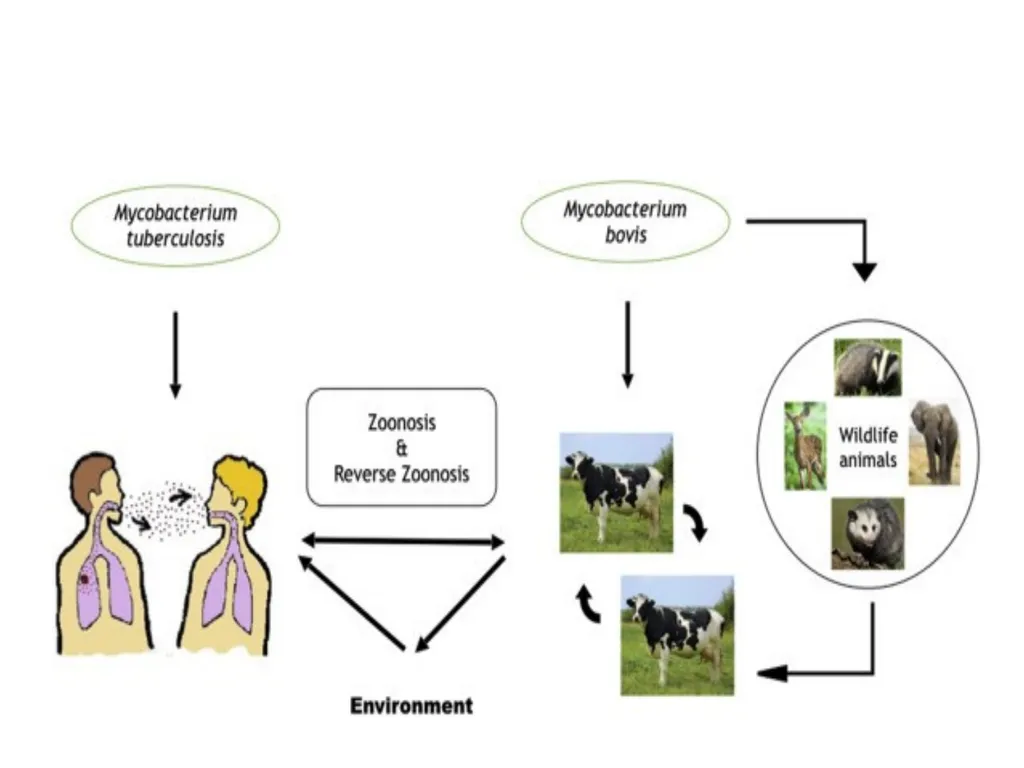
Animal to human
PulmonaryTB- more in rural dwellers… due to inhalation of infected dust
GastrointestinalTB- more in urban dwellers… due to ingestion of unpasteurized milk and dairy products
HIV people
Human to animal -Rare
Genito-urinaryTB… urination in cowsheds/ pasture … animal craving salt would prefer grazing there…
Human to human
Rare
Less efficient than M. Tuberculosis
HIV infected humans are highly susceptible<br>
07
Survivality of mycobacterium Several months in Cold, dark, moist conditions.
12-24C… 18-332 days
Susceptible to sunlight<br>
08
Population at risk Occupational Risk
Farmers, Abattoir workers,Veterinarians, Laboratory technicians, Animal caretakers in zoos, Workers in animal reservations and national parks, Close association with people living with animals or working with them.
Susceptible age group- Infants, Pregnant women, Old.
Consumption related risk factors - Nutritionally deficient people
Consumers of unpasteurized milk,
Raw meat or
Undercooked meat.
Medical conditions
HIV positive humans
Diabetics
Previously incorrectly treated TB patients<br>
09
Incubation Period Takes months to develop
Dormant for years and reactivating during period of stress or old age
2-5 weeks
Kittens-experimentally IP is 3 weeks.<br>
10
Clinical signs Humans;
A bad cough that lasts 3 weeks or longer.
Pain in the chest.
Coughing up blood or phlegm from deep inside the lungs.
Weakness or feeling very tired.
Losing weight without trying.
Having no appetite.
Chills and fever.
Sweating at night or when sleeping.
In Animals: Early on it remains asymptomatic
-Late stages progressive emaciation, a low–grade fluctuating fever,
weakness and inappetence.<br>
11
Animals with pulmonary involvement
a moist cough that is worse in the morning, during cold weather or exercise, dyspnea or tachypnea.
In the terminal stages, animals may become extremely emaciated acute respiratory distress, retropharyngeal or other lymph nodes enlarge and may rupture and drain. Greatly enlarged lymph nodes can also obstruct blood vessels, airways, or the digestive tract.
If the digestive tract is involved, intermittent diarrhea and constipation may be seen<br>
12
Granulomas (tubercles) where bacteria have localized.
Usually yellowish,either caseous, caseo-calcareous or calcified
Often encapsulated, found in the lymph nodes, particularly those of the head and thorax.
common in the lung, spleen, liver and the surfaces of body cavities.<br>
13
Morbidity and mortality Infective dose:
Cattle: 1 CFU (colony forming units)=6-10 viable bacilli;
Human respiratory route: 10’s to 100’s bacteria;
Millions by gastrointestinal route
100% mortality if not treated.<br>
14
Daignosis Cattle:
Tuberculin skin test (screening test)
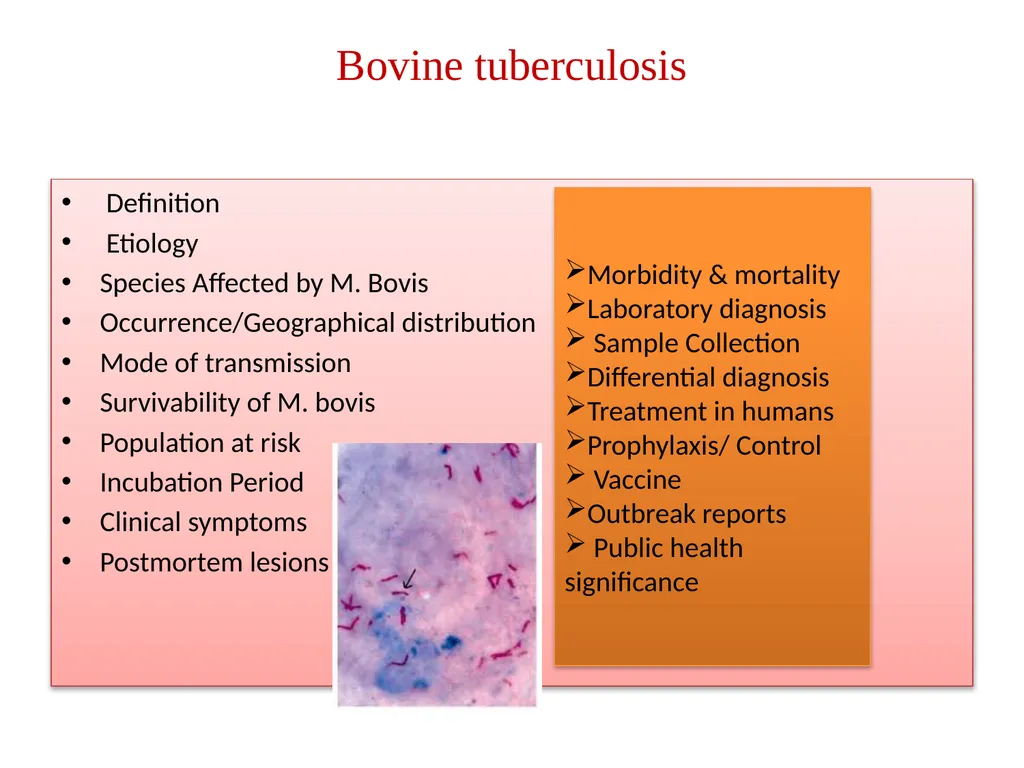
Microscopic examination of AFB
Ziehl/Neelson stain
Flourescent acid-fast stain
Isolation on selective culture media (8 weeks)
PCR
Biological safety cabinet should be used
Wildlife: Lymphocyte proliferation assay/gamma-interferon assays / ELISA.<br>
15
Sample collection Samples from Live animal:
Sputum and other body fluids
Blood samples
Samples at necropsy:
Abnormal lymph nodes ,Lungs ,Liver,Spleen<br>
16
Differential diagnosis Contagious bovine pleuropneumonia
Pasteurella
Corynebacterium pyogenes pneumonia
Aspiration pneumonia
Traumatic pericarditis
Caseous lymphadenitis
Liver fluke infestation<br>
17
Treatment Isoniazid
Rifampicin
Ethambutol
Pyrazinamide
Streptomycin
6months
MDRTB… 2 years
Rx… 3lakh/year expense<br>
18
Prophylexis/Control Why control???
Risk of infection to human
Loss in productivity
Animal market restrictions set by countries with advanced eradication programs
Threat to endangered wild animal species
Failure of control programs in developing countries???
Cannot shoulder the cost of eradication program and compensate for culled animals.
Limited access to education
Poor information networks
Lack of disease surveillance<br>
19
MandatoryTest-and- slaughter strategy or test- and-segregation.
Periodic re-testing of infected herd
Quarantine
Trace back reactor and those that came in contact with them
Strong Disinfection with 5% phenol, iodine solutions, glutarldehyde and formadehyde…long contact time
Rodent control
Barrier the area to prevent wildlife interaction with domestic animals.
Pasteurization of milk
Awareness about the deleterious effects of unpasteurized milk consumption.
Proper cooking of meat.
Restricted animal movement.
Involvement of ministry of health in coalition with agriculture industry for combined efforts to reduce bovineTB<br>
20
Vaccine HumanTB
Bacillus CalamiteGuerin (BCG)
Attenuated strain of wild type of M. bovis isolate from cattle Bovine TB
BCG vaccination in animals less effective<br>