
TWO VS THREE ELECTRODE SYSTEM TITLE PRESENTED TO:
CB
Published · 14 slides · 0 views
1 / 1





Description
TWO VS THREE ELECTRODE SYSTEM TITLE PRESENTED TO: DR. SARA RIAZ PRESENTED BY: LINTA AZMAT REGISTRATION NO. : FA23-R06-014 ELECTROANALYTICAL TECHNIQUES INTRODUCTION Electrochemical systems are widely used in various fields such as analytical
Related Topics
Share
Embed code
Download this presentation From Below
"TWO VS THREE ELECTRODE SYSTEM TITLE PRESENTED TO:" is the property of its rightful owner. Permission is granted to download and print the materials on this website for personal, non-commercial use only, and to display it on your personal computer provided you do not modify the materials and that you retain all copyright notices contained in the materials. By downloading content from our website, you accept the terms of this agreement.
Presentation Transcript
01
TWO VS THREE
ELECTRODE
SYSTEM TITLE PRESENTED TO: DR. SARA RIAZ
PRESENTED BY: LINTA AZMAT
REGISTRATION NO. : FA23-R06-014 ELECTROANALYTICAL TECHNIQUES<br>
PRESENTED BY: LINTA AZMAT
REGISTRATION NO. : FA23-R06-014 ELECTROANALYTICAL TECHNIQUES<br>
02
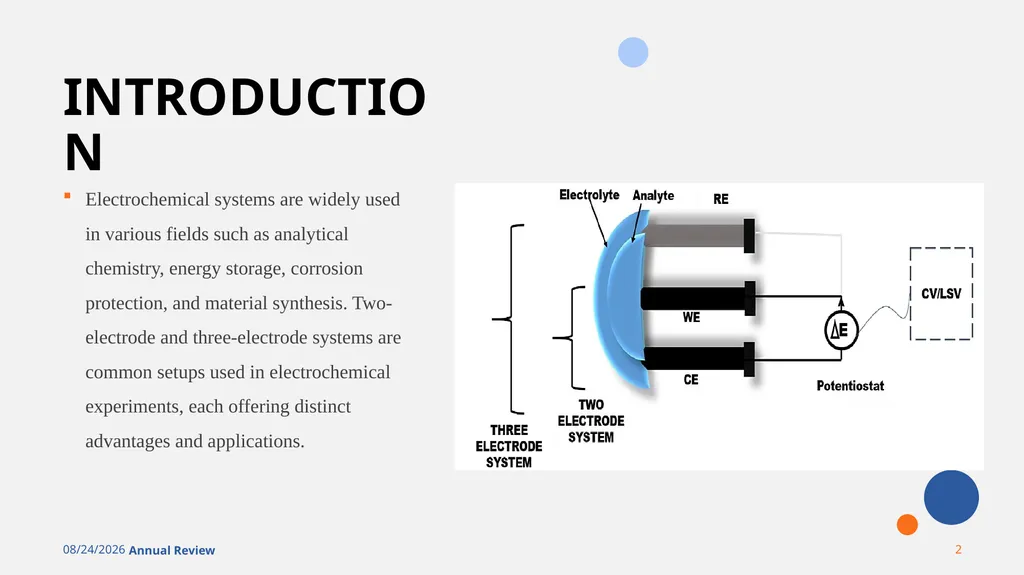
INTRODUCTION Electrochemical systems are widely used in various fields such as analytical chemistry, energy storage, corrosion protection, and material synthesis. Two-electrode and three-electrode systems are common setups used in electrochemical experiments, each offering distinct advantages and applications.<br>
03
DIFFERENCE BETWEEN TWO AND THREE ELECTRODE SYSTEM The main difference between a three-electrode system and other electrode configurations lies in its
design and
functionality<br>
design and
functionality<br>
04
TWO ELECTRODE SYSTEM Electrodes:
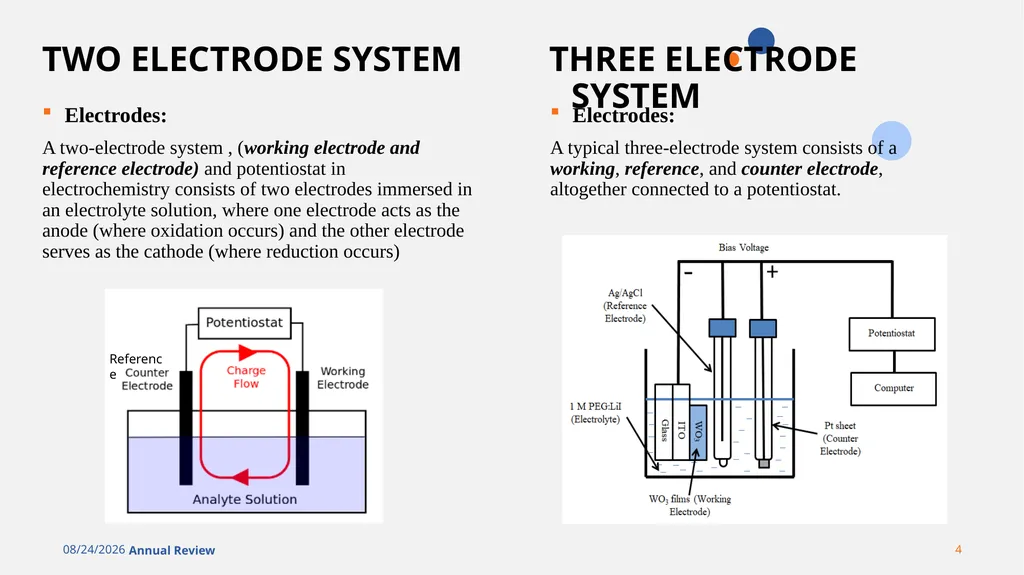
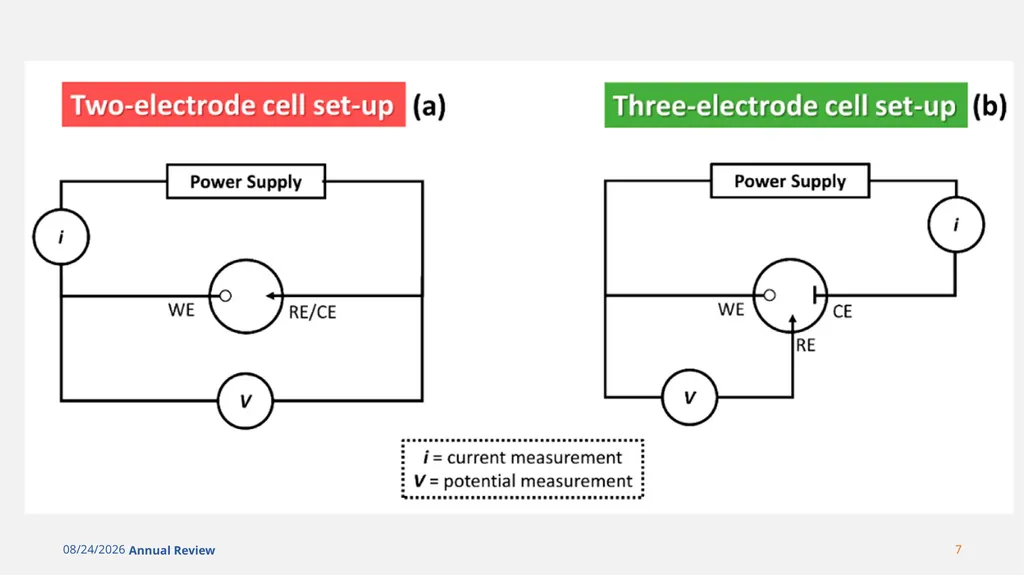
A two-electrode system , (working electrode and reference electrode) and potentiostat in electrochemistry consists of two electrodes immersed in an electrolyte solution, where one electrode acts as the anode (where oxidation occurs) and the other electrode serves as the cathode (where reduction occurs) THREE ELECTRODE SYSTEM Electrodes:
A typical three-electrode system consists of a working, reference, and counter electrode, altogether connected to a potentiostat. Reference<br>
A two-electrode system , (working electrode and reference electrode) and potentiostat in electrochemistry consists of two electrodes immersed in an electrolyte solution, where one electrode acts as the anode (where oxidation occurs) and the other electrode serves as the cathode (where reduction occurs) THREE ELECTRODE SYSTEM Electrodes:
A typical three-electrode system consists of a working, reference, and counter electrode, altogether connected to a potentiostat. Reference<br>
05
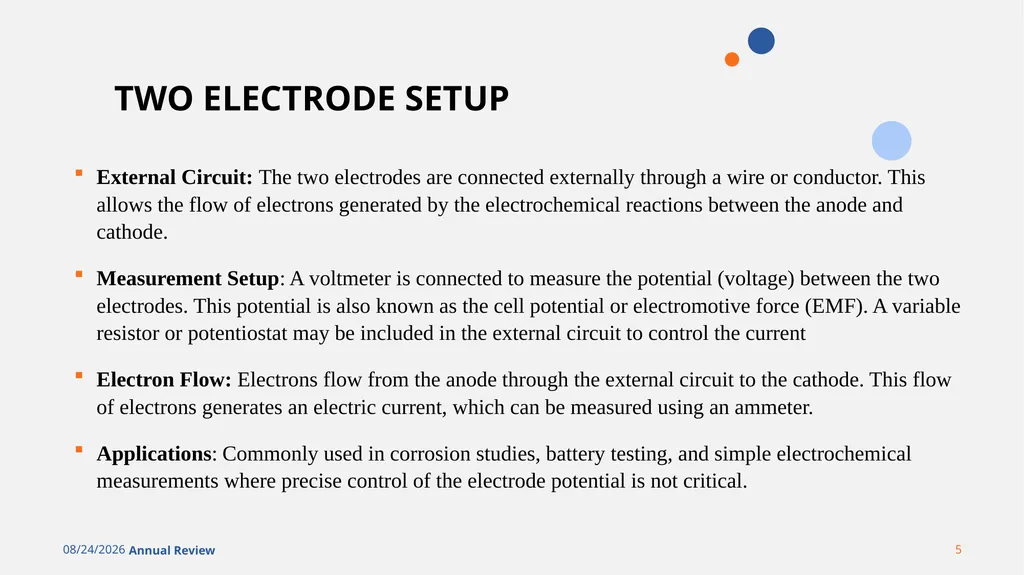
External Circuit: The two electrodes are connected externally through a wire or conductor. This allows the flow of electrons generated by the electrochemical reactions between the anode and cathode.
Measurement Setup: A voltmeter is connected to measure the potential (voltage) between the two electrodes. This potential is also known as the cell potential or electromotive force (EMF). A variable resistor or potentiostat may be included in the external circuit to control the current
Electron Flow: Electrons flow from the anode through the external circuit to the cathode. This flow of electrons generates an electric current, which can be measured using an ammeter.
Applications: Commonly used in corrosion studies, battery testing, and simple electrochemical measurements where precise control of the electrode potential is not critical. TWO ELECTRODE SETUP<br>
Measurement Setup: A voltmeter is connected to measure the potential (voltage) between the two electrodes. This potential is also known as the cell potential or electromotive force (EMF). A variable resistor or potentiostat may be included in the external circuit to control the current
Electron Flow: Electrons flow from the anode through the external circuit to the cathode. This flow of electrons generates an electric current, which can be measured using an ammeter.
Applications: Commonly used in corrosion studies, battery testing, and simple electrochemical measurements where precise control of the electrode potential is not critical. TWO ELECTRODE SETUP<br>
06
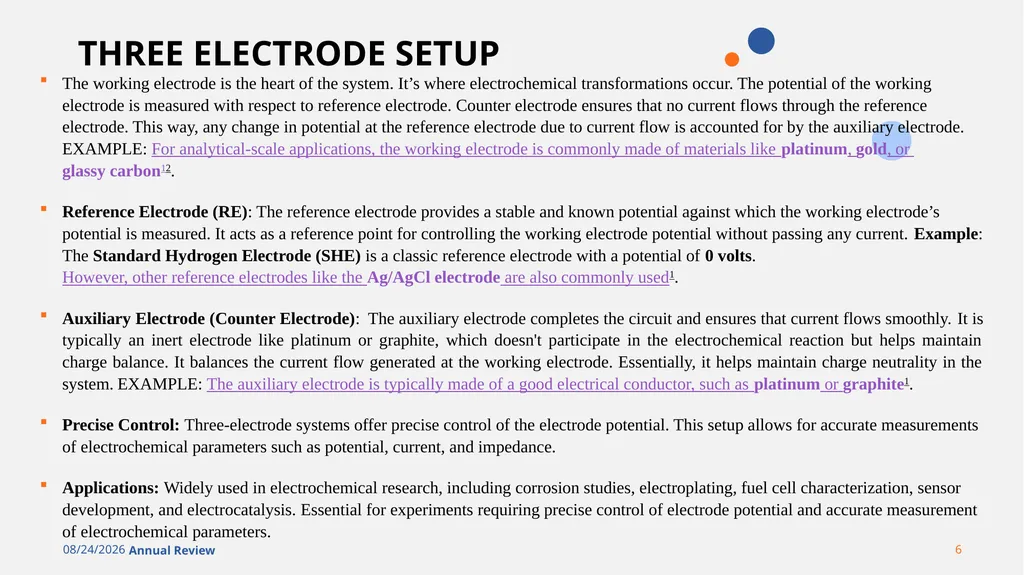
The working electrode is the heart of the system. It’s where electrochemical transformations occur. The potential of the working electrode is measured with respect to reference electrode. Counter electrode ensures that no current flows through the reference electrode. This way, any change in potential at the reference electrode due to current flow is accounted for by the auxiliary electrode. EXAMPLE: For analytical-scale applications, the working electrode is commonly made of materials like platinum, gold, or glassy carbon12.
Reference Electrode (RE): The reference electrode provides a stable and known potential against which the working electrode’s potential is measured. It acts as a reference point for controlling the working electrode potential without passing any current. Example: The Standard Hydrogen Electrode (SHE) is a classic reference electrode with a potential of 0 volts. However, other reference electrodes like the Ag/AgCl electrode are also commonly used1.
Auxiliary Electrode (Counter Electrode): The auxiliary electrode completes the circuit and ensures that current flows smoothly. It is typically an inert electrode like platinum or graphite, which doesn't participate in the electrochemical reaction but helps maintain charge balance. It balances the current flow generated at the working electrode. Essentially, it helps maintain charge neutrality in the system. EXAMPLE: The auxiliary electrode is typically made of a good electrical conductor, such as platinum or graphite1.
Precise Control: Three-electrode systems offer precise control of the electrode potential. This setup allows for accurate measurements of electrochemical parameters such as potential, current, and impedance.
Applications: Widely used in electrochemical research, including corrosion studies, electroplating, fuel cell characterization, sensor development, and electrocatalysis. Essential for experiments requiring precise control of electrode potential and accurate measurement of electrochemical parameters. THREE ELECTRODE SETUP<br>
Reference Electrode (RE): The reference electrode provides a stable and known potential against which the working electrode’s potential is measured. It acts as a reference point for controlling the working electrode potential without passing any current. Example: The Standard Hydrogen Electrode (SHE) is a classic reference electrode with a potential of 0 volts. However, other reference electrodes like the Ag/AgCl electrode are also commonly used1.
Auxiliary Electrode (Counter Electrode): The auxiliary electrode completes the circuit and ensures that current flows smoothly. It is typically an inert electrode like platinum or graphite, which doesn't participate in the electrochemical reaction but helps maintain charge balance. It balances the current flow generated at the working electrode. Essentially, it helps maintain charge neutrality in the system. EXAMPLE: The auxiliary electrode is typically made of a good electrical conductor, such as platinum or graphite1.
Precise Control: Three-electrode systems offer precise control of the electrode potential. This setup allows for accurate measurements of electrochemical parameters such as potential, current, and impedance.
Applications: Widely used in electrochemical research, including corrosion studies, electroplating, fuel cell characterization, sensor development, and electrocatalysis. Essential for experiments requiring precise control of electrode potential and accurate measurement of electrochemical parameters. THREE ELECTRODE SETUP<br>
07
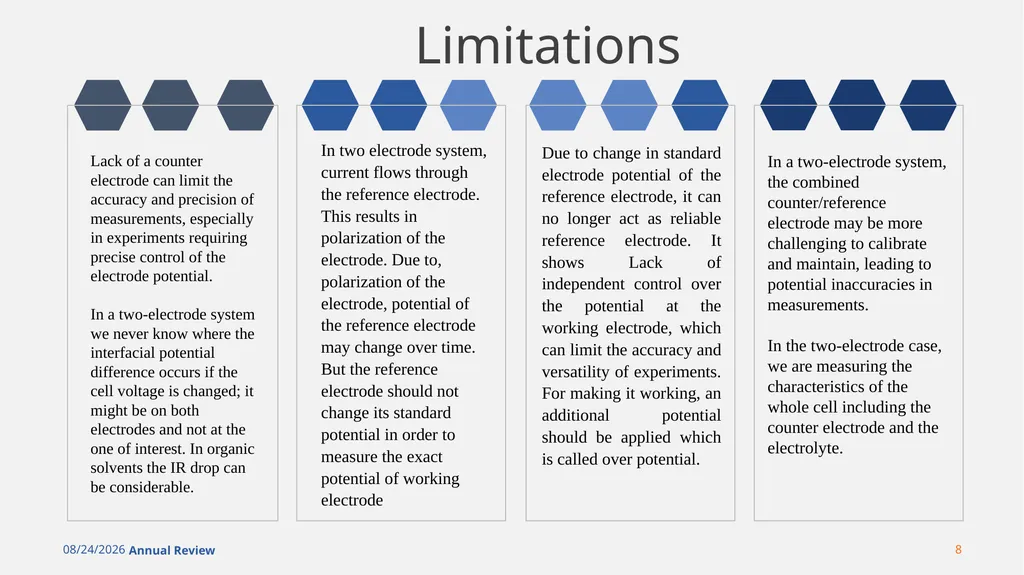
Limitations Lack of a counter electrode can limit the accuracy and precision of measurements, especially in experiments requiring precise control of the electrode potential.
In a two-electrode system we never know where the interfacial potential difference occurs if the cell voltage is changed; it might be on both electrodes and not at the one of interest. In organic solvents the IR drop can be considerable. In two electrode system, current flows through the reference electrode. This results in polarization of the electrode. Due to, polarization of the electrode, potential of the reference electrode may change over time. But the reference electrode should not change its standard potential in order to measure the exact potential of working electrode Due to change in standard electrode potential of the reference electrode, it can no longer act as reliable reference electrode. It shows Lack of independent control over the potential at the working electrode, which can limit the accuracy and versatility of experiments. For making it working, an additional potential should be applied which is called over potential. In a two-electrode system, the combined counter/reference electrode may be more challenging to calibrate and maintain, leading to potential inaccuracies in measurements.
In the two-electrode case, we are measuring the characteristics of the whole cell including the counter electrode and the electrolyte.<br>
In a two-electrode system we never know where the interfacial potential difference occurs if the cell voltage is changed; it might be on both electrodes and not at the one of interest. In organic solvents the IR drop can be considerable. In two electrode system, current flows through the reference electrode. This results in polarization of the electrode. Due to, polarization of the electrode, potential of the reference electrode may change over time. But the reference electrode should not change its standard potential in order to measure the exact potential of working electrode Due to change in standard electrode potential of the reference electrode, it can no longer act as reliable reference electrode. It shows Lack of independent control over the potential at the working electrode, which can limit the accuracy and versatility of experiments. For making it working, an additional potential should be applied which is called over potential. In a two-electrode system, the combined counter/reference electrode may be more challenging to calibrate and maintain, leading to potential inaccuracies in measurements.
In the two-electrode case, we are measuring the characteristics of the whole cell including the counter electrode and the electrolyte.<br>
08
Which is the Preferred Electrode System?<br>
09
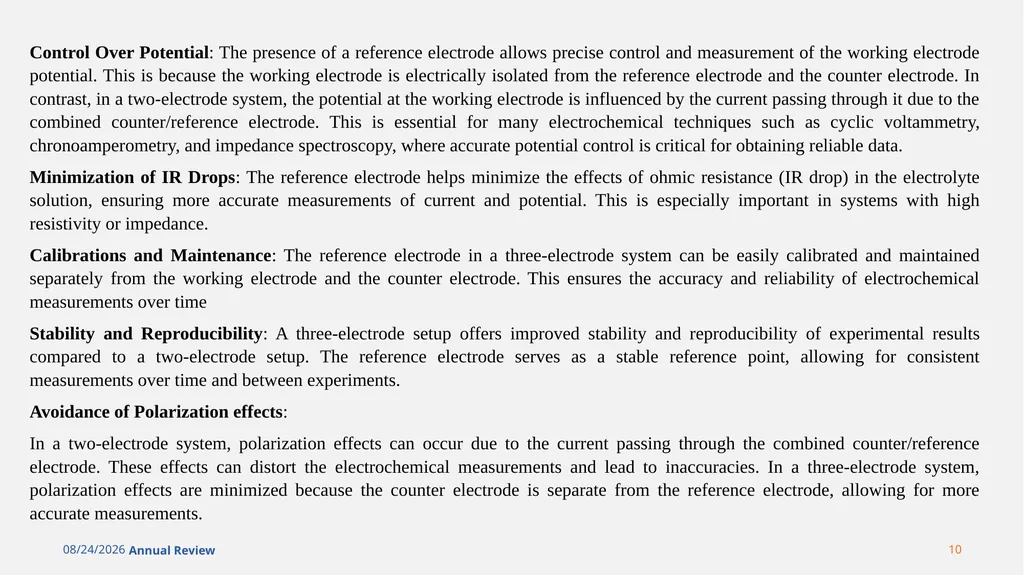
Control Over Potential: The presence of a reference electrode allows precise control and measurement of the working electrode potential. This is because the working electrode is electrically isolated from the reference electrode and the counter electrode. In contrast, in a two-electrode system, the potential at the working electrode is influenced by the current passing through it due to the combined counter/reference electrode. This is essential for many electrochemical techniques such as cyclic voltammetry, chronoamperometry, and impedance spectroscopy, where accurate potential control is critical for obtaining reliable data.
Minimization of IR Drops: The reference electrode helps minimize the effects of ohmic resistance (IR drop) in the electrolyte solution, ensuring more accurate measurements of current and potential. This is especially important in systems with high resistivity or impedance.
Calibrations and Maintenance: The reference electrode in a three-electrode system can be easily calibrated and maintained separately from the working electrode and the counter electrode. This ensures the accuracy and reliability of electrochemical measurements over time
Stability and Reproducibility: A three-electrode setup offers improved stability and reproducibility of experimental results compared to a two-electrode setup. The reference electrode serves as a stable reference point, allowing for consistent measurements over time and between experiments.
Avoidance of Polarization effects:
In a two-electrode system, polarization effects can occur due to the current passing through the combined counter/reference electrode. These effects can distort the electrochemical measurements and lead to inaccuracies. In a three-electrode system, polarization effects are minimized because the counter electrode is separate from the reference electrode, allowing for more accurate measurements.<br>
Minimization of IR Drops: The reference electrode helps minimize the effects of ohmic resistance (IR drop) in the electrolyte solution, ensuring more accurate measurements of current and potential. This is especially important in systems with high resistivity or impedance.
Calibrations and Maintenance: The reference electrode in a three-electrode system can be easily calibrated and maintained separately from the working electrode and the counter electrode. This ensures the accuracy and reliability of electrochemical measurements over time
Stability and Reproducibility: A three-electrode setup offers improved stability and reproducibility of experimental results compared to a two-electrode setup. The reference electrode serves as a stable reference point, allowing for consistent measurements over time and between experiments.
Avoidance of Polarization effects:
In a two-electrode system, polarization effects can occur due to the current passing through the combined counter/reference electrode. These effects can distort the electrochemical measurements and lead to inaccuracies. In a three-electrode system, polarization effects are minimized because the counter electrode is separate from the reference electrode, allowing for more accurate measurements.<br>
10
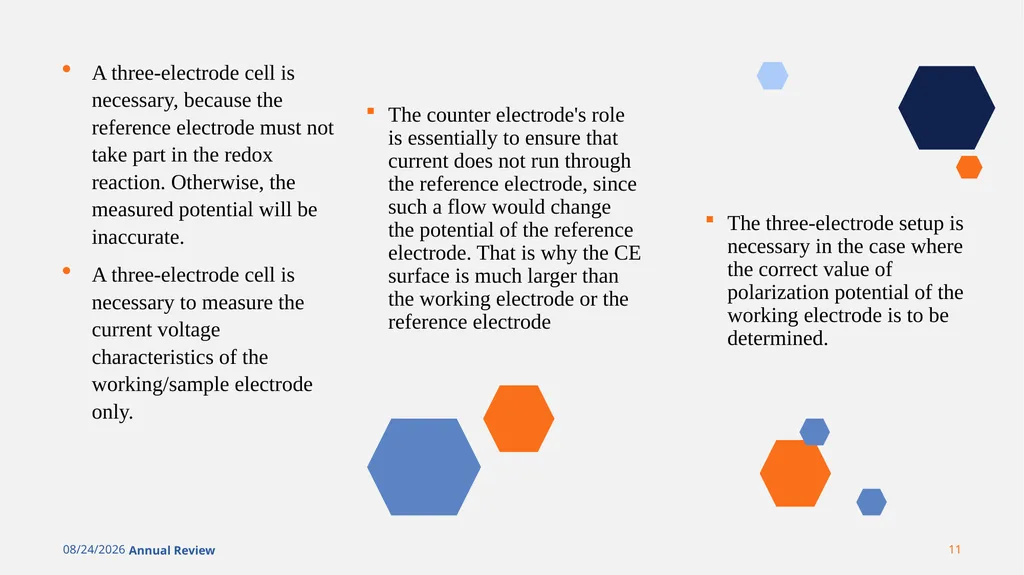
A three-electrode cell is necessary, because the reference electrode must not take part in the redox reaction. Otherwise, the measured potential will be inaccurate.
A three-electrode cell is necessary to measure the current voltage characteristics of the working/sample electrode only. The three-electrode setup is necessary in the case where the correct value of polarization potential of the working electrode is to be determined. The counter electrode's role is essentially to ensure that current does not run through the reference electrode, since such a flow would change the potential of the reference electrode. That is why the CE surface is much larger than the working electrode or the reference electrode<br>
A three-electrode cell is necessary to measure the current voltage characteristics of the working/sample electrode only. The three-electrode setup is necessary in the case where the correct value of polarization potential of the working electrode is to be determined. The counter electrode's role is essentially to ensure that current does not run through the reference electrode, since such a flow would change the potential of the reference electrode. That is why the CE surface is much larger than the working electrode or the reference electrode<br>
11
CONCLUSION However, he choice between a two-electrode setup and a three-electrode setup depends on the specific needs of the experiment or process. While a two-electrode setup offers simplicity and cost-effectiveness, a three-electrode setup provides greater control, accuracy, and versatility, making it preferred for many electrochemical studies requiring precise measurements and control over potential.<br>
12
REFERENCES:
https://chem.libretexts.org/Bookshelves/Analytical_Chemistry/Supplemental_Modules_%28Analytical_Chemistry%29/Electrochemistry/Electrodes/Standard_Hydrogen_Electrode
https://www.researchgate.net/figure/Schemes-illustrating-the-experimental-setups-of-a-two-electrode-and-b-three-electrode_fig1_341760846
https://13654368/GloriaHoover/
https://www.sciencedirect.com/topics/materials-science/electrode/ by Tarab Fatima, Shikha Bansal, Samina Husain, Manika Khanuja, in Electrochemical Sensors, 2022
Bard, A. J., & Faulkner, L. R. (2001). Electrochemical Methods: Fundamentals and Applications (2nd ed.). Wiley.
Zoski, C. G. (2007). Handbook of Electrochemistry. Elsevier.
Sawyer, D. T., Roberts, J. L., & Sobkowiak, A. (1995). Electrochemistry for Chemists (2nd ed.). Wiley.
Compton, R. G., Banks, C. E., & Meadows, K. E. (2018). Understanding Voltammetry: Simulation of Electrode Processes (4th ed.). Imperial College Press.<br>
https://chem.libretexts.org/Bookshelves/Analytical_Chemistry/Supplemental_Modules_%28Analytical_Chemistry%29/Electrochemistry/Electrodes/Standard_Hydrogen_Electrode
https://www.researchgate.net/figure/Schemes-illustrating-the-experimental-setups-of-a-two-electrode-and-b-three-electrode_fig1_341760846
https://13654368/GloriaHoover/
https://www.sciencedirect.com/topics/materials-science/electrode/ by Tarab Fatima, Shikha Bansal, Samina Husain, Manika Khanuja, in Electrochemical Sensors, 2022
Bard, A. J., & Faulkner, L. R. (2001). Electrochemical Methods: Fundamentals and Applications (2nd ed.). Wiley.
Zoski, C. G. (2007). Handbook of Electrochemistry. Elsevier.
Sawyer, D. T., Roberts, J. L., & Sobkowiak, A. (1995). Electrochemistry for Chemists (2nd ed.). Wiley.
Compton, R. G., Banks, C. E., & Meadows, K. E. (2018). Understanding Voltammetry: Simulation of Electrode Processes (4th ed.). Imperial College Press.<br>
13
THANK YOU<br>