
Types and Memory, Part II CS 61: Lecture 3





Description: Types and Memory, Part II CS 61: Lecture 3 9132023 RAM CPU Values Recap: Memory A programs address space has four segments The code segment stores the programs CPU instructions The static data segment contains global variables The stack
Related Topics
Download Presentation
"Types and Memory, Part II CS 61: Lecture 3" is the property of its rightful owner. Permission is granted to download and print the materials on this website for personal, non-commercial use only, and to display it on your personal computer provided you do not modify the materials and that you retain all copyright notices contained in the materials. By downloading content from our website, you accept the terms of this agreement.
Presentation Transcript
slide1. Types and Memory, Part II CS 61: Lecture 3
9/13/2023 RAM CPU Values<br>
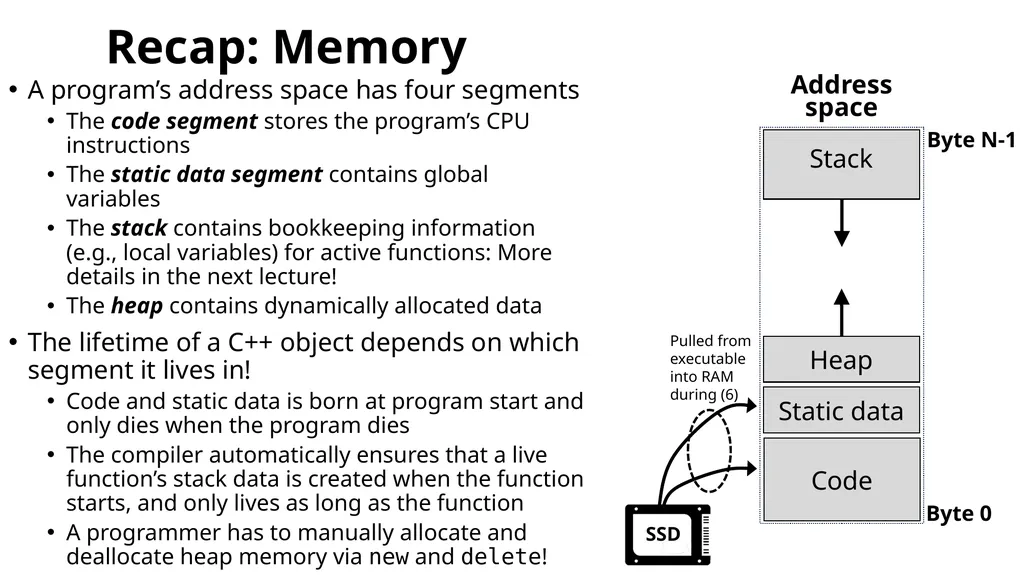
slide2. Recap: Memory A program’s address space has four segments
The code segment stores the program’s CPU instructions
The static data segment contains global variables
The stack contains bookkeeping information (e.g., local variables) for active functions: More details in the next lecture!
The heap contains dynamically allocated data
The lifetime of a C++ object depends on which segment it lives in!
Code and static data is born at program start and only dies when the program dies
The compiler automatically ensures that a live function’s stack data is created when the function starts, and only lives as long as the function
A programmer has to manually allocate and deallocate heap memory via new and delete! Byte 0 Byte N-1 Address space Code Static data Heap<br>
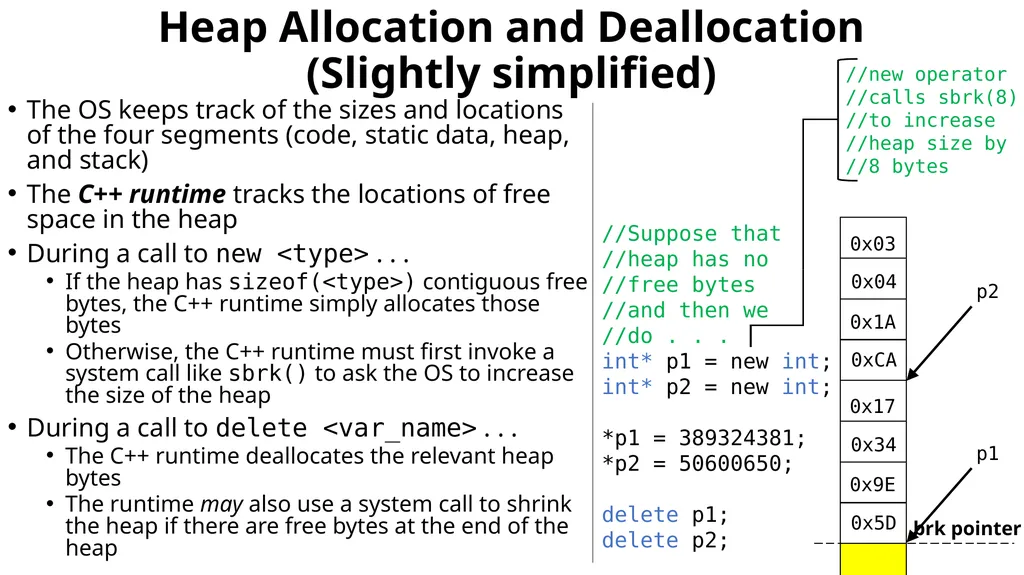
slide3. Heap Allocation and Deallocation (Slightly simplified) The OS keeps track of the sizes and locations of the four segments (code, static data, heap, and stack)
The C++ runtime tracks the locations of free space in the heap
During a call to new <type> . . .
If the heap has sizeof(<type>) contiguous free bytes, the C++ runtime simply allocates those bytes
Otherwise, the C++ runtime must first invoke a system call like sbrk() to ask the OS to increase the size of the heap
During a call to delete <var_name> . . .
The C++ runtime deallocates the relevant heap bytes
The runtime may also use a system call to shrink the heap, although many runtimes don’t do this A language runtime contains code that is:
Provided by the language implementation itself
Handles bookkeeping tasks on behalf of developer-written code
Examples of runtime code are:
C++ new/delete operators that directly handle low-level heap management
C++ code which initializes global variables to all-zero bytes
C++ IO functionality (e.g., printf(), cout) that provides simplified interfaces to IO-related system calls
C++ data structures like vector
Garbage collectors in languages like Python, Java, and OCaml<br>
slide4. Heap Allocation and Deallocation (Slightly simplified) The OS keeps track of the sizes and locations of the four segments (code, static data, heap, and stack)
The C++ runtime tracks the locations of free space in the heap
During a call to new <type> . . .
If the heap has sizeof(<type>) contiguous free bytes, the C++ runtime simply allocates those bytes
Otherwise, the C++ runtime must first invoke a system call like sbrk() to ask the OS to increase the size of the heap
During a call to delete <var_name> . . .
The C++ runtime deallocates the relevant heap bytes
The runtime may also use a system call to shrink the heap if there are free bytes at the end of the heap //Suppose that
//heap has no
//free bytes
//and then we
//do . . .
int* p1 = new int;
int* p2 = new int;
*p1 = 389324381;
*p2 = 50600650;
delete p1;
delete p2; 0x5D 0x9E 0x34 0x17 0xCA 0x1A 0x04 0x03<br>
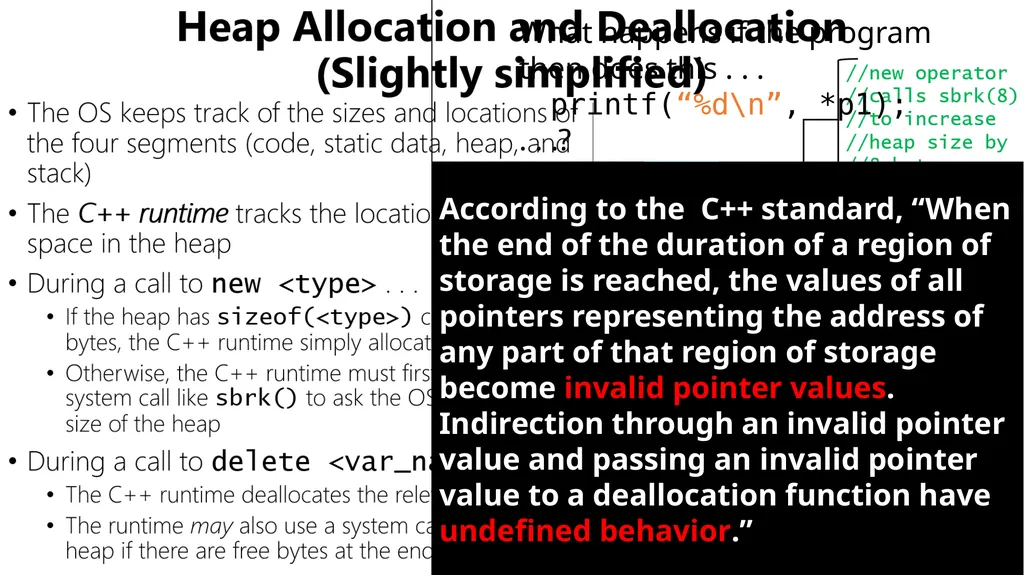
slide5. What happens if the program then does this . . .
printf(“%d\n”, *p1);
. . .? NOBODY KNOWS WHAT THESE FOUL THINGS WANT
DO NOT BRING THEM INTO YOUR LIFE According to the C++ standard, “When the end of the duration of a region of storage is reached, the values of all pointers representing the address of any part of that region of storage become invalid pointer values. Indirection through an invalid pointer value and passing an invalid pointer value to a deallocation function have undefined behavior.”<br>
slide6. When your program performs an undefined action, your program is not guaranteed to deterministically perform the same behavior (e.g., hang, crash, emit smoke) during each program run. All you know is that something will happen. SOMETHING UNDEFINED.<br>
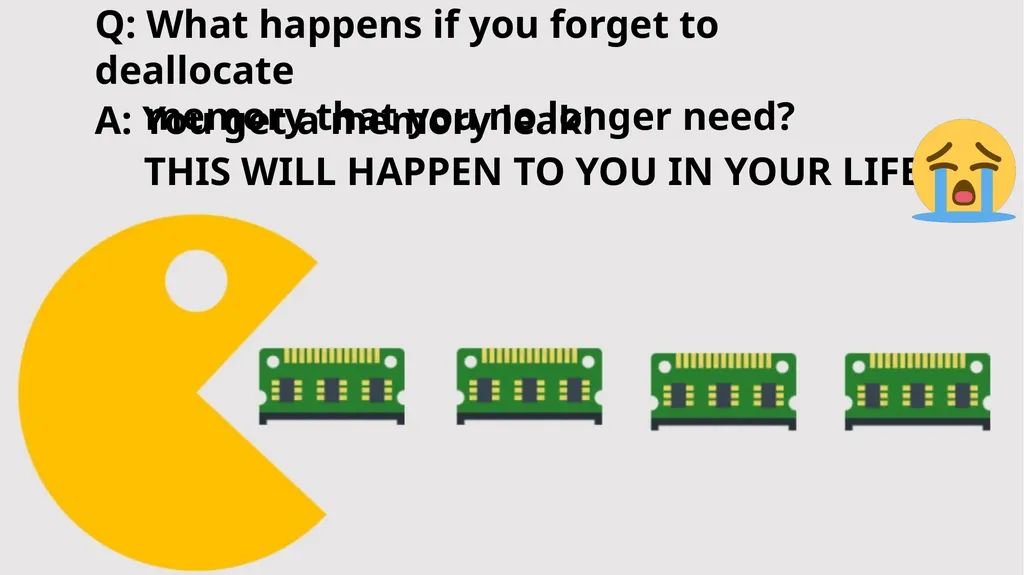
slide7. Q: What happens if you forget to deallocate
memory that you no longer need? A: You get a memory leak! THIS WILL HAPPEN TO YOU IN YOUR LIFE.<br>
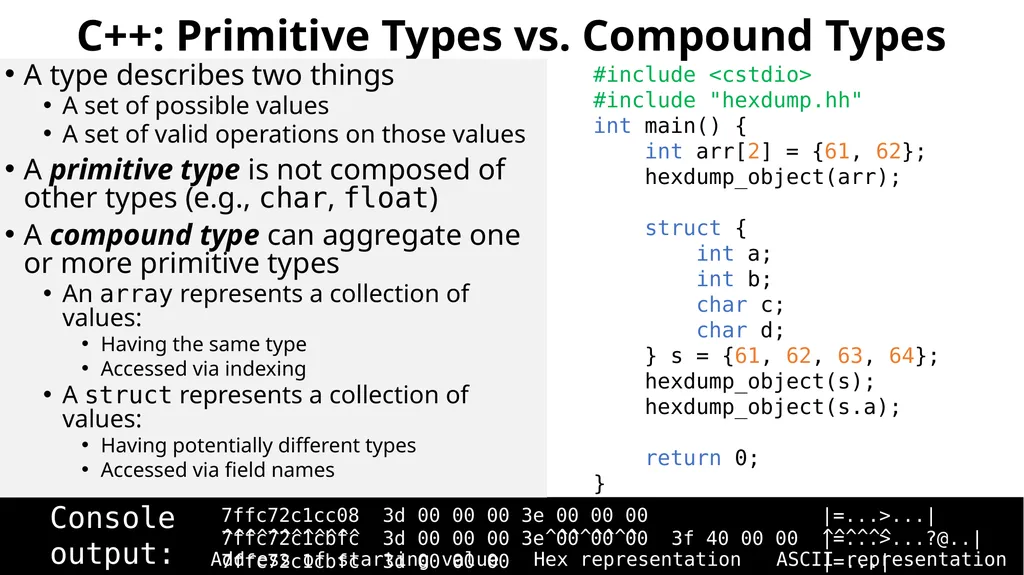
slide8. C++: Primitive Types vs. Compound Types A type describes two things
A set of possible values
A set of valid operations on those values
A primitive type is not composed of other types (e.g., char, float)
A compound type can aggregate one or more primitive types
An array represents a collection of values:
Having the same type
Accessed via indexing
A struct represents a collection of values:
Having potentially different types
Accessed via field names #include <cstdio>
#include "hexdump.hh"
int main() {
int arr[2] = {61, 62};
hexdump_object(arr);
struct {
int a;
int b;
char c;
char d;
} s = {61, 62, 63, 64};
hexdump_object(s);
hexdump_object(s.a);
return 0;
} 7ffc72c1cc08 3d 00 00 00 3e 00 00 00 |=...>...|
7ffc72c1cbfc 3d 00 00 00 3e 00 00 00 3f 40 00 00 |=...>...?@..|
7ffc72c1cbfc 3d 00 00 00 |=...| ^^^^^^^^^^^^ ^^^^^^^^ ^^^^^^
Address of starting value Hex representation ASCII representation<br>
slide9. #include <cstdio>
#include <cstdlib>
static void fhexdump_ascii(FILE* f, const unsigned char* p, size_t pos) {
// Print an ASCII report that ends with byte p[pos].
// The first byte printed is p[first], where first is the max multiple
// of 16 having `first < pos`. The report starts at column 51.
size_t first = pos - (pos % 16); // first char to print
int n = pos + 1 - first; // # chars to print
char buf[17];
for (size_t i = first; i != first + n; ++i) {
buf[i - first] = (p[i] >= 32 && p[i] < 127 ? p[i] : '.');
}
fprintf(f, "%*s|%.*s|\n", 51 - (3 * n + (n > 8)), "", n, buf);
}
void fhexdump_at(FILE* f, size_t first_offset, const void* ptr, size_t size) {
const unsigned char* p = (const unsigned char*) ptr;
for (size_t i = 0; i != size; ++i) {
if (i % 16 == 0) {
fprintf(f, "%08zx", first_offset + i);
}
fprintf(f, "%s%02x", (i % 8 == 0 ? " " : " "), (unsigned) p[i]);
if (i % 16 == 15 || i == size - 1) {
fhexdump_ascii(f, p, i);
}
}
}
void hexdump(const void* ptr, size_t size) {
fhexdump_at(stdout, (size_t) ptr, ptr, size);
}
#define hexdump_object(object) hexdump(&(object), sizeof((object))) Here is the hexdump code in case you’re curious about how it works!<br>
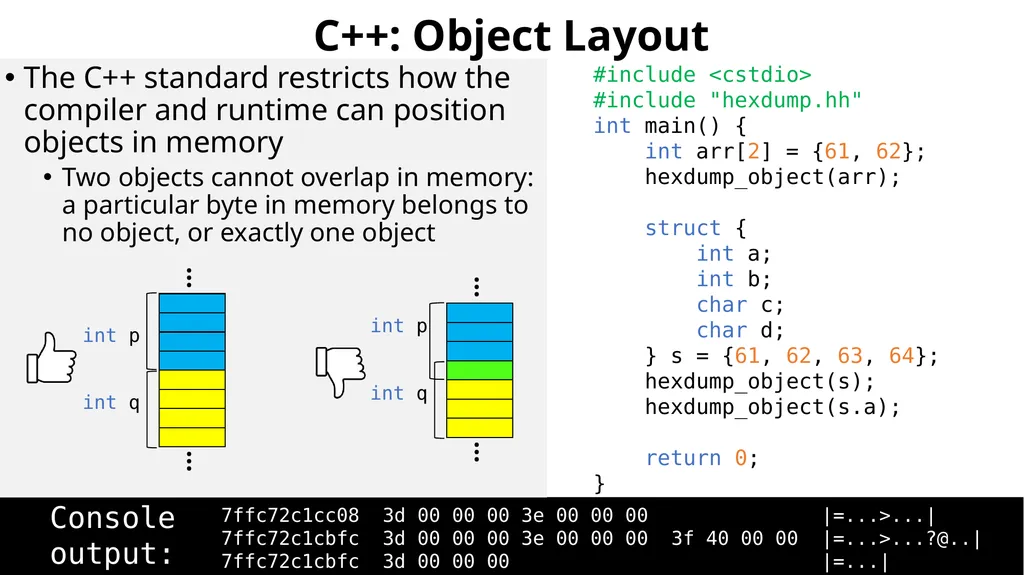
slide10. The C++ standard restricts how the compiler and runtime can position objects in memory
Two objects cannot overlap in memory: a particular byte in memory belongs to no object, or exactly one object #include <cstdio>
#include "hexdump.hh"
int main() {
int arr[2] = {61, 62};
hexdump_object(arr);
struct {
int a;
int b;
char c;
char d;
} s = {61, 62, 63, 64};
hexdump_object(s);
hexdump_object(s.a);
return 0;
} 7ffc72c1cc08 3d 00 00 00 3e 00 00 00 |=...>...|
7ffc72c1cbfc 3d 00 00 00 3e 00 00 00 3f 40 00 00 |=...>...?@..|
7ffc72c1cbfc 3d 00 00 00 |=...| C++: Object Layout<br>
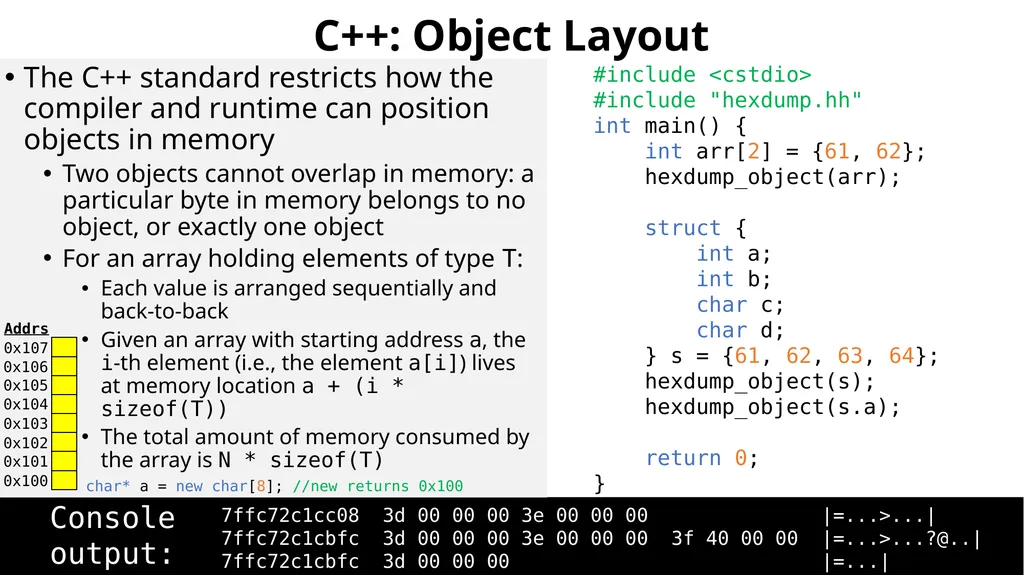
slide11. The C++ standard restricts how the compiler and runtime can position objects in memory
Two objects cannot overlap in memory: a particular byte in memory belongs to no object, or exactly one object
For an array holding elements of type T:
Each value is arranged sequentially and back-to-back
Given an array with starting address a, the i-th element (i.e., the element a[i]) lives at memory location a + (i * sizeof(T))
The total amount of memory consumed by the array is N * sizeof(T) #include <cstdio>
#include "hexdump.hh"
int main() {
int arr[2] = {61, 62};
hexdump_object(arr);
struct {
int a;
int b;
char c;
char d;
} s = {61, 62, 63, 64};
hexdump_object(s);
hexdump_object(s.a);
return 0;
} 7ffc72c1cc08 3d 00 00 00 3e 00 00 00 |=...>...|
7ffc72c1cbfc 3d 00 00 00 3e 00 00 00 3f 40 00 00 |=...>...?@..|
7ffc72c1cbfc 3d 00 00 00 |=...| char* a = new char[8]; //new returns 0x100 C++: Object Layout<br>
slide12. #include <cstdio>
#include "hexdump.hh"
int main() {
int arr[2] = {61, 62};
hexdump_object(arr);
struct {
int a;
int b;
char c;
char d;
} s = {61, 62, 63, 64};
hexdump_object(s);
hexdump_object(s.a);
return 0;
} 7ffc72c1cc08 3d 00 00 00 3e 00 00 00 |=...>...|
7ffc72c1cbfc 3d 00 00 00 3e 00 00 00 3f 40 00 00 |=...>...?@..|
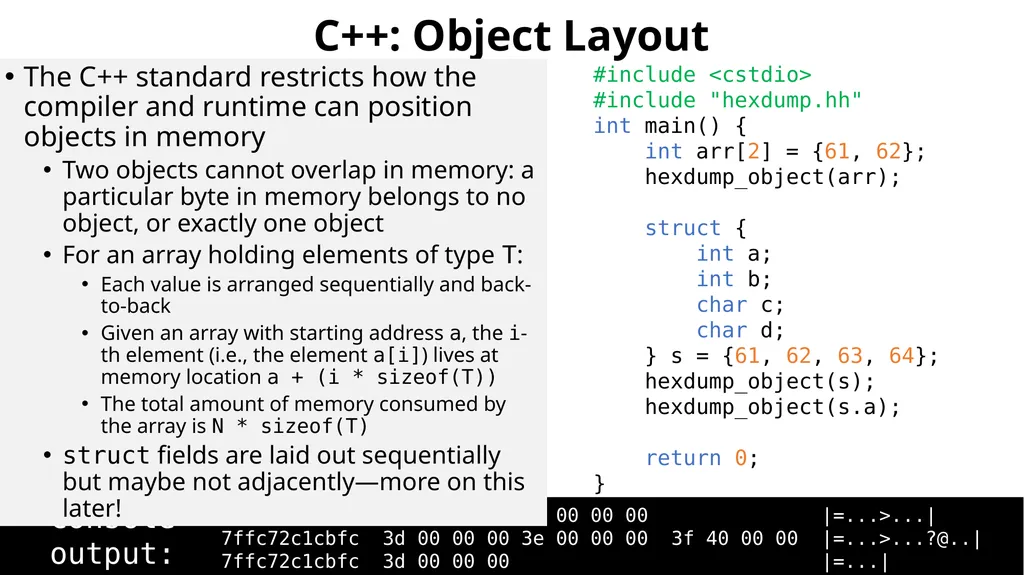
7ffc72c1cbfc 3d 00 00 00 |=...| C++: Object Layout The C++ standard restricts how the compiler and runtime can position objects in memory
Two objects cannot overlap in memory: a particular byte in memory belongs to no object, or exactly one object
For an array holding elements of type T:
Each value is arranged sequentially and back-to-back
Given an array with starting address a, the i-th element (i.e., the element a[i]) lives at memory location a + (i * sizeof(T))
The total amount of memory consumed by the array is N * sizeof(T)
struct fields are laid out sequentially but maybe not adjacently—more on this later!<br>
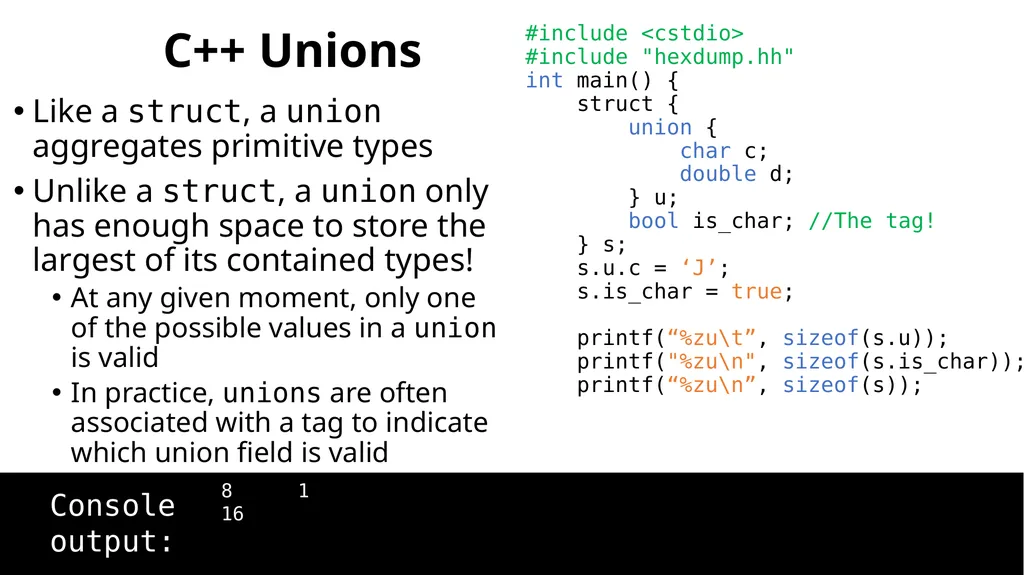
slide13. C++ Unions Like a struct, a union aggregates primitive types
Unlike a struct, a union only has enough space to store the largest of its contained types!
At any given moment, only one of the possible values in a union is valid
In practice, unions are often associated with a tag to indicate which union field is valid Console output: 8 1
16 #include <cstdio>
#include "hexdump.hh"
int main() {
struct {
union {
char c;
double d;
} u;
bool is_char; //The tag!
} s;
s.u.c = ‘J’;
s.is_char = true;
printf(“%zu\t”, sizeof(s.u));
printf("%zu\n", sizeof(s.is_char));
printf(“%zu\n”, sizeof(s));
hexdump_object(s);
return 0;
}<br>
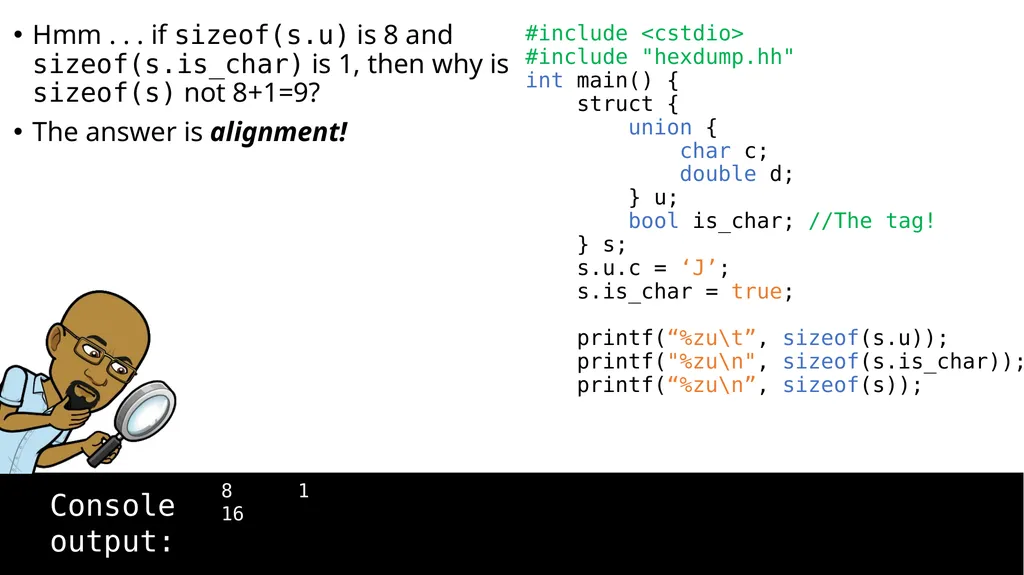
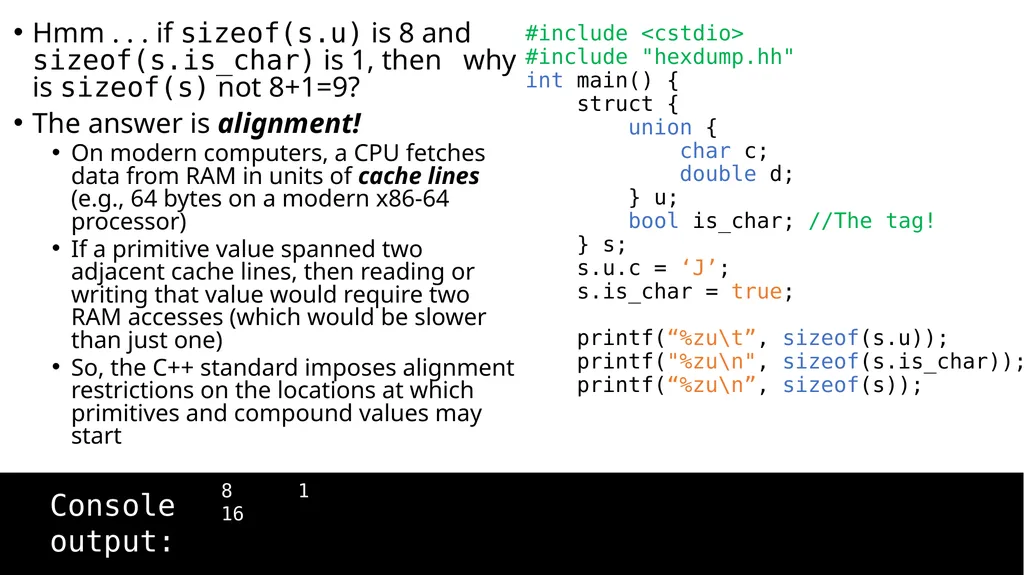
slide14. Hmm . . . if sizeof(s.u) is 8 and sizeof(s.is_char) is 1, then why is sizeof(s) not 8+1=9?
The answer is alignment!
On modern computers, a CPU fetches data from RAM in units of cache lines (e.g., 64 bytes on a modern x86-64 processor)
If a primitive value spanned two adjacent cache lines, then reading or writing that value would require two RAM accesses (which would be slower than just one)
So, the C++ standard imposes alignment restrictions on the locations at which primitives and compound values may start #include <cstdio>
#include "hexdump.hh"
int main() {
struct {
union {
char c;
double d;
} u;
bool is_char; //The tag!
} s;
s.u.c = ‘J’;
s.is_char = true;
printf(“%zu\t”, sizeof(s.u));
printf("%zu\n", sizeof(s.is_char));
printf(“%zu\n”, sizeof(s));
hexdump_object(s);
return 0;
} Console output: 8 1
16<br>
slide15. #include <cstdio>
#include "hexdump.hh"
int main() {
struct {
union {
char c;
double d;
} u;
bool is_char; //The tag!
} s;
s.u.c = ‘J’;
s.is_char = true;
printf(“%zu\t”, sizeof(s.u));
printf("%zu\n", sizeof(s.is_char));
printf(“%zu\n”, sizeof(s));
hexdump_object(s);
return 0;
} Console output: 8 1
16
7ffea59a86e0 4a 87 9a a5 fe 7f 00 00 01 00 00 00 00 00 00 00 \
|J...............| Hmm . . . if sizeof(s.u) is 8 and sizeof(s.is_char) is 1, then why is sizeof(s) not 8+1=9?
The answer is alignment!
On modern computers, a CPU fetches data from RAM in units of cache lines (e.g., 64 bytes on a modern x86-64 processor)
If a primitive value spanned two adjacent cache lines, then reading or writing that value would require two RAM accesses (which would be slower than just one)
So, the C++ standard imposes alignment restrictions on the locations at which primitives and compound values may start<br>
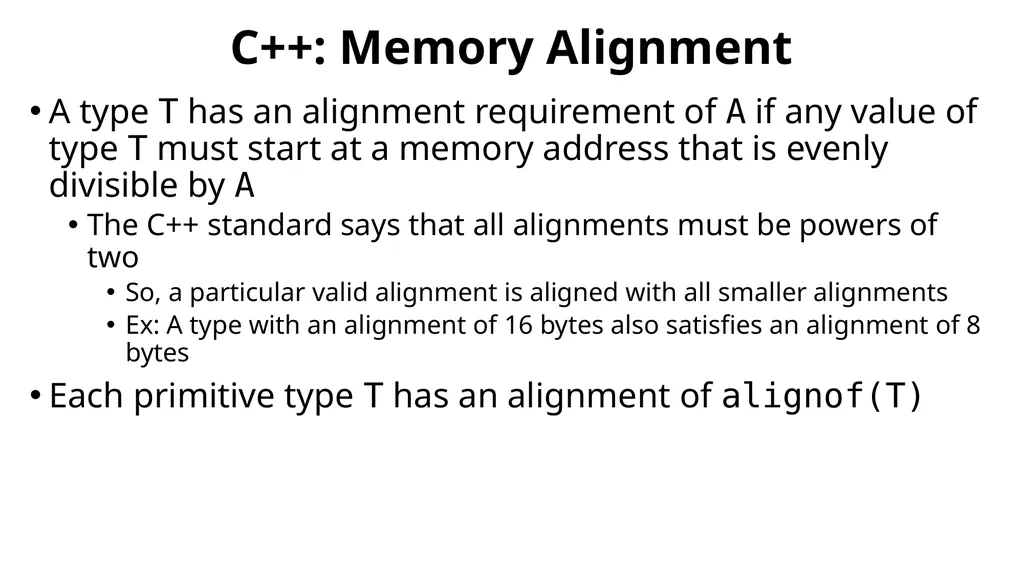
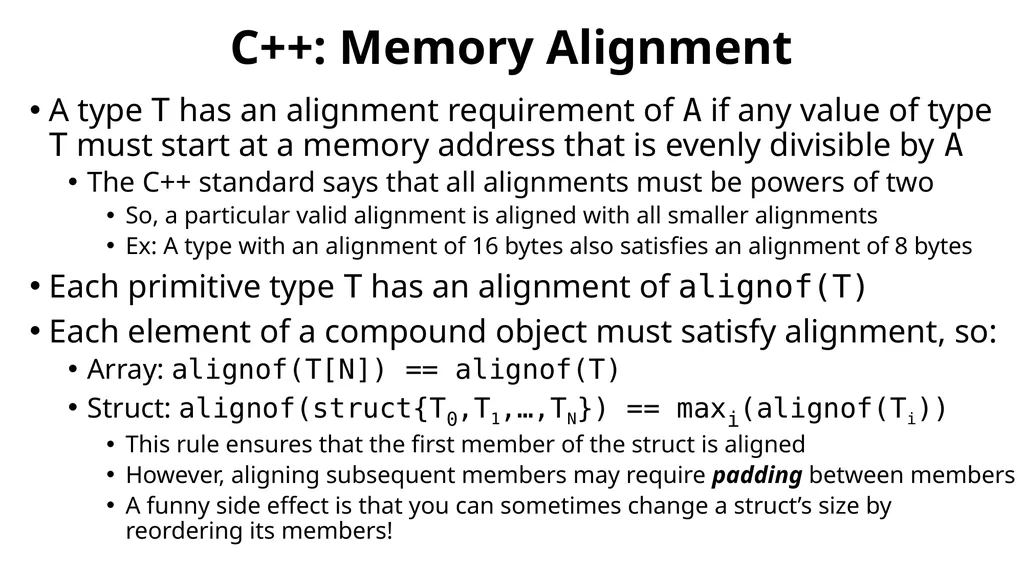
slide17. C++: Memory Alignment A type T has an alignment requirement of A if any value of type T must start at a memory address that is evenly divisible by A
The C++ standard says that all alignments must be powers of two
So, a particular valid alignment is aligned with all smaller alignments
Ex: A type with an alignment of 16 bytes also satisfies an alignment of 8 bytes
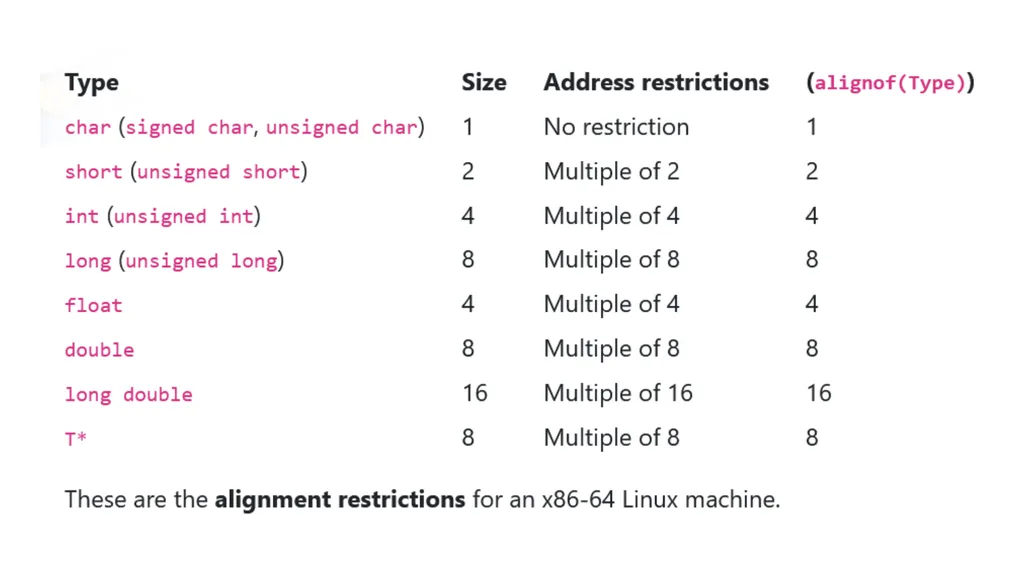
Each primitive type T has an alignment of alignof(T)<br>
slide19. C++: Memory Alignment A type T has an alignment requirement of A if any value of type T must start at a memory address that is evenly divisible by A
The C++ standard says that all alignments must be powers of two
So, a particular valid alignment is aligned with all smaller alignments
Ex: A type with an alignment of 16 bytes also satisfies an alignment of 8 bytes
Each primitive type T has an alignment of alignof(T)
Each element of a compound object must satisfy alignment, so:
Array: alignof(T[N]) == alignof(T)
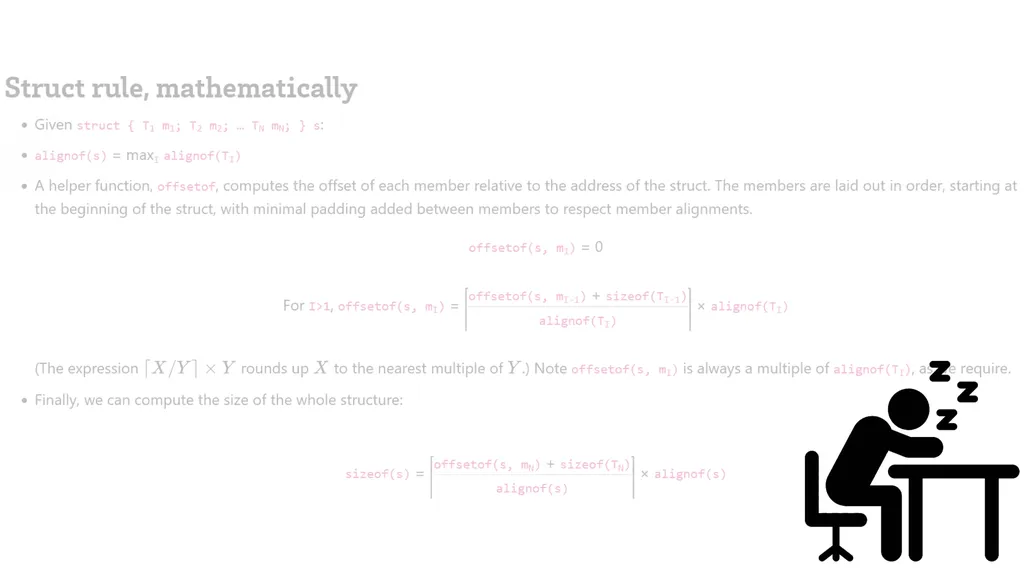
Struct: alignof(struct{T0,T1,…,TN}) == maxi(alignof(Ti))
This rule ensures that the first member of the struct is aligned
However, aligning subsequent members may require padding between members
A funny side effect is that you can sometimes change a struct’s size by reordering its members!<br>
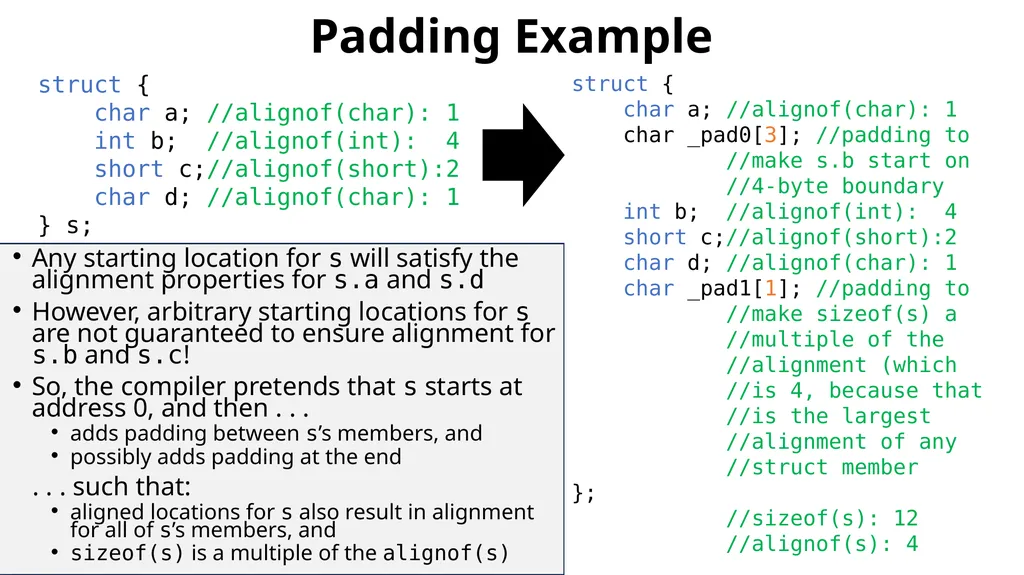
slide20. Padding Example struct {
char a; //alignof(char): 1
int b; //alignof(int): 4
short c;//alignof(short):2
char d; //alignof(char): 1
} s; Any starting location for s will satisfy the alignment properties for s.a and s.d
However, arbitrary starting locations for s are not guaranteed to ensure alignment for s.b and s.c!
So, the compiler pretends that s starts at address 0, and then . . .
adds padding between s’s members, and
possibly adds padding at the end
. . . such that:
aligned locations for s also result in alignment for all of s’s members, and
sizeof(s) is a multiple of the alignof(s)<br>
slide22. #include <cstdio>
#include "hexdump.hh"
int main() {
struct {
union {
char c;
double d;
} u;
bool is_char; //The tag!
} s;
s.u.c = ‘J’;
s.is_char = true;
printf(“%zu\t”, sizeof(s.u));
printf("%zu\n", sizeof(s.is_char));
printf(“%zu\n”, sizeof(s));
hexdump_object(s);
return 0;
} Console output: 8 1
16
7ffea59a86e0 4a 87 9a a5 fe 7f 00 00 01 00 00 00 00 00 00 00 \
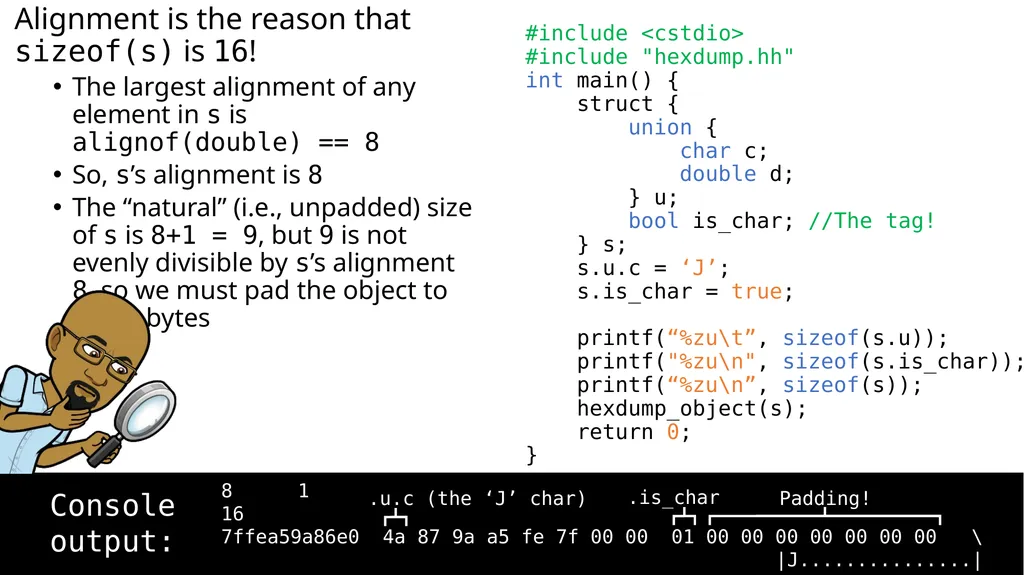
|J...............| Alignment is the reason that sizeof(s) is 16!
The largest alignment of any element in s is alignof(double) == 8
So, s’s alignment is 8
The “natural” (i.e., unpadded) size of s is 8+1 = 9, but 9 is not evenly divisible by s’s alignment 8, so we must pad the object to be 16 bytes<br>
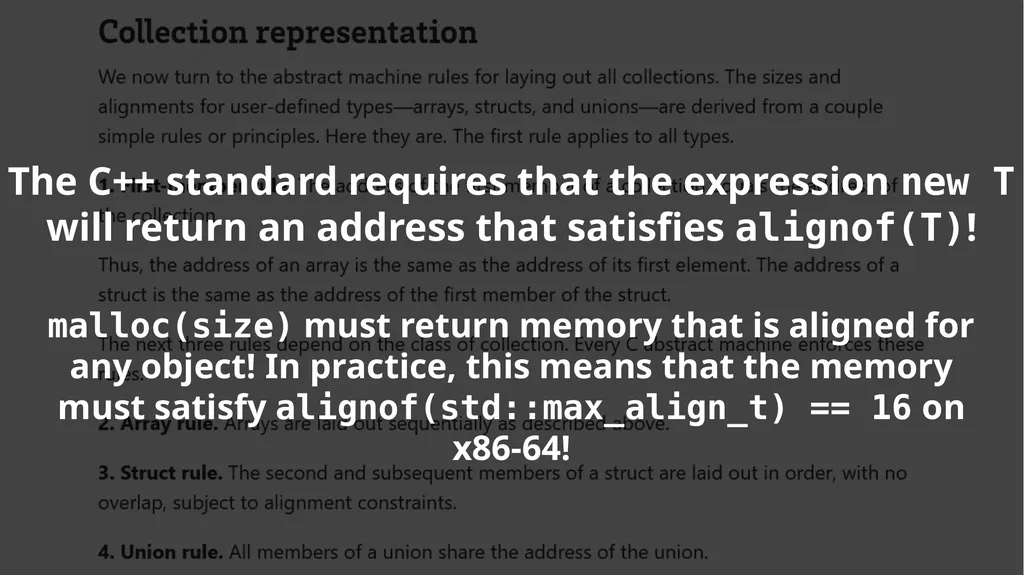
slide23. malloc(size) must return memory that is aligned for any object! In practice, this means that the memory must satisfy alignof(std::max_align_t) == 16 on x86-64!<br>
slide2. Recap: Memory A program’s address space has four segments
The code segment stores the program’s CPU instructions
The static data segment contains global variables
The stack contains bookkeeping information (e.g., local variables) for active functions: More details in the next lecture!
The heap contains dynamically allocated data
The lifetime of a C++ object depends on which segment it lives in!
Code and static data is born at program start and only dies when the program dies
The compiler automatically ensures that a live function’s stack data is created when the function starts, and only lives as long as the function
A programmer has to manually allocate and deallocate heap memory via new and delete! Byte 0 Byte N-1 Address space Code Static data Heap<br>
slide3. Heap Allocation and Deallocation (Slightly simplified) The OS keeps track of the sizes and locations of the four segments (code, static data, heap, and stack)
The C++ runtime tracks the locations of free space in the heap
During a call to new <type> . . .
If the heap has sizeof(<type>) contiguous free bytes, the C++ runtime simply allocates those bytes
Otherwise, the C++ runtime must first invoke a system call like sbrk() to ask the OS to increase the size of the heap
During a call to delete <var_name> . . .
The C++ runtime deallocates the relevant heap bytes
The runtime may also use a system call to shrink the heap, although many runtimes don’t do this A language runtime contains code that is:
Provided by the language implementation itself
Handles bookkeeping tasks on behalf of developer-written code
Examples of runtime code are:
C++ new/delete operators that directly handle low-level heap management
C++ code which initializes global variables to all-zero bytes
C++ IO functionality (e.g., printf(), cout) that provides simplified interfaces to IO-related system calls
C++ data structures like vector
Garbage collectors in languages like Python, Java, and OCaml<br>
slide4. Heap Allocation and Deallocation (Slightly simplified) The OS keeps track of the sizes and locations of the four segments (code, static data, heap, and stack)
The C++ runtime tracks the locations of free space in the heap
During a call to new <type> . . .
If the heap has sizeof(<type>) contiguous free bytes, the C++ runtime simply allocates those bytes
Otherwise, the C++ runtime must first invoke a system call like sbrk() to ask the OS to increase the size of the heap
During a call to delete <var_name> . . .
The C++ runtime deallocates the relevant heap bytes
The runtime may also use a system call to shrink the heap if there are free bytes at the end of the heap //Suppose that
//heap has no
//free bytes
//and then we
//do . . .
int* p1 = new int;
int* p2 = new int;
*p1 = 389324381;
*p2 = 50600650;
delete p1;
delete p2; 0x5D 0x9E 0x34 0x17 0xCA 0x1A 0x04 0x03<br>
slide5. What happens if the program then does this . . .
printf(“%d\n”, *p1);
. . .? NOBODY KNOWS WHAT THESE FOUL THINGS WANT
DO NOT BRING THEM INTO YOUR LIFE According to the C++ standard, “When the end of the duration of a region of storage is reached, the values of all pointers representing the address of any part of that region of storage become invalid pointer values. Indirection through an invalid pointer value and passing an invalid pointer value to a deallocation function have undefined behavior.”<br>
slide6. When your program performs an undefined action, your program is not guaranteed to deterministically perform the same behavior (e.g., hang, crash, emit smoke) during each program run. All you know is that something will happen. SOMETHING UNDEFINED.<br>
slide7. Q: What happens if you forget to deallocate
memory that you no longer need? A: You get a memory leak! THIS WILL HAPPEN TO YOU IN YOUR LIFE.<br>
slide8. C++: Primitive Types vs. Compound Types A type describes two things
A set of possible values
A set of valid operations on those values
A primitive type is not composed of other types (e.g., char, float)
A compound type can aggregate one or more primitive types
An array represents a collection of values:
Having the same type
Accessed via indexing
A struct represents a collection of values:
Having potentially different types
Accessed via field names #include <cstdio>
#include "hexdump.hh"
int main() {
int arr[2] = {61, 62};
hexdump_object(arr);
struct {
int a;
int b;
char c;
char d;
} s = {61, 62, 63, 64};
hexdump_object(s);
hexdump_object(s.a);
return 0;
} 7ffc72c1cc08 3d 00 00 00 3e 00 00 00 |=...>...|
7ffc72c1cbfc 3d 00 00 00 3e 00 00 00 3f 40 00 00 |=...>...?@..|
7ffc72c1cbfc 3d 00 00 00 |=...| ^^^^^^^^^^^^ ^^^^^^^^ ^^^^^^
Address of starting value Hex representation ASCII representation<br>
slide9. #include <cstdio>
#include <cstdlib>
static void fhexdump_ascii(FILE* f, const unsigned char* p, size_t pos) {
// Print an ASCII report that ends with byte p[pos].
// The first byte printed is p[first], where first is the max multiple
// of 16 having `first < pos`. The report starts at column 51.
size_t first = pos - (pos % 16); // first char to print
int n = pos + 1 - first; // # chars to print
char buf[17];
for (size_t i = first; i != first + n; ++i) {
buf[i - first] = (p[i] >= 32 && p[i] < 127 ? p[i] : '.');
}
fprintf(f, "%*s|%.*s|\n", 51 - (3 * n + (n > 8)), "", n, buf);
}
void fhexdump_at(FILE* f, size_t first_offset, const void* ptr, size_t size) {
const unsigned char* p = (const unsigned char*) ptr;
for (size_t i = 0; i != size; ++i) {
if (i % 16 == 0) {
fprintf(f, "%08zx", first_offset + i);
}
fprintf(f, "%s%02x", (i % 8 == 0 ? " " : " "), (unsigned) p[i]);
if (i % 16 == 15 || i == size - 1) {
fhexdump_ascii(f, p, i);
}
}
}
void hexdump(const void* ptr, size_t size) {
fhexdump_at(stdout, (size_t) ptr, ptr, size);
}
#define hexdump_object(object) hexdump(&(object), sizeof((object))) Here is the hexdump code in case you’re curious about how it works!<br>
slide10. The C++ standard restricts how the compiler and runtime can position objects in memory
Two objects cannot overlap in memory: a particular byte in memory belongs to no object, or exactly one object #include <cstdio>
#include "hexdump.hh"
int main() {
int arr[2] = {61, 62};
hexdump_object(arr);
struct {
int a;
int b;
char c;
char d;
} s = {61, 62, 63, 64};
hexdump_object(s);
hexdump_object(s.a);
return 0;
} 7ffc72c1cc08 3d 00 00 00 3e 00 00 00 |=...>...|
7ffc72c1cbfc 3d 00 00 00 3e 00 00 00 3f 40 00 00 |=...>...?@..|
7ffc72c1cbfc 3d 00 00 00 |=...| C++: Object Layout<br>
slide11. The C++ standard restricts how the compiler and runtime can position objects in memory
Two objects cannot overlap in memory: a particular byte in memory belongs to no object, or exactly one object
For an array holding elements of type T:
Each value is arranged sequentially and back-to-back
Given an array with starting address a, the i-th element (i.e., the element a[i]) lives at memory location a + (i * sizeof(T))
The total amount of memory consumed by the array is N * sizeof(T) #include <cstdio>
#include "hexdump.hh"
int main() {
int arr[2] = {61, 62};
hexdump_object(arr);
struct {
int a;
int b;
char c;
char d;
} s = {61, 62, 63, 64};
hexdump_object(s);
hexdump_object(s.a);
return 0;
} 7ffc72c1cc08 3d 00 00 00 3e 00 00 00 |=...>...|
7ffc72c1cbfc 3d 00 00 00 3e 00 00 00 3f 40 00 00 |=...>...?@..|
7ffc72c1cbfc 3d 00 00 00 |=...| char* a = new char[8]; //new returns 0x100 C++: Object Layout<br>
slide12. #include <cstdio>
#include "hexdump.hh"
int main() {
int arr[2] = {61, 62};
hexdump_object(arr);
struct {
int a;
int b;
char c;
char d;
} s = {61, 62, 63, 64};
hexdump_object(s);
hexdump_object(s.a);
return 0;
} 7ffc72c1cc08 3d 00 00 00 3e 00 00 00 |=...>...|
7ffc72c1cbfc 3d 00 00 00 3e 00 00 00 3f 40 00 00 |=...>...?@..|
7ffc72c1cbfc 3d 00 00 00 |=...| C++: Object Layout The C++ standard restricts how the compiler and runtime can position objects in memory
Two objects cannot overlap in memory: a particular byte in memory belongs to no object, or exactly one object
For an array holding elements of type T:
Each value is arranged sequentially and back-to-back
Given an array with starting address a, the i-th element (i.e., the element a[i]) lives at memory location a + (i * sizeof(T))
The total amount of memory consumed by the array is N * sizeof(T)
struct fields are laid out sequentially but maybe not adjacently—more on this later!<br>
slide13. C++ Unions Like a struct, a union aggregates primitive types
Unlike a struct, a union only has enough space to store the largest of its contained types!
At any given moment, only one of the possible values in a union is valid
In practice, unions are often associated with a tag to indicate which union field is valid Console output: 8 1
16 #include <cstdio>
#include "hexdump.hh"
int main() {
struct {
union {
char c;
double d;
} u;
bool is_char; //The tag!
} s;
s.u.c = ‘J’;
s.is_char = true;
printf(“%zu\t”, sizeof(s.u));
printf("%zu\n", sizeof(s.is_char));
printf(“%zu\n”, sizeof(s));
hexdump_object(s);
return 0;
}<br>
slide14. Hmm . . . if sizeof(s.u) is 8 and sizeof(s.is_char) is 1, then why is sizeof(s) not 8+1=9?
The answer is alignment!
On modern computers, a CPU fetches data from RAM in units of cache lines (e.g., 64 bytes on a modern x86-64 processor)
If a primitive value spanned two adjacent cache lines, then reading or writing that value would require two RAM accesses (which would be slower than just one)
So, the C++ standard imposes alignment restrictions on the locations at which primitives and compound values may start #include <cstdio>
#include "hexdump.hh"
int main() {
struct {
union {
char c;
double d;
} u;
bool is_char; //The tag!
} s;
s.u.c = ‘J’;
s.is_char = true;
printf(“%zu\t”, sizeof(s.u));
printf("%zu\n", sizeof(s.is_char));
printf(“%zu\n”, sizeof(s));
hexdump_object(s);
return 0;
} Console output: 8 1
16<br>
slide15. #include <cstdio>
#include "hexdump.hh"
int main() {
struct {
union {
char c;
double d;
} u;
bool is_char; //The tag!
} s;
s.u.c = ‘J’;
s.is_char = true;
printf(“%zu\t”, sizeof(s.u));
printf("%zu\n", sizeof(s.is_char));
printf(“%zu\n”, sizeof(s));
hexdump_object(s);
return 0;
} Console output: 8 1
16
7ffea59a86e0 4a 87 9a a5 fe 7f 00 00 01 00 00 00 00 00 00 00 \
|J...............| Hmm . . . if sizeof(s.u) is 8 and sizeof(s.is_char) is 1, then why is sizeof(s) not 8+1=9?
The answer is alignment!
On modern computers, a CPU fetches data from RAM in units of cache lines (e.g., 64 bytes on a modern x86-64 processor)
If a primitive value spanned two adjacent cache lines, then reading or writing that value would require two RAM accesses (which would be slower than just one)
So, the C++ standard imposes alignment restrictions on the locations at which primitives and compound values may start<br>
slide17. C++: Memory Alignment A type T has an alignment requirement of A if any value of type T must start at a memory address that is evenly divisible by A
The C++ standard says that all alignments must be powers of two
So, a particular valid alignment is aligned with all smaller alignments
Ex: A type with an alignment of 16 bytes also satisfies an alignment of 8 bytes
Each primitive type T has an alignment of alignof(T)<br>
slide19. C++: Memory Alignment A type T has an alignment requirement of A if any value of type T must start at a memory address that is evenly divisible by A
The C++ standard says that all alignments must be powers of two
So, a particular valid alignment is aligned with all smaller alignments
Ex: A type with an alignment of 16 bytes also satisfies an alignment of 8 bytes
Each primitive type T has an alignment of alignof(T)
Each element of a compound object must satisfy alignment, so:
Array: alignof(T[N]) == alignof(T)
Struct: alignof(struct{T0,T1,…,TN}) == maxi(alignof(Ti))
This rule ensures that the first member of the struct is aligned
However, aligning subsequent members may require padding between members
A funny side effect is that you can sometimes change a struct’s size by reordering its members!<br>
slide20. Padding Example struct {
char a; //alignof(char): 1
int b; //alignof(int): 4
short c;//alignof(short):2
char d; //alignof(char): 1
} s; Any starting location for s will satisfy the alignment properties for s.a and s.d
However, arbitrary starting locations for s are not guaranteed to ensure alignment for s.b and s.c!
So, the compiler pretends that s starts at address 0, and then . . .
adds padding between s’s members, and
possibly adds padding at the end
. . . such that:
aligned locations for s also result in alignment for all of s’s members, and
sizeof(s) is a multiple of the alignof(s)<br>
slide22. #include <cstdio>
#include "hexdump.hh"
int main() {
struct {
union {
char c;
double d;
} u;
bool is_char; //The tag!
} s;
s.u.c = ‘J’;
s.is_char = true;
printf(“%zu\t”, sizeof(s.u));
printf("%zu\n", sizeof(s.is_char));
printf(“%zu\n”, sizeof(s));
hexdump_object(s);
return 0;
} Console output: 8 1
16
7ffea59a86e0 4a 87 9a a5 fe 7f 00 00 01 00 00 00 00 00 00 00 \
|J...............| Alignment is the reason that sizeof(s) is 16!
The largest alignment of any element in s is alignof(double) == 8
So, s’s alignment is 8
The “natural” (i.e., unpadded) size of s is 8+1 = 9, but 9 is not evenly divisible by s’s alignment 8, so we must pad the object to be 16 bytes<br>
slide23. malloc(size) must return memory that is aligned for any object! In practice, this means that the memory must satisfy alignof(std::max_align_t) == 16 on x86-64!<br>