Understanding Cancer Basics Understanding Cancer Basics Can cancer be prevented? How is cancer diagnosed? What are cancer risk factors? What does cancer stage mean? Why is it important? How does cancer spread? What is cancer? Todays
"Understanding Cancer Basics Understanding Cancer" is the property of its rightful owner. Permission is granted to
download and print the materials on this website for personal, non-commercial use only, and to display it
on your personal computer provided you do not modify the materials and that you retain all copyright
notices contained in the materials. By downloading content from our website, you accept the terms of this
agreement.
Presentation Transcript
01
Understanding Cancer Basics<br>
02
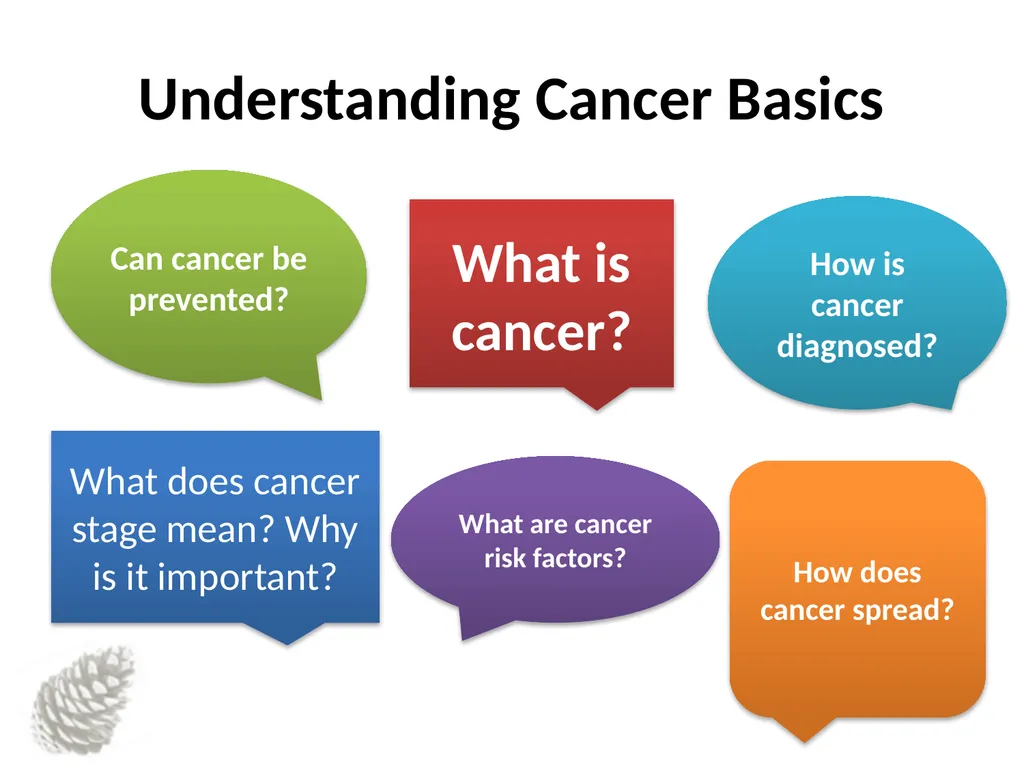
Understanding Cancer Basics Can cancer be prevented? How is cancer diagnosed? What are cancer risk factors? What does cancer stage mean? Why is it important? How does cancer spread? What is cancer?<br>
03
Today’s Objectives At the end of this section, you will be able to:
UNDERSTAND what cancer is
STATE how a cancer diagnosis is made
IDENTIFY cancer risk factors
UNDERSTAND the importance of cancer stage<br>
04
What is Cancer? Cancer is not just one disease, but a group of over 200 different diseases.
Cancer is an abnormal growth of cells.
Each cell contains a set of instructions (DNA).
The instructions tell the cell when to reproduce and when to die.
Sometimes, the instructions (DNA) can be damaged and can result in a mutation.
If cells keep reproducing in an uncontrolled way, a mass forms.<br>
05
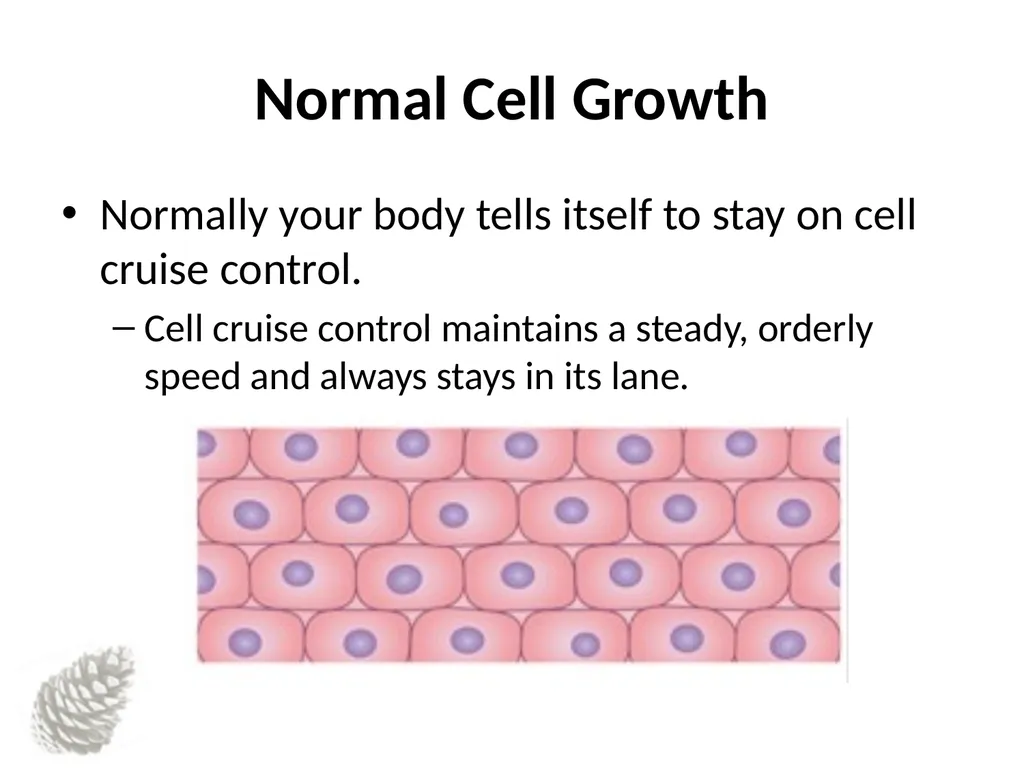
Normal Cell Growth Normally your body tells itself to stay on cell cruise control.
Cell cruise control maintains a steady, orderly speed and always stays in its lane.<br>
06
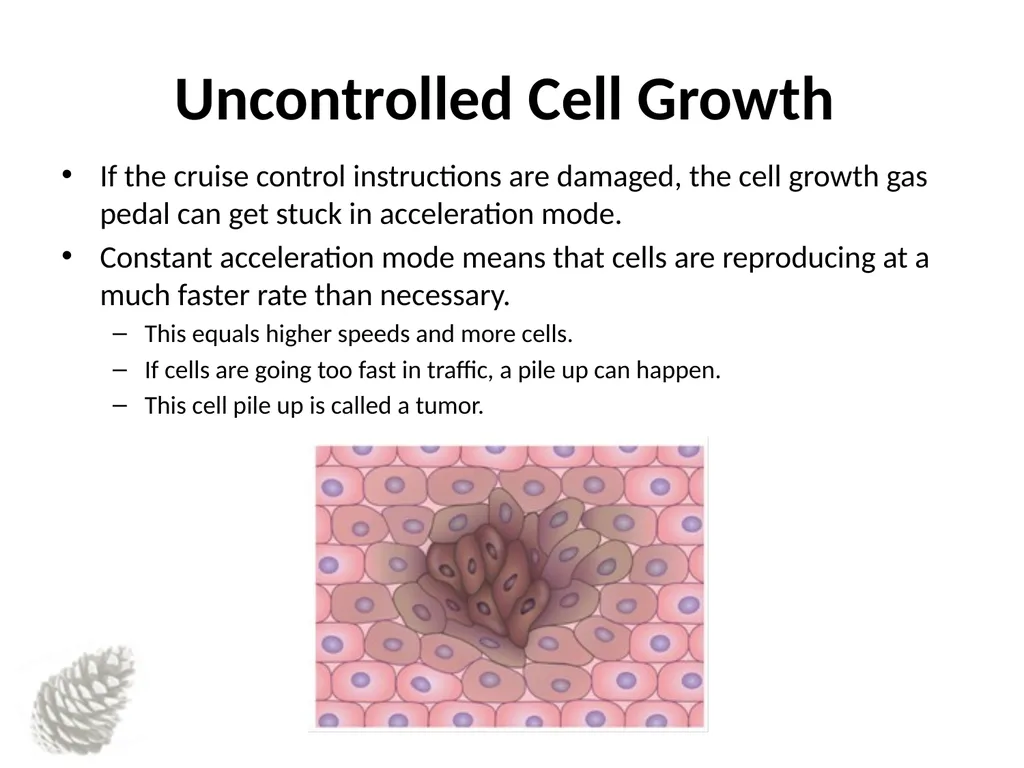
Uncontrolled Cell Growth If the cruise control instructions are damaged, the cell growth gas pedal can get stuck in acceleration mode.
Constant acceleration mode means that cells are reproducing at a much faster rate than necessary.
This equals higher speeds and more cells.
If cells are going too fast in traffic, a pile up can happen.
This cell pile up is called a tumor.<br>
07
Tumors can be benign or malignant Benign tumors are not cancer. They do not spread to other parts of the body and are not usually a threat to someone’s life.
Malignant tumors are cancer cells which reproduce without control or order. Cancer cells can spread to other parts of the body. Think of the cells like a car whose cruise control is stuck and speeding out of control.<br>
08
What causes cancer? Over time, a cell takes many “hits.”
“Hits” come from:
what you are exposed to (environmentally, occupationally, radiation, viruses), and
how you live (tobacco, diet, alcohol, activity, etc.)<br>
09
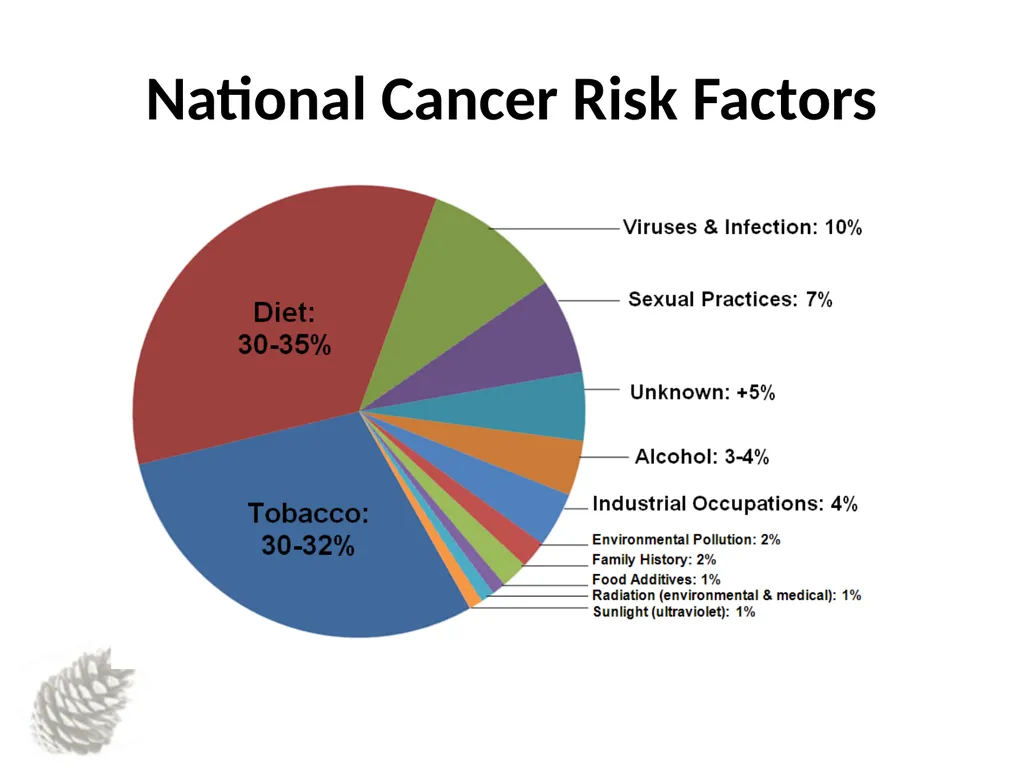
National Cancer Risk Factors<br>
10
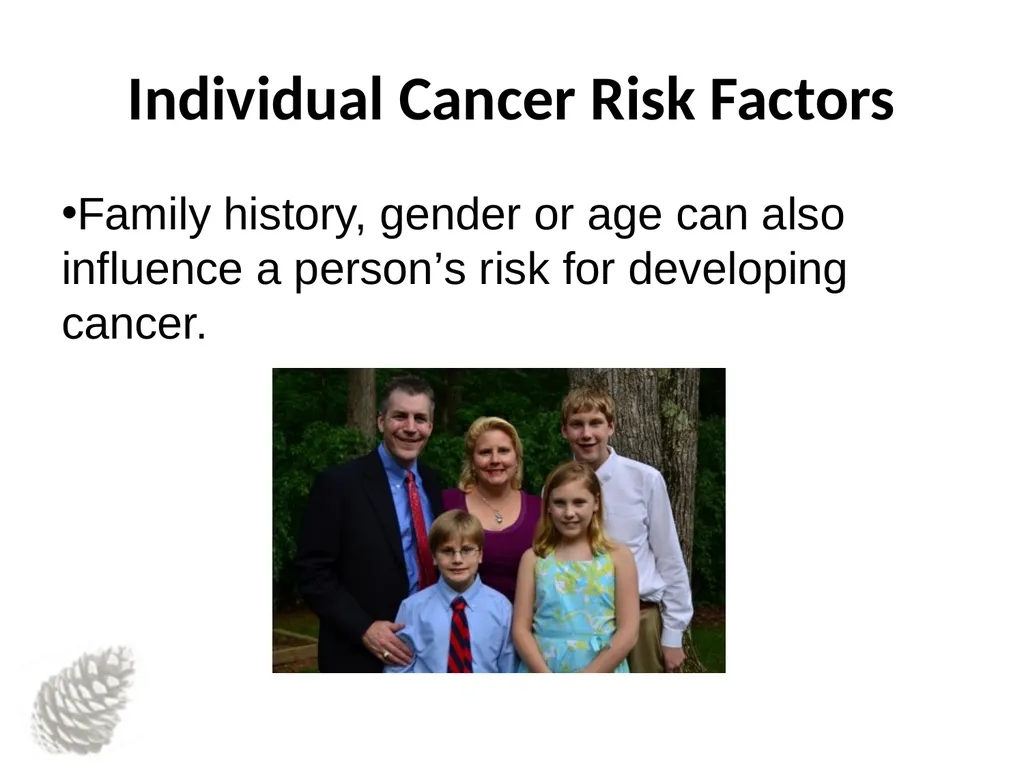
Individual Cancer Risk Factors Family history, gender or age can also influence a person’s risk for developing cancer.<br>
11
What are my cancer risk factors? Your risk of developing cancer, as well as stroke, heart disease and diabetes, depends on:
who you are (family history)
what you are exposed to (environmentally, secondhand smoke, occupationally, viruses, radiation), and
how you live (tobacco, diet, alcohol, physical activity, etc.).<br>
12
How is a cancer diagnosis made? A cancer diagnosis can only be made by looking at cells from a biopsy under a microscope.<br>
13
Primary Cancer Site Most cancers are identified by the organ in which they first begin to grow (i.e. breast cancer).<br>
14
What if the cancer spreads?<br>
15
Example: The Stages of Colorectal Cancer<br>
16
Thank you!! For additional information please contact www.ruralcancernetwork.org website.<br>