Understanding Ingredients Eggs Topics Types of
Description: Understanding Ingredients Eggs Topics Types of Eggs Structure of Eggs Nutritive Value of Eggs Choice and Storage of Eggs Uses of Egg in Cooking Diet Food and Nutrition Labelling of Eggs 2 Types of Eggs 3 Types of Eggs Eggs commonly used
Related Topics
Download Presentation
"Understanding Ingredients Eggs Topics Types of" is the property of its rightful owner. Permission is granted to download and print the materials on this website for personal, non-commercial use only, and to display it on your personal computer provided you do not modify the materials and that you retain all copyright notices contained in the materials. By downloading content from our website, you accept the terms of this agreement.
Presentation Transcript
slide1. Understanding Ingredients Eggs<br>
slide2. Topics Types of Eggs
Structure of Eggs
Nutritive Value of Eggs
Choice and Storage of Eggs
Uses of Egg in Cooking / Diet
Food and Nutrition Labelling of Eggs 2<br>
slide3. Types of Eggs 3<br>
slide4. Types of Eggs Eggs commonly used in our diet:
Hen’s egg, commonly referred as egg
Duck’s eggs
Quail’s eggs
Pigeon’s eggs
Preserved eggs
Salted eggs 4<br>
slide5. Structures of Eggs 5<br>
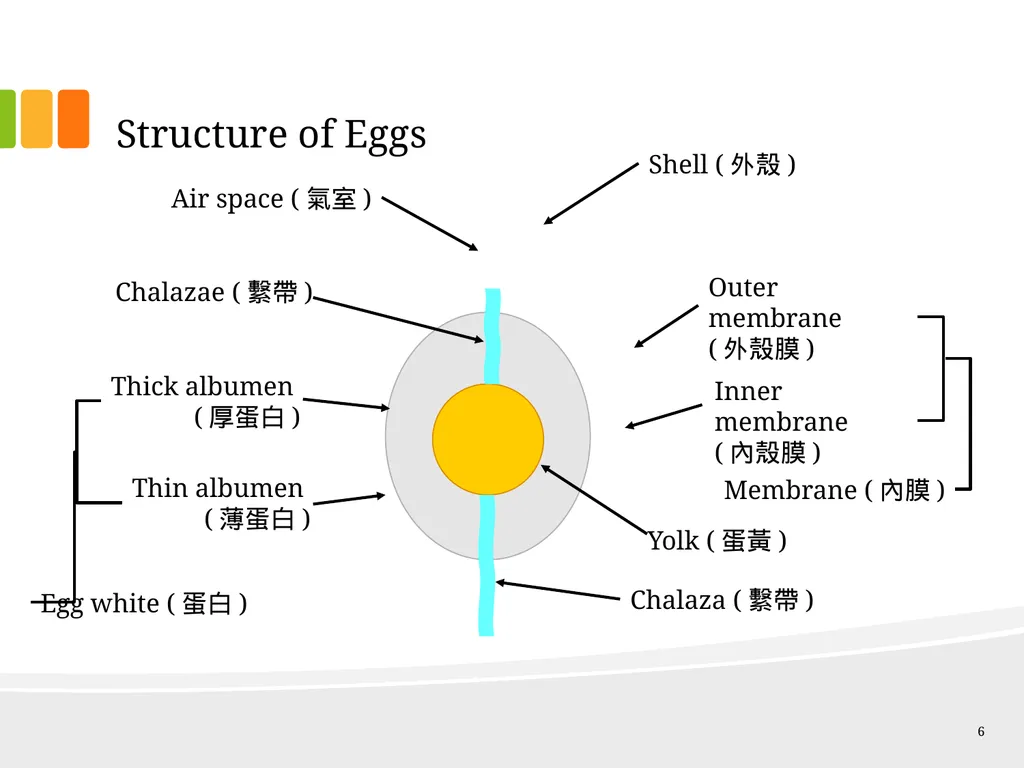
slide6. Structure of Eggs Shell (外殼) Yolk (蛋黃) Outer membrane
(外殼膜) Chalaza (繫帶) Air space (氣室) Egg white (蛋白) Thick albumen
(厚蛋白) Thin albumen
(薄蛋白) Chalazae (繫帶) Inner membrane
(內殼膜) Membrane (內膜) 6<br>
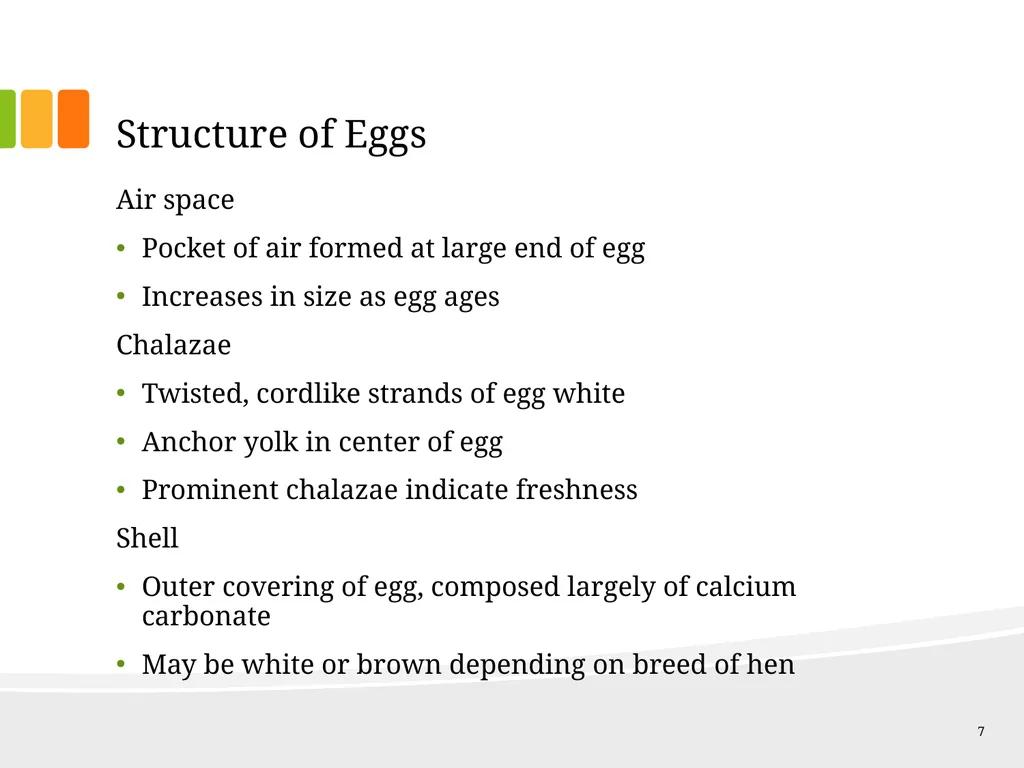
slide7. Structure of Eggs Air space
Pocket of air formed at large end of egg
Increases in size as egg ages
Chalazae
Twisted, cordlike strands of egg white
Anchor yolk in center of egg
Prominent chalazae indicate freshness
Shell
Outer covering of egg, composed largely of calcium carbonate
May be white or brown depending on breed of hen 7<br>
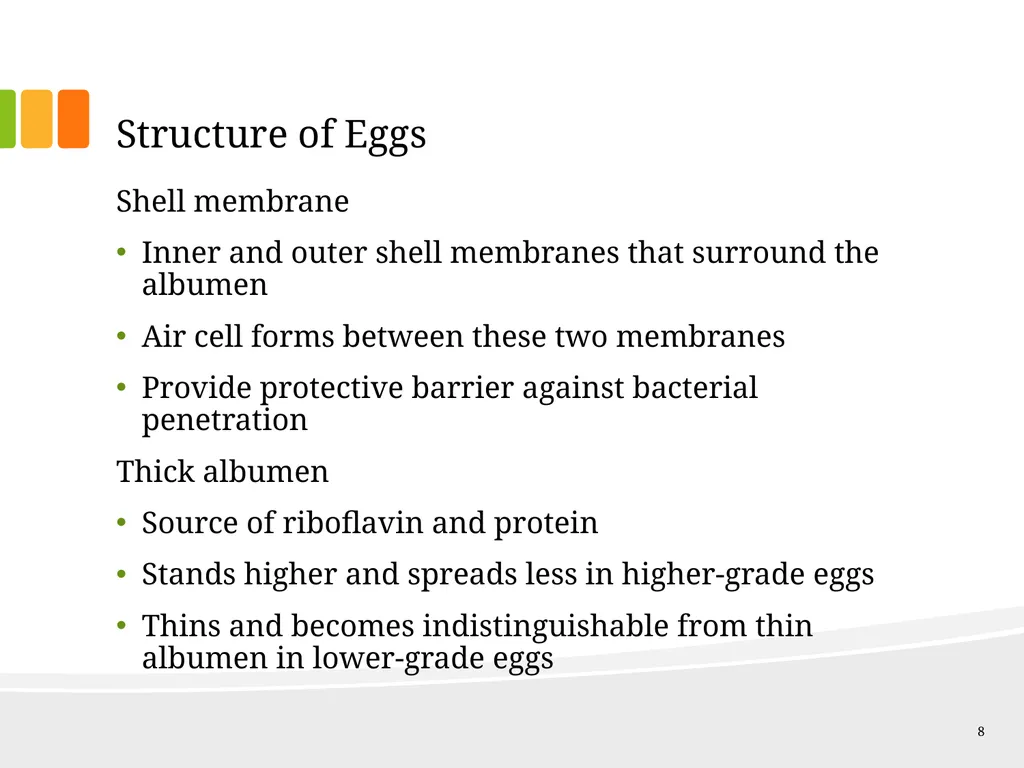
slide8. Structure of Eggs Shell membrane
Inner and outer shell membranes that surround the albumen
Air cell forms between these two membranes
Provide protective barrier against bacterial penetration
Thick albumen
Source of riboflavin and protein
Stands higher and spreads less in higher-grade eggs
Thins and becomes indistinguishable from thin albumen in lower-grade eggs 8<br>
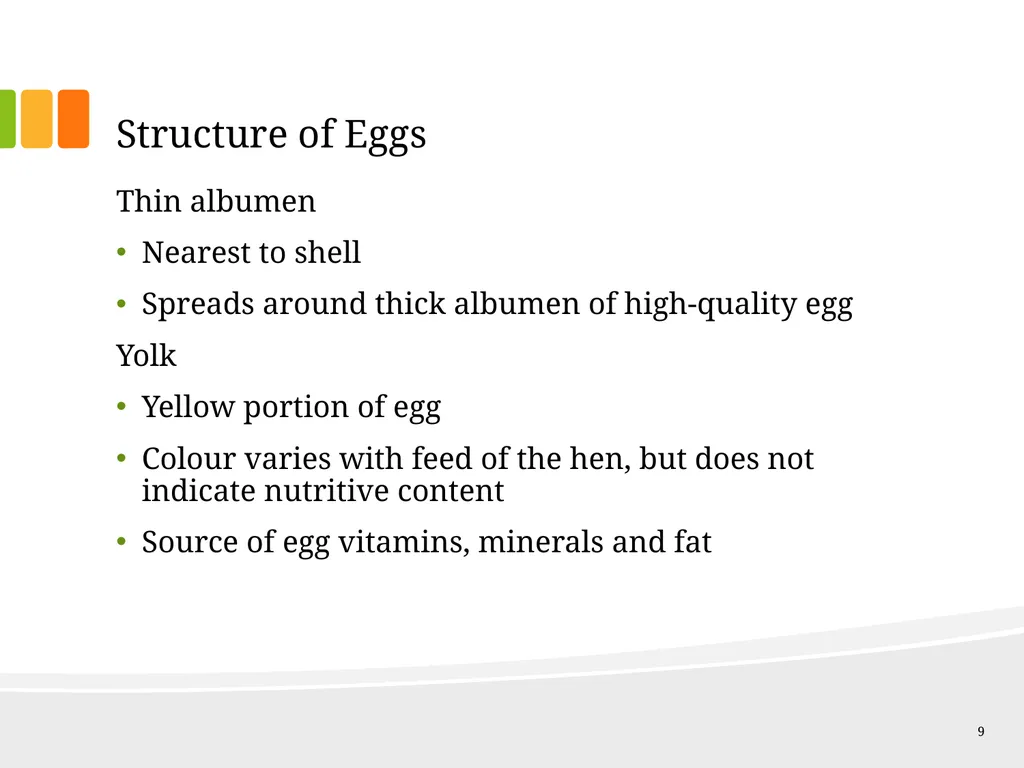
slide9. Structure of Eggs Thin albumen
Nearest to shell
Spreads around thick albumen of high-quality egg
Yolk
Yellow portion of egg
Colour varies with feed of the hen, but does not indicate nutritive content
Source of egg vitamins, minerals and fat 9<br>
slide10. Nutritive Value of Eggs 10<br>
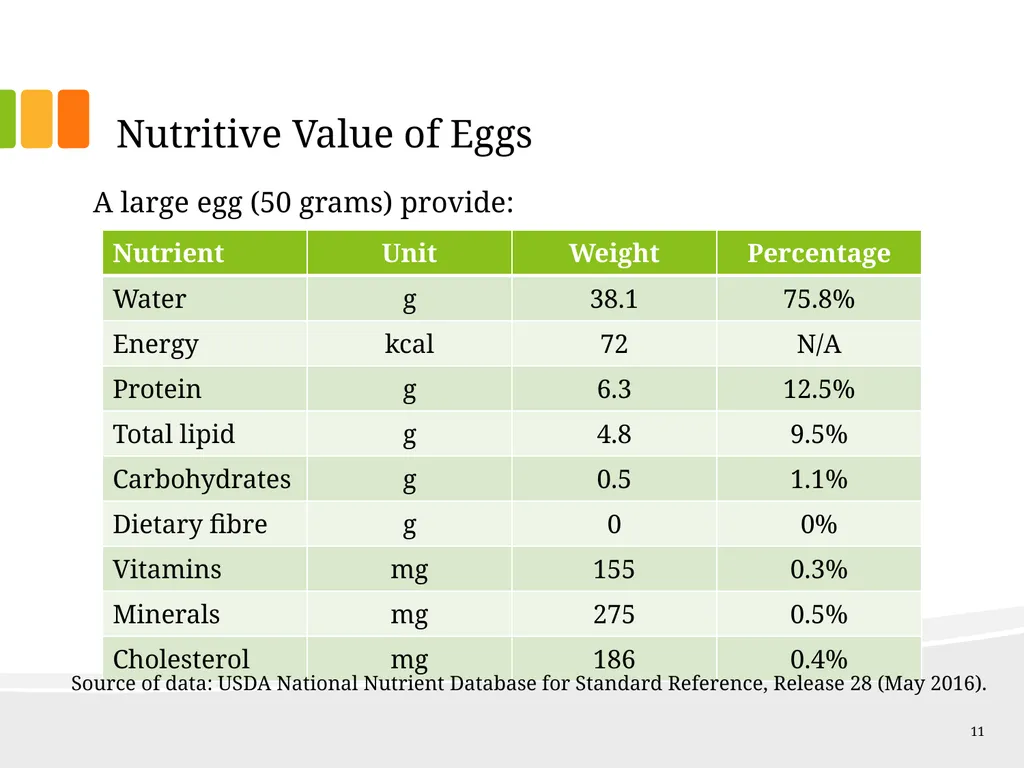
slide11. Nutritive Value of Eggs A large egg (50 grams) provide: Source of data: USDA National Nutrient Database for Standard Reference, Release 28 (May 2016). 11<br>
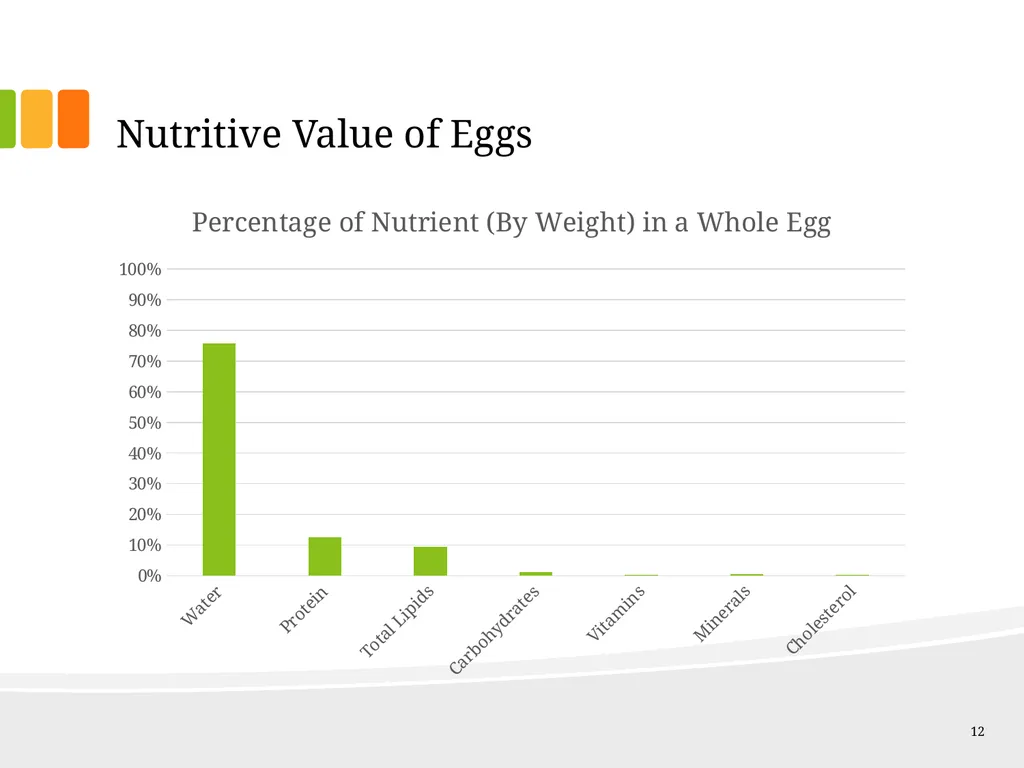
slide12. Nutritive Value of Eggs 12<br>
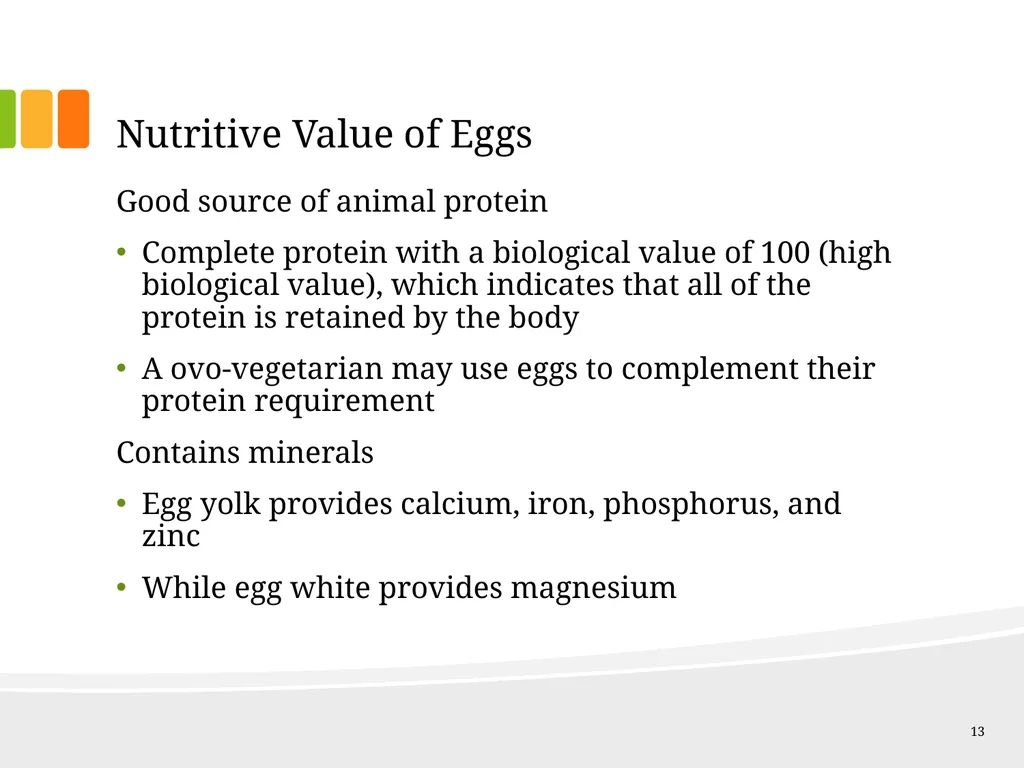
slide13. Nutritive Value of Eggs Good source of animal protein
Complete protein with a biological value of 100 (high biological value), which indicates that all of the protein is retained by the body
A ovo-vegetarian may use eggs to complement their protein requirement
Contains minerals
Egg yolk provides calcium, iron, phosphorus, and zinc
While egg white provides magnesium 13<br>
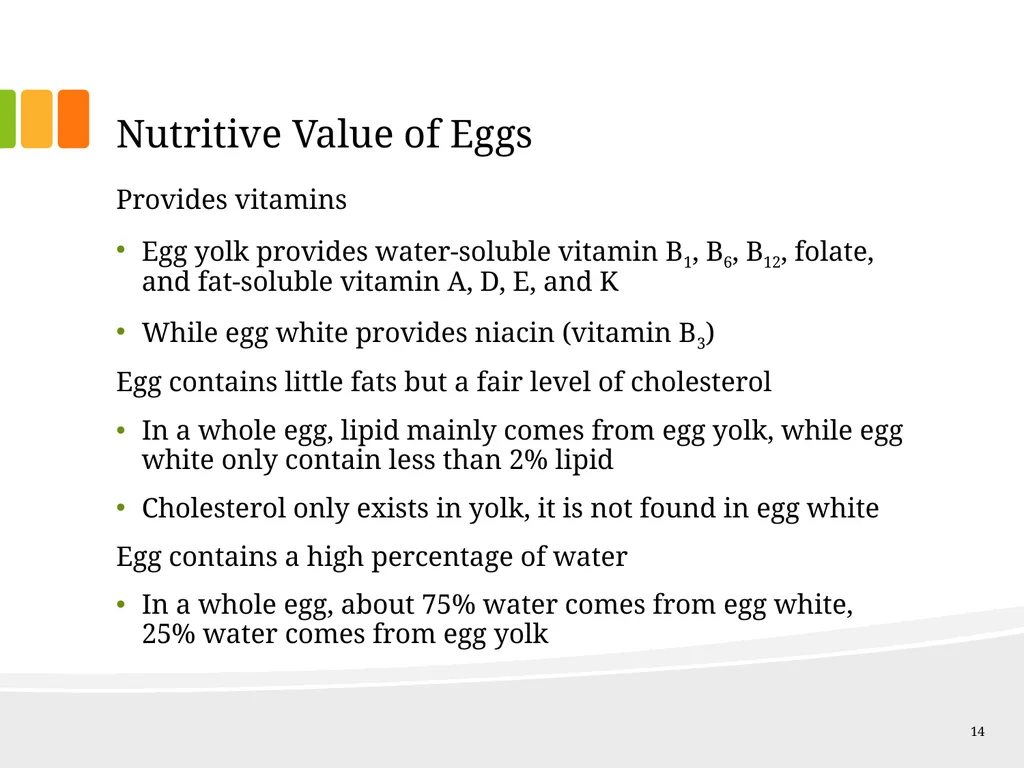
slide14. Nutritive Value of Eggs Provides vitamins
Egg yolk provides water-soluble vitamin B1, B6, B12, folate, and fat-soluble vitamin A, D, E, and K
While egg white provides niacin (vitamin B3)
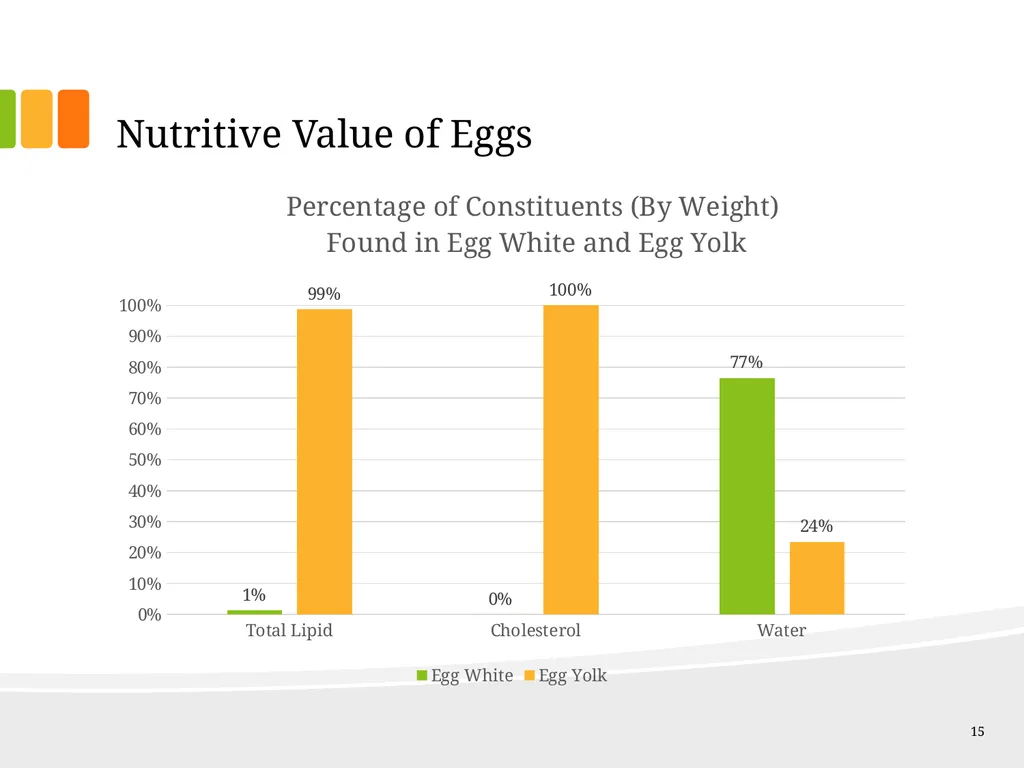
Egg contains little fats but a fair level of cholesterol
In a whole egg, lipid mainly comes from egg yolk, while egg white only contain less than 2% lipid
Cholesterol only exists in yolk, it is not found in egg white
Egg contains a high percentage of water
In a whole egg, about 75% water comes from egg white, 25% water comes from egg yolk 14<br>
slide15. Nutritive Value of Eggs 15<br>
slide16. Choice and Storage of Eggs 16<br>
slide17. Choice and Storage of Eggs Choosing Eggs
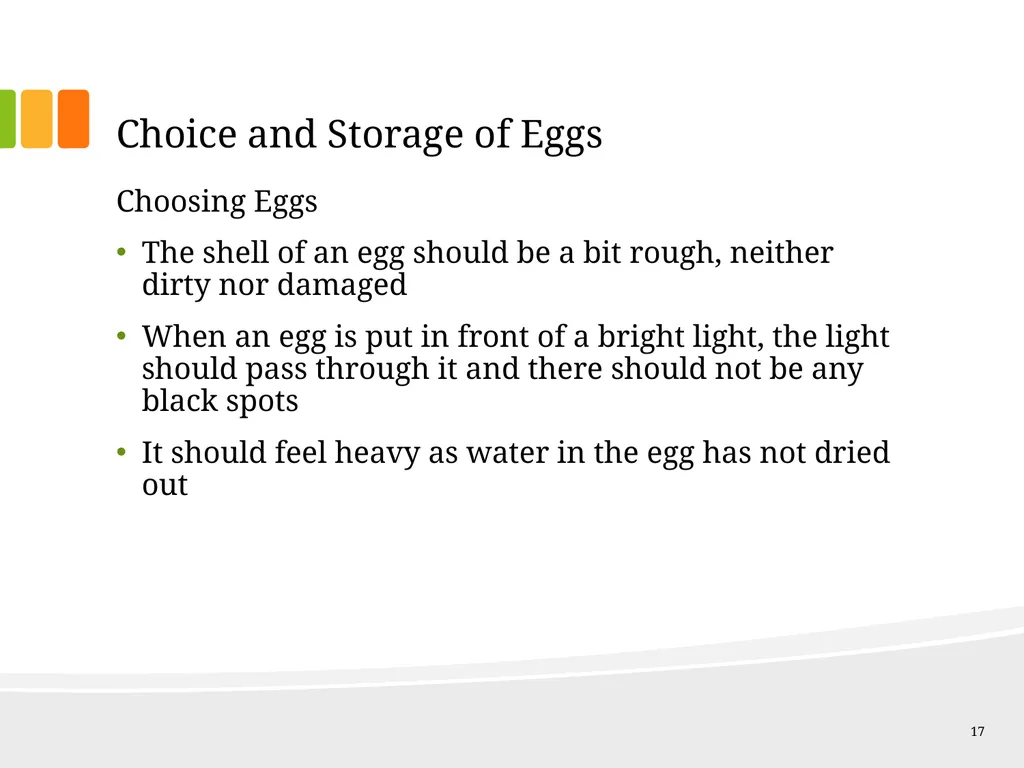
The shell of an egg should be a bit rough, neither dirty nor damaged
When an egg is put in front of a bright light, the light should pass through it and there should not be any black spots
It should feel heavy as water in the egg has not dried out 17<br>
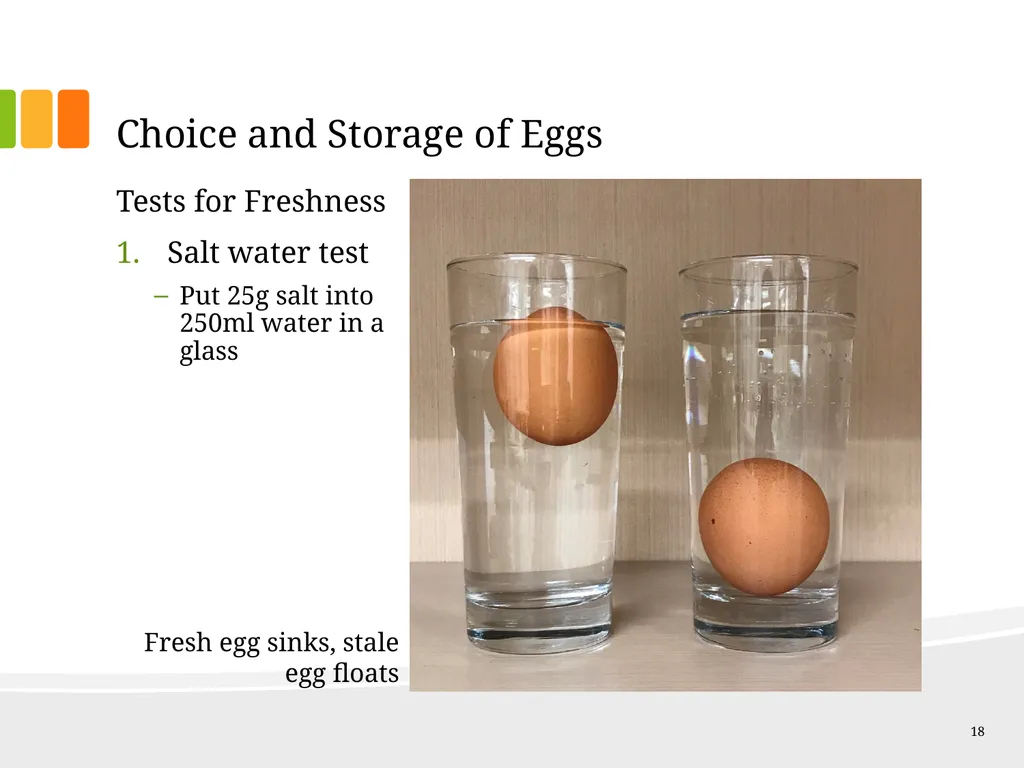
slide18. Choice and Storage of Eggs Tests for Freshness
Salt water test
Put 25g salt into 250ml water in a glass Fresh egg sinks, stale egg floats 18<br>
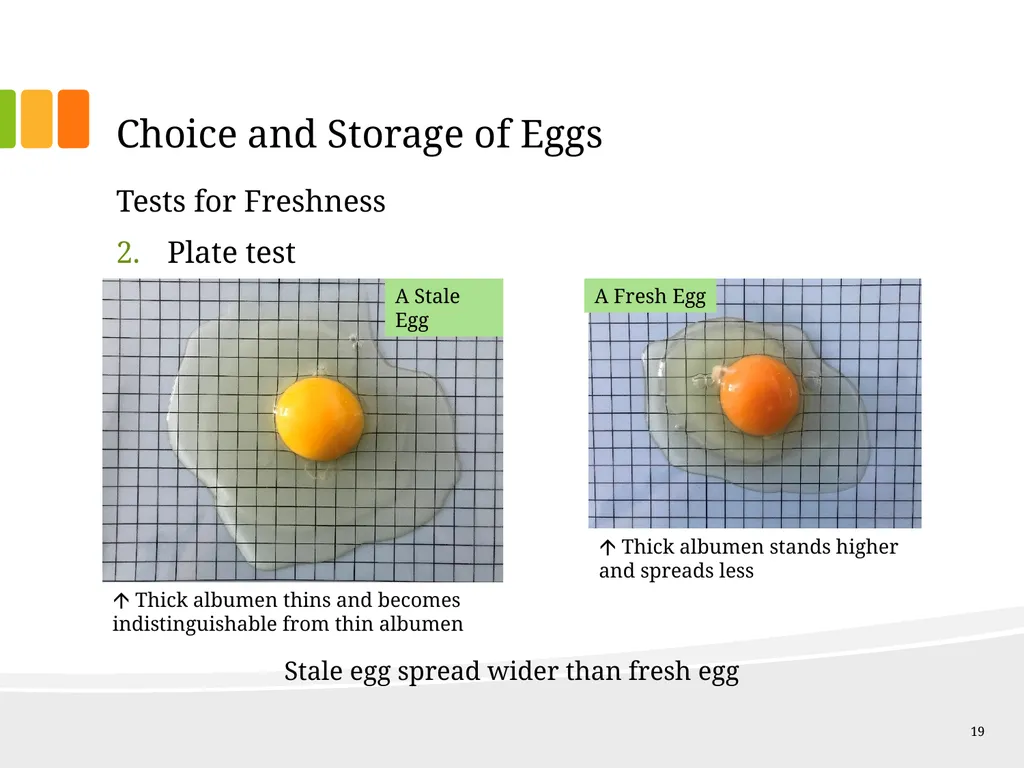
slide19. Choice and Storage of Eggs Tests for Freshness
Plate test A Fresh Egg A Stale Egg Stale egg spread wider than fresh egg Thick albumen stands higher and spreads less Thick albumen thins and becomes indistinguishable from thin albumen 19<br>
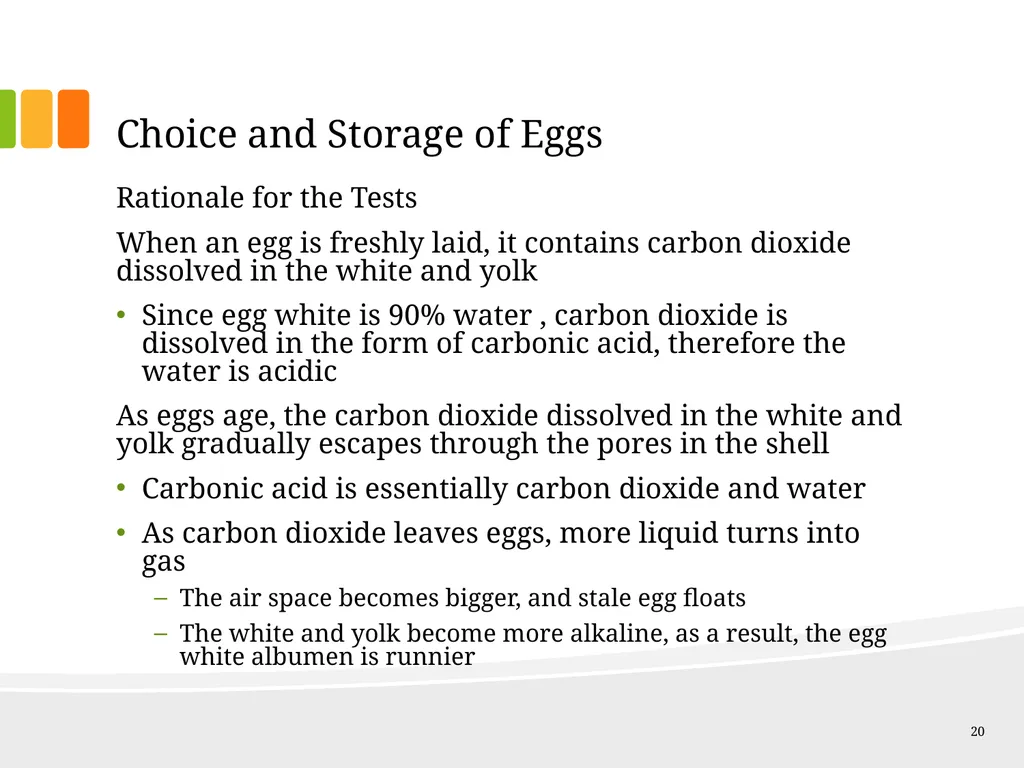
slide20. Choice and Storage of Eggs Rationale for the Tests
When an egg is freshly laid, it contains carbon dioxide dissolved in the white and yolk
Since egg white is 90% water , carbon dioxide is dissolved in the form of carbonic acid, therefore the water is acidic
As eggs age, the carbon dioxide dissolved in the white and yolk gradually escapes through the pores in the shell
Carbonic acid is essentially carbon dioxide and water
As carbon dioxide leaves eggs, more liquid turns into gas
The air space becomes bigger, and stale egg floats
The white and yolk become more alkaline, as a result, the egg white albumen is runnier 20<br>
slide21. Choice and Storage of Eggs Storing Eggs
Do not wash the eggs before storage, bacteria may enter the shell through the pores by pressure changes in a cooling egg after washing
Clean the shells with a damp cloth, if necessary
Keep eggs with broad ends up in an egg rack of a refrigerator where there is limited temperature fluctuation
Keep eggs away from strong-smelling food, e.g. onions
Do not keep eggs past their “best before” date 21<br>
slide22. Choice and Storage of Eggs Storing Eggs
If egg shell is broken or cracked, components include avidin, lysozyme, and conalbumin may lose their natural ability to protect the egg against bacteria, therefore the egg must be used as soon as possible 22<br>
slide23. Uses of Egg in Cooking / Diet 23<br>
slide24. Uses of Egg in Cooking The function of eggs is important in food preparation. It has many uses, here are some examples:
Egg as the main ingredient of a dish to provide protein, such as poached/boiled/fried/scrambled egg, omelette, egg salad
Eggs are viscous and they coagulate to a solid or semisolid state; therefore, they bind ingredients such as those in meatloaf or croquettes
Egg yolks contain phospholipid emulsifiers, including lecithin, emulsifiers allow two ordinarily immiscible liquids, such as in the preparation of mayonnaise
Egg whites increase six to eight times in volume when beaten to a foam, as the egg white foam is heated, the protein coagulates around air cells, maintaining a stable foam structure, e.g. egg white is used in angel food cake, and meringues
Egg forms a gel as it coagulates, e.g. in custards 24<br>
slide25. Uses of Egg in Cooking The function of eggs is important in food preparation. It has many uses, here are some examples:
Eggs coagulate and thicken mixtures such as custards and hollandaise sauce
Egg yolk carotenoids add yellowish colour to baked products; egg glazed on bakery products improve their appearance
Fat from yolk provides flavour, inhibits crystal formation in sugars, and inhibits staling
Eggs provide nutritional value in cooked or baked food mixtures 25<br>
slide26. Uses of Egg in Cooking Functional properties of eggs at a glance:
Coagulation
Emulsification
Foaming
Binding
Coating
Glazing
Thickening 26<br>
slide27. Uses of Egg in Cooking Eggs can be used in different ways:
Breakfast – e.g. poached/scrambled/hard-boiled/fried egg, Sunny Side Up, Egg Benedict
Appetizer/soup – e.g. smoked egg, Devil Egg, Chinese Egg Flower Soup
Main course – e.g. omelette, steamed egg, quiche, Scotch Egg, egg croquette, Scrambled Egg with Ham, Egg Curry
Dessert – e.g. meringue, ice cream, pudding, cold sweets, soufflé, egg tart, egg custard
Snack – e.g. sandwich, Egg Puff, French toast, Tea Egg
Bakery products – e.g. cakes, biscuits and bread
Sauce /spread– e.g. custard sauce, Kaya, mayonnaise
Noodles and pasta- e.g. egg noodles, fresh egg pasta 27<br>
slide28. Food and Nutrition Labelling of Eggs 28<br>
slide29. Food and Nutrition Labelling of Eggs Eggs that are not sold as prepackaged products in Hong Kong, is not bound to follow the nutrition labelling regulation in Hong Kong
Eggs that are sold in cartoon boxes usually include information such as size, country of origin, and type
In Hong Kong, egg sizes are generally differentiated as small, medium, large, and extra large, and the classification is not legally bound 29<br>
slide30. References Provost, J., Kelly, B., Bodwin, J., & Wallert, M. (2016). The Science of Cooking. John Wiley & Sons.
Vickie A. Vaclavik, Elizabeth W. Christian. Essentials of food science. New York, NY: Springer, c2008. 30<br>

slide2. Topics Types of Eggs
Structure of Eggs
Nutritive Value of Eggs
Choice and Storage of Eggs
Uses of Egg in Cooking / Diet
Food and Nutrition Labelling of Eggs 2<br>
slide3. Types of Eggs 3<br>
slide4. Types of Eggs Eggs commonly used in our diet:
Hen’s egg, commonly referred as egg
Duck’s eggs
Quail’s eggs
Pigeon’s eggs
Preserved eggs
Salted eggs 4<br>
slide5. Structures of Eggs 5<br>
slide6. Structure of Eggs Shell (外殼) Yolk (蛋黃) Outer membrane
(外殼膜) Chalaza (繫帶) Air space (氣室) Egg white (蛋白) Thick albumen
(厚蛋白) Thin albumen
(薄蛋白) Chalazae (繫帶) Inner membrane
(內殼膜) Membrane (內膜) 6<br>
slide7. Structure of Eggs Air space
Pocket of air formed at large end of egg
Increases in size as egg ages
Chalazae
Twisted, cordlike strands of egg white
Anchor yolk in center of egg
Prominent chalazae indicate freshness
Shell
Outer covering of egg, composed largely of calcium carbonate
May be white or brown depending on breed of hen 7<br>
slide8. Structure of Eggs Shell membrane
Inner and outer shell membranes that surround the albumen
Air cell forms between these two membranes
Provide protective barrier against bacterial penetration
Thick albumen
Source of riboflavin and protein
Stands higher and spreads less in higher-grade eggs
Thins and becomes indistinguishable from thin albumen in lower-grade eggs 8<br>
slide9. Structure of Eggs Thin albumen
Nearest to shell
Spreads around thick albumen of high-quality egg
Yolk
Yellow portion of egg
Colour varies with feed of the hen, but does not indicate nutritive content
Source of egg vitamins, minerals and fat 9<br>
slide10. Nutritive Value of Eggs 10<br>
slide11. Nutritive Value of Eggs A large egg (50 grams) provide: Source of data: USDA National Nutrient Database for Standard Reference, Release 28 (May 2016). 11<br>
slide12. Nutritive Value of Eggs 12<br>
slide13. Nutritive Value of Eggs Good source of animal protein
Complete protein with a biological value of 100 (high biological value), which indicates that all of the protein is retained by the body
A ovo-vegetarian may use eggs to complement their protein requirement
Contains minerals
Egg yolk provides calcium, iron, phosphorus, and zinc
While egg white provides magnesium 13<br>
slide14. Nutritive Value of Eggs Provides vitamins
Egg yolk provides water-soluble vitamin B1, B6, B12, folate, and fat-soluble vitamin A, D, E, and K
While egg white provides niacin (vitamin B3)
Egg contains little fats but a fair level of cholesterol
In a whole egg, lipid mainly comes from egg yolk, while egg white only contain less than 2% lipid
Cholesterol only exists in yolk, it is not found in egg white
Egg contains a high percentage of water
In a whole egg, about 75% water comes from egg white, 25% water comes from egg yolk 14<br>
slide15. Nutritive Value of Eggs 15<br>
slide16. Choice and Storage of Eggs 16<br>
slide17. Choice and Storage of Eggs Choosing Eggs
The shell of an egg should be a bit rough, neither dirty nor damaged
When an egg is put in front of a bright light, the light should pass through it and there should not be any black spots
It should feel heavy as water in the egg has not dried out 17<br>
slide18. Choice and Storage of Eggs Tests for Freshness
Salt water test
Put 25g salt into 250ml water in a glass Fresh egg sinks, stale egg floats 18<br>
slide19. Choice and Storage of Eggs Tests for Freshness
Plate test A Fresh Egg A Stale Egg Stale egg spread wider than fresh egg Thick albumen stands higher and spreads less Thick albumen thins and becomes indistinguishable from thin albumen 19<br>
slide20. Choice and Storage of Eggs Rationale for the Tests
When an egg is freshly laid, it contains carbon dioxide dissolved in the white and yolk
Since egg white is 90% water , carbon dioxide is dissolved in the form of carbonic acid, therefore the water is acidic
As eggs age, the carbon dioxide dissolved in the white and yolk gradually escapes through the pores in the shell
Carbonic acid is essentially carbon dioxide and water
As carbon dioxide leaves eggs, more liquid turns into gas
The air space becomes bigger, and stale egg floats
The white and yolk become more alkaline, as a result, the egg white albumen is runnier 20<br>
slide21. Choice and Storage of Eggs Storing Eggs
Do not wash the eggs before storage, bacteria may enter the shell through the pores by pressure changes in a cooling egg after washing
Clean the shells with a damp cloth, if necessary
Keep eggs with broad ends up in an egg rack of a refrigerator where there is limited temperature fluctuation
Keep eggs away from strong-smelling food, e.g. onions
Do not keep eggs past their “best before” date 21<br>
slide22. Choice and Storage of Eggs Storing Eggs
If egg shell is broken or cracked, components include avidin, lysozyme, and conalbumin may lose their natural ability to protect the egg against bacteria, therefore the egg must be used as soon as possible 22<br>
slide23. Uses of Egg in Cooking / Diet 23<br>
slide24. Uses of Egg in Cooking The function of eggs is important in food preparation. It has many uses, here are some examples:
Egg as the main ingredient of a dish to provide protein, such as poached/boiled/fried/scrambled egg, omelette, egg salad
Eggs are viscous and they coagulate to a solid or semisolid state; therefore, they bind ingredients such as those in meatloaf or croquettes
Egg yolks contain phospholipid emulsifiers, including lecithin, emulsifiers allow two ordinarily immiscible liquids, such as in the preparation of mayonnaise
Egg whites increase six to eight times in volume when beaten to a foam, as the egg white foam is heated, the protein coagulates around air cells, maintaining a stable foam structure, e.g. egg white is used in angel food cake, and meringues
Egg forms a gel as it coagulates, e.g. in custards 24<br>
slide25. Uses of Egg in Cooking The function of eggs is important in food preparation. It has many uses, here are some examples:
Eggs coagulate and thicken mixtures such as custards and hollandaise sauce
Egg yolk carotenoids add yellowish colour to baked products; egg glazed on bakery products improve their appearance
Fat from yolk provides flavour, inhibits crystal formation in sugars, and inhibits staling
Eggs provide nutritional value in cooked or baked food mixtures 25<br>
slide26. Uses of Egg in Cooking Functional properties of eggs at a glance:
Coagulation
Emulsification
Foaming
Binding
Coating
Glazing
Thickening 26<br>
slide27. Uses of Egg in Cooking Eggs can be used in different ways:
Breakfast – e.g. poached/scrambled/hard-boiled/fried egg, Sunny Side Up, Egg Benedict
Appetizer/soup – e.g. smoked egg, Devil Egg, Chinese Egg Flower Soup
Main course – e.g. omelette, steamed egg, quiche, Scotch Egg, egg croquette, Scrambled Egg with Ham, Egg Curry
Dessert – e.g. meringue, ice cream, pudding, cold sweets, soufflé, egg tart, egg custard
Snack – e.g. sandwich, Egg Puff, French toast, Tea Egg
Bakery products – e.g. cakes, biscuits and bread
Sauce /spread– e.g. custard sauce, Kaya, mayonnaise
Noodles and pasta- e.g. egg noodles, fresh egg pasta 27<br>
slide28. Food and Nutrition Labelling of Eggs 28<br>
slide29. Food and Nutrition Labelling of Eggs Eggs that are not sold as prepackaged products in Hong Kong, is not bound to follow the nutrition labelling regulation in Hong Kong
Eggs that are sold in cartoon boxes usually include information such as size, country of origin, and type
In Hong Kong, egg sizes are generally differentiated as small, medium, large, and extra large, and the classification is not legally bound 29<br>
slide30. References Provost, J., Kelly, B., Bodwin, J., & Wallert, M. (2016). The Science of Cooking. John Wiley & Sons.
Vickie A. Vaclavik, Elizabeth W. Christian. Essentials of food science. New York, NY: Springer, c2008. 30<br>