
Understanding Standards — Advanced Higher English
SN
Published · 72 slides · 0 views
1 / 1
Description
Understanding Standards Advanced Higher English Project-dissertation Aims of the webinar To support teachers and lecturers in their understanding of national standards by: providing an overview of general marking principles and detailed
Related Topics
Share
Embed code
Download this presentation From Below
"Understanding Standards — Advanced Higher English" is the property of its rightful owner. Permission is granted to download and print the materials on this website for personal, non-commercial use only, and to display it on your personal computer provided you do not modify the materials and that you retain all copyright notices contained in the materials. By downloading content from our website, you accept the terms of this agreement.
Presentation Transcript
01
Understanding Standards — Advanced Higher English
Project-dissertation<br>
Project-dissertation<br>
02
Aims of the webinar To support teachers and lecturers in their understanding of national standards by:
providing an overview of general marking principles and detailed marking instructions
reviewing candidate evidence
explaining how the marking instructions are applied to the evidence
answering frequently asked questions about the marking of the dissertation<br>
providing an overview of general marking principles and detailed marking instructions
reviewing candidate evidence
explaining how the marking instructions are applied to the evidence
answering frequently asked questions about the marking of the dissertation<br>
03
Materials required course assessment task
marking instructions
the four candidate scripts to be discussed<br>
marking instructions
the four candidate scripts to be discussed<br>
04
Format of the webinar introduction
marking principles
exemplification of the application of the marking instructions (scripts 1-4)
frequently asked questions
further resources and support<br>
marking principles
exemplification of the application of the marking instructions (scripts 1-4)
frequently asked questions
further resources and support<br>
05
General marking principles positive marking
dissertation is marked in terms of knowledge, understanding, analysis, evaluation and expression
holistic
strengths and weaknesses in every dissertation<br>
dissertation is marked in terms of knowledge, understanding, analysis, evaluation and expression
holistic
strengths and weaknesses in every dissertation<br>
06
Detailed marking instructions Select the band containing the descriptors that most closely describe the dissertation.
Where the evidence fully meets the standard described, award the highest available mark from that band range.
Where the candidate’s work just meets the standard described, award the lowest mark from that band range.
Otherwise, award the mark from the middle of that band range.
Where the number of marks in the band selected is four, use professional judgement to decide allocation of the mark.
For example 14–11, reconsider the candidate’s abilities in the four main characteristics.<br>
Where the evidence fully meets the standard described, award the highest available mark from that band range.
Where the candidate’s work just meets the standard described, award the lowest mark from that band range.
Otherwise, award the mark from the middle of that band range.
Where the number of marks in the band selected is four, use professional judgement to decide allocation of the mark.
For example 14–11, reconsider the candidate’s abilities in the four main characteristics.<br>
07
Candidate 1 – Waugh Topic and Task:
How does Catholicism influence relationships in Brideshead Revisited?
‘Catholicism dominates the book’ and that the ‘most affectionate bonds within the book – Sebastian and Charles, Julia and Charles – are confronted and overshadowed by Catholicism.’ (p.1)<br>
How does Catholicism influence relationships in Brideshead Revisited?
‘Catholicism dominates the book’ and that the ‘most affectionate bonds within the book – Sebastian and Charles, Julia and Charles – are confronted and overshadowed by Catholicism.’ (p.1)<br>
08
Candidate 1 – knowledge and understanding secure knowledge and understanding of the text as a whole which demonstrates some insight into the issues explored
a relevant exploration which demonstrates secure consideration of the implications of the task
extensive textual evidence to support the demands of the task, demonstrating this with selections from across the breadth of the text<br>
a relevant exploration which demonstrates secure consideration of the implications of the task
extensive textual evidence to support the demands of the task, demonstrating this with selections from across the breadth of the text<br>
09
Candidate 1 – knowledge and understanding (continued) the relationship Charles Ryder has with Sebastian Flyte whom ‘he develops a love for’ and then how Charles later falls for ‘Sebastian’s sister Julia’ (p.1)
‘Sebastian lives the remaining days at Oxford in the shadows, under his mother’s imposing eye,’ and that he ‘finds respite from religion in his alcoholism’ and that as his ‘alcoholism worsens [his] rapport with Charles suffers’. (p.2)
Sebastian and Charles’s ‘bond is eventually reduced to nothing more than a familiar tie’ (p.2)
‘Catholicism has ruined any love [Charles] and Sebastian shared’ (p.3)<br>
‘Sebastian lives the remaining days at Oxford in the shadows, under his mother’s imposing eye,’ and that he ‘finds respite from religion in his alcoholism’ and that as his ‘alcoholism worsens [his] rapport with Charles suffers’. (p.2)
Sebastian and Charles’s ‘bond is eventually reduced to nothing more than a familiar tie’ (p.2)
‘Catholicism has ruined any love [Charles] and Sebastian shared’ (p.3)<br>
10
Candidate 1 – knowledge and understanding (continued) Charles and Sebastian’s ‘friendship fragments and each character is left isolated and pained’, (p.3)
Charles ‘spends “ten dry years” alone and listless’ and that Sebastian flees ‘abroad from his mother and the feeling of persecution from his religion’ only to struggle ‘for the rest of his days as a lowly under-porter, after begging himself entry into a monastery in Tunis’ (p.3)
Julia ‘finds herself in similar circumstance’ to Charles in that she has an unsatisfying and ‘unpassionate marriage’ (p.3)<br>
Charles ‘spends “ten dry years” alone and listless’ and that Sebastian flees ‘abroad from his mother and the feeling of persecution from his religion’ only to struggle ‘for the rest of his days as a lowly under-porter, after begging himself entry into a monastery in Tunis’ (p.3)
Julia ‘finds herself in similar circumstance’ to Charles in that she has an unsatisfying and ‘unpassionate marriage’ (p.3)<br>
11
Candidate 1 – knowledge and understanding (continued) Charles and Julia ‘are drawn together and share a great understanding of one another’ and ‘a conquering love is formed between them’. (p.4)
‘Charles and Julia have the most fulfilling relationship in Brideshead’ but that ‘Julia struggles with emptiness in her human love – a consequence of her entanglement with Catholicism.’ (p.5)
Charles and Julia had had ‘[a] love – strong and frank – undone by religion’ and would ‘live isolated and loveless days, distant from happiness with another human.’ (p.6)<br>
‘Charles and Julia have the most fulfilling relationship in Brideshead’ but that ‘Julia struggles with emptiness in her human love – a consequence of her entanglement with Catholicism.’ (p.5)
Charles and Julia had had ‘[a] love – strong and frank – undone by religion’ and would ‘live isolated and loveless days, distant from happiness with another human.’ (p.6)<br>
12
Candidate 1 – analysis relevant analysis of a range of literary techniques which strengthens the line of the candidate’s argument<br>
13
Candidate 1 – analysis (continued) ‘[a] perfect love is offered by God, and the human love and happiness Charles, Julia and Sebastian find in each other is overshadowed and forfeited as a result’ (p.1)
Sebastian ‘is free, liberated from the shackles of religion and the pressures of Lady Marchmain’ [his love of Charles] ‘lacks direction [and] lacks a future beyond a “romantic friendship”’. (p.1)
Sebastian’s alcoholism is described as ‘an escapism from the pressure and humiliation targeted at his indulgent lifestyle’ where ‘[m]erriment and autonomy are replaced by morose and listless confinement [and] it is now the only route to happiness for him.’ (p.2)<br>
Sebastian ‘is free, liberated from the shackles of religion and the pressures of Lady Marchmain’ [his love of Charles] ‘lacks direction [and] lacks a future beyond a “romantic friendship”’. (p.1)
Sebastian’s alcoholism is described as ‘an escapism from the pressure and humiliation targeted at his indulgent lifestyle’ where ‘[m]erriment and autonomy are replaced by morose and listless confinement [and] it is now the only route to happiness for him.’ (p.2)<br>
14
Candidate 1 – analysis (continued) Sebastian becomes ‘a lonely, loveless and empty shadow of his former self’ where his only ‘solace and comfort are found in his dedication to the church, its community and its vows’ (p.3)
Julia’s problematic marriage leaves her ‘unfulfilled and unhappy, longing for a greater love – a love that Charles later tries to offer her but a love she comes to believe […] to be attainable only with God.’ (pages 3-4)
‘“thwarted passion”’ is analysed as highlighting ‘the underdeveloped and restricted nature of their love’ which ‘may be caring and heartfelt but it fails to flourish under the shadow of religion.’ (p.5)
‘[h]uman love is replaced with suffering for a perfect love of God’. (p.6)<br>
Julia’s problematic marriage leaves her ‘unfulfilled and unhappy, longing for a greater love – a love that Charles later tries to offer her but a love she comes to believe […] to be attainable only with God.’ (pages 3-4)
‘“thwarted passion”’ is analysed as highlighting ‘the underdeveloped and restricted nature of their love’ which ‘may be caring and heartfelt but it fails to flourish under the shadow of religion.’ (p.5)
‘[h]uman love is replaced with suffering for a perfect love of God’. (p.6)<br>
15
Candidate 1 – evaluation clearly identifiable evaluative stance with respect to the text and the task
securely based on a wide variety of evidence presented within the dissertation<br>
securely based on a wide variety of evidence presented within the dissertation<br>
16
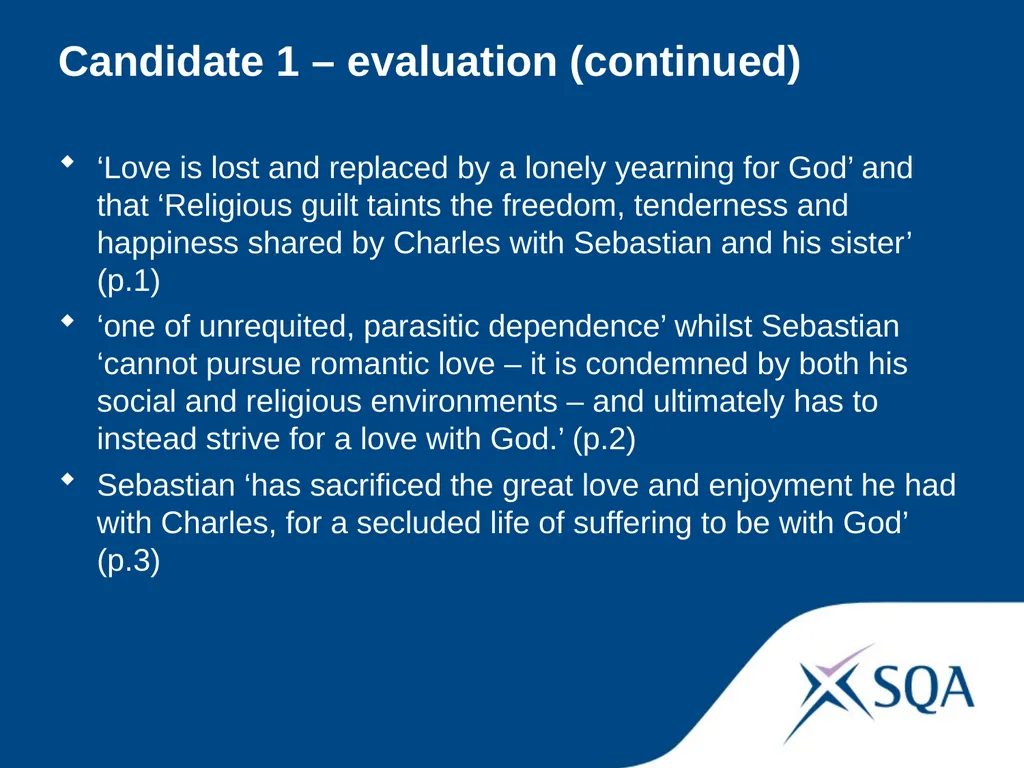
Candidate 1 – evaluation (continued) ‘Love is lost and replaced by a lonely yearning for God’ and that ‘Religious guilt taints the freedom, tenderness and happiness shared by Charles with Sebastian and his sister’ (p.1)
‘one of unrequited, parasitic dependence’ whilst Sebastian ‘cannot pursue romantic love – it is condemned by both his social and religious environments – and ultimately has to instead strive for a love with God.’ (p.2)
Sebastian ‘has sacrificed the great love and enjoyment he had with Charles, for a secluded life of suffering to be with God’ (p.3)<br>
‘one of unrequited, parasitic dependence’ whilst Sebastian ‘cannot pursue romantic love – it is condemned by both his social and religious environments – and ultimately has to instead strive for a love with God.’ (p.2)
Sebastian ‘has sacrificed the great love and enjoyment he had with Charles, for a secluded life of suffering to be with God’ (p.3)<br>
17
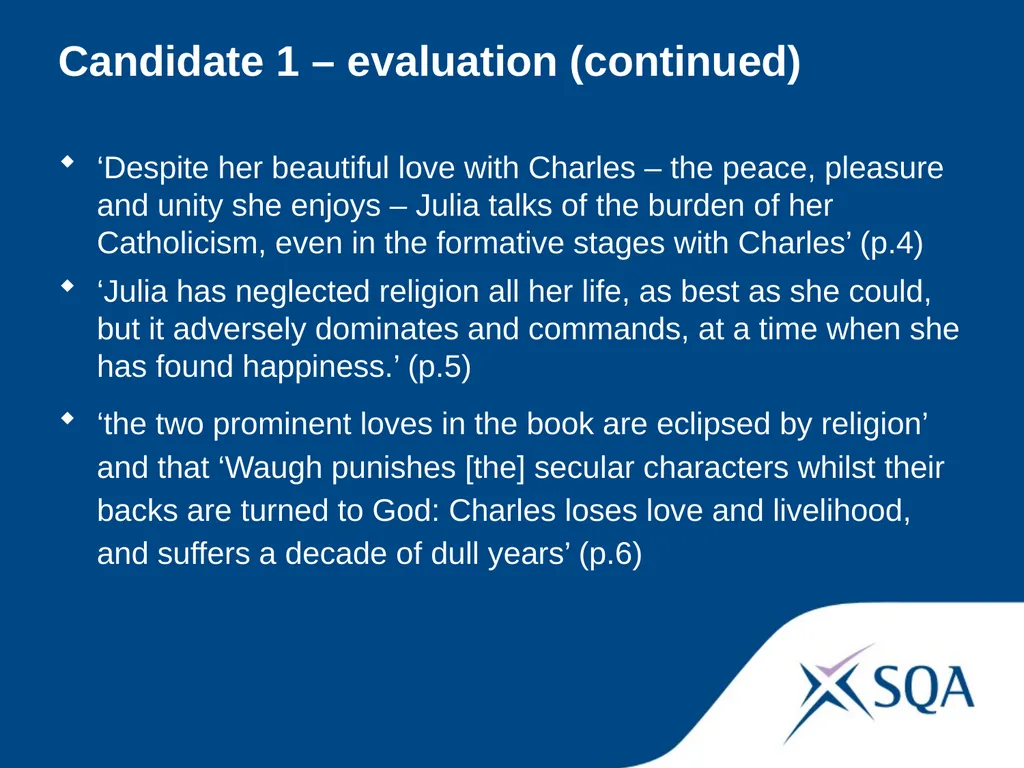
Candidate 1 – evaluation (continued) ‘Despite her beautiful love with Charles – the peace, pleasure and unity she enjoys – Julia talks of the burden of her Catholicism, even in the formative stages with Charles’ (p.4)
‘Julia has neglected religion all her life, as best as she could, but it adversely dominates and commands, at a time when she has found happiness.’ (p.5)
‘the two prominent loves in the book are eclipsed by religion’ and that ‘Waugh punishes [the] secular characters whilst their backs are turned to God: Charles loses love and livelihood, and suffers a decade of dull years’ (p.6)<br>
‘Julia has neglected religion all her life, as best as she could, but it adversely dominates and commands, at a time when she has found happiness.’ (p.5)
‘the two prominent loves in the book are eclipsed by religion’ and that ‘Waugh punishes [the] secular characters whilst their backs are turned to God: Charles loses love and livelihood, and suffers a decade of dull years’ (p.6)<br>
18
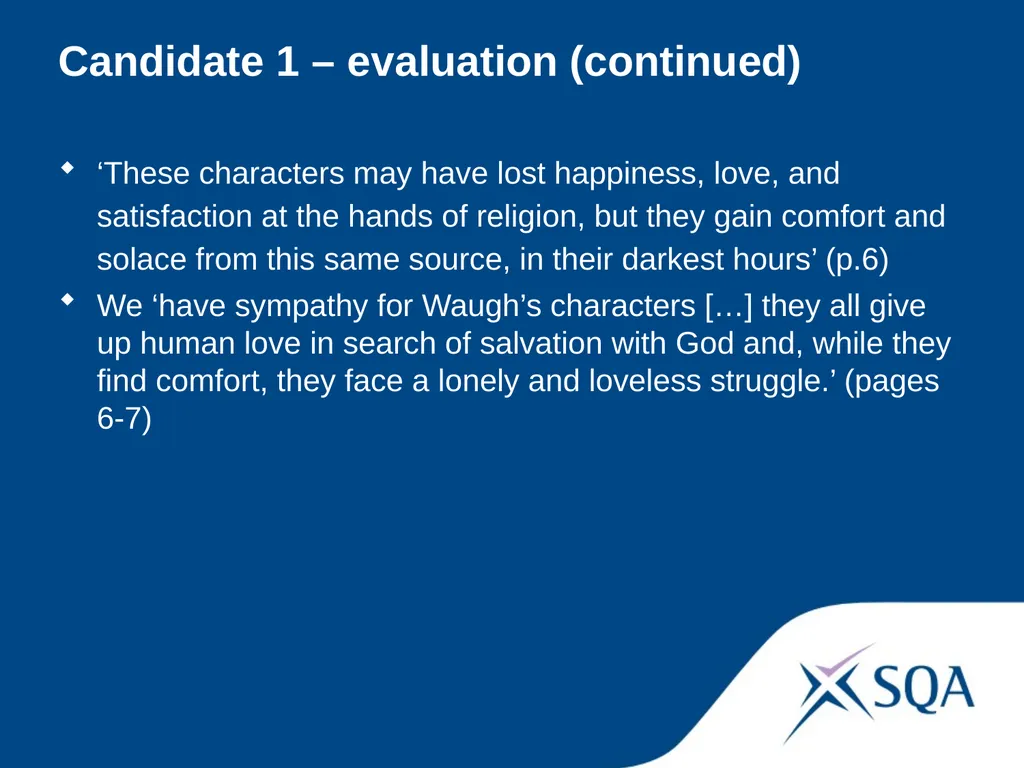
Candidate 1 – evaluation (continued) ‘These characters may have lost happiness, love, and satisfaction at the hands of religion, but they gain comfort and solace from this same source, in their darkest hours’ (p.6)
We ‘have sympathy for Waugh’s characters […] they all give up human love in search of salvation with God and, while they find comfort, they face a lonely and loveless struggle.’ (pages 6-7)<br>
We ‘have sympathy for Waugh’s characters […] they all give up human love in search of salvation with God and, while they find comfort, they face a lonely and loveless struggle.’ (pages 6-7)<br>
19
Candidate 1 – expression skilful use of structure, style and language, including appropriate critical/analytical terminology
with a sustained focus on the task<br>
with a sustained focus on the task<br>
20
Candidate 1 – mark holistic assessment
band range: 26-23
fully meets descriptor
mark awarded: 26<br>
band range: 26-23
fully meets descriptor
mark awarded: 26<br>
21
Candidate 2 – Orwell and Atwood Topic and Task:
Comparative analysis of psychological impacts resulting from life under totalitarian rule in ‘Nineteen Eighty-Four’ and ‘The Handmaid’s Tale’.<br>
Comparative analysis of psychological impacts resulting from life under totalitarian rule in ‘Nineteen Eighty-Four’ and ‘The Handmaid’s Tale’.<br>
22
Candidate 2 – knowledge and understanding broad knowledge and understanding of the texts as a whole<br>
23
Candidate 2 – knowledge and understanding (continued) the discussion of Winston and the society of Nineteen Eighty-Four (p.1)
the contrasting system of power and hierarchies in The Handmaid’s Tale (p.2)
societal control exerted over Winston and Offred (p.2)
narrative technique (p.3)
portrayal of Winston as one disconnected from his emotions (p.3)
depiction of characters at “the limits of mental endurance” (p.4)
sex as a theme (pages 5-6)
the use of colour as a symbol in Nineteen Eighty-Four (pp.6-7)<br>
the contrasting system of power and hierarchies in The Handmaid’s Tale (p.2)
societal control exerted over Winston and Offred (p.2)
narrative technique (p.3)
portrayal of Winston as one disconnected from his emotions (p.3)
depiction of characters at “the limits of mental endurance” (p.4)
sex as a theme (pages 5-6)
the use of colour as a symbol in Nineteen Eighty-Four (pp.6-7)<br>
24
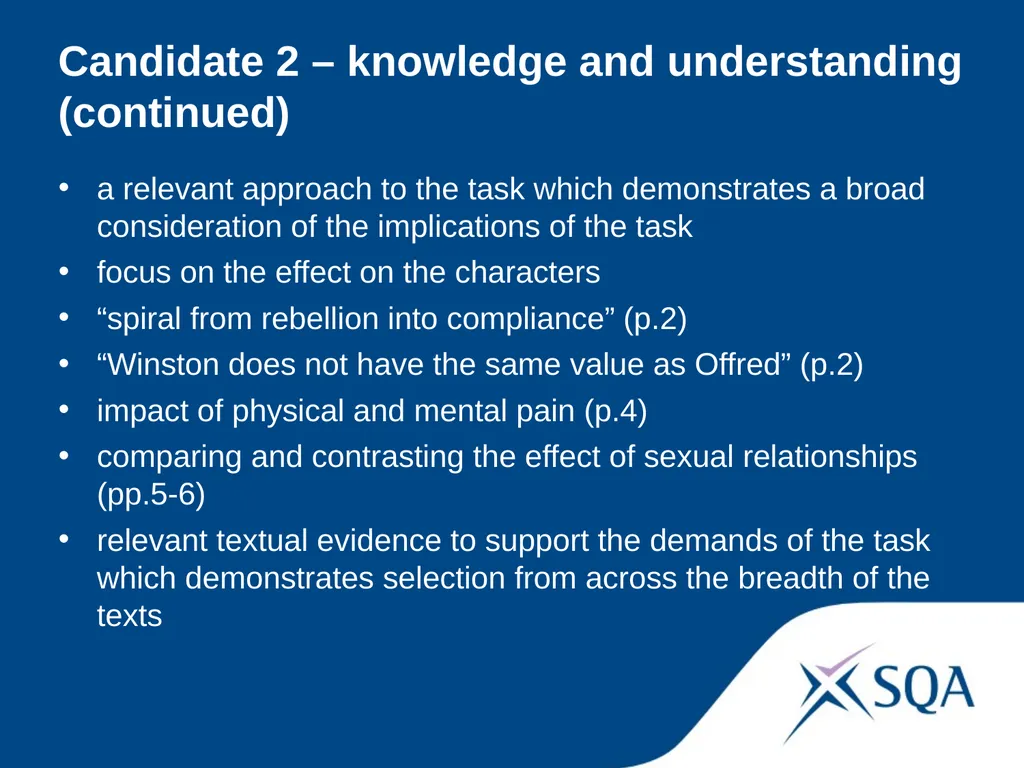
Candidate 2 – knowledge and understanding (continued) a relevant approach to the task which demonstrates a broad consideration of the implications of the task
focus on the effect on the characters
“spiral from rebellion into compliance” (p.2)
“Winston does not have the same value as Offred” (p.2)
impact of physical and mental pain (p.4)
comparing and contrasting the effect of sexual relationships (pp.5-6)
relevant textual evidence to support the demands of the task which demonstrates selection from across the breadth of the texts<br>
focus on the effect on the characters
“spiral from rebellion into compliance” (p.2)
“Winston does not have the same value as Offred” (p.2)
impact of physical and mental pain (p.4)
comparing and contrasting the effect of sexual relationships (pp.5-6)
relevant textual evidence to support the demands of the task which demonstrates selection from across the breadth of the texts<br>
25
Candidate 2 – analysis relevant analysis of a range of techniques used to support the line of argument<br>
26
Candidate 2 – analysis (continued) characterisation
setting
narrative technique
the significance of the sexual act
colour symbolism<br>
setting
narrative technique
the significance of the sexual act
colour symbolism<br>
27
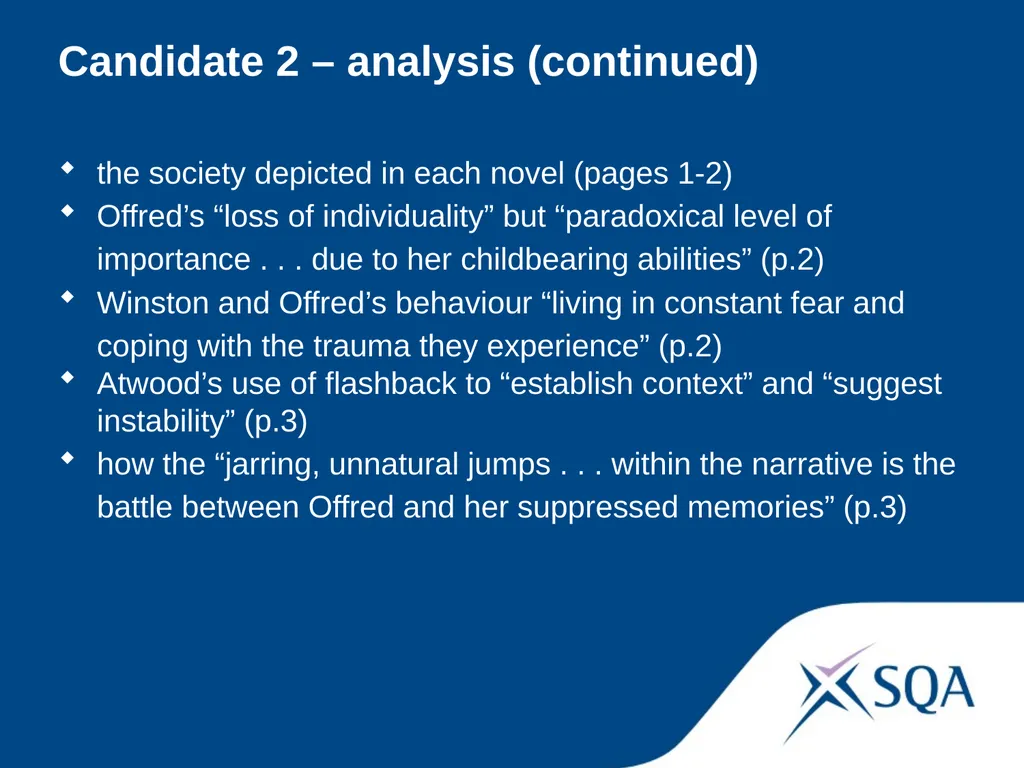
Candidate 2 – analysis (continued) the society depicted in each novel (pages 1-2)
Offred’s “loss of individuality” but “paradoxical level of importance . . . due to her childbearing abilities” (p.2)
Winston and Offred’s behaviour “living in constant fear and coping with the trauma they experience” (p.2)
Atwood’s use of flashback to “establish context” and “suggest instability” (p.3)
how the “jarring, unnatural jumps . . . within the narrative is the battle between Offred and her suppressed memories” (p.3)<br>
Offred’s “loss of individuality” but “paradoxical level of importance . . . due to her childbearing abilities” (p.2)
Winston and Offred’s behaviour “living in constant fear and coping with the trauma they experience” (p.2)
Atwood’s use of flashback to “establish context” and “suggest instability” (p.3)
how the “jarring, unnatural jumps . . . within the narrative is the battle between Offred and her suppressed memories” (p.3)<br>
28
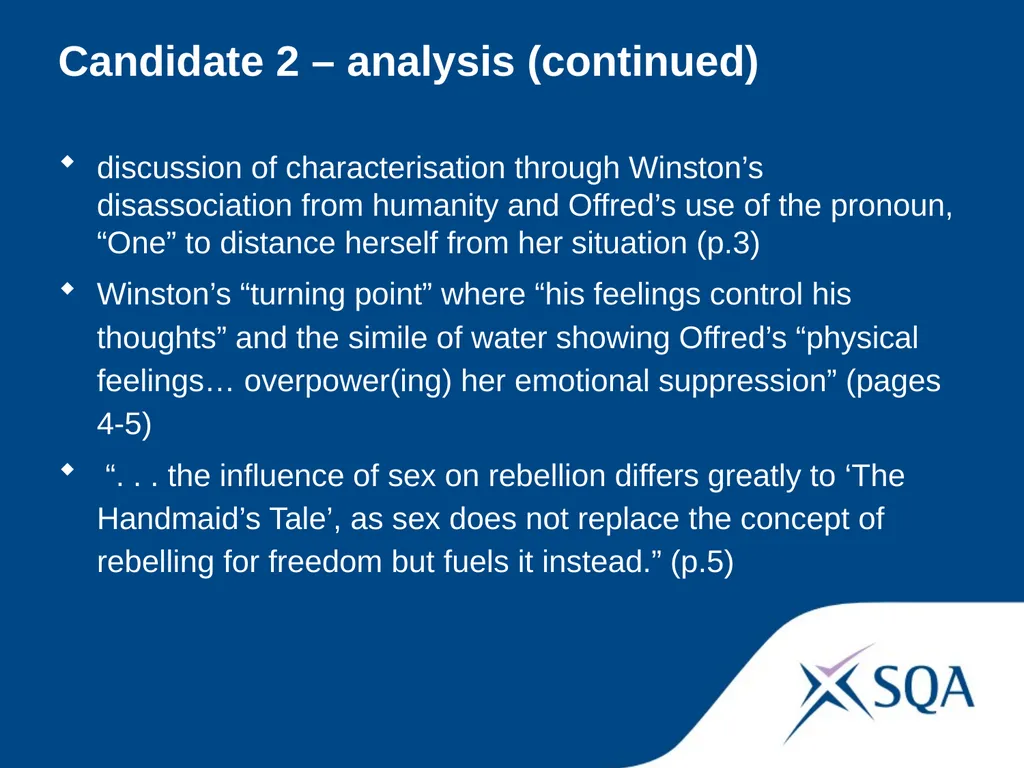
Candidate 2 – analysis (continued) discussion of characterisation through Winston’s disassociation from humanity and Offred’s use of the pronoun, “One” to distance herself from her situation (p.3)
Winston’s “turning point” where “his feelings control his thoughts” and the simile of water showing Offred’s “physical feelings… overpower(ing) her emotional suppression” (pages 4-5)
“. . . the influence of sex on rebellion differs greatly to ‘The Handmaid’s Tale’, as sex does not replace the concept of rebelling for freedom but fuels it instead.” (p.5)<br>
Winston’s “turning point” where “his feelings control his thoughts” and the simile of water showing Offred’s “physical feelings… overpower(ing) her emotional suppression” (pages 4-5)
“. . . the influence of sex on rebellion differs greatly to ‘The Handmaid’s Tale’, as sex does not replace the concept of rebelling for freedom but fuels it instead.” (p.5)<br>
29
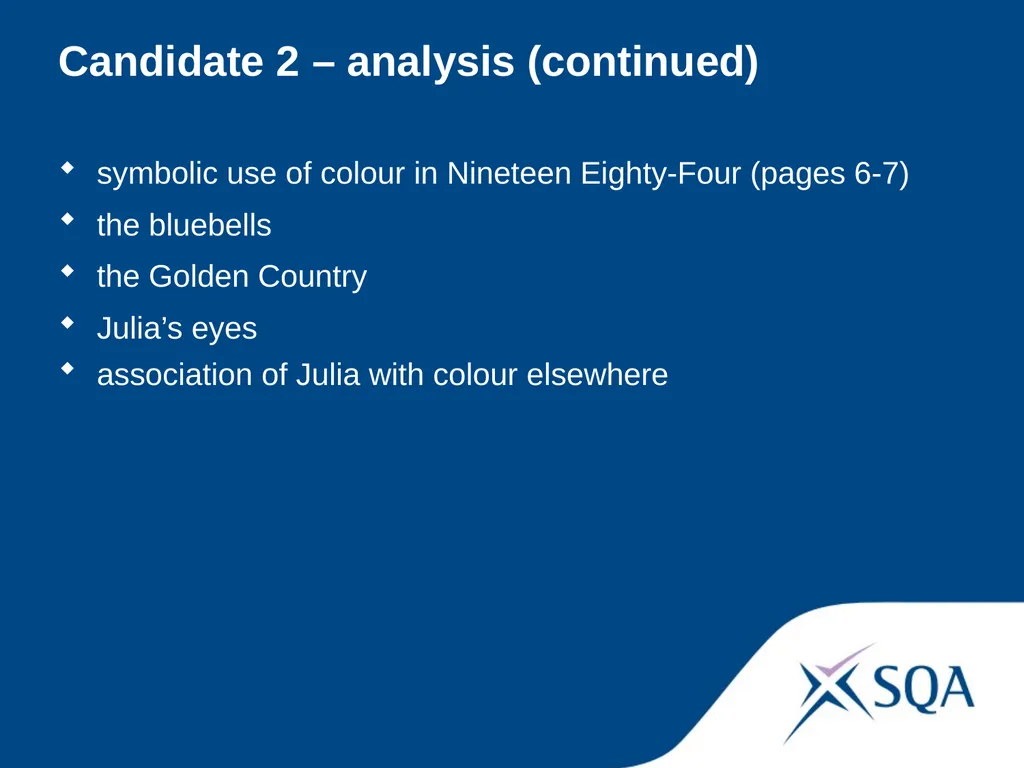
Candidate 2 – analysis (continued) symbolic use of colour in Nineteen Eighty-Four (pages 6-7)
the bluebells
the Golden Country
Julia’s eyes
association of Julia with colour elsewhere<br>
the bluebells
the Golden Country
Julia’s eyes
association of Julia with colour elsewhere<br>
30
Candidate 2 – evaluation a relevant evaluative stance based on the evidence presented<br>
31
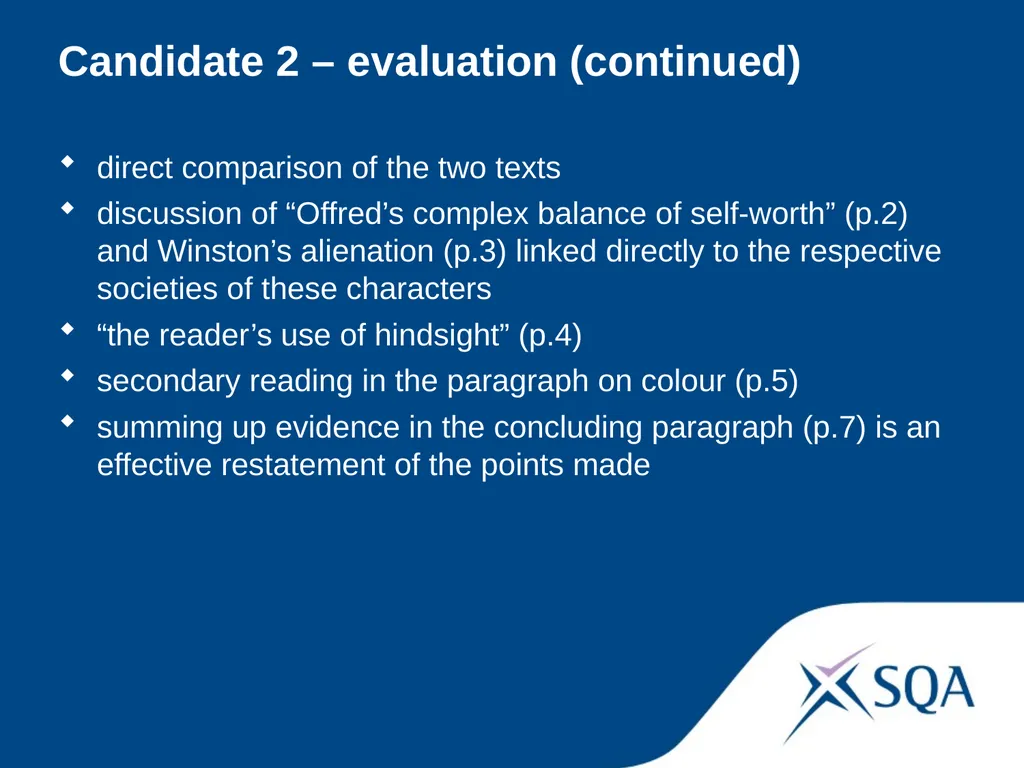
Candidate 2 – evaluation (continued) direct comparison of the two texts
discussion of “Offred’s complex balance of self-worth” (p.2) and Winston’s alienation (p.3) linked directly to the respective societies of these characters
“the reader’s use of hindsight” (p.4)
secondary reading in the paragraph on colour (p.5)
summing up evidence in the concluding paragraph (p.7) is an effective restatement of the points made<br>
discussion of “Offred’s complex balance of self-worth” (p.2) and Winston’s alienation (p.3) linked directly to the respective societies of these characters
“the reader’s use of hindsight” (p.4)
secondary reading in the paragraph on colour (p.5)
summing up evidence in the concluding paragraph (p.7) is an effective restatement of the points made<br>
32
Candidate 2 – expression consistently accurate in use of structure, style and language
appropriate terminology to develop an argument focused on the task<br>
appropriate terminology to develop an argument focused on the task<br>
33
Candidate 2 – mark holistic assessment
band range: 22-19
fully meets descriptor
mark awarded: 22<br>
band range: 22-19
fully meets descriptor
mark awarded: 22<br>
34
Candidate 3 – Poe Topic and Task:
A critical comparison of Poe’s exploration of madness in ‘The Tell-tale Heart’, ‘The Black Cat’ and ‘The Fall of the House of Usher’.
unreliable first-person narrator, setting, characterisation and symbolism
motif, foreshadowing, and pathetic fallacy<br>
A critical comparison of Poe’s exploration of madness in ‘The Tell-tale Heart’, ‘The Black Cat’ and ‘The Fall of the House of Usher’.
unreliable first-person narrator, setting, characterisation and symbolism
motif, foreshadowing, and pathetic fallacy<br>
35
Candidate 3 – knowledge and understanding an appropriate knowledge and understanding of the key elements and/or central concerns of the texts
a relevant approach to the task
textual evidence which is relevant to the task and supports the demands of the task, but with some limitations in terms of the breadth of selection<br>
a relevant approach to the task
textual evidence which is relevant to the task and supports the demands of the task, but with some limitations in terms of the breadth of selection<br>
36
Candidate 3 – knowledge and understanding (continued) the ‘terrifying effects that madness can have on people […] as the mental state of all the narrators in his stories seem to progressively worsen’ (p.1)
the ‘mental decay’ of the narrator (p.3)
the building of the narrator’s paranoia and lack of motive in ‘The Tell-tale Heart’ and the ‘external influence’ of alcohol in ‘The Black Cat’ (pages 4-5)<br>
the ‘mental decay’ of the narrator (p.3)
the building of the narrator’s paranoia and lack of motive in ‘The Tell-tale Heart’ and the ‘external influence’ of alcohol in ‘The Black Cat’ (pages 4-5)<br>
37
Candidate 3 – knowledge and understanding (continued) the ‘effect that the actual House has on the narrator’ and his mental health in ‘The Fall of the House of Usher’ (p.5-6)
the ‘helplessness of the narrator’ of ‘The Black Cat’ (p.6)
the differing representations of madness (p.8)
the importance of symbolism in exploring madness in the stories (p.9)<br>
the ‘helplessness of the narrator’ of ‘The Black Cat’ (p.6)
the differing representations of madness (p.8)
the importance of symbolism in exploring madness in the stories (p.9)<br>
38
Candidate 3 – knowledge and understanding (continued) ‘In both texts the narrator’s rushed denial of madness results in the reader now questioning further events in the stories’ (p.3)
‘This could suggest that for the narrator in ‘The Tell-tale Heart’, his mad behaviour could be pre-existing and is not the result of external influences such as alcohol as in ‘The Black Cat’ (p.4)
‘In ‘The Fall of the House of Usher’, the mental condition of the narrator initially seems normal, differing from both of the other texts’ (p.5)<br>
‘This could suggest that for the narrator in ‘The Tell-tale Heart’, his mad behaviour could be pre-existing and is not the result of external influences such as alcohol as in ‘The Black Cat’ (p.4)
‘In ‘The Fall of the House of Usher’, the mental condition of the narrator initially seems normal, differing from both of the other texts’ (p.5)<br>
39
Candidate 3 – knowledge and understanding (continued) ‘Despite the significance of setting in: ‘The Fall of the House of Usher’, there is a distinct lack of this technique in both ‘The Black Cat’ and ‘The Tell-tale Heart’’ (p.7)
‘in ‘The Black Cat’, “eye” symbolism is used in a similar way to that of ‘The Tell-tale Heart’ but with a different resulting effect’ (p.9)<br>
‘in ‘The Black Cat’, “eye” symbolism is used in a similar way to that of ‘The Tell-tale Heart’ but with a different resulting effect’ (p.9)<br>
40
Candidate 3 – analysis relevant analysis of a range of literary techniques as appropriate to the task<br>
41
Candidate 3 – analysis (continued) ‘creates a feeling of claustrophobia in the reader as they are trapped in the narrator’s mind and its incumbent madness with no release or reprieve’ (p.2)
narrative structure ‘creates a storytelling atmosphere as if they are personally being told the story by the narrator himself’ and that due to the fact that ‘the effects of madness on the narrator are clear to observe’ (p.2)
Makes the reader question the clarity of the narrator’s thought processes making them unreliable in the telling’ (p.2)<br>
narrative structure ‘creates a storytelling atmosphere as if they are personally being told the story by the narrator himself’ and that due to the fact that ‘the effects of madness on the narrator are clear to observe’ (p.2)
Makes the reader question the clarity of the narrator’s thought processes making them unreliable in the telling’ (p.2)<br>
42
Candidate 3 – analysis (continued) ‘as soon as the story begins’ Poe ‘establishes the ‘motif of denial’ […] to highlight the narrator’s unreliability’ (p.2-3)
although ‘alcohol addiction […] may not be the central reasoning for his abominable actions later in the story, it does seem to act as a catalyst for his continuing breakdown’ (p.5)
‘presents an awareness that the narrator shows regarding his decaying mental condition’ and that ‘By doing so, Poe is highlighting the helplessness of the narrator, unable to prevent his own mental deterioration despite being aware of it’ (p.6)
Pluto ‘has his eye cut out by the narrator’ and that this has ‘significance as it is the first display of his demented violence’ (p.9)<br>
although ‘alcohol addiction […] may not be the central reasoning for his abominable actions later in the story, it does seem to act as a catalyst for his continuing breakdown’ (p.5)
‘presents an awareness that the narrator shows regarding his decaying mental condition’ and that ‘By doing so, Poe is highlighting the helplessness of the narrator, unable to prevent his own mental deterioration despite being aware of it’ (p.6)
Pluto ‘has his eye cut out by the narrator’ and that this has ‘significance as it is the first display of his demented violence’ (p.9)<br>
43
Candidate 3 – analysis (continued) rhetorical question ‘creates a direct link from narrator to reader, seeming to demand reasoning to justify the accusation of madness that he feels is being pointed at him’ and that ‘The narrator’s poor vindication for his actions proves they are not of sound mind and their mental state continues to become more fragile’ (p.3)
‘the emphasis on both “day” and “night” further suggests the extent of his suffering and the word choice of “haunted” has connotations of the supernatural dread that is tormenting him’ (p.4)<br>
‘the emphasis on both “day” and “night” further suggests the extent of his suffering and the word choice of “haunted” has connotations of the supernatural dread that is tormenting him’ (p.4)<br>
44
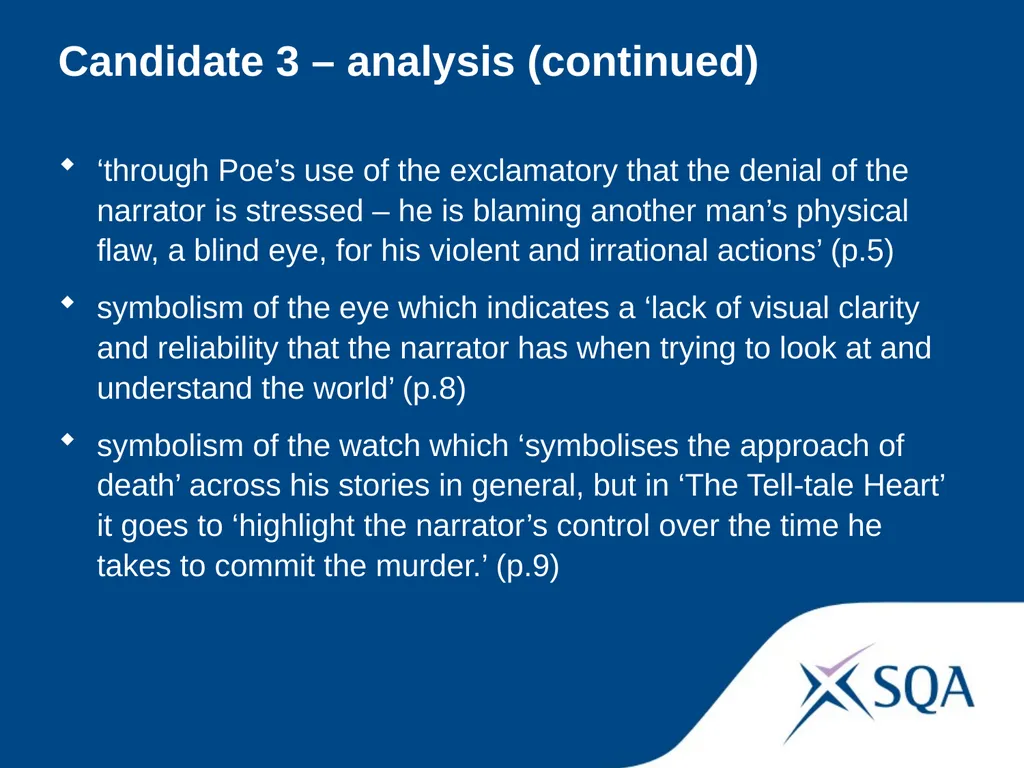
Candidate 3 – analysis (continued) ‘through Poe’s use of the exclamatory that the denial of the narrator is stressed – he is blaming another man’s physical flaw, a blind eye, for his violent and irrational actions’ (p.5)
symbolism of the eye which indicates a ‘lack of visual clarity and reliability that the narrator has when trying to look at and understand the world’ (p.8)
symbolism of the watch which ‘symbolises the approach of death’ across his stories in general, but in ‘The Tell-tale Heart’ it goes to ‘highlight the narrator’s control over the time he takes to commit the murder.’ (p.9)<br>
symbolism of the eye which indicates a ‘lack of visual clarity and reliability that the narrator has when trying to look at and understand the world’ (p.8)
symbolism of the watch which ‘symbolises the approach of death’ across his stories in general, but in ‘The Tell-tale Heart’ it goes to ‘highlight the narrator’s control over the time he takes to commit the murder.’ (p.9)<br>
45
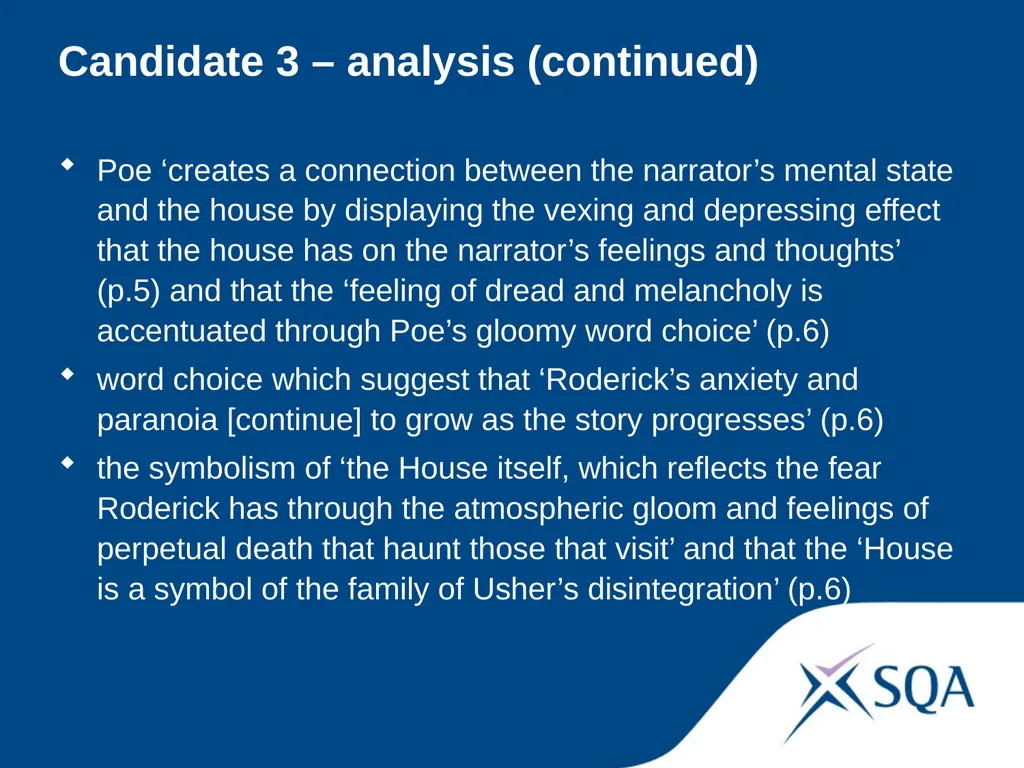
Candidate 3 – analysis (continued) Poe ‘creates a connection between the narrator’s mental state and the house by displaying the vexing and depressing effect that the house has on the narrator’s feelings and thoughts’ (p.5) and that the ‘feeling of dread and melancholy is accentuated through Poe’s gloomy word choice’ (p.6)
word choice which suggest that ‘Roderick’s anxiety and paranoia [continue] to grow as the story progresses’ (p.6)
the symbolism of ‘the House itself, which reflects the fear Roderick has through the atmospheric gloom and feelings of perpetual death that haunt those that visit’ and that the ‘House is a symbol of the family of Usher’s disintegration’ (p.6)<br>
word choice which suggest that ‘Roderick’s anxiety and paranoia [continue] to grow as the story progresses’ (p.6)
the symbolism of ‘the House itself, which reflects the fear Roderick has through the atmospheric gloom and feelings of perpetual death that haunt those that visit’ and that the ‘House is a symbol of the family of Usher’s disintegration’ (p.6)<br>
46
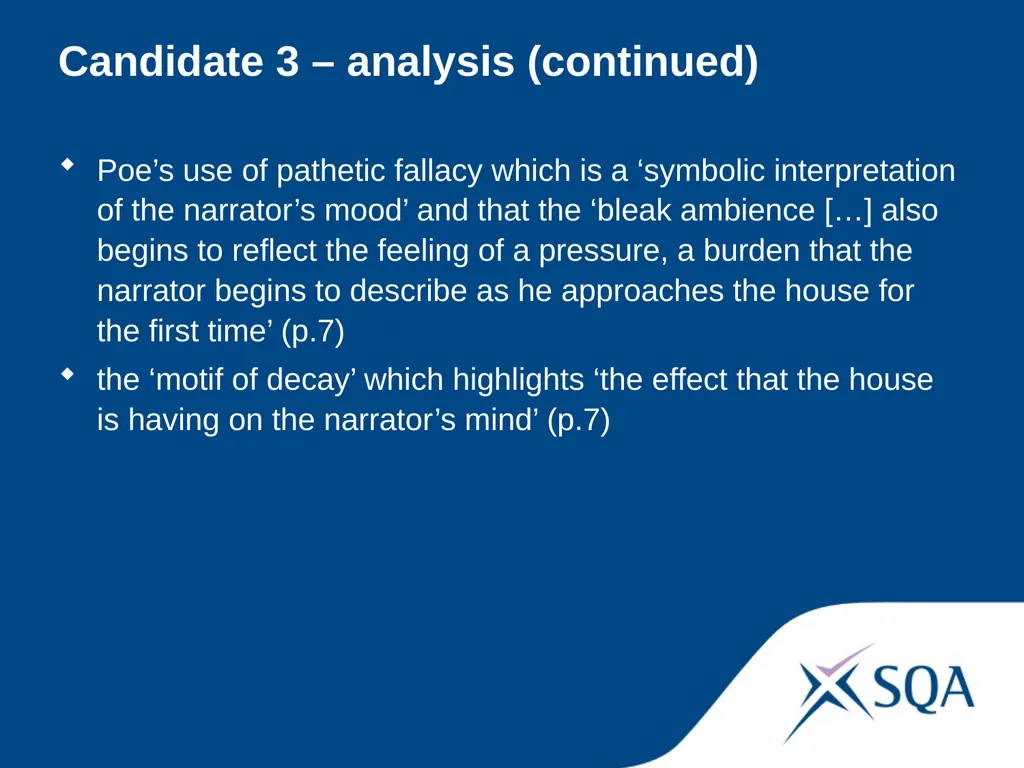
Candidate 3 – analysis (continued) Poe’s use of pathetic fallacy which is a ‘symbolic interpretation of the narrator’s mood’ and that the ‘bleak ambience […] also begins to reflect the feeling of a pressure, a burden that the narrator begins to describe as he approaches the house for the first time’ (p.7)
the ‘motif of decay’ which highlights ‘the effect that the house is having on the narrator’s mind’ (p.7)<br>
the ‘motif of decay’ which highlights ‘the effect that the house is having on the narrator’s mind’ (p.7)<br>
47
Candidate 3 – evaluation discernible evaluative stance with respect to the texts and the task based on evidence presented within the dissertation<br>
48
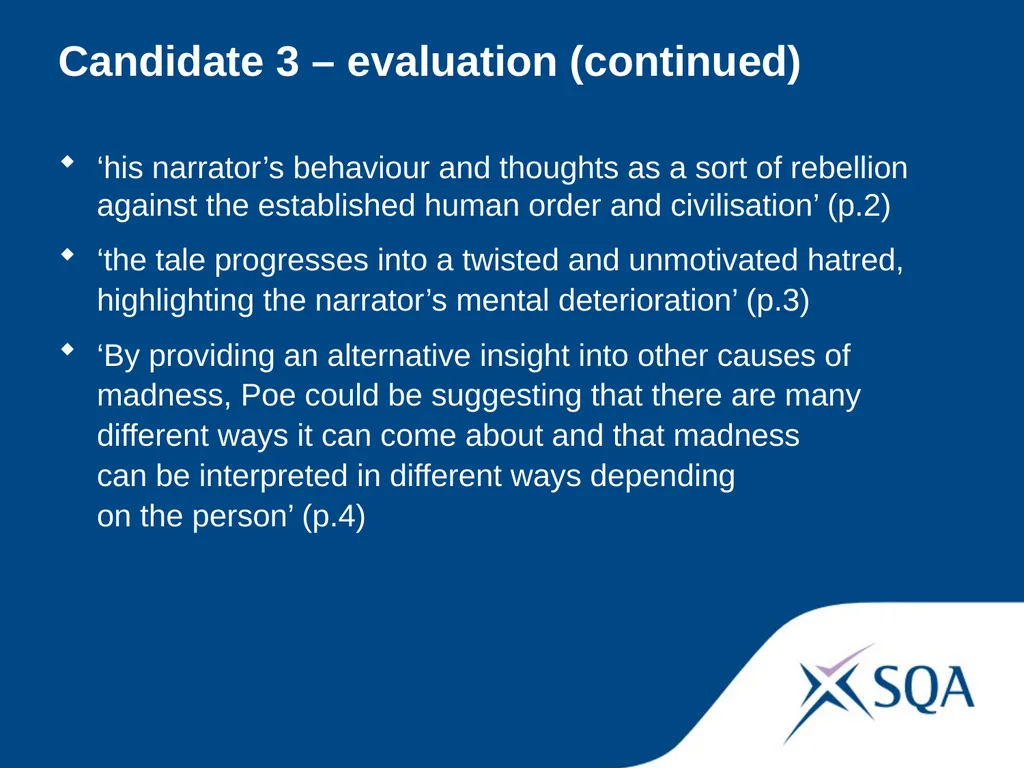
Candidate 3 – evaluation (continued) ‘his narrator’s behaviour and thoughts as a sort of rebellion against the established human order and civilisation’ (p.2)
‘the tale progresses into a twisted and unmotivated hatred, highlighting the narrator’s mental deterioration’ (p.3)
‘By providing an alternative insight into other causes of madness, Poe could be suggesting that there are many different ways it can come about and that madness can be interpreted in different ways depending on the person’ (p.4)<br>
‘the tale progresses into a twisted and unmotivated hatred, highlighting the narrator’s mental deterioration’ (p.3)
‘By providing an alternative insight into other causes of madness, Poe could be suggesting that there are many different ways it can come about and that madness can be interpreted in different ways depending on the person’ (p.4)<br>
49
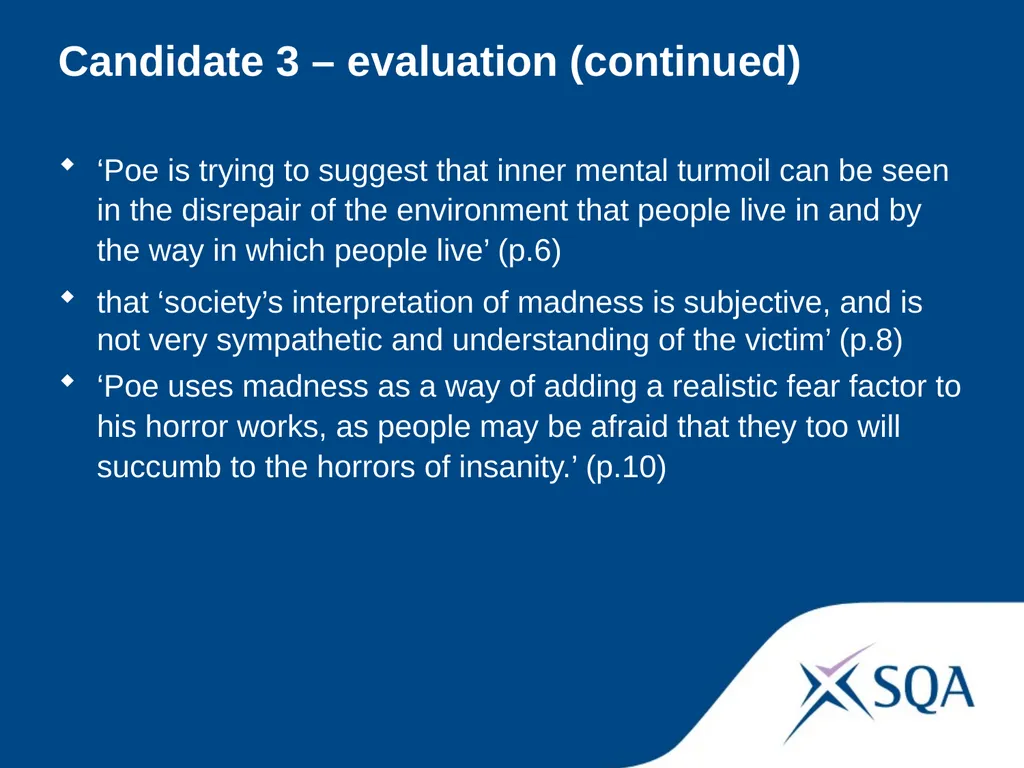
Candidate 3 – evaluation (continued) ‘Poe is trying to suggest that inner mental turmoil can be seen in the disrepair of the environment that people live in and by the way in which people live’ (p.6)
that ‘society’s interpretation of madness is subjective, and is not very sympathetic and understanding of the victim’ (p.8)
‘Poe uses madness as a way of adding a realistic fear factor to his horror works, as people may be afraid that they too will succumb to the horrors of insanity.’ (p.10)<br>
that ‘society’s interpretation of madness is subjective, and is not very sympathetic and understanding of the victim’ (p.8)
‘Poe uses madness as a way of adding a realistic fear factor to his horror works, as people may be afraid that they too will succumb to the horrors of insanity.’ (p.10)<br>
50
Candidate 3 – expression consistently accurate use of structure, style and language, including appropriate critical/ analytical terminology, to develop an argument relevant to the task<br>
51
Candidate 3 – mark holistic assessment
band range: 18-15
fully meets descriptor
mark awarded: 18<br>
band range: 18-15
fully meets descriptor
mark awarded: 18<br>
52
Candidate 4 – Hardy Topic and Task:
An exploration of how Thomas Hardy uses characterisation, symbolism and key events in “Far from the Madding Crowd” and “Tess of the D’Urbervilles” to convey his condemnation of the treatment of women in the Victorian era.<br>
An exploration of how Thomas Hardy uses characterisation, symbolism and key events in “Far from the Madding Crowd” and “Tess of the D’Urbervilles” to convey his condemnation of the treatment of women in the Victorian era.<br>
53
Candidate 4 – knowledge and understanding knowledge and understanding of the key elements and/or central concerns and/or significant details of the texts with some insecurities
appropriate approach to the task with some weakness in relevance<br>
appropriate approach to the task with some weakness in relevance<br>
54
Candidate 4 – knowledge and understanding (continued) “the Victorian era . . . was a period of time when women were seen as inferior to men” and that Hardy was “able to relate to women . . . as he too was treated unfairly . . . because of his class” (p.2)
characterisation, symbolism and key events
characterisation of Tess on pages 2 and 3; Bathsheba and Fanny on pages 3 and 4 and Alec, Troy and Angel on pages 4-6
Tess “very different from the conventional woman in the Victorian era” and that her lack of choice in this makes her “unlike Bathsheba” (p.2)<br>
characterisation, symbolism and key events
characterisation of Tess on pages 2 and 3; Bathsheba and Fanny on pages 3 and 4 and Alec, Troy and Angel on pages 4-6
Tess “very different from the conventional woman in the Victorian era” and that her lack of choice in this makes her “unlike Bathsheba” (p.2)<br>
55
Candidate 4 – knowledge and understanding (continued) innocence of Tess and Hardy’s description of her as “a pure woman” (p.3)
Bathsheba: “independent” and “not treated the same as other women” (p.3); “narcissistic” (p.3) and “emotional” and “impulsive” (p.4)
Fanny: “the obvious victim” in “Far from the Madding Crowd” (p.4)
Alec and Troy: villains of their respective novels (pages 4 and 5)
contrasts with Gabriel Oak (“a reliable and good man”) and with Angel (“not a villain or a hero”) (p.5)
Angel and “the double standards that existed” (p.6)<br>
Bathsheba: “independent” and “not treated the same as other women” (p.3); “narcissistic” (p.3) and “emotional” and “impulsive” (p.4)
Fanny: “the obvious victim” in “Far from the Madding Crowd” (p.4)
Alec and Troy: villains of their respective novels (pages 4 and 5)
contrasts with Gabriel Oak (“a reliable and good man”) and with Angel (“not a villain or a hero”) (p.5)
Angel and “the double standards that existed” (p.6)<br>
56
Candidate 4 – knowledge and understanding (continued) key events in the two texts
the episode when Tess confesses her past to Angel (p.6)
Fanny walking to the poor house (p.6)
the endings of both novels (p.7)<br>
the episode when Tess confesses her past to Angel (p.6)
Fanny walking to the poor house (p.6)
the endings of both novels (p.7)<br>
57
Candidate 4 – knowledge and understanding (continued) symbolism
Angel and Gabriel (pages 7 and 8)
Alec as devil (p.8)
the use of nature in both texts (pages 8 and 9)
Izz Huett: “Because nobody could love ‘ee more than Tess did!” (p.2)<br>
Angel and Gabriel (pages 7 and 8)
Alec as devil (p.8)
the use of nature in both texts (pages 8 and 9)
Izz Huett: “Because nobody could love ‘ee more than Tess did!” (p.2)<br>
58
Candidate 4 – analysis some attempt to analyse literary techniques
weakness in the depth of the analysis
brief and rather obvious statements of character traits followed by quotation and reference<br>
weakness in the depth of the analysis
brief and rather obvious statements of character traits followed by quotation and reference<br>
59
Candidate 4 – analysis (continued) “She also has a narcissistic nature, as she thinks she is too good for some men. We are shown this with Gabriel Oak: ‘He wasn’t quite good enough for me.’” (pages 3 and 4)
“Alec is also very deceitful as he acts very warm and kind towards Tess, only to then take advantage of her when she is sleeping and very vulnerable.” (p.5)<br>
“Alec is also very deceitful as he acts very warm and kind towards Tess, only to then take advantage of her when she is sleeping and very vulnerable.” (p.5)<br>
60
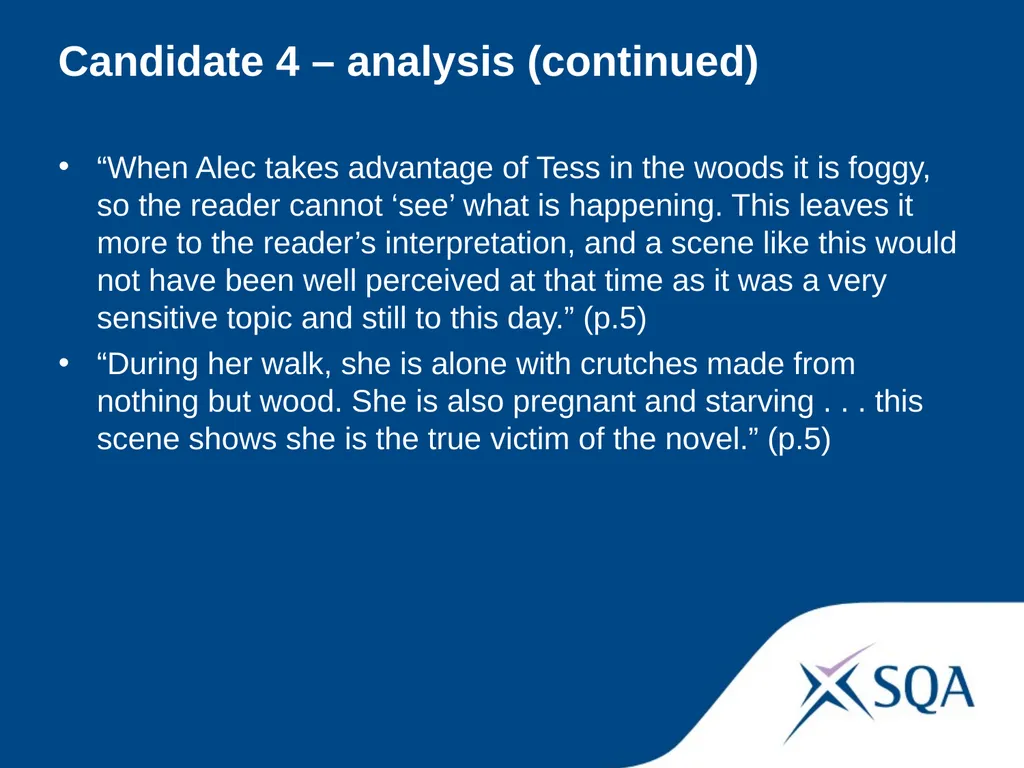
Candidate 4 – analysis (continued) “When Alec takes advantage of Tess in the woods it is foggy, so the reader cannot ‘see’ what is happening. This leaves it more to the reader’s interpretation, and a scene like this would not have been well perceived at that time as it was a very sensitive topic and still to this day.” (p.5)
“During her walk, she is alone with crutches made from nothing but wood. She is also pregnant and starving . . . this scene shows she is the true victim of the novel.” (p.5)<br>
“During her walk, she is alone with crutches made from nothing but wood. She is also pregnant and starving . . . this scene shows she is the true victim of the novel.” (p.5)<br>
61
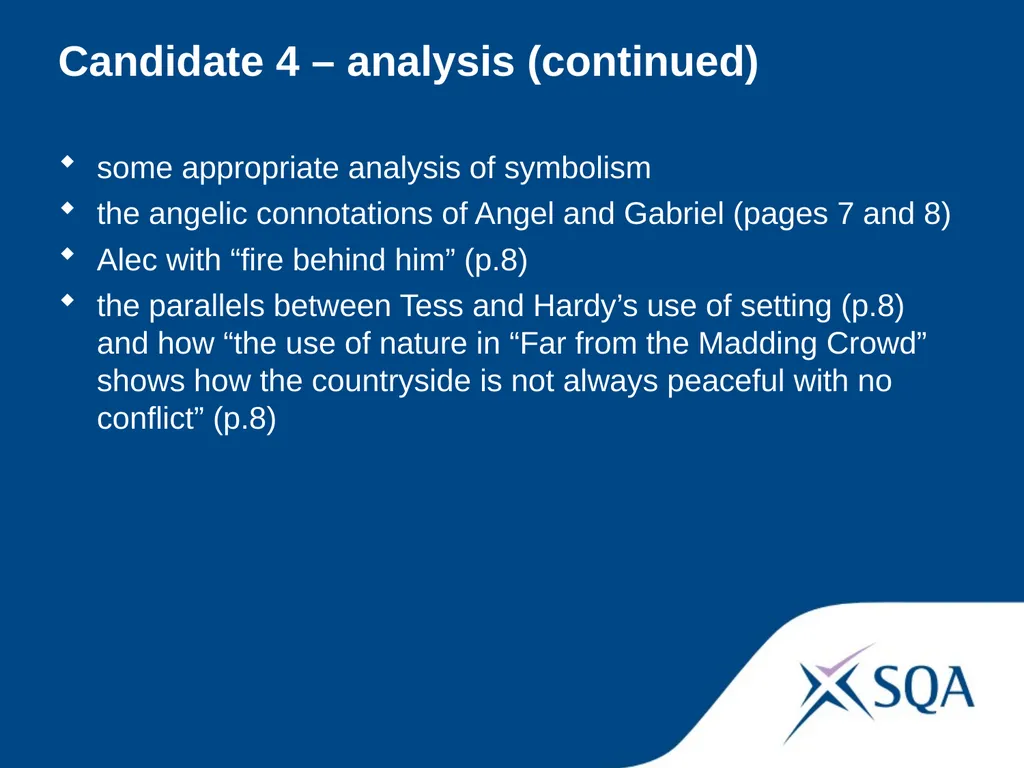
Candidate 4 – analysis (continued) some appropriate analysis of symbolism
the angelic connotations of Angel and Gabriel (pages 7 and 8)
Alec with “fire behind him” (p.8)
the parallels between Tess and Hardy’s use of setting (p.8) and how “the use of nature in “Far from the Madding Crowd” shows how the countryside is not always peaceful with no conflict” (p.8)<br>
the angelic connotations of Angel and Gabriel (pages 7 and 8)
Alec with “fire behind him” (p.8)
the parallels between Tess and Hardy’s use of setting (p.8) and how “the use of nature in “Far from the Madding Crowd” shows how the countryside is not always peaceful with no conflict” (p.8)<br>
62
Candidate 4 – evaluation an implied evaluative stance with respect to the texts and task<br>
63
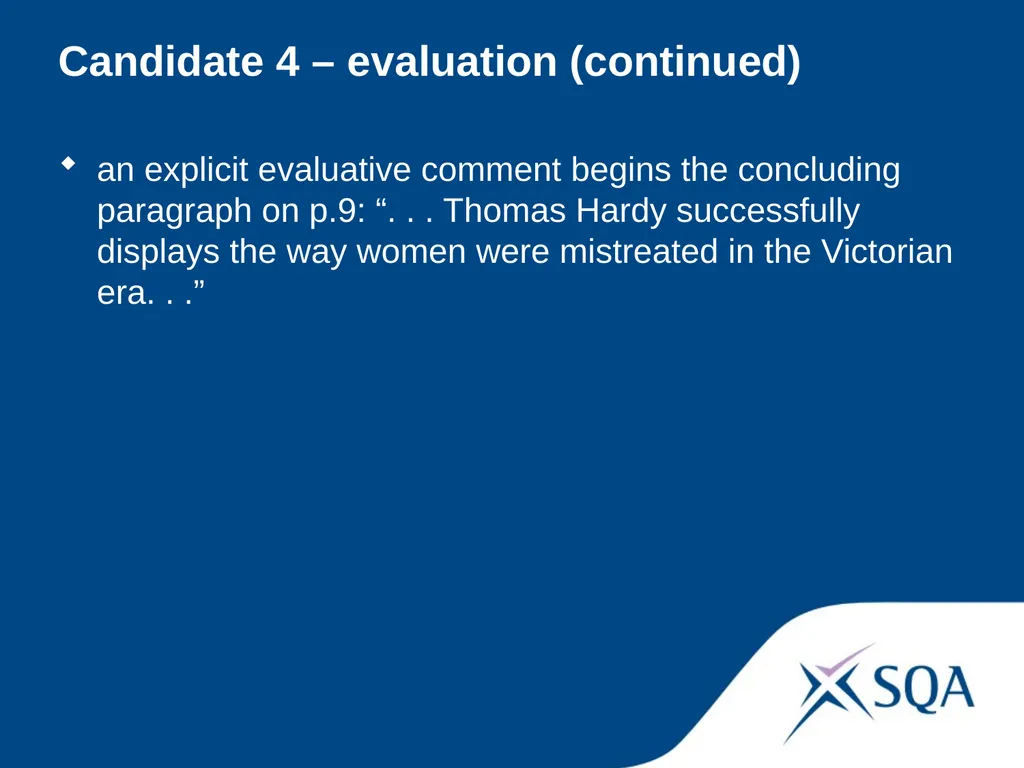
Candidate 4 – evaluation (continued) an explicit evaluative comment begins the concluding paragraph on p.9: “. . . Thomas Hardy successfully displays the way women were mistreated in the Victorian era. . .”<br>
64
Candidate 4 – expression some attempt to use appropriate critical/analytical terminology
weaknesses in the use of style and language affect the strength of the candidate’s argument<br>
weaknesses in the use of style and language affect the strength of the candidate’s argument<br>
65
Candidate 4 – expression (continued) “. . . she never lay emphasis on the face that Angel chose her” (p.2)
“. . . he is already riding off into the sunset with another woman” (p.6)<br>
“. . . he is already riding off into the sunset with another woman” (p.6)<br>
66
Candidate 4 – mark holistic assessment
band range: 14-11
fully meets descriptor
mark awarded: 14<br>
band range: 14-11
fully meets descriptor
mark awarded: 14<br>
67
Frequently asked questions How important is secondary reading in a dissertation?
A dissertation with no secondary reading could be awarded full marks, and conversely, a dissertation with two pages of secondary sources could be awarded 7 marks. It is all about what the texts themselves demand, and it is often more about the quality and relevance of secondary sources than any arithmetical or binary view of secondary sources being good or bad. It is more important that a candidate's use of secondary sources assists the candidate in supporting their line of argument.<br>
A dissertation with no secondary reading could be awarded full marks, and conversely, a dissertation with two pages of secondary sources could be awarded 7 marks. It is all about what the texts themselves demand, and it is often more about the quality and relevance of secondary sources than any arithmetical or binary view of secondary sources being good or bad. It is more important that a candidate's use of secondary sources assists the candidate in supporting their line of argument.<br>
68
Frequently asked questions (continued) How important is the level of demand in the chosen dissertation text(s)?
A dissertation is a piece of critical literary discourse, and the 'literariness' of a text is important as it is that 'literariness' which provides the candidate with the raw material which allows them to show their analytical skills and evaluate their texts. So, it is important that at the heart of all dissertations is the literary discourse, and therefore level of demand can often be associated with the 'literariness' of a text and its complexity and sophistication.<br>
A dissertation is a piece of critical literary discourse, and the 'literariness' of a text is important as it is that 'literariness' which provides the candidate with the raw material which allows them to show their analytical skills and evaluate their texts. So, it is important that at the heart of all dissertations is the literary discourse, and therefore level of demand can often be associated with the 'literariness' of a text and its complexity and sophistication.<br>
69
Frequently asked questions (continued) Is an imbalance in treatment of texts in a dissertation problematic?
If a candidate defines two texts as being at the heart of a topic/task, then there should generally be a balanced approach if the candidate wishes to be seen as having, for example, ‘selections from across the breadth of the texts(s)’ as per the higher band ranges. A failure to do so could then be deemed to have ‘some limitations across the breadth’ or even ‘limited’ evidence to support the demands of the task.<br>
If a candidate defines two texts as being at the heart of a topic/task, then there should generally be a balanced approach if the candidate wishes to be seen as having, for example, ‘selections from across the breadth of the texts(s)’ as per the higher band ranges. A failure to do so could then be deemed to have ‘some limitations across the breadth’ or even ‘limited’ evidence to support the demands of the task.<br>
70
Frequently asked questions (continued) Is there any disadvantage in writing a dissertation on a single text?
The primary aim of the dissertation is to ‘assesses candidates’ independent reading of complex and sophisticated literature. It provides evidence of candidates’ skills in critical analysis, evaluation, investigation and writing.’ (Course Specification, p.18) So as long as a single text has the complexity and sophistication which will allow a candidate to analyse and evaluate for 2500-3500 words then this is no different to a candidate doing this for two novels.<br>
The primary aim of the dissertation is to ‘assesses candidates’ independent reading of complex and sophisticated literature. It provides evidence of candidates’ skills in critical analysis, evaluation, investigation and writing.’ (Course Specification, p.18) So as long as a single text has the complexity and sophistication which will allow a candidate to analyse and evaluate for 2500-3500 words then this is no different to a candidate doing this for two novels.<br>
71
SQA resources and support Subject–specific guidance on gathering key evidence for session 2020–21
SQA Understanding Standards
SQA past papers and marking instructions<br>
SQA Understanding Standards
SQA past papers and marking instructions<br>
72
The qualifications team<br>