
UNIT 19: RESOURCE AND TALENT PLANNING UNIT CODE:
CS
Published · 21 slides · 0 views

1 / 1





Description
UNIT 19: RESOURCE AND TALENT PLANNING UNIT CODE: T5080531 CREDIT VALUE: 15 UNIT 19: RESOURCE AND TALENT PLANNING Learning Outcome 3: Apply the appropriate documents and processes which contribute to effective recruitment and selection.
Related Topics
Share
Embed code
Download this presentation From Below
"UNIT 19: RESOURCE AND TALENT PLANNING UNIT CODE:" is the property of its rightful owner. Permission is granted to download and print the materials on this website for personal, non-commercial use only, and to display it on your personal computer provided you do not modify the materials and that you retain all copyright notices contained in the materials. By downloading content from our website, you accept the terms of this agreement.
Presentation Transcript
01
UNIT 19: RESOURCE AND TALENT PLANNING UNIT CODE: T/508/0531
CREDIT VALUE: 15<br>
CREDIT VALUE: 15<br>
02
UNIT 19: RESOURCE AND TALENT PLANNING Learning Outcome 3: Apply the appropriate documents and processes which contribute to effective recruitment and selection.<br>
03
THE BASIC SYLLABUS 1. Analyse labour market trends and appropriate legal requirements which influence workforce planning.
2. Determine current and anticipated skills requirements in varying contexts.
3. Apply the appropriate documents and processes which contribute to effective recruitment and selection.
4. Evaluate how to manage the human resource life-cycle within the context of a HR strategy.<br>
2. Determine current and anticipated skills requirements in varying contexts.
3. Apply the appropriate documents and processes which contribute to effective recruitment and selection.
4. Evaluate how to manage the human resource life-cycle within the context of a HR strategy.<br>
04
LEARNING OUTCOMES Determine current and anticipated skills requirements in varying contexts.
D 2: Make valid judgements and recommendations on how appropriates documents and process can be improved for effective recruitment and selection.<br>
D 2: Make valid judgements and recommendations on how appropriates documents and process can be improved for effective recruitment and selection.<br>
05
OVERVIEW There are a number of legal considerations in the recruiting process. In fact, it is possible to ask unlawful or even discriminatory questions without realizing it. There are a number of cost that is also involved in the recruitment and selection process both direct and indirect cost.<br>
06
THE LEGAL AND FINANCIAL ASPECTS AND IMPLICATIONS OF DIFFERENT RECRUITMENT AND SELECTION METHODS There are a number of ethical and legal issues that you must consider in relation to the recruitment and selection process. Ethical issues are those not governed by law but considered the right processes to follow to be fair and equal to all. It is important that employers are aware of the latest equal opportunities legislation and ensure that they comply with it or risk prosecution.<br>
07
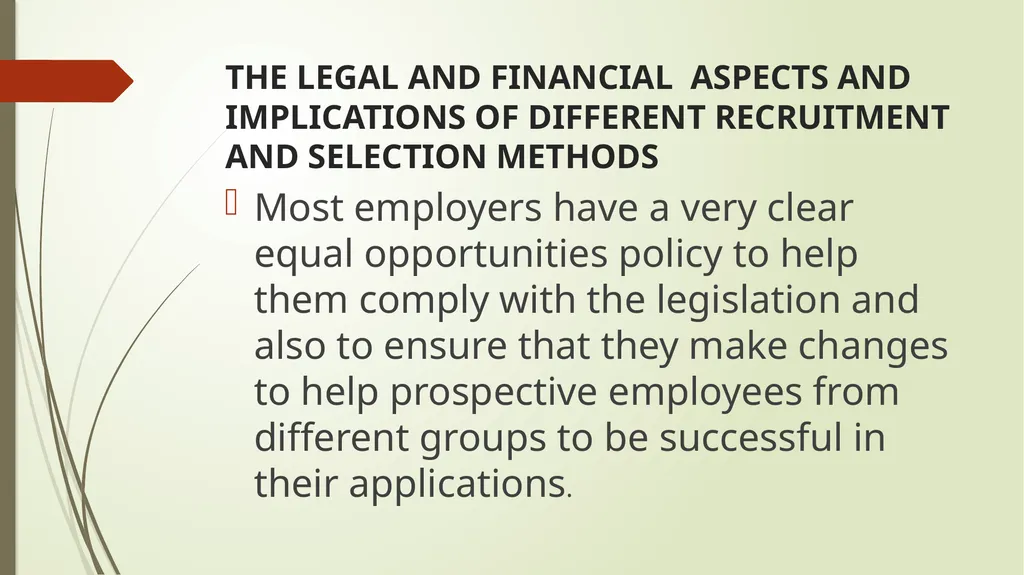
THE LEGAL AND FINANCIAL ASPECTS AND IMPLICATIONS OF DIFFERENT RECRUITMENT AND SELECTION METHODS Most employers have a very clear equal opportunities policy to help them comply with the legislation and also to ensure that they make changes to help prospective employees from different groups to be successful in their applications.<br>
08
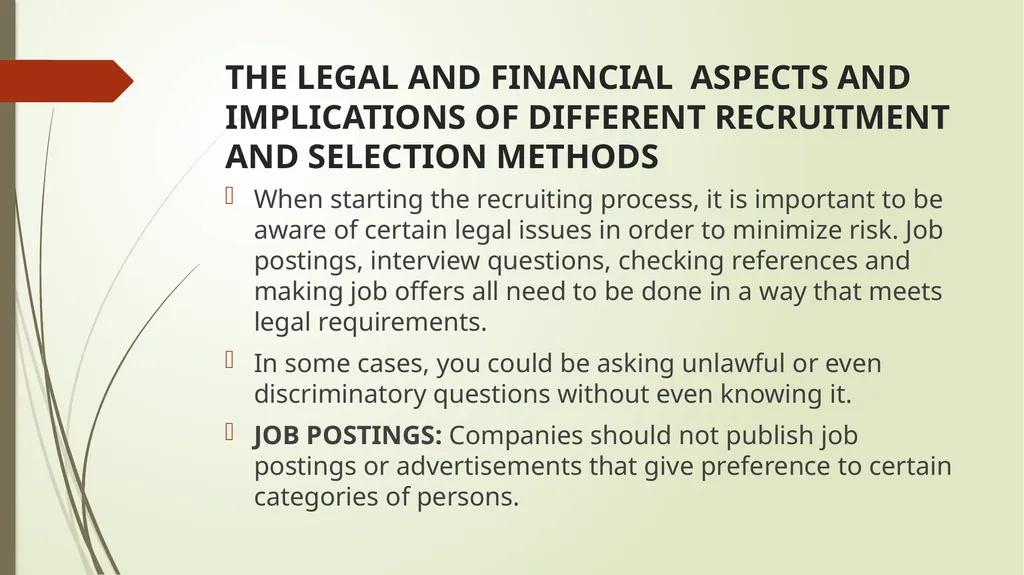
THE LEGAL AND FINANCIAL ASPECTS AND IMPLICATIONS OF DIFFERENT RECRUITMENT AND SELECTION METHODS When starting the recruiting process, it is important to be aware of certain legal issues in order to minimize risk. Job postings, interview questions, checking references and making job offers all need to be done in a way that meets legal requirements.
In some cases, you could be asking unlawful or even discriminatory questions without even knowing it.
JOB POSTINGS: Companies should not publish job postings or advertisements that give preference to certain categories of persons.<br>
In some cases, you could be asking unlawful or even discriminatory questions without even knowing it.
JOB POSTINGS: Companies should not publish job postings or advertisements that give preference to certain categories of persons.<br>
09
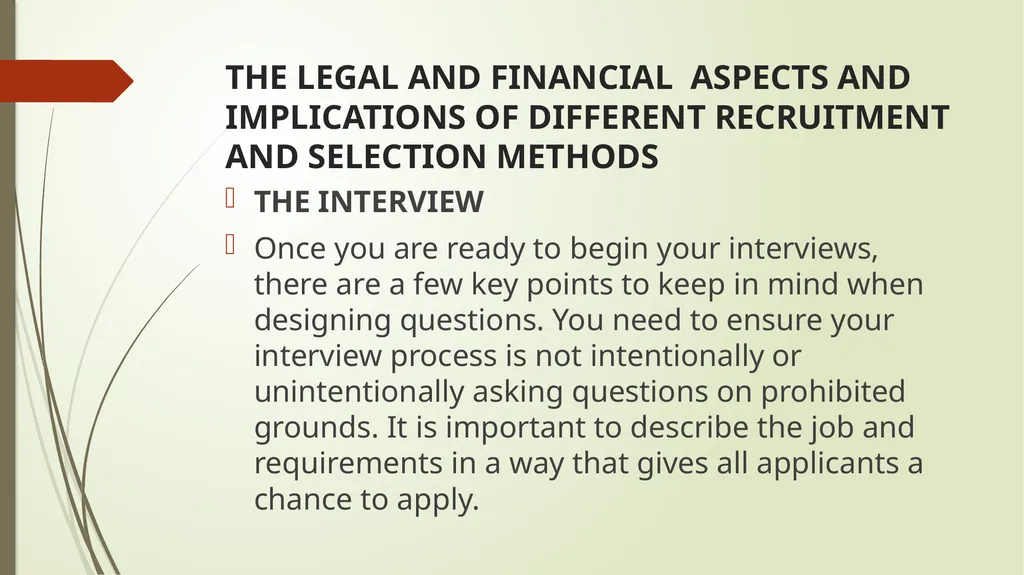
THE LEGAL AND FINANCIAL ASPECTS AND IMPLICATIONS OF DIFFERENT RECRUITMENT AND SELECTION METHODS THE INTERVIEW
Once you are ready to begin your interviews, there are a few key points to keep in mind when designing questions. You need to ensure your interview process is not intentionally or unintentionally asking questions on prohibited grounds. It is important to describe the job and requirements in a way that gives all applicants a chance to apply.<br>
Once you are ready to begin your interviews, there are a few key points to keep in mind when designing questions. You need to ensure your interview process is not intentionally or unintentionally asking questions on prohibited grounds. It is important to describe the job and requirements in a way that gives all applicants a chance to apply.<br>
10
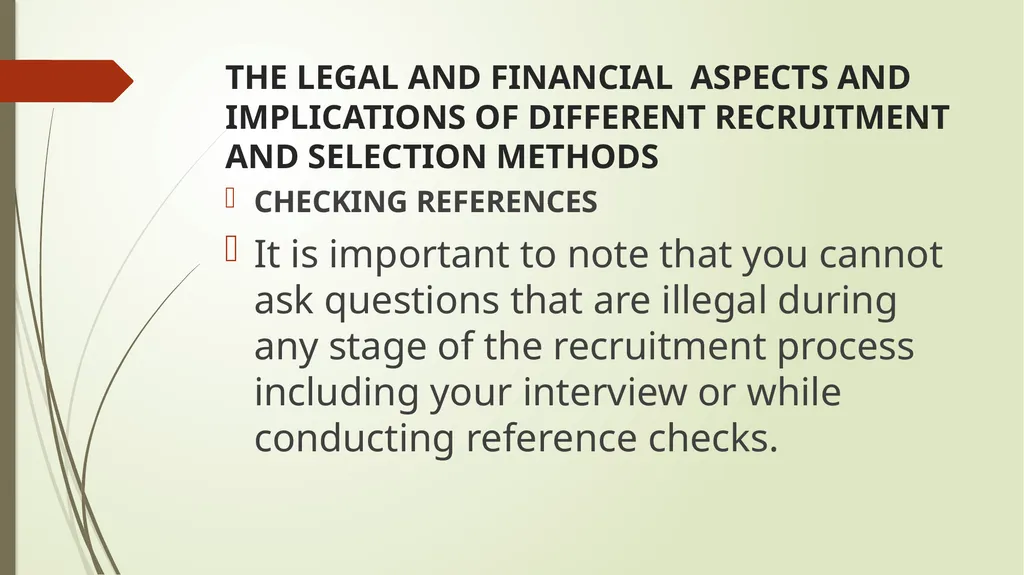
THE LEGAL AND FINANCIAL ASPECTS AND IMPLICATIONS OF DIFFERENT RECRUITMENT AND SELECTION METHODS CHECKING REFERENCES
It is important to note that you cannot ask questions that are illegal during any stage of the recruitment process including your interview or while conducting reference checks.<br>
It is important to note that you cannot ask questions that are illegal during any stage of the recruitment process including your interview or while conducting reference checks.<br>
11
THE LEGAL AND FINANCIAL ASPECTS AND IMPLICATIONS OF DIFFERENT RECRUITMENT AND SELECTION METHODS Privacy and equal opportunity legislation require that the recruitment process is conducted in a fair and transparent manner and a good recruitment and selection policy will always make this very clear to recruiters.
A candidate may have recourse to legal action if they feel they have been discriminated against, so impartiality is not only the right thing to do, it’s also good risk management practice.<br>
A candidate may have recourse to legal action if they feel they have been discriminated against, so impartiality is not only the right thing to do, it’s also good risk management practice.<br>
12
THE LEGAL AND FINANCIAL ASPECTS AND IMPLICATIONS OF DIFFERENT RECRUITMENT AND SELECTION METHODS Discrimination may be quite unintentional.
Privacy laws also require that a candidate’s application is treated confidentially. Penalties apply if breaches occur, so here as well, a good recruitment and selection policy helps to protect the organisation’s best interests.
An example of a privacy breach would be a recruiter discussing the details of a confidential job application with their family or friends. A recruitment and selection policy that reminds staff about the implications of possible lapses such as these can go a long way towards ensuring they never happen.<br>
Privacy laws also require that a candidate’s application is treated confidentially. Penalties apply if breaches occur, so here as well, a good recruitment and selection policy helps to protect the organisation’s best interests.
An example of a privacy breach would be a recruiter discussing the details of a confidential job application with their family or friends. A recruitment and selection policy that reminds staff about the implications of possible lapses such as these can go a long way towards ensuring they never happen.<br>
13
THE LEGAL AND FINANCIAL ASPECTS AND IMPLICATIONS OF DIFFERENT RECRUITMENT AND SELECTION METHODS Part of the reasons that cash-strapped businesses hesitate to start hiring, even when they need employees, is due to the actual cost of hiring. It's easy to forget that an employee, in terms of cost, means more than just the salary which can be substantial all by itself. But add in the cost of recruiting, training and more, and the dollars start growing.<br>
14
THE LEGAL AND FINANCIAL ASPECTS AND IMPLICATIONS OF DIFFERENT RECRUITMENT AND SELECTION METHODS Cost measures include such things as the money paid for advertising, agency fees, and referral bonuses. Also included is travel expenses for both recruiters and recruits, as well as salary costs for people who spend time and effort on recruiting activities.<br>
15
THE LEGAL AND FINANCIAL ASPECTS AND IMPLICATIONS OF DIFFERENT RECRUITMENT AND SELECTION METHODS The cost of simply finding the right person to hire can be hefty. There are several potentially high costs in the process of recruiting alone: advertisement, time cost of internal recruiter, time cost of recruiter's assistant in reviewing resumes and performing other recruitment-related tasks, time cost of the person conducting the interviews, drugs screens and background checks, and various pre-employment assessment tests.<br>
16
THE LEGAL AND FINANCIAL ASPECTS AND IMPLICATIONS OF DIFFERENT RECRUITMENT AND SELECTION METHODS Cost is an important factor in the recruitment process. Effective recruitment ensures that the organization will indeed attract the most qualified applicants (Buhler P., 2002). Only through attracting talented staff can the organization create a sustainable competitive advantage. Recruitment and selection cost increases with age and experience in specialty (Billsberry J., 2007). Recruitment efforts made by an organization are very expensive (Sims R.R., 2002).<br>
17
THE LEGAL AND FINANCIAL ASPECTS AND IMPLICATIONS OF DIFFERENT RECRUITMENT AND SELECTION METHODS The overall cost of human resources includes the acquisition costs and the development and learning costs (Flamholtz E.G., 1999): -the acquisition costs: direct costs (recruitment, selection) and indirect costs (employment or promotion from within the organization); -the development and the learning costs: direct costs (formal training, training on-the-job) and indirect costs (the time of trainers, the loss of productivity).<br>
18
THE LEGAL AND FINANCIAL ASPECTS AND IMPLICATIONS OF DIFFERENT RECRUITMENT AND SELECTION METHODS The assessment category includes any kind of candidate assessments your company pays for (tests, competitions etc.). Companies can buy tests from consultancies or other firms to use during the hiring process. The cost of these kinds of assessments are usually calculated per candidate.<br>
19
THE LEGAL AND FINANCIAL ASPECTS AND IMPLICATIONS OF DIFFERENT RECRUITMENT AND SELECTION METHODS Peter Drucker mentioned in 1992 about the nature of recruitment that « any organization is competing for its essential resources: qualifications and people knowledge ». The organizations need to hire the most qualified candidates that it can buy at the best price. The organizations could choose candidates in recruitment and selection processes well trained, but now is very difficult to find a good candidate (Holbeche L., 2001);<br>
20
REFERENCES Hg.org. (2017). Cite a Website - Cite This For Me. [online] Available at: https://www.hg.org/busemployment.html [Accessed 29 Oct. 2017].
Go2hr.ca. (2017). Legal Issues in Your Recruiting Process - HR Information for BC Tourism Employers - go2HR. [online] Available at: https://www.go2hr.ca/articles/legal-issues-you-need-consider-your-recruiting-process [Accessed 30 Oct. 2017].
Do Better Hiring - The RecruitLoop Blog. (2017). 5 Reasons You Need A Recruitment And Selection Policy. [online] Available at: http://recruitloop.com/blog/5-reasons-you-need-a-recruitment-and-selection-policy/ [Accessed 30 Oct. 2017].
pearsonschoolsandfecolleges.co.uk. (2017). Recruitment and selection process. [online] Available at: https://www.pearsonschoolsandfecolleges.co.uk/FEAndVocational/...1/unit-8. [Accessed 30 Oct. 2017].<br>
Go2hr.ca. (2017). Legal Issues in Your Recruiting Process - HR Information for BC Tourism Employers - go2HR. [online] Available at: https://www.go2hr.ca/articles/legal-issues-you-need-consider-your-recruiting-process [Accessed 30 Oct. 2017].
Do Better Hiring - The RecruitLoop Blog. (2017). 5 Reasons You Need A Recruitment And Selection Policy. [online] Available at: http://recruitloop.com/blog/5-reasons-you-need-a-recruitment-and-selection-policy/ [Accessed 30 Oct. 2017].
pearsonschoolsandfecolleges.co.uk. (2017). Recruitment and selection process. [online] Available at: https://www.pearsonschoolsandfecolleges.co.uk/FEAndVocational/...1/unit-8. [Accessed 30 Oct. 2017].<br>
21
REFERENCES Mueller, A. (2017). The Cost Of Hiring A New Employee. [online] Investopedia. Available at: http://www.investopedia.com/financial-edge/0711/the-cost-of-hiring-a-new-employee.aspx [Accessed 30 Oct. 2017].
Valentina FLOREA, N. (2013). COST/BENEFIT ANALYSIS – A TOOL TO IMPROVE RECRUITMENT, SELECTION AND EMPLOYMENT IN ORGANIZATIONS. Management&Marketing, 9(2/2013).
Recruiting Resources: How to Recruit and Hire Better. (2017). Recruiting budget: HR planning tips and examples | Workable. [online] Available at: https://resources.workable.com/tutorial/recruiting-budget [Accessed 30 Oct. 2017].<br>
Valentina FLOREA, N. (2013). COST/BENEFIT ANALYSIS – A TOOL TO IMPROVE RECRUITMENT, SELECTION AND EMPLOYMENT IN ORGANIZATIONS. Management&Marketing, 9(2/2013).
Recruiting Resources: How to Recruit and Hire Better. (2017). Recruiting budget: HR planning tips and examples | Workable. [online] Available at: https://resources.workable.com/tutorial/recruiting-budget [Accessed 30 Oct. 2017].<br>