
Unit 3: Disaster Medical Operations - Part 1 CERT

Description: Unit 3: Disaster Medical Operations - Part 1 CERT Basic Training Unit 3 Objectives Identify life-threatening conditions resulting from trauma including severe bleeding, low body temperature, and airway blockage Apply correct life saving
Related Topics
Download Presentation
"Unit 3: Disaster Medical Operations - Part 1 CERT" is the property of its rightful owner. Permission is granted to download and print the materials on this website for personal, non-commercial use only, and to display it on your personal computer provided you do not modify the materials and that you retain all copyright notices contained in the materials. By downloading content from our website, you accept the terms of this agreement.
Presentation Transcript
slide1. Unit 3: Disaster Medical Operations - Part 1 CERT Basic Training<br>
slide2. Unit 3 Objectives Identify life-threatening conditions resulting from trauma including severe bleeding, low body temperature, and airway blockage
Apply correct life saving techniques
Provide basic first-aid care for non-life threatening injuries PM 3-1 CERT Basic Training Unit 3: Disaster Medical Operations – Part 1 3-1<br>
slide3. Treating Life-Threatening Conditions Without treatment, severe bleeding and airway obstruction can quickly lead to death
The first priority of CERT volunteers assisting in disaster medical operations is to attend to these conditions by controlling bleeding and positioning a patient so they can breathe PM 3-2 CERT Basic Training Unit 3: Disaster Medical Operations – Part 1 3-2<br>
slide4. Safety Considerations Prior to treatment, ensure that both the patient and rescuer are in a safe environment to administer care
Some questions CERT volunteers to consider
Do I feel safe at this spot?
Should I leave and move to a safer location, or am I able to stay and start providing care immediately?
If I leave, can I take anyone with me? PM 3-2 CERT Basic Training Unit 3: Disaster Medical Operations – Part 1 3-3<br>
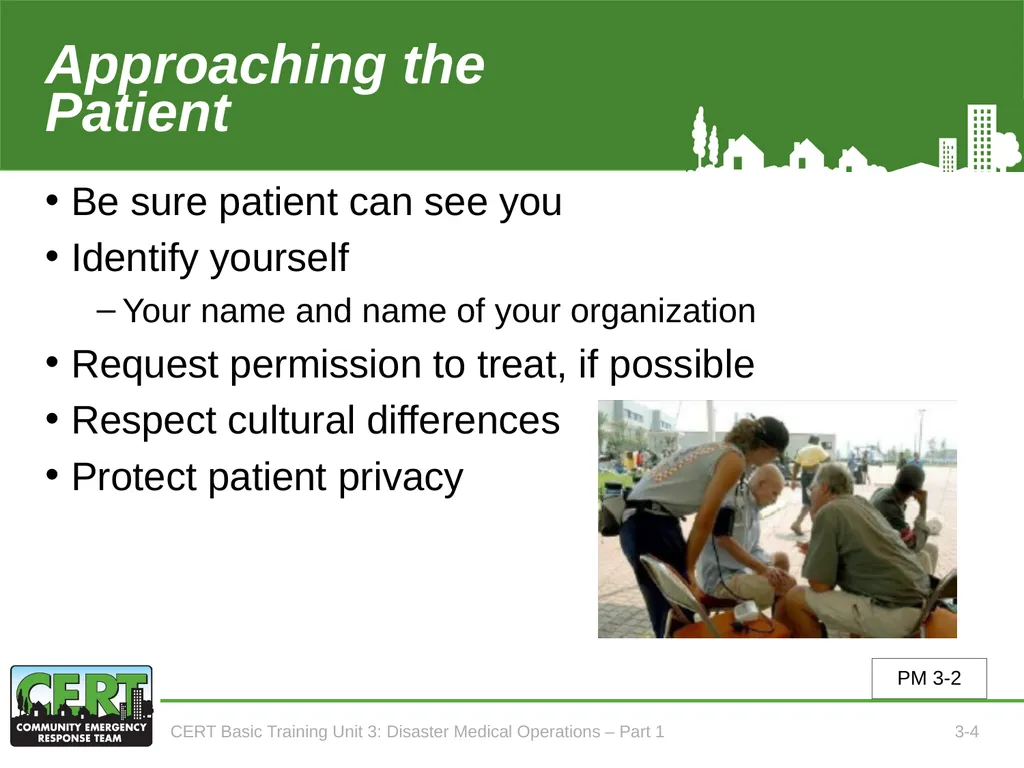
slide5. Approaching the Patient Be sure patient can see you
Identify yourself
Your name and name of your organization
Request permission to treat, if possible
Respect cultural differences
Protect patient privacy PM 3-2 CERT Basic Training Unit 3: Disaster Medical Operations – Part 1 3-4<br>
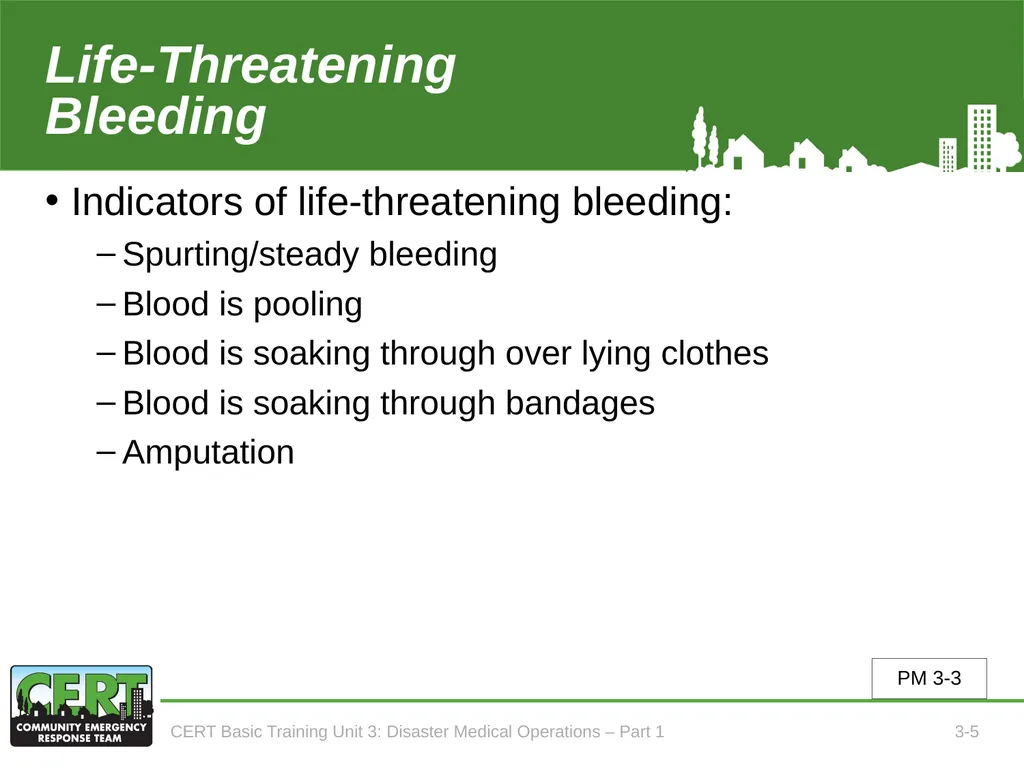
slide6. Life-Threatening Bleeding Indicators of life-threatening bleeding:
Spurting/steady bleeding
Blood is pooling
Blood is soaking through over lying clothes
Blood is soaking through bandages
Amputation PM 3-3 CERT Basic Training Unit 3: Disaster Medical Operations – Part 1 3-5<br>
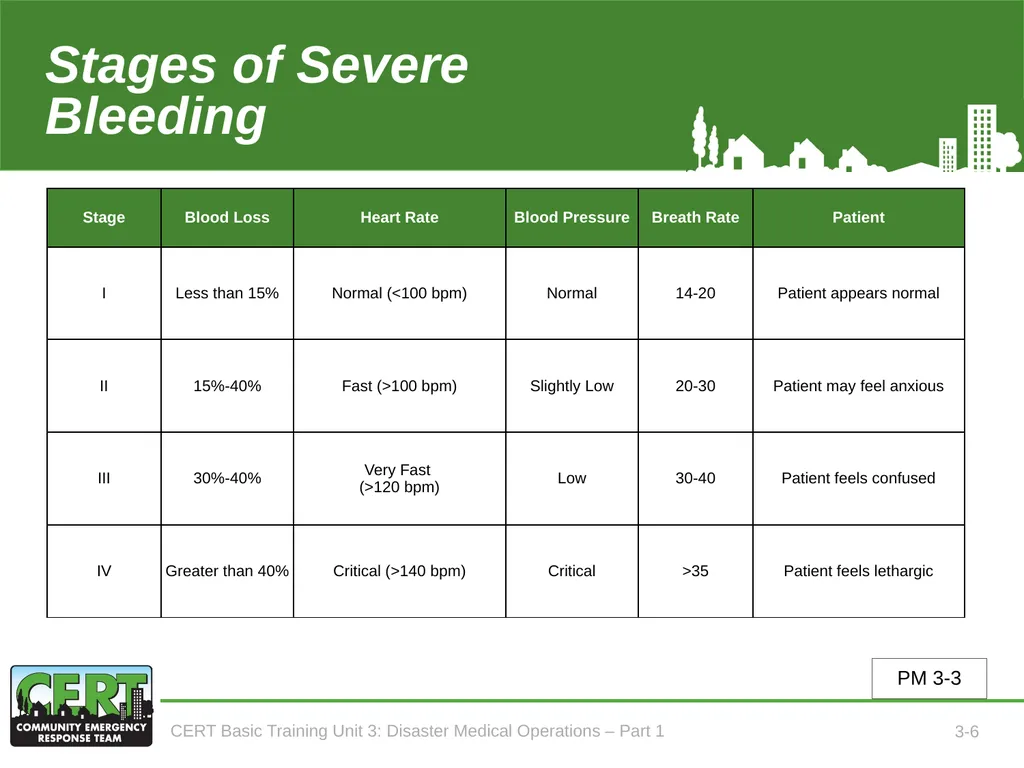
slide7. Stages of Severe Bleeding PM 3-3 CERT Basic Training Unit 3: Disaster Medical Operations – Part 1 3-6<br>
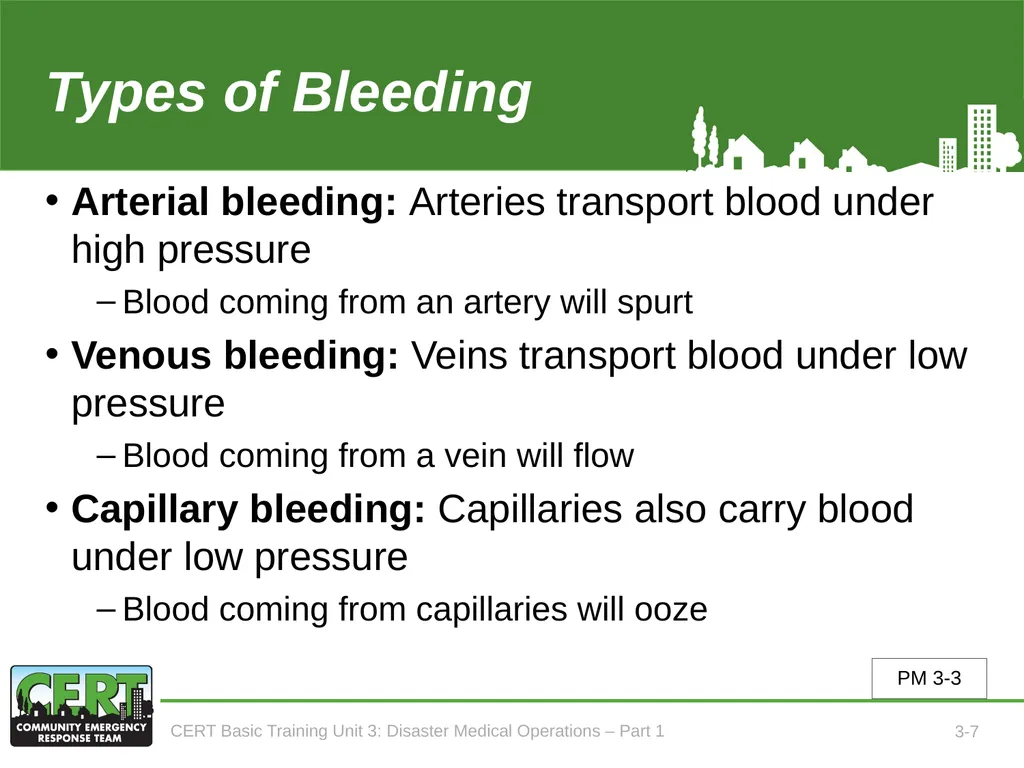
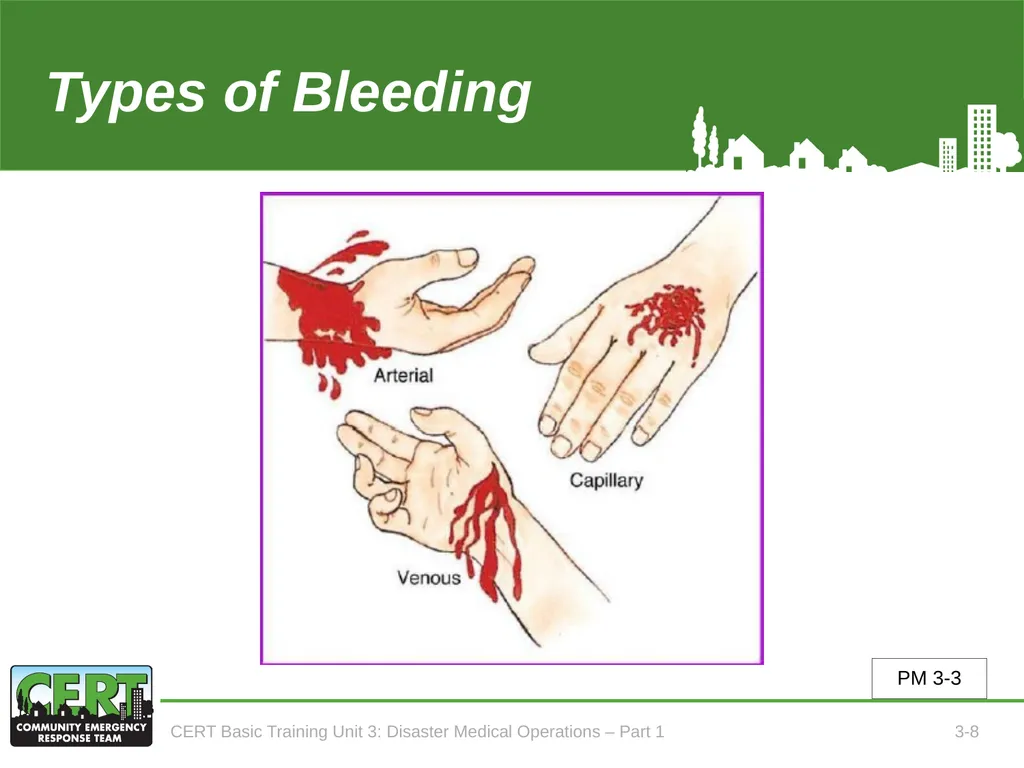
slide8. Types of Bleeding Arterial bleeding: Arteries transport blood under high pressure
Blood coming from an artery will spurt
Venous bleeding: Veins transport blood under low pressure
Blood coming from a vein will flow
Capillary bleeding: Capillaries also carry blood under low pressure
Blood coming from capillaries will ooze PM 3-3 CERT Basic Training Unit 3: Disaster Medical Operations – Part 1 3-7<br>
slide9. Types of Bleeding (image) PM 3-3 CERT Basic Training Unit 3: Disaster Medical Operations – Part 1 3-8<br>
slide10. Controlling Bleeding: Direct Pressure Step 1: Find the source(s)
Step 2: Cover the source
Step 3: Apply pressure
Step 4: Maintain pressure until bleeding has stopped PM 3-3 CERT Basic Training Unit 3: Disaster Medical Operations – Part 1 3-9<br>
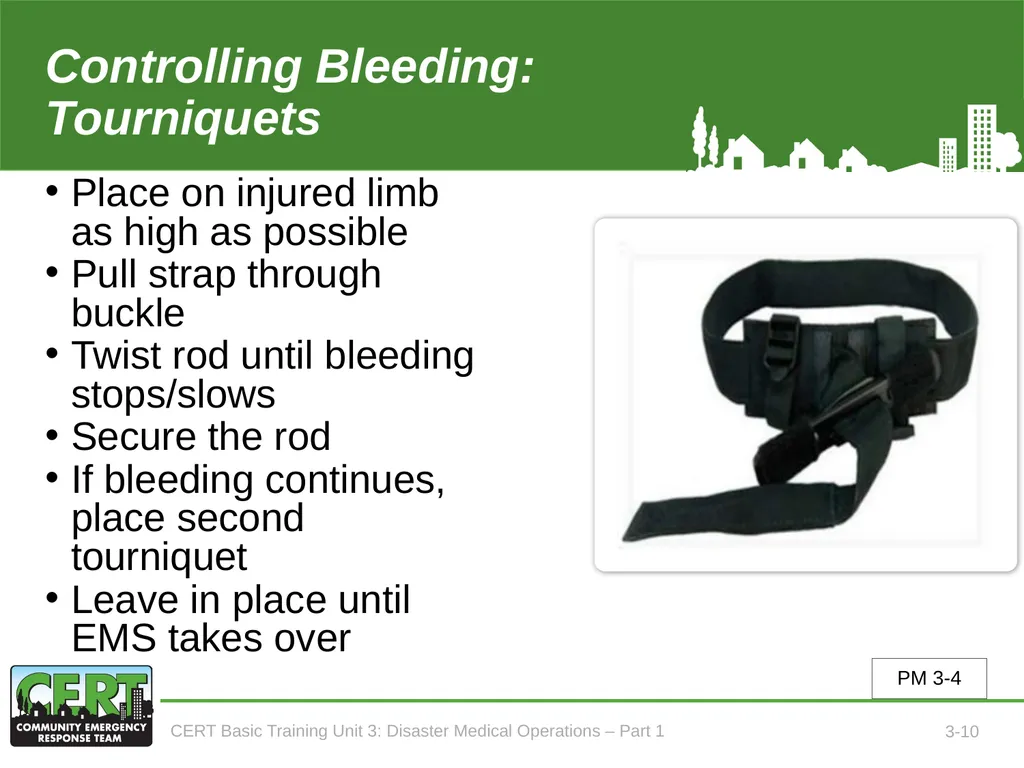
slide11. Controlling Bleeding: Tourniquets Place on injured limb as high as possible
Pull strap through buckle
Twist rod until bleeding stops/slows
Secure the rod
If bleeding continues, place second tourniquet
Leave in place until EMS takes over PM 3-4 CERT Basic Training Unit 3: Disaster Medical Operations – Part 1 3-10<br>
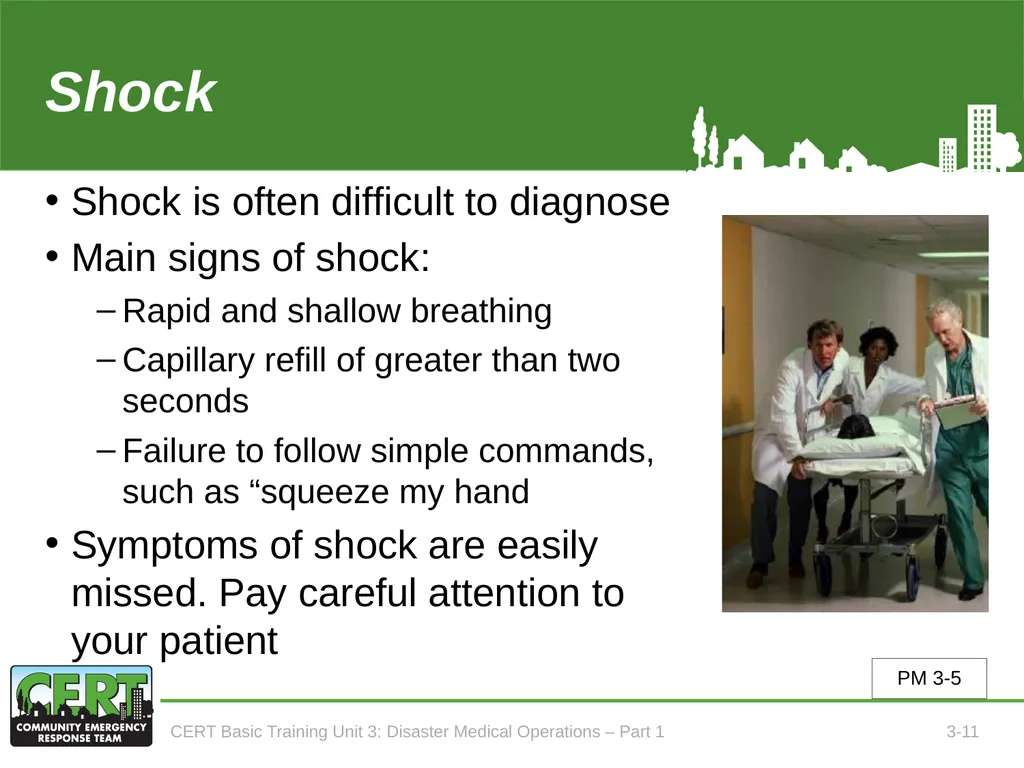
slide12. Shock Shock is often difficult to diagnose
Main signs of shock:
Rapid and shallow breathing
Capillary refill of greater than two seconds
Failure to follow simple commands, such as “squeeze my hand
Symptoms of shock are easily missed. Pay careful attention to your patient PM 3-5 CERT Basic Training Unit 3: Disaster Medical Operations – Part 1 3-11<br>
slide13. Maintaining Body Temperature Keep the patient warm
Remove wet clothing
Place something between patient and ground (e.g., cardboard, jacket, blanket)
Wrap patient with dry layers (e.g., coat, blanket, Mylar emergency blanket)
Shield patient from wind PM 3-5 CERT Basic Training Unit 3: Disaster Medical Operations – Part 1 3-12<br>
slide14. Exercise 3.1 After breaking into pairs, identify one person to take the role of the patient and one to take the role of the rescuer
Respond as if the patient has an injury on the right forearm, just below the elbow
Apply a pressure bandage or tourniquet (if available)
Repeat the process twice
Swap roles and have the new rescuer complete the above steps PM 3-6 CERT Basic Training Unit 3: Disaster Medical Operations – Part 1 3-13<br>
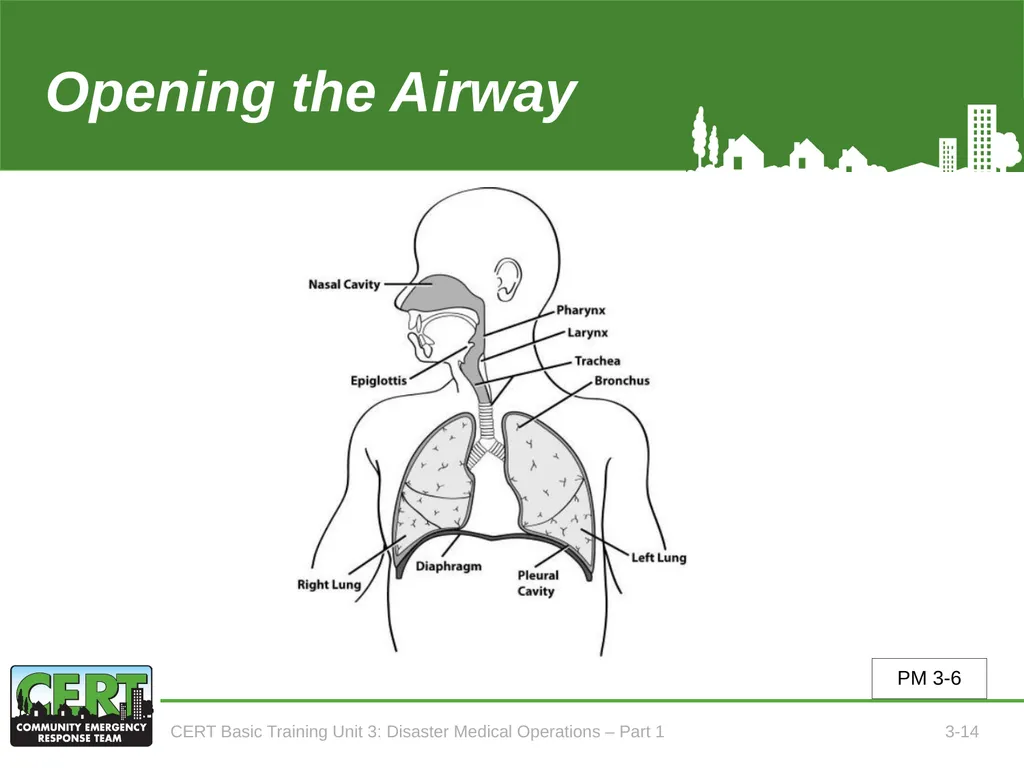
slide15. Opening the Airway PM 3-6 CERT Basic Training Unit 3: Disaster Medical Operations – Part 1 3-14<br>
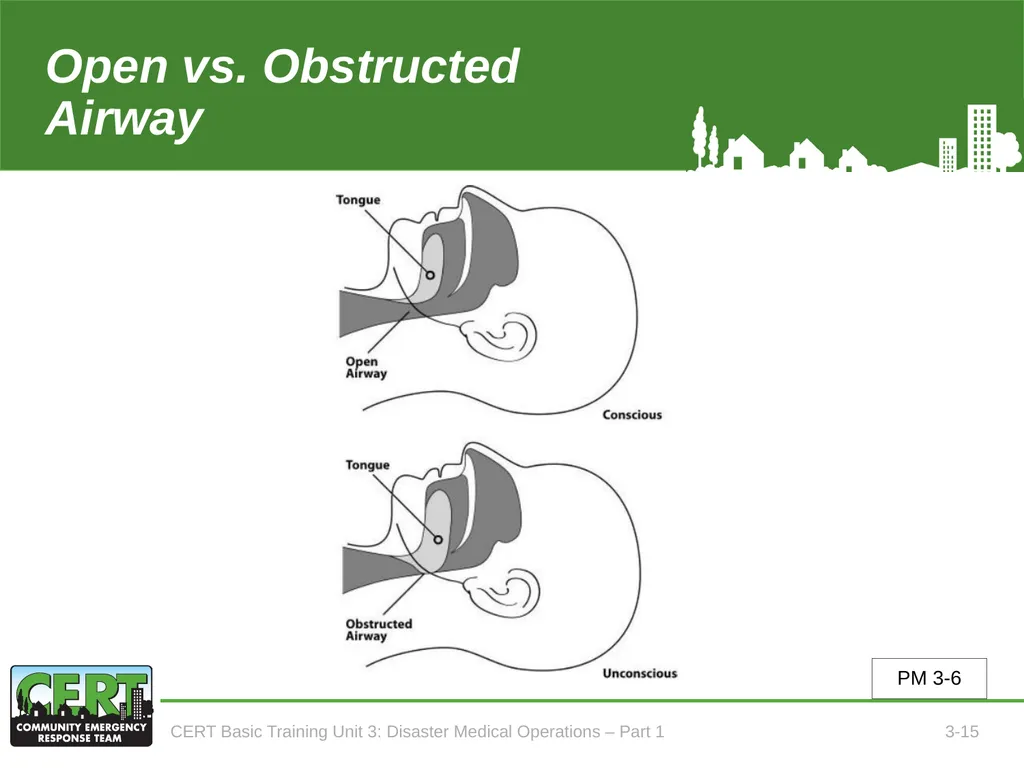
slide16. Open vs. Obstructed Airway PM 3-6 CERT Basic Training Unit 3: Disaster Medical Operations – Part 1 3-15<br>
slide17. Positioning a Conscious Patient When sitting on a raised platform(e.g., chair, bench): Legs shoulder width apart, elbows or hands on knees, and leaning slightly forward
When standing: Legs shoulder width apart, hands on knees arms straight, and leaning forward with flat back PM 3-6 CERT Basic Training Unit 3: Disaster Medical Operations – Part 1 3-16<br>
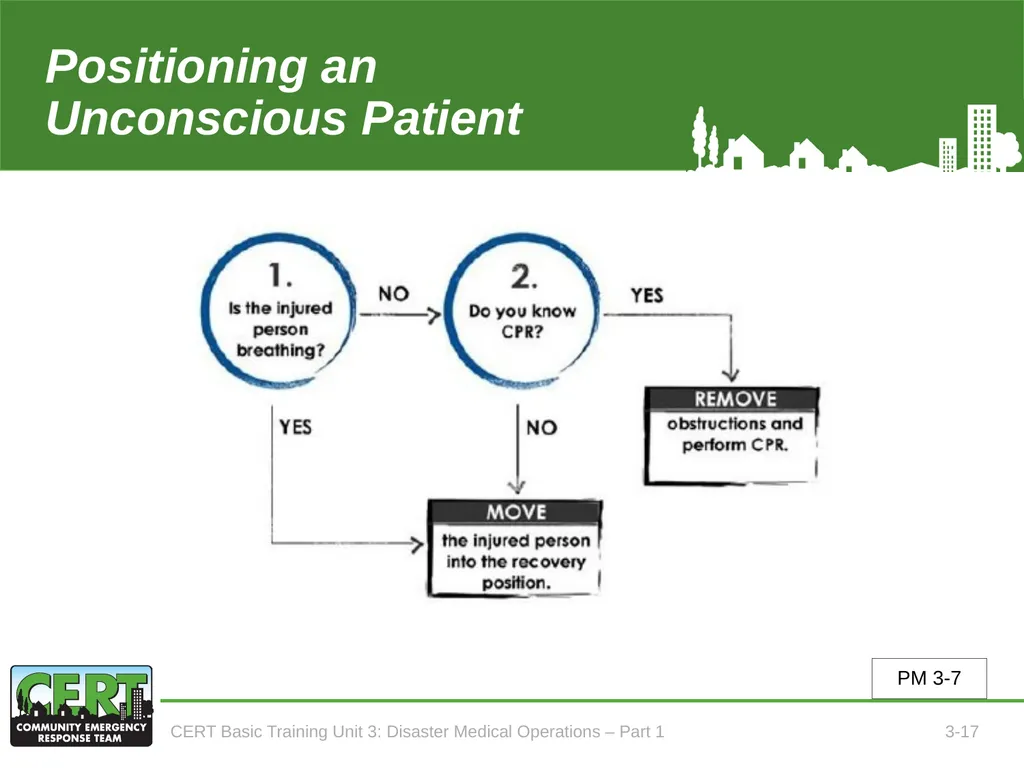
slide18. Positioning an Unconscious Patient PM 3-7 CERT Basic Training Unit 3: Disaster Medical Operations – Part 1 3-17<br>
slide19. Recovery Position Body: Laid on its side
Bottom Arm: Reached outward
Top Arm: Rest hand on bicep of bottom arm
Head: Rest on hand
Legs: Bent slightly
Chin: Raised forward
Mouth: Pointed downward PM 3-7 CERT Basic Training Unit 3: Disaster Medical Operations – Part 1 3-18<br>
slide20. Jaw-thrust Maneuver Kneel above the patient’s head
Put one hand on each side of the patient’s head with the thumbs near the corners of the mouth pointed toward the chin, using the elbows for support
Slide the fingers into position under the angles of the patient’s jawbone without moving the head or neck
Thrust the jaw upward without moving the head or neck to lift the jaw and open the airway PM 3-7 CERT Basic Training Unit 3: Disaster Medical Operations – Part 1 3-19<br>
slide21. Exercise 3.2 Break into pairs and have one person play the rescuer and one person play the patient
Assume that the unconscious injured individual is breathing
Place them into the recovery position using the technique you just learned PM 3-8 CERT Basic Training Unit 3: Disaster Medical Operations – Part 1 3-20<br>
slide22. Providing Comfort What can you do?
Keep them warm
Offer a hand to hold
Maintain eye contact
Be patient and understanding
If you have to move on to provide aid to another person, let them know PM 3-8 CERT Basic Training Unit 3: Disaster Medical Operations – Part 1 3-21<br>
slide23. Treating Burns Prevent hypothermia
Manage pain
Reduce risk of infection PM 3-9 CERT Basic Training Unit 3: Disaster Medical Operations – Part 1 3-22<br>
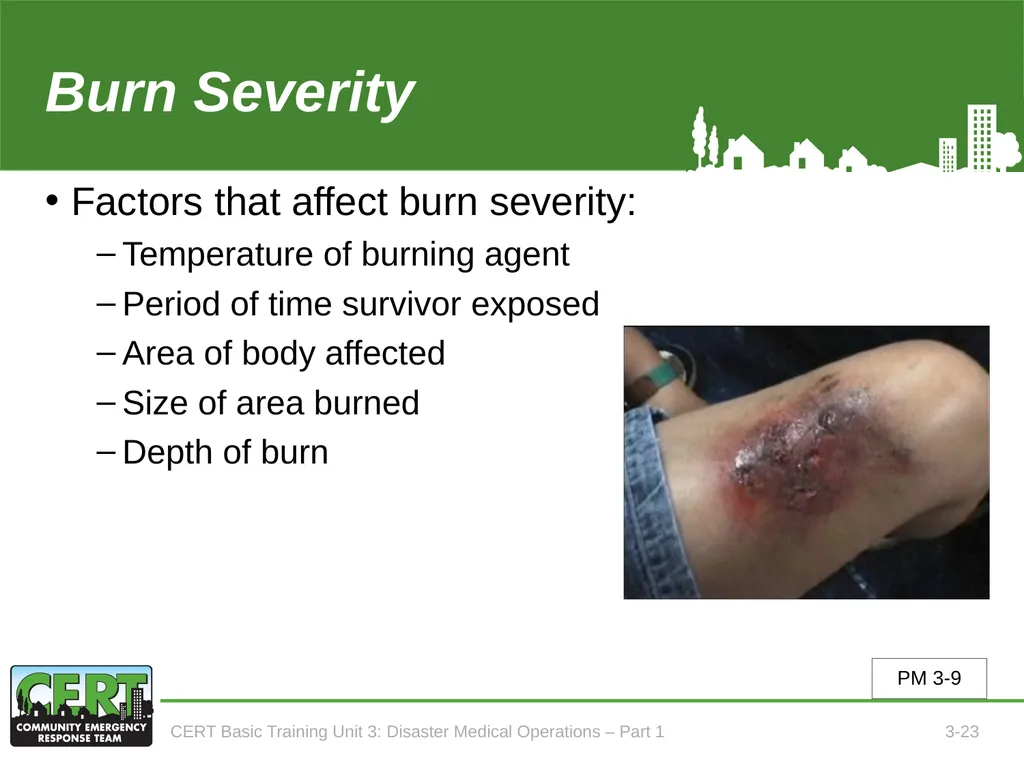
slide24. Burn Severity Factors that affect burn severity:
Temperature of burning agent
Period of time survivor exposed
Area of body affected
Size of area burned
Depth of burn PM 3-9 CERT Basic Training Unit 3: Disaster Medical Operations – Part 1 3-23<br>
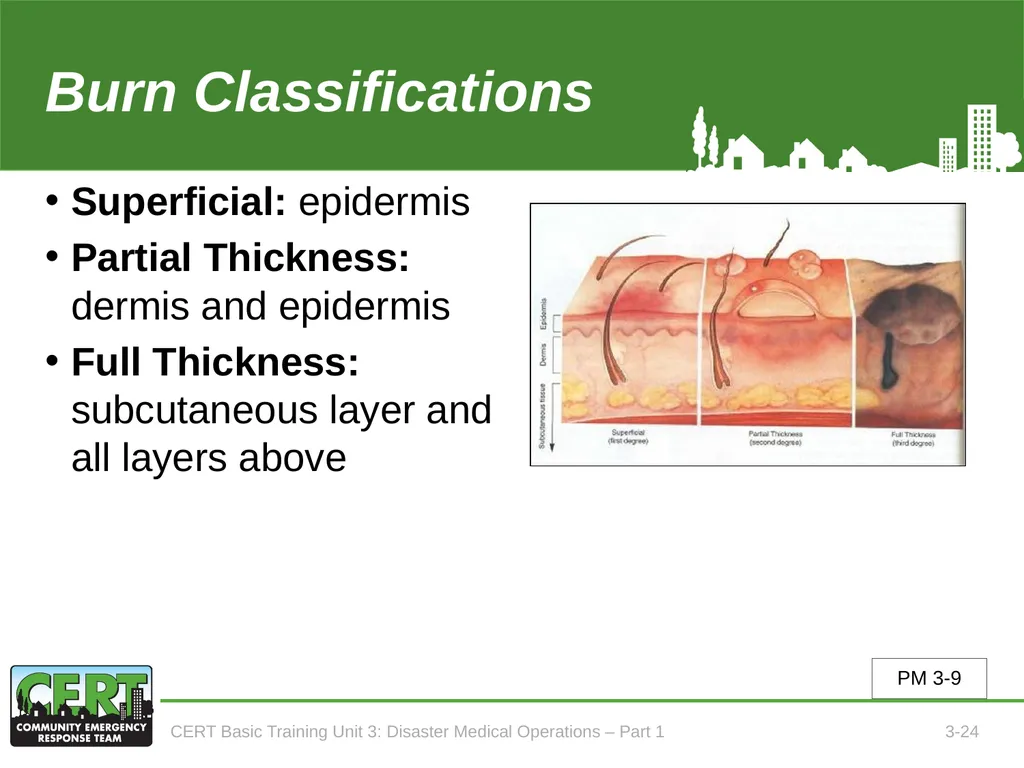
slide25. Burn Classifications Superficial: epidermis
Partial Thickness: dermis and epidermis
Full Thickness: subcutaneous layer and all layers above PM 3-9 CERT Basic Training Unit 3: Disaster Medical Operations – Part 1 3-24<br>
slide26. Treatment for Chemical Burns Remove cause of burn and affected clothing or jewelry
If irritant is dry, gently brush away as much as possible
Always brush away from eyes, survivor, and yourself
Flush with lots of cool running water
Apply cool, wet compress to relieve pain
Cover wound loosely with dry, sterile or clean dressing PM 3-10 CERT Basic Training Unit 3: Disaster Medical Operations – Part 1 3-25<br>
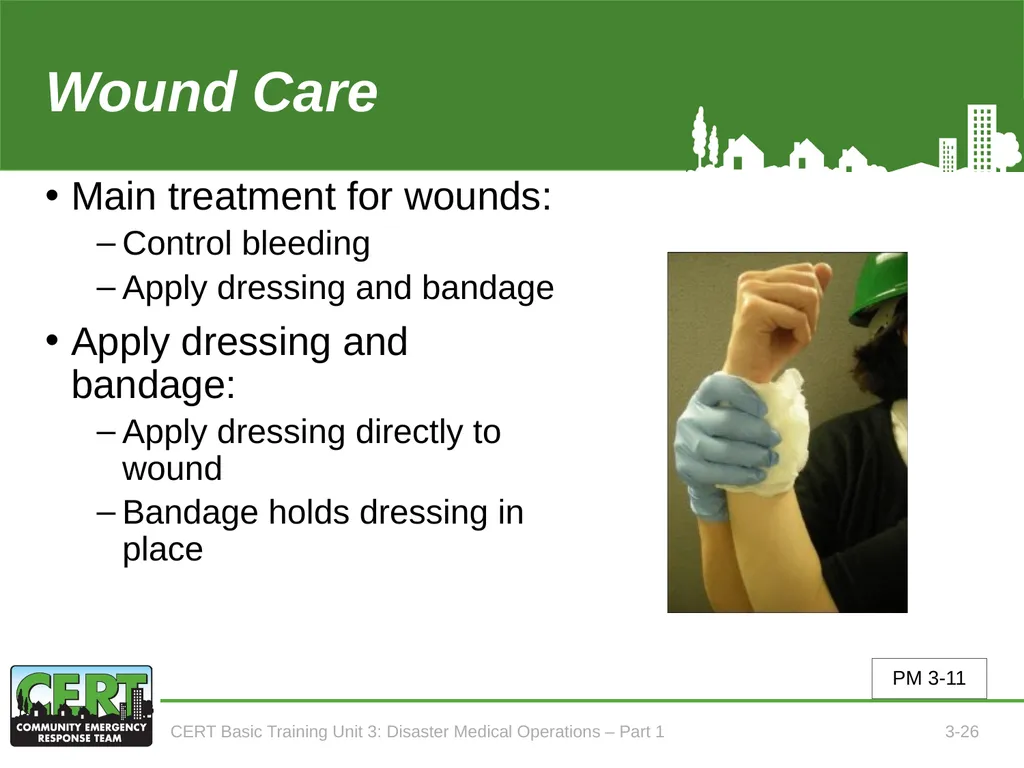
slide27. Wound Care Main treatment for wounds:
Control bleeding
Apply dressing and bandage
Apply dressing and bandage:
Apply dressing directly to wound
Bandage holds dressing in place PM 3-11 CERT Basic Training Unit 3: Disaster Medical Operations – Part 1 3-26<br>
slide28. Rules of Dressing If active bleeding:
Redress OVER existing dressing
If no active bleeding:
Maintain the pressure and keep wound bandaged until further treatment by a medical professional PM 3-11 CERT Basic Training Unit 3: Disaster Medical Operations – Part 1 3-27<br>
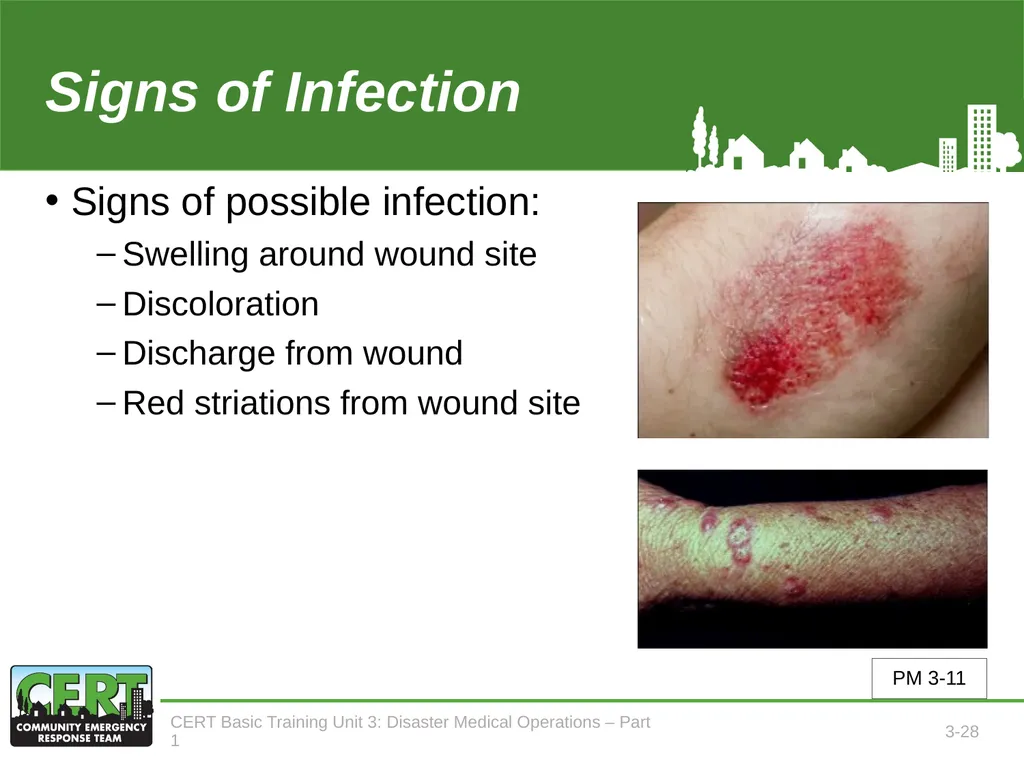
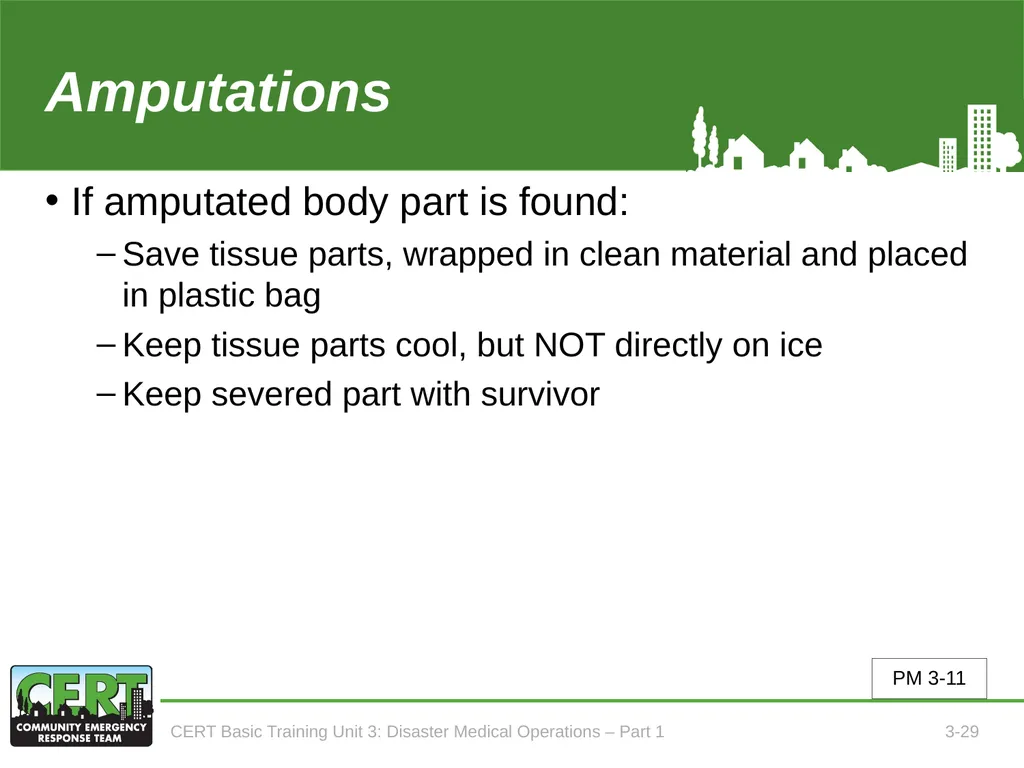
slide29. Signs of Infection Signs of possible infection:
Swelling around wound site
Discoloration
Discharge from wound
Red striations from wound site PM 3-11 CERT Basic Training Unit 3: Disaster Medical Operations – Part 1 3-28<br>
slide30. Amputations If amputated body part is found:
Save tissue parts, wrapped in clean material and placed in plastic bag
Keep tissue parts cool, but NOT directly on ice
Keep severed part with survivor PM 3-11 CERT Basic Training Unit 3: Disaster Medical Operations – Part 1 3-29<br>
slide31. Impaled Objects When foreign object is impaled in patient’s body:
Immobilize affected body part
Do not attempt to move or remove
Try to control bleeding at entrance wound
Clean and dress wound, making sure to stabilize impaled object PM 3-12 CERT Basic Training Unit 3: Disaster Medical Operations – Part 1 3-30<br>
slide32. Fractures, Dislocations, Sprains, Strains Immobilize injury and joints immediately above and below injury site
If uncertain of injury type, treat as fracture PM 3-12 CERT Basic Training Unit 3: Disaster Medical Operations – Part 1 3-31<br>
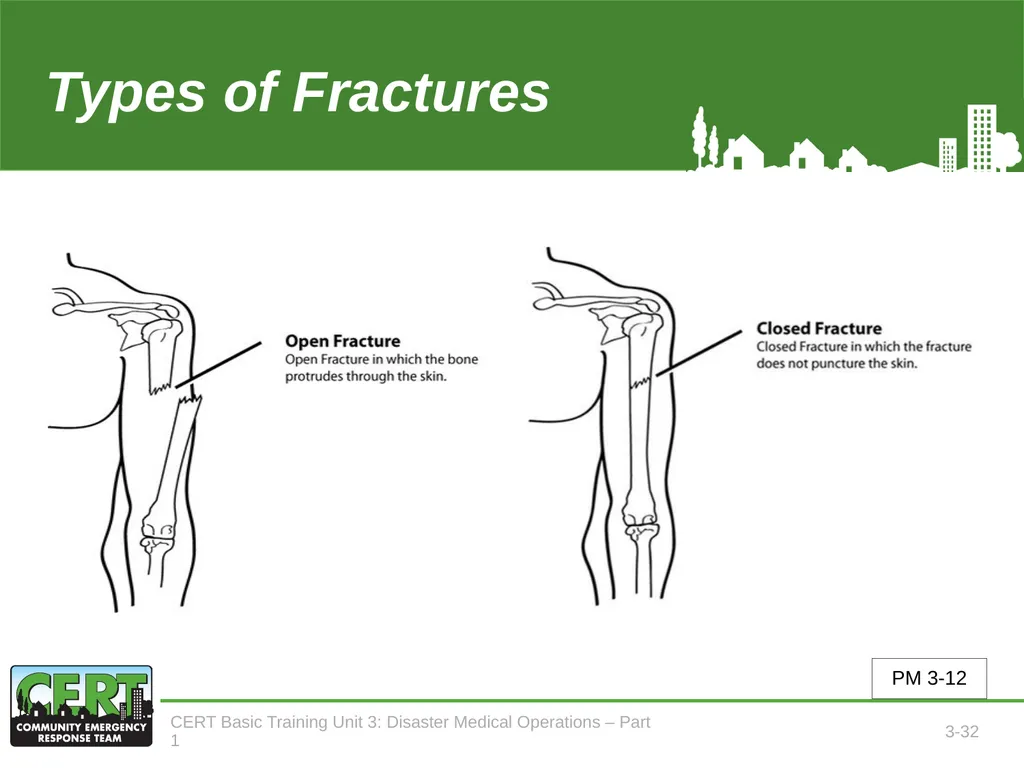
slide33. Types of Fractures (1 of 2) PM 3-12 CERT Basic Training Unit 3: Disaster Medical Operations – Part 1 3-32<br>
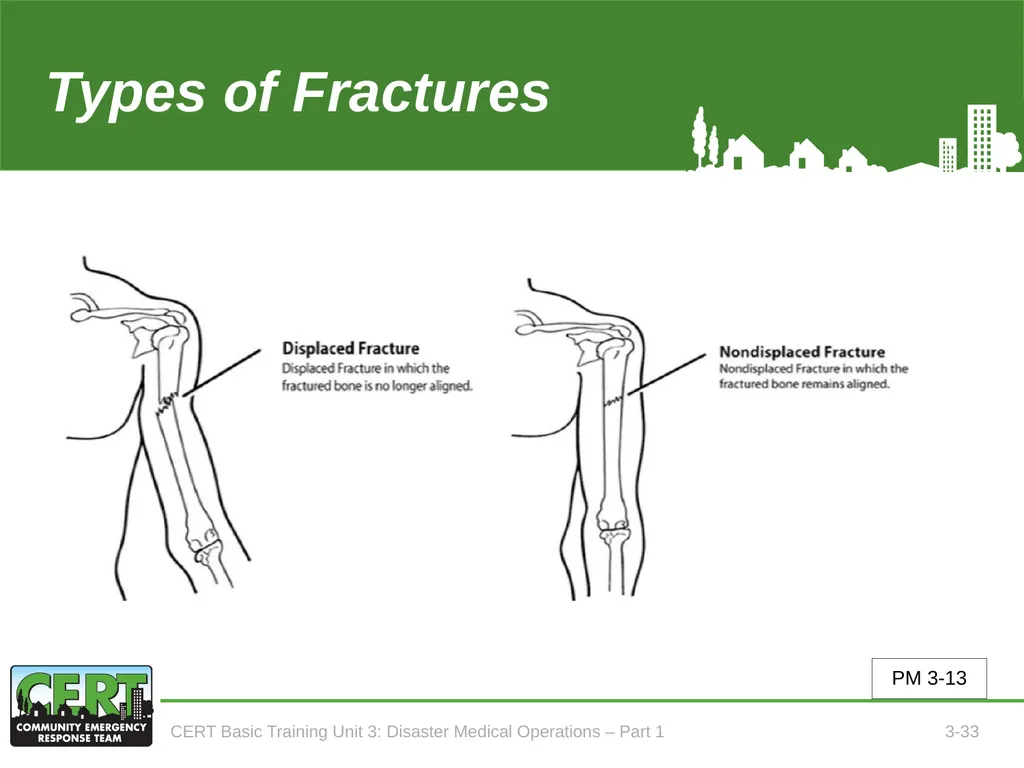
slide34. Types of Fractures (2 of 2) PM 3-13 CERT Basic Training Unit 3: Disaster Medical Operations – Part 1 3-33<br>
slide35. Treating Open Fractures Do not draw exposed bone ends back into tissue
Do not irrigate wound
Cover wound with sterile dressing
Splint fracture without disturbing wound
Place moist dressing over bone end PM 3-13 CERT Basic Training Unit 3: Disaster Medical Operations – Part 1 3-34<br>
slide36. Dislocations Dislocation is injury to ligaments around a joint
It is so severe that it permits separation of bone from its normal position in a joint
Treatment:
Immobilize; do NOT relocate
Check Pulse, Movement, and Sensation (PMS) before and after splinting/immobilization PM 3-13 CERT Basic Training Unit 3: Disaster Medical Operations – Part 1 3-35<br>
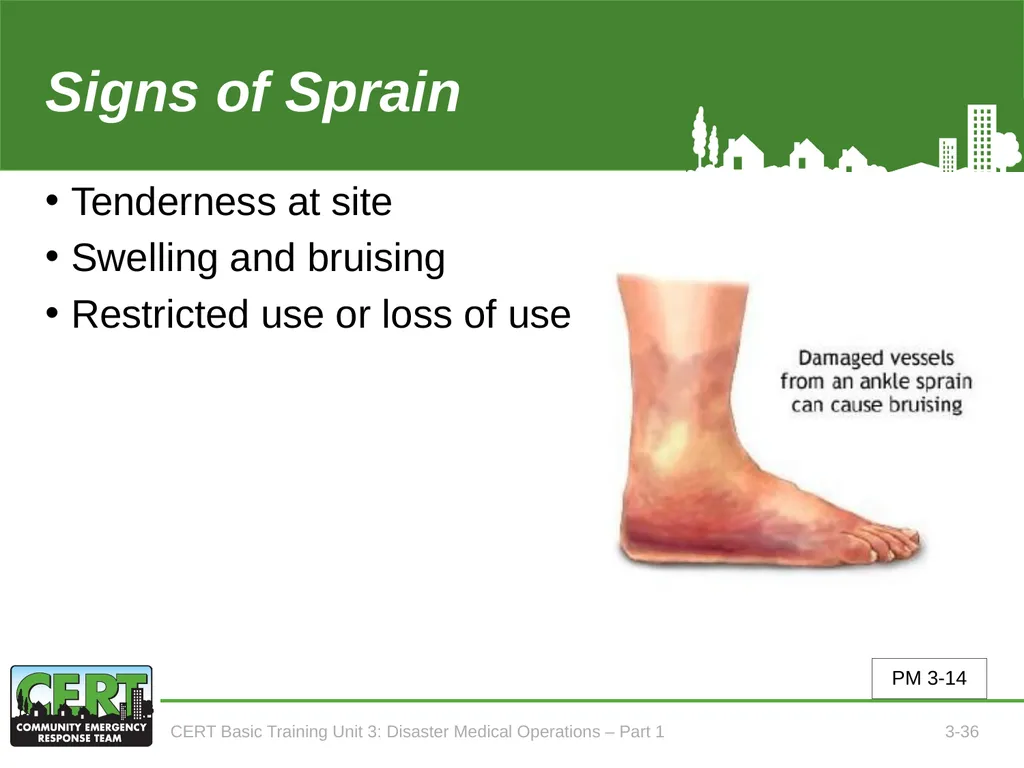
slide37. Signs of Sprain Tenderness at site
Swelling and bruising
Restricted use or loss of use PM 3-14 CERT Basic Training Unit 3: Disaster Medical Operations – Part 1 3-36<br>
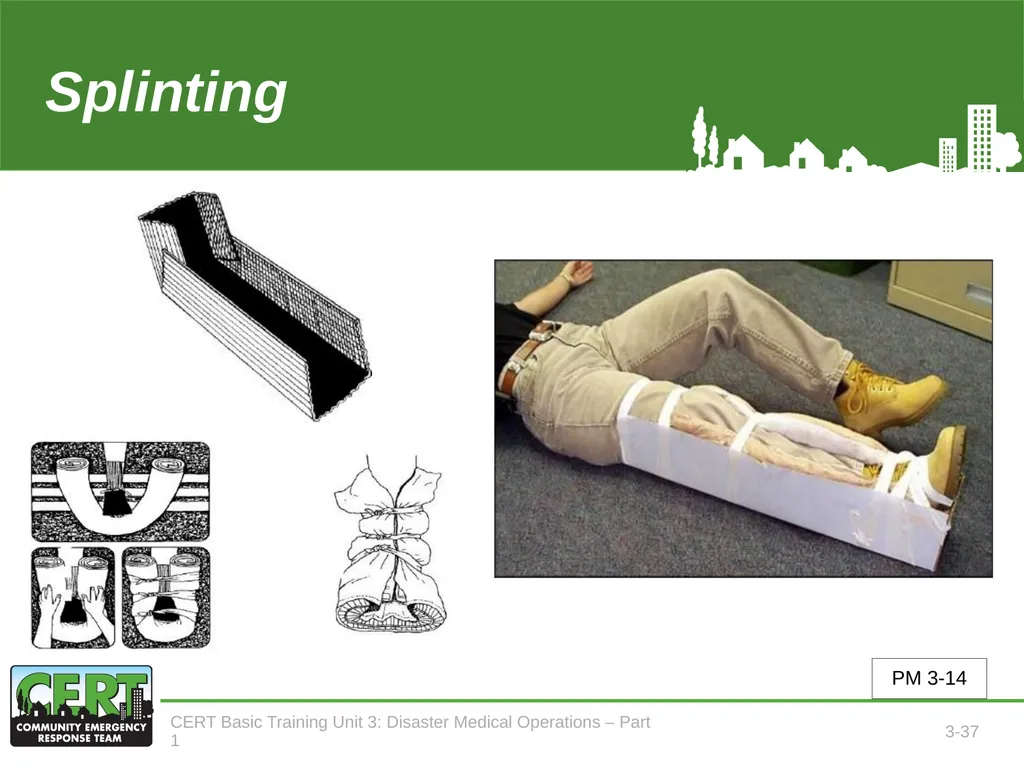
slide38. Splinting PM 3-14 CERT Basic Training Unit 3: Disaster Medical Operations – Part 1 3-37<br>
slide39. Cold-Related Injuries Hypothermia:
Occurs when body’s temperature drops below normal
Frostbite:
Occurs when extreme cold shuts down blood flow to extremities, causing tissue death PM 3-16 CERT Basic Training Unit 3: Disaster Medical Operations – Part 1 3-38<br>
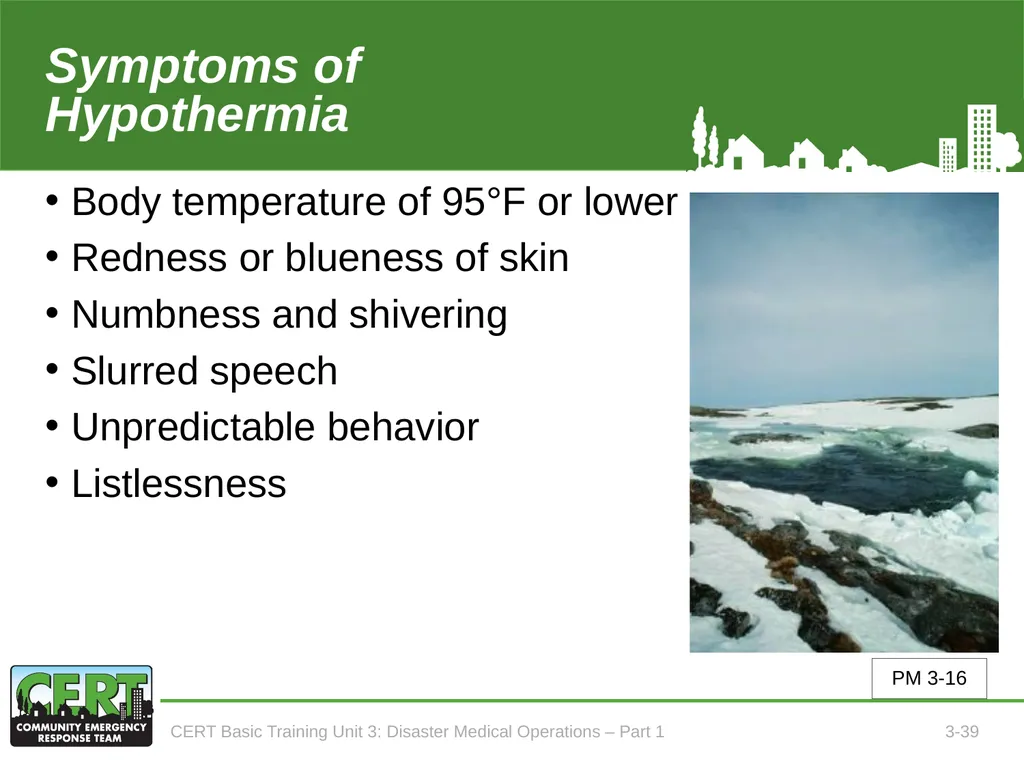
slide40. Symptoms of Hypothermia Body temperature of 95°F or lower
Redness or blueness of skin
Numbness and shivering
Slurred speech
Unpredictable behavior
Listlessness PM 3-16 CERT Basic Training Unit 3: Disaster Medical Operations – Part 1 3-39<br>
slide41. Hypothermia Treatment Remove wet clothing
Put something under the patient
Keep them sheltered and/or covered
Do not attempt to use massage
Place in the recovery position if unconscious PM 3-16 CERT Basic Training Unit 3: Disaster Medical Operations – Part 1 3-40<br>
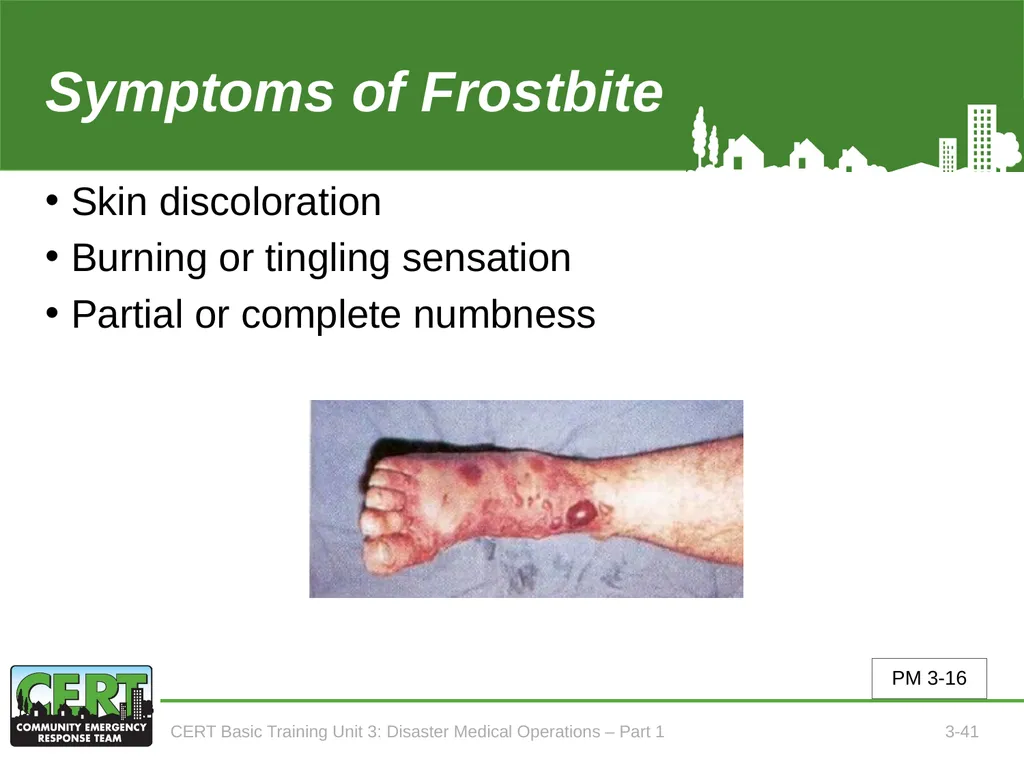
slide42. Symptoms of Frostbite Skin discoloration
Burning or tingling sensation
Partial or complete numbness PM 3-16 CERT Basic Training Unit 3: Disaster Medical Operations – Part 1 3-41<br>
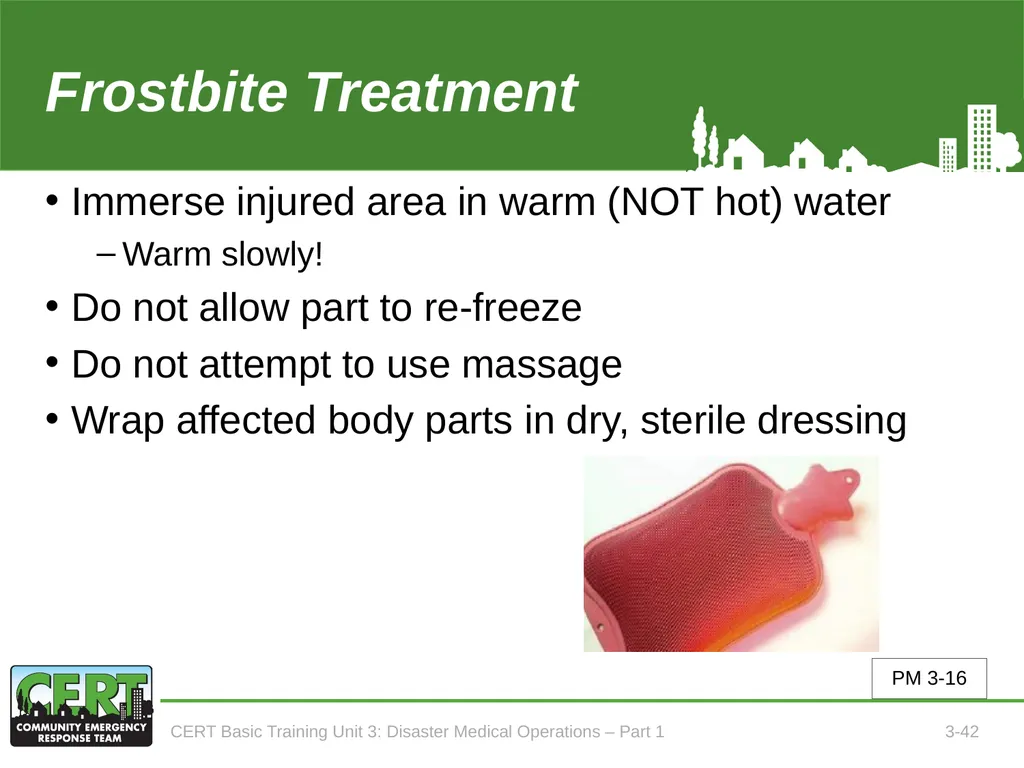
slide43. Frostbite Treatment Immerse injured area in warm (NOT hot) water
Warm slowly!
Do not allow part to re-freeze
Do not attempt to use massage
Wrap affected body parts in dry, sterile dressing PM 3-16 CERT Basic Training Unit 3: Disaster Medical Operations – Part 1 3-42<br>
slide44. Heat-Related Injuries Heat cramps
Muscle spasms brought on by over-exertion in extreme heat
Heat exhaustion
Occurs when exercising or working in extreme heat results in loss of body fluids
Heat stroke
Survivor’s temperature control system shuts down
Body temperature rises so high that brain damage and death may result PM 3-17 CERT Basic Training Unit 3: Disaster Medical Operations – Part 1 3-43<br>
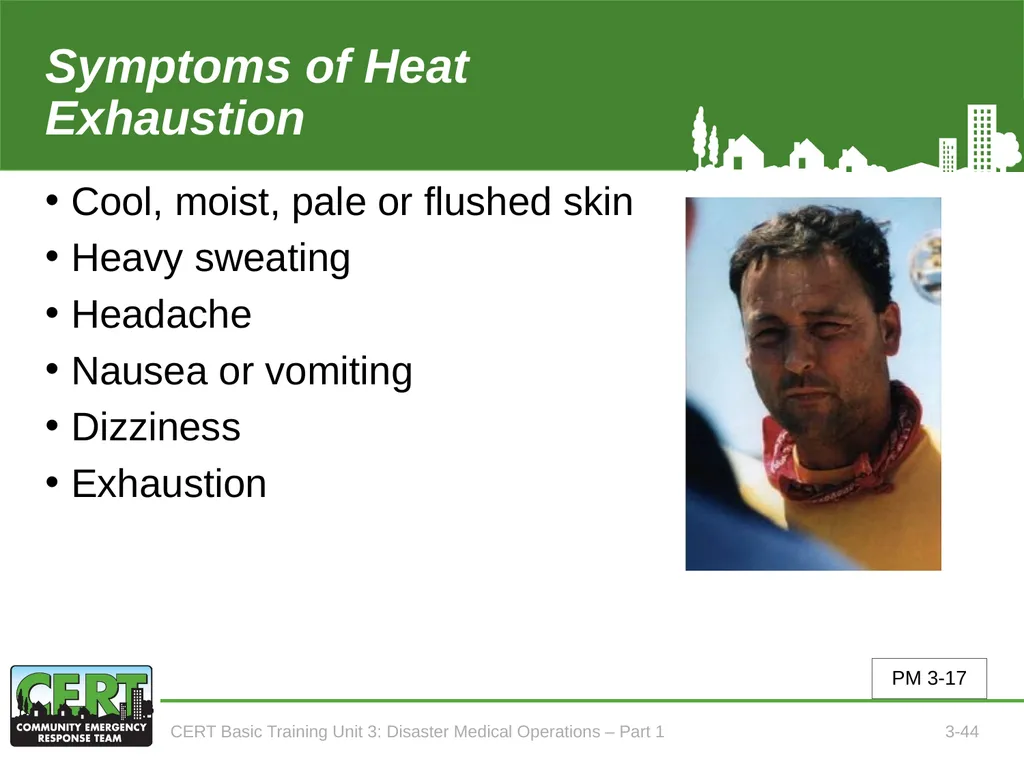
slide45. Symptoms of Heat Exhaustion Cool, moist, pale or flushed skin
Heavy sweating
Headache
Nausea or vomiting
Dizziness
Exhaustion PM 3-17 CERT Basic Training Unit 3: Disaster Medical Operations – Part 1 3-44<br>
slide46. Symptoms of Heat Stroke Hot, red skin
Lack of perspiration
Changes in consciousness
Rapid, weak pulse and rapid, shallow breathing PM 3-17 CERT Basic Training Unit 3: Disaster Medical Operations – Part 1 3-45<br>
slide47. Treatment of Heat-Related Injuries Remove from heat to cool environment
Cool body slowly
Have the heat exhaustion patient drink water, SLOWLY
Do not provide food or drink to the patient if he or she is experiencing vomiting, cramping, or is losing consciousness PM 3-18 CERT Basic Training Unit 3: Disaster Medical Operations – Part 1 3-46<br>
slide48. Treatment for Bites/Stings If bite or sting is suspected, and situation is non-emergency:
Remove stinger if still present by scraping edge of credit card or other stiff, straight-edged object across stinger
Wash site thoroughly with soap and water
Place ice on site for 10 minutes on and 10 minutes off PM 3-18 CERT Basic Training Unit 3: Disaster Medical Operations – Part 1 3-47<br>
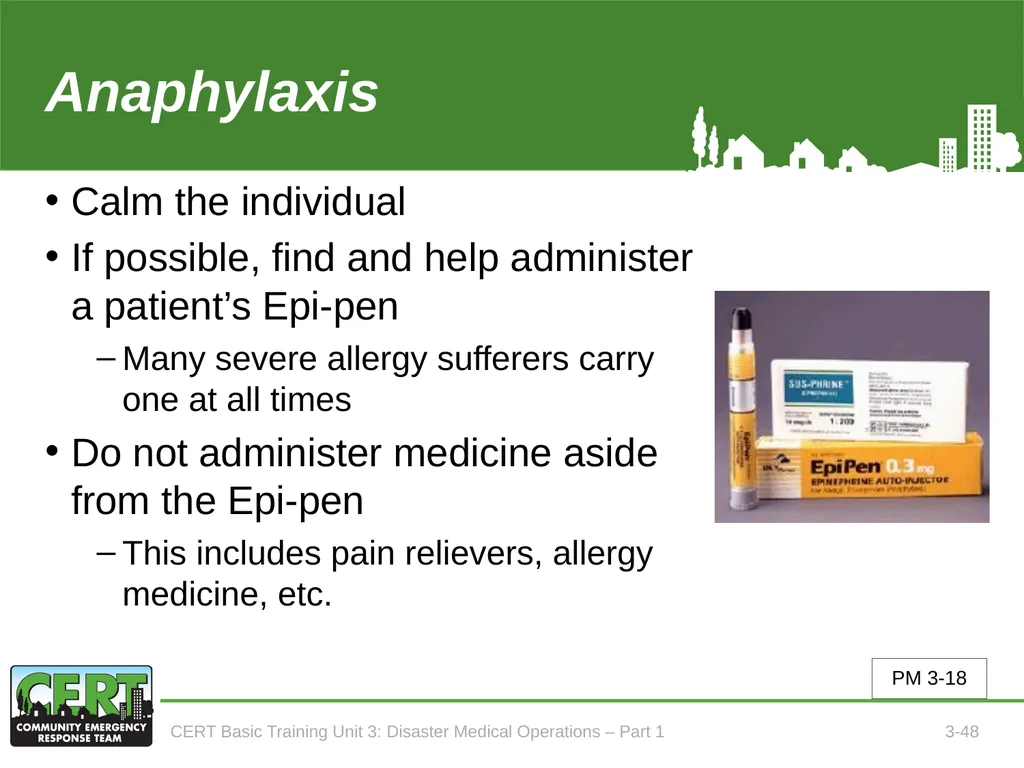
slide49. Anaphylaxis Calm the individual
If possible, find and help administer a patient’s Epi-pen
Many severe allergy sufferers carry one at all times
Do not administer medicine aside from the Epi-pen
This includes pain relievers, allergy medicine, etc. PM 3-18 CERT Basic Training Unit 3: Disaster Medical Operations – Part 1 3-48<br>
slide50. Unit Summary (Unit 3) Life-saving measures CERT volunteers can take:
Control bleeding using direct pressure and/or a tourniquet
Maintain normal body temperature
Open airway and position patient correctly
Other injuries that are common after disasters:
Burns
Wounds
Amputations and impaled objects
Fractures, dislocations, sprains, and strains
Cold-related injuries
Heat-related injuries
Insect bites/stings PM 3-19 CERT Basic Training Unit 3: Disaster Medical Operations – Part 1 3-49<br>
slide51. Homework Assignment (Unit 3) Read unit to be covered in next session
Wear appropriate clothes for next session PM 3-19 CERT Basic Training Unit 3: Disaster Medical Operations – Part 1 3-50<br>
slide2. Unit 3 Objectives Identify life-threatening conditions resulting from trauma including severe bleeding, low body temperature, and airway blockage
Apply correct life saving techniques
Provide basic first-aid care for non-life threatening injuries PM 3-1 CERT Basic Training Unit 3: Disaster Medical Operations – Part 1 3-1<br>
slide3. Treating Life-Threatening Conditions Without treatment, severe bleeding and airway obstruction can quickly lead to death
The first priority of CERT volunteers assisting in disaster medical operations is to attend to these conditions by controlling bleeding and positioning a patient so they can breathe PM 3-2 CERT Basic Training Unit 3: Disaster Medical Operations – Part 1 3-2<br>
slide4. Safety Considerations Prior to treatment, ensure that both the patient and rescuer are in a safe environment to administer care
Some questions CERT volunteers to consider
Do I feel safe at this spot?
Should I leave and move to a safer location, or am I able to stay and start providing care immediately?
If I leave, can I take anyone with me? PM 3-2 CERT Basic Training Unit 3: Disaster Medical Operations – Part 1 3-3<br>
slide5. Approaching the Patient Be sure patient can see you
Identify yourself
Your name and name of your organization
Request permission to treat, if possible
Respect cultural differences
Protect patient privacy PM 3-2 CERT Basic Training Unit 3: Disaster Medical Operations – Part 1 3-4<br>
slide6. Life-Threatening Bleeding Indicators of life-threatening bleeding:
Spurting/steady bleeding
Blood is pooling
Blood is soaking through over lying clothes
Blood is soaking through bandages
Amputation PM 3-3 CERT Basic Training Unit 3: Disaster Medical Operations – Part 1 3-5<br>
slide7. Stages of Severe Bleeding PM 3-3 CERT Basic Training Unit 3: Disaster Medical Operations – Part 1 3-6<br>
slide8. Types of Bleeding Arterial bleeding: Arteries transport blood under high pressure
Blood coming from an artery will spurt
Venous bleeding: Veins transport blood under low pressure
Blood coming from a vein will flow
Capillary bleeding: Capillaries also carry blood under low pressure
Blood coming from capillaries will ooze PM 3-3 CERT Basic Training Unit 3: Disaster Medical Operations – Part 1 3-7<br>
slide9. Types of Bleeding (image) PM 3-3 CERT Basic Training Unit 3: Disaster Medical Operations – Part 1 3-8<br>
slide10. Controlling Bleeding: Direct Pressure Step 1: Find the source(s)
Step 2: Cover the source
Step 3: Apply pressure
Step 4: Maintain pressure until bleeding has stopped PM 3-3 CERT Basic Training Unit 3: Disaster Medical Operations – Part 1 3-9<br>
slide11. Controlling Bleeding: Tourniquets Place on injured limb as high as possible
Pull strap through buckle
Twist rod until bleeding stops/slows
Secure the rod
If bleeding continues, place second tourniquet
Leave in place until EMS takes over PM 3-4 CERT Basic Training Unit 3: Disaster Medical Operations – Part 1 3-10<br>
slide12. Shock Shock is often difficult to diagnose
Main signs of shock:
Rapid and shallow breathing
Capillary refill of greater than two seconds
Failure to follow simple commands, such as “squeeze my hand
Symptoms of shock are easily missed. Pay careful attention to your patient PM 3-5 CERT Basic Training Unit 3: Disaster Medical Operations – Part 1 3-11<br>
slide13. Maintaining Body Temperature Keep the patient warm
Remove wet clothing
Place something between patient and ground (e.g., cardboard, jacket, blanket)
Wrap patient with dry layers (e.g., coat, blanket, Mylar emergency blanket)
Shield patient from wind PM 3-5 CERT Basic Training Unit 3: Disaster Medical Operations – Part 1 3-12<br>
slide14. Exercise 3.1 After breaking into pairs, identify one person to take the role of the patient and one to take the role of the rescuer
Respond as if the patient has an injury on the right forearm, just below the elbow
Apply a pressure bandage or tourniquet (if available)
Repeat the process twice
Swap roles and have the new rescuer complete the above steps PM 3-6 CERT Basic Training Unit 3: Disaster Medical Operations – Part 1 3-13<br>
slide15. Opening the Airway PM 3-6 CERT Basic Training Unit 3: Disaster Medical Operations – Part 1 3-14<br>
slide16. Open vs. Obstructed Airway PM 3-6 CERT Basic Training Unit 3: Disaster Medical Operations – Part 1 3-15<br>
slide17. Positioning a Conscious Patient When sitting on a raised platform(e.g., chair, bench): Legs shoulder width apart, elbows or hands on knees, and leaning slightly forward
When standing: Legs shoulder width apart, hands on knees arms straight, and leaning forward with flat back PM 3-6 CERT Basic Training Unit 3: Disaster Medical Operations – Part 1 3-16<br>
slide18. Positioning an Unconscious Patient PM 3-7 CERT Basic Training Unit 3: Disaster Medical Operations – Part 1 3-17<br>
slide19. Recovery Position Body: Laid on its side
Bottom Arm: Reached outward
Top Arm: Rest hand on bicep of bottom arm
Head: Rest on hand
Legs: Bent slightly
Chin: Raised forward
Mouth: Pointed downward PM 3-7 CERT Basic Training Unit 3: Disaster Medical Operations – Part 1 3-18<br>
slide20. Jaw-thrust Maneuver Kneel above the patient’s head
Put one hand on each side of the patient’s head with the thumbs near the corners of the mouth pointed toward the chin, using the elbows for support
Slide the fingers into position under the angles of the patient’s jawbone without moving the head or neck
Thrust the jaw upward without moving the head or neck to lift the jaw and open the airway PM 3-7 CERT Basic Training Unit 3: Disaster Medical Operations – Part 1 3-19<br>
slide21. Exercise 3.2 Break into pairs and have one person play the rescuer and one person play the patient
Assume that the unconscious injured individual is breathing
Place them into the recovery position using the technique you just learned PM 3-8 CERT Basic Training Unit 3: Disaster Medical Operations – Part 1 3-20<br>
slide22. Providing Comfort What can you do?
Keep them warm
Offer a hand to hold
Maintain eye contact
Be patient and understanding
If you have to move on to provide aid to another person, let them know PM 3-8 CERT Basic Training Unit 3: Disaster Medical Operations – Part 1 3-21<br>
slide23. Treating Burns Prevent hypothermia
Manage pain
Reduce risk of infection PM 3-9 CERT Basic Training Unit 3: Disaster Medical Operations – Part 1 3-22<br>
slide24. Burn Severity Factors that affect burn severity:
Temperature of burning agent
Period of time survivor exposed
Area of body affected
Size of area burned
Depth of burn PM 3-9 CERT Basic Training Unit 3: Disaster Medical Operations – Part 1 3-23<br>
slide25. Burn Classifications Superficial: epidermis
Partial Thickness: dermis and epidermis
Full Thickness: subcutaneous layer and all layers above PM 3-9 CERT Basic Training Unit 3: Disaster Medical Operations – Part 1 3-24<br>
slide26. Treatment for Chemical Burns Remove cause of burn and affected clothing or jewelry
If irritant is dry, gently brush away as much as possible
Always brush away from eyes, survivor, and yourself
Flush with lots of cool running water
Apply cool, wet compress to relieve pain
Cover wound loosely with dry, sterile or clean dressing PM 3-10 CERT Basic Training Unit 3: Disaster Medical Operations – Part 1 3-25<br>
slide27. Wound Care Main treatment for wounds:
Control bleeding
Apply dressing and bandage
Apply dressing and bandage:
Apply dressing directly to wound
Bandage holds dressing in place PM 3-11 CERT Basic Training Unit 3: Disaster Medical Operations – Part 1 3-26<br>
slide28. Rules of Dressing If active bleeding:
Redress OVER existing dressing
If no active bleeding:
Maintain the pressure and keep wound bandaged until further treatment by a medical professional PM 3-11 CERT Basic Training Unit 3: Disaster Medical Operations – Part 1 3-27<br>
slide29. Signs of Infection Signs of possible infection:
Swelling around wound site
Discoloration
Discharge from wound
Red striations from wound site PM 3-11 CERT Basic Training Unit 3: Disaster Medical Operations – Part 1 3-28<br>
slide30. Amputations If amputated body part is found:
Save tissue parts, wrapped in clean material and placed in plastic bag
Keep tissue parts cool, but NOT directly on ice
Keep severed part with survivor PM 3-11 CERT Basic Training Unit 3: Disaster Medical Operations – Part 1 3-29<br>
slide31. Impaled Objects When foreign object is impaled in patient’s body:
Immobilize affected body part
Do not attempt to move or remove
Try to control bleeding at entrance wound
Clean and dress wound, making sure to stabilize impaled object PM 3-12 CERT Basic Training Unit 3: Disaster Medical Operations – Part 1 3-30<br>
slide32. Fractures, Dislocations, Sprains, Strains Immobilize injury and joints immediately above and below injury site
If uncertain of injury type, treat as fracture PM 3-12 CERT Basic Training Unit 3: Disaster Medical Operations – Part 1 3-31<br>
slide33. Types of Fractures (1 of 2) PM 3-12 CERT Basic Training Unit 3: Disaster Medical Operations – Part 1 3-32<br>
slide34. Types of Fractures (2 of 2) PM 3-13 CERT Basic Training Unit 3: Disaster Medical Operations – Part 1 3-33<br>
slide35. Treating Open Fractures Do not draw exposed bone ends back into tissue
Do not irrigate wound
Cover wound with sterile dressing
Splint fracture without disturbing wound
Place moist dressing over bone end PM 3-13 CERT Basic Training Unit 3: Disaster Medical Operations – Part 1 3-34<br>
slide36. Dislocations Dislocation is injury to ligaments around a joint
It is so severe that it permits separation of bone from its normal position in a joint
Treatment:
Immobilize; do NOT relocate
Check Pulse, Movement, and Sensation (PMS) before and after splinting/immobilization PM 3-13 CERT Basic Training Unit 3: Disaster Medical Operations – Part 1 3-35<br>
slide37. Signs of Sprain Tenderness at site
Swelling and bruising
Restricted use or loss of use PM 3-14 CERT Basic Training Unit 3: Disaster Medical Operations – Part 1 3-36<br>
slide38. Splinting PM 3-14 CERT Basic Training Unit 3: Disaster Medical Operations – Part 1 3-37<br>
slide39. Cold-Related Injuries Hypothermia:
Occurs when body’s temperature drops below normal
Frostbite:
Occurs when extreme cold shuts down blood flow to extremities, causing tissue death PM 3-16 CERT Basic Training Unit 3: Disaster Medical Operations – Part 1 3-38<br>
slide40. Symptoms of Hypothermia Body temperature of 95°F or lower
Redness or blueness of skin
Numbness and shivering
Slurred speech
Unpredictable behavior
Listlessness PM 3-16 CERT Basic Training Unit 3: Disaster Medical Operations – Part 1 3-39<br>
slide41. Hypothermia Treatment Remove wet clothing
Put something under the patient
Keep them sheltered and/or covered
Do not attempt to use massage
Place in the recovery position if unconscious PM 3-16 CERT Basic Training Unit 3: Disaster Medical Operations – Part 1 3-40<br>
slide42. Symptoms of Frostbite Skin discoloration
Burning or tingling sensation
Partial or complete numbness PM 3-16 CERT Basic Training Unit 3: Disaster Medical Operations – Part 1 3-41<br>
slide43. Frostbite Treatment Immerse injured area in warm (NOT hot) water
Warm slowly!
Do not allow part to re-freeze
Do not attempt to use massage
Wrap affected body parts in dry, sterile dressing PM 3-16 CERT Basic Training Unit 3: Disaster Medical Operations – Part 1 3-42<br>
slide44. Heat-Related Injuries Heat cramps
Muscle spasms brought on by over-exertion in extreme heat
Heat exhaustion
Occurs when exercising or working in extreme heat results in loss of body fluids
Heat stroke
Survivor’s temperature control system shuts down
Body temperature rises so high that brain damage and death may result PM 3-17 CERT Basic Training Unit 3: Disaster Medical Operations – Part 1 3-43<br>
slide45. Symptoms of Heat Exhaustion Cool, moist, pale or flushed skin
Heavy sweating
Headache
Nausea or vomiting
Dizziness
Exhaustion PM 3-17 CERT Basic Training Unit 3: Disaster Medical Operations – Part 1 3-44<br>
slide46. Symptoms of Heat Stroke Hot, red skin
Lack of perspiration
Changes in consciousness
Rapid, weak pulse and rapid, shallow breathing PM 3-17 CERT Basic Training Unit 3: Disaster Medical Operations – Part 1 3-45<br>
slide47. Treatment of Heat-Related Injuries Remove from heat to cool environment
Cool body slowly
Have the heat exhaustion patient drink water, SLOWLY
Do not provide food or drink to the patient if he or she is experiencing vomiting, cramping, or is losing consciousness PM 3-18 CERT Basic Training Unit 3: Disaster Medical Operations – Part 1 3-46<br>
slide48. Treatment for Bites/Stings If bite or sting is suspected, and situation is non-emergency:
Remove stinger if still present by scraping edge of credit card or other stiff, straight-edged object across stinger
Wash site thoroughly with soap and water
Place ice on site for 10 minutes on and 10 minutes off PM 3-18 CERT Basic Training Unit 3: Disaster Medical Operations – Part 1 3-47<br>
slide49. Anaphylaxis Calm the individual
If possible, find and help administer a patient’s Epi-pen
Many severe allergy sufferers carry one at all times
Do not administer medicine aside from the Epi-pen
This includes pain relievers, allergy medicine, etc. PM 3-18 CERT Basic Training Unit 3: Disaster Medical Operations – Part 1 3-48<br>
slide50. Unit Summary (Unit 3) Life-saving measures CERT volunteers can take:
Control bleeding using direct pressure and/or a tourniquet
Maintain normal body temperature
Open airway and position patient correctly
Other injuries that are common after disasters:
Burns
Wounds
Amputations and impaled objects
Fractures, dislocations, sprains, and strains
Cold-related injuries
Heat-related injuries
Insect bites/stings PM 3-19 CERT Basic Training Unit 3: Disaster Medical Operations – Part 1 3-49<br>
slide51. Homework Assignment (Unit 3) Read unit to be covered in next session
Wear appropriate clothes for next session PM 3-19 CERT Basic Training Unit 3: Disaster Medical Operations – Part 1 3-50<br>