
UNIT 7 · 1890–1945 Imperialism Through WWII:
EM
Published · 22 slides · 0 views

1 / 1


Description
UNIT 7 18901945 Imperialism Through WWII: Federal Power in Three Surges Progressive Era WWI mobilization New Deal: one mechanism, three surges apushistoryexamprep.com Free Teacher Resource Unit 7 at a Glance: 55 Years in Four
Related Topics
Share
Embed code
Download this presentation From Below
"UNIT 7 · 1890–1945 Imperialism Through WWII:" is the property of its rightful owner. Permission is granted to download and print the materials on this website for personal, non-commercial use only, and to display it on your personal computer provided you do not modify the materials and that you retain all copyright notices contained in the materials. By downloading content from our website, you accept the terms of this agreement.
Presentation Transcript
01
UNIT 7 · 1890–1945 Imperialism Through WWII:
Federal Power in Three Surges Progressive Era → WWI mobilization → New Deal: one mechanism, three surges apushistoryexamprep.com · Free Teacher Resource<br>
Federal Power in Three Surges Progressive Era → WWI mobilization → New Deal: one mechanism, three surges apushistoryexamprep.com · Free Teacher Resource<br>
02
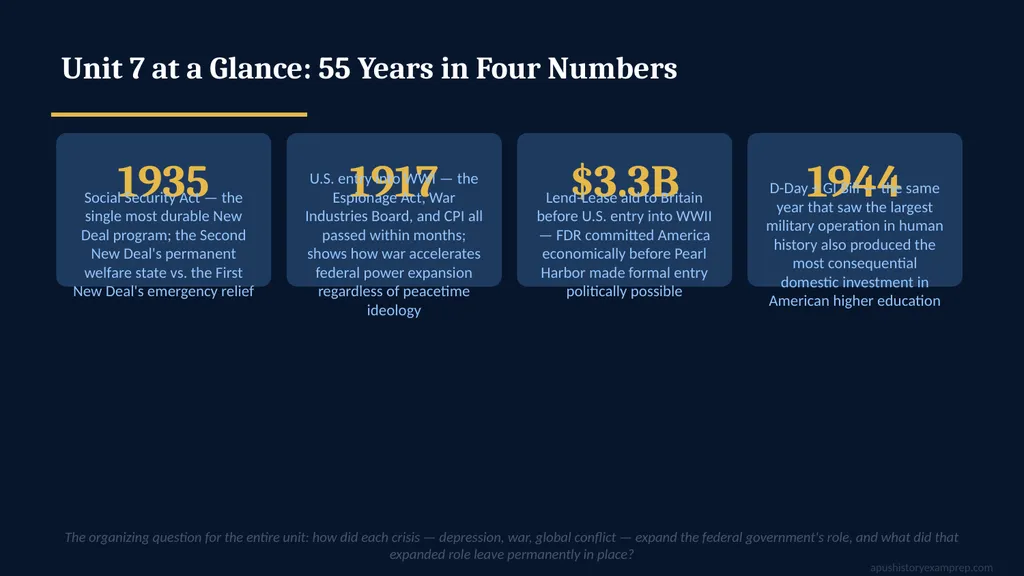
Unit 7 at a Glance: 55 Years in Four Numbers 1935 Social Security Act — the single most durable New Deal program; the Second New Deal's permanent welfare state vs. the First New Deal's emergency relief 1917 U.S. entry into WWI — the Espionage Act, War Industries Board, and CPI all passed within months; shows how war accelerates federal power expansion regardless of peacetime ideology $3.3B Lend-Lease aid to Britain before U.S. entry into WWII — FDR committed America economically before Pearl Harbor made formal entry politically possible 1944 D-Day + GI Bill — the same year that saw the largest military operation in human history also produced the most consequential domestic investment in American higher education The organizing question for the entire unit: how did each crisis — depression, war, global conflict — expand the federal government's role, and what did that expanded role leave permanently in place? apushistoryexamprep.com<br>
03
SECTION 1 OF 4 Organizing 55 Years: Federal Power as the Unit's Spine apushistoryexamprep.com<br>
04
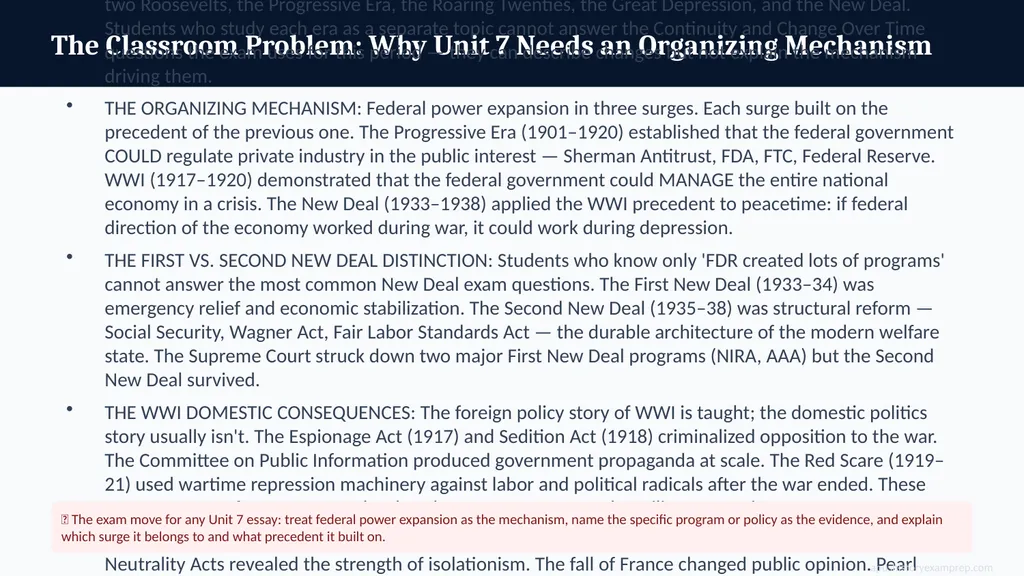
The Classroom Problem: Why Unit 7 Needs an Organizing Mechanism Unit 7 spans 55 years, four wars (Spanish-American, WWI, WWII, and the undeclared conflicts of the era), two Roosevelts, the Progressive Era, the Roaring Twenties, the Great Depression, and the New Deal. Students who study each era as a separate topic cannot answer the Continuity and Change Over Time questions the exam uses for this period — they can describe changes but not explain the mechanism driving them.
THE ORGANIZING MECHANISM: Federal power expansion in three surges. Each surge built on the precedent of the previous one. The Progressive Era (1901–1920) established that the federal government COULD regulate private industry in the public interest — Sherman Antitrust, FDA, FTC, Federal Reserve. WWI (1917–1920) demonstrated that the federal government could MANAGE the entire national economy in a crisis. The New Deal (1933–1938) applied the WWI precedent to peacetime: if federal direction of the economy worked during war, it could work during depression.
THE FIRST VS. SECOND NEW DEAL DISTINCTION: Students who know only 'FDR created lots of programs' cannot answer the most common New Deal exam questions. The First New Deal (1933–34) was emergency relief and economic stabilization. The Second New Deal (1935–38) was structural reform — Social Security, Wagner Act, Fair Labor Standards Act — the durable architecture of the modern welfare state. The Supreme Court struck down two major First New Deal programs (NIRA, AAA) but the Second New Deal survived.
THE WWI DOMESTIC CONSEQUENCES: The foreign policy story of WWI is taught; the domestic politics story usually isn't. The Espionage Act (1917) and Sedition Act (1918) criminalized opposition to the war. The Committee on Public Information produced government propaganda at scale. The Red Scare (1919–21) used wartime repression machinery against labor and political radicals after the war ended. These consequences of WWI are exactly what the exam tests — not the military narrative.
THE WWII FEEDBACK LOOP: Every major WWII foreign policy decision changed domestic politics. The Neutrality Acts revealed the strength of isolationism. The fall of France changed public opinion. Pearl Harbor ended the debate overnight. Japanese American internment showed how wartime emergency powers could override constitutional rights. Each foreign policy development is also a domestic politics development. 📌 The exam move for any Unit 7 essay: treat federal power expansion as the mechanism, name the specific program or policy as the evidence, and explain which surge it belongs to and what precedent it built on. apushistoryexamprep.com<br>
THE ORGANIZING MECHANISM: Federal power expansion in three surges. Each surge built on the precedent of the previous one. The Progressive Era (1901–1920) established that the federal government COULD regulate private industry in the public interest — Sherman Antitrust, FDA, FTC, Federal Reserve. WWI (1917–1920) demonstrated that the federal government could MANAGE the entire national economy in a crisis. The New Deal (1933–1938) applied the WWI precedent to peacetime: if federal direction of the economy worked during war, it could work during depression.
THE FIRST VS. SECOND NEW DEAL DISTINCTION: Students who know only 'FDR created lots of programs' cannot answer the most common New Deal exam questions. The First New Deal (1933–34) was emergency relief and economic stabilization. The Second New Deal (1935–38) was structural reform — Social Security, Wagner Act, Fair Labor Standards Act — the durable architecture of the modern welfare state. The Supreme Court struck down two major First New Deal programs (NIRA, AAA) but the Second New Deal survived.
THE WWI DOMESTIC CONSEQUENCES: The foreign policy story of WWI is taught; the domestic politics story usually isn't. The Espionage Act (1917) and Sedition Act (1918) criminalized opposition to the war. The Committee on Public Information produced government propaganda at scale. The Red Scare (1919–21) used wartime repression machinery against labor and political radicals after the war ended. These consequences of WWI are exactly what the exam tests — not the military narrative.
THE WWII FEEDBACK LOOP: Every major WWII foreign policy decision changed domestic politics. The Neutrality Acts revealed the strength of isolationism. The fall of France changed public opinion. Pearl Harbor ended the debate overnight. Japanese American internment showed how wartime emergency powers could override constitutional rights. Each foreign policy development is also a domestic politics development. 📌 The exam move for any Unit 7 essay: treat federal power expansion as the mechanism, name the specific program or policy as the evidence, and explain which surge it belongs to and what precedent it built on. apushistoryexamprep.com<br>
05
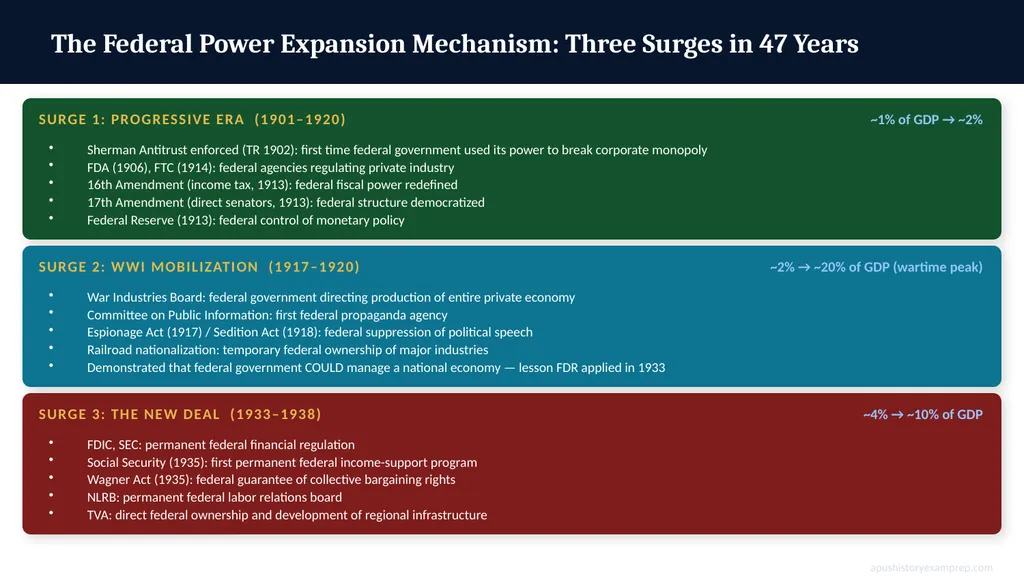
The Federal Power Expansion Mechanism: Three Surges in 47 Years SURGE 1: PROGRESSIVE ERA (1901–1920) ~1% of GDP → ~2% Sherman Antitrust enforced (TR 1902): first time federal government used its power to break corporate monopoly
FDA (1906), FTC (1914): federal agencies regulating private industry
16th Amendment (income tax, 1913): federal fiscal power redefined
17th Amendment (direct senators, 1913): federal structure democratized
Federal Reserve (1913): federal control of monetary policy SURGE 2: WWI MOBILIZATION (1917–1920) ~2% → ~20% of GDP (wartime peak) War Industries Board: federal government directing production of entire private economy
Committee on Public Information: first federal propaganda agency
Espionage Act (1917) / Sedition Act (1918): federal suppression of political speech
Railroad nationalization: temporary federal ownership of major industries
Demonstrated that federal government COULD manage a national economy — lesson FDR applied in 1933 SURGE 3: THE NEW DEAL (1933–1938) ~4% → ~10% of GDP FDIC, SEC: permanent federal financial regulation
Social Security (1935): first permanent federal income-support program
Wagner Act (1935): federal guarantee of collective bargaining rights
NLRB: permanent federal labor relations board
TVA: direct federal ownership and development of regional infrastructure apushistoryexamprep.com<br>
FDA (1906), FTC (1914): federal agencies regulating private industry
16th Amendment (income tax, 1913): federal fiscal power redefined
17th Amendment (direct senators, 1913): federal structure democratized
Federal Reserve (1913): federal control of monetary policy SURGE 2: WWI MOBILIZATION (1917–1920) ~2% → ~20% of GDP (wartime peak) War Industries Board: federal government directing production of entire private economy
Committee on Public Information: first federal propaganda agency
Espionage Act (1917) / Sedition Act (1918): federal suppression of political speech
Railroad nationalization: temporary federal ownership of major industries
Demonstrated that federal government COULD manage a national economy — lesson FDR applied in 1933 SURGE 3: THE NEW DEAL (1933–1938) ~4% → ~10% of GDP FDIC, SEC: permanent federal financial regulation
Social Security (1935): first permanent federal income-support program
Wagner Act (1935): federal guarantee of collective bargaining rights
NLRB: permanent federal labor relations board
TVA: direct federal ownership and development of regional infrastructure apushistoryexamprep.com<br>
06
SECTION 2 OF 4 Imperialism and WWI: Why America Went Global — and What It Cost Domestically apushistoryexamprep.com<br>
07
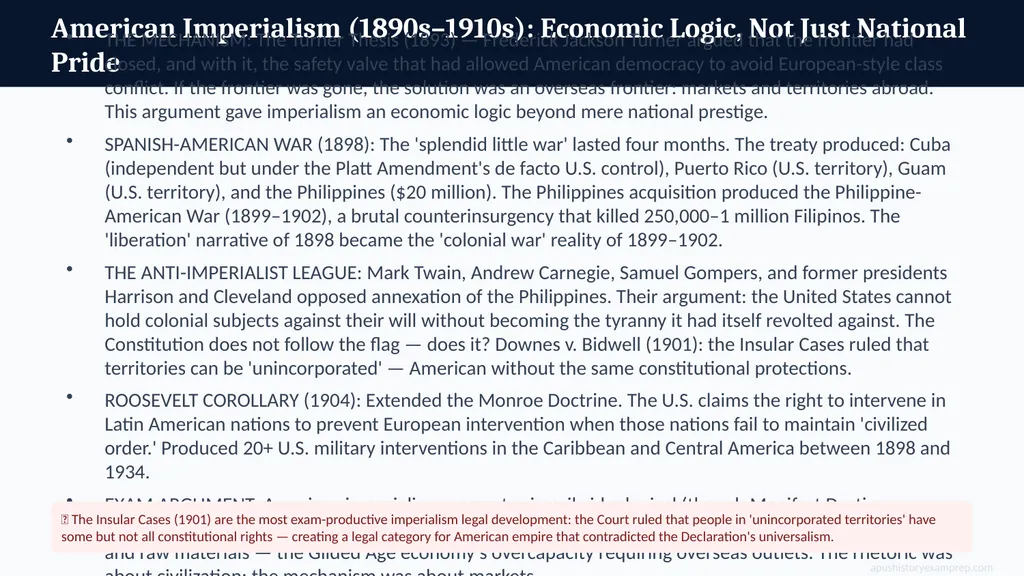
American Imperialism (1890s–1910s): Economic Logic, Not Just National Pride THE MECHANISM: The Turner Thesis (1893) — Frederick Jackson Turner argued that the frontier had closed, and with it, the safety valve that had allowed American democracy to avoid European-style class conflict. If the frontier was gone, the solution was an overseas frontier: markets and territories abroad. This argument gave imperialism an economic logic beyond mere national prestige.
SPANISH-AMERICAN WAR (1898): The 'splendid little war' lasted four months. The treaty produced: Cuba (independent but under the Platt Amendment's de facto U.S. control), Puerto Rico (U.S. territory), Guam (U.S. territory), and the Philippines ($20 million). The Philippines acquisition produced the Philippine-American War (1899–1902), a brutal counterinsurgency that killed 250,000–1 million Filipinos. The 'liberation' narrative of 1898 became the 'colonial war' reality of 1899–1902.
THE ANTI-IMPERIALIST LEAGUE: Mark Twain, Andrew Carnegie, Samuel Gompers, and former presidents Harrison and Cleveland opposed annexation of the Philippines. Their argument: the United States cannot hold colonial subjects against their will without becoming the tyranny it had itself revolted against. The Constitution does not follow the flag — does it? Downes v. Bidwell (1901): the Insular Cases ruled that territories can be 'unincorporated' — American without the same constitutional protections.
ROOSEVELT COROLLARY (1904): Extended the Monroe Doctrine. The U.S. claims the right to intervene in Latin American nations to prevent European intervention when those nations fail to maintain 'civilized order.' Produced 20+ U.S. military interventions in the Caribbean and Central America between 1898 and 1934.
EXAM ARGUMENT: American imperialism was not primarily ideological (though Manifest Destiny language was used). It was driven by the economic logic of industrial capitalism needing export markets and raw materials — the Gilded Age economy's overcapacity requiring overseas outlets. The rhetoric was about civilization; the mechanism was about markets. 📌 The Insular Cases (1901) are the most exam-productive imperialism legal development: the Court ruled that people in 'unincorporated territories' have some but not all constitutional rights — creating a legal category for American empire that contradicted the Declaration's universalism. apushistoryexamprep.com<br>
SPANISH-AMERICAN WAR (1898): The 'splendid little war' lasted four months. The treaty produced: Cuba (independent but under the Platt Amendment's de facto U.S. control), Puerto Rico (U.S. territory), Guam (U.S. territory), and the Philippines ($20 million). The Philippines acquisition produced the Philippine-American War (1899–1902), a brutal counterinsurgency that killed 250,000–1 million Filipinos. The 'liberation' narrative of 1898 became the 'colonial war' reality of 1899–1902.
THE ANTI-IMPERIALIST LEAGUE: Mark Twain, Andrew Carnegie, Samuel Gompers, and former presidents Harrison and Cleveland opposed annexation of the Philippines. Their argument: the United States cannot hold colonial subjects against their will without becoming the tyranny it had itself revolted against. The Constitution does not follow the flag — does it? Downes v. Bidwell (1901): the Insular Cases ruled that territories can be 'unincorporated' — American without the same constitutional protections.
ROOSEVELT COROLLARY (1904): Extended the Monroe Doctrine. The U.S. claims the right to intervene in Latin American nations to prevent European intervention when those nations fail to maintain 'civilized order.' Produced 20+ U.S. military interventions in the Caribbean and Central America between 1898 and 1934.
EXAM ARGUMENT: American imperialism was not primarily ideological (though Manifest Destiny language was used). It was driven by the economic logic of industrial capitalism needing export markets and raw materials — the Gilded Age economy's overcapacity requiring overseas outlets. The rhetoric was about civilization; the mechanism was about markets. 📌 The Insular Cases (1901) are the most exam-productive imperialism legal development: the Court ruled that people in 'unincorporated territories' have some but not all constitutional rights — creating a legal category for American empire that contradicted the Declaration's universalism. apushistoryexamprep.com<br>
08
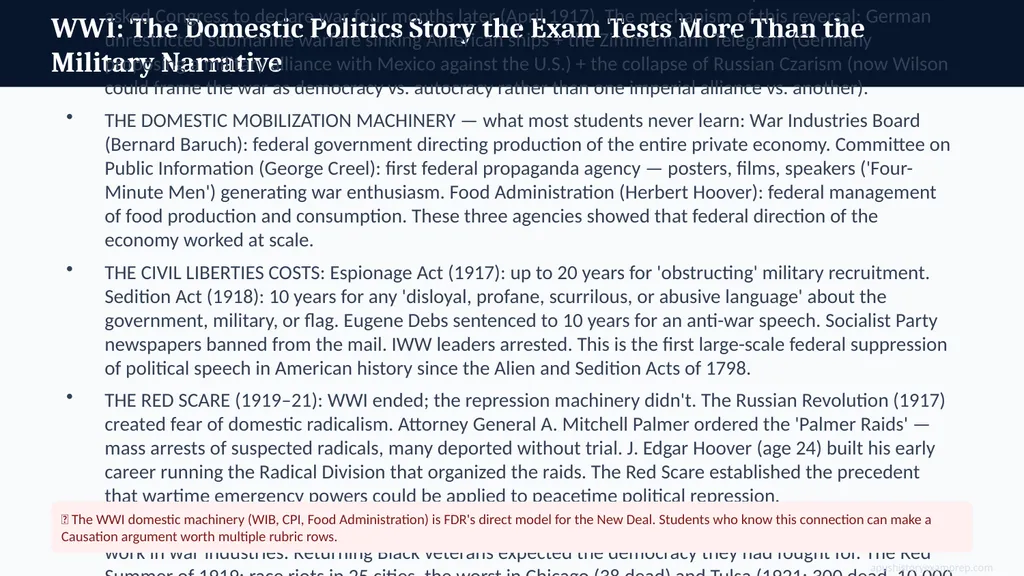
WWI: The Domestic Politics Story the Exam Tests More Than the Military Narrative THE NEUTRALITY PROBLEM: Woodrow Wilson won re-election in 1916 on 'He kept us out of war.' He asked Congress to declare war four months later (April 1917). The mechanism of this reversal: German unrestricted submarine warfare sinking American ships + the Zimmermann Telegram (Germany proposing a military alliance with Mexico against the U.S.) + the collapse of Russian Czarism (now Wilson could frame the war as democracy vs. autocracy rather than one imperial alliance vs. another).
THE DOMESTIC MOBILIZATION MACHINERY — what most students never learn: War Industries Board (Bernard Baruch): federal government directing production of the entire private economy. Committee on Public Information (George Creel): first federal propaganda agency — posters, films, speakers ('Four-Minute Men') generating war enthusiasm. Food Administration (Herbert Hoover): federal management of food production and consumption. These three agencies showed that federal direction of the economy worked at scale.
THE CIVIL LIBERTIES COSTS: Espionage Act (1917): up to 20 years for 'obstructing' military recruitment. Sedition Act (1918): 10 years for any 'disloyal, profane, scurrilous, or abusive language' about the government, military, or flag. Eugene Debs sentenced to 10 years for an anti-war speech. Socialist Party newspapers banned from the mail. IWW leaders arrested. This is the first large-scale federal suppression of political speech in American history since the Alien and Sedition Acts of 1798.
THE RED SCARE (1919–21): WWI ended; the repression machinery didn't. The Russian Revolution (1917) created fear of domestic radicalism. Attorney General A. Mitchell Palmer ordered the 'Palmer Raids' — mass arrests of suspected radicals, many deported without trial. J. Edgar Hoover (age 24) built his early career running the Radical Division that organized the raids. The Red Scare established the precedent that wartime emergency powers could be applied to peacetime political repression.
THE RACIAL VIOLENCE: The Great Migration (1910–1930) brought 1.6 million Black Americans north to work in war industries. Returning Black veterans expected the democracy they had fought for. The Red Summer of 1919: race riots in 25 cities, the worst in Chicago (38 dead) and Tulsa (1921: 300 dead, 10,000 displaced, Greenwood District destroyed). The federal government that had mobilized the nation for democracy abroad did nothing. 📌 The WWI domestic machinery (WIB, CPI, Food Administration) is FDR's direct model for the New Deal. Students who know this connection can make a Causation argument worth multiple rubric rows. apushistoryexamprep.com<br>
THE DOMESTIC MOBILIZATION MACHINERY — what most students never learn: War Industries Board (Bernard Baruch): federal government directing production of the entire private economy. Committee on Public Information (George Creel): first federal propaganda agency — posters, films, speakers ('Four-Minute Men') generating war enthusiasm. Food Administration (Herbert Hoover): federal management of food production and consumption. These three agencies showed that federal direction of the economy worked at scale.
THE CIVIL LIBERTIES COSTS: Espionage Act (1917): up to 20 years for 'obstructing' military recruitment. Sedition Act (1918): 10 years for any 'disloyal, profane, scurrilous, or abusive language' about the government, military, or flag. Eugene Debs sentenced to 10 years for an anti-war speech. Socialist Party newspapers banned from the mail. IWW leaders arrested. This is the first large-scale federal suppression of political speech in American history since the Alien and Sedition Acts of 1798.
THE RED SCARE (1919–21): WWI ended; the repression machinery didn't. The Russian Revolution (1917) created fear of domestic radicalism. Attorney General A. Mitchell Palmer ordered the 'Palmer Raids' — mass arrests of suspected radicals, many deported without trial. J. Edgar Hoover (age 24) built his early career running the Radical Division that organized the raids. The Red Scare established the precedent that wartime emergency powers could be applied to peacetime political repression.
THE RACIAL VIOLENCE: The Great Migration (1910–1930) brought 1.6 million Black Americans north to work in war industries. Returning Black veterans expected the democracy they had fought for. The Red Summer of 1919: race riots in 25 cities, the worst in Chicago (38 dead) and Tulsa (1921: 300 dead, 10,000 displaced, Greenwood District destroyed). The federal government that had mobilized the nation for democracy abroad did nothing. 📌 The WWI domestic machinery (WIB, CPI, Food Administration) is FDR's direct model for the New Deal. Students who know this connection can make a Causation argument worth multiple rubric rows. apushistoryexamprep.com<br>
09
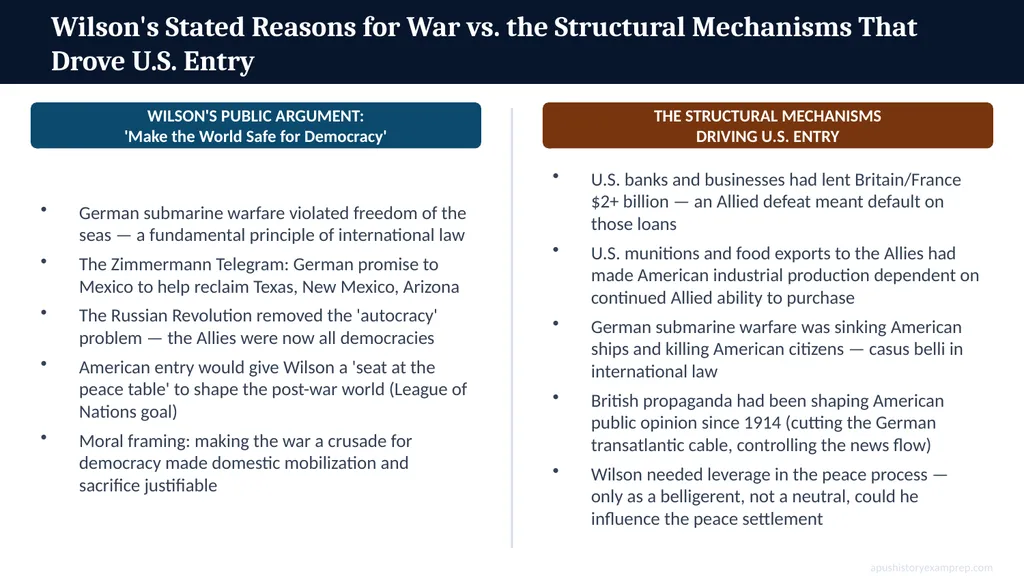
Wilson's Stated Reasons for War vs. the Structural Mechanisms That Drove U.S. Entry WILSON'S PUBLIC ARGUMENT:
'Make the World Safe for Democracy' THE STRUCTURAL MECHANISMS
DRIVING U.S. ENTRY German submarine warfare violated freedom of the seas — a fundamental principle of international law
The Zimmermann Telegram: German promise to Mexico to help reclaim Texas, New Mexico, Arizona
The Russian Revolution removed the 'autocracy' problem — the Allies were now all democracies
American entry would give Wilson a 'seat at the peace table' to shape the post-war world (League of Nations goal)
Moral framing: making the war a crusade for democracy made domestic mobilization and sacrifice justifiable U.S. banks and businesses had lent Britain/France $2+ billion — an Allied defeat meant default on those loans
U.S. munitions and food exports to the Allies had made American industrial production dependent on continued Allied ability to purchase
German submarine warfare was sinking American ships and killing American citizens — casus belli in international law
British propaganda had been shaping American public opinion since 1914 (cutting the German transatlantic cable, controlling the news flow)
Wilson needed leverage in the peace process — only as a belligerent, not a neutral, could he influence the peace settlement apushistoryexamprep.com<br>
'Make the World Safe for Democracy' THE STRUCTURAL MECHANISMS
DRIVING U.S. ENTRY German submarine warfare violated freedom of the seas — a fundamental principle of international law
The Zimmermann Telegram: German promise to Mexico to help reclaim Texas, New Mexico, Arizona
The Russian Revolution removed the 'autocracy' problem — the Allies were now all democracies
American entry would give Wilson a 'seat at the peace table' to shape the post-war world (League of Nations goal)
Moral framing: making the war a crusade for democracy made domestic mobilization and sacrifice justifiable U.S. banks and businesses had lent Britain/France $2+ billion — an Allied defeat meant default on those loans
U.S. munitions and food exports to the Allies had made American industrial production dependent on continued Allied ability to purchase
German submarine warfare was sinking American ships and killing American citizens — casus belli in international law
British propaganda had been shaping American public opinion since 1914 (cutting the German transatlantic cable, controlling the news flow)
Wilson needed leverage in the peace process — only as a belligerent, not a neutral, could he influence the peace settlement apushistoryexamprep.com<br>
10
SECTION 3 OF 4 The New Deal: Two Distinct Legislative Projects, One Durable Legacy apushistoryexamprep.com<br>
11
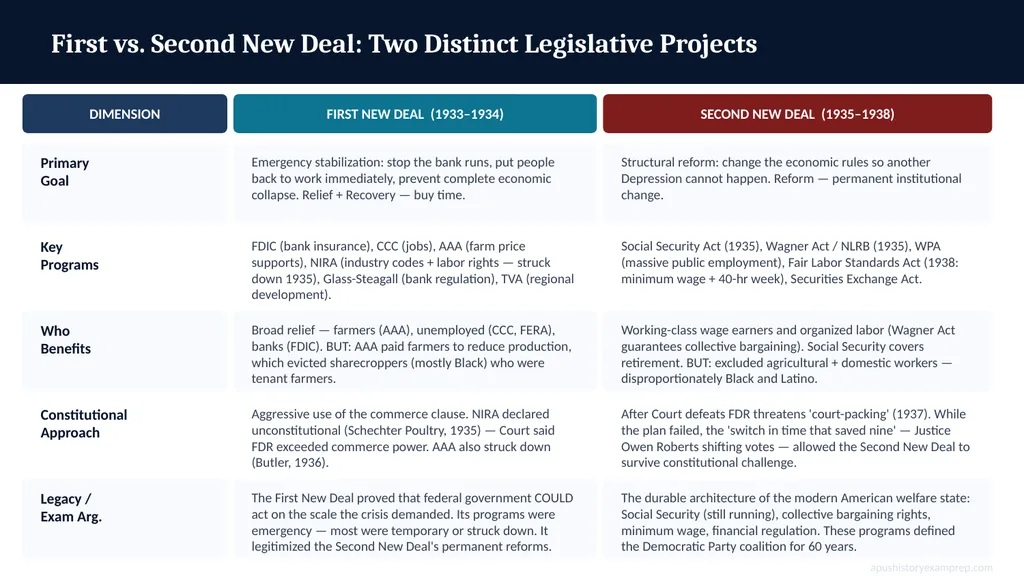
First vs. Second New Deal: Two Distinct Legislative Projects DIMENSION FIRST NEW DEAL (1933–1934) SECOND NEW DEAL (1935–1938) Primary
Goal Emergency stabilization: stop the bank runs, put people back to work immediately, prevent complete economic collapse. Relief + Recovery — buy time. Structural reform: change the economic rules so another Depression cannot happen. Reform — permanent institutional change. Key
Programs FDIC (bank insurance), CCC (jobs), AAA (farm price supports), NIRA (industry codes + labor rights — struck down 1935), Glass-Steagall (bank regulation), TVA (regional development). Social Security Act (1935), Wagner Act / NLRB (1935), WPA (massive public employment), Fair Labor Standards Act (1938: minimum wage + 40-hr week), Securities Exchange Act. Who
Benefits Broad relief — farmers (AAA), unemployed (CCC, FERA), banks (FDIC). BUT: AAA paid farmers to reduce production, which evicted sharecroppers (mostly Black) who were tenant farmers. Working-class wage earners and organized labor (Wagner Act guarantees collective bargaining). Social Security covers retirement. BUT: excluded agricultural + domestic workers — disproportionately Black and Latino. Constitutional
Approach Aggressive use of the commerce clause. NIRA declared unconstitutional (Schechter Poultry, 1935) — Court said FDR exceeded commerce power. AAA also struck down (Butler, 1936). After Court defeats FDR threatens 'court-packing' (1937). While the plan failed, the 'switch in time that saved nine' — Justice Owen Roberts shifting votes — allowed the Second New Deal to survive constitutional challenge. Legacy /
Exam Arg. The First New Deal proved that federal government COULD act on the scale the crisis demanded. Its programs were emergency — most were temporary or struck down. It legitimized the Second New Deal's permanent reforms. The durable architecture of the modern American welfare state: Social Security (still running), collective bargaining rights, minimum wage, financial regulation. These programs defined the Democratic Party coalition for 60 years. apushistoryexamprep.com<br>
Goal Emergency stabilization: stop the bank runs, put people back to work immediately, prevent complete economic collapse. Relief + Recovery — buy time. Structural reform: change the economic rules so another Depression cannot happen. Reform — permanent institutional change. Key
Programs FDIC (bank insurance), CCC (jobs), AAA (farm price supports), NIRA (industry codes + labor rights — struck down 1935), Glass-Steagall (bank regulation), TVA (regional development). Social Security Act (1935), Wagner Act / NLRB (1935), WPA (massive public employment), Fair Labor Standards Act (1938: minimum wage + 40-hr week), Securities Exchange Act. Who
Benefits Broad relief — farmers (AAA), unemployed (CCC, FERA), banks (FDIC). BUT: AAA paid farmers to reduce production, which evicted sharecroppers (mostly Black) who were tenant farmers. Working-class wage earners and organized labor (Wagner Act guarantees collective bargaining). Social Security covers retirement. BUT: excluded agricultural + domestic workers — disproportionately Black and Latino. Constitutional
Approach Aggressive use of the commerce clause. NIRA declared unconstitutional (Schechter Poultry, 1935) — Court said FDR exceeded commerce power. AAA also struck down (Butler, 1936). After Court defeats FDR threatens 'court-packing' (1937). While the plan failed, the 'switch in time that saved nine' — Justice Owen Roberts shifting votes — allowed the Second New Deal to survive constitutional challenge. Legacy /
Exam Arg. The First New Deal proved that federal government COULD act on the scale the crisis demanded. Its programs were emergency — most were temporary or struck down. It legitimized the Second New Deal's permanent reforms. The durable architecture of the modern American welfare state: Social Security (still running), collective bargaining rights, minimum wage, financial regulation. These programs defined the Democratic Party coalition for 60 years. apushistoryexamprep.com<br>
12
The New Deal Federal Power Cascade: From Economic Collapse to Permanent Welfare State HOOVER FAILS
1929–1932
Voluntarism and balanced budget doctrine fail to stop collapse. 25% unemployment by 1932. 'No federal relief' ideology discredited. FIRST NEW DEAL
1933–1934
Emergency relief (CCC, FERA), banking stability (FDIC), market regulation (SEC, Glass-Steagall). Stops the freefall. COURT STRIKES
1935–1936
Supreme Court invalidates NIRA (Schechter), AAA (Butler). FDR's first-wave programs lack constitutional foundation. SECOND NEW DEAL
1935–1938
Social Security, Wagner Act, Fair Labor Standards Act. Built on more durable constitutional basis. Survives court challenge. COURT-PACKING
CRISIS 1937
FDR's plan to add justices fails in Congress but produces 'switch in time' — Roberts shifts, Second New Deal upheld. PERMANENT
WELFARE STATE
Social Security, collective bargaining, minimum wage survive WWII and Cold War. Federal baseline permanently raised. 📌 This causal chain is the exam's expected Causation argument for any New Deal essay. Each step caused the next — the Supreme Court defeats didn't end the New Deal, they redirected it toward more durable constitutional ground. apushistoryexamprep.com<br>
1929–1932
Voluntarism and balanced budget doctrine fail to stop collapse. 25% unemployment by 1932. 'No federal relief' ideology discredited. FIRST NEW DEAL
1933–1934
Emergency relief (CCC, FERA), banking stability (FDIC), market regulation (SEC, Glass-Steagall). Stops the freefall. COURT STRIKES
1935–1936
Supreme Court invalidates NIRA (Schechter), AAA (Butler). FDR's first-wave programs lack constitutional foundation. SECOND NEW DEAL
1935–1938
Social Security, Wagner Act, Fair Labor Standards Act. Built on more durable constitutional basis. Survives court challenge. COURT-PACKING
CRISIS 1937
FDR's plan to add justices fails in Congress but produces 'switch in time' — Roberts shifts, Second New Deal upheld. PERMANENT
WELFARE STATE
Social Security, collective bargaining, minimum wage survive WWII and Cold War. Federal baseline permanently raised. 📌 This causal chain is the exam's expected Causation argument for any New Deal essay. Each step caused the next — the Supreme Court defeats didn't end the New Deal, they redirected it toward more durable constitutional ground. apushistoryexamprep.com<br>
13
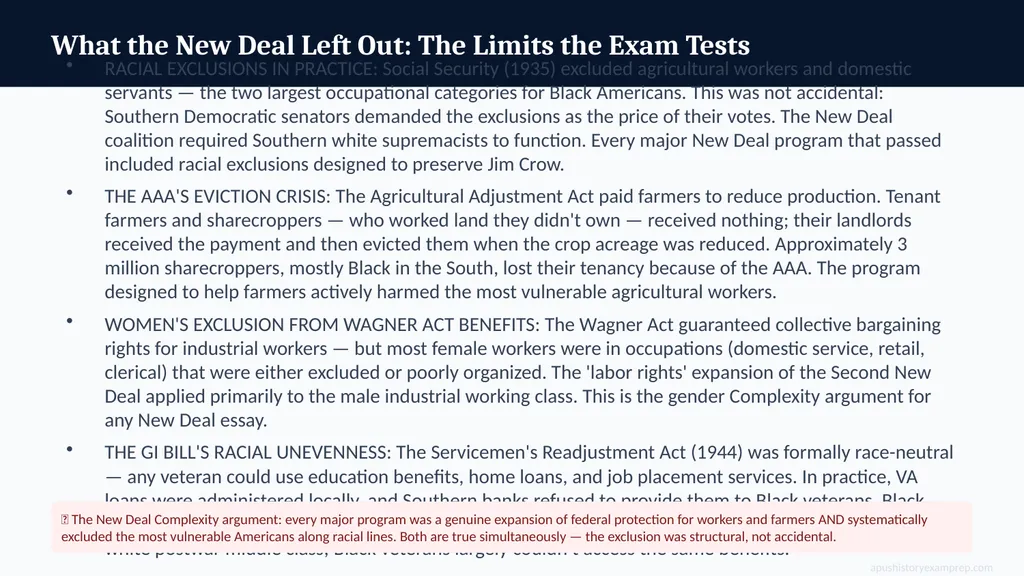
What the New Deal Left Out: The Limits the Exam Tests RACIAL EXCLUSIONS IN PRACTICE: Social Security (1935) excluded agricultural workers and domestic servants — the two largest occupational categories for Black Americans. This was not accidental: Southern Democratic senators demanded the exclusions as the price of their votes. The New Deal coalition required Southern white supremacists to function. Every major New Deal program that passed included racial exclusions designed to preserve Jim Crow.
THE AAA'S EVICTION CRISIS: The Agricultural Adjustment Act paid farmers to reduce production. Tenant farmers and sharecroppers — who worked land they didn't own — received nothing; their landlords received the payment and then evicted them when the crop acreage was reduced. Approximately 3 million sharecroppers, mostly Black in the South, lost their tenancy because of the AAA. The program designed to help farmers actively harmed the most vulnerable agricultural workers.
WOMEN'S EXCLUSION FROM WAGNER ACT BENEFITS: The Wagner Act guaranteed collective bargaining rights for industrial workers — but most female workers were in occupations (domestic service, retail, clerical) that were either excluded or poorly organized. The 'labor rights' expansion of the Second New Deal applied primarily to the male industrial working class. This is the gender Complexity argument for any New Deal essay.
THE GI BILL'S RACIAL UNEVENNESS: The Servicemen's Readjustment Act (1944) was formally race-neutral — any veteran could use education benefits, home loans, and job placement services. In practice, VA loans were administered locally, and Southern banks refused to provide them to Black veterans. Black veterans in the North faced segregated universities that refused to admit them. The GI Bill created the white postwar middle class; Black veterans largely couldn't access the same benefits. 📌 The New Deal Complexity argument: every major program was a genuine expansion of federal protection for workers and farmers AND systematically excluded the most vulnerable Americans along racial lines. Both are true simultaneously — the exclusion was structural, not accidental. apushistoryexamprep.com<br>
THE AAA'S EVICTION CRISIS: The Agricultural Adjustment Act paid farmers to reduce production. Tenant farmers and sharecroppers — who worked land they didn't own — received nothing; their landlords received the payment and then evicted them when the crop acreage was reduced. Approximately 3 million sharecroppers, mostly Black in the South, lost their tenancy because of the AAA. The program designed to help farmers actively harmed the most vulnerable agricultural workers.
WOMEN'S EXCLUSION FROM WAGNER ACT BENEFITS: The Wagner Act guaranteed collective bargaining rights for industrial workers — but most female workers were in occupations (domestic service, retail, clerical) that were either excluded or poorly organized. The 'labor rights' expansion of the Second New Deal applied primarily to the male industrial working class. This is the gender Complexity argument for any New Deal essay.
THE GI BILL'S RACIAL UNEVENNESS: The Servicemen's Readjustment Act (1944) was formally race-neutral — any veteran could use education benefits, home loans, and job placement services. In practice, VA loans were administered locally, and Southern banks refused to provide them to Black veterans. Black veterans in the North faced segregated universities that refused to admit them. The GI Bill created the white postwar middle class; Black veterans largely couldn't access the same benefits. 📌 The New Deal Complexity argument: every major program was a genuine expansion of federal protection for workers and farmers AND systematically excluded the most vulnerable Americans along racial lines. Both are true simultaneously — the exclusion was structural, not accidental. apushistoryexamprep.com<br>
14
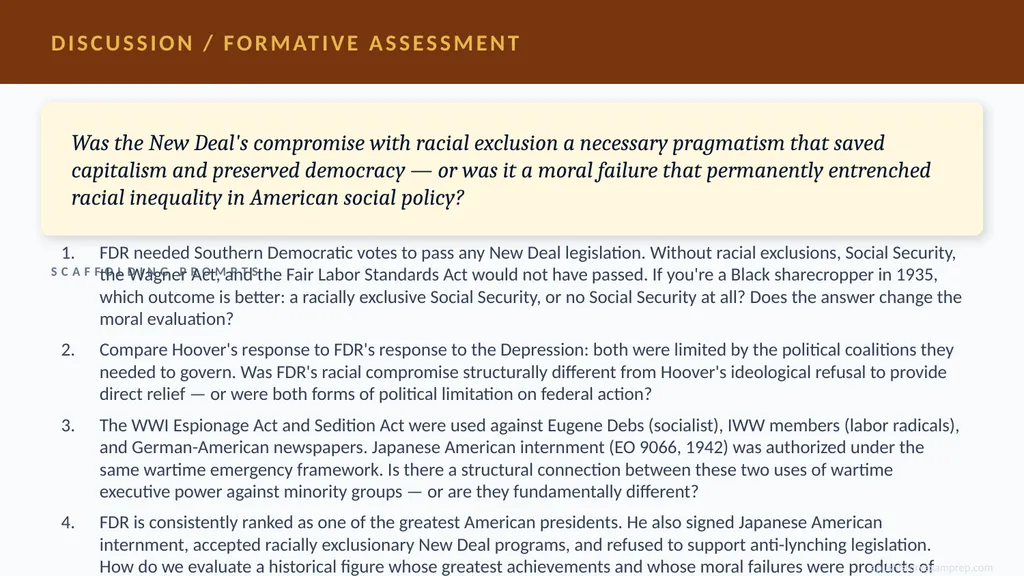
DISCUSSION / FORMATIVE ASSESSMENT Was the New Deal's compromise with racial exclusion a necessary pragmatism that saved capitalism and preserved democracy — or was it a moral failure that permanently entrenched racial inequality in American social policy? SCAFFOLDING PROMPTS FDR needed Southern Democratic votes to pass any New Deal legislation. Without racial exclusions, Social Security, the Wagner Act, and the Fair Labor Standards Act would not have passed. If you're a Black sharecropper in 1935, which outcome is better: a racially exclusive Social Security, or no Social Security at all? Does the answer change the moral evaluation?
Compare Hoover's response to FDR's response to the Depression: both were limited by the political coalitions they needed to govern. Was FDR's racial compromise structurally different from Hoover's ideological refusal to provide direct relief — or were both forms of political limitation on federal action?
The WWI Espionage Act and Sedition Act were used against Eugene Debs (socialist), IWW members (labor radicals), and German-American newspapers. Japanese American internment (EO 9066, 1942) was authorized under the same wartime emergency framework. Is there a structural connection between these two uses of wartime executive power against minority groups — or are they fundamentally different?
FDR is consistently ranked as one of the greatest American presidents. He also signed Japanese American internment, accepted racially exclusionary New Deal programs, and refused to support anti-lynching legislation. How do we evaluate a historical figure whose greatest achievements and whose moral failures were products of the same political calculation? apushistoryexamprep.com<br>
Compare Hoover's response to FDR's response to the Depression: both were limited by the political coalitions they needed to govern. Was FDR's racial compromise structurally different from Hoover's ideological refusal to provide direct relief — or were both forms of political limitation on federal action?
The WWI Espionage Act and Sedition Act were used against Eugene Debs (socialist), IWW members (labor radicals), and German-American newspapers. Japanese American internment (EO 9066, 1942) was authorized under the same wartime emergency framework. Is there a structural connection between these two uses of wartime executive power against minority groups — or are they fundamentally different?
FDR is consistently ranked as one of the greatest American presidents. He also signed Japanese American internment, accepted racially exclusionary New Deal programs, and refused to support anti-lynching legislation. How do we evaluate a historical figure whose greatest achievements and whose moral failures were products of the same political calculation? apushistoryexamprep.com<br>
15
SECTION 4 OF 4 WWII: The Foreign Policy ↔ Domestic Politics Feedback Loop apushistoryexamprep.com<br>
16
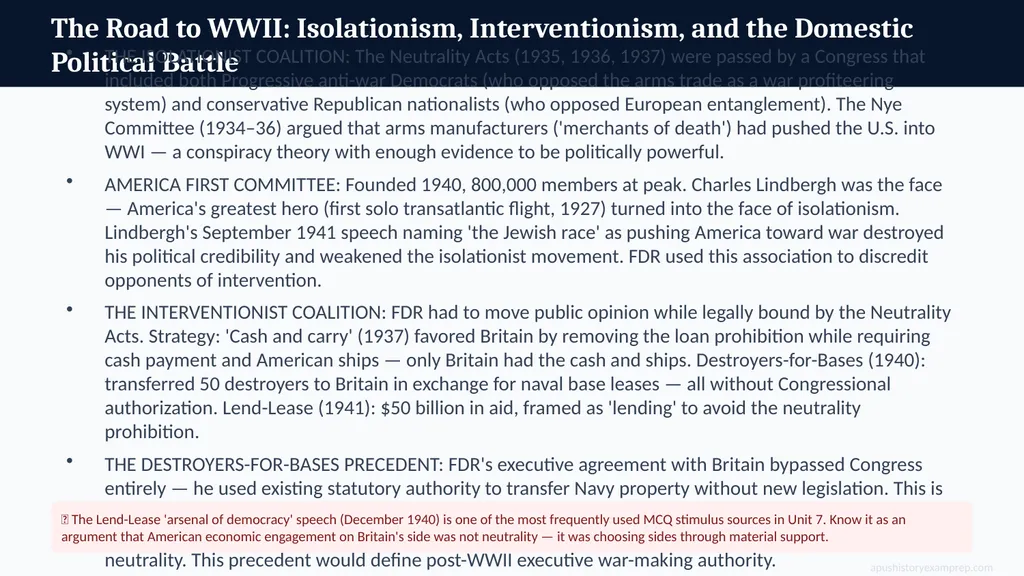
The Road to WWII: Isolationism, Interventionism, and the Domestic Political Battle THE ISOLATIONIST COALITION: The Neutrality Acts (1935, 1936, 1937) were passed by a Congress that included both Progressive anti-war Democrats (who opposed the arms trade as a war profiteering system) and conservative Republican nationalists (who opposed European entanglement). The Nye Committee (1934–36) argued that arms manufacturers ('merchants of death') had pushed the U.S. into WWI — a conspiracy theory with enough evidence to be politically powerful.
AMERICA FIRST COMMITTEE: Founded 1940, 800,000 members at peak. Charles Lindbergh was the face — America's greatest hero (first solo transatlantic flight, 1927) turned into the face of isolationism. Lindbergh's September 1941 speech naming 'the Jewish race' as pushing America toward war destroyed his political credibility and weakened the isolationist movement. FDR used this association to discredit opponents of intervention.
THE INTERVENTIONIST COALITION: FDR had to move public opinion while legally bound by the Neutrality Acts. Strategy: 'Cash and carry' (1937) favored Britain by removing the loan prohibition while requiring cash payment and American ships — only Britain had the cash and ships. Destroyers-for-Bases (1940): transferred 50 destroyers to Britain in exchange for naval base leases — all without Congressional authorization. Lend-Lease (1941): $50 billion in aid, framed as 'lending' to avoid the neutrality prohibition.
THE DESTROYERS-FOR-BASES PRECEDENT: FDR's executive agreement with Britain bypassed Congress entirely — he used existing statutory authority to transfer Navy property without new legislation. This is the most important pre-Pearl Harbor domestic politics moment: it established that the president could conduct quasi-belligerent foreign policy through executive action even when Congress was committed to neutrality. This precedent would define post-WWII executive war-making authority. 📌 The Lend-Lease 'arsenal of democracy' speech (December 1940) is one of the most frequently used MCQ stimulus sources in Unit 7. Know it as an argument that American economic engagement on Britain's side was not neutrality — it was choosing sides through material support. apushistoryexamprep.com<br>
AMERICA FIRST COMMITTEE: Founded 1940, 800,000 members at peak. Charles Lindbergh was the face — America's greatest hero (first solo transatlantic flight, 1927) turned into the face of isolationism. Lindbergh's September 1941 speech naming 'the Jewish race' as pushing America toward war destroyed his political credibility and weakened the isolationist movement. FDR used this association to discredit opponents of intervention.
THE INTERVENTIONIST COALITION: FDR had to move public opinion while legally bound by the Neutrality Acts. Strategy: 'Cash and carry' (1937) favored Britain by removing the loan prohibition while requiring cash payment and American ships — only Britain had the cash and ships. Destroyers-for-Bases (1940): transferred 50 destroyers to Britain in exchange for naval base leases — all without Congressional authorization. Lend-Lease (1941): $50 billion in aid, framed as 'lending' to avoid the neutrality prohibition.
THE DESTROYERS-FOR-BASES PRECEDENT: FDR's executive agreement with Britain bypassed Congress entirely — he used existing statutory authority to transfer Navy property without new legislation. This is the most important pre-Pearl Harbor domestic politics moment: it established that the president could conduct quasi-belligerent foreign policy through executive action even when Congress was committed to neutrality. This precedent would define post-WWII executive war-making authority. 📌 The Lend-Lease 'arsenal of democracy' speech (December 1940) is one of the most frequently used MCQ stimulus sources in Unit 7. Know it as an argument that American economic engagement on Britain's side was not neutrality — it was choosing sides through material support. apushistoryexamprep.com<br>
17
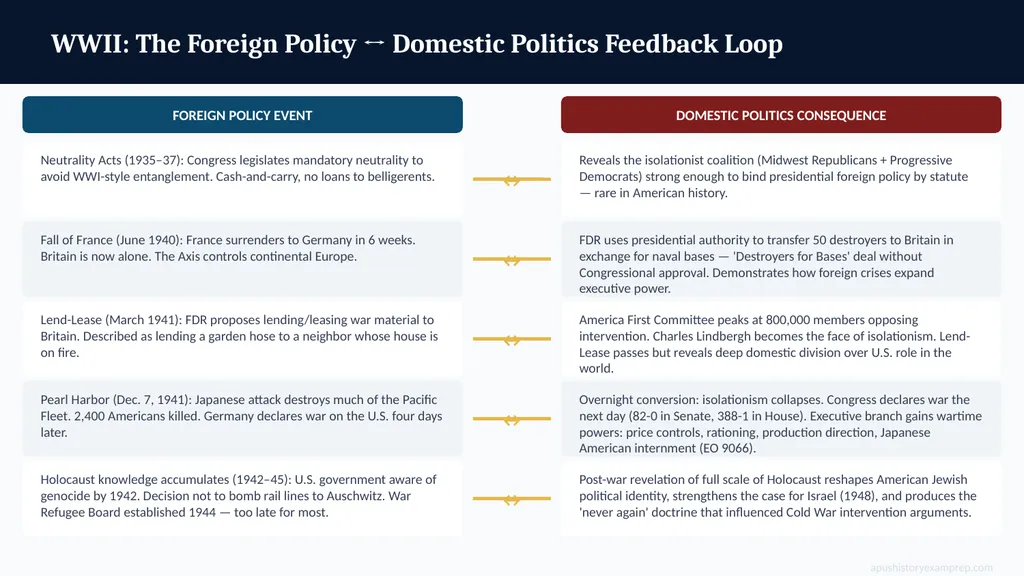
WWII: The Foreign Policy ↔ Domestic Politics Feedback Loop FOREIGN POLICY EVENT DOMESTIC POLITICS CONSEQUENCE Neutrality Acts (1935–37): Congress legislates mandatory neutrality to avoid WWI-style entanglement. Cash-and-carry, no loans to belligerents. ↔ Reveals the isolationist coalition (Midwest Republicans + Progressive Democrats) strong enough to bind presidential foreign policy by statute — rare in American history. Fall of France (June 1940): France surrenders to Germany in 6 weeks. Britain is now alone. The Axis controls continental Europe. ↔ FDR uses presidential authority to transfer 50 destroyers to Britain in exchange for naval bases — 'Destroyers for Bases' deal without Congressional approval. Demonstrates how foreign crises expand executive power. Lend-Lease (March 1941): FDR proposes lending/leasing war material to Britain. Described as lending a garden hose to a neighbor whose house is on fire. ↔ America First Committee peaks at 800,000 members opposing intervention. Charles Lindbergh becomes the face of isolationism. Lend-Lease passes but reveals deep domestic division over U.S. role in the world. Pearl Harbor (Dec. 7, 1941): Japanese attack destroys much of the Pacific Fleet. 2,400 Americans killed. Germany declares war on the U.S. four days later. ↔ Overnight conversion: isolationism collapses. Congress declares war the next day (82-0 in Senate, 388-1 in House). Executive branch gains wartime powers: price controls, rationing, production direction, Japanese American internment (EO 9066). Holocaust knowledge accumulates (1942–45): U.S. government aware of genocide by 1942. Decision not to bomb rail lines to Auschwitz. War Refugee Board established 1944 — too late for most. ↔ Post-war revelation of full scale of Holocaust reshapes American Jewish political identity, strengthens the case for Israel (1948), and produces the 'never again' doctrine that influenced Cold War intervention arguments. apushistoryexamprep.com<br>
18
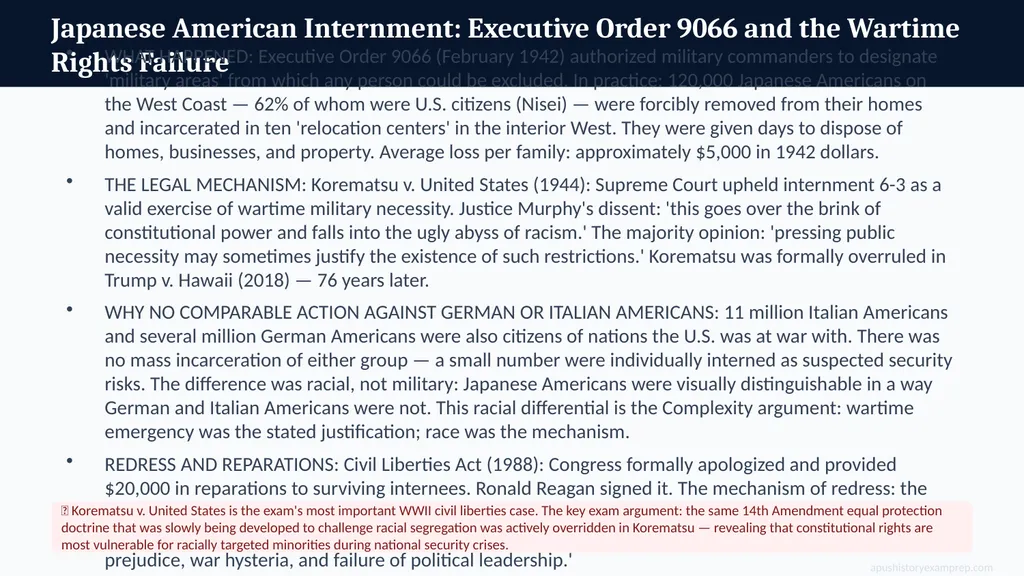
Japanese American Internment: Executive Order 9066 and the Wartime Rights Failure WHAT HAPPENED: Executive Order 9066 (February 1942) authorized military commanders to designate 'military areas' from which any person could be excluded. In practice: 120,000 Japanese Americans on the West Coast — 62% of whom were U.S. citizens (Nisei) — were forcibly removed from their homes and incarcerated in ten 'relocation centers' in the interior West. They were given days to dispose of homes, businesses, and property. Average loss per family: approximately $5,000 in 1942 dollars.
THE LEGAL MECHANISM: Korematsu v. United States (1944): Supreme Court upheld internment 6-3 as a valid exercise of wartime military necessity. Justice Murphy's dissent: 'this goes over the brink of constitutional power and falls into the ugly abyss of racism.' The majority opinion: 'pressing public necessity may sometimes justify the existence of such restrictions.' Korematsu was formally overruled in Trump v. Hawaii (2018) — 76 years later.
WHY NO COMPARABLE ACTION AGAINST GERMAN OR ITALIAN AMERICANS: 11 million Italian Americans and several million German Americans were also citizens of nations the U.S. was at war with. There was no mass incarceration of either group — a small number were individually interned as suspected security risks. The difference was racial, not military: Japanese Americans were visually distinguishable in a way German and Italian Americans were not. This racial differential is the Complexity argument: wartime emergency was the stated justification; race was the mechanism.
REDRESS AND REPARATIONS: Civil Liberties Act (1988): Congress formally apologized and provided $20,000 in reparations to surviving internees. Ronald Reagan signed it. The mechanism of redress: the Japanese American Citizens League lobbied for decades; the Congressional Commission on Wartime Relocation (1983) documented that the internment was not justified by military necessity but by 'race prejudice, war hysteria, and failure of political leadership.' 📌 Korematsu v. United States is the exam's most important WWII civil liberties case. The key exam argument: the same 14th Amendment equal protection doctrine that was slowly being developed to challenge racial segregation was actively overridden in Korematsu — revealing that constitutional rights are most vulnerable for racially targeted minorities during national security crises. apushistoryexamprep.com<br>
THE LEGAL MECHANISM: Korematsu v. United States (1944): Supreme Court upheld internment 6-3 as a valid exercise of wartime military necessity. Justice Murphy's dissent: 'this goes over the brink of constitutional power and falls into the ugly abyss of racism.' The majority opinion: 'pressing public necessity may sometimes justify the existence of such restrictions.' Korematsu was formally overruled in Trump v. Hawaii (2018) — 76 years later.
WHY NO COMPARABLE ACTION AGAINST GERMAN OR ITALIAN AMERICANS: 11 million Italian Americans and several million German Americans were also citizens of nations the U.S. was at war with. There was no mass incarceration of either group — a small number were individually interned as suspected security risks. The difference was racial, not military: Japanese Americans were visually distinguishable in a way German and Italian Americans were not. This racial differential is the Complexity argument: wartime emergency was the stated justification; race was the mechanism.
REDRESS AND REPARATIONS: Civil Liberties Act (1988): Congress formally apologized and provided $20,000 in reparations to surviving internees. Ronald Reagan signed it. The mechanism of redress: the Japanese American Citizens League lobbied for decades; the Congressional Commission on Wartime Relocation (1983) documented that the internment was not justified by military necessity but by 'race prejudice, war hysteria, and failure of political leadership.' 📌 Korematsu v. United States is the exam's most important WWII civil liberties case. The key exam argument: the same 14th Amendment equal protection doctrine that was slowly being developed to challenge racial segregation was actively overridden in Korematsu — revealing that constitutional rights are most vulnerable for racially targeted minorities during national security crises. apushistoryexamprep.com<br>
19
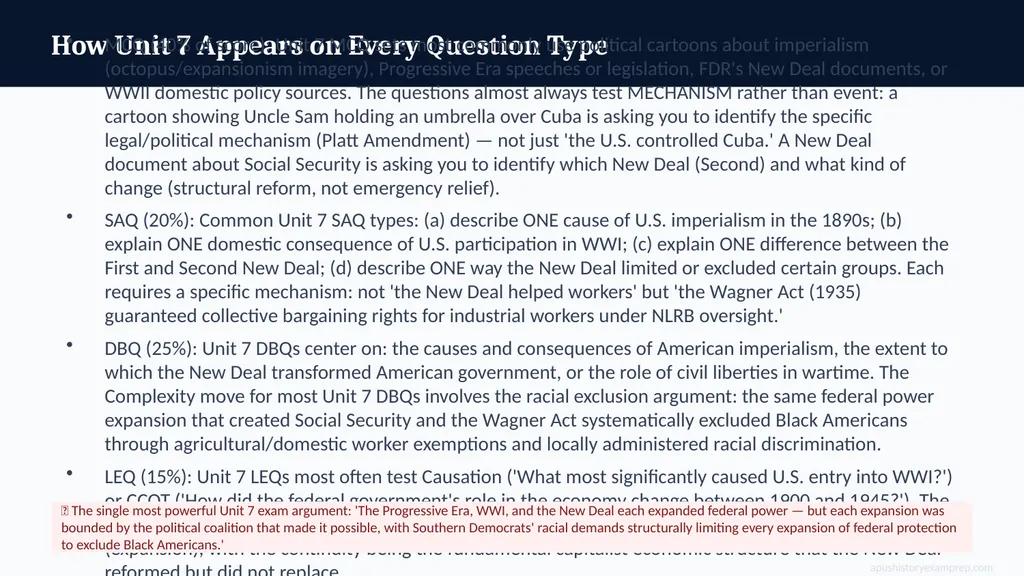
How Unit 7 Appears on Every Question Type MCQ (40% of score): Unit 7 MCQ sets most commonly use political cartoons about imperialism (octopus/expansionism imagery), Progressive Era speeches or legislation, FDR's New Deal documents, or WWII domestic policy sources. The questions almost always test MECHANISM rather than event: a cartoon showing Uncle Sam holding an umbrella over Cuba is asking you to identify the specific legal/political mechanism (Platt Amendment) — not just 'the U.S. controlled Cuba.' A New Deal document about Social Security is asking you to identify which New Deal (Second) and what kind of change (structural reform, not emergency relief).
SAQ (20%): Common Unit 7 SAQ types: (a) describe ONE cause of U.S. imperialism in the 1890s; (b) explain ONE domestic consequence of U.S. participation in WWI; (c) explain ONE difference between the First and Second New Deal; (d) describe ONE way the New Deal limited or excluded certain groups. Each requires a specific mechanism: not 'the New Deal helped workers' but 'the Wagner Act (1935) guaranteed collective bargaining rights for industrial workers under NLRB oversight.'
DBQ (25%): Unit 7 DBQs center on: the causes and consequences of American imperialism, the extent to which the New Deal transformed American government, or the role of civil liberties in wartime. The Complexity move for most Unit 7 DBQs involves the racial exclusion argument: the same federal power expansion that created Social Security and the Wagner Act systematically excluded Black Americans through agricultural/domestic worker exemptions and locally administered racial discrimination.
LEQ (15%): Unit 7 LEQs most often test Causation ('What most significantly caused U.S. entry into WWI?') or CCOT ('How did the federal government's role in the economy change between 1900 and 1945?'). The CCOT LEQ is perfectly served by the three-surge federal power mechanism: each surge is a CHANGE (expansion), with the continuity being the fundamental capitalist economic structure that the New Deal reformed but did not replace. 📌 The single most powerful Unit 7 exam argument: 'The Progressive Era, WWI, and the New Deal each expanded federal power — but each expansion was bounded by the political coalition that made it possible, with Southern Democrats' racial demands structurally limiting every expansion of federal protection to exclude Black Americans.' apushistoryexamprep.com<br>
SAQ (20%): Common Unit 7 SAQ types: (a) describe ONE cause of U.S. imperialism in the 1890s; (b) explain ONE domestic consequence of U.S. participation in WWI; (c) explain ONE difference between the First and Second New Deal; (d) describe ONE way the New Deal limited or excluded certain groups. Each requires a specific mechanism: not 'the New Deal helped workers' but 'the Wagner Act (1935) guaranteed collective bargaining rights for industrial workers under NLRB oversight.'
DBQ (25%): Unit 7 DBQs center on: the causes and consequences of American imperialism, the extent to which the New Deal transformed American government, or the role of civil liberties in wartime. The Complexity move for most Unit 7 DBQs involves the racial exclusion argument: the same federal power expansion that created Social Security and the Wagner Act systematically excluded Black Americans through agricultural/domestic worker exemptions and locally administered racial discrimination.
LEQ (15%): Unit 7 LEQs most often test Causation ('What most significantly caused U.S. entry into WWI?') or CCOT ('How did the federal government's role in the economy change between 1900 and 1945?'). The CCOT LEQ is perfectly served by the three-surge federal power mechanism: each surge is a CHANGE (expansion), with the continuity being the fundamental capitalist economic structure that the New Deal reformed but did not replace. 📌 The single most powerful Unit 7 exam argument: 'The Progressive Era, WWI, and the New Deal each expanded federal power — but each expansion was bounded by the political coalition that made it possible, with Southern Democrats' racial demands structurally limiting every expansion of federal protection to exclude Black Americans.' apushistoryexamprep.com<br>
20
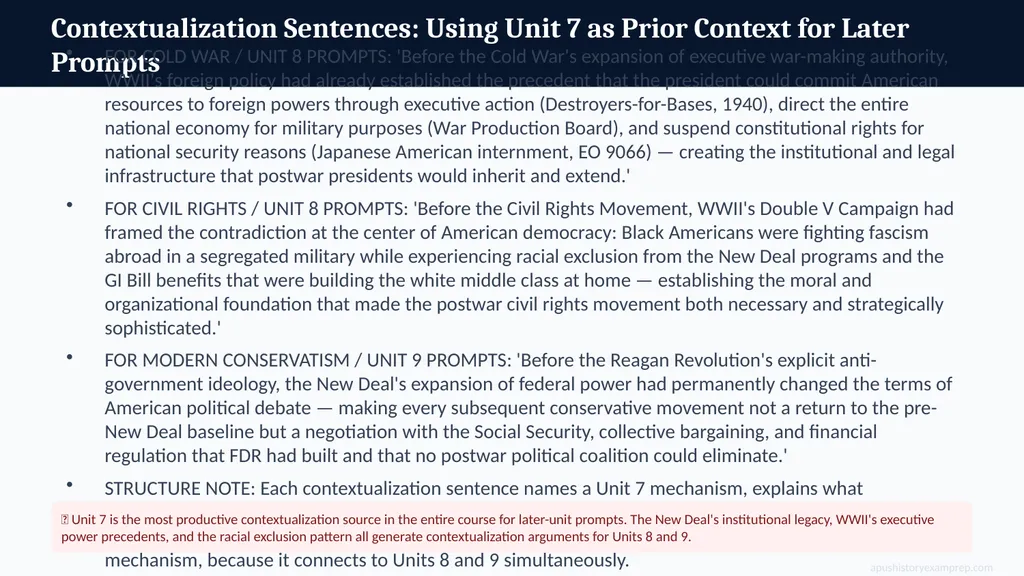
Contextualization Sentences: Using Unit 7 as Prior Context for Later Prompts FOR COLD WAR / UNIT 8 PROMPTS: 'Before the Cold War's expansion of executive war-making authority, WWII's foreign policy had already established the precedent that the president could commit American resources to foreign powers through executive action (Destroyers-for-Bases, 1940), direct the entire national economy for military purposes (War Production Board), and suspend constitutional rights for national security reasons (Japanese American internment, EO 9066) — creating the institutional and legal infrastructure that postwar presidents would inherit and extend.'
FOR CIVIL RIGHTS / UNIT 8 PROMPTS: 'Before the Civil Rights Movement, WWII's Double V Campaign had framed the contradiction at the center of American democracy: Black Americans were fighting fascism abroad in a segregated military while experiencing racial exclusion from the New Deal programs and the GI Bill benefits that were building the white middle class at home — establishing the moral and organizational foundation that made the postwar civil rights movement both necessary and strategically sophisticated.'
FOR MODERN CONSERVATISM / UNIT 9 PROMPTS: 'Before the Reagan Revolution's explicit anti-government ideology, the New Deal's expansion of federal power had permanently changed the terms of American political debate — making every subsequent conservative movement not a return to the pre-New Deal baseline but a negotiation with the Social Security, collective bargaining, and financial regulation that FDR had built and that no postwar political coalition could eliminate.'
STRUCTURE NOTE: Each contextualization sentence names a Unit 7 mechanism, explains what institutional or ideological infrastructure it created, and connects that infrastructure to why the prompt era had to respond to or build on it. The most versatile Unit 7 source: the three-surge federal power mechanism, because it connects to Units 8 and 9 simultaneously. 📌 Unit 7 is the most productive contextualization source in the entire course for later-unit prompts. The New Deal's institutional legacy, WWII's executive power precedents, and the racial exclusion pattern all generate contextualization arguments for Units 8 and 9. apushistoryexamprep.com<br>
FOR CIVIL RIGHTS / UNIT 8 PROMPTS: 'Before the Civil Rights Movement, WWII's Double V Campaign had framed the contradiction at the center of American democracy: Black Americans were fighting fascism abroad in a segregated military while experiencing racial exclusion from the New Deal programs and the GI Bill benefits that were building the white middle class at home — establishing the moral and organizational foundation that made the postwar civil rights movement both necessary and strategically sophisticated.'
FOR MODERN CONSERVATISM / UNIT 9 PROMPTS: 'Before the Reagan Revolution's explicit anti-government ideology, the New Deal's expansion of federal power had permanently changed the terms of American political debate — making every subsequent conservative movement not a return to the pre-New Deal baseline but a negotiation with the Social Security, collective bargaining, and financial regulation that FDR had built and that no postwar political coalition could eliminate.'
STRUCTURE NOTE: Each contextualization sentence names a Unit 7 mechanism, explains what institutional or ideological infrastructure it created, and connects that infrastructure to why the prompt era had to respond to or build on it. The most versatile Unit 7 source: the three-surge federal power mechanism, because it connects to Units 8 and 9 simultaneously. 📌 Unit 7 is the most productive contextualization source in the entire course for later-unit prompts. The New Deal's institutional legacy, WWII's executive power precedents, and the racial exclusion pattern all generate contextualization arguments for Units 8 and 9. apushistoryexamprep.com<br>
21
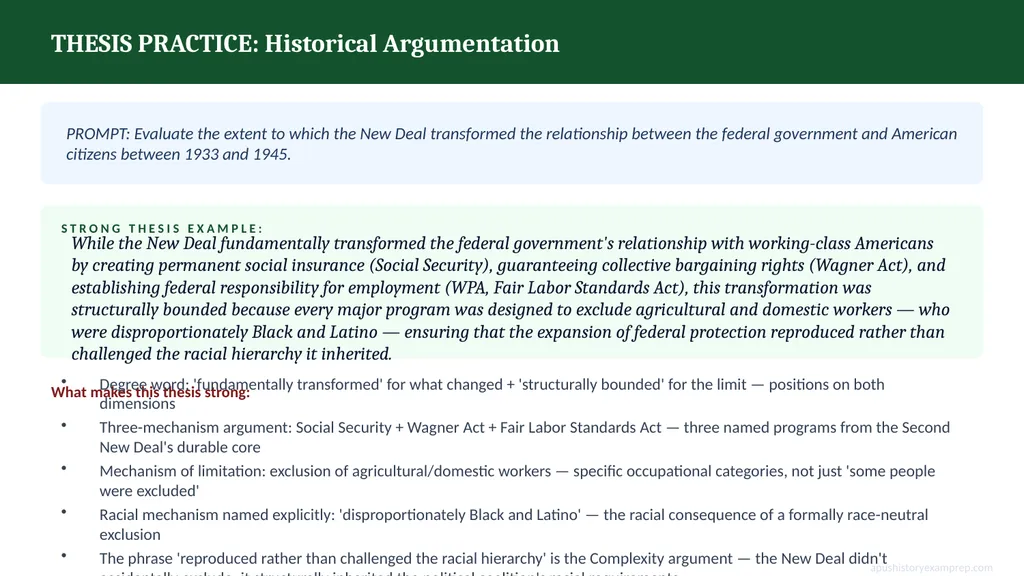
THESIS PRACTICE: Historical Argumentation PROMPT: Evaluate the extent to which the New Deal transformed the relationship between the federal government and American citizens between 1933 and 1945. STRONG THESIS EXAMPLE: While the New Deal fundamentally transformed the federal government's relationship with working-class Americans by creating permanent social insurance (Social Security), guaranteeing collective bargaining rights (Wagner Act), and establishing federal responsibility for employment (WPA, Fair Labor Standards Act), this transformation was structurally bounded because every major program was designed to exclude agricultural and domestic workers — who were disproportionately Black and Latino — ensuring that the expansion of federal protection reproduced rather than challenged the racial hierarchy it inherited. What makes this thesis strong: Degree word: 'fundamentally transformed' for what changed + 'structurally bounded' for the limit — positions on both dimensions
Three-mechanism argument: Social Security + Wagner Act + Fair Labor Standards Act — three named programs from the Second New Deal's durable core
Mechanism of limitation: exclusion of agricultural/domestic workers — specific occupational categories, not just 'some people were excluded'
Racial mechanism named explicitly: 'disproportionately Black and Latino' — the racial consequence of a formally race-neutral exclusion
The phrase 'reproduced rather than challenged the racial hierarchy' is the Complexity argument — the New Deal didn't accidentally exclude; it structurally inherited the political coalition's racial requirements apushistoryexamprep.com<br>
Three-mechanism argument: Social Security + Wagner Act + Fair Labor Standards Act — three named programs from the Second New Deal's durable core
Mechanism of limitation: exclusion of agricultural/domestic workers — specific occupational categories, not just 'some people were excluded'
Racial mechanism named explicitly: 'disproportionately Black and Latino' — the racial consequence of a formally race-neutral exclusion
The phrase 'reproduced rather than challenged the racial hierarchy' is the Complexity argument — the New Deal didn't accidentally exclude; it structurally inherited the political coalition's racial requirements apushistoryexamprep.com<br>
22
Unit 7 PowerPoint Complete Continue Building with These Free Resources: All Unit PowerPoints Connections Between Units Most Confusing Periods DBQ Practice APUSH Cheat Sheet These slides are a teacher starting point — adapt, expand, and combine with primary sources and discussion. Not affiliated with or endorsed by the College Board. AP® and Advanced Placement® are registered trademarks of the College Board. © 2026 apushistoryexamprep.com — Free for classroom use<br>